David Bordwell's website on cinema   click for CV

Home

Blog

Books

Perplexing Plots: Popular Storytelling and the Poetics of Murder

On the History of Film Style pdf online

Reinventing Hollywood: How 1940s Filmmakers Changed Movie Storytelling

Film Art: An Introduction

Christopher Nolan: A Labyrinth of Linkages pdf online

Pandora’s Digital Box: Films, Files, and the Future of Movies pdf online

Planet Hong Kong, second edition pdf online

The Way Hollywood Tells It pdf online

Poetics of Cinema pdf online

Figures Traced In Light

Ozu and the Poetics of Cinema pdf online

Exporting Entertainment: America in the World Film Market 1907–1934 pdf online

Video

Hou Hsiao-hsien: A new video lecture!

CinemaScope: The Modern Miracle You See Without Glasses

How Motion Pictures Became the Movies

Constructive editing in Pickpocket: A video essay

Essays

Rex Stout: Logomachizing

Lessons with Bazin: Six Paths to a Poetics

A Celestial Cinémathèque? or, Film Archives and Me: A Semi-Personal History

Shklovsky and His “Monument to a Scientific Error”

Murder Culture: Adventures in 1940s Suspense

The Viewer’s Share: Models of Mind in Explaining Film

Common Sense + Film Theory = Common-Sense Film Theory?

Mad Detective: Doubling Down

The Classical Hollywood Cinema Twenty-Five Years Along

Nordisk and the Tableau Aesthetic

William Cameron Menzies: One Forceful, Impressive Idea

Another Shaw Production: Anamorphic Adventures in Hong Kong

Paolo Gioli’s Vertical Cinema

(Re)Discovering Charles Dekeukeleire

Doing Film History

The Hook: Scene Transitions in Classical Cinema

Anatomy of the Action Picture

Hearing Voices

Preface, Croatian edition, On the History of Film Style

Slavoj Žižek: Say Anything

Film and the Historical Return

Studying Cinema

Articles

Book Reports

Observations on film art

THE HATEFUL EIGHT: The boys behind the booth

Saturday | December 5, 2015

See It 700

DB here:

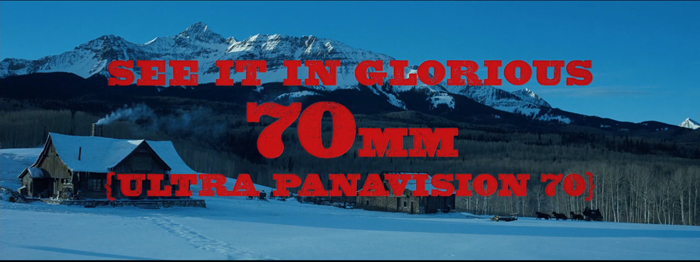
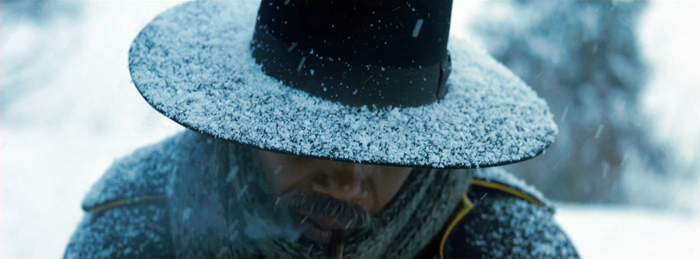
By now everybody knows that Tarantino’s forthcoming The Hateful Eight was shot on film in the Ultra Panavision 70 format. This anamorphic widescreen process yields a projected aspect ratio of 2.76–in a word, humongous. An early version of it, MGM Camera 65, was employed on Ben-Hur (1959), but Panavision quickly developed a new generation of cameras and renamed the process. It wasn’t heavily used; supposedly Khartoum (1966) was the last film shot in the format.

The process by which Tarantino, ace cinematographer Robert Richardson, and the enthusiastic boffins at Panavision revived Ultra Panavision 70 is detailed  in the current American Cinematographer (alas, not yet online). The production is an extraordinary tale. But what about exhibition? Luckily, the widescreen fans among us can glean a lot about that from veteran projectionist Paul Rayton’s interview with Chapin Cutler, co-owner of Boston Light & Sound. It was the task of Chapin and his team to find over 100 projectors, refurbish them, test them, and set them up in theatres all over America.

Chapin is a legendary figure in movie exhibition. Trained as a projectionist during his college years, he and Larry Shaw have made BL&S one of the very top companies for installation and maintenance of theatre projection equipment. He has supervised theatrical setups at festivals (Sundance, Telluride, TCM), industry gatherings (CinemaCon), and at some of the world’s top-notch theatres.

He’s more than a professional’s professional: He loves film and prides himself on delivering a powerhouse show. He was a natural choice for a movie geek like Tarantino to arrange the roadshow screenings of The Hateful Eight.

Chapin has discussed the nearly military precision necessary to fulfill Tarantino’s mandate in The New York Times and The Boston Globe. You should read these pieces for essential background. When Chapin added some new information courtesy of the listserv of the Art House Convergence, I jumped at the chance to include you in the audience. I know that many of our readers are keen to devour whatever they can learn about this film, one of the year’s major American releases.

So here are Chapin’s notes on how you prepare and ship out 100+ 70mm film prints.

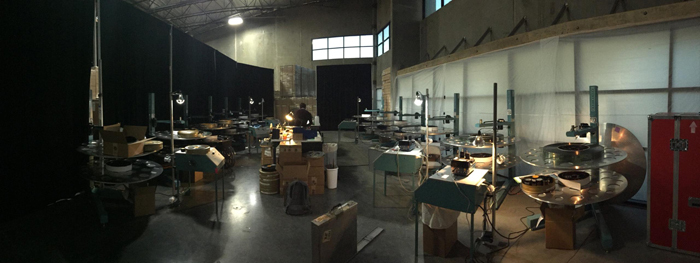
For those of you that are interested in these things, attached is a picture of our “platter farm” in Valencia CA. This is where all the prints are being made up.

The space before, in Academy ratio.

Before

The space after, in sort of Ultra Panavision.

after 700

We are getting the prints as 1000 ft. loads, so we have to assemble 20 rolls to make a print up.

About 90 of the prints will be made up for platter operation and shipped totally assembled. The prints are being ultrasonically welded so that it is one continuous piece of film; no splices. The remaining prints are going out for reel to reel houses.

On the right of the frame above you can see part of one of the shipping cases. It is 5 ft. x 5 ft. by 1 ft. thick. When loaded, it weighs about 400 lbs. On the platter next to it, there is a partially disassembled platter reel. With the reel full, out of the box, the film and reel weigh about 250 lbs. Four people can easily lift it onto a platter deck.

We have a dedicated team of four folks working 7 days a week to get this done.

All this makes you appreciate the effort behind the scenes that makes this remarkable enterprise work. (So far, there have been a couple of problematic press screenings, but a dozen or so other shows–notably last night’s SAG screening at the Egyptian–have gone off perfectly.) Whatever you think of Tarantino as a filmmaker (I like him), he deserves credit for exposing a new generation to the volcanic fun of a roadshow presentation. And we should thank Chapin, the guru with the bandit mustache, as well.

Photo credits: Chas. Phillips.

hat 700

The Hateful Eight.

The first Sherlock and other video releases for the holidays

Tuesday | December 1, 2015

Our Lady of the Sphere Flicker Alley

Our Lady of the Sphere (Lawrence Jordan, 1969)

Kristin here–

Our friends at Flicker Alley have offered three major releases since early October: Masterworks of American Avant-garde Experimental Film 1920-1970 (October 6), Sherlock Holmes (November 10), and Chaplin’s Essanay Films 1915 (November 17). This may seem ridiculously fast-paced, but it is partly explained by a delay in the release of Sherlock Holmes. All three editions package Blu-ray and DVD versions together.

In the move from 16mm to digital, avant-garde cinema was initially left behind. Eventually big boxes and series of DVD releases made a huge number of experimental short films available to audiences who may 9 Variations on a Dance Theme 2have had little access to such fare before. In quick succession, Unseen Cinema: Early American Avant-Garde Film 1894-1941 (2005), Kino’s three-volume series Avant-Garde: Experimental Cinema 1920s and ’30s (2005), Experimental Cinema 1928-1954 (2007), and Experimental Cinema 1922-1954 (2009), and the forth volume of the “American Treasures” series, Avant-Garde Film 1947-1986 (2009) were released.

Now we have another ambitious set, Masterworks of American Avant-Garde Experimental Film 1920-1907.  Fans of experimental cinema who have purchased all of the earlier sets might wonder if there is room for yet another extensive collection of American films.  Won’t there be a lot of overlap? The answer is a definite no. The body of work by important avant-garde filmmakers is extensive enough to support many boxed-sets.

I can find not a single film in the seven DVDs in Unseen Cinema (which takes a rather broad view of what counts as avant-garde) that is duplicated here. The same is true of the Avant-Garde Film 1947-1986 set.  The Kino boxed sets (two discs each) are heavily slanted toward international films, and there is a slight overlap. Flicker Alley’s website has a list of all 37 titles included in Masterworks.

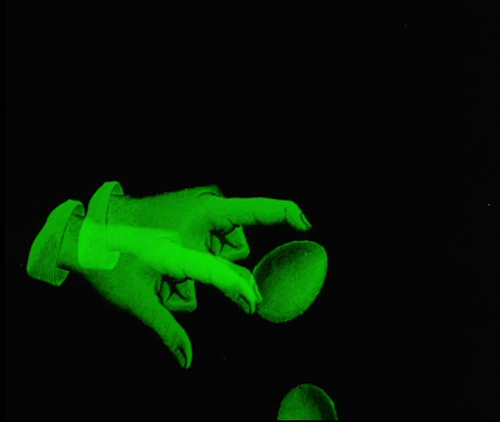
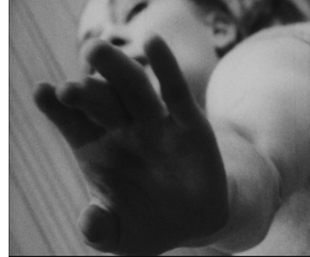
It’s impossible to deal with all the films included in the set here. (The film illustrated at the top is one of them.) I’ll just say that I was happy to see Hilary Harris’ 9 Variations on a Dance Theme (1966/67, right). We used to show it in the introductory film course we taught back in the mid-1970s, when Film Art had not yet been dreamt of. It’s a lovely film in itself, but it also might possibly be the clearest way to get across the ideas of form and style that one could find. Starting with a long shot of the dancer in a segment that simply records her movements, documentary style, the film repeats the same music and choreography eight times, with the cinematography and editing rendering a progressively abstract set of images.

Flicker Alley has put together an essential collection of films that will be new and exciting to many fans. The extras include, generously, three other experimental films. A a helpful booklet contains an introduction by Bruce Posner and brief program notes and filmmaker bios.


The Return of Sherlock Holmes 

Sherlock Holmes CU

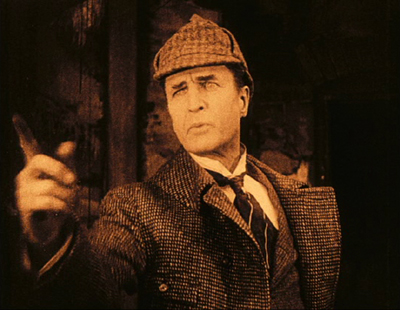
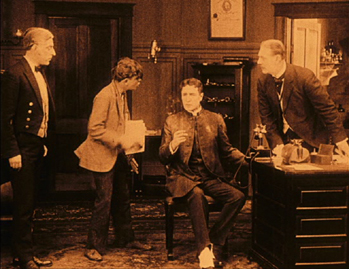
Until recently the 1916 version of Sherlock Holmes, based on the play by William Gillette, was lost. That seemed exceptionally unfortunate, not only for legions of Holmes fans but for anyone interested in late Victorian stage practices. Gillette’s performance as Holmes was considered the defining one, influencing subsequent portrayals. The play, which was produced in the US in 1899, had the cooperation of Arthur Conan Doyle, whom Gillette consulted during the period when he was writing it. The film version was a precious record from the time when the Holmes series was still being written.

In fact, Conan Doyle had killed Holmes off in 1893 in “The Final Problem,” and at the time when he authorized the play, he still had not resurrected his popular character. Gillette’s play influenced the later stories with such additions the character of the young servant Billy, a character invented by Gillette and later used by Conan Doyle.

In one of those happy endings that occasionally happen with lost films, a copy was discovered in the Cinémathèque française. Not just any old copy but the original nitrate negative of the French release version, which was shown as a serial in four parts in 1919. Apparently no footage was lost, and the main difference between the restored version that we have now and the original American feature film is that the new intertitles have been translated from those of the French release.

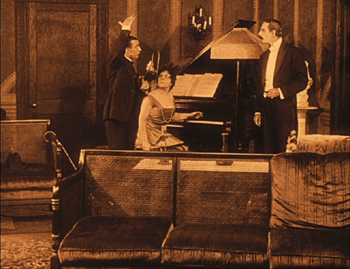
The original play has four acts, and the film has compromised between maintaining the interior setting of each act for a long stretch of the film and opening it out with brief exterior scenes and cutaways to other locales. One very lengthy section of the film takes place in the isolated house used by the villains to imprison the heroine, Alice. The sets are somewhat reminiscent of the stage, and yet they have been extended forward, and at times we see at least three walls and perhaps part of a fourth. In many cases,  the stage-style set is made more cinematic through the simple device of adding some furniture in the foreground (left). In others, the characters are strung out in a line across the playing space, as in the final “act,” which takes place in Dr. Watson’s office (right).

Sherlock Holmes hideout set      Sherlock Holmes Watson's office

Physically, Gillette makes a convincing Holmes in terms of the way Conan Doyle describes him, and his performance is restrained and usually lacking in expressivity–which works for a character noted for not exhibiting emotion. Unfortunately Gillette added a love interest for Holmes. Doyle, who apparently didn’t care what others did with Holmes now that he was rid of him, gave his permission. This would be bad enough in itself, but Alice is quite young looking, and Holmes is much older than she. Gillette had originated the role seventeen years earlier, when he was 46. By the time the film was made, he was 63, and though he doesn’t look that old in the film, the age difference between Holmes and Alice is obvious.

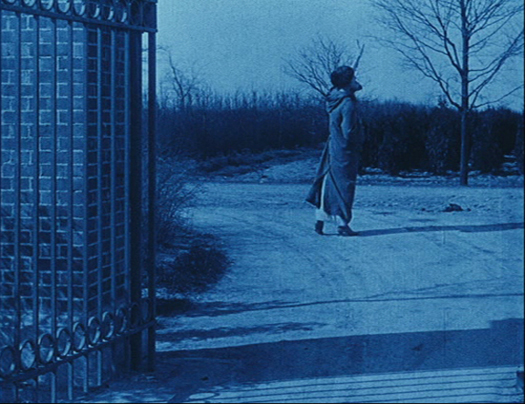
Given the survival of the negative, the Blu-ray/DVD transfer is impressive. Serpia toning is used in most scenes, while dark blue tinting represents night exteriors, many of which are nicely filmed (see bottom). The music is by Neil Brand, one of the best accompanists in the business.

There are generous bonuses, including some earlier comic shorts based around the character, Conan Doyle’s Fox Movietone interview, and a typescript of Gillette’s play. The set comes with a booklet with short essays on Gillette and his play, the film adaptation, the restoration, and the music.


The Little Tramp takes shape

The-Tramp-Charlie-eyes-money

Jeffrey Vance begins his essay on Chaplin in the booklet accompanying Chaplin’s Essanay Comedies 1915 with this observation:

If the early slapstick comedy of the Keystone Film Company represents Charles Chaplin’s cinematic infancy, the films he made for the Essanay Film Manufacturing Company are his adolescence. The Essanays find Chaplin in transition, taking greater time and care with each film, experimenting with new ideas, and adding textue to the Little Tramp character that would become his legacy. Chaplin’s Essanay Comedies would become his legacy. Chaplin’s Essanay comedies reveal an artist experimenting with his palette and finding his craft.

The unstated conclusion to the series of companies where Chaplin worked during the 1910s is that the Mutual period saw Chaplin’s maturity as an artist. Flicker Alley has now completed its epic survey of all three periods, with copies restored by the Cineteca Bologna and Lobster Films in cooperation with Blackhawk Films and the Chaplin Mutual and Essanay Project. Many archives provided material. For those who first saw Chaplin in worn 8mm and 16mm copies, these prints are a revelation.

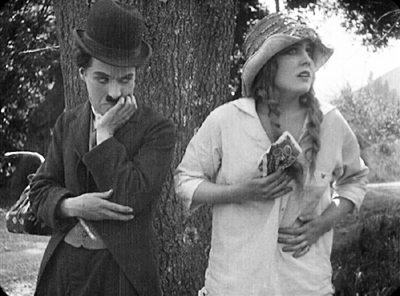
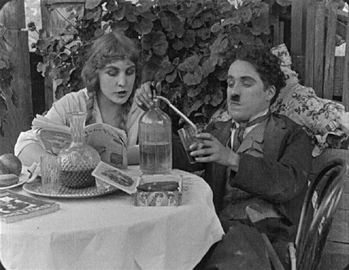
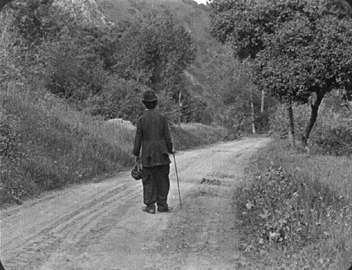
Chaplin’s tinkering with his Tramp character is evident in the most famous short in the set, The Tramp. It begins and ends with the character on the road, going nowhere in particular. In between are sandwiched broad slapstick scenes, quieter comic moments, and a big of the pathos that would become increasingly central to the Tramp.

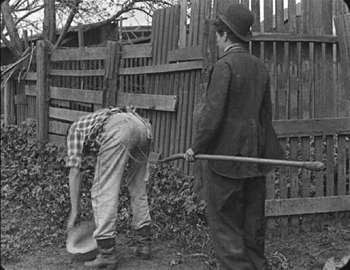
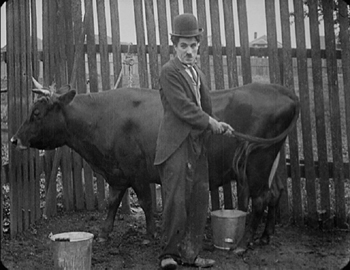
Early in the film he is capable of saving an innocent farm girl with a wad of money from a trio of thieving hobos, then stealing the money himself (above), and then relenting and giving it back.  His comic pacing is sometimes off–way off in an overlong scene of the Tramp, who gets a job at the heroine’s farm, repeatedly poking a fellow farmhand with a pitchfork (a pretty cliched gag to begin with). The Tramp’s clueless attempts at milking a cow work distinctly better, as he tries everything, including turning the cow’s tail into a pump handle. That’s the sort of visual punning that would become one of Chaplin’s comic strengths. There are some funnier scenes, as when the Tramp is forced to bunk in with the farmhand and suffers agonies from his roommate’s smelly socks.

The Tramp Charlie & pitchfork     The Tramp Charlie & Cow

Some quietly funny moments are better, though, as when the Tramp, having been wounded in the leg while trying to foil a burglary attempt, sits complacently enjoying his leisure and assuming that the heroine is in love with him. The absent boyfriend, well-dressed and handsome, soon shows up and, recognizing the inevitable, the Tramp removes himself from the triangle and takes to the road once more. Perhaps more than any other image, this one summarizes how Chaplin’s Tramp was thought of for many years and by millions of people.

The Tramp Charlie & selzer     The Tramp last shot

Bonuses include some films using discarded footage or cutting together scenes from already-released shorts, as Essanay tried to capitalize as much as possible on Chaplin’s extraordinary international popularity. There is also a booklet with Vance’s essay and a set of program notes. Each of these has a brief description of the restoration process, which is a nice thing to see in a supplement.

Sherlock Holmes Alice at night

Sherlock Holmes (1916)

Still Agnès

Monday | November 23, 2015

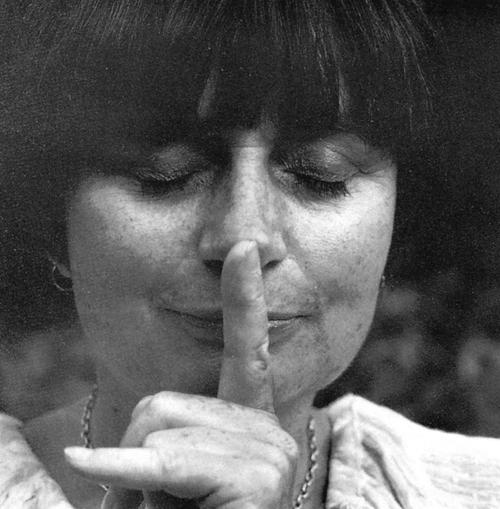
Varda cans 500

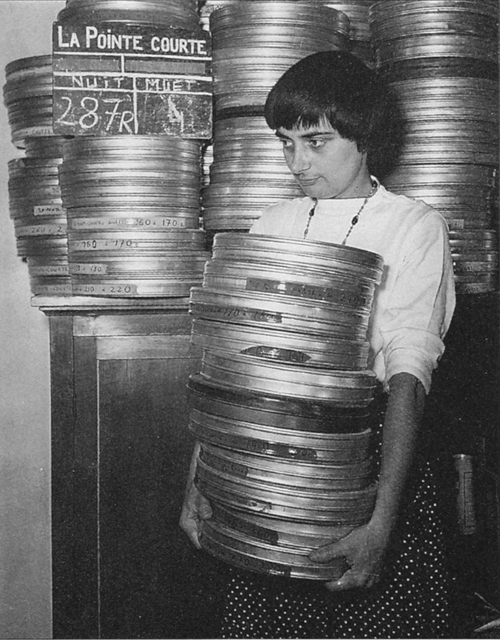
Self-portrait by Agnès Varda.

DB here:

Sixty years ago, a twentysomething photographer released a film shot in an out-of-the-way French fishing village. Coming right after Rossellini’s Voyage to Italy and Fellini’s La Strada (both 1954), the result announced something new in cinema. Like those other works, it looked forward to the French Nouvelle Vague and the cinematic modernism of Antonioni, Bergman, and a host of other filmmakers.

But the status of Agnès Varda’s La Pointe Courte (1955) became apparent only with the most distant hindsight. It didn’t win big attention on the festival circuit, in the international market, or in the pages of highbrow film magazines. Denied a commercial release, La Pointe Courte circulated mostly in French ciné-clubs. In the early 1980s, when I saw it at the Brussels Cinematek, it was still a rarity.

Thirty years after La Pointe Courte, Varda’s career reached a new level. Vagabond (Sans toi ni loi, 1985), widely recognized as her masterpiece, remains one of the great achievements of that modern cinema she helped create. And she hasn’t exactly been idle since. There have been many films both long and short, including a biopic of her husband Jacques Demy in Jacquot de Nantes (1991) and the picaresque The Gleaners and I (2000); the fascinating autobiography Varda par Agnès (1994); and over the last decade a series of installations in museums around the world. She started as a photographer, became a cinéaste, and is now a plasticienne, a maker of painting and sculpture.

She is eighty-seven years old.


Agnès V., not B.

Our colleague Kelley Conway has just published an authoritative consideration of the work of this shrewd, unpredictable survivor. Reading Kelley’s book reminded me of that encounter with La Pointe Courte.

I had known Varda’s more famous works: Cléo from 5 to 7 (1961), screened at my college film society as the project of a New-Wave fellow-traveler; Le Bonheur (1965), which might be called Jules et Jim revisé et corrigé; One Sings the Other Doesn’t (1977), which got circulation among other feminist films of the period. These didn’t prepare me for La Pointe Courte’s daring mix of realism and minimalism. Varda wanted, she said, to make a film that was the equivalent of a difficult book, and for me she succeeded.

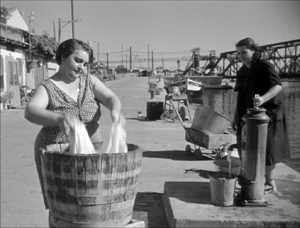
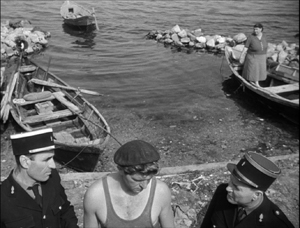
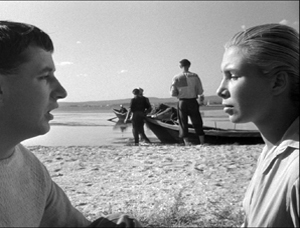
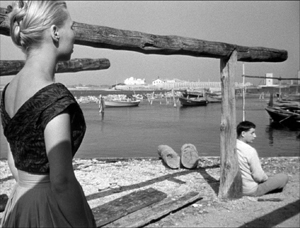
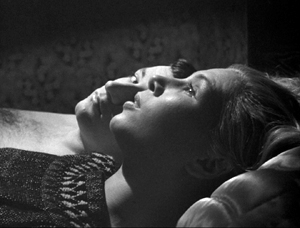
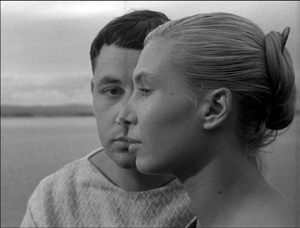
The film alternates sunny images of local life—fishing, net-mending, washing-up, a festival—with episodes in which a Parisian couple drift through the village, oddly detached from the life around them. The everyday scenes are shot in documentary style, but with a casual rigor suggesting Cartier-Bresson. Meanwhile, the couple talk in stylized compositions that could only remind me of L’Avventura.

Washerwomen 300     Boats 300

Foreground 300     Dock 300

No wonder Picasso was Varda’s favorite painter: she splits up the couple’s faces with cubistic zeal.

Bedheads 300     Profiles 300

The disjunction between the actuality of a location and the abstraction of the couple’s anomie-riddled duet, often heard only as voice-over commentary, looks forward to Hiroshima mon amour. (No wonder: Resnais edited the film.) I barely understood the French, but the film gripped me. It was of great historical interest, and it had its own stubborn vivacity. When Kristin and I planned the first edition of Film History: An Introduction (1994) I made sure it got in. In that year, forty years after it was made, La Pointe Courte was released on VHS.

Things change. Varda is now regarded as a living treasure of world cinema, preserved in excellent Criterion DVD editions, available for streaming on Hulu, and  wrapped up in a vast cube, Tout(e) Varda (20 features, 16 shorts). Whatever she does in the future, we can at least take a long-distance measure of her accomplishments.

The dream of many writers on a single director is to cover it all: appreciative study of the films, background on how the films came to be, assessment of their immediate impact and long-range influence. But this breadth of understanding is very hard to achieve. Where are the documents? How do you get the filmmaker to talk?

Kelley has done it. Her book combines film analysis, historical research, and information drawn from Varda’s archives. Kelley can tell us how the films came to be, what Varda wanted to accomplish, and how they were received. To top it off, there’s a new interview with Agnès herself.


Crossing landscapes

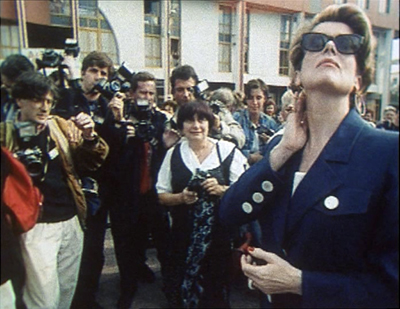
Agnes Cath 400

Les Demoiselles ont eu 25 ans (1993): Varda and Deneuve.

With a brisk practicality echoing that of her subject, Kelley has focused her lens tightly. You can’t quarrel with her choices: La Pointe Courte, the early short documentaries, Cléo, Vagabond, The Gleaners, two installations, and The Beaches of Agnès (2008). Her plan of attack is straightforward: scrutinize the film, then work backward to the conditions of production and forward to the film’s reception.The analyses are models of attention to story and style, images and sounds. Kelley pins down what intrigued me about the acting in La Pointe Courte, showing its debt to Brechtian distancing (a big influence on Varda). She goes on to connect the performances to the experiments in “flat” performance we find in Tati and Bresson at the same period. Kelley shows how many of Varda’s artistic strategies, such as whimsical puns and a love of digression, go back to her early documentaries.

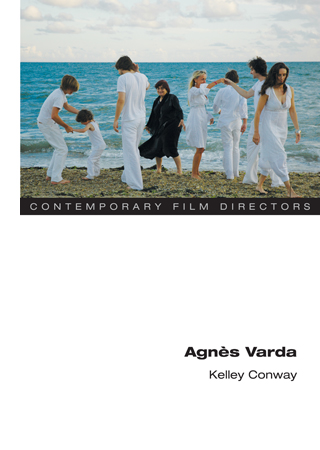
Varda cover 300In a sense, Varda has never ceased to be a documentarist, since all her films depend on a process of research, exploration, and a personal viewpoint characteristic of the roving photographer. The book includes fresh information on two of Varda’s major multimedia installations, obviously born of her interest in found materials, gags, and unexpected juxtapositions. For one, Varda covered the gallery floor with 1500 pounds of potatoes and played the role of “Lady Potato.” Another exhibition included a reference to the grave of her beloved cat Zgougou. As described by Kelley, these installations are less narcissistic than they might seem, because Varda’s work has always been personal, derived from her perceptions of her subject. Even The Gleaners, which is at one level a denunciation of a society built on waste and inequality, is refracted through the filmmaker’s sense of aging. And though Mona in Vagabond is ferociously solitary, we meet her through Varda’s welcoming voice-over: “It seems to me she came from the sea.”

Another legacy of documentary: Kelley points up how even the fiction films spring from an attention to the specifics of a locale. “Part of Varda’s journey is regularly exploring a chosen region at length, waiting for ideas, emotions, and images to emerge.” That region might be a single Parisian street (L’Opéra-Mouffe, 1958; Daguerréotypes, 1975) or the fourteenth arrondissement (Cleo from 5 to 7). Like La Pointe Courte, Cleo is the story of a walk, this time purportedly played out in actual duration as a beautiful pop singer awaits the results of a test for cancer. Mona, in Vagabond, is another wanderer, and the wintry bleakness of southern France is as central to the action as whatever psychology we can find in her or the people she meets. The Gleaners and I searches out people who stalk the landscape and live off what they can scavenge. With modern cinema from Bicycle Thieves onward, Dwight Macdonald once noted, “The talkies have become the walkies,” but Varda has always embedded her footloose protagonists in the particulars of place.

Varda’s personal archive has given Kelley the opportunity to document the director’s creative process. The scripts are sometimes scrapbooks, with texts and images jostling one another. (Kelley offers an example in a 2011 blog entry.) The arrival of digital tools reinforced and expanded Varda’s method of free assembly. Out of a database of images, Varda erected the scaffolding of The Beaches of Agnès before starting her screenplay. She wrote, shot, and edited the whole thing in a nonlinear fashion. During the final stages, two editors worked busily in separate rooms. “I went from one to the other. On one side was Sète and Los Angeles, in the other room was Belgium and Paris.”

As for exhibition, crucial to Varda’s early films was a distinctive French institution. Varda had created her company to make shorts, but when La Pointe Courte grew to 80 minutes, it could not be distributed under those auspices without new investment. As a result, it found its main audience in the network of ciné-clubs that had grown up after World War II. That network became activated to the maximum during the release of Cleo from 5 to 7. One of the side benefits of Kelley’s book is its explanation of the power that the ciné-club scene had achieved by the early 1960s.

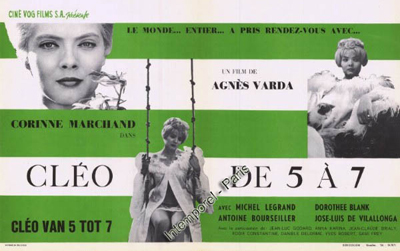
Cleo poster 400

Brandishing the slogan “Develop Film Taste, Introduce Masterpieces, Educate the Public,” an astonishing five hundred clubs with over two hundred thousand members showed thousands of films in the year that Cleo was released. Varda took advantage of this situation to promote her film, but Kelley goes beyond the simple marketing issue to point out that the clubs bolstered spectators’ appreciation of New Wave films. She draws on audience comments to show that the organizers guided audiences to talk about form, style, theme, and historical context. The clubs helped create the “demanding viewer” described by Alain Resnais: a viewer eager for challenging films that could bear comparison to advanced works in traditional arts.

Varda’s later films were absorbed into the mainstream commercial distribution/exhibition infrastructure, and Kelley is painstaking in plotting critical response to them. Near the book’s close, she traces how another institution shaped Varda’s work: the museum. Kelley shows how the emerging importance of installation art encouraged filmmakers like Varda and Chris Marker to create multimedia exhibits that were natural continuations of their poetic-essayistic documentaries. The installations seem to have encouraged Varda to take up the autobiographical compilation mode that yielded The Beaches of Agnès.


There is much more in Agnès Varda than I can summarize, but I hope I’ve piqued your interest. For any lover of Varda, Kelley’s book is a must, and even casual viewers will learn things that will drive them to the films. Reading it led me to think about how Varda’s lack of cinephile culture (she emphasizes that she knew nothing of film when she started) allowed her to respond to stories more directly than did the Bad Boys of the Cahiers, who saw everything through a mesh of hundreds of other movies. I was also prodded to think of her as quite an innovator in narrative. She has given us the parallel structure of La Pointe Courte, the fantastic science-fiction plot of Les Créatures, the isoceles love triangle of Le Bonheur, the dual-protagonist structure of One Sings, and the network narrative of Vagabond, with Mona as a circulating object a bit like Bresson’s Balthazar.

From the delightful interview with Lady Potato herself, I allow myself just one spoiler:

KC: You seem to start your projects with considerable preparation but you also have a flair for improvisation. Do you see it that way also?

AV: Yes and no. Or no and yes, depending.


An earlier entry discusses a Kelley talk on La Point Courte. I discuss some ambiguous narrative cues in Vagabond in my updated “Art Cinema” essay in Poetics of Cinema, 166-169.

This has been a good publishing year for our colleagues at Wisconsin–Madison. Lea Jacobs’ book on filmic rhythm came out last winter; go here for our observations.

Varda cu 500

The return of Homunculus

Sunday | November 15, 2015

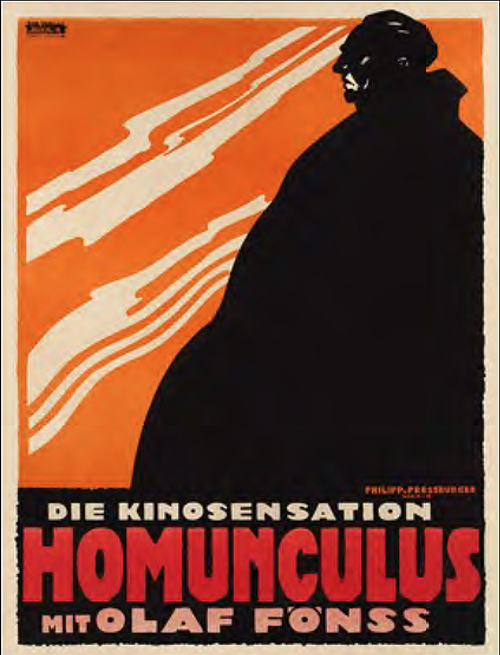
Homunculus poster 500

On 21 November, the Museum of Modern Art in New York will be screening a version of Otto Rippert’s long-lost German serial Homunculus (1916). It was reconstructed by Stefan Drössler and his colleagues at the Munich Film Museum on the basis of material from the Moscow Film Archives and other collections. Here’s the background offered by the opening titles on this version.

Homunculus was shown as a six-part series in movie theaters in Germany and its occupied territories in 1916, in the midst of World War I. Each episode was about an hour long. In 1920 the opus was reissued as a three-part version. Scenes were shifted around and new intertitles added.

The following reconstruction adapts the structure of the reissue edition, but it also contains some scenes that had been shortened for the later version and often only survived as photographs.

Fewer than 20% of the original German intertitles have been preserved or are known in their exact wording. Newly worded texts for this reconstruction were based, when possible, on information from contemporary program notes and reviews; also, some were translated back from foreign-language versions of the film and others were created from keywords scratched into the film as montage cues.

For the first time, the current work print makes it possible to recognize the original concept of the entire series.

Today, as a preparation for this very important event, each of us offers you something. First Kristin sketches the trend of fantasy filmmaking in German cinema of the 1910s. After providing this context for the film, David offers some thoughts on this new version of Homunculus and its value for us today.


Kristin here:

The seeds of Expressionism

Many viewers who come to Homunculus for the first time may be expecting traits of the most famous German silent film trend, Expressionism. And indeed historians have mentioned Rippert’s serial, along with Der Student von Prag (The Student of Prague, 1913), Hoffmanns Erzählungen (Tales of Hoffman, Richard Oswald, 1916), and others, as forerunners of the Expressionist movement.

But we don’t have a very concrete account of how these earlier films led up to the more famous trend that began with Das Cabinet des Dr. Caligari’s release in early 1920. Moreover, at first glance there aren’t many visual qualities in these earlier films that remind you of Expressionism. They display few or none of those Expressionist distortions of mise-en-scene influenced by contemporary trends in painting and theatre. Similarly, the acting, while exaggerated in a fashion common during the 1910s, seldom reaches the extreme stylization of the performances in Expressionist films.

Yet there are clearly some other similarities between the two groups of films. Most obviously, the early films brought to prominence two related genres to which many of the Expressionist films would belong: the phantastischen film and the Märchenfilm, or fairy-tale film.The main examples of the latter all starred Paul Wegener: Rattenfänger von Hameln (The Pied Piper of Hameln, 1918), Hans Trutz im Schlaraffenland (Hans Trutz in the Land of Cockaigne, 1917), and Rübezahls Hochzeit (Rübezahl’s Wedding, 1916).

For Expressionist filmmakers, elements of the supernatural or the legendary could motivate highly stylized mise-en-scene. In contrast, these 1910s films often used relatively realistic mise-en-scene. Location shooting, straightforward period costumes, and skillfully executed trick photography introduced the fantastic elements into the milieu of a concrete, seemingly everyday world.


A changing view of cinema

Despite such differences, the two genres provide a specific link between some of the most prominent German films of the 1910s and those of the Expressionist movement. Moreover, fantasy films seem to have provided a basis for at least a tentative exploration of theoretical issues surrounding the relationship of cinema to the other arts. In Germany, cinema had previously been compared primarily to literary and theatrical arts, but Wegener’s Der Student von Prag and other films led to a wider consideration of cinema in relation to visual arts such as painting.

In a 1916 lecture, Wegener expressed dissatisfaction with most of what had previously been done with the cinema. He sought to establish the cinema as an independent visual art, separated from theatre and literature:

When a new technology is developed, it is initially cultivated in relation to existing ones, and a new idea does not immediately find its own unique form. The first steamboats looked like big sailing schooners, except that instead of masts they had high funnels. The first railway cars copied mail coaches, the first automobiles kept the large bodies of landaus, and the cinema was like pantomime, drama, or the illustrated novel.

A more broadly based view of the cinema as combining theatrical and graphic arts created a newtradition which carried over from the 1910s to the Expressionist movement of the 1920s. These early films may have become models for the development of an “art cinema” movement in the next decade.

The painterly approach to film promulgated by Wegener lingered in German cinema for about a decade. Starting around 1924, a new approach, based on the moving camera and a more realistic three-dimensional space, would largely replace the older one.


Frames and books
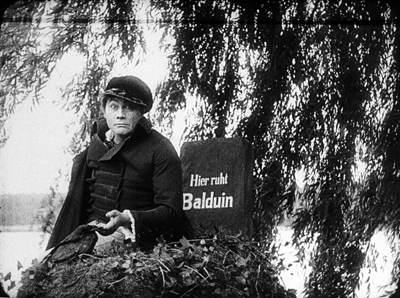
Gravestone 400

Der Student von Prag.

Aside from this specific link created by Wegener’s emphasis on the pictorial powers of the camera, several conventions of the fantasy films of the 1910s look forward to Expressionism. Perhaps most notable among these devices is the use of the frame story.

Expressionist films frequently employ this device: Francis’ tale to the fellow asylum inmate in Caligari, the record of the Bremen town historian in Nosferatu (as well as the imbedded narratives of the Book of the Vampyres and the ship’s log), the young poet hired to write publicity anecdotes for a sideshow in Wachsfigurenkabinett, and so on.

Yet this pattern was already well established during the 1910s. Der Student von Prag begins and ends with a poetic scroll (“Ich bin kein Gott/bin kein Dämon …”), with the final return leading to a shot of Balduin’s gravestone—upon which sit the Doppelgänger and a crow. (The 1926 remake, which has some distinct Expressionist touches, begins and ends with a gravestone that summarizes Balduin’s life.) Wegener’s other major surviving film from the mid-1910s, Rübezahls Hochzeit, begins with a scene of Wegener, as himself rather than in character as the titular hero, reading to a group of children from a book entitled Rübezahls Hochzeit.

In some cases the frame story introduces multiple embedded narratives. Richard Oswald’s two main fantasy films of the pre-1920 era, Hoffmanns Erzählungen (1916) and Unheimliche Geschichten (Uncanny Stories, 1919), both use this technique. The first begins with a prologue showing Hoffmann surrounded by strange characters like Count Dapertutto and Coppelius. Three dream sequences show him incorporating these figures into bizarre stories; the transition from the prologue to the the main portion of the story begins with Hoffmann in bed as the three sinister figures stand over him.
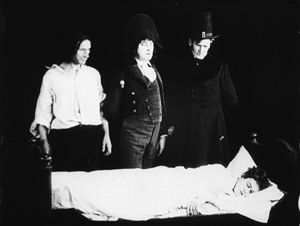
3 figs 300

Unheimlische Geschichten begins, as an intertitle announces, with “A fantastic Prologue at an antiquarian book dealer’s.” On the wall are three large pictures depicting a whore, death, and the devil. After the proprietor chases away his customers and departs, the three images come to life and amuse each other by reading tales out of a book. The series of embedded tales, adapted from Poe, Hoffmann, and other authors of the uncanny, form the bulk of the film.

Not all fantasy films of the 1910s contain frame stories or embedded narratives. Characters do, however, often read or write books that contribute major premises or motifs. In Homunculus, Richard Ortmann keeps a large diary, which records his shifting and somewhat contradictory thoughts, feelings and goals—and thus conveys them to us. Joe May’s Hilde Warren und der Tod (Hilde Warren and Death, 1917) also has no frame story. Its opening, however, involves the heroine reading in a book that death is an escape from sadness. This notion becomes a motif, as the figure of Death appears to her at intervals, foreshadowing her eventual surrender. Books would become an important motivating device in Expressionist films, introducing embedded narratives or crucial motifs.

Hilde Warren und der Tod also carries through the pictorial tradition of Der Student von Prag. Here the special effects are not used to allow one actor to play two roles through split exposure. Rather, superimpositions introduce the figure of Death into the everyday scenes of Hilde’s life.
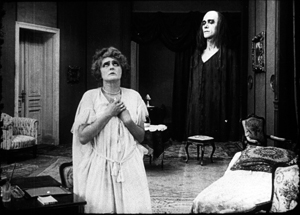
Ghost 300


Some early hints of Expressionism

Although the fantasy films of the 1910s don’t contain strongly Expressionist elements, a few stylistic touches foreshadow the distortions of the later movement. Some of these relate to performances by actors who were to become central to the Expressionist movement. In Hoffmanns Erzählungen, for example, Werner Krauss’s stylized acting in the role of Count Dapertutto suggests why he was later cast as Dr. Caligari. Conrad Veidt’s acting and especially his makeup as Death in Unheimliche Geschichten mark him as the ideal candidate to show up in Caligari’s cabinet.
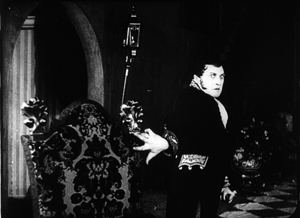
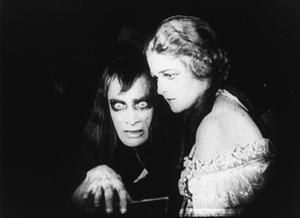
Dappertutto 300     Conrad 300

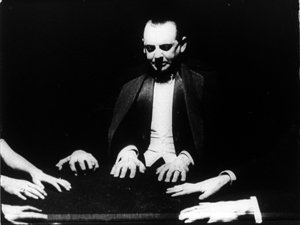
The stylized hand gestures in these two shots are particularly striking, and the same device is carried through in a séance sequence in Unheimliche Geschichten. The lighting of the séance looks forward to more famous scenes in Dr. Mabuse, der Spieler (1922), Feu Mathias Pascal (1926), and The Ministry of Fear (1944)—yet here Oswald introduces a twist by including one more hand than there should be for the number of bodies present.
seance 300

There are other major films made in 1919 which contain stylistic and generic elements soon to become far more prominent. Lang’s Die Spinnen (The Spiders, 1919-1920) draws upon conventions of the thriller serial which would soon by transmogrified in his Expressionist film, Dr. Mabuse, Der Spieler. Lubitsch’s Die Puppe (The Puppet) and Die Austernprinzessin (The Oyster Princess), both 1919, could be counted as comic Expressionist films that introduced the style into the cinema months before the appearance of Caligari. The exact cut-off date between pre-Expressionism and Expressionism proper is not vitally important. Some 1910s developments in genre and style prepared the way for Expressionism. Caligari, however great its stylistic challenges were, did not appear in a vacuum.


DB here:

Wanted: Love. #Homunculus
piano 400

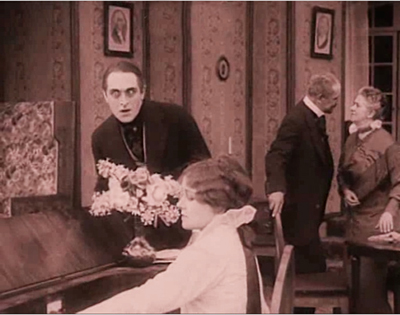
The 1920 reissue of the Homunculus serial compresses its original story considerably, but the outlines are clear. Some omissions in the Munich reconstruction may reflect gaps in the 1920 version. Still, the basic outline of the tale is clear.

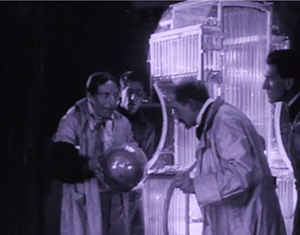
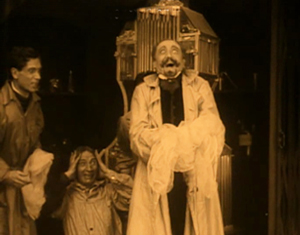
Very likely the first test-tube baby, the Homunculus arrives on the scene as the result of a pseudoscientific effort to create life. Out of a bubble, properly zapped, comes an infant.
Bubble 300    Baby 2 300

The baby is brought up in an ordinary human family, thanks to the classic switched-in-the-cradle device. Known as Richard Ortmann, the creature grows up into something of a superman, with extraordinary strength and explosive energy. But his core is hollow. Richard discovers that he lacks fellow-feeling and finds himself alienated from his carousing peers.
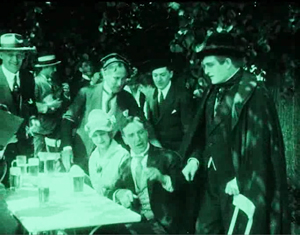
Table

When Richard discovers his technological origin, he sets himself a drastic choice: either discover human love or destroy this worthless world.

Each episode replays the same dynamic. Somewhere Richard discovers a possibility of uncorrupted love. But that prospect shatters, either because of prejudice (would you want your daughter to marry a homunculus?) or his sadistic urge to plunge the world into chaos. Only his friendship with Edgar Rodin, one of the scientists who attended his birth, forms an enduring bond across the episodes.

Richard Ortmann plays many roles in his saga. He’s a scientific tinkerer who invents an explosive, a wanderer who ventures into Africa, and a capitalist who enjoys masquerading as a rabble-rouser bent on fomenting rebellion. No sooner has he provoked a war than he tries his own social experiment, that of isolating a young couple in hope of breeding a new society. All these exploits he records in a mighty book
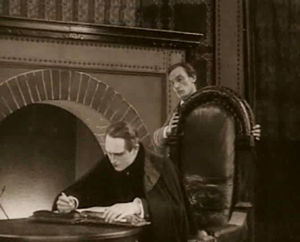
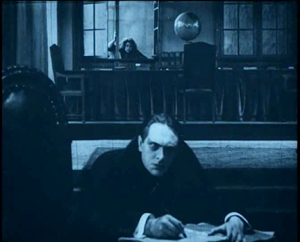
Writing 1 300     Writing 2 300

This tome becomes a handy narrative device when the plot demands that other characters learn of his inhuman origins.

Like those films that clone a Stallone or a Van Damme, the series realizes that one monster can be defeated only by another one.  The long tale comes to a climax when Rodin creates a second Homunculus and raises him up to conquer Ortmann–already somewhat weakened from age and fear of death. The titanic confrontation is played out on mountain craigs.
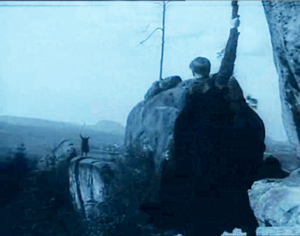
2 Homuncs 300

Who will win? Or will both perish?


Annihilation, courtesy Homunculus
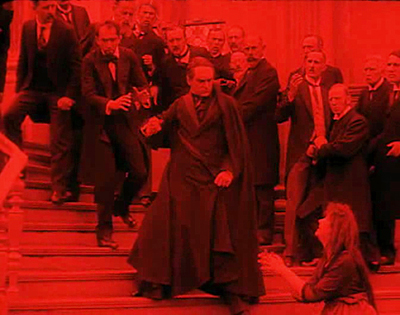
Staircase 400

The rocking-horse rhythm of the episodes, with hope for Ortmann’s redemption rising and inevitably falling, takes some getting used to. To the filmmakers’ credit, they vary the prospects for love: an array of women, a dog, and in the fourth episode a woman who wholeheartedly embraces Ortmann’s wicked side.

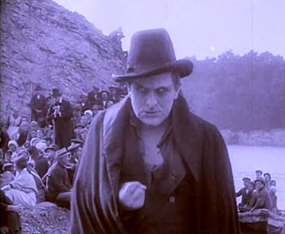
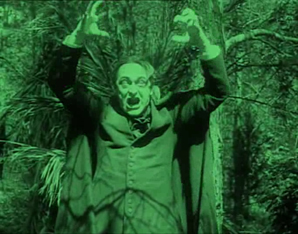
Today’s viewers will also need to accustom themselves to the seething extremes of Olaf Fønss’s performance. Fønss was a major Danish actor who became famous in Atlantis (1913) and who migrated to Germany to star in this series. Fønss conceives his performance as a matter of ferocious glares, raised fists, and heroically villainous postures. It looks overdone to us today.
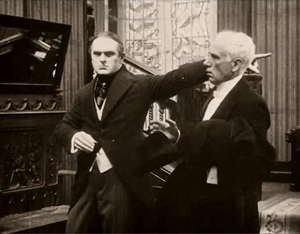
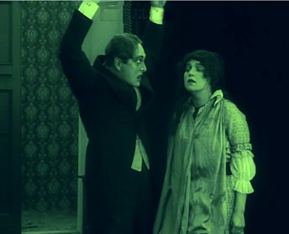
Pointing 300     arms up 300

His box cape, reminiscent of bat wings, helps the brooding effect.

But this isn’t merely a matter of old-fashioned hamming. Fønss’s performance is calibrated to be ragingly different from the other portrayals. Most of the actors exaggerate less, and the pacifist preacher actually underplays. Fønss goes over the top because Homunculus does.
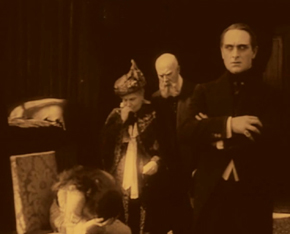
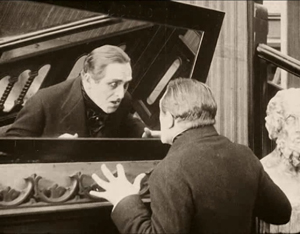
Arms folded 300     Mirror 300

Fist 300        shriek 300

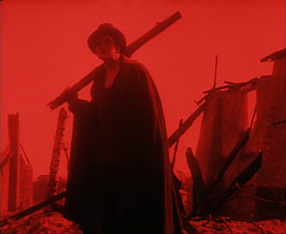
What makes the series compelling? For one thing, it offers a fairly original reworking of the Frankenstein premise. For another, its central conceit of a mad, misunderstood supervillain in search of love can evoke some empathy. There’s also the effort to convey a world in flames, to suggest a cosmic catastrophe with minimal means. While the Great War devastates Europe offscreen, one can hardly avoid thinking of trenches and bombardment in blasted shots like these–which also look forward to the jagged decor of Expressionism.
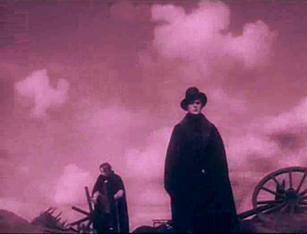
skyline 300     Club 300

The student of film technique will, I think, be struck by the filmmakers’ pictorial ambitions. It’s now clear that by focusing just on The Cabinet of Dr. Caligari (1920) we have limited our sense of the wide-ranging visual discoveries of German cinema. Homunculus belongs with the splendid string of films that includes Der Tunnel (1915), Algol (1920), I.N.R.I. (1920), and the outstanding pair of 1919 films by Robert Reinert, Opium and Nerven. Reinert, unsurprisingly, wrote the screenplay for Homunculus.

The fourth episode, which I commented on back in the summer (based on a much inferior copy), remains a treat for your eyes, with unexpected camera angles and daring use of depth. In the one on the left, we see touches of Expressionist performance in the orchestration of hands.
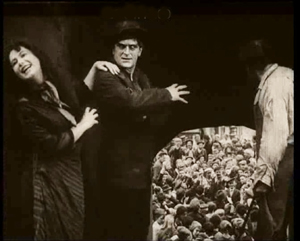
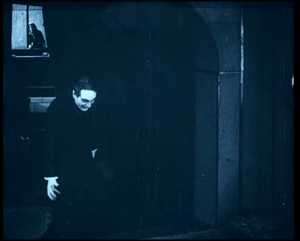
Crowd 300     Window 300

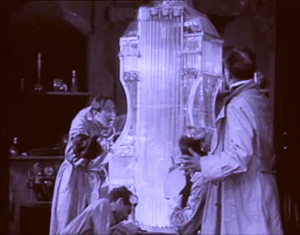
Elsewhere Kristin has remarked that during the 1910s filmmakers began to go beyond basic storytelling and explore the expressive dimensions of cinema—not only in acting but also in composition, lighting, and set design. The Jugendstil curves of the incubator gleam inside a cavernous chamber you might not expect to find in a lab.
Incubator 300

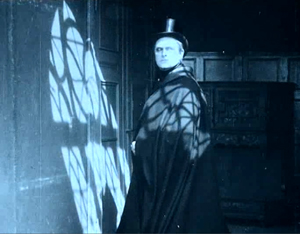
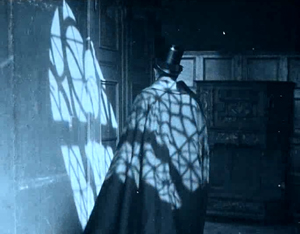
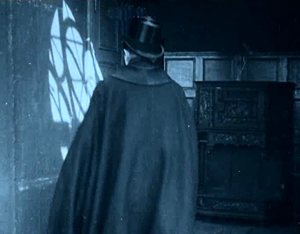
Other episodes provide both grand images—landscapes, sumptuous sets, crowd scenes—and an arresting, small-scale play of light and shade. A purely expository shot of Ortmann approaching Steffens’ study becomes a little suite of shadow patterns, stressed when Ortmann pauses and swivels to the camera and creates a pictorial climax.
Wall 1 300     Wall 2 300     Wall 3 300

Seeing the three-dimensional lighting effects of German cinema of the mid-1910s onward, I wonder whether Caligari‘s jutting, broken-up planes and painted shadows are not only a borrowing from Expressionist painting but also a reaction against the rich volumes created by directors like Rippert.


In all, Stefan Drössler and all the archives and individuals working with him have done world film culture a great service. As with Gance’s Napoleon and Lang’s Metropolis, more footage may appear and need to be integrated into this version. Perhaps some day we’ll have something approaching the full scope of the original series. For now, we should be thankful that another silent classic steps out of the shadows and forces us to rethink what we thought we knew about the history of cinema.


Many thanks to Stefan Drössler for his assistance in preparing this entry.

At Nitrateville Arndt has posted helpful synopses of all six parts of the restoration. Leonardo Querisima offers a wide-ranging discussion in “Homunculus: A Project for a Modern Cinema,” in A Second Life: German Cinema’s First Decades, ed. Thomas Elsaesser and Michael Weidel (Amsterdam University Press, 1996), pp. 160-167. Excerpts can be found here.

Kristin’s discussion of fantasy films is excerpted from her essay “Im Anfang War…: Some Links between German Fantasy Films of the Teens and the Twenties,” in Before Caligari: German Cinema, 1895-1920, ed. Paolo Cherchi Usai and Lorenzo Codelli (Pordenone: Bibliotexa dell’Immagine, 1990), 138-161. The Wegener quotation is from Paul Wegener, “Die künsterlischen Möglichkeiten des Films,” in Kai Möller, ed., Paul Wegener: Sein Leben und seine Rollen (Hamburg: Rowohlt Verlag, 1954), p. 102. Translation by KT.

Elsewhere on this site we discuss other neglected German films of the period: Der Stoltz der Firma (The Pride of the Firm, 1914);  Der Tunnel (1915); Asta Nielsen features of the teens; Doktor Satansohn (1916); Hilde Warren und der Tod (1917); Die Pest in Florenz (The Plague in Florence, 1919, directed by Rippert after Homunculus); late-1910s Lubitsch; Algol and I. N.R.I. (both 1920); and Der Golem (1920). I have an essay on Robert Reinert’s remarkable films in Poetics of Cinema. Some day I hope to write more about Paul Leni’s war drama Das Tagebuch des Dr. Hart (Dr. Hart’s Diary, 1917) and Joe May’s energetic and entertaining serial Die Herrin der Welt (Mistress of the World, 1919).


Homunculus poster 2

David Bordwell
top of page

have comments about the state of this website? go here