





Archive for the 'People we like' Category
Tokyo choruses
DB here:
I’ve had a terrific time since I arrived late last Saturday. The only thing that could have improved it would be the discovery that there was a Japanese town named Bordwell. If it could happen to Barack, why not me?
Actually, I know why not. On Sunday, a trip to a temple yielded a promise that nothing good would come on any front.
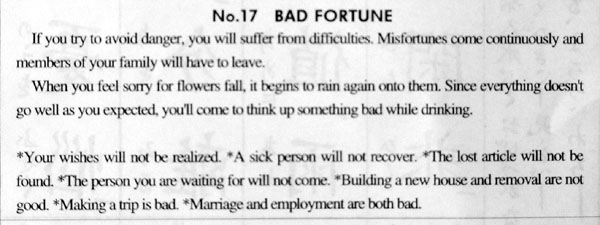
Pretty dire. Yet I press on, foolishly trusting that meals will be tasty, the city will shake me up, and three fine sorts of things will grace the first phase of my stay: the symposium, the movies, and my companions. Still, I vow to avoid thinking up something bad while drinking.
The conference
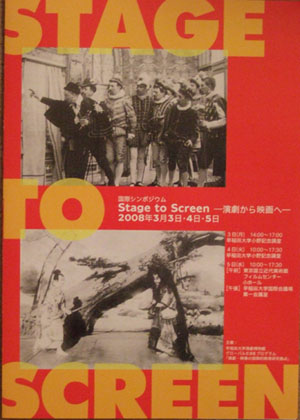
I came for a symposium at Waseda University, Stage to Screen. For three days local scholars delivered papers and comments about how cinema related to theatre.
Young researchers have done thorough work on the relation of Japanese cinema to the culture’s lively theatrical traditions. Usai Michika explored a topic that’s always fascinating–the benshi, the person who accompanied silent film with commentary and dialogue. She found a remarkable poster from the Waseda Theatre Museum collection illustrating many short films, and through diligent archive work she was able to identify most of the films. Although the poster came from 1899, the films were all pre-1896. Ogawa Sawako gave a thorough examination of how films were influenced by kodan, a sort of novelistic oral recitation. It turns out that kodan stories were at least as important as kabuki plays as sources of Japanese film, well into the 1920s. Shimura Miyoko studied later forms of rensa-geki, the mix of live performance and film that was fairly common in the silent era. She showed that there was a resurgence of it in the early 1930s, with sound cinema.
Western cinema attracted attention as well. Kataoka Noburo analyzed the relationship between Samuel Beckett’s Play and his Film, directed by Alan Schneider and starring Buster Keaton. Our host Professor Komatsu Hiroshi gave a talk called “Actors without Bodies,” suggesting the quasi-supernatural qualities of early film. He surveyed cinema’s links to the phantasmagoria shows of the French magician Robertson. He also explored how sound recordings synchronized with early films evoked theatre but didn’t exactly correspond to stage performance techniques–another form of bodiless acting.
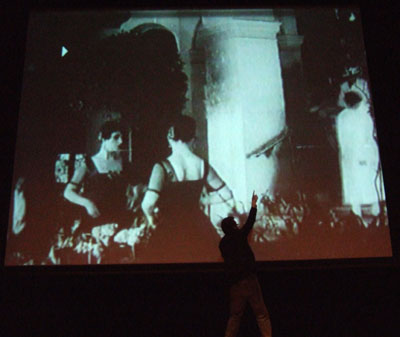
There were two keynote addresses as well, one from Yuri Tsivian and one from me. Yuri was, as usual, energetic and infectious. Our talks naturally overlapped when we touched on the 1910s, and we had some good conversation about films of that era offstage as well as on. Above you see Yuri analyzing, with his usual body English, a scene that he has made famous–a play with mirrors in Bauer’s King of Paris (1917).
The films
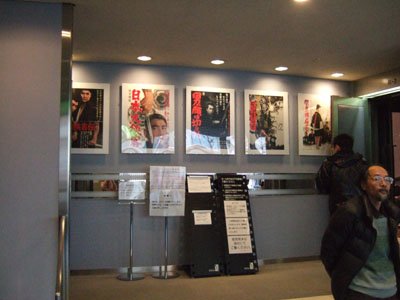
The last day of the symposium was devoted to two films that show how world film language changed between the mid-1910s and the early 1920s. Goro Masamune (1915) is a complicated tale about a swordsmith and the dramatic results of his mysterious parentage. It offered a stringent version of the sort of tableau staging we find in Europe and the US at the same period. As with those films, Goro Masamune used lateral staging and some striking depth effects, as well as long takes: I counted 58 shots and 24 intertitles across its 58 minutes.
With 356 shots and 25 intertitles, Roben-sugi exemplified a more cutting-based approach to cinematic storytelling. Scenes were broken down into many shots, often with a great variety of setups; the 180-degree system is in force; and many expressive effects were based on intercut close-ups. In the lengthy final scene, Roben, a temple bishop, discovers his long-lost mother and she prostrates herself before him. The action is played out in high-angle shots of the mother and low-angle shots of Roben. You couldn’t ask for better proof that filmmakers around the world were adopting the US continuity approach than this 1922 film.
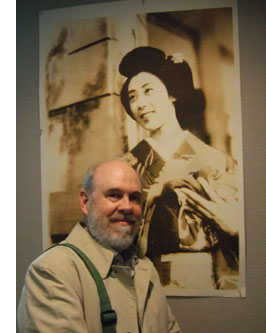 These two movies were powerful treats, and the day was embellished with a visit behind the scenes to the Film Center’s staff area, where I got Yuri to shoot me with one of my favorites, Yamada Isuzu.
Earlier in the week, with Kyoko Hirano, I’d visited the Film Center to catch an item in its massive Makino Masahiro retrospective. Makino, son of Japan’s pioneering director Makino Shozo, directed films from the late 1920s to the early 1970s. For his centenary, the Center has mounted 100 programs of his work. No, that’s not a typo. The screenings include 110 titles directed or produced by Makino—and of course several others are lost. Japanese filmmakers are nothing if not prolific.
The film that Kyoko and I saw was Japanese Gangster Story 6: Sake Cup of the White Sword (1967), starring Takakura Ken. The plot consisted of intrigues crisscrossing rival gangs during the 1920s, capped by two bloody fights at the end. Ken doesn’t say much, but the camera loves him; early in the film he seemed to me to get the biggest close-ups. In the finale, of course he sacrifices himself for his gang boss. Is any genre cinema more standardized than the 1960s-1970s yakuza yarn? After a lunch of the Asakusa version of big Hiroshima-style omelettes, Makino’s buoyant retake on the classic tropes was a filling dessert.
The people
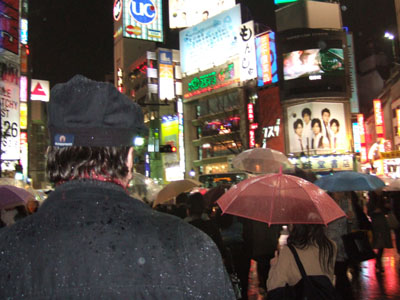
The third factor that has made this trip so pleasant has been the people. Hanging out with Yuri was great fun, and as luck would have it, Wisconsin film guy Michael Pogorzelski was visiting Tokyo at the same time. Mike is the archivist for the Academy of Motion Picture Arts and Sciences, and he restores classic films for the AMPAS collection. (It isn’t all Hollywood, either: the archive is handling Satayajit Ray and Stan Brakhage.) Darkness and rain turned our trip through Shibuya into a scene out of Blade Runner.
Then there was Komatsu Hiroshi, who invited me to the symposium. Hiroshi is one of Japan’s top film historians, a man tirelessly committed to finding Japanese films and explaining their significance. He has made his appearance on this blog before. There was also Fujiwara Toshi, an exuberant young filmmaker I first met in Kyoto about ten years ago. Toshi has directed docs about Amos Gitai and other filmmakers, and his latest fiction film, We Can’t Go Home Again, played at the Berlin festival.
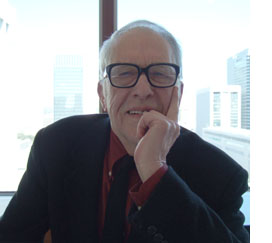 I’ve mentioned Kyoko Hirano, another former student and a best-selling author. Then there was my lunch with Donald Richie, hearty at 82 and planning more books, film screenings, and festival trips. His classic, The Inland Sea, is now being translated into Romanian. He gave me a copy of his newest, A Tractate on Japanese Aesthetics and I reciprocated with a copy of Poetics of Cinema. Donald’s book is as delicate and sharp as a Basho lyric; beside it, my book looks like an andiron.
At the symposium I learned a great deal from Prof. Takemoto Mikio, director of the Tsubouchi Memorial Theatre Museum at Waseda University, and the vice-director Prof. Akiba Hirokazu; Prof. Takeda Kiyoshi, who studied with Christian Metz; Prof. Nagata Yasushi of Theatre Studies; and many others who contributed talks and comments.
Finally, one more person, the one who spurred me to study Japanese cinema.
Ozu Yasujiro‘s gravesite is in Kita-Kamakura, about an hour southwest of Tokyo by train. In the summer of 1988, Kristin and I were led there by Donald, and so I was due for another pilgrimage. The day was cool and sunny, perfect for a brisk walk through the grounds of Engaku-Ji Temple.
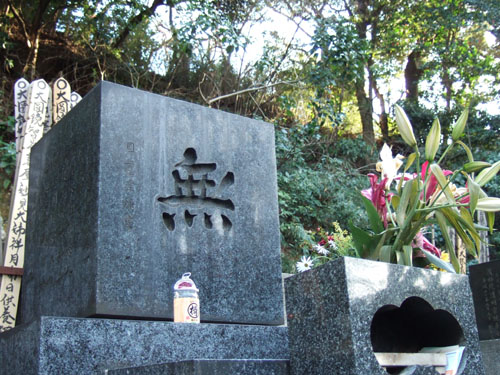
At the end of my trip was the gravestone, which famously bears a single character: Mu, or nothing. Twenty years ago, two beer cans sat reverently on the stone, but today there was an opened bottle of sake. A cigarette lighter was tucked into a hole in the surrounding stone fence. Ozu, fierce smoker and professional drinker, was in his element.
On the platform and then on the train, I let my eyes drift among the schoolkids and the teenyboppers and the salarimen and the grave elders with hygiene masks. I began to imagine how Ozu, the poet of the transience of city life and the comic poignancy of human ties, would turn us all into cinema. He might put the camera over there, squatting on the floor of the traincar. That boy with the backpack might give a sassy reply to his father. Those two stylish office ladies sharing an iPod while a middle-aged man snores beside them–surely that’s a setup for a gag. Playing with the possibilities, one gaijin felt a pang of rapture at the blending of life and art.
Manhattan: Symphony of a Great City
DB here:
In December Kristin and I attended a wide-ranging conference at Rome University devoted to “Exploded Narration”—the effects that digital technology has had on storytelling in film and television. As our host Vito Zagarrio put it, the question is one of continuity or rupture. Have new formats like HD, the Internet, and DVD revolutionized media storytelling? Or are they serving traditional approaches?
Many papers explored the “rupture” option, while Kristin and I offered presentations that emphasized continuity. You can find one version of my argument elsewhere on this site. Still, both of us also pointed up some innovations, or what I called “spillover” effects. As so often with such questions, the answer turned out to be complicated.
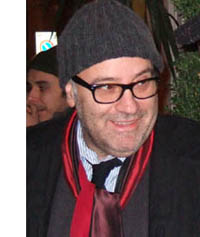 We enjoyed the conference, and one standout aspect was the presence of Amos Poe. Poe is probably best known for his first feature, Alphabet City (1985), and for his 16mm film on the Punk scene, The Blank Generation (1976). His Triple Bogey on a Par Five Hole (1991) has also attracted attention. For three decades Poe has worked as a director, producer, screenwriter, and teacher. The Sundance festival is playing Amy Redford’s The Guitar, which Poe wrote and coproduced.
Amos was great fun. A soft-spoken man with a quick and wicked sense of humor, he enlivened our dinners at various ristoranti. He also spoke extensively about screenwriting, which he teaches at NYU and at NYU’s Florence program. Like many screenwriters, he’s extremely intelligent and articulate about his craft. Three examples:
*How to learn screenwriting? Get a script version of a film you admire. Read the first ten pages, then closely watch the first ten minutes of the movie. Go back and read the next ten pages, and go ahead and watch the corresponding ten minutes. And so on until the end. Do this with three first-rate films, and you will have a concrete, intuitive understanding of how a screenplay works.
*A screenplay, Amos points out, isn’t a short story or novel or play. It’s a movie in words. It must make the reader see and hear an imaginary film, and not only the action, either. Without indicating specific shots, the descriptions should suggest the flow of long-shots and close-ups (”Her lipstick leaves a smear on the cigarette butt”). “The screenwriter is a filmmaker.”
*Write sounds into the background of scenes, setting them up for fuller presence later. If a train becomes important late in the story, mention the wail of a distant train early in the screenplay. This sort of auditory planting quietly strengthens the structure of the story in your reader’s mind.
Amos must be a terrific teacher. I learned a great deal from his descriptions of contemporary film conventions, several of which I hadn’t noticed before. Don’t be surprised to find some of them creeping into future blogs.
Given Amos’ expertise in mainstream storytelling, the film he presented was quite a surprise. It’s called Empire II, and though you don’t normally call a three-hour movie a delight, I can’t think of a better word. After a week of tourism and no films, it was just the sensuous boost that my hungry eyes needed.
Man with a Video Camera
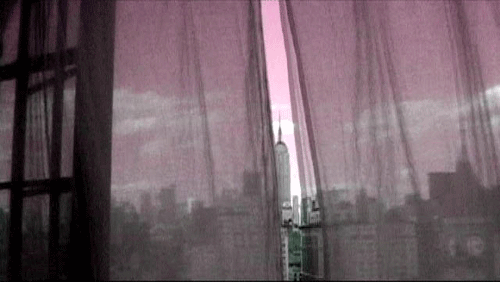
Poe’s apartment on Christopher Street yields a stunning view of the Manhattan skyline—the Chrysler Building, Jefferson clock tower, and of course the Empire State Building. He planted a Sony PD150 video camera at his window for a year, from 1 November 2005 to 31 October 2006, and took time-lapse shots. Through single-framing, he captured a total of 1 or 1 ½ seconds of every thirty seconds of real time. He shot traffic, people, skies, and the horizon. He did not look at the footage until after the year was up.
He wound up with sixty hours of imagery. He then made an absolute gesture. Using Final Cut Pro, he compressed all sixty hours into three. What was already highly elliptical, a string of tiny slices of action, became enormously accelerated.
Poe and his students then spent months blending up to forty tracks of music, spoken verse, and sound effects. It’s a crisp stereo mix, with remarkable audio-visual correspondences: whipping wind and ticking machinery sync up with snow and the tower clock. The music, which ranges from alt-rock to Keith-Jarrettish piano strumming, works sympathetically but not redundantly with the imagery. (No surprise that Poe has made music videos.) Shooting the film cost virtually nothing, but Poe spent about $100,000 for music clearances, though old friends like Patti Smith and Deborah Harry gave him their material for free.
The result is a city symphony, a lyrical tribute to the looks and sounds of New York. It joins the tradition of Walter Ruttmann and Dziga Vertov, as well as Paul Strand’s Manhatta (1921) and Jay Leyda’s Bronx Morning (1931). It also reminds you that Poe has roots in the downtown avant-garde. In 1972-1975, he often watched works by Jonas Mekas, Stan Brakhage, Michael Snow, Bruce Baillie, and Jack Smith at Millennium Film Workshop, and he made films for its Friday night open screenings. As a result, Empire II carries premises of lyrical and Structural cinema into the digital era.
The conditions of production are at once subjected to strict guidelines—a single year, only views from the window, the 20x compression—and open to chance. As with the films of Ernie Gehr, chance becomes more felicitous when set within a rigid frame. “I needed to create a base for accidents to happen.” Poe refused to cut or rearrange what he had (”I don’t edit unless I get paid for it”) and so he was ready to accept what came out. “I had to let go of the result.” That result mixes smoothness and fracture; the moon arcs like a golf ball, but traffic hammers relentlessly in a way recalling the last sequence of Man with a Movie Camera. Every so often there are calm islands of blank frames, provided by Poe’s occasional neglect to set focus or exposure.
Poe’s Book of Hours and Days
The title pays homage to Warhol’s 1964 film, so often discussed and so little seen. In many ways, though, Poe gives us an anti-Empire. Instead of a silent film, sound, both aggressive and immersive. (The stereo tracks shoot noises bouncing across channels, swallowing you up.) Instead of a single night, a year’s time span. Warhol shot Empire at 24 frames per second but insisted on projecting it at 16, slowing up time; Poe’s single-frame sampling and frantic acceleration speed time up. Warhol used for the most part a single camera position and shot in long takes, but Poe presents a flutter of shots. The framing is steady, but what we see flickers and pulsates, creating superimposition effects comparable to Ruttmann’s and Vertov’s slashing diagonals.
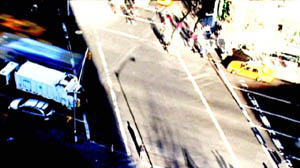
Warhol was withdrawn and impersonal, but Poe turned on the camera when he spotted something that looked interesting. He felt free to focus, reframe, zoom, and shift camera position for different angles on the life beyond his balcony. Likewise, the automaton Warhol (”I’d like to be a machine”) is counterposed to Poe’s more organic sensibility. He never lets us forget the flowers twitching on his windowsill, and their growth and rearrangements become traces of his daily life in the apartment.
The rules are simple and viewer-friendly. We instantly recognize the trappings of city life; we know the cycles of the seasons and the shifts between night and day. This cogent structure throws all our attention on what we see from moment to moment, and how we see it.
The Empire State Building and the skyline around it, along with the flowing clouds, remain stable reference points for a flurry of visual transformations. The taxis and pedestrians we glimpse move in jagged, incomplete rhythms very different from the smooth flow of fast motion in Godfrey Reggio’s films like Koyaanisqatsi.
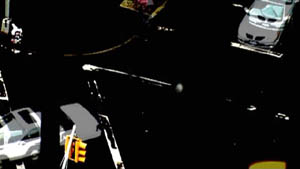
As you see, high angles, plays of focus, and tight framings provide energetic abstraction. Flaring exposure makes the Building look like it’s in flames, triggering echoes of the 9/11 attacks.
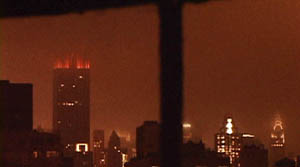
When the weather changes, the light does too. Raindrops become not only a pebbly surface on the windows but tiny filters. As with Warhol’s films, we have to change our conception of what counts as an event. Slight differences of framing and texture become visual epiphanies. Rain can be gray-green, and snow can go pale red. At times, the steeple clock face in the lower right becomes an imperturbable timekeeper, a sort of pictorial timecode, reminiscent of the clock in the corner of the shots of Robert Nelson’s Bleu Shut (1971).
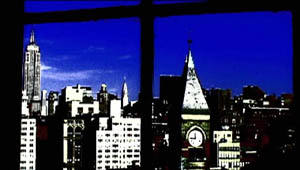
Spring comes about halfway through. It’s as lyrical as you’d expect, but again the colors startle. If snow can be red, then budding trees can be blindingly white.
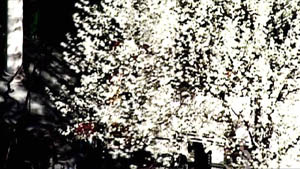
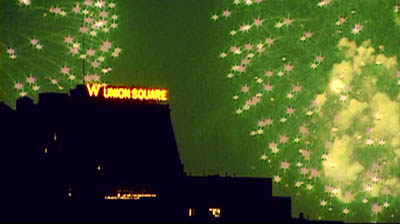
As in Ives’ Holidays Symphony, the festive iconography of Americana is made somewhat dissonant. July Fourth fireworks become splinters, and the slurred, jerky figures in the final Halloween chapter recall Mekas’ Notes on the Circus. Now shooting more continuously, with handheld shots and bumpy pans and zooms, Poe lets his 20x compression turn the parading ghosts, skeletons, nuns, and dark angels into scurrying hallucinations, complete with cellphones.
Empire II is at once exuberant and tranquil. What a pleasure to find a film devoted simply to seeking out beauty in everyday surroundings. “She celebrates the small,” sings Jimmie James while we see snow lashing the sidewalks. So does Poe. He has said that he made the film at a difficult period of his life, but what he has given us, I think, is jubilation.
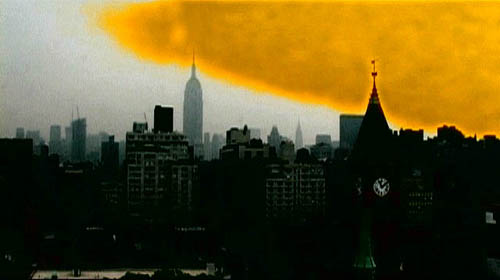
PS 22 Jan: For more on Empire II, including a trailer, go to amospoe.com.
Two Chinese men of the cinema
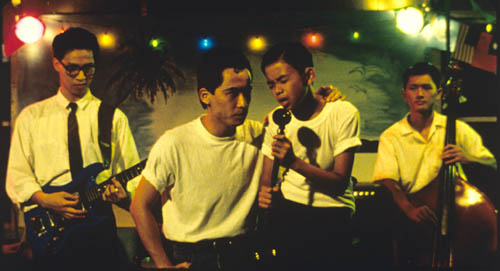
A Brighter Summer Day.
DB here:
This summer two major figures in Chinese filmmaking died. One was Edward Yang (Yang Dechang), one of Taiwan’s finest directors, who died on 29 June. But before I pay tribute to him, I want to acknowledge another figure who had a great impact on Asian cinema.
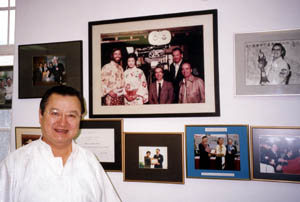
Charles Wang died on 6 July. Along with his brother Fred, Dr. Wang ran Salon Films, the major supplier of film equipment for Hong Kong and a principal one for East Asia and the Pacific Rim. Charles graduated with a degree in chemistry before inheriting the business from his father. As Hong Kong filmmaking grew in sophistication, Salon grew along with it. Most Hong Kong films bear the firm’s brand in their end credits.
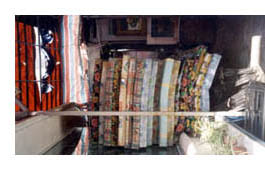 Since 1969 Salon has provided top-flight cameras, lenses, lighting gear and other technical support for both local and visiting productions, such as Mission: Impossible III‘s Shanghai shoot. An early triumph was winning the Panavision franchise for the region. The company even supplies trampolines and landing cushions for martial acrobatics, as this glimpse inside a Salon van shows.
When I interviewed Dr. Wang in 2003 he kindly gave me information about the company and the development of film technology in Hong Kong. He showed me his many awards and talked enthusiastically about Salon’s new efforts to assist mainland moviemaking. In recent years, Salon was investing in films such as Zhang Yimou’s Hero. Like most Hong Kong film people, he was very accessible and generous; he even gave me a lift back to my hotel. Charles Wang was a major force in the Hong Kong industry and will certainly be missed.
Laconic cuts and long takes
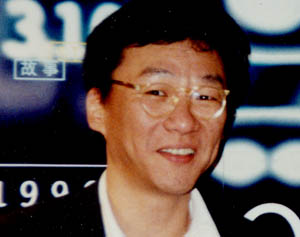
I met Edward Yang twice. First, at a Hong Kong Film Festival reception, we chatted about his film Mahjong (1996), which had screened. I got to know him a little better in fall of 1997, when we were both invited to the Kyoto Film Festival. We ate and watched films together, and we shared baby-boomer nostalgia; it turns out that he and I (and Hou Hsiao-hsien) were all born in the same year.
I found him friendly, thoughtful, and open to appreciating all film traditions. He spoke of enjoying Japanese swordplay movies in his youth, and he admired American films for their gripping stories. Still, his preference for ellipsis and understatement came through. When we met Kitano Takeshi for dinner, Edward praised a crisp transition in Sonatine: to show the gang going from Tokyo to Okinawa, Kitano simply gives us a quick pan of the sky accompanied by the sound of a jet plane.
Yang was an accomplished cartoonist, and I thought that this background partly explained his early style, on display in the short film Desires (1982) and in the features That Day, on the Beach (1983), Taipei Story (1985), and The Terrorizers (1986). In these films Yang often breaks his scenes into simple but striking fragments. After the police shootout in The Terrorizers—one of the most enigmatic and elliptical opening sequences in modern cinema—the Eurasian girl staggers out to the street. Yang gives us her collapse in quite abstract, percussive images. Her foot hits the pavement. Cut. She takes a step and falls out of frame; the camera holds on the empty frame. Cut. She’s lying on the crosswalk. I imagine these as forceful, laconic comic-book panels.
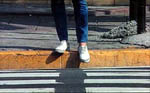
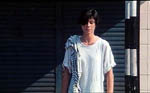
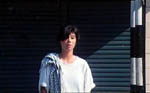
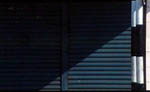
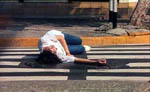
With A Brighter Summer Day (1991), my favorite of his works, Yang tells another gap-filled story but treats the scenes in long, distant, often decentered takes reminiscent of Hou. Now his frames are more dense with figures and furniture, and layers of action extend quite far back. In Figures Traced in Light, I devote a little—too little—analysis to one admirably staged passage. Another of my favorite scenes in A Brighter Summer Day shows the hero Xiao S’ir developing a romantic attachment to Ming, the girlfriend of the absent gang leader Honey. They sit in a brightly decorated café.
Suddenly Ming darts out of the shot, leaving Xiao S’ir and the other boys staring. From their point of view we see that Honey, dressed in a sailor suit, has returned and Ming has gone to meet him.
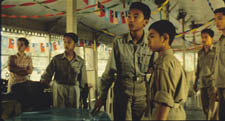
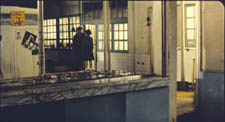
Yang cuts back to the boys as Honey’s gang starts to threaten Xiao S’ir. Abruptly, Ming runs into the shot, past the boys, down the long central aisle, and out of the café. (In a 35mm print you can see her pausing and lingering outdoors.)
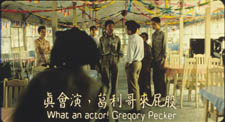
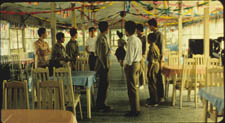
The group closes around Xiao S’ir; only Honey’s entry breaks the tension. He leads the boy into the depth of the shot, the camera following them.
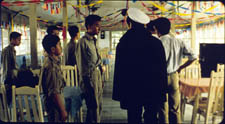
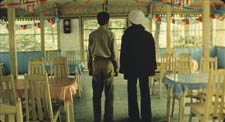
Honey warns Xiao S’ir off, and our hero goes outside, mimicking the path Ming had followed.
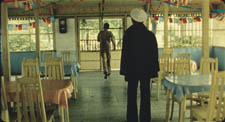
As Honey turns his attention to his gang and an upcoming skirmish with their rivals, he moves back down the aisle, the camera backing up. Once his business is done, Honey drifts back to the rear door.
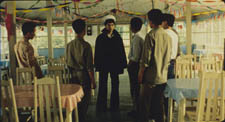
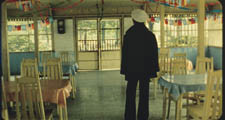
Honey pauses far from us, at the window. Yang cuts to show what he sees: Xiao S’ir, in flagrant violation of the warning, talking to Ming outside.
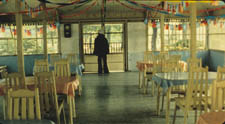
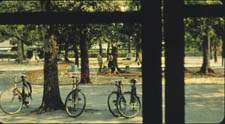
First we got Xiao S’ir’s point of view on Honey and Ming; now, in a reversal, we get Honey’s point of view on Ming and Xiao S’ir. In scenes like this, Yang merges his developing skills in long-take staging with cuts that develop not only the action but story parallels. Very distant framings, characters moving to the rear of the shot and turning their backs: Yang “dedramatizes” the scene. Further, by shifting point of view, he leaves us guessing about story information: What led to Ming’s running away from Honey? What are Xiao S’ir and Ming talking about now? Yang created a laconic visual approach that, I’d argue, invests fairly standard dramatic situations with a tantalizing uncertainty.
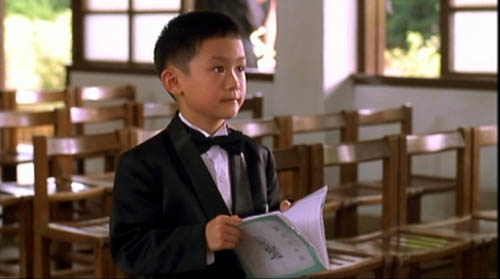
Yang’s best-known film is, of course, Yi Yi (2000), and it won him the wide appreciation that he had long deserved. It’s a warm and gentle work, less innovative than his earlier efforts but utterly typical of his vision of lives pervaded by melancholy routine and abrupt disappointment. People often remarked that the adolescent hero of A Brighter Summer Day resembled Edward himself. Perhaps too in Yi Yi Yang’s enigmatic pictorialism is echoed in the idea of a little boy who makes photographs of people’s heads seen from the rear. Like the director, the boy (named Yang-yang) displays a reticence that respects the mysteries of people’s private lives.
We already have a very useful guide to Yang’s work in one chapter of Emilie Yueh-Yu Yeh and Darrell William Davis’ book, Taiwan Film Directors. And Criterion’s Curtis Tsui has done a wonderful edition of Yi Yi, as Brian Hu shows here. We must hope that Criterion, Eureka, or another gilt-edged DVD publisher will soon bring us Yang’s other works in the pristine editions they deserve.
A Brighter Summer Day (1991)
In 1998, when we screened A Brighter Summer Day at our Cinémathèque, I wrote a program note. I reproduce it, lightly revised, as a quick pointer to one of the great films of the 1990s.
With Taipei Story (1985) and The Terrorizers (1986) Edward Yang established himself as one of the two leaders of the Taiwanese New Wave generation. At first it seemed that he and Hou Hsiao-hsien had agreed to a division of labor in their subjects and styles. Hou tended to concentrate on life in the countryside, or on rural characters transplanted, bewilderingly, to the modern city. Hou was also deeply interested in the history of Taiwan; his most acclaimed film, City of Sadness (1989), is a panoramic survey of Taiwanese society immediately after World War II. Hou’s tranquil style favored a contemplative mood and muted emotion.
Yang, by contrast, tended to focus on the lives of well-to-do urbanites in a contemporary setting, Taiwanese yuppies plagued by anomie and the desperation of love and work. His elliptical editing technique, reminiscent of Resnais, fractured time and space, while his compositions had a painterly starkness. The Terrorizers shuttles kaleidoscopically among characters at its beginning; their relations only gradually settle into intelligible patterns. Whereas Hou tended toward nuance and quiet drama, Yang was unafraid of shocking, inexplicable bursts of bloodshed.
Now it seems evident that this impression of a division of labor was somewhat schematic. Hou’s range of interests has widened, with new emphasis on the violent world of urban crime (Goodbye South Goodbye, 1996), and he has come to rely on quite disorienting transitions between past and present (Good Men, Good Women, 1995). Likewise, with A Brighter Summer Day Yang turned to history and cultivated a more sober style of filming, with lengthier shots and a fixed or barely moving camera. This approach throws down a challenge to the razzle-dazzle of contemporary popular cinema—from Hollywood, Hong Kong, and even the American “independents”—and invites us to scrutinize, moment by moment, the details of action unfolding on the screen.
Three years in the making, A Brighter Summer Day was a triumph of independent production. At a period when the Taiwanese film industry was virtually dead, Yang found money (mostly Japanese) to mount a project of remarkable ambition. Over half the cast and crew had never worked on a film before. At first released in a three-hour version, the film was re-released in a four-hour director’s cut, and this has become the standard version.
The historical event examined in A Brighter Summer Day took place in Taipei in the 1960s, when an adolescent boy about Yang’s age stabbed a young woman. At epic length Yang creates a web of circumstances around the event. He shows the interplay of traditional culture—filial duty, education as an ideal of social advancement—with popular culture, especially the rock n’ roll songs that recur throughout. Yang has said that Americans might not realize the shattering force of rock in other cultures: “These songs made us think of freedom.”
The film has over eighty speaking parts, most filled by nonactors, and it intertwines several characters’ destinies. On first viewing, the film can be somewhat bewildering to a non-Taiwanese audience, so a plot sketch may help. (Skip to the next paragraph if you don’t want to know the action in advance.) At the center is fourteen-year-old Xiao Si’r. He tries to be a dutiful student, but with his friends Cat and Airplane, he lives on the fringes of the Little Park gang of teenage thugs. When Xiao Si’r reports seeing a gang member with another boy’s girlfriend, he triggers a power struggle in the gang. As his friends fall by the wayside and rival gangs fight for control of local turf, Xiao S’ir becomes involved with Ming, a girl who’s attached to Honey, exiled leader of the Little Park gang. A major climax occurs during a gang rumble at a rock n’ roll concert. Interwoven with the juvenile intrigues are political matters; the police pursue and question Xiao S’ir’s father about his Communist friends. Xiao S’ir becomes friendly with Ma, a general’s son, before they start to compete for Ming’s favor. The rivalries build to a tense schoolroom confrontation and a tragic finale in the park. In the final scene and over the credits, a radio transmission broadcasts the names of the students who have passed their school entrance exams.
The plot is even more intricate than my bare-bones summary can indicate; I haven’t discussed the boys’ adventures in a film studio or Cat’s singing career or the slender line of action involving Xiao S’ir’s sister. The breadth of action is extraordinary, and a sense of the contradictory pulls of daily life emerges steadily. No less demanding is Yang’s style—scenes played in darkness, few close-ups, with medium-shots and long-shots keeping us at a distance from the characters. But the result is a dispassionate look at teenaged passions, a deromanticized treatment of young people growing up in a repressive milieu. A Brighter Summer Day (the English title comes from Elvis Presley’s “Are You Lonesome Tonight?”) is an elegy to the ideals and mistakes of youth, an analysis of the vanities of the male ego, and a view of a generation painfully facing the limitations of tradition, the constraints of political oppression, and the demands of the modern world.
Yi Yi.
Arrivederci Ritrovato
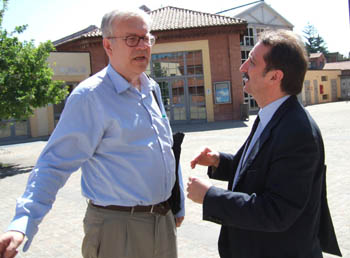
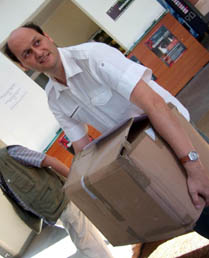
The three chiefs of Cinema Ritrovato: Peter von Bagh and Gianluca Farinelli strategize, while Guy Borlée does some heavy lifting.
Our last days at Bologna’s Cinema Ritrovato were as busy as the first ones. Inevitably, choices, choices. Invasion of the Body Snatchers in a rare SuperScope print, or Asta Nielsen as Hamlet? Emilio Fernandez’s melodrama Enamorada (1946) or a 1907 version of Little Red Riding Hood, with a big dog playing the Wolf? You can’t see it all, but we offer some notes on some of the choices we made.
I can’t say that I am a great fan of Frank Borzage’s films of the 1930s and 1940s. For me his great period was the mid- to late 1920s. 7th Heaven (1927) somehow manages to climb beyond its blatant sentimentality, much as the hero and heroine ascend the stairs of their tenement apartment house, and earns our emotional investment in their transcendent love. For me, Lazybones (1925) and Lucky Star (1929) were the revelations of the Borzage retrospective during the 1992 Giornate del Cinema Muto in Pordenone. It is a true pity that both remain largely unknown.
Borzage’s No Greater Glory (1934) was shown in a stunning print supplied by Sony Columbia. It didn’t fall into any of this year’s themes but was simply one of the “Ritrovati & Restaurati” items. The film deals with rival youth gangs in Budapest who organize themselves along strict military lines. Purportedly an anti-war tale, it manages to make the self-imposed discipline and even gallantry of the boys seem almost redemptive. I found the young hero, a scrawny but brave lad who struggles to be worthy of promotion within the ranks of his chosen gang, a bit too calculated to tug at the heartstrings. Still, it was entertaining, and the print showed it—and especially Joseph H. August’s cinematography—off to the best possible advantage. (KT)
While Kristin was watching Borzage, I decided to revisit Ilya Trauberg’s Goluboi Express (1929), one of the least known of the Soviet Montage films. Like Pudovkin’s Storm over Asia, it’s an attack on Western imperialism. Chinese, many sold into servitude, are packed into the rear cars of the train, while colonialists loll around up front. Two western soldiers of fortune attack a Chinese girl, and a young Chinese tries to defend her. This launches a prolonged battle and chase while the train roars on. By 1929, Trauberg had absorbed the lessons in cutting taught by Kuleshov, Eisenstein, and Pudovkin, and he adds his own imaginative touches. The taut construction and torrential editing (over 1400 shots in less than an hour) create an electrifying experience.
This particular version is an intriguing rarity. In his introduction, Bernard Eisenschitz explained that Soviet authorities persuaded Abel Gance to distribute the film in France. Gance recut it to avoid censorship, and he commissioned musical accompaniment by Edmund Meisel, the experimental composer who scored Battleship Potemkin. Meisel’s score amplifies and sharpens Trauberg’s hammering visuals. (DB)
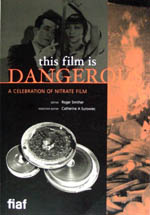
The book room was running for only about half the festival, so I was glad I nabbed my consumer durables early. Many high points, including a fascinating DVD collection of Marey films, but the most memorable, if only because of the struggle to carry it back home, is This Film is Dangerous. Published by the International Federation of Film Archives, this colossal book appears to present everything you wanted to know about this incendiary filmstock. It includes discussions of how nitrate came to be an ingredient of film, how the nitrate preservation movement (“Nitrate won’t wait”) started, case histories of restorations, poems in praise of nitrate, a chronology of nitrate fires, and an anonymous contribution called “Nitrate Pussy.” In all, virtually a film geek’s bathroom book, although its bulk demands a large lap. It doesn’t yet seem to be available on the FIAF website, but it should be soon.
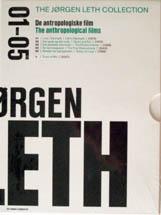
Speaking of swag and plunder, Dan Nissen of the Danish Film Institute kindly gave me a copy of their latest DVD publication, the first of several volumes devoted to Jørgen Leth. It’s a handsome production and sure to increase interest in the man behind The Perfect Human and the target of Lars von Trier’s painstaking abuse in The Five Obstructions. It’s available at the DFI website. (DB)
Although Michael Curtiz’s 1929 epic Noah’s Ark has been shown at various festivals in recent years, I somehow had always managed to miss it. Perhaps this was just as well, since the print shown in Bologna as part of the salute to Curtiz is longer than most and has the original sound restored from the Vitaphone records. (More often the film has been shown in its silent version.) Piecing together bits from several release prints held in different archives, something approximating the 1929 release version has been reassembled and matched to the sound. The credits in the program—“Print restored by YCM laboratories, funded by Turner Entertainment Company and AT&T in collaboration with La Cinémathèque Française and The Library of Congress”—hints at the complexity of the task.
Like The Jazz Singer and other early talkies, Noah’s Ark has long stretches of purely musical accompaniment. At intervals, though, characters suddenly start speaking, usually at the lugubrious pace typical of performances at the dawn of sound. The effect is startling, especially when the transition happens within a scene. Such switches proved jarring to the reviewers of the day, but the chance to see a film hovering between silent and sound can be fascinating to a modern viewer. The pacifist message of Noah’s Ark reflects a general anti-war sentiment in Hollywood films of the 1920s and 1930s—a healthy reminder of a day when the majority of good, patriotic Americans could take a dim view of warfare. The film’s ending, in fact, optimistically declares that the Great War had put an end to all wars. (KT)
Having written a book on Ernst Lubitsch’s silent features, Herr Lubitsch Goes to Hollywood, I was particularly interested in a dossier on the director. It included a reconstruction of Die Flamme (1922), of which only one reel survives, using publicity photos, set designs, and descriptive intertitles. Though still short at only 44 minutes, this version gives a good sense of the plot, which was certainly not evident from the existing footage.
We have long known that Lubitsch’s intended first project in Hollywood was to be a version of Faust with Mary Pickford as Marguerite. That fell through, but it went far enough that screen tests were made. Twelve minutes of tests for a series of actors trying out for the part of Mephistopheles were shown. These were not exactly a revelation, but they do shed light on this transitional moment in the director’s career. (KT)
What do we do with a terrible movie by a sublime filmmaker? I’d argue that at least three directors achieved greatness in the years before 1920: D. W. Griffith, Louis Feuillade, and Victor Sjöström. Sjöström’s Ingeborg Holm (1913), Terje Vigen (1917), The Girl from Stormycroft (1917), The Outlaw and His Wife (1918), and Sons of Ingmar (1919) remain deeply moving and cinematically inventive. Sjöström moved smoothly from the fixed camera, long-take “tableau” style of the early 1910s to profound mastery of continuity editing on the US model only a few years later. He continued into the 1920s with such key American films as The Scarlet Letter (1926) and The Wind (1928).
So it’s saddening to report that A Lady to Love (1930) is a turkey. Edward G. Robinson, in full hambone overreach, plays an Italian-American grape farmer who seems to be flourishing despite the Volstead Act. Tony brings a down-at-heel waitress from the big city to be his wife, and she grows to love him, despite a little indiscretion involving Tony’s best friend. The sort of inert stage adaptation that gave talkies a bad name, A Lady to Love is solely for completists (of which Cinema Ritrovato boasts many). It was Sjöström’s last Hollywood picture. (DB)
The programs of 1907 films continued to yield treasures. Max Linder’s career got going that year, and he had not yet settled into the debonair, top-hatted persona that would within a few years become so familiar. In the simple and not terribly funny Débuts d’un patineur, he plays a novice ice-skater reduced to tears at by the film’s end, and in the more amusing Pitou bonne d’enfants Linder is a bumbling soldier who loses a baby confided to his care by his nursemaid sweetheart. The same program contained Louis Feuillade’s ever-popular Le Thé chez la concierge, where the guests start carousing so loudly that they drown out the bell rung by tenants trying to get into the house.
There were many early attempts to record synchronous sound, though all too often the accompanying discs have been lost even if the image track survives. The 1907 films contained a few such, but one, La Marseillaise, had its singer’s original voice, remarkably clear and perfectly synchronized. The result was an unusually poignant and vivid sense of a link to a hundred-year-old performance, an immediacy that went beyond what most silent films can convey, wonderful though they might be.
A familiar but welcome short was La course aux potirons (“The Pumpkin Chase”), one of the great entries in the very familiar genre of the day, the chase film. Special effects allow a wagon-load of pumpkins (looking like they were probably constructed from old tires) to bounce along city streets, up a chimney, and through windows, followed by the usual growing group of passersby. The inclusion of a donkey, duly hauled through the windows and up the chimney, makes the whole pursuit far funnier than in most such films.
Finally, the inclusion of a series of films about bomb-throwing anarchists, another common genre of the day, reminds us that the current international situation is not altogether a new one. (KT)
The DVD awards singled out efforts to making unusual cinema available in the DVD format. The top prize, Best DVD, was won by the Ernst Lubitsch collection, from Transitfilm and the Murnau Stiftung (available, with some variations, on Kino in the US). The committee commended it as “a model in the elegant packaging of rare materials in a form that is certain to attract new audiences.”
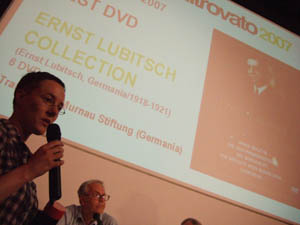
Anke Wilkening of the Murnau Stiftung accepts the award for best DVD.
Other awards: L’amore in città (Minerva, Italy), Best discovery; Seven Samurai (Criterion, US), Best Extras; the series on German cinema published by the Munich Film Archive, Best Series; and Akerman films of the 1970s (Carlotta, France), the French Naruse set (Wild Side) and the British Naruse set (Eureka), Best Box Sets.
Peter von Bagh commented that DVD producers are continuing the traditional work of film archives, and they often go beyond what archives can afford to tackle. Ironically, we sometimes find ourselves in the position of having excellent DVD versions of films that don’t exist in equally good prints. (DB)
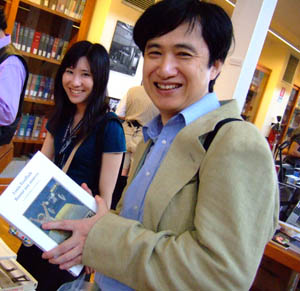
Finally, some snapshots. Glancing around the book room, you’ll see Sawako Ogawa and Hiroshi Komatsu pouncing on items.
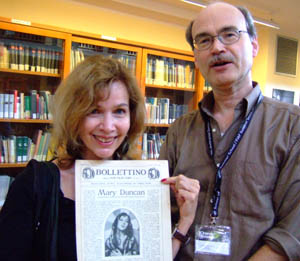
Not to be left behind, Janet Bergstrom and Richard Koszarski display Janet’s find.
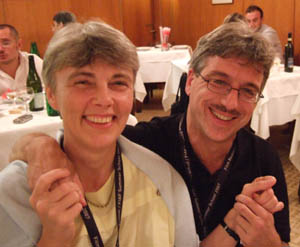
Every year, Frank Kessler‘s birthday occurs during Ritrovato; this year was his fiftieth, and so Sabine Lenk made it a special treat.
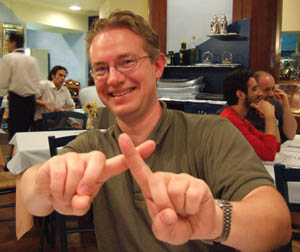
At another meal, Danish film archivist Thomas Christensen, who really ought to know better, fends off the camera’s magical powers.
Same meal: shellfish and pasta sacrificed in a good cause.

Danish film historian Casper Tybjerg and Kristin sample gelato. Later I ate the one in the middle.

On the final evening, the film cans are wheeled out. Ci vediamo l’anno prossimo!