















Archive for the 'National cinemas: Hong Kong' Category
My name is David and I’m a frame-counter
DB here:
Elsewhere on this site and in Figures Traced in Light (Chapter 1) and The Way Hollywood Tells It (second essay), I sometimes say rude things about the rapid editing in today’s films. But I’m actually a fan of fast cutting–when it’s precise, functional, and thoughtful. Most directors today don’t think about their cuts. Godard: “The only great problem of cinema seems to be more and more, with each film, when and why to start a shot and when and why to end it.”
My interest in fast cutting goes back to the 1960s, when I was first reading Eisenstein and seeing fims by Godard, Truffaut, Hitchcock, and, yes, Richard Lester. At first I would wind sequences backward and forward on a 16mm projector, stopping to pull the film off the reels to hold up to the light. For my dissertation on French cinema of the 1920s, I had a chance to examine films by Abel Gance, Jean Epstein, Germaine Dulac, et cie on editing tables or rewinds. In quickly-cut passages, the patterns of shot-length showed how a director could control the visual pace.
Over the years, when I studied 35mm film prints regularly, I periodically returned to my love of rhythmically cut passages. I studied Dreyer’s Passion de Jeanne d’Arc, the work of the Soviet Montage directors, and Asian action movies, from 1920s Japanese swordplay items to 1990s Hong Kong martial-arts sagas. Somewhat surprisingly, I found that Ozu, as in everything else, was there too; a lot of his intermediate spaces (landscapes, objects in rooms) are cut arithmetically.
By examining 16mm and 35mm prints, I could measure shot lengths in frames. In a sound film, a 24-frame shot would last a second on the screen. Things were trickier in gauging the cutting of silent films, since they were shown at rates between 16 and 24 frames per second. But at least the number of frames per shot gave me a sense of rhythmic relationships. A sequence in Jean Epstein’s Chute de la Maison Usher (1928) displays an arithmetical unfolding that would yield a distinct tempo at any projection speed of the era.
Directors have been counting frames for a long time. Experimental filmmakers like Brakhage did. Ozu had a special stopwatch built to register feet and frames during filming. Hitchcock cared about frame counting too. In Film Art‘s chapter on editing (pp. 224-225 of the new edition), we show how the gas station fire in The Birds gains impact from its steadily shorter shot lengths. The first shot lasts 20 frames, the second 18, the third 16, and so on down to 8 frames.
In sum, frame counting is one valuable way to find how a director can govern the pace of our pickup. When shots come this fast, our involvement can quicken as well.
When 35mm plays us false
For silent films, counting frames can be a problem if you have a “stretch-printed” copy. Since silent films often ran at something less than 24 frames per second (sound speed), some later film versions have been printed to repeat frames at certain intervals, to stretch out the print to 24 fps. That makes it easier to add a synchronized score to the print.
In the 1970s the Soviets were big fans of this procedure, rereleasing many classics by Eisenstein, Pudovkin, and others in stretch-printed 35mm and 16mm copies. The Soviet Montage filmmakers definitely counted frames, calculating the shots to play off each other rhythmically, so adding extra frames spoiled things. Worse, the stretch-printed versions often played sluggishly at sound speed, making the action spasmodic and blurring the figures. The result completely wrecked the rhythmic effects the directors were after. Even today, stretch-printed copies of Eisenstein’s Strike are in circulation.
Videotape and the 3:2 pulldown
Videotape arrived. The first Betavision players measured something–a little tally counter clicked away–but you couldn’t be sure what was being counted. Then came digital displays that measured hours, minutes, and seconds. But what about frames? When I tried to count frames on videotape, I found that the figures didn’t match those I got from film frames.
To see why, we have to remember that television developed its own frame rates. The technical details can get pretty daunting; see here for one account. I also recommend Jim Taylor’s DVD Demystified and Kallenberger and Cvjetnicanin’s Film into Video. Still, we non-engineers can get a general sense of what’s at stake.
There are two primary television standards, NTSC and PAL. NTSC (for National Television System Committee) is used primarily in North America and Japan. PAL (Phase Alternating Line) is common throughout Europe and Asia. Because NTSC video operates at a 60-Hertz refresh rate, the rate for individual frames is close to 30 per second. (Actually, it’s 29.97 fps.) The problem is this: Do you run 24-frame movies at 30 frames per second on television? This would make them look speeded up. Or do you pad out a second of film to fit a second of TV? American engineers took the second solution and created the so-called 3:2 pulldown.
In interlaced video, each “frame” is really two venetian-blind image fields presented as one image on your screen.(1) In the 3:2 pulldown, some film frames are selectively repeated to fill out the video playback format. The film is converted to video by making two fields from one film frame and then three from the next frame. Here is a useful diagram from a site on video transfer.
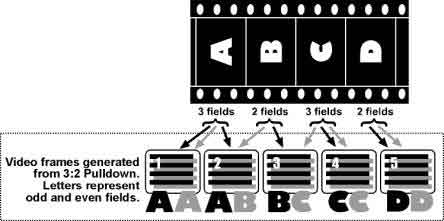
The 3:2 pulldown preserves three of the original four film frames (video frames AA, CC, and DD above).
But you don’t see this exactly this result when you jog/shuttle through a videotape frame by frame because the VCR has been engineered to display the 3:2 pulldown slightly differently. Stepping through a videotape, we find that some frames will show phases of movement and some repeat a phase. Depending on your playback machine and the tape itself, you may get varying patterns. Usually I see four video freeze-frames decomposing a movement, then they’re followed by an extra frame in which nothing changes.(2) That process turns 4 film frames into 5 display frames. Adding 6 repeated frames to the original 24 frames yields 30 video frames a second. I find that you can get a rough sense of the number of frames in the original shot by ignoring the repeated frames in the video display, but the video frames showing decomposed movement may or may not correspond to the actual film frames.
Laserdiscs and the frame count
Those heavy, rainbow-flashing 12″ discs: Cinephiles loved ’em. They gave us a sharper picture, properly letterboxed, along with terrific sound. Aficionados today still prefer the rich digital sound of laserdiscs to the compression of many DVDs.
Most laserdiscs used the CLV (Constant Linear Velocity) format, which preserved and even exaggerated the effects of the 3:2 pulldown. Counting frames meant stepping through the stills and ignoring the repeated ones, as with videotape, but often the coupled frames (AB and BC above) shivered wildly. But in the high-end CAV (Constant Angular Velocity) format, laserdiscs were able to make each stored frame pristine. This is why people thought that laserdiscs would be used archivally, for storing paintings, photographs, manuscript pages.
A bonus of the CAV format was that in transferring motion pictures to disc, one film frame could be matched to a single video frame. In fact, each film frame was assigned its own number, so the counter display spit out digits with blinding speed. During normal playback, the 3:2 repeated frames were added in, but in STEP mode, CAV laserdiscs gave you the original film frames one by one–steady, crisp, and bright. Frame-counting gained a new piece of hardware.
DVD and frame counting
Laserdiscs used optical analog technology for the image track. But consumers wanted something easier to handle, on the model of the music CD, so in came digital image technology via MPEG-2 and the DVD.
Despite all the differences between digital video and film (color, resolution, artifacts, etc.), DVDs in the NTSC format gained one advantage over tape. Like CAV laserdiscs, they could preserve the 24-frames-per-second rate of film. Essentially MPEG-2 technology encodes the film frame by frame. Flags on the DVD instruct the player to regenerate extra frames during playback. For a more detailed explanation, go to Dan Ramer’s article here.
The result is that during freeze-frame viewing, a DVD can yield the original film frames. Watch the Universal DVD of The Birds, and the frame-counts correspond to the 20-18-etc. layout we discovered on a 16mm print. Your remote’s STEP button moves through the original frames, hiding the repeated ones that were shown during normal playback.
But not always. DVDs can sometimes play us false.
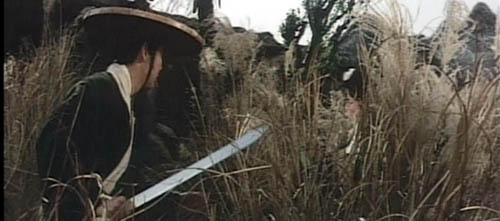
Before the DVD was a gleam in Warren Lieberfarb‘s eye, I studied King Hu’s wonderful A Touch of Zen on an editing table. There is a lot of frame arithmetic in the editing. During one swordfight, the mysterious stranger leaps away from the blows of Miss Yang and lands in a medium shot. He steps back, tipping up his face to reveal that she’s bloodied his head. He stares in astonishment. The shot lasts only 20 frames.
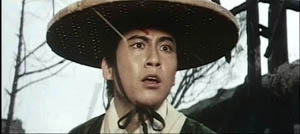
Yang stands still, holding her sword at the ready. The shot lasts a mere 9 frames, which dynamizes her stillness.
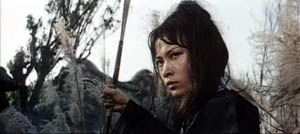
The stranger turns and runs out of frame in another twenty-frame shot. The static shot of Miss Yang now becomes an abrupt punctuation, and the stranger’s panic registers on us more sharply by being caught up in a repetitive rhythmic pattern.
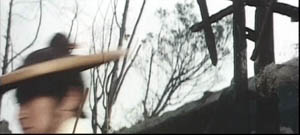
Yang plunges after him, in a twelve-frame shot.
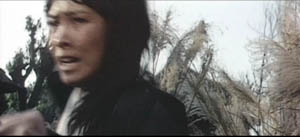
All four shots add up to less than three seconds of screen time, but they’re completely legible. It seems to me that the shots accentuate a pause in the fight by inserting a striking micro-rhythm, and then they dissolve that by letting the fighters continue the combat. Would that today’s filmmakers thought out their cuts so precisely! (If you want to learn more about King Hu’s editing style, see my Planet Hong Kong and the essay on him in the forthcoming Poetics of Cinema.)
But if you examine these shots on the US DVD of A Touch of Zen, you’ll find that the number of frames is way off from the film. The first and third shots run 25 frames each, not 20 frames; the second shot runs 11 frames (instead of 9), and the fourth 15 (instead of 12). Why? Inspection reveals our old friend, the 3:2 pulldown, at work. Improper authoring has left in the frames that should be jettisoned in step playback.
An even more severe instance: The sequence from Epstein’s Fall of the House of Usher that I admired in my dissertation days. It has become hash on the US DVD. When I try to count frames, I find that apparently the silent original has been stretch-printed and subjected to the 3:2 pulldown. When I click through the frames on a DVD player, I find that many frames are repeated, and some shots have doubled in length.
The lesson: Not all DVDs are created equal, or equally accurate in their correspondence with the original film.
What about PAL?
NTSC interlaced video has a 60-Hertz refresh rate. But PAL has a 50-Hertz one. That means not 30 video frames per second but 25. What do you do in transferring a film? The obvious answer: You speed it up.
Films shot at 24 frames per second tend to run at 25 in PAL videos, both tapes and DVDs. As a result, many films on European video run shorter than they did in the theatre, or on American DVDs. For example, Preminger’s Where the Sidewalk Ends runs 94:41 on the Fox DVD, but the same film, known as Mark Dixon Detective, runs 90:49 on the French DVD release. That’s a difference of nearly four minutes. PAL video playback of a 24 fps movie runs about 4% shorter than the original. For this reason, some European films are shot at 25 frames per second, to facilitate transfer to PAL.
So counting frames on a PAL videotape or DVD won’t necessarily mislead you on the number of frames, since none is repeated. That’s the case with our Touch of Zen example. Both the UK and the French DVDs of King Hu’s film yield the correct frame-counts for the shots in question. We just need to remember that each frame is onscreen for a tiny bit less time. In other words, each shot will contain the right number of frames, but that shot will be briefer in screen duration .
Note to Sátántangó fans: Yes, that means a much shorter movie. The PAL DVD available from England’s Artificial Eye claims to run 419 minutes; if you disregard opening and closing credits, the film runs a shade under 400 minutes. But the 35mm version I clocked here runs 434 minutes sans credits. So if you want to add 34 minutes to your life, watch the import DVD.
Note to Asian cinema fans: For reasons I don’t understand, many Hong Kong DVDs yield very blurred and vibrating still-frame images, not corresponding to the frames of the original film. These discs may be using a downmarket authoring process, or there may be problems converting to and fro between PAL and NTSC.
Progressive scan
This all applies to interlaced video, the original television broadcast format. Now we have progressive-scan video, for plasma and LCD displays and computer monitors. A progressive display, still adhering to the 60-Herz standard, is rigged to preserve the right number of film frames without repeating any.
But it does so by in effect combining two film frames together, and the step function may skip over several frames, or create a blurred composite that isn’t there on any frame. This is especially apparent on media-player computer software.
When I run my Touch of Zen shots on my computer, I get wildly abbreviated frame-counts in Step mode. In WinDVD, for instance, the first shot of the UK DVD registers as 8 frames, not 20; the second as 3 frames, not 9; the third as 9 frames, not 20; and the fourth as 6, not 12. Same thing for Epstein’s Fall of the House of Usher. On a tabletop DVD player there are more frames than in the original film; on my player’s software, there are fewer.
For this reason, I’d avoid trying to count frames on a computer’s media player.
So…..
Frame-counting is a nifty tool for discovering some secrets of filmmaking, but when we work from a video copy, we need to keep in mind the constraints of the various formats. And whenever possible, check the film!
(1) To complicate things, the scanning of alternate raster lines never yields a single complete frame. Before the image is fully completed at the bottom, it’s being refreshed at the top! To this extent, the video frame doesn’t have the stable, singular identity of a film frame. It can be encoded to correspond to a film frame, but as an image display, even a frozen frame is always in the process of being filled in. It’s just that our eyes, not designed to track such small-scale processes, are fooled.
(2) A quick sampling of my old VHS tapes shows that occasionally a tape doesn’t exhibit effects of the 3:2 pulldown. My Facets VHS copy of Where Is the Friend’s Home? plays back on two machines without any repeated frames. Perhaps this comes from making the transfer from a PAL master tape?
Updates and outtakes (in which we try, perhaps in vain, to catch up with ourselves)
Exiled
Kristin writes:
“The Hobbit Film: New Developments” (January 13, 2007)
In this entry I discussed Bob Shaye’s recent claim that Peter Jackson would never get a chance to direct The Hobbit for New Line. I mentioned that one of the factors involved in the negotiations about who would direct is that the production rights will eventually revert to producer Saul Zaentz. I didn’t know the length of the option on those rights, which New Line currently holds. The January issue of the fantasy/sci fic magazine Locus says that the rights will revert to Zaentz in 2009.
Zaentz had owned the rights since the mid-1970s and sold them to Miramax in early 1997. Miramax had the two-film version of The Lord of the Rings in pre-production for about 18 months and then sold the rights to New Line in August of 1998. I don’t know what the source of Locus’ information is, but a twelve-month option would seem pretty plausible.
If that information is correct, New Line only has about two years to get the actual making of the film underway. It takes years for any big film to lumber into production in Hollywood these days, so the studio doesn’t have a lot of room to wiggle.
“By Annie Standards” (December 14, 2006)
Here I talked about methods for publicizing animated features. One way, I suggested, would be to foster audience interest in the various animation awards other than the Oscars. I remarked, “Under Academy rules, only three animated features can be nominated in any year unless sixteen or more such features are released that year. Then the number of nominations jumps to five, but so far that hasn’t happened. It may finally happen this year, if all sixteen features currently under consideration qualify under Academy rules.”
Close, but not close enough. On January 11, Variety announced that one film, Luc Besson’s Arthur and the Invisibles, had been disqualified as an animated feature. To qualify, a film must have at least 75% animated footage, and Arthur has too much live action.
With the number of qualifying features down to fifteen, only three can be nominated. Probably Cars will win, as I predicted in the original entry. It just won the Golden Globe in the newly established Animated Film category.
“Snakes, No, Borat, Yes: Not All Internet Publicity Is the Same” (January 7, 2007)
Here I suggested some reasons why Snakes on a Plane failed at the box office and Borat: Cultural Learnings of America for Make Benefit Glorious Nation of Kazakhstan succeeded, despite the fact that both garnered considerable fan-generated publicity on the internet. I mentioned that Sacha Baren Cohen had appeared on talk shows in character as Borat rather than in persona proper: “Each appearance by “Borat,” supposedly there to talk about the film, ended up being a hilarious performance by Cohen, ad-libbing on everything around him—the chairs, the coffee mugs, the cameras, the audience. Spectators ended up with one impression about the film: it was about this incredibly funny guy doing incredibly funny things.”
Trying to correct the widespread assumption that Borat was an improvised film, the January 8-14 issue of Variety ran a story about how Cohen worked with three scriptwriters, Peter Baynham, Dan Mazer, and Anthony “Ant” Hines: “The scribes even concoct Cohen’s dialogue for his promo appearances on ‘The Tonight Show’ and ‘Live With Regis and Kelly.’” Although Cohen presumably ad-libs to meet specific circumstances of each talk show, the publicity appearances are even more controlled by Cohen than I had assumed.
I also remarked that it is difficult to judge the degree to which the film manipulated the scenes of Borat’s encounters with real people. Especially in terms of editing and sound techniques, there was clearly much opportunity for this manipulation. The same Variety story goes on to say, “Much of the script had to be altered depending on how situations unravel. This means the writers ultimately end up producing the equivalent of multiple scripts, much of which ends up on the cutting room floor.” I’m not sure how chunks of scripts can end up on the cutting-room floor, but the point is that the filmmakers were carefully stitching the “documentary” scenes together on the script level and presumably would do so through stylistic means as well.
David writes:
Back to the Hotel
The Uchoten Hotel (aka Suite Dreams, blogged here) has acquired yet another English-language title: Hotel Avanti. It made it to #93 on Variety‘s list of the world’s 100 top-grossing films, with $51 million box office in Japan and none yet recorded overseas.
Speaking of Variety‘s list, the highest-grossing non-English language item turns out to be Bong Joon-ho’s Korean hit The Host (#59 at $84 million), due out in the US any month now. Only ten non-English-speaking films made the top 100, and of those, three were European (including Volver) but all the rest were Asian: Chinese (Fearless), Korean (The Host and King and Clown), and Japanese (Tales from Earthsea, Umizaru 2 Limit of Love, Hotel Avanti, and Japan Sinks–no rude remarks, please).
The entire list is in the 15-21 January hard copy of Variety, p. 15, but evidently it isn’t yet available on the paper’s site.
More on Johnnie To
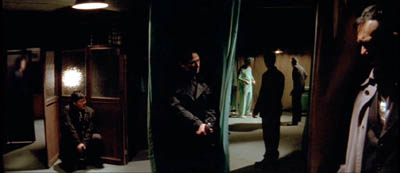
In an earlier blog I praised Johnnie To as a director who shot and cut PTU smoothly and crisply. I waited through the fall, hoping somehow to see To’s latest, Exiled, on the big screen at one festival or another. No such luck. So last night I broke down and watched the DVD. Making full use of the widescreen format, To shows that classic technique can be at once rigorous and imaginative.
Exiled was more visually engaging than any US film I can recall last year, including Miami Vice. It immediately became my Best Film of 2006 That I Saw in 2007. (Runner-up: Children of Men.) I visited Milkyway while the film was being shot, and I hope to blog about the result in a future entry.
At Large on the Internets
On this very site, I’ve posted a new essay on action movies.
Annie Frisbie interviewed me for the Zoom-In podcast here. Annie is also blogging/reviewing Sundance films here.
Fox Independent visited Madison and posted videos on its site. The setup and the interview with filmmaker and teacher Erik Gunneson are here. An interview with me is here.
Mad City’s movie mania
The Hilldale Theatre of Madison, Wisconsin opened its doors in spring of 1966 roadshowing The Sound of Music, and last weekend the theatre closed. To celebrate its passing, the management held a Sound of Music Sing Along, complete with subtitles to help with the lyrics. (No, not “How do you hold a moonbeam in your hand?” but the really tough ones.)
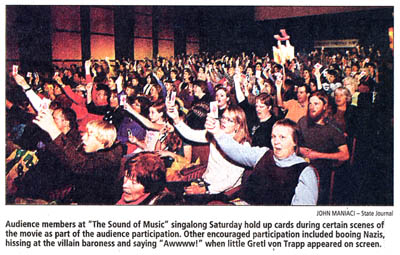
People came dressed as Maria, nuns, and the frog that was slipped into Maria’s pocket. There were cues for audience interaction, including saying “Awwww!” when Gretl appears on screen. This brought back memories of The Rocky Horror Picture Show, which ran at midnight shows at the now departed Majestic Theatre from 1976 through the mid-1990s. For a report on that, and the connubial bliss it brought, have a look here.
Kristin and I came to Madison in fall of 1973, prime time. The campus boasted 22 film societies: Wisconsin Film Society, Fertile Valley, Green Lantern, Hal-9000, and all the rest. Members of the Union Film Committee, overseeing the only campus 35mm venue, were passionately debating whether to show Godard, or Jancso, or a John Ford retrospective. I convinced them to show The Young Girls of Rochefort, which hurt my reputation,and Play Time, which I think helped it.
The Wisconsin Center for Film and Theater Research had just acquired several thousand Warners and RKO films. The Majestic Theatre ran double and triple bills (kung-fu, Leone’s Dollars trilogy). The Velvet Light Trap magazine was going strong, run wholly by students and semi-students.
In those days, before home video, it was glorious to be in Mad City. We had 6-10 movies to see every night, apart from course screenings. We didn’t even own a TV. Who needed one?
 Not to mention the cast of characters, all colorful. In the late 1960s-early 1970s the film community included:
The late Mark Bergman, premiere projectionist, fan of Phil Karlson, and gentle soul.
Joe McBride, critic (Variety), screenwriter (Rock and Roll High School), actor (The Other Side of the Wind), and excellent biographer (Spielberg, Capra, Ford, now Welles; What Ever Happened to OW? is very engaging).
Mike Wilmington, one of America’s top film critics, a mainstay of the Chicago Tribune.
Tim Onosko, author of Wasn’t the Future Wonderful?, industry consultant, and documentary filmmaker.
Gerry Peary, enterprising critic, screenwriter, and film professor.
Danny Peary, most famous for his series of Cult Movies books.
John Davis, co-founder of the Light Trap and creator of Capital City Comics.
Susan Dalton, another co-founder of the Light Trap and archivist at the American Film Institute.
Pat McGilligan, prolific critic, interviewer, and biographer.
Tom Flinn, the other co-founder of the Light Trap, pop-culture encyclopedist, and expert on Germans in Hollywood.
Bill Banning, founder of Roxie Releasing and operator of San Francisco’s Roxie Cinema.
Reid Rosefelt, publicist, producer’s rep, and filmmaker.
Many of these worthies ran film societies, so their ideas and passions showed through the films they screened. For more on the Madison Movie Mafia, go here.
Also present and active in late 1960s-early 1970s:
Filmmakers Erroll Morris, Stewart Gordon, Jim Benning, Bette Gordon, Michelle Citron, Karyn Kay.
Scholars-in-training James Naremore, Doug Gomery, Maureen Turim, Fina Bathrick, Marilyn Campbell, Diane Waldman, Ed Branigan, Vance Kepley, Peter Lehman, Brian Rose, Peter Brunette, Frank Scheide, and many more.
Great days, and nights…Mike Wilmington has written a fond appreciation of the whole scene here.
But this isn’t just an exercise in baby-boomer nostalgia. The Madison Cinema Juggernaut rolls on. The Light Trap just published its 58th issue. The Onion, founded by Madison students, continues to be America’s finest news source. Dan Fuller makes silent films with his students, using cameras from the 1920s, and the results have played at Pordenone. And not least, the Cinematheque, founded by faculty and students in the Communication Arts Department, carries on the spirit of the old film societies.
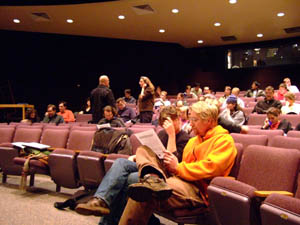
In sync with the closing of Hilldale, our Cinematheque ended the semester last weekend. (Crowd starting to gather above.) An outstanding schedule (S. Ray, Tarr, Godard, Sjostrom.) wound up with Lau Kar-leung’s Dirty Ho, the last of our string of Shaw Brothers classics. It was, of course, a delight, full of flamboyant, good-humored, and downright weird kung-fu.
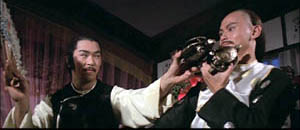
A lot of it was close-quarter work, as warriors examining pottery or sampling wine disguise their deadly thrusts as elaborate courtesy. Lau is arguably Hong Kong’s top martial arts choreographer, but he’s a fine moviemaker as well, and Dirty Ho is one of his best. Even the shabby state of the print, an original from 1979 complete with curious purple splotches, seemed to pay tribute to three decades of campus film fanaticism. It could have played the Majestic.
Even with the loss of the two Hilldale screens, Madison has five commercial screens dedicated to foreign and independent films, not counting the Cinematheque and the Play Circle in the Student Union. Come spring with Sundance, we’ll get six more. And our Wisconsin Film Festival (April 12-15) comes hard on the heels of the Sundance complex. Wisconsin Movie Madness lives on.
DB
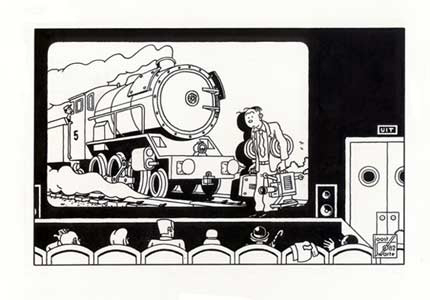
PS: Thanks to Ivo Blom for the Swarte illustration up top.
PPS 21 December: Today’s Isthmus has a nice story on Dan Fuller and the Wisconsin Bioscope company. I played a small role in their last film of the semester, and despite the need to wear eye shadow, this gave me an even greater appreciation of their efforts. They’ll have a screening of recent work some time next term.
Can they make ’em like they used to? continued

DB here:
In the wake of discussions of The Good German, on this site and elsewhere, the idea of a retro-looking movie has surfaced again. American Cinematographer‘s coverage of Casino Royale is very intriguing.
Phil Méheux, the cinematographer, decided that the opening sequence, a black-and-white passage showing Bond earning his 00 status, would pay homage to 1960s Techniscope. Techniscope was an optical process that produced 2.35:1 images without anamorphic lenses. It allowed great depth of field because it could take advantage of the wide-angle lenses available for non-anamorphic cinematography. The most familiar Techniscope images are probably those in Sergio Leone’s westerns.
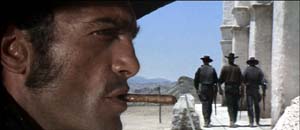 For a Few Dollars More.
Mehaux explains what he wanted for Casino Royale:
With Techniscope, the increased depth of field meant they were able to put things like lampshades and telephone boxes in the foreground, and they didn’t appear amoebic–you could actually see depth in them. In The Ipcress File, there’s a shot where a table lamp is huge in the frame and a man’s face is in the top right-hand corner. I really like that look. Part of the dialogue in our opening sequence was done with very carefully controlled shots that have huge things in the foreground and faces pushed to the corners of the frame. Little things like that echo the Cold War period of spy films.
But, but….
1. In the print of Casino Royale I saw in my local, the opening office scene didn’t really exploit sharp-focus foregrounds. There weren’t that many objects in the foreground, and they weren’t in discernible focus. Of course the cutting was so rapid that it was hard to concentrate on foreground/ background relations.
2. It’s fall of 1965, in Albany, New York. A film geek literally fresh off the farm is in his freshman year of college and goes to every movie in town. He sees The Ipcress File not once but three times. He’s fascinated by its flamboyant technique. He’s just seen Citizen Kane, so he’s impressed by deep staging and big foregrounds in this unheralded spy pic.
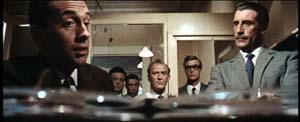
There’s even wilder stuff: a murder victim seen through a hanging lamp, for example.
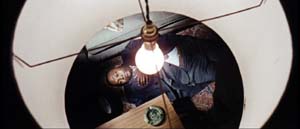
The Geek reads up on long lenses, wide-angle lenses, and so on. Knowing nothing about Techniscope, he wonders how these extravagant shots got made. Just as important, why are they here (apart from looking cool)?
(Spoilers coming up. Skip to 3 if want to retain your innocence.)
After a couple viewings, the Geek begins to get a hunch about what those lampshades are doing there. Throughout the movie, actors are shot in juxtaposition to looming shapes–doors, lecterns, tabletops–which mask large stretches of the set.
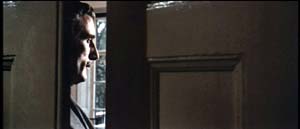
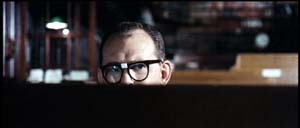
And sometimes those blocking objects are lampshades.
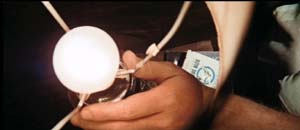
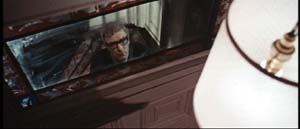
At a climactic moment, our hero escapes from torture and calls his superior officer, who’s framed in the usual off-center way, with a lampshade dominating the shot. It works as a sheer (and pretty) block of solid color.
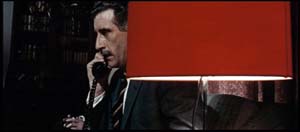
Turns out, however, that this time the shade actually conceals something important. The officer withdraws behind the shade and out pops a guest sitting alongside him.
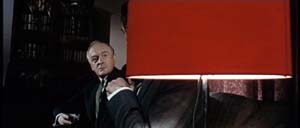
The guest is the arch-villain. Now we know the officer is a traitor.
The Geek dimly realizes three things.
*A movie sets up visual “rules” it will follow or violate. (Later the Geek will call these intrinsic norms.)
*Visual motifs build up across a film, sometimes asking the viewer to notice them.
*A motif can seem gratuitous but that very gratuitousness can be exploited for storytelling purposes. When we see the red lampshade, we assume that it’s another decorative flourish, not a way of hiding information. Earlier sequences suggest that the device is a mannered tic but at the climax it helps spring a surprise. Motifs, the Geek would realize eventually, can fulfill narrational functions–that is, motifs can shape the ongoing flow of story information.
3. Sidney J. Furie was considered a showoffish filmmaker. Michael Caine said he belonged to the look-Ma-I’m-directing school. Certainly the outrageous compositions involving Marlon Brando’s sombrero in The Appaloosa back up that charge.
But like Richard Lester, Ken Russell, and other fancy-pants pictorialists, Furie can at least get us to notice technique. Not bad to cut your cinephile teeth on. Or at least so the Geek thinks, forty years afterward.
4. The AC article also talks about the problem of making poker games interesting. Hong Kong filmmakers figured this out long ago. Martin Campbell, director of the new 007 adventure, should study the crisp card sequences in Wong Jing’s God of Gamblers series. Filmed on a minuscule budget, they put the strained and blandly shot poker scenes of Casino Royale to shame. Incidentally, Wong’s use of diopters yields the sort of nifty depth that Meheux liked in Ipcress.
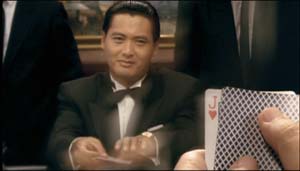 God of Gamblers.
PS: Casino Royale didn’t learn the lessons of the 1960s well enough, in my view. After the sparkling opening credits, it was all downhill. The usual problems: overcut scenes, overcloseupped acting, incoherent chases and fights, uninspired dialogue you recite just before the actor says the line. One landing-strip truck fracas amalgamates Road Warrior, Raiders of the Lost Ark, and Die Hard 2. The makers have indeed updated the Bond franchise. After a series of lame 1970s-looking movies, the franchise has given us a lame contemporary-looking movie.
Granted, I never cared much for the Bond pictures. The Geek liked From Russia and Goldfinger, and Diamonds Are Forever is enjoyable in its wacko way. But for Machiavellian intrigue, Fritz Lang’s Spies remains the gold standard. No one can make ’em like he used to.
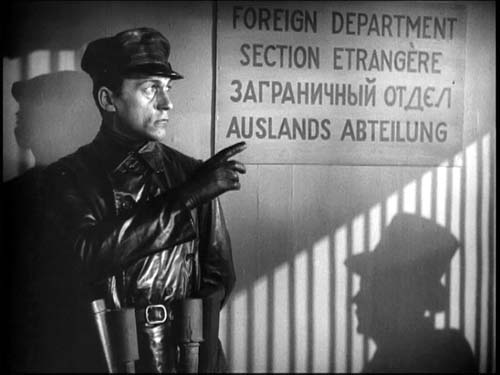 Spies
Spies



