




Archive for the 'National cinemas: Hong Kong' Category
A many-splendored thing 4: Triangulating
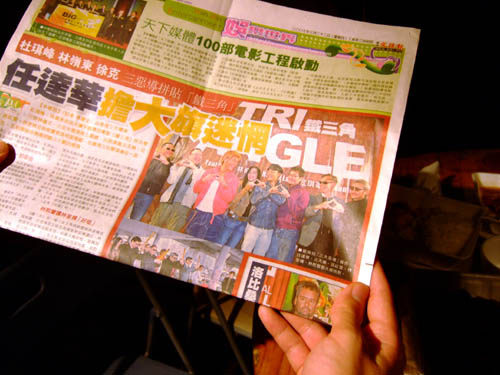
DB, still in Hong Kong:
Three directors of renown collaborate on a single film. Each is responsible for one part. But unlike your ‘portmanteau film,’ which tells separate stories (e.g., RoGoPaG or Paris je t’aime), in this project the same plot and characters are followed throughout. To make things interesting, the director of part one doesn’t tell the others what he’s planning; he simply presents a finished third. The second director has to take that further, and the man at the end has to wrap things up.
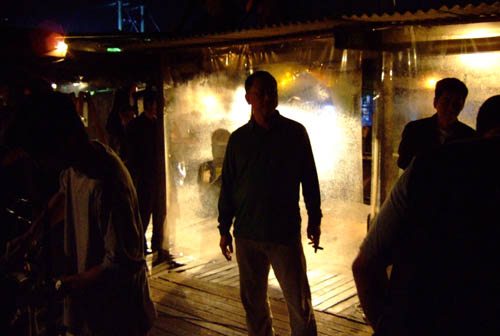
Hong Kong director Johnnie To came up with the idea for Triangle, and it’s nearing completion. Tsui Hark has finished the first section, Ringo Lam the second. Now To is shooting the conclusion, and he kindly invited Shelly Kraicer (Chinese movie expert), Todd Brown (of Twitchfilm.net), Antoine Thirion (of Cahiers du cinéma), and your obedient servant to a late-night shoot on Thursday. Milkyway mainstay Shan Ding was our guide.
I don’t have to tell you it was fun.
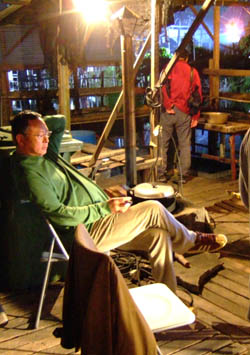
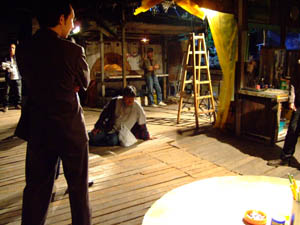
The setting is a rundown cafe perched on a swampy pond in the New Territories. The location is near the forest where the armored-car shootout takes place in Exiled. We saw To shoot a scene with Lam Suet, Louis Koo, and other actors meeting in the café. In this portion, Lam is sprawled on the floor.
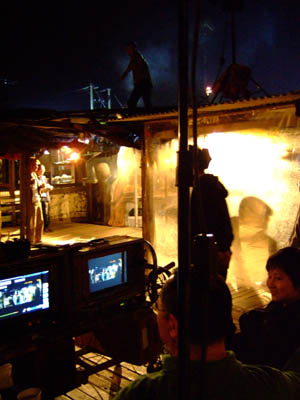
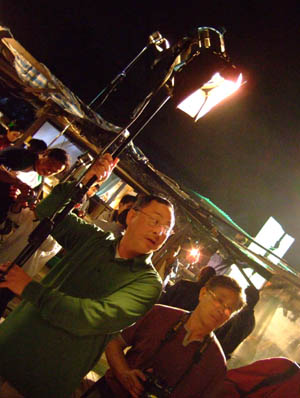
The scene climaxes with one actor dangling from a hole in the roof. You can see Mr. To in the lower right foreground watching the shot on his video assist, a monitor that shows what the camera sees. Maybe you can glimpse the shadowy assistant on the rooftop helping the actor hold on.
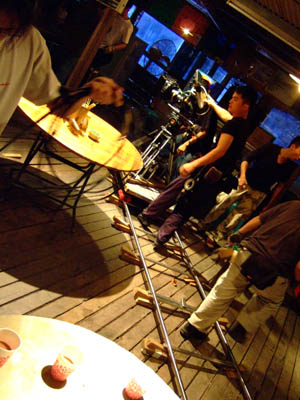
Meanwhile, the camera is shooting off on the right. It was a good opportunity to watch how To uses camera movement (constant in his films). Here you can see the camera dolly and the rail tracks it coasts along.
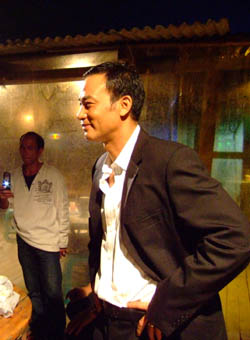
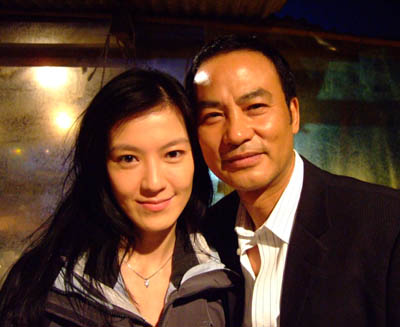
Louis Koo was also there, but not too visible. Simon Yam showed up for another scene, this one in the forest. Simon exudes charm and is warm and unpretentious. I first met him in 1995 at the Hong Kong Film Awards banquet, and he looks as handsome and mischievous as ever.
Kelly Lin arrived soon afterward. Another charmer, she told me she grew up in Santa Barbara and went to UC-Irvine. She’s been in a lot of recent HK movies.
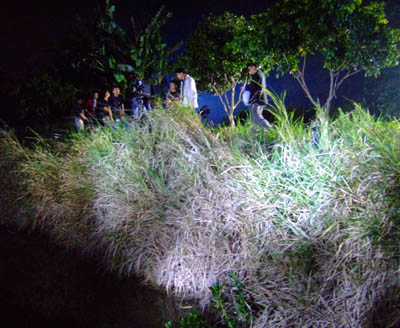
Later, shooting in the forest, the Milkyway team worked efficiently. We guests were parked on a little pier to watch from a distance.
A crew member rustled a big sheet of plastic to create the impression of reflections from the water.
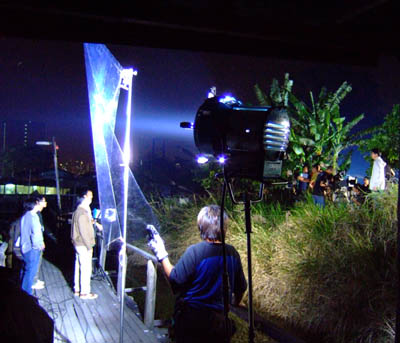
I’ve visited other Milkyway shoots, and each time I’ve been impressed by the sheer speed with which the work gets done. Everybody knows his/her job, and the staff changes camera and lighting setups very quickly. It also helps that HK films are almost always shot with no sound recording; everything is postdubbed. That yields the visual freedom, as well as the speed of production, of silent-era moviemaking.
In another echo of old production methods, To’s films sometimes use rooftop sets. Last year the set for the hotel in Exiled was erected on the top of the Milkyway building. Its Demy-like pastels looked very artificial in daylight.
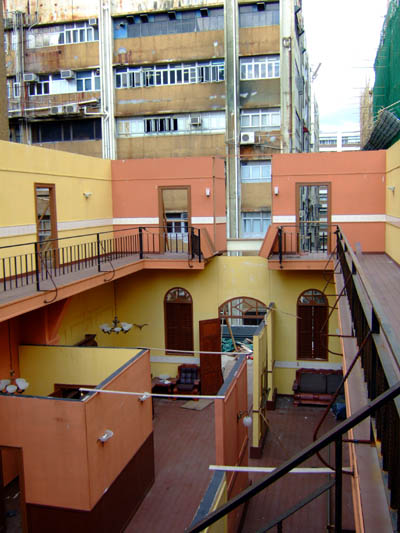
But check out the results on film, shot at night.
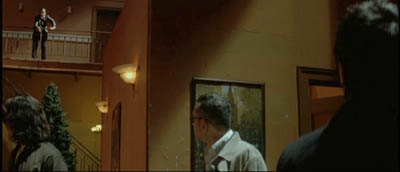
To’s art is furthered by his craftsmanship in shot composition. Composing in anamorphic (2.35:1), nearly always putting the camera on a tripod or dolly, he gets precise results with few lighting units. When I complained that all the new films I saw at Filmart were shot shakycam, Shan Ding reported a neat saying that HK DPs have. The handheld camera covers 3 mistakes: Bad acting, bad set design, and bad directing.
Unlike Hollywood filmmakers, who fiddle with the film by pushing and pulling and bleach bypassing and digital fixing in postproduction, Mr To just lets the film do its rich photochemical work. Expose it correctly, anchor the camera, and 35mm film stock can look gorgeous. His films show that we already have a high-definition moving-image medium, using not pixels but molecules. Motto: Let the emulsion be your friend.
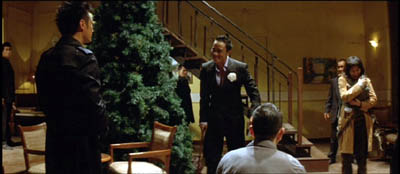
Shan also told me that the anamorphic format used by Milkyway is Technovision, an Italian system from the 1970s. These lenses yield lovely images with good depth of field, and To likes to fill up the wide frame with complicated blocking. Here’s an example from Exiled.
According to Rick Mitchell, Vittorio Storaro used Technovision lenses on Apocalypse Now and other pictures. It’s another way in which To is maintaining a heritage of quality—while also being economical. Milkyway owns the lenses, so no need to rent from local supply houses.
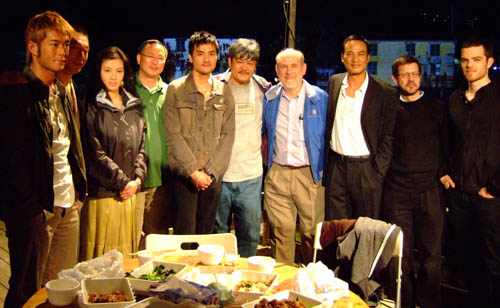
Mr To, Shan Ding, and the rest of the crew were very kind to us, even providing snacks and suggesting a group picture. Who could resist an offer like that?
Later in my stay, I hope to report on another upcoming Milkyway film, the Simon/ Kelly pickpocket movie called The Sparrow.
PS 24 March: I was told that Johnnie To came up with the idea for Triangle, but Vicki Rothrock reports for Variety that it was Tsui’s concept originally. Thanks to D. W. Hudson of GreenCine Daily for the link.
PPS 27 March: For Todd’s coverage of our set visit , go to Twitchfilm here.
PPPS 14 May: Per Variety, Triangle is a late addition to Cannes.
PPPPS 4 December 2010: Correction: The original entry claimed, inaccurately, that Mr. To used Techniscope, a two-perforation non-anamorphic format. The process being used is in fact Technovision, an anamorphic format. My apologies for the error.
A many-splendored thing 3: Filmart and filmfans
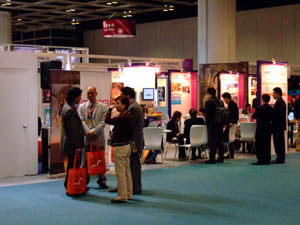
The annual Hong Kong Filmart is a trade show for all aspects of film/TV production and distribution. As in past years it commands several floors of the Convention and Exposition Center, shown in yesterday’s entry. There are many screenings (thinly attended) but the main business is dealing. Representatives from Europe and Asia meet and greet in their display spaces, or more often in restaurants and hotel rooms. Here are some snapshots from the floor of the market, which I managed to visit on Wednesday.
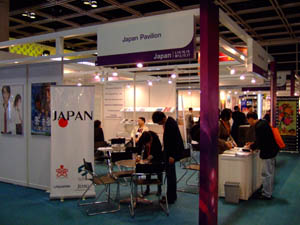
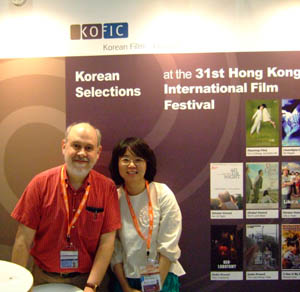
The cheerful Park Jiyin gave me some publications and DVDs from the Korean Film Council. She had read Film Art in her university courses!
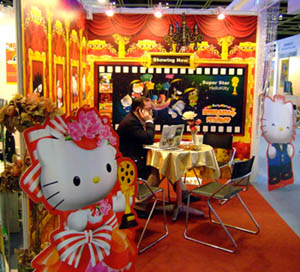
Sanrio’s display areas were pretty nifty.
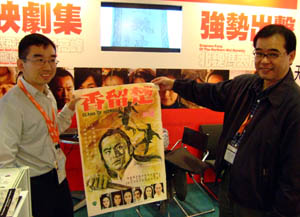
On the Filmart floor I again ran into King Wei-chu, brandishing yet another of his poster treasures while we talked with Ip File, a publicity executive for Celestial Pictures (current owners of the Shaw film library). Mr. Ip also worked as an assistant director to Chor Yuen, one of the best Hong Kong directors of the 1950s-1970s.
After cruising Filmart I caught the trade screening of Twins Mission, a goofy but likeable Hong Kong film by martial arts choreographer Kong Tao-hoi. Twins, in case you don’t know, are, or is, a pair of girl pop singers who have made some films before this, notably The Twins Effect (2003). In this entry, Twins are now trapeze artists, and they encounter a squad of kung-fu killers, all themselves either male or female twins. It’s gradually revealed that our Twins were trained in the martial arts along with many other twins…by kung-fu masters who are twins. Confused yet? Given that our Twins don’t resemble one another, the premise seems a sendup of the very idea of twins and, er, Twins.
The agreeable fight sequences are enhanced by digital effects; my favorite passage includes a moment when a spinning blade trims one girl’s eyelashes. There’s a mawkish subplot about a little kid with cancer, but the presence of Sammo Hung and Yuen Wah, who literally plays his own evil twin, more than makes up for it.
A sequel seems already to be shot. This movie, released about a month ago, ends without resolving the plot, and then we’re asked to watch out the rest of the story. Maybe the next installment will develop the subplot involving Sam Lee overacting as a mainland cop, a trail that leads nowhere here. Morever, the 35mm print I saw jumped from scarily sharp HD footage (every pore on the face all too crisp) to fairly poor digitized stuff to soft, sometimes out-of-focus 35 footage. Did they change formats partway through the shoot?
Yes, I learned later that night. I met Grady Hendrix and Goran Topalovic, directors of the New York Asian Film Festival (aka Subway Cinema), for drinks at the movie-themed coffeeshop/ bookstore Kubrick. They bought books, I bought books, then we sat outside chatting. Soon Ryan Law joined us. Ryan has recently expanded the server for the Hong Kong Movie Database, of which he’s the founder and mainstay.
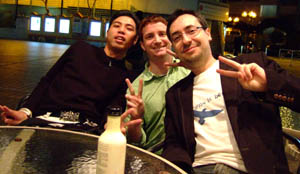
Ryan, Grady, and Goran
Ryan said that for reasons of economy, it’s become very common for HK movies to mix analog and digital formats. He said that in fact Twins Mission used film, HD, and Betacam!
Leisurely talk on a balmy spring night was a good ending to a full but unhurried day, and I came back to write the blog you see now. Tomorrow: more film viewing and a visit to a night shoot of Johnnie To’s installment of Triangle.
A many-splendored thing 2: Awards aplenty
Short version:
This year the Hong Kong Entertainment Expo has launched the Asian Film Awards, a celebration of outstanding films and filmmakers created by the HK International Film Festival. Over 700 films were sifted by a jury and a handful of finalists were chosen in several categories. At the ceremony on Tuesday night, Bong Joon-ho’s The Host, which I wrote about at Vancouver’s film festival, won several: best film, best actor (Song Kang-ho, the put-upon father of the family), best cinematographer (Kim Hyung-goo), and best visual effects (The Orphanage). Best director honors went to Jia Zhang-ke for Still Life. Other winners:
Best actress: Miki Nakatani (Memories of Matsuko)
Best screenply: Mani Hagighi (Men at Work)
Best production design: Tim Yip (The Banquet)
Best musical score: Rahayu Supanggah (Opera Jawa)
Best editing: Lee Chatametikool (Syndromes and a Century)
A special award for Outstanding Contribution to Asian Cinema went to the great actress Josephine Siao Fong-Fong, presented by Luc Besson in an eloquent tribute.
I was fortunate enough to be given an award for Excellence in Asian Film Scholarship.
Long version follows.
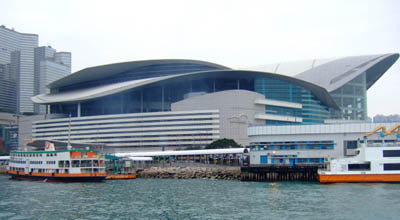
Tuesday morning-early afternoon: The film market, Filmart, is held in the overwhelming Convention Center on the harbor: at least seven floors of steel and glass, shaped like a wingspread gull and full of gigantic auditoria and meeting rooms. Sellers have set up booths to showcase films, TV shows, and the like. There’s also a film financing forum, where directors come to pitch projects to likely funders.
After getting my credentials, I shmoozed with old friend Shelley Kraicer, a Chinese film expert who’s a consultant for several festivals. I also spent time with Ho Yuhang, whose Rain Dogs I’d seen at Vancouver. Ho is a great fan of film noir, and I brought him some DVDs that seemed up his alley. He’s planning a psychological crime drama for his next project, and don’t be surprised if touches of David Goodis and Jim Thompson show up in it.
Late afternoon: After climbing into a suit, back to the Convention Center. At the preshow reception, met Fred Milstein, who works as a completion guarantor at Cine Finance; Fred went to film school, so we had several friends in common.
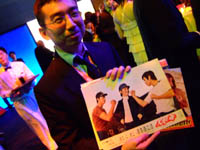
Also reunited with King Wei-chu, a programmer for Montreal’s wonderful Fantasia film fest, and Frédéric Amboisine, passionate adherent of Asian cinema and writer for the lush French magazine Kumite. (King and Frédéric awed me with the memorabilia they tote around, rare posters and books they’ll whip out to show you.)
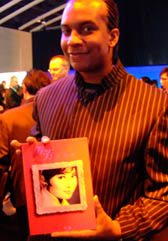
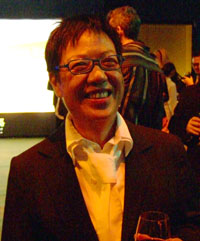
Also ran into director Ann Hui, looking happy and relaxed as usual. Ann, who’s one of Hong Kong’s best filmmakers, visited UW-Madison to show Summer Snow back in the 1990s.
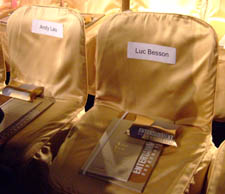
Evening: The ceremony approached. We spilled into the auditorium, with assigned seats. Mine was in the front row, and as I passed the center section I saw plenty of indications of star power.
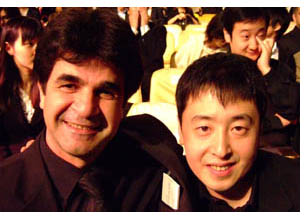
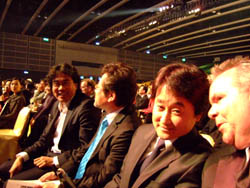
I was lucky enough to be seated beside the remarkable Iranian director Jafar Panahi (The Circle, Offside) and next to him was Jia Zhang-ke, who remembered me from a panel we’d been on together in Shanghai. You can see that they were in good spirits. On my other side sat Vicki Zhou Wei and Song Kang-ho.
Before the curtain rose, I caught up with Tony Rayns, wearing an amazingly horticultural bow tie, and Peggy Chiao, the godmother of the New Taiwanese Cinema.
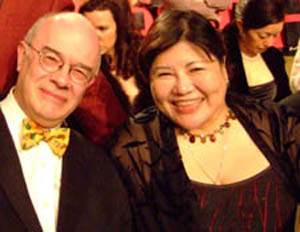
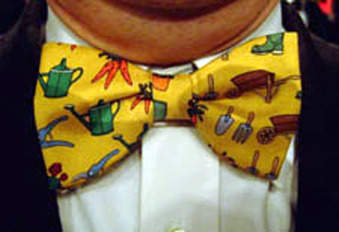
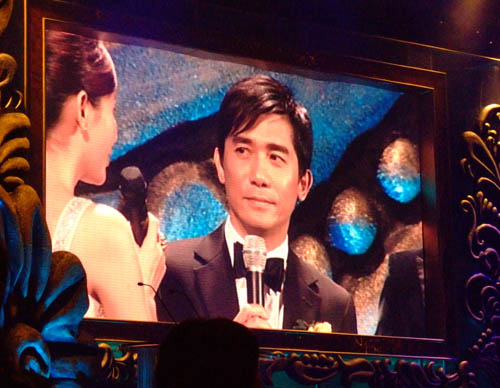
The big noise of the night was the presence of Korean pop star Rain, who brought shrieks from the crowd whenever he turned his head. Still, there was no shortage of fan response for Andy Lau and Tony Leung, the spokesman for Entertainment Expo.
The ceremony was principally in English, from a clever script written by the resourceful Grady Hendrix. Karen Mok started things off in her plummy English accent, but then David Wu showed up with his rapid-fire patter, eventually joined by Fiona Sit.
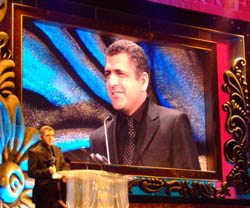
I missed some stretches because I had to go backstage before my award, but here are some pictures before and after. First, Mani Haghighi gets his screenplay award.
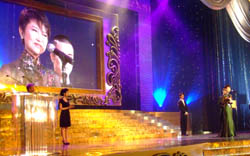
Here’s Siao Fong-Fong getting her special award:
And here’s the Korean contingent as they realize they’re on a roll:
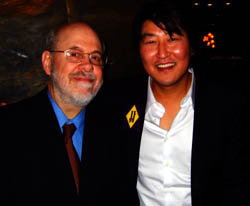
Late evening: At the afterparty, in a bar called JJ’s, I met with Grady, Stuart Levy of Tokyo Pop (who grasped the importance of Asian pop culture before nearly anybody else), his Japanese associate Matsuhashi Masashi, and several other folks—not least the indispensable Athena Tsui, who had worked very hard to make the Awards show a success. On the way out, got my picture taken with the charming Song Kang-ho.
Later evening: Quiet dinner at a great fish restaurant with pals Yuhang and Michele, including Tony Rayns sans bowtie. We had some fine dishes, including pissing prawn (don’t ask).
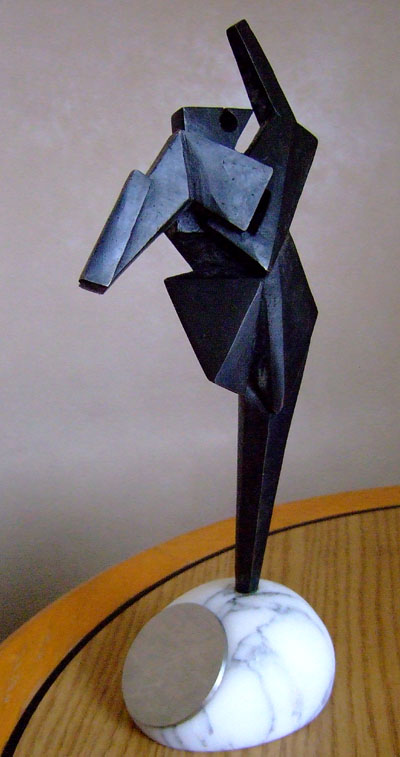
Finally: Say hello to my lee’l fren’. The awards statuettes were designed by Wong Kar-wai art director William Chang.
In the spirit of awards ceremonies: Thanks to everyone who’s helped me work on Asian film over the years, especially Tony Rayns, Donald Richie, Komatsu Hiroshi, Li Cheuk-to, Athena Tsui, Shu Kei, Sam Ho, Ding Yuin Shan, Stephen Teo, Doug Gomery, and Gabrielle Claes, along with several archives, festivals, and film distributors. Thanks also to Mr. Johnnie To, who kindly presented me with the award.
A many-splendored thing 1: Academics and premieres
This year’s Hong Kong International Film Festival is mammoth—at 23 days, perhaps the world’s longest. It’s smoothly meshed with the HK Filmart, a trade gathering for buyers and sellers, the Asian Film Awards, and a slew of other events, all under the umbrella of Entertainment Expo. The goal, Timothy Gray points out in a communique in Variety, is to confirm Hong Kong as a regional media hub.
So many things have happened to me since my arrival, and so many impressions pile up, the diary form is for now the best way I can recount my doings. In the course of my stay, I’ll try for less fragmentary reportage.
Saturday 17 March
Back in my favorite city. Plane arrived two hours late around midnight Saturday, and the Internets connection in my room didn’t work. Went to bed, got a surprising 8 hours’ sleep.
Sunday 18 March
Joined my friends Mette Hjort and Paisley Livingston for a shopping expedition with their kids Erik and Siri to Sha Tin, a megamall in the New Territories. That night I stayed with them in their newly renovated home in Sai Kung, with calming views of a park and a bay. Slept 4 ½ hours; read about Alien Autopsy, prepping for a future blog.
Monday 18 March
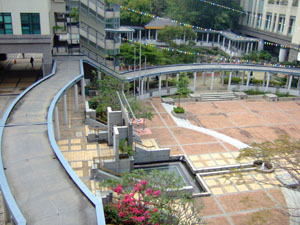
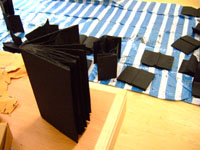
A busy day. Most of it was spent at cozy Lingnan University (one area shown above), where Paisley and Mette teach. I got a little tour and met artist-in-residence Jane Dyer, who’s working on some lovely pieces involving books. She finds ’em, shreds ’em, paints ’em black…and turns them into disquieting sculptures.
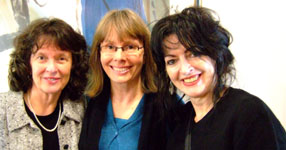
Had an informal sandwich lunch with the students in the Visual Culture program, then a more extended attack on dim sum with Mette (center), Jane (right), and Meaghan Morris, head of Cultural Studies at Lingnan and another fan of HK action cinema.
Late afternoon, I gave my CinemaScope talk, with an addendum on HK cinema’s use of Scope. Good questions afterward.
With Meaghan I rushed off to Wanchai, where she lives and where I was slated to see the new Milkyway film, Eye in the Sky, at the Convention Center. After a comical mishap involving changing taxis, I made it to the Center just as the crowd was gathering. I hovered on the edge, uncertain of what to do next, when Yuin Shan Ding, Johnnie To’s right-hand man, saw me and gestured me in.
So I walked the red carpet, waiting for somebody to stop me. I should have remembered: This is HK, where such events are unbelievably informal.
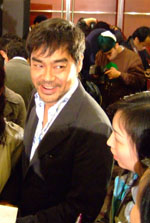
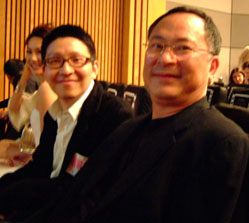
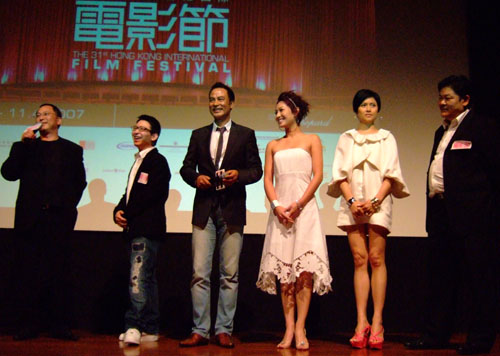
Inside I caught up with Shan and got my ticket. At that moment I met another old friend, Athena Tsui, who was coordinating things in the foyer. Behind her Simon Yam, Lau Ching-wan (above left), Johnnie To, and Yau Nai-hoi were giving press interviews in the glare of TV lights. After snapping some pix, I went in and took my favorite seat, down front and center—where I also found another old Hong Kong friend, Li Cheuk-to, bustling about seeing to a dozen matters. Soon the major players came in too. Above, it’s Yau Nai-hoi, director of Eye in the Sky, on the left and producer Johnnie To on the right.
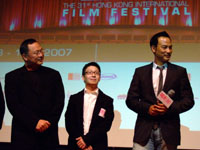
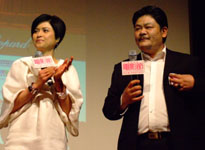
Then the ceremony started. The principals (To, Yau, Yam, Kate Tsui, Maggie Siu, and Lam Suet) got up on stage and said a few words of introduction. Simon claimed that he gained twenty pounds for his role, while Lam Suet proudly said that he had not.
Compared to To’s own directorial efforts, Eye in the Sky is more conventional genre fare. It’s very linear, giving us essentially a ninety-minute pursuit sequence. As a result, we get almost no backstory about the plainclothes cops (Yam and Kate Tsui) who are tailing heistmeister Tony Leung Kar-fai. It does recall other Milkyway films, which are often built around games of chase and disguise. It’s also very much a street film; you see a lot of the Hollywood Road area, and there are nice images of passersby caught unawares.
Here forward momentum is everything, with virtually no pauses for reflection or just catching your breath. Each scene seems caught on the fly, with aggressive smash-and-grab camerawork. Eye contrasts intriguingly with To’s Expect the Unexpected, which exhibits more control of the run-and-gun look and immerses us more thoroughly in the lives of its police protagonists. Still, Yau’s career will be worth watching, not least because Hong Kong needs to replenish its cadre of young directors.
Audience response to Eye was enthusiastic. Darcy Paquet has some quick first thoughts here.
I Am a Cyborg followed, but I have several other chances to catch it, and sleep beckons. Back to the hotel. Tomorrow, Tuesday, is the biggest day of my trip.