




Archive for the 'National cinemas: Hong Kong' Category
Cutting remarks: On THE GOOD GERMAN, classical style, and the Police Tactical Unit
DB herer:
For about ten days Kristin and I are off the grid, unable to check email, let alone blog.
In the meantime we’ll backlog some blogs (backblogs) to be posted at intervals. When we get back, we’ll probably divulge where we went.
This is a followup to my entry on The Good German of some days back. I want to talk a bit about editing technique in classical and contemporary film.
Recall that Dave Kehr’s fine reportage on Soderbergh’s Good German appeared in the New York Times. The film is set in postwar Berlin during the late 1940s, and Soderbergh is trying to film it with the production procedures of the time. He’s using boom microphones and incandescent lights, and he’s asking actors to deliver the lines in the forthright manner characteristic of classic studio acting. He’s using prime lenses of fixed focal length (as opposed to today’s zoom lenses with minutely adjustable focal length). Those prime lenses will often be wide-angle ones (e.g., 32mm), the sort that Soderbergh discovered that Michael Curtiz employed at Warners.
Soderbergh will also avoid multiple-camera shooting, which is common for most scenes nowadays; he will shoot single-camera. This has fascinating implications for staging and editing choices. Dave Kehr explains:
If there is a single word that sums up the difference between filmmaking at the middle of the 20th century and the filmmaking of today, it is “coverage.” Derived from television, it refers to the increasingly common practice of using multiple cameras for a scene (just as television would cover a football game) and having the actors run through a complete sequence in a few different registers. The lighting tends to be bright and diffused, without shadows, which makes it easier for the different cameras to capture matching images.
The advantage for directors is that they no longer need to make hard and fast decisions about where the camera will go for a particular scene or how the performances will be pitched. The idea is to pump as much coverage as possible into the editing room, where the final decisions about what goes where will be made.
The danger for a director is that with so much material available, the original vision may be drowned or never really defined; and the sheer amount of exposed film makes it possible for executives to step in (after the director has completed his union-mandated first cut) and rearrange the material to follow the latest market-research reports.
During the studio era it was more typical for directors to arrive on the set, block out their shots and light them with the use of stand-ins; the actors were then summoned from their dressing rooms and, after a brief rehearsal, they would film the lines needed in the individual shot. The crew would then break down the camera and move it to the next setup, as determined by the director.
“That kind of staging is a lost art,” Mr. Soderbergh said, “which is too bad. The reason they no longer work that way is because it means making choices, real choices, and sticking to them. It means shooting things in a way that basically only cut together in one order. That’s not what people do now. They want all the options they can get in the editing room.”
While the editing process now routinely takes months, “I had a pretty polished cut of ‘The Good German’ two days after we wrapped,” Mr. Soderbergh said. “It was shot to go together very, very specifically.”
Let’s start with the concept of coverage.
Shooting to Protect
Consider a traditional conversation scene.
In the classical Hollywood style, most such scenes were shot with a single camera. (In the silent years, big films would be shot with a second camera to provide a negative for foreign markets. This means that in some films, the overseas versions were slightly different, shot for shot, from their US counterparts.)
Your conversation scene will be edited. So how do you film it? Working with only one camera, directors developed procedures for “covering” a scene.
Here’s the default. The entire scene would be played out in a single, distant take, usually called the master shot (sometimes “master scene”–for a long time, filmmakers confusingly called shots “scenes”). The master shot provided an uninterrupted record of the whole scene, and thus served as a reference point for overall set geography, where actors were standing, and so on.
Once the master shot was finished, the filmmakers went on to break the scene down into closer positions. That meant repeating portions of the scene already played in the master. They shot the medium two-shots of the actors talking, the shots of each actor taken from over the shoulder of the other actor, the singles of each player–which might be medium-shots, medium close-ups, or close-ups.
(Sometimes the filmmakers also shot inserts, the detail shots of objects or printed matter that would be inserted into the action, but usually they were filmed another time, or by an entirely different crew under the supervision of an assistant or second-unit director. Often the hands we see in an insert close-up aren’t those of the actor.)
For each different camera position, the actor would have to repeat the relevant bit of dialogue, gesture, or whatever that had already been played out in the master. Must have gotten boring, no?
The question arises: How much coverage do you shoot? Do you have to film from all those angles, and do you have to repeat everything to the max?
One answer says yes. Overshoot. This is the shoot and protect option. Film lots more footage than you can possibly ever use. Film is cheap, and you want lots of options in the editing room. Since in the studio system, directors rarely supervised the editing of their films, the editor worked with the producer, and the producer wanted to readjust the film in the cutting phase–inserting a close-up of the star, tightening the pace, and so on.
Shoot and protect is an insurance policy, and producers still insist on it. In The Way Hollywood Tells It, I quote Swedish cinematographer Sven Nykvist’s remark that American directors shot a lot more coverage than European ones. “I believe that comes from the fact that producers usually have the final cut and they want to have all the material they can get.” In the studio era, producers might want changes and demand reshoots of portions of scenes so the sequence would cut together better.
During the studio era, the most famous director who relied on overshooting is George Stevens. In an interview with Kristin and me, William Hornbeck talked about how Stevens was maniacal about reshooting the scene from every angle he could think of. Then he would run the footage over and over, trying to decide what takes to use. One result of this is a fairly choppy style. The barroom fight in Shane is almost wholly created in the editing room, and some of the cuts are downright clumsy.
Or take the barbecue scene of Giant, where the cuts struggle to extract a throughline of action. Elizabeth Taylor stands on the edge of the crowd, and abruptly Stevens dissolves to an extreme long shot of the festivities.

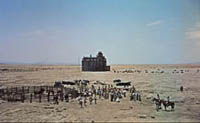
So is the scene ending, as such a reestablishing shot might suggest? No, because we dissolve again to her, now walking to the tree in the foreground, captured in a high angle from a crane.
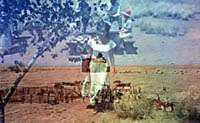
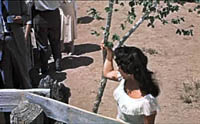
Most directors would have moved Elizabeth Taylor away from the crowd in a single tracking shot, letting the camera follow her approach to the tree. Stevens apparently hadn’t planned or filmed such a shot, so he had to use two dissolves, although there doesn’t seem to be a time lapse. Once Liz gets to the tree, the high angle obscures her face and gesture, so a cut tries to clarify:
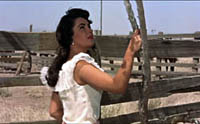
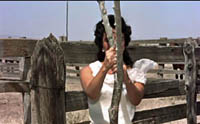
Stevens cuts to a head-on shot of her starting to swing around the tree. But she doesn’t get a chance to complete this gesture because the tree blocks her face and arms. So Stevens cuts away to James Dean, already walking leftward to the car–another interrupted action.
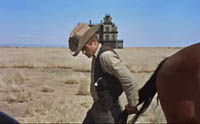
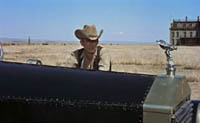
Dean settles down to watch the barbecue from a distance, but instead of getting anything resembling a point-of-view shot, we go back to the uninformative high angle, in which a cowpoke offers Taylor a drink.
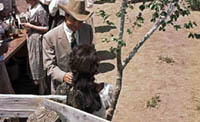
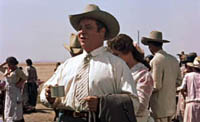
We can’t really see the first man’s gesture, or her reaction, so the dialogue has to carry the whole scene. And this action is interrupted again by another man proposing a toast to the couple. The high angle adds nothing to the scene. Didn’t Stevens film this bit of action from a more straightforward setup? If not, maybe he didn’t protect himself. Whatever happened, this passage seems to be very awkward filmmaking.
Granted, the cuts between Taylor and Dean do parallel them as outsiders and prefigure their alliance later in the film. But the same points could be made with smoother cuts and greater integrity of gesture. The scene’s fragmentation prefigures today’s interruptive editing.
Someone might argue that the jumpy cutting conveys something expressive about the scene (maybe Taylor’s anxiety about making a mistake in front of her new husband’s friends). But this is an all-purpose alibi, which can be invoked to defend any case of poor craftsmanship. My shot’s out of focus because…um…the hero’s uncertain of his identity. Moreover, if we defend the cutting as projecting Taylor’s anxiety, we’re tacitly granting that the scene has failed to convey that through performance, staging, and other techniques.
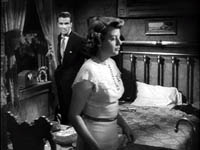
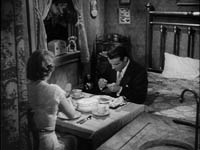
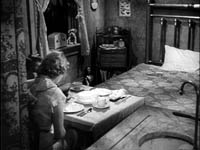
Lest it seem I’m being too mean to Stevens, I’ll just point out that occasionally he took some chances, even using single-shot high-angle staging reminiscent of Mizoguchi. Here’s an example from A Place in the Sun.
Shooting Cut to Cut
“Shooting for protection” sounds a bit defensive and wussy, like you’re afraid to make a choice. Suppose you try another tactic. Suppose you shoot only what you think you will finally cut together.
You might still shoot the master shot for insurance, but maybe not. On the whole, you’d shoot only the angles you’d decided on in advance, or perhaps you would add a few pieces for protection. Basically there would be only one way to cut the scene together. This was called filming “cut to cut” or “cutting in the camera.”
Hitchcock is the most famous exponent of this tactic, thanks largely to his claims that he preplanned everything that appeared on screen. After working out the script, shot lists, and storyboards, he knew exactly what he wanted, he said, and so the actual filming was a little tedious. I think he once remarked that he wished he could phone a film in. In truth, Sir Alfred exaggerated the precision of his planning. Bill Krohn’s excellent book Hitchcock at Work debunks “the myth of the storyboard” (which were often made after filming, to show reporters) and Krohn offers several examples of set improvisation, last-minute changes, tightening during editing, and so on (pp. 9-16). Nevertheless, on the whole Hitch probably shot significantly less coverage than most directors.
So too, evidently, did John Ford. Ford didn’t pre-plan his films to the minute degree Hitchcock claimed, but he achieved enough power in the system to avoid the shoot-and-protect method. According to editor Elmo Williams, whom I once asked about this, Ford had the reputation of giving his cutters almost no range of setups to choose from. If you give ’em a close-up, he supposedly said, they’ll use it. Ford apparently kept track of all the shots he wanted in his head, which may explain some of the mismatches that we find in his films. But it did mean that when the shooting was finished, he could hand the footage over to an editor and go out on his boat.
Another director who filmed coverage sparingly was W. S. Van Dyke, known as Wun-Shot Woody. You can read more about him here.
So there are degrees of coverage, from the maximal coverage of shoot-and-protect to the minimalism of cutting in the camera. Of course you can avoid coverage altogether by shooting your scene in a single take, from a single position (as Hou Hsiao-hsien often does) or with a moving camera. Producers hate this. Christine Vachon calls it “a ‘macho’ style that leaves no way of changing pacing or helping unsteady performances” (The Way Hollywood Tells It, 153). The director who doesn’t provide extensive coverage is a producer’s nightmare.
Camera A + Camera B + Camera C…+Camera N = ?
What about shooting the scene with more than one camera? Before the 1970s, multiple cameras were used chiefly for action sequences, and especially for things that couldn’t be repeated, like an explosion or cars hurtling off a cliff. Multiple cameras were also used for a brief period when sound first came in; watch nearly any film from 1929-1931 on Turner Classic Movies, and you’ll see scenes filmed much as TV sitcoms and soaps are filmed today, with several cameras. (For more on this, see The Classical Hollywood Cinema, Chapter 23.)
On the whole, though, multiple cameras were rarely used until some time in the early 1980s, when shooting schedules were accelerated. Faced with the need to turn out more footage quickly, directors began using “B” cameras to pick up alternate angles. Now a big picture may have “C” camera plus a Steadicam roaming around to grab details. One of my favorite quotes (in The Way, p. 154) is from John Mathieson, DP for Gladiator, who after explaining that by using seven cameras for some scenes, “I was thinking, ‘Someone has got to be getting something good.'” The old Hollywood directors, thinking through the scene shot by shot, knew when they were getting something good; now everybody just hopes.
In effect, as Dave Kehr’s article implies, multiple-camera shooting is today’s equivalent of classic coverage. Soderbergh is right to note that this practice postpones decisions until the editing stage. But it has other knock-on effects on the way the movie looks. I’ll consider just two, which I expand on in The Way.
1) Having reams of footage tends to speed up the cutting rate. Rather than sticking with a few angles, directors offered many choices tend to like a little bit of angle 1, the middle part of angle 2, another stretch of angle 3, and the last bit of angle 4. Four shots arise in the editing process, when maybe a single well-chosen one would do the job.
There are many sources of the fast cutting that rules contemporary cinema, but probably the practice of shooting with A, B, C, and N cameras is one.
2) Multiple camera shooting limits the freedom of camera position that single-camera shooting allows. Obviously, you can’t put Camera B in a position where it will be seen by camera A. In fact, you tend to keep all the cameras at a fair distance from the scene, using long lenses to enlarge the actors.
The implication is that the cameras really don’t work their way into the space as much as they do in single-camera shooting. You can’t put the camera between characters as easily, so Ozu’s characteristic frontal framings aren’t as feasible. Or, going back to Soderbergh’s beloved 1940s, take the variety of angles we find in the conversations between Spade and Gutman in The Maltese Falcon. These can’t easily be replicated with multi-cam staging.
Medium two-shots are also problematic with multiple cameras. (Hence perhaps all the singles and close-ups we get in contemporary films.) And all cinematographers grant that lighting an overall scene so that it looks right from several camera angles requires many compromises.
So I look forward to seeing how, in an age when single-camera coverage is rare, Soderbergh will handle these matters. Will The Good German‘s cutting rate be slower than is common nowadays? (The 1940s and early 1950s saw the widest disparity in average shot lengths in Hollywood’s history, from very short shots to ASLs over thirty seconds.) Will the camera penetrate the space in the manner of the ubiquitous setups of the studio years?
Finally, I’d just like to note that Soderbergh didn’t have to return to the 1940s for inspiration. Classic techniques of coverage, even cutting in the camera, are amply on display in other cinemas.
Mackendrick’s Axiom
Today’s choppy editing style is interruptive rather than integrative. A typical director today doesn’t let a shot ripen to full implication. The cut interrupts the shot rather than coming at the moment that will carry forward what’s been developing in the image.
The British director Alexander Mackendrick once suggested that at each moment the director must prepare the audience for what is going to happen next. If you’re really good, shot A prepares not only for B but for C and D as well. You can study this process in Lang, Ford, Hawks, and other classical directors, but it’s still visible today, I think, if we know where to look.
Yes, the answer is Asian cinema again. Hong Kong, no less.
Johnnie To Kei-fung began his career in television in the 1970s, made a feature in 1980, and returned to shooting TV series in the early 1980s. He shot single-camera cop shows, martial-arts shows, and other dramatic shows. No shot lists, no storyboards–no time! Given the brisk schedules of TV shooting, To mastered the ability to film one shot while thinking about the next three, the way a chess master conceives a string of moves. He makes the determining decisions about the sequence in the flow of production, then fine-tuning them in editing.
Johnnie To shifted to feature filmmaking in 1986, and he has turned out more than forty films since. Sometimes he finishes three films in a single year. His output includes many extraordinary achievements, such as Lifeline (1997), The Longest Nite (1998), Expect the Unexpected (1998), A Hero Never Dies (1998), The Mission (1999), Throw Down (2004) and several others. His two films about Triad life, Election 1 (2005) and Election 2 (2006) have received wide attention, as has his most recent release, Exiled. These last three have been picked up for US theatrical release.
His style can vary a lot from film to film, from the frenetic action of A Hero Never Dies to the hairtrigger poise of The Mission. But in each case you detect a director who makes his stylistic choices and sticks to them. He can structure a scene in his head and he can shoot the result efficiently. He is, we might say, today’s Woody Van Dyke. Except he’s quite a bit better.
Here’s a sequence that exemplifies Mackendrick’s axiom.
During the climactic gunfight of PTU (2003), a female police officer fires at a gunman. He fires back, and she drops her pistol as she dives back into her car. Then the cop Lo, the hapless slob we’ve been following, seeing the gunman about to fire, dashes out of the shot. This is followed by a shot of the gunman swiveling and firing.
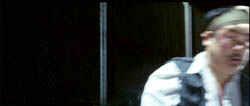
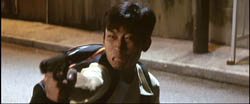
The next shot is the crucial one. Through a rain-speckled car windshield we see Lo fleeing.
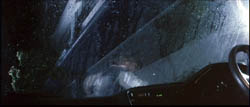
Why shoot from this fancy angle? It does two things at once. It tells us about the fleeing cop’s progress, continuing the action of the earlier shot of him, but it also puts us in the car, implying that the next phase of the action will take place here, rather than on the street. And so it does:
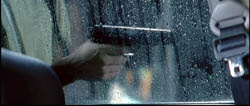
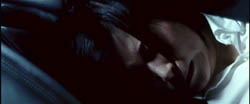
The wounded gunman staggers against the car, and again, instead of seeing his progress from the outside, we’re in the car. We don’t need to see his face, only the gun: director To films the danger. This shot expands on the previous one, keeping us in the front seat, and then gives us new information. The camera tilts diagonally to the policewoman crouching below the window.
The suspense is heightened when To cuts back to the pistol, bumping along the glass.
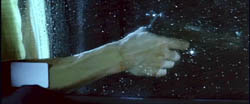
Will the gunman look inside the car? The movement of his arm is continued smoothly in a new angle:
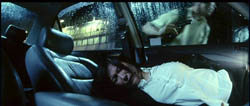
….as he rushes off to the right in pursuit of Lo. Director To gives us both action and reaction in the same concise shot. The policewoman sobs in relief, and this sub-sequence ends with a pause on her.
The sequence has broader implications as well, since this officer has been suspecting all along that Lo has lost his pistol (which he has). Now she has lost hers. After the smoke has cleared, Lo strolls back to her, and the shot echoes the earlier shots taken through the windshield.
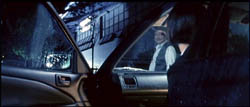
The irony dawns on her–in the heat of battle, it’s easy to lose your weapon–as she glances down at her discarded gun and retrieves it.
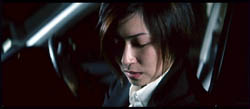
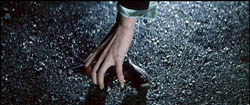
This sequence couldn’t have attained such precision if it were filmed with several cameras snatching shots, hoping to get something; nor with shoot-and-protect coverage. The passage is conceived cut to cut, in the director’s head. Each shot makes one or more points succinctly and leads us crisply to the next bit of action. When I asked Mr. To about the shot of Lo fleeing, seen through the windshield, he seemed surprised that I’d wonder. “Of course! You have to let people know they’ll see her in the car.”
This, that, and the other
1) People who know Kristin primarily as a film scholar probably don’t know that she’s also the librarian/curator of the P. G. Wodehouse papers. Every couple of years she goes to England to organize and preserve the papers that the family has acquired since her last visit. She first worked with the papers when she wrote her book on Wodehouse, Bertie Proposes, Jeeves Disposes; or, Le Mot Juste, an appreciation of the inimitable Wooster novels. For the last few days Kristin has been there working on the collection, and out of the range of the Internet; so no new entries from her. When she returns, expect a followup on her “How to read the box-office figures” post.
2) During her absence I’ve been busy with research projects. One involves scene transitions in Hollywood movies. When Kristin, Janet Staiger, and I were working on the book, The Classical Hollywood Cinema, I got interested in how movies moved the viewer smoothly from one scene to the next. Often, we found, a line of dialogue, a sound, or an image at the very end of Scene A somehow linked to Scene B. We called these “hooks,” and talked a little about them in the book.
Recently I got curious about the problem again and as I was thinking about it, I saw a piece by Karl Iglesias, called “8 Ways to Hook the Reader,” Creative Screenwriting 13, 4 (2006), 48-49. (It doesn’t seem to be available online.) Igelesias spells out various ways in which screenwriters tie scenes together. Interestingly, our term hook seems to have entered screenwriters’ parlance a little bit.
I gave a rather sketchy talk on the question here at Madison last Thursday, and got helpful feedback from faculty and grads. Seems like everybody had a good example, from Jerry Lewis movies to The Family Guy. So I hope to develop this talk into a lecture I can give elsewhere. Eventually I expect it will end as an online essay elsewhere on this site.
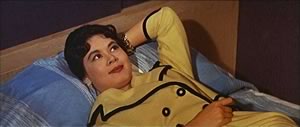
Les Belles
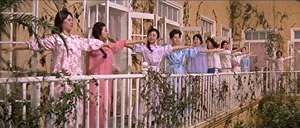
Les Belles
3) My other current research project is looking into the development of anamorphic widescreen filmmaking in Hong Kong. In the early 1960s Shaw Bros. introduced ShawScope, a system similar to CinemaScope’s sprawling format. I’m interested in how directors used this new technology, and whether they followed the same paths as Americans did in working with CinemaScope. Did ShawScope slow up their cutting or staging? Did they find alternative ways to compose for this wide format?
Despite the rather tedious plots, I’m enjoying watching the films because they’re so striking at the level of lighting and color design. If you’re curious, have a look at Les Belles (1961) or The Love Eterne (1963). Really stunning color coordination, with both saturated tones and pastels popping off the screen–so different from the murky monochrome we like now. To get such brilliant, almost shadowless imagery in a period of slow film (ASA 50!), you have to drench your sets in light. How can actors remain so chipper when they’re blasted by so much light and heat? The crew had to wear sunglasses when working on these movies. This article is for a collection of essays called Widescreen Worldwide, edited by John Belton and Sheldon Hall.
4) My old friend Brian Rose writes to tip me off to Malcolm Gladwell’s New Yorker article on Epagogix, the software program that purports to predict what films will be commercial hits. This program has been flashing into view in the trade papers over the last few years, but Gladwell (aka Mr Blink) is the first to give it long and detailed discussion. I hope to assimilate it over the next few days and maybe Kristin or I will blog about it.
5.) As a new blogger, I’m still learning a lot. (Okay, you already can tell that.) But as I scan our Statistics counter for this site, I’m impressed all over again by the sheer weirdness of the Web.
Take the keywords that bring people to our site. I expect to see our names, Film Art, Scorsese, and so on. But I have to admire any search engine that can fling onto our site someone typing the following strings:
jack vermee
bonfire
lingua film di toto’
Christian film
zizek mao
Chinatown first act
and my current favorite:
where can I find photos of jerry van dyke
Of course now that I’ve listed these topics, I expect a lot of repeat business for them.
Speaking of Asian film….
Did you know that South Korea represents the fifth largest theatrical box office in the world? (More than Germany.) Or that Korean films and TV shows are sweeping Asia, with middle-aged ladies in Japan and the PRC swooning over SK pop stars? Or that Hong Kong star Andy Lau Tak-wah (Infernal Affairs, As Tears Go By, Running Out of Time) has been in 130-plus movies?
Variety for October 9-15 has a nice supplement pegged to the Puchan Film Festival detailing what’s on there. Kristin and I went once, and we had a great time (despite my coming down with pneumonia). It’s fall’s most important Asian film festival, with Hong Kong playing a parallel role in the spring. Online you can go to VARIETY or SCREEN INTERNATIONAL.
This year’s outing gives the award for Asian Filmmaker of the Year to Andy. He is of course a major pop idol–singer, TV star, film star, and model for fashion, shoes, watches, cameras, and God knows what else. After twenty-five years in the business, he still has charisma; I’ve seen a stadium full of teenage girls burst into a frenzy, screaming, “Tak-wah!”
Andy’s used his clout to benefit local and regional cinema. His production company Focus has supported a lot of recent work, notably Crazy Stone, and his First Cuts program underwrote such films as Patrick Tam’s After This Our Exile and Ou Yuhang’s Rain Dogs. (On the last, see my Vancouver blogs). And Andy is only 45 (though he looks about 30, dammit).
DB
THE DEPARTED: No departure
David here:
I’m usually a terrible prophet. But when I first saw Infernal Affairs (2002), I decided that Hong Kong filmmakers had finally made a Hollywood film. Comprehensible exposition, intricate plotting, and well-earned twists have never been strong points of local cinema. I tried to show in Planet Hong Kong that this filmmaking tradition favored episodic construction and virtuoso staging and strictly organized visceral arousal. But in IA Andrew Lau Wai-keung and Alan Mak Siu-fai produced a tit-for-tat crime movie with ingenious intrigue and a density of characterization.
Filled with both top-line stars and powerful character actors, it proved a box-office sensation across Asia, triggering an ambitious prequel/sequel and a strange third installment that is much more like the scattershot Hong Kong movie a lot of us have come to love. Now IA has become the first local film to be remade overseas. Nice as it is to see Media Asia highlighted, the credits of The Departed offer only a stingy mention of the source.
The Departed has been hailed as a big comeback for Scorsese, a filmmaker who has had as many comebacks as Woody Allen, usually to as little effect. The critics are going nuts. “A new American crime classic,” declares Rolling Stone. Newsweek‘s reviewer grants that the Hong Kong original is “terrific” but in the next sentence declares that “Screenwriter William Monahan has done a terrific job transposing the story to ethnically fraught Boston.” Terrific reviewing too: No wonder people turn to the Internet to get less packaged commentary.
Even though IA leaned toward Hollywood, the differences are instructive. (Spoilers in this and the next paragraph.) Structurally, The Departed swerves from the original in a way that softens its impact. In IA, the final twist leaves the Triad mole in the police alive and victorious. In a local context, this ending gains a powerfully bleak effect. A Hong Kong movie hero needn’t survive the final confrontation (he even gains in stature from dying grandly), but the villain is seldom left standing.
In most respects Monahan’s script adheres to the original beat by beat, or rather bleep by cellphone bleep. But the American ending is oddly more faithful to the Hong Kong mainstream. Now our hero doesn’t die in vain. The bad dude is paid back, thanks to a contrived in-case-of-my-death message sent to the shrink-girlfriend whom the two protagonists share. Ironically, Monahan’s ending is akin to the obligatory punishment on display in the version of Infernal Affairs reshot to placate Mainland China’s censors. Maybe American and Chinese tastes align more than we think.
Most reviews have warmly welcomed the return of the tone of GoodFellas and Mean Streets, but I’m more hesitant. We’ve seen a lot of this before. Again guys cuss a lot and make sexist jokes. (The first ten minutes have three references to menstruation, none complimentary.) Again confrontations and whackings are underscored by boomer rock tunes. And again the camera swaggers. Scorsese’s visual bravado was always a bit overhyped; did he bequeath us the idea that every scene had to have “energy”? This time out the tricks seem to me forced; I didn’t think we needed so many cut-off pans and swiveling camera moves.
Apparently Scorsese originally wanted something a bit fresher, as we learn from the October American Cinematographer (eventually to be online here). He asked Director of Photography Michael Ballhaus to study not only master cinematographer John Alton’s movies for Anthony Mann (T-Men, Raw Deal) but also hard-edged Korean neo-noir like Oldboy (Park Chan-wook, 2003) and Bad Guy (Kim Ki-duk, 2001).
By asking me to watch those wild Asian movies, I think Marty was pushing me to try something different. I tried to do that, but after a couple of days on the shoot I realized that although the styles of those movies were great for the particular stories they were telling, we were doing an American movie with American stars. In the end, I had to pull back a bit from those wilder styles; I couldn’t go that far with this movie (p. 38).
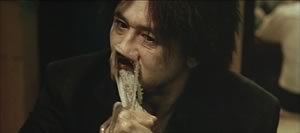
Maybe that’s the problem. Wild films don’t get nominated for Academy Awards. True, wild performances do, but even satanic Jack probably wouldn’t eat a big live squid (as does the hero of Oldboy, right). Long ago Taxi Driver inspired Hong Kong filmmakers to push harder, but instead of replying in kind, Scorsese/Ballhouse leave it to B entertainments like Crank, Torque, Running Scared, and Domino to nudge Hollywood toward Asian extroversion.
Even more eagerly than The Aviator, The Departed embraces what I’ve called “intensified continuity.” (See Film Art Chapter 6 and The Way Hollywood Tells It, Part 2) In this style, conversation scenes feature very little movement of actors around the set. Performers sit or stand and deliver their lines in isolated shots (singles) or over-the-shoulder (OTS) setups. The visual stasis is compensated for by lots of cutting, camera movements, and tight close-ups.
The Departed has calmed Scorsese’s urge to track a bit, but that’s balanced by its over 3200 cuts. The result is an average shot length (ASL) of about 2.7 seconds. Not unusual for an action picture nowadays, but consider where Scorsese started by conning these ASLs:
Mean Streets 7.7 seconds
Alice Doesn’t Live Here Anymore 8.0 seconds
Taxi Driver 7.3 seconds
King of Comedy 7.7 seconds
Gangs of New York 6.7 seconds
The Aviator 3.6 seconds
Like his contemporaries, Scorsese has succumbed to the fast-cut, hyper-close style that has made our movies so pictorially routine, however well-suited they may be for display on TV monitors and computer screens and iPods. In 1990 he seems to have realized that he needed to pick up the pace. Of GoodFellas (ASL 6.7 seconds) he remarked: “I guess the main thing that’s happened in the past ten years is that the scenes [shots] have to be quicker and shorter. [GoodFellas] is sort of my version of MTV. . . but even that’s old-fashioned” (The Way Hollywood Tells It, p. 152). (For more on measuring ASLs, see the Cinemetrics site here.)
Speaking of editing: It’s blasphemy, but I’ve been long convinced that Scorsese’s films aren’t particularly well-edited. Look at any conversation scene, particularly the OTS passages, and you’ll see blatant mismatches of position, eyeline, and gesture. Spoons, hands, and cigarettes jump around spasmodically. In The Departed, Alec Baldwin somehow loses his beer can in a reverse shot, and in the swanky restaurant, it’s hard to determine if there are one or two of those towering chocolate desserts on the table.
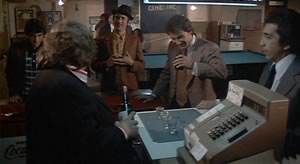
This may seem picky, but craft competence is not for nothing. Current reliance on tightly framed faces tends to sacrifice any sense of the specifics of a place. In most scenes, actors are so overcloseupped that little space is left for geography, even the mundane layout of a police station. Choppy cutting also subtly jars our sense of a smooth performance. Why can’t our directors sustain a fixed two-shot of the principals and let the actors carry the scene–not just with the lines they say but with the way they hold their bodies and move their hands and employ props? Scorsese, though always a heavy shot/reverse-shot user, held full shots to greater effect in earlier movies.
Space on a larger scale matters too. The atmosphere of Hong Kong was conveyed far more vividly in the original IA than the landscape of Boston is here. The most concrete locale seems to be a Chinatown porn theatre (filmed at New York’s Cinema Village). There’s also a gilded State House dome that is distressing in its lumpy symbolism. For more textured renderings of a parallel milieu, I’d recommend the comparatively overlooked State of Grace (1990) and The Yards (2000).
I’d love to join the applause that welcomes Scorsese back, but for these and other reasons I have to sit on my hands. For me, the inventiveness of the Asian tradition still reigns supreme in the crime genre. I grant that Infernal Affairs accepts the energy-aesthetic, with its swooping camera moves and its 3.2 second ASL. But the camera gives its actors room to breathe, and it spares some time to define a scene’s locale.
On a higher level of accomplishment stand Johnnie To’s The Mission, PTU, A Hero Never Dies, and half a dozen other films–very likely including the most recent, Exiled–along with the dazzling works of Kitano Takeshi and several other Asian directors. These are truly terrific.
P.S. 20 Oct 2006: This post on Scorsese’s Departed started a passionate and pretty discerning discussion over on Jim Emerson’s Scanners blog. You can read the thread, including my horrendously long comment, here.