






Archive for the 'Narrative strategies' Category
Vancouver: Stories, spliced and stacked
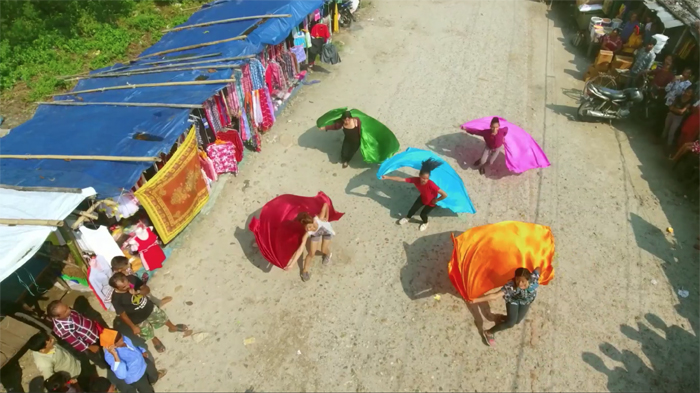
Sarita (2019).
DB here:
Humans love stories, the more the better. As a result, many storytellers find ways to bring distinct story lines together. The most common way is to link them, through subplots involving major and minor characters. Viktor Shklovsky urged us to think of folktales, novels, and plays as “braided” out of several story lines. At other times, the stories are bracketed within a bigger plot. A character tells others about incidents in childhood, or characters tell completely detachable tales, as Scheherazade and Chaucer’s pilgrims do. Instead of braiding, we get embedding within a frame situation.
I started to think again about these options watching four films at the always exhilarating Vancouver International Film Festival. All were engaging, partly because they often mixed comedy and drama in rewarding ways. They also offer a nice menu of creative possibilities, exploited by ambitious filmmakers.
Screen life
An omnibus film can offer a frame story, as the British classic Dead of Night does, but most modern ones simply line up one tale after another, in blocks. Essentially these are short stories, and they tend to follow literary patterns.
One option is the “snapper,” the plot consisting of twists and a sting in the tail, a surprise ending. Edgar Allan Poe may have invented this format, O. Henry canonized it, and Roald Dahl gave it a grisly tenor. Diverting examples of the surprise-ending story can be found in the omnibus Spanish film Tales of the Lockdown (2020).
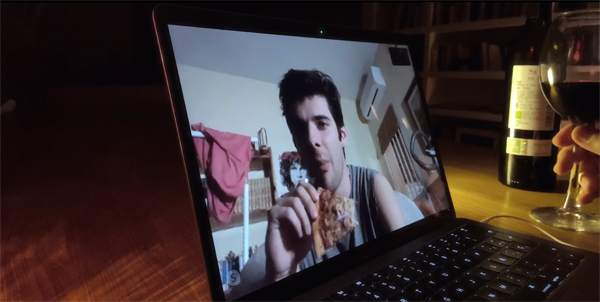
All five modules are comic, though sometimes in a macabre vein. Produced during the COVID-19 lockdown, somehow staged and shot remotely, each episode is cleverly scripted and elegantly directed. In one, a reclusive Milquetoast is pressed by an aggressive neighbor who wants to sell him a plan to expunge “bad vibrations” from his apartment. The Feng Shui saleslady gets more than she bargained for when she learns the source of those vibes.
In another, an aspiring hitman recruited by The Agency gets a remote tutorial from an experienced killer, who makes him practice techniques on a teddy bear and the dogs he snags from the neighborhood. A third, gentler episode is still tricky: we’re led to presume some things about a couple that turn out to be not valid–at least, not until the end. Sorry to be so elliptical, but films like this oblige you to avoid spoilers.
The most straightforward comedy concerns a woman auditioning by video for a TV part, aided by her husband who decides he could get a role as well. For a local audience, the fact that she is played by star Sara Sálamo and her actual husband, a Real Madrid football player, doubtless adds to the fun. The last episode, a black comedy, presents a rich couple’s extreme reaction to a tenant strike in one of their buildings.
The filmmakers have found many nifty ways to exploit the limited viewpoint enforced by lockdown. Naturally, remote conversations take place over laptops, which motivates minimal change of setting and little need for elaborate action scenes, or even ordinary staging in interiors. Offscreen action is likewise conveyed minimally, just by speech or noise in the world outside. The funniest moments in the fifth episode concern the rich couple learning they’ve received a “package” which we never see and must assume is problematic, since the thug on speakerphone says it’s “middle-aged.”
Confined settings have in effect created five “chamber plays” of the kind I’ve talked about before. This constraint allows directors to design and dress settings and find playful compositions to accentuate the plot twists that keep us glued to the screen.
In all, Tales of the Lockdown is a display of light and lively cinema craftsmanship. It’s heartening to see creative energy maintained in pandemic conditions. It premiered on Spanish Amazon Prime and would be worth looking for on that platform in other markets.
Food, memories, and the future
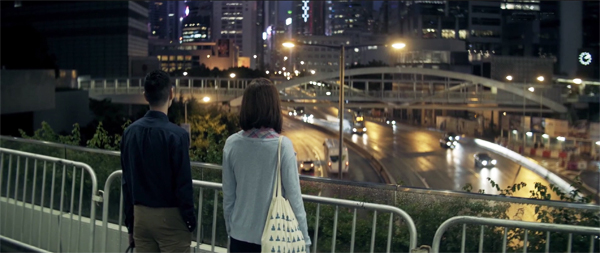
The major alternative to the twisty snapper tale is the “slice of life,” the muted drama of a situation that may change little or not at all. Here the emphasis falls on characters–their relations, their reactions, and their sensitivity to one another. The classic examples come from Chekhov and from Joyce’s Dubliners, but they’re also prevalent in what used to be thought of as the classic New Yorker short story of John Cheever or J. D. Salinger.
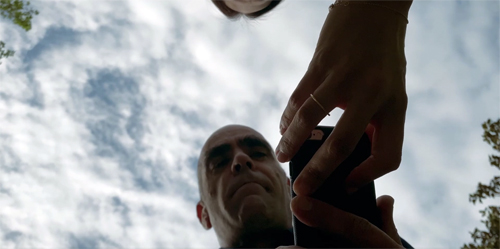
Pensive incompleteness of this sort well suits the Hong Kong film Memories to Choke on, Drinks to Wash Them Down (2019). Directors Kate Reilly and Leung Ming-kai have made three of the four stories fictional, treating them as vignettes of restrained realism. A Malay caregiver takes a grandma on an afternoon outing. She wants to go to a political rally where rice will be given out, and she hopes to meet old friends from her village. The old lady is forgetful, and her chatter recycles memories of her youth. The trip turns out to be something quite different, but she doesn’t realize it. The caregiver’s concern turns a simple duty into an act of kindness, as well as a tactful political gesture.
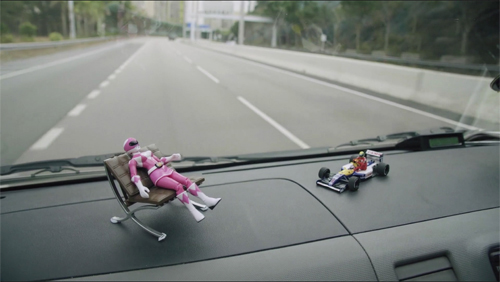
In “Toy Stories,” two brothers meet in their mother’s toy store, which is being sold, contents and all. As with the first episode, memory comes to the fore. The men play games and quarrel about the Power Rangers figures they loved. One, who has a son, tries to find something educational to bring back. He is barely hanging on financially, while his brother has lost his job. A final scene shows a bit of development in their situation, and gives room for a little hope; it’s the only episode that ends, “To Be Continued.”
The third episode is a wistful, Wongkarwai-ish almost-romance. Ruth, an American Caucasian, has come to teach in the school where John, a Chinese, teaches economics. Both are on their way elsewhere–Ruth to teach in Beijing, John to “try something different” in America. They bond over food. (Of course; this is a Hong Kong movie.) From their meeting at a vending machine to the street stalls and cheap restaurants they explore, Ruth learns of the joys of salted egg, pig intestines, and above all yuen yeung, a uniquely local mixture of tea and coffee.
These three stories quietly evoke distinctive Hong Kong culture–the older generation’s memories of moving to the colony, the Gen-X absorption in popular culture, and the particularities of local cuisine. The fourth segment builds on these in looking toward the future.
It’s a documentary showing the barista and cat-lover Jessica Lam running for a local council seat. She faces a pro-Beijing candidate, but she’s more grassroots. She’s also an amateur and runs a fairly minimal campaign. Although she does denounce police violence against demonstrators, the main force of this sequence is the portrait of a sincere young woman trying to improve neighborhood life. This is the only episode with a climax, the election-day vote count. And there is a twist when Jessica gives her final verdict on the results.
The omnibus format has proven a strong option for contemporary Hong Kong cinema, as witness the powerful Ten Years (2015). Memories to Choke On addresses not state oppression, as that did, but the politics of everyday life, the ways in which the sagging economy and the Chinese takeover ripple through the lives of ordinary people. The impact is quite specific: local audiences would know that the actor playing John in the third segment is Gregory Wong Chung-yiu, who is at risk of years of imprisonment for participation in a demonstration. Each story is a telling vignette, a slice of Hong Kong life that will engage overseas audiences and instill a mixed nostalgia in everybody who has ever visited what Chuck Norris in The Octagon (a very different movie) calls “the place.”
Camp as community
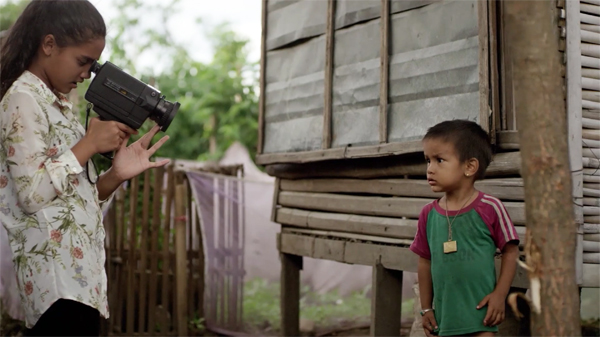
The option of embedding the stories within a frame can blur their edges more or less. Sarita (aka Tell Me Who I Am; 2019), an Italian film about refugees from Bhutan living in a Nepalese camp, could have been a straightforward documentary about problems of exile and resettlement under the auspices of the UN. Instead, it blends real-life stories of the refugees with a young girl’s quest to recover her memory. In what filmmaker Sergio Basso calls a more fanciful and energetic approach than a “tragic” documentary would give, we get a film close to magical realism–with DIY Bollywood musical numbers.
Sarita is more or less happy in the camp. She has friends to play and dance with, a school to attend, and every opportunity to worship her favorite god Shiva. But she often quarrels with her parents and wonders why they can’t go back home, a place she has never known. Shiva wipes Sarita’s memory, endowing her with the drive to ask questions of everyone around her. In this Rip van Winkle device, we are introduced to camp routines, as well as the history of her displaced neighbors.
Sarita visits her beloved teacher, only to find that he is often laid low by his injuries from torture sessions. People tell her of ethnic cleansing in Bhutan, of disappeared relatives and political oppression. Deciding that “building my future is easier than desiring my past,” Sarita turns to her immediate prospects. But her sister tells of the hardships of getting a university education. Taking her grandma to be treated for diabetes, she learns of people sleeping in a clinic as they wait days for treatment.
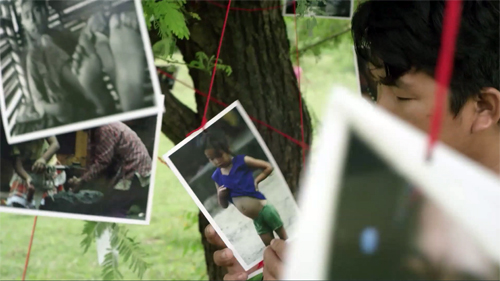
After the family is assigned a home in Oslo, she acquires a super-8 camera and cassette recorder and begins to document the life she will leave behind. Now the world she rejected seems precious. After Sarita has gone, we see her grandmother and those left behind lingering at a tree, studying mementos of their departed neighbors.
Counterpointing the harsh realities of daily routines and homesickness are moments of song and dance, in bursts of brilliant color and gymnastic choreography. We also get fantasy scenes, satires on overeager bureaucracy (the resettlement officer is a hyperactive Gene Kelly wannabe), and signs that youthful exuberance can’t be contained by drab regimentation. We hear “There is no childhood here” on the soundtrack as kids are shown inventing games and playing jacks with pebbles. The ending, however, has the poignancy of pure realism (even though it’s fictitious).
This film is an extraordinary achievement. Basso and his colleagues made it over ten years–filming without electricity and no funding from national governments or NGOs. Yet the minimal conditions enabled close collaboration with the camp residents. Seeing the children’s dances inspired Basso to make it a musical, and he gained access to local leaders. Thanks to the Kuleshov effect, Sarita even appears to interview the head of the resettlement office. Although the performers had some coaching from a theatre director and a choreographer, they clearly have natural gifts, particularly Sasha Biswas, who carries the film.
In the wake of the coronavirus, seventy Italian independent cinemas cooperated in making Sarita available on streaming platforms. There, Basso reports, it has found an encouragingly large audience. Another item to look for on the streaming menu in your area!
Visions of the good life, words of disquiet
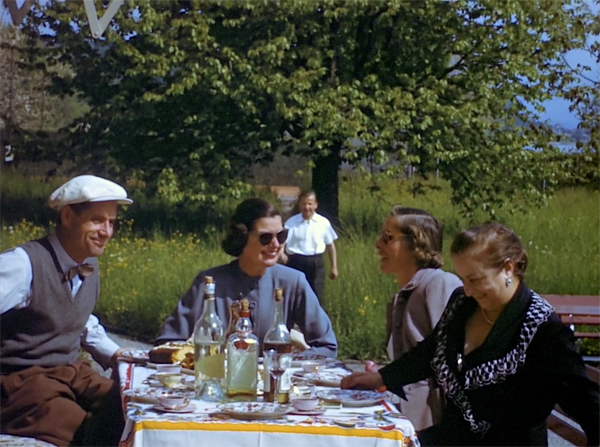
One more film about memory, but now the memories themselves are captured on film. And the stories aren’t sealed off in blocks or gently embedded in a wider frame. They’re stacked.
Again, to say too much would soften your efforts to come to grips with the teasing, hypnotic My Mexican Bretzel (2019). Think of it as layered, like a cake.
The image track consists of a Swiss family’s home movies from the late 1940s through the early 1960s. In luscious color we see a couple leading a European life of leisure: summers on the beach, winter skiing, tours of postcard capitals, yummy meals with friends in open-air restaurants. The husband, a genial, brawny fellow, clowns for the camera, but most screen time is given to his wife, a willowy brunette with a radiant smile. The landscapes might have come straight out of Holiday, that oversize American magazine dedicated to worldwide vacationing.
The next layer is a written text, purportedly a diary of Vivian Barrett. This tells of the marriage. Vivian traces the efforts of husband Leon to make and market an antidepressant. Leon’s love of flying during the war has translated into his urge to travel widely, especially on his luxurious yacht. But as the years pass, Vivian starts to record her worries, her dissatisfactions, and the temptation of taking a lover. Her musings are interrupted by remarks she finds in an untitled book by the Indian guru Kharjappalli. (Sample piece of wisdom: “God also doubts your existence.”) The couple’s lives form the outline of an Antonioni film.
Léon is making a record too. He’s wielding the Daddycam as he documents all those vacations and breakfasts and views of Manhattan, Hawaii, Las Vegas, and aqueducts. Vivian has misgivings (“If you film, you don’t have to live”) but learns to use the camera herself, and even steer the yacht.
Finally there is an exceptionally discreet effects track. The home-movie scenes are eerily silent because there’s no voice-over, but occasional noises are dubbed in, and very rarely there’s a snatch of music. On the whole, the absence of musical cues for emotion renders the pictures and the diary texts all the more powerful. (Compare the emotional tug of Jóhannsson’s score for Last and First Men, a film that also “overwrites” mysterious visuals with a text sourced to a woman.) The result is a dry, unsentimental treatment of a crumbling marriage in the midst of Europe’s postwar boom.
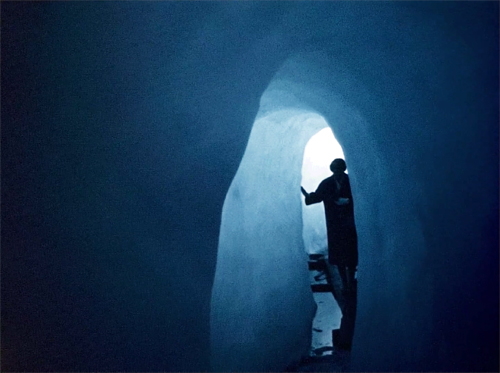
Out of 29 hours of found footage Nuria Giménez and her colleagues have fashioned a fascinating film that is at once pure documentary and creative fiction. I like to think of it as another way to assemble a narrative–at one level simple chronology of a cosmopolitan couple’s life, on another the hidden story of voyages to Italy and elsewhere. I kept seeing the ghosts of Bergman and Sanders in this couple on the modern Grand Tour.
I knew about none of these films before encountering them at VIFF, which is of course one reason we cherish this and all other festivals. Granted, there’s reassuring pleasure in seeing the latest accomplishments of established and esteemed old hands (here Ozon, Petzold, Vinterberg, Rasoulof et al.). Just as valuable, though, is the jolt of seeing newcomers present beguiling variants on familiar traditions. Three of these films, as far as I can tell, are first features, and they offer fresh takes on stories we thought we’d seen before.
All are graced with sharp cinematic intelligence and offer pointed commentary on lives lived now and back then, close to home or far away. All remind me of why this VIFF wing is called Panorama. Every movie widened my vision.
Thanks, as usual, to Alan Franey, PoChu AuYeung, Jane Harrison, Curtis Woloschuk, and their colleagues for their help during the festival. Thanks as well to programmer and consultant Shelly Kraicer for background on Memories to Choke On.
You can sample the films in their trailers: Tales of the Lockdown is here; Memories to Choke On is here; Sarita is here; and a particularly shrewd one for My Mexican Bretzel is here (incorporating, I think, footage not in the film). Giménez’s film won the Found Footage Award at Rotterdam. If you insist on knowing about how her film was made before seeing it, you can check this Film at Lincoln Center interview.
I hope other festivals, and streaming services, and even theatres will pick up all these films for wide distribution.
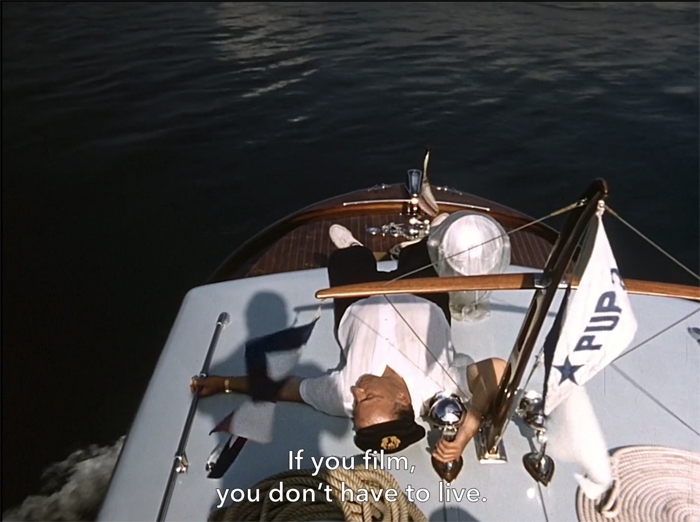
My Mexican Bretzel (2019).
Nero, Archie, and me: Preface to a new web essay
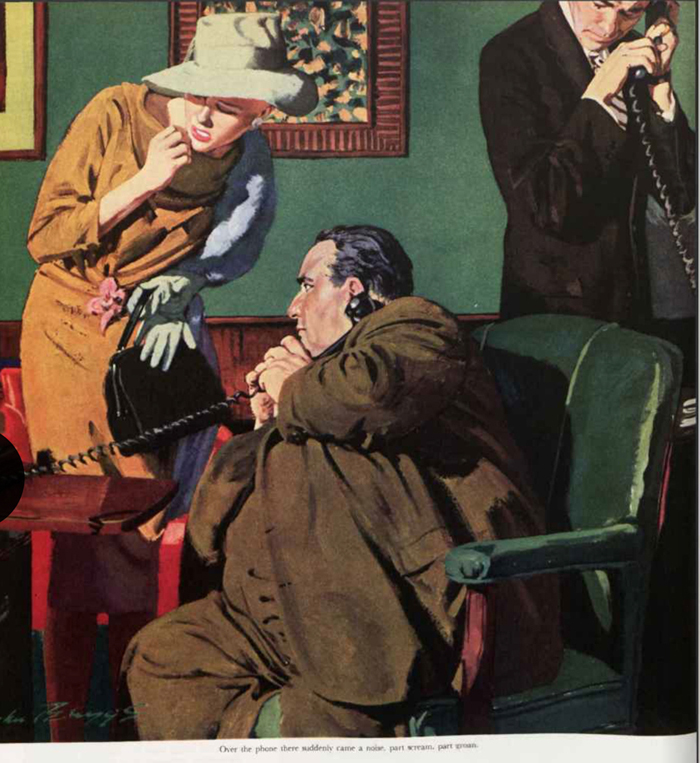
“Frame-Up for Murder” (“Murder Is No Joke”), Saturday Evening Post (21 June 1958).
DB here:
“It is impossible to say which is the more interesting and admirable of the two.” Thus Jacques Barzun on Nero Wolfe and Archie Goodwin, the characters created by Rex Stout. I’d go farther. For me they are among the outstanding figures of American fiction, and Stout is one of the finest American writers of the twentieth century.
Wolfe and Archie are detectives, and Stout wrote mystery fiction. But that just goes to prove that genre work isn’t just good “of its kind.” It’s often good, period.
Stout started as a pulp novelist. He moved to what we now call literary fiction before pursuing a variety of more mainstream genres. He wrote quasi-experimental novels (one is told backward), comic romances, lost-world sagas, and a political thriller, The President Vanishes. (Stout admitted that Wellman’s film version was better than the book.) He introduced several other detective protagonists, but he wisely concentrated on Wolfe and Archie, whom he launched in 1934 and traced through dozens of adventures until his death in 1975.
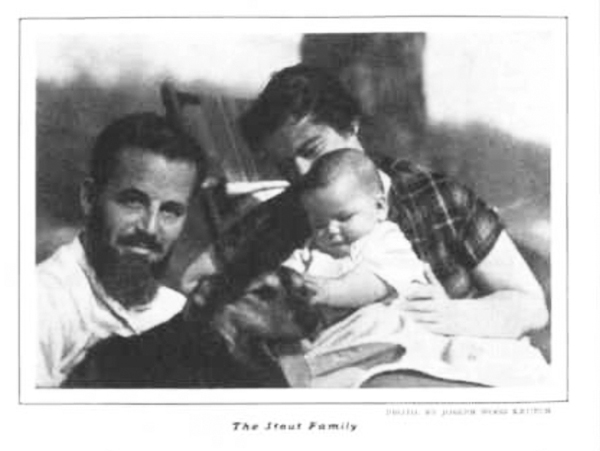
Here is Stout with his wife Pola and daughter Barbara in 1935.
Are these stories still read? I hope so. When I quizzed the grad students in my seminar this spring, most seemed unaware of what for me–and, I think, other baby boomers–were major figures in popular culture. It’s partly because the ancillary media never did a good job spreading the word. The film Meet Nero Wolfe (1936) was weak, in keeping with the general failure of 1930s films to capture the strengths of supersleuths like Philo Vance and Ellery Queen. (Better were the Mr. Moto and Charlie Chan vehicles.) During the late 1990s, Bantam reprinted the books in quality paperback editions, with introductions by other writers (Westlake, Lippman et al.). There was a solid cable-TV series (A Nero Wolfe Mystery) back in the early 2000s, with a trying-a-bit-too-hard Timothy Hutton as Archie but a near-definitive Wolfe in the form of Maury Chaykin. But that’s all pretty far back now.
O well . . . . If Perry Mason can come back, maybe Wolfe and Archie can too. And they won’t be scruffy and unshaven. Archie explains: “I was born neat.” So was his prose.
Today, I’m posting a long (22,000 words!) essay on Wolfe and Archie in an effort to show some reasons they and their creator matter. Background follows below.
Research? Say rather, obsession
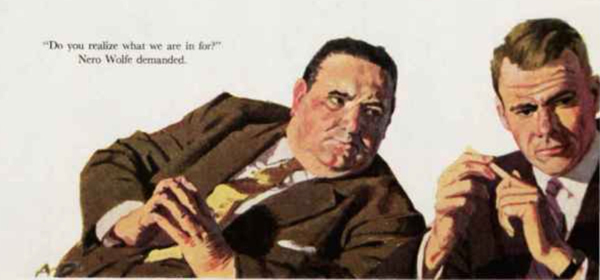
Like most academics, I try to pour my obsessions into my research. My interest in mystery stories (fiction, film, even theatre and TV) is surfacing in my current project, a book studying principles of popular narrative as they emerge in thrillers and detective stories. In a way, the book turns inside out what I tried to do in Reinventing Hollywood. There I traced film techniques to sources in adjacent media. Now I’m looking directly at those media to consider their formal and stylistic strategies, with some consideration of how film shaped and was shaped by them.
My survey covers familiar ground. I consider the classic detective story (the so-called “Golden Age” of Christie, Sayers, Queen, Carr et al.), the hardboiled writers, the suspense thriller, and the crystallization of major techniques in the 1940s (a polemical point with me). Later chapters analyze the heist plot, the police procedural, and particular writers (e.g., Cornell Woolrich, Ed McBain, Richard Stark, Patricia Highsmith). As presently planned, the book ends with an odd-couple pair of chapters: the “puzzle film” trend of the 1990s, and the domestic thriller of recent years (Gone Girl, The Girl on the Train). Some chips from the workbench have littered this blog, as the links indicate.
One of my key questions is: What has enabled readers and viewers to welcome the sort of extreme complexity that we find in movies like Pulp Fiction or Memento? We’re all now connoisseurs of narrative intricacy, in not only crime plots but science-fiction and fantasy ones (which actually often rest on mysery premises; see Devs).
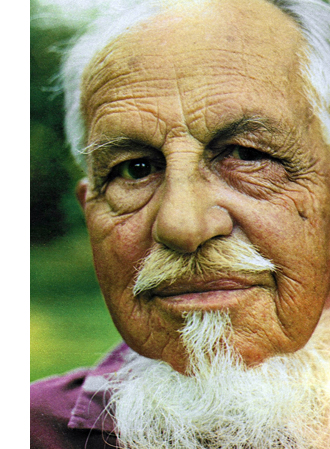 Another theme of the book is one I pitched in Reinventing Hollywood. I argued that very quickly “modernist” innovations in fictional technique were channeled into something more moderate and middlebrow. It’s there that wider audiences gained proficiency in handling flashbacks, ellipses, plunges into subjectivity, opaque exposition, and other challenges to linear storytelling. At the end of the 1920s, while Joyce and Woolf and Faulkner were pushing modernism into ever more recondite byways (Finnegans Wake, The Waves, The Sound and the Fury), other writers were adapting advanced techniques to traditional ends.
And traditional genres. I’ll argue that modernist experiments provided some strategies that mystery writers could recast within the bounds of their tradition. Stout’s first two serious novels, How Like a God (1929) and Seed on the Wind (1930) joined the trend toward mainstreaming modernism. By 1930 he had fully absorbed what the 1910s-1920s writers had achieved. What’s less obvious is the mark of modernist writing on his reader-friendly detective stories. Yet one lesson of modernism, I think, is the need to play with language, to “defamiliarize” literary texture. That, I think, is one of the tasks Stout took on in the Wolfe saga.
I had planned to include a chapter on the Wolfe/Archie series, but what resulted was far too long in comparison with its mates. So I’m posting it online as an essay. A shorter version will show up, somehow, in the finished book.
Luckily, thanks to the Internetz, the essay’s web incarnation can include some illustrations from magazine publication of the stories. Since most of the books’ drama takes place in Wolfe’s office, artists are challenged to find nifty ways to show people grouped around a desk.
I hope, then, that fans of the series will find some ideas and information of interest. Above all, I hope what I’ve said here and there will stimulate novices to venture on one of the great exercises in American popular storytelling. If you don’t care for it, all I have to say is: Pfui.
There are many good websites devoted to mystery fiction. The most comprehensive is Mike Grost’s. You should also look into Martin Edwards’ fine blog Do You Write Under Your Own Name? See also the official Wolfe Pack site, full of links and assorted Stoutiana. John McAleer’s biography Rex Stout (Little, Brown, 1977) is vastly informative. Stout was not only a great writer but also a fascinating man.
P.S. 8 July 2020: I’ve just learned that jazz pianist Ethan Iverson has posted on his site “Comfort Food,” a superb appreciation of Nero and Archie’s world. He discusses all the books, and even includes a page of Stout’s FBI file!
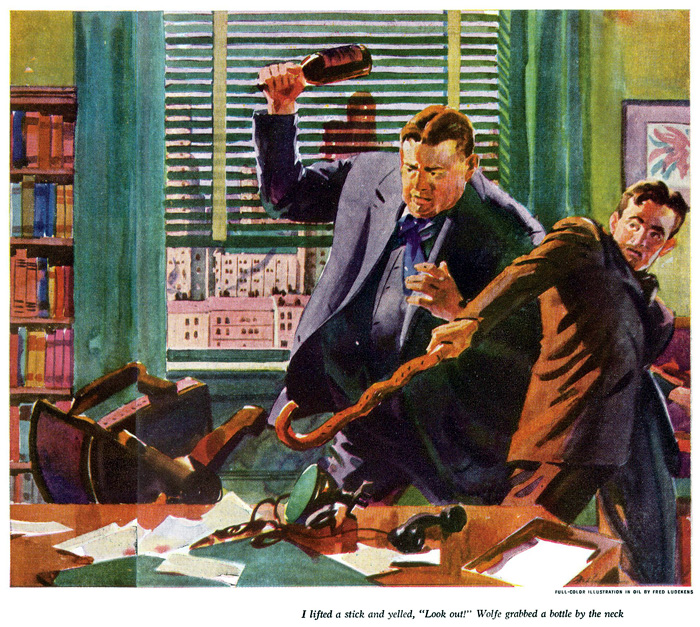
Fer-de-Lance, serialized as “Point of Death” in American Magazine (November 1934).
Who will match the Watchmen?
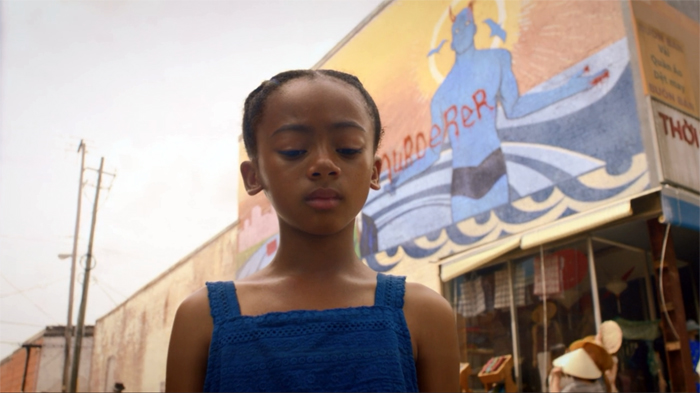
Watchmen (2019), Episode 7.
DB here:
If we want to understand the craft of filmmaking, we should pay attention to what filmmakers say about their technique. Sometimes we have to confirm what they tell us with other evidence and the onscreen results, but practitioners usually offer unique angles on their creative choices. For this reason I found it fascinating to come upon what Director of Photography Gregory Middleton had to say about his work on HBO’s limited-series Watchmen.
I had read the comic back in the 1980s and was intrigued by its experiments in pictorial storytelling. I’d also seen the movie, which I thought not as adventurous as the book and vitiated by the book’s adolescent nihilism. (Your mileage may vary.) But Middleton’s interview made me watch the series. So I thought I’d use this anxious pause in normal activities to share some ideas with you.
Middleton has a lot to say about the visual design, such as the sort of lenses he used to get startling depth effects. These echo some common graphic-novel compositions.
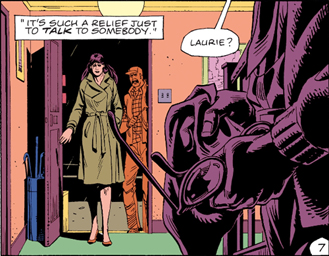
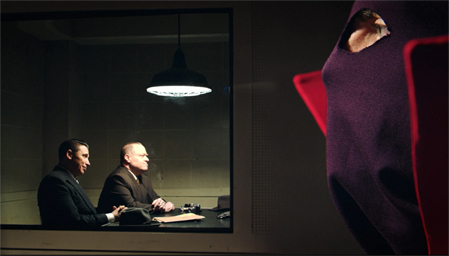
But I got more interested in other questions. How does the show adapt some classical cutting techniques? And how do those techniques square with the “editing” techniques we get in the original comic?
Here’s the relevant passage:
And transitions are the biggest tell when you cut from a beat of one thing to a beat of something else. In the case of the comics, one of the transitional devices we wanted to use to echo the graphic novel is the match cut. In the comic you’ve got one panel with a character in the foreground and someone in the background. The next panel is the same character in the foreground, but they are somewhere else — or somewhere else in a different outfit. And the background is something similar, but it’s something else, and you’re basically just jumping time because you’re really with the character and where their state of mind is, so the intervening time between how they went from here to there is irrelevant.
There is a great one in episode two where Angela walks back after they just sat down, and she sort of disagrees with the idea of going to rustle up the people at Nixonville, and she walks away, and she’s pacing as a match cut to her pacing at the police lineup at Nixonville. You go right where she’s thinking, like Okay, I don’t want to be here, but now I’m gonna be here, and suddenly you’re right there.
The match cut is also a way to instantly transport the audience without introducing a lot of other extraneous visual information. In episode four, we did her opening and closing her trunk when she is going to just get rid of the wheelchair she’s cut apart. She chucks it in the trunk, slams the trunk, and it’s a match cut to her opening the trunk, and she’s already somewhere else. And that just works — you don’t need to see her driving and parking and all that. The point is you just know she is dumping this thing, and it’s a nice, clever way to keep you on point with where she is with her intent.
Afterward, it’s like he’s just jumped ahead again — both places, same time. So it’s a way to sort of double-use that technique. It just takes a lot of planning and preparation. Nicole [Kassell, director/producer] and I worked hard on all the transitions in that episode to try and achieve that effect and make it interesting.
The transitions between scenes that Middleton is discussing are, I think, what have been since the 1940s called “hooks.” His comments open up some ideas about how editing works with them.
There are some spoilers, but not my usual quota.
Matchmaking
We can enhance our understanding of filmmakers’ creative options if we systematize a little bit the choices they face and the terms they use. That’s what I try to do in the online essay on hooks between scenes. There I suggest that we can have four sorts of palpable hooks from shot to shot: sound/sound, sound/image, image/sound, image/image. My examples come from National Treasure (2004), a movie that revels in tricky transitions.
For example, one transition in Watchmen creates a sound/ image hook. The Game Warden tells Adrian, “No Mercy” and we cut to a close-up of a Mercy perfume being tested on a focus group.
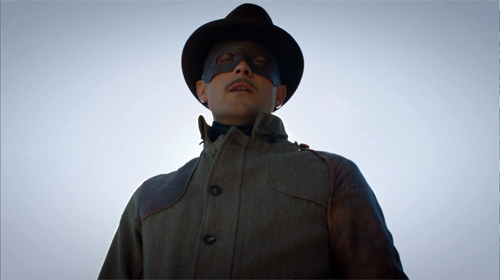
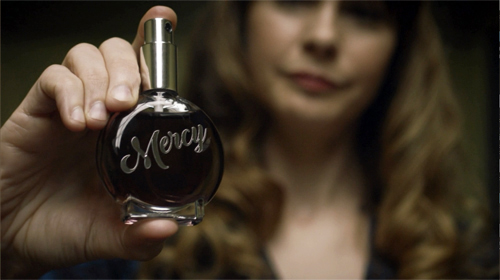
Middleton calls the cuts that create image/ image hooks “matches.” “Match” is a broad term that points up a general principle of cutting for continuity. In a match shot-change, which might be a cut or a dissolve, something in shot B picks up something that was in shot A. Without distinguishing different types of matching, Middleton is stressing how continuity editing techniques, normally applied within scenes, can be used as transitions between scenes as well.
So let’s create an initial menu of possibilities. Within scenes, there’s the eyeline match, which shows a single character looking, followed by a shot of what the character sees (not necessarily from their optical viewpoint).
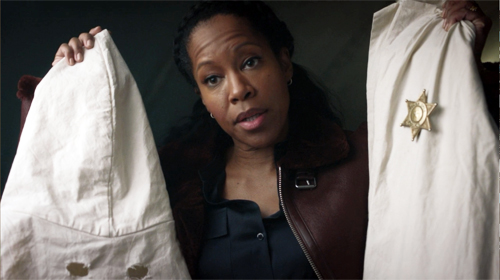
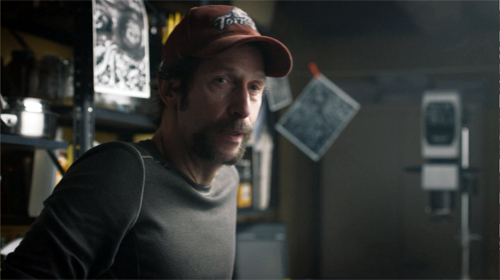
Shot/reverse exchanges like this one often rely on the eyeline match, but need not; you can have a shot/reverse pattern if the characters aren’t looking at each other. (Imagine two people talking with their backs to each other.) The eyeline match can link more than two characters within story space.
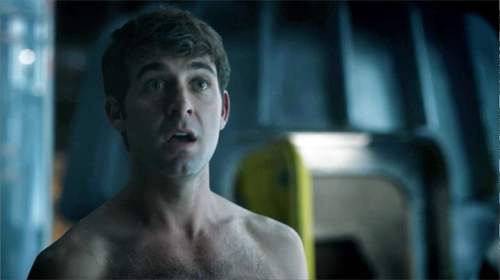
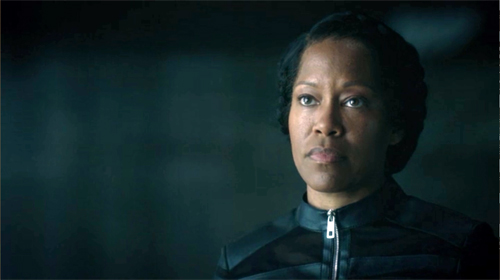
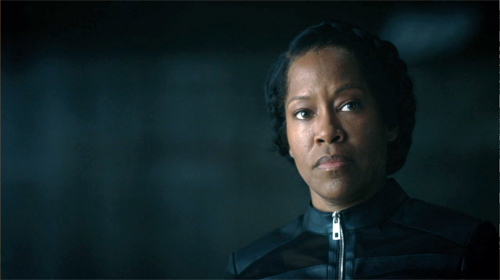
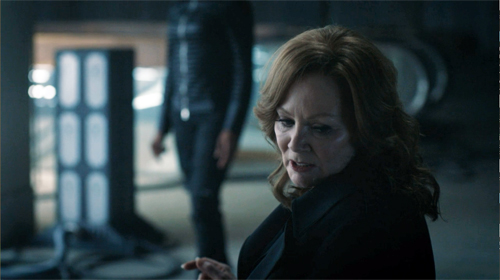
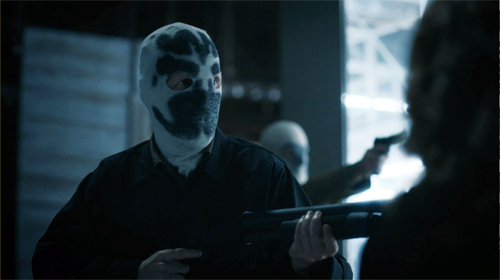
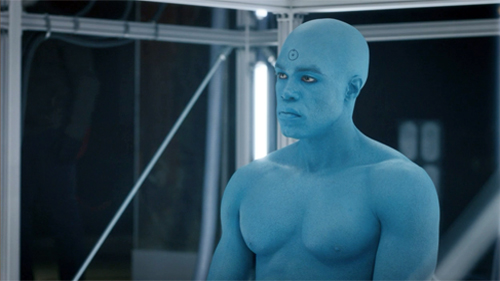
There’s also the match on action, where a bit of movement in A is carried over into B, despite the change of camera position. The scene between Wade and Angela continues with a combination of the eyeline match and the match on action.
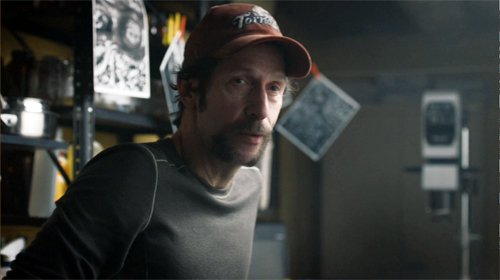
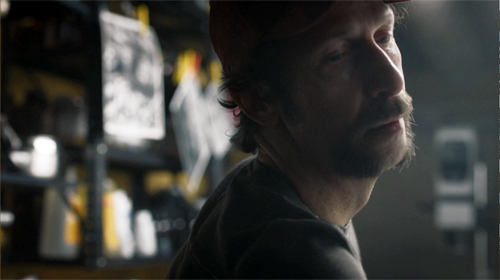
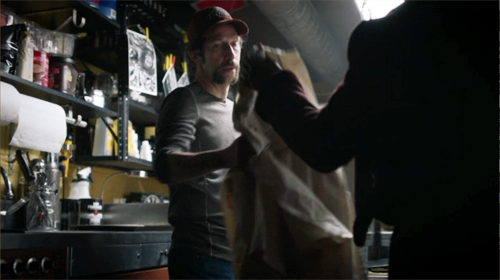
Another sort of match plays upon the sheer pictorial qualities of the two shots. As Middleton says, shapes and color patches can be carried over from the background or foreground or both. Filmmakers don’t seem to have developed a specific term for this type of shot change, although they were clearly using it from at least the 1920s onward. (Eisenstein was the most explicit.) In Film Art: An Introduction, Kristin and I proposed calling the lining-up of compositional features from A to B a graphic match.
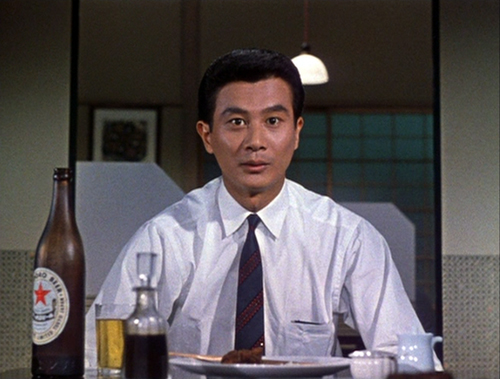
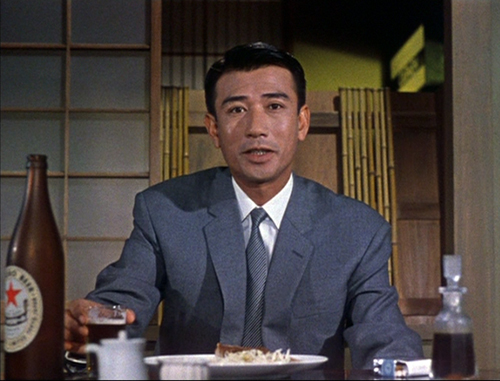
Precise graphic matches are common in experimental films, but they seldom show up within scenes of narrative films. Still, Eisenstein, Lang, Ozu (here, from An Autumn Afternoon), and a few other directors made bold use of them. And they’re obviously a matter of degree: Ozu can match an overall shot in some detail, as above, or just one portion of the frame.
We might add the possibility of the “category match,” as when a prop in shot A is followed by something comparable in shot B. Imagine cuts among wanted posters inside a sheriff’s office.
When we move beyond the individual scene, what are the possibilities? Clearly, all types of match-cutting can be used for transitions.
In Watchmen, an eyeline match shifts us from Angela, lying wounded on her living room floor, to a view of Judd looking down at her in the hospital when she awakens. Here the eyeline yields an optical POV.
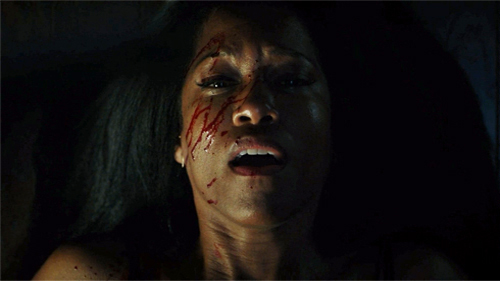
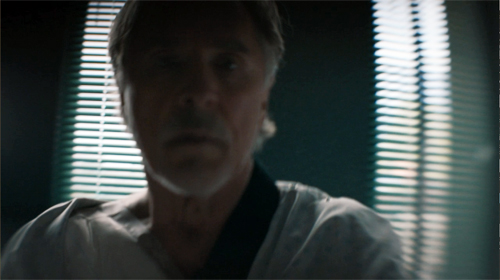
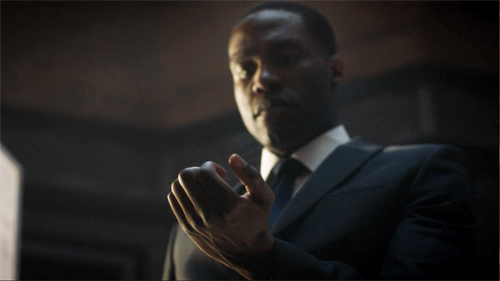
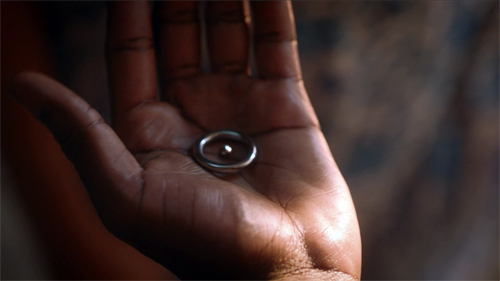
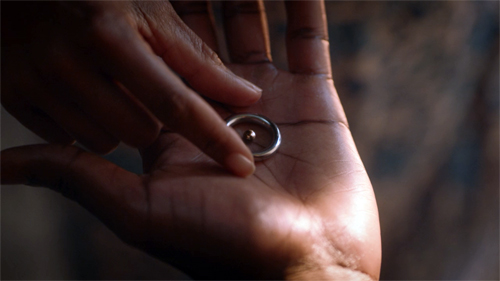
A match on action takes us from one scene of Cal opening his hand to another as Angela reaches for the hydrogen-atom ring.
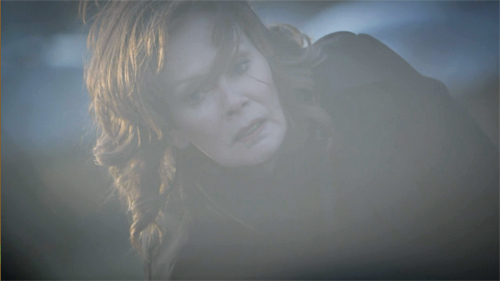
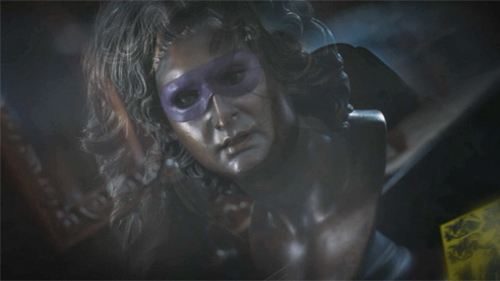
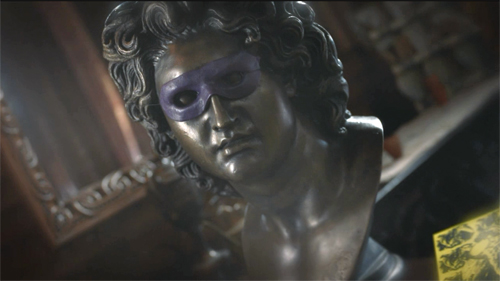
A hook can also exploit a graphic match. As Laurie lies sideways after a bomb blast, the image dissolves to a similar composition, a twisting view of a masked bust.
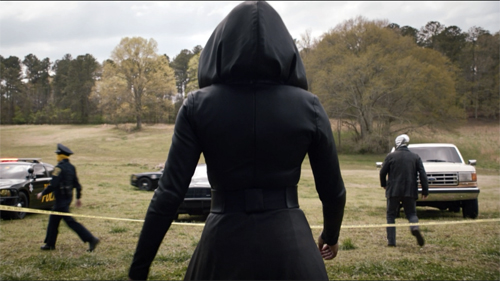
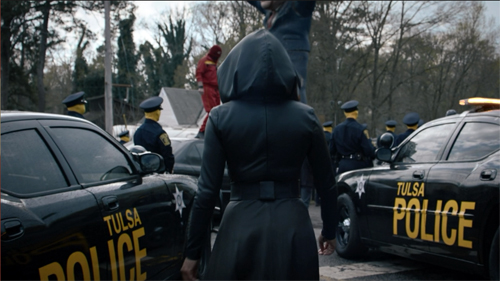
Middleton points to one striking moment that viewers are likely to notice: a match on action that’s also a bold graphic match. Angela strides away from one scene and continues her movement, and her compositional thrust, in a new location, Nixonville.
The “category match” is at work on occasion too, as when one scene ends on a pocket watch and the next starts on a clock face.
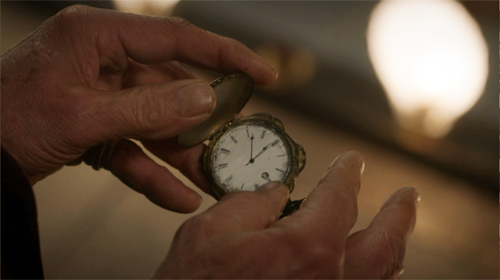
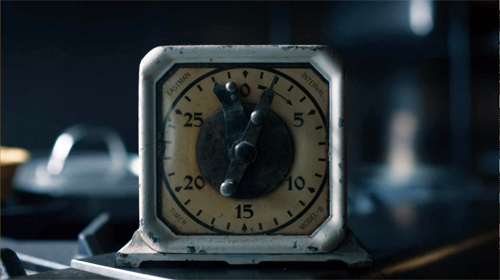
The category match blends with the graphic match when hands links scenes.
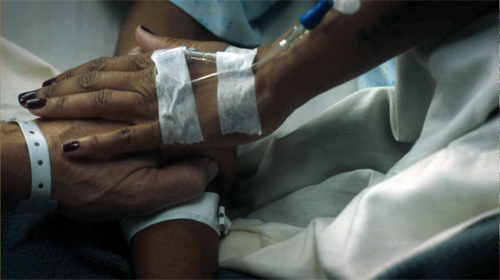
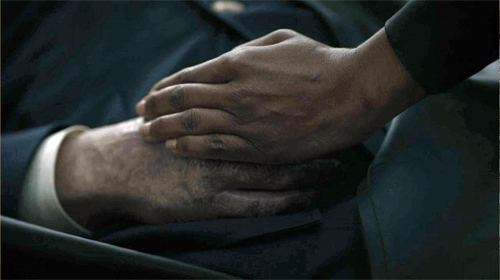
What seems to have sensitized the show’s creators to the possibilities of hooks is the fact that the Moore/Gibbons comic makes punchy use of graphic matches between panels. These are often used to signal character memories by opening and closing flashbacks.
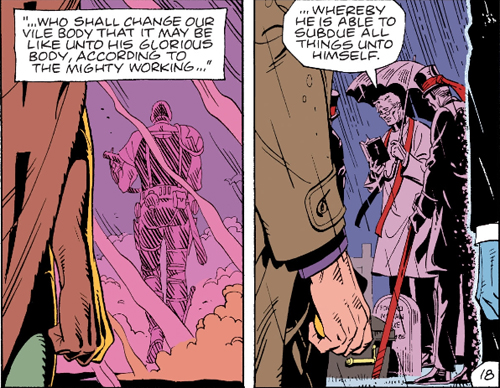
Vivid as these examples and others are, the hook, even the graphically matched one, has a long lineage, as my essay tries to show. The creators of Watchmen are working in a distinct tradition of classic filmmaking.
Showing and showing off
More broadly, that classic tradition favors speed and quick pickup. The new Watchmen is essentially a police procedural, unlike the comic and the feature film. Accordingly, the investigation of a crime is interwoven with the personal lives of the police, the “cop soap opera” that brings in friends, family, lovers, and secrets from the investigators’ pasts.
The crucial backstory involves Angela Abar, who knits together many threads. The child of a US black soldier and a Vietnamese woman, she became a policewoman in Tulsa and underwent the new militarization of the force in response to white supremacy. Some of the earlier Watchmen team, notably Adrian Veidt and Dr. Manhattan, are still exercising their power, while Laurie Blake, the daughter of Silk Spectre, is now working for the FBI.
Like the comic, the series must move the plot swiftly between past and present. The comic splinters time more audaciously, jumping back and forth across its grid of nine vertical panels. But in a classical film, where you don’t normally pause or go back, the story must unwind linearly, and so other strategies come forward to impose a felt pattern.
Older films might dwell on the aftermath of a scene, letting the tension relax a little, and provide a cadence that marks off a distinct section. Modern films, especially if they’re presented in the distracting environment of home viewing, display a need to maintain a rapid pace. So scenes push to a high point, then provide a “button” like that close-up of Laurie, and then move swiftly to the next. Among other advantages, this tactic keeps people from pausing or changing the input. Still, the scene shifts need to be clear fairly quickly.
Hooks can help on both fronts. They snap up the pace, keep us alert, maintain interest from moment to moment. A less clear-cut hook can provide a bump of surprise that teases us into the next scene. Soon, though, we will get imagery, and especially dialogue, that anchors us in the ongoing action.
Hooks also provide motifs that can cascade through the film. Adrian’s ambitions to be the new Alexander the Great are provided by cuts that mock his pretentions.
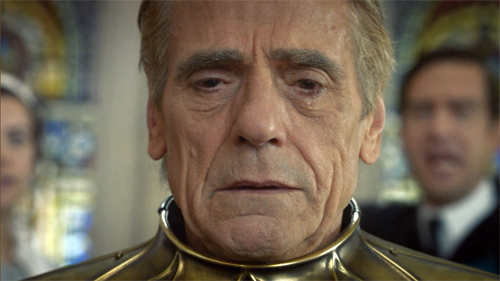
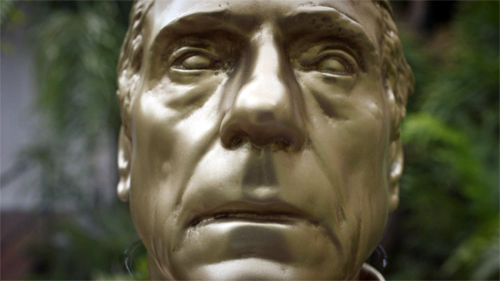
And, as in the comic, the cinematic hooks facilitate subjectivity. The most common way classical storytelling justifies unrealistic or nonlinear narration is through getting into characters’ heads. (Middleton: “You’re really with the character and where their state of mind is.”) Abrupt and startling cuts can be motivated if what we see is a memory, a dream, or a hallucination. This is what we get when Angela embraces Judd’s legs: a match-on-action hook to a flashback of her slow-dancing with Cal.
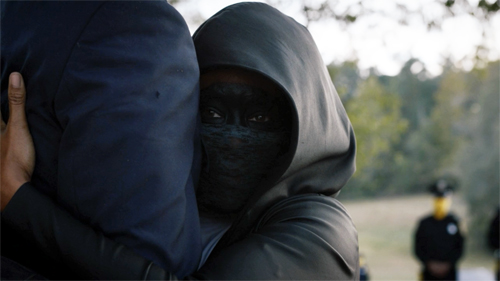
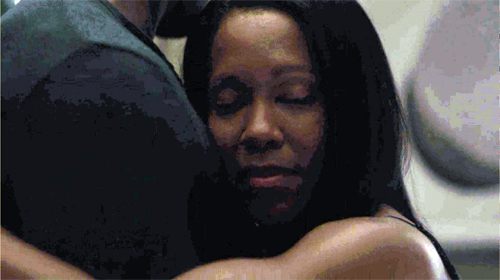
The most elaborate hooks can provide something more: a certain elation in virtuosity. The precise matching of Angela’s stride across those two scenes above is a stylistic flourish that asks us to appreciate the care and bravado of the filmmakers.
Watchmen‘s hooks, however flamboyant, stand out against a pervasive backdrop of classically constructed scenes. We get lots of over-the-shoulder reverse angles, properly timed reaction shots, now-standard cuts to extreme distant shots that provide a “beat” for the scene, and other devices that have been around for decades. Plenty of other traditional strategies for narrative coherence are on display, from goal-oriented protagonists and deadlines to newspaper headlines and TV broadcasts as sources of impersonal narration. There’s even the inevitable Hollywood line: “What are you doing here?” As usual, striking moments emerge out of a familiar flow of narrative cause and effect, with some mysterious gaps eventually filled.
Paging the Watchmen
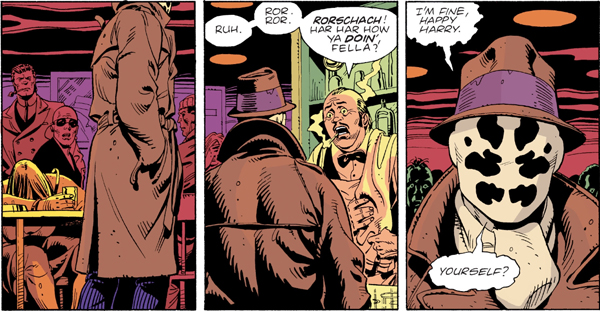
Comics artists absorbed the lessons of continuity filmmaking. If the hooks in films stand out by contrast with the overall smoothness and linearity of classic construction, something similar happens in comics. Here are three “continuity shots” from the Watchmen graphic novel, complete with obedience to the axis of action, reverse-angle cutting, and a “single” for emphasis on Rorschach’s reaction.
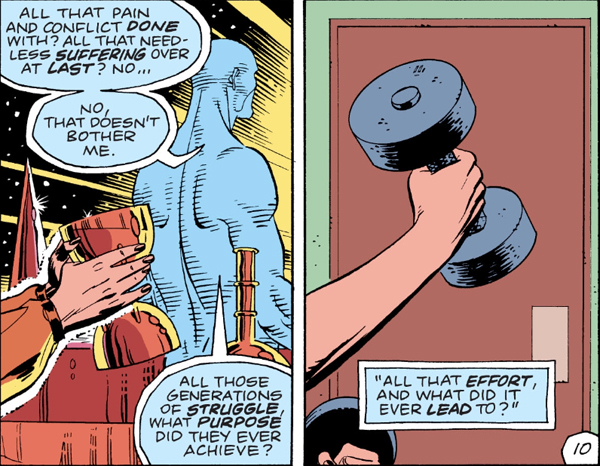
Even a match-on-action hook can be suggested, as when Laurie’s lifting a goblet on Mars “cuts” to her as a teenager lifting a dumbbell.
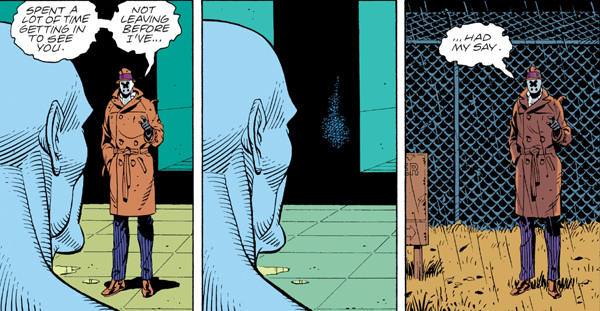
Graphic continuities and discontinuities can be motivated by science-fiction premises, as when Dr. Manhattan teleports Rorschach out of the facility. The sense of instantaneous change wouldn’t be so strong if Rorschach’s size and placement in the format weren’t kept constant.
In a way, the graphic continuities are almost needed for the time-shifting transitions. A new angle on Adrian at the start of the funeral flashback below would be more confusing than the frontal close-up that completes a gradual enlargement of his face. The new costume and the “offscreen” dialogue cue us to a new scene.
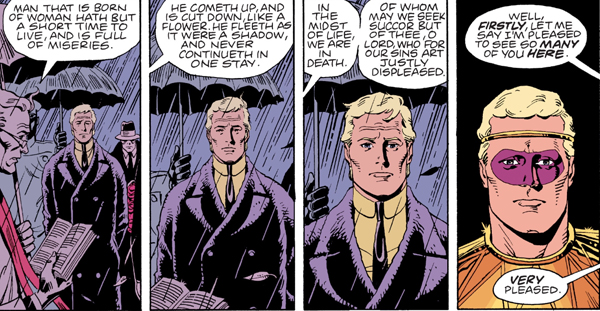
To keep things tidy, the flashback ends with a foreground graphic match on Adrian, leading us back to the funeral.
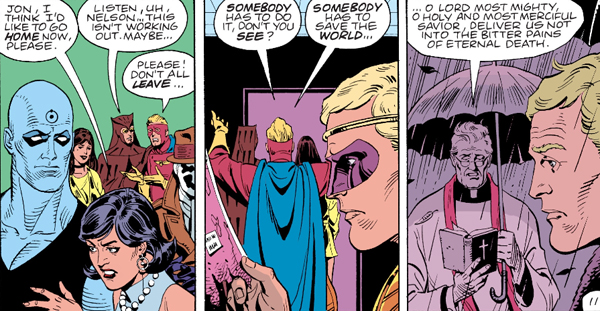
As ever, popular narrative maintains symmetry and redundancy to keep the action clear. Here’s a more “staggered” but no less symmetrical foreground graphic match–used, again, for subjectivity.
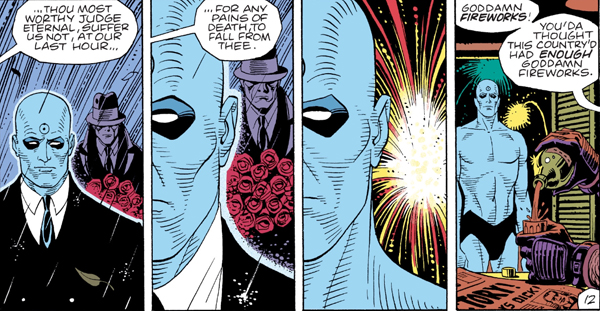
The rectilinear staging evokes either a track-in (the first two panels) and a track-back (the last two) or axial cuts in to and back from Dr. Manhattan. (The Soviets called these in-and-out edits “accordion” cuts.)
So there are some rough equivalents between film editing and the principles binding comic panels, especially ones this jammed with information. But comics have unique resources too–ones that Watchmen‘s creators were well aware of. Dave Gibbons notes that he exploited techniques articulated by the great Will Eisner, “where you could, say, hold the camera’s point of view and have characters walk past it, or follow the characters through a scene acrosss a changing background, where you could echo panel compositions . . . .”
The echoes Gibbons mentions depend on the fact that the book page and its role in a two-page spread create a force-field that displays the story both as a timeline and a spatial array. Panels are at once phases of action and a simultaneous order of images, and the interplay of story information and pictorial pattern can become quite rich, even baroque.
Consider when Rorschach rummages in the Comedian’s closet. Even if we could replicate the panels in a movie shot by shot, the page’s severe structure couldn’t be grasped as a simultaneous whole onscreen.
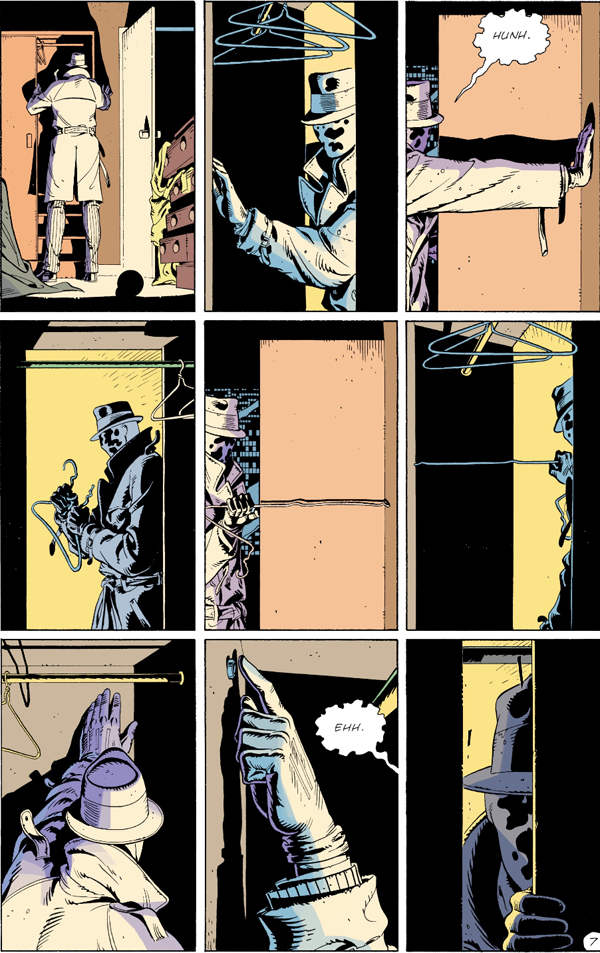
The echoes are striking. Panel 1, the establishing shot, is enlarged in panel 7 on the bottom row, as is panel 2 in panel 8. Each lower-tier mate is markedly closer than the top one, emphasizing the growing sense of discovery. Panel 2, with its sidelong strips of solid black, is echoed in panel 4 and panel 6 (a slight “pan” left from 4) and, with another enlargement, in panel 9, the climax. The color slabs (yellow/black, grey/purple) accentuate the repetitions and variations. The middle stretch, panels 3-6, forms a suite of variations as well (5 picks up 3, 6 picks up 4), while Eisensteinian cuts flip us back and forth across the axis formed by the straightened coat hanger. All the cuts are compass-point shifts, moving us in 90-degree multiples. The crisp geometry of the découpage renders the unhurried professionalism of Rorschach’s search, an effect accentuated by the snapshot imagery (no motion lines).
The effect depends in large part on the presence of all these images on the page at once. The alternation of shot scale and color fields can be discerned only by seeing the overall architecture of the page.
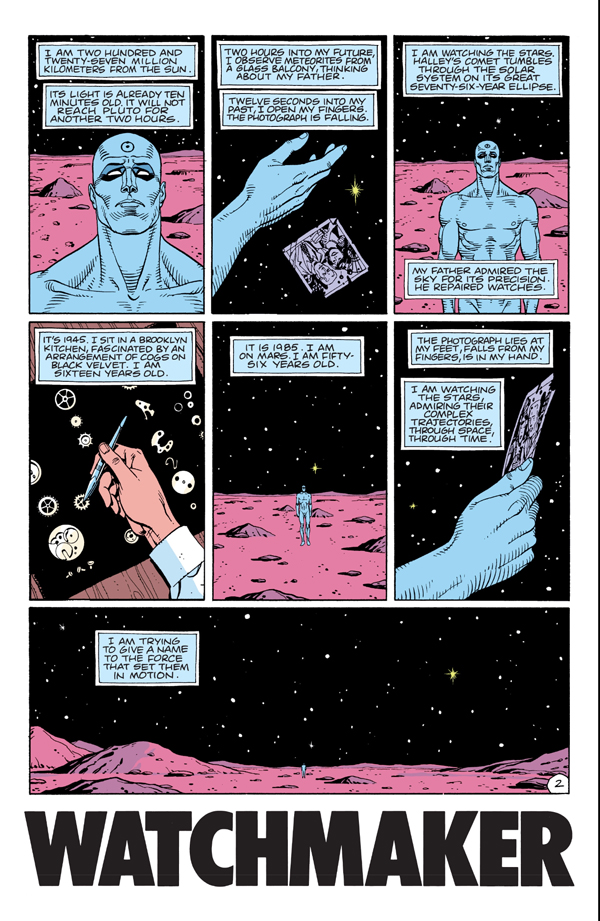
Panels 1, 3, and 5 build to the climax of the wide framing on the bottom as we pull farther back from Dr. Manhattan during his soliloquy. Panels 2 and 6, echoes of a close-up of the photograph, provide a sharp contrast to the landscape and emphasize the power of memory. That power is enacted in another variant of the hand image, as the young Jon Osterman arranges watch parts, like stars, on a velvet ground.
The page is one standard mid-size unit for the comics story, but the two-page spread is the next phase up. A continuous action can be spread across the open book, with echoes emerging. In the big fight scene, the shifting POV (occasionally objective, but also bouncing us among Rorschach, Adrian, and Daniel) is capped by symmetrical wide panels at the bottom of each page. The rose-tinted panels on the right page add their own fillip of pattern.
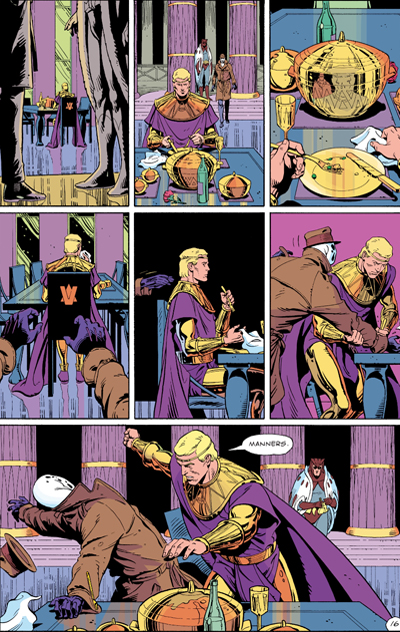
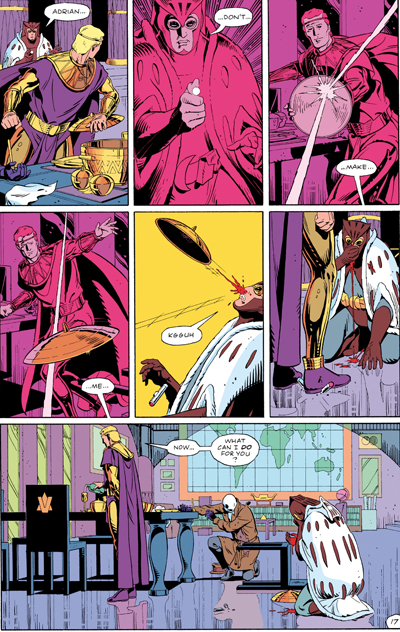
In a film such symmetries and variations unfold over time. We can make them apparent only through a “spatialized” analysis, spread out on the page like a comic-album layout. (Such were those pioneered by Raymond Bellour in the 1960s and 1970s.) In comics, these patterns strike us immediately, as a primary and palpable expressive vehicle. One-off devices like the graphic match can be sustained both on the screen and on the page, but each medium stamps its own structures on the flow of time.
There’s a lot more chop and change in the space-time continuum of the Watchmen comic than I can do justice to here. (Some pages run three time periods simultaneously.) But my main point should be clear. As usual, when we start to pay attention to the films and media artifacts that fascinate us, we always find more going on than we realized. Both movies and comics work on us so directly that their design subtleties can easily pass unnoticed. We can keep reverse-engineering them as long as we like, and we’ll learn a lot. And the creators can be very helpful guides about what to pay attention to.
I first became aware of Gregory Middleton’s comments by reading the review essay by Namwali Serpell, “In the Time of Monsters,” New York Review of Books (9 April 2020). I’m grateful to Serpell for calling my attention to the problem of cutting in the Watchmen series.
The essay is somewhat misleading in its account of match cutting, which is said to create “‘jumps’ rather than flows from shot to shot.” It’s actually just the opposite. The match cut creates continuity of time, space, and graphics between shots. It need not, as the essay claims, link two settings, and it’s not an alternative to a “splice cut,” which is a term with no currency I’m aware of. (A splice is simply the physical join between film strips, and it can govern any type of cut. Splices are increasingly rare with the dominance of digital editing.) The alternative to match cutting would be discontinuity cutting.
Serpell’s essay is worth reading for its interpretive dimension. She argues that for all the creators’ efforts to create strong images of minority heroes fighting white supremacy, there is a critical, antiheroic aspect to the original comic that isn’t picked up in the series. The sanctioned violence of Angela, Wade, and others is treated as unproblematically righteous.
I’d largely agree. Yet I’m not sure that the original book’s portrayal of superhero trauma (the result of the go-to source, childhood abuse) elevates these caped crusaders much. They seem to me best understood as part of that cycle of debunked superheroes we find in other 80s comics, notably The Dark Knight. Why would someone put on a mask to fight crime alone? What dignifies vigilantism? Are these “the heroes we need now”? These, we’re told, are deep questions, but they seem to me the tropes of a quickly standardized set of conventions. They signal a “new complexity” and “adult attitude” comparable to the romanticism of film noir and the cynicism about samurai ideals we find in Japanese swordplay movies. Bringing heroic genres low is itself a genre convention.
More broadly, I’d propose that the the storytelling strategy Serpell highlights is part of the common move within thematically ambitious mass-market movies to be strategically ambiguous. Creators, I’ve suggested here, often throw many things against the wall to see what will stick. They can then point to contradictory aspects which show balance. So yes, Angela tortures members of the Seventh Kavalry, but (a) they’d do the same to her; and (b) she’s driven by righteous vengeance for ancient wrongs; and (c) we want to make you a little uncomfortable with her vigilantism anyhow. Nowadays, it may be that what seem involuntary contradictions are deliberate efforts to have things many ways at once. This maximizes viewer outreach and gives critics fodder for debate. For another recent instance, see the previous entry on The Hunt.
The Dave Gibbons quotation comes from the supplement “The Phenomenon: The Comic That Changed Comics” available on the DVD of the Director’s Cut of Watchmen, 9:35-10:14.
Raymond Bellour’s “spatialized” analyses of repetition and variation can be found collected in The Analysis of Film (Indiana University Press, 2001). Some efforts of mine are in On the History of Film Style and in Ozu and the Poetics of Cinema (available for free, if patient download here), as well as in other material on this site.
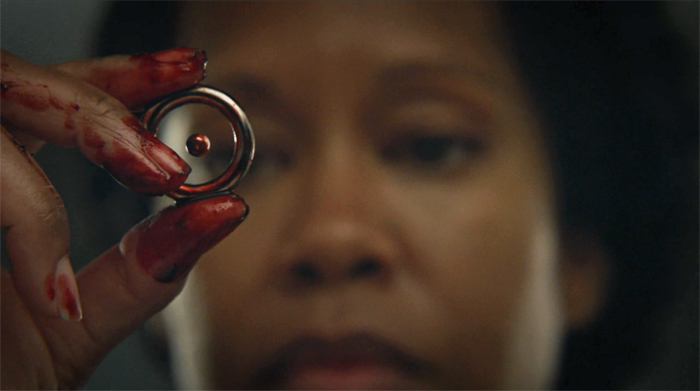
Watchmen (2019).
When Hollywood ruminates: Calm after THE MORTAL STORM
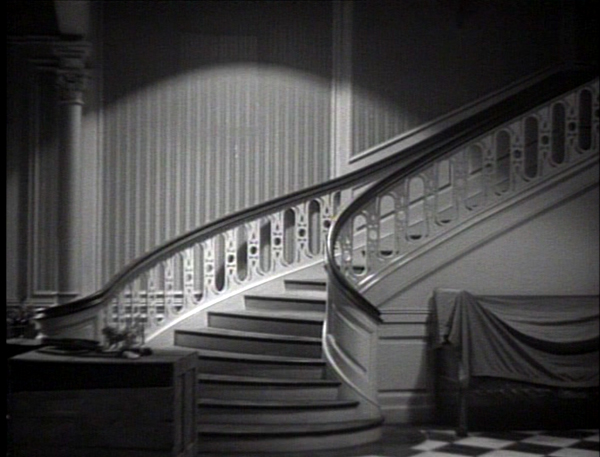
The Mortal Storm (1940).
DB here:
We don’t usually think of classic studio cinema as particularly contemplative. But many films open up spaces for quiet reflection on what we’re seeing, or have seen. In the 1940s, that tendency owed a good deal to the ways that Hollywood became, to put it roughly, more novelistic.
Movies had been based on novels for many decades, but in Reinventing Hollywood: How 1940s Filmmakers Changed Movie Storytelling, I claimed something more specific. I think that many 1940s filmmakers became more acutely aware of sound film’s capacities for manipulating time and point of view. These are novelistic techniques par excellence, distinctly different from the largely “theatrical” conceptions of presentation that we find in most studio cinema of the 1930s. Films turned inward, probing perceptions, memories, and dreams. If you need a storytelling twist, one journalist cracked, just call it psychology, and it will get by.
Of course, there are plenty of precedents for time and POV shifts in early decades. Still, I wanted to show that between 1939 and 1952 many major options emerged and were developed in ambitious directions. The results left a legacy. Today, when flashbacks are common and we easily grasp elaborate shifts in viewpoint, our films rework the possibilities refined and consolidated in the 1940s.
One stretch of the book considered some films from early-to-mid 1940 that offered glimpses of innovations we’d see in later years. Married and in Love, One Crowded Night, Stranger on the Third Floor, and Edison, the Man previewed techniques that would dominate the next decade. Particularly chock-full of storytelling ideas, I argued, was Our Town, a daring transposition of 1930s theatrical devices into the key of cinema.
Missing from my roster, though, is The Mortal Storm, a film that went into release in June of 1940. I had neglected to rewatch it when writing the book. A couple of weeks back I caught up with it during a screening at our Cinematheque. Restored by UCLA, it fairly shimmered off the screen.
How could I not have remembered the stunning closing sequence? It’s a bundle of narrative strategies that would get elaborated in the years to come. And it achieves its effect from being somber, slow, and based on human absence. In this epilogue, the movie pauses to think.
To talk about this passage and its counterparts, I have to parade plenty of spoilers. Sorry. But at least you get video.
Emptying the nest
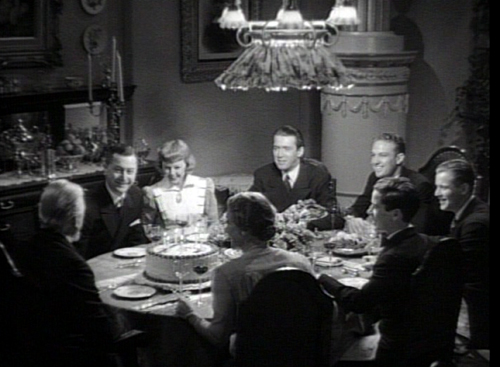
The Mortal Storm.
The plot starts in Germany at the moment of Hitler’s ascension to power in 1933. Elderly Viktor Roth is a much-loved Jewish professor of medicine. His household includes his stepsons Otto and Erich, his wife Emilia, and their daughter Freya. Two other young men are close to the family: Fritz, who aspires to marry Freya, and Martin, a farm boy training to be a veterinarian.
Otto, Erich, and Fritz become enthusiastic Nazis, but Freya draws closer to Martin, who quietly resists the growing bigotry in their small town. Professor Roth is arrested and killed. Martin and Freya, now deeply in love, try to escape by ski to Austria. A squad of soldiers, under Fritz’s direction, fires on them. Freya is killed.
In the crucial scene, Fritz returns to the family home to tell Otto and Erich.
The sequence blends several narrational choices. Most obvious is the camera movement that seems to drift off on its own. It is, we might say, semi-subjective. It suggests Otto’s slow walk through the now-empty home, but it isn’t clearly marked as his optical POV. The opening stretch of the shot shows him pacing more or less obliquely to us, before the camera pans and tracks to the table and beyond.
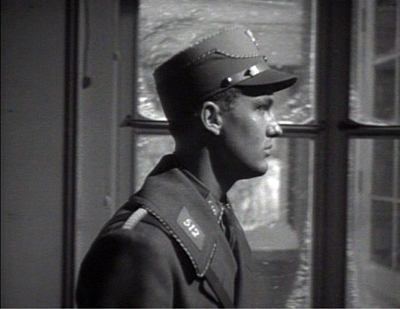
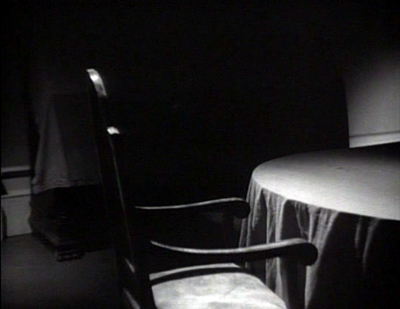
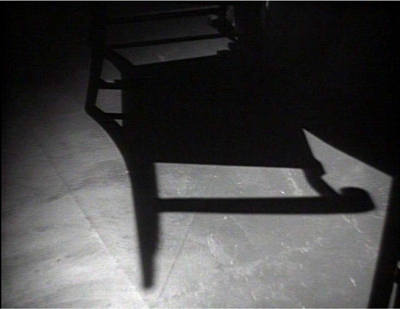
The framing insistently keeps Otto offscreen. Only the sound of his footsteps and pauses suggest that he’s present, off left or behind us, at each station of the shot.
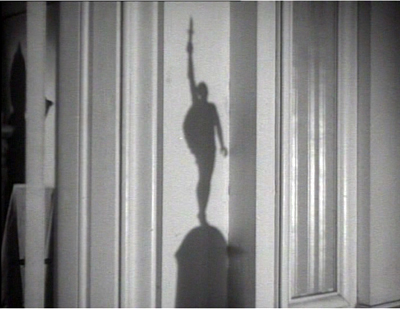
As the camera drifts along, we get auditory flashbacks to earlier scenes, three at the table, and one echoing the Professor at his lectern. Flashbacks are characteristic features of 1940s cinema, and purely auditory ones will come into prominence, as in The Fallen Sparrow (1943). Since we’ve seen the action these flashbacks evoke, they’re as much flashbacks for us as for Otto. Indeed, Otto has been a minor character in the story. His walk triggers them, but his absence from the frame makes it easier for us to project our memories onto these spaces.
The transition among the flashbacks prepares for Otto’s defection. The voice shifts from Freya, whose death Otto is grieving, to the men challenging authority. We hear Professor Roth urge youth forward, and Martin advocating peace and free thought. These later moments seem to crystallize Otto’s change of heart. Dwelling a bit on the statuette of Youth carrying the torch of knowledge suggests that Otto may become inspired to take up his father’s commitment to humanism.
At the climax of the shot, the camera frames the staircase (another icon of 1940s cinema) and starts to back up. This can hardly be Otto’s optical viewpoint. The rapid footsteps suggest that he has left the house by striding out, as it were, behind us. The sound of a closing door confirms our inference. He has left us behind.
As he does in the final moments, when Otto’s flight is depicted as footprints in the snow. Perhaps, now that he has become revolted by the cruelty of Fritz and the Nazi regime, he will take up resistance in Martin’s spirit.
Accompanying the shots of the footprints is the voice-over narrator whom we heard at the film’s start. (Such narrators proliferate in 1940s movies.) His speech, from a poem called “The Gate of the Year,” echoes the visuals: a man “at the gate,” the prospect that one may “tread safely into the unknown.” In giving up Nazism, Otto is giving up home.
The camera tilts up to show the empty house. The snow-encased home is quite different from the bustling view we saw at the film’s start, when the postman delivered gifts for Professor Roth.
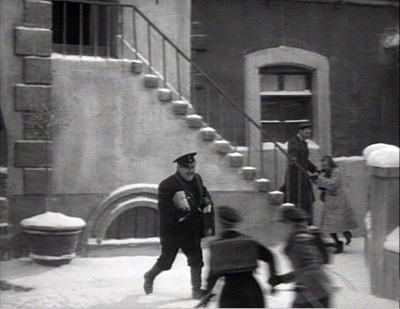
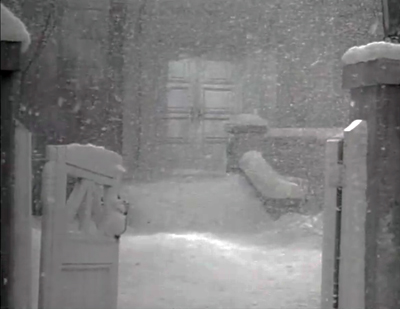
Hitler has destroyed the family. Still, as the snow buries the footprints, the narrator urges that divine guidance can provide safety for Otto’s escape, and perhaps a decision to fight Nazism.
We don’t normally think of MGM as a hotbed of cinematic innovation in the studio years. But the company had its moments (here and there), and this is one of them. The Mortal Storm‘s play with time (flashbacks, the solemn duration of the house tour) and viewpoint (Otto triggering some bits of remembered dialogue) resembles what we might get in a psychologically slanted novel of the time. We’re given a few minutes to breathe deeply and think about what we’ve seen, and to build up expectations about what Otto may do.
The house as memory vessel
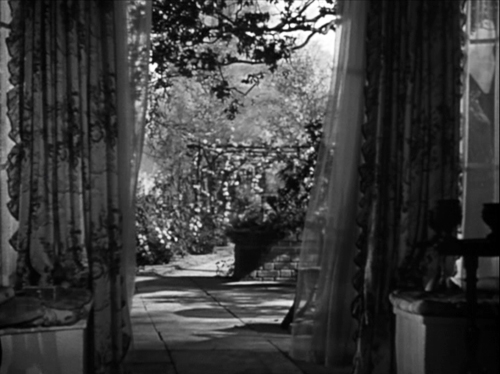
The Miniver Story (1950).
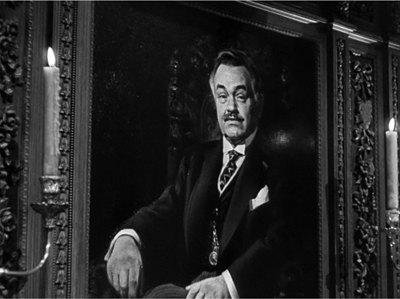
One section of Reinventing Hollywood analyzes Enchantment (1948), a film narrated by a house. The house presents itself as a cozy repository of the memories of several generations. More generally, houses are powerful images in 40s films; think of Tara, Manderly, the estate in Dragonwyck, and the Gothic mansions of Jane Eyre, Gaslight, and The Spiral Staircase. Often they’re presided over by ominous portraits, as Steven Jacobs and Lisa Colpaert have shown.
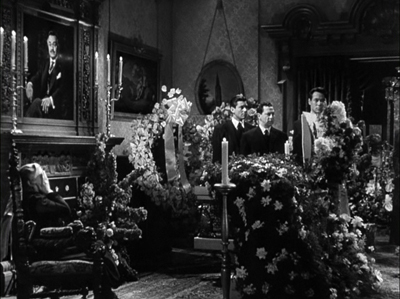
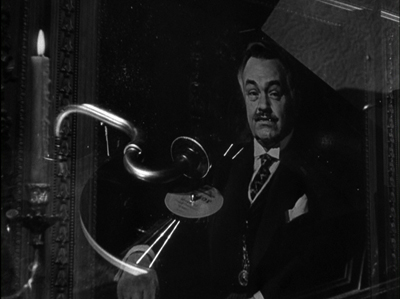
One lesser-known example is House of Strangers (1949), directed by Joseph Mankiewicz. This story of an Italian immigrant who has become the head of a big bank is framed by his son Max returning to their massive home. The bulk of the film is given in flashback, but the flashback is launched by a wandering camera accompanied by “M’apparti tutt’amor” (from the opera Martha) playing on the phonograph. After a trip up the stairs we are taken via dissolve to the patriarch singing it in his bath.
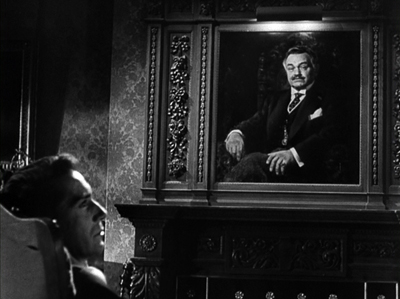
The plot’s central section treats the lyric (“You all seem to love me”) with doubled implication: Gino’s reckless loans endear him to his customers, but his sons resent his power over them. The long flashback ends at Gino’s funeral, passing from the portrait in the past to the phonograph and to his son Max, brooding under the looming picture.
The huge Minafer mansion is practically a character itself in The Magnificent Ambersons (1942). One of Welles’ late script versions envisioned a climax in which George, distraught by the shabbiness of their neighborhood, would pass numbly through the house, and our sense of it would be given through his eyes.
145 FULL SHOT of the Amberson Mansion, seen from behind George who is standing in front of camera. He starts walking toward the mansion. CAMERA FOLLOWS, moving faster than he does and soon is so close to him that his body creates a dark screen for a DISSOLVE TO:
146 CAMERA is on the steps of the Amberson Mansion, MOVING up to the door and STOPPING. George’s hands enter the scene, insert a key in the lock, turn it —
147 On the Narrator’s words, “move out” the door opens and CAMERA MOVES thru it into the house.
MOVING SHOT as CAMERA WANDERS SLOWLY about the dismantled house — past the bare reception room; the dining room which contains only a kitchen table and two kitchen chairs, up the stairs, close to the smooth walnut railing of the balustrade. Here CAMERA STOPS for a moment, then PANS down to the heavy doors which mask the dark, empty library. HOLD on this for a short pause, then CAMERA PANS back and CONTINUES, even more slowly, up the stairs to the second floor hall where it MOVES up to the closed door of Isabel’s room. The door swings open and we see Isabel’s room is still as it always has been; nothing has been changed. FADE OUT
This passage is strikingly similar to what we see in The Mortal Storm. True, the cues for George’s optical viewpoint are more explicit than what Borzage gives us for Otto. But Welles is subtler along another dimension. He counts on our remembering earlier scenes without benefit of auditory flashbacks. The camera revisits the reception area we saw during the ball, the dining room where George challenged Eugene Morgan, and the staircase where George and Fanny quarreled, before coming to rest in Isabel’s room, where we saw her waste away and die. We are asked to supply our own flashbacks.
Some of this POV passage might have been filmed, but it wasn’t retained in Welles’ final version, even before RKO’s mangling. In the film as we have it, only Welles’ lead-in and conclusion remain. The narrator supplies a moving-camera montage, as George registers the changes in Amberson Avenue.
The street sequence ends in darkness and tracks back from George kneeling at the bed begging forgiveness. The fact that the shot starts from his darkened head reinforces the subjectivity of the montage.
Welles’s handling is novelistic in the sense of wrapping a character’s flowing impressions inside an omniscient verbal commentary using free indirect discourse (“Tomorrow they were to move out”). George’s moments of rueful meditation are moments for us as well.
Like the narrator that closes The Mortal Storm, this voice is external to the story world. But the same house-haunting effect can be achieved by a narrator who lives in that world. Coupled with the wandering camera, this can turn our view of a scene in the present into a view of the past–or of an eternal future.
The example I have in mind is from The Miniver Story (MGM again, 1950). In Reinventing, I analyze a sequence that creates layers of time: Clem Miniver’s voice-over in our present, an image of he and Kay in the past, and references in the commentary to periods still earlier than what we see. (The clip of this sequence is online here.) At the end of the film, after the Minivers have married off their daughter Judy to Tom, they must face Kay’s impending death from cancer.
The final sequence shifts from the day of the wedding to a kind of timeless realm in which Kay’s spirit lives on. Again, camera movement suggests an invisible presence.
By 1950, we’ve had several permutations. The camera wanders without verbal narration (music alone in House of Strangers). It does so with auditory flashbacks (The Mortal Storm). It does so with a nondiegetic (external) narrator (The Magnificent Ambersons). And it does so with a diegetic (story-world) narrator (The Miniver Story). I try to show in the book that 1940s filmmakers swiftly expanded, even exhausted, menu options involving many storytelling techniques.
Trust Hitchcock to give us yet another variant, and in a tour de force at that.
Enough rope
In the eleven shots of Rope (1948), set almost completely in an apartment, the camera’s peregrinations are usually motivated by character movement or simple track-ins and track-outs. At the climax, though, the camera cuts loose. Sort of.
Brandon and Phillip have strangled their friend David and hidden his body in a chest in their living room. They’ve ghoulishly used the chest as a buffet table for their afternoon party. After the party, one guest, their prep school teacher Rupert Cadell, has returned. He suspects that something bad has happened to David. Rupert challenges the pair and sketches out how they might have murdered their friend.
His reconstruction isn’t wholly correct. David wasn’t bludgeoned, and apparently the armchair played no role. What’s fascinating is that the camera supplies a hypothetical, virtual flashback. As in our earlier examples, David becomes an invisible guest, summoned up by the mobile frame.
The camera traces out the action Rupert posits, emphasizing the hall closet (where Rupert earlier discovered David’s hat) and edging eventually toward the chest. At that point Brandon steps in, with his hand tensing around the pistol in his pocket. He stands in front of the drinks table.
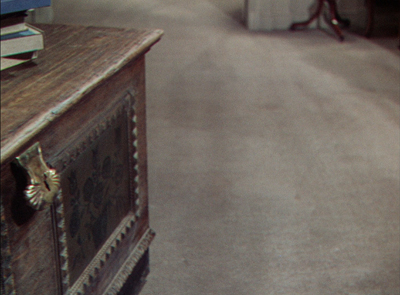
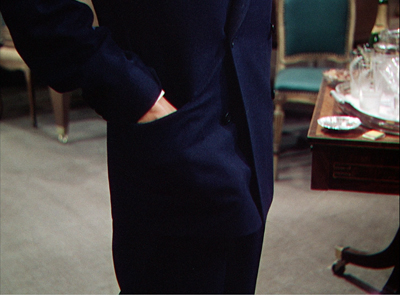
That’s the climax of the shot. Cut to a shot of Rupert. He seems to intuit that he should avoid mentioning the chest, so he proposes that they might have carried the body out of the building. As the camera traces out that possibility, Brandon steps back into the frame to confront Rupert.
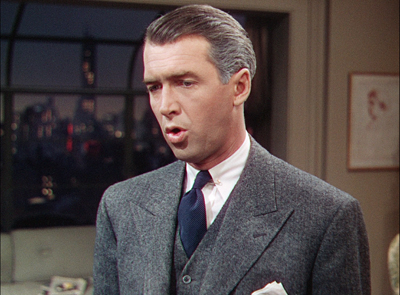
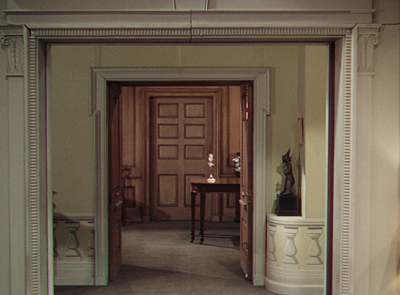
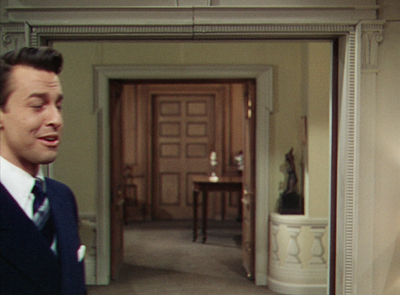
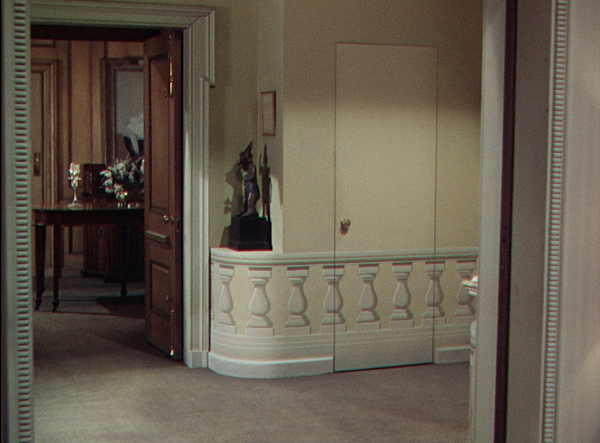
Here I think Hitchcock made a mistake. At the end of the first shot, Brandon and his pistol are quite close to Rupert, near the drinks table. But in the followup shot, he’s not visible when the camera pans left past the table to enact the scenario Rupert is considering. Brandon would have had to skip backward like the Road Runner to get as far away as he is when he steps back into the frame in the second shot.
Still, the important effect is the representation of Rupert’s thinking. Goaded by Brandon, he ponders how the crime might have been committed, and the camera carves into space to reveal the scheme he conjures up. A sort of flashback? Yes, but an unreliable replay, left largely to our imagination. Semi-subjective? Yes, since when we cut to Rupert he seems to be staring down at the chest. Yet the camera is too free-ranging to be purely Rupert’s optical POV. He’s not moving around, as Otto is in the Mortal Storm sequence.
In this most “theatrical” of movies, Hitchcock manages to give us a verbal-visual flow that is something like a cinematic equivalent of the novelist’s conditional perfect tense. If Brandon and Phillip had killed David, they could have done it this way. The camera enacts a speculative train of thought. Call it psychology.
One thing I shouldn’t ever forget: Hollywood in the Forties is a booming rush of visual, auditory, and narrative ideas. In the approximately 5,655 features released in the period I marked off, there are surely many other startling instances of creative craft. I’ll keep looking.
Thanks as ever to our Wisconsin Cinematheque for fine programming under the auspices of Jim Healy, Mike King, and Ben Reiser and excellent projectionist Roch Gersbach. Thanks as well to Joe McBride for sharing material on The Magnificent Ambersons. More on Ambersons can be found here and here.
The Mortal Storm‘s “novelistic” final moments owe nothing to its source, Phillis Bottome’s The Mortal Storm (1938). An earlier version of my ideas about Enchantment are here.
Chapters 4 through 6 of Patrick Keating’s The Dynamic Frame: Camera Movement in Classical Hollywood offer a careful survey of creative choices facing filmmakers of the period, along with explications of their “practical theories” about cinematography. After writing this entry, I learned that Patrick has also made a fine video essay on the Ambersons sequence.
For earlier blogs on related subjects, see the category 1940s Hollywood.
PS 2 March 2020: Patrick Keating reminds me of another 1940 release I should have mentioned: Hitchcock’s Rebecca. When Maxim narrates his confrontation with Rebecca, the camera moves autonomously to “replay” the scene. It anticipates my Rope example, except that Maxim is recounting what really happened, while Rupert is sketching out his (partially inaccurate) reconstruction of David’s death. Still, though, it’s another variant on an emerging pictorial convention. Thanks, Patrick!
PS 2 March 2020, later: Thanks also to John Belton, who writes to remind me not only of the Rebecca scene but a comparable camera movement in Under Capricorn. Crowdsourcing works.
Rope (1948).



