







Archive for the 'Narrative strategies' Category
Madison calling Budapest: Can you read me?
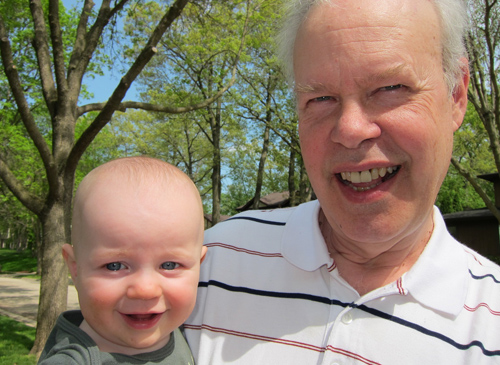
Can you look at this picture without smiling? I think it’s hard, for reasons that relate to one thread of the essay here. Thanks to Levi Buchhuber, age eight months, and Jim Cortada, grandpa.
DB here:
Next week several dozen bright, energetic researchers will be crowding into conference rooms at Elte University in Budapest for the annual meeting of the Society for Cognitive Studies of the Moving Image. Full details on the event are here. As usual, I expect that a hell of a time will be had by all.
I’ve discussed the purposes and projects of the members of this dynamic bunch on earlier occasions. If you want a rundown, I’d suggest reading the items in chronological order:
*I sketch out the SCSMI project in this entry. There are more ruminations in two run-ups to the 2008 Madison SCSMI get-together (here and here), and one a year later summing up that event.
*For a report on the wonderful 2009 Copenhagen convention, go here.
*I try to sum up the wide-ranging 2010 Roanoke powwow here, while a recent blog, “Molly Wanted More,” can be considered an echo of that event.
*For an utterly fun introduction to some of the research on display at SCSMI, head to one of our most popular entries, the guest blog by Tim Smith called “Watching you watch THERE WILL BE BLOOD.”
This year’s paper line-up is especially enticing, and the prospect of seeing so many old friends is even more thrilling. Alas, for reasons beyond our control, Kristin and I aren’t able to attend. As the date draws near, my need to stay home saddens me more than I had expected it would. I must content myself with directing you, with all the fervor I can muster, to the event. Many of our members have told me that their first visit was life-changing, providing them a whole new social network that would encourage their research. Moreover, I notice that every year several participants tell me that they think this one was the best session yet. We’re just getting better, and we’re not going away! I should also alert you to the likelihood that many of the papers will be published in the SCSMI-affiliated journal Projections.
I thought, though, that I might participate a little at long range. So I’ve posted a web essay that sets out, in less technical terms, what my proposed paper for the convention would have tried to say. The essay, “Common Sense + Film Theory = Common-Sense Film Theory?,” reflects an effort to rethink ideas about filmic comprehension that I set out in Narration in the Fiction Film in 1985. This book was one of the first efforts to explore how findings in cognitive science might help us make progress in understanding cinematic storytelling.
I’d stand by much of what I argued there, but in the light of further thinking and later research (much of it conducted by SCSMI members), I wanted to float some ideas that recast and correct my arguments in the book. (Yes, I hope I’ve learned something in twenty-five years.) Some of my more recent notions are available in Poetics of Cinema and under the Film theory: Cognitivism category on this blogsite, but the conference provided a good occasion to submit to the sort of friendly but pointed critique at which my SCSMI colleagues excel.
Of course, give me another twenty-five years and I’ll probably find fault with what I say now. Others won’t need so much time.
Start with this question, which I think is one of the most fascinating we can ask:
What enables us to understand films?
Continue reading here.
To my SCSMI cohort: I wish you a superb gathering. See you next year, at Sarah Lawrence!
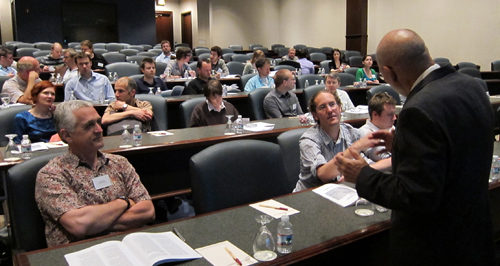
Joe Anderson, co-founder of the Society for Cognitive Studies of the Moving Image, opens the 2010 session at Roanoke.
Alignment, allegiance, and murder
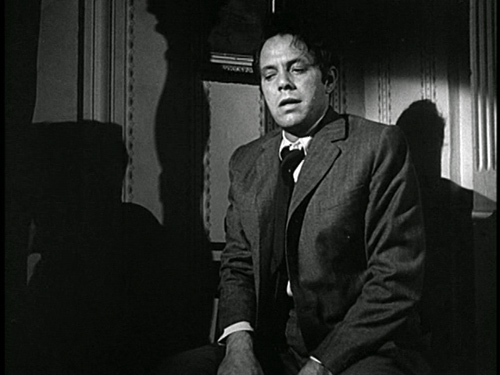
House by the River (1950).
DB here:
“Point of view” is one of those terms that we can’t seem to do without, but it’s rather vague. The clearest application of the term would be to shots that conform more or less to what a character sees, presenting what we might call optical point of view.
But sometimes we’re given access to what a character sees, hears, and knows less narrowly. Without any optical pov shots, we might still be restricted to a character’s range of knowledge. This happens in detective films like The Big Sleep, which confines us almost completely to what Philip Marlowe knows. We follow him into scenes, stay with him as the action plays out, and then leave the scene when he does. We’re “with” him, but not via optical point of view.
In his book Engaging Characters, Murray Smith calls this sort of restriction to character knowledge alignment. He points out that it has both objective and subjective sides. Objectively, we’re spatially attached to a character in the course of a scene or several scenes. Subjectively, we may get access to the character’s thoughts, memories, dreams, or immediate perceptions (as with a POV shot). Spatial attachment refers to the limited range of our knowledge; subjective access refers to the depth of knowledge about the character’s inner experience.
But what about our emotional engagement with the characters? We usually call this “identification,” but Smith shows that this is a misleading way to think about what happens. Identification seems to imply taking on another’s state of being, but we don’t necessarily mimic a character’s emotions. We might pity a grieving widow, but she isn’t feeling pity, she’s feeling grief. Smith talks instead of allegiance, the extending of our sympathy and other emotions to characters on the basis of their emotional states. Allegiance, Smith maintains, depends partly on the moral evaluations we make about the character’s actions and personality.
Alignment and allegiance don’t necessarily involve us with only one character in the course of a film. Cases like The Big Sleep, which put us “with” Marlowe all the way through, are rare. Often a filmmaker shifts our alignment and allegiance away from one character to another, perhaps in the course of a single scene. That may involve some careful choices about staging, framing, sound, and cutting.
I offer you an example from Fritz Lang’s marvelously perverse House by the River. I’m afraid I can’t avoid spoilers, but at least I don’t give away the ending.
At the point of a nail file
Stephen Byrne, a struggling but well-to-do writer is married to the lovely Marjorie. But this doesn’t stop him from trying to seduce their maid Emily. While struggling with Emily, Stephen strangles her. With the help of his brother John, he stuffs Emily’s body into a large sack and deposits it in the river. Stephen’s crime has stirred something in him, and he begins writing a new book, Death on the River, with its plot based on what he has done. Meanwhile, an inquest into Emily’s disappearance casts suspicion on John as her killer.
The very end of the inquest scene has shown the prosecutor and chief inspector confronting Stephen, who says he won’t do anything to incriminate his brother. Since neither John nor Marjorie knows of this conversation, we’re aligned with Stephen. He now has precious information: the police are likely to be watching his brother, not him.
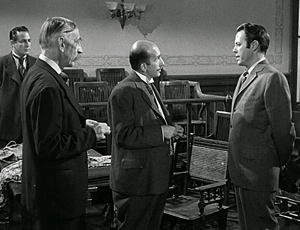
Our alignment with Stephen continues at the start of the next scene, which shows him at work on his manuscript. Marjorie comes in and asks to talk with him about Inspector Sarten.
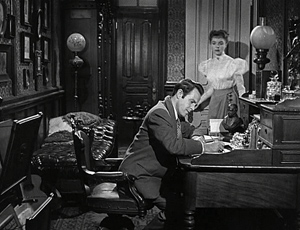
After a pause to consider, Stephen reluctantly follows her into her bedroom. Lang’s camera, angled along the corridor, puts us strongly with him.
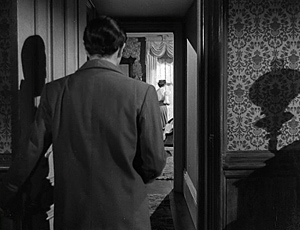
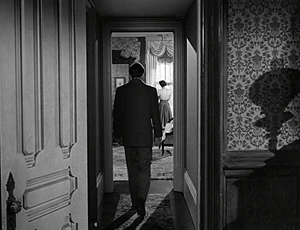
As Stephen enters the bedroom, Lang continues to favor him. Stephen comes into a knees-up shot facing front, but the answering shot of Marjorie weeping at the window is more distant, approximating his optical point of view.
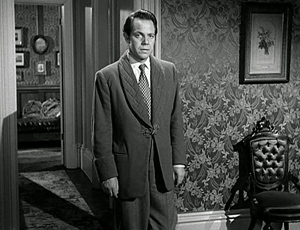
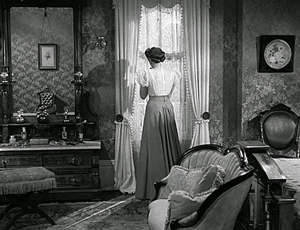
Often filmmakers give us slightly stronger alignment with one character than another by framing one more closely than another. That happens here, I think, for Lang repeats these camera setups several times as Stephen apologies for being snappish and asks Marjorie what she wants to tell him. We know he’s being pleasant only because he wants information.
She comes forward and sits, reporting that she has seen the detective following her. Now we can see her expression more clearly and she is less remote from our concerns.
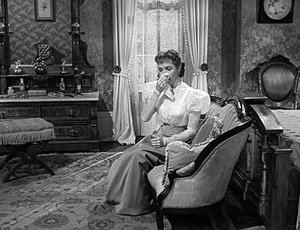
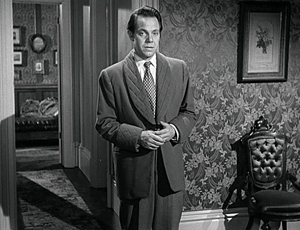
Again the setups repeat for a bit, with the framings still making Stephen more salient. Aligned with him, and to some extent allied as well, we are able to share his sense that danger is approaching. Stephen comes forward and steps into a more neutral and balanced framing. I’d argue that our sense of being “with” him now begins to taper off.
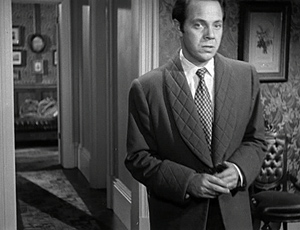
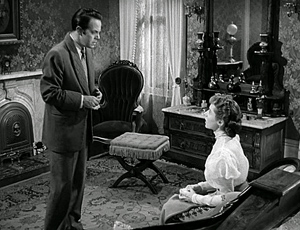
Marjorie points to the window (in one of Lang’s compositionally accented gestures) and suggests that an officer may be watching the house. Stephen goes to look out.
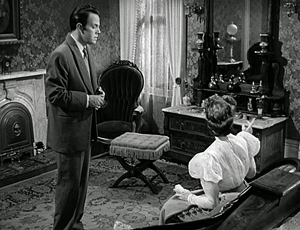
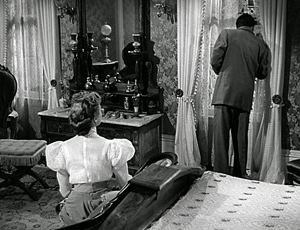
Stephen suggests that the police should be targeting John, since he’s acted suspiciously after the inquest. As Stepehn talks, he saunters to the dressing table and uses the file there to smooth his nails. He suggests that John may very well have had an affair with Emily. Although the framing is in long shot, we can see Stephen’s expression clearly, and it’s duplicated in the mirror. By contrast, when Marjorie rises indignantly and upbraids him, her back is mostly to us.
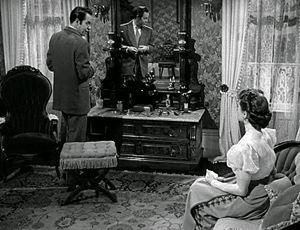
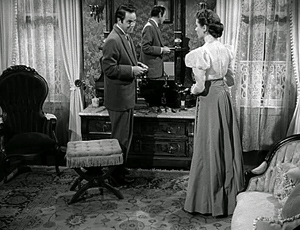
Stephen sits, remarking, “There’s a limit to this business of being brothers, Marjorie.” She turns slightly, saying, “Stephen, you’re insane.” This line prompts a cut to Stephen, still smoothing his nails but turned from us.
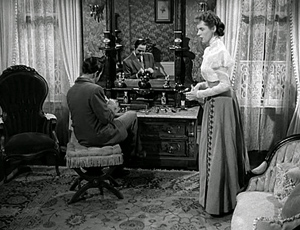
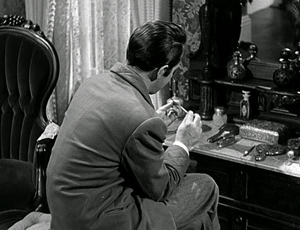
His face turned away and no longer visible in the mirror, Stephen says casually, “You’re very fond of him, aren’t you?” Now we’re more aligned with Marjorie, seeing more or less what she could see. Lang could have staged this phase of the scene to give us more information about Stephen’s expression (say a low-angle depth shot with his face in the foreground), but the opaque shot we get is balanced by a close, clear view of Marjorie for the first time in the scene–another step toward alignment and allegiance with her. The turned-away shot of Stephen also highlights his gesture of filing his nails, important in what will come next.
Cut to a medium shot of Marjorie’s reaction. “You know that.” Back to Stephen: “Are you in love with him?”

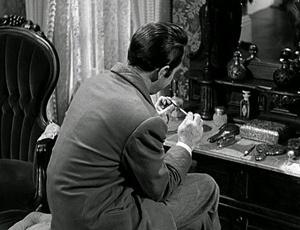
Stephen doesn’t see her reaction, which confirms his guess about her feelings for John, but we do. More important, our allegiance shifts toward her too. We know that Stephen is lustful (he’s seeing women in town every night), but Marjorie is suppressing her fondness for John for the sake of her marriage vows. She has the moral edge.
He questions her further, finally turning to her and grinning: “Don’t think I haven’t been aware of it.” Cut back to her: “You have a filthy mind”—something we know to be true. Her moral scheme fits ours, and sympathy for her builds.
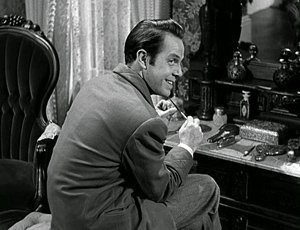
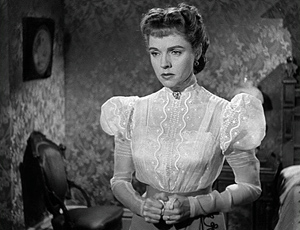
This riposte wipes the smile from his face and he walks slowly toward her, the nail file extended like a knife, but also waggling jauntily in his hand. He recovers his flippancy and assures her he doesn’t feel any jealousy toward John because he no longer finds Marjorie attractive.
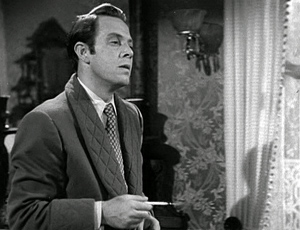
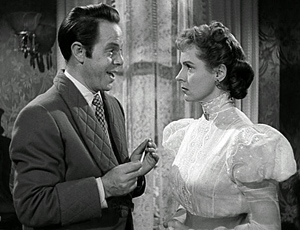
After he says he finds cheap perfume exciting, she calls him a swine. He resumes filing his nails. Stephen leaves the shot but, crucially, Lang’s camera dwells on Marjorie, glaring after him.
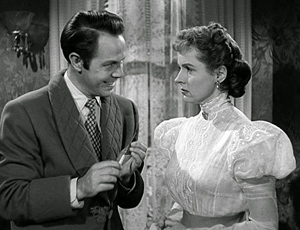
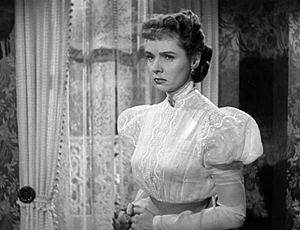
The scene’s final shot shows Stephen strolling down the corridor, and it ends with him smiling and slamming his door. It is a kind of symmetrical reply to the early shot of him going to her room.
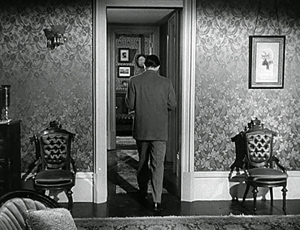
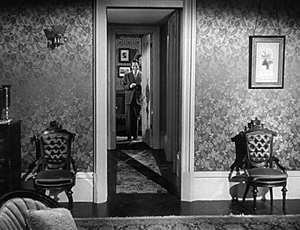
This point-of-view shot anchors us with Marjorie, both perceptually and morally. She now realizes that she is the only ally John has.
Marjorie doesn’t know that Stephen is the killer and that John helped him dispose of the body. As often happens in films, we know more than any one character. As a result, we can register suspense when Stephen approaches with the nail file (we know he’s capable of stabbing her), but she evidently doesn’t feel herself in danger. To put it more generally, a string of scenes which restricts us to one character after another gives us a moderately unrestricted knowledge of the overall narrative.
Still, moment by moment, the director can use film technique to weight one character’s reaction more than another’s. We can balance those short-term reactions against our wider compass of knowledge. Our sympathies can shift as we register characters’ changing awareness of their situation, however partial their awareness may be.
Interestingly, the end of this scene, emphasizing Marjorie’s new understanding of Stephen’s turpitude, links to the next scene rather neatly. We see John at home, drinking with grim determination, but when he answers the door he finds Marjorie there.
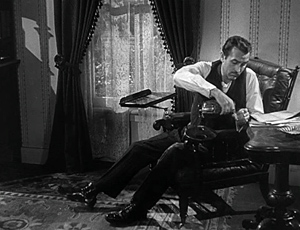
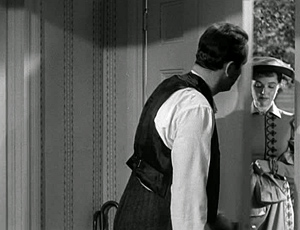
The segue to Marjorie as a center of consciousness in the bedroom scene prepares for her going to comfort John.
More broadly, the shift initiates a new phase of the film in which Stephen must further cover up his crime. For nearly all of the film’s first half-hour, we’re restricted to Stephen’s ken, when he commits and covers up his crime. After that, the film’s narration alternates between scenes organized around Stephen and ones organized around John, with two brief ones centering on Marjorie. The inquest, at twelve minutes the longest sequence in the film, gathers together all the characters and functions as something of a neutral and objective reset.
That scene is followed by the one I’ve examined, in which we return to Stephen writing a manuscript, as we saw him at the start of the film. The new scene’s narrational weight briefly shifts, as we’ve just seen, from him to Marjorie. After she leaves John’s house, however, the film will build suspense by attaching itself almost wholly to Stephen as he plots to kill both his brother and his wife.
Smith points out throughout his book that alignment and allegiance are complicated matters. It sometimes happens that we have sympathy for the devil–someone who’s acted immorally but whom we might root for to some degree. Bruno in Strangers on a Train is a classic example. And we can think of instances of villains who engender some sympathy because they have some admirable features or because they are treated unfairly.
So I don’t want to leave you with the impression that Lang hasn’t toyed with our allegiances more severely in other stretches of House by the River. At the start, Stephen is at best a bounder, but who doesn’t want him to succeed initially in hiding his crime? (For one thing, if he didn’t try, the story would be over too soon.) And there may be something admirable in his cleverness and bravado as he tries to palm the guilt off on John. My discussion of this scene simply wants to show that the fluctuations of alignment and allegiance can be quite small-scale, and they often depend on niceties of directorial technique.
Craftiness
Artistry depends on craft, and craft is something both cinephile critics and academics have neglected.
Coming across that sentence in a recent essay in Film Comment, you might have a question. What is craft, and how is it different from artistry?
Some thinkers, most famously R. G. Collingwood, saw a sharp line dividing the two. I’m more inclined to see them on a continuum, at least in certain art traditions. In film, I’d suggest that craft consists in fulfilling the task at hand with skill and efficiency.
Craft implies a set of norms, a default or standard that any competent artisan should be able to fulfill. Artistry then, we might say, becomes a plus. It goes beyond the task’s narrow purpose. Ozu’s establishing shots, for example, do more than establish the locale of the upcoming scene. They create intricate plays with compositional motifs that recur through the entire film. Artistry may not necessarily add complexity, though; it can also compress and concentrate. Bresson eliminates establishing shots and providing environmental information through glimpses of background or information on the soundtrack.
Sometimes artistry adds a psychological complexity not apparent in the bare-bones task. This might be given through performance and/or the way the scene is shot. This is what I think happens in the House by the River scene. It’s not a flamboyant job of direction. We need to take a little effort to see how Lang has set up the master shot to allow Stephen to go to the window, then to the dressing-table; and to see how Lang has reserved the closer shots of the couple for a new level of conflict.
But so much might have been done by any solid artisan. And you could imagine other ways to shoot the scene. Someone like Preminger might have presented the entire encounter in a few balanced two-shots. Lang’s extras—the discreet use of optical point of view, the analogous corridor shots, and the subtle variation in shot scale between Stephen and Marjorie, not to mention Stephen’s playful waggling of the nail file—build subtle attitudes toward the characters.
Call it artistry, or cunning craft. Either way, it shows how directors can shape our experience by adjusting the range and depth of our knowledge, sometimes in small but powerful ways.
The distinction between range and depth of information in cinematic narration is presented in Film Art: An Introduction, Chapter 3 and in my Narration in the Fiction Film. For more on these concepts, see Meir Sternberg’s Expositional Modes and Temporal Ordering in Fiction. Murray Smith’s Engaging Characters refines these and other distinctions in order to understand how we grasp character in film.
Tom Gunning’s The Films of Fritz Lang offers a detailed, fascinating commentary on House by the River, concentrating especially on motifs of writing, mirroring, and filth.
For other entries on the craft of staging dialogue scenes, go here and here and here and here elsewhere on this site. For more on niceties of direction, from a director seldom credited with such, try here.
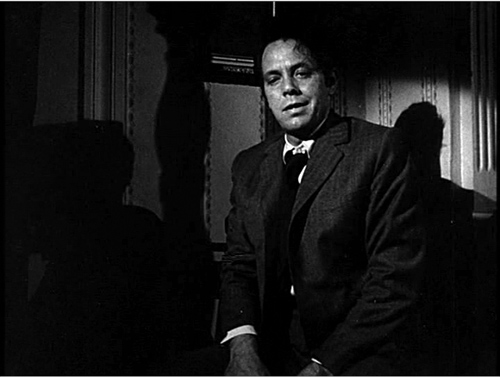
House by the River (1950).
Forking tracks: SOURCE CODE
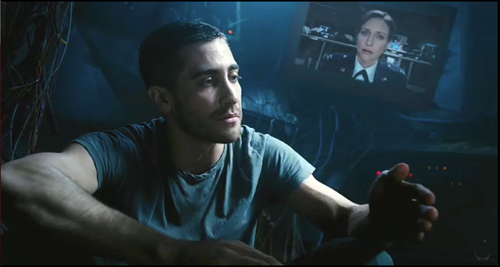
Source Code.
DB here:
Who cares if the Source Code software is junk science? The muzzy premise forms the basis of an agreeable little thriller from the tail end of this year’s Dead Zone. Even if you don’t share my admiration for this movie, maybe I can persuade you that it points up an intriguing wrinkle in the recent history of American studio storytelling.
I surveyed this history in some books, but Source Code provides a nice occasion to update my argument. My main point remains: More than we often admit, today’s trends rely on yesterday’s traditions. Quite stable strategies of plotting, visual narration, and the like are still in play in our movies. When a movie does innovate in its storytelling, it needs to do so craftily. The more daring your narrative strategies, the more carefully, even redundantly, you need to map them out. The game demands clarity through varied repetition.
More generally, there’s a value in thinking of movies as combinations and transformations of inherited conventions. We’re used to considering conventions as matters of theme and genre, but I’m equally interested in conventions of technique and of narrative form. These are areas we’re still only starting to understand, although many entries on our site try to make progress in understanding changing norms of style and storytelling. (Check our Narrative Strategies category for further leads.)
If you haven’t seen Source Code, you shouldn’t read on. I reveal damn near everything.
He couldn’t come home
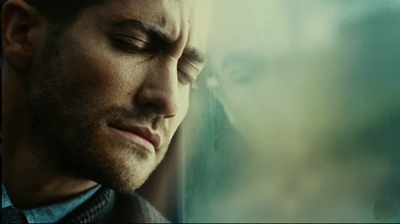
Colter Stevens awakes on a Chicago commuter train in the body of another man, Sean Ventress, who’s accompanying the attractive Christina Warren. Very soon the train explodes, and Colter reawakens in a pod in a military facility. He learns that after being shot down in Afghanistan he has been at the Nellis facility for two months, awaiting an experiment in “time realignment.”
Because a person’s brain activity does not cease immediately at death, memory modules can be accessed across an eight-minute period before full shutdown. Colter’s brain anatomy happens to be attuned to that of Ventress, so the experimenters can in effect insert his mind into Ventress’s body in the few minutes before the train explosion. The investigators know that the bomber is planning to set off a much bigger explosion in downtown Chicago, and Colter-as-Ventress could gather enough information to prevent it.
Under the tutelage of officer Goodwin and her superior, chief researcher Rutledge, Colter will be sent back in to the train, neurally speaking, to try to identify the bomber for them. He cannot prevent the train blowup, Rutledge insists. He can only hope to identify the bomber before the dirty bomb goes off downtown. But Colter can, in the shrinking time remaining, be sent back again and again, though it’s physically and emotionally punishing for him.
As a result, the film alternates between two zones of action. At the Nellis facility, time moves forward as Colter gradually comes to understand his circumstances and his mission. This action is under the pressure of a deadline: find the culprit before the dirty bomb is triggered. The other zone of action is the train, where the deadline is tighter (eight minutes before Ventress’s death) and the action is replayed as Colter tries different tactics to fulfill his charge.
Many incidents fill out this dynamic. In the pod, the early scenes are dominated by Colter’s efforts to understand the experiment he’s involved in and to grasp what has happened to him since his chopper crash. He is being kept alive artificially so that his brain activity can sync with Ventress’s. Eventually he breaks through Goodwin’s façade of coldness, converting her to sympathy for his plight. When she finally stares compassionately down at his broken body in its glowing casket, she resembles a mother or nurse looking down at a baby. On the train, the early scenes throw up some decoy suspects, most prominently an agitated man of vaguely Middle Eastern appearance. He is proven not to be the bomber, who’s eventually revealed as a dough-faced nerd. (Between the stereotyped Islamic terrorist and the stereotype domestic one, the plot opts for the latter.)
Colter not only blocks the Chicago bombing; with Goodwin’s help he is sent back one last time to stop the train bombing as well. In the course of that effort, he manages to reset the past, creating a parallel world in which the briefcase bomb never ignited and the bomber was captured before he left the train. Colter, dead at the Nellis facility, becomes Ventress wholly, able to spend a day with Christina and to send a text message to Goodwin promising that the Source Code has even bigger possibilities than Rutledge imagines. It can change the course of events. And she can reassure Colter’s original self, when he finally is sent on a mission: “Everything’s gonna be okay.”
It’s the new me
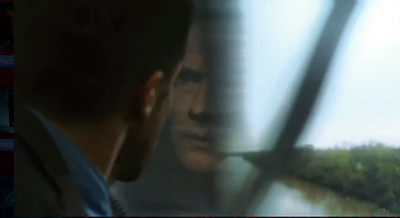
This plot is articulated in quite traditional ways. At less than 90 minutes, the film yields three large-scale parts or “acts.” The Setup introduces us to the premises, establishing the train bombing and the Nellis facility supervision; I’d argue that this ends at about 28 minutes. At this point Colter, has to rule out his chief suspect, the commuting businessman with motion sickness, when the train explosion takes place. The second stretch of the plot consists of more failed efforts, but culminates at about 56 minutes, when Colter correctly identifies the bomber, Derek Frost. Again, he can’t forestall the train bombing, but returning to his capsule he passes the key information to his masters, and they can arrest Derek before the dirty bomb hits Chicago. At this point his official mission is over. But the movie isn’t. Colter persuades Goodwin to let him go back one more time to stop the train bomb and save the passengers—effectively countermanding Rutledge’s injunction that the past can’t be altered. A three-minute epilogue starting around 82:00 wraps things up.
Filling out this structure is the characteristic double plot of classical Hollywood: heterosexual romance plus another, usually connected, line of action. The suspense plotline is organized as a series of goals, initially articulated by Goodwin. She tells Colter to find the bomb, which he does in the first replay. But as he can’t prevent the explosion, he needs to know more about who’s behind it. His next passes proceed in steps. He has to identify the guilty passenger; then he must try to steal the conductor’s pistol; then he searches for bomb-related paraphernalia.
About halfway through the film, however, Colter conceives purposes of his own. Inside the capsule, he probes Goodwin about what has happened to him. On the train, he starts to investigate the insignia of the agency controlling him, to trace his own fate in Afghanistan, to try to contact his father, and to phone the Nellis facility. He’ll eventually succeed in all these attempts, balancing the failures of the first chunk of the plot. Ultimately he’ll decide to try to save the train. Crucially, this last goal is formulated after he believes that having been more or less killed in Afghanistan, he is about to be terminated by the Source Code project. So he can now operate in a mode of pure self-sacrifice. As often happens in a classical film, a character finds the resources to throw off others’ demands and make decisions on his own.
In the romance plotline, by assuming the identity of Sean Fentress, Colter becomes attached to Christina. Now saving the train takes on a more personal weight; he will be saving her. The emotional dimension here is deepened by Colter’s backstory, his unresolved relation to his father. Eventually he is able to get closure by posing as Fentress and phoning tell the grieving old man that Colter indeed loved him. In screenwriters’ parlance, Colter is “exorcising his demons.”
Colter’s growing confidence in dealing with his past and the bomb threat changes his behavior toward Christina. No longer the skittish neurotic of his early incarnations, he becomes brisk and confident. Eventually he can relax, paying the standup comic across the aisle to entertain the other passengers. As often happens, character change is measured by a repetition. The first time Colter says, “It’s the new me,” he refers ironically to his discovery that he’s in another man’s body. But now, as the comic launches into his shtick, Christina points out that her companion has changed. He answers by saying, “It’s the new me,” which signals a deeper acceptance of his sacrificial role. He doesn’t expect to survive after he returns to the capsule, but he has saved the people on the train and he can for a moment celebrate a final moment of vitality.
This is not a simulation
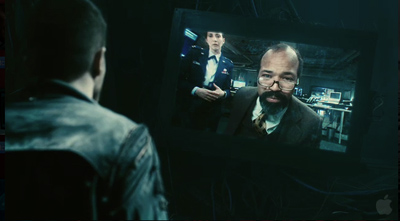
These cascading goals and character arcs emerge gradually, thanks to cunning narration. At first we’re restricted largely to what Colter knows, but gradually our awareness widens. We come to learn about Goodwin’s role in the Source Code project and about Rutledge’s ruthless efforts to use Colter as a test case. By the climax, the film cuts freely between the two arenas, the train and the Nellis compound, creating classical suspense as Goodwin postpones erasing Colter’s memory while he races to prevent the train blowup. This is the Griffith heritage of the last-minute rescue.
For the viewer, the film starts with mystery—Colter is on the train and he doesn’t know who he is—and moves toward a mixture of curiosity about his past and suspense about how he will solve his problem. By the start of the climax, we have understood all the forces converging on Colter’s last mission, and sheer suspense takes over. There is, though, one final surprise, which seems to have worried other critics more than it does me. More on this shortly.
Even before the explicit widening of narrational knowledge, we’ve been given a dose of something enigmatic. The shifts from the train explosion to the Nellis pod are provided with whooshing transitions of blurred and fragmentary imagery that, as the film goes on, clarify a bit. At the film’s center, these images will be replaced by distorted flashbacks to his helicopter crash in Afghanistan, a passage that leads him to ask Goodwin: “Am I dead?”
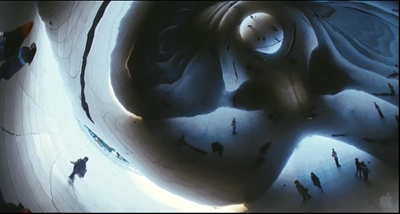
One of the images glimpsed in the vortex montages is that of Anish Kapoor’s Cloud Gate sculpture, which Christina and Colter-as-Sean will visit in the epilogue.
Thematically, the image can be taken as an emblem of the lives Colter has saved, with a hazy overlay that reminds us of his floating consciousness for most of the movie. But the more basic question is about the status of these blurry visions. Are they Colter’s premonitions of a future to come? That assumption seems confirmed at the end when Colter, staring at the sculpture, asks Christina if she believes in Fate. At the same time, the images can be treated as coming from outside his ken, as if the film were providing teasing hints about how the action will resolve.
In these montages we see an interplay between destiny and chance common in Hollywood storytelling. (Christina answers Colter’s question by saying she’s “more of a dumb luck kind of girl.”) Very often, even if chance seems to govern the plot, a film’s overarching narration seems to “know” how things will turn out. Thus the film can have it both ways, acknowledging that life sometimes depends on chance but also recognizing that satisfying stories feel inevitable.
As usual, you will have eight minutes
Since the early 1990s, many films have resorted to what we might call“multiple-draft” plotting, the replaying of key scenes with important variations. Groundhog Day (1993) is our prototype, and it influenced Source Code screenwriter Ben Ripley. An earlier instance is the alternative futures revisited by Marty McFly in Back to the Future II (1989). Yet these films revived an older, although minor, trend going back quite far in Hollywood. The device was sometimes used to present alternative futures, as in The Love of Sunya (1927), but more commonly it presented different characters’ versions of what happened in the past. We find it in the courtroom drama Thru Different Eyes (1929), which dramatizes conflicting trial testimony, and in Crossfire (1947), which somewhat anticipates Rashomon‘s use of the strategy. Contradictory replays are used for more comic effect in The I Don’t Care Girl (1953) and Les Girls (1955).
What led to the resurgence of multiple-draft storytelling in our day? Partly, I think, the changing genre ecology of Hollywood. During the 1970s and 1980s, certain genres like the musical and the Western faded out, and horror and science-fiction/ technofantasy became more important. These genres, still going strong today, encourage playing around with subjective states (dreams, hallucinations), devising misleading narration, and creating branching and looping timelines (through time-travel, telepathy, multiverses, and the like). The filmic experiments probably owe something as well to the rise of popular writers in the vein of Stephen King and Michael Crichton, along with the revival of the work of Philip K. Dick.
Pop science also furnished new narrative possibilities. Researchers discovered the Butterfly Effect: change one little condition at the start of a process, and you get a different result. There was the Forking-Path, or Choose Your Own Adventure, option, whereby you can imagine taking a different path in your life. And there was the Multiple-Universe Hypothesis, whereby we can hop from one parallel world to another.
Even without the pseudoscientific justification, the reset-replay option showed up in films that were influenced by earlier storytelling. Film noir sometimes resorted to replaying scenes in ways that filled in information missing on the first pass (e.g., Mildred Pierce, 1945). Tarantino made no bones about being influenced by the overlapping flashbacks in The Killing (1955), themselves derived from Lionel White’s original novel Clean Break. So in the wake of Reservoir Dogs (1992) and Jackie Brown (1997), we got many thrillers and crime films that retold the same events from different characters’ viewpoints (Out of Sight, 1998), right up to an almost endless series of replays (Vantage Point, 2008).
All of these multiple-draft tactics made their way into global cinema too; Run Lola Run (1998) is a prominent example, but so too is the dazzling anime The Girl Who Leaped through Time (2006). In America, the market’s constant demand for something novel (but not too novel) pushed filmmakers toward all the variants we see in films as different as Thirteen Conversations about One Thing (2001) and Confidence (2003).
For mainstream filmmakers the key is redundancy. The reset-replay device has to be explained through dialogue, diagrams, intertitles, and sheer repetition so that we understand it going forward. (Contrast, say, Primer, which left most viewers behind.) Once we’ve grasped the similarities in the core situation, we can measure the differences in each iteration.
Source Code director Duncan Jones had already shown an interest in replays in Moon (2009), with its Möbius-band treatment of the crashed lunar vehicle, followed by Sam’s awakening in the infirmary. The mystery of the first encounter, in which Sam seems to find another version of himself in the vehicle, gets slowly cleared up through dialogue, the discovery of a secret repository, and not least important, a bandaged hand wound that allows us to keep the two Sams more or less distinct. Similarly, in Source Code, the returns to the train can be more elliptical as we master the situation: the introductory shots (duck pond, Colter waking up) can be skipped or compressed. Our training is guided by Colter’s, as he starts to predict the trivial incidents (coffee spill, cellphone call from Christina’s ex) and handle them matter-of-factly. These repetitions anchor us and allow us to register the different actions he undertakes in each module.
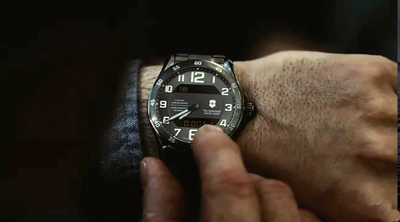
Those modules are ruled by another convention, what screenwriting manuals call the ticking clock. Usually reserved for the climax of films in all genres, even romantic comedies, the ticking clock plays a bigger role in Source Code. It governs both the macro-level (the deadline to stop the dirty bomb) and every return to the train. Strikingly, those replays are very strictly contained. Colter is assigned eight minutes for each mission, and by my count each of the developed train episodes before the climax consumes anywhere between four and eight minutes of screen duration, never more. His recurring deadline becomes a structural cell of the movie.
We have a chance to start over in the rubble
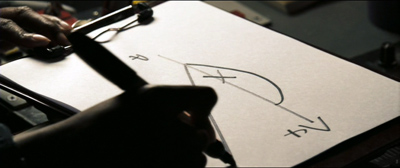
Déjà vu.
Multiple-draft storytelling promises to abandon the classic “linearity” of Hollywood storytelling, but the promise is largely a tease. The convention gestures toward unruly complication, but it tends to reinstall linearity, sorting everything out and making the final stretch of the film seem a logical consequence of what went before. Despite all the cycles and skip-backs of Groundhog Day, Phil changes incrementally into a kinder person and gets the woman he has come to deserve. In the money-drop sequence of Jackie Brown, the minute variations of point-of-view mesh into a single comprehensive account of how the scam went down. Part of the fascination of the technique for us may be similar to what a child feels after spinning around and stopping: the dizziness is fun, but so too is the bumpy readjustment to a stable world.
Source Code wants a happy ending. Does it prepare us sufficiently? We have the vortex transitions that look forward to the Cloud Gate epilogue, but are these enough? Don’t we need something at the level of plot action?
In his last visit to the train, Colter manages to disarm the briefcase bomb and capture Derek Frost. So now the train didn’t explode; the Nellis facility was never put on alert to forestall the dirty bomb; Rutledge and Goodwin never tried using Colter as their Source Code guinea pig. Rutledge earlier denied that this revision of the past would be possible, but the plot nonetheless moves us into a parallel world characteristic of forking-path plots like Run Lola Run and The Butterfly Effect (2004). And this reality has become sovereign, since Colter can now successfully send Goodwin a text message advising her about the unexpected success of the Source Code stratagem. This also means that as more or less a brain in a vat, the wounded Colter survives to serve in other missions.
Given the right sort of motivation, then, the forking-path option can be activated as a resolution device for multiple-draft plots. The film’s makers invoke a multiverse explanation explicitly in one piece of publicity for the film (trailer 2 here). More important, we’re prepared to accept such a switch on pretty slender evidence. Counterfactual thinking in terms of forking paths is a part of our folk psychology. If only we’d left the parking lot ten minutes earlier, we wouldn’t have hit this traffic. If I hadn’t taken this job, I wouldn’t have met my husband….and so on. Despite what experts like Rutledge say, when we see Colter disarm the lethal briefcase, we’re prepared to buy the possibility that everything afterward has changed.
Still, we need some elements in the movie itself to justify the jump. During his final questioning of Goodwin, Colter asks if she could imagine a world in which she didn’t get divorced, being “a woman who took a different fork in the road.” Colter insists that the course of events is changeable: Christina “doesn’t have to be dead.” At various points he says he thinks he can save the train, but like Rutledge, Goodwin reasserts that there’s only one reality, and its events have already happened.
Interestingly, the debate itself might be a minor convention of the multiple-draft plot. In Tony Scott’s Déjà vu, (2006) a close analogue to Source Code, two scientists disagree about whether the past is malleable. Professor Denny says that you cannot change what’s already happened. “God’s mind is made up about this.” But his colleague Shanti adheres to the “branching universe theory,” which she helpfully draws on paper for our benefit (echoing Doc’s famous diagram in Back to the Future II). A significant event, Shanti maintains, can shift the course of events and create a new path. It can even, she claims, wipe out the branch that was initially taken as baseline reality.
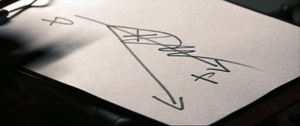
Images of linearity deflected, of hiccups and branches off a main line, show up in Source Code too. The train bomb is fired off just as another train passes on a parallel track. But in the final replay, after Colter has set things right and paid the comedian to do his turn, we see “all this life”—the passengers frozen in amusement. The shot is a kind of marker that, as Shanti puts it, something big has changed. Abruptly we get a shot we haven’t seen before: a high angle of our train switching to another track. Then we cut back to Colter and Christina about to kiss, as the rival train passes safely. Our train’s new trajectory confirms that an alternate reality has been put in place. It also echoes an earlier line, when Christina, talking about her plans for the future, asks Colter: “Am I on the right track?”
This will end
Source Code appropriates the forking-path option in order to arrive at a final draft of Colter’s fate. This stratagem reflects a common tendency in the history of narrative forms. Over the years, as readers become more skilled in picking up conventions, authors can be more elliptical and oblique. Descriptions can be more bare-bones, and authorial commentary can be given in a phrase rather than a paragraph. (Elmore Leonard: “I leave out the parts that readers skip.”) Films that once needed to motivate alternative futures through dreams or fortune-telling now do so through scientific gadgetry, or just by referencing similar movies.
We surely lose something in a trend toward such laconic storytelling, but there are gains in speed and impact. What Déjà vu debates for minutes can be abbreviated in Source Code because audiences have caught on: a few cues suffice to let us figure out how this sort of story goes. For me, the very premise of the replay device, plus Colter’s raising the issue of forking paths with Goodwin, plus our commonsense psychology, plus the swooshes, plus the convention of the happy wrapup, not to mention the overall urge to reward our our hero for all his sacrifice—all this is enough to push the ending over the finish line.
More generally, you can invoke Steven Johnson’s argument that we’re getting smarter about picking up quickly-emerging conventions. Popular culture, he claims, is more intellectually demanding than it used to be; examples would be The Wire and Lost. I’m not wholly convinced, since Our Mutual Friend and other items consumed by generations past can be pretty complex, and twentieth-century middlebrow artists like Thornton Wilder, J. B. Priestley, and Alan Ayckbourn have flirted with formal experiment. I’d relate the intricacy of some popular narratives partly to the proliferation of more niche genres and specialized publics, along with the growth of pop connoisseurship. Aging hipsters and cool college-educated youngsters, fortified with high disposable incomes, now flaunt a nerdy side and enjoy avant-gardish innovations.
For whatever reasons, in a lot of mass storytelling, form is the new content. But that newness depends considerably on recasting long-standing traditions. Nothing comes from nothing. And it can be fun to trace the fluctuating dynamic of novelty and familiarity as it emerges in the movies that we see right now.
At Electric Sheep Duncan Jones elaborates on the forking-path dimension of his film.
This entry builds on work I’ve done elsewhere. For more on classical conventions of plotting and narration, see The Classical Hollywood Cinema: Film Style and Mode of Production to 1960, part one, and Narration in the Fiction Film, Chapter 9. On recent narrative innovations and their relation to classical premises, see The Way Hollywood Tells It: Story and Style in Modern Movies, 51-103. On forking-path plots and their relation to folk psychology, see the essay “Film Futures” in Poetics of Cinema. One essay in that volume discusses Mildred Pierce‘s tricky replay of the opening murder, while another surveys another contemporary trend, the network narrative.
On dividing a film’s plot into parts, see Kristin’s earlier entry and my essay on Mission: Impossible III. Go here to see what happens when Archie Andrews takes a forking path.
Yes, there’s something similar to be done with The Adjustment Bureau. But I leave that to others.
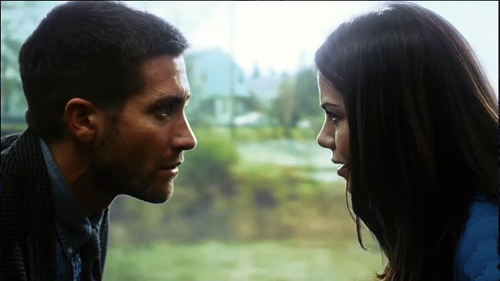
Source Code.
Molly wanted more

The Crime of M. Lange.
DB here:
I was watching Snow White and the Seven Dwarfs some years ago with a friend’s three-year-old daughter. Molly hadn’t seen the movie before, and she watched it in a fascinated silence. At the end, Snow White and the prince leave the dwarfs and ride off into the distance.
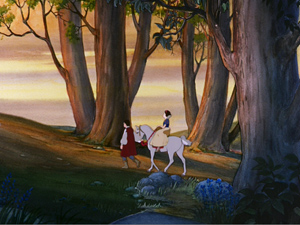
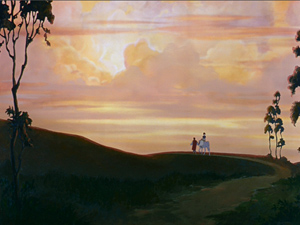
At this point Molly cried, “More!”
This surprised me. How could she know, on her first pass, that the story was ending?
In and out
It has no name that I’m aware of, but it’s one of the most common conventions of movie storytelling. At the end of the film, the story world closes itself off from us. The characters turn away, perhaps walking into the distance. We may get a distant long shot of the scene. In some cases the camera accentuates this withdrawal by craning or tracking away from the action.
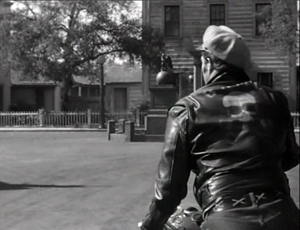
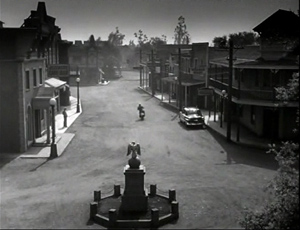
At the end of The Wild One, the biker hero smiles at the woman he’s met and goes out into the street. After exchanging a glance with the ineffectual sheriff, he swings his motorcycle around, his back to us. Cut to an extreme long shot as he rides off.
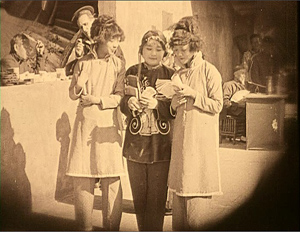
Once you notice this sort of ending, you’re likely to think about beginnings. Sure enough, we find some symmetry. A movie often visually brings us into the story world. Most common is an inward progression, moving from a large view to the central space of action. As far back as 1919, Griffith started Broken Blossoms with an overall view of the harbor and an explanatory title.
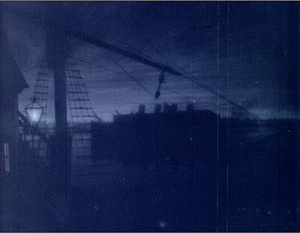
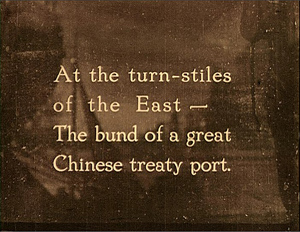
Then we have a gradual entry into the Chinese neighborhood, moving steadily from long shots to closer views. The young ladies we encounter aren’t major characters in the plot, but we’re still slowly drawn into the story world.
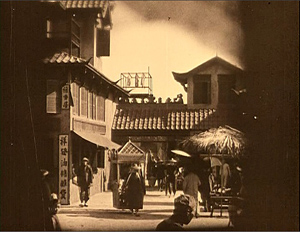
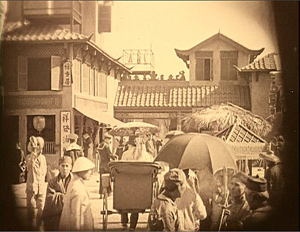
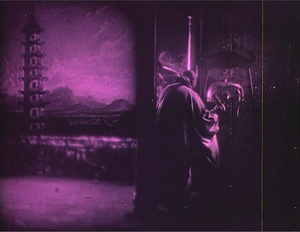
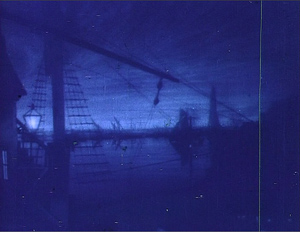
At the film’s end, Griffith’s cutting will manage a parallel withdrawal, from the lovers to the temple and back to the waterfront view.
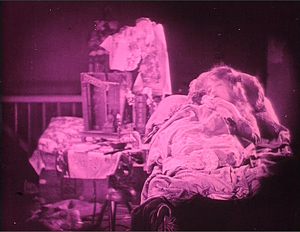
In fact, Snow White starts with a comparable, if somewhat smoother shift inward, from the exterior of the Queen’s castle then, via camera movement and dissolves, to the Queen at her mirror.
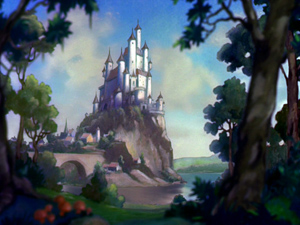
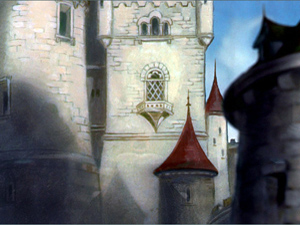
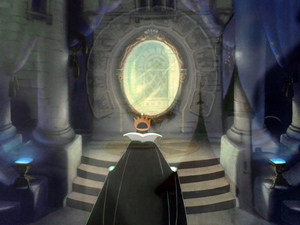
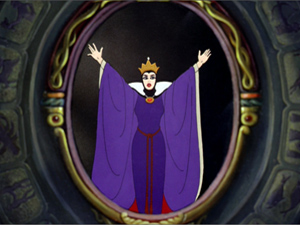
This last shot reminds us that alternatively, a film can start with the characters coming forward, as if to meet us. This is the way The Wild One begins.
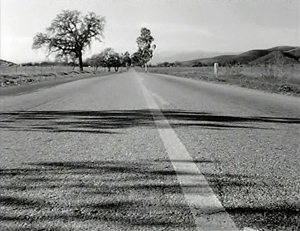
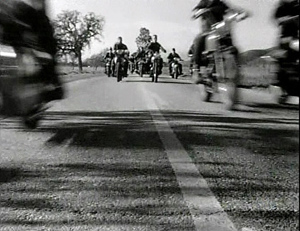
Any sort of combination is possible. The Silence of the Lambs starts with Clarice Starling climbing up a hill toward us and pausing long enough for us to register her as a protagonist.
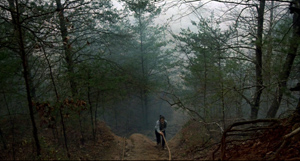
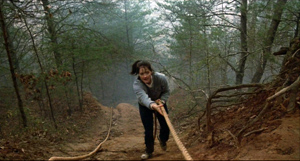
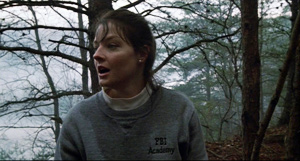
She then turns and runs off into the forest. If this were an ending, we might see her go off further and further into the distance. But this is an opening, so we follow her with a tracking shot forward, letting her lead us into the story action. Soon we’re back to the frontality and intimacy of an opening passage, like the shot of the Queen.
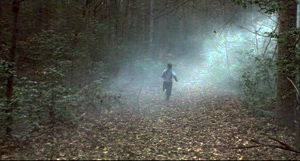
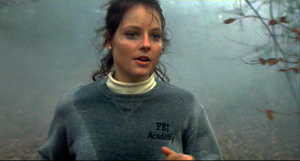
At the end, Jonathan Demme gives us a pair of “farewell” shots. The first occurs when Clarice, who’s been talking to Dr. Lecter on the phone, hears the line go dead. We pull away from her.
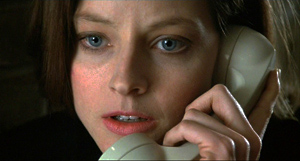
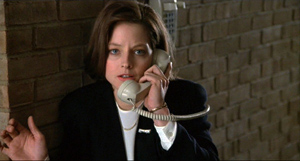
The second farewell shot takes place on Lecter’s end in a Caribbean island. It shows him rising to follow Chilson and walking away from us, to be swallowed up into the crowd.
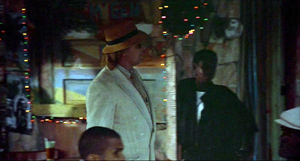
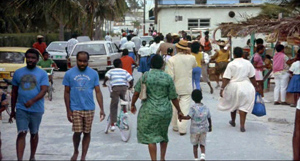
The Silence of the Lambs takes leave of its protagonists in two alternative ways: If the camera doesn’t move away from our characters, it seems, then the characters move away from the camera. They may even seal themselves off, as when a flight attendant pinches shut the curtain at the end of The Hunt for Red October.
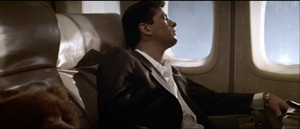
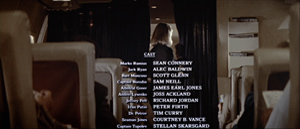
So when we speak of films’ “openings” or “closings,” it seems that we are often talking about a world that initially invites us in but will finally expell us, however slowly and politely.
See it here!
Researchers play Jeopardy! Their answers always take the form of a question. Most film critics work in the declarative mode (“The performances are gripping”), but ideally the academic film researcher works in the interrogative mode. What is this pattern of beginnings and endings doing in movies? How does it work? How did it become common? And how do we learn it?
Take the first question, about the purposes and functions of the device. At one level its neat symmetry mimics the sort of frame that we find in other sorts of narrative, particularly oral storytelling. Fictional stories need to be set off from the surrounding flow of discourse. When we hear “Once upon a time,” we all know a fairy tale is starting. There are equivalents in other oral traditions, as in “Here is a tale . . . .” (Yoruba) and “See it here!” (Hause).
Likewise, oral storytelling traditions use formulaic final lines. In our fairy tales, it’s often “And they lived happily ever after.” Native American folk tales may finish with the storyteller simply saying, “The end” or “Tied up.” African oral epics sometimes use the formula “That is what I know” or “Let us leave the words right here.”
In fact, I cheated a little with my examples from Snow White. The film actually is bracketed by a literal opening and closing.
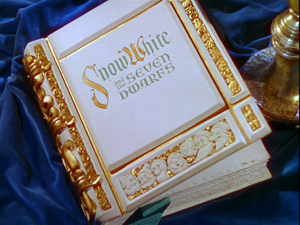
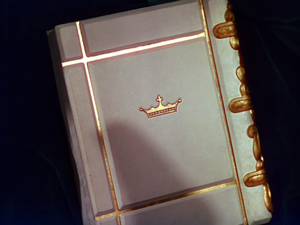
In film, however, the symmetrical structure is only part of the answer. While a film can copy the literary idea of opening and closing a written text, the medium as a whole offers something more. Thanks to the visual nature of movies, the widening or closing-off of the story world can mimic the act of our entering or backing out of a tangible situation. That’s what we see in Snow White and my other examples. In a sense we greet the characters, and after spending some time with them we bid them farewell. The sense of entering and leaving their world is harder to capture so concretely in literature or theatre.
So we need a more specific account of the convention. Surely you’ve thought about the most obvious candidate. The entry/ leave-taking pattern mimics our activities as perceiving, socially inclined people. For creatures like us, to encounter a new situation or setting simply involves approaching it or letting it approach us, then becoming part of it and fixing our attention on its details. At a party, we amble closer to a knot of people we want to talk with, or someone comes up to us. Sooner or later that encounter ends or trails off, and we withdraw or turn away or watch when others depart. More poignantly, the extreme long-shot option can recall moments when a car or bus or train carried us away from our loved ones. In any case, thanks to moving images the salient features of this very common experience can be made tangible for viewers.
This convention, we might say, is just natural. Molly, who had already logged three years of social experience, could plausibly make the analogy with ease. She recognized that her encounter with the world of Snow White was coming to an end–the characters were leaving her–and could express her regret.
This common-sense answer is, I think, basically right. But it needs to be fortified against some objections.
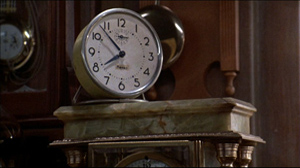
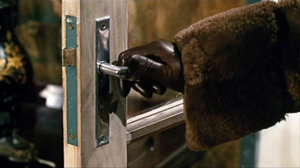
For one thing, not all films use this convention. Lots of films start with close-ups of particular items in an environment, plunging us into details without a gradual entry (below, Back to the Future; Muriel; ou le temps d’un retour).
And lots of films don’t end with marks of withdrawal or closure. They end on close views, often of the characters or a significant object (below, Le Silence de la mer; Sorry, Wrong Number).
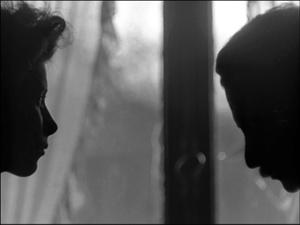
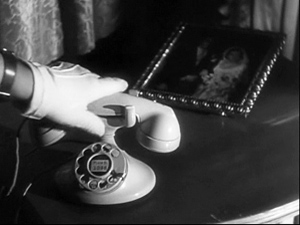
If this pattern were biased by our natural proclivities, wouldn’t it be more common than it is? And if it comes so naturally, why wasn’t it present at the start of cinema, as soon as people started telling stories? Most of the storytelling techniques we now consider very user-friendly, like cutting and camera movement, emerged after many years of moviemaking. It’s akin to a problem in the history of painting: Why did painters need centuries to learn to imitate the way things look?
Moreover, the naturalness can look pretty unnatural. Nobody lies down in the middle of the road to let a horde of bikers sweep by, as in the beginning of The Wild One. The high angle at the end of the movie doesn’t imitate anybody’s likely point of view; it mimics, if anything, a godlike perspective we almost never get. Similarly, the cuts and dissolves that link the views in Broken Blossoms and Snow White don’t have any parallel in our real experience. Tied to our bodies, we can only move toward or away from situations in real time, step by step. The time-compression and freedom of position we get on film are far from natural. In sum, the concrete ways in which this immersion/ withdrawal pattern shows up in actual movies suggest that the films aren’t imitating the literal vantage points we might assume in the real world. There is a lot of contrivance going on.
Real life, amped up
So the convention has some roots in our perceptual and social experience, but filmmakers have streamlined and sharpened it for our uptake. Another example of this process, which I discuss here, involves actors’ eye behavior. Film actors start with normal patterns of looking and blinking, but they modify them in order to signal emotional states and to concentrate our attention on the drama. Similarly, the schema of entering/ leaving a milieu derives from our common experience, but it can be simplified and stylized through cinematic techniques that have no correspondence in our normal experience. All that matters is that the result preserves the core of that schema.
As filmmakers simplify our perceptual and social experiences, they amplify them as well. Movie characters stare at each other more intently than we do in normal life. The actors are stripping off everyday noise (blinks, averted looks) in order to create cleaner, exaggerated signals of mutual attention to the dramatic situation. Likewise, a steep high angle like that ending The Wild One or the pointedly closed curtains of The Hunt for Red October exaggerates the sense of departure and conclusion, giving the action a weight it wouldn’t have in ordinary life.
Why don’t all films use the entry/ retreat convention? I think we should consider such conventions to be tools. They arise in particular filmmaking traditions, perhaps through trial and error, and get refined for different purposes. Some filmmakers might never use them, or knowingly refuse them to create different reactions, or play games with them (as Resnais does at the start of Muriel). But when filmmakers want certain effects, these tools are ready to hand. If you want to ease your audience into the story world, a slow entry pattern works very well. It’s so familiar that the viewer can overlook its contrivance and concentrate on the story information.
So Jeopardy!-style, we have new questions. Has the opening/ closing device spread because it is a very accessible, spontaneously understood convention? Or is it because filmmakers in other cultures have mechanically copied Hollywood? Perhaps it’s like a tool that originates in particular cultural circumstances but which can be useful all over the world. The Phillips-head screw was devised for the US automotive industry but is now a universal gadget. Over time, such tools become more widespread, perhaps dominant. But a tool can always be refused if the task changes.
There’s still a mystery, though. Assuming that viewers understand these image-clusters as signaling beginnings and endings, how did that understanding come about? How, and when, do people learn the conventions? If they are quickly learned, is that because they play into inclinations of our minds?
My best guess for now is this. We tend to think that all artistic conventions are equally hard to learn, but that’s probably not the case. The conventions of Cubist painting demand more effort and knowledge than the conventions of perspective drawing, and that’s probably not just because we’ve seen more perspective pictures across our lives. Likewise, mastering the conventions of Structural Film demands more time and trouble than mastering those of popular genre filmmaking. It seems likely that some conventions rise to dominance because they fit most viewers’ prior inclinations rather well. For example, we are creatures who interact socially in face-to-face manner. Shot/ reverse-shot editing is unfaithful to our ordinary experience in many ways; cuts provide instant changes of viewpoint we can’t achieve in real time and space. But shot/ reverse-shot cutting preserves the familiar social pattern of turn-taking and conversational flow, so it’s comparatively easy to learn.
Still, I don’t have a full answer. My questions bring us back to Molly. If she had seen Snow White before, we might say that she remembered that the film ended at this point. But she hadn’t seen the film before. So does her demand for more indicate that she generalized from her experience of other films? Did she have already a degree of “narrative competence,” allowing her to recognize certain types of cues? Is her competence full or spotty? (Maybe she gets endings, but not characters’ intentions, or goal orientation.) And how did she acquire that competence? Quickly or slowly?
Maybe some researchers have already explored how children master narrative framing of this sort. (I’d welcome correspondence on the matter.) My hunch is that Molly grasped the cinematic convention, perhaps on limited exposure, because she recognized the core perceptual and social experiences it preserves. Leveraging this insight, perhaps, was some understanding of narrative architecture generally. More basically, it may be that as social animals we’re tuned by evolution to detect fairly quickly some constant features of interactions with our peers.
In any case, I’m betting that Molly wasn’t simply mastering a convention cut off from everyday life, like algebraic equations. To learn anything, you already need to know a lot. Cinematic storytelling isn’t, as some semiologists once thought, a highly arbitrary sign system. It piggybacks on our experience of the world–our knowledge, certainly, but also our most routine ways of sensing and thinking. Not least, understanding movies taps skills associated with our social intelligence. More on this in a future entry, I hope.
This is only an anecdote, but I hope it provokes readers to think about the broader issues I raise. I floated these ideas in my closing address for the convention of the Society for Cognitive Studies of the Moving Image, on 5 June 2010. I thank the members of the audience for their contributions to that discussion. Incidentally, this year’s meeting is coming up, in Budapest this June. For more on SCSMI and the sort of issues broached in this entry, go to this category on this site.
My basic argument for a “moderate constructivism” in understanding film conventions is developed in the 1996 essay “Convention, Construction, and Cinematic Vision,” reprinted in Poetics of Cinema (2008), 57-82. I discuss the entry/ withdrawal pattern as a holistic strategy in a later essay in that collection, “Three Dimensions of Film Narrative”, 94-95. An earlier, more fancily titled piece puts the pattern in the context of a different argument: “Neo-Structuralist Narratology and the Functions of Filmic Storytelling” in Marie-Laure Ryan, ed., Narrative across Media: The Languages of Storytelling (2004), 209.
It’s worth mentioning that, like Snow White, the images at the start and conclusion of Le Silence de la mer are enframed by a book–in this case, shots of the original book by Vercors. This iconography is of course common when a film wants to emphasize the literary origins, though in some films, like Dreyer’s, the device of the film as a replay of an already-written text plays a more complicated narrative role. I talk about that in my book The Films of Carl Theodor Dreyer (1981).
The research on children’s understanding of stories is vast and detailed. Alison Gopnik briskly summarizes the evidence that even very young children have surprising narrative competence in The Philosophical Baby (2009), chapters 1 and 2. The pioneering source here, at least for an amateur like me, was Katherine Nelson, ed., Narratives from the Crib (1989).
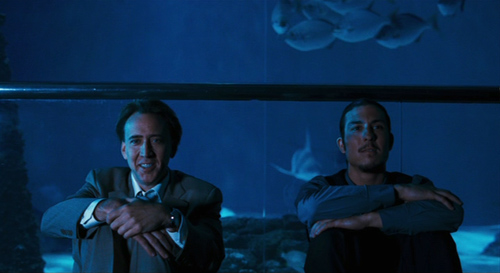
The Bad Lieutenant: Port of Call New Orleans. As in many films, the final shot addresses the viewer in a comparatively overt way.