






Archive for the 'Narrative strategies' Category
Splashy and spare, vengeance and regrets
DB here at the Hong Kong Film Festival:
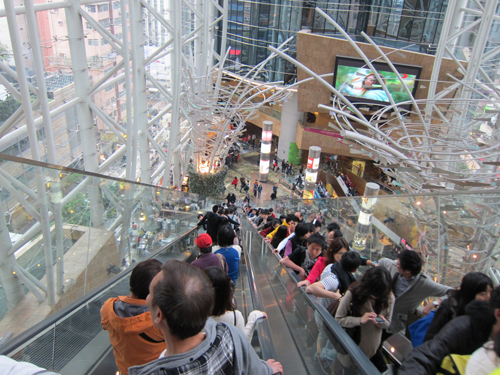
Above, a tourist pic, the view from one of several escalators in the towering mall in Langham Place. Its flamboyance makes a sharp contrast with the movie I saw in the mall’s cinema, the minimalist Turin Horse. (See below.) The very end of this entry presents another view from the heights of Langham.
Righting wrongs, with new wrongs
Heaven’s Story.
Most Hong Kong thrillers and action pictures use revenge as their mainspring. It’s fairly uncommon, however, for a film to try to convey the cost that vengeance exacts on the avenger. Punished, directed by Law Wing-chong and produced by Johnnie To, makes an effort in this direction. A mogul’s spoiled daughter is kidnapped, and his refusal to bend to the captors’ will leads one, in a moment of pique, to kill her. After learning of her death, the mogul contracts with his chauffeur, a man who knows the underworld, to track down the gang.
The tycoon, played by Anthony Wong, goes through some agonizing as he must hide his daughter’s death from the girl’s stepmother. In turn, the chauffeur, Richie Jen (whose skilful performance dominates the movie), must abandon his son after executing the boss’s revenge. The men’s lives dissolve in their quest for payback, and the fact that the daughter, a brattish cocaine addict, is completely unsympathetic only makes the whole thing bleaker. An obvious parallel is the Eurothriller Taken, which presents a rash but innocent daughter rescued by a father who remorselessly cuts down everything in his path. Well-mounted, with perhaps too many flashbacks, Punished is that unusual Hong Kong film that insists that every effort to assuage male pride takes a toll in male pain as well.
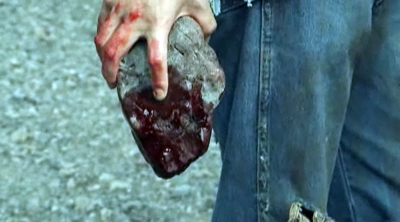
But for a film that really investigates the cost of settling accounts you have to turn to Heaven’s Story. Here Zeze Takahisa, known mostly for erotic films, traces out the consequences of three killings. The cop Kaijima impulsively shoots a suspect. The locksmith Tomoki’s wife and child are brutally murdered by a teenager, Mitsuo. And elsewhere the little girl Sato is the only survivor of another family homicide.
The stories link up. Sato, in numb grief, sees Tomoki on television vowing to kill Mitsuo when he leaves prison. Because the man who killed her family has committed suicide, Sato embraces Tomoki’s reckless vendetta. She grows up hoping to help him kill Mitsuo. At the same time, Kaijima’s son develops a sidelong relation with her….
I really haven’t given away much, because the film traces these characters and several more across the space of—yes!—four and a half hours. As in a novel, the motives and connections among characters emerge slowly. Zeze’s plot maintains a balance between suspense about what comes next and curiosity about the past. And as in most network narratives, part of the pleasure is wondering how the new characters we meet will tie into the ramifying web of relationships.
Zeze splits the film into two “acts,” with intermission, at a bold spot: ending the first part on a pitch of suspense and starting the second with a new set of characters, making us wait for the developments set up at the end of act one. Working on a broad canvas allows the film to shift majestically, in large blocks, from one person to another. The same goes for the ending: After the main drama is resolved, Zeze allows a long epilogue in which many of the film’s motifs are gently set to rest.
That drama and those motifs, unsurprisingly, bear on the power of unspeakable acts to ignite our desire for revenge. Every character, even those unaware of the savage deaths in the past, is altered by the central killings. An amateur rock singer, a young woman almost defiantly self-centered, becomes a devoted mother, which seems to yield some hope; but her family is eventually shattered by echoes of Mitsuo’s crime.
Those more directly affected by the killings face more severe tests. Kaijima, for instance, tries to compensate for his impulsive shooting by giving monthly money to the victim’s wife and daughter. (The irony is that the money comes from his sideline, moonlighting as a paid killer.) The daughter grows up expecting Kaijima’s payments as her due and tries to extract more money from him, as if he were her surrogate father. This daughter, along with Mitsuo the teen murderer and the older woman who takes him in, come to unexpected prominence as the film unwinds a tale of sorry lives and compromised choices.
Mostly shot in rough-edged, somewhat bumpy shots, Heaven’s Story at first made me fret: 278 minutes of this? I needn’t have worried. The pace is steady, even relentless, but I didn’t find it monotonous, and a more polished presentation might have lacked the distressed urgency of what we get. Incidentally, the framing bits, showing a sinister puppet play with Shinto overtones, are filmed with smooth care. The contrasts in technique suggest that a more serene supernatural domain exists alongside the anxious sphere of human desires, where people persist in trying to redress old sins by committing new ones.
The obscurity of the everyday
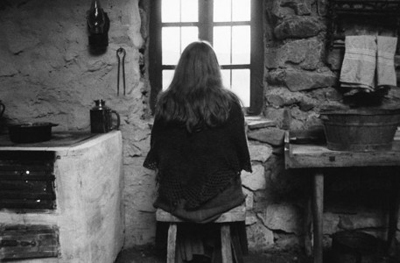
A horse is feverishly hauling a cart, the camera riding low underneath the beast’s plunging head. The wheezing repetitive score rises to a scraping whine, then it’s replaced by the sound of fiercely whipping wind. The old driver pulls the cart up at a farmhouse, where he’s met wordlessly by a younger woman. As the wind tears at them, they take the horse to the barn, the cracked leather harness left on the cart. Inside the cottage, the woman helps the man change his clothes. The woman boils a pair of potatoes. She says: “It’s ready.” It’s the first line of dialogue, and it comes nineteen minutes into the film.
Thus begins the festival film that has exhilarated me most so far, The Turin Horse. With this movie, Béla Tarr, a favorite of mine (especially here, but also here and here), has given us his most spare entry yet. Almost nothing dramatic happens during its 140 minutes, and what does take place is opaque and enigmatic. The film refuses traditional exposition, forcing us to observe bits of behavior and speculate on why things unfold this way.
At one level, it’s the heritage of Neorealism paying off. In Umberto D’s scene of the housemaid preparing breakfast, we had an early example of sheer dailiness used to characterize a person and a milieu, as well as to absorb us in what we might call mundane beauty. But something different, more abstract and disturbing, happens when a film is nearly all routine. In the farmhouse, the old man and his daughter eat their steaming potatoes barehanded, squeezing and mushing them. He wraps himself in a blanket and stares out the window while she does household chores. Next day they arise, dress, and hurl themselves again into the blasting wind. (The wind ripping along the wet streets in Sátántangó is nothing compared to this gale.) In all, cramped settings observed with Tarr’s usual tactile detail, rendered gorgeous in black and white, become as obscurely allegorical as the magical tabletop in Tarkovsky’s Stalker.
Other characters show up eventually. An hour in, a talkative friend arrives and provides a monologue cursing the ignoble forces that have driven intelligence from the world. Later some travelers appear outside at the well, with malevolent results. And the horse refuses to be fed. Perhaps at bottom the “story arc” is that light simply goes out of this world. Having dwelt on gestures (hands pouring out alcohol or struggling to harness the horse) and textures (the ripples of woodgrain on the stable door), the film slides into darkness. The motif is announced in the cryptic trailer for the movie.
From Tarr’s comments we learn that the man is a carter and the woman is his daughter. The film’s voice-over prologue invokes an episode from the life of Nietzsche, who once tried to stop a driver from mercilessly whipping his horse. The incident purportedly led to Nietzsche’s descent into insanity. Tarr has said that the film, based on a short story by László Krasznahorkai (who also wrote the novel Sátántangó), tries to imagine what happened to the horse after the incident.
Yet the horse is less important in the film than the carter and his daughter. It’s not hard to see them living a post-Nietzschean world, and the visitor’s rant about universal debasement may offer support for this interpretation. It’s another exercise in what an earlier entry called Tarr’s “postlude” vein, presenting what remains of life after history has more or less ended. Yet these are no stick figures in a metaphysical meditation. Virtually without psychology, father and daughter are defined through their sheer physical weight and movements. They confront the blasted landscape when they pass outside and the wind tears at them, but once inside they shift to the window to watch. The image of an observer trying to understand a harsh, senseless world beyond the walls is one we’ve seen in the opening of Perdition, and in the scene in which the obese doctor in Sátántangó planted at his desk tries to write down everything he sees happening outside.
Not that the cottage is any more welcoming. Splendidly filmed from a constrained variety of angles, the cottage seems bare of love, meaning, and what we normally consider drama. Tarr’s camera movements and the solemn rhythms of his shots (I counted only 37, including intertitles) are coordinated with the pace of the characters. Perhaps not since Dreyer’s Ordet has the lumbering pace of country life, the trudging gaits and reluctant effort to rise after sleeping, been rendered so expressively. Here, however, nothing is touched by grace
Tarr makes his inhospitable world spellbinding. I’m ready to watch the The Turin Horse again, even, or especially, if it proves to be Tarr’s last film.
For a detailed, less sympathetic review of Heaven’s Story, see Peter Debruge’s piece in Variety. Suggesting that The Turin Horse will be his final film, Béla Tarr discusses it here. At The MUBI Notebook, David Hudson has provided very informative coverage of the controversy around Tarr’s place in Hungarian cultural politics. For an interview with Tarr’s cinematographer, as well as a sensitive appreciation of the film, see Robert Koehler’s piece in the new Cinema Scope.

A view from Langham Place shopping mall, Mongkok.
Overbooked
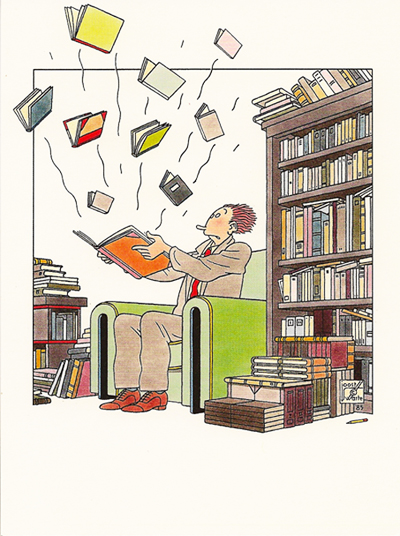
Reading Habits, ©Joost Swarte 1990.
DB here:
Are blog readers book readers, let alone book buyers?
I sometimes wonder. There are only so many hours in a day, and the Net is, among other things, the Celestial Magazine Rack. Day or night you can find something funny, informative, or provocative. Thanks to sites like Arts and Letters Daily, Boing Boing, and their mates, you need never run short of reading material. And if you need a full-length read, there are always e-books. Who needs print?
So I thought when we took off for NYC for the month of February. My grand experiment: To bring along no printed book that I wouldn’t discard en route or in the city. I don’t have an e-book reader of any sort. Instead, I would read only what was loaded on my laptop, including Joseph Warren Beach’s Method of Henry James. If I purchased a codex for bedtime reading (there I read on my stomach or side, so a laptop wasn’t practicable), the unlucky item would be abandoned in our rental apartment for the next occupant. Dave would travel light.
The experiment succeeded only partly. I convinced myself that I had to lug along books I needed for the blog entry on eye-scanning. So my no-book mandate was limited to recreational reading. While I was in New York, though, a visit to the Strand put too many tempting items in reach. Most of those I ransacked and left behind, except for Stanislas Dehaene’s Reading in the Brain, far too stimulating to part with, and a mystery novel to be named later. But as our departure day approached, the itch returned and I ventured to Barnes & Noble for three of the new Harper editions of Agatha Christie classics (The ABC Murders, Five Little Pigs, and Crooked House, all sturdy items). These I toted back to Madison, reading the first two on the plane.
When I got home, finding several parcels awaiting my touch, I faced facts. I had deluded myself. I am both a book person and a Net person. I like text in both formats.
I love storing webpages and pdfs for searching, but books let me savage them with markups. Yes, I know you can annotate e-books, but it’s not the same. I think highlighting is ugly. I like to draw marginal asterisks, make solid lines under key points and wiggly lines under weak or silly ones, and add faces with frowns or rolled eyes. (Though I’m not as obsessive as this guy.) So in NYC my pencil traced tattoos over Dehaene’s information and arguments. In my whodunits I more discreetly inserted question marks, exclamation points, and curses as I reacted to the plots’ feints and jabs. Now I’m stuck. Once marked up, the books can’t be abandoned; some day I might need to consult them, or at least those pages I dog-eared and defaced.
Worse, as the Joost Swarte illustration up top shows, one book leads you to an epidemic of others. That realization dawned on me back in high school, when I learned that Coleridge would go on to read every book that was mentioned in the one he’d just finished. Hypertext isn’t new; reading done right is a combinatorial explosion.
Booked for murder
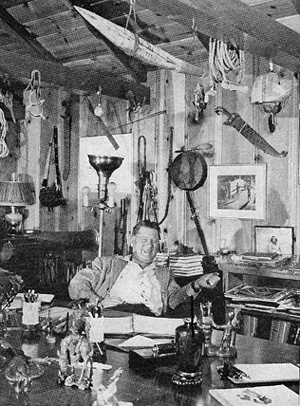
Erle Stanley Gardner.
So the Christies took me back to Robert Barnard’s A Talent to Deceive, a magnificent analysis of how Dame Agatha’s technical innovations changed the detective genre. (Creating a clue out of an apparent misprint—now that’s a tactic I can get behind.) Barnard’s book reminded me of another fine study in genre storytelling, Secrets of the World’s Best-Selling Writer by Francis L. and Roberta B. Fugate. I passed frrom The Method of Henry James to the method of Erle Stanley Gardner.
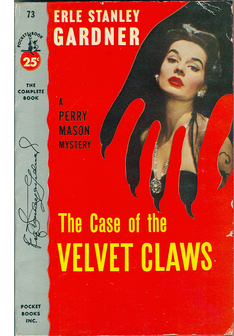 Now that we live in Harry Potter’s world, I suppose Gardner is no longer the sovereign of the best sellers. Does anyone still read Perry Mason or Doug Selby or Bertha Cool/ Donald Lam novels? But in his day, from the 1930s through the 1960s, Gardner was a central figure in US middlebrow literary culture. The Fugates’ book traces Gardner’s career, surveys the publishing scene he worked within, and compiles a great many notes on fiction techniques.
Gardner was probably the most fanatically productive and anally retentive of all mystery writers. In any month he could write a novel while turning out a hundred thousand words for the pulp magazines. He typed until his fingers bled, then he patched them with adhesive tape, and as he put it, “kept hammering.”
Typing was eventually replaced by dictation, putting Gardner in the same oral tradition as Edgar Wallace, Barbara Cartland, and Homer. By the time his first novel, the Perry Mason mystery The Case of the Velvet Claws (1933), was published he had already put his business on a rational basis. What he called his Fiction Factory employing up to seven full-time staff members. He composed all his stories himself, but his secretaries typed from his Dictaphone cylinders and kept track of characters, situations, and titles that he had used in published work, so that he could avoid repeating himself. (Shades of the bibles used for Star Wars and other sagas.) His success allowed him to buy a vast working ranch and build a compound where he and his staff could live together and maximize output.
Not that he withdrew completely from the world. The first Cool/Lam novel revealed that a California law could allow someone to get away with murder. After Gardner pointed out the loophole, the law was changed. Gardner also founded what he called the Court of Last Resort, a group of lawyers and criminologists who sought to overturn unjust convictions.
Along with pumping out fiction and crusading on legal matters, Gardner jotted copious notes to himself on story ideas, career goals, and general precepts of fiction writing. He tinkered with a “plot wheel” that would generate unexpected situations. The results do get you thinking: Locale: Wagon train. Character: Statesman. Predicament: Madness. . . Surely there’s a story there.
Dissatisfied with the wheels and gimmicks like Plot Genie and Plotto, Gardner decided to create his own machine for generating stories. The Fugates generously publish his outlines for “The Fluid or Unstatic Theory of Plots,” “Page of Actors and Victims,” “Character Components,” and so on. Some of these were synopses of discussions he would conduct with writers who were scripting the Perry Mason TV shows. They cut to the quick.
Every character in a story can and should have: 1. Point of strength; 2. Likeable or humorous weakness; 3. Prejudices; 4. Common characteristics. . . ; 5. Father, mother, other relatives dependent or wealthy; 6. Emotions—Love, hate, dislike, etc. for other characters; 7. Problems—And this is where you sell the character to the reader.
Gardner’s search for formulas led him to spell out, with unusual explicitness, the conventions of the form he worked with. (In this he intersects with those of us interested in poetics of media.) I would think that aspiring writers of fiction or movies could learn a lot from Gardner’s thoughts on craft.
If you’re interested in mystery plots, his ideas about the “murderer’s ladder” and “clue sequences” might provoke some ideas. He emphasized plotting a mystery from the criminal’s point of view, not from the investigator’s: It made for less contrivance. Consider as well Gardner’s notion of the “three-ring circus” plot. Take three conventional situations, he suggested, then hook them together in ingenious ways. The film example that occurred to me was the network narrative, which weaves several protagonists’ stories together. Pulp Fiction folds together a hitman story, a prizefighter story, a robbery story, and a few others to create something that felt fresh.
Gardner was a pack rat. The Fugates’ book could be very inclusive because his collection, donated to the Harry Ransom Center at the University of Texas, ran to over 36 million items. Among the memorabilia were Gardner’s notes on a book to which I often refer in lectures, J. Berg Esenwein and Arthur Leeds’ 1913 manual Writing the Photoplay. From Secrets I learned as well of two other books on popular plotting I needed to read, if not buy. I’m not saying what they are; you might beat me to them. Book information sometimes wants not to be free.
Crime on the set
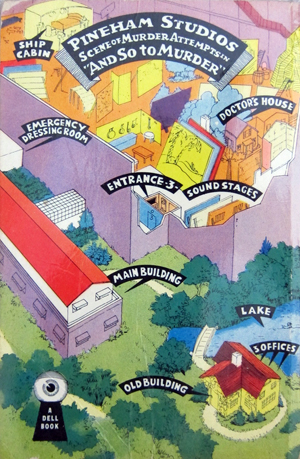
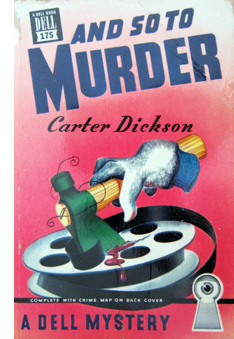
Why the old books? Why not Franzen’s Freedom? When it comes to fiction, more and more I’d rather read books I’ve read before instead of trying new things. Reader’s comfort food, I suppose; or at least the adolescent window. So at the Strand a 1947 mapback edition of Carter Dickson’s And So to Murder (1940) practically wriggled its way into my hand, like a cat begging to be stroked.
Carter Dickson was a pseudonym of the endlessly inventive John Dickson Carr, who throughout the 1930s and 1940s reliably turned out many detective novels and short stories. The Dickson ones feature Sir Henry Merrivale, a short, balding, profane doctor-barrister-baronet who is usually at the center of confusion. He once “sorta hit a cow with a train.”
The Old Man, as H.M. is known, enters And So to Murder rather late. The bulk of the action is occupied with a string of attempted killings during the preparation of a movie. It had been axiomatic in Golden Age detective stories that only homicide could justify a book-length tale, but here a tumble of conspiracies and Nazi espionage fill out the plot. There are as well the usual Carr chapter-endings, which unashamedly break off at points of high tension.
Experts rate And So to Murder not as highly as other Carr/ Dickson classics, although I find that several of my favorites, including gems like The Reader Is Warned (1939) and the short story “The House in Goblin Wood,” don’t score high numbers either. Of course all agree on the excellence of The Judas Window (1938), a virtuoso performance.
A cinephile can hardly resist the premise of my mapback. Monica Stanton, an unworldly provincial, writes a steamy novel called Desire. When it becomes a bestseller, Albion Films hires her as a screenwriter, but not in order to adapt her novel. Instead, she has to adapt And So to Murder, the novel by a handsome but deplorably bearded mystery writer, Bill Cartwright. Bill, of course, is assigned to adapt Desire. As flirtation and squabbling develop and a tough Hollywood screenwriter arrives to punch up the projects, Monica is threatened with poisoned cigarettes and sulfuric acid.
Carr novels like The Burning Court (1937) and The Crooked Hinge (1938, a masterpiece) carry a whiff of horror and brimstone, but the Dickson efforts are largely comedies. Like many Golden Age authors, Carr yoked his mystery to a developing romance, and his Dickson plots often treat the couple disrespectfully, showing how male vanity and female obstinacy create perpetual misunderstandings. His women, who typically wear no make-up, are smart and impertinent, and his men are clumsily chivalrous in their efforts to woo them.
And So to Murder is a good example of the sexual rivalry. Monica, barred from joining Bill at the War Office, decides to pay him back by plunging into the sordid side of London (short of visiting Soho) and picking up the first man she meets.
Bill Cartwright had done that deliberately, of course, to humiliate her. He had known all along that she would never be allowed into the War Office.
Her mind dwelt with hatred on the picture of Bill as he probably was now. He would be sitting in a spacious office, all mahogany and deep carpets, with bronze busts on bookcases, and an Adam fireplace. He would be drinking whiskey-and-soda—Monica herself, when she reached the Café Royal, was going to have absinthe—and listening to some thrilling anecdote of the Secret Service, told by a tall gray man with a deep voice, who sat at a desk with his back to the Adam fireplace.
Every film-goer knows that this is a true picture of the Military Intelligence Department, and Monica decorated it until pukka sahibs abounded.
 It is, of course, a setting straight out of a 1930s film. Carr cleverly gives his heroine a fantasy suitable for her movie-struck imagination. Here’s one screenwriter who really believes the myths the studios spawn.
The romance fulfills another purpose: it is a decoy. Carr fills out Bill’s and Monica’s embroglios with lively action, crisp descriptions, flashbacks, and fancies like the one just mentioned. Only later do you find that the smooth surface cunningly glides us toward quick reading, so that we’ll pass over hints that are ultimately of great importance. Carr was a connoisseur of magic, and although he could sometimes dwell on his clues, demanding that we puzzle them out, he was also skilled in the conjuror’s art of misdirection.
Carr’s affectionate mockery of stars, directors, producers, scenarists, and the down-at-heel British film industry holds up well. The plot centers on missing footage, and there are clues involving props and practical sets, along with a running gag about a coarse American mogul who keeps demanding big battle scenes filled with historical anachronisms.
There is no snobbery in this satire of moviemakers, only the zesty teasing that Carr aimed at aristocracy, pomposity, and pretension (especially when displayed by characters from the Continent). Although he was a deep-dyed Anglophile, Carr retained a vigorous American impatience with ceremony and circumlocution. At the same time, he could be serious about the gathering threat to his beloved Britain.
This was on Wednesday, the 23rd of August. Before a fortnight had elapsed there was a new noise in the earth. The dozenth pledge was broken; the gray mass burst loose; over London the sirens roared as the Prime Minister finished speaking; the great concrete hats of the Maginot Line revolved, and looked toward the West; Poland died, with all her guns still ablaze; the nights of the blackout came; and at Pineham, a small spot in England, a patient murderer struck again at Monica Stanton.
The passage ends with a typical Carr dodge (there will be no murder, so no murderer), but the lead-up has that rumble of thunder and kettledrums he could summon as occasion demanded. Still, the comic tone eventually wins out. The last line of the book is “It’s just one of the things that happen in the film business.”
The standard biography of Christie is Janet Morgan’s Agatha Christie. The recent Agatha Christie’s Secret Notebooks is not to my mind as illuminating as it might be. On Gardner, the unabashed puff piece by Alva Johnston, The Case of Erle Stanley Gardner, offers some insights. The only biography of Carr is Douglas Greene’s John Dickson Carr: The Man Who Explained Miracles. See also S. T. Joshi’s John Dickson Carr: A Critical Study. Old as it is, Howard Haycraft’s anthology, The Art of the Mystery Story, remains an excellent general source.
Thanks to Stef Franck and Gabrielle Claes for help with a Dutch translation.

To read the Readers’ Bill of Rights for Digital Books, go here. Image by Nina Paley, whom Kristin and Richard Leskovsky interviewed here.
PS 14 March: Jon Jermey kindly alerted me to the lively website he moderates on Golden Age Detective Fiction. It’s full of information and expert opinion, including Mike Grost’s overviews of John Dickson Carr’s works and Erle Stanley Gardner’s plotting tactics. Thanks to Jon for letting me know.
Time piece
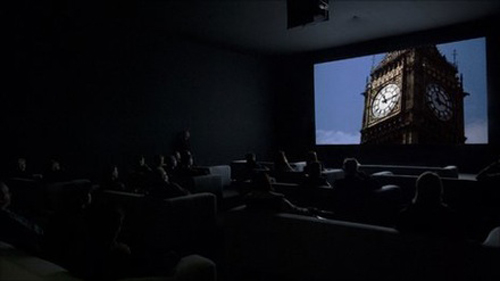
Christian Marclay, The Clock (2010).
DB here:
Normally I wouldn’t comment on a movie after seeing only 10.4 % of it, but there are always exceptions. The Clock, which played at the Paula Cooper Gallery during our stay in Manhattan, runs 24 hours. It’s a compilation of over 3000 film clips, mostly from Hollywood but also from Europe and Asia. Some of the footage is easily recognized, but a lot of it I couldn’t identify.
The premise, or gimmick, is that every snippet of a scene is purportedly connected in some way to the passing of time measured on a clock. Characters check their watches, or the camera shows a wall clock or digital alarm clock or countdown device. There are tiny clocks and gigantic ones. If the whole thing has a star, it might be Big Ben, who reappears surprisingly often.
A nice idea, but why stretch it over twenty-four hours? So that the creator Christian Marclay can assemble scenes that synchronize perfectly with the passage of time in projection. A shot shows a watch at 11:55 AM; you look at your watch; it’s 11:55 AM. Wherever the piece is screened, it must start precisely at the corresponding local time. The Clock isn’t just about clocks; it is a clock.
The project teases you into lame puns, which I’ve been unable to resist. But my visits set me thinking about what makes The Clock unique and pleasant. Maybe it’s a little too pleasant.
Collage without closure
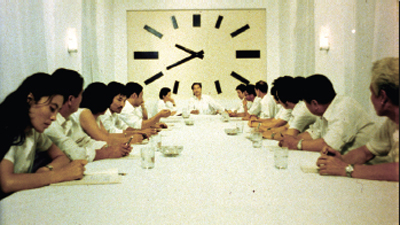
The Black Cannon Incident (1986).
In its collage of compiled material, what The Clock does is quite familiar to cinephiles. For a long time, experimental filmmakers have built works out of footage from mainstream movies. One of the most famous, Joseph Cornell’s Rose Hobart (1935), powerfully illustrates how the collage principle can pry images from their narrative context and call attention to their poetic or graphic qualities. The assemblage artist Bruce Conner did something similar in A Movie (1958), which creates anassociational form out of newsreels and old Hollywood sequences. Although both Rose Hobart and A Movie still evoke vague narrative expectations, Craig Baldwin whipped together found footage to create a hallucinatory narrative in Tribulation 99: Alien Anomalies under America (1991). An urgent, hard-bitten voice-over tells of CIA conspiracies and interplanetary conquest while we see images scavenged from cheap science-fiction films.
Nowadays plenty of filmmakers, especially on the Web, have snipped footage from old films to develop a theme. Jim Emerson has done it with close-ups, and Matt Zoller Seitz, Aaron Aridillas, and Steven Santos have created a video essay around guns in American film. Last summer, at the new facility of the Cinematek in Brussels, I found thematic loops running on their video monitors. Sometimes there was an interplay among them, so that characters one screen seemed to be looking at those in another. Some of the Cinematek loops in fact centered on clocks.
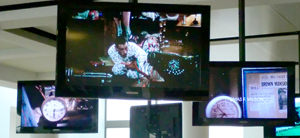
So the principle of compilation collage didn’t seem new to me. But Marclay refreshes it by the other central premise of The Clock: its time structure, which syncs moments indicated onscreen with moments of viewing.
Some fiction films (e.g., Cleo from 5 to 7, Nick of Time) and TV shows (e.g., 24) have played with the conceit of making the duration of the piece (“real time”) correspond to the amount of time covered in the plot. (Usually, however, the film fudges it.) But in The Clock, there’s no overarching plot, so the duration of that action can’t be determined. Marclay gives us real time with a vengeance, in the relentless correspondence between screen clocks and audience clocks.
Without this exact synchronization, The Clock would be an enjoyable but unexceptional found-footage movie. The onscreen clocks check the flow of the images like centers of magnetic force. They form nodes around which each set of shots revolves, like a musical key that a melody can drift from and return to.
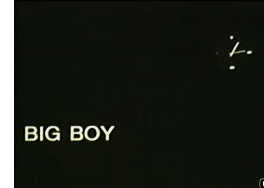 This patterning too has parallels in the experimental film tradition, I think. What P. Adams Sitney famously called Structural film was a 1960s-1970s trend that often built the awareness of time into a film’s overall pattern. A simple example is Robert Nelson’s Bleu Shut (1970). A clock runs in the right corner of the frame to measure the time consumed by a film that is, we’re promised by a woman’s breathless voice-over, “exactly thirty minutes long.” (She lies.)
A less explicit instance is Hollis Frampton’s Zorns Lemma (1970). In its central section, one by one a string of images replaces one-second shots of signs marking the letters of the Latin alphabet. The shot-changes set up a steady beat, and the pattern locks in a sense of momentum. Although we’re surprised by what images replace the letters, our expectations get focused on the inevitability of all the alphabet shots being deleted. There’s no literal clock, but we can sense this event slowly fulfilling itself. In addition, some of the replacement images show processes moving toward completion, such as dried beans steadily filling up a container. I’m tempted to say that in many Structural films, an actual or tacit clock tracing the film’s movement toward closure becomes a sort of non-narrative equivalent of a deadline in a storytelling movie.
The Clock doesn’t provide exactly that sense of closure, since it has no end point. It’s on a loop and, like a real clock, can be reset according to the time zone of the venue. But the nodal clock images make us aware of the film’s relentless unfolding, and its sync principle has affinities with the Structural tradition’s commitment to a precise time-based architecture. That tradition had its own sources, of course, including the experiments of the Fluxus movement, a trend that also influenced Marclay.
Top-down time
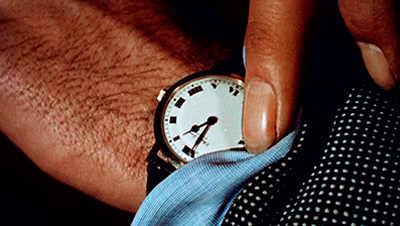
Tracing parallels shouldn’t lead us away from the unique qualities that make The Clock so appealing. For one thing, the fact that there isn’t a continually running readout, as in Bleu Shut or in an iPod slider, enables the film to test our feeling for passing time. Not every shot shows a clock; indeed, most shots in the portions I saw don’t. As we get captivated by clock-less images and follow their development within a scene, the arrival of a timepiece reminds us of the structuring principle. The appearance of a clock creates something like a punchline, while also letting us realize how loose our sense of duration in a movie usually is.
This test-like quality of the film, an important aspect of Structural film that Sitney points out, is reinforced by Marclay’s central idea. We are primed to scan the shots for clocks. Indeed, the search for the clock can reshift our sense of what is important about the scene. In an earlier entry, I discussed how Alfred Yarbus’ experiments in tracking eye movements assigned people tasks, such as estimating the social status of people in a painting. This created “top-down,” concept-driven search behavior. The Clock does the same thing, with the only explicit instruction being the title and our background knowledge of the piece’s procedures.
The result of our top-down search that we pay attention to clocks in the corners of shots or out of focus in the background, in scenes in which time isn’t really at stake. Normally we probably wouldn’t notice these items, but spotting them gives us a reward and allows us to admire Marclay’s cleverness. Some scenes seem to lack clocks altogether, but that doesn’t make them filler; a stretch of clockless footage only sharpens the fun when one shows up.
With shots pried free of narrative demands, you start to discriminate details, like the designs of numerals and brand identities. As you see the names Bulova, GE, Tissot, Hamilton Beach, and all the rest, you realize that it isn’t only James Bond films that use watches for product placement.
I’ve said that the film isn’t narrative in the same way that Craig Baldwin’s fantasy collages are. Yet it does tease us with some narrative expectations. If you recognize the footage, then you can summon up your memory of the story. If you don’t recognize the footage, you might still recognize the generic situation (investigation, pursuit, lovers’ confrontation, awakening in the morning). And the whole shebang does get you thinking about the role of time in narrative.
In this regard, the film makes an almost didactic point: Stories, at least those we’ve become used to, need clocks. They set the story world in motion, they measure its changes, and above all they provide deadlines that generate suspense, surprise, and satisfaction. The Clock makes deadlines especially apparent as we approach noon, when we get not only images from High Noon but also a flurry of other 12:00 PM shots (Titanic, for one). Noon is a really important moment in Central Standard Movie Time. I didn’t see the midnight stretch of The Clock, but I bet it’s a hell of a show.
Perfect timing
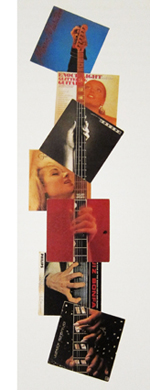 Like the compilation filmmakers, Marclay wants crosstalk among his bits, but the stretches of The Clock I saw don’t create much friction. There’s a lot of continuity from shot to shot: One character in one movie walks out a door, and we cut to another character from another movie entering a new locale. Music links scenes smoothly. Although Marclay was influenced by the diffuse, chance organizations promoted by John Cage, some of his earlier work emphasized through-line linkages and blending as well. Marclay’s famous record-album collages allow a unified figure to emerge as a gestalt binding together disparate images. On the right, you can see this happening in Guitar Neck (1992), which virtually diagrams the sort of smooth juxtapositions we get in The Clock.
The result has a fairly slick texture. It goes down easily. I admire the way that Marclay and his assistants have rummaged through a vast archive and pulled together a majestic, utterly entertaining assembly. But emotionally it’s mostly cold. The year-end obituary tributes on Turner Classic Movies, reminding us that the perfect faces and bodies gliding past us are definitively gone, are more throat-catching than anything I saw here. Along another dimension, so are Conner’s A Movie and his dissection of the JFK assassination, Report (1963-67). Just as important, none of what I saw seemed to me particularly challenging or discordant, and in this regard The Clock parts company with the comparable film traditions.
Structural film was notoriously demanding, ruffling viewers’ perceptions and trying their patience. And experimental compilations were often seeking to shake us up, sometimes in absurd ways. An earlier blog entry of ours illustrates how Baldwin’s Mock Up on Mu (2008) builds disconcerting scenes out of bits taken from other movies. A man and woman constantly shift their identities and positions while their conversation continues without missing a beat.
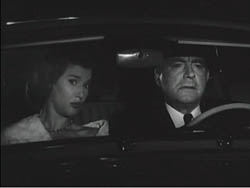
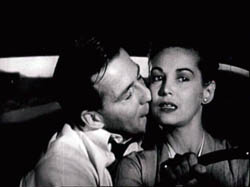
Crucial to the classic compilation films is the central innovation of collage: the fragments do not blend into a smooth whole. There are clashes between one shot or clutch of shots and the next. There’s also a sense of material differences. Each piece of scuffed or distressed footage retains something of its own integrity. In his sound work, Marclay too claimed an interest in the “sound patina” of vinyl LPs:
When a record skips or pops or we hear the surface noise, we try very hard to make an abstraction of it so it doesn’t disrupt the musical flow. I try to make people aware of these imperfections and accept them as music; the recording is a sort of illusion, while the scratch on the record is more real.
But the shots in The Clock are mostly scrubbed clean of imperfections, presenting a sleek surface that facilitates the flow across shots. The movie is a pure product of the DVD era, with all those gleaming images so easily appropriated. At times Marclay manages to match weather conditions, with rain in one scene carrying over into the next. This tactic creates an intriguing sense that the two movies are set in a shared world, but it makes the gaps between the images even narrower.
For about twenty years there has been a controversy in the gallery world about whether the burgeoning tradition of “artists’ films” owes anything to avant-garde film traditions. It’s often summarized as the difference between the white cube of the gallery and the black box of the movie theatre. By setting The Clock alongside collage compilation films, am I guilty of comparing apples and oranges? For instance, the films have fixed beginnings and endings, whereas The Clock is an installation that can be entered at any point. It’s not a film but rather, to use a current phrase, a “time-based audiovisual work.” Moreover, some will argue that Marclay’s lineage doesn’t consist of Cornell, Conner, Baldwin, and Structural Film but rather Fluxus, Minimalism, Punk, and Scratch-and-Mix. (Marclay has devised a turntable he can play like a guitar.)
All of which carries some weight, but I see enough common features between the two traditions to make my main point: Based on what I sampled, this is an ingratiating work, virtuosic in a Postmodernist way. But it doesn’t risk the roughness, the boring patches, and the confusions of the film traditions I’ve invoked. Perhaps the most condemnatory thing you can say about The Clock is that it runs like clockwork.
But maybe things get more disruptive in the 89.6 % I wasn’t able to see.
This entry was written fairly early in The Clock‘s Manhattan run. (Thanks to James Schamus for tipping me to it.) I had no trouble getting in at 10:40 AM and staying until about 1:15. But it quickly became a sensation. A friend and I tried to visit on a chilly Friday night and confronted a long line. I heard from others that the line was just as forbidding at 5:00 AM. The problem, of course, is that you could wait a very long time, since there’s no set point when many are likely to leave. (Nobody will say, “This is where we came in.”) This New York Times article traces the rise of the Clock cult. The article also confirms that midnight is a high point of the video.
Yet another Times piece discusses The Clock as akin to recorded music, making some points related to mine above. Here is a loving account by Jerry Saltz, who logged nineteen hours on duty. Easy to enjoy and admire, Marclay’s piece probably deserves to be added to Christian Lander’s list of Stuff White People Like.
A good overview of the artist’s earlier work can be found in Jennifer Gonzalez et al., Christian Marclay (London: Phaidon, 2005). My quotation comes from p. 33.
On the experimental compilation film, see William C. Wees, Recycled Images: The Art and Politics of Found Footage Films (New York: Anthology Film Archives, 1993). See also Stefano Basilico, ed., Cut: Film as Found Object in Contemporary Video (Milwaukee Art Museum, 2004). P. Adams Sitney’s Visionary Film, second edition and thereafter, provides the most influential account of the Structural tradition. Scott MacDonald discusses Zorns Lemma at length in Avant-Garde Film: Motion Studies. For incisive analyses of how compilation and Structural films elicit particular activities from their viewers, see James Peterson’s Dreams of Chaos, Visions of Order.
Thanks to Jim Kreul and Jonathan Walley for guidance in the controversy about artworld and filmworld traditions. Jonathan’s essay “Modes of Film Practice in the Avant-Garde,” in Tanya Leighton’s collection Art and the Moving Image: A Critical Reader, is a useful guide to these and other trends. I advance some notions about the user-friendliness of another artist’s film project in this entry on Matthew Barney’s Cremaster cycle. Kristin and I have written about associational form in Conner’s A Movie in our book Film Art: An Introduction.
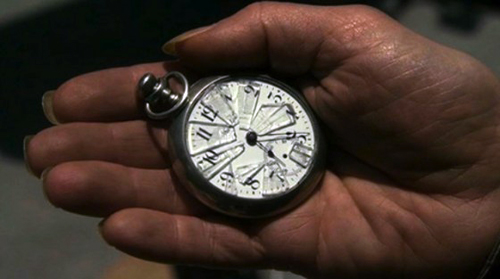
How to watch FANTÔMAS, and why
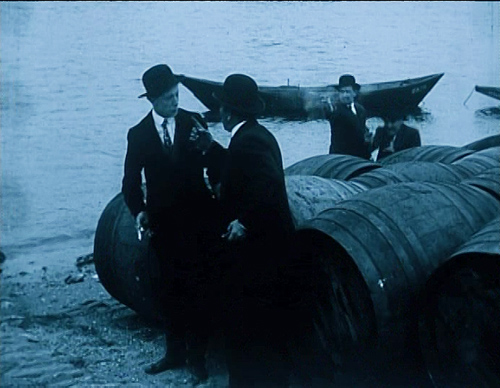
DB here:
He is, we’re told in the opening of the first volume, “The Genius of Crime.” Not a genius, the genius. And he doesn’t play nice.
“Fantômas.”
“What did you say?”
“I said: Fantômas.”
“And what does that mean?”
“Nothing. . . . Everything!”
“But what is it?”
“Nobody. . . . And yet it is somebody!”
“And what does the somebody do?”
“Spread terror!”
In the standard English translation, the last line sounds exceptionally scary, especially today. The original French, “Il fait peur,” is closer to “He creates fear,” but that sounds tamer in English than in French.
In whatever language, for a hundred years this catechism has proven bone-chilling. Cinephiles, crime fans, avant-garde artists, and mass audiences have found the tales anxiety-provoking, even hallucinatory. The delirious imagery and plot twists are felt to harbor a demented poetry. So the first reason to celebrate the arrival of a U. S. DVD version of Louis Feuillade’s great installment-film Fantômas (1913-1914) is that we can all have a look at what made Apollinaire and Magritte and Resnais and Robert Desnos tremble.
I confess myself of the other party. I enjoy tales of Fantômas and Dr. Gar-el-Hama (the Danish equivalent in movies of the era) and Dr. Mabuse and Haghi (of Lang’s magnificent Spione, 1928) but they don’t give me an existential frisson, or unmoor me from rationality, or make me feel the secret currents swirling through the modern city. Call me cold-blooded.
On second thought, don’t. The best-made efforts in the master-mind genre do heat my blood—but because they arouse my love of narrative invention and dazzle me with flourishes of cinematic style. The conventions of the genre, all the disguises and elaborate schemes and surprising revelations engineered by the Genius behind the scenes, the cascades of coincidence and the hairbreadth escapes, aren’t merely enjoyable in themselves. They show how little plausibility matters to storytelling. (People may say they like realism, but they’re suckers for far-fetched stories.) And in order to make the whole farrago of traps and conspiracies flow along, you need filmmakers who can hold our interest with swift pacing and ingenious narration. On many occasions, depicting virtuosity of crime has called forth virtuoso cinematic technique.
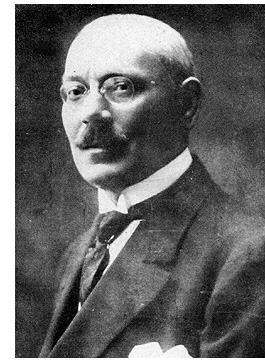 So let Fantômas make your flesh creep, if your flesh is creepward inclined. But even if it’s not, we should celebrate Louis Feuillade’s triumph in creating, in the first great era of filmmaking 1908-1918, a fine piece of cinematic storytelling. To appreciate it, we need to watch—really watch—what he’s doing.
Thirty-two Fantômas novels by Marcel Allain and Pierre Souvestre were published from 1911 through 1913. By the time Feuillade launched the film version in May of 1913, the book cycle was winding down; in La Fin du Fantômas (1913), the master criminal dies, at least for a while. Souvestre died in 1914, but the prodigious Allain revived the series and the villain during the 1920s.
When the films were made, Feuillade was working for Gaumont, one of the two most powerful French studios. He was head of production, overseeing other directors while turning out his own movies at a rapid clip. He signed over fifty films, mostly one-reel shorts, in 1913 alone. The Fantômas films are often thought of as a serial, but they are really long installments in a series, somewhat like our Bond and Bourne franchises. A “feature” film at the period might run fifty to seventy-five minutes. As with our franchises, there are recurring characters. The films pit police inspector Juve and the journalist Fandor against Fantômas and his accomplices, notably the treacherous but passionate Lady Beltham.
Feuillade was one of the great directors. He had a fine comic touch, not only in the shorts featuring child players like Bébé and Bout de Zan but also in farcical two-reelers like Les Millions de la bonne (The Maid’s Millions, 1913). His dramas could be powerful too, epitomized for me in the two-part feature Vendemiaire (1919) and sentimental melodramas like Les Deux Gamines (1921) and Parisette (1922). Still, he’ll probably always be most famous for his crime films like Les Vampires (1915-1916), Judex (1917), Tih Minh (1919), and of course the first of them, Fantômas.
The new video edition, which comes to us from Kino, is the third DVD release I’ve seen. The first was a French set from Gaumont in 1998, the first full year of the DVD format. The box contains a handsome booklet with background material, pictures, and an interview with Feuillade, but the intertitles aren’t translated. All subsequent releases seem to be based on the Gaumont copy used in this collection. That results in so-so picture quality, a rather haphazard score pasted together from classical pieces, and occasional distracting sounds, like birds tweeting in outdoor scenes. The UK Artificial Eye PAL release of 2006 includes a brief introduction by Kim Newman but no booklet. The original Gaumont titles are preserved, with English subtitles added.
Kino’s version unfortunately eliminates the French titles altogether, substituting English translations. Visually, however, I prefer the Kino version to the others, which on my monitors is less contrasty and heavily saturated in its tinting. Still, the Gaumont master was made in the early days of DVD authoring and could stand a complete redo. In fact, Gaumont should release many more Feuillade titles, starting of course with Tih Minh.
How best to persuade you that these movies are worth watching? I decided to concentrate on just the first episode, Fantômas (aka The Shadow of the Guillotine) as a sample of Feuillade’s artistry. Everything I analyze here is on display in later installments, sometimes more flamboyantly. The creative principles at work are explored in greater detail in my books On the History of Film Style and Figures Traced in Light (which has a long chapter on Feuillade), as well as in several items on this site.
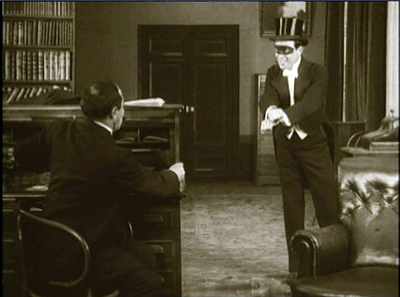
1. Get ready for preposterousness. The film, based on the first book in the series, rearranges the novel’s plot order considerably and simply excises the first half’s major line of action, a hideous murder. Even with cuts, though, the film asks us to believe that after Fantômas, disguised as one Gurn, is put into prison, he can get his wealthy mistress to bribe a guard to let him out for a while. And that during their rendezvous, the couple can replace the murderer with an actor who happens to be playing Gurn in a stage show based on the case. And that the actor, having been drugged, can’t recall his identity.
There’s at least one glaring plot gap in the film. Juve solves the mystery of the disappearance of Lord Beltham when he discovers his body in a steamer trunk about to be sent overseas. The novel explains his rather tenuous line of reasoning (Chapter 11), but the film simply shows him arriving at Gurn’s apartment and examining the fatal trunk. Presumably, though, Feuillade could afford to be elliptical. Some of the audience would have known the novels and could fill in bits that seem enigmatic to us.
The film’s climax is in fact less implausible than the novel’s, perhaps out of considerations of good taste. In the novel, the actor substituted for Gurn actually dies at the guillotine; the authorities realize their mistake only when they see the head smeared with greasepaint. In the film, Juve interrogates the dazed Valgrand and astounds other officials by revealing that he isn’t the prisoner they had locked up. Even then, it seems unlikely that nobody but Juve would have noticed the prisoner’s wig and false mustache.
Far-fetchedness is built into the genre, so the problem is handling. Craziness must be treated matter-of-factly, and Feuillade’s sober technique takes all the wild developments in its stride. Nothing fazes Fantômas, or our director.
2. Accept the conventions of “pre-classical” cinema. Film historians often consider the years from 1907 to 1917 as leading up to the sort of cinematic storytelling we know, replete with lots of cutting, close-ups, and camera movements. A film like Fantômas exemplifies some tendencies of French cinema in this period. There is relatively little crosscutting among lines of action. The film uses no shot/ reverse-shot or extended passages of close-ups. Typically a cut is used to enlarge printed matter, like a news story or a business card, or to emphasize crucial details. Here is Juve discovering a clue, Gurn’s hat, in Lady Beltham’s parlor.
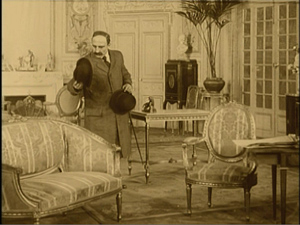
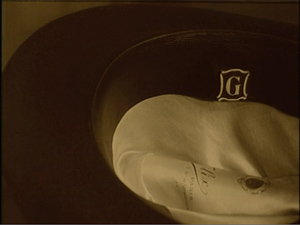
Interior sets were usually designed to be seen from only one camera orientation. In exteriors, we get somewhat freer cutting, presumably because real surroundings don’t confine the camera as much as a fake set does.
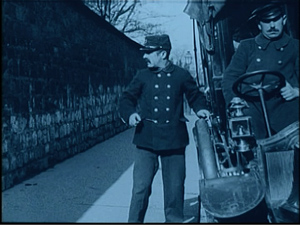
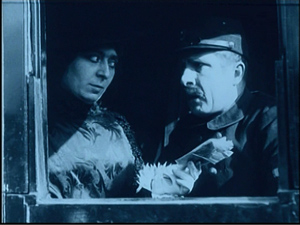
In this transitional era, some habits of earlier years hang on: the fairly distant framings, the fairly obvious sets, and the occasional glances at the audience.
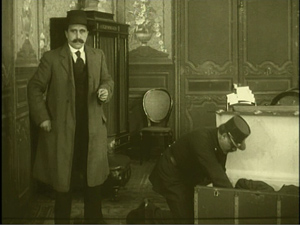
You can almost sense stylistic change happening during such moments. In earlier films, characters constantly looked at the audience, but in Fantômas a character’s eyes pause fractionally on us before drifting away, as if the look to the camera simply signified thinking, not an effort to share a response.
Similarly, Feuillade seems to be sensing the need for varying his camera positions in a way that we’d find in later cinema. Consider his handling of the Royal-Palace Hotel.
To show the elevator entry on different floors he reuses the same set. This is motivated realistically, since hotels look more or less the same on different floors. But if the camera were framing every elevator shot exactly the same way, we would have weird jump cuts when cutting from floor to floor, and the use of the same set would be more apparent. So Feuillade not only re-labels each landing at the top of the frame, but he shifts his camera position slightly, moving the framing rightward in the string of shots showing the elevator descending to the ground floor.
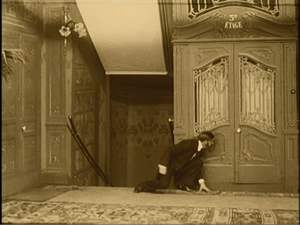
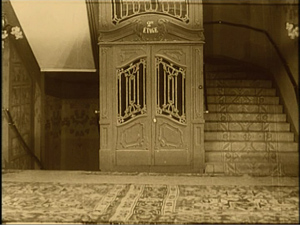
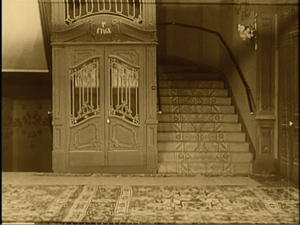
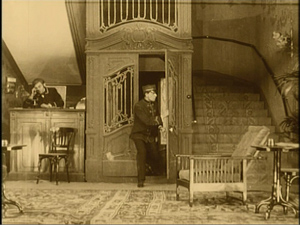
The slight shifts in framing reinforce the sense that we’re on different floors.
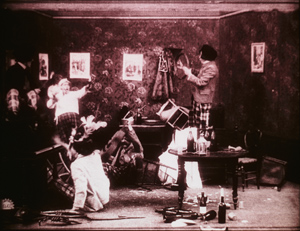
3. Watch the back door. Deep space is common in exteriors from the beginning of cinema, even in Lumière shorts, but by the early 1910s filmmakers were starting to replace relatively flat interior sets with ones that give their actors more playing space in depth. Here, for example, is a Bohemian party from Feuillade’s Une Nuit agitée of 1908. The parlor and the action are shot in a flat, lateral way, and people enter the room from the right or left.
Compare the depth in the interiors of many scenes in Fantômas of five years later.
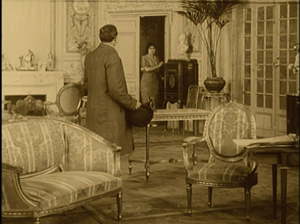
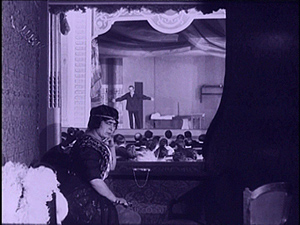
Once sets become deeper, the rear door becomes very handy for entrances and exits, and Feuillade is a master of using it. It’s usually fairly close to the center, but in the actor Valgrand’s dressing room, it’s off to the side.
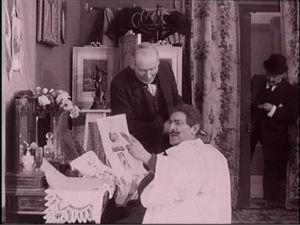
The rear door prepares us for upcoming action and provides another center of compositional interest—advantages that don’t come up when actors enter from the sides of the frame. The door also allows people to be shown overhearing what is going on in the foreground.
4. It isn’t theatre! There’s a common belief that the cinema of this period simply records performances as if on a stage. But that’s not true. As most of these shots show, the camera is usually closer than any spectator would be to a stage play. Feuillade reminds us of what a real stage performance would look like when Lady Beltham sees the actor Valgrand in the dramatization of Gurn’s capture. (It’s reminiscent of the stage-like set in Une Nuit agitée above.)
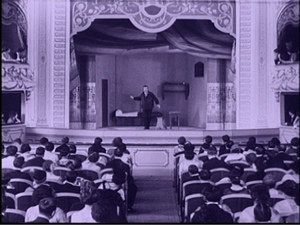
Valgrand’s gestures are broad ones, suitable to being seen from a great distance. But in the surrounding story, the performances are much more subdued. Feuillade demanded dry, quick acting from his players, and their gestures aren’t extravagant. (Juve usually jams his hands in his overcoat pockets.) Instead, Feuillade keeps his actors busy with small props. Here, as Fandor writes a story, Juve is brooding on his failure to capture his adversary. Before he’s finished one cigarette he’s already rolling another, and he lights up the new one end to end.
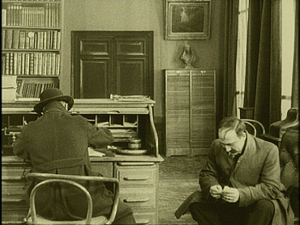
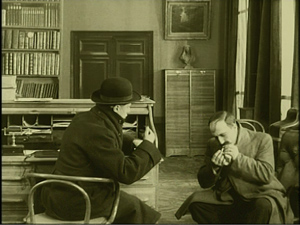
Crucially, theatrical space is geometrically very different from cinematic space, as I’ve argued in several other entries. A shot like this wouldn’t work onstage because spectators sitting to the right or the left would have their sightlines blocked by furniture.
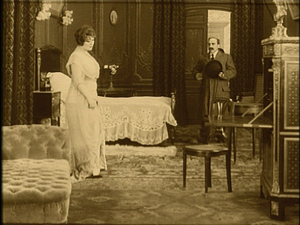
Because the camera slices out a wedge of space in depth, actors can be carefully arranged in dynamically developing compositions that would not be visible on the stage. When the doped-up Valgrand is brought to be questioned by the police officials, we first see him through the rear doorway–a view that wouldn’t be shared by many spectators in a theatre performance.
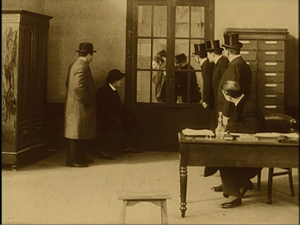
The dazed actor is questioned, with Juve emerging slowly out of the welter of authorities behind him.
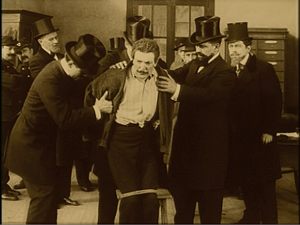
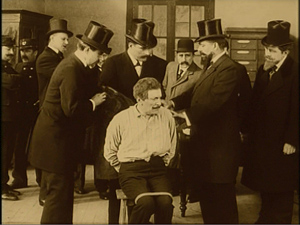
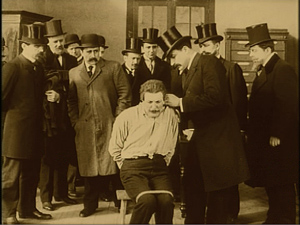
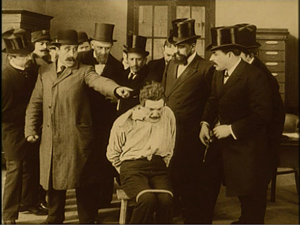
Needless to say, the earliest phases of this shot would be unintelligible on a stage; for most members of the audience, the other actors would block Juve. Recall as well that this was accomplished in an era when directors and cinematographers could not look through the lens to see exactly how the configuration would appear onscreen.
5. Develop an appreciation of complex staging. In a cinema relying on analytical editing, our attention is driven to one item or another through cutting and closer views. By contrast, the director of “tableau cinema,” as this 1910s style is sometimes called, must shift the actors around the sets in ways that call our attention to what’s important at each moment. In the course of the scene, the director must also try to maintain some pictorial harmony on the two-dimensional plane of the screen. Shots are subtly balanced, then unbalanced, then rebalanced, all in the service of story intelligibility.
As we’d expect, depth can play a key role here. Take the simple moment when Lady Beltham’s butler announces the arrival of Nibet, the prison guard whom she bribes. Lady Beltham turns at the sound, rises, and moves to the settee.
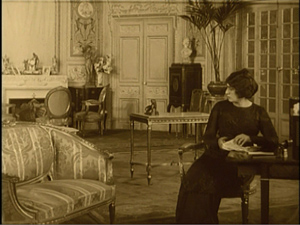
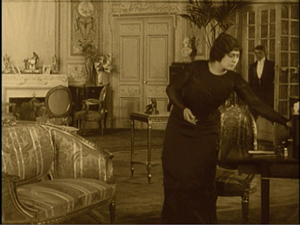
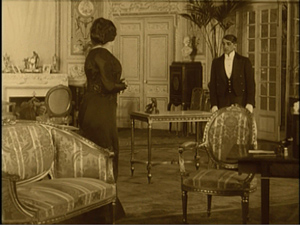
As Nibet enters, Lady Beltham returns to her writing desk. This is our old friend the Cross, refreshing the image by having the actors trade placement in the frame.
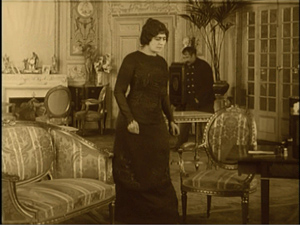
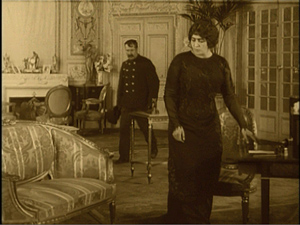
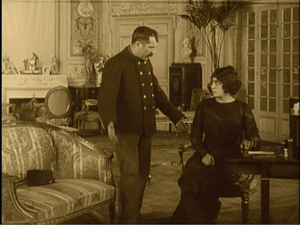
The same choreography of balancing, unbalancing, and rebalancing can be found when the characters aren’t arranged in depth. The scene of Lady Beltham and Gurn drugging Valgrand plays out laterally. Gurn hides behind a curtain, and our awareness of his presence there colors the whole scene. But because Valgrand will be on the settee, for some while Lady Beltham’s position at her tea table would make an appearance by Gurn compositionally clumsy.
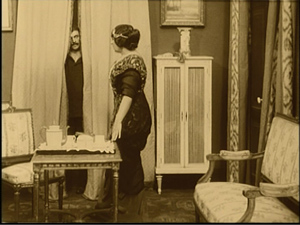
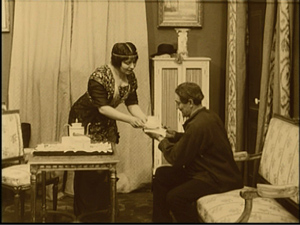
As the drug takes effect, Lady Beltham moves to Valgrand’s side. This gesture of concern unbalances the composition–until Gurn peeps out to rebalance it.
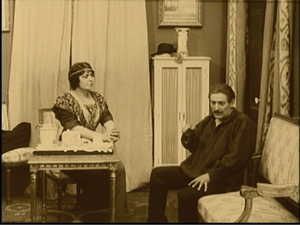
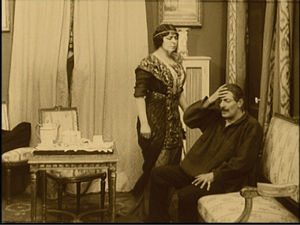
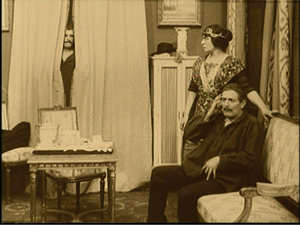
Lady Beltham’s stare at him makes sure we notice his presence. Soon the police arrive to return “Gurn” to his cell.
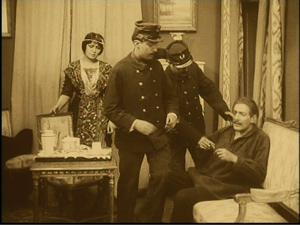
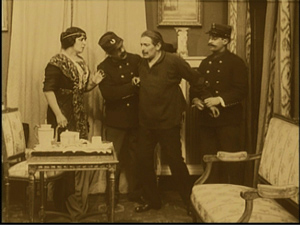
Again Lady Beltham moves to the right, and again it’s motivated: She wants to make sure the cops have gone. But that movement clears a space for Gurn, i.e. Fantômas, to reveal himself in triumph just as Lady Beltham relaxes in relief.
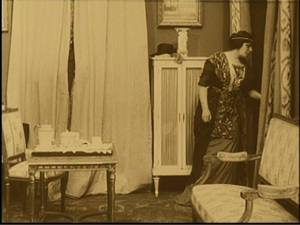
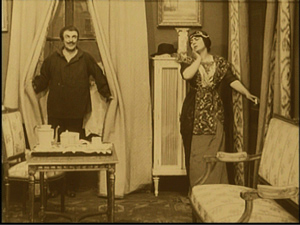
The synchronization demanded of the actors, in pacing and placement, is considerable, and of course the director has to coordinate everything. Feuillade, directing with shouts and a drillmaster’s whistle, drove his actors through each long-take scene. Turn off the music occasionally and imagine him calling out instructions to them.
These examples, and many others, gainsay David Kalat’s curious claim in the Kino commentary that Feuillade’s work exhibits an “anti-style” that doesn’t present stories “cinematically”–because he doesn’t exploit cutting and changes of camera position.
The camera has been plopped down perfunctorily in front of a set in which the actors meander around within the frame without any sense of composition. In several scenes the actors nonchalantly turn their backs on the audience completely. Only rarely does a shot appear in which the actors seem positioned in front of the camera for any specific pictorial effect. The shots ramble on with hardly any change of point of view until the scene ends and a new one takes its place (Disc 1, 11:54-12:20).
Actually, here and in other works, Feuillade’s staging is quite precise. I doubt that many directors today could block fixed shots as fluidly as he does; sustained, intricate staging in this sense is an almost lost art. Hou Hsiao-hsien, in his films up through Flowers of Shanghai, might be the last great exponent of this technique.
We find the same principles at work in later Fantômas episodes. Some scenes have greater pictorial splendor than the ones I’ve considered; many aficionados believe that the essence of the series is on display in the second installment, Juve contre Fantômas. Certainly it has crazier plot twists. (I got through a whole blog without mentioning Juve’s python-repelling suit, below.)
Granted, it’s hard to study the films as they’re unfolding. That’s partly because Feuillade guides our eye so subtly that we get caught up in the plot. Still, re-viewing can help us spot the fine points. With this DVD set, you have at least five and a half hours of fun before you.
In the lurid tales of Allain and Souvestre, Feuillade found sensational material. He had fine actors. He had luminous prewar Paris as a backdrop. And he had at his fingertips all the resources of tableau cinema. The whole mixture creates a lively cinematic experience. Watching films like Fantômas and Ingeborg Holm and The Mysterious X and many others from 1913, we can still be bowled over by their exquisitely modulated storytelling. If Feuillade is less baroque than Bauer and less poignant than Sjöström, he’s also more brisk, laconic, and playful. Call him the Hawks of the tableau tradition. Thanks to this new release, more Americans will have a chance to enjoy his exuberant creativity.
And they can have all the frissons they want.
Searching “tableau” in our blog entries will offer many further examples of what I’m discussing here. Our 1913 entryoffers an overview of what Feuillade’s contemporaries were up to.
The Kino set includes two other Feuillade films, The Nativity (1910) and The Dwarf (1912). These are better transfers than the main attractions, and make for some interesting comparisons with his artistic strategies in Fantômas. There’s also a short documentary on Feuillade’s career, adapted from the Gaumont box set Le Cinéma premier, which contains many Feuillade titles. Other Feuillade films are available on US DVD: Les Vampires, in an out-of-print Image set; Judex, from Flicker Alley; and various items in the Kino package Gaumont Treasures, 1897-1913. That set, a selection from the Gaumont box, includes The Agonie of Byzance, made the same year as the first installments of Fantômas.
As times changed, Feuillade adopted editing, sometimes in rather flashy forms. For examples, go to my chapter on Feuillade in Figures and here. Essays by Ben Brewster and Lea Jacobs show how performance style adjusted to the tableau tradition. Charlie Keil’s Early American Cinema in Transition traces the somewhat differing developments in U. S. cinema of the period.
For all things Fantômas, visit the Fantômas Lives website. There’s also the very helpful Encyclopédie de Fantômas (1981), self-published by the mysterious ALFU. If you want to know the percentage of deaths by defenestration in the oeuvre (6.8 %), this is the book for you. David Kalat offers a wide-ranging survey of Fantômas’ influence on modern art and popular culture in “The Long Arm of Fantômas,” in Third Person: Authoring and Exploring Vast Narratives, ed. Pat Harrigan and Noah Wardrip-Fruin (MIT Press, 2009), 211-224.
Francis Lacassin has written prolifically on both Fantômas and Feuillade. The arch criminal earns a chapter in Lacassin’s À la recherche de l’empire caché (Julliard, 1991), while his Louis Feuillade: Maître des lions et des vampires (Bordas, 1995) remains the essential work on the director.
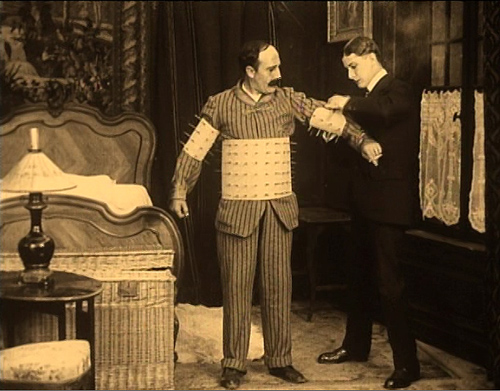
Juve contre Fantômas.



