















Archive for the 'Film history' Category
Bwana Beowulf
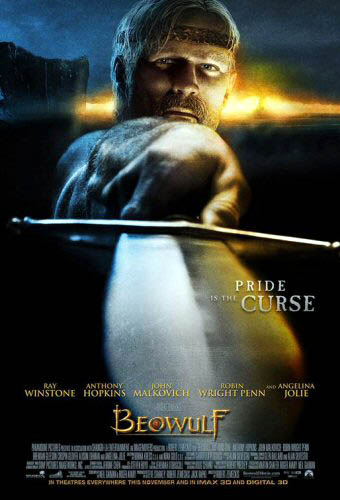
KT: I do not understand Beowulf. I don’t understand why the director who made one of the great modern Hollywood films, Back to the Future, and several very good ones, including Who Framed Roger Rabbit? and Cast Away, now has this fixation with creating nearly photo-realistic 3D digital images.
DB: I think that on the whole Zemeckis’ films have become weaker since Bob Gale stopped working with him. I like the sentiment of I Wanna Hold Your Hand and the crass misanthropy of Used Cars, and I think the Back to the Future trilogy mixes both in clever ways. But now almost every Zemeckis film seems to be less about telling a story than solving a technical problem. How to best merge cartoons and humans (Roger Rabbit)? How to push the edge of spfx (Death Becomes Her, Forrest Gump, Contact)? How to make half a movie showing only one character (Cast Away)? There’s a stunting aspect to this line of work, though I grant that it can lead to technical breakthroughs, as in Gump.
KT: I also don’t understand why most of the supposedly state-of-the-art effects technology looks distinctly cruder than the CGI in The Lord of the Rings, the first part of which came out six years ago. I don’t understand why studios that are trying to push 3D to a broad audience make a film with silly action aimed at teenage boys. That’s an OK strategy when you’ve got a $30 million horror film, but a budget of $150 million demands a lot broader appeal.
DB: And the evidence so far indicates Beowulf doesn’t have that appeal. The obvious comparison is 300, from earlier this year. According to Box Office Mojo it cost about $65 million to make, but it reaped $70 million domestically in its first weekend and wound up with $450 million theatrically worldwide. Beowulf grossed $27.5 million in its first US weekend and currently sits at about $146 million worldwide. I’d think that this has to be a disappointment. Recall too that the Imax screenings have higher ticket prices, so there are fewer eyeballs taking in Angelina Jolie’s pumps, braid, and upper respiratory area.
In addition, sources suggest that a 3-D version of Beowulf will not be available on DVD, so the sell-through takings—the real source of studio profit—may be significantly smaller than average.
KT: It seems to me that the people who are pushing 3-D so hard and hoping for it to become standard in filmmaking are forcing it on the public too soon. It’s still fiendishly difficult and expensive to shoot live action material in digital 3-D, so most projects are animated. One approach, taken in Beowulf, is to motion-capture real people and animate the characters to make them appear as much like the real people as possible. The problem is that they still have a weird look about them, like moving dolls. People have complained about the dead-eyed gaze of the characters in The Polar Express, and though there’s apparently been an improvement between the two films, the eyes don’t always look as though they’re focusing on anything. It can be done, though; the extended-edition Lord of the Rings DVD supplements about Gollum show how much effort went into making his eyes have a realistic sheen and flicker.
I was also struck by how clunky some of the animation looked. Beowulf is supposedly state of the art, and it certainly had the budget of a major CGI film. Yet some of the rendering and motion-capture was distractingly crude. I noticed that particularly on the horses. Their coats looked pre-Monsters, Inc., and their movements at times reminded me of kids rocking plastic toys back and forth. I suspect this effect had something to do with a lack of believable musculature. If you look at the way the cave troll was done in The Lord of the Rings: The Fellowship of the Ring (again, demonstrated in the DVD supplements), there was a specific program to simulate the way muscles move on skeletons, even the skeletons of imaginary creatures. Now, six years later, we see these things that look like hobby-horses—and that all run alike.
The backgrounds were often strange as well, simple and flat-looking, like painted backdrops. There were some exceptions, with the seascapes and rocky crags pretty realistically done. But just plain hillsides and groups of tents and so on looked almost sketchy in comparison with the moving figures, and I noticed that at times some fog would be put in, presumably to cover that problem up. There certainly was some very good animation as well, most notably the dragon, but there was no consistency of visual style.
DB: I’d go farther and say that 3-D hasn’t improved significantly since the 1950s. It ought to work: just replicate the eyes’ binocular disparity by setting two cameras at the proper interval or, now, by manipulating perspective with software. Yet in films 3-D has always looked weirdly wrong. It creates a cardboardy effect, capturing surfaces but not volumes. Real objects in depth have bulk, but in these movies, objects are just thin planes, slices of space set at different distances from us. If our ancestors had seen the world the way it looks in these movies, they probably wouldn’t have left many descendants.
It would take a perceptual psychologist to explain why 3-D looks fake. Whatever the cause, I’d speculate that good old 2-D cinema is better at suggesting volumes exactly because the cues to depth are less specific and so we can fill in the somewhat ambiguous array.
By the way, in watching a 3-D movie I seem to go through stages. First, there’s some adjustment to this very weird stimulus: I can’t easily focus on the whole image and movement seems excessively fuzzy. Then adaptation settles in and I can see the 2 ¼-D image pretty well. But adaptation carries me further and by the end of the movie I seem to see the image as less dimensional and more simply 2-D; the effects aren’t as striking. But maybe this is just me.
Back to the Future, or at least 1954
DB: I’d like to think about it from a historical perspective for a while. The industry seems to be repeating a cycle of efforts that took place in 1952-1954. The American box office plunged after 1947 as people strayed to other entertainments, including TV, and so the industry tried to woo them back with some new technology. Today, as viewers migrate to videogames, the Internet, and movies on portable devices, how can theatres woo their customers? Answer: Offer spectacle they can’t get at home.
Beowulf brings together at least three factors that eerily remind me of the early 1950s.
(1) Obviously, 3-D. The first successful 3-D feature era was Bwana Devil, released in November of 1952. It was an uninspired B movie, but it launched the brief 3-D craze. Columbia, Warners, and other studios made major pictures in the format, most notably House of Wax (1953). But costs of shooting and screening 3-D were high, with many technical glitches, and apart from novelty value, the process didn’t guarantee a big audience. The fad ended in spring of 1954, when all studios stopped making films in the format.
The process has been sporadically revived, notably in the 1980s (Comin’ at Ya, Jaws 3-D) and once more it fizzled. So, ignoring the lessons of history and chanting the mantra that Digital Changes Everything, we try it again.
(2) Big, big screens. In September of 1952, Cinerama burst on the scene with its huge tripartite screen and multitrack sound. It attracted plenty of viewers, but it could be used only in purpose-built venues. Like 3-D, its technology could never replace ordinary 35mm as the industry standard. The contemporary parallel is Imax, which though very impressive will not replace orthodox multiplex screens—too expensive to install and maintain, pricy tickets. Like 3-D, it’s a novelty. (1)
(3) The sword-and-sandal costume epic. It’s a long-running genre, but it got significantly revived in the late 1940s. It was a logical input for the new technologies of widescreen—not Cinerama but more practical offshoots that gained more general usage.
From the standard-format Samson and Delilah (1949), David and Bathsheba (1951), and Quo Vadis (1951) it was a short step to The Robe (1953) and The Egyptian (1954) in CinemaScope, The Ten Commandments (1956) in VistaVision, The Vikings (1958) in Technirama, Hercules (1959) in Dyaliscope, Solomon and Sheba (1959) and Spartacus (1960) in Super Technirama 70, and Ben-Hur (1959) in anamorphic 70mm Panavision. It is, incidentally, a pretty dire genre; the peplum might be the only genre that has given us no great films since Cabiria (1914) and Intolerance (1916).
In parallel fashion, the revival of the beefcake warrior film with Gladiator (2000) coincided with innovations in CGI and thus furnished new forms of spectacle for Troy (2004), Kingdom of Heaven (2005), and 300 (2007). This trend paved the way for Beowulf. When screens get bigger, Hollywood hankers for crowds, oiled biceps, big swords, and nubile ladies in filmy clothes. Not to mention soundtracks with pounding drums, wailing sopranos, and choirs chanting dead or made-up languages. And the conviction that Greeks, Romans, and those other ancient folks spoke with British accents. The innovation of Beowulf is to turn a Nordic hero into a Cockney pub brawler.
In other words, it’s 1954 again. So if we ask, Will it all last? I’m inclined to answer, Did 1954?
KT: Yes, the studios see the new technology as one more way to lure people away from their computers and game consoles and into the theaters. Maybe that will work to some extent. There’s no doubt that a lot of the people who have seen Beowulf have praised it as a fun experience and as having effectively immersive 3-D effects. I’m surprised at how many positive comments there are on Rotten Tomatoes, where the average score from both amateur and professional reviewers is 6.5 out of 10. That’s not exactly dazzling, but it’s a lot higher than I would give it.
Even so, the film hasn’t lured all that many people away from their other activities. You’ve mentioned that Beowulf hasn’t done all that well at the box-office. It did much better in theaters that showed it in 3-D. If it hadn’t been for the 3-D gimmickry, it would probably have been dead in the water from the start. And if 3-D effects remain on the level of gimmickry, they will soon wear out their welcome. Presumably the people who have been going to Beowulf are to a considerable extent those who are already interested in 3-D, and I can’t believe there are huge numbers of people really passionate about the idea of someday being able to watch lots of films in 3-D. If more films like Beowulf come out—ludicrous, bombastic action with distracting animation problems—they’re not likely to make the prospect any more attractive.
Eventually somebody—James Cameron or Peter Jackson, perhaps—will make the first great 3D film, and then maybe the passion will spread.
3-D in 2-D
DB: I’m doubtful that there will ever be a great 3-D film, and especially from those directors. But one last historical note.
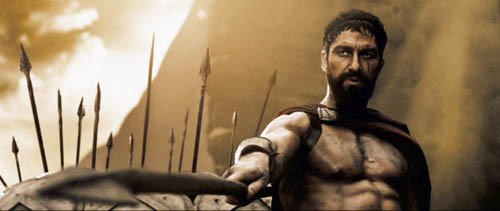
I think that ordinary mainstream cinema has been setting us up for the flashiest 3-D flourishes for some time. One of the goals of the Speilberg-Lucas spearhead was to amp up physical action, to make it more kinetic, and this often showed up as in-your-face depth. Spielberg used a lot of deep-focus effects to create a punchy, almost comic-book look, and who can forget the opening shot of Star Wars, with that spacecraft arousing gasps by simply going on into depth forever? Seeing the movie in 70mm on release, I was struck by how the last sequence of Luke’s attack mission was maniacally concerned with driving our eye along the fast track of central perspective. Did it foreshadow the tunnel vision of videogame action?
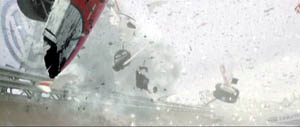
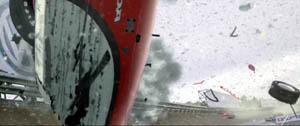
In any case, I think that aggressive thrusting in and out of the frame was integral to the style of the new blockbuster. Since then, our eyes have been assaulted by plenty of would-be 3-D effects in 2-D. In Rennie Harlan’s Driven (2001), the crashing race cars spray us with fragments.
Jackson is definitely in the Spielberg line, favoring steep depth and big foreground elements. In King Kong, the primeval creatures lunge out at us, heave violently across the frame, and fling their victims into our laps.
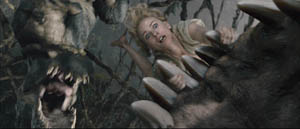
Such shock-and-awe shots recall American comic-book graphics. These affinities are at the center of 300, as we’d expect. For example, a cracking whip curls out at us in slow motion, like a two-panel series.
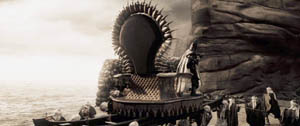
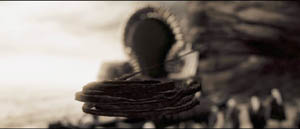
Beowulf draws on this thrusting imagery, but inevitably it doesn’t seem fresh because so many 2-D films have already used it. Maybe the most original device is having the camera pull swiftly back and back and back, letting new layers of foreground pop in and shrink away. This is viscerally arousing in 3-D, but aren’t there precedents for it—in the Rings, in animated films, or some such?
Zemeckis tries to transpose into 3-D the style of what I’ve called, in The Way Hollywood Tells It, intensified continuity. This style favors rapid cutting, many close views, extreme lens lengths, and lots of camera movement. I found Zemeckis’ restless camerawork even more distracting than in 2-D. So I’m wondering if current stylistic conventions can simply be transposed to 3-D, or do directors have to be more imaginative and make fresher choices?
KT: That pull-back effect may be viscerally arousing, but in Beowulf it was usually pretty gratuitous and, for me at least, it called attention to itself in a way that was often risible. I don’t think there’s anything in Rings as crude as the shots in Beowulf that you’re talking about. In the opening scene of the latter, in the mead-hall, the camera zips into the upper part of the room, with rafters, chains, torches, and even rats whizzing in from the sides of the frame. None of that contributes to the narrative.
The flashiest backward camera movement, or simulated camera movement, I can think of in Rings is the one in the Two Towers scene where Saruman exhorts his army of ten thousand Uruk-hai to battle. The final shot is a rapid track backward through the ranks of soldiers holding flag poles. The point is to stress the enormous numbers of soldiers. There’s no gratuitous thrusting-in of set elements from the sides, just the cumulative effect of so many similar figures. The simulated camera also at one point “bumps” one of the flagpoles, causing it to wobble, but I take it that that’s an attempt to add a certain odd realism to the “camera” movement, not a knowing nudge to the audience. In Rings, the virtual camera usually follows action rather than moving independently through space. It tends to go forward or obliquely rather than backward.
As to transferring classical Hollywood style to 3-D or finding a whole new set of conventions to fit 3-D, Beowulf offers an object lesson. It uses a combination of the two. At times we have conventional conversations using shot/reverse shot, and at other times we have the swoopy-glidey style you described, with the camera zipping around the space and trying to see it from every angle within a few seconds.
The odd thing is, neither one works. The very close shot/reverse shot views of the digital characters make them look unnatural and emphasizes the not infrequent failure of their eyes to connect with each other. The swoop-glidey camera movements are silly and don’t stick to the narrative.
I’m not optimistic enough to think that directors can come up with a whole set of “fresher stylistic choices” to make 3-D work. Maybe Sergei Eisenstein, with his meticulous attention to every aspect of such topics, could have thought the issue through, but his solution would probably not be viable for the Hollywood studios. My own thought is that directors working in 3-D should probably stick to classical Hollywood style and avoid flashy stylistic effects. So far, the more blatantly 3-D something looks on the screen, the less it makes 3-D seem like something we want to watch on a regular basis. Think of the best films of this year: Zodiac, The Assassination of Jesse James by the Coward Robert Ford, Ratatouille, Across the Universe, and so on. Would any of them be better in 3-D? Probably not.
Plus, I don’t like watching movies through something. Movies should just be the screen and you. The 3-D glasses are definitely better now than in the earliest days of the cardboard, red/green versions. Still, the Imax glasses we used in watching Beowulf were heavy enough to leave a groove on my nose. Make the mistake of touching the lenses, and you’ve got a blur on one half of your vision of the film. In short, I think that 3-D still has to prove itself, and Beowulf didn’t add any evidence.
(1) PS 9 December: DB: I originally added in regard to Imax: “It’s actually waning in popularity, except in newly emerging markets like China.” This disparaging comment was misleading. Yesterday I learned from Screen International that Imax recently signed a deal with AMC to install 100 systems in 33 US cities. Oops! Today Paul Alvarado Dykstra of Austin’s Villa Muse Studios kindly wrote to point out the Hollywood Reporter‘s coverage, which gives background on the costs of installing and maintaining an Imax facility.
I was, obscurely, thinking of the traditional Imax programming of travelogues and documentaries. I failed to register that these have been largely displaced by screenings of blockbuster features, catching fire in 2003 with The Matrix Reloaded and proving successful with The Polar Express and other titles. Imax is now largely an alternative venue for megapictures, and its seesawing financial performance may have been steadied by moving into the features market.
PS 26 December: Travel has delayed our timely linking, but we couldn’t neglect Mike Barrier’s in-depth critique of Beowulf here.
PPS 5 January 2008: Harvey Deneroff has a comprehensive and judicious discussion of the 3D situation here.
Do filmmakers deserve the last word?
DB here:
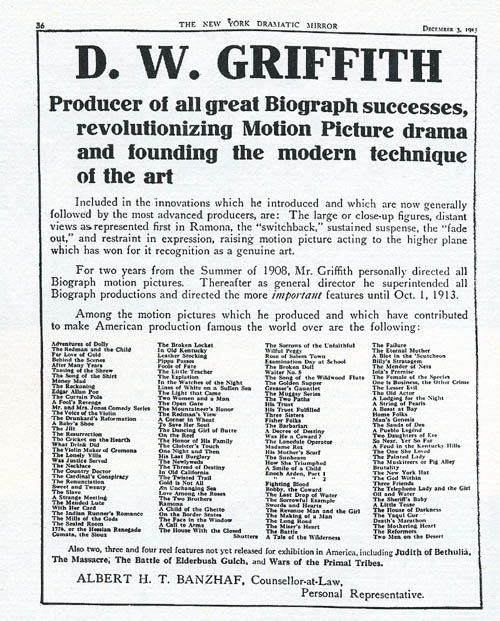
On 3 December 1913, the above advertisement appeared in the New York Dramatic Mirror. D. W. Griffith had left the American Biograph company and set out on an independent path that would lead to The Birth of a Nation and beyond. Because Biograph never credited directors, casts, or crews, he wanted to make sure that the professional community was aware of his contributions. Not only did he point out that he had made several of the most noteworthy Biograph films; he also took credit for new techniques. He introduced, he claims, the close-up, sustained suspense, restrained acting, “distant views” (presumably picturesque long-shots of the action), and the “switchback,” his term for crosscutting—that editing tactic that alternates shots of different actions occurring at the same time.
Griffith’s bid for credit was a shrewd move for his career, and it had repercussions after the stunning success of The Birth of a Nation two years later. Many historians took Griffith at his word and credited him with the breakthroughs he listed. He became known as the father of “film grammar” or “film language.” The idea hung on for decades. Here’s the normally perceptive Dwight Macdonald, criticizing Dreyer’s Gertrud for being anachronistic:
He just sets up his camera and photographs people talking to each other, usually sitting down, just the way it used to be done before Griffith made a few technical innovations. (1)
Filmmakers believed the Griffith story too. Orson Welles wrote of the “founding father” in 1960:
Every filmmaker who has followed him has done just that: followed him. He made the first close-up and moved the first camera. (2)
In the late 1970s a new generation of early-cinema scholars gave us a more nuanced account of Griffith’s place in history. They pointed out that most of the innovations he claimed either predated his Biograph work, (3) or appeared simultaneously and independently in Europe and in other American films. Some Griffith partisans had already conceded this, but they maintained that he was the great synthesizer of these devices, and that he used them with a vigor and vividness that surpassed the sources.
That judgment seems right in part, but Eileen Bowser, Tom Gunning, Barry Salt, Kristin Thompson, Joyce Jesniowski, and other early-cinema researchers have drawn a more complicated picture. (4) Griffith did speed up cutting and devote an unusual number of shots to characters entering and leaving locales. But these innovations weren’t usually recognized as original by previous historians. More interestingly, much of what Griffith did was not taken up by his successors. His technique was idiosyncratic in many respects. By 1915 younger directors like Walsh, Dwan, and DeMille were forging a smoother style that would be more characteristic of mainstream storytelling cinema than Griffith’s somewhat eccentric scene breakdowns. Instead of creating film language, he spoke a forceful but often unique dialect.
The New York Dramatic Mirror ad coaxes me to reflect on how filmmakers have shaped critics’ and historians’ responses to their work. Hawks and Hitchcock developed a repertory of ideas, opinions, and anecdotes to be trotted out on any occasion. Today, directors write books, give interviews, appear on infotainment shows, and provide DVD commentary. We know that many of the talking points are planned as part of the film’s publicity campaign, and journalists dutifully follow the lead. (In Chapter 4 of The Frodo Franchise, Kristin discusses how this happened with Lord of the Rings.) For many decades, in short, filmmakers have been steering critics and viewers toward certain ways of understanding their films. How much should we be bound by the way the filmmaker positions the film?
Deep focus and deep analysis
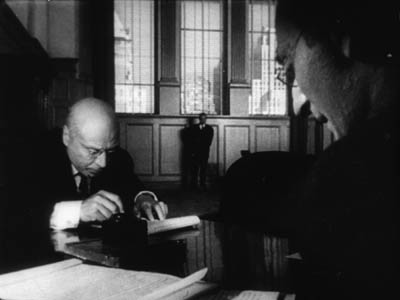
Citizen Kane (1941).
Determining intentions is tricky, of course. Still, I think that in many cases we can reconstruct a plausible sense of an artist’s purposes on the basis of the artwork, the historical context, surviving evidence, and other information. (5) This may or may not correspond to what the artist says on a particular occasion. For now, I want simply to point to one instance in which filmmakers have shaped critical uptake, with results that are both illuminating and limiting.
In the late 1940s and early 1950s, André Bazin, one of the great theorists and critics of cinema, argued that Orson Welles and William Wyler created a sort of revolution in filmmaking. They staged a shot’s action in several planes, some quite close to the camera, and maintained more or less sharp focus in all of them. Bazin claimed that Welles’ Citizen Kane and The Magnificent Ambersons and Wyler’s The Little Foxes and The Best Years of Our Lives constituted “a dialectical step forward in film language.”
Their “deep-focus” style, he claimed, produced a more profound realism than had been seen before because they respected the integrity of physical space and time. According to Bazin, traditional cutting breaks the world into bits, a series of close-ups and long shots. But Welles and Wyler give us the world as a seamless whole. The scene unfolds in all its actual duration and depth. Moreover, their style captured the way we see the world; given deep compositions, we must choose what to look at, foreground or background, just as we must choose in reality. Bazin wrote of Wyler:
Thanks to depth of field, at times augmented by action taking place simultaneously on several plane, the viewer is at least given the opportunity in the end to edit the scene himself, to select the aspects of it to which he will attend. (6)
While granting differences between the directors, Bazin said much the same about Welles, whose depth of field “forces the spectator to participate in the meaning of the film by distinguishing the implicit relations” and creates “a psychological realism which brings the spectator back to the real conditions of perception” (7).
In addition, Bazin pointed out, this sort of composition was artistically efficient. The deep shot could supply both a close-up and a long-shot in the same framing—a synthesis of what traditional editing had given in separate shots. Bazin wove all these ideas into a larger theory that cinema was inherently a realistic medium, bound to photographic recording, and Welles and Wyler had discovered one path to artistic expression without violating the medium’s biases.
There are many objections to Bazin’s argument, some of which I’ve rehearsed in On the History of Film Style. My point here is that Bazin was presenting analytical points that stemmed from publicity put out by Welles, Wyler, and especially their talented cinematographer Gregg Toland.
In a 1941 article in American Cinematographer, Toland talked freely about how he sought “realism” in Citizen Kane. The audience must feel it is “looking at reality, rather than merely a movie.” Key to this was avoiding cuts by means of long takes and great depth of field, combining “what would conventionally be made as two separate shots—a close-up and an insert—into a single, non-dollying shot.”(8) Toland defended his sometimes extreme stylistic experimentation on grounds of realism and production efficiency, criteria that carried some weight in his professional community of cinematographers and technicians. (9)
Toland’s campaign for his style addressed the general public too. For Popular Photography he wrote an article (10) explaining again that his “pan-focus” technique captured the conditions of real-life vision, in which everything appears in sharp focus. A still broader audience encountered a Life feature in the same year (11), explaining Toland’s approach with specially-made illustrations. Two samples show selective focus, one focused on the background, the other on the foreground.
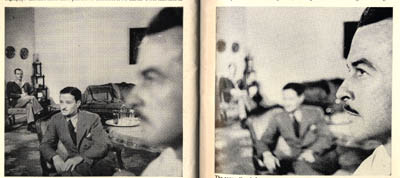
An accompanying photo shows pan-focus at work, with Toland in frame center, an actor in the background, and Toland’s camera assistant in the foreground.
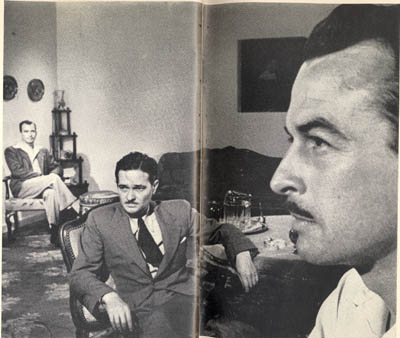
In sum, Toland’s publicity prepared viewers, both professional and nonprofessional, for an odd-looking movie.
Throughout the 1940s, Welles and Wyler wrote and gave more interviews, often insisting that their films invited greater participation on the part of spectators. In a crucial 1947 statement, Wyler noted:
Gregg Toland’s remarkable facility for handling background and foreground action has enabled me over a period of six pictures he has photographed to develop a better technique for staging my scenes. For example, I can have action and reaction in the same shot, without having to cut back and forth from individual cuts of the characters. This makes for smooth continuity, an almost effortless flow of the scene, for much more interesting composition in each shot, and lets the spectator look from one to the other character at his own will, do his own cutting. (12)
Some of this publicity material made its way into French translation after the liberation of Paris, just as Kane, The Little Foxes, and other films were arriving too. Bazin and his contemporaries picked up the claims that these films broke the rules. Deep-focus cinematography became, in the hands of critics, a revolutionary new technique. They presented it as their discovery, not something laid out in the films’ publicity.
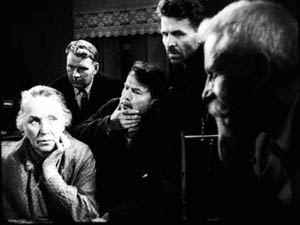
But the case involved, as Huck Finn might say, some stretchers. Watching the baroque and expressionist Kane, it’s hard to square it with normal notions of realism, and we may suspect Toland of special pleading. Some of Toland’s purported innovations, such as low-angle shots showing ceilings, had been seen before. Even the signature Toland look, with cramped, deep compositions shot from below, can be found across the history of cinema before Kane. Here is a shot from the 1939 Russian film, The Great Citizen, Part 2 by Friedrich Ermler.
More seriously, some of Toland’s accounts of Kane swerve close to deception. For decades people presupposed that dazzling shots like these were made with wide-angle lenses.
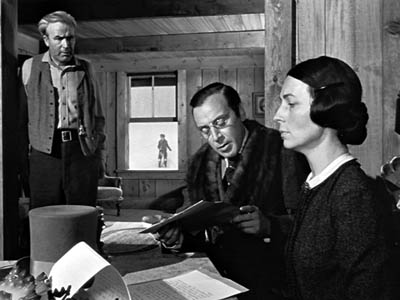
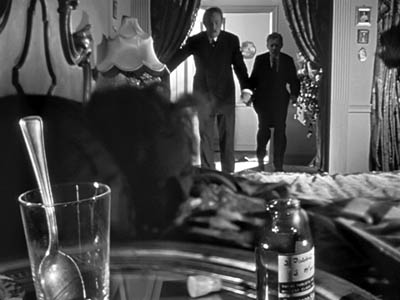
Yet the deep focus in the first image was accomplished by means of a back-projected film showing the boy Kane in the window, while the second image is a multiple exposure. The glass and medicine bottle were shot separately against a black background, then the film was wound back and the action in the middle ground and background were shot. (And even the middle-ground material, Susan in bed, is notably out of focus.) I suspect that the flashy deep-focus illustration in Life, shot with a still camera, is a multiple exposure too. In any event, much of the depth of field on display in Kane couldn’t have been achieved by straight photography. (13)
RKO’s special-effects department had years of experience with back projection and optical printing, notably in the handling of the leopard in Bringing Up Baby, so many of Kane‘s boldest depth shots were assigned to them. But here is all that Toland has to say on the subject:
RKO special-effects expert Vernon Walker, ASC, and his staff handled their part of the production—a by no means inconsiderable assignment—with ability and fine understanding. (14)
Kane’s reliance on rephotography deals a blow to Bazin’s commitment to film as a medium committed to recording an event in front the camera. Instead, the film becomes an ancestor of the sort of extreme artificiality we now associate with computer-generated imagery.
Despite these difficulties, Toland’s ideas sensitized filmmakers and critics to deep space as an expressive cinematic device. Modified forms of the deep-focus style became a major creative tradition in black-and-white cinema, lasting well into the 1960s. Bazin’s analysis certainly developed Toland’s ideas in original directions, and he creatively assimilated what Toland and his directors said into an illuminating general account of the history of film style. None of these creators and critics were probably aware of the remarkable depth apparent in pre-1920 cinema, or in Japanese and Soviet film of the 1930s. Their claims taught us to notice depth, even though we could then go on to discover examples that undercut Toland’s claims to originality.
Some little things to grasp at
I assume that Toland and his directors were sincerely trying to experiment, however much they may have packaged their efforts to appeal to viewers’ and critics’ tastes. But sometimes artists aren’t so sincere. By the 1950s, we have directors who started out as film critics, and they realized that they could guide the agenda. Here is Claude Chabrol:
I need a degree of critical support for my films to succeed: without that they can fall flat on their faces. So, what do you have to do? You have to help the critics over their notices, right? So, I give them a hand. “Try with Eliot and see if you find me there.” Or “How do you fancy Racine?” I give them some little things to grasp at. In Le Boucher I stuck Balzac there in the middle, and they threw themselves on it like poverty upon the world. It’s not good to leave them staring at a blank sheet of paper, no knowing how to begin. . . . “This film is definitely Balzacian,” and there you are; after that they can go on to say whatever they want. (15)
Chabrol is unusually cynical, but surely some filmmakers are strategic in this way. I’d guess that a good number of independent directors pick up on currents in the culture and more or less self-consciously link those to their film.
Today, in press junkets directors can feed the same talking points to reporters over and over again. An example I discuss in the forthcoming Poetics of Cinema is the way that Chaos theory has been invoked to give weight to films centering on networks and fortuitous connections. As I read interview after interview, I thought I’d scream if I encountered one more reference to a butterfly flapping its wings.
More recently, Paul Greengrass gave critics some help when he suggested that the jumpy cutting and spasmodic handheld camera of The Bourne Ultimatum suggested the protagonist’s subjective point of view–presumably, Jason’s psychological disorientation and frantic scanning of his surroundings. I expressed skepticism about this on an earlier blog entry, Anne Thompson replied on her blog, and I returned to the subject again. Any director’s statement of purpose is interesting in itself, but it should be assessed in relation to the evidence we detect onscreen.
Another recent instance: the new Taschen book on Michael Mann. The luscious pictures, mainly from Mann’s archive, are the volume’s raison d’etre, but the filmmaker seems to have placed unusual demands on the text. F. X. Feeney writes:
An earlier version of this book completed by another writer attempted (in a spirit of sincere praise) to treat Mann’s films as reactions against film traditions, as subversions of genre. This fetched a rebuke from Mann: “It’s irrelevant and neither accurate nor authentic to compare my films to other films because they don’t proceed from genre conventions and then deviate from those conventions. They proceed from life. For better or worse, what I’ve seen and heard and learned on my own is the origin of this material. Maybe the film medium by nature spawns conventions, because we all built on what’s gone before, but the content and themes of my films are not facile and derivative. They are drawn from life experience.” (16)
We have to wonder if Mann’s objection played a role in eliminating the earlier writer’s version. If that happened, it’s an unusually strong instance of a director’s holding sway over critical commentary. (17)
In the text we have, Feeney provides a chronological account of Mann’s career: plot synopses, thematic commentary, production background. There’s no discussion of broader historical trends, such as the migration of TV directors into film, the creative options available in 1980s-1990s Hollywood, the development of self-conscious pictorialism in modern film, the possibility of genre films becoming art-films or prestige pictures, or the changes in media culture or American society. All of these lines of inquiry would require comparing Mann with other filmmakers. It remains for other writers, perhaps without the director’s cooperation, to put Mann’s achievement into such contexts.
It’s always vital to listen to filmmakers, but we shouldn’t limit our analysis to what they highlight. We can detect things that they didn’t deliberately put into their films, and we can sometimes find traces of things they don’t know they know. For example, virtually no director has explained in detail his or her preferred mechanics for staging a scene, indicating choices about blocking, entrances and exits, actors’ business, and the like. Such craft skills are presumably so intuitive that they aren’t easy to spell out. Often we must reconstruct the director’s intuitive purposes from the regularities of what we find onscreen. (For examples, see this site here, here, and here.) And it doesn’t hurt, especially in this age of hype, to be a little skeptical and pursue what we think is interesting, whether or not a director has flagged it as worth noticing.
(1) Macdonald, “Gertrud,” Esquire (December 1965), 86.
(2) Quoted in Orson Welles and Peter Bogdanovich, ed. Jonathan Rosenbaum, This is Orson Welles (New York: HarperCollins, 1992), 21).
(3) Such would seem to be the case of the close-up, which of course is found very early in film history. But Griffith’s idea of a close-up may not correspond to ours. More on this in a later blog, perhaps.
(4) I give an overview of this rich body of research in Chapter 5 of On the History of Film Style. See also various entries in the Encyclopedia of Early Cinema, ed. Richard Abel (New York: Routledge, 2005).
(5) The most detailed argument for this view I know is Paisley Livingston’s book Art and Intention: A Philosophical Study.
(6) “William Wyler, or the Jansenist of Directing,” in Bazin at Work: Major Essays and Reviews from the Forties and Fifties, ed. Bert Cardullo (New York: Routledge, 1997), 8.
(7) Orson Welles: A Critical View, trans. Jonathan Rosenbaum (New York: Harper and Row, 1978) 80).
(8) Toland, “Realism for Citizen Kane,” American Cinematographer 22, 2 (February 1941), 54, 80.
(9) See the discussion in Bordwell, Janet Staiger, and Kristin Thompson, The Classical Hollywood Cinema: Film Style and Mode of Production to 1960 (New York: Columbia University Press, 1985), 345-349.
(10) Toland, “How I Broke the Rules in Citizen Kane,” Popular Photography (June 1941), 55, 90-91.
(11) “Orson Welles: Once a Child Prodigy, He Has Never Quite Grown Up,” Life (May 26, 1941), 110-111.
(12) Wyler, “No Magic Wand,” The Screen Writer (February 1947), 10.
(13) Peter Bogdanovich was to my knowledge the first person to publish some of this information; see “The Kane Mutiny,” Esquire 77, 4 (October 1972), 99-105, 180-90.
(14) Toland, “Realism,” 80.
(15) “Chabrol Talks to Rui Noguera and Nicoletta Zalaffi,” Sight and Sound 40, 1 (Winter 1970-1971), 6.
(16) F. X. Feeney, Michael Mann (Cologne: Taschen, 2006), 21.
(17) Mann’s reasoning puzzles me. He insists that his films can’t be compared to others along any dimensions, especially thematic ones. Yet in saying that his films are lifelike, he suggests that other films aren’t as realistic as his. Moreover, what about comparisons on grounds of technique, surely one of the most striking and admired features of Mann’s work? For reasons that are obscure, the director discourages any critical consideration of style; Feeney tells us that Mann hates the very word (p. 20).
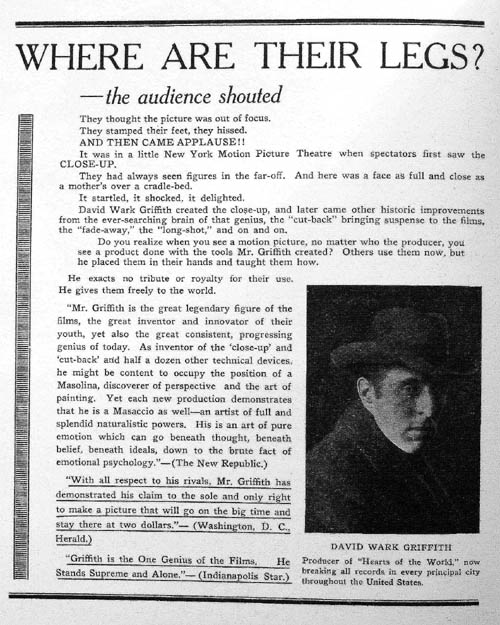
Ad in Wid’s Year Book 1918.
PS: 15 October: I’ve received a clarification from Paul Duncan, editor of F. X. Feeney’s Michael Mann book for Taschen. He expresses general agreement with my suggestions about how directors shape the uptake of their work, but he explains that the Mann book isn’t an instance of it. Here are the comments bearing on my blog entry.
In reply to my suggestion of other avenues to explore about Mann’s career:
In fairness to F.X. Feeney, he only had 25,000 words to cover Mann’s career, and all the subjects you write about are really outside the scope of the book. It sounds as though these are subjects that you would like to explore, and I can’t wait to read them in a future book or blog.
As for whether Mann exercised some control over the book’s final form, which I float as one possible explanation for its compass:
First, you speculate whether Mann caused the first version of the book to be scrapped, i.e. He exerted editorial control/censorship over the book. This is not the case, and if it was, do you think that he would have allowed F.X. to write that in the published version of the book?
In Note 17 appended to Feeney’s quote, you write: “Yet in saying that his films are lifelike, he suggests that other films aren’t as realistic as his.” If you had continued Mann’s quote, you would have reported the following: “I don’t look at the excellent French director Jean-Pierre Melville to decide how to tell the story in Thief. I meet thieves. And I guarantee you the reason Melville’s Le Samourai 1967) has authenticity, the reason Raoul Walsh’s White Heat (1949) has authenticity, is because those film-makers knew thieves, too.” I do not see any evidence here that Mann suggests that his films are more lifelike than other directors’. Only that his films stem from life like other films stem from life.
Also, in Note 17, you write: “For reasons that are obscure, the director discourages any critical consideration of style; Feeney tells us that Mann hates the very word (p. 20).” The reason Mann hates the word “style”—and I apologize for not making this clear in the book—is because after producing the Miami Vice TV show, he was forever referred to as a stylist, and the “style” of the show was all anybody ever talked about. The implication was that Mann is a director of style without substance. Subsequently, Mann has been very wary of the word, and discussion of it, because it puts undue weight on one aspect of his work.
Finally, I would like to explain a little of the working method with Mann on the book. The book was researched and written during rehearsal, filming and editing of Collateral. F.X. wrote the text and was given full access to everything that Mann had said in interviews. Mann then read and annotated the text, and this was discussed face-to-face with F.X. Most of these annotations were of a factual nature, correcting dates, being precise about the sequence of events, and to correct misinterpretations of his comments in previous interviews. However, they would also bring up new comments from Mann about his work. F.X. then rewrote some texts to include Mann’s comments, and then F.X. wrote his replies. In this way, the book became more of a dialogue between Mann and F.X. and is stronger for it I feel. So, in this case, the filmmaker did not get the last word.
I thank Paul for his clarifications, which should be of interest to all the book’s readers. On only two matters do we disagree.
First, Feeney’s book achieves what it set out to achieve, and it deserves credit for giving us valuable information about Mann in a clear, pungent style. And no one expects a Taschen book to be an in-depth monograph covering all aspects of a director’s career. But I still think that length limits don’t prevent an author from raising the contextual issues I mention. Many articles manage to address matters that go beyond the sort of career survey that Feeney provides, so there are ways to sketch such issues in an abbreviated way. I inferred, erroneously, that the choice not to tackle them could have been related to Mann’s own views on the comparative dimension that such issues tend to rely on.
Secondly, a minor matter: The fact that Mann can invoke Melville and Walsh on films about thieves suggests that a comparative perspective is valuable; he’s including himself in the company of directors who know their subjects from life, in explicit contrast to those who don’t. I didn’t include the extra sentences because I thought that they simply provided further signs of the contradiction I found in Mann’s own position—that his films can’t be compared to other directors’ works.
Rat rapture
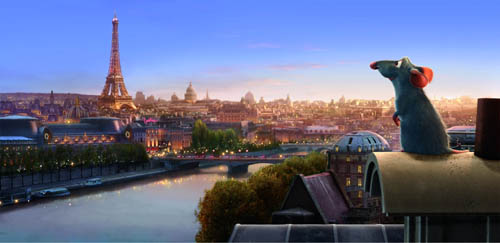
Recently we went to see Ratatouille and both loved it. We thought it was the best Hollywood movie we’ve seen this summer.
KT: Last October, in the infancy of this blog, I posted an entry on Cars. There I said, “For me, part of the fun of watching a Pixar film is to try and figure out what technical challenge the filmmakers have set themselves this time. Every film pushes the limits of computer animation in one major area, so that the studio has been perpetually on the cutting edge.” For Cars it was the dazzling displays of light and reflections in the shiny surfaces of the characters.
Figuring out the main self-imposed challenge in a new Pixar film is like a game, and I avoid reading any statements about the films by their makers ahead of time.
At first glance Ratatouille might seem to be “about” fur. True, there are lots of rats with impressively rendered fur—but fur was the big challenge way back in Monsters, Inc. Surely Pixar wasn’t repeating itself. To be sure, Monsters, Inc. contained only one major furry character, Sulley, and his fur was the long wispy type that some stuffed animals have. Difficult to render, no doubt, but different from the rats’ fur, which is dense, short, and has to ripple with the movements of the animals.
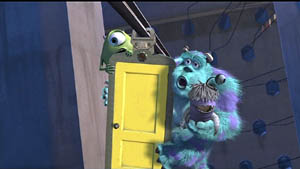
Not only that, but in Ratatouille, we see furry rats in all sorts of situations: just running round, crawling out of water and various other liquids, and in one virtuoso throwaway shot, emerging all fluffed up from a dishwasher. It’s all very impressive, but I didn’t think that was the main technical feat that the filmmakers were aiming at.
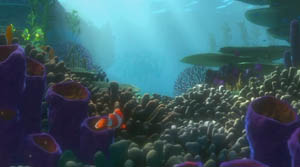
I quickly became aware that there was something different about the settings. Pixar films always have eye-catching settings: the beautiful and convincing underwater seascapes of Finding Nemo, the huge vistas of the factory in Monsters, Inc., the stylized domestic settings in the The Incredibles.
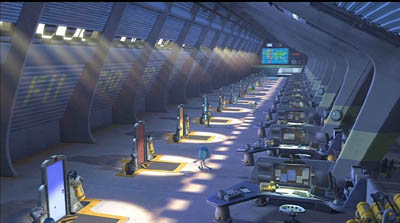
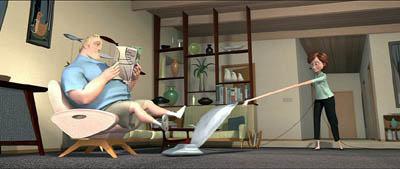
The Incredibles, the first film that Brad Bird directed for Pixar, was deliberately cartoony-looking, evoking the streamlined Populuxe look of 1950s cartoons. Ratatouille, his second effort, takes a very different approach. Here the settings are far more realistic and three-dimensional, approaching photo-realism in some of the Parisian street scenes. Often our vantage-point moves rapidly through these settings, twisting, turning, and plunging from high angle to low angle framings in a second. In the scene where the protagonist Remy is swept away from his family through the sewers until he emerges in Paris, the twists and turns of the pipes sweep by. Likewise, the camera explores the crevices of the restaurant’s crowded pantry.
The settings have a tangible and immediate presence beyond what we have seen in previous Pixar films, partly because so many objects in the surroundings are pulled into the action. Ingredients sit in bowls and jars that take up considerable portions of the kitchen set, and the rat dashes among them, sniffing to find the ones he needs for a new concoction. The lessons learned in Cars return here to make the shiny copper cooking utensils reflect their surroundings. The brick arch and floor tiles of the restaurant kitchen were individually tweaked, so that they don’t have the uniformity that CGI tends to give repetitive patterns. Dense combinations of bricks, tiles, wood panels, carpets, patterned wallpaper, glass, and Venetian blinds make every shot too busy for the eye to fully take in.
A delightful demonstration of all these features and more is given in the “Ratatouille QuickTime Virtual Tour.” 360-degree spherical space allows you to look up at the ceiling and down at the floor as well as scan the walls. (The download time is reasonably quick; you need to move your cursor into the window that opens and use it to scroll in any direction and at variable speeds. Use the shift key to zoom in and the control key to zoom out.)
DB: Two things, one general and one specific to Ratatouille:
(1) The idea of explaining artists’ works in terms of problems and solutions is common in art history and musicology, but not so common in film studies. It can be fruitful to consider that sometimes filmmakers face common problems and that they compete to solve them, or to find different problems they can solve.
I sometimes try to imagine what animators for other Hollywood studios thought when they walked out of Snow White and the Seven Dwarfs. Did the talents at Warners, Fleischer et al. just throw up their hands in despair? Disney must have been the Pixar of its day, challenging its rivals with a dazzling series of achievements along many dimensions. Disney had solved so many problems—of rendering color and depth, of catching detail and voluminous movement, of blending pathos with comedy—that the others could hardly compete in the same race. So it seems that they carved out other niches. Fleischer, though trying its hand at feature cartoons as well, concentrated on the familiar and presold comic-strip world of Popeye. Warners avoided child-oriented sentimentality and offered more insolent and whacked-out entertainment, personified in Bugs and Daffy. In today’s CGI realm, Pixar seems to set the pace, staking its claim before anybody else has realized the territory has opened up–though Aardman consistently offers something different.
(2) Along with the problems that you’ve mentioned, I was struck by what we might call a general task facing all animators: the need to display a sophisticated cinematic intelligence that fit contemporary tastes in live-action movies. So the pacing has to be fast (here, an average shot length of about 3.5 seconds), but it isn’t frantic. Today’s movies are overstuffed with details, so this is too; but here many stand out sharply. Central are all the minutiae of food and its preparation, which you mention below. Our friend Leslie Midkiff Debauche reports that her son, a chef, noticed the burn mark on Colette’s right forearm—a combat wound of the professional cook. Instead of the heavy satire and flatulence of the Shrek cycle, Pixar always gives us something that would engage us even if it weren’t animated.
Every director, I think, should study this film for lessons in making movement expressive. The velocity of our rats’ scampering depends on the surface they cross, and the differences in acceleration and braking are vivid. The vertigo-inducing river turbulence that carries Remy away from his clan displays the old Disney genius in rendering the behavior of water. There’s a caricatural difference in body language among all the characters, from the cadaverous Ego to the heaving movements of pudgy Emile and the spasmodic twirling of Linguini when Remy is at the controls. Shot scale is always well-judged. When there’s a moment of uncertainty about whether the kitchen team will support Linguini, the pause is accentuated by the fierce Horst taking a step forward toward the boy, in big close-up. Will this be the signal for the others to join him? The close-up conceals the key piece of information: Horst has stripped off his apron, and only when he lifts it into the frame do we realize that he’s walking out. Perhaps the visual expressiveness of silent filmmaking survives best today in animation.
KT: A secondary but still important challenge seemed to be the effort to find ways of rendering the textures of surfaces that are difficult to capture in animation. Most obviously the food—slices of carrots and tomatoes, stalks of celery—must look realistic and attractive if we are to believe that the dishes Remy devises are truly as scrumptious as the characters find them. (The film wisely sticks to soups, desserts, and, yes, ratatouille, sidestepping the problematic notion of an animal cooking other animals.)
Once you decide what you think the Pixar crew was working on extra hard in their newest film, it’s usually easy to find supporting evidence in interviews with the top people involved. For some reason Bird was reluctant to talk much about the big technical challenges for Ratatouille, but he gave a good summary in the interview on Collider.com:
I think our goal is to get the impression of something rather than perfect photographic reality. It’s to get the feeling of something so I think that our challenge was the computer basically wants to do things that are clean and perfect and don’t have any history to them. If you want to do something that’s different than that you have to put that information in there and the computer kind of fights you. It really doesn’t want to do that and Paris is a very rich city that has a lot of history to it and it’s lived in. Everything’s beautiful but it’s lived in. It has history to it, so it has imperfections and it’s part of why it’s beautiful is you can feel the history in every little nook and cranny. For us every single bit of that has to be put in there. We can’t go somewhere and film something. If there’s a crack in there, we have to design the crack and if you noticed the tiles on the floor of the restaurant, they’re not perfectly flat, they’re like slightly angled differently, and they catch light differently. Somebody has to sit there and angle them all separately so we had to focus on that a lot.
DB: This relates back to the idea that an animated film has to offer its own equivalent of what live-action has led viewers to expect. Since at least Alien and Blade Runner, we’ve come to equate realism with a worn-out world. No more spanking-clean spaceships, but rather creaky Gothic ones; no more shiny futures, only dilapidated ones. Bird acknowledges that once his team opts for more detailed settings, they have to look lived-in, rather than the rather generic ones we find in Toy Story and even The Incredibles. But then the food contrasts with this air of casual imperfection; it looks pristine.
KT: Speaking of food, in another interview, Bird expands on the difficulties of rendering it:
There was quite a bit of effort expended to make the food look delicious. Because if one of the things your movie is about is gourmet food, then you can’t have it not look delicious. And computers aren’t really very interested in making things look delicious. They’re interested in things looking clean and things looking geometrically precise, and usually hard not squishy – not tactile. Computers are great for perfection. They’re not great at organic things. We had to work really hard to get the food to look like you could taste it and smell it and enjoy it.
The interviews I’ve read don’t mention it, but the film also takes a small but impressive step toward solving the ever-difficult problem of rendering human skin. Most of the characters are given the usual smooth skin that we have come to expect in computer-animated films.
DB: Agreed! One of the things that put me off CGI animation years ago was the overpolished look of CGI surfaces. Volume without texture always looked plastic to me. But in Ratatouille, the Pixar team has made great progress in dirtying up the surfaces. That kitchen is full of spills and stains, but the faces are still pretty balloon-like, except for that villainous chef Skinner. He’s the most cartoony character, I suppose, and the range of expressions he passes through just in delivering a single line had me in stitches. The Termite Terrace legacy lives on in him.
KT: Yes, Skinner must have inspired the filmmakers. His face gets very sophisticated treatment. In most character animation, eyes and eyebrows are the main means of creating expressions in the upper half of the face. Several times, however, Skinner comes into extreme close-up, so that his expressions of rage and shock are complete with elaborate forehead wrinkles. There’s even a patch of pores on his nose. That degree of detail is used sparingly in this film, but perhaps we see a sign of things to come as the Pixar animators set up new hurdles to jump.
PS 25 August: For an interesting, more thematically oriented discussion of Ratatouille, see Michael J. Anderson and Lisa K. Broad’s entry on the Tativille blog.
PPS 31 August: Bill Desowitz has a lively and informative feature on the film, including behind-the-scenes interview material, at Animation World.
Fantasy franchises or franchise fantasies?
Kristin here–
While David is watching films in Brussels, I’m back in Madison, overseeing some house renovations, moving into the publicity phase of The Frodo Franchise in anticipation of its release, and generally enjoying a chance to catch up on my reading.
I’ve also finally tackled one of those “someday we really must …” projects. Not surprisingly, a considerable portion of our home is given over to storing books, journals, file folders, DVDs, videotapes, laserdiscs, negatives, and slides. For all too long a heap of old magazines has been sitting on the floor in the aisle between two of our bookshelves, on the assumption that someday we really must triage these and file the clippings in subject folders where we might actually have a chance of finding them.
Most of these magazines are old issues of Premiere, mainly from the 1990s. Premiere ceased publication as of April, and I can’t say that I miss it greatly. It had slid distinctly by then, but back in the nineties it was actually pretty good. (J. Hoberman was writing regularly for it!) Every issue I’ve examined so far has at least one item worth saving, and sometimes two or three.
These issues aren’t in chronological order, so the first stack I scooped up to look through was a random batch, with the October 1994 issue on top. It featured a 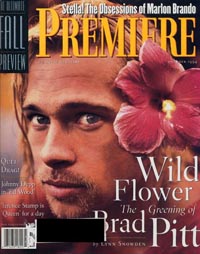 big close-up of Brad Pitt on its cover. He was just on the brink of becoming a star, being best known to that point for his supporting roles in Thelma and Louise and A River Runs Through It. He had just finished Interview with the Vampire.
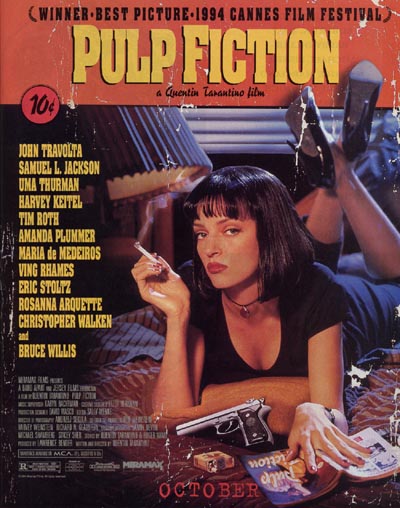
What interested me more was an ad that greeted me as I flipped the first few pages: the famous fake-worn-dust-jacket ad for Pulp Fiction. Odd that I had happened to begin with an issue from the season when one of the most influential films of the past two decades was being touted in preparation for its October release.
Indeed, the April issue happened to contain Premiere’s “Ultimate Fall Preview.” Naturally I got sucked into checking out what other films had been released that season. Given all the complaints these days about franchise films dominating Hollywood and pushing out the worthwhile films, I wondered just how good the good old days were.
To get a sense of what was going on in 1994, let’s start with the 10 top-grossing films of the year. Based on Box Office Mojo’s list of domestic grosses (in unadjusted dollars), they are: Forrest Gump, The Lion King, True Lies, The Santa Clause, The Flintstones, Dumb and Dumber, Clear and Present Danger, Speed, The Mask, and Pulp Fiction.
From our current perspective, the lack of franchise films on this list is striking. Only Clear and Present Danger, the second film starring Harrison Ford as Jack Ryan, belongs to part of an exiting series. The only film in a long-established franchise that came near the top was Star Trek: Generations at #15. Other sequels appear further down the top 50: The Naked Gun 33 1/3: The Final Insult (#23), City Slickers II: The Legend of Curly’s Gold (#32), Beverly Hills Cop III (#34), and Major League II (#45). No wonder sequels got a bad reputation!
On the other hand, several films in the top 10 spawned sequels: The Santa Clause, Dumb and Dumber, Speed, and The Mask. (Dumb and Dumber and The Mask both had their sequels considerably delayed by New Line Cinema’s inability to meet Jim Carrey’s skyrocketing salary demands and his resultant departure from the studio.)
In 1994, Hollywood was still in the early days of the franchise trend. After Batman in 1989, its sequel, Batman Returns, had come out in 1992, but that wasn’t enough to establish a pattern. Jurassic Park had appeared the year before but hadn’t yet seen a sequel. Aliens (1986) and Terminator 2: Judgment Day (1991) had both appeared seven years after the first films, suggesting that there was not exactly an automatic impulse to generate franchises. In fact, in 1994 we might expect to find Hollywood relatively untainted by franchise fever. Hence it should also very different from Hollywood today—if it’s true that franchises drive out other films. If all the anti-franchise critics are right, 1994 should also be a distinctly better year for auteurist fare, art-house movies, and stand-alone popular films.
What do we find in Premiere’s fall preview? In some ways it looks like a strong season. Apart from Pulp Fiction and Interview with the Vampire, there are Tim Burton’s Ed Wood, Robert Altman’s Prêt-à-Porter, Woody Allen’s Bullets over Broadway, Luc Besson’s Léon (aka The Professional), Frank Darabont’s The Shawshank Redemption, and Alan Rudolph’s Mrs. Parker and the Vicious Circle. Notable as well are Quiz Show and Nell. Buried in the “Also in Season” box at the end are Frederick Marx’s documentary Hoop Dreams, Clerks (with Kevin Smith not even mentioned), and Krysztof Kieslowski’s Red.
Alongside these films, though, there are the usual forgettable items: Junior (the Arnold Schwarzenegger-gets-pregnant comedy), Little Women, Disclosure, The Pagemaster, Radioland Murders and a bunch of other films that don’t get watched much anymore.
Putting aside the huge blockbusters of 2007, the fall season of 1994 doesn’t look all that different from the kind of fare Hollywood puts out now. Many of the same auteurs are with us. Burton is making Sweeney Todd (again with Johnny Depp). Allen continues to direct at his usual fast clip, albeit now in Europe. Besson promises more “Arthur” animated features. Darabont’s Stephen King adaptation, The Mist, is due out in November. Jordon’s thriller, The Brave One, starring Jodie Foster, is announced for September. Smith’s Clerks II came out last year. Tarantino tried to find inspiration by moving from dime novels to grindhouse movies, this time without success. The influence of his 1994 classic, however, is still very much with us. Even the unexpected success of Hoop Dreams is echoed by the recent vogue for documentaries. We have lost some of our major directors since 1994, of course, including Altman and Kieslowski, and Rudolph seems finally to have ceased being able to fund his eccentric independent films.
Is the fall season of 1994 typical? Premiere also used to run a chart of the year’s major releases called “Critics Choice,” which used a one-to-four-stars system to show how favorably each film was received by fifteen popular reviewers. Looking at the rest of 1994’s more memorable films, we find more familiar current directors , including Spike Lee (Crooklyn), the Coen Brothers (The Hudsucker Proxy), Ron Howard (The Paper), Oliver Stone (Natural Born Killers), John Waters (Serial Mom), Ben Stiller (Reality Bites), Zhang Yimou (To Live), Bille August (The House of the Spirits), Ang Lee (Eat Drink Man Woman), Kenneth Branagh (Mary Shelley’s Frankenstein), Ken Loach (Ladybird Ladybird), James Cameron (True Lies), Robert Zemekis (Forrest Gump), Peter Jackson (Heavenly Creatures) and on, and on. Steven Spielberg would be there, too, if Schindler’s List and Jurassic Park hadn’t both come out in 1993. There is also the smattering of adorably eccentric (Four Weddings and a Funeral, The Adventures of Priscilla, Queen of the Desert) or beautifully acted (The Madness of King George) English-language imports of the sort that find an audience each year—not to mention the unclassifiable Thirty-Two Short Films About Glenn Gould. And 1994 was no richer in subtitled fare than recent years have been: apart from Red and To Live, the only other notable foreign-language import is Queen Margot.
I don’t want to push the similarities between this randomly chosen season and the current Hollywood situation too much. There certainly are some differences. The rise of blockbuster franchises has changed the pattern of releases, with the big series films occupying the summer and Christmas seasons. It’s interesting, for example, to note that the year’s top grosser, Forrest Gump, was released in July (a week before True Lies), while today it would probably be given a fall slot. That’s just a matter of timing, though. Even there we have distributors using counter-programming for smaller films, some of which inevitably become surprise successes, like The 40 Year Old Virgin.
So just what is it that got pushed out by franchises?
(For more on sequels and franchises, see the May discussion by the Badger squad and Henry Jenkins on the third Pirates of the Caribbean film. A lot of comments have been added to the latter since I first linked it. I see that Henry’s post was also cited by Lee Marshall in an article in the June 22, 2007 issue of Screen International, “The People’s Choice.” Marshall makes the point that reviewers who lambaste big franchise films often do so in a condescending way that implicitly criticizes the public for liking them.)



