







Archive for the 'Film history' Category
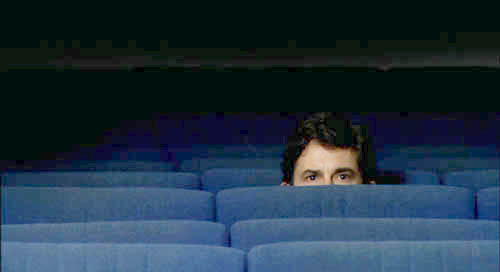
Can you spot all the auteurs in this picture?
DB here:
Some movies consist of several distinct episodes, each directed by a different filmmaker and all focused on a single theme. I’ve heard them called anthology films, omnibus films, and portmanteau films.
The earliest one I know is If I Had a Million (1932); later, Hollywood offered us Ziegfeld Follies (1946) and O. Henry’s Full House (1952). The Brits gave us the horror anthology Dead of Night (1945). Still, I think we associate the form chiefly with European cinema of the 1950s and 1960s. We got Love in the City (1953), Amori di mezzo secolo (1954), The Seven Deadly Sins (1962), RoGoPaG (1963), Les plus belles escroqueries du monde (1964), Paris vu par . . . (1965), Three Faces of Woman (1965), The World’s Oldest Trade (1967), and Amore e rabbia (1969).
Why the emergence of omnibus movies at this point in history? Some causes are surely financial. Most high-budget European films of the period had to be cross-national coproductions. Bringing in directors from several different countries could help guarantee funding under EU auspices and participating nations’ subsidy schemes. Just as important, the anthology format appeared when the festival scene was starting to become a vast clearing house for international film trade.
Although you can argue that many people seeing If I Had a Million would recognize the Lubitsch episode, Hollywood’s use of the form didn’t stress directorial differences. But as the Euro auteur was becoming a marketable commodity in the postwar era, a collection of short films could sell if they were signed by big-name filmmakers. “Paris As Seen by…” signals the importance of the different directorial approaches, and the very title of RoGoPaG invokes Rossellini, Godard, and Pasolini as brand-name labels. (Granted, the final G, Hugo Gregoretti, didn’t add much to the deal.)
For full enjoyment, the 1960s portmanteau film requires a degree of specialized film knowledge. At one level, we enjoy varied treatments of a theme, but at another we’re supposed to recognize each director’s personal vision, as we know it from other films. Even political-commentary portmanteau films like Far from Vietnam (1967), Lucía (1968), and Germany in Autumn (1978) gathered international attention because of the name recognition of the filmmakers who participated. The same branding operates in New York Stories (1989) and, more openly, in the documentary 12 registri per 12 città (“12 Directors for 12 Cities,” 1989).
The format has returned recently. We’ve had 11’09”01—Sept. 11 (2002), Eros (2004), Tickets (2005), and Paris, je t’aime (2006), the last virtually a rebooting of Paris vu par . . . . As we’d expect, such films continue to highlight the personal signatures of festival familiars. But we can spot some new twists too.
For one thing, the unifying idea may be formal as well as thematic. The episodes of 11’09”01 were all obliged to be the same length, eleven minutes, nine seconds, and one frame. Lumière et cie (1995) not only celebrated the centenary of film but obliged the directors to make their entries with a Lumière camera, to shoot without sync sound, to shoot no more than three takes, and to restrict the length to 52 seconds, the approximate running time of the earliest films. The Lumière homage also introduces the key themes of cinema and cinephilia, an angle that doesn’t seem prominent in the 1960s omnibus movies.
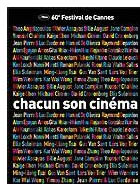 The most prominent portmanteau film so far this year fits snugly into current trends. As Anthony Kaufman writes, “Chacun son cinéma. . . showcases a range of filmmaking aesthetics, and for the most part, the program is a dazzling and memorable array of current auteur cinema.” As in other eras, we get a stylistic buffet; as in recent years, we find formal constraints and the theme of cinephilia. Commissioned for Cannes’ sixtieth anniversary by festival head Giles Jacob, the project restricts filmmakers to three minutes per episode and dictates the subject: “their state of mind of the moment as inspired by the motion picture theater.” The result was 33 short films about the joys and sorrows of film viewing and, to some degree, an extended commercial promoting the cultural value of the Cannes event.
A half-dozen things strike me while watching the French DVD version (which has English subtitles but is unaccountably lacking the Coens’ entry). Most notable, I suppose, is the way that many of the shorts replay tendencies that are characteristic of art cinema generally (1).
1. Cinema invokes eroticism . . . We get a dreamy Wong Kar-wai scene of a man watching, or recalling, heavy petting in the theatre. Polanski’s episode plays amusingly on the similarity of orgasmic moans and painful groans. Gus van Sant’s First Kiss reinvents Sherlock Jr., while the Dardenne brothers give us a tight tale of hands in the dark. Olivier Assayas’ episode, a crisp piece of filmmaking, reveals its l’amour fou at the very end. Angelopoulos makes clever use of the Kuleshov effect to create a touching exchange between Jeanne Moreau and the lamented Mastroianni.
2. . . . and childhood, especially for the Chinese directors, who haven’t exactly risen to the occasion here. The international art film has long traded on the appeal of kids, but the treatment of them in these episodes is remarkably banal. Tsai Ming-liang, who already passed his benediction for classic cinema in Goodbye, Dragon Inn, gives us a dream of a family reunited at the pictures. Chen Kaige shows children watching—hold on now—a silent Chaplin film. Hou Hsiao-hsien provides a sepia-toned flashback to going to the movies in Taiwan, while Zhang Yimou takes us to movie night in a Mainland village. At least the Hou episode opens on a lengthy shot that nicely decenters areas of interest in a busy street scene.
3. The cinema is on the decline . . . . One way to interpret Kitano Takeshi’s cryptic sequence is that films, even his own Kids’ Return, are little more than an anachronism today. More explicitly, David Cronenberg’s single-take close-up, captured by a surveillance camera shows himself as the world’s last surviving Jew, on the threshold of suicide in a movie house.

4. . . . yet it holds us in a magical spell. Some directors celebrate the simple folk at the movies. Claude Lelouch’s parents watch Top Hat and fall in love. Raymond Depardon takes us to a rooftop cinema in Alexandria, and Wenders shows a Congolese village running Black Hawk Down on video (more kids, but this time to disturb us). Kaurismaki seems to be poking fun at this arthouse commonplace by showing foundry workers blankly watching a rather different image of workers at the end of the day. The cinema, Ruiz and González Iñárritu suggest, mesmerizes even blind people.
Walter Salles provides a charming, deflating musical dialogue (below) that might be called Far from Cannes, showing that this festival casts a quasi-religious spell felt across the world. In my favorite section, Kiarostami gives us shots of women responding to Zeffirelli’s Romeo and Juliet. The image/sound pairing hints at their own thwarted loves, while certain lines, such as “Where be these enemies?,” seem addressed to Westerners who try to dehumanize the people of Iran.
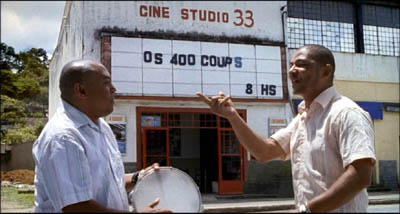
5. Film can be silly. Von Trier, decked out in a tux, silences a businessman through extreme means, and the rest of the audience hardly notices. Jane Campion, in an awkward episode, reveals a bug living in a theatre speaker. Probably the funniest contribution shows a mute Elia Suleiman preparing for a Q & A session after a screening. There are more gags in this three minutes than in all the other episodes put together.
5. Lest we forget . . . This couldn’t help but be a nostalgia exercise, encouraging filmmakers to muse on their lives in cinema. This theme recalls Cinema Paradiso, Scola’s Splendor, and all the other films soaked in the melancholy sweetness of movie memories. Moretti (top image above), gives us an anecdotal monologue, while Youssef Chahine unashamedly thanks Cannes for giving him an award ten years ago. The most formally ingenious entry here is Atom Egoyan’s tale of a couple sitting in different screenings while texting each other. Eventually one grabs an image from La Passion de Jeanne d’Arc and passes it along, creating a parallel to what’s happening in the other film (Egoyan’s The Adjuster).
In particular, there’s nostalgia for the golden age of auteurs, the very period when the anthology film gained its purchase. Chacun son cinéma is dedicated to Fellini, and Konchalovsky’s episode centers on 8 ½. Bresson and Godard are the most frequently referenced directors. (More generally, in our new century Bresson seems to have become the prototype of the serious filmmaker.) Other icons of the 1960s, such as Mastroianni and Anna Karina, keep popping up.

6. Spot the auteur. Most episodes don’t reveal the director’s name until the end, so the cinephilia takes on a suspenseful dimension, forcing you to guess who filmed the bit you’re watching. You also have to identify movies within the movies on the basis of clips and soundtracks. It’s a great game for arthouse aficionados, but it also highlights festival cinema’s reliance on the cult of the director and the organic unity of his/her body of work.
Suppose that all these films omitted the director’s name and replaced the recognizable players with nobodies. Would any of these episodes have been accepted for Cannes’ short film programs? Probably not, but we shouldn’t be cynical about this. Clearly artworks can gain in interest by virtue of their place in history or an artist’s career. Renoir’s Sur un air de Charleston (1927), Bresson’s Les affaires publiques (1934), Dreyer’s They Caught the Ferry (1948), and Fassinder’s episode in Germany in Autumn are not masterpieces, but these shorts show fresh sides of great filmmakers, and our understanding of their accomplishment is enriched by having them.
So we’re right to recognize the director’s career as a meaningful whole. But we should also recognize that today such careers continue thanks to a distinct system of marketing. At the Cannes site, Rauol Ruiz says: “It’s a delight to be a preferred filmmaker and especially a favored filmmaker of Gilles Jacob.” The system depends on reciprocity. “Without the auteurs,” says Jacob, “there wouldn’t be a festival.” (2) In turn, auteurs are obligated to festival gatekeepers and tastemakers, the powerful critics, programmers, and impresarios. The filmmaker knows the drill. You showed my film last year, so yes, I’ll sit on a jury or offer a master class or show up on the red carpet this year.
We’re told by Anne Thompson that a more complete DVD edition, including the David Lynch entry, will be available before Christmas. That gesture makes the disc I bought the equivalent of the plain-vanilla DVD of a blockbuster that will be followed at the right moment by the Deluxe Edition. Who says the art cinema operates above pressures of business and the market?
(1) I discuss the idea of art cinema in a 1979 article, “The Art Cinema as a Mode of Film Practice,” revised in the forthcoming Poetics of Cinema.
(2) Nancy Tartaglione-Vialatte, “‘Without the auteurs there wouldn’t be a festival,'” Screen International (May 18-31, 2007), p. 15. See also the accompanying article by Nick Roddick, “The bucks start here,” pp. 14-15. These are available online to subscribers.
PS: Speaking of Cannes and the art cinema, I wrote an essay about camerawork in contemporary Danish film for the festival issue of the Danish Film Institute magazine. It’s now online here (pp 22-26). And speaking of Danish filmmakers. . . .
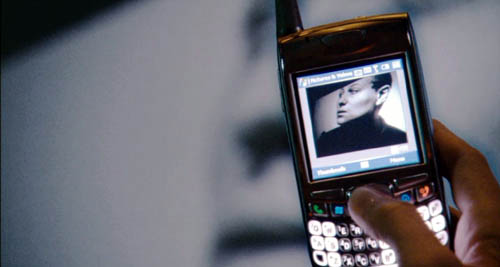
Atom Egoyan, Artaud Double Bill.
The Celestial Multiplex

Kristin here—
The Internet is mind-bogglingly huge, and a lot of people seem to think that most of the texts and images and sound-recordings ever created are now available on it—or will be soon. In relation to music downloading, the idea got termed “The Celestial Jukebox,” and a lot of people believe in it. University libraries are noticeably emptier than they were in my graduate-school days, since students assume they can find all the research materials they need by Googling comfortably in their own rooms.
A lot depends what you’re working on. For The Frodo Franchise, studying the ongoing Lord of the Rings phenomenon would have been impossible without the Internet. A big portion of its endnotes are citations to URLs. On the other hand, my previous book, Herr Lubitsch Goes to Hollywood, a monograph on the stylistic and technical aspects of Ernst Lubitsch’s silent features, has not a single Internet reference. Lubitsch can only be investigated in archives and libraries, where one finds the films and the old books and periodicals vital to such a project.
Vast though it is, the Internet is tiny in comparison with the real world. Only a minuscule fraction of all the books, paintings, music, photographs, etc. is online. Belief in a Celestial Jukebox usually works only because people tend to think about the types of texts and images and sounds that they know about and want access to. Yes, more is being put into digital form at a great rate, but more new stuff is being made and old stuff being discovered. There will never come a time when everything is available.
Even so, every now and then someone proclaims that in the not too distant future all the movies ever made will be downloadable for a small fee, a sort of Celestial Multiplex. A. O. Scott declared this in “The Shape of Cinema, Transformed at the Click of a Mouse” (New York Times, March 18): “It is now possible to imagine—to expect—that before too long the entire surviving history of movies will be open for browsing and sampling at the click of a mouse for a few PayPal dollars.”
Not only that, but Scott goes on, “This aspect of the online viewing experience is not, in itself, especially revolutionary.” He’s more interested in the idea that online distribution will allow filmmakers to sell their creations directly to viewers. That would be significant, no doubt, but as a film historian, I’m still gaping at that line about “the entire surviving history of movies.” Such availability would not only be “revolutionary,” it would be downright miraculous. It’s impossible. It just isn’t going to happen.
(The image above was generated to publicize the “Search inside the Music” program that is an important part of the Celestial Jukebox. Imagine movie screens with actors’ faces in those little boxes, and you’ve got the Celestial Multiplex.)
I will give Scott credit for specifying “surviving” films. Other pundits tend to say “all films,” ignoring the sad fact that great swathes of our cinematic heritage, especially in hot, humid climates like that of India, have deteriorated and are irretrievably lost.
Dave Kehr has already briefly pointed out some of the problems with Scott’s claims, mainly the overwhelming financial support that would be needed: “Tony Scott’s optimism struck me as, well, a little optimistic.” On the line about “the entire surviving history of movies,” Kehr suggests, “That’s reckoning without the cost of preparing a film for digital distribution — the same mistake made by the author of the recent vogue book ‘The Long Tail’ — which, depending on how much restoration is necessary, can run up to $50,000 a title. None of the studios is likely to pay that much money to put anything other than the most popular titles in their libraries on line.” As Kehr says, the numbers of films awaiting restoration and scanning isn’t in the hundreds, as Scott casually says. No, it’s in the tens of thousands even if we just count features. It’s more like hundreds of thousands or more likely millions if we count all the surviving shorts, instructional films, ads, porn, everything made in every country of the world. To see how elaborate the preservation of even one short medical teaching film can be, go here.
Putting aside the need for restoration, newer films present a daunting prospect. To help put the situation in perspective, let’s glance over the total number of feature films produced worldwide during some representative years from recent decades (culled from Screen Digest‘s “World Film Production/Distribution” reports, which it publishes each June): 1970, 3,512; 1980, 3710; 1990, 4,645; 2000, 3,782; and 2005, 4,603. For me the numbers conjure up the last shot of Raiders of the Lost Ark, only with just stack upon stack, row upon row of film cans.
Scott isn’t the first commentator to prophesy that all films will eventually be on the Internet. It’s an idea that crops up now and then, and it would be useful to look more closely at why it’s a wild exaggeration. It’s not just the money or the huge volume of film involved, though either of those factors would be prohibitive in itself. There are all sorts of other reasons why the advent of practical digital downloading of films will never come close to providing us with the entire history of cinema.
Coincidentally, two experts on this subject, Michael Pogorzelski, Director of the Film Archive of the Academy of Motion Picture Arts and Sciences, and Schawn Belston, Vice President, Film Preservation and Asset Management for Twentieth Century Fox, visited Madison this past week. Mike got his MA here in the Dept. of Communication Arts and now returns about once a year to show off the latest restored print that he has worked on. Schawn isn’t an alum, but he has also visited often enough that most students probably think he is. The two brought us the superb new print of Leave Her to Heaven that Fox and the Academy have recently collaborated on.
I figured it would be very enlightening to sit down with these two and talk about why the Internet is never going to allow us to watch just anything our hearts desire. They kindly agreed, and with my trusty recorder in tow we went for burgers—and fried cheese curds, a commodity not available in Los Angeles—at the Plaza Tavern. I’m grateful for the fascinating insights they provided into some of the less obvious obstacles to putting films on the Internet en masse.
No Coordinating Body
Before we launch in, though, one point needs to be made: there is no single leader or group or entity out there organizing some giant program to systematically put all surviving movies on the Internet. There isn’t a set of guidelines or principles. There’s no list of all surviving films. How would we even know if the goal of putting them all up had been achieved? When the last archivist to leave turned out the light, locked the door, and went looking for a new line of work?
Most of the physical prints that would be the basis for such transfers are sitting in the libraries of the studios that own them or in the collections of public and private archives (including many individuals). The studios would make films available online for profit. The archives might be non-profit organizations, but they still would need to fund their online projects in some fashion, either by government support, from private grants, or by charging a fee for downloads. Most archives are more concerned about getting the money to conserve or restore aging, unique prints than about making them widely available. Preservation is an urgent matter, and making the resulting copies universally available for public entertainment or education is decidedly a secondary consideration.
Mike works for a non-profit archive, Schawn for a studio, so together they provide a good overview of some key problems facing the creation of an ideal, comprehensive collection of movies for download.
Money
People who claim that all surviving films could simply be put on the Internet don’t go into the technology and expenses of how that could be done.
Of course, Schawn says, studios want to “digitize the library.” That phrase is highly imprecise, however. He specifies, “For the purposes of this idea of media being online, available, downloadable, streamable, whatever, that’s something that we’re dealing with now using existing video masters. So there isn’t an extra cost to quote, unquote digitize. But there is a cost to make the compression master, what we’re calling at Fox a ‘mezzanine file,’ which is basically a 50 megabit file. That’s the highest-quality ‘low’ quality version of the content from which you can derive all of the different flavors of compression for the various websites that have downloadable media.
“There’s a huge problem with this, in that Amazon, iTunes, and Google all have a slightly different technical specification of how they need the files delivered to them. If you don’t have this kind of mezzanine file, you have to make a different compressed version for each one of these, which costs something, certainly. It’s not incredibly expensive, but it’s not free.
“So why? What’s the motivation to us to compress at Fox the entire library? I don’t know. Are we going to sell enough copies of Lucky Nick Cain [a 1951 George Raft film] compressed on iTunes to cover the costs of making the compression? I don’t think so.”
Compatibility and the Onrush of Technology
Schawn’s mention of the variety of files needed by the big download services raises the problem of compatibility. It’s not just a matter of supplying the files and then forgetting about the whole thing, assuming that the film is available to anybody forever. What about new standards and formats?
Shawn: “Just as with consumer video, the standard changes, so what used to be acceptable yesterday isn’t acceptable now in terms of technical quality.” As time passes, plug-ins make access faster and cheaper, and eventually the original files don’t look good enough. He points out that currently iTunes can’t download HD. If it becomes possible later, “If you want to get 24 in HD, what Fox will have to do is go and re-deliver all the files in HD.” And presumably re-deliver again when the next big format revolution occurs.
Mike explains further, “Using the mezzanine file, you would just have to continue to reformat it to whatever the players demand. The lowest of the low quality will keep going up as people have broadband and can handle larger chunks of data faster.”
What about the film you’ve already downloaded? You acquire films using plug-ins, which change. Think how often you’re told that an update is now available. If you go ahead and keep updating, the changes accumulate. Eventually you may not be able to play the download you paid for. Quicktime will have moved way beyond what the technology was when you made your purchase.
Schawn and Mike both point out that at this stage in the history of downloading, the level of quality is still pretty bad in comparison with prints of films in theaters or on DVDs. It would be nice to think that the virtual film archive could provide sounds and images worthy of the movies themselves, but that will take a long, long time–not the “before too long” that Scott envisions.
Copyright
I raised another matter: “But what about copyright? Every time I hear something about restoration or bringing something out on DVD, it’s, ‘Well, there are rights problems.’ And some of those rights problems don’t get resolved. I assume that quite a few films that they blithely believe can be slapped up for downloading can’t be slapped up.”
Schawn: “Sure, and there are often not any kinds of provisions in the contract about Internet distribution—obviously! So you’re right, how do you deal with that?”
He pointed to Viva Zapata as a film that Fox has restored but can’t make available due to rights issues. The potential sales are not thought to warrant paying to resolve those issues. “I’m sure there are lots of titles in everybody’s libraries that you can’t just pop up on the Internet and start selling.”
The copyright barrier is worse for archives, which seldom own the exhibition or distribution rights to the films they protect. Usually—though not invariably–the studios do not object to archives owning and preserving prints. Making money through showing them or selling copies would be quite another matter.
Mike described the online presence of archival prints. “On a much smaller scale, this is being attempted in the archive world already, like on Rick Prelinger’s site [Prelinger Archives] or on the Library of Congress’s site, where they’ve put up dozens of moving-image files. True, it’s not independent cinema and it’s mostly commercials and the paper prints that have recently been restored. On Prelinger’s site it’s all the industrial films that he’s collected over the years. That has seen a good amount of traffic, but it hasn’t created new audiences for these films, I would argue. At least, not on a huge scale.”
Prelinger’s site contains only public-domain items, including the ever-popular Duck and Cover, allowing him to avoid the problem of copyright. Similarly, the Library of Congress gives access primarily to films in the pre-1915 era.
Suppose an archive and a film studio both have good-quality prints of a minor American film made in the 1940s. The archive does not have the legal right to put it online, and if the studio decides that it does not have the financial incentive to do so, that film will not be made available for downloading. A private collector might possibly create a file and make it available, but he or she would risk being threatened by the copyright-holder.
Piracy
We briefly discussed the methods used to prevent pirated copies being made from downloaded films. Like DVDs, downloads can be pirated, with people sending copies to their friends or even offering downloads for a fee in competition with the copyright holder. Copy-protection codes might make it necessary for a purchaser to keep a downloaded copy only on a hard-drive without being able to burn it onto a DVD. Another type of code could erase the file once the film had been viewed once or twice. That’s not exactly conducive to the ideal archive of world cinema, where we would hope to be able to study a film in detail if we so choose.
One might think that piracy protection mainly applies to studios, with their need to make money. Mike points out, though, that the need for such protection “even applies to the archival model, too. For films that you mention that have gone out of copyright, there’s still the same costs associated with putting a silent film that no one owns–digitizing it, creating the compressed master that goes on the Web—and they aren’t the kinds of subjects that people are going to get rich on at all, so there isn’t a lot of piracy. You don’t hear many archivists complaining, ‘Hey, you took my 1911 Lubin film, damn you! You can’t put that on your Website. That belongs on the archive’s Website.’ But that scenario becomes more of a likelihood for more popular titles. The obscure 1911 Lubin film is on one extreme, but Birth of a Nation, a well-known silent film a lot more people would like to see, is on the other. Let’s say the highest-quality copy is on the Museum of Modern Art’s Website and can be easily lifted and posted on your own site. And even if you just say, ‘Oh, I’ll charge 99 cents or I’ll charge 50 cents to stream it,’ it’s still going to be someone taking over something that the archive put all of the high-end effort and money into doing. Frankly, I think unless it’s an archive with a national mandate and a little bit higher budget to digitize and to put the contents of their archives online, there’s not going to be any motivation to make that high-end investment up front.”
Thus an archive may simply not bother to put a film on the internet because it can’t guarantee recouping the costs that would be generated.
Language and Cultural Barriers
Scott’s notion of easy access to all of surviving world cinema implicitly depends on an idea that all these films are either English-language or already subtitled or dubbed for English-speaking users.
That’s not true for a start, so there would remain a great deal of work to translate films that have never been released in English-language markets. That’s another huge, expensive task.
Then there’s the opposite side of that coin. For truly complete access, everyone in the world, whatever language they speak, would be able to download and appreciate every film. Of course, there are billions of people without computers or Internet access, and it looks unlikely that being able to go online will become universal anytime soon. (For figures on numbers of people with internet access, check here; percentages can be calculated by clicking on each country and finding the total population. In Tajikistan, for example, .07% of the population was online in 2005. One has to assume that a lot of connections in some of those countries are dial-up, so downloading films would be virtually impossible. [June 21, 2010: In 2008, Tajikistan’s online population has grown to .08%.])
So let’s just say that for the foreseeable future downloadable films would “only” need to be subtitled in the languages of countries or regions where significant numbers of people subscribe to PayPal.
In our conversation, Schawn pointed out that digital compression files mean that there can be huge numbers of versions, with different soundtracks dubbed in or different subtitles added. Technically it’s possible to do all that translation. Still, “it’s very complicated. So for worldwide distribution of anything, like you’re talking about your silent film. If you’re in Pakistan, do you get the American version of the movie or do you get the version of the movie with the intertitles appropriate to wherever it is that you’re showing it? If so, that quickly compounds the amount of stuff that’s digitized.”
I responded, “Yeah, or a 1930s Japanese film put on the Internet for downloading, subtitled in every language where there are people that can pay for it. The more you think about it, the more absurd it becomes.”
Scott must be implying as well that there is some single “original” version of a film and that that version would be the one available in this ideal collection in cyberspace. Yet any archivist or film historian knows that multiple versions of a given film are typically made, depending partly on the censorship laws of the different countries where it is originally shown. In making downloadable files available, does a studio or archive use only the original version of a film made for its country of origin and thus risk having it include material offensive to viewers in some places where it might be downloaded? Or does a whole slew of different versions, one acceptable in, say, Iran, another inoffensive to the Danes, and still another compatible with Senegalese social mores, get put online? How could one even gather all such versions and digitize them? National film archives tend to have government mandates to concentrate primarily on preserving their own countries’ films. Not every version of every film gets saved.
The Bottom Line
For all the reasons noted here and others as well, film availability for download will follow pretty much the same economic principles that have governed film sales in other media. Mike’s opinion is, “Whether they’re from an archive or a studio, I think things’ll start going online in the same pace that they came onto DVD, in an eight to ten-year cycle. And there still will be large gaps.”
Schawn interjects, “Just as there are on DVD.”
Mike concludes, “There’s stuff that will never go online. Yeah, just as on DVD.”
*
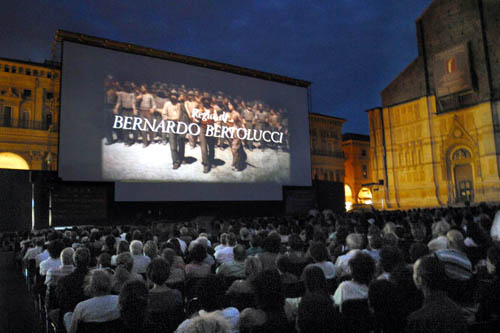
A truly celestial screening: a restored 35mm print of Bertolucci’s 1900 projected free, under the stars in the Piazza Maggiore, Bologna, summer of 2006
Homage to Mme. Edelhaus
Why are Americans polarized between francophobia and francophilia? Some people mock the French for liking Jerry Lewis, when most French people probably don’t even know who he is. Others think that France is the repository of world culture and represents the finest in writing about the arts, even though the Parisian intelligentsia can be pretentious and hermetic.
But we must face facts. When it comes to cinephilia, the French have no equals. They grant film a respect that it wins nowhere else. Spend a year, or even a month, in Paris, and you will feel like a Renaissance prince. This is a city where one lonely screen can run tattered prints of One from the Heart and Hellzapoppin!, once a week, indefinitely.
My first trip was too brief, only a week in 1970, but my second one—four weeks of dissertation research in 1973—left me exhausted. Reading Pariscope on the way in from the airport, I learned about a Tex Avery festival. I checked into my hotel and Métro’d to the theatre, where I and a bunch of moms and kids gazed in rapture upon King-Size Canary. Another time, also coming in from the airport, Kristin and I passed a marquee for King Hu’s Raining in the Mountain. Next stop, Raining in the Mountain. My memories of The Naked Spur, Ministry of Fear, Liebelei, Tati’s Traffic, and Vertov’s Stride Soviet! are inextricable from the Parisian venues in which I saw them.
Sound like a lament for days gone by? Nope. You can find the same variety on offer today. Of course the two monthlies, Cahiers du cinéma and Positif, have to take a lot of credit for this. Add Traffic, Cinéma, and several other ambitious journals, and you get a film culture unrivalled in the world.
Critics from Louis Delluc onward have led thousands of readers toward appreciating the seventh art. Historians like Georges Sadoul, Jean Mitry, Laurent Mannoni, Francis Lacassin, and others have enlightened us for decades. Academic film analysis would not be what it is without Raymond Bellour, Noel Burch, Marie-Claire Ropars, Jacques Aumont, and a host of other scholars. Above all stands André Bazin, the greatest theorist-critic we have had.
And the books! Arts-and-sciences publishing receives government subsidies; the French understand that books contribute to the public good. There are plenty of worse ways to spend tax dollars (e.g., trumped-up military invasions). The French, like the Italians, have created an ardent translation culture too. If you can’t read something in Russian or German, there’s a good chance it’s available in French.
I was reminded of the glories of Gallic film publishing when the mailman tottered to my door this week with twenty-two pounds worth of recent items I’d ordered. I haven’t even read them yet; otherwise, they’d be filed with Book Reports. Instead I want to spend today’s blog celebrating them as fruits of an ambition that has no counterpart in English-language publishing. All are grand and gorgeous and informative to boot.
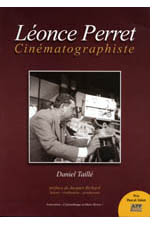 Daniel Taillé, Léonce Perret Cinématographiste. Association Cinémathèque en Deux-Sèvres, 2006. 2.5 lbs.
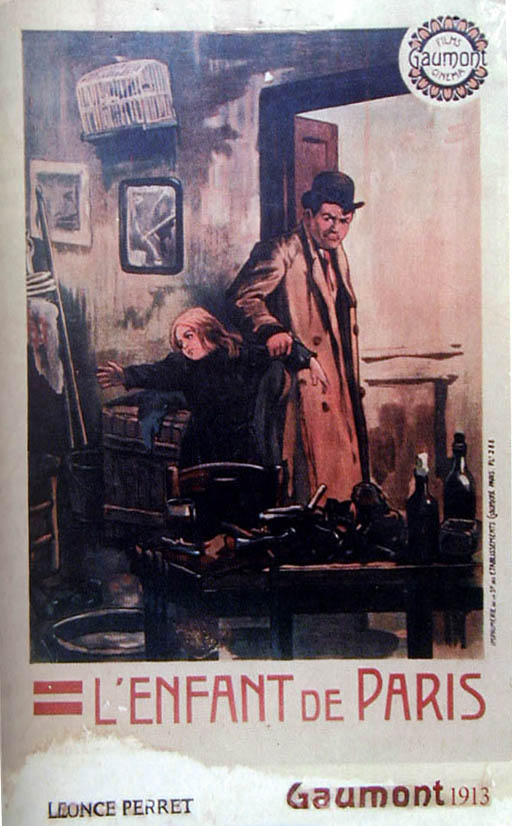
A biographical study of a Gaumont director still too little known. Perret was second only to Feuillade at Gaumont, and he performed as a fine comedian as well. His shorts are charming, and his longer works, like L’enfant de Paris (1913), remain remarkable for their complex staging and cutting. After a thriving career in France, Perret came to make films in America, including Twin Pawns (1919), a lively Wilkie Collins adaptation. He returned to France and was directing up to his death in 1935.
Although the text seems a bit cut-and-paste, Taillé has included many lovely posters and letters, along with a detailed filmography, full endnotes, and a vast bibliography. It compares only to that deluxe career survey of the silent films of Raoul Walsh, published by Knopf. . . .Oh, wait, there’s no such book. . . .Think there ever will be?
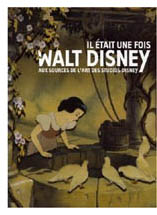 Il était une fois Walt Disney: Aux sources de l’art des studios Disney. Galéries nationales du Grand Palais, 2006. 4 lbs.
A luscious catalogue of an exposition tracing visual sources of Disney’s animation. Illustrated with sketches, concept paintings, and character designs from the Disney archives, this volume shows how much the cartoon studio owed to painting traditions from the Middle Ages onward. It includes articles on the training schools that shaped the studio’s look, on European sources of Disney’s style and iconography, on architecture, on relations with Dalí, and on appropriations by Pop Artists. There’s also a filmography and a valuable biographical dictionary of studio animators.
Some of the affinities seem far-fetched, but after Neil Gabler’s unadventurous biography, a little stretching is welcome. This exhibition (headed to Montreal next month) answers my hopes for serious treatment of the pictorial ambitions of the world’s most powerful cartoon factory. The catalogue is about to appear in English–from a German publisher.
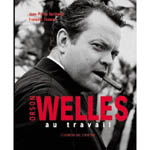 Jean-Pierre Berthomé and François Thomas. Orson Welles au travail. Cahiers du cinéma, 2006. 4 lbs.
The authors of a lengthy study of Citizen Kane now take us through the production process of each of Welles’ works. They have stuffed their book with script excerpts, storyboards, charts, timelines, and uncommon production stills.
The text, on my cursory sampling, will seem largely familiar to Welles aficionados; the frames from the actual films betray their DVD origins; and I would like to have seen more depth on certain stylistic matters. (The authors’ account of the pre-Kane Hollywood style, for instance, is oversimplified.) Yet the sheer luxury of the presentation overwhelms my reservations. A colossal filmmaker, in several senses, deserves a colossal book like this.
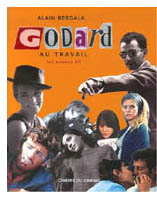 Alain Bergala. Godard au travail: Les années 60. Cahiers du cinéma. 2006. 5 lbs.
In the same series as the Welles volume, even more imposing. If you want to know the shooting schedule for Alphaville or check the retake report for La Chinoise (these are eminently reasonable desires), here is the place to look. Detailed background on the production of every 1960s Godard movie, with many discussions of the creative choices at each stage. Once more, stunningly mounted, with lots of color to show off posters and production stills.
Anybody who thinks that Godard just made it up as he went along will be surprised to find a great degree of detailed planning. (After all, the guy is Swiss.) Yet the scripts leave plenty of room to wiggle. “The first shot of this sequence,” begins one scene of the Contempt screenplay, “is also the last shot of the previous sequence.” Soon we learn that “This sequence will last around 20-30 minutes. It’s difficult to recount what happens exactly and chronologically.”
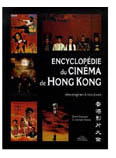 Emrik Gouneau and Léonard Amara. Encyclopédie du cinéma du Hong Kong. Les Belles Lettres, 2006. 6.5 lbs.
The avoirdupois champ of my batch. The French were early admirers of modern Hong Kong cinema, but their reference works lagged behind those of Italy, Germany, and the US. (Most notable of the last is John Charles’ Hong Kong Filmography, 1977-1997.) More recently the French have weighed in, literally. 2005 gave us Christophe Genet’s Encyclopédie du cinéma d’arts martiaux, a substantial (2 lbs.) list of films and personalities, with plots, credits, and French release dates.
Newer and niftier, the Gouneau/ Amara volume covers much more than martial arts, and so it strikes my tabletop like a Shaolin monk’s fist. There are lovely posters in color and plenty of photos of actors that help you identify recurring bit players. Yet this is more than a pretty coffee-table book. It offers genre analysis, history, critical commentary, biographical entries, surveys of music, comments on television production, and much more. It has abbreviated lists of terms and top box-office titles, as well as a surprisingly detailed chronology.
 Above all—and worth the 62-euro price tag in itself—the volume provides a chronological list of all domestically made films released in the colony from 1913 to 2006! Running to over 200 big-format pages, the list enters films by their English titles and it indicates language (Mandarin, Cantonese, or other), release date, director, genre, and major stars. Until the Hong Kong Film Archive completes its vast filmography of local productions, this will remain indispensable for all researchers.
Mme. Edelhaus was my high school French teacher. A stout lady always in a black dress, she looked like the dowager at the piano during the danse macabre of Rules of the Game. She was mysterious. She occasionally let slip what it was like to live under Nazi occupation, telling us how German soldiers seeded parks and playgrounds with explosives before they left Paris. When I asked her what avant-garde meant, she replied that it was the artistic force that led into unknown regions and invited others to follow–pause–“in the unlikely event that they will choose to do so.”
For three years Mme. Edelhaus suffered my execrable pronunciation. When I tried to make light of my bungling, she would ask, “Dah-veed, why must you always play the fool?”
I suppose I’m still at it. But thanks largely to her I’m able to read these books as well as look at them. She opened a path that’s still providing me vistas onto the splendors of cinema.
Classical cinema lives! New evidence for old norms
Hero.
Kristin here—
Note: This entry was written for Jim Emerson’s Contrarian Blog-a-Thon (III).
When David and I got into film studies in the late 1960s and early 1970s, an era of Hollywood’s history was drawing to a close. Many of the great directors who had defined the classical studio era from the period of World War I to the early age of television were at or approaching retirement. Andrew Sarris’s pivotal book, The American Cinema: Directors and Directions 1929-1968 (1968) came out just in time to elevate their reputations by dubbing them with the fashionable French term auteur.
John Ford and Howard Hawks made their last films in this period (7 Women, 1966, and Rio Lobo, 1970). Alfred Hitchcock, Otto Preminger, and Vincente Minnelli kept driecting into the 1970s, though few would say their late films stacked up to their earlier ones. (Preminger did manage to struggle back after a string of turkeys to make a very creditable final film, The Human Factor, in 1980.) Sam Fuller kept working through the 1980s, but he had to go to France to do it. Billy Wilder’s last film came out in 1981, though most of us wish he had stopped with The Private Life of Sherlock Holmes in 1970.
The decline of these greats coincided with the rise of the New Hollywood generation, whose directors, originally dubbed “the movie brats,” have become the grand old men of the current cinema. It also coincided with the early rumblings of the blockbuster (Jaws, 1975) and franchise (Star Wars, 1977) age that we know today. Definitely a shift took place in the 1970s, but to what?
Many film historians have claimed that the films that have come out of Hollywood since roughly the end of the 1980s are radically different from those of the classical “Golden Age.” Factors like television, videogames, spectacular special effects, moviegoers with short attention spans, the internet, the acquisition of the old studios by multi-national corporations, and the resulting rise of franchises have all putatively given rise to a “post-classical” cinema. This phenomenon is sometimes also referred to as the “post-Hollywood” or “post-modern” era.
I’m suspicious of the “post” terms, vague as they are. Usually stylistic labels describe what something is, not what it follows. Do we speak of “post-silent” or “post black-and-white” cinema?
Post-classical films supposedly jettison the old norms of style and storytelling. Frenetic editing, constant camera movement, product placement, juggled time-schemes—these and other tropes of recent cinema have replaced the continuity system, the carefully structured screenplay, and the character-based storytelling of the classical era. Computer-generated imagery has enabled filmmakers to create action scenes, spectacular settings, and fantastical creatures that hold our attention so thoroughly that the plot ceases to matter.
Or not. David and I have spent much of our professional careers studying the norms of classical filmmaking. We’ve swum against the stream by claiming that, despite many changes in style and technique, the fundamental norms of classical storytelling have remained intact. The classical cinema is with us still, precisely because it enables filmmakers to present us with absorbing plots and characters. It also is a flexible filmmaking approach that can absorb new technologies and new influences from other media and bend them to its own uses.
It’s less seductive to proclaim a long-term stability in Hollywood than to trumpet revolutionary, transformational, epochal changes. Still, some things just work so well that people want to keep them going as is. American films have dominated world screens since 1915. Why tinker with an approach that works so well?
It’s amazing to think of it now, but back in the late 1970s, virtually no one had studied the traditional norms of Hollywood filmmaking. We all knew what the distinctive traits of the great auteurs were, but distinctive as opposed to what? Academics kept saying that someone should figure out just what the cinema of the classical studio era consisted of. What principles guided filmmakers? What assumptions did they share? Not realizing how much material was available on Hollywood cinema, we and our colleague Janet Staiger set out to document the norms of style, technology, and mode of production that composed the “classical Hollywood cinema.”
The result was a much larger tome than we had expected, The Classical Hollywood Cinema: Film Style and Mode of Production to 1960 (1985). After finishing it, David and I dusted off our hands, figuring that we had dealt with that topic. We went back to studying non-classical directors like Ozu, Eisenstein, Tati, Godard, Bresson, and Hou, confident that we had the knowledge to show exactly how and why their work differed from standard filmmaking.
Then claims about post-classical filmmaking started to appear. In our book, we had limited our survey to pre-1960 cinema because the breakdown of the studio structure and the competition from television led to a different situation in Hollywood. We did not, however, say that classical filmmaking died then. Quite the contrary; we said that it had endured through those changes in the industry.
Those favoring the post-classical explanation obviously disagreed with that. Bypassing our claims for the endurance of classical filmmaking, they borrowed our cut-off date of 1960, as if we had intended that year to signal the end of all aspects of the classical cinema—style, storytelling, mode of production, technology, the whole thing.
During the 1990s it became apparent that claims about post-classical cinema were becoming one very common way of dealing with modern Hollywood films. We decided to move well beyond 1960 and show that classical norms still prevail in American mainstream cinema. I wrote Storytelling in the New Hollywood (1999), which analyzes ten successful films of the 1980s and 1990s to show that they use narrative principles that are virtually the same as those that were standard in the 1930s and 1940s. Goal-oriented characters, dangling causes, appointments, double plot-lines, carefully timed turning points, redundancy—all these classical devices are still very much with us. The claim was not that every single film coming out of Hollywood adhered to classical norms, only that the vast majority did.
David went on to make a similar argument in The Way Hollywood Tells It (2006), though he deals with visual style as well as narrative. There he examines some of the new norms of storytelling, showing how they are variants of the older classical system. He discusses, for example, “intensified continuity,” where tighter framings on actors, faster cutting, and prowling camera movements have modified but not replaced the standard continuity approach to presenting a conversation scene.
One of the most persistent claims by proponents of a post-classical era is the spectacle made possible by CGI. With the thrilling fight sequences of The Matrix, the vast battles of The Lord of the Rings, the extensive recreation of historical places of Gladiator, and the fantastical creatures and places of The Chronicles of Narnia: The Lion, the Witch and the Wardrobe, the individual scene supposedly becomes more spellbinding than the story in which it is embedded.
David and I have tried to refute this claim to some extent. I talk about Terminator 2 in the first chapter of Storytelling, showing that it has a tightly constructed, character-based narrative. David has a chapter section called “A Certain Amount of Plot: Tentpoles, Locomotives, Blockbusters, Megapictures, and the Action Movie,” where he examines films like Judge Dredd and The Rock. He demonstrates that they, too, have plots that adhere to traditional Hollywood norms. He puts forth a more detailed analysis in this online essay.
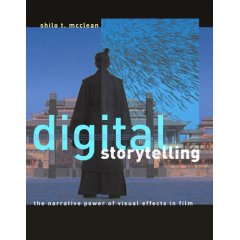 We’ve never really dealt much, however, with the issue of how CGI may or may not have elevated spectacle over narrative interest. Luckily now a new book does that and does it very well. Shilo T. McClean, in her Digital Storytelling: The Narrative Power of Visual Effects in Film (MIT Press, 2007), agrees with much of what we have claimed about the survival of classical filmmaking (though The Way Hollywood Tells It came out too late for her to have seen it). She builds upon our case by examining systematically and imaginatively the question of whether digital special effects support narrative interest. McClean convincingly demonstrates that DVFx (digital visual effects), as she terms them, are used in an enormous variety of ways, and most of these help to tell classically constructed stories.
McClean’s basic points are two. First, DVFx are not used just in the more obvious ways, for big action scenes or elaborate fantasy and science fiction settings. They are applied for a wide range of purposes, from dustbusting (removing dust and other minor flaws from frames) to spectacular scenes. Far from being inevitably spectacular, DVFx are often invisible. (1)
Second, McClean claims that whether modest or spectacular, DVFx usually serve the narrative in some way—and she points out that practitioners in the industry invariably make that same claim.
Digital Storytelling started out as McClean’s dissertation at the University of Technology Sydney. It betrays its origins in a survey of the literature that takes up the first two chapters. There the author is somewhat too conciliatory, for my taste anyway, to a number of theorists’ claims about the breakdown of narrative in the digital-effects age. She tries to find something useful in each writer’s position, even though some of those positions are irreconcilable with the general standpoint she adopts.
Chapter 3 sketches the history of computer graphics and how they came to be used in films. McClean points out that DVFx are perfectly suited to the three criteria for the adoption of new technology that David and Janet formulated in their sections of The Classical Hollywood Cinema: greater efficiency, product differentiation, and support for achieving standards of quality. Like sound and color, DVFx have marked a major technological shift for the film industry, but like them, DVFx have been readily integrated into the existing division of labor. A modern digital studio, as she says, functions in much the same way as a physical one does. Indeed, in watching the credits of a modern film, we see lighting, matte paintings, and so on listed as the specialties for the digital craftspeople.
In these early chapters, McClean points out that in many ways DVFx simply replaces the traditional special effects of the pre-digital age. Most of Citizen Kane’s many effects are not supposed to be noticeable, and indeed for years historians were unaware of just how many it contained. In cases where DVFx create a flashy effect, as in the virtual camera movements through walls in Panic Room, the function is to inform the viewer of the locations of various characters and create suspense. Probably the most vital lesson one could take away from this book is that techniques can serve multiple purposes in a film. Spectacularity, as McClean calls it, and storytelling can co-exist in the same digital images.
The author also explains that, unlike what many writers say about DVFx, they are not simply a post-production technique used to ramp up the visual appeal of a film. Computer imagery is used from the pre-production stages onward, and the mise-en-scene and camera movements must be planned around them.
After this setup, the author systematically explores the factors that might influence the storytelling—or merely spectacular—use of DVFx. As we did in The Classical Hollywood Cinema, McClean samples a large number of films, 500 including shorts. Any film using DVFx, however unobtrusively, qualified.
On this basis, the author has distinguished eight types of DVFx usage. Documentary is one, as in films where computer reconstructions of ancient buildings are shown. Such usage comes into films when information is presented as part of the mise-en-scene, as with the educational film that is screened in Jurassic Park. The second type of DVFx usage, Invisible, is fairly self-explanatory. We are not supposed to notice when buildings are extended, clouds are added to skies, or smudges on actors’ faces disappear.
Seamless DVFx are those we know must be faked, even though the results look photorealistic. The recreation of ancient cities, as with Rome in Gladiator or giant storms, as in Master and Commander, are of this type. Exaggerated effects involves actions or things posited to be real but created in a stylized fashion. McClean cites the comic effects in Steven Chow comedies, and puts wire-erasure for stunts into this category. I assume The Hudsucker Proxy would be another instance.
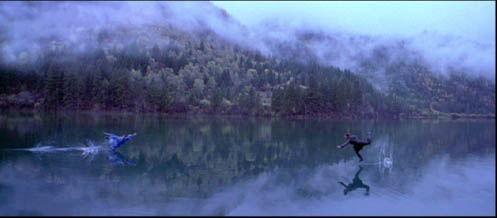
Fantastical DVXs obviously involve impossible beings like dragons, cave trolls, and a wide variety of X-Men. McClean also finds them in non-fantasy, non-sci fic films like Forrest Gump, Big Fish, and Hero. Surrealist uses of effects can include mental representations, as in Eternal Sunshine of the Spotless Mind and American Beauty, or a bizarre but objective world, as in Amélie.
Finally, there are New Traditionalist uses of DVFx, exemplified by Pixar’s films, and HypeRealist ones, like Final Fantasy.
Armed with this typology, McClean studies various approaches to film studies, testing what each one reveals about the use of DVFx. Since classical Hollywood cinema is based on character traits and goals, she begins by showing convincingly how DVFx can “establish, realize, and enhance” character. For example, films often use effects to put the protagonist in greater danger than would be safe to do in reality. The staged fights in Gladiator, the author argues, create a greater emotional engagement with the main character and make plausible the heroism that allows him to defeat his enemy in the end.
Next McClean tests how DVFx can change the impact of a film by analyzing a pre-digital film and its remake in the computer age. (As a method, this is similar to what David does in The Way Hollywood Tells It when he examines framing, editing, and other techniques in the two versions of The Thomas Crown Affair.) The case study chosen is the 1963 Robert Wise version of The Haunting and the Jan De Bont remake (1999). McClean presents considerable evidence that the inferiority of the later film has nothing to do with its expensive DVFx supernatural effects. Instead, she locates the problem partly in the removal of all the creepy ambiguity of the earlier version. De Bont also changes the heroine from a guilt-ridden, virtually suicidal woman (too wimpy in this politically-correct age?) to a strong, determined savior. The result is a conventional super-woman versus evil monster film where the digital effects stand out simply because the original story was stripped of its most intriguing elements.
McClean moves on to genre, an important subject given the apparent concentration of DVFx (the ones we notice, that is) in fantasy and sci-fi films. She rightly points out, “For all the many assertions that special effects are an emerging narrative form, no one has proposed the narrative structure that this new form demonstrates.” The author makes up for that lack herself, concocting an outline of a film based around a string of effects-laden action scenes. Her outline fits the descriptions of films as given by proponents of post-classicism. The result, however, doesn’t resemble any film I’ve ever seen.
In the genre chapter McClean uses an obvious research resource, but one that the post-classicists largely ignore. She has gone through the entire run of the special-effects journal Cinefex, on the assumption that the films it covers are those assumed to be most significant in terms of their DVFx. McClean lists the 291 films by genre, showing that sci-fi films and horror do not have a monopoly on DVFx. For example, thirty-three period and dramatic movies feature in her list.
To gauge the impact of the rise of franchises in modern Hollywood, McClean surveys the four Alien films, which begin in the pre-digital and move into the digital era. As with remakes, the author demonstrates through analysis that the decline in the series after its two first films had to do with a thematic shift and a change in the character of Ripley.
McClean does not overlook the auteur theory, tracing the work of Steven Spielberg during that same transition from pre-digital to digital cinema. Unlike the other effects-oriented giants of Hollywood, George Lucas and James Cameron, Spielberg has worked in many genres. As soon as DVFx became available, he used them in nearly all the ways listed in McClean’s typology, from the Invisible creation of the swooping airplanes in Empire of the Sun to the Exaggerated in the Flesh Fair setting in A.I. to the Fantastical Martians in War of the Worlds. Always in the service of the narrative.
Along the way McClean offers a number of astute observations. One of these is a novel argument against the “DVFx equals non-narrative spectacle” position. She points out that “In many instances technically weak DVFx will be forgiven if they are narratively congruent; it is the strength of the narrative that will carry them, rather than the other way round.” This claim is plausible when we consider how in the pre-digital age we tried to overlook the obvious back-projections and matte-work in Hitchcock films like The Birds and Marnie.
She also suggests some plausible reasons why bad films might be heavy with DVFx. In some cases the effects create a publicity hook that makes up for the lack of other production values. In others, an inexperienced director, carried away with the “cool” possibilities of DVFx, uses them to excess.
And finally someone has come out strongly against the use of the term “cinema of attractions” to describe modern films. Historian Tom Gunning originally coined this phrase in describing very early cinema, where magic acts with stop-motion disappearances and elaborately hand-colored dances were as common as narrative films. For that period, the label worked and was useful. Applying it to later eras just because films have spectacular sequences has rendered the term much less meaningful.
One thing that I particularly like about McClean’s book is that she shows respect for the films she discusses. She actually seems to enjoy both watching and writing about them. McClean asks questions of aesthetic import, and she treats films as artworks—some good, some bad, but all to be taken seriously as evidence for her case.
Her final chapter provides an excellent conclusion: “While DVFx have completely reequipped the storyteller’s toolbox, they have not rewritten the storyteller’s rulebook entirely.” Yes, classical cinema lives, and Digital Storytelling provides vital new evidence to bolster that claim.
(1) In Film Art, we have touched on this range in the section “From Monsters to the Mundane: Computer-Generated Imagery in The Lord of the Rings” (pp.249-251 in the 7th edition, pp. 179-181 in the 8th). McLean treats the topic in far more depth.