



Archive for the 'Film history' Category
Getting real

Art is not reality; one of the damned things is enough.
Attributed to Virginia Woolf, Gertrude Stein, and others.
DB here, with another followup to Ebertfest:
Ebertfest, once known as the Overlooked Film Festival, has always been keen to support American independent filmmaking. In previous incarnations, Roger spotlighted Junebug, Tarnation, and other movies that flew below the multiplex radar. This year’s crop was especially ripe. Besides The Fall and Sita Sings the Blues, there were important documentaries like Begging Naked and Trouble the Water. In particular, two fiction features set me thinking about types of independent storytelling and how they might be considered realistic.
The river is wide
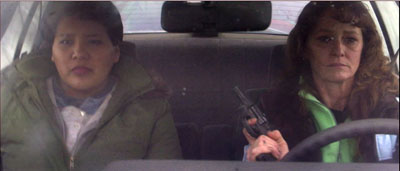
Roger noted that when he first saw Frozen River, he wanted to bring it to his festival, but then it became the very opposite of an overlooked movie. It has grossed $4.3 million worldwide, a very healthy amount for a small-budget film without big stars. It won eleven national awards and was nominated for fourteen others, including a Best Original Screenplay Oscar. By now, you’ve probably seen it. I had been away during its Madison run, so I was happy to catch up with it.
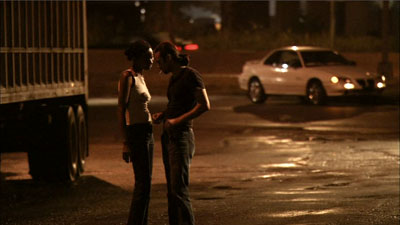
“You have five minutes to show the audience you’re in charge,” commented director Courtney Hunt in the Q & A, and her film follows that advice. Seconds into Frozen River, we hit a crisis. Ray finds that her no-good husband has grabbed their savings and taken off to gamble, even as she waits for the delivery of their new prefab home. What begins as a drama of pursuit, with Ray trying to track down her husband, turns into a blocked situation. He’s gone and she has to not only pay off their mortgage but also keep her two sons going, counting on their school lunches to offset their domestic meals of popcorn and Tang.
Drama is about choices, and good drama is about bad choices. Ray has clearly made her share of mistakes—addictive mate, kids she can’t support, a bigscreen TV she can’t afford—and the plot shows her making the biggest of all. To scrape together money she agrees to transport illegal immigrants from Canada to upstate New York, driving across the frozen St. Lawrence. She casts her lot with Lila Littlewolf, a Native American with her own bad choices, and their common fate creates a series of parallels about motherhood that are resolved through Ray’s final sacrifice. The film also activates some current concerns about immigration, racism, and the problems shared by poor whites and ethnic minorities.
Resolutely unHollywood in its setting, theme, and characters—deglamorized women, especially—Frozen River still adheres to classical script structure. We have characters with goals, encountering obstacles and entering into conflicts, and the turning points come at the standard junctures. The ending is a resolution, although not an entirely happy one. In the course of the plot, suspense is built up at many points. Will Ray and Lila be caught by the state troopers who grimly monitor their comings and goings? What will become of that abandoned baby? The film is a sturdy example of how classic principles of construction can be applied to subject matter that is worlds away from our prototype of Hollywood filmmaking.
Neo-neo and all that
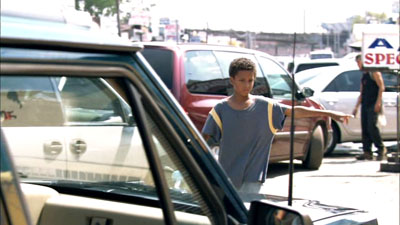
Ramin Bahrani’s Chop Shop, which I was also just catching up with, offers another flavor of independent dramaturgy. Roger has been a staunch supporter of Ramin’s films since Man Push Cart, and he has declared him “the new great American director.”
Bahrani has mastered a somewhat different narrative tradition than the crisis-driven plotting of Frozen River. “Neo-neorealism,” A. O. Scott has called it, linking Goodbye Solo to Wendy and Lucy, Treeless Mountain, Old Joy, and other films that offer us an “escape from escapism.” Now, Scott suggests, American cinema is having its delayed Neorealist moment. Richard Brody offers some useful, sometimes scornful, qualifications of Scott’s conjecture, reminding us of the urban dramas of the 1940s and the rise of Method acting. Scott has replied, claiming that their dispute essentially depends on their differing tastes in movies.
Here’s my $.02. “Neorealism” isn’t a cinematic essence floating from place to place and settling in when times demand it. The term, like the films it labels, emerged under particular circumstances, and it’s hard to transfer the label to other conditions. Moreover, there are many problems just with applying the term to Italian cinema, since it tends to cover not only the purest cases, like Bicycle Thieves, but also more mixed ones like the historical drama The Mill on the Po.
Still, because postwar Italian cinema had a big influence on other national cinemas, we have a prototype of The Italian Neorealist Movie. The filmmaker focuses on the lives of working people. He emphasizes their daily routines and travails. The film will be shot on location (at least in the exteriors) and may use nonactors in some or all roles. Bazin pointed out that we’re likely to find an elliptical or unresolved plot. It’s also very likely that we’ll see washlines and women in slips.
Why not just call this an Italian variant of that broad tradition of naturalism or verismo or “working-class realism” that we find in many national cinemas? In France there was the work of Andre Antoine (e.g., La Terre, 1921) and Jean Epstein’s Coeur fidele (1923) and his lyrical barge romance La Belle Nivernaise (1923). More famous are Renoir’s Toni (1935) and The Lower Depths (1936). (Recall that Visconti was Renoir’s assistant on A Day in the Country, 1936.) In Italy, there were harbingers too, not only the famous ones like Four Steps in the Clouds (1942) but also the charming Treno Popolare (1933). And Japan gave us many instances in the 1930s, notably Ozu’s Inn in Tokyo (1935) and The Only Son (1936).
Realer than real
On an Ebertfest panel Ramin Bahrani argued for a realist aesthetic. “Most people in movies never seem to pay rent or keep track of how often they can eat out . . . [Ordinary people] have day-to-day struggles; they ask how to survive.” That’s to say that a realistic work is distinguished primarily by its subject matter, the social milieu it presents. Bahrani also mentioned that some plot devices are unrealistic. Criticizing Slumdog Millionaire, he remarked: “My world doesn’t end in a Hollywood fantasy.” He didn’t deny the need for a dramatic structure, but he did insist on avoiding “obvious plot points like ‘He crossed the door and can’t go back.’”
This leads me to another $.02 contribution. I’m reluctant to contrast realism with something like artifice or formula. To me, realism comes in many varieties, but none escapes artifice. All realisms I know rely on conventions shaped by tradition.
For example, Chop Shop shows us a slice of life that most of us don’t know, the world of garages and salvage yards clustered around Shea Stadium. Such a low-end milieu is a convention of literary naturalism (Zola, Gorki). In this tradition, an artwork acknowledging the lives of the poor gains a dose of realism that, say, a novel by P. G. Wodehouse or a play by Noël Coward will lack. Some critics complained that when Rossellini’s Europa 51 and Voyage to Italy presented upper-class life, he left Neorealism behind.
There seem to me other conventions at work in Chop Shop. In one garage we find a boy, Alejandro, who has two goals. He wants to set up a food van that will sell meals to the men working in the neighborhood, and he wants to keep his sister Isamar safe from bad companions. Goal-driven plotting is central to Hollywood dramaturgy, as it is to much literary realism (e.g., An American Tragedy). It’s true that in real life people often form goals, but many do not, and those who do seldom come to a state of heightened awareness in the time frame typical of a movie’s plot. Alejandro fails to achieve one goal but partially achieves another, so we have an open, somewhat ambivalent ending—another convention of realist storytelling and modern cinema (especially after Neorealism). Life goes on, as we, and many movies, often say.
Instead of following a crisis structure, as Frozen River does, Chop Shop presents what we might call “threads of routine.” Most scenes consist of ordinary activities: the work of the garage, Alejandro’s sales of candy and DVDs, opening and closing the shop, Alejandro watching from the window of his room. But these vignettes aren’t sheer repetitions. They vary as Alejandro encounters progress or setbacks with respect to his goals. Most of the routines establish a backdrop against which moments of change and conflict will stand out.
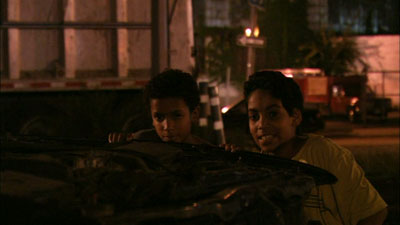
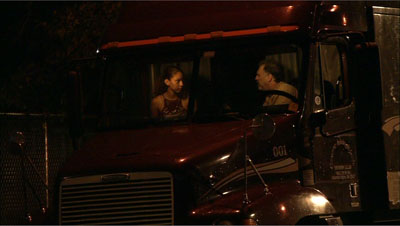
Building a movie out of routines can also make convenient coincidences seem plausible. For instance, dramas have always relied on accidental discoveries of key information—the overheard conversation, the token that betrays what’s really happening. In Chop Shop, Ale and his pal Carlos discover that Isamar has become one of the hookers who service men in the cab of a tractor-trailer. They might have discovered this, as in life, by simply wandering by the spot on a single occasion. Instead, Bahrani’s script motivates their discovery by explaining that they habitually spy on the truck assignations. “Let’s go to the truck stop and see some whores.” Planting information in scenes of everyday activities seems more natural than giving it special emphasis at a moment of crisis. In two later scenes, the truck-stop becomes an arena for conflict, so Ale’s initial discovery motivates his later actions.
As for plot points, Chop Shop has them. (At about 15 minutes, the zone of the Inciting Incident, Ale declares his intention to buy the van. At about 30 minutes he discovers that Isamar is turning to prostitution.) Likewise, the threaded routines yield poetic motifs, such as the pigeons that are carefully established early in the film. Bahrani’s plotting is meticulous, and it highlights the paradox of realism: It takes effort and calculation to “capture reality.” De Sica was said to have endlessly rehearsed the boy in Bicycle Thieves.
What gives the film a more episodic organization than Frozen River, I think, and what gives it a greater sense of “dailiness,” is that it lacks deadlines. There’s relatively little time pressure on the action, except for Ale’s sense that he’s getting close to having enough money for the van. Chop Shop’s refusal of Hollywood’s ticking clock seems to me to confirm the observation, made by Geoff Andrew and J. J. Murphy, that in some respects American indie film is located midway between classical narrative cinema and “art cinema.”
The threads-of-routine pattern can be harnessed to character-driven drama, as in Chop Shop, but it can also be more opaque or minimalist. During at least half of Elia Suleiman’s Chronicle of a Disappearance, we watch anonymous characters go through routines, but instead of revealing their psychological drives, the scenes show the people overwhelmed by their surroundings. Narrative development is charted through changes in the spaces that the figures inhabit and vacate. The result is a “surreal realism” that evokes the anxieties of Magritte or de Chirico.
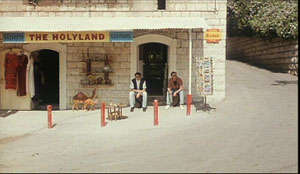
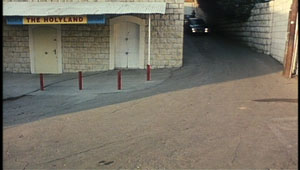
To say that realist traditions rely on conventions doesn’t make them less worthwhile. Chop Shops seems to me quite a good film. Nor would I deny that realist conventions do capture some aspects of real life. Both the crisis structure and the threads-of-routines structure can be taken as realistic. Sometimes our lives are in crisis, and at other times we do just plod along. But more stylized narrative forms can capture important aspects of reality too. The Searchers, a work of high artifice, renders a portrait of a self-destructive racist that many of us recognize in the world outside the movie house. Has any film better caught the adolescent yearning for romantic love and family stability than Meet Me in St. Louis?
The problem comes when we think that only one variant of realism can lay claim to validity, let alone beauty. Sometimes fidelity takes a back seat to vivacity. In Roy Andersson’s films, everyday nuisances like checking in to a plane flight or waiting in a clinic are inflated to grotesque, gargantuan proportions, becoming torments in a vision of hell. Like all caricatures, the exaggeration captures something true.
Comparing Wilkie Collins and Dickens, T. S. Eliot notes that both writers give us vivid characters. Collins’ characters are “painstakingly coherent and life-like,” terms of praise that we could assign to Bahrani’s films as well. But, Eliot adds, “Dickens’ characters are real because there is no one like them.”
What was Neorealism? Some of André Bazin’s invaluable essays on the subject can be found in What Is Cinema? vol. 2 (Berkeley: University of California Press, 1971). Kristin and I offer a survey of some historical factors in Chapter 16 of Film History: An Introduction. (Go here for a little bibliography.) For more on art cinema and its commitments to realism and open endings, see my essay, “The Art Cinema as a Mode of Film Practice,” in Poetics of Cinema, 151-169. On American indies’ borrowing of art-cinema conventions, see Geoff King, American Independent Cinema (Bloomington: Indiana University Press, 2005) and J. J. Murphy, Me and You and Memento and Fargo (New York: Continuum, 2007). J.J. also has a blog entry on Chop Shop here. The quotations from T. S. Eliot come from “Wilkie Collins and Dickens,” Selected Essays (New York: Harcourt, Brace, 1950), 410-411.
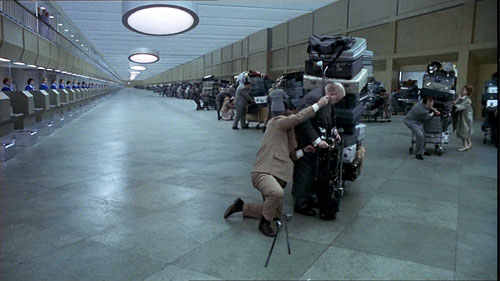
Songs from the Second Floor (Roy Andersson, 2000).
Color, shape, movement . . . and talk
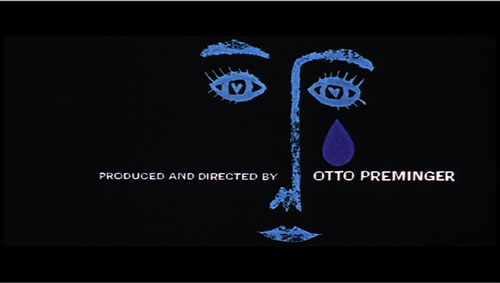
Bonjour Tristesse.
DB here:
Our weekly Film Colloquium is sort of like your old high-school assembly, except that it’s fun. The Film Studies area meets nearly every Thursday afternoon at 4 to hear a paper by a grad student, a faculty member, or a guest. It’s a great forum for ideas and information, and it gives the speaker a chance to try out a talk before taking it to a conference or lecture gig. The local audience is, in my experience, the toughest I’m likely to encounter. And this spring, despite a heavy travel and work schedule, Kristin and I caught two outstanding presentations.
Not in color, but colored
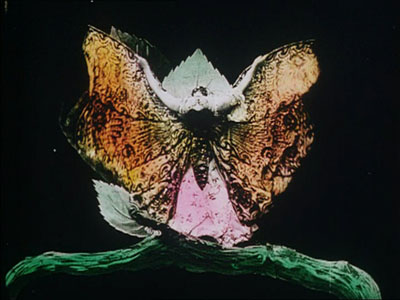
By now we all understand that silent films were most often shown with musical accompaniment, and sometimes sound effects. But we tend to forget that most silent films were in color too.
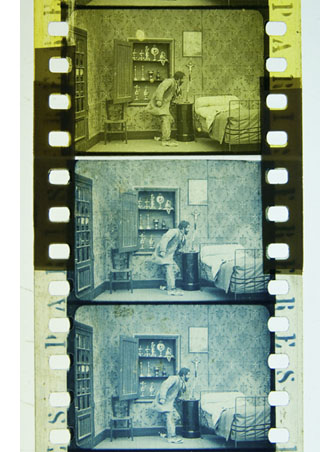
By the early 1920s, 80% of films were colored in one way or another. There were a few efforts to record the actual colors in a scene, but most often color was added after filming. Areas of the frame might be painted over by stenciling or by freehand. More commonly, the shots were dipped into dyes, yielding images that were tinted (washing over the image and coloring the areas of white, as in the frames below) or toned (coloring the darkest areas and leaving the white areas white). Over the years, film prints were preserved in black and white, partly because color stock was more expensive than today. As a result, even archival prints lost the sense of what audiences actually saw. Today archivists labor to reconstruct what silent films looked like in all their rainbow glory.
 Professor Joshua Yumibe of Oakland University wrote his Ph. D. thesis on early color processes, and his Colloquium talk asked some powerful questions. We know that there was a transition in film artistry from the late 1900s to the early 1910s, a shift toward what Tom Gunning has called the “cinema of narrative integration.” As films became longer and were shown in more or less permanent venues, moviemakers began to tell more complicated stories. How, Josh asks, did this shift away from a cinema of isolated “attractions” affect practices of coloring? Do color processes affect the way stories were told? Do the color processes change how people saw the space on screen? How did the trade press respond to different strategies of coloring?
These are fascinating questions, and Josh’s exploration of them was careful and detailed. He has done enormous research on the various color processes, and he was able to trace several lines of development. For instance, he found that writers of the earliest years thought that color enhanced the sensual and emotional effects of the image, even creating an illusion of 3-D. In a shot like that of the butterfly dancer, people seem to have sensed that her multicolored shape was thrusting out of the screen toward them.
Josh argues that with the growing emphasis on narrative, color became more muted. Filmmakers were no longer aiming at momentary stimulation but at ongoing mood. Now tinting and toning came into their own. Color codes developed: blue for night scenes, yellow for sunlight, red for fire, amber for artificial light. Josh also explored the different ways in which European and US companies conceived of color; there seem to have been different color policies at Pathé and at American companies. But this wasn’t the end of change. In the 1920s, with the feature film now at the center of the theatre program, a wide variety of color practices emerged, including those isolated Technicolor sequences we find in films like The Wedding March.
The Q & A was as lively as the talk itself, and afterward, we repaired to a bar and thence to dinner. Josh’s talk was a model of deep, imaginative research and it kept us thinking and talking for a long time afterward. Not to mention his slide show, which regaled us with gorgeous shots that make you realize how much you’re missing when you see an old movie in black and white.
Bass, o profondo!
Another stimulating Colloq session was presided over by our old friend Jan-Christopher Horak, director of the UCLA Film and Television Archive. Chris was in town because our Cinematheque has been showcasing UCLA archival restorations across the semester, and he introduced our screening of The Dark Mirror. But we also got him to give a talk, and that was quite something.
Chris reminded me that we first met thirty years ago, here in Madison, when he came to do research on his dissertation. Since then Chris has been a top-flight scholar and author of many books. His Lovers of Cinema, published by our series at the UW Press, laid the groundwork for the popular film series Unseen Cinema. He’s also been one of the world’s leading film archivists, having supervised collections at Eastman House, the Munich Film Archive, Universal studios, and most recently UCLA.
Chris has long worked at the intersection of film, photography, and the graphic arts. He is one of the world’s experts on the 1920s German avant-garde; one of his early curatorial coups was a 1979 restaging of the pioneering Film und Foto exhibition of 1929. Chris has also long been fascinated by film publicity, having written a book on the subject. So it’s natural that he would gravitate toward studying the film-related work of Saul Bass, one of America’s greatest graphic designers.
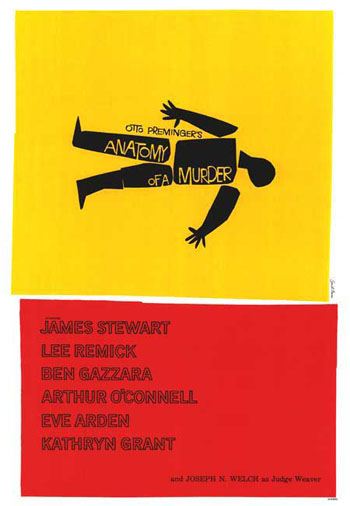
 Chris’s talk focused not so much on Bass’s brilliant credit sequences for films by Preminger and Hitchcock as on Bass’s contributions to poster design. Bass turns out to have had a fascinating career, having worked in Manhattan advertising before moving to Los Angeles in 1948. Chris has found at least one early 1950s poster design that Bass probably executed, but he definitely worked for Preminger on publicity for The Moon Is Blue (1953) and Carmen Jones (1954)—the latter yielding to my mind one of the greatest credit sequences in film history. In 1955 Bass founded his own firm.
Throughout, he carried on the ideals of György Kepes, his teacher and a major conduit for Bauhaus ideas into America. Like his European models, Kepes promoted the idea of art as having cognitive value, teaching us to see the world in a new way. Kepes also emphasized that artworks could be of practical utility—an idea that chimed with Bass’s turn toward commercial design.
Chris was able to show that the Bauhaus tradition powerfully influenced Bass’s design principles. Who would have thought that the credits for The Seven Year Itch replayed Paul Klee? Obvious, though, when Chris showed us the images.
Chris emphasized two further points. First, Bass understood what we now call branding. We have to remember that it up to that time, most film publicity featured images of the stars, either in portraits or caught in typical scenes from the film. Bass’s poster design concealed the stars. Instead, he relied on dynamic geometrical design to capture a film’s mood in a powerful, stylized image. The result was an eye-catching logo, instantly recognizable: the flaming rose of Carmen Jones, the Vertigo whirlpool, the dismembered body of Anatomy of a Murder.
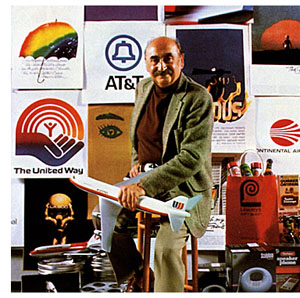
The key image could be repeated in newspaper ads, posters, credits, even the production company’s letterhead. When you saw the teaser trailer for Star Trek (“Under Construction”) dominated by that looming boomerang shape, you saw the heritage of Saul Bass. Who cares who’s in the movie? The very image is intriguing. No accident that Bass also designed many corporate logos, like the ATT bell and the United Way hand.
Chris’s second main point was that Bass was able to flourish because of the rise of independent production in the 1950s. Preminger, Hitchcock, and Wilder, acting as their own producers, could control the publicity for their films to a degree not possible for directors working in the classic studio system. Now films were sold as one-offs, and each film needed to pull itself above the clutter. In addition, Bass’s signature designs could set a director apart. In the 1950s, the Bass look was closely identified with his major clients like Hitchcock and Preminger, to the point that other designers for those directors tried to copy his style. I had always thought that Bass did the title design for Hurry Sundown, but Chris showed that it’s another artist’s pastiche of the master.
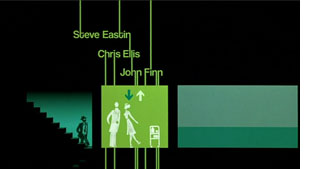 Chris’s talk reminded me that Bass contributed to making the opening credits a major attraction—not merely an overture, but an abstract treatment of the key story idea, a sort of graphic map that teases us into the main story. The opening sequences of Se7en and Catch Me If You Can (left) owe a lot to Bass’s idea that the credits should constitute a little movie, witty or ominous, tantalizing us with sketchy glimpses of what is to come. And Almodóvar’s diverting openings, probably the most sheerly enjoyable credit sequences we have today, are unthinkable without Bass. Synchronized with infectious music, Bass’s credit sequences can be seen as continuing the tradition of Walter Ruttmann and Oskar Fischinger, who back in the 1920s and 1930s made abstract films that advertised consumer goods.
For such reasons, I’m glad I hung around Madison after my retirement. With visiting researchers like Josh and Chris, who wants to go fishing?
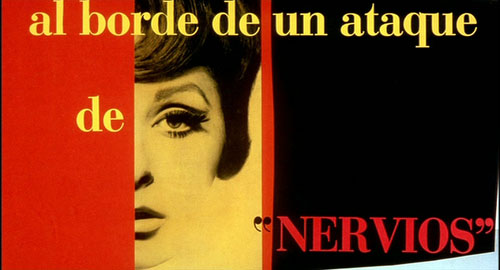
Woman on the Verge of a Nervous Breakdown.
Thanks to Joshua Umibe for the silent-film illustrations. The first comes from Gaston Velle, Métamorphoses du Papillon / A Butterfly’s Metamorphosis (Pathé, 1904). Frame enlargement from Discovering Cinema (di. Eric Lange and Serge Bromberg, Lobster Film/Flicker Alley). The second comes from Albert Capellani’s Le Chemineau / The Vagabond (Pathé, 1905; tinted and toned). Frame enlargement Joshua Yumibe, courtesy of the Netherlands Filmmuseum.
Happy birthday, Film Workshop
Tsui Hark is the mad genius of Hong Kong cinema. The problem comes with assigning proportions. 10 % mad, 90% genius? 50-50? 99 % mad, 1 % genius?
Across a career that’s lasted more than thirty years, Tsui has had more ups and downs than the local economy. On the twenty-fifth anniversary of Film Workshop, the company he founded, the Hong Kong International Film Festival mounted a tribute. That provides an occasion to examine what he did and didn’t accomplish.
25 years old, but who’s counting?
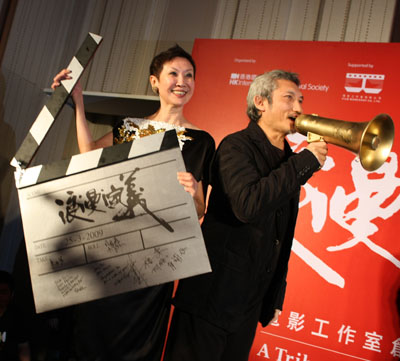
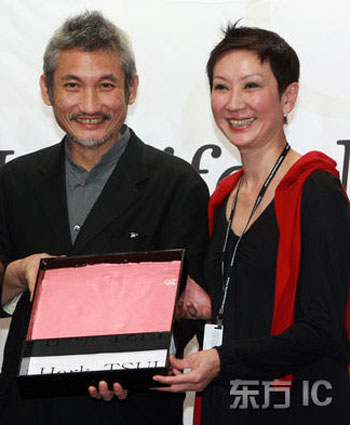
Nansun Shi and Tsui Hark.
At this year’s Asian Film Awards, Film Workshop was given a special prize for outstanding achievement. On another evening there was a party gathering many Workshop alumi, from which the above photo comes. You can see more pictures from that party here. At the agnes b. gallery, a small show featured posters, a looped video documentary, a photocopy of the Better Tomorrow script, and some memorable props.
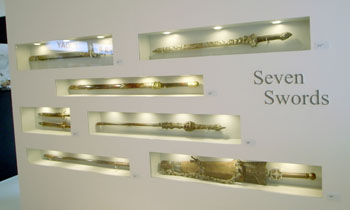
Nat Olsen has other pictures at his lively Hong Kong Hustle site.
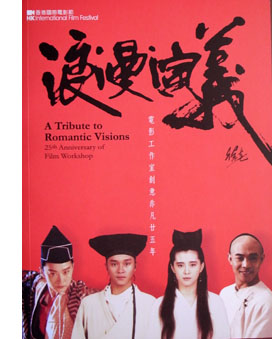 The catalogue, A Tribute to Romantic Visions: 25th Anniversary of Film Workshop, is a must for all aficionados of Hong Kong film. Consisting largely of interviews, it offers many glimpses of creative choices and business strategies governing the company. Nansun Shi, Tsui’s partner and business manager, recalls how they placed films in overseas markets and won critical acclaim in Europe. She also explains matter-of-factly how frantic the midnight-show system was. In those days, Hong Kong filmmakers test-screened a movie to a midnight audience, and then reedited the film based on perceived reaction. Shi explains:
Cinemas often wondered what could be done to a film in the eight hours between the midnight show and the day-time show the next day. I ran some calculation with the technicians: what is the least amount of time for them to do this and that, and then sent them to the cinemas to do the work. If worse comes to worst, they could do the re-editing when the show was running (80).
There isn’t much sugar-coating in the interviews. Collaborators often found Tsui a harsh taskmaster. At peak pressure, he seldom halted shooting for sleep and instead took cat naps on the set. Those who couldn’t keep up his pace, or adjust to his demands, left the company. There are also some comments on production practices. Herman Yau, for instance, notes: “Directors, in general, use most of the shots to tell the story. Tsui prefers images that look good on their own” (121).
Overall, the catalogue confirms that what started as a “workshop” designed to enable directors to realize individual creative visions became a company built around Tsui’s restless ideas about cinema. This was more or less the premise of the panel on Friday afternoon. Two critics, Keeto Lam and Longtin, discussed the Film Workshop enterprise largely as an extension of Tsui’s interests. Keeto had been a screenwriter at the company and shared information about the making of A Chinese Ghost Story 2, while Longtin speculated on Tsui’s interest in transcending polarities, particularly those between human and demon and male and female. Another scriptwriter was in the audience and contributed information as well.
One of Keeto’s points set me thinking. Having characterized Leslie Cheung as the “Golden Boy” of Film Workshop, he asked who the Golden Girl was, and he and audience members discussed candidates for the honor. (My vote, obviously, would go to Brigitte Lin.) But I began to speculate that one of Film Workshop’s main contributions was in star-making. Tsui has mentioned that his early films with gorgeous women tried to create a “comedy of pretty faces” opposed to the “comedy of ugly faces” that ruled in the 1970s and early 1980s. (Think of Michael and Ricky Hui, Karl Maka, Jackie Chan, and Sammo Hung.) By coaxing Brigitte Lin to Hong Kong and by giving Sally Yeh, Leslie Cheung, Chow Yun-fat, and other younger players big roles, Film Workshop created a new generation of glamorous stars.
A better yesterday
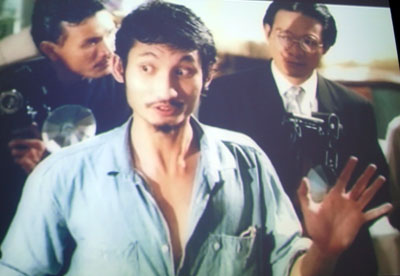
This celebration comes at a parlous period in Tsui’s career. Over the last dozen years Tsui directed some weak, even awful movies. Granted, even a bad Tsui movie is bad in a unique way, but that doesn’t make Tri-Star (1996), the Van Damme outings (Double Team, 1997; Knock Off, 1998), and The Legend of Zu (2001) any better. Some films he has produced, like Era of Vampires (2002) and Xanda (2003), are best forgotten. Today, after the only moderate success of Seven Swords (2008) and the disappointments Missing (2008) and All About Women (2008), many local film professionals consider him a spent force.
I’d argue that Tsui and Jackie Chan were the two most ambitious young filmmakers of 1980s Hong Kong. Tsui was the more daring and mercurial; he seemed to be trying a dozen things at once. He made some bad films, but others changed the face of local film: Shanghai Blues (1984), Peking Opera Blues (1986), A Better Tomorrow III (1989), Once Upon a Time in China I and II (1991, 1992), The East Is Red (1993), and The Chinese Feast and The Blade (both 1995). He also produced, and often co-directed, A Chinese Ghost Story and A Better Tomorrow (both 1986), The Big Heat and Gun Men (1988), The Killer (1989), the demented Wicked City (1992), and Iron Monkey (1993). These films had enormous impact locally, and they made Hong Kong film a major force in world cinema.
The problem is the mad-genius thing. Tsui is uneven, not only from film to film but within each one. Tsui can create a fairly unified tone, as The Blade and Seven Swords show. But more likely a Tsui film will contain something brilliant, something banal, something silly, and something just weird. Labored facetiousness is a virus plaguing Hong Kong film generally, but Tsui seems entirely too fond of bursts of dumb comedy. He replies: “Sometimes it’s fun to be stupid.”
Yet the thrown-together quality of many of his movies also means that even a troublesome one is likely to have a passable sequence. More important, his best films use the lurches in tone to create a grotesque, sweeping verve. Things happen so fast you can’t protest; either go with it or walk out.
Tsui’s strategy is based upon a breathless rhythm. He chops off scenes without warning, and he bustles his actors around the set maniacally; the poor things seldom rest long. Almost never do characters simply sit down and talk to one another, as in those bland American indie films. The beginning of Triangle (2007) shows how nervous, even opaque, Tsui’s style becomes when characters have to sit still.
For Tsui, story action is a matter of physical movement, and the film frame becomes a force-field, with actors popping in and out with abandon. He carries the staccato choreography of martial-arts film down to the most straightforward dramatic scene. He’s not alone in this; you can find it in the 1980s martial-arts films too, but Tsui gives it a special force with his pitched angles, his wide-angle lenses, and his love of comic-book-rococo compositions. Try, for instance, this shot of a woman getting an injection in Missing.
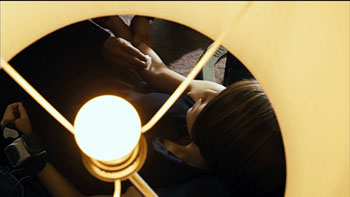
Such images can seem merely cheap flash, but what saves the best ones from preciosity is their constant but disciplined rhythm. In Once Upon a Time in China, Wong Fei-hung is about to be arrested after a clash with local thugs. The shot starts with the police official pointing his pistol to Wong’s head.

Another cop comes in to tell the official that the invaders left something. Any other director would have shown the cop’s face, but why? He’s important only to get the official out of the frame, so he becomes just a red hat poking in from the lower right corner.
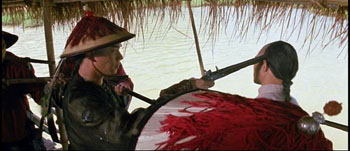
The official dodges out, moving rightward across the frame.
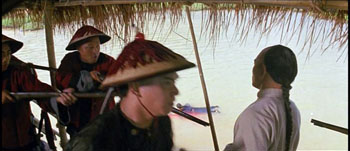
There’s a pause, then Wong, now isolated in the shot, snaps his head around to follow what’s happening.
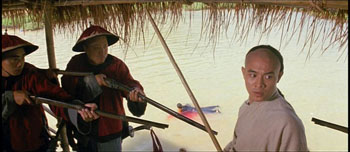
Tsui isn’t usually considered an economical director, but it’s hard to imagine a more crisp way to handle this routine bit of action. The shot takes less than eight seconds.
The same restless energy rules Tsui’s cutting, which has a punch and recoil derived, I think, partly from New Hollywood (Spielberg especially; see the Jaws example here) and partly from the local martial arts tradition. (Some proto-Tsui cutting is on display in Lau Kar-leung’s Legendary Weapons of China, 1982.) Watching Once Upon a Time in China at the retrospective, I was reminded that Tsui not only cooks up sequences that you can’t forget (three words: fight on ladders), but he risks audacious cuts on movement that few contemporary directors could bring off. When he wants to emphasize a moment, he channels Eisenstein. During the final combat of Wong and Iron Robe Yim, the iron weight sliding down the platform gets the Potemkin treatment. Four shots stretch out the instant through overlapping movement.
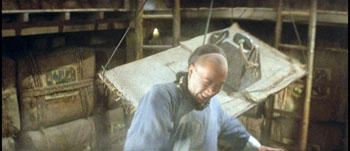
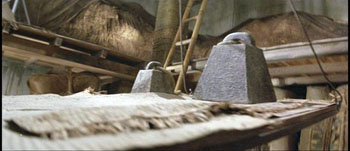
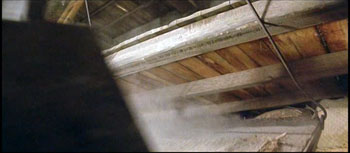
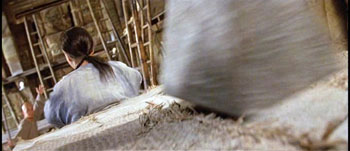
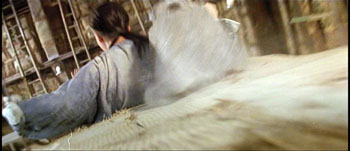
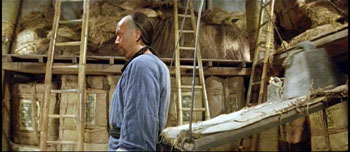
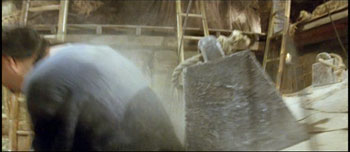
As we might expect, Tsui goes beyond Eisenstein by accentuating major points of impact with swift camera movements forward.
Tsui thinks visually. True, some sound is important—he is a master at merging music and image—but words are a last resort. He has been known to change dialogue in post-production so radically that the dubbing doesn’t match the actors’ lip movements. Shooting without sound gives Tsui, like other Hong Kong directors, a freedom of camera placement that recalls the silent cinema. And like a silent director, he thinks that every story point needs to be pictured. Kenny Bee is looking for the girl he met years ago (Shanghai Blues)? So let’s have an image that dramatizes the problem.
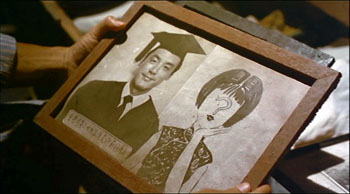
The inclusion of Kenny’s graduation picture might seem superfluous, but it makes the frame an anticipatory wedding picture, and it gives us a sense of his pure, if naïve, romantic impulses.
Motion plus or minus emotion
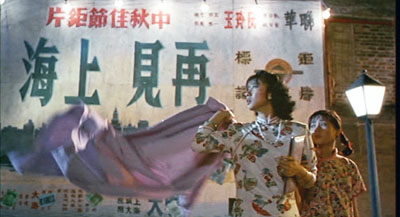
Shanghai Blues.
If you disapprove of what Spielberg and Lucas did to the American cinema, you will hate Tsui’s love of remakes, sequels, and spinoffs, his frequent confusion of SPFX with imagination, and his efforts to milk franchises to a point that can be considered cynical. Yet historically, he pushed Hong Kong cinema forward.
Before the star-making efforts I’ve already mentioned, indeed before Film Workshop was created, Tsui’s Dangerous Encounters: First Kind (1980) offered a blistering attack on class disparity in Hong Kong. He updated Cantonese fantasy swordplay in Zu: Warriors from the Magic Mountain (1983), and he tried his hand at a local version of low-budget exploitation in We’re Going to Eat You (1980). Keeto’s catalogue essay argues that Film Workshop pioneered six new genres in Hong Kong film, from comic-book adaptations to science-fiction and animation. And there’s more variety than we might expect. Film Workshop directors might have sometimes mimicked his style, but John Woo’s Workshop projects managed to do something quite different. Despite Tsui’s hands-on involvement, the lyrical Iron Monkey and the more hard-edged Gun Men and The Big Heat avoid the eccentricities of his signed work while maintaining his love of flamboyant set-pieces and visual creativity.
 Tsui’s scripts often seem like patchwork, granted, but I tried to show in Planet Hong Kong that the episodic, additive plotline is a convention of Hong Kong cinema. Tsui—like Wong Kar-wai, though in a different key—took advantage of this formula to explore the power of the arresting image and an infectious rhythm. (You might say that Wong’s rhythm is that of cool jazz, while Tsui’s is closer to the percussiveness of Chinese opera.) Shanghai Blues and Peking Opera Blues, two of Tsui’s most ingratiating movies, jump smartly from one thrusting scene to the next, shifting emotional registers with dazzling speed. These movies can turn on a dime.
Part of what pulls us along is characters we care about—especially strong women. In the old days, we Hong Kong fans used to love the idea that John Woo, carrying on the Chang Cheh tradition, specialized in the sorrows of masculine obligation, while Tsui was much more interested in women. He gave us the comedy of pretty faces, the wide-eyed innocence of Joey Wong, and the severe beauty of Brigitte Lin who, in the final installment of the Swordsman series, becomes a sheer force of nature. (Her bi-gendered role in Ashes of Time stems from Tsui’s creation of her as such in Swordsman II and The East Is Red.) When Tsui took over the Better Tomorrow franchise, his prequel showed that Woo’s ideal hero Mark (Chow Yun-fat) learned his combat crafts from, of all people, a woman. Even the non-stop testosterone fervor of The Blade, all sweaty torsos and clanking weaponry, may be the hallucination of a madwoman.
These were rousing yarns. Yet at some point, I think, Tsui lost interest in telling a story. This tendency can be detected already in the Van Damme projects; the opening of Knock Off revels in visual effects (microscopic close-ups of the ripping fibers inside running shoes) but doesn’t dwell on what we need to know. Tsui’s task in the collaborative film Triangle was to simply to set up the premises of the action, but dialogue-driven exposition seems to bore him, and the opening scene is a frenzy of eccentric angles and barely registered plot points. His SPFX extravaganza The Legend of Zu has a fairly incomprehensible story to begin with, but by swamping it in explosions and magical transformations, Tsui makes a movie that is, like Spinal Tap’s amplifier knob, permanently set at 11.
With the lack of interest in economical storytelling comes a resistance to emotional engagement. Time and Tide has some virtuoso passages—the tenement sniping, the finale in Kowloon Station (with a woman giving birth during a gun battle)—but the film’s jittery momentum and lack of a coherent point of view sacrifice everything to momentary visceral impact. The death of a little boy caught in the crossfire is not a stab of pathos but the pretext for the visual shock of a ricocheting skateboard.
Tsui’s first films often shied away from sustained romantic scenes, a point made by Sylvia Chang in a catalogue interview. Still, he sometimes translated the awkwardness of love into gesture and motion, from the race to the train at the end of Shanghai Blues to the tender exchange of morsels of food between reconciled husband and wife in The Chinese Feast. Even Once Upon a Time in China can pause for a moment to let Aunt Yee reveal her growing affection for Wong Fei-Hong by having her shadow stroke his.
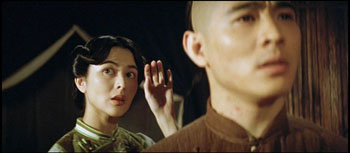
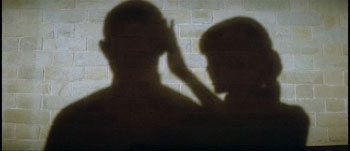
In the early FW films, emotion was translated into movements large or small. Losing her love makes a woman turn abruptly and snap out her cape, underneath a billboard advertising her lover’s song. But more recently Tsui seems to suffocate emotion in a welter of one-off effects. The lustrous HD shots of Missing make it visually striking, but the lacquered technique doesn’t seem to me to serve the story’s core drama of loss.
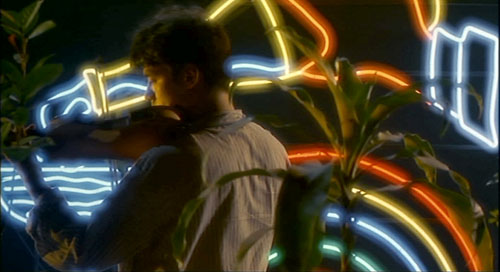
We can’t write Tsui off. He’s not yet sixty, and his new project, the Tang era mystery Detective Dee, sounds promising. Whatever happens next, his many admirers thank him and the FW team for some of the most radiant moments in modern cinema. Everyone who has seen Shanghai Blues needs only the stills at the top and bottom of this entry to conjure up the scene: Kenny plays his violin on the rooftop, we hear the soaring tune “Shanghai Nights,” and as we see Sally listening on another balcony, a chill goes up your spine. A little mad, but mostly genius.
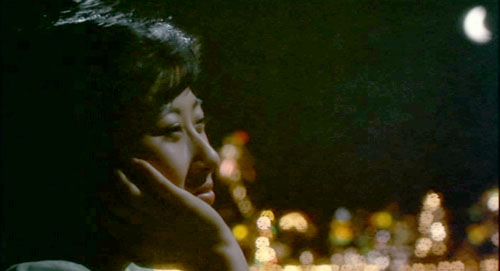
Thanks to Alvin Tse for the illustration from the Film Workshop party.
Stalking a roast duck
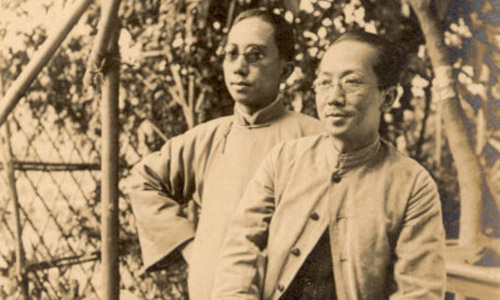
Lai Man-wai and Lai Buk-hoi. Photo from Hong Kong Film Archive Collection.
DB, still in HK:
The Hong Kong Film Awards will be celebrating 2009 as the centenary of Chinese film. Why this year? It’s long been said that the first local film was Stealing a Roast Duck, shot by a Chinese director and produced by an American film entrepreneur in 1909. Following received opinion, my book Planet Hong Kong claimed it as the first as well.
Which only illustrates the maxim that history will not repeat itself, but historians will repeat each other. The Hong Kong International Film Festival mounted a panel around several questions. Is it justified to claim 1909 as the start of Hong Kong cinema? Is Stealing a Roast Duck truly the first film? More ominously, did Duck exist at all? What follows are my interpretations of what the panel, moderated by Li Cheuk-to, came up with.
Law Kar, senior historian of Hong Kong cinema, and Frank Bren, an Australian actor/writer, have diligently pursued the Roast Duck question as part of a larger inquiry into the career of Benjamin Brodsky (erroneously called Brasky or Polasky) who later Americanized his surname to Borden. You can read earlier results of their research in their 2004 book Hong Kong Cinema: A Cross-Cultural View. There they review Brodsky’s filmmaking in China and Japan, but they’re cautious about the claims about his 1909 films. Stealing a Roast Duck “has been recorded as the first commercially made ‘Hong Kong film’ by a Chinese director. . . . Unfortunately, due to the non-discovery of any reports about filmmaking in China in any contemporary newspapers from Hong Kong or Shanghai, [Brodsky’s] story remains partly ‘mythic’ . . . .’ (pp. 37, 43).
At Sunday’s panel, Law and Bren reviewed their most recent research. Law noted that Roast Duck enters film historians’ writings quite a bit after the fact. The crucial mention comes in an article in Cinema Almanac of China 1927, published in Shanghai. Even that article did not specify that Roast Duck was filmed in 1909, only that it was one of four films made by Brodsky’s company, which was founded that year. Law went on to trace how later print sources, mostly books and survey articles, elaborated on these points. By 1936, Roast Duck was said to be one of two 1909 films produced by Brodsky in Hong Kong. Later historians recast the claims again, promoting Roast Duck to the status of Hong Kong’s first story film.
The problem is that there appear to be no contemporaneous sources that can resolve the matter. Law, Bren, and other scholars have found no advertisements, announcements, catalogue listings, or other print documents in 1909 mentioning Roast Duck. Moreover, a 1916 interview with Brodsky, conducted by no less a figure than George S. Kaufman, makes no mention of the film. Brodsky mentions The Empress of Dowers (probably The Empress Dowager) and The Unfortunate Boy , two films he made in China, but gives no specific year of production. Since the piece was written to promote Brodsky’s most recent efforts, it would have been in his interest to play up any pioneering role in Chinese cinema he might have had.
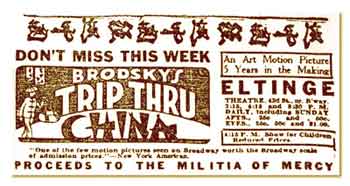
Frank Bren’s presentation was a fascinating detective story. Bren has chased Brodsky through the Internet, Social Security records, city directories, and many other data sources. The efforts yielded the outlines of the remarkable story of a Russian-born American who went to Asia in hopes of setting up film businesses there. Brodsky evidently did produce a Hong Kong film, Chuang Tzu Tests His Wife (1913 or 1914), which involved local filmmakers Lai Buk-hoi, Lai Man-wai, and Lo Wing-Cheung. Chuang Tzu is sometimes considered the earliest true Hong Kong fiction film.
Brodsky was also a documentarist, making two feature-length travelogues, A Trip through China (1916) and Beautiful Japan (1917). He died in 1960 in California. Bren continues to research this colorful figure, being especially fascinated by Brodsky’s unpublished autobiography.
The upshot of this research? There is no positive or direct evidence that Stealing a Roast Duck was made in 1909 or was the first Hong Kong film.
Perhaps it was not made at all? Wong Ain-ling, Research Officer at the Hong Kong Film Archive, is not willing to go so far. She is quite convinced of the existence of the film for several reasons. Apart from the references Cinema Almanac of China 1927, she notes an article published in HK in a 1924 New Bijou Theatre Newsletter, often overlooked for some reason or other. The latter reports: “A Russian [Brodsky?] arrived in Hong Kong in 1912 and cast Mr. Leung Siu-po in Stealing a Roast Duck, one of several slapstick films. Shortly after, Lai Man-wai was cast in Chuang Tzu Tests His Wife and The Ghost of the Pot Returns.”
Wong Ain-ling also cited the testimony of veteran filmmaker Moon Kwan, in both his 1976 book Unofficial History of the Chinese Cinema and his oral records with film historian Yu Mo-wan (as recorded in Yu’s Historical Account of HK Cinema, vol 1). Moon Kwan indicated that he watched the Roast Duck alongside Chuang Tzu Tests His Wife in Hollywood in 1917 (or perhaps 1915). In some detail, he recalled the story of the film and the cast, with Leung Siu-po in the role of the thief, Wong Chong-man as the hawker of roast ducks, and Lai Buk-hoi as the policeman.
As for the year of production, Wong finds 1909 quite shaky; 1912 as cited in the New Bijou Theatre article seems a bit closer. That date is also more consistent with the biography of Brodsky. She concluded her remarks by asking whether it is so important to have a celebration or centenary.
I was asked to sit on the panel as well. All I suggested was that there are problems with determining “first films” in any national cinema tradition. There are empirical difficulties—matters of fact, we might say. Most silent films are lost, and paper records are incomplete or destroyed, so it’s quite likely that any country’s earliest productions could be undocumented. Hence we often have to rely on memories, oral history, word of mouth, and collective opinion. Such seems to have been the case with Stealing a Roast Duck.
There are conceptual difficulties about firsts too. What will count as a film? There were many documentaries and newsreel films made in Hong Kong before 1909, some by Hong Kongers. Why are these not candidates for first films? Because, I suggested, we tend to think of “real films” as telling fictional stories by staging the events. Stealing a Roast Duck would fulfill that condition.
The first volume of the Hong Kong Film Archive filmography has taken care to specify what conditions make something a first film in some respect. Chuang Tzu is called Hong Kong’s first “two-reel” film and its first “fiction” film. The Calamity of Money (1924) is described as the first Hong Kong film to be publicly shown in the colony. Rouge (1925) is labeled “Hong Kong’s first feature-length fiction film.” All of these films are, of course, currently lost.
I added that we select firsts on the basis of our assumptions and purposes. We assume that fiction films are more central instances of cinema than newsreels, or that films directed by Hong Kong people are more central instances than those directed by visitors or residents. And sometimes we want to celebrate cinema, so we create a pivotal anniversary: an example is the one hundredth anniversary of cinema (held in 1995, when we could also have done it in 1994). The effort to create a centenary, which in turn generates public interest in Hong Kong film, has settled on a story that suits that purpose.
It’s fun to imagine what a 1909 Stealing a Roast Duck might have been like. A one-reeler, maybe, built around a string of gags. Perhaps the thief makes many efforts to hitch the duck off the rack, before finally succeeding and being chased through the streets of Hong Kong by the cop. The duck becomes a football tossed from one party to another. . . .
More seriously, you have to be impressed with the care with which my fellow panelists exhumed and dissected their evidence. As usual, the closer you look, the more complicated any issue becomes. One of the pleasures of studying film history is that it can surprise us.
An excerpt from Brodsky’s Beautiful Japan is included on volume 1 of the DVD collection Treasures from American Film Archives. A Guardian interview with Law Kar about Stealing a Roast Duck is here. Thanks to Frank Bren for help with access to illustrations.
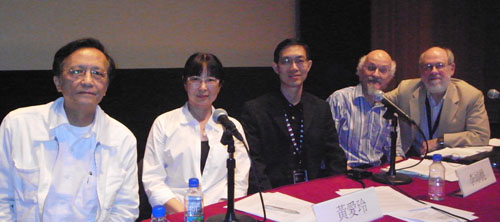
Law Kar, Wong Ain-ling, Li Cheuk-to, Frank Bren, DB.