



Archive for the 'Film history' Category
Niceties: how classical filmmaking can be at once simple and precise
DB here:
A film academic once complained that I was too preoccupied with “formalistic niceties.” So here I go again. But read no further if you haven’t seen Christopher Nolan’s The Prestige.
Dueling magicians: The film’s premise might be considered high-concept. In turn-of-the-century London, two young conjurers launch their careers with different attitudes toward their craft. Robert Angier favors audacious showmanship, while Alfred Borden is committed to finding a trick that will baffle the experts. Their rivalry is ignited when Alfred accidentally kills Angier’s wife during a dangerous underwater stunt. Their struggle peaks around each one’s supreme trick: transporting himself from one point to another instantaneously.
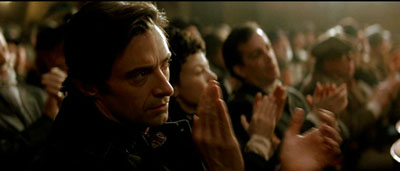
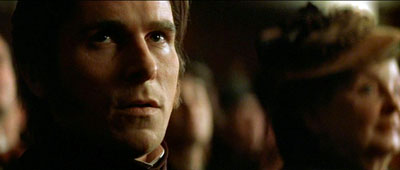
The item that attracts my attention today is established in the film’s opening sequence. As the voice of Cutter (Michael Caine) explains a magic trick’s three acts, we see a climactic confrontation between the competitors. Hoping to discover Robert’s secret, Alfred watches the Real Transported Man performance from the audience.
As Cutter’s narration mentions “a man,” the camera picks out Alfred in the crowd. Cut to Robert onstage, a shift that establishes the two as our protagonists.
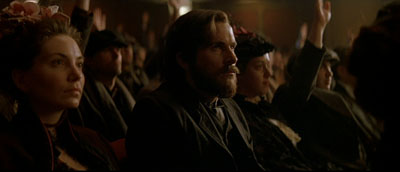
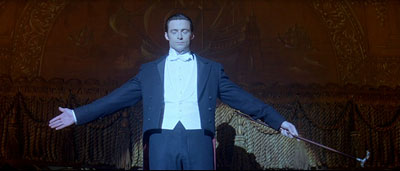
What interests me is the view of the bearded Alfred: a medium-shot framing him nearly in profile facing right. This framing will be repeated, but varied, when Alfred’s voice-over diary entry introduces both him and Robert as apprentices, working as audience shills for another magician:
We were two young men at the start of a great career—two young men devoted to an illusion, who never intended to hurt anyone.
The new shot parallels the introduction of Alfred in the first scene, but varies it. Again we see Alfred in the audience, but now without a beard, and the camera tracks rightward to show Robert in another row.
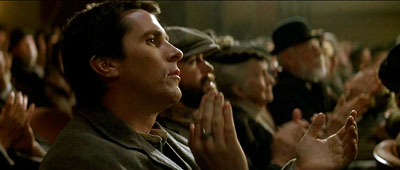
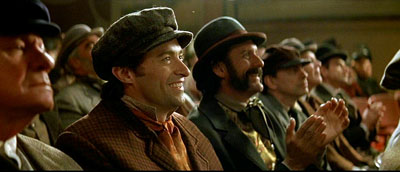
In this sequence, our protagonists are connected by a camera movement rather than the cut employed in the opening. The two men’s reactions—Robert grinning (his wife is onstage), Alfred more pensive—add to the characterizations that we will see played out.
This simple camera motif gets varied further in the course of the film. The disastrous immersion illusion that drowns Robert’s wife is initiated by another tracking shot of the two men in the audience, a variation of the earlier shot.
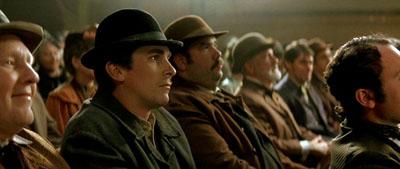
The new combination starts with Robert and ends on Alfred. At this point, not only are the two men linked but they replace one another. If you want to push your luck, you could say that this variant quietly affirms the film’s overall dynamic of substitution (doubles, twins, clones).
Earlier, a contrasting way of showing the men in an audience is given us when they attend a performance of the wizard Chung Ling Soo. Cutter provides a dialogue hook, warning Robert that “the blokes at the ends of row three and four” can see him kissing his wife’s leg.
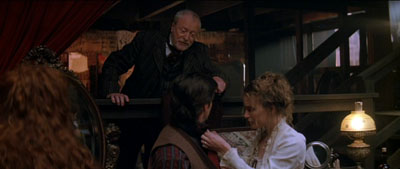
Cut to our protagonists, sitting at the end of a row watching the Chinese magician.
A nicety: Now the men are sitting side by side and facing left rather than right. Just through camera placement and character position, we know we’re in a different performance, one in which our apprentices play no role.
As they study the trick, Nolan gives us another characterizing shot: Robert is amazed, but Alfred grins: He’s worked out Chung’s secret.
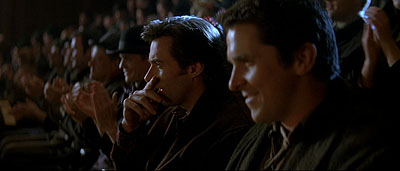
What would have happened if Nolan had framed the men sitting apart and/or facing to the right? For an instant we might have thought we were back in the act they shill for. Simple but reiterated differences assure immediate comprehension: medium shot/ long shot, looking rightward/ looking leftward, men in different rows/ men in the same row. Just as the repeated framings of their own act clarify the situation, so do these little polarities. Call it redundancy, if you like, but it’s also precision and economy.
With Julia’s death, the men become enemies. But each will still slip into the audience of the other’s performances. From now on, the magician is always on the right, the onlooker on the left. Nolan and company could have handled their rivalry in camera setups that exactly mimic the early ones. Instead, a new pattern of parallels comes into play, building on the earlier ones but different enough to heighten the symmetries.
The new pattern is set up by restricting our range of knowledge. First, we are attached to Alfred when he performs his bullet catch in a barroom theatre. Robert, seeking vengeance for Julia’s drowning, steps up to spoil the trick, but we don’t know he’s there until Alfred does, and then it’s too late.
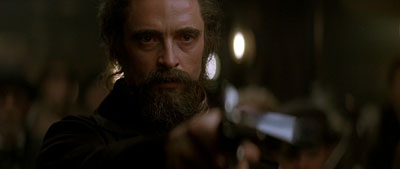
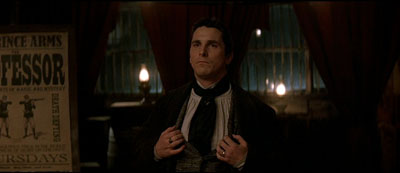
Similarly, we’re restricted to Robert’s range of knowledge when he tries to execute his disappearing dove trick. Only when Alfred is about to trigger the collapsing cage—killing the dove and wounding a lady from the audience—does Robert realize that his adversary has struck back.
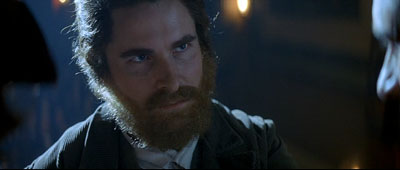
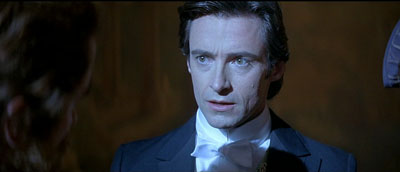
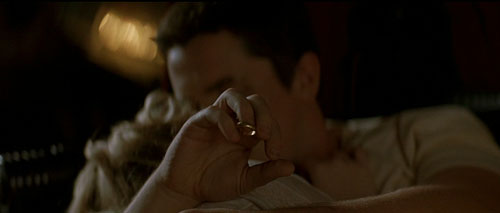
Another nicety: The two shots of each man in similar disguises, seen in 3/4 view, reset the stylistic parameters. But the image of the bearded Alfred is given extra punch through a tilt up from his missing fingers–the result of the parallel, bullet-catch scene before.
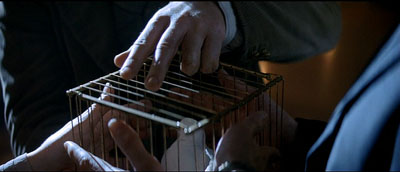
The whole pattern shifts yet again when Robert sneaks in to watch Alfred’s Transported Man illusion. We get a shot of him (in a beard again) that fuses two of the cues from the earlier scenes: He’s in the audience, as in the early sequences, but he’s shown from an angle congruent with that of the earlier beard shots.
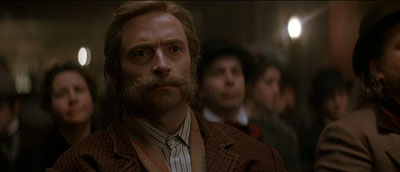
And perhaps we can take the shot of Robert at home, telling of his amazement at Alfred’s illusion, as an echo of the initial prototype: A magician staring intently rightward at a dazzling trick played out offscreen, but now in memory.
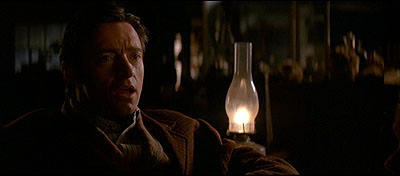
Robert returns from Colorado with the Tesla-designed “Real Transported Man,” and Alfred’s visit to watch the stunt reworks the givens of this pattern yet again. Alfred is seated, minimally disguised, in the standard audience spot looking right, but he is not in profile and the camera position is much closer than before. The answering shot of Robert onstage recalls the gesture we saw at the film’s outset and anticipates what we will see when that opening scene is replayed, with the wicked Alfred climbing onstage.
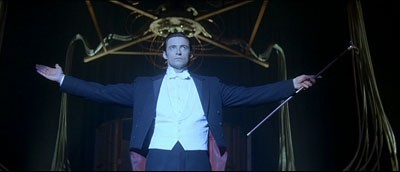
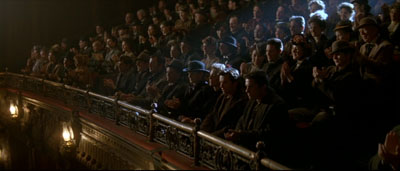
At the close of the trick, yet one more variant: Robert appears in the rear balcony and the crowd all turns to watch him off left.
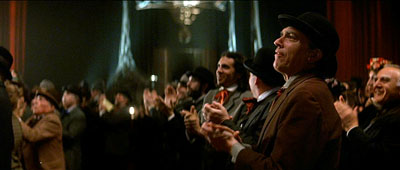
After a glance back, Alfred turns away, looking right–the first time any character has flinched from the performance. His puzzlement is mixed with anger (at last a trick he can’t see through), a less charitable response than we saw in Robert’s stunned fireside recollection of Alfred’s Transported Man.
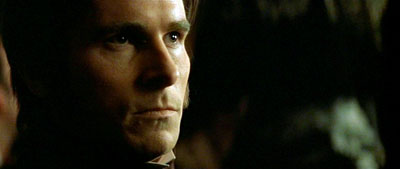
The things held constant, such as camera placement and position in the locale, set off the differences in characters’ disguises and reactions, while this shot carries faint echoes of our very first view of Alfred during Cutter’s voice-over monologue. That view, and its answering shot of Robert in the spotlight, will recur when Robert’s pseudo-death is replayed.
Nolan’s audacious film is built out of more marked parallels than these, but I wanted merely to highlight the ups and downs of one small pattern. Many films work varied repetitions like these into their shot-by-shot texture. Back in the 1930s, Eisenstein saw this possibility clearly, as I try to show in my book on his work. In the 1960s and 1970s, Raymond Bellour called our attention to such patterns in films by Hitchcock, Hawks, and Minnelli. His collection of essays The Analysis of Film includes pioneering studies of how fine-grained such things can become.
I wouldn’t go as far as Bellour does in seeing varied repetition as the motor force of classical filmmaking, but it surely plays an important role. What he takes as a manifestation of pure textual difference I’m inclined to psychologize: these differences help the audience understand, usually without awareness, the ongoing narrative dynamic and have the extra payoff of creating tacit narrative parallels. But from either perspective, object-centered or response-centered, studying such microforms is enlightening. It’s a way to understand films as wholes, dynamic constructions that shift their shapes across the time of their unfolding. Moreover, by examining things this closely, we can try to understand not only how this or that film works, but how this or that film relies on principles distinctive of a filmmaking tradition. Consider this another plug for poetics.
I’d add that such principles neatly fuse two pressures: toward narrative coherence and comprehension on the one hand, and toward production efficiency on the other. It’s cheaper and easier to repeat camera setups if you can. Artistic economy and financial economy can work together, nicely.
Speaking of repetitions….
A tale of 2–make that 1 and 1/3–screens

DB here:
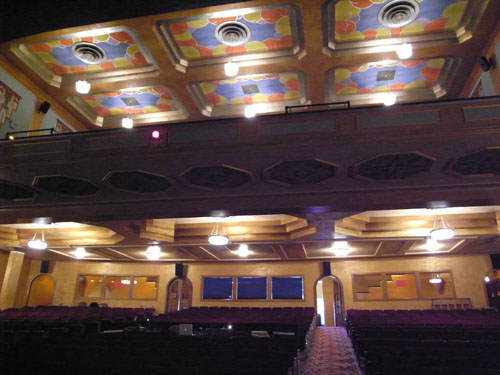
Last week family affairs took me back to my home area, the Finger Lakes region of New York State. About ten miles from our farm lies the village of Penn Yan (short for Pennsylvania Yankees). When I was growing up there in the 1950s and 1960s, Penn Yan boasted about 3500 people—enough to support one movie theatre. That theatre, the Elmwood on Elm Street, was where I saw most of the movies I didn’t see on TV.
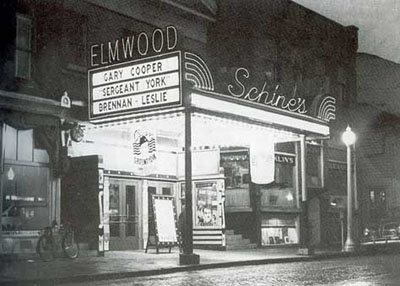
The Elmwood was my introduction to film. When my parents went to town, I was embedded with hundreds of other kids in Saturday afternoon matinees of Tarzan and Lone Ranger movies. On Friday nights, I might catch June Allyson, Donald O’Connor, or Martin and Lewis. When I got older I saw Lawrence of Arabia and From Russia with Love. The Elmwood showed a fair number of art films in the 1960s, including The Servant, The L-Shaped Room, and even 8 ½ (dubbed, I think).
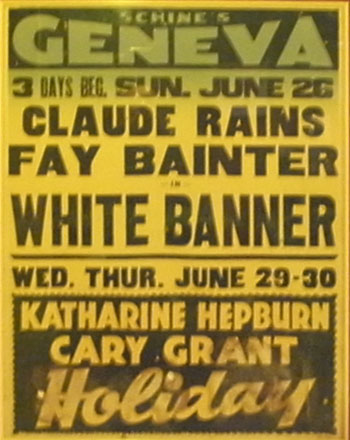
Built in the early 1920s, the Elmwood was acquired by the Schine brothers in 1936. Some towns in our area had two or three Schine theatres. Schine Amusements penetrated Auburn, Bath, Canandaigua, Corning, Cortland, Glens Falls, Gloversville (where it all started), Hamilton, Herkimer, Lockport, Massena, Oneonta, Oswego, Perry, Rochester, Salamanca, Seneca Falls, Syracuse (four houses), Tupper, and Watertown. Clearly, they were leaving the major cities to the big boys. The firm also owned venues in Kentucky and Ohio (none in Cleveland or Cincinnati, but three in Bucyrus). By snapping up screens in the sticks, Meyer and Louie Schine wound up holding nearly a hundred screens in their prime.
Although the brothers went for the smaller markets, they didn’t forget the amenities. They contracted some of the top theatre architects, notably John Eberson, a fantasist with eclectic tastes. The Elmwood didn’t benefit much from the Schines’ largesse as far as I can tell, but it was a sturdy place, with 838 seats, or one for every four people in town.
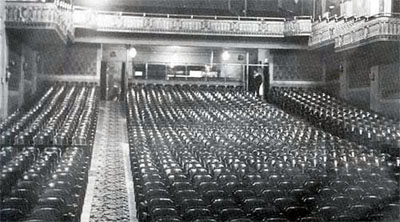
The Elmwood passed out of the Schines’ hands and eventually closed in the early 1970s. For awhile it was an indoor tennis court. The village offices now sit on the site. (Photo: Darlene Bordwell.)

But Penn Yan still has three screens, which I discovered when my sister Diane Verma and I went to Ken Kwapis’ He’s Just Not That Into You. It’s a network narrative like Kwapis’ earlier Sexual Life, and like that (and his Sisterhood of the Traveling Pants) it has some affecting and clever moments. There’s also a nice handling of shot/ reverse-shot when characters are turned away from each other. Mainly, though, I went to see the town’s multiplex, the Lake Street Plaza Theatres.
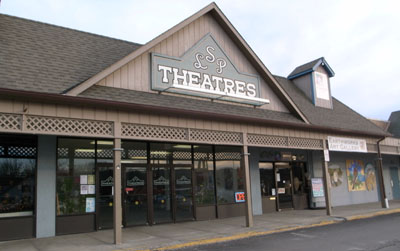
Converted from an exercise club, the LSP houses three screens in a bare-bones design typical of many multiplexes.
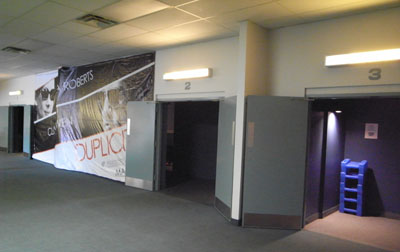
A young man, whose father owned the complex, sold the tickets and ran the projectors. A young woman handled the concession stand. Both were friendly and talkative. Diane and I, two of four people in the house, left happy, although the sugar in the Dots may have helped raise our mood.
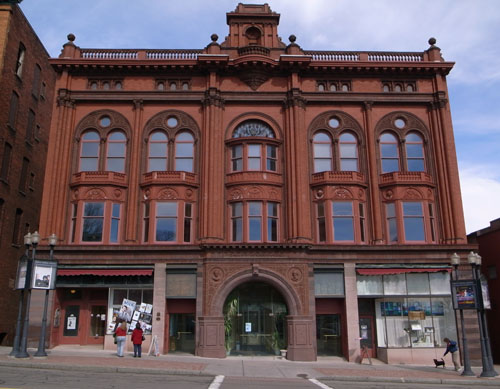
Earlier that day, Diane, my other sister Darlene, and I were driving around our childhood haunts. The towns here are hollowed out by the big-box stores and the recession. Mall parking lots are full, but the main streets are desolate and many storefronts are empty.
Yet in another lake town we came across a surprise. At first I was puzzled. How could the Geneva Theatre have been replaced by a much older and more dignified building, the Smith Opera House?
The door was ajar.
Inside Bruce Purdy, the Technical Director and professional magician, and Sharon Barnes were preparing for a children’s play. They kindly led us on an exploration of this half-hidden jewel. It may have assumed its old name, but the building has regained the delirious splendor that was the Geneva in its heyday.
The Smith Opera House was built in 1894. To its stage came Sousa, Bill Bojangles Robinson, Ellen Terry, and traveling shows mounted by Belasco. The vaudeville programs started including short films during the 1910s, and the Smith was one of thirteen venues in which Edison screened his experiments in talking pictures. The Birth of a Nation played there. Soon the theatre became a movie house, called initially the Strand. It wasn’t the only film theatre in town, and by the late 1920s it had competition. The nearby Regent had already become a picture palace, with about 1000 seats; it screened its first sound picture, John Ford’s Four Sons, in 1928 (presumably in a music-plus-effects version).
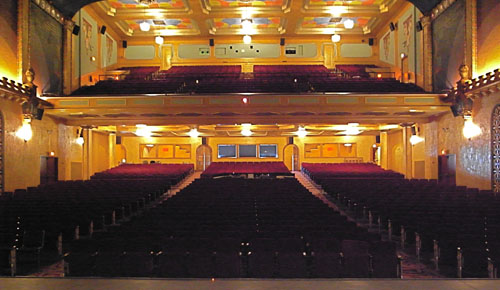
Enter, on cue, the Schines. They bought the Smith, and after playing burlesque there for some months, they decided to revamp it as a picture palace. The process took several years. The interior was stripped; opera seats were sold for a dollar each. What emerged was an “atmospheric,” with the dome displaying shifting clouds that would slowly clear to reveal twinkling stars. The architecture was a fanciful mix of Art Deco, Baroque, Art Nouveau, and Moorish influence. The premise was that you were in a courtyard under the heavens, surrounded by facades of buildings that were implausible but vaguely familiar in their exoticism.
With over 1800 seats, the Geneva Movie Theatre was advertised as the largest movie house in central New York. The first film to play there was Keaton’s Parlor, Bedroom, and Bath in March 1931. The manager, Mr. Gerald Fowler, stayed in charge until 1965.
I didn’t go to the Geneva as often as the Elmwood. Not until I got my Learner’s Permit (a life-changing event to country youth) was I able to drive to Geneva on my own. At the Geneva I saw Mary Poppins, What’s New, Pussycat?, and the CinemaScope version of How the West Was Won. I have no memories of the décor, but by all accounts it was decaying.
Like the Elmwood, the Geneva was closed in the 1970s. Today it looks spanking new. It hosts musical acts (Ani DeFranco is coming up), local and touring stage productions, and on weekends films, “mostly foreign and arthouse,” as Bruce Purdy explained. When we were there the theatre was running a package of Academy Award Best-Picture nominees.
My sisters and I first paused in the lobby, with its fine hanging lamps.

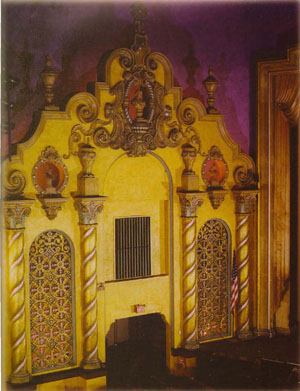
Inside, the auditorium area is of course very impressive, flanked by facades with corkscrew columns.
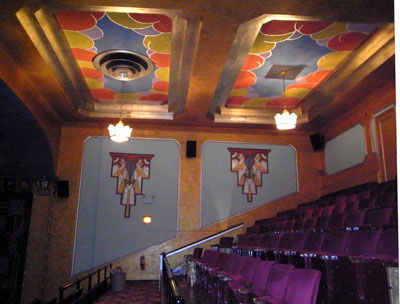
Along the balcony are vaguely ziggurat wall designs.
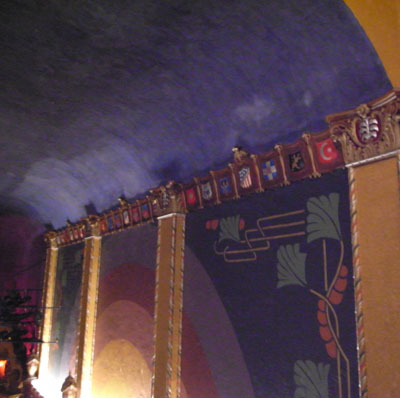
Just in case there was too much empty space, architect Victor Rigamount added some escutcheons.
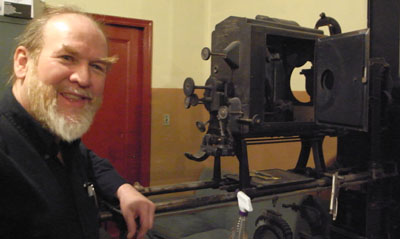
In the projection booth, Bruce showed us the Brenkograph, a marvelous old gadget for projecting lantern slides in dissolving views. The Brenkograph provided the milky clouds cast onto the ceiling: light was pumped through a swirling oil mixture.
In 1946, the year before I was born, US movie attendance reached its peak of about 82 million weekly. The industry had receipts of nearly $1.6 billion. It must have looked like filmgoing would never fall off. But it did, and fast. Enjoying Peter Pan, Moby Dick, and Davy Crockett, I was living through the first major decline in the film industry. By the time I left for college in 1965, weekly US attendance had dropped to 20 million, where it would hover for nearly three decades. Hollywood’s annual box-office receipts were then $927 million (about $657 million in 1947 dollars). In the course of my eighteen years the country had lost 5,000 screens and about 50,000 theatre jobs.
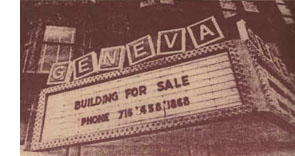 I wish I could go back to see how these old theatres looked then. I wish I could photograph them, inside and out. I wish that I could return to the Elmwood in June 1954 to ask Mr. Norman Williams (unmarried) about the new screen, said to be twenty feet high and 35 feet long—redesigned, of course, for CinemaScope. He was planning to add stereophonic sound, which would, the newspaper story explains, “create the illusion that the sound travels with the movement of actors or objects across the screen.” But until the new system arrived, Mr. Williams said, only Warner Bros’ CinemaScope pictures would be run, because they didn’t require stereo. You mean movies like A Star Is Born and Rebel without a Cause? What wouldn’t I give to see those in their original form, from the front row.
Just before I left the area in 1965, I could have quizzed the managers and staff about the old days. After the war, had they suspected what was coming? What was it like to watch your livelihood shrivel year by year? I didn’t know enough to ask. I didn’t understand what had happened.
In the meantime, we haven’t lost everything. On one screen of the Lake Shore Plaza, you could have seen Watchmen on opening weekend. The projection is very good.
My general information about theatres and attendance is culled from back volumes of The Film Daily Yearbook. The Schine family entered history in another way; see here. Information about CinemaScope at the Elmwood comes from the Penn Yan Chronicle-Express of 10 June 1954, p. 1. My account of the Geneva Theatre is largely derived from two publications, The Smith Opera House (Geneva: n.d.) and Charles McNally’s The Revels in Hand: The First Century of the Smith Opera House, October 1894-October 1994 (Geneva: Finger Lakes Regional Arts Council, 1995). Both are available at the theatre; for contact information go here. The Elmwood photos come from wetlandspy. Check out Darlene’s photo page too.
For a panoramic study of American movie exhibition, see Douglas Gomery’s Shared Pleasures: A History of Movie Presentation in the United States. The first time I met Doug, he asked where I was from. I said Penn Yan. He nodded. “Okay, so you went to a Schine theatre.” The man knows his stuff.
Thanks to Bruce Purdy and Sharon Barnes for their hospitality. And thanks to Ryan Kelly for asking me to clarify the situation with Four Sons.
Acting up
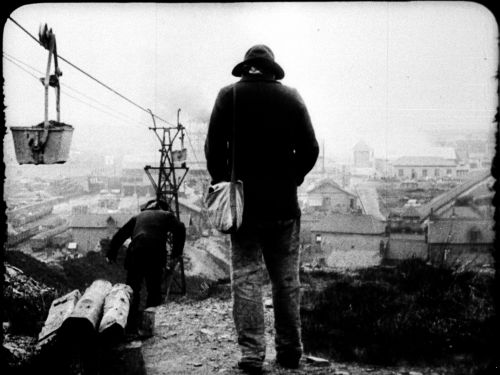
Germinal (1913).
DB here:
Film performance is notoriously difficult to analyze. We don’t lack zesty celebrations of actors; I think especially of Richard Schickel on Doug Fairbanks and Gary Giddins on Jack Benny and Bob Hope (praised in an earlier entry). But we have long found it difficult to penetrate actors’ secrets with the same precision that we bring to editing or framing or a film’s musical score.
Actors’ performances don’t offer themselves in neat slices, the way that shots come to us. There isn’t a firm notational system that lets us capture performances the way that scores can pick out important patterns in music.
Moreover, it’s hard to dissect something that seems so evanescent, so direct, and so natural. When we see someone smile on the bus or at a party, we react immediately and without any apparent thought. When someone smiles in a movie, we’re tempted to say that we respond just as directly. But then, what is acting? Just doing what comes naturally?
Acting is clearly an art and a craft. Not everyone can do it, and comparatively few do it well. So if there is a skill or a technique involved, surely acting goes beyond ordinary behavior. And if as in other arts there are creative choices involved, there is likely to be a menu of options to be chosen from. Some of those options are likely to be conventions sanctioned by tradition. How strongly, then, is acting conventionalized? If it’s conventionalized to some degree, we should be able to analyze it.
A small-scale debate has gone on for some years in film studies about whether film acting is heavily conventionalized, even coded. Advocates of the coding view point to the fact that acting styles vary in different places and change across time. What does Kabuki performance have in common with Method acting? It’s hard to claim that there is a universally realistic acting style that naturally represents human behavior. Against this, others have argued that even if there is no absolute and unchanging standard of realism, we can speak of more or less realistic aspects of performance. Some styles, like Method are just less artificial than others, like Kabuki—even if both are somewhat stylized with respect to realistic behavior.
My own view, explored in Poetics of Cinema, is that performance traditions streamline or stylize a common core of widely shared human behaviors. In everyday life, smiling expresses happiness and/or serves as a social signal of openness. We’re unlikely to find a distant culture in which smiling expresses rage. (Of course we can have an instance of smiling concealing rage, but that would acknowledge the difference between the two states.) Some acting traditions, like Kabuki, retain certain common behaviors like weeping or proud walking, but make them more dancelike. Other acting traditions stylize core behaviors in different ways–the mumble of the Method, or the comic double-take. The differences lie in what aspects of facial expressions, gestures, gait, and the like are on the tradition’s menu, and how they become “streamlined” for expressive purposes and spectatorial uptake.
In short, I’m a moderate constructivist about such matters. I agree that we have to learn to comprehend performances in different traditions. But our learning is fast and spontaneous, not at all like learning Morse code or English, because we already have strong hunches about what a frown or a wail might express. Frowning or wailing are likely to be contingent universals of human behavior. An intuition about the meaning of the performance guides us to recognize the more stylized aspects of the presentation. When Cesare coasts along walls in The Cabinet of Dr. Caligari, we take that to be a stylized representation of the act of stalking. That construal relies on the hunch that he’s doing something we already understand–stalking–in an unusual way. Although sometimes we might have to revise our intuitions about the meaning, those intuitions serve as a point of departure. (Where do our intuitions ultimately come from? Short answer: The evolution of humans as a social species.) E. H. Gombrich put it well: “It is the meaning which leads us to the convention and not the convention which leads us to the meaning.”
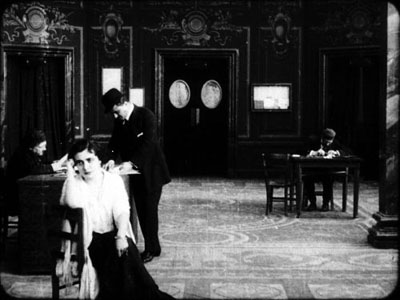
Assunta Spina (1915).
The faculty and alumni of the Film Studies program here at Wisconsin keep in touch through a (closed) listserv, and thanks to Jonathan Frome we also have a wiki, to be found here. It’s just starting to fill up, mostly with ideas for teaching and examples of sample sequences to illustrate film techniques. But now the wiki has gained striking essays on acting from two scholars of early cinema.
Ben Brewster and Lea Jacobs’ book, Theatre to Cinema, took on the problem of what early feature films owed to the stage, and they concluded: Quite a lot. But instead of condemning this tradition as “uncinematic,” as most historians have, they showed that a highly engaging form of cinema arose by reshaping theatrical traditions. Specifically, Ben and Lea examined how “situational” plotting principles were carried into film, and they discussed film’s debt to the “pictorialist” drama of the nineteenth century. Many scholars had argued that melodramatic theatre was replaced by the Naturalist theatre, derived from the literary movement associated with Émile Zola. But Lea and Ben argued that a pictorialist conception of theatre and its modified form in early feature films cut across this distinction. A film that was avowedly Naturalist in plot or theme could maintain conventions of earlier forms.
Consequently, they argued that film acting of the period, even when it seemed to be moving toward greater realism, was still building on the stereotyped expressions, gestures, and attitudes of pictorialist theatre. Actors were called upon to execute vivid stage tableaus. Standard gestures had to be imbued with fresh emotional intensity, and actors were expected to move gracefully from one expressive picture to another.
Now Ben and Lea have extended their book’s argument in two in-depth studies posted on the UW wiki. Ben’s essay examines that great Capellani film Germinal (1913) and shows that it often perpetuates the poses and expressions of pictorialism, while also scaling them down. Lea tackles the work of the diva Francesca Bertini, including an analysis of the wonderful Assunta Spina (1915). Her piece is a companion to Ben’s. She writes:
While I do not doubt that the plot of Assunta Spina fits under the rubric of naturalism, and that the acting and staging of some scenes in the film also show the influence of naturalism in the theatre, it seems to me that Bertini’s technique (and incidentally that of [Asta] Nielsen as well) is more reminiscent of Bernhardt than it is of the Duse, and that the blocking and use of gesture in the film is largely governed by what Brewster and I have discussed in terms of “pictorialism” in acting.
By considering 1910s performance as a modification of theatrical poses, attitudes, and staging conventions, Jacobs and Brewster are led to remarkably detailed analyses. They have studied the conventions of acting at that period, and because they are alert to standard bits of business, so they are able to show fine points of performance that we would ordinarily miss.
They’re also able to hold the realism/ artifice dispute in suspension by concentrating on particular historical traditions. They shrewdly note that as acting styles change, the newer one is likely to be praised as more realistic than the styles it supplants. In turn, that style will be considered artificial when a still newer one comes along. For this reason, Method acting may seem less realistic and more artfully contrived today than it did in the 1950s.
Apart from the subtle discussion of acting styles, one merit of these essays is that they recognize how films can take bits and pieces of different traditions and modify them for particular ends. I’m sympathetic to this perspective. For instance, I still think that many of today’s Hollywood films, despite their contemporary look and feel, draw on principles of narration and plot structure that we can find in classic American studio cinema.
In addition, you ought to visit the site to see how detailed their analyses are and how extensively they draw on frame stills. Indeed, one reason they published these pieces online was that no academic film journal could have accommodated so many illustrations. So much the better for us. The frames, taken from 35mm prints with a Nikon lens and negative film, are among the most beautiful you’ll find on the Internets. I swiped some here.
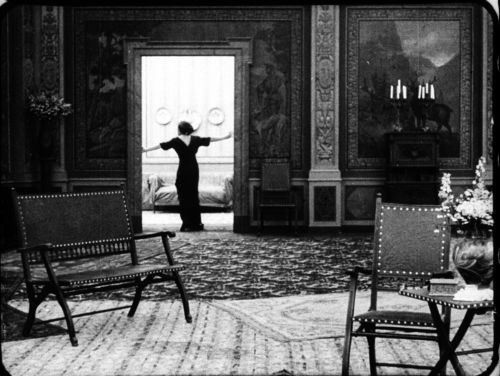
Sangue bleu (1914).
The quotation from E. H. Gombrich comes from his essay “Image and Code: Scope and Limits of Conventionalism in Pictorial Representation,” in The Image and the Eye: Further Studies in the Psychology of Pictorial Representation (Ithaca: Cornell University Press, 1982), 289.
Kristin has written a couple of blog entries concentrating on performance, here and here.
Around the world in 750 pages
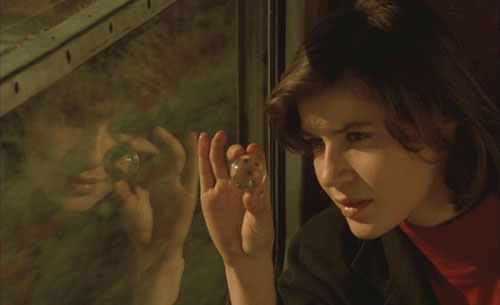
The Double Life of Véronique (1992).
DB here:
Just over twenty years ago Kristin and I embarked on a perilous task. We decided to write a synoptic history of world cinema.
The task wasn’t perilous because it was innovative. Since the 1930s, there has been no shortage of historical surveys of international filmmaking, and such items continue to be published. But when we decided on this project in 1987, we wanted something different.
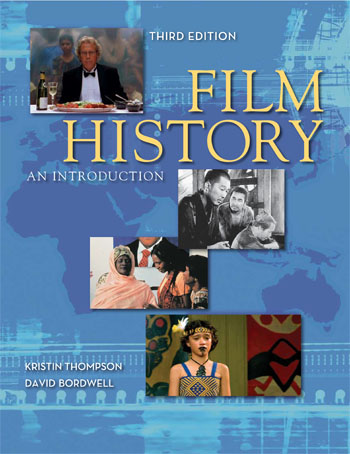
Soon that book will appear in a third edition. We take this occasion to explain the whys and wherefores.
Just start over
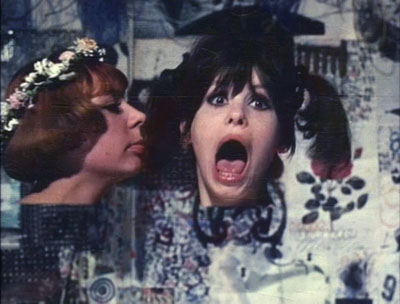
Daisies (1966).
For a very long time, and sometimes still, film histories written by Americans took a very partial look at the phenomenon of cinema. For one thing, they tended to focus on a series of masterpieces, films that had been deemed important within a narrow canon. The earliest lineup went pretty much this way: Lumière films, Méliès’ Trip to the Moon, Porter’s Great Train Robbery, Griffith’s Birth of a Nation and/ or Intolerance. Then came national schools, such as German Expressionism (The Cabinet of Dr. Caligari), Soviet Montage (Battleship Potemkin), and Continental Dada and Surrealism (Entr’acte, The Andalusian Dog). Early sound was M and Sous les toits de Paris and maybe Love Me Tonight. The 1940s was Grapes of Wrath and Citizen Kane and Enfants du Paradis and Italian Neorealism. And so on.
But in the 1970s archivists began opening their doors to researchers. Thanks to wider and deeper viewing, new film historians, young and old, were questioning the canon. André Gaudreault and Charles Musser showed that Porter’s Life of an American Fireman, which supposedly gave birth to crosscutting, did not do so; in fact the version people had used for years was a re-cut print! In Jay Leyda’s seminars at NYU, young scholars like Roberta Pearson were tracing what Griffith actually did and didn’t do, a task taken up by Joyce Jesionowski as well. At the same time, Eileen Bowser, Tom Gunning, Noël Burch, and others began questioning the idea that “our cinema” developed step by step from “primitive” beginnings. In England, Ben Brewster, Barry Salt, and others were minutely analyzing changes in film technique in the earliest years. Here at Madison, Tino Balio and Doug Gomery were revising the study of Hollywood as a business enterprise. Specialists working on national cinemas, from Russia, Italy, and the Nordic countries, were showing that there was far more diversity in world cinema than was dreamt of in orthodox histories.
 We were part of this generation of revisionists. In the 1970s and 1980s Kristin concentrated on European and American silent film, studying both stylistic movements and film distribution, as well as particular filmmakers like Eisenstein, Godard, and Tati. I did work on European and Japanese cinema. We spent years working on a reconsideration of the history of American studio film in collaboration with Janet Staiger. Writing The Classical Hollywood Cinema: Film Style and Mode of Production to 1960 we realized that asking fresh questions was both necessary and exciting.
That’s what made our task perilous. Everything, it seemed, needed to be rethought.
Most obviously, countries outside Europe and North America had been neglected. One of my favorite film statistics is this, to quote from our book:
In the mid-1950s, the world was producing about 2800 feature films per year. About 35 percent of these came from the United States and western Europe. Another 5 percent were made in the USSR and the Eastern European countries under its control. . . . Sixty percent of feature films were made outside the western world and the Soviet bloc. Japan accounted for about 20 percent of the world total. The rest came from India, Hong Kong, Mexico, and other less industrialized nations. Such a stunning growth in film production in the developing countries is one of the major events in film history.
Traditional histories, and film history textbooks, had virtually ignored the bulk of film-producing nations. Only one or two major directors would step in from the shadows. Kurosawa summed up Japan, Satayajit Ray stood in for India. And the books’ layout of chapters indicated this second-class status. The history of film was Euro-American, with East Asia, Southeast Asia, South America, and Africa, appearing, if at all, in periods when westerners first got glimpses of their film culture. So Japan was typically first mentioned after World War II, when Rashomon won a prize at the Venice Film Festival. One would hardly know that there were many, and many great, Japanese filmmakers working in a long-standing tradition.
As if this weren’t enough, we were determined to include other varieties of artistic filmmaking. Documentary cinema, animation, and experimental film had attracted subtle historians like Bill Nichols, Mike Barrier, and P. Adams Sitney. We weren’t experts in these areas, but we were keenly interested in the debates in that domain, and so, guided by these and other scholars, we sought to integrate the histories of documentary, avant-garde, and animated cinema into our survey.
Kristin and David’s excellent adventure
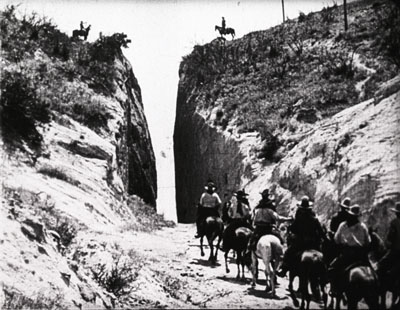
Straight Shooting (1917).
In sum, we decided that we could write a plausible international history of cinema—not a be-all and end-all, but a new draft that reflected the rich variety of new findings and fresh perspectives. Like all historians, we had to be selective. We couldn’t, for instance, track every nuance of the “false starts and detours” in early film technique. More globally, we decided to concentrate on three lines of inquiry.
First, we studied changes in modes of film production and distribution. This inquiry committed us to a version of industrial history. How filmmaking was embedded in particular times and places, how it connected to local culture and national politics: these factors affected the ways films were made and circulated. For example, the early distribution of films followed the trade routes of late nineteenth-century imperialism. That global system started to crack with the start of World War I. A new world power, the United States, became the major film exporting country—a position it has enjoyed for most years since then.
Secondly, we studied changes in film form, style, and genre. We treated these artistic matters as not wholly the products of individual innovators but also as more widely-developed practices and norms. This emphasis on norms allowed us to link, in some degree, the development of technique to opportunities and constraints presented by film industries.
This angle of approach also meant looking at older works with a fresh eye, informed by others’ research but also by our own interests in film as an art. We were obliged to seek out films lying outside the orthodox story. Birth and Caligari and M feature in our account, but so do The Cheat and Assunta Spina and Liebelei. In those pre-DVD days, few of the titles we sought could be found on video, but we preferred to watch film on film anyway. So it was off to the archives. Fortunately, many collections were wide-ranging. We saw Egyptian and Swedish films in Rochester, French and Italian films in London, Indian and Japanese films in Washington, D. C., Polish and African films in Brussels. Committed to documenting our claims with frame enlargements, not production stills, we were lucky to be able to take photos from many of the movies we saw.
 In looking at national film industries and artistic change, we wanted to go beyond local observations. So a third question pressed upon us. What international trends emerged that knit together developments in different countries? We could not claim expertise in all the relevant national traditions, but we could, by drawing on films and other scholars’ writings, create a comparative study that gave a sense of the broad shape of film history.
For example, we could point to the emergence of tableau cinema in many countries in the 1910s. We could consider various models of state-controlled cinema in the 1930s and discover the “New Waves” that emerged not only in France but around the world in the late 1950s and early 1960s. Citizen Kane popularized a “deep-focus” look, but comparative study showed us that its principles were prefigured in Soviet cinema of the 1930s and spread to most major filmmaking nations in the 1940s. Not all trends march in lockstep, but there was enough synchronization to let us plot broad waves of change across the 100 years of film. Our aim was a truly comparative film history.
As a kind of overarching commitment, we wanted readers to think about what historical processes had shaped earlier historical frames of reference. How, for instance, did the “standard story” and the mainline canon get established in the first place? Part of the answer lies in the growth of film journalism and film archives. Why did Fellini, Bergman, Kurosawa, and other directors get so much fame in the 1950s and 1960s? True, they made exceptional films, but so did many other directors who remained unknown to a wider public. We suggested that the “golden age of auteurs” owed a good deal to developments in film criticism and to the postwar growth of film festivals. What led Japanese anime to a period of international popularity in the 1980s? Not only worldwide television distribution, but also devoted fans who spread their gospel through fanzines, videocassettes, and the youthful Internet. The “institutional turn” in film research of the 1970s and 1980s pushed us to consider how film industries and international film culture governed the way films were made and circulated.
The research programs that were launched in the 1970s were characterized by a greater self-consciousness than we had seen before. Historians questioned their assumptions and explanations. Why attribute originality only to “great men” without also examining their circumstances? Why presuppose that film technique grows and progresses in a linear way? To capture this new self-consciousness about purposes and methods, we incorporated something that had never been seen in a film history before: an introduction to historiography. In its latest incarnation it can be found elsewhere on this site. We also appended to each chapter short “Notes and Queries” discussing intriguing side issues, debates in the field, and topics for further research.
Up-to-date, and beyond
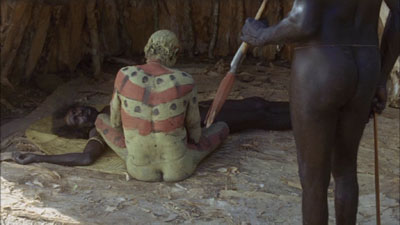
10 Canoes (2006).
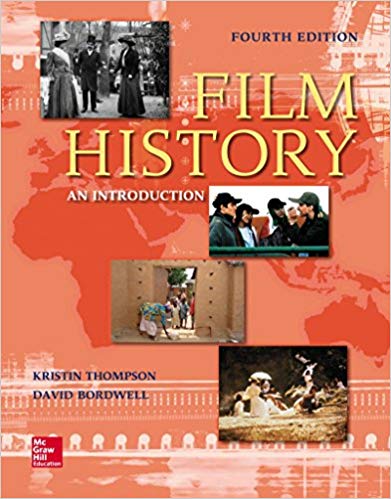
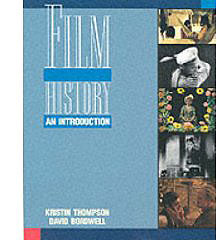
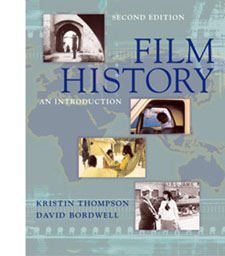
The result of our efforts was first published by McGraw-Hill in 1994 as Film History: An Introduction. A second edition appeared in late 2002. More recently, we’ve spent about twenty months preparing a third edition, which will be published on 20 February this year.
We thought that writing the first edition was bloody hard, and it didn’t get any easier on the second or third pass. As usual, however, visiting new material broadens your compass. Writing my portions of the first edition had a profound impact on my research, but also on my personal tastes. The activity awakened my interest in Hindi cinema of the 1950s, Latin American cinema of the 1960s, experimental work of the 1980s, and African film of the 1990s. On this third round, I was caught up in the innovations of contemporary Korean film and of avant-gardists like Sharon Lockhart. Overall, our urge to trace cinematic creativity around the world led us to a greater appreciation of the wonders of film.
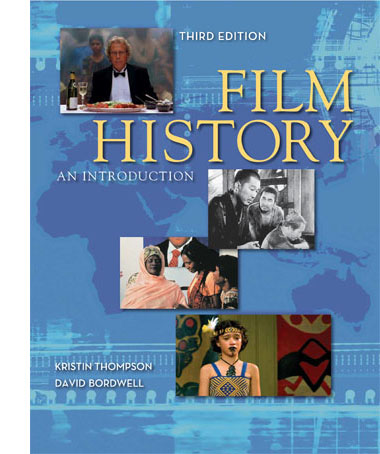 Film History‘s third edition consists of six parts. The first looks at early cinema, from the 1880s to the end of the 1910s. The second considers the late silent era through the 1920s and slightly beyond. Part Three surveys the international development of sound film, up to 1945. The postwar era, from 1945 to the end of the 1960s, constitutes Part Four. We next consider the contemporary period, generously conceived as running from the 1970s to the present. The last section, Cinema in the Age of Electronic Media, makes up for the broad compass of Part Five by reconsidering trends that took shape during the 1980s.
What’s new in this edition? Several small changes have been made in the early portions to reflect newly available films and filmmakers now recognized as important. We have updated coverage of documentary with discussions of the rise of the theatrical doc and its two most striking practitioners, Errol Morris and Michael Moore. We have likewise expanded our section on avant-garde filmmaking by considering “paracinema,” which should have been in earlier editions, and the increase in cinema presented as installations and gallery works.
As for national cinema developments, we have extended our survey of western Europe and the USSR (Chapter 25), continental and subcontinental cinemas such as Latin America, Africa, and India (Chapter 26), and East Asia and Oceania (Chapter 27). New coverage is given to the recovery of the Russian and Chinese industries, the increasing world presence of Bollywood, and fresh talent from the Middle East and South Korea.
The book’s last part continues to host a chapter (28) on American cinema’s development in the light of home video and the rise of independent filmmaking; the blockbuster and Mumblecore are among the subjects we tackle. As in the second edition, we devote a chapter to globalization, which lets us trace the struggle between Hollywood’s global blockbusters and countervailing trends in other regions. This chapter allows us to study other globalizing processes, such as multiplexing, the Internet, fan culture, piracy, and diasporic populations.
Chapter 30 is new to this edition. It examines the effects of the digital revolution on all aspects of film production, as well as on new means of distribution and exhibition. The subjects covered include 3-D animation, DIY independents, and online distribution. We end by recognizing film as no less international an art form than it was in the earliest decades, when silent films slipped freely across national borders.
As in the early editions, we’ve tried to synthesize contemporary contributions but also add our own research and our own interpretations. Here, for example, is our very cine-centric conclusion about “the death of film.”
Will this barrage of new media ultimately overwhelm the cinema? Will the Internet, video games, and personal music players take over as the preferred forms of entertainment? Possibly, but there is evidence against that notion.
Each time that a digital platform appeared, it initially lacked the capacity to show films. Yet each platform adapted itself in order to add that capacity. In the 1990s, computers acquired the power to display movies. The Internet originally did not show films, but now it has Quicktime and downloads. Cell phones started out as communication devices, but later models included a camera and screen so that users could shoot and view films. The first game consoles could not show movies, but after the advent of DVDs, the next generation of machines became combination players. The original iPod and other personal music devices were strictly for audio, but Apple added the capacity to download digital video from computers, DVDs, and the Internet. The iPod enlarged its screen to better display films, even though that meant abandoning the signature click-wheel in favor of touch-screen controls.
Far from killing movies, digital media have allowed them to leave the theater and our living rooms. Now they can travel with us almost anywhere. In effect, film has reshaped the new media to accommodate it. As new digital devices emerge, we suspect that they, too, will adjust themselves to the cinematic traditions that have developed over 110 years.
No book can be definitive, partly because things change astonishingly fast. When we wrote the revision, DreamWorks was firmly within the Paramount family, and our chart of media conglomerates on p. 683 left it there. In page proofs, we shifted it when it seemed all but certain to move to Universal. Now comes the news that DreamWorks has signed with Disney. Likewise, the flow of important research hasn’t abated, and valuable books, like Jay Beck and Tony Grajeda’s Lowering the Boom: Critical Studies in Film Sound, were published after we went to press. Another peril of writing contemporary history, then: Keeping up.
To squeeze in our new material, we’ve had to excise the historiography essay mentioned above, as well as our Notes and Queries and our plump bibliographies. Those, all updated, have appeared at the McGraw-Hill site. Even if you’re not reading the book, feel free to go to the Student Edition tab and browse through the Notes and Queries for each chapter. Some of these brief, bloggish items may pique your interest.
Without exactly planning to do it, we seem to have come up with the most wide-ranging, extensively illustrated survey of world cinema history available in English. The third edition of Film History: An Introduction runs to 750 large-format pages, not counting the index. It contains hundreds of black-and-white frame enlargements and thirty pages of color illustrations.
We hope that if you’re interested in film history you’ll take a look. Feel free to write to us with your thoughts, especially if you find misprints (we’ve been chasing them for months) and factual errors. We’d also appreciate comments about our larger arguments and interpretations. We improve only by constantly rechecking what we say and how we say it.
The quotation about 1950s world film output comes from Kristin Thompson and David Bordwell, Film History: An Introduction, third ed. (New York: McGraw-Hill, 2009), 373.
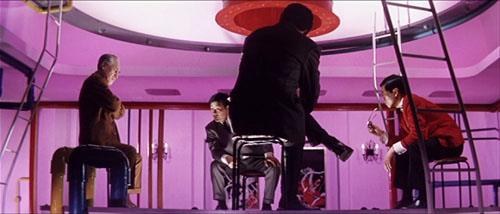
Tokyo Drifter (1966).