







Archive for the 'Film comments' Category
I Love a Mystery: Extra-credit reading
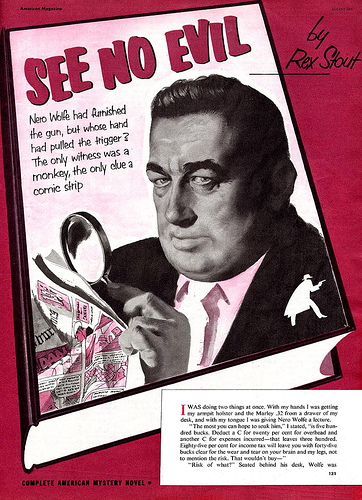
Thornton Utz illustration for Rex Stout novella from American Magazine, 1951. Obtained from the excellent site Today’s Inspiration.
DB here:
Over the next few months, I’ll be traveling with a talk on Hollywood cinema of the 1940s. The ideas I’ll propose are destined for a book about narrative norms during that period. Mystery fiction is important to that lecture, but I don’t have room there to supply much background about the relevant conventions. So I’m sketching in this background here, for people who might hear the talk somewhere or who might just be curious. Consider this as another experiment on the blog, using the web to supplement a lecture.
Although the lecture is mostly about cinema, this entry is mostly about novels and plays. But I’ll mention film here and there, and you’ll notice that some of the books and plays I mention were adapted for the screen.
A mega-genre
The first half of the twentieth century saw an explosive expansion in genres built around mystery and suspense. The most obvious genre is the detective story. In the wake of Conan Doyle’s Sherlock Holmes tales, a great many writers developed and elaborated on the idea of the master sleuth, the genius of observation and reason. Central to this tradition was the puzzle that could be solved by careful noting of clues and meticulous reasoning about them, supplemented by a good knowledge of human nature or local customs. The author needs to keep us in the dark about both the crime and the detective’s chain of reasoning; hence point-of-view figures like Watson, who can be appropriately confounded, relay the detective’s cryptic hints, and marvel at the final revelations.
Readers quickly learned the conventions, so writers had to innovate constantly. Sometimes a writer was original on more than one front. For example, R. Austin Freeman created a revamped Holmes surrogate in a scientific criminologist, Dr. Thorndyke, while also creating a new narrative structure: that of the “inverted” tale. The first section of the story follows the criminal who commits the crime; the second part details how Thorndyke, using evidence and inference, solves it.
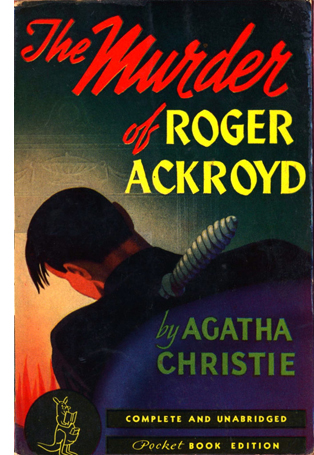 Historians of the detective story have a standard account that goes like this. The puzzle-centered plot developed to its apogee in the 1920s and 1930s, chiefly in Britain, and was picked up in the United States. In books like The Murder of Roger Ackroyd (Agatha Christie, 1926), The Canary Murder Case (S. S. Van Dine, 1927), The Unpleasantness at the Bellona Club (Dorothy L. Sayers, 1928), The Poisoned Chocolates Case (Anthony Berkeley, 1929), The Egyptian Cross Mystery (Ellery Queen, 1932), and The Crooked Hinge (John Dickson Carr, 1938), the crimes are deeply puzzling, even fantastical, and the solutions ever more recherché.
It’s hard for us to conceive today how massively popular these puzzle books were. Van Dine’s first novels were bestsellers comparable to Jonathan Kellerman’s books today. Just as important, the detective story was granted quasi-literary status. Magazines and newspapers that wouldn’t dream of reviewing romance or adventure fiction devoted space to detective stories, sometimes even setting up separate columns or sections for reviews. It was believed, rightly or wrongly, that whodunits had a more intellectual readership than Westerns or science fiction.
At about the same time, according to the standard account, a counter-current was swelling. In the pulp magazines of the 1920s, the “hard-boiled” detective emerged as an alternative to the master sleuth. The prototype is Dashiell Hammett’s Continental Op in stories through the late 1920s, to be followed by Sam Spade in The Maltese Falcon (1930). Strikingly, Hammett and other hard-boiled writers don’t wholly abandon the basic idea of solving a mystery through some sort of reasoning. The differences have to do with realism. The crimes, however, aren’t usually fantastical ones like the Locked-Room problem; the killings tend to be mundane. If the white-glove detective’s only real opponent is a master criminal like Professor Moriarty, the hard-boiled detective faces off against organized crime, or at least people who commit murder outside upper-crust parlors and remote country houses. Clues are less likely to be physical, and more psychological, depending on bits of behavior or flashes of temperament. Raymond Chandler and others took the hard-boiled initiative into the 1940s, and the brute detective, who solves crimes with boldness, insolence, and a pair of fists, occasionally supplemented by torture, found bestseller status in Mickey Spillane’s I, the Jury (1947) and subsequent novels.
I’d argue that some writers could blend the master-mind detective and the tough guy. Erle Stanley Gardner’s Perry Mason was one such hybrid, though leaning closer to the hard-boiled model. Rex Stout solved the problem neatly by creating two detectives: the insolent legman Archie Goodwin serves as a hard-boiled Watson to sedentary Nero Wolfe. But on the whole, historians tend to assume that the Holmesian superman and the puzzle-dominated plot were swept aside by the rise of the tough-guy detective solving mysteries that were grittier and more “realistic” than what had preoccupied Golden Age writers.
Two other major developments are typically highlighted by historians. There was the police procedural, perhaps initiated by Lawrence Treat’s V as in Victim (1945), and explored with great ingenuity in the novels of Ed McBain. There was also what Julian Symons has called the “crime novel,” the story of psychological suspense, with Patricia Highsmith’s Strangers on a Train (1950) serving as a good example. Both of these genres have proven popular to this day (CSI as a procedural, the films of De Palma as psychological thrillers).
A tree and its branches
Like most histories hovering fairly far above the ground, the standard account traces some main contours of the landscape but misses some interesting byways. By taking Doyle as the prototype, this account tends to identify mystery fiction with detective plots in the Holmes mold. But mysteries come up in other forms.
The standard account has trouble accommodating the development of the spy genre, which often involves solving a crime, but less through abstract reasoning than by putting the hero through hairbreadth adventures. Think for instance of The 39 Steps, both the 1915 novel and the 1935 film.
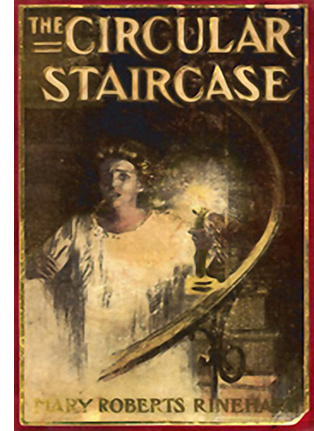 More seriously, by identifying solving mysteries with the activities of professional, overwhelmingly male, detectives historians have neglected the powerful and popular tradition of the revived Gothic or “sensation” novel of the mid-nineteenth century. This is typified by Wilkie Collins’ Woman in White (1859-1860) as much as by The Moonstone (1868), often considered the first detective novel (largely because a detective figures as one of the characters, even though he doesn’t solve the mystery). Collins’ novels, along with those of Mary E. Braddock, updated the Gothic format through more complex plotting and multiple points of view. In the next century, Mary Roberts Rinehart, with The Circular Staircase (1908), has to be considered as important as Freeman. Rinehart’s plot introduces the crucial conventions of the mysterious house, the curious and brave woman who explores it, and the threats lurking behind placid domesticity. While the classic white-glove sleuth isn’t usually in much danger, The Circular Staircase and other updated sensation novels make the investigating figure a woman in peril. The sensation novel replaces cool rationality with fear and desperation.
Jane Eyre is an obvious source for Rinehart and her successors, and perhaps the association with women’s writing in general made historians and practitioners of the Golden Age mock the revived Gothic as too feminine, too far removed from the bluff masculine camaraderie of 221 B Baker Street. The Gothicists had their revenge: Daphne Du Maurier’s Rebecca (1938) outsold every other mystery novel of its time and sustained a cycle of new sensation novels by Mabel Seeley (The Chuckling Fingers, 1941), Charlotte Armstrong (The Chocolate Cobweb, 1948), and Hilda Lawrence (The Pavilion, 1946). The genre is maintained today by Mary Higgins Clark, Nicci French, and many other writers.
So mystery and detection formed a broader tradition than literary historians sometimes acknowledge. Another marginal form was the suspense thriller. Again, we can point to a woman: Marie Belloc Lowndes, author of The Lodger (1913). An early instance of the serial-killer plot, it’s also a tour de force of point-of-view; unlike the film versions, it restricts itself quite rigorously to what certain secondary characters know. Choices about narration and viewpoint are no less crucial to the thriller than to the Great Detective tradition.
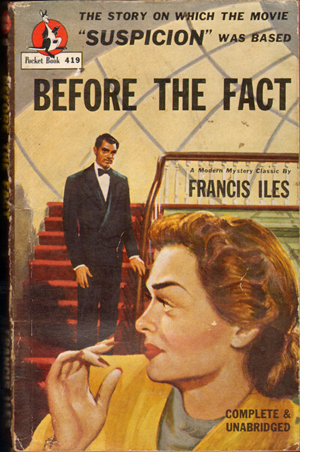 The psychological thriller was revived during the Golden Age, sometimes by practitioners of the puzzle-story. Anthony Berkeley Cox, writing as Anthony Berkeley, noted in The Second Shot (1930):
I personally am convinced that the days of the old crime puzzle pure and simple, relying entirely upon plot, and without any added attractions of character, style, or even humour, are, if not numbered, at any rate in the hands of the auditors. . . The puzzle element will no doubt remain, but it will become a puzzle of character rather than apuzzle of time, place, motive, and opportunity. The question will be not “Who killed the old man in the bathroom?” but “What on earth induced X, of all people, to kill the old man in the bathroom?”
Cox went on to test his premises in Malice Aforethought (1931) and Before the Fact (1932). Both trace the schemes of wife-killers, but the first novel is told from the husband’s standpoint and the second from the wife’s. The latter book opens:
Some women give birth to murderers, some go to bed with them, and some marry them. Lina Aysgarth had lived with her husband for nearly eight years before she realized that she was married to a murderer.
There followed other domestic-crime psychological novels, notably Richard Hull’s The Murder of My Aunt (1934).
Sometimes suspense thrillers have a solid mystery at their center; this is common when the protagonist is a potential victim. Other thriller plots in effect present the first half of a Freeman “inverted” story, concentrating on the criminal’s execution of a crime and the resulting efforts to escape punishment. Both possibilities were on display in British stage plays of the 1920s and 1930s. In a sense Cox was beaten to the punch by Rope (1929), Blackmail (1929), and Payment Deferred (1931). Later examples are Night Must Fall (1935) and the woman-in-peril dramas Kind Lady (1935) and Gaslight (1938). Many of these plays were made into films.
The novel of suspense really came into its own in the 1940s, when it started to incorporate abnormal psychology. Patrick Hamilton, author of Rope and Gaslight, provided an influential novel as well, Hangover Square (1941). Cornell Woolrich and David Goodis, who mined this nightmarish vein, achieved posthumous cult status because, again, of the spell of film noir. Other suspenseful students of mania were Dorothy B. Hughes (In a Lonely Place, 1947), Charlotte Armstrong (The Unsuspected, 1945; Mischief, 1951, filmed as Don’t Bother to Knock), and Elizabeth Sanxay Holding (The Blank Wall, 1947, source of The Reckless Moment). Chandler called Sanxay Holding “the top suspense writer of them all.” We shouldn’t ignore the influence of Simenon’s romans durs, which were being translated and respectfully reviewed throughout the war years.
Yet another new wrinkle on the mystery thriller was the genre of courtroom novels. The Bellamy Trial (1927), which begins when the trial does and restricts itself almost completely to what transpires in the courtroom, popularized the pattern. Stage plays of the 1920s adopted the pattern too. The format proved irresistible for early talkies, as in adaptations of The Bellamy Trial (1929) and Thru Different Eyes (1929) and the radio-inspired Trial of Vivienne Ware (1932). Cox, who seemed to try his hand at every current trend, gave his own twist to the juridical mystery in Trial and Error (1937).
Most of these novels focused on the trial proceedings from the perspective of the defendant, but a few concentrated on those sitting in judgment. The Jury (1935), by Gerald William Bullett, characterizes the jurors singly before they gather and then shows the trial from their standpoints before taking us into the jury room to hear the arguments. Bullett’s novel finds an equally engrossing complement in Raymond Postgate’s Verdict of Twelve (1940). There were also Eden Philpotts’ The Jury (1927) and George Goodchild and C. E. Bechhofer Roberts’ The Jury Disagree (1934). We can immediately recognize the teleplay and film Twelve Angry Men as an updating of this minor line.
Merging and markets
The family tree of mystery, then, grew many branches in the 1920s and 1930s—the pure puzzle, the hard-boiled investigation, the spy story, the revised Gothic or sensation novel, and the suspense thriller, often of a psychological cast. Unsurprisingly, the genres began to mingle. Cox was perhaps the writer most interested in hybrids, but John Dickson Carr tried his hand at the thriller as well (The Burning Court, 1937), as did Agatha Christie in And Then There Were None (aka Ten Little Indians, 1940).
The process sped up during the 1940s, when writers began blending crime-solving with psychological suspense. We can get a sense of how the protagonist-in-peril side of the thriller melded smoothly with the enigma-based investigation by looking at the jacket copy of a fairly ordinary entry, Alarum and Excursion (1944):
Bit by bit, a gesture here, a sound there, Nick Matheny pieced together the awesome puzzle of the accident that had sent him to a sanitarium with traumatic amnesia. One by one he reconstructs, he probes the cirumstances of the explosion in his factory, the disappearance of his weak but beloved son, his wife’s strange attitude toward the new management of the business, and the status of the new synthetic fuel formula, which was so urgently needed.
As the dreadful picture unfolds itself, Nick escapes from the sanitarium to ferret out the sinister changes that have disrupted his business and brought his active life to an abrupt close.
Virginia Perdue, author of He Fell Down Dead, skillfully handles the difficult flash backs in this unusual psychological drama. There are many scenes where the tricks of thought, the tenseness of apprehension, the visions through the deserted streets of blacked-out memory poignantly work their stealth upon the mind of the reader.
Alarum and Excursion wasn’t adapted into a film, but reading this spoiler-filled jacket copy you can easily imagine the movie.
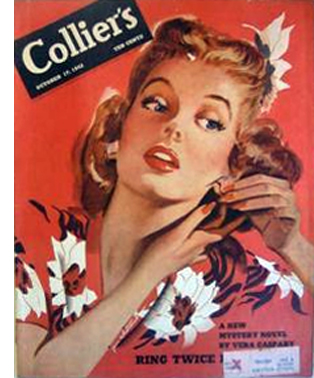 One more factor needs to be mentioned: the publication venues. Everybody knows that the hard-boiled tradition has its roots in Black Mask and other pulp magazines of the 1920s. What’s less often emphasized is the “slick-paper” market of the 1930s and 1940s. The Saturday Evening Post, Ladies’ Home Journal, Good Housekeeping, Cosmopolitan (rather different from what it is now), The American Magazine, and many other weekly magazines ran a great deal of fiction, both short stories and serialized novels. The high-paying slick market showcased soft-boiled mysteries involving Perry Mason and Nero Wolfe and welcomed suspense fiction too. Major suspense authors of the 1940s, such as Charlotte Armstrong and Vera Caspary, would garner tens of thousands of dollars in serialization rights. On the right is the cover of Collier’s for 17 October 1942, announcing the first installment of Ring Twice for Laura, later known simply as Laura.
As mystery genres proliferated, their popularity soared. Contrary to what historians imply, the puzzle novel with a brilliant sleuth was far from defunct. Christie’s Poirot and Sayers’ Wimsey retained their fame into the 1940s, significantly outselling Hammett and Chandler. Ellery Queen’s novels are not read much today, so it’s hard to imagine a time when over a million copies of them were in print. More generally, the public’s appetite for mystery novels and radio plays was intense. In 1940, 40 % of all titles published were mysteries, and in 1945, an average four radio shows devoted to mystery were broadcast every day, each drawing about ten million listeners.
Small wonder, then, that Hollywood came calling. Curiously, the master detectives popular with the reading public wound up in B-film series (Charlie Chan, Ellery Queen) or remained unexploited in the 40s (Nero Wolfe, Perry Mason). What came to the fore, as being more suitable for the dynamic medium of film, were the hard-boiled heroes of Hammett and Chandler. Because the rise of hard-boiled adaptations fed clearly into film noir, they have attracted the most attention. But mutating alongside them, and becoming at least as lucrative, were the films shaped by the updated Gothic and the psychological thriller. Variety noticed the trend in fall of 1944.
Plain murder as a film frightener is passé. Been done too long in the same old way. Theatregoers actually can yawn in the face of manslaughter as it’s been perpetrated for the whodunits during the past year or more. . . . The newer type of horror pictures, invested with psychological implications, deal with mental states rather than melodramatic events. . . . The typical tale in the new genre crawls with living horror, is eerie with something impending, and socks its suspense thrill well along toward the middle of the story instead of doing the crime victim in at the beginning and then building a whodunit and a detective quiz as the element of suspense.
The piece doesn’t respect today’s genre distinctions. Apart from using the term “horror” in a way we wouldn’t, the author lumps together suspense thrillers like The Lodger, Hangover Square, The Uninvited, and The Suspect; the Gothic Gaslight (“a perfect example of the new approach”); and spy thrillers The Mask of Dimitrios and The Ministry of Fear. Even Jane Eyre is included, without irony. (Surprisingly, Double Indemnity from spring 1944 isn’t mentioned.) Still, the article acknowledges that mystery had strong audience appeal and that while the classic whodunit had had its day on the movie screen, films could be given new energy by other literary trends.
Mystery as artifice
Mystery is the only genre I know that makes narrative strategies as such central to its identity. A musical, a Western, or a science-fiction saga can be presented in linear fashion, telling us everything step by step, and still retain a genre identity. But a mystery plot can’t be presented straightforwardly. The writer must manipulate plot structure and narration to some degree.
A mysterious situation or plot action is one whose causes are to some degree unknown. In the detective formula, both refined and hard-boiled: A person has been murdered; what led up to it? In the Gothic: There are sinister goings-on in the house; what’s causing them? In the suspense thriller: Someone wants to harm me; who and why? (And will I escape?) To generate mysteries, the plot-maker must suppress key information. That can be done by opening late in the story (say, after the crime has been committed), by employing flashbacks (often launched from a climactic moment), or by restricting the range of knowledge (via a Watson or a string of eyewitnesses). More subtle options involve ellipses, such as those in The Murder of Roger Ackroyd and the diary portion of The Beast Must Die (1938).
At the level of prose style, clues can be buried in descriptions or offhand remarks. The narration can creatively mislead us from the start, in the title (The Murder of My Aunt, The Murderer Is a Fox) or the diabolical opening sentence of Carr’s “The House in Goblin Wood.” And sometimes you get pure showing off. The first chapter of The Rynox Murder Mystery (1931) is entitled “Epilogue,” and the last chapter is entitled “The Prologue.” In addition, the book is broken not into parts and chapters but “reels” and “sequences,” a device creating a small meta-mystery (gratuitously, so far as I can tell.)
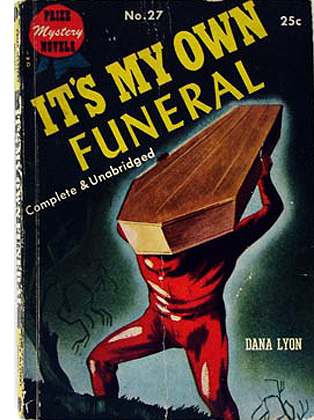 Given the proliferation and mixing of genres and the constant demand for innovation (echoed in Variety’s crack about things “being done too long in the same old way”), 1940s mystery writers were pressed to find new storytelling gimmicks. Everything had not been done, at least not yet. Historians of the detective story routinely praise the ingenuity of Christie and company in the 1930s, but the 1940s saw a positively baroque expansion of options. A dead detective pursues the investigation as a ghost. Another wakes up trapped in a coffin and starts telling us how he got there. Pat McGerr distinguished her work by replacing the question Whodunit? with others, such as: We know who’s guilty, but who’s been murdered?
In the suspense mode as well, we find efforts to create novelty at the level of narration. With the emerging interest in psychoanalysis, the thriller began to probe the protagonist’s inner life and hidden traumas, producing not only the hallucinatory visions of Woolrich and Goodis but the crazy-lady divagations seen in The Snake Pit (1947), Devil Take the Blue-Tail Fly (1948), and Patricia Highsmith’s early short story, “The Heroine” (1945). As in the purer tale of detection, a great deal depended on feints and fake-outs at the level of the prose. The cleverly misleading narration of Ira Levin’s A Kiss Before Dying (1953) turns on the use of a pronoun.
Hollywood filmmakers borrowed plentifully from the new genres, particularly the psychological thrillers that could appeal to women. Significantly, Rinehart’s pioneering 1908 novel was remade as The Spiral Staircase (1945), and Warner Brothers redid Collins’ classic Woman in White in 1948. Moreover, I think, filmmakers tried to find cinematic counterparts for the genre’s restricted narration, dream and fantasy passages, misleading exposition, and shrewd ellipses (e.g., Possessed, 1947; Mildred Pierce, 1945; Fallen Angel, 1945). The diversity of mystery fiction inspired Hollywood writers and directors to create a Golden Age of the mystery film, and the innovations of the period left a legacy for filmmakers ever since.
These genres had a wider impact too. That’s what I’ll concentrate on in my presentation, “I Love a Mystery: Narrative Innovation in 1940s Hollywood.”
The two major histories of mystery fiction are Howard Haycraft, Murder for Pleasure: The Life and Times of the Detective Story (1941) and Julian Symons, Mortal Consequences: A History from the Detective Story to the Crime Novel (1972). Both are very much worth reading, as is Leroy Lad Panek’s idiosyncratic An Introduction to the Detective Story. The best study of the 1920s-1930s puzzle tradition is Panek’s Watteau’s Shepherds: The Detective Novel in Britain 1914-1940. On A. B. Cox, see Malcolm J. Turnbull, Elusion Aforethought: The Life and Writing of Anthony Berkeley Cox.
The Variety article I quote bears the misleading title, “New Trend in Horror Pix; Laugh with the Horror.” It’s in the issue of 16 October 1944, p. 143.
Unlike The Rynox Murder Mystery, Cameron McCabe’s Face on the Cutting-Room Floor (1937) blends moviemaking and murder in a thoroughgoing, albeit wacko, fashion.
Other entries on this blog have dealt with some of my mystery favorites, especially Ellery Queen and Rex Stout.
P. S. 11 June: Mystery expert Mike Grost has kindly reminded me of his encyclopedic site, A Guide to Classic Mystery and Detection. By discussing authors both famous and forgotten, he displays the great diversity of this mega-genre.

The Gearheads
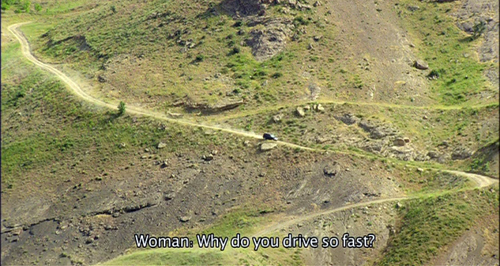
Mourning.
DB here:
At the Wisconsin Film Festival I saw the best film I’ve seen over the last six months. I can’t really say much about it, but I’ll do what I can. My remarks make most sense, I think, if I embark on a pretty long detour.
The frame-rate shuffle
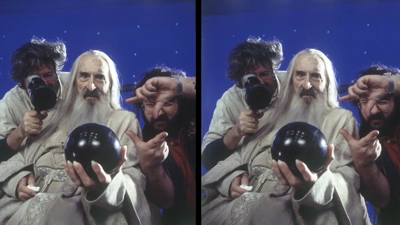
3D still photographs by Peter Jackson taken during the filming of the Lord of the Rings trilogy.
In the wake of April’s convention of the National Association of Theater Owners, the biggest press tumult surrounded Peter Jackson’s ten-minute demo from The Hobbit. Fulfilling what James Cameron had called for at the 2011 NATO confab, Jackson has been shooting at 48 frames per second, and the demo was screened at that rate. Cameron and Jackson are concerned that there’s too much image judder and strobing in digital cinema, especially 3D. They propose a higher frame rate to smooth things out.
Opinion on the Hobbit footage was divided. Some theatre owners and operators were happy with it, but others were uneasy. The higher frame rate tends to eliminate motion blur and create a sharpness that recalls, for some viewers, the brittle look of HD sports broadcasts. “It looked to me like a behind-the-scenes featurette,” said one.
Jackson, who has been preparing for this initiative on his Facebook page, defended his decision. He maintains that audiences will adapt to it, just as his production team has. Many exhibitors seem to have dismissed the new initiative as too expensive, particularly at a time when many are still paying off the digital conversion. But the Regal Entertainment Group, the largest cinema chain in the US, announced plans to outfit up to 2700 screens so that The Hobbit can be screened at 48 fps. It now seems possible that The Hobbit may be shown in no fewer than six formats: 2D, 3D, and Imax, and in each there will be both 24 fps and 48 fps presentations.
Not being present to watch the footage, I have to withhold judgment about how it looks. I haven’t though, withheld my opinion about how Cameron and Jackson, along with George Lucas, have used their roles as superstar directors to prod exhibitors to adopt expensive new technology. They acted as the figureheads for the switch to digital in 2005, using 3D as the incentive for exhibitors to convert. A few years later, after proposing 3D television, Cameron upped the ante by urging higher frame rates for film. Jackson has joined him by actually making a film at 48 fps. Cameron has said he prefers 60 fps, which may mean that the goal posts get shifted again when Avatar 2 or something else comes along.
You can go to my earlier post for more thoughts on their tactics. My book on the digital conversion, due out on this site in a few days, offers a fuller account. In the meantime, I’m going to try to understand this frame-rate fracas in a wider historical context.
The palette
Cinema technology has been surprisingly stable, as befits its status as the last surviving nineteenth-century engine of popular entertainment. The dimensions of the film strip, the rate of shooting and showing, and other fundamental factors have altered relatively little. The coming of sound and then the replacement of nitrate-based film by acetate are perhaps the biggest alterations in the basic technology. Below this macro-level, though, innovation has been constant.
From the 1920s through the 1960s, most of the change came in the production sector. The adoption of panchromatic film stock; color processes, principally Technicolor and the monopack systems like Agfacolor and Eastman Color; the development of various lighting units (carbon-arc, incandescent, Xenon); the shift from optical sound recording and reproduction to magnetic processes; the emergence of different sorts of camera support (varieties of tripod, dollies, and cranes, along with handheld devices)—all of these shaped how movies were made but had relatively little effect on how they were shown.
Some 1950s innovations launched in the production sector, notably widescreen cinema, stereophonic sound, and 3D, reshaped exhibition more drastically, because they came at a moment when theatres were anxious to lure back their clientele. Other revampings of exhibition, like wide-gauge film (65mm/70mm) and Cinerama, were never intended to be the universal standard. They were designed for a distribution system that included roadshow exhibition. Dedicated screens showcased big films like The King and I and Lawrence of Arabia for long, well-upholstered runs before the film hit the neighborhoods and the suburbs.
Producers innovate and exhibitors hesitate. Exhibitors must be cautious and conservative; they risk revamping their venue at great cost only to find that the new technology isn’t catching on. The roadshow system repaid exhibitors well, until it collapsed in response to the rise of saturation booking in the 1970s. For similar conservative reasons, exhibitors looked askance at the digital sound reproduction technologies that emerged from the 1970s through the 1990s. At one point, a house had to accommodate four different sound systems, some of them subject to periodic upgrades.
When technologies emerge in the production sector, they mostly promise to enlarge the filmmaker’s palette. A 1950s film could be made black-and-white or color, deep-focus or soft-focus, with arc or incandescents, flat or anamorphic, and so on.
In practice, of course, not everything was possible on every project. Budgets, as ever, limited options, and many directors and DPs disliked shooting in color or CinemaScope but were obliged to do so. And there were some trade-offs. Filmmakers of the 1930s could not shoot on orthochromatic stock, and after the mid-1950s, it was hard to make a film destined for the classic 1.37 Academy ratio. Still, there were few absolutely forced choices, and many directors explored different options from project to project.
The prospect of an enhanced palette is in fact one reason that some filmmakers embraced new technologies. Sergei Eisenstein (who trained as an engineer) was eager to try out sound, color, and even television because they expanded creative choice. Orson Welles saw in the RKO effects department, which had pioneered sophisticated optical-printer work, a way to create images that couldn’t be generated in the camera. As is now widely known, many of Citizen Kane’s most famous “deep-focus” shots were achieved through special effects. Similarly, Stanley Kubrick renewed the power of his images through his eager adoption of new technologies, including long lenses for Paths of Glory, the handheld camera in Dr. Strangelove, faster lenses for Barry Lyndon, and the Steadicam for The Shining. These filmmakers wanted to multiply options, not foreclose them.
Share our fantasy
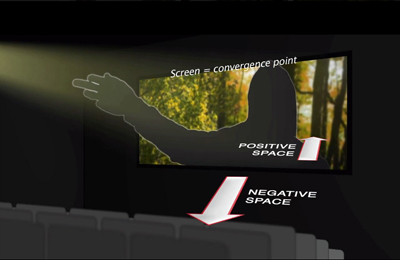
The changes that Cameron and Jackson propose are more sweeping. Now that digital projection is an accomplished fact, there will be backward pressure to create a wholly digital workflow. Filmmakers who want to shoot on 35mm will be reminded that they will eventually be fiddling with a digital intermediate, and that the final version will be digital, not film-based. A selling point of digital cinema to the creative community was the promise of complete control over the film’s look and sound, so that the audience gets exactly what the filmmaker envisioned. To assure that integrity, the director will have to shoot and finish the project on digital. That will take away an entire dimension of choice—specifically, shooting on film.
The pressure to shoot 3D adds to this. Martin Scorsese and Ang Lee showed up at the same NATO convention to praise the format. Now films that aren’t tentpole items can be made in 3D, they agreed. According to Variety, Scorsese claimed that “2D projection [sic] will eventually go the way of black-and-white—used primarily as a stylistic choice—as auds will soon acclimate to depth even in indie films.” This sounds like a widening-of-the-palette defense, as does his reaction to new frame rates. “You can do anything you want [in post-production] with that image at that level of clarity, can’t you?”
In contrast to Scorsese’s offhand pluralism, Cameron, Jackson, and their confrère Lucas may be creating a scorched-earth policy. Their conception of cinema, I would say, is now largely that of the Gearhead. Their notion of artistry has become quite mechanical, in that they see progress to depend almost wholly on improved hardware (and software).
They represent three mini-generations of Hollywood techno-lover: Lucas, who began in animation; Cameron, who started as a model-builder; and Jackson, the 1980s fanboy who played with King Kong action figures. They are directors who treat cinema as a delivery system for stories grounded in genre conventions. Fantasy is their touchstone, and realism of any sort bears only on how vividly we perceive the images, not what the films show or say or suggest.
Back in 1999, Lucas noted frankly that film was becoming a form of painting, “unfixing the image.”
You have news footage, you have documentary footage—which are supposedly realistic images—and then you have movies, which are completely fantasy images. There’s nothing in a movie that’s true or real—ever . . . . The people in the movie are actors playing parts. The characters are not real. The sets are not real. If you go behind that door you’ll see there’s no building—it’s just a big flat piece of wood. Nothing is real. Not one little tiny minutia of detail is real.
The Hollywood cinema was then putting fantasy and special effects at the center of its aesthetic, and Lucas understood that every film—action picture, romantic comedy, even dramas—would rely on special effects to a new extent.
Here’s Cameron saying the same thing in defending 3D in 2008.
Godard got it exactly backwards. Cinema is not truth 24 times a second, it is lies 24 times a second. Actors are pretending to be people they’re not, in situations and settings which are completely illusory. Day for night, dry for wet, Vancouver for New York, potato shavings for snow. The building is a thin-walled set, the sunlight is a Xenon, and the traffic noise is supplied by the sound designers. It’s all illusion, but the prize goes to those who make the fantasy the most real, the most visceral, the most involving. This sensation of truthfulness is vastly enhanced by the stereoscopic illusion.
It’s hard to believe that Lucas and Cameron don’t know the long tradition of debate in the arts about realism. Realism can be considered a question of subject matter, plot plausibility, random detail, psychological revelation, and many other things; it isn’t just about trompe l’oeil illusion. Moreover, documentary and experimental filmmakers have suggested that cinema can capture moments of unplanned truth. And André Bazin and others have argued that even when presenting fictional tales, photographic cinema gives us unique access to some essential qualities of phenomenal reality. For Bazin, even an awkwardly shot scene could preserve the sensuous surface of things with a conviction that no painterly manipulation can equal—not perfection but brute facticity. Instead, Lucas and Cameron offer a Frank Frazetta notion of realism: glistening, overripe, academically correct rendering of things we’ve seen many times before.
Turnstile dynamics
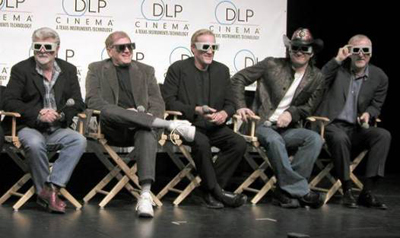
NATO’s 2005 ShoWest convention: Lucas, Robert Zemeckis, Randal Keiser, Robert Rodriguez, Cameron.
I see a valid place for a cinema of splendor and spectacle, especially in certain genres. There’s nothing wrong with seeking new methods of pictorial representation, as Spielberg did in Jurassic Park, a genuine triumph of veridical realism. Nor am I trashing Lucas and Cameron wholesale; I admire their early films a fair amount. But they’re forcing their conception of cinema on all filmmakers.
Am I being unfair? I don’t think so. When directors say that digital or 3D or 48 fps is the future of cinema, they’re implying wholesale conversion is in the offing. Although Scorsese says that 2D or another frame rate will remain an option, Cameron and Jackson aren’t quite so open-handed. Because they’re convinced that the result is much more immersive, and immersion is always good, the technology should suit every kind of movie. Cameron again:
It is intuitive to the film industry that this immersive quality is perfect for action, fantasy, and animation. What’s less obvious is that the enhanced sense of presence and realism works in all types of scenes, even intimate dramatic moments.
Both directors usually add that they’re not insisting that every film is suited to the new bells and whistles, that it has to suit the plot and so on—the usual boilerplate about the primacy of “story.” “Stereo [imagery] is just another color to paint with,” says Cameron.
But they sound as if not having 3D or 48 fps puts the movie at a disadvantage. Cameron in 2008:
Every time I watch a movie lately, from 300 to Atonement, I think how wonderful it would have been if shot in 3D.
Jackson in 2011:
You get used to this new look [48 fps] very quickly. . . Other film experiences look a little primitive. I saw a new movie in the cinema on Sunday and I kept getting distracted by the juddery panning and blurring. We’re getting spoilt! . . . There’s no doubt in my mind that we’re headed toward movies being shot and projected at higher frame rates.
As happened before, the pronouncements of the directors mesh well with the initiative of the manufacturers. Back in 2005, Cameron, Lucas, Jackson, Robert Rodriguez, and Bob Zemeckis took to the NATO stage to help sell the Digital Cinema Initiatives program to skeptical exhibitors. Their support (and the box-office numbers of the 3D Chicken Little) aided the projector manufacturers Christie, Barco, NEC, and Sony in rolling out units. The number of digital screens in the US and Canada jumped from ninety in 2004 to over 300 at the end of 2005.
This year, with about two-thirds of all US screens fully converted, Christie circulated a promotional leaflet tied to Jackson’s demo. A few years ago, the future was all about 3D, but now, the text states flatly, “The future of cinema is all about high frame rates.” The cards are on the table.
At just 24 FPS, fast panning and sweeping camera movements that are a critical part of any blockbuster are severely limited by the visual artifacts that would result. . . .
The “Soap Opera Effect” has been derisively used to describe film purist perceptions of the cool, sterile visuals they say is [sic] brought on by digital.
But the success of Hollywood, Bollywood and big-budget filmmakers around the world has little to do with moody art-house films. The biggest blockbusters are usually about immersive experiences and escapism—big, vibrant, high-action motion pictures.
The HFR system, then, aims to spiff up franchises and tentpoles, and all other filmmaking must be dragged along and adjust. Although Jackson says he has heard no plans to charge more for 48 fps shows, Christie thinks we would pay for this treat:
Beyond the simple turnstile dynamics of “must-see” movies, a new, higher standard of movie-going should support premium pricing. Managed right, hotly-anticipated 3D HFR should empower ticket up-charges.
By all signs, the churn won’t stop. “Every three months you’re behind,” says Ang Lee. “We’re guinea pigs.” David S. Cohen, technology writer for Variety, believes that 48 fps is a transitional technology and that 60 fps will win out (“but not soon”). He adds: “Bizzers in both TV and movies are going to be making creative and financial decisions about HFR for years—maybe forever.”
Lucas and Cameron, and then Jackson, grasped that if cinema technology went wholly digital, it would change in fundamental ways. It would turn a medium into a platform, like a computer operating system. The most basic technology of showing a movie would become subject to rapid, radical, ceaseless remaking. It would demand versions, upgrades, patches, fixes, tweaks, and new software and hardware indefinitely.
I’m not sure that NATO’s members have fully realized this. They went into the deal lured by the chance to raise ticket prices and thus offset flat or slumping admission numbers. But attendance is still stagnant, even with the occasional stupendous successes like Avatar and The Avengers. Interestingly, AMC, one of the Big Three circuits that invested heavily in digital projection, is reportedly in talks to sell out to Chinese investors, and other chains are on the auction block. The studios are proceeding with VOD plans that may thin theatrical attendance even more.
Meanwhile, exhibitors face a long future of payouts. When cinema goes IT, as Steve Jobs might put it, we should expect a big bag of pain.
And now for something completely different
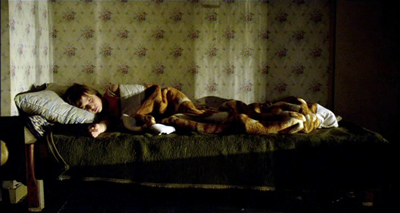
I saw Morteza Farshbaf’s Mourning (Soog) on a so-so DigiBeta copy at the Wisconsin Film Festival. This Iranian feature was shot on some godforsaken digital format, certainly nothing that Cameron and Company would approve. For all I know, its camera movements may have strobed unacceptably. I didn’t care.
Cameron et al. claim to worship the god of Story, but no film they’ve made has this subtle a grasp of narrative. Mourning gives us a plot so full of twists—in terms of what happens and how we learn about it—that I can’t summarize even the basic situation without subtracting some of your pleasure. A man and a woman are driving a little boy through a landscape. That’s about all I can tell you.
The film critics at Christie would consider it a moody art-house film. It’s also simple, suspenseful, and surprising, even shocking. It is formally inventive, emotionally poignant, and respectful of its characters and its audience. It is gentle but also unflinching. It’s the closest thing to Chekhov I’ve seen onscreen in a long time.
Was I immersed? Yes, but not in the way Cameron et al. define that state. I was trying to figure out what had already happened, what was happening at the moment, and what might happen next. And maybe I wasn’t seeing things “realistically,” in the 3D sense, but I was seeing something that captured the world we live in—our surroundings (and their stubborn physicality) and our relations to others. That world was also poetically heightened through the most straightforward means: camera placement, lighting, cutting, sound design. The film was, in other words, working in ways that we have always considered central to cinema’s creative mission.
Mourning is part of the fine Global Lens program of circulating features. Here’s a schedule of where and when films in the program are playing. Ask your local festival or art house to book Mourning, or try to see it when it’s available online or on disc. It’s even worth an upcharge.
Lucas’s remarks on realism come from “Return of the Jedi,” an interview with Don Shay in Cinefex no. 78 (July 1999), 18. Figures on the adoption of digital cinema are taken from the report, “Digital Cinema Roll-Out Begins,” Screen Digest (April 2006), 110. A detailed video explaining Hobbit production methods is here, as part of the video diaries on Jackson’s Facebook page. For more from a veteran, see “‘The Hobbit’: Douglas Trumbull on the 48 Frames debate.”
After writing this, I found that Devin Faraci of Badass Digest has a vigorously critical entry on the footage and even calls Jackson and Cameron “gearhead directors.” So I can’t claim originality, but it’s nice to know I have a badass ally.
Thanks to Jim Cortada, author of the forthcoming Digital Flood and Co-Director of the Irvington Way Institute, for explaining IT matters to me.
P.S. 11 May: Christopher Nolan, still embracing film-as-film, claims he’s no gearhead.

Carry me back to the old Virginia
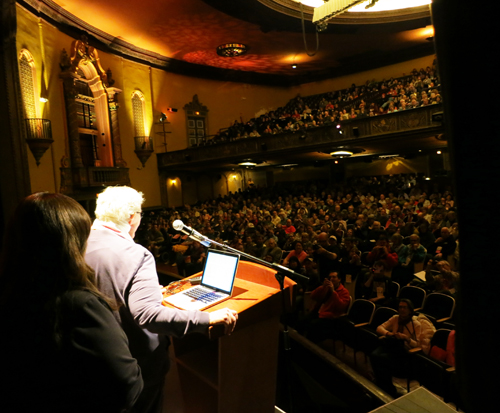
Chaz Ebert and Roger Ebert on the stage of the Virginia Theatre, Ebertfest 2012. Photo by DB.
DB here:
The fourteenth Ebertfest, held in the sumptuous Virginia Theatre in Urbana, had its customary mix of independent films old and new, Hollywood classics (sometimes cult classics), an Alloy Orchestra performance, and some unclassifiable items. It was, as ever, a crowd-pleasing jamboree. It reflected Roger’s eclectic tastes and was brought to us by Chaz Ebert, festival director Nate Kohn, and woman-who-knows-and-does-all-things Mary Susan Britt.
You can see the intros, the panels, and the Q & As—that is, nearly everything, except the movies and the offside fun–on the Festival channel here.
The young and the restless
Kinyarwanda.
First features are a hallmark of Ebertfest, and many have stayed in my memory, among them The Stone Reader (2003), Tarnation (2004), Man Push Cart (2006), The Band’s Visit (2008), and Frozen River (2009). This year there were several feature debuts.
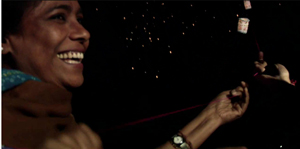
Patang (The Kite) concentrates on a single day in the life of a family celebrating the annual festival of kite-flying in Ahmedabad, India. An uncle has returned to town with his daughter, and usual in such movie reunions, old tensions are reignited. A side-story concerns Bobby, a street-wise local, and a little boy who delivers kites. Needless to say, this story intersects with and sheds light on the primary family conflict.
Prashant Barghava is a pictorialist with an eye for startling color and compositions. Shot in nervous handheld images, with many planes of action jammed together and the camera eye seeking something to focus on, Patang reminded me of The Hurt Locker, but without that film’s sense of ominous vigilance. The tone of this one is more exuberant, and the cast of nonactors gives it vibrancy.
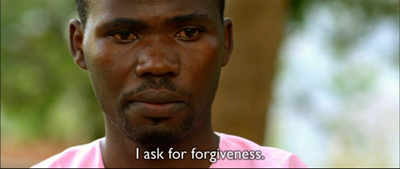
Kinyarwanda, by Alrick Brown and an energetic team of collaborators, explores the Rwandan genocide of 1994 in an unusual way. It displays the role of the Muslim community in protecting the Hutu population (many Christian, some not) from the depredations of the Tutsi death squads. To emphasize the breadth of experience, the film adopts a chaptered network-narrative structure. A Catholic priest, a young woman, an angry Tutsi, a sympathetic imam, a little boy, and a leader of the Rwanda Patriotic Front gradually converge, first in a mosque compound, and ten years later in a reeducation and reconciliation camp. The film also plays with time, replaying some key events—notably the Tutsi’s advance on Jeanne’s home—but also anticipating some outcomes. Interestingly, by showing many of the Tutsi killers in 2004 repenting their crimes before we see those attacks, the film builds a degree of compassion into its overall form.
Scenes with adults are dominated by either personal problems (the Hutu/ Tutsi clash infiltrates a marriage) or discussions of religious doctrine. There are as well wordless moments in which we follow children—a little girl whose Qu’ran has been defaced, a boy who encounters a death squad while sent to fetch cigarettes. If the adults supply the film’s prose, the kids are its poetry.
Patang played both Berlin and Tribeca and will be opening in New York, Chicago, and San Francisco soon. Kinyarwanda won awards at several festivals, including Sundance and AFI Fest, and is coming to several other festivals. It arrives on DVD 1 May.
The misfit section
Terri.
Two other young directors got good exposure. Robert Siegel wrote the screenplay for The Wrestler after working on The Onion (Madison cheer obligatory here). His debut feature, Big Fan, is the story of a football fan who is mangled by his idol and has to struggle against his family’s pressure to sue. Patton Oswalt, who had to cancel his Ebertfest visit at the last minute, played Paul with a potato-like obstinacy that offset the shrieking caricatures around him. On the down side, I could have done with a couple of hundred fewer close-ups. (Watching a movie at the Virginia reminds you of the power of the two-shot.) Still, Siegel wisely doesn’t give his hero a girlfriend who would lead him to the Big Normal and wean him away from his obsession. As Siegel points out, “He’s completely happy, but everyone around him thinks he’s unhappy.” Big Fan is an enjoyable portrait of the sports nerd.
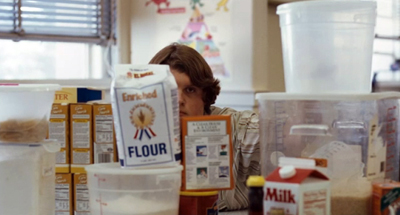
More laid-back was Azazel Jacobs’ second feature Terri. It’s sort of a coming-of-age movie, but it has a peculiar humor that such wistful exercises usually lack. Terri, an enormous teenager, goes to high school in pajamas and is teased mercilessly, but he reacts with a dead-eyed passivity that suggests both resignation and resilience. Like the hero of Gulliver’s Travels, the book Terri is working his way through, he’s tied down by Lilliputians around him, but he gets by.
It’s a film of character revelation rather than plot turns. No, Terri’s addled uncle isn’t going to die; no, Terri’s not going to lose his virginity. The action revolves around Jacob Wysocki as the title character and John C. Reilly, who never disappoints in any film, as the school principal. Their scenes together are the heart of the film, and if Terri is looking for a father-figure/ role model this off-center administrator with a soft heart for hard cases wouldn’t be a bad choice. To the film’s credit, though, we have little reason to suggest that he’s looking for any such thing. This movie has tact.
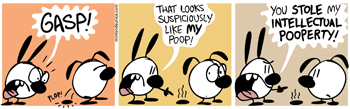
I ran into another Ebertfest first-time-director, Nina Paley, whose Sita Sings the Blues (2009) I first saw and loved at Roger’s event. Kristin had already seen it at the Wisconsin Film Fest. Sita worked her way into our blog and into our Film Art material. Nina, long a foe of copyright in any form, told me she plans an act of “copyright civil disobedience” soon. In the meantime, check her effervescent blog site, news of her new project Seder-Masochist, and excerpts from her new books about Mimi, Eunice, and their take on IP.
And then there was…
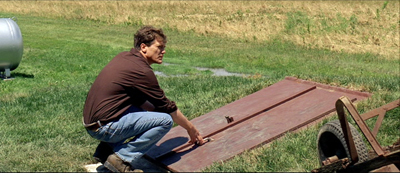
Take Shelter.
The first evening’s late show was given over to John Davies and Raymond Lambert’s Phunny Business, a documentary about the rise of a Chicago comic club, and this was preceded by Kelechi Ezie’s The Truth about Beauty and Blogs. I had to miss the doc, but go here for a review from Scott Jordan Harris. The short was charming—a snappy comedy about a single woman trying to be Queen of All Media on her YouTube show. Very quickly her aplomb cracks and she uses her online persona to recapture her straying boyfriend. Her web skills give her a rostrum, and then a tracking device (she follows him on Facebook), but soon her site turns into a diary of mounting desperation.
Higher Ground: Not a come-to-Jesus moment but a go-from-Jesus one. I had trouble figuring out the tone. I think the obvious caricatures, including an unctuous evangelical marriage counselor, were there to suggest that the ordinary believers were more worthy of respect. But they all gave me the creeps, including the relentlessly sunny pastor. Also, it seemed a bit of a hothouse drama. I missed a sense of exactly where this story took place, and I kept wondering how all these people made a living wage. But of course it’s Vera Farmiga’s film, and as usual she projects a wary intelligence. The opening sequence showing a string of people being immersion-baptized had a winning radiance.
Joe vs. the Volcano: Joe wins the match, sort of. It deserves to be a cult film for its portrayal of a workday out of the dankest basements of Brazil and Hudsucker Industries. Still, I thought everybody was trying a little too hard, especially Meg Ryan. Cinematographer Stephen Goldblatt talked about how he likes shooting on film and showing on digital: Film’s richness can support 4K, 8K, or whatever. As for 48 frames per second: “I can’t wait.”
Paul Cox: On Borrowed Time: A warts-and-all tribute to the stubborn director of over thirty films. I can’t think of a question to ask about Paul Cox that the film doesn’t answer.
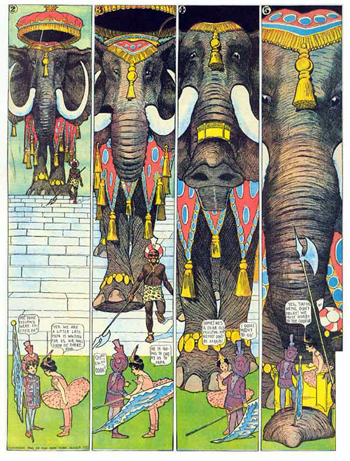
The Alloy Orchestra: Wild and Weird: Classic early trick-films plus a couple of avant-garde items from the 1920s given new brio by the Alloy boys. It was fun but less hefty than earlier efforts. I especially liked re-seeing Winsor McKay’s Dream of a Rarebit Fiend (aka The Pet) from 1921, which replays McKay’s fascination with figures and spaces that swell to mammoth proportions (a bit like Avery’s King-Size Canary), though the effect is less looming onscreen than in the comics. You can see the whole thing, and other of the W & W titles, on Fandor, one of this years E-fest sponsors.
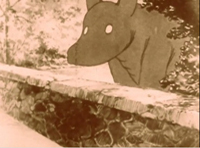
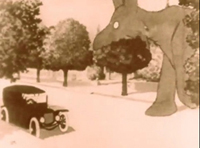
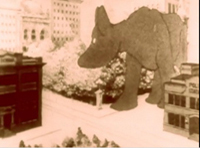
I’d like to see the Alloy talents and others move away from the big spectacles like Napoleon and Metropolis, which appeal to our current tastes in splashy films with special effects, and toward quieter, less-known silent masterworks by the French (e.g., Germinal), the Danes (The Abyss, The Ballet Dancer, The Evangelist’s Life), Italians (Il Fauno, Rapsodia Satanica, Ma l’amore mio non muore) and above all Victor Sjöström. Audiences would, I think, love Ingeborg Holm, Sons of Ingmar, Masterman, and The Girl from Stormycroft, and the Alloyists could do them proud. Not to mention William S. Hart, whose films are among the pride of US silent cinema.
Take Shelter: A tour de force of what literary theorists call the fantastic: Is the hero going mad, or is there indeed something real behind his visions of impending disaster? Everyone has praised, and rightly, the precision of the performances and framings. Jeff Nichols was another first-timer at Ebertfest some years back, with Shotgun Stories. Take Shelter is the sort of movie that makes independent American cinema proud.
A Separation: I wrote about it here a year ago, having seen it during what might be my last visit to Hong Kong. This time around, I admired it all over again. It shows many characters’ attitudes without bias (everyone has his or her reasons), and it’s aware of how lies told out of loyalty corrode love. The screening was enhanced by excellent background information from Michael Barker of Sony Pictures Classics and Omer Mazaffar during the Q and A.
If you’re a good storyteller, I think, you balance straightforward presentation (e.g., A Separation’s exposition, which sketches in the core of a relationship) and somewhat sneaky suppression (e.g., the ellipsis that hides a key event from us). I’ve argued that Iranian directors understand suspense better than almost anybody working today, and this film supports that hunch. Now let’s get hope we get to see, on some platform, Arghadi’s earlier exercise in mystery and ambivalent morality, About Elly. Now there’s an overlooked/ forgotten film.
E-fest goes digital
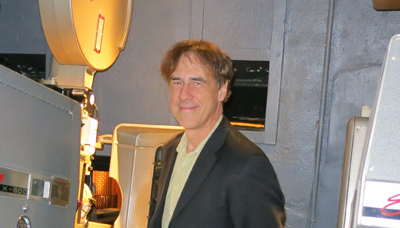
Ebertfest has shown digital copies of films in the past, notably Bad Santa and Woodstock, but this time around only Take Shelter was on film. Everything else was on HDCam, except Paul Cox: On Borrowed Time, which was on Blu-ray.
James Bond, legendary projection magician and theatre designer/ outfitter, oversaw the shows. Although the films often looked very good on the 50+ -foot Virginia screen, his expert eye saw shortcomings in the digital versions. Even I could detect the videoish quality of Joe vs. the Volcano. It looked pretty good, but compared to what James had shown in years past—70mm prints of Lawrence of Arabia, Play Time, My Fair Lady—there was definitely a sense that we were passing into a new era. Above you see James between his thoroughbreds, the lovingly assembled 35/70mm projectors.
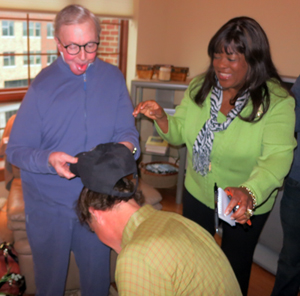
Because Steak ‘n Shake became a festival sponsor this year, Roger presented James with the first-ever S-n-S award, a cap displaying the motto, “In Sight It Must Be Right,” a fitting label for James’ superlative standards in projection. Here he receives the Order of Takhomasak.
James was ably assisted by Steve Kraus and Travis Bird, who is both a musician and a cinephile. Great guys and great professionals, all.
The Virginia Theatre, an analog artifact if there ever was one, is closing after Ebertfest this year. It will be renovated and spiffed up, with new seats and many other upgrades.
The festival wrapped up with Citizen Kane brought to us digitally. A Blu-ray copy was screened, and instead of the film’s original track, we heard Roger’s pointed and wide-ranging 2001 commentary. He was by this point an old hand at play-by-play explication, after years with his “Cinema Interruptus” series, now taken over by Jim Emerson. After the screening, I was happy to be able to interview Jeff Lerner, of Blue Collar Productions. Jeff produced and recorded Roger’s commentary. Again, check the Ebertfest channel if you want to see the Q & A, which takes off after Chaz’s moving memoir.
Thanks to the many staff and guests who made this year’s Ebertfest especially enjoyable. I’m particularly grateful to C. O. “Doc” Erickson for giving me an interview for an upcoming blog entry, and to David Poland and Michael Barker for enlightening table talk. Thanks as well to Jim Emerson, excellent companion of the highway.
Thanks to Kat Spring and Nate Kohn for correction of boo-boos.
Speaking of digital, here’s a neat possibility: http://gizmodo.com/5906353/the-avengers-screening-delayed-because-some-dunce-deleted-the-freaking-movie.
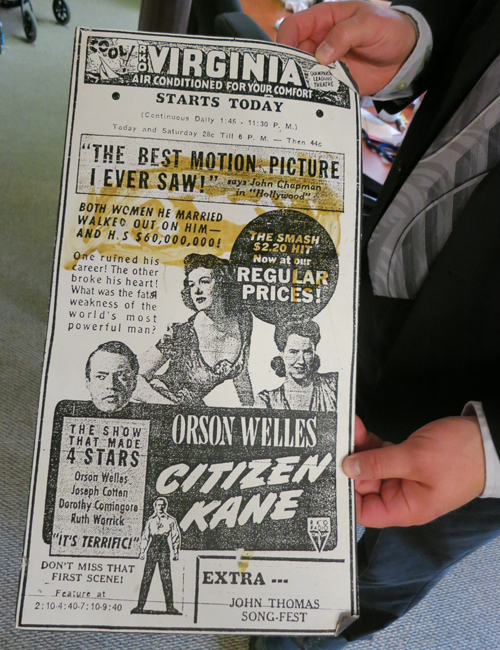
This deserves a blog entry of its own. The hands belong to Steven Bentz, Virginia Theatre Director, whom we must thank for preserving this ad (from, I assume, 1941). Note the listing of start times for the feature, and the request not to miss the opening. This is a topic discussed elsewhere on this site.
Spring comes, bringing movies for Badgers
Good Bye (Mohammad Rasoulof).
DB here:
The thirteen years of our Wisconsin Film Festival have furnished plenty of high-definition moments. I’ll never forget Roger Ebert facing a crowd of a couple of thousand in the Orpheum Theatre to introduce A Hard Day’s Night, or Michael Snow explaining Corpus Callosum to a couple of hundred of the devout in our Cinematheque. We sponsored the first retrospective of Hong Sang-soo’s work—after he had made only three films—and he came along. Hundreds of young filmmakers have visited Madison with their independent works, while we’ve also sponsored some wonderful restorations of classics. Somehow spring always arrives right on time as people line up, chatting, to pass from sunshine into the darkness of our local movie houses, or to the many coffeehouses and pubs near the venues.
Some years the festival has clashed with the Hong Kong International Film Festival, and it’s always been awkward for me to leave Madison for the Fragrant Harbor. But this year, number 14, I can happily stay at home and let the festival come to me.

Roger Ebert and Meg Hamel, Wisconsin Film Festival 2006.
You can see what’s on offer here. Our programming team has gone the full distance for us.
This year’s guests include the distinguished experimentalist Phil Solomon (three programs, one curated by him) and Dan Levin, cognitive scientist and part-time filmmaker , who’s paying tribute to Joel Gersmann in a movie called Filthy Theater. We also have James Schamus of Focus Features. You know him as the award-winning screenwriter of many Ang Lee films and a founder of the Good Machine company, a bastion of bold independent cinema in the 1990s. His New York Times profile is here. James is giving a talk, “My Wife Is a Terrorist” on Thursday at 7:30, and it should be quite something: a narrative analysis of his wife’s Homeland Security file, including, he promises, meditations on redactions.
I thought I’d use today’s entry to signal to Madisonians, and anybody else who’s interested, some of the films that we’re showing that I’ve found worthwhile. In some cases, I supply links to write-ups on this site.
Monsieur Lazhar is a warm drama given astringency by its sudden bits of realism. The mysterious title character takes a teaching post in a primary school and must negotiate between corridor politics and students’ personal problems. Just enough sweetness, just enough toughness, and just enough of an uncertain ending to put it squarely in the Tradition of Quality. That isn’t meant as a complaint.
For me The Devil, Probably is second-tier Bresson, which means first-rate anybody else. People tend to forget that this spiritual director, his eyes supposedly lifted to the clouds and mists of holiness, was also resolutely secular. He was fascinated by young people and their way of being in the world, from the boyish Country Priest to the hapless Mouchette. Moving with the times, he gave us this reflection on post-’68 disenchantment with where things were going. I should see it again. Everybody should.
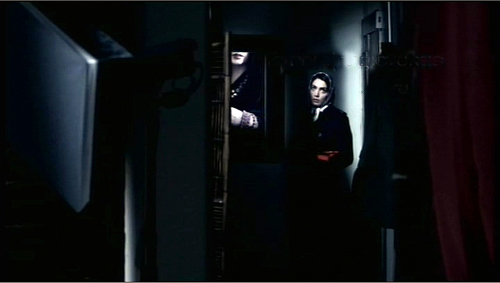
Good Bye (aka Goodbye) has a bit of Bresson about it. It’s an austere film concentrating on a woman lawyer forced out of her profession and up against a plethora of problems. Her past and present unfold gradually: Every scene has two levels, usually a mundane action that gradually yields hints about her husband, her unborn child, and her plans to leave Iran. A scathing portrait of a culture of bureaucracy, bribery, and surveillancer (the film was smuggled out of the country), Good Bye will stay with you. Kristin talks about it here.
Current, in my view wholly justified, admiration for Tinker Tailor Soldier Spy should bring people to The Deadly Affair, Sidney Lumet’s intelligent version of A Call for the Dead. All have had their say about Guinness vs. Oldman as spymaster George Smiley, but what about a 57-year-old James Mason in the role? This time around the sexual jealousies underlying the recent Tinker Tailor are brought to the fore (the title is a pun), with Harriet Andersson as a ravishing Ann Smiley.
Another Brit retrospective item is Alberto Cavalcanti’s Went the Day Well? Kristin spent a whole blog on this surprisingly grim study in complacency overcome by offhand heroism.
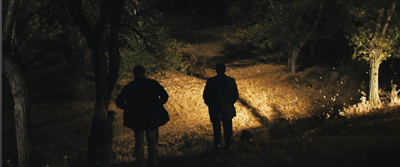
One of the very best films we saw at Vancouver last fall was Once Upon a Time in Anatolia (above), which we discuss a little bit here. Somber and mesmerizing, it coaxes you to pay attention. My kind of movie.
Speaking of Hong Kong, there’s one of Johnnie To’s latest, Life without Principle. This story of intersecting destinies during the European financial crisis spurred me to comment at some length here. To is, in my immodest opinion, one of the best directors working anywhere today, and a chance to see his recent work is really splendid. We have a 35mm print, and I’m tempted to go back and see it a third time.
Klown’s outrageous bad manners are perhaps a little too calculated, but this Danish dramedy from Lars von Trier’s company does catch you up. Laced with jokes about pedophilia and manly touching rituals, it seems at first glance a rough-edged bromance. Two pals and a nephew go on a canoeing trip aiming to end at an upscale brothel. After a string of slapstick disasters, the thing looks ominously like it might end in hugs and cheerful tears, but the biggest sting comes in the last few seconds. With a funny, offhand performance by musician Bent Fabric and a walk-on by Jørgen Leth (himself no stranger to outlaw sexytime).
Testosterone to the bursting point is no less on display in Policeman, a bristling, brutal examination of male bonding among Israeli cops. Although it builds to an incendiary action sequence, it’s mostly a study of how people of all classes and political cultures acquire an appetite for violence. Kristin wrote about it here.
Ben Rivers’ Two Years at Sea is a low-key, haunting piece. A portrait documentary? Semi-autobiographical fiction? Experimental film? All three, I guess. And in glorious black-and-white 16mm, which Rivers processes himself. Kristin gives it thumbs up here.
Finally: No film can portray the state of a country at a moment in history, but you’ll be thinking a lot about how today’s Russia might work after you see Elena. A character study of a woman whose ruthlessness is made reasonable and even sympathetic, a thriller centered on how to keep your enemies close, and a sociological study of the haves and have-nots in rapacious capitalism.
Because these are outstanding movies, several are listed as sold out. But some seats have been kept aside, and inevitably some who bought tickets won’t show up. The festival staff tell me that there will be a wait line for each show, and they’ll try to get everybody in. Me, I hope to watch at least a dozen programs, and I’ll try to blog about some in the afterglow. See you there?
Sleepless Night (Nuit blanche; Frédéric Jardin).