





Archive for the 'Film comments' Category
Another Bologna briefing
More notes and notions from Cinema Ritrovato, all from DB:
Could you make a movie today about a farm girl who becomes a concert pianist under the sway of a womanizing egomaniac? The slightly nutty I’ve Always Loved You (1946) displays Frank Borzage’s usual faith in the way lovers communicate by spiritual ESP, this time aided by Rachmaninoff. Borzage talked the low-end Republic studio into this expensive project, and the result, though marred by strained performances, looks great in a glowing restoration by UCLA. A teenage André Previn darts through, and for once someone playing the piano onscreen (in this case Catherine McCloud) looks skillful. (The playback renditions were those of Arthur Rubinstein, credited as “the world’s greatest pianist.”) The title is perfectly ambiguous, since it could refer to any character’s attitude toward almost any other.
Travel delays prevented Ben Gazzara from introducing the fine print of Anatomy of a Murder. Too bad. It would be fascinating to hear how he developed his disturbing portrayal of an accused killer under Preminger’s notoriously dictatorial direction. But Gazzara did participate in an interview with Peter von Bagh that led into a screening of a beautiful restoration of Jack Garfein’s The Strange One (aka End as a Man).
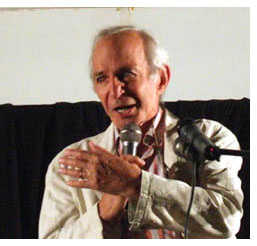 Gazzara talked of coming out of the Actors Studio after the success of Marlon Brando, a tremendous influence on Gazzara’s generation. He recalled that he was in the same Studio class as James Dean, Steve McQueen, and Paul Newman. What was the Method? “It’s a word I never use. I don’t know what it means. . . It gave you things to fall back on” if you couldn’t come to grips with the script material.
He said that he loved Hollywood acting of the studio era: Gable, Grant, Tracy, and Stewart remain fresh and modern. When he saw Meet John Doe, he realized that Gary Cooper used his own version of the Method: “He did very little, but he did everything.”
Gazzara said that seeing Faces (1968) drew him to Cassavetes. “I was mesmerized. I was so jealous. I thought, I’ve gotta work with this man.” A year later he made Husbands. Cassavetes was very supportive, always “waiting for surprises.” He was laughing in enjoyment behind the camera, encouraging his players. “All you did was safe, and you could do no wrong.”
The Strange One, set in a Southern military academy, was Gazzara’s first film. He was offered the part of the cadet who eventually leads a revolt against the Machiavellian cadet Jocko De Paris. But Gazzara said that he wanted to play DeParis because “he got all the laughs.” George Peppard wound up with the good guy role. Though the film seems to me confused on several dimensions, Gazzara revels in the showy part of a soft-spoken, eminently reasonable sociopath. As in Anatomy of a Murder, he makes gently menacing use of a cigarette holder.
In the early 1930s, Japanese companies explored the possibility of exporting their films to Europe and the US. One result of these initiatives was Nippon: Liebe und Leidenschaft in Japan, a 1932 German compilation created by Carl Koch. It originally consisted of three films from the Shochiku studio, condensed and supplied with German intertitles. The original films were silent, so, oddly enough, synced Japanese dialogue was added.
In the version screened here, only two episodes were presented. What beauties they were! Since many of the 1920s and 1930s Japanese films that survive look quite weatherbeaten, it was wonderful to see, in the print from the Cinémathèque Suisse, how gorgeous quite ordinary movies from this era could be.
The first story, Kaito samimaro (orig. 1928), deals with a young samurai rescuing his beloved from the clutches of a corrupt priest. Brisk and beautifully shot, it came to the sort of frothing swordplay climax typical of the period—rapid cutting, dynamic tracking, and slashing assaults aimed at the camera. Kagaribi (1928), about a young vassal betrayed by his corrupt lord, likewise ended with a protracted action scene capped by a jolting climax. A prolonged tracking shot follows the young man’s former lover as she backs away from him, but then we cut to a full shot. With a single stroke he kills her, jaggedly ripping a paper door in his follow-through. Both stand motionless for a moment before she falls. A conventional finish, but no less eye-smiting for that. For more on the power of this action-cinema tradition, see an earlier entry on this site.
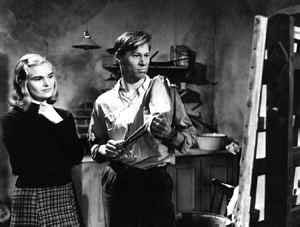
There are no fewer than ten flashbacks in the 1950 Swedish film Flicka och Hyacinter (Girl with the Hyacinths, above). Peter von Bagh’s Bologna programming has often highlighted Nordic work that’s little known outside the region, such as this engrossing post-Kane exercise in probing a dead person’s life. Teasingly directed by Hasse Ekman, the interlocking flashbacks would be savored by today’s puzzle-film aficionados, and the movie’s equivalent of Rosebud is genuinely surprising. The twist would never have been permitted in Hollywood of that era.
Kristin and I hope to post one more entry, probably soon after Ritrovato’s final session on Saturday. Lots more to report–Lubitsch, Borzage, Chaplin (of course), etc. For now, a glimpse of the official names of the Cineteca’s two screening rooms…
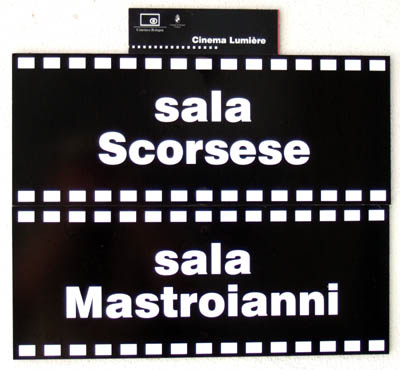
Cinema bolognese
Cinema Ritrovato, a festival of rediscovered and restored films, is now in its twenty-first year. We visited its two previous installments, and we found it one of the most hugely enjoyable festivals on the calendar. Where else can you see films from 1907, Richard Fleischer’s Violent Saturday (1955), and a tribute to Ben Gazzara in a single week? Then there are the nightly screenings on the Piazza Maggiore, which attract hundreds of locals. The city plays host magnificently, with plenty of fine restaurants and perpetually cheerful people.
Mounting hundreds of screenings and panels is an enormous effort, but Gianluca Farinelli, Guy Borlée, Peter von Bagh, and all their colleagues have made it look easy. (The word sprezzatura comes to mind.) Here are our impressions from the first half of the event.
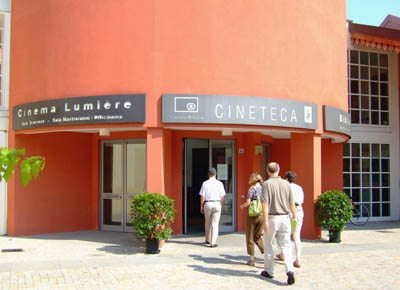
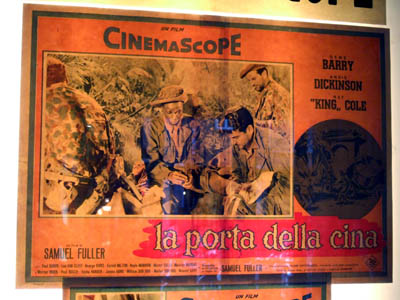
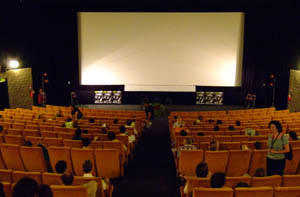
The home base is the Cineteca di Bologna, the local film archive. It’s located in a wide, quiet courtyard. It houses a large library and meeting rooms, along with two cinemas. During the festival, the Lumiere 1 auditorium specializes in silent screenings with piano accompaniment, while Lumiere 2 presents sound films. Widescreen titles and big events are reserved for the Arlecchino, a big, comfortable commercial theatre built in the era of roadshows and CinemaScope.
Organizing such a mixed program is more difficult in certain ways than presenting an event involving contemporary films, which are moving through the festival circuit already. Ritrovato must find good prints of titles that fit the year’s themes and also coordinate the ongoing efforts of archives that are restoring films.
A good example is a remarkable project overseen by Alexander Horwath of the Austrian Film Museum. One of the most famous lost films in US history is Josef von Sternberg’s 1929 movie The Case of Lena Smith. In 2003, Japanese scholar Komatsu Hiroshi found a fragment, in very good condition, in China. On the basis of this, Horwath and his collaborators created a wonderful book that reconstructs the film. It includes a detailed shot breakdown (based on one published in Japan during the film’s release), along with gorgeous stills, script extracts, summaries of critical reception in various countries, and essays about the film’s place in history.
The fragment, previously screened at the Giornate del Cinema Muto last fall, was tantalizing. Lena and her friend Pepi are in the Prater, Vienna’s dazzling amusement park, and they are eyed by two young officers. The women watch some of the sideshow entertainments before darting away, the officers in pursuit. Several of the shots evoke the heady atmosphere of the park, with prismatic, superimposed images of the sideshow attractions and—typical von Sternberg—a spinning ride providing pulsating visions of the crowd.
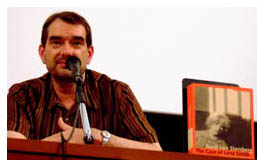 In his panel presentation, Horwath stressed that the book couldn’t have been done without the cooperation of researchers around the world. The multilingual volume is to be made available in the UK and the US in 2008. It is a splendid example of what archives and scholars can accomplish working together, with festivals like Cinema Ritrovato providing a forum for rediscoveries. The book is available already at the archive’s website and will be distributed later this year by Wallflower in the UK and Columbia University Press in North America. (DB)
One of the threads of this year’s festival is the early US career of Michael Curtiz. The Strange Love of Molly Louvain (1932) is an energetic Warners crook melodrama. Starring Ann Dvorak and the ever-annoying Lee Tracy, the film displays Curtiz’s characteristically staccato direction. The scenes with hard-bitten reporters use overlapping dialogue in a manner that prefigures His Girl Friday. Rarer was The Third Degree (1926), an early instance of Europe’s “International Style” infiltrating Hollywood. For his first Warners project, Curtiz fills an implausible mother-daughter melodrama with cloudy superimpositions, canted angles, florid tracking shots, oddball angles, extreme close-ups, and frantic montages played with prismatic lenses. Richard Koszarski gave an amusing and helpful introduction. (DB)
One attractive constant of the Ritrovato is a series of short films from 100 years ago. Thus when we first attended in 2005, there were groups of shorts from 1905. As we progress through the early years of the current century, we go in parallel through the early years of the previous one. Each day one or two small groups of 1907 films have been shown, grouped by country or genre. These included some familiar items, like the poignant Le Bagne des gosses (“Children’s Prison,” Pathé) and the amusing British chase film, That Fatal Sneeze (directed by Lewis Fitzhamon). I have run across references to early Westerns made in Europe but had not seen any from this early period. Les Apaches du Far-West (produced by Pathé) is as unauthentic as one might predict, with the cowboys riding on English-style saddles and the shoot-outs with the Apaches taking place in bucolic fields and woods that are clearly in France, not the West. (KT)
A major new initiative for international film preservation was announced in May at the Cannes Film Festival. The World Cinema Foundation was founded by Martin Scorsese, and its advisory board contains such major filmmakers as Abbas Kiarostami, Elia Suleiman, Walter Salles, and Wim Wenders. The goal is to restore films made in nations that lack the archival facilities to do so locally.
The Moroccan Transes (El Hal, 1981), directed by Ahmed El Maanouni, is the new foundation’s first restoration, and it was introduced by the director and by its producer, Izza Genini. The titles crediting Giorgio Armani, Cartier, and Qatar Airlines as sponsors raised some surprised laughter in the audience, but if Scorsese and his colleagues can draw funding from such sources into film restoration, all the better. Transes is partly a concert film and partly a history of a band that became popular in the 1970s by expressing young people’s frustrations and rebelliousness. The big concert that begins and ends the film is exhilarating in its depiction of the crowd’s enthusiasm—but chilling as well as soldiers patrol the audience and occasionally suppress the more demonstrative spectators. (KT)
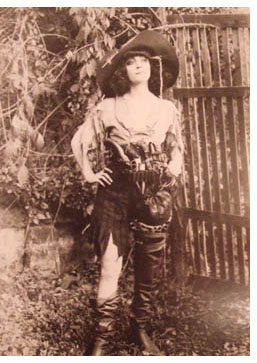 Another major theme is the ever-popular star Asta Nielsen. Again, items familiar from other retrospectives are mixed with new discoveries. Karola Gramann has curated the series and plans to restore other Nielsen films, either new discoveries or better prints of familiar films. Zapatas Bande (1913-14), for example, existed before, but now a color print has been made based on tinting notations on an existing black-and-white copy. It’s a slight item, a casual tale of filmmakers getting into trouble while shooting an adventure movie, but it allows Nielsen to get away from her usual melodramas and display her range as a comic actor. (KT)
Our first visit to Italy for a film festival was in 1986, when Le Gionate del Cinema Muto, in Pordenone, presented a vast retrospective of Scandinavian cinema from the pre-1919 era. One of the major revelations was that alongside Mauritz Stiller and Victor Sjöström, there was a third great Swedish director during the silent era, Georg af Klerker. The event also brought home to the audience one of the great tragedies of cinema history, the loss of many of Stiller’s and Sjöström’s films in an archive fire in the 1940s.
Every now and then, another film by one of these masters surfaces. This year the Ritrovato festival showed Madame de Thèbes, a 1915 Stiller film. As too often happens, the surviving copy, a French release print discovered by Lobster Films, was incomplete. The Svenska Filminstitutet has filled it out by inserting still shots created from copyright frames deposited at the Library of Congress and by replicating the original Swedish intertitles and letters. The result, full of sumptuous decor and extravagant plot twists, gives as good an approximation of the original as is now possible. It’s one more indication that the 1910s Swedish cinema was one of the glories of the silent era. (KT)
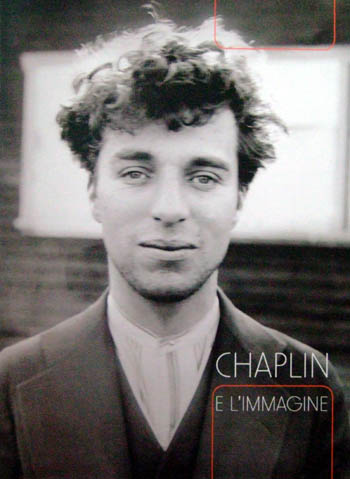
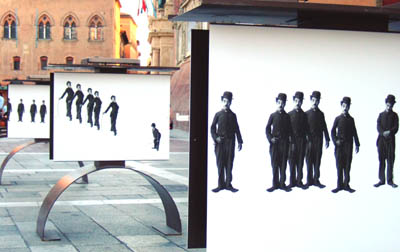
The festival has a close relation with the Charlie Chaplin estate; this is the place to come for the latest in Chaplin restorations and scholarship. Every year the festival mounts a tribute, including a superbly designed book on some aspect of Chaplin’s career. This year’s volume is a collection of rarely seen pictures, and its cover carries one of the most melancholy and haunting portraits of Charlie I’ve ever seen (up top).
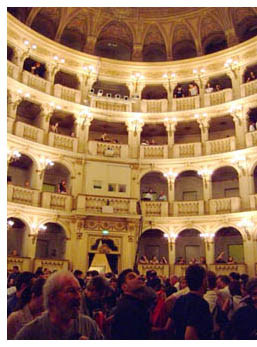 The first big event of the festival was a screening in the city’s Teatro Communale, an overpowering opera house. It was a fitting venue for The Idle Class (1921) and The Kid (1921), accompanied by orchestra. The prints were pristine, shown in a nearly square ratio. The version of The Kid was based on Chaplin’s 1971 rerelease, since that represents his final thoughts, but the Bologna gang generously tacked on the material that Chaplin chopped out—all scenes with Edna Purviance, playing the unwed mother who abandons her baby. These scenes include her uneasy meeting her old lover years after she’s achieved success. The plot turn and the regretful tone seemed to me to look forward to A Woman of Paris. This version, along with the deleted scenes, is available on the MK2 DVD release.
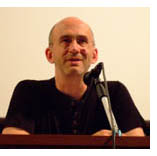 The score was by Timothy Brock, who also conducted. On the following day Brock gave an enlightening seminar on how he based his scores on original themes that Chaplin came up with. Chaplin was in the habit of working and reworking tunes at the piano, and many of his efforts were recorded. The recordings came to light three years ago, and Brock was able to integrate the tunes into his scores—sometimes linking five or six in a single passage. (DB)
A cloud was cast over our visit by the news of the death of Edward Yang (Yang Dechang). We admired his films and discussed them in Film History: An Introduction and my Figures Traced in Light. Edward was a likeable, tough-minded fellow. His films explored the effects of urbanization and politics on everyday life in Taiwan. He made his breakthrough to a broad international audience with Yi Yi (2000), but his other films, particularly Taipei Story (1985), The Terrorizers (1986), and A Brighter Summer Day (1991) are to me even more important. It’s a great loss that these aren’t easily available on DVD. When I get back to Madison and have access to pictures from my encounter with Edward in Kyoto in 1997, I hope to write a more adequate tribute. (DB)
Christian Bale picks up a rail
DB here:
In James Mangold’s 3:10 to Yuma, some law officers are taking the captured killer Ben Wade (Russell Crowe) to the farmhouse of Dan Evans (Christian Bale). When the stagecoach sinks into a rut, Evans limps out of his house, snatches up a fence rail, and uses it to pry the wheel free.
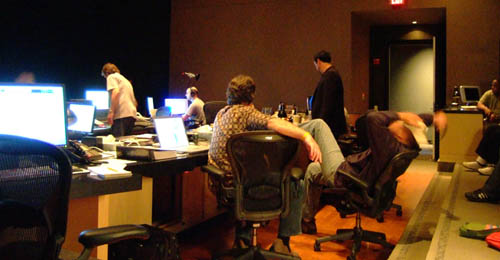
Not an earth-shattering moment, but one I got to know pretty well last week when I visited the mixing session as the director’s guest. About a year ago, Jim sent me an email expressing his liking for my book The Way Hollywood Tells It. We kept corresponding through the planning and production of Yuma, and last month he asked me if I wanted to see the picture-locked film and visit a sound mixing session.
As we say in Wisconsin: You bet.
Watch their eyes
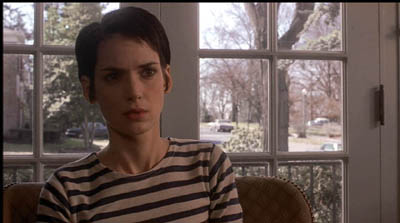
Mangold has been prolific, turning out seven films in about twelve years. Heavy, CopLand, Girl, Interrupted, Kate and Leopold, Identity, and Walk the Line nicely illustrate the difference between convention and cliché. While embracing each genre’s conventions, Mangold always tries to enlarge, enrich, and explore them. Where other directors try for brute impact, he seeks out implication and understated lyricism. Above all there are the nuanced performances, female ones in particular. (Remember those Oscars for Angelina Jolie and Reese Witherspoon.) If anybody can bring the psychological nuances of that elusive “indie sensibility” to mainstream filmmaking, James Mangold is a likely candidate.
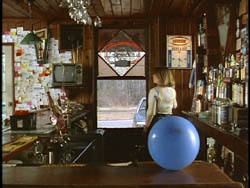
As a writer-director, he balances concern for story and character with a carefully wrought visual style. The opening of Heavy makes a shabby tavern beautiful through precise compositions and geometrical cutting that recall Ozu, whom Mangold has acknowledged as an influence.
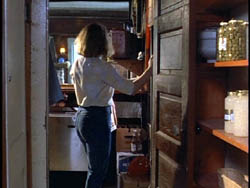
At the same time, he has understood one of the great strengths of the Hollywood tradition—letting the actors’ faces tell as much of the story as possible. He believes that the script should include not only dialogue but also “pieces of silent acting.” John Ford remarked of actors: “Watch their eyes.” Mangold’s version of this precept can be found on the DVD commentary of Girl, Interrupted: “Actors dance with their looks and glances.”
In fact, his commentary tracks are gold. Anybody who wants to know more about the craft of writing and directing should simply sit down and listen. Mangold is not one of those I-do-what-I-feel guys; he channels the story’s feeling into precise, writable and filmable moments, and his commentary tracks explain how he does it.
Delmer Daves’ original 3:10 to Yuma (1957) is one of Mangold’s favorite films, as he explained several years ago in the interview with Tod Lippy that prefaces the published screenplays of Heavy and CopLand. He’s been bold enough to remake it, in an era in which Westerns are supposed to be unpopular. I was keen to see what a director renowned chiefly for intimate psychological dramas would do with a Western. Yet maybe the gap isn’t so great after all. Mangold points out in the Lippy interview that most classic Westerns aren’t action pictures but character studies.
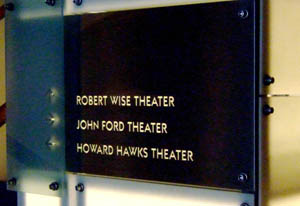
In the shadow of John Ford
The Yuma production has been chronicled elsewhere on the internets, so I won’t rehearse it here. I came in on the third day of mixing. The session was held on the Twentieth Century Fox lot, at the John Ford theater (a lucky spot, surely). Mangold, his editor Mike McCusker, and half a dozen sound specialists had already been working through the morning. The team included the lauded sound rerecording mixer Paul Massey, winner of three BAFTAs and recipient of five Oscar nominations. His work includes Nixon, Clueless, Gattaca, Jerry Maguire, Master and Commander: The Far Side of the World, the second and third Pirates of the Caribbean films, and not least, the wonderful SCTV parody The Last Polka.
For me, it was an intensive four-hour seminar. Once I start to focus on a movie soundtrack, I have to marvel at the level of precision you can find. As we tell our students: It’s hard to really watch a movie, but even harder to really listen to it.
When Jim asked if I’d sat in on a mix before, I had to confess that I’d visited only one—a session in which Walter Murch was blending rustling foliage and mosquito noises for a scene in Apocalypse Now. (Must blog about that some day.) Things had changed a lot since the 1970s. No longer was a scratchy black-and-white print run and rerun; now we get a 4K image on a large screen, crisp and bright and frozen on a frame for as long as you like. Now there are several mixing stations, each one with a glowing Mac monitor alongside.
The standard division of labor endures, but it’s much more refined. Music is filed on many tracks and with a few mouseclicks can be reworked in tempo, timbre, and orchestration. The dialogue tracks consist of thousands of stored line readings, ready to be pulled up in moments. As for sound effects, at this point Yuma had 96 effects tracks, each of them already premixed from many sources. I usually notice the impact that the digital revolution has had on camerawork and editing, but this session really drove home to me the ways in which the computer has made the art of the soundtrack more exact and exacting.
Details, details
Most of the session was devoted to effects. The first problem was that the track seemed to Mangold too “absent,” too thin and empty. Mike remarked that he didn’t feel the atmosphere, the air between the more discrete noises. “There’s nothing of any character that’s holding it all together,” Mike said. The difficulty, though, as Jim pointed out, is that if you simply add in more sounds, you can confuse things. “If we hear just one moo, that becomes an event.” How to thicken the acoustic atmosphere without muddying it or creating competing noises?
Step by step, the team filled in the ambience. They added tiny air currents, always seeking to avoid what Mangold called “radio wind.” We got very soft and distant moos, shifting horse hooves, even low “horse vocals.” After it was all blended, I found the ambience full and modest, but Jim and the others felt that it was still too bright. They would go back later and mute it a bit.
Now that the ambience was fleshed out, the rest of the session was devoted to specific effects and a few lines. Jim asked for a heaving sound as the stagecoach burst out of the rut, more jingling on the coach reins, a little clinking on Russell Crowe’s handcuffs, a gun-cock. When Crowe’s henchman (Ben Foster), watching from the ridge, urges his horse to move, he makes a smootchy tsk-tsk; Mangold wanted to give it a slightly mocking edge, suggesting the killer’s disdain for the guards’ efforts to protect Wade.
During the 1990s I’d noticed the greater detailing of movie soundtracks. I heard garments brushing against sofas and flakes of tobacco crackling when someone lit a cigarette. Now I was seeing and hearing how skilled artisans orchestrated thousands of such sonic micro-events. They clarified a muffled line. They inserted the sound of stagecoach springs shifting. The words “Good luck” were shifted eight frames. At one point Jim asked for a new line to be put in. “We need a ‘Let’s go.'” “Should I steal it?” “Steal it.” How much of this would be heard in the typical multiplex, or even in fancy home theatres? These guys were going all the way down, creating something of great finesse.
Jim reminded me that sound can create a sense of visual momentum too. The coach drives off in two shots, a long shot and an extreme long shot, and Mangold thought it seemed to go a bit faster in the second. So he added noise that gave an accelerating launch to the first shot.
Then there were Mr. Bale’s steps and the rail he picks up, which gave me an acoustic hallucination.
David is hearing things
As Dan Evans limps out of the cabin (he was wounded in the war), Jim found his footsteps too thudding. He wanted to hear that they were “grounded,” that there was some loose earth underfoot. The team worked to add the textures of pebbles and grit as Evans makes his way to the coach. The action was replayed many times. As the texture thickened, the fence rail that Evans grabs started to sound different to me. At first it was a soft but distinct scrape against the ground; at the end of the mix, it had a faintly twangy timbre. I congratulated the team on giving the rail its own little moment.
They looked at me. They hadn’t done a thing to the rail.
Two explanations arise, maybe both correct. (1) The sound team said that constantly replaying a clip can create such little mirages. Faced with so much repetition, maybe the mind needs to project some variation into it. (2) Changing the texture of the whole scene can alter our sense of the individual, unchanged elements. If there was a little twang to the rail, perhaps it came from overtones or other emergent qualities of the mix.
Maybe too, in my third hour of concentrating on minutiae of the track, I was getting oversensitive to sound.
Realism and convention
After the stagecoach drives off, Wade and the men guarding him trudge into Evans’ cabin. There’s a short scene with Wade and his wife, and that too needed its ambient filling in. I noticed that the banker, first glimpsed inside the cabin, is somewhat closer to the couple a few shots later. Jim noticed it too. In a jiffy three or four very soft bootsteps and slightly creaking boards were added, so that subliminally we were prepared to see the banker on the porch.
Night falls and two of the men guarding Wade are lingering on the cabin porch. It was simple dialogue, filled out with the atmospheric sound. The sound mixers had to redo one actor’s line reading, yanking an alternative out of the files. Jim still wasn’t satisfied and thought they might reloop the line later. Most interesting was Jim’s idea to add some softly clinking dishes to the tail of the scene, preparing us for the cut inside to Evans’ family at dinner with Wade. In these ways, barely perceptible sound smooths over cuts and shifts of point-of-view.
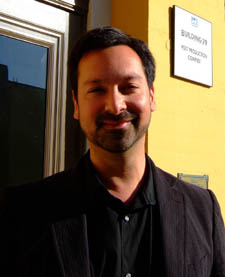 In the course of all this, as Paul and Mike and the others were fixing things, Jim came back to talk with me. He answered my questions and we chatted about directors, mostly Spielberg. Close Encounters is a favorite of his, and he pointed out ways in which it’s been influential on a range of other movies. He also showed how aware he is that realism in sound goes only so far and that pure conventions often kick in. In a movie, when somebody hangs up a phone abruptly, the person on the other end hears a dial tone. Does that ever happen in life? You just get silence. But the dial tone conveys a stronger sense that the line has been broken.
Jim halted the session as the family dinner scene began. The team would continue to polish it, and he’d be back tomorrow to keep going. I snapped a picture of him just before he left. Later, I caught up with Mike McCusker, who also edited Walk the Line. He has an enormous respect for Mangold, saying that his success with female performers was reminiscent of Cukor’s accomplishments.
Next day, watching the premix version of the whole movie, I saw Christian Bale limp thuddingly to the coach. Almost no moos or jingles, and definitely no clinking crockery. No twang when he picked up the rail. You almost never get a chance to notice this sort of before-and-after differences on soundtracks, and it brought home to me how much skill and effort would go into reworking every scene. Making movies is really, really hard work. And I remembered another reason I like movies: They sharpen your senses.
Coming attractions
I plan to write more on 3:10 to Yuma in a few days. In the meantime, Kristin may be posting her experience at another mixing session–that one in Wellington, New Zealand in May. Over the next week we’ll also be filing reports from Cinema Ritrovato in Bologna. Sign up for a feed if you want to keep abreast of developments.
Professor sees more parallels between things, other things
An Onion report brought to my attention by Stew Fyfe celebrates the comparative method (“Professor Sees Parallels between Things, Other Things”). I confess myself an admirer of this approach. We can learn a lot by setting two things alongside one another. It’s even better if we have a reason to do so.
I thought about this when Kristin and I visited the Auckland Art Gallery in May. Their modern wing was hosting an intriguing Triennial show called Turbulence, an array of contemporary work, but I was more drawn to the Museum’s traditional collection. I saw a very nice Brueghel (he’s one of my favorites) and an arresting Adoration of the infant Jesus, painted by the rather minor Francisco Antolinez y Sarabia (1644-1700).
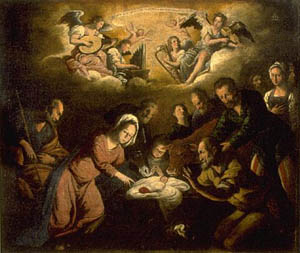
Though indifferently painted, it reminds me of El Greco in its tipped, piled-up figures. I enjoyed the acrobatic Madonna: Is she crouching, leaping, or tripping? It recalls Eisenstein’s point that much classic art creates impossible contortions which suggest various stages of movement, a point I discussed in a blog last year.
To get to those parallels: We wandered through the Gallery’s sturdy collection of British art and I was once again captivated by narrative painting of the late nineteenth century. Paintings have long been assigned the task of telling stories, but usually those stories were already well-known to the viewers, drawn as they were from history or mythology. In what’s come to be called “narrative painting,” the stories seem to be taken from life, although they’re really invoking our knowledge of prototypical situations.
Without the advantage of easily recognized religious or mythological tales, such pictures usually rely on a title to coax us fill in the story. The title specifies the context for the concrete action we see. For example, two prosperous young women are sitting in a garden. One is reading from a sheet of paper. What’s going on?
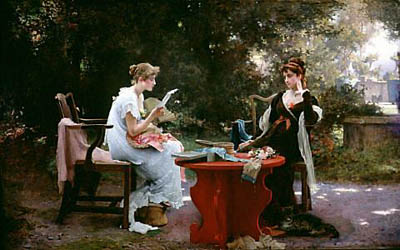
The title, Her First Love Letter, helps us zero in on specific aspects of the action and fill in the situation. The girl on the left, bathed in light, leaning forward eagerly and wearing the pale frilly dress, can be seen as the more inexperienced of the pair, caught up in the anticipation of the young man’s ardor. The more worldly woman sits relaxed, perhaps a little skeptical but also tolerant of the ways of young love. You can’t see it in reproduction, but the flower in the darker woman’s bosom is a mere spatter of paint, the brightest bit of red in the picture. The painting is by Marcus Stone and dates from 1889.
Narrative paintings like this are evidently one source of early cinema’s approach to staging and composition. This “full shot” somewhat recalls the sort of thing we see throughout European filmmaking of the first twenty years. Staging the action on more or less the same plane, viewing from a distance characters grouped around a table, is very common at the time.
Another picture can teach us a bit about acting.
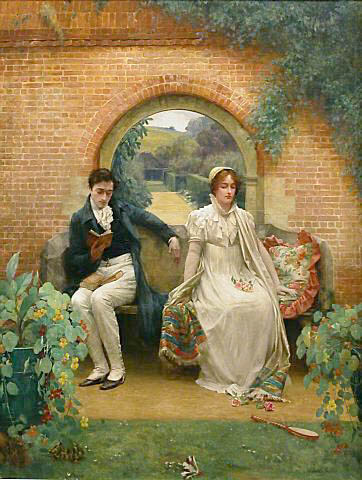
Here the body language and facial expressions yield hints. The man sits casually, the woman more rigid, and his arm is not quite brushing hers. Absorbed in his book, he seems unaware she’s there. She sits stiffly, with downcast eyes and an expression that seems stoic. You can even take her slight unfolding of the colorful shawl as an invitation to the touch that he doesn’t offer.
This painting, by Walter Sadler, is called Married (undated but presumably turn of the century). Once the title tells us that the couple are husband and wife, we can infer that their passion has subsided, largely through the husband’s self-absorbed inattention. Did he really need to take three books into the garden? The single-word title also lets us see certain elements as iconographic clues. The woman’s white dress and bouquet recall the wedding, and the fallen badminton birdie and racket suggest an earlier time when they played together. Kristin sees sexual symbolism in the flowers in her lap and the books in his. The gallery’s caption suggests that the turtle is going off to hibernate and that the blocked-off back garden suggests no future for the relationship.
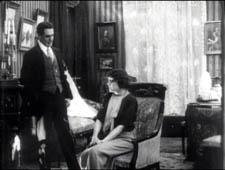
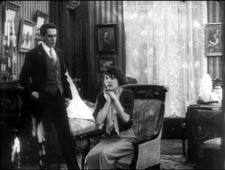
Putting aside the symbolic connotations, though, the strong cues supplied by the figures’ postures and expressions point us toward the sort of slight changes in body language provided by acting in early cinema. Some viewers think that early film acting was expansive and overblown, but that’s not always the case. Here is an instance from Evgenii Bauer’s Twilight of a Woman’s Soul (1913), in which Vera starts to confess an indiscretion to her admirer Prince Bol’skii. She raises her hands , an obvious indication of her anxiety, but more subtle is what’s going on below. At first her legs are turned toward him, but as she lifts her hands they shift a bit further away from him. Her small adjustment of her torso is a kind of accompaniment of the hand gesture, like a harmonic change accompanying a melody.
Both Her First Love Letter and Married lay their figures out along a line perpendicular to the viewer, a common strategy in early film. I discuss this in Figures Traced in Light; for other examples, see figs. 2A.7-11 here. The alternative is to arrange figures in depth, and one of the jewels of the Auckland collection illustrates this nicely. The title is more allusive than our others: For of Such Is the Kingdom of Heaven (1891), a reference to Jesus’s admonition to let children come to him (Matthew 19:14). The painter is Frank Bramley.
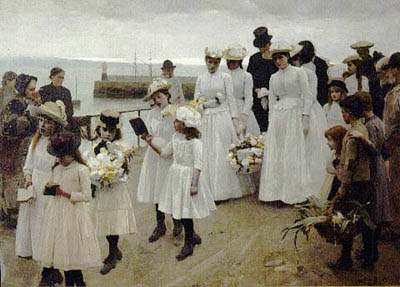
We are watching the funeral of a child, with the family carrying the almost weightless casket, swathed in flowers. In the picture’s suggestion of solemn movement, we might be tempted to say, we find early cinema before cinema. More to my point, though, is the way in which a diagonal layout creates a play between strong composition and rich ancillary effects.
The picture is composed along two lines, with the adult mourners grouped at the point where the procession intersects with the horizon. That horizon is given a widening sliver of light, a rolling wave that accentuates the heads of the two women right of center. The central bright patch of grays, whites and pastels is set off against the earth tones of the docks and the robust but respectful working-class onlookers. At the peak of the picture, the crowning moment of the angle formed by horizon and pier, is the bowed black head of the father.
The depth composition also guides our visual search, allowing us to discover a great variety of postures and facial views. The little girls in the center stride and sing from their hymnals dutifully, while the girl in the straw boater, bearing a huge bouquet, is staring at us—a disturbing effect, since her face is unhealthily gray. Will she be another victim?
In the years after 1908 or so, many filmmakers adopted the diagonal layout as a dynamic way to play out scenes. Here’s an instance from Bauer’s Twilight of a Woman’s Soul. Vera is calling on a men’s club where they practice fencing and pistol shooting. They put on a show for her.
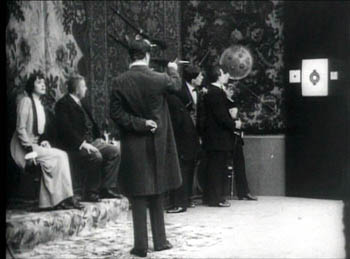
The diagonal draws our attention to the target, but Vera’s contrasting bright costume and her tilted face are further accented by putting her at the opposite end of the vector. All these factors make sure we note that her eye is on the handsome marksman, Prince Bol’skii. Receding compositions like this offered 1910s filmmakers a way to guide visual search in ways similar to Bramley’s painting.
Even more intriguing to me in For of Such Is the Kingdom of Heaven is the figure who’s evidently the dead child’s mother. She is bowed and tucked away to the right of the husband and behind two pallbearers. Bramley has taken advantage of the diagonal view to mask her off, as if viewing her grief would be too great for us to bear. This device has a parallel in cinema too.
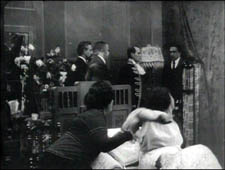
A film scene unfolds in time, unlike a painting’s action. So filmmakers can block certain parts of the action and then, at the proper moment, reveal it. If Bramley were working in film, he could arrange his cortege so that the mother’s face came gradually into view as the group advanced, creating both a dramatic and pictorial climax. This blocking-and-revealing tactic is common in the choreographed staging we find in 1910s films, and again Bauer’s Twilight of a Woman’s Soul offers a nice illustration.
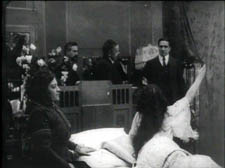
Vera, now ill, is visited by her suitor Prince Dol’skii. Her parents object, but she begs her father to let him in, and he reluctantly agrees. As the action starts, she clutches her father as the doctor looks on. The men’s bodies mask a doorway in the background, and as a servant comes through it, they pivot, revealing him.
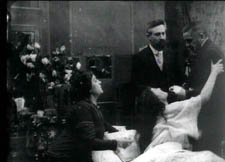
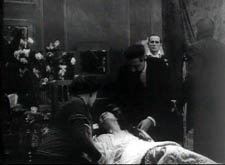
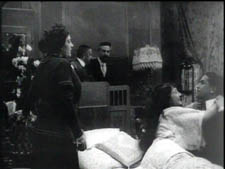
I’d argue that the servant’s entrance primes this area of the shot for the dramatically important entrance, that of Dol’skii. The father, the doctor, and the servant withdraw toward the back wall. After a pause, the Prince enters and advances.
Vera greets him warmly as he takes the father’s place in the shot.
I’m not arguing that these particular paintings influenced filmmakers, only that the principles that the painters employed were picked up by directors. The more general point is that in understanding film aesthetics, we can usefully compare movies to other movies, and movies to other arts. By doing this, we sharpen our sense of what various media can do. The professor in the Onion story wisely notes, “It’s not just similarities that are important, though—the differences between things are also worth exploring at length.”
All paintings shown here are in the permanent collection of the Auckland Art Gallery. Bauer’s film is available on a Milestone DVD. I hope to blog more about his work later this summer.