





Archive for the 'Film comments' Category
Simplicity, clarity, balance: A tribute to Rudolf Arnheim
DB here:
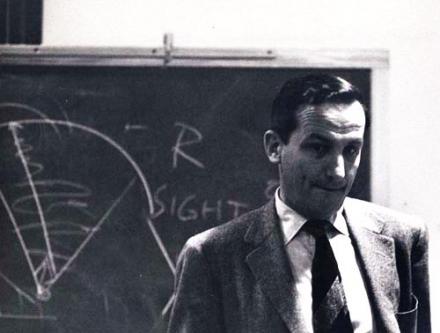
On Monday, at age 102, Rudolf Arnheim died. You can read his obituary here, and this is a lovely website devoted to his work. He was one of the most important theorists of the visual arts of the last century, and he had enormous impact on how people, including Kristin and me, think about film.
A good Gestalt
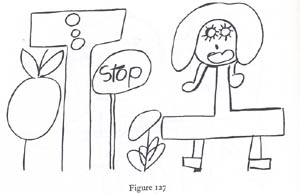
In parallel with E. H. Gombrich, who died in 2001, Arnheim brought modern psychological concepts into the study of visual art. His most famous work, Art and Visual Perception (1954, new version 1974) has the sort of magisterial presence that very few books in any era achieve. Arnheim delighted in the fact when, visiting a painter’s studio, he would find a spattered copy on the workbench. Of the revised edition, entirely rewritten, he noted:
All in all, I can only hope that the blue book with Arp’s black eye on the cover will continue to lie dog-eared, annotated, and stained with pigment and plaster on the tables and desks of those actively concerned with the theory and practice of the arts, and that even in its tidier garb it will continue to be admitted to the kind of shoptalk the visual arts need in order to do their silent work (new ed., x).
He aimed at theory that actively participates in the way artists do their job. The chapter titles of Art and Visual Perception deal with the nuts and bolts of picture-making: Balance, Shape, Form, Growth, Space, Light, Color, Movement, Dynamics, and Expression. No puns, slashes, dashes, or parentheses. What academic theorist today would so boldly announce their concern with the craft of creating images?
The book is subtitled, A Psychology of the Creative Eye, and the chapters’ subsection titles explain why. The hidden structure of a square . . . Vision as active exploration . . . Perceptual concepts . . . What good does overlapping do? . . . Why do children draw that way? . . . Gradients create depth . . . Visible motor forces . . . The priority of expression. Arnheim’s principal achievement in art theory was to integrate the Gestalt theory of perception with the traditional concerns of picture-making. He sought to show how perceptual laws discovered in the psychological laboratories of Berlin were intuitively applied by classic and modern artists.
As he put it, he was at the university at around age twenty:
My teachers Max Wertheimer and Wolfgang Köhler were laying the theoretical and practical foundations of gestalt theory at the Psychological Institute of the University of Berlin, and I found myself fastening on to what may be called a Kantian turn of the new doctrine, according to which even the most elementary processes of vision do not produce mechanical recordings of the outer world but organize the sensory raw material according to principles of simplicity, regularity, and balance, which govern the receptor mechanism.
This discovery of the gestalt school fitted the notion that the work of art, too, is not simply an imitation or selective duplication of reality but a translation of observed characteristics into the forms of a given medium (Film as Art, 3).
The Gestalters thought that these principles–figure/ground, completeness, good continuation, and the like–were fundamental to all human perception, across times and cultures. Art and Visual Perception makes a powerful case for this view. Today this position is so unfashionable that Arnheim’s calm confidence in it is quite stunning. For many scholars today, all that matters is what divides and differentiates us. But for eighty-plus years Arnheim emphasized ways in which we share a common experience of the world and of art.
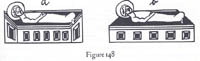 It’s often said that Arnheim favored modernist styles, like Cubism and expressionism, and that his emphasis on art as going beyond mere copying reflects modern artists’ will to distorted form. But he saw a deep continuity between classic art and modern art. Both traditions explored the perceptual force of form. Amazingly, he argues that the cockeyed creche in Fig. a conveys a stronger sense of three-dimensionality than the correct perspective presented in b. The “inverted” perspective encloses baby Jesus’ head fully, just a hollow cradle would.
Arnheim saw the same form-giving activity at work in “primitive” art, the art of children, and even the art of the mentally ill. It turns out that the “universalism” of Gestalt theory underwrites diversity no less vigorously than the most ardent postmodernism.
Flexible striving
Arnheim made another contribution to our thinking about art, one that I think is rarely recognized. In a bold stroke, he extended the Gestalt conception of form beyond its concern with geometrical qualities and argued that form was inherently expressive. A triangle resting on its base wasn’t just balanced; it was weighty. We see the weeping willow as not just curved but sad; a skyscraper isn’t just tall, it’s aggressively thrusting upward. Every shape or movement we apprehend has a distinctive flavor and feeling. Indeed, he writes, “expression can be described as the primary content of vision”!
We have been trained to think of perception as the recording of shapes, distances, hues, motions. The awareness of these measurable characteristics is really a fairly late accomplishment of the human mind. Even in the Western man of the twentieth century it presupposes special conditions. It is the attitude of the scientist and the engineer or of the salesman who estimates the size of a customer’s waist, the shade of a lipstick, the weight of a suitcase. But if I sit in front of a fireplace and watch the flames, I do not normally register certain shades of red, various degrees of brightness, geometrically defined shapes moving at such and such a speed. I see the graceful play of aggressive tongues, flexible striving, lively color. The face of a person is more readily perceived and remembered as being alert, tense, concentrated rather than being triangularly shaped, having slanted eyebrows, straight lips, and so on (Art and Visual Perception, first ed., 430).
Arnheim found feeling in his forms.
Moving pictures
Arnheim wrote about many artforms, including mass media in his 1936 monograph on radio. His book on cinema, Film als Kunst (1932), was quickly translated into English as Film (1933). Always in search of greater clarity and point, Arnheim rewrote it in 1957. Oddly, he didn’t update it: You’ll search in vain for examples from the 1930s, 1940s, or 1950s. The touchstones remain Chaplin, Keaton, von Sternberg, and the Soviets. Arnheim held that cinema was essentially a pictorial art (see my earlier blog on this question) and that synchronized sound added very little; in fact, it might even inhibit visual experimentation. It was so easy to convey a story point with dialogue that lazy filmmakers would simply create photographed stage plays.
As a result, Arnheim is usually taken to be the summation of a certain strain of 1920s film theory. Like many earlier thinkers, Arnheim emphasized how film technique reshapes what is filmed. Close-ups, shot design, camera angles, and cutting make cinema no simple medium of reproduction. Film form transforms the world that is photographed. This position, commonplace today, was a real advance in the silent era and gave cinema artistic respectability, a subject that Arnheim reflected on thoughtfully in the 1933 edition of Film.
Again, Arnheim did more than synthesize current ideas. Theorists’ hunches that film stylized reality could now be grounded in Gestalt ideas about medium and form. In effect, Arnheim rewrote Film in the light of Art and Visual Perception, and the result was Film as Art. Here is the most famous passage:
Not until film began to become an art was the interest moved from mere subject matter to aspects of form. What had hitherto been merely the urge to record certain actual events, now became the aim to represent objects by special means exclusive to film. These means obtrude themselves, show themselves able to do more than simple reproduce the required object; they sharpen it, impose a style upon it, point out special features, make it vivid and decorative. Art begins where mechanical reproduction leaves off, where the conditions of reproduction serve in some way to mold the object (Film as Art, 57).
This, you might say, is Arnheim’s reply to Walter Benjamin’s theory of cinema as mechanical reproduction: no less than other artists, filmmakers use their medium, a photographic one, to create perceptually vivid effects akin to those in other arts.
Still, Arnheim held that film, like photography, has more limits than other arts. Tied to recording, film and photography can never achieve the range of expressive form we find in painting. I don’t believe this for a moment, but Arnheim clung to this opinion, I suspect, because of his deep love for creative freedom he found in other visual arts. And I sometimes think that for him, a painting harbored enough pushes, pulls, twists and torques. Movies just made explicit what was tactfully implied in still images.
Envoi
Kristin and I first saw Arnheim when we were graduate students at the University of Iowa, March 1972. He gave a lecture that stuck to his principles of 1933:
*Every art medium has a ceiling, beyond which it cannot effectively pass. The ceiling is somewhat low for the reproductive arts. Photography is more limited in what it can do than painting, and so is film.
*Films should be in black and white, the better to stylize reality. Are there no worthwhile color films? Pause. Red Desert, perhaps.
*Do you see many contemporary films? No.
Around 1980, I lined him up for a visiting lecture at UW. But he had to cancel; he had slipped on ice and broken his hip. He was then about seventy-five.
Later in the 1980s I visited Ann Arbor and had lunch with him. It was wonderful. By then I had read enough to ask him about Gombrich–an old friend and courtly opponent of his. (Read one of his reviews of Gombrich’s books to see what genuinely respectful disagreement looks like.) He saw pretty quickly that I was a Gombrichian and he gave a shrewd analysis of the dividing line: Gestalt psychology vs. ‘New Look’ cognitivism, illusions vs. expressive percepts, brain fields vs. schemas. He asked me to send me copies of my publications, which I did on and off during the decade. I never heard what he thought about my favorite fancy-pants sentence in Narration in the Fiction Film, when I contrasted J. J. Gibson’s theory of optical realism with Arnheim’s idea of expressiveness: “Gibson likes likeness, Arnheim loves liveliness.”
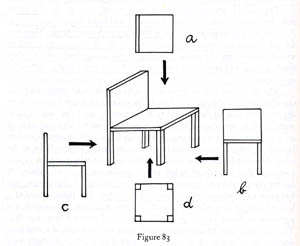
I thought of him often as I read more perceptual psychology. Gestalt work had once seemed to me a dead-end, but with David Marr’s theory of visual perception, a prototype of computational perceptual psychology, Gestaltism came roaring back. The “3D model representation” that Marr claimed operated in early vision uncannily echoes Arnheim’s discussion of our perception’s reliance on “characteristic aspects.” (Arnheim illustrates the idea with the various views of the chair, above. Which one is instantly recognizable as a chair?) And with contemporary interest in the relation between emotion and cognition, Arnheim’s theory of the expressive side of perception is creeping back too. Nothing worthwhile is forgotten, nothing goes away.
When we ran a book series at the University of Wisconsin Press, we were eager to publish an anthology of Arnheim’s film criticism, a collection originally published in German in 1977. Brenda Benthien, a close friend of Arnheim and his wife Mary, executed a lively translation and Arnheim supplied a touching introduction. A refugee of the Hitler years, an émigré across Europe and America, Arnheim summoned up the failure of the Weimar republic:
Even now I keep as a sort of talisman a bullet which in the days of the 1918 revolution, when I was fourteen, flew over the neighboring houses, bored a little hole through the windowpane, and fell inert on the carpet before my bed. Thus it began (Film Essays and Criticism, 3).
In the same introduction, Arnheim deplores the current state of cinema (“my basic objection to the talking film as a mongrel seems to me just as valid today as then”) and he warns against the cheapening of our vision:
Without the flourishing of visual expression no culture can function productively (5).
Aspiring film critics, and especially bloggers, should go back and read Arnheim on Keaton, Eisenstein, Gance, Pudovkin, Chaplin, von Sternberg, and other greats, as well as the essays “Style and monotony in film,” “Epic and dramatic film,” and especially “The Film Critic of Tomorrow.”
Scarcely a month goes by when I don’t have some idea that can be traced, however circuitously, to my reading of Arnheim. For instance, my blog on funny framings, posted a couple months ago, starts with his discussion of Chaplin’s The Immigrant. Arnheim’s theory of expression goes a long way toward explaining how composition can trigger laughter. I doubt that I’d be so alert to the possibilities of two-dimensional design in film shots if I hadn’t been tutored by Film as Art, Art and Visual Perception, The Power of the Center (1982, rev. 1988), his 1962 monograph on Picasso’s creative process in painting Guernica, and the essays in Toward a Psychology of Art (1966)–one of which is a skeptical review of Gombrich’s Art and Illusion. In preparing this entry, I found that my pleas that we probe the norms that guide filmmakers’ craft practices is just a clumsier restatement of this, which I discovered marked in Art and Visual Perception, the New Version:
Good art theory must smell of the studio, although its language should differ from the household talk of painters and sculptors (4).
Three years ago, after the Society for Cognitive Studies of the Moving Image convention in Grand Rapids, several of us from Madison–Ben Singer, Jen Chung, and Jonathan Frome–detoured back by way of Ann Arbor in order to call on Arnheim. He had just turned 100. He resided in an assisted-living facility, and his room was bright and clean, packed with books, remarkable drawings and paintings (Feininger, Köllwitz), a microfilm reader, and a worktable with a gigantic magnifying lens on an articulated arm. Conversation was difficult for him, but he seemed to understand everything we were saying. His smile was quick and his eyes were bright. When I showed him the first German edition of Film als Kunst I’d brought along, he turned it over in his hands as if he hadn’t seen one in years. He signed it, then shook his head apologetically at the shaky writing.
Now that Benjamin and Kracauer have become the prototypical Weimar intellectuals, it’s a pity that so many media students and professors are unaware of the importance of Arnheim’s work. His Leonardo-like interest in merging art and science is discouraged in a climate that posits the cultural construction of everything. He also writes with a grace and clarity that’s all too rare. In an unfashionable way, he exemplifies the passion, rigor, and dignity that interwar German intellectuals brought to the study of the arts. A lot of what he believed remains–what’s the word I want? Oh, yes–true.
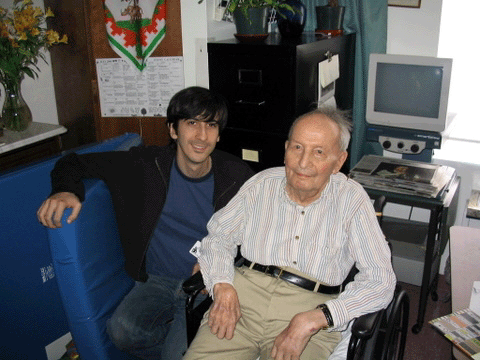
Rudolf Arnheim, with Jonathan Frome, July 2004.
Line illustrations come from Art and Visual Perception.
The latest updates
KT here:
On May 29 we posted an entry responding to the inevitable badmouthing of sequels that journalistic movie critics tend to indulge in when the summer season starts. “Live with it! There’ll always be movie sequels. Good thing, too.” gathered comments from current and present “filmies” of the University of Wisconsin-Madison. They defended sequels for a wide variety of reasons.
Now another ex-Madisonian, Henry Jenkins, has weighed in with “The Pleasures of Pirates and What It Tells Us about World Building in Branded Entertainment.” Despite its somewhat formidable title, this essay jumps into the fray, taking critics to task for their knee-jerk tendency to lump virtually all sequels together into a category fraught with prior expectations and to dismiss the latest entries as mindless, inept films.
Henry takes Pirates of the Caribbean: At World’s End as his point of defense. Somehow critics seem by telepathy to agree to take the same stance on a particular blockbuster. Here they claimed that AWE is far too complicated and gets bogged down in exposition at the expense of action. (So much for claims that blockbusters are all CGI pyrotechnics and no plot!) They also kvetched that there is too little of Jack Sparrow’s character, apparently their main focus of interest in the film.
Henry takes AWE to be, alongside The Matrix, an example of elaborate world-building, a trait of the best of the big film series. In the age of DVDs and cross-media franchises, such films, he argues, are meant to be watched more than once. They also place a lot of faith in the viewer to be able to follow a complicated plot. Henry, like Steve Johnson in his Everything Bad Is Good for You, credits modern media as challenging viewers/readers with dense works that require a lot of figuring out.
Critics assume the opposite, that summer movies are supposed to be mindless entertainment, and they treat them as such. Complexity, which they would hail in an art-house release, becomes a fundamental flaw. Henry has some cogent remarks on the circumstances of reviewers’ screenings and how they handicap the writers’ approach to pop summer movies.
Whether or not one admires AWE, Henry mounts a strong defense of the film and in the process shows how much most reviewers are out of touch with audiences’ tastes and miss the various ways in which summer blockbusters work.
In other news, David’s The Way Hollywood Tells It has just been slated for translation into simplified-form Chinese. He’s now preparing a blog entry paying tribute to the great art theorist Rudolf Arnheim, who died on Monday at the age of 104. The family’s obituary is here.
The Cinema Ritrovato, which we’ll be attending in July, has posted a provisional schedule here. David will go on from Bologna to Brussels for research and the annual Cinedecouvertes and L’age d’or festival; films and other info available here.
Can you spot all the auteurs in this picture?
DB here:
Some movies consist of several distinct episodes, each directed by a different filmmaker and all focused on a single theme. I’ve heard them called anthology films, omnibus films, and portmanteau films.
The earliest one I know is If I Had a Million (1932); later, Hollywood offered us Ziegfeld Follies (1946) and O. Henry’s Full House (1952). The Brits gave us the horror anthology Dead of Night (1945). Still, I think we associate the form chiefly with European cinema of the 1950s and 1960s. We got Love in the City (1953), Amori di mezzo secolo (1954), The Seven Deadly Sins (1962), RoGoPaG (1963), Les plus belles escroqueries du monde (1964), Paris vu par . . . (1965), Three Faces of Woman (1965), The World’s Oldest Trade (1967), and Amore e rabbia (1969).
Why the emergence of omnibus movies at this point in history? Some causes are surely financial. Most high-budget European films of the period had to be cross-national coproductions. Bringing in directors from several different countries could help guarantee funding under EU auspices and participating nations’ subsidy schemes. Just as important, the anthology format appeared when the festival scene was starting to become a vast clearing house for international film trade.
Although you can argue that many people seeing If I Had a Million would recognize the Lubitsch episode, Hollywood’s use of the form didn’t stress directorial differences. But as the Euro auteur was becoming a marketable commodity in the postwar era, a collection of short films could sell if they were signed by big-name filmmakers. “Paris As Seen by…” signals the importance of the different directorial approaches, and the very title of RoGoPaG invokes Rossellini, Godard, and Pasolini as brand-name labels. (Granted, the final G, Hugo Gregoretti, didn’t add much to the deal.)
For full enjoyment, the 1960s portmanteau film requires a degree of specialized film knowledge. At one level, we enjoy varied treatments of a theme, but at another we’re supposed to recognize each director’s personal vision, as we know it from other films. Even political-commentary portmanteau films like Far from Vietnam (1967), Lucía (1968), and Germany in Autumn (1978) gathered international attention because of the name recognition of the filmmakers who participated. The same branding operates in New York Stories (1989) and, more openly, in the documentary 12 registri per 12 città (“12 Directors for 12 Cities,” 1989).
The format has returned recently. We’ve had 11’09”01—Sept. 11 (2002), Eros (2004), Tickets (2005), and Paris, je t’aime (2006), the last virtually a rebooting of Paris vu par . . . . As we’d expect, such films continue to highlight the personal signatures of festival familiars. But we can spot some new twists too.
For one thing, the unifying idea may be formal as well as thematic. The episodes of 11’09”01 were all obliged to be the same length, eleven minutes, nine seconds, and one frame. Lumière et cie (1995) not only celebrated the centenary of film but obliged the directors to make their entries with a Lumière camera, to shoot without sync sound, to shoot no more than three takes, and to restrict the length to 52 seconds, the approximate running time of the earliest films. The Lumière homage also introduces the key themes of cinema and cinephilia, an angle that doesn’t seem prominent in the 1960s omnibus movies.
 The most prominent portmanteau film so far this year fits snugly into current trends. As Anthony Kaufman writes, “Chacun son cinéma. . . showcases a range of filmmaking aesthetics, and for the most part, the program is a dazzling and memorable array of current auteur cinema.” As in other eras, we get a stylistic buffet; as in recent years, we find formal constraints and the theme of cinephilia. Commissioned for Cannes’ sixtieth anniversary by festival head Giles Jacob, the project restricts filmmakers to three minutes per episode and dictates the subject: “their state of mind of the moment as inspired by the motion picture theater.” The result was 33 short films about the joys and sorrows of film viewing and, to some degree, an extended commercial promoting the cultural value of the Cannes event.
A half-dozen things strike me while watching the French DVD version (which has English subtitles but is unaccountably lacking the Coens’ entry). Most notable, I suppose, is the way that many of the shorts replay tendencies that are characteristic of art cinema generally (1).
1. Cinema invokes eroticism . . . We get a dreamy Wong Kar-wai scene of a man watching, or recalling, heavy petting in the theatre. Polanski’s episode plays amusingly on the similarity of orgasmic moans and painful groans. Gus van Sant’s First Kiss reinvents Sherlock Jr., while the Dardenne brothers give us a tight tale of hands in the dark. Olivier Assayas’ episode, a crisp piece of filmmaking, reveals its l’amour fou at the very end. Angelopoulos makes clever use of the Kuleshov effect to create a touching exchange between Jeanne Moreau and the lamented Mastroianni.
2. . . . and childhood, especially for the Chinese directors, who haven’t exactly risen to the occasion here. The international art film has long traded on the appeal of kids, but the treatment of them in these episodes is remarkably banal. Tsai Ming-liang, who already passed his benediction for classic cinema in Goodbye, Dragon Inn, gives us a dream of a family reunited at the pictures. Chen Kaige shows children watching—hold on now—a silent Chaplin film. Hou Hsiao-hsien provides a sepia-toned flashback to going to the movies in Taiwan, while Zhang Yimou takes us to movie night in a Mainland village. At least the Hou episode opens on a lengthy shot that nicely decenters areas of interest in a busy street scene.
3. The cinema is on the decline . . . . One way to interpret Kitano Takeshi’s cryptic sequence is that films, even his own Kids’ Return, are little more than an anachronism today. More explicitly, David Cronenberg’s single-take close-up, captured by a surveillance camera shows himself as the world’s last surviving Jew, on the threshold of suicide in a movie house.
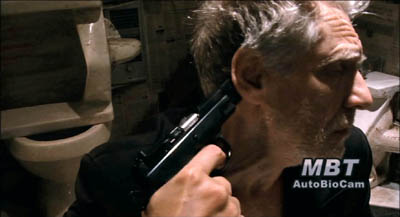
4. . . . yet it holds us in a magical spell. Some directors celebrate the simple folk at the movies. Claude Lelouch’s parents watch Top Hat and fall in love. Raymond Depardon takes us to a rooftop cinema in Alexandria, and Wenders shows a Congolese village running Black Hawk Down on video (more kids, but this time to disturb us). Kaurismaki seems to be poking fun at this arthouse commonplace by showing foundry workers blankly watching a rather different image of workers at the end of the day. The cinema, Ruiz and González Iñárritu suggest, mesmerizes even blind people.
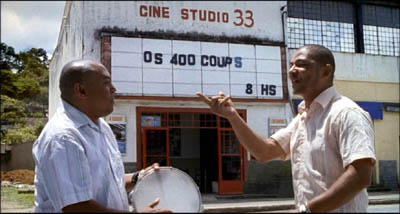
Walter Salles provides a charming, deflating musical dialogue (below) that might be called Far from Cannes, showing that this festival casts a quasi-religious spell felt across the world. In my favorite section, Kiarostami gives us shots of women responding to Zeffirelli’s Romeo and Juliet. The image/sound pairing hints at their own thwarted loves, while certain lines, such as “Where be these enemies?,” seem addressed to Westerners who try to dehumanize the people of Iran.
5. Film can be silly. Von Trier, decked out in a tux, silences a businessman through extreme means, and the rest of the audience hardly notices. Jane Campion, in an awkward episode, reveals a bug living in a theatre speaker. Probably the funniest contribution shows a mute Elia Suleiman preparing for a Q & A session after a screening. There are more gags in this three minutes than in all the other episodes put together.
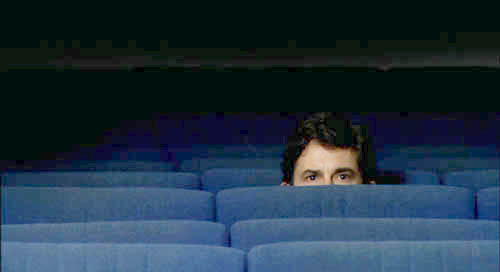
5. Lest we forget . . . This couldn’t help but be a nostalgia exercise, encouraging filmmakers to muse on their lives in cinema. This theme recalls Cinema Paradiso, Scola’s Splendor, and all the other films soaked in the melancholy sweetness of movie memories. Moretti (top image above), gives us an anecdotal monologue, while Youssef Chahine unashamedly thanks Cannes for giving him an award ten years ago. The most formally ingenious entry here is Atom Egoyan’s tale of a couple sitting in different screenings while texting each other. Eventually one grabs an image from La Passion de Jeanne d’Arc and passes it along, creating a parallel to what’s happening in the other film (Egoyan’s The Adjuster).
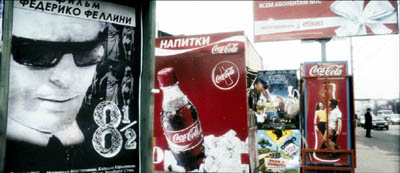
In particular, there’s nostalgia for the golden age of auteurs, the very period when the anthology film gained its purchase. Chacun son cinéma is dedicated to Fellini, and Konchalovsky’s episode centers on 8 ½. Bresson and Godard are the most frequently referenced directors. (More generally, in our new century Bresson seems to have become the prototype of the serious filmmaker.) Other icons of the 1960s, such as Mastroianni and Anna Karina, keep popping up.
6. Spot the auteur. Most episodes don’t reveal the director’s name until the end, so the cinephilia takes on a suspenseful dimension, forcing you to guess who filmed the bit you’re watching. You also have to identify movies within the movies on the basis of clips and soundtracks. It’s a great game for arthouse aficionados, but it also highlights festival cinema’s reliance on the cult of the director and the organic unity of his/her body of work.
Suppose that all these films omitted the director’s name and replaced the recognizable players with nobodies. Would any of these episodes have been accepted for Cannes’ short film programs? Probably not, but we shouldn’t be cynical about this. Clearly artworks can gain in interest by virtue of their place in history or an artist’s career. Renoir’s Sur un air de Charleston (1927), Bresson’s Les affaires publiques (1934), Dreyer’s They Caught the Ferry (1948), and Fassinder’s episode in Germany in Autumn are not masterpieces, but these shorts show fresh sides of great filmmakers, and our understanding of their accomplishment is enriched by having them.
So we’re right to recognize the director’s career as a meaningful whole. But we should also recognize that today such careers continue thanks to a distinct system of marketing. At the Cannes site, Rauol Ruiz says: “It’s a delight to be a preferred filmmaker and especially a favored filmmaker of Gilles Jacob.” The system depends on reciprocity. “Without the auteurs,” says Jacob, “there wouldn’t be a festival.” (2) In turn, auteurs are obligated to festival gatekeepers and tastemakers, the powerful critics, programmers, and impresarios. The filmmaker knows the drill. You showed my film last year, so yes, I’ll sit on a jury or offer a master class or show up on the red carpet this year.
We’re told by Anne Thompson that a more complete DVD edition, including the David Lynch entry, will be available before Christmas. That gesture makes the disc I bought the equivalent of the plain-vanilla DVD of a blockbuster that will be followed at the right moment by the Deluxe Edition. Who says the art cinema operates above pressures of business and the market?
(1) I discuss the idea of art cinema in a 1979 article, “The Art Cinema as a Mode of Film Practice,” revised in the forthcoming Poetics of Cinema.
(2) Nancy Tartaglione-Vialatte, “‘Without the auteurs there wouldn’t be a festival,'” Screen International (May 18-31, 2007), p. 15. See also the accompanying article by Nick Roddick, “The bucks start here,” pp. 14-15. These are available online to subscribers.
PS: Speaking of Cannes and the art cinema, I wrote an essay about camerawork in contemporary Danish film for the festival issue of the Danish Film Institute magazine. It’s now online here (pp 22-26). And speaking of Danish filmmakers. . . .
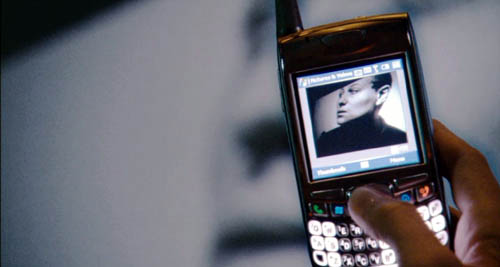
Atom Egoyan, Artaud Double Bill.
Movies on the radio
DB here:
There’s no shortage of podcast film reviews, but I confess that I’ve listened to only a few. I’m just not that interested in following a movie review at the pace of a speaking voice; I prefer skimming print to pluck out the good parts. And I’m on the lookout for ideas and information, not only opinions. I want to learn new stuff. So my iPod favors shows that center on interviews with directors, writers, and moguls. The two programs that I like best are produced by the extraordinary KCRW in Santa Monica and are also available from iTunes.
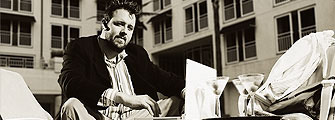
 One is The Business, hosted by Claude Brodesser-Akner (above top). Armed with solid research and snappy patter, he comes across as sharp and a little insolent, a quality always welcome in an interviewer. After a disrespectful roundup called The Hollywood News Caravan, Brodesser-Akner devotes most of the rest of a show to a major topic. You can survey several programs here.
A recent installment focused on the latest cycle of teenage horror, with input from Eli Roth, director of the Hostel films, and Oren Koules, producer of the Saw series. They talk about marketing directly to the fan sites and avoiding the expensive TV ads that studios bombard the public with. Putting banners and flashing ads on the horror sites, Roth says, attracts the same eyeballs as an ad on Lost, but for a fraction of the price. Koules:
Playing [an ad] on a Friends rerun doesn’t help anyone.
Likewise for budgets overall. Roth:
The scare is the star. . . .Nobody wants to see a $50 million version of Saw II. . . . People aren’t paying for big special effects. They’re paying to be scared.
In one of the most interesting stretches of the interview, Roth and Koules explain how they negotiate with the MPAA ratings board. According to the filmmakers, the board completely understands what they want to give the audience and the board is willing to cooperate. Koules:
We’re very respectful of the process. . . . And they know that we kind of know the market.
The fact that the films are designed for an R rating makes the task easier, of course, but sexual violence remains the most sensitive area. Roth:
They’re reflecting what the parents of America are going to say. . . . Just look at the culture. We have violence on television, people watch it—no problem. The stuff that I did in Hostel 1 is now on 24. [But] Janet Jackson shows her nipple and Congress is in session meeting about it and there’re all sorts of fines. So [the raters] really are just reflecting the temperature of the culture.
More proof that the MPAA and the ratings board find it easier to accept the excesses of genre filmmaking than to support the naughty indie material Kirby Dick surveys in This Film Is Not Yet Rated. Why should bathing in blood rate an R while boinking, boffing, and the Wild Mambo get threatened with an NC-17?
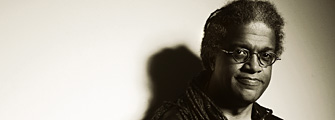
 I’ve been following The Business for a year or so, but in May while traveling in New Zealand I started listening to The Treatment, hosted by Elvis Mitchell (above, bottom). For all the superstar press he gets, he comes across as soft-spoken, thoughtful, and probing. It’s very unusual for a journalist-critic to pose questions about film craft and aesthetics, but Mitchell wades right in.
He asks Robert Rodriguez, for instance, how music shapes a film’s editing rhythms. After acknowledging that he plays music for actors on the set (as Wong Kar-wai does), Rodriguez adds:
I’ll be doing music all the way through the process of making a movie. And then I’ll usually just start editing first. Then I’ll put the edit into my music system, write the music for it, and if I like how the music is driving the scene and if the edits don’t match, I’ll go and adjust the edits. So I tell other composers—they’re probably very jealous—that I’m the composer who can tell the editor to go back and make the picture fit the music.
Another example: A while back, I posted a blog entry on how framing and the choice of lenses can create comic effects. I illustrated with an instance from Shaun of the Dead. Serendipitously, last week I discovered Mitchell’s recent interview with Shaun‘s director Edgar Wright, who acknowledged that the idea was central to his filmmaking.
The thing I’ve been trying to do in Spaced and Shaun and Hot Fuzz is the camera almost becomes a personality. Not only is the script funny and the performances are funny, but the compositions are funny—the framing of the shots is funny. . . . I remember seeing Raising Arizona and thinking, “Oh, why isn’t all comedy shot like this? It’s amazing.” . . . You get the actors to think of the camera as another performer that they’re blocking with.
The entire conversation seems to me mandatory for students of film. Coaxed by Mitchell, Wright supplies specifics about planning a shoot, varying camera setups, and the “epileptic” style of the contemporary action films that Hot Fuzz is satirizing. Wright even seems to like Domino, which shows that he can see virtues in extravagance.
So I recommend both The Business and The Treatment to anyone who wants to get filmmakers’ thoughts about current trends in movie tradecraft.