






Archive for the 'UW Film Studies' Category
Love isn’t all you need
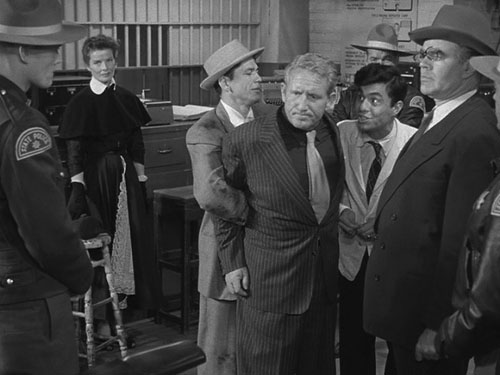
Pat and Mike.
DB still in HK:
Last week the Hong Kong International Film Festival hosted Gerry Peary’s For the Love of Movies: The Story of American Film Criticism. It’s a lively and thoughtful survey, interspersing interviews with contemporary critics with a chronological account that runs from Frank E. Woods to Harry Knowles. It goes into particular depth on the controversies around Pauline Kael and Andrew Sarris, but it even spares some kind words for Bosley Crowther.
Some valuable points are made concisely. Peary indicates that the alternative weeklies of the 1970s and 1980s were seedbeds for critics who moved into more mainstream venues like Entertainment Weekly. I also liked the emphasis on fanzines, which too often get forgotten as precedents for internet writing. In all, For the Love of Movies offers a concise, entertaining account of mass-market movie criticism, and I think a lot of universities would want to use it in film and journalism courses.
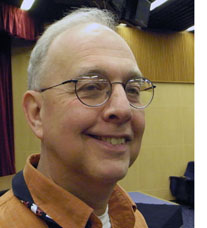 I should declare a personal connection here. I’ve known Gerry since 1973, when I came to teach at the University of Wisconsin—Madison. Like me, he was finishing a dissertation: he was writing a history of the gangster films made before Little Caesar. We spent good lunches together at the Fish Store. Gerry was one of the moving spirits of Madison movie culture—running a film society, writing and editing for the student paper, working with John Davis, Susan Dalton, Tim Onosko, and Tom Flinn on The Velvet Light Trap. I knew I’d come to the right place when somebody would drop by my office to talk about last night’s screening of Underworld or Steamboat ‘Round the Bend.
Like many of our generation, Gerry became a mixture of critic and academic. He taught at several colleges, wrote for The Boston Phoenix, and published books, notably Women and the Cinema: A Critical Anthology (1977) and The Modern American Novel and the Movies (1977). Most recently he’s edited collections of interviews with Tarantino and John Ford. He has moved smoothly into online publishing with a packed and wide-ranging website.
Gerry’s documentary comes along at a parlous time, of course. Most of the footage was taken before the wave of downsizings that lopped reviewers off newspaper staffs, but already tremors were registered in some interviewees’ remarks. Apart from this topical interest, the film set me thinking: Is love of movies enough to make someone a good critic? It’s a necessary condition, surely, but is it sufficient?
Gerry’s film includes the inevitable question: What movie imbued each critic with a passion for cinema? I have to say that I have never found this an interesting question, or at least any more interesting when asked of a professional critic than of an ordinary cinephile. Watching Gerry’s documentary made me think that everybody has such formative experiences, and nearly everybody loves movies. But what sets a critic apart?
Elsewhere, I’ve argued that a piece of critical writing ideally should offer ideas, information, and opinion—served up in decent, preferably absorbing prose. This is a counsel of perfection, but I think the formula ideas + information + opinion + good or great writing isn’t a bad one.
You really can’t write about the arts without having some opinion at the center of your work. Too often, though, a critic’s opinions come down simply to evaluations. Evaluation is important, but it has several facets, as I’ve tried to suggest here. And other sorts of opinions can also drive an argument. You can have an opinion about the film’s place in history, or its contribution to a trend, or its most original moments. Opinions like these allow you to build an argument, drawing on evidence or examples in or around the movie in question. Several of our blog entries on this site are opinion-driven, but not necessarily evaluations of the movies.
Most people think that film criticism is largely a matter of stating evaluations of a film, based either in criteria or personal taste, and putting those evaluations into user-friendly prose. If that’s all a critic does, why not find bloggers who can do the same, and maybe better and surely cheaper than print-based critics? We all judge the movies we see, and the world teems with arresting writers, so with the Internet why do we need professional critics? We all love movies, and many of us want to show our love by writing about them.
In other words, the problem may be that film criticism, in both print and the net, is currently short on information and ideas. Not many writers bother to put films into historical context, to analyze particular sequences, to supply production information that would be relevant to appreciating the movies. Above all, not many have genuine ideas—not statements of judgments, but notions about how movies work, how they achieve artistic value, how they speak to larger concerns. The One Big Idea that most critics have is that movies reflect their times. This, I’ve suggested at painful length, is no idea at all.
Once upon a time, critics were driven by ideas. The earliest critics, like Frank Woods and Rudolf Arnheim, were struggling to define the particular strengths of this new art form. Later writers like André Bazin and the Cahiers crew tried to answer tough idea-based questions. What is distinctive about sound cinema? How can films creatively adapt novels and plays? What are the dominant “rules” of filmmaking ? (And how might they be broken?) What constitutes a cinematic modernism worthy of that in other arts? You could argue that without Bazin and his younger protégés, we literally couldn’t see the artistry in the elegant staging of a film like George Cukor’s Pat and Mike. Manny Farber, celebrated for his bebop writing style, also floated wider ideas about how the Hollywood industry’s demand for a flow of product could yield unpredictable, febrile results.
One of the reasons that Sarris and Kael mattered, as Gerry’s documentary points out, was that they represented alternative ideas of cinema. Sarris wanted to show, in the vein of Cahiers, that film was an expressive medium comparable in richness and scope to the other arts. One way to do that (not the only way) was to show that artists had mastered said medium. Kael, perhaps anticipating trends in Cultural Studies, argued that cinema’s importance lay in being opposed to high art and part of a raucous, occasionally vulgar popular culture. This dispute isn’t only a matter of taste or jockeying for power: It is genuinely about something bigger than the individual movie.
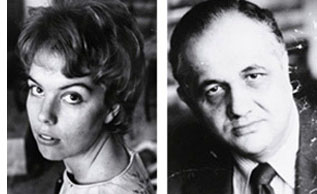 During the Q & A, it emerged that at the same period critics’ ideas had an impact on filmmaking. Sarris’s promotion of the director as prime creator, with a bardic voice and a personal vision, was quickly taken up by Hollywood. Now every film is “a film by….” or “ a … film”: auteur theory shows up in the credits. Similarly, the concept of film noir was constructed by French critics and imported to the US by Paul Schrader. Suddenly, unheralded films like The Big Combo popped up on the radar. Today viewers routinely talk about film noir, and filmmakers produce “neo-noirs.” It seems to me as well that Hollywood became somewhat more sensitive to representation of women after Molly Haskell (here, alongside Sarris) had brought feminist ideas to bear on the American studio tradition, avoiding simple celebration or denunciation. Film criticism had a robust impact on the industry when it trafficked in ideas.
You can argue that these are old examples. What new ideas are forthcoming from mainstream film criticism? In the Q & A Gerry, like the rest of us, couldn’t come up with many. On reflection, I wonder if the rise of academic film studies forced ideas to migrate to the specialized journals and the Routledge monograph. These ideas also had a different ambit—sometimes not particularly focused on cinema, or on aesthetics, or on creative problem-solving.
Of course ideas don’t move on their own. A more concrete way to put this is that bright, conceptually oriented young people who in an earlier era would have become journalistic critics became professors instead. The division of labor, it seems, was to aim Film Studies at an increasingly esoteric elite, and let film reviewers address the masses. It’s an unhappy state of affairs that we still confront: recondite interpretations in the university, snap evaluations in the newspapers. You can also argue that print reviewers, by becoming less idea-driven, paved the way for DIY criticism on the net.
What about information, the other ingredient I mentioned? If we think of film criticism as a part of arts journalism, we have to admit that most of it can’t compare to the educational depth offered by the best criticism of music, dance, or the visual arts. You can learn more from Richard Taruskin on a Rimsky performance or Robert Hughes on a Goya show than you can learn about cinema from almost any critic I can think of. These writers bring a lifetime of study to their work, and they can invoke relevant comparisons, sharp examples, and quick analytical probes that illuminate the work at hand. Even academically trained film reviewers don’t take the occasion to teach.
Most of the print criticism I’ve seen today is remarkably uninformative about the range and depth of the art form, its traditions and capacities. Perhaps editors think that film isn’t worthy of in-depth writing, or perhaps their readers would resist. As if to recall the battles that Woods, Arnheim and others were fighting, cinema is still not taken seriously as an art form by the general public or even, I regret to say, by most academics.
Yet other aspects of information could be relevant. Close analysis offers us information about how the parts work together, how details cohere and motifs get transformed. For an example of how analysis can be brought into a newspaper’s columns, see Manohla Dargis on one scene in Zodiac.
 I’d also be inclined to see description—close, detailed, loving or devastating—as providing information. It’s no small thing to capture the sensuous surface of an artwork, as Susan Sontag put it. Good critics seek to evoke the tone or tempo of a film, its atmosphere and center of gravity. We tend to think that this is a matter of literary style, but it’s quite possible that sheer style is overrated. (Yes, I’m thinking of Agee.) Thanks to our old friends adjective and metaphor, even a less-than-great writer can inform us of what a film looks and sounds like.
In any event, I’m coming to the view that the greatest criticism combines all the elements I’ve mentioned. As so often in life, love isn’t always enough.
Gerry’s documentary doesn’t distinguish between critics and reviewers, but we probably should. Reviewers typically give us opinions and a smattering of information (plot situations, or production background culled from presskits), wrapped up in a writing style that aims for quick consumption. Today anybody with a web connection can be a reviewer.
Exemplary critics try for more: analysis and interpretation, ideas and information, lucidity and nuance. Such critics are as rare now as they have ever been. Far from being threatened by the Internet, however, they have more opportunities to nourish film culture than ever before.
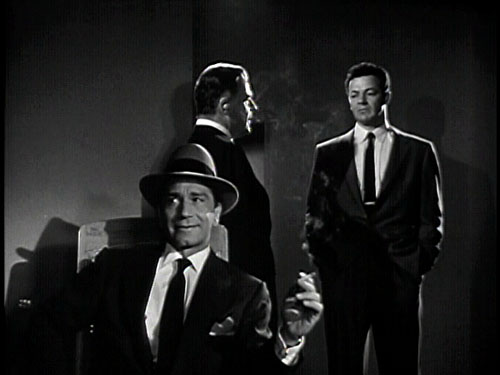
The Big Combo.
PS 4 April (HK time): Thanks to Justin Mory for correcting a name error in the original post!
Acting up
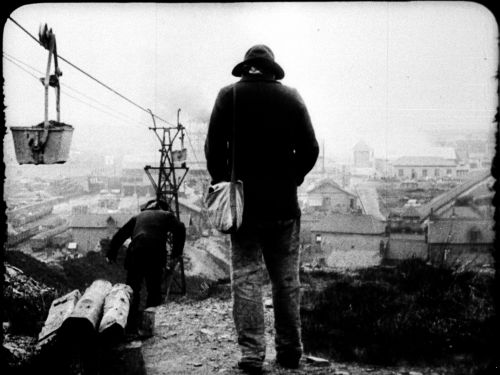
Germinal (1913).
DB here:
Film performance is notoriously difficult to analyze. We don’t lack zesty celebrations of actors; I think especially of Richard Schickel on Doug Fairbanks and Gary Giddins on Jack Benny and Bob Hope (praised in an earlier entry). But we have long found it difficult to penetrate actors’ secrets with the same precision that we bring to editing or framing or a film’s musical score.
Actors’ performances don’t offer themselves in neat slices, the way that shots come to us. There isn’t a firm notational system that lets us capture performances the way that scores can pick out important patterns in music.
Moreover, it’s hard to dissect something that seems so evanescent, so direct, and so natural. When we see someone smile on the bus or at a party, we react immediately and without any apparent thought. When someone smiles in a movie, we’re tempted to say that we respond just as directly. But then, what is acting? Just doing what comes naturally?
Acting is clearly an art and a craft. Not everyone can do it, and comparatively few do it well. So if there is a skill or a technique involved, surely acting goes beyond ordinary behavior. And if as in other arts there are creative choices involved, there is likely to be a menu of options to be chosen from. Some of those options are likely to be conventions sanctioned by tradition. How strongly, then, is acting conventionalized? If it’s conventionalized to some degree, we should be able to analyze it.
A small-scale debate has gone on for some years in film studies about whether film acting is heavily conventionalized, even coded. Advocates of the coding view point to the fact that acting styles vary in different places and change across time. What does Kabuki performance have in common with Method acting? It’s hard to claim that there is a universally realistic acting style that naturally represents human behavior. Against this, others have argued that even if there is no absolute and unchanging standard of realism, we can speak of more or less realistic aspects of performance. Some styles, like Method are just less artificial than others, like Kabuki—even if both are somewhat stylized with respect to realistic behavior.
My own view, explored in Poetics of Cinema, is that performance traditions streamline or stylize a common core of widely shared human behaviors. In everyday life, smiling expresses happiness and/or serves as a social signal of openness. We’re unlikely to find a distant culture in which smiling expresses rage. (Of course we can have an instance of smiling concealing rage, but that would acknowledge the difference between the two states.) Some acting traditions, like Kabuki, retain certain common behaviors like weeping or proud walking, but make them more dancelike. Other acting traditions stylize core behaviors in different ways–the mumble of the Method, or the comic double-take. The differences lie in what aspects of facial expressions, gestures, gait, and the like are on the tradition’s menu, and how they become “streamlined” for expressive purposes and spectatorial uptake.
In short, I’m a moderate constructivist about such matters. I agree that we have to learn to comprehend performances in different traditions. But our learning is fast and spontaneous, not at all like learning Morse code or English, because we already have strong hunches about what a frown or a wail might express. Frowning or wailing are likely to be contingent universals of human behavior. An intuition about the meaning of the performance guides us to recognize the more stylized aspects of the presentation. When Cesare coasts along walls in The Cabinet of Dr. Caligari, we take that to be a stylized representation of the act of stalking. That construal relies on the hunch that he’s doing something we already understand–stalking–in an unusual way. Although sometimes we might have to revise our intuitions about the meaning, those intuitions serve as a point of departure. (Where do our intuitions ultimately come from? Short answer: The evolution of humans as a social species.) E. H. Gombrich put it well: “It is the meaning which leads us to the convention and not the convention which leads us to the meaning.”
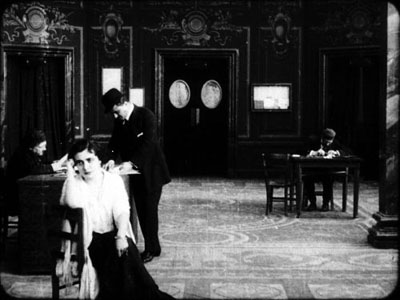
Assunta Spina (1915).
The faculty and alumni of the Film Studies program here at Wisconsin keep in touch through a (closed) listserv, and thanks to Jonathan Frome we also have a wiki, to be found here. It’s just starting to fill up, mostly with ideas for teaching and examples of sample sequences to illustrate film techniques. But now the wiki has gained striking essays on acting from two scholars of early cinema.
Ben Brewster and Lea Jacobs’ book, Theatre to Cinema, took on the problem of what early feature films owed to the stage, and they concluded: Quite a lot. But instead of condemning this tradition as “uncinematic,” as most historians have, they showed that a highly engaging form of cinema arose by reshaping theatrical traditions. Specifically, Ben and Lea examined how “situational” plotting principles were carried into film, and they discussed film’s debt to the “pictorialist” drama of the nineteenth century. Many scholars had argued that melodramatic theatre was replaced by the Naturalist theatre, derived from the literary movement associated with Émile Zola. But Lea and Ben argued that a pictorialist conception of theatre and its modified form in early feature films cut across this distinction. A film that was avowedly Naturalist in plot or theme could maintain conventions of earlier forms.
Consequently, they argued that film acting of the period, even when it seemed to be moving toward greater realism, was still building on the stereotyped expressions, gestures, and attitudes of pictorialist theatre. Actors were called upon to execute vivid stage tableaus. Standard gestures had to be imbued with fresh emotional intensity, and actors were expected to move gracefully from one expressive picture to another.
Now Ben and Lea have extended their book’s argument in two in-depth studies posted on the UW wiki. Ben’s essay examines that great Capellani film Germinal (1913) and shows that it often perpetuates the poses and expressions of pictorialism, while also scaling them down. Lea tackles the work of the diva Francesca Bertini, including an analysis of the wonderful Assunta Spina (1915). Her piece is a companion to Ben’s. She writes:
While I do not doubt that the plot of Assunta Spina fits under the rubric of naturalism, and that the acting and staging of some scenes in the film also show the influence of naturalism in the theatre, it seems to me that Bertini’s technique (and incidentally that of [Asta] Nielsen as well) is more reminiscent of Bernhardt than it is of the Duse, and that the blocking and use of gesture in the film is largely governed by what Brewster and I have discussed in terms of “pictorialism” in acting.
By considering 1910s performance as a modification of theatrical poses, attitudes, and staging conventions, Jacobs and Brewster are led to remarkably detailed analyses. They have studied the conventions of acting at that period, and because they are alert to standard bits of business, so they are able to show fine points of performance that we would ordinarily miss.
They’re also able to hold the realism/ artifice dispute in suspension by concentrating on particular historical traditions. They shrewdly note that as acting styles change, the newer one is likely to be praised as more realistic than the styles it supplants. In turn, that style will be considered artificial when a still newer one comes along. For this reason, Method acting may seem less realistic and more artfully contrived today than it did in the 1950s.
Apart from the subtle discussion of acting styles, one merit of these essays is that they recognize how films can take bits and pieces of different traditions and modify them for particular ends. I’m sympathetic to this perspective. For instance, I still think that many of today’s Hollywood films, despite their contemporary look and feel, draw on principles of narration and plot structure that we can find in classic American studio cinema.
In addition, you ought to visit the site to see how detailed their analyses are and how extensively they draw on frame stills. Indeed, one reason they published these pieces online was that no academic film journal could have accommodated so many illustrations. So much the better for us. The frames, taken from 35mm prints with a Nikon lens and negative film, are among the most beautiful you’ll find on the Internets. I swiped some here.
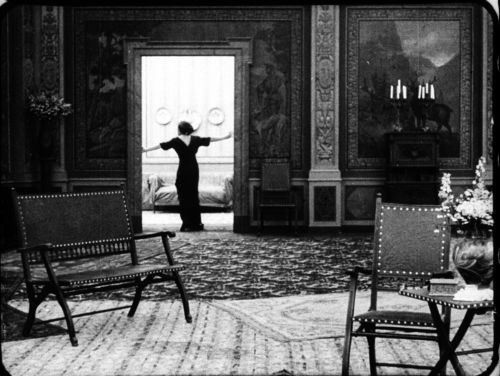
Sangue bleu (1914).
The quotation from E. H. Gombrich comes from his essay “Image and Code: Scope and Limits of Conventionalism in Pictorial Representation,” in The Image and the Eye: Further Studies in the Psychology of Pictorial Representation (Ithaca: Cornell University Press, 1982), 289.
Kristin has written a couple of blog entries concentrating on performance, here and here.
American (Movie) Madness
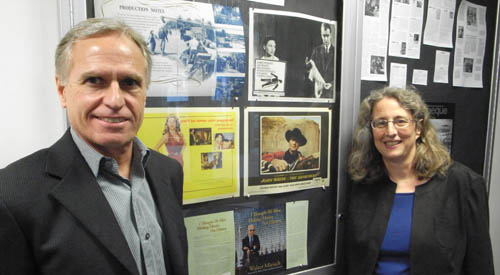
Grover Crisp and Lea Jacobs outside the University of Wisconsin–Madison Cinematheque.
DB here, again:
He holds sway over thousands of movies and the transfer of hundreds of DVDs. At home he has a high-definition set, but he gets local channels on a rabbit-ears antenna. If that isn’t a working definition of a Film Person, I don’t know what is.
Over the years our UW Film Studies area has hosted many visiting Film Persons, including archivists Chris Horak, Mike Pogorzelski, Joe Lindner, Schawn Belston, and Paolo Cherchi Usai. (1) Being a department centrally interested in film history, we’re eager to screen recent restorations and learn the ins and outs of film archivery.
This year our Cinematheque screened several Sony/ Columbia restorations, running the gamut from Anatomy of a Murder to The Burglar. We wound up our series, and our season, with a stunning print of Frank Capra’s American Madness (1932). To conclude things with a bang, Lea Jacobs, Karin Kolb, and Jeff Smith brought Grover Crisp, Sony’s Senior Vice President of Asset Management, Film Restoration, and Digital Mastering.
Kristin and I had met Grover at the Cinema Ritrovato festival in Bologna, and after hearing him introduce some restorations, we knew he had to come to Madison. It was a Bologna screening of American Madness that convinced me that we had to show this sparkling print on our campus. Fortunately for us, Grover squeezed a Madison visit into his schedule and suffered the caprices of American Airlines’ delays. We had about two days of his company.
It was a great learning experience. On Thursday 8 May he addressed our colloquium, where he showed two shorts: a 1933 Screen Snapshots installment explaining the process of motion picture production, from script to final product, and a trim 75-second short by his colleague Michael Friend tracing the evolution of filmmaking technology. On Friday Grover introduced American Madness and took questions.
Just a note about terminology: Archives engage in both film preservation and film restoration. Preservation means, as you’d think, saving films for the future. This involves maintaining the materials (prints, negatives, camera material, sound tracks) in surroundings that minimize harm and deterioration. Restoration demands more resources. It involves trying to create an authoritative version of the film as it existed in some earlier point in history. But that’s a complicated matter, as we’ll see.
Archives and assets
Grover brings a Film Person’s sensitivity to the mission of film preservation. What does that mean? For one thing, he takes the long perspective. Film archivists think about how to store and maintain films for decades, even hundreds of years. In an industry geared to short-term cycles, booms and busts and jagged demand curves, a commercial archivist like Grover, or Schawn of Fox, has to reconcile traditional museum standards with market demands, strategic release considerations, and current studio policies. In short, he has to think both about saving the film for a century and about hitting a DVD street date.
Grover explained his obligations at Sony Pictures Entertainment. He manages all film and television materials. That means preserving everything for any future use and restoring some items for video and theatrical screening. It also means that he keeps abreast of current TV and film productions. This gives him a chance to “embed archival needs” into production and postproduction processes. For example, from 1991 to the present, YCM separation masters are prepared for every film. (2) And today, when a film is finished and output digitally onto a negative for release prints, another negative is assembled from the camera negative, the most pristine source, and that goes into cold storage.
Grover supervises a staff of about twenty-five people, six of whom are overseeing film laboratory and audio work full-time. Unlike other studio archives, Sony does not hand off preservation tasks to outside companies. Being a Film Person, Grover asks that for films a new negative be created, and fresh screening prints be prepared.
What impelled a big company like Sony to invest so much in preservation and restoration? Grover explained that the rise of home video taught most studios that their libraries had some value. In particular, executives were impressed by Ted Turner’s 1986 purchase of MGM for its library, which he could recycle endlessly on TBS. They realized that the libraries were genuine assets. Old movies enhanced the firm’s value (if it were to be sold, as many were in those days) and could be exploited through new media platforms, like cable.
The arrival of DVD made all the studios return to their libraries to make high-quality versions of their top titles. Now the high-definition format of Blu-ray will re-start restoration because of the leap in quality it offers.
Sony moved early, partly because it understood new media. When Sony bought Columbia Pictures in 1989, the Japanese executives envisioned a synergy between Sony’s hardware and a movie studio’s software. “One of the first things they asked,” Grover recalls, “was, ‘What’s the condition of the library?’” Soon afterward, Sony set up the first systematic collaboration between studio archivists and museum-based archivists. The Sony Pictures Film Preservation Committee included archivists from Eastman House, the Library of Congress, UCLA, MoMA, the Academy, and other institutions. In addition, Grover modeled Sony’s restoration policies on the exemplary work of legendary UCLA archivist Bob Gitt (whose work on sound restoration we’ve already saluted in another entry).
Digital restoration has been part of the Sony program. The 1997 restoration of Capra’s Matinee Idol (1927), from a Cinémathèque Française print, was the first live-action high-definition restoration from any studio.
Sony holds between 3600 and 5000 titles. It’s impossible to be more precise at this point because in hundreds of cases the rights situation is uncertain. But of the core library, about half to two-thirds of the films are restored. Crisp’s team is at work on about 200 titles at any moment! Many more are restored than warrant DVD release, but they may be available On Demand and via TCM, which has recently acquired cablecast rights to several older Columbia titles.
Restore, yes! But what, and how?
We’re grateful for preservation, but for cinephiles, restoration holds a special thrill. A “restored” Intolerance or Napoleon or von Sternberg movie gets us salivating. This year Cannes ran nine restorations on its program.
But what is a restoration?
We expect that a restoration will provide a film with a better-quality image or soundtrack than we’ve had so far. We often expect as well that a restoration will provide a more complete version of the title. Yet there are problems with both expectations.
First, who’s to say what the quality of the original is? Grover encountered this difficulty in restoring Funny Girl. It was released in the classic Technicolor dye-transfer process, usually considered the gold standard for color cinematography. He assembled five original Technicolor prints and all of them looked different. It turns out that Technicolor prints varied quite a bit. (3) The kicker was that Grover couldn’t make the new dye-transfer 35mm print of Funny Girl match any of these reference prints. That didn’t stop it looking fabulous when it premiered in LA.
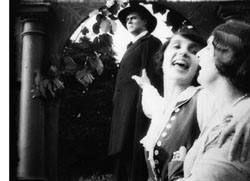 What about restoration that adds footage to an existing version of a movie? My previous blog entry mentioned an example, the wild and crazy Nerven (1919), to be issued on DVD by the Munich Film Museum. Stefan Drössler, Munich’s curator, has done a remarkable job of incorporating new footage into the longest version of Nerven to date. (The new material includes “living intertitles,” in which actors drape themselves around gigantic letters.) But Nerven remains incomplete, lacking about a third of its original material.
Moreover, it’s possible to “over-restore” a film. That is, by adding footage culled from many versions, the restorer may be creating an expanded version that nobody actually saw.
Original version? What does that mean? Paolo Cherchi Usai has reflected on this at length. (4) Is the original what the film was like on initial release? This is tricky nowadays for new titles, because as Grover pointed out, most films are “initially released” in several versions. Since Hollywood filmmaking began, different versions have been made for the domestic and the overseas markets, and often the overseas versions are longer. Sometimes a film opens locally or at a film festival and then is modified for release. Major films by Hou Hsiao-hsien and Wong Kar-wai have played Cannes in versions longer than circulated later.
Now suppose that the film was modified by producers or censors for its initial release somewhere. If you can determine the filmmaker’s wishes, should you restore the film to what she or he wanted it to be? That flouts the historical principle of getting back to what people actually saw. Consider the shape-shifting Blade Runner. Only now, twenty-five years after its release, has the U. S. theatrical version appeared on video.
Or what do we do when a filmmaker, after the release, decides that the film needs to be changed? Late in life, Henry James felt the urge to rewrite many of his novels, and the revised versions reflect his mature sense of what he wanted his oeuvre to be. Why can’t a filmmaker decide to recast an older film? Such was the case with Apocalypse Now Redux and Ashes of Time Redux. Since the later version represents the artist’s latest viewpoint, should that be the authoritative version?
Grover encountered a variant of this problem when he invited one cinematographer to help restore a film. The cinematographer’s own aesthetic and approach to his work had evolved over the years, so he started to tweak things in a way that was taking the look of the film to a level much different than the original achievement. Grover had to steer him back to respecting the film’s original look.
On the brighter side: Grover brought in master cinematographer Jack Cardiff to advise on the restoration of A Matter of Life and Death. Cardiff said that one scene needed a “more lemony” cast. Grover tried, but each time Cardiff said it wasn’t right. Finally, Grover confessed that he just couldn’t get that lemony look. Cardiff nodded. “Neither could I.”
Grover offers this nugget of wisdom: It is almost impossible to get an older film to look the way it does when it was originally released. The color will never look as it did, nor will sound sound the way it did. Film stocks have changed, printing processes have changed, technology in general has changed. Every version is an approximation, though some approximations may be better than others. Take consolation in the fact that even when the movie was in circulation, it may have already existed in multiple versions.
What do consumers want?
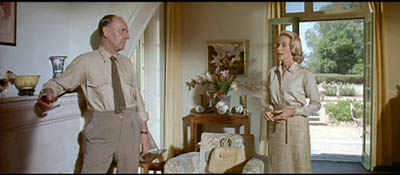
All archivists explain that compromises enter into the preservation process down the line. One of the revelations of Grover Crisp’s visit was the awareness of just how many of these compromises come into play, and how some of them are tied to what DVD buyers expect.
Many films from Hollywood’s studio era are soft, low-contrast, and grainy. Project a 1930s nitrate copy today, and though it will be gorgeous, it’s likely to look surprisingly unsharp. Things apparently didn’t improve when safety stock came along in the late 1940s; projectionists complained that those prints were even softer and harder to focus than nitrate ones. As recently as the 1970s, films were not as crisp as we’d like to think. I’ve examined the first two parts of The Godfather on IB Tech 35mm originals, and though they look sharp on a flatbed viewer, in projection the grains swarm across the screen like beetles. (I should add that many of today’s films also look mushy and grainy in the release prints I see at my local.)
But I think that DVD cultivated a taste for hard-edged images, perhaps in the way that music CDs cultivated a taste for brittle, vacuum-packed sound. It’s not surprising, then, that video aficionados are often startled when a DVD release of a classic movie looks far from clean. This is not always attributable to a film’s not being cleaned up to the fullest extent the technology allows. Some films are inherently grainy, gritty, or soft-looking. With the advent of Blu-ray and HD imagery for the home, those films’ look is often mistaken for problems with the transfer, or signs that the distributor didn’t care enough to spend the money to thoroughly make it new. “New” in this case means contemporary.
So there are compromises, according to Grover, that the studios are having to deal with:
What do do about a film that is really grainy? Do you remove the grain, reduce the grain, leave the grain alone? Everyone seems to have a different answer, and it often puts the distributor in a difficult situation. These are questions that will be answered over time, as the consumer gets used to seeing images in HD that truly represent the way a film looks.
Another compromise involves sound. “Now you’re getting to an ethical area,” Grover remarks. In restoring early sound movies, Sony removes only clicks, pops, and scratchy noises (while still keeping the original, faults and all, as a reference). Sound problems are compounded in films from the early 1950s. Many releases at that time were shot in a widescreen process but retained monaural sound. Yet avid DVD buyers want multitrack versions to feed their home theatres. “If it’s not 5.1, we get complaints.” So Grover’s engineers “upmix” mono, as well as two-channel stereo, to 5.1—though they strive to keep the 5.1 minimal and retain as much authenticity as possible. Not on every film, of course: often the original mono track is included on the DVD.
On the positive side, Sony held the original tracks for Tommy (1975), originally released in Quintaphonic. (Old-timers will remember that audiophiles were urged to upgrade to this, and some LPs were released in that format.) Grover was pleased that he could replicate the theatrical version’s 5-channel mix on the DVD. (More details here.)
Now for a hobby horse of mine. The 1950s-1960s standards for multichannel sound were not those of today’s theatres. Today’s filmmakers funnel important dialogue through the front central speaker. But in multi-track CinemaScope and other widescreen formats, dialogue was spread to the left and right speakers as well, and these were behind the screen. That meant that a character standing on screen left was heard from that spot as well. (Remember, these screens might be seventy feet across.) Long ago Kristin and I saw an original 70mm release print of Exodus (shot in Super Panavision) in a big roadshow house in Paris. The ping-pong effect of the conversations between Ralph Richardson and Eva Marie Saint was fascinating.
Today, however, it might be distracting. In a home theatre, where discrete tracks present sound from offscreen left or right, it would seem downright weird. Although Grover didn’t comment on this, it’s clear that the big-screen classics from the magnetic-track era are remixed for DVD to suit current theatrical and home-video standards. This makes it very difficult for researchers to study the aesthetics of sound design from that period. Even if you visit an archive, that institution almost certainly isn’t able to project the film in a multi-channel version. (5) Is it too late to ask DVD producers to replicate, on a second soundtrack, the original channel layout? This would be a big favor to the academic study of the history of sound, and some home-theatre enthusiasts might develop a taste for the old-fashioned sonic field.
Last questions
Q: Do Grover and his colleagues take notice of online chat about DVD releases?
A: Yes, because it’s important to know what many participants in those conversations want from a film’s release, and they may also know things (from a hardcore fan’s pespective) about a film that is useful to know. Grover’s staff members can learn about missing scenes and other variant prints. But sometimes the Net writers are working from incomplete information and can get things wrong. A fan fervently announced that one word was intelligible in the “original” version of a film but not on the DVD. Yet the theatrical release version muffled the word. It turns out that the word was audible in a remixed TV version, which the fan had used as reference. Likewise, one critic who found the color on the Man for All Seasons Special Edition DVD too vibrant was evidently using a VHS version as the reference point. (For what it’s worth, the color in the Man for All Seasons theatrical release I saw was extremely vivid.) And Grover and his colleagues never intervene in the online debates.
Q: Why do DVDs seem different from projected prints—often much sharper?
A: An original film frame, in camera negative, has more resolution than can be captured in a print. Most prints are a generation or two past the material that a DVD transfer uses, so they gain a certain softness. Granted, however, in making high-definition video masters sometimes the tools to sharpen and de-grain the image are overused.
In addition, it’s generally a good idea to get your home video display calibrated. Most home displays are way too bright, sometimes brighter than a theatre screen. If you darkened the room and had the display dialed down, DVDs would look more film-like.
Q: When will we get the Boetticher westerns?
A: It’s the most frequent question Grover gets asked. Soon, soon: A boxed set of restored titles is on the way.
Q: And what about all the Capra titles?
A: Sony plans to restore each of them. Columbia struck many prints of them, and so there is some negative wear. Some negatives no longer exist. On one title, Say It with Sables (1928), Sony has neither negative nor prints.
There’s a too-good-to-be-true backstory here. Capra had a ranch in Pomona, which upon his death was bequeathed to Pomona State University. After some years, people found in a locked stable his private collection of prints struck in 1939. The cache included Lost Horizon, You Can’t Take It with You, It Happened One Night, and the best-quality print of Mr. Smith Goes to Washington Grover had yet seen. There were also photographs Capra had shot of premieres and vacations. Thanks to the good offices of Frank Capra, Jr., Sony acquired the prints and used them in its restorations.
As for American Madness, Grover called it a “training film” for later Capra productions. The theme of faith in the little man, manifested in a bank run that tests a humane banker’s alliances in the community, points ahead to It’s a Wonderful Life and other films. Sony holds a complete soundtrack and a nearly complete original negative. UCLA held a complete nitrate print donated by the Los Angeles Parks and Recreation Department; evidently the film was screened in parks as public entertainment. That print wasn’t in good condition, but it allowed Grover’s team to fill out certain scenes. The nitrate print’s footage is noticeably lighter and grainier in a few places. American Madness wasn’t a digital restoration, but if it were done today Grover would probably use CGI to blend in the alien footage.
Talkies, with a vengeance
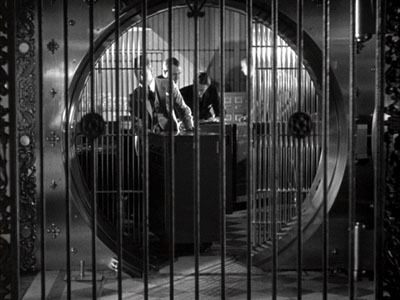
It was fine to see the film again; its brisk inventiveness held up. The gleaming and geometrical images of the opening, which acquaint us with the daily routine of opening the bank vault, might have come out of Metropolis. One helter-skelter montage sequence, complete with canted framings and chiaroscuro lighting, looks forward to Slavko Vorkapich’s delirious contributions to Mr. Smith and Meet John Doe.
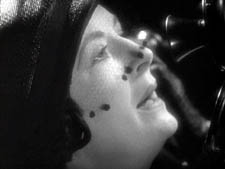
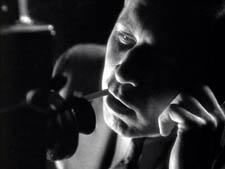
The tactics of depth composition that we find in many 1930s movies reappear here, and the illumination has dashes of noir.
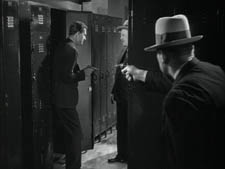
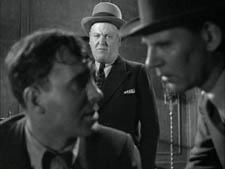
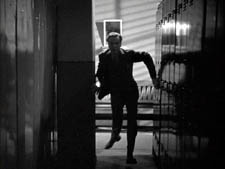
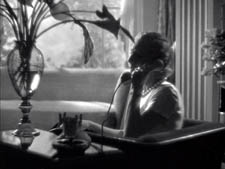
I especially like the dynamic pans that carry Walter Huston and Pat O’Brien in and out of the main office; I suspect that they’re cut together faster and faster as the climax gets near. And the huge set of the bank lobby, publicized at the time as the biggest set yet built on the Columbia lot, remains not only impressive but functional. It establishes a cogent geography to which Capra adheres strictly while filming it from a great variety of angles.
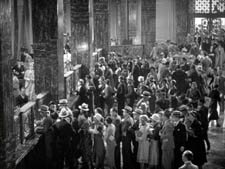
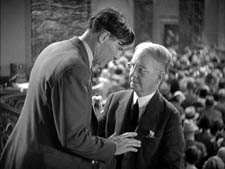
But this is not a treat just for the eyes. American Madness flaunts its mastery of emerging talkie technique. The rising action is accentuated by the steady increase in volume of the growing crowd in the bank lobby. The clerks’ scattershot morning chat in the vault is captured in microphone distances and auditory textures that suggest a hollow, sealed-off space. Hawks’ rapid-fire patter in Twentieth Century (1934) has an antecedent here, and at the same studio. The actors speak at a terrific clip, scarcely pausing between lines, and sometimes the dialogue overlaps. We even get competing lines, two or more speeches rattled off at once. (And did Hawks get the idea for His Girl Friday’s variants on telephone chatter from O’Brien working the receivers at the climax?)
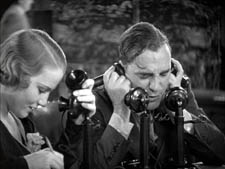
In films like this, American movies talk American. Consequently, I’m inclined to regard as an in-joke the glimpse we get of a marquee that’s advertising another Columbia picture: Hollywood Speaks.
Thanks to Grover and Sony Pictures Entertainment for a wonderful series and an enlightening brace of talks. American Madness is available on the DVD set The Premiere Frank Capra Collection.
(1) Chris Horak has been head archivist at George Eastman House, the Munich Film Museum, Universal, and the Hollywood Museum; he’s now Director of the UCLA Film & Television Archive. Mike Pogorzelski is Director of the Film Archive for the Academy of Motion Picture Arts and Sciences; Joe Lindner is Preservation Officer there. (Both are former Badgers.) Schawn Belston is Vice President of Asset Management and Film Preservation at Twentieth Century Fox. Paolo Cherchi Usai is Director of ScreenSound Australia, the national archive, and director of the recent film Passio. Kristin interviewed Mike and Schawn for this blog entry.
(2) YCM separation masters are made by copying a color film onto three black-and-white films. Thanks to filtering, these preserve color luminance at the different values of yellow, cyan, and magenta. Since these monochrome versions are not as susceptible to fading, they can be used for archival preservation. Combined, they can recreate the original color image.
(3) This confirms my impression when I’ve seen different Technicolor prints of the same title. You sometimes get this effect with a composite print, in which the color values change from reel to reel. Anecdotally, I’ve heard that Technicolor staff in the studio days would sort reels according to their dominant color (“That’s the yellow pile over there”).
(4) See Chapter 7 of Silent Cinema: An Introduction (London: British Film Institute, 2000). This book, incidentally, is a good introduction to the sheer fun of archive work. Others communicating the same enthusiasm are Roger Smither and Catherine A. Surowiec, This Film Is Dangerous: A Celebration of Nitrate Film (Brussels: FIAF, 2002) and Dan Nissen et al., eds., Preserve Then Show (Copenhagen: Danish Film Institute, 2002).
(5) This problem renders the activities of Britain’s National Media Museum in Bradford all the more important. There you can see classic films in a great many formats and sound arrays.
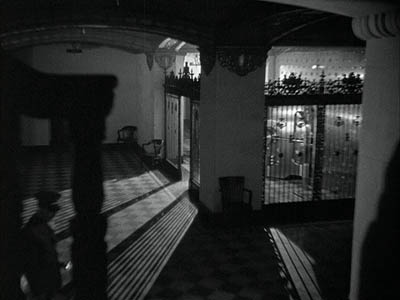
American Madness.
15 June: Thanks to Kent Jones for correcting a name slip.
19 June: Breaking News: Grover has just been promoted to Senior Vice President for asset management, film restoration, and digital mastering. Nice timing; wish we could say our blog put him over the top, butVariety explains that it was good old-fashioned talent. Congratulations to Grover!
A glimpse into the Pixar kitchen
DB here:
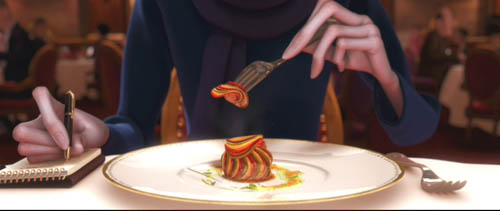
On some of Bill Kinder‘s business cards, the I in PIXAR is represented by Buzz Lightyear, the blustery, not-too-swift astronaut of Toy Story. It’s a typical gesture of self-deprecation from the studio that showed that computer animation didn’t have to be just plastic surfaces and mechanical expressions. Pixar is cool, geeky, and warm all at the same time. Its films are both smart and soulful, made by movie fans for movie fans, and for everybody else. Like the best of the Hollywood tradition, Pixar movies have the common touch and still offer the most refined pleasures.
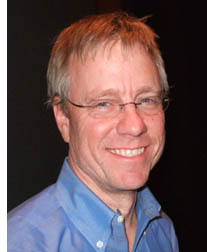 Kristin and I have already written admiringly about Pixar on this site (here, here, and here). It’s quite likely that this studio is making the most consistently excellent films in America today. So we were delighted when our colleague Lea Jacobs arranged for Bill to come to the University of Wisconsin—Madison last fall. He toured our new Hamel 3-D media facility, met with faculty and students, and gave a talk, “Editing Digital Pictures.” Bill is Director of Editorial and Post-Production, a position that gives him an encompassing view of the Pixar process as he champions the efforts of the editors and their teams as key creative contributors.
A graduate of Brown, where he studied with our old friend Mary Ann Doane, Bill is like Pixar movies—intellectual, good-natured, energized, and adept at connecting with people. He started his career in news-gathering and TV editing before moving to work at Francis Ford Coppola’s American Zoetrope, in the days of Jack (1996) and the uncompleted Pinocchio project. He joined Pixar in 1996, while they were finishing Toy Story. When the success of A Bug’s Life enabled Pixar to move to a purpose-built facility in Emeryville, Bill went along.
Whittling vs. building
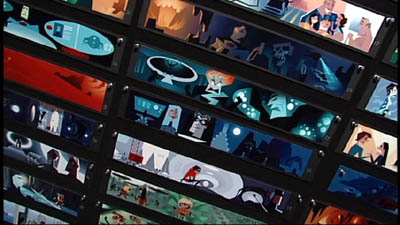
I’ve always been uncertain about what an editor does in the animation process. Since every shot is planned and executed in detail, what can be left for an editor to do? Bill started from that question. No, editing digital animation isn’t just a matter of cutting off the slates and splicing perfectly finished shots together.
As in live-action filming, the animation editor is working with dozens of alternate versions of every shot. The reason is that at Pixar, there are roughly five phases of production: storyboarding, layout, animation, lighting, and effects/ rendering. Each one generates footage that has to be cut together.
The static storyboards, for instance, present poses, expressions, and movements against a blank background. They are assembled in digital files that can be played back as if they were a movie. In order to plan the next phase, the resulting “footage” has to be edited, and choices are made at every cut. And each scene is storyboarded at least five different ways, with many variations of action and timing. A single film uses up to 80,000 boards!
At the next phase, layout, the scene’s overall action is planned. Layout artists develop the staging of each shot, testing different backgrounds and camera angles with the editors. Again, the alternatives have to be assembled and cut in various combinations.
Whittling versus building, Bill called it. The live-action editor gets a mass of footage that has to be triaged, but the animation editor is building and tuning the film from the start. Editing operates at each phase, from storyboarding to final rendering. This “almost overwhelming iteration,” as Bill called it, demands that the editorial department hold all the alternatives in its collective mind at once. Add to this the fact that Pixar can take up to five years to produce a film, maintaining several editorial teams to cover projects at different degrees of completion. When you realize that all this brainpower and bookkeeping are necessary for even the simplest shot, you appreciate the felicities of the finished product even more. These people make it all look easy.
Continuity and the viewer’s eye
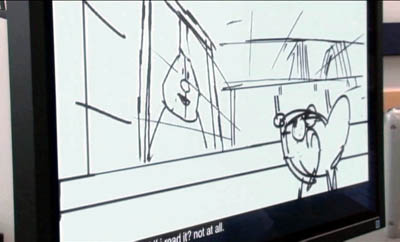
Bill explained that digital animation occasionally requires something like live-action coverage. (1) Action sequences with fast cutting need to be spatially clear, and “chase scenes can be hard to board.” So sometimes the layout artists create master shots and closer shots from different angles that the editor will pick out and assemble, live-action fashion.
Like live-action editors, Pixar editors have to keep an eye on continuity of the objects in the frame. Because each shot is reworked across many phases, items of the set, lighting, color, atmosphere, effects and rendering have to be maintained, on many layers or levels of the program. (I gather it’s like the layers in PhotoShop.) Sometimes a layer, whether a prop, character, or set element, fails to “turn on” and so a discontinuity can crop up. A finished Pixar film typically has 1500 shots or more, so there’s a lot to keep track of.
In another carryover from live-action features, Pixar plots are conceived and executed in three discrete acts. It’s not only a storytelling strategy but a convenience in production. Rather than waiting until the entire film is done to examine the results of the different phases, the filmmakers can finish one act ahead of the others in order to troubleshoot the rest.
I’ve studied how filmmakers compose the image in order to shift our attention (2), so I was happy to hear that this process is of concern to the Pixar team. “Guiding the viewer’s eye,” Bill called it. He explained that in looking at storyboards and animated sequences, his colleagues sometimes use laser pointers to track the main areas of interest within shots and across cuts, especially when characters’ eyelines are involved. Nice to see that sometimes academic analysis mirrors the practical decisions of filmmakers.
The auteurs of Pixar
What makes Pixar films so fine? Bill supplied one answer: It’s a director-driven studio. As opposed to filmmaking-by-committee, with producers hiring a director to turn a property into a picture, the strategy is to let a director generate an original story and carry it through to fruition (aided by all-around geniuses like the late Joe Ranft). Within the Pixar look, John Lasseter’s Toy Story 2 and Cars are subtly different from Brad Bird’s The Incredibles and Ratatouille or Andrew Stanton’s Finding Nemo and upcoming Wall.E.
Bill covered many other fascinating topics, including the importance of sound (“the animated film’s nervous system”). But I’ll end with some pull-quotes from Bill’s talk.
*Francis Ford Coppola: “No film is ever as good as its dailies or as bad as its first assembly.”
*Gary Rydstrom: “Film sound is the side door to people’s brains.”
*Bill himself: “Editing is just writing, but using different tools.”
We’re grateful to Bill for his visit and look forward to seeing him again. Goes to prove what we’ve said before: Popular American filmmaking harbors many of the most intelligent, sensitive, and generous people you’ll ever find.
(1) In live-action production, coverage involves shooting a master shot of a scene that shows the entire action. Then parts of the action are repeated and filmed in closer views. This allows the editor several options for cutting the scene together.
(2) I talk about this in Chapter 6 of On the History of Film Style and throughout Figures Traced in Light. See also Film Art, pp. 140-153, and this blog here and here.

PS: Another glimpse into the kitchen: Bill Desowitz reports on Wall*E at Animation World. Now Pixar is trying to emulate the look of 70mm. And there’s footage from Hello, Dolly! in there? All the signs point to another nutty, dazzling achievement.