















Archive for the 'UW Film Studies' Category
Creating a classic, with a little help from your pirate friends
DB here:
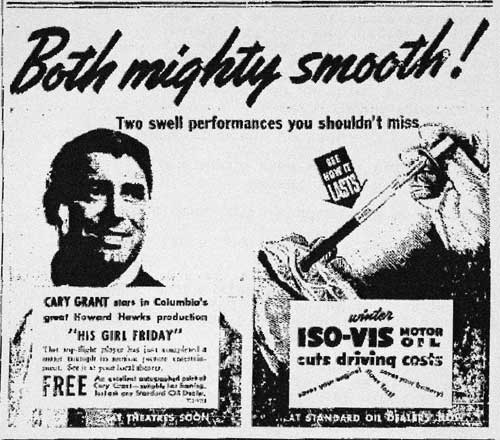
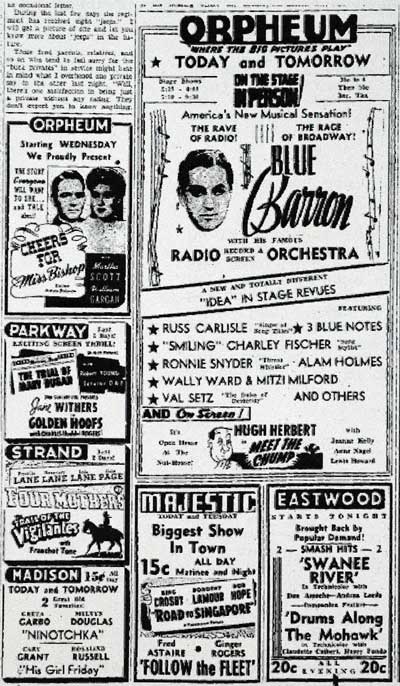
In early April of 1940, His Girl Friday came to Madison, Wisconsin. It ran opposite Juarez, The Light that Failed, Of Mice and Men, and a re-release of Mamoulian’s Dr. Jekyll and Mr. Hyde. Pinocchio was about to open. Most screenings cost fifteen cents, or $2.21 in today’s currency.
Before television and home video, film was a disposable art. Except in big cities, a movie typically played a town for a few days. Programs changed two or three times a week, and double bills assured the public a spate of movies—nearly 700 in 1940 alone. People responded, going to the theatres on average 32 times per year. Given the competition, it’s no surprise that His Girl Friday didn’t stand out in the field; it was nominated for no Academy Awards and honored by no prizes. On just a single day in Madison, the cast of His Girl Friday was up against icons like Muni, Colman, March, and Bette Davis.
Nowadays, of course, nearly everyone regards HGF as one of the great accomplishments of the studio system. Most would consider it a better movie than any of the others it played opposite in my home town. A typical example of critical exuberance is Jim Emerson’s comment here. Or read James Harvey’s 1987 encomium:
It would be hard to overstate, I think, the boldness and brilliance of what Hawks has done here: not only an astonishingly funny comedy, but a fulfillment of a whole tradition of comedy—the ur-text of the tough comedy appropriated fully and seamlessly to the spirit and style of screwball romance. His Girl Friday is not only a triumph, but a revelation.
Oddly, this extraordinary film lay largely unnoticed for three decades. How did it become a classic? The answer has partly to do with the rising status of Howard Hawks, the director, among critics. It also owes something to changes in how academics thought about film history. And a little movie piracy didn’t hurt.
An unseen power watches over the Morning Post
Hawks the Artist is a creation of the 1960s. Before that, American film historians almost completely ignored him. Andrew Sarris often reminds us that he’s absent from Lewis Jacobs’ Rise of the American Film (1939), but he’s also missing from Arthur Knight’s The Liveliest Art (1957), the most popular survey history of its day. Apart from press releases and reviews of individual films, there were few discussions of Hawks in American newspapers and magazines. The most famous piece is probably Manny Farber’s “Underground Movies” of 1957, which treats Hawks along with other hard-boiled directors like Wellman and Mann.
From the start, Hawks was more appreciated in France. There film historians acknowledged A Girl in Every Port (1928), in part because of the presence of Louise Brooks, and they usually flagged Scarface (1932) as well, which they could see and Americans couldn’t. (Howard Hughes kept it out of circulation for decades.) But Hawks is barely mentioned in Georges Sadoul’s one-volume Histoire du cinéma mondiale (orig. 1949) and he’s ignored in the 1939-1945 volume of René Jeanne and Charles Ford’s monumentally monotonous Histoire encyclopédique du cinéma (1958).
The essay that marked the first phase of reevaulation was evidently Jacques Rivette’s “The Genius of Howard Hawks” in Cahiers du cinéma in 1953. Inspired by Monkey Business, Rivette’s philosophical flights and you-see-it-or-you-don’t tone helped define the auteur tactics identified with Cahiers’s young Turks. Rivette and his colleagues became known as “Hitchcocko-Hawksians.” The essay, however, doesn’t seem to have been immediately influential. Antoine de Baecque claims that within Cahiers, an admiration for Hawks was controversial in a way that liking Hitchcock was not. (1) It took some years for Hawks to ascend to the Pantheon.
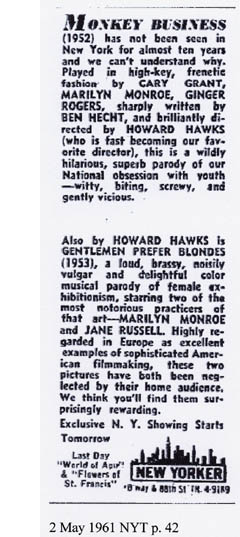 The story of that ascent has been well-told by Peter Wollen in his essay, “Who the Hell Is Howard Hawks?” In France, the Young Turks’ tastes had been nurtured by Henri Langlois, who showed many Hawks films at the Cinémathèque Française. In New York, Andrew Sarris and Eugene Archer had become intrigued by Cahiers but were ashamed that as Americans they didn’t know Hawks’ work. They persuaded Daniel Talbot to show a dozen Hawks films at his New Yorker Theatre during the first eight months of 1961. The screenings’ success allowed Peter Bogdanovich to convince people at the Museum of Modern Art to arrange a 27-film retrospective for the spring of 1962. The package went on to London and Paris, sowing publications in its wake.
For the MoMA retrospective, Hawks granted Bogdanovich a monograph-length interview, which was to be endlessly reprinted and quoted in the years to come. (2) Sarris, now knowing who the hell Hawks was, wrote a career overview for the little magazine, The New York Film Bulletin, and this piece became a two-part essay in the British journal Films and Filming. Both Bogdanovich and Sarris made brief reference to His Girl Friday, as did Peter John Dyer in another 1962 essay, this one for Sight and Sound. At the end of 1962, another British magazine, Movie, published an issue on Hawks. At the start of 1963, Cahiers devoted an issue to him, including an homage by Langlois himself. Thanks to the work of Archer, Bogdanovich, Sarris, and MoMA, Hawks was rediscovered.
Sarris provided a condensed case for Hawks in his far-reaching catalogue of American directors, published as an entire issue of Film Culture in spring of 1963. There followed an interview with Hawks’s female performers in the California journal Cinema (late 1963), an appreciation by Lee Russell (aka Peter Wollen) in New Left Review (1964), another Cahiers issue (November 1964), J. C. Missiaen’s slim French volume Howard Hawks (1966), Robin Wood’s Howard Hawks (1968), and Manny Farber’s Artforum essay (1969). There were doubtless other publications and events that I never learned about or have forgotten. In any case, by the time I started grad school in 1970, if you were a film lover, you were clued in to Hawks, and you argued with the benighted souls who preferred Huston. . . even if you hadn’t seen His Girl Friday.
Light up with Hildy Johnson
One of my obsessions in graduate school was the close analysis of films. But I was also interested in whether one could build generalizations out of those analyses. My initial thinking ran along art-historical lines. My Ph. D. thesis on French Impressionist cinema sought to put the idea of a cinematic group style on a firmer footing, through close description and the tagging of characteristic techniques. But that approach came to seem superficial. I wasn’t satisfied with my dissertation; although it probably captured the filmmakers’ shared conceptions and stylistic choices, I couldn’t offer a very dynamic or principled account of formal continuity or change.
Watch a bunch of movies. Can you disengage not only recurring themes and techniques, but principles of construction that filmmakers seem to be following, if only by intuition? As I was finishing my dissertation, reading Russian Formalist literary theory pushed me toward the idea that artists accept, revise, or reject traditional systems of expression. These become tacit norms for what works on audiences. My reading of E. H. Gombrich pushed me further along this path. We should, I thought, be able to make explicit some of those norms. Eventually I would call this perspective a poetics of cinema.
I was assembling my own version of some ideas that were circulating at the time. In the early 1970s, several theorists floated the idea that different traditions fostered different approaches to filmic storytelling. People were seeing more experimental and “underground” work, as well as films from Asia and what was then called the Third World. Being exposed to such alternative traditions helped wake us up to the norms we took for granted. The mainstream movie, typified by what Godard called “Hollywood-Mosfilm,” seemed more and more an arbitrary construction.
People began examining films not as masterworks or as expressions of an auteur, but as instances of a representational regime. Films became “tutor-texts,” specimens of formal strategies that were at play across genres, studios, periods, and directors. Again, the French pointed the way, particularly Raymond Bellour, Thierry Kuntzel, and Marie-Claire Ropars. At the same moment, Barthes’ S/z was published in English, and it seemed to provide a model for how one might unpick the various strands of a text, either literary or cinematic. Screen magazine was a conduit for many of these ideas in the English-speaking world.
Some of my contemporaries disdained the mainstream cinema and moved toward experimental or engaged cinema. Others read the dominant cinema symptomatically, for the ways it revealed the contradictions of ideology. I learned from both approaches, but I believed that the current analysis of how Hollywood worked, even considered as a malevolent machine, was incomplete. Could we come up with a more comprehensive and nuanced account of the mainstream movie? This line of thinking was already apparent in non-evaluative studies of form and style, such as essays by Thomas Elsaesser, Marshall Deutelbaum, and Alan Williams. (3)
At some point in graduate school at the University of Iowa, between fall 1970 and spring 1973, I saw a screening of His Girl Friday. I fell in love with its heedless energy. It seemed to me a perfect example of what Hollywood could do.
In my admiration I was channeling the cultists. Rivette, in a review of Land of the Pharoahs: “Hawks incarnates the classical American cinema.” (4) Bogdanovich: He is “probably the most typical American director of all.” Richard Griffith, then film curator of MoMA, had slighted Hawks in his addendum to Paul Rotha’s The Film Till Now, but in his foreword to the Bogdanovich interview he caved to the younger generation: “Hawks works cleanly and simply in the classical American cinematic tradition, without appliquéd aesthetic curlicues.” As for HGF, in the 1963 Cahiers tribute Louis Marcorelles called it “the American film par excellence.”
Praising Hawks, and HGF specifically, was part of a larger Cahiers strategy to validate the sound cinema as fulfilling the mission of film as an art. What traditional critics would have considered theatrical and uncinematic in HGF—confinement to a few rooms, constant talk, an unassertive camera style—exactly fit the style that Bazin and his younger colleagues championed. (For more on that argument, see Chapter 3 of my On the History of Film Style.)
These niceties didn’t inform my reaction at the time. I was already primed to like Hawks, though, having caught what films I could after reading Wood et al. (During my initial summer in Iowa City, I went to a kiddie matinee of El Dorado and got Nehi Orange spilled down my neck.) On my first viewing His Girl Friday delighted me with the sheer gusto of the pace and playing. Clearly the cast was having fun. A press release sent out before the film claimed that during one scene, with Cary Grant dictating frantically to Rosalind Russell, she cracked him up by handing over what she had typed.
Cary Grant is a ham. Cary Grant is a ham. Now is the time for all good men to quit mugging. You don’t think you can steal this scene, do you—you overgrown Mickey Rooney? The quick brown fox jumps over the studio. Cary Grant is a ham.
Even discounting this tale as PR flackery, we know from Todd McCarthy’s excellent biography that Hawks encouraged competitive scene stealing and wily improvisation. Russell hired an advertising copywriter to compose quips she could “spontaneously” conjure up in her duels with Grant.
If there was a “classical Hollywood cinema”—a phrase that was in the early ’70s coming into circulation via Screen—the buoyant forcefulness of His Girl Friday embodied it. Here was a film pleasure-machine that hummed with almost frightening precision. What else do you expect from a director who studied engineering and whose middle name is Winchester?
Production for use
When I saw His Girl Friday, little had been written about it. Despite Langlois’ screenings, before the 1962 touring program, the Cahiers critics seemed to have had limited access to Hawks’ prewar work. His Girl Friday wasn’t released theatrically in France until January of 1945 (not perhaps the most propitious moment), and it apparently made no long-lasting impression on the intelligentsia. I can’t find any critical commentary on it in French writing before the 1963 issue of Cahiers.
In the United States, HGF earned Hawks a courteous write-up in the New York Times by, of all people, Bosley Crowther, (5) but it wasn’t acknowledged as an instant classic like Mr. Smith Goes to Washington or The Philadelphia Story. After the initial flurry of mostly favorable reviews, the movie seems to have been forgotten until Manny Farber’s 1957 essay, and even there it’s only mentioned in a list. Interestingly, it wasn’t screened during the 1961 New Yorker series. Robin Wood’s sympathetic but not uncritical discussion in his Hawks book of 1968 seems to have been the most comprehensive account available since the movie’s release.
At about the time Wood’s book was published, something big happened. Columbia Pictures failed to renew its copyright, and His Girl Friday fell into the public domain.
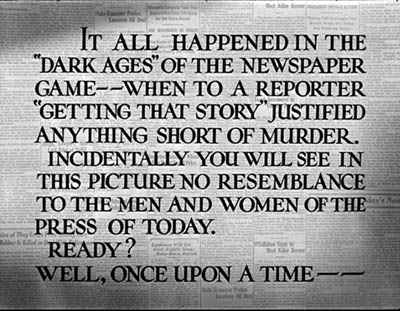
Entrepreneurs made dupe copies, in quality ranging from okay to terrible. You could rent one for peanuts and buy one for only a little more. Some of these bleary prints have been telecined and turned into the DVD versions of the film that fill bargain bins today. After I got to the University of Wisconsin, where Hawks films stoked the two dozen campus film societies, I bought a public domain print. The copy was better than average, although it lacked the fairy-tale warning title at the start. From 1974 on, I showed the poor thing constantly.
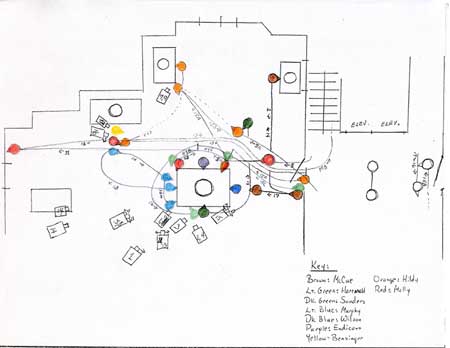
In Introduction to Film, taught to hundreds of students each semester, HGF illustrated some basic principles of classical studio construction. It had the characteristic double plotline (work/ romance), a careful layout of space, an alternation of long takes and quick cutting, manipulation of point-of-view, judicious depth framing (see frame below), and cascading deadlines. In Critical Film Analysis, I asked students to map out scenes shot by shot (see diagram above) and to show how different approaches (genre-based, feminist, Marxist) would interpret the film. In a seminar on “the classical film and modernist alternatives” HGF grounded comparisons with Bresson, Dreyer, Ozu, Godard, and Straub/Huillet. By steeping ourselves in such alternative traditions, could we resist the naturalness of Hollywood artifice?
The movie became a UW staple. It went into the first edition of Film Art (1979) as an instance of classical construction; even the telephones were scrutinized. Marilyn Campbell’s paper from our seminar was published in 1976. (6) Over the years, many of our grad students, exposed to the film in our courses, have gone on to use it in their teaching.
Doesn’t have to rhyme
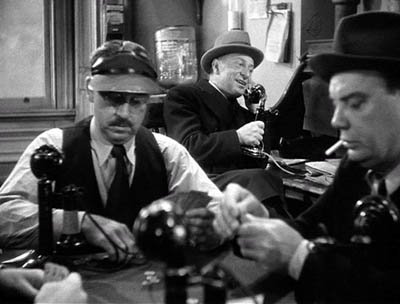
I can’t let HGF go. I still use moments to illustrate points in my writing and lectures. Madison colleagues and I swap banter from it; Kristin and I talk in Hawks-code, as she explains here. I’ve been told that grad students in another PhD program compared our program to the Morning Post pressroom (favorably or not, I don’t know). Thanks to Lea Jacobs, the invitation to my retirement party was surmounted by a picture of Walter Burns whinnying into his phone.
But seriously, His Girl Friday, isn’t a bad guide to a lot of social life. You can learn a lot from its Jonsonian glee in selfishness and petty incompetence, as well as its sense that virtue resides with the person who has the fastest comeback. Think as well how often you can use this line in a university setting:
If he wasn’t crazy before, he would be after ten of those babies got through psychoanalyzing him.
I’m not claiming special credit for the HGF revival, of course. Plenty of other baby-boomer film professors were teaching it. It became a reference point for feminist film criticism, particularly Molly Haskell’s From Reverence to Rape (1974), and it has never lost its auteurist cachet. Richard Corliss’s 1973 book on American screenwriters flatly declared that “His Girl Friday is Hawks’s best comedy, and quite possibly his best film.”
Most important of all, TV stations were screening their bootleg prints. HGF didn’t become a perennial like that other public domain classic It’s a Wonderful Life, but its reputation rose. Its availability pushed the official Cahiers/ Movie masterpieces Monkey Business and Man’s Favorite Sport? into a lower rank, where in my view they belong.
Once HGF became famous, the proliferation of shoddy prints became an embarrassment. In 1993 it was inducted into the National Film Registry, which gave it priority for Library of Congress preservation. Columbia managed to copyright a new version of the film. A handsomely restored version was released on DVD, and a few years back I saw a 35mm copy whose sparkling beauty takes your breath away.
The lesson that sticks with me is this. If Columbia had renewed its copyright on schedule, would this film be so widely admired today? Scholars and the public discovered a masterpiece because they had virtually untrammeled access to it, and perhaps its gray-market status supplied an extra thrill. Thanks mainly to piracy, His Girl Friday was propelled into the canon.
Epilogue
In May of 1940, His Girl Friday hung around Madison, shifting from its first venue, the Strand downtown, to an east side screen, the Madison. The film came back in late September to yet a third screen, the Eastwood (now a music venue).
HGF was revived in March of 1941, as the second half of a double bill at the Madison (bottom left below). Check out the competition: some killer re-releases from Ford, Lubitsch, Astaire-Rogers, and Hope-Crosby. A Midwestern city of 60,000 could become its own cinémathèque without knowing it.
(1) Antoine de Baecque, Cahiers du cinéma: Histoire d’une revue, vol. 1: À l’assaut du cinéma, 1951-1959 (Paris: Cahiers du cinéma, 1991), 202-204.
(2) Bogdanovich has published a much fuller version in Who the Devil Made It? (New York: Knopf, 1997) , 244-378.
(3) Thomas Elsaesser, “Why Hollywood?” Monogram no. 1 (April 1971), 2-10; “Tales of Sound and Fury,” Monogram no. 4 (1972), 2-15; Marshall Deutelbaum, “The Structure of the Studio Picture,” Monogram no. 4 (1972), 33-37; Alan Williams, “Narrative Patterns in Only Angels Have Wings,” Quarterly Review of Film Studies 1, 4 (November 1976), 357-372.
(4) Jacques Rivette, “Après Agesilas,” Cahiers du cinéma no. 53 (December 1955), 41.
(5) Bosley Crowther, “Treatise on Hawks,” New York Times (17 December 1939), 126. “He brings to his work as a director the ingenious and calculating brain of a mechanical expert. . . . He pitches into the job just as though he were building a racing airplane.”
(6) Marilyn Campbell, “His Girl Friday: Production for Use,” Wide Angle 1, 2 (Summer 1976), 22-27.
For a helpful collection of conversations with the master, see Howard Hawks Interviews, ed. Scott Breivold (Jackson: University of Mississippi Press, 2006). Go here for a 1970s piece by James Monaco on then-current controversies.
PS 24 Feb: Jason Mittell responds to my post with some nice nuancing and draws out the implication for copyright issues: contrary to current media policy, the wider availability of a work can actually enhance its value.
Coming attraction: Kristin is preparing a blog entry commenting on fair use in the digital age.
Things to like about looking

13 Lakes.
“What I like about looking is how many ways there are to see the same thing.”
Sadie Benning
DB here. Today no extended essay, just some jottings.
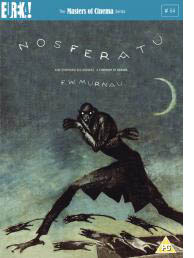 Some day I really must do an extended tribute to the Eureka/ Masters of Cinema DVD line. To call it the UK Criterion is partly right, given the painstaking transfers and the ample supplementary material. But Eureka ventures into some very fresh territory. A company that puts out the terminally peculiar Funeral Parade of Roses (Toshio Matsumoto, 1969) as well as a double-disc set of Mizoguchi’s Sansho the Bailiff and Gion Bayashi deserves points for audacity.
A recent batch of Eureka releases:
*Two cult animation items by René Laloux, Gandahar and Les maitres du temps. Fans of Fantastic Planet and the bande dessinée artist Moebius will snap these up, as much for the large booklets as for the discs.
*Then there’s Nosferatu. You say we’ve already got enough? Nope. First, we can never have too many of this, one of the greatest of silent films. Second, this version looks scarily definitive: a two-DVD set with the Murnau-Stifung restoration and the original score, plus a documentary, plus a book including some primary material along with essays by Enno Patalas, Gil Perez, Thomas Elsaesser, and Craig Keller.
*Sticking with Murnau (who directed, some say, in a white lab coat), Eureka offers a double-disc set of Tabu, also from the Murnau-Stiftung and with previously unseen scenes and title cards.
*Finally, there’s Peter Watkins’ Edvard Munch in its long version, with a booklet including a Watkins “self-interview.”
Unbelievably, many more great movies are on the way. Check the catalogue and preview lineup here.
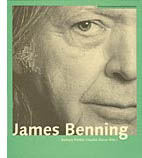 Also from overseas, the Austrian Filmmuseum adds a new title to its Synema book series, alongside Alexander Horwath’s remarkable dossier on Sternberg’s Case of Lena Smith (discussed in an earlier entry here) and many other books on experimental cinema. It’s the first book devoted to James Benning.
I have a personal interest. I met Jim when I came to Madison in 1973. He was working on his MFA in film and art, and he was one of four teaching assistants assigned to me. There was Doug Gomery, already an impressive film historian, soon to go on to fame for his work on the US film industry. There was Brian Rose, one of the most alert cinephiles I ever met, and one of the funniest. There was Frank Scheide, already an expert on Chaplin, Keaton, and their peers. And there was Jim, a master mathematician (helpful for computing grade curves) and the only filmmaker in the bunch. Jim and Frank, both serene, had a calming influence on the rather hyper Rose, Gomery, and Bordwell. It was a great team, my Dirty 1/3 Dozen, and I remember our collective grading sessions fondly.
Jim had already made Time and a Half, but his most famous works, starting with 81/2 x 11 (1974), were yet to come. He left Madison and went on to teach filmmaking at several places, settling finally at Cal Arts. I kept in occasional touch with him and his work. He visited our Wisconsin Film Festival with his remarkable, politically charged Four Corners, El Valley Central, and Los. I’ve seen him more frequently in the last few years because turn up at the same film festivals—me as an observer, him showing gorgeous and provocative films like 13 Lakes, 10 Skies, and One Way Boogie Woogie/ 27 Years Later.
So the book, edited by Claudia Slanar and Barbara Pichler, is very welcome. It just arrived, so I haven’t had a chance to read it through, but I signal it to all those interested in a filmmaker who has been enthralling and surprising us for thirty-five years. Apart from a career chronology and a complete filmography, it features essays by Julie Ault, Sharon Lockhart, Volker Pantenburg, Dick Hebdige, Amanda Yates, Scott MacDonald, Allan Sekula, Michael Pisaro, Nils Plath, and of course Sadie Benning, a mean hand with Pixelvision. Lockhart supplies lustrous shots of some Wisconsin beer bottles in Jim’s collection.
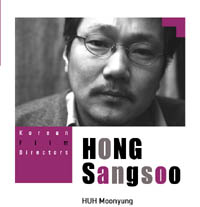 Speaking of books, not beer, the Korean Film Council has just published a series of trim books on major directors, both classic and contemporary. Each volume includes a detailed filmography and a lengthy interview. Some volumes are through-written by a single author, others consist of analyses and appreciations by various hands, including major Korean critics and Asian cinema expert Chris Berry.
The directors honored are Kim Dong-on, Im Kwon-taek, Lee Chang-dong, Kim Ki-young, Park Chan-wook, and Hong Sang-soo. This last volume, edited by Huh Moonyung, includes an homage by Claire Denis and a small essay by me, “Beyond Asian Minimalism: Hong Sang-soo’s Geometry Lesson.”
Books in the series may be ordered here.
Speaking, again, of books. . . The paper edition of Phillip Lopate‘s American Movie Critics: An Anthology from the Silents until Now (The Library of America) has just come out. I found reading the first edition addictive, like eating peanuts and M & Ms. Now we need a second volume including Frank Woods (a critic close to Griffith), Welford Beaton, and other less-known early writers.
In the meantime, the new edition has grown to include an essay on Fincher’s fine Zodiac by Nathan Lee and internet pieces from Stephanie Zacharek (Salon.com) and your obedient servant. I’ve never imagined an essay of mine in a collection that includes my teenage idols Mencken, Macdonald, Sontag, and Sarris, so this volume amounts to a swell early Christmas present. Thanks to Mr. Lopate and Geoffrey O’Brien for all their help.
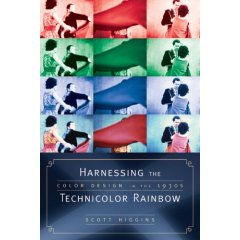
Speaking, yet again, of books. . . A plug is in order for Scott Higgins’ meticulous, engagingly written Harnessing the Technicolor Rainbow: Color Design in the 1930s, just out from Texas. I sat on Scott’s dissertation committee, and I was impressed by his imaginative research methods (e.g., using Pantone swatches as an objective measure of color hues in movies) and his sensitive attention to the way the movies look. Nobody before Scott has analyzed color in film so carefully. Scott is also attentive to production practices, so filmmakers interested in the history of technology should find a lot to chew on here. Several pages of original Technicolor frames support Scott’s case in graceful detail. No beer bottles, however.
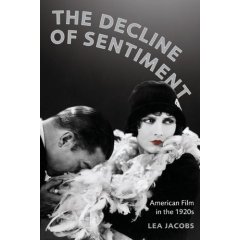
More books from Wisconsin scholars: The above-mentioned Doug Gomery has a new book due out early next year, A History of Broadcasting in the United States. Lea Jacobs’ The Decline of Sentiment: American Film in the 1920s should follow soon. I’ve read the latter already, but both are without doubt worthy of your attention. If you like your American film history at once informationally solid and intellectually daring, you will like these items. Neither Doug nor Lea is a fan of conventional wisdom.
Finally, for fans of Hong Kong cinema: Johnnie To and Wai Ka-fai‘s Mad Detective (I filed a note on it from Vancouver) has been a hit in Hong Kong, beating Beowulf. An analog Lau Ching-wan can thrash a digital Ray Winstone any day of the week. Milkyway Image’s boundlessly energetic Shan Ding has set up a Facebook page as a place to chat about movies and, one hopes, to keep us apprised of developments in Mr T’s upcoming remake of Melville’s Cercle Rouge.
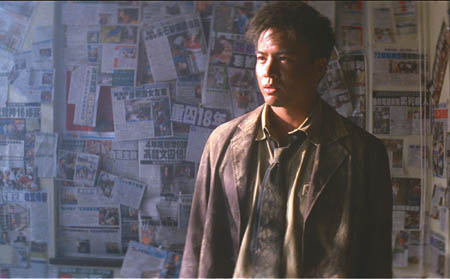
Mad Detective.
PS: Just learned about an informative interview with Jim Benning here, with more ravishing shots from 13 Lakes. This entry also includes several other links to web discussions of Jim’s films.
Live with it! There’ll always be movie sequels. Good thing, too.
DB:
You’ve heard it before. Facing a summer packed with sequels, a journalist gets fed up. This time it’s Patrick Goldstein in the Los Angeles Times, and his lament strikes familiar chords. Sequels prove that Hollywood lacks imagination and is interested only in profits. Sequel films are boring and repetitious. They rarely match the original in quality. And when good directors sign on to do sequels, they get a big payday but they also compromise their talents.
Me, I want more original and plausible ideas. So, I expect, do you. Time to call in the Badger squad, the ensemble of email pals drawn from various generations of UW-Madison grad students and faculty. I asked them if we can’t understand sequels in a more thoughtful and sophisticated way—historically, artistically, in relation to other media. The result is another virtual roundtable, like the one on B-films held here a few months ago.
There were enough ideas for several blogs, and I’ve regretfully had to drop a whole thread devoted to comics and videogames. Maybe I’ll compile those remarks into a sequel. For now, the participants are: Stew Fyfe; Doug Gomery; Jason Mittell (of JustTV); Michael Newman (of Zigzigger and Fraktastic); Paul Ramaeker; and Jim Udden. I throw in some ideas as well.
Are all sequels in the arts automatically second-rate?
DB: The Odyssey is a sequel to the Iliad, and the second, better part of Don Quixote is a sequel to the first. Tolkien’s Lord of the Rings trilogy is explicitly a followup to The Hobbit. After killing off Sherlock Holmes in “The Adventure of the Final Problem,” Conan Doyle resurrected him for more exploits. The Merry Wives of Windsor brings back Sir John Falstaff after his death in Henry IV Part II, because, supposedly, Queen Elizabeth wanted to see him again, this time in a romance plot.
Michael Newman: Sequels exist in all narrative forms–novels, plays, movies, television, videogames, comics, operas. What is the Bible but a series of sequels? Didn’t Shakespeare follow up Henry IV with a part II? What of Wagner’s Ring Cycle and Updike’s Rabbit novels? Many novelists of high reputation have written sequels, including Thackeray, Trollope, Faulkner, and Roth. There is nothing intrinsically unimaginative about continuing a story from one text to another. Because narratives draw their basic materials from life, they can always go on, just as the world goes on. Endings are always, to an extent, arbitrary. Sequels exploit the affordance of narrative to continue.
What about film sequels? What’s their track record?
DB: Goldstein grants the excellence of Godfather II, but what about Aliens, The Empire Strikes Back, Toy Story 2, and Indiana Jones and the Last Crusade (arguably the best entry in the franchise)? We have arthouse examples too, provided by Satyajit Ray (Aparajito and The World of Apu), Bergman (Saraband as a sequel to Scenes from a Marriage), and Truffaut (the Antoine Doinel films). If we allow avant-garde sequels, we have James Benning‘s One-Way Boogie Woogie/ 27 Years Later. As for documentaries, what about Michael Moore’s Pets or Meat?, the pendant to Roger and Me?
The world of film would be a poorer place if critics had by fiat banned all the fine Hong Kong sequels, notably those spawned by Police Story, A Better Tomorrow, Drunken Master, Once Upon a Time in China, Swordsman, and so on up to Johnnie To’s Election 2 and Andrew Lau’s Infernal Affairs 2. And arthouse fave Wong Kar-wai hasn’t been shy about making sequels.
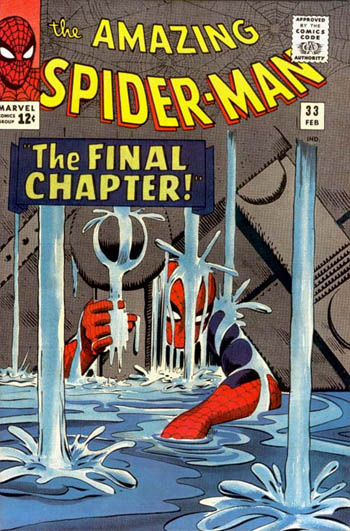
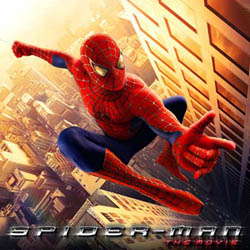
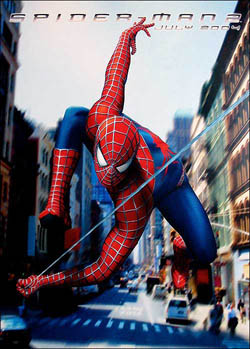
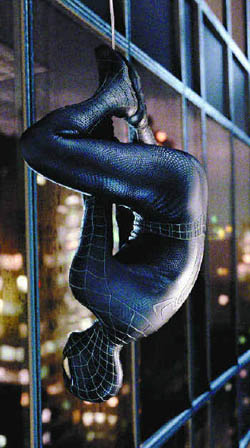
Stew Fyfe: Other sequels of quality: The Bride of Frankenstein, Mad Max II (The Road Warrior), Spider-Man 2, X-Men 2, Dawn of the Dead, Sanjuro, Quatermass and the Pit. Personally, I’d also add Blade 2, Babe 2 and The Devil’s Rejects, but I’m sure those are arguable. Would The Limey be a sequel to Poor Cow? Del Toro speaks of Pan’s Labyrinth as a companion piece or “sister-film” to The Devil’s Backbone. If you want to include docs, there’s always the Up series.
Why are there film sequels in the first place?
DB: Most film industries need to both standardize and differentiate their products. Audiences expect a new take on some familiar forms and materials. Sequels offer the possibility of recognizable repetition with controlled, sometimes intriguing, variation. This logic can be found in sequels in other media, which often respond to popular demand for the same again, but different. Remember Conan Doyle reluctantly bringing back Holmes, and Queen Elizabeth asking to see Sir John in love.
Doug Gomery: Sequels happen because the studio owners have never figured out any business model to predict success. If #1 is popular, perhaps #2 will be almost as popular. Until recently, producers seldom expected the followup’s revenues to equal the first. The basics were keep costs low, keep risks low, and make a profit. Maybe not a large as the breakthrough initial film—but at least a profit.
But they’re not a contemporary development. As part of the Hollywood studio system, they have existed in all eras—the Coming of Sound, the Classical Era, and the Lew Wasserman era. They surely seem to be surviving Wasserman as well. Indeed, as much as I admire Wasserman, who can defend Jaws 2 and its successors?
In the classic era, it may seem that there were fewer sequels as such, but there was a variant called rewrites in another genre. Years ago as I did my first book, a study of High Sierra, I watched Colorado Territory with something close to awe. It’s a gangster film turned western almost line by line. After all, Warners owned the literary rights: why not recycle it?
Given the mercenary impulse behind sequels, does a director’s willingness to make one mean that he or she has sold out?
Goldstein: “Look at the great talent who’s on the sequel beat: Steven Soderbergh has done two Ocean’s sequels. Bryan Singer, the wunderkind behind The Usual Suspects, has done X-Men 2 and is at work on a sequel to Superman Returns. Christopher Nolan has left behind the raw originality of Memento to do Batman movies. Robert Rodriguez, who burst on the scene with El Mariachi, has done two sequels for Spy Kids, with a Sin City sequel on its way. After making Darkman and A Simple Plan, Sam Raimi seemed poised to be our generation’s dark prince of meaty thrillers but has turned himself into an impersonal Spider-Man ringmaster instead.”
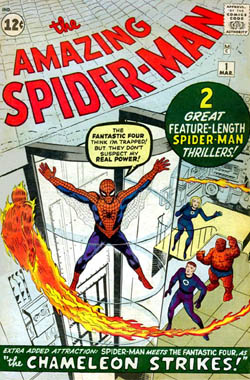
Paul Ramaeker: To assume that the Spider-Man films must necessarily be less personal than Darkman or A Simple Plan (both of which are heavily indebted to the strictures of their genres) is to perpetuate a culturally snobbish perspective on comic books. I’ve not seen S-M3, but Raimi is a genuine fan of the character, a character with a long and complex narrative history, and given the way S-M2 continues and develops threads from the first film, I see no reason to assume he didn’t have some artistic investment in presenting his interpretation of the character over 3 films (or however many) to present a larger “story” about the character. Why should this not be seen as “personal” filmmaking to the same extent as any other kind of adaptation?
Moreover, speaking as a Soderbergh fan: I may not like Ocean’s 12 as much as Ocean’s 11, but it seems like an experiment made in good faith to me. It is a stranger movie than you would think from the way it gets picked up in articles like Goldstein’s. In fact, the way it plays with audience expectations is both dependent upon familiarity with the first film, and radically divergent from it- in many ways, it does the exact opposite of what sequels are supposed to do, which is to provide a “cozy” (Goldstein’s word) repetition of familiar pleasures. Perhaps it failed (again, I remain sort of fond of the film, which I think was best described as being like an issue of Us Weekly as put together by the editors of Cahiers du cinéma), but even so I think you’d have to call it a failed experiment rather than a rehashing.
Stew Fyfe: At a guess, I’d say that audiences or critics might evaluate the worthiness/mercenary nature of sequels by asking three questions:
(1) Has the sequel been made because there’s more story to tell?
(2) Has the sequel been made because the characters are great and people want to see them again?
(3) Has the sequel been made because there’s more money to be made?
Obviously, any combination of all three can be answered in the affirmative for any sequel and presumably the sequel wouldn’t get made if the answer to (3) was No. But with something like The Two Towers, (1) gets priority, while with Pirates 2 + 3, (3) nudges out (2). Even with (3), money, as the primary motivation, one could still make a good film. The suspicion of milking the franchise just makes the movie an easier target for critics.
Do sequels automatically equal predictability?
Jason Mittell: The line that most interests me in Goldstein’s piece is the last: “When it comes to entertainment, I’ll take excitement and unpredictability over familiarity every time.” This sets up a false dichotomy between the known and the unknown. As David and I both blogged about a few months ago, knowing a story doesn’t preclude suspense and excitement (and for some viewers, it might actually enhance it). And arguably knowing a storyworld actually allows for greater opportunities for excitement and unpredictability – a film/episode/entry in any series that doesn’t need to spend much time introducing already-established settings, characters, conflicts, etc. can literally cut to the chase. Think of the second Bourne film as a good example, or Spider-man 2 as a chance to deepen character once basic exposition is accounted for.
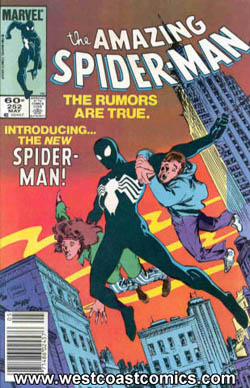
Paul Ramaeker: I have a theory. In the contemporary comic-book blockbuster, the sequels will always be better than the first entries. Spider-Man 2 is better than Spider-Man, X-Men 2 is better than X-Men, and I will bet that The Dark Knight will be better than Batman Begins, just as Batman Returns was better than Batman. The pattern seems to me to be that the first film in the series is relatively impersonal—the franchise must be established as a franchise, meaning that few boats will be rocked, and the director must prove that they can handle both a film on that scale, and can be trusted with the property with all the investment it represents.
But once they’ve done so, in the above cases where the first films enjoyed significant economic (and critical) success, the directors are given a bit more leeway, are allowed to drive the family car a little further and a little faster. In each case, the second film in the series by the same director has been significantly more idiosyncratic. Batman Returns has much more of Burton‘s sense of humor and interest in the grotesque; X-Men 2 is a much more serious and ambitious film narratively and thematically, more obviously the product of a prestige filmmaker (Singer’s never been an auteur by any stretch, so that will have to do). Spider-Man seemed sort of anonymous in terms of style, but Spider-Man 2 had a much more extensive and playful use of classic Raimi techniques: short, fast zooms; canted angles; rapid camera movements; whimsical motivations for techniques, like the mechanical-tentacle POV shot (virtually a repeat of his flying-eyeball POV from Evil Dead 2).
Who knows what The Dark Knight will be like, but I’m prepared to put money on the claim that it will have something to do with how people construct elaborate narratives around themselves to explain, justify, or obscure their actions and motives.
Are sequels part of a larger trend toward serial narrative?
DB: We can continue a story in another text within the same medium, but we can also spread the storyline across many platforms—novels, films, comic books, videogames. Henry Jenkins has called this process transmedia storytelling.
Michael Newman: Compared with literary fiction, there seems to be a strong propensity toward the never-ending story in genre storytelling like sci-fi and fantasy and superhero comics and spy novels and soap operas. Much of the cinematic sequel storytelling today might be considered as this kind of serialized genre storytelling. Such serials tend to have a low aesthetic reputation in comparison to more respectable genres. (The cinematic comparison would be summer blockbusters vs. fall Oscar bait.) Serial forms have historically been associated with children (e.g., comic books) and women (e.g., soaps). In other words, there is cultural distinction, a system of social hierarchy, at play.
Stew Fyfe: Yes, the longer-standing comics universes have made regular use of serial continuity to forge after-the-fact connections. It’s a form of what fans call retcon or “retroactive continuity.”
Sci-fi writer Phillip Jose Farmer used a similar concept, the “Wold Newton family” to link various mystery, pulp, crime, sci fi, adventure and spy fiction characters (so that Sherlock Holmes, Doc Savage, Sam Spade, The Shadow, Captain Blood and James Bond, among others, all become linked). Alan Moore did something similar with The League of Extraordinary Gentlemen, and Warren Ellis in Planetary. More limited filmic examples of this might be Zatoichi vs. Yojimbo, or Enemy of the State (which more or less sticks The Conversation‘s Harry Caul into a Bruckheimer film). There’s Freddy vs. Jason, which very adroitly observes and incorporates the continuities of two long-standing, mostly dormant franchises. In television, there’s that whole, rather insane St. Elsewhere continuity thing.
In the current crop of movie sequels featuring superheroes, one thing that has been noticeable is the casting of minor characters who might serve as springboards for later storylines. We’ve seen Dylan Baker play Dr. Connors in two Spidey films, for example, so if they decide to go with The Lizard as a villain in one of the later films, they’ve already set him within the film series’ continuity. Aaron Eckhart’s casting as Harvey Dent in The Dark Knight could similarly be used to set up Two Face as a villain for film 3.
This is similar to the idea of leaving a film “open for a sequel,” but it seems more closely integrated into the planning and execution of the film. It also points to a middle ground between the “We’re going into this making three unified films” model (Lord of the Rings) and the “We can make more money, so let’s see what plot elements we can build off of” (Pirates of the Caribbean). This is more of a “We’re probably going to make more films, let’s give ourselves something to work with” model.
It also raises the question, I guess, if you want to start speaking of dangling causes extending past the end of a film, or in the case of Pirates, the conversion of plot elements into something like dangling causes. In Pirates 1, we hear of Bootstrap Bill Turner getting chained to a cannonball and shot out into the ocean, but wasn’t it after he was made immortal by the curse of the Aztec gold? I guess you could call this a retroactive cause. Or, noting the similarity to “retcon,” a “retcause.” Never mind, that sounds lame.
Michael Newman: In the contemporary era of media convergence, serialized storytelling is becoming a mainstay across media and genres. Serial narratives supposedly facilitate spreading franchises out across multiple platforms. The media franchise demands long-format storytelling that can be spun off in multiple iterations. The rise of sequels is a much larger issue than a bunch of directors trying to make lots of money or audiences having unadventurous tastes–sequel/serial franchises are a central business model in the media industry today, supported and encouraged by the structure of conglomeration and horizontal integration.
The real point of the LAT article is that Hollywood is all commerce and no art, and sequels are a symptom. But this is such old news. And to connect it to a Squeeze summer tour is really stretching.
Jason Mittell: I think Michael’s cross-media point is crucial – continuity of a narrative world is a core part of nearly every storytelling form, but the language of “sequel” is applied predominantly to film. “Series” seems a more respectable term, as it suggests an organic continuity rather than a reactive stance of “Hey, let’s do that again!”
Are some serial/ sequel forms better suited to different media?
Jason Mittell: I think the LAT article is ultimately trying to valorize cinema’s potential to introduce something new, in reaction to the presumed rise of legitimate and praised series narratives on television (The Sopranos, Six Feet Under, Lost, etc.). And perhaps he has a point. Maybe film should stick to presenting compelling stand-alone short stories, since television has emerged as the leader in narrating persistent worlds? Or maybe I’m just saying that to pick a fight…
Jim Udden: I disagree that films should stick with one-off feature-length productions and leave ongoing series work to TV. Television has long had its Made for TV Movies, so why shouldn’t cinema think more in terms of series than it does? After all, if these are truly hard times for the film industry, as we’re always told, doesn’t it make more economic sense to adapt, just as TV has done in the last couple of decades?
True, there are things that cannot be matched on either side. I cannot imagine any film ever matching the daunting complexity of Deadwood or The Wire. Then again, some things work best as a stand-alone concern. Try to imagine a sequel to Pan’s Labyrinth or Children of Men, or try to imagine either film being made only for TV, for that matter. Moreover, some sequels should never be made. (Remember 2010?) On the other hand, some films would have been better off had they been pitched as an HBO series. (Syriana comes to mind.)
Yet film has proven its ability to take on a series format even when it is not called that. In a sense the oeuvres of most of the great art cinema auteurs are series of sorts. Aren’t Tati’s films a series with the ongoing presence of Hulot (or Hulots, if we include the false ones in Play Time)? And does anybody castigate Wong Kar-wai for following up Chungking Express with Fallen Angels, or In the Mood for Love with 2046, which are not series, but mere (gasp!) sequels? Clearly these examples were based not just on aesthetic visions, but on banking on previous success. Why do we give them a pass, but not more mainstream fare?
I think the more closely we look, the more we might find there are series and sequels even if they are not tagged by those names. It does happen in documentary, and not just in the 7 Up series. For example, American Dream does seem to me to a continuation of Harlan County USA, if not an outright sequel. Bowling for Columbine and Fahrenheit 9/11 combined make for a more complex argument about the relation of the defense industry to class issues than each one does on its own.
In other words, none of these formats has any value on its own. Everything depends on the type of stories to be told and the talent and economic wherewithal to find the best format for that story (or argument). The most appropriate format could be just a two-hour film, or it could be a television series going on for years. Or it could be something in between, such as the first two Infernal Affairs films, which got clumsily condensed into one film in The Departed. Both television and film can equally participate in such in-between formats.
DB: I don’t agree with all of these arguments and opinions, and I don’t expect you to either. The point is that compared to journalists’ rote dismissal of sequels, these writers offer more stimulating and more probing arguments. These guys are researchers and teachers, and they offer detailed evidence for their claim. They also write clearly, a point to remember when people say that film academics always talk in jargon and pontificate about gaseous theories.
To end on an upbeat note, I note that some journalists avoid the conventional wisdom. Consider Manohla Dargis’ recent and welcome defense of the blockbuster. Her case doesn’t seem to me spanking new: the artistic possibilities of the format have been defended for several years by film historians, as well in Tom Shone’s lively 2004 book Blockbuster. (1) Still, in the pages of the good, gray Times, Dargis’s piece remains something of a breakthrough. Maybe some day the paper will host a defense of sequels as well. If so, consider this communal blog a prequel.
(1) A sample, with Shone responding to the charge that the ’70s blockbuster drove out ambitious American filmmaking: “Any revolution that left it difficult for Robert Redford to make a movie as self-importantly glum as Ordinary People can be no bad thing” (Blockbuster, 312).
PS 30 June: Jason Mittell continues the conversation by contesting another journo’s claim that the public is tiring of sequels this summer.
Cinema for cheeseheads
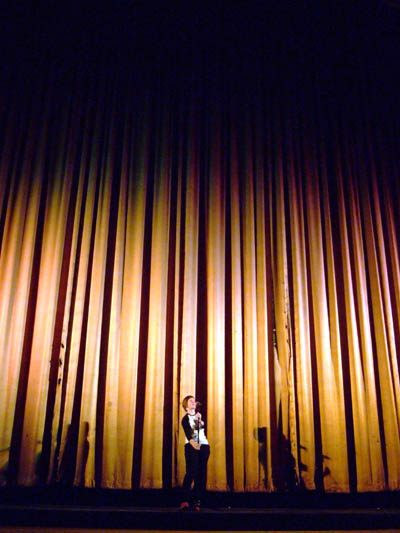
Meg Hamel introducing a film at the gigantic Orpheum Theatre.
DB here:
Today a chatty, catching-up blog filled with peekaboo links. Lots to do, know what I mean? Or do you?
Excuses, excuses
Kristin and I meant to blog about the Wisconsin Film Festival last weekend. We really did. But I missed the first night because my plane from Hong Kong got in late, and on Saturday I felt enough jetlag to mope around in a desultory fashion. I did see Fay Grim, Ten Canoes, Vanaja, and of course Johnnie To’s Exiled (better than ever on that CinemaScope Orpheum screen). Kristin saw several more films than I did, and that was part of the problem: She was too busy watching films to blog about them. By the time she finished, the festival was over and we faced some looming deadlines.
Regrettably, we simply let our festival blog go. Kristin drove off to Toledo for a conference of the American Research Council in Egypt. A fine conference it was too, but preparing for that took away some time for blog duties. To meet our Internets obligations, I pulled out a general essay that was sitting on the shelf. It turned out to be one of our most popular ever.
 Over the same days I was occupied with two publishing projects. First is the online version of my 1988 book Ozu and the Poetics of Cinema, available here. In the original book, the frames taken from color films were reproduced in black and white. Markus Nornes of the University of Michigan, who first suggested putting the book online, wanted to replace those with color frames. Since virtually all the book’s pictures came out poorly in the pdf scans posted online, we decided to replace the black-and-white images with scans from my original negatives. Kristi Gehring, our stalwart assistant, digitized all the black-and-white stills, and Markus found the color frames. So in the next few months the good folks at the University of Michigan should be replacing the tawdry stills with nicer ones. A bonus: Markus and his colleagues are working on giving the stills a click-to-enlarge feature.
I’ll also be adding a new Foreword to the book. That will reflect on the book’s approach and its reception, and I’ll add corrections and new thoughts. In all, the updated online version should be available in late September. It’s been quite a struggle to revive the old thing, as I’ve chronicled earlier, but several people have taken a lot of trouble to help, and I’m grateful. Because, you see, I believe that Ozu is the greatest filmmaker who ever lived.
The second publishing project is my Poetics of Cinema collection. Delays, endemic in academic publishing, have pushed it past its spring release date. I’ve just gotten page proofs, and indexing should take place in August. So the thing is now slated for October. It’s rather big and expensive: 500 book pages, with about 500 stills. About half the essays are new to the volume. If you want to lay down your plastic before seeing it, you can order it here.
Coming attractions
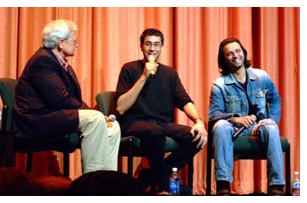 At the moment we’re preparing for Roger Ebert’s Festival of Forgotten and Overlooked Films, which comes up later this week. Previous years’ sessions have been excellent. Alongside, you see a 2006 photo of Roger interviewing Ramin Bahrani and Ahman Razvi, director and principal actor of Man Push Cart. Ramin’s new film, Chop Shop, is now in the Directors’ Fortnight at Cannes.
This year should be lots of fun: a chance to meet Herzog, Alan Rickman, Joey Lauren Adams, and other creative film folk…and to see Roger and Chaz again. The films run the gamut from Holes to Beyond the Valley of the Dolls. Kristin and I will be moderating the screening of Sadie Thompson, with an orchestral score by Joseph Turrin. Another musical event: a performance by Strawberry Alarm Clock. (Now I do feel old.) We hope to post at least one blog, with pix of course. Other blogomanes will be present, notably the audacious David Poland and the hyperenergetic Jim Emerson.
Speaking of festivals: the biggest of them all is coming up, and to celebrate it Turner Classic Movies is running, on 16 May, Richard Schickel’s documentary Welcome to Cannes. It samples the glitz but also affords information about the caste system of screening passes, the role of Cannes in easing films into the world market, and even the harm that a Cannes prize can do to a director. There’s neat footage of Godard and Truffaut preparing to shut down the festival in May of 1968–an event that a couple of interviewees claim was a turning point in the festival’s history. Along with the docu, TCM will screen four Palme d’or nominees/winners: The Big Red One, Blowup, Taxi Driver, and Pale Rider. But one question remains: Why does nobody think of the French as cheeseheads like us?
 When we get back to Madison from Ebertfest, we have just enough time to pack for a month in New Zealand. Brian Boyd has arranged for us to come as guest lecturers to the University of Auckland, under the auspices of the Hood Fellowship.
Kristin will be lecturing mostly from her Lord of the Rings study, The Frodo Franchise (for instance, here), but she also offers a talk on her Amarna research. I’ve got a more varied agenda: talks on CinemaScope, on ShawScope, on the history of cinema style, on the cognitive approach to film theory, and on scene transitions, as well as a visit to the Philosophy department. One or more of these items may materialize as an essay on this site some day. We’ll also be visiting the University of Otago, in Dunedin, for a brief stay and a lecture apiece.
While dwelling among the Kiwis, I hope to write a short online essay reflecting on our 1985 book The Classical Hollywood Cinema, which amazingly still arouses some discussion. I’ll also be thinking about plans for two further books, one on Hong Kong cinema and the other on a new approach to film theory.
We’re planning to maintain our blog while we’re away, recounting our activities down under, and posting some more general pieces that I’ve already prepared.
Just butter, hold the popcorn
But what about our film festival just past? To be blunt: A hell of a time was had by all. We screened 182 films and attracted our biggest audience to date, with 28,700 tickets sold. Not bad for a festival that starts on Thursday night and ends on Sunday night, held in a town of about 240,000. Isthmus, our free arts-and-politics paper, offered an outstanding preview, and other local coverage was enthusiastic, natch. The event earned a glowing first-page write-up from Charlie Olsky in Indiewire. The official wrapup is here. For more on Madison cinephilia, go to our earlier entry.
We know whom to thank. Festival director Meg Hamel, The Boss of It All, is pictured at the top, channeling Judy Garland’s Palladium sessions. Technical supervisors Erik Gunneson and Jared Lewis are the calm and cheerful gents pictured below. We also owe a lot to Tom Yoshikami, Karin Kolb, Stew Fyfe, and a host of volunteers, as well as to several university agencies, notably the Department of Communication Arts and the International Institute.
With Sundance 608 opening in a couple of months, we might be able to spread next year’s fest between the downtown (cozy, near the students, lots of eateries) and the west side (the Borders-Whole Foods demographic). And with our University Cinematheque screening weekly, Madison film culture offers something for everybody.
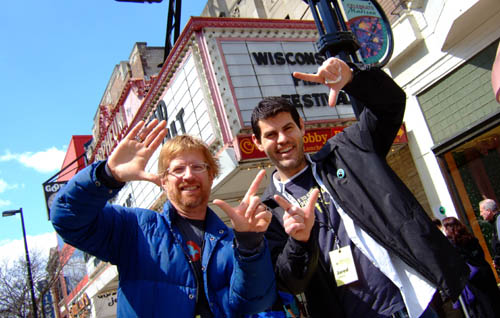
Erik and Jared pay homage to the canted angles of Hartley’s Fay Grim.



