





Archive for the 'Film comments' Category
A new hope
Photo by David Bordwell.
Categorical coherence: A closer look at character subjectivity
Subjective
[NOTE: There are some spoilers here, though I’ve tried to avoid giving away the ends of the films I mention. Teachers who show clips in class would probably want to do the same. Some of the films mentioned here would be good choices to show in their entirety to classes when they study Chapter 3 of Film Art.]
Kristin here—
We have had occasion to mention the Filmies list-serve of the Department of Communication Arts’ Film Studies area here at the University of Wisconsin-Madison. Current and past students and faculty, sometimes known as the “Badger squad,” share news, links, and requests for information. Once in a while a topic is raised for discussion. These exchanges are usually fascinating, and when we have felt that they might be of interest to a general audience, we have used them as the basis for blog entries. (See here and here.)
Another occasion arose recently, one which relates to the teaching of Film Art: An Introduction. Matthew Bernstein, of Emory University, queried the group about suggestions for teaching a section of the third chapters, “Narrative as a Formal System.” He found that the section, “Depth of Story Information,” gives some students trouble. They can’t grasp the distinction we make between perceptual and mental subjectivity.
Our definitions of the terms go like this. Perceptual subjectivity is when we get “access to what characters see and hear.” Examples are point-of-view shots and soft noises suggesting that the source is distant from the character’s ear. In contrast, “We might hear an internal voice reporting the character’s thoughts, or we might see the character’s inner images, representing memory, fantasy, dreams, or hallucinations. This can be termed mental subjectivity.”
We then go on to give a few examples. The Big Sleep has little perceptual subjectivity, while The Birth of a Nation contains numerous POV shots. We see the heroine’s memories in Hiroshima mon amour and the hero’s fantasies in 8 ½. Filmmakers can use such devices in complex ways, as when in Sansho the Bailiff, the mother’s memory ends not by returning to her in the present, but to her son, apparently thinking of the same things at the same time.
Yeah, but what about …?
Filmmakers don’t always use these categories in straightforward ways. They may oscillate between perceptual and mental representations and events. Films may present narrative events that make the distinction between characters’ perceptions and their mental events ambiguous. That’s why in introducing the concepts, we stress that “Just as there is a spectrum between restricted and unrestricted narration, there is a continuum between objectivity and subjectivity.
Easy to say, but not necessarily so easy to grasp for a student who’s trying to understand these categories. They need to start with simple examples to familiarize themselves with the basic distinction before going on to what the likes of Resnais, Fellini, and Mizoguchi can throw at them. But some students immediately proffering exceptions. As Charlie Keil, of the University of Toronto, put it in his post on the subject, “I hardly need add that students, even the least analytically astute, border on the brilliant when it comes to suggesting examples that provide challenges to categorical coherence.”
Looking over the one and a half pages of the textbook that we devoted to depth of narration, you might find it fairly straightforward. Once you start looking for ways to teach the concepts without bogging down in too many nuances and subcategories, though, the passage does seem challenging. What follows is a suggestion about how someone might go about explaining and utilizing examples. It also points up some ways we might revise this passage of the book for its next edition.
What it’s not
One obstacle that Matthew has found is that students are used to thinking of “subjective” as meaning something like “biased,” as in “here’s my subjective opinion on that.” It might be useful to point out that this is only one meaning of the word. The dictionary definition that comes closest to the way we use it in Film Art is this: “relating to properties or specific conditions of the mind as distinguished from general or universal experience.” For film, we specify that “subjective” means either sharing the characters’ eyes and ears (properties) or getting right inside his or her mind (conditions).
Another misconception comes when students assume that the facial expressions, vocal tones, and gestures used by actors are subjective because they convey the characters’ feelings. Again, best to scotch that notion up front. Those techniques are projected outward from the character, and we observe them. Cinematic subjectivity goes inward.
One step at a time
Another distinction to stress early on is the basic one we make between film technique and function. There are a myriad of film techniques that could be used in either objective or subjective ways. To take a simple example, a low camera angle might indicate the POV of a character lying down and looking up at something; that’s perceptual subjectivity. A low angle of a skyscraper in an establishing shot might simply be the objective narration’s way of showing where a new scene will occur.
In contrast, indicating perceptual and mental subjectivity are two specific kinds of functions. Filmmakers can call upon whatever cinematic techniques they choose, and historically the more imaginative ones have shown immense creativity in trying to convey what characters see and think.
Some films depend heavily upon subjectivity, but objective narration is more common. There are many films that give us little access to characters’ perceptual and mental activities. Apart from The Big Sleep, there are films like Anatomy of a Murder, or virtually anything by Preminger. Most films use subjectivity sparingly. So let’s assume the students can tell that objective narration is the default.
With that out of the way, we can go back to basics. Both perceptual and mental subjectivity depend on being “with” the character in a strong way, as opposed to observing him or her as we would see another person in real life.
Perceptual subjectivity is fairly simple. The camera is in the character’s place, showing what he or she sees. The microphone acts as the character’s ears. Other characters present in the scene could step into the same vantage point and observe the same things.
So the test could run like this: As a viewer, when we see something in a film, is it really present within the scene? Could someone else in the same position see and hear the same things? Or is it a purely mental event, something no one else could see and hear, even if they stood beside the character or stepped into the place where that character had been standing?
If I were teaching the concept of narrational subjectivity as Film Art defines it, I would stress the notion of a continuum. After starting with very clear examples of both perceptual and mental subjectivity, I would progress to more ambiguous, mixed, or tricky instances.
Contributing to this discussion on the Filmies list, Chris Sieving, of the University of Georgia, says he shows a 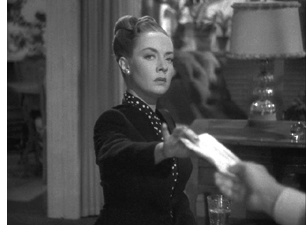 clip from Lady in the Lake, the film noir where the camera always shows the POV of the detective protagonist. As Chris says, “It seems to effectively get across what perceptual subjectivity means (and how awkward it is in large doses), as well as what is meant by a (highly) restricted range of narration (as is the case with most whodunits).” As Chris also says, Lady in the Lake is a sort of limit case, a film that depends as much on perceptual subjectivity as it’s possible to do. (That’s “our” hand taking the paper in the shot at the right.) One could show several minutes from any section of the film and make the point thoroughly.
There are other films that contain a lot of POV shots but intersperse them with objective ones. Rear Window is an obvious case. When Jefferies is alone, we see the courtyard events from his POV, a fact which is stressed by his use of binoculars and his long camera lenses to spy on his neighbors. This is clearly perceptual rather than mental. We never doubt that what we see through the hero’s eyes is real; we don’t believe that he’s making things up to entertain himself or because his mind is unbalanced. For one thing, there are two other characters who visit at intervals and see the same things that he does. We and they might question whether Jefferies’ interpretation of what he sees is correct, but we assume that the story’s real events have been conveyed to us through his eyes and ears. Only if we saw something like his fantasy of how he imagines his neighbor might have killed his wife would we move into the mental realm.
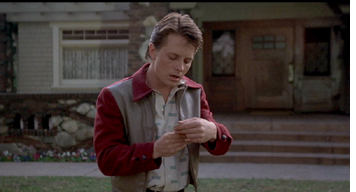
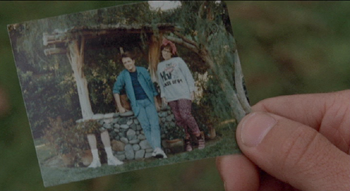
These two films foreground their use of POV. Usually, though POV shots are slipped into the flow of the action smoothly. Scenes of characters looking at small objects or reading letters often cut to a POV shot to help us get a look at an important plot element. At intervals during Back to the Future, Marty looks at a picture of himself and his siblings, gradually fading away to indicate that the three of them might never be born if he doesn’t succeed in bringing their parents together. It’s a simple way of reminding us what’s at stake and that Marty’s time to solve the problem is running out.
The Silence of the Lambs uses many POV shots and provides an excellent case of narration switching frequently and seamlessly between objective and subjective. Most of the POV views are seen through Clarice’s eyes, but sometimes through those of other characters. The first view of Lecter is a handheld tracking shot clearly established as what she sees as she walks along the corridor in front of the row of cells.
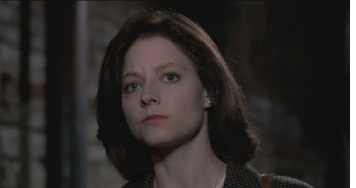

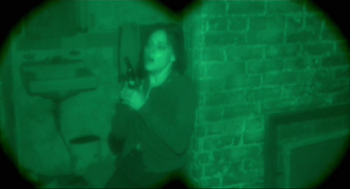
The scenes of Clarice conversing with Lecter develop from conventional over-the-shoulder shot/ reverse shot to POV shot/ reverse shot as both characters stare directly into the lens. (In Film Art, we use this device as an example of how style can shape the narrative progression of a scene [p. 307, 8th edition]). Other characters have POV shots as well, most noticeably, when Buffalo Bill twice dons night-vision goggles and we briefly see the world as he does.
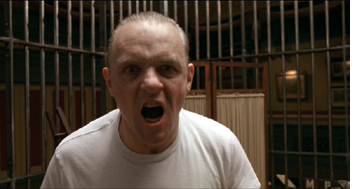
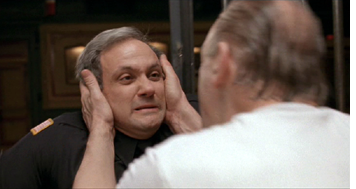
Occasionally we see the POV of even minor characters, as when Lecter’s attack on his guard is rendered with a quick POV shot of Lecter lunging open-mouthed at the camera and then an objective shot of him grabbing the guard.
In their minds
Let’s jump to the other end of the continuum. Here we find a clear-cut use of mental subjectivity for fantasies, hallucinations, and the like. Obviously no one else present, unless he or she is posited as having special telepathic abilities, can see and hear what takes place only in a character’s mind.
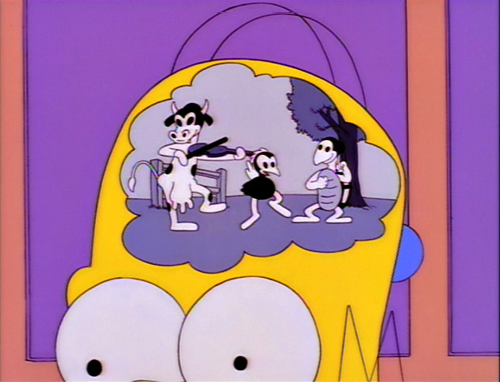
Such fantasies are a running gag on The Simpsons, where Homer’s misinterpretations, distractions, and visions of grandeur are shown either in a thought balloon or superimposed on his skull. In the example above, he abruptly starts “watching” a little cartoon after assuring Lisa that she has his complete attention. No one could mistakenly assume that these exist anywhere but in Homer’s imagination.
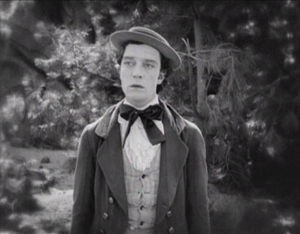
In Buster Keaton’s Our Hospitality, the hero receives a letter telling him he has inherited a Southern home. After an image of him thinking there is a dissolve to a view of a large, pillared house. Later, when he arrives at his small, ramshackle house, he stands staring in a similar situation, and here there is a fade-out to his dream house, which abruptly blows up. The humor in the second scene would be impossible to grasp if we didn’t easily understand that the shot of the house exists only in his mind.
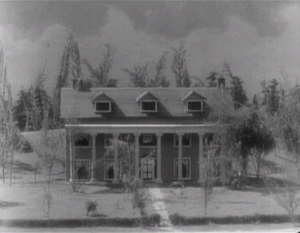
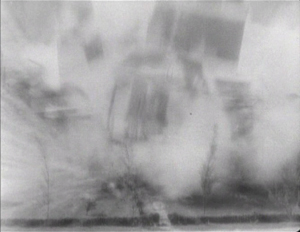
Whole films can be built around fantasies. A large central section of Preston Sturges’ black comedy Unfaithfully Yours consists of a husband envisioning three different ways he might kill his supposedly cheating wife, all set to the musical pieces he is conducting at a concert. Fellini’s 8 ½ is only the most obvious example of how the art cinema often brings in fantasies. Other examples include Jaco van Dormael’s Toto le héros or Bergman’s Persona.
Once students have grasped the basic distinction between perceptual and mental subjectivity, it might be useful to emphasize the continuum by moving directly to its center, where the two types coexist.
The middle of the continuum: Ambiguity and simultaneity
Right in the middle of the continuum between the pure cases we find ambiguous cases. Filmmakers can create deliberate, complex, and important effects by keeping it unclear whether what we see is a character’s perception of reality or his/her imaginings.
1961 was a big year for ambiguous subjectivity, with two of the purest cases appearing. One was a genre picture, the other a controversial art film.
The first is the British horror film, The Innocents, directed by Jack Clayton and based on Henry James’s novella, The Turn of the Screw. In several scenes, a new governess at a country estate sees frightening figures whom she takes to be ghosts haunting the two children entrusted to her. We see these figures as she does, but we never see them except when she does. The children behave very oddly in ways that might be consistent with her belief, yet they deny seeing any ghosts. Finally the governess tries to force the little girl to admit that she also sees the silent female figure standing in the reeds across the water. Does the child’s horrified expression reflect her realization that the governess knows about her secret relationship with the ghosts? Or is she simply baffled and frightened by the governess’s increasingly frantic demands that she confess to seeing something that in fact she can’t see?
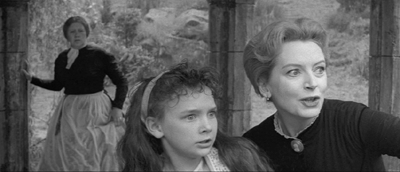
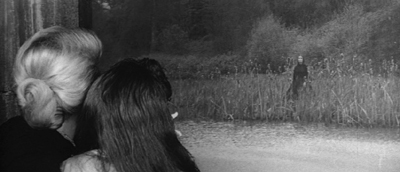
From the first appearance of the eery figures, the question arises as to whether the governess is imagining the ghosts or they are real, controlling the children, who try to keep them secret. There are apparent clues for either answer. By the end, we arguably are no closer to knowing whether the ghosts are real or figments of the heroine’s imagination.
Since Last Year at Marienbad appeared, critics have spilled gallons of ink trying to fathom its symbolism and sort out the “real” story that it tells. Clearly there are contradictions in events, settings, and voiceover narration. The second of the three accompanying images depicts the heroine as the hero’s voiceover describes their first meeting. They talked about the statue that stands beside her, seen against the formal garden of walks lined with pyramid-shaped shrubs. Yet another version of the first meeting starts, this time with the characters and the same statue against a background of a large pool. Later scenes in these locales display the same inconsistencies.
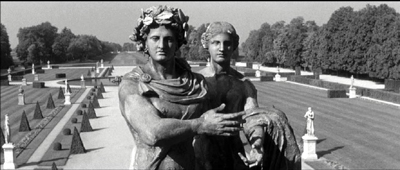
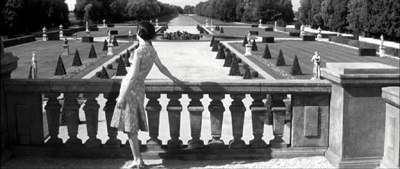
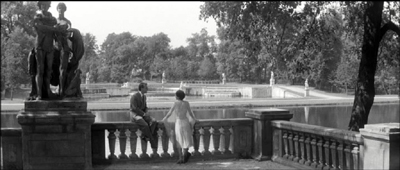
Are such contradictions the result of one character’s fantasies or of the conflicting memories that two characters have of the same event? Or are the contradictions not the products of subjectivity at all but just the playfulness of an objective, impersonal narration, manipulating characters like game pieces to challenge the viewer? (Our analysis of Last Year at Marienbad is available here on David’s website. It and all the Sample Analyses that have been eliminated from Film Art to make room for new essays are available here as pdf’s; the index to them is here, about halfway down the page.)
It’s not a good example of subjectivity to show students, but just as an aside, the screwball comedy Harvey is an interesting case, a sort of reversal of the Innocents situation. The narration withholds a character’s perceptual and mental events. Elwood P. Dowd describes what he sees and hears: a six-foot talking rabbit invisible to us and to all the other characters. The story concerns whether Dowd’s relatives will institutionalize him for insanity, and we assume along with them Harvey is a mere delusion. Thus the narration seems to be objective—or, the ending asks, has it been very uncommunicative, withholding something that the hero really does see and hear? True, throughout the film the framing leaves room for Harvey, as if he were there. One could argue, though, that these framings simply emphasize that the giant rabbit isn’t visible to us or the other characters and hence isn’t likely to really exist.
A film can easily present both perceptual and mental subjectivity at the same time. A POV shot may be accompanied a character’s voice describing his or her thoughts and feelings. Matthew shows his class part of the opening section of The Diving Bell and the Butterfly, where a stroke victim’s extremely limited sight and hearing are rendered in juxtaposition with his voice telling of his reactions to his new situation. It is one of the most extensive and successful uses of such a combination in recent cinema, and it might be very effective in differentiating the two for introductory students.
A scene can also move rapidly back and forth between a character’s perceptions and his or her thoughts. Charlie writes that he shows his students the scenes of Marion Crane driving in Psycho. While the car is moving, almost every alternating shot is a POV framing of the rearview mirror or through the windshield. At that same time, we hear the voices of her lover, her boss, her fellow secretary, and the rich man whose money she has stolen while she imagines how they would react to her crime.
Showing scenes like these, where both types of subjectivity are used and clearly distinguishable might be more useful for students than showing several scenes that contain only one or the other.
Flashbacks, Voiceovers, and Altered States
In his original query to the Filmies, Matthew also said that students have problems with flashbacks: “Particularly, they resist the idea that a flashback is an example of subjective depth in general, even if the flashback unfolds objectively.” I can think of two ways to explain this.
First, classical films tend not to have flashbacks that just start on their own. To be sure, some do: a track-in to an important object and a dissolve can signal the start of a passage from the past, without a character being there. But more often a character is used to motivate the move into the past. A thoughtful look may do it, or a character may describe the past to someone else. In either case, the flashback is coming “from” the character and is assumed to show approximately what he or she is remembering. Occasionally the flashback may be a lie rather than objective truth, as we know from Hitchcock’s Stage Fright, The Usual Suspects, and a few other films.
In Poetics of Cinema’s third essay, David argues that most flashbacks in films are motivated as a character’s memory, but what is shown often strays from what he or she knew or could have known. He suggests that the prime purposes of most flashbacks is to rearrange the order of story events, and the character recalling or recounting simply provides an alibi for the time shift.
So we might think of character-motivated flashbacks as subjective frameworks that also contain objectively conveyed narrative information.
Second, the fact that flashbacks slip in objective information into characters’ memories is a convention. It’s a widely used method for presenting us with two things at once: first, a character’s memories and second, some story information that the viewer needs to have—even if the character couldn’t know about it. As we watch movies, we frequently accept conventions for the sake of being entertained. Beings that travel to Earth from distant galaxies speak English, high school kids can put together shows that wind up triumphing on Broadway, and people who drive up to buildings in crowded cities always find perfect parking spots. In a similar way, implausible mixtures of subjectivity and objectivity in flashbacks is just something we have to accept.
There are two other techniques that didn’t get mentioned during the discussion but that might confuse students.
What about shots showing the vision of a character who is drunk, dizzy, drugged, or otherwise unable to see straight? The most common convention is to include a POV shot that’s out of focus, perhaps accompanied by a bobbing handheld camera. Other characters in the scene, assuming they are not similarly impaired, would not see the surroundings in the same way.
Still, I think the same perceptual/mental distinction holds for such moments. The fuzziness and the lack of coordination are physical effects that are not being imagined by the character. They remain in the perceptual realm. Mental effects of impairment would be dreams or hallucinations. Some examples: the “Pink Elephants on Parade” sequence in Dumbo and the DTs vision of the protagonist of Wilder’s The Lost Weekend. As the title suggests, Altered States takes such mental activities as its subject matter and has many scenes that represent them.
A harder case is voiceover. Are all cases of voiceover subjective? Clearly not. If we have a situation where a character tells a story to a group and his or her voice continues over a flashback, the narration remains objective. We assume that the group can still hear the storyteller. Cases where the voice exists only in the mind, as when a character speaks to himself or herself, but not aloud, are mental subjectivity.
That said, there are many unclear cases. Just what is the status of the narration in Jerry Maguire? Jerry seems to speak directly to us, pointing out things that happen during the action, yet clearly there is no suggestion that he made the film we are watching. The problem is compounded in Sunset Boulevard, where the protagonist not only implicitly addresses us but is also dead. In many cases when a character’s voice is heard over a scene, it might occur to audience members to wonder where the character is or was when speaking these words. And does a character’s voice describing his or her feelings constitute objective or subjective narration? Probably we would want to say that only when the voice is posited as strictly an internal voice, audible only to the character, would we want to dub it subjective.
The problem with voiceovers arises, I think, because it’s such a slippery technique to begin with, and therefore often hard to categorize. Is a character speaking narration over events that happened in the past diegetic sound or nondiegetic? If there’s never an establishment of where and when that character does the narrating, he or she exists in a sort of limbo in between the two states: diegetic because he or she is a character, nondiegetic because he or she is in some ineffable way removed from the story world.
For voiceovers, then, I think it’s best simply to categorize the ones that obviously are straightforwardly objective or subjective. In tricky cases, we just have to admit that not all uses of film technique are easy to pin labels on. But the point of having categories like these isn’t to pin labels. In part knowing them allows us simply to notice things in films that might otherwise remain a part of an undifferentiated flow of images. They enable us to see underlying principles that make films into dynamic systems rather than collections of techniques. They give us ways to organize our thoughts about films and convey them to others. And, though students may doubt this, watching for such things becomes automatic and effortless once we have understood such categories and watched a lot of films. As a child, I don’t think I knew about the concept of editing or ever really noticed cuts. Now I’m aware of every cut in every film I see, and I notice continuity errors and graphic matches and other related techniques, all automatically, without that awareness impinging in the least on my following the story and being entertained. Learning the categories is only the beginning.
Playing with subjectivity
Once students have seen some clear cases of each type of cinematic subjectivity and understand the difference, the teacher could move on to emphasize that filmmakers can play with both in original ways. It’s not really possible in an introductory textbook to discuss all the possibilities—and probably not possible to come up with a typology that would cover every example of subjectivity that could exist across that continuum we mentioned. Imaginative filmmakers will always find new variants on how to use techniques for this purpose. But here are a few intriguing cases.
In his class, Chris shows the scene in Hannah and Her Sisters where the Woody Allen character, a hypochondriac, visits a doctor for some hearing tests. Initially the doctor comes into the room and gives a dire diagnosis of inoperable cancer. After Mickey has reacted to that, a cut takes us back to an identical shot of the doctor entering, but this time he gives Mickey a clean bill of health. The first part of the scene is retroactively revealed to have been a mental event, Mickey’s pessimistic fantasy.
The same sort of thing happens in a more extended way with the familiar “it was only a dream” revelations that make the audience realize that a major part of the plot has been subjective. In a more sophisticated way, as Chris points out, other sorts of mental subjectivity, usually lies or extended fantasies, can be revealed retrospectively, as in The Usual Suspects, Mulholland Drive, and Fight Club.
A flashback from one character’s viewpoint may reveal something new about an earlier scene. In Ford’s The Man who Shot Liberty Valance, the shootout is initially shown through objective narration. Only later in the plot does another character reveals that, unbeknownst to us or the other people present, he had also been present at the shootout. The flashback to his account reveals that the shootout happened very differently from the way we had assumed when first seeing it.
I’ll close with an example from The Silence of the Lambs. This shows how subtle and effective a play with perceptual and mental narration can be. In the scene at the funeral home where a recently discovered body of a murder victim is to be examined, Clarice is left waiting in the midst of a group of state troopers who stare at her. To get out of the situation, she turns and looks into the chapel, where a funeral is taking place. We see her face and then her POV as she surveys the room. A cut shows Clarice suddenly within the chapel, moving forward toward the camera and staring straight into the lens. We will only realize retrospectively that this image begins a fantasy that leads quickly into a memory. Clarice has not actually left her previous position just outside the door.
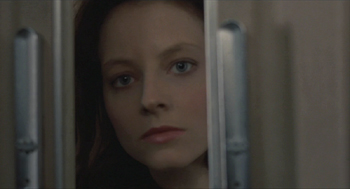
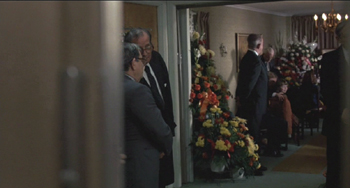
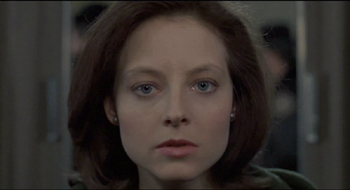
The next shot is a track forward through the center aisle toward the casket. Since Clarice had been walking in that direction before the cut, we recognize this as a POV and assume that Clarice is continuing to walk. Yet the man in the casket, as we soon will learn, is Clarice’s father. The shot represents a different funeral, one in the past which she has been triggered to remember by her glance into the chapel. The fantasy has become a flashback. A second, similar view of Clarice’s face returns us to her fantasizing adult self, the one remembering this scene but not the one still standing outside the door. A closer view of the father’s casket shows it from a lower vantage-point, as if that of a child.
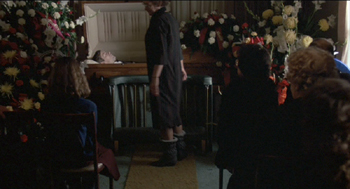
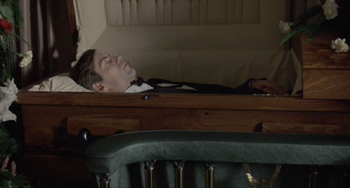
The reason for the change becomes apparent from a radical change at the next cut, so that the camera is on the far side of the casket, filming from a low angle. The sudden shift moves us away from the adult Clarice in order to show her as a child approaching her father and leaning down to kiss him. A noise pulls Clarice out of her memory, and a cut back to the hallway shows her turning away from the chapel. (As often happens, sound, and particularly music, helps guide us through the scene, marking the beginning and ending of the fantasy/flashback.)
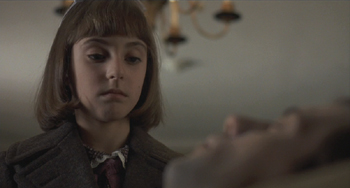
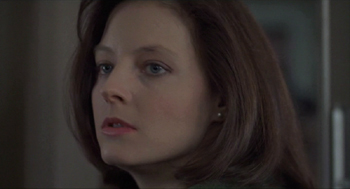
The most experienced film specialist could not track all the rapidly shifting levels of subjectivity in this scene on first viewing. Still, later analysis using some categories of subjective narration can help us appreciate how Demme has woven them into a scene that helps explain Clarice’s motives in becoming an FBI agent and her determination in pursuing her first case.
Categories matter
To some students, the categories I’ve just discussed may seem like trivial distinctions. They’re not. The use of subjective narration is one of the key ways the filmmaker has to engage our thoughts and emotions with the characters. In Psycho, we become involved in Marion Crane’s life in a remarkably short time, partly because of her situation but also partly because Hitchcock keeps us so close to her once she prepares to steal the money. The camera not only frames her closely, but to a considerable degree we see and imagine what she does: her fearful forebodings of how her rash act will turn out. Much the same thing happens with Clarice Starling in The Silence of the Lambs, though there our emotional involvement lasts throughout the film, and we are given glimpses of Clarice’s memories.
Perhaps choosing a scene or two from such films and going through them with the students, trying to imagine what it would be like without the POV shots and the imaginings and the memories, would convince them of the value of learning these categories. After all, the exceptions they find are only exceptional because they play in a zone defined by solid concepts.
[Note added October 24: I should have referred back as well to David’s entry “Three Nights of a Dreamer,” largely on POV.]

Objective
Women and children first
Ten AM on a Tuesday, and I’m at my local megaplex, Star Cinema. I’m here to not to see a movie, exactly, but to catch a phenomenon I’ve been curious about for some years.
To back up: Kristin and I have fallen a bit behind in our blogging. For one thing, the presidential election has been so exciting that we spend more time staring at cable news than ever before. (But the time hasn’t been wasted: the campaigns have given me an idea for a blog entry, which I hope to post next week.) Secondly, we’ve been going over the copy-edited version of the third edition of our textbook, Film History: An Introduction. It’s due out this spring, and we’ll have more to say about it later. If you want a preview now, check the new essay I posted elsewhere on this site. It’s called “Doing Film History,” and it’s an updated version of the introduction that appeared in earlier editions of FH.
Kristin has been laboring over an epic blog on character subjectivity. As for me, to take a break from both politics and the textbook, I headed to Star.
The youngest demographic

The phenomenon I was interested in goes by different names, but here in Madison it’s called Baby Box Office.
Every Tuesday morning Star runs screenings for parents and their pre-schoolers. It’s billed as a chance to bring your child to see a film in a welcoming setting. The theatre is a little more illuminated than normal, the sound a little softer. Nobody will ask the kid to shush; you can even nurse your baby. Incidentally I hope that this gets babies to associate movies with oral gratification. The future needs passionate filmgoers, not to mention film students.
You can get more details from the Kerasotes chain’s website, and they’re pretty interesting. (Some theatres offer a Stroller Valet Service.) So I got curious and headed to the ‘plex.
I was surprised that five films were lined up to be screened—not Saw V and Max Payne, naturally, but a fairly wide range, including W. and a couple of animated titles. If none of the customers chooses a film, it’s not run. I asked which movie was today’s top pick, and Susan the cashier suggested The Secret Life of Bees. Buying my ticket, I met Meg and her son Connor. I asked whether she came often. With a smile, she said: “It’s been a life-saver.” She regularly meets a friend, who also has an infant, at the show.
Outside the auditorium there was a changing cot, with baby powder at the ready. Somehow, knowing it was there comforted me.
I counted twelve non-kids at the show, including a guy more or less like me (graying, maybe retired) and three young women who might have been playing hooky from high school. The show was an ordinary screening. There were local ads and video commercials. There were trailers for upcoming releases The Boy in the Striped Pajamas (Nazis with, natch, British accents), Marley and Me (a dog running in surf), The Soloist (Oscar bait), and Australia (part African Queen, part Out of Africa; I gather that She Will Fall in Love with a Man. . . and a Country).
I wish I could report that a dramatic incident, or at least an epiphany, took place during my visit. But the kids were mostly quiet. Occasionally I heard a wail or gurgle, and at one point a mother took a fretful baby out. The screening went fine. Glancing at the kids, I saw many of them staring at the screen transfixed and uncomprehending. On the basis of this experience, I’ve decided it’s better to have a squad of babies in a theatre than a few teenage boys.
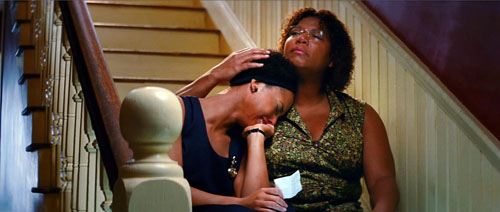
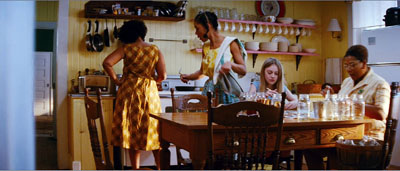
As for The Secret Life of Bees: Cynics will say it’s ready for the Hallmark Channel, but I liked it. It’s what the Japanese call a “wet” film, affording many occasions for tears, in which I freely indulged. Not of much pictorial interest, it is saved, at least for me, by a robust script (tailored to Kristin’s four-part template), solid performances, and sentimental situations centering on racism, child abuse, female bonding, and raging male inadequacy. Needless to say, thanks to intensified continuity a lot of reaction shots drive home each moment. Appropriately, the mommy audience was seeing a movie about mommies; the idealistic but forlorn little heroine winds up with three, at least.
Afterwards, I talked to a pair of ladies who had brought a toddler. While he wrestled with the steering wheel on an arcade driving game, they explained that they frequently come to the shows and are glad that Star Cinema offers them the option. I then talked at length with Star’s savvy general manager, Craig Hussin, who has been part of the Madison movie scene for many years. Craig sees Baby Box Office as part of what every theatre should do—offer the patrons many options, and do it with the sort of flair that used to be called showmanship.
Mom, dad, and dollars

Susan Hansen, Meg Teter, and Connor.
There’s a broader point of interest to us as students of cinema. I think that the phenomenon is a good example of market segmentation, which David Waterman has talked informatively about in Hollywood’s Road to Riches. (1)
Obviously, people’s preferences about movies, as about anything else, differ. Some people want to see a movie the day it’s released; others are willing to wait a while. So it’s better business to charge the eager consumer more than the more cautious one. This is a form of price discrimination.
What makes the film business unusual, Waterman points out, is that it has a very wide range of price demands. Some people will pay a lot to see a film on opening night, others will pay a smidgeon to see it years later on basic cable TV, and there is a wide range of pricing options in between. Just on DVD, you can rent it new, or rent it later for less. You can buy it new, buy it discounted a few months later, or buy a used copy for still less.
In the classic studio days, the principles of market segmentation and price discrimination gave birth to a systematic strategy of distribution, discussed by historians Tino Balio and Doug Gomery (2): The run/ zone/ clearance system. A run was the period during which a film was screened in theatres. The first-run showing, usually at a well-appointed downtown cinema, gave city viewers the first chance to see the movie. The second-run shows, in neighborhood theatres and small towns, took place later, at lower ticket prices. Zones established the territory in which any title could play exclusively. Clearances were the intervals of time separating the runs, typically a matter of weeks or months.
What’s interesting is that the system is still with us. Your average Hollywood movie has its first run at a multiplex. It may get a second theatrical run at a budget theatre or campus venue. Then begins its most profitable string of runs, in the nontheatrical sector. The movie is released on various video platforms sequentially–pay per view, premium cable, airline and hotel systems, DVD, Internets, and eventually free cable. As in the old days, there are clearances between these runs; today they’re called “release windows.” You’ve probably noticed that films come to the ancillary platforms faster than they did only a few years ago. This trend toward shrinking windows is, as you’d expect, a bone of contention with distributors.
The point of the system is to extract the most money from the film. If films were only shown first-run, some people wouldn’t go at all. The price would be set too high for their level of interest. So the prices shrink over time, with broadcast or basic cable airings becoming the last link in the chain. Spreading out the opportunities to see the film allows people with different preferences and budgets to buy in at different points.
So I’m thinking that the Baby Box Office is a nice example of market segmentation. Parents with young children tend not to go to movie theatres. A night out is expensive, especially reckoning in babysitter costs, and many couples I know are just too tired to enjoy a movie at the theatre. If the parents take an infant to a show, it might squall and disturb others. So many parents just stay home. Baby Box Office goes after a niche market.
It’s shrewd policy to screen a recent release for Baby Box Office. If the film were in second-run, the screenings might seem a step down from what else the ‘plex is showing. But if parents see a first-run title, they can then gain the sense of participating in a current pop-culture event—an important motivator for first-run patrons—and they, like other first-run patrons, can spread word of mouth.
Do the costs make sense? At first glance, no. Babies get in free. Mom or Mr. Mom pays $5. If the child is three years old or more, that ticket costs $3. Not a huge amount of money in all: the 12 adults at my screening yielded only $60. But it’s a mistake to compare the takings with Friday-night box office, fattened by hordes of teens.
First, some of the theatre staff are working in the morning anyhow, preparing for the day’s shows, checking prints and projection equipment, talking with bookers on the phone, supervising cleaning, priming the concession stand. So running a few prints at that time of day isn’t a big extra expense. Tuesdays are theatres’ slowest days, so since you’re open you might as well get some people through the turnstiles. Then there’s the intangible factor of good will. Parents are likely to think well of a business that takes pains to cater to them, and they may be likely to return to that theatre when they get other chances.
As for price, five bucks is a little more than a DVD rental these days, so the off-hours screening is a bargain compared to standard ticket prices, but it preserves the integrity of the runs/ windows system. And the concession stand is open. There, where the real money is made, a parent can indulge a guilty impulse for Raisinets.
You can argue that the phenomenon is really a reaction to thinning theatre attendance, and that may indeed be part of the story. But more positively, Baby Box Office sessions seem to lie on a continuum with making a movie available on video, on iPods or phones, and on the Internets. Media moguls have long said that today’s consumers want their objects of desire, no matter how obscure, with maximum convenience. Media distribution has had to adapt itself to audiences’ schedules. Granted, theatres can’t do that as flexibly as video can. Still, Baby Box Office seems a logical effort by exhibitors to adjust to a world in which people expect entertainment to adjust itself to their lifestyles, kids and all. Kids especially.
(1) David Waterman, Hollywood’s Road to Riches (Cambridge: Harvard University Press, 2005), 9-10.
(2) Gomery explains the origins of the strategy in The Hollywood Studio System: A History (London: British Film Institute, 2005), 19-20.
Dispatch from sunny Vancouver
Ballast.
After six days, plenty to report from the Vancouver International Film Festival. It has been unusually warm and sunny during our first week, but we have diligently spent most of our time in darkened theaters.
Kristin here:
Another country heard from
It’s a rare day when one gets to see a Haitian film. It’s an equally rare day when one gets to see a Jordanian film. On Monday I saw both, and the contrast between them could hardly have been greater.
Eat, for This Is My Body (Mange, ceci est mon corps, 2007), a Haitian/French co-production is Michelange Quay’s first feature. A Haitian-American, Quay received his MFA in directing at New York University.
The film’s opening is extraordinary, with a series of low-altitude helicopter shots beginning over the ocean and then moving rapidly across huge shanty-towns and finally into bleak mountain canyons in the country’s interior. After this passage of flight over bright landscapes, the bulk of the story takes place in and around a quiet, dark, nearly deserted colonial mansion somewhere in the countryside.
I’ve noticed that there seems to be a mini-revival of 1970s-style art cinema conventions. After many years in which art cinema tended to mean intricate psychological studies, a more challenging, formalist avant-garde seems to surface now and then. While watching Eat, for This Is My Body, it occurred to me that it could almost have been called Haiti Song, so strongly did it remind me of Marguerite Duras’s India Song. There enigmatic actions, often dancing, were staged in a colonial house. Eat, for This Is My Body’s action is, if anything, more enigmatic, though in this case the native population is present in the house in the person of a dignified manservant and a group of nine boys brought at intervals into the house, apparently as a treat.
The story is so minimal as to be non-existent. Apart from the nine boys, there are only three characters: an 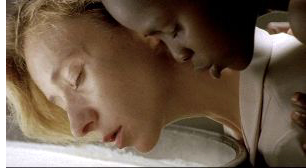 old woman, a young woman, and the black servant. Not until about 70 minutes into a 105-minute film are these characters identified, though only to the extent that the younger woman is revealed to be the daughter of “Madame.” There are hints of an erotic attraction between the daughter and the servant, though this comes to nothing. The daughter’s wandering through the local town, among the teaming population engaged in washing, selling, and other everyday activities suggests that she may be gaining some insight into native Haitian culture—but this, too, remains a mere hint. Ultimately, the film creates not a narrative, but an evocative narrative situation full of mystery. The film was shot on 35mm and creates a lovely, austere style for the scenes shot within the mansion.
The Jordanian film, Captain Abu Raed (2007), takes a more familiar approach, centering around a likable, heartwarming protagonist. Raed, an airport janitor, finds an old pilot’s hat, and the children in his working-class neighborhood assume he really is a pilot. He plays along, less to feed his own ego than to inspire their imaginations through false tales of his adventures abroad. Gradually he becomes more involved in the lives of some of his listeners, and the film progresses from the sugar-coated tone of the opening scenes into a darker situation as Raed seeks a way to save the family of a violent neighbor.
Director Amin Matalqa was raised principally in the U.S., but he returned to his native country for this, his first feature. It is also the first feature film to come from Jordan in decades, and it reflects a slow but distinct movement into movie production in some of the Middle-Eastern countries where conservative religious views have long suppressed it. Captain Abu Raed is technically polished and makes considerable use of Amman cityscapes and ancient ruins as backdrops for the action. It’s also definitely a crowd-pleaser, judging by the sold-out audience I saw it with.
Another rarity is Australian director Benjamin Gilmore’s first fiction feature, Son of a Lion (2007), which he filmed entirely in the Peshawar region of Pakistan. That’s an area adjacent to the northwest border of the country with Afghanistan, notorious as a refuge for Taliban fighters and probably Osama bin Laden. The program lists Son of a Lion as an Australian/Pakistan production. I doubt any Pakistani funding went into it, but Gilmour wrote the script with the advice of the local people, and non-professionals play all the characters. The credits also contain quite a few Pakistanis performing tasks behind the camera.
The story seems inspired in part by the “child’s quest” narratives of the Iranian classics of Abbas Kiarostami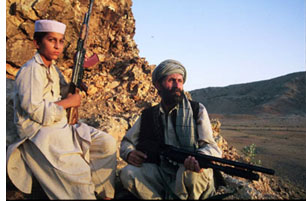 and Mohsen Makhmalbaf. A strict, traditionalist widower who makes guns wants his 11-year-old son to follow in the family business, while the boy longs to attend school. Apart from his father’s determined opposition, Niaz’s desires fly in the face of the local culture. Gun shops are everywhere, and every male adult seems to be armed. Shopkeeper casually step into the street to fire off weapons to test or demonstrate them. At one point the falling bullet from such random shooting kills a bystander. Between the personal scenes Gilmour intersperses occasional scenes of men sitting around and discussing the situation, debating whether they would shelter Bin-Laden if asked to or turn him in for the reward; they also speculate on America’s image of their part of the world.
Son of a Lion was shot under difficult and dangerous circumstances on digital video (with post-production handled, amazingly enough, by Peter Jackson’s Park Road Post facility in New Zealand). The shots of the beautiful desert landscapes are not up to those we are used to from Iranian films, but they manage to suggest the grandeur of the area and to give a fascinating and humanizing insight into a region which the American government and media portray as merely a hotbed of terrorism.
Moroccan films are not quite as rare as these, but they’re certainly not common. As Burned Hearts (Morocco/France, 2007) was being introduced, I realized that the only other Moroccan film I had previously seen was by the same director, Ahmed El Maanouni. That had been Trances, a semi-documentary1982 film about a touring pop-music group. It was shown last year at the Il Cinema Ritrovato festival in Bologna, having been the first film restored by Martin Scorsese’s World Cinema Founda tion.
Burned Hearts was another film that seemed to transport me back to the 1970s art cinema. A young man returns to his childhood home after being educated as an architect in Paris. His tyrannical uncle is dying, and flashbacks present the painful memories evoked by the familiar sights and sounds of the city, this exploration of the character’s mental paralysis, along with the black-and-white cinematography of the locations, evokes both Duras and Antonioni. But El Maanouni refuses to concentrate solely on the hero’s concerns, bringing in several intriguing characters from the neighborhood and having groups spontaneously break into song and dance in the streets and shops.
Melodramas from Mexico
These films all come from regions seldom represented in international film festivals, but Mexican cinema 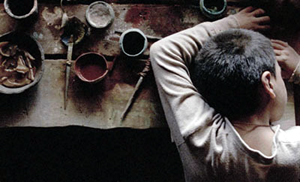 has had a growing presence in such venues in recent years. Two I’ve seen so far are very different from each other. The Desert Within (Desierto adentro, 2008), Rodrigo Plá’s second feature, already has a reputation after winning a cluster of prizes at the Guadalajara Film Festival. A period piece beginning in the late period of the Mexican revolution and extending into the 1930s, it tells the story of a peasant who inadvertently brings destruction on his village and decides that the only way to expiate his guilt is to drag his family far into the desert to build a church. The film takes a bitter view of Catholic guilt, with the protagonist forcing suffering, sexual frustration and death upon his children as his obsession grows.
The other Mexican film, All Inclusive (2008), deals with another family crisis, but one which takes place over a few days in a luxurious resort on the “Mayan Riviera.” The story is slickly told by director Rodrigo Ortúzar Lynch and beautifully shot by Juan Carlos Bustamante, but I found the story forumulaic. A man who has just been told that he has only a short time to live, goes on vacation with his family, whom he has not informed of his condition. As he struggles with his secret, his wife and three children undergo their own crises. One daughter faces up to the fact that she is a lesbian, the son becomes entangled in an online “affair” with another man’s girlfriend, and the wife, assuming that her husband is being unfaithful, allows a young scuba instructor to seduce her—all this observed by the sardonic goth daughter.
As the tensions grow, a hurricane approaches, and the climactic set of revelations and reconciliations come just as it hits. During the narrative, each of the troubled family members manages to find someone gorgeous willing to bed them and/or hear their tales of woe. The idea that the bearish husband, seeking escape in a local bar, would run across a stunning 23-year-old Cuban woman who would take him into her home, listen at length to him, and finally, of course, teaching him to enjoy life. This gives him the courage to return to his family and tell them the truth. Once the family members have bared their soles, they become a jolly, well-adjusted bunch. It’s an entertaining story with likeable characters and touches of humor—but it’s a bit too much to believe.
Americans in Canada
Apart from Craig Baldwin’s Mock Up on Mu, which David will cover, I’ve seen two American indies so far. Momma’s Man (2008) is directed by Azazel Jacobs. It deals with Mikey, a man traveling on business who has problems with his flights and ends up staying with his parents in their New York loft. Finding excuses not to return to his wife and baby in California, he fritters away his time by reverting to his childhood pursuits. The film takes the daring step of being centered on an unsympathetic character who is the point-of-view figure for all but a few scenes. It manages to convey his gradual move from indecision to obsession and eventually a full-blown breakdown in a believable fashion.
Part of the appeal of Momma’s Man comes from the fact that Mikey’s parents are played by Ken Jacobs, the great experimental filmmaker, and his artist wife Flo Jacobs. It is set in their actual New York loft, a maze of odd filmmaking devices, accumulated pop-culture artifacts, and artworks. The two give extraordinary performances, managing to seem wise and caring and at the same time obsessive and eccentric to a degree that might have contributed to Mikey’s breakdown. Although Jacobs cast an actor as Mikey, one has to suspect that the film is at least somewhat autobiographical, and the casting of his parents has created a uniquely convincing portrait of a family.
David and I were delighted to see RR (2007) on the program. It’s the latest feature by American avant-gardist James Benning. Jim is an old friend, having been a graduate student in our department at the University of Wisconsin-Madison during our early years there. He has concentrated largely on landscape films, usually consisting of lengthy, static shots. This one consists wholly of distant views of trains in what appear mostly to be western and Midwestern locations. In virtually every case the shot holds until the entire train has moved through the shot or out of sight—or stopped, in a few cases.
As so often happens with structural films, small variations become evident to the alert viewer. A shot of a 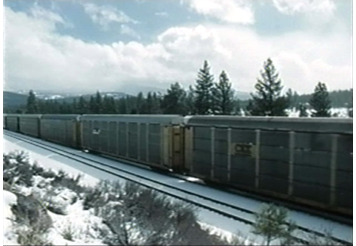 car stopped for a train passing through a small town contains tiny reflections in the windows of a nearby house that may draw the eye. Some trains are covered with spray-painted graffiti, while others are pristine. One is led to speculate about what the cars may be carrying, and there is a hint of social comment in that activity. A considerable portion of most of the trains consists of tankers, presumably carrying the gasoline or other petroleum products that are currently causing so much trouble in our economy. Others contain numerous livestock cars, and one lengthy train contains nothing else. Among the views of many freight trains, we are treated to a glimpse of a single very short passenger train zipping through the briefest shot in the film.
RR draws us to enter into perceptual play, often with a distinct touch of humor. Few of Jim’s films have contained the measure of their shot length in their mise-en-scene so decisively. The length and speeds of the trains determine the duration of the shots, and one learns to watch for the number of engines pulling or pushing a train as an indicator of how long the train is likely to be. A few shots show trains moving slowly and decelerating at an almost imperceptible rate, teasing us as to whether they will stop altogether and whether the shot will end if they do. At times a train may move through the shot, only to reveal another on a parallel track. One shot plays a very clever game with us. I won’t reveal what it is, but the shot comes perhaps a third of the way through: an oblique view along a track with bushes prominently in the foreground and a short, arched underpass in the middle distance.
Jim has continued to shoot in 16mm in an increasingly digital age, and he consistently manages to make gorgeous images that look more like 35mm. The last one of RR, involving a vast wind farm, is a stunner.

Captain Abu Raed.
David here:
An unusually good VIFF, with many films to get your eyes open.
Enter the Dragons, with Tigers
As usual, the venerable Dragons and Tigers thread is offering some remarkable new films from Asia. The Good the Bad the Weird lived up to its reputation, not to mention its title, offering frenetic action and comic-book (in the good sense) bravura. Sell Out!, a Malaysian satire of corporate maneuvering and media brainwashing, doesn’t get points for subtlety—the goliath is called the FONY corporation—and sometimes it tries too hard. Still, it’s likeable enough, and the fact that it’s a musical adds a welcome bit of froth. The funniest bit, for me, was the opening parody of an art movie, which does actually get integrated into the main action.
Two late works by long-time Japanese directors offered a study in contrast. Kitano Takeshi’s Achilles and the Tortoise starts out sweet and ends very sour, not to say bitter. In telling the story of a boy whose spontaneous love of drawing is forced into narrow commercial channels, Kitano suggests that art is a racket. Across the decades, schools and galleries push the pliant, nearly comatose young artist to create a signature style. He is told to be original, but also he must harmonize with fashion and tradition. With a grim obstinacy he tries to fulfill what the business demands, and to the end he is still trying.
Achilles is less willful than Takeshis’ and Glory to the Filmmaker!, and it tells a more coherent tale, but their glum narcissism is still in evidence. The film cries out for an autobiographical interpretation: is the naïve filmmaker corrupted by exposure to international art cinema? Pictorially, there’s some confirmation of this: Kitano seems to have abandoned his early films’ ingenious use offscreen spaces and planimetric compositions. Like his hero, who can’t achieve artistic singularity, Kitano has become a surprisingly academic and anonymous stylist.
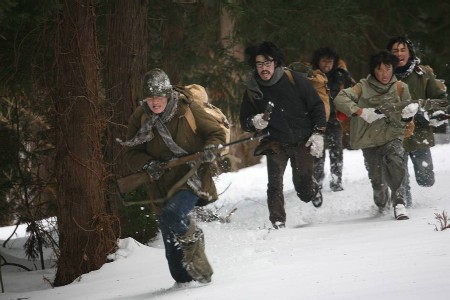
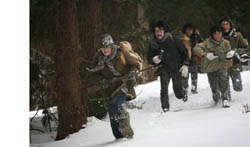 One can’t claim high originality for the style of Wakamatsu Koji either, but at least United Red Army has a gripping premise. The 1960s student movement was driven by opposition to the war in Vietnam and Japan’s cooperation with US policy, but in the following decade some factions emerged that were committed to violent revolution. Small cadres sequestered themselves in mountain cabins. Their exercises in “criticism and self-criticism” devolved into games of increasingly murderous aggression.
Wakamatsu’s technique is unstressed: No fancy angles, neverending tracking shots, or virtuoso compositions, just a businesslike application of today’s wobbly handheld look. The cunning lies in the film’s structure. After a half-hour montage summarizing the formation of the group, we are carried into the hideouts and watch the punishment grow more feverish and self-destructive under the domination of two leaders who seem parallel to Mao and Madam Mao.
By the end of the second hour, the remains of the army are on the run, struggling through vast snowy landscapes. Soon four survivors straggle into a ski lodge, hold the owner’s wife hostage, and face their final challenge: wave after wave of police assaults. Waiting for the inevitable outcome, the survivors spare time for grim humor: On 28 February one remarks, “I’m glad the all-out war won’t be tomorrow. Then my death anniversary could come only every four years.” And they can pause for an exercise in political discipline. After a lad takes an extra cookie, he criticizes himself. Stern reprimand follows: “That very cookie you ate is an anti-revolutionary symbol.” Unsentimental and unsparing, United Red Army is over three hours long, with not a longueur in sight.
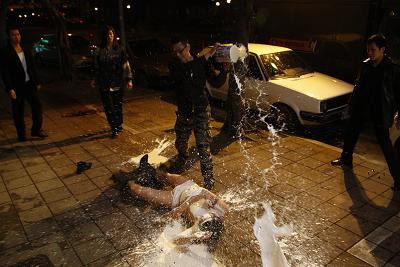
A man parks his car to pick up some cake at a bakery. He has been away from home all night; now he’s rude to the lady behind the counter. Having bought a couple of cakes, he finds that a sinister black car has double-parked and hemmed him in. His efforts to find the owner lead to a spiral of comic and pathetic confrontations with an orphan child, burly Triads armed with whitewash, and a pimp with a distinctly bad haircut.
Creating something of a network narrative, Chung Mong-hong’s Parking in its modest way offers a cross-section of Taiwanese society, from the prostitute brought over from China to a jaunty barber who more or less controls the switch-points of the story. The ending will strike some as dovetailing all the cards a little too smoothly, but I found it satisfying, if only because it lets our haughty hero show unexpected resilience and compassion. This is only Chung’s second feature, but his work bears watching.
For once, it really is rocket science.

If you’ve already figured out the deep connections among Scientology, the aerospace industry, ritual sex magic, New Age spirituality, and the migration of Los Angeles hipsters to San Francisco in the 1950s, Mock Up on Mu won’t come as news. If, like me, you haven’t the faintest idea about the cat’s-cradle ties among these cultural phenomena, Craig Baldwin’s latest collage-essay-epic-lyric-narrative (all terms he applies to it) is the very thing you need. It’s as exuberantly peculiar as his earlier work like Tribulation 99 and Spectres of the Spectrum, flooding us with a relentless voice-over that splits off from and reconnects with the torrent of images grabbed from all manner of movies.
These earlier films had stories of a sort, swollen conspiracies and ominous coincidences that make Baldwin the eccentric cousin to Fritz Lang. But Baldwin says that these stories couldn’t really engage people, couldn’t get them to identify. Mu tells a more personalized tale. L. Ron Hubbard, founder of Scientology, has colonized the moon and sends Agent C to earth to arrange for people to be shipped up. Agent C runs afoul of Lockheed Martin, corrupt aerospace executive, and becomes attached to Jack Parsons, an early rocketeer who in the 1950s assumed the secret identity of Richard Carlson, so-so Hollywood actor. Meanwhile, Aleister Crowley rules a secret society at the center of the earth….
Or maybe not.
Actually, I won’t swear to much of what I just said. Baldwin’s phantasmagoria tests my memory, as well as plausibility. The story line is swallowed up by what he calls footnotes—swarming digressions, tangents, and flashbacks which are conjured up in imagery that shoots off in a dozen different directions. A few frames from a kiddie science movie or a grade-Z space opera, juxtaposed to Parsons’ rapid-fire account of the history of rocket testing, whiz by almost subliminally.
In any case, there are characters and a more or less linear story. But Baldwin is Baldwin, so things can’t be so simple. He has for the first time staged and shot footage of actors, and their scenes form a sort of string that you can follow. But just as crystals grow in fantastic array along a string, alien footage exfoliates out from the staged scenes. Baldwin aims, he says, at “a dialectical density.”
The result is a narrative experiment I’ve never seen before. With a simple cut, our characters are replaced by figures from other films, who become, in some spectral fashion, both alien inserts and our characters.
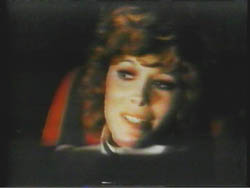
Confused? Here’s an example. Agent C (who will turn out to be Marjorie Cameron, muse of many West Coast artists) is riding with rocket scientist Jack Parsons. A series of shots shows them in the car’s front seat.
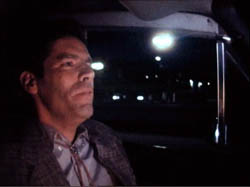
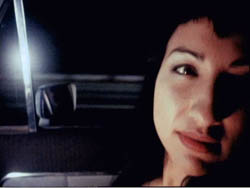
As the scene goes on, one character gets replaced by another.
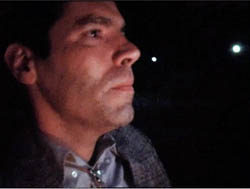
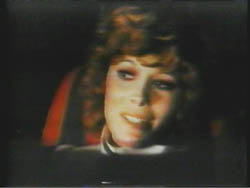
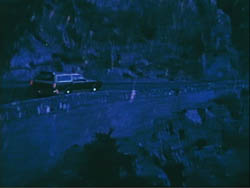
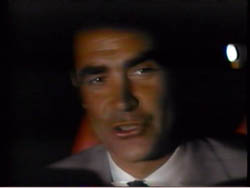
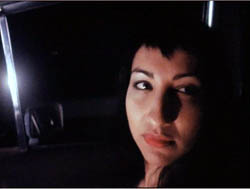
Eventually both of our originals have been replaced.
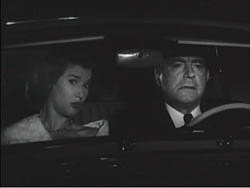
The stand-ins can even change position as the dialogue continues uninterrupted (but always mis-synchronized).
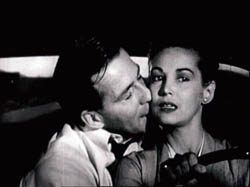
The cuts make the inserted characters surrogates or avatars for our people, but they retain wisps of their original, enigmatic existence. They also remind us that situations like driving in a car are genre stereotypes, schemas so common that individual instances can serve as place-holders for one another. Yet the shots always return to the original actors, anchoring the associations and keeping at least one plane of the narrative moving forward.
These phantasmagoric shifts make the identity transformations in I’m Not There look labored. In Mock Up on Mu Baldwin may have found a new method of cinematic storytelling. Don’t expect Hollywood to pick it up soon.
Pulling half away
How do you tell your audience what it needs to know to understand what it’s seeing, and what it will see? A film can handle exposition (aka backstory) in several ways. Most films favor concentrated and preliminary exposition: Most information is given in one spot and quite early on. This is when you get the opening dialogue when characters say to one another: “Look, you’re my sister. You can tell me.” (Ohh…They’re sisters.) Concentrated, preliminary exposition is usually clunky, but it can be done with finesse, as in the opening soliloquy of Jerry Maguire.
The major alternative is distributed exposition, where information about the backstory is spread out, evenly or unevenly, across the film. This is common in mystery films (as when, under pressure, characters start to confess their relation to the murder victim) and in “puzzle films” like Memento, where we only gradually understand the relations among the characters. Delayed and distributed exposition in straight dramas is common in European art cinema, but it’s rare in the US, although independent films like Claire Dolan and Man Push Cart have made good use of the technique. Kristin already mentioned a similar strategy at work in Eat, for This Is My Body.
Lance Hammer’s Ballast comes garlanded with praise from festivals and major news outlets like the New York Times. For once the advance word is justified. I thought that Ballast was an exceptional intimate drama, focused almost entirely on three people and their layered relationships in a country town in the Mississippi Delta.
At this point I should mention how the three principals are connected, but part of the daring of Hammer’s film is to postpone, for almost an hour, telling you such things. He says he wanted a film that is, like the Delta, “spacious and quiet and slow.” Here the very issue of what we need to know is put into question. By blocking our knowledge of characters’ relationships, Hammer forces us to confront moments of action in a pure state. Each instant, each shot even, gains an integrity and gravity it wouldn’t have if we knew the full dramatic context.
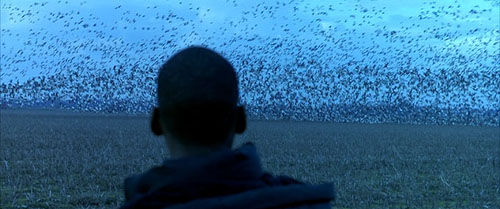
Take the opening. After a brief, wordless prologue showing a boy in a field of crows, we’re in a vehicle pulling up at a bungalow.
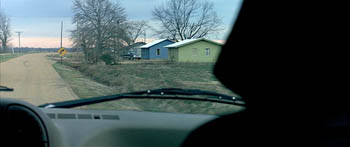
The indistinct figure of a man goes to the door. Inside, a brief shot shows a black man’s face in silhouette.
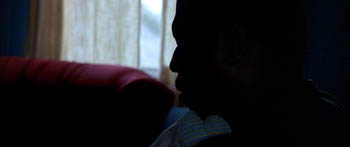
Soon, the first man, who is white and weatherbeaten, is seen at the door, expressing concern for the man inside.
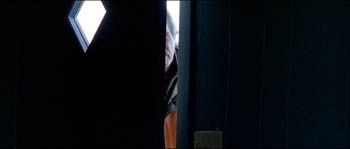
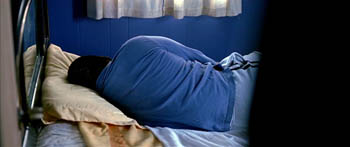
The white man enters, wrinkles his nose at a smell, and proceeds to another room, where a figure, turned from us, lies on a bed.
The black man continues to sit impassively before his TV, though now we can see his face more clearly.
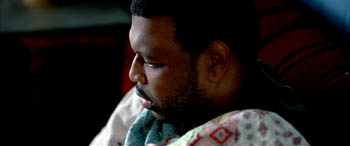
Who are these men? What connects them? Who has died? An ordinary film would tease us with these questions but answer them fairly soon (say, in the next three or four scenes). Here, we will have to wait a considerable time to find out the answers. In the meantime, what we have registered in place of an action arc is the atmosphere of shock, sorrow, grieving, and lowering skies. And almost immediately a rather dramatic event will occur, nearly offscreen, and its causes will remain equally opaque for quite some time.
Ballast’s delay in spelling out its story premises is sustained by two unusually quiet main characters. Lawrence, the man sitting in the darkness, leads a solitary life and speaks reluctantly and briefly. Likewise, the boy James is often silent or alone. These two don’t soliloquize, and they live one day at a time. We must simply observe their behavior, try reading their minds, and more generally absorb the emotional tenor of their lives.
The sparseness of the exposition also puts us on the alert for any scrap of information that will fill in the blanks. For instance, references to “the store” flash out as clues to possible connections among the characters. Hammer’s strategy demands that the audience exercise a degree of patient concentration that most films never ask for.
For roughly the first half of the film, then, Hammer’s narrational technique creatively impedes our full understanding of the basic givens of the story. Once the relationships have coalesced (though there are still some revelations to come), the dialogue becomes more explicit and, some would say, the drama more traditional. But the visual narration continues to mute and elide dramatic moments. At some points pieces of action are rendered opaque by the bobbing, jump-cut camerawork. Most memorably, a clumsy embrace is hidden by a “wrong” camera setup, all the better to make us wonder about the impulses behind the gesture. Hammer matches his oblique plotting with an oblique visual style.
Hammer has cited Bresson as an inspiration, and in conversation he also mentioned late Godard, who has become willing to avoid exposition for nearly an entire film. Unlike Godard, who seems to revel in the pure artifice of withholding information, Hammer appeals to realism: The gradual piecing together of the narrative, he remarked to me, is like our coming to know people in life, bit by bit.
Correspondingly, by the end of Ballast we come to feel more empathy for Hammer’s characters than for Godard’s, and possibly even for most of Bresson’s enigmatic souls. But the empathy doesn’t come cheap, and it isn’t wallowed in. The climax is brushed past in one sideswiping shot; blink and you’ll miss it. In another interview, Hammer speaks of “putting something out and pulling half away.” By leaving us to fill in that half, Hammer exhibits his respect for his characters, and for his audience.
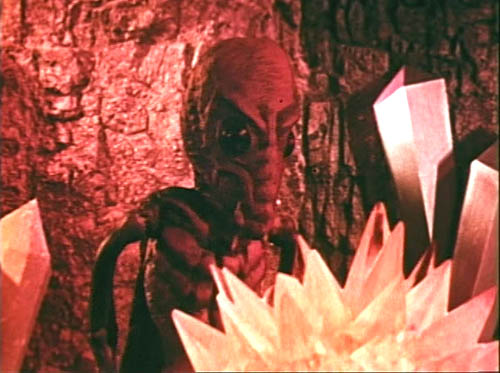
Mock Up on Mu
P. S. For dispatches from 2006 and 2007 editions of the VIFF, type Vancouver into our search box.