















Archive for the 'Animation: Aardman' Category
Tracking down Aardman creatures in 2008
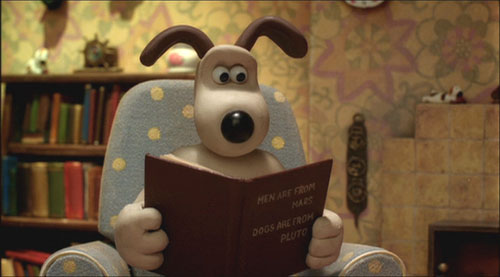
Cracking Contraptions: The Tellyscope.
David’s health situation has made it difficult for our household to maintain this blog. We don’t want it to fade away, though, so we’ve decided to select previous entries from our backlist to republish. These are items that chime with current developments or that we think might languish undiscovered among our 1094 entries over now 17 years (!). We hope that we will introduce new readers to our efforts and remind loyal readers of entries they may have once enjoyed.
On Friday, December 15, Chicken Run: Dawn of the Nugget will have its American streaming release on Netflix. I’ve been a fan of the film’s producer, Aardman, since David and I saw a compilation of the three original Wallace and Gromit shorts, including the sublime The Wrong Trousers, in a theater. On January 28, 2008 I posted a long entry on Aardman’s history to that time, including a chronology of all its releases. Aardman has been so productive since then that I could not possibly update this entry. The company has been extremely successful in the area of television series, such as those featuring Shaun the Sheep, thus multiplying the number of titles created. Nevertheless, I think this entry offers some useful information on the early period of the studio.
Kristin here—
David and I are currently plugging away on revising our Film History textbook. In setting out to update the section on Aardman animation, I ran into difficulties pinning down the dates of certain television series or the director of a given short film. Indeed, I was quite surprised at the dearth of complete chronologies or filmographies for such a famous and important company.
The obvious sources such as Wikipedia and the Internet Movie Data Base, are helpful but sketchy. Aardman’s own “History” section on its official website is even briefer–and ends in 2005. The filmography in Peter Lord and Brian Sibley’s coffee-table book, Creating 3-D Animation (p. 189), is far from complete. (I must confess that I’m still using the first edition, but even so the filmography is sketchy for the period it covered. The revised edition came out in 2004.) Each source was, however, incomplete in different ways. I decided to try and compile as comprehensive a chronology/filmography as I could as a research and reference tool. This turned out to be a considerable task. Given how little of this work will end up in the textbook, I decided that I might as well offer it to the world.
I expected to find one or more fan-originated sites that would provide additional information, as so often happens in the world of popular culture. The main “unofficial” site that came up when I Googled Aardman is actually an online shop with scarcely any actual information.
What follows is not by any means complete. It’s more like a rough draft for a filmography, though it’s more detailed than any that I have found so far. No doubt it has gaps and perhaps inaccuracies. One problem I encountered is that dates given in various filmographies seem to waver between when a film was made, when it was copyrighted, and when it was released to theaters or first shown in TV. I’ve tried to stick to release/broadcast dates when I could find them.
Aardman has produced many ephemeral animations for station-identification logos, credit sequences, and websites, as well as perhaps hundreds of commercials. I’ve made no attempt to include commercials, apart from the Heat Electric series, which are available on DVD. The following primarily includes television shorts and series, as well as films.
My main sources of information are: The Internet Movie Datebase; the history section of Aardman’s official website (which ends with 2005); the Big Cartoon Database’s Aardman page; Lord and Sibley’s Creating 3-D Animation; Insideaard (a booklet included in the British DVD Aardman Classics); and the credits of various Aardman films on DVD and on AtomFilms. Some details have been filled in from the Wikipedia entries on Nick Park and Steve Box. The main Aardman entry is so far rather sketchy, though it includes some films not listed in other filmographies and links to entries on the individual films and series, given below.
[Added January 29: Aardman itself might seem to be the ideal place to start, but the company doesn’t currently have a list of all its productions. It recently hired an archivist who, among other tasks, plans to compile such a list, including the commercials. In the meantime, this entry can serve as a stop-gap reference source.]
* indicates a music video, as identified in Lord and Sibley.
1970s
c. 1972, Friends and amateur animations Peter Lord and David Sproxton sell an untitled cel short featuring a “Superman” gag (illustrated on p. 10 of Lord and Sibley) to the BBC for about ₤15, for its “Vision On” series (producer Patrick Dowling; aimed at deaf children). The superhero’s name, Aardman, would give the pair’s company its name.
 1976 Aardman Animation founded.
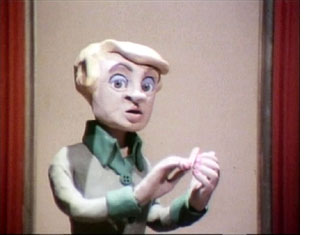
1978 Two films for Animated Conversations series, BBC: Down and Out (copyright 1977) and Confessions of a Foyer Girl (left; both dir. Lord and Sproxton). First use of real-life interviews for soundtracks.
1980s
1979-1982 Morph shorts for BBC. Initially part of Vision On series, then Take Hart, and finally on its own as The Amazing Adventures of Morph (dated 1981-83 in Lord and Sibley; 1980-81 on imdb).
c. 1982 Aardman starts making commercials. This becomes the financial staple of the studio and allows the company to move into larger facilities and hire more staff. Thereafter Aardman has produced 25-30 commercials a year. Lord and Sibley’s filmography contains a list of the products/companies for which Aardman made commercials from 1982 to 1998, but listed alphabetically without individual dates. (A few of these are on YouTube, such as this one for Chevron.)
1983 Conversation Pieces series: Sales Pitch, Palmy Days, Late Edition, Early Bird, and On Probation (dir. Lord and Sproxton). All shown during one week on Channel Four for its first anniversary.
1985 Nick Park joins Aardman full time.
1986 Babylon (Lord and Sproxton) First film that Nick Park worked on. Channel Four.
* Sledgehammer (dir. Stephen Johnson; Aardman’s portion animated by Park, Lord, Richard Goleszowski) Peter Gabriel music video.
1986-91 Aardman provides the Penny segments for five seasons of Pee-wee’s Playhouse, CBS.
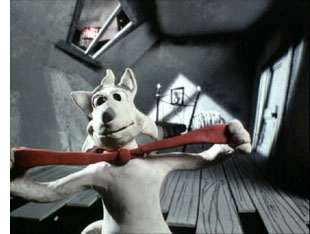
* 1987 My Baby Just Cares for Me (dir. Lord; right).
Going Equipped (dir. Lord).
* Barefootin’ (dir. Goleszowski) On YouTube.
* 1988 Harvest for the World (one sequence, dir. Sproxton, Lord, and Goleszowski).
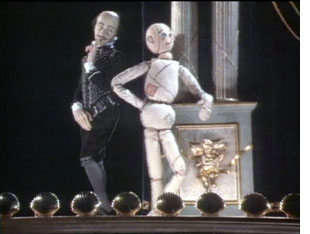 1989 Lip Sync series: Next (dir. Barry Purves; left), Ident (dir. Goleszowski; first appearance of Rex the Runt), Going Equipped (dir. Lord), Creature Comforts (dir. Park), War Story (dir. Lord) Channel Four.
Creature Comforts spawns the Heat Electric series of ads.
A Grand Day Out (dir. Park) Produced by the National Film & Television School and finished with help from Aardman. The introduction of Wallace & Gromit.
Lifting the Blues (dir. Sproxton).
1990s
1990 Steve Box joins Aardman.
1990-91 Rex the Runt: How Dinosaurs Became Extinct (dir. Goleszowski).
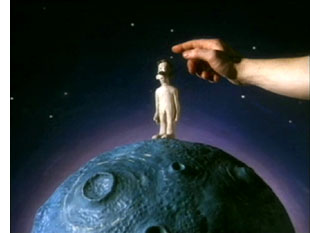 1991 Adam (Lord; right).
Rex the Runt: Dreams (Goloeszowski).
1992 Never Say Pink Fury Die (dir. Louise Spraggon).
Love Me … Loves me Not (dir. Jeff Newitt).
1993 The Wrong Trousers (dir. Park). Co-financed by Aardman and the BBC. Shown during the Christmas season.
Not without My Handbag (dir. Boris Kossmehl) Channel Four.
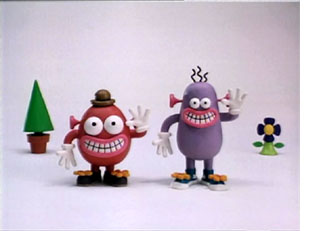 1994 Pib & Pog (dir. Peter Peake; left).
1995 A Close Shave (dir. Park), shown on the BBC at Christmas.
The Title Sequence (dir. Luis Cook and Dave Alex Riddett).
The Morph Files (dir. Lord and Sproxton) BBC.
1996 Rex the Runt: North by North Pole (Goleszowski) “Pilot”.
Wat’s Pig (dir. Lord) Channel Four.
Pop (dir. Sam Fell)
* Never in Your Wildest Dreams (dir. Bill Mather).
 1997 Dreamworks pre-buys the U.S. rights to Chicken Run.
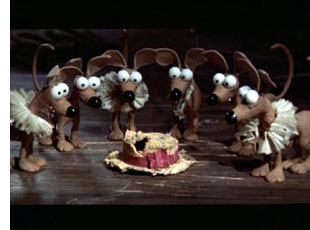
Stage Fright (dir. Box, right).
Owzat (dir. Mark Brierly)
1998 Humdrum (dir. Peake) Channel Four and Canal +.
Al Dente (dir. Brierly).
Rex the Runt (dir. Goleszowski) 13 episodes for BBC2, aired December 1998 to January 1999.
The Angry Kid series (dir. Darren Walsh) 3 episodes posted on the internet by AtomFilms.
* Viva Forever (dir. Box).
1999 The Angry Kid (dir. Darren Walsh) 13 episodes distributed on the internet by AtomFilms.
Minotaur and Little Nerkin (dir. Nick Mackie) Theatrical release.
Rabbits! (dir. Sam Fell).
2000s
2000 The Angry Kid (dir. Walsh) episodes 14-25 (continuation of season one).
Chicken Run (dir. Lord and Park) Aardman’s first feature. Released in the U.S. by DreamWorks and in the U.K. by Pathé.
Non-Domestic Appliance (dir. Sergio Delfino) This and the next four films were posted on AtomFilms in 2003.
Chunga Chui (dir. Stefano Cassini).
Comfy (dir. Seth Watkins).
Ernest (dir. Darren Robbie)
Hot Shot (dir. Michael Cash).
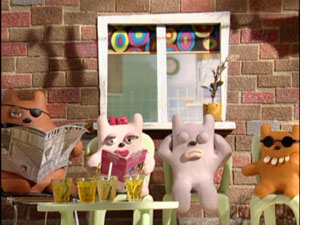 2001 Rex the Runt (dir. Golwszowski; left) second season, BBC2, 13 episodes, aired September to December.
The Deadline (dir. Stefan Marjoram) A CGI short imitating Aardman’s traditional claymation style, made for an Aardman retrospective in New York. Nickelodeon subsequently commissioned twenty one-minute episodes with the same characters to create the series The Presenters (The Deadline on YouTube.).
2002 Cracking Contraptions (dir. Lloyd Price and Christopher Sadler) Ten episodes shown by BBC during the Christmas season.
Chump (dir. Fell) Theatrical.
2003 Creature Comforts (dir. Goleszowski) First season, 13 episodes, ITV1.
The Angry Kid moves from the internet to BBC3.
2004 The Angry Kid: Who Do You Think You Are? (dir. Walsh) 22 minute film outside the series.
2005 Wallace & Gromit in The Curse of the Were-Rabbit (dir. Box and Park) Released in the U.S. by DreamWorks and in the U.K. by United International Pictures.
Planet Sketch (dir. ?) 13 episodes, 2005-2006. For a breakdown of episodes, see the Wikipedia entry.
Creature Comforts, second season, ITV starting in October.
2006 Flushed Away (dir. David Bowers and Fell) Distributed in the U.S. by DreamWorks and in the U.K. by United International Pictures. Aardman’s first CGI feature.
Purple and Brown (dir. Richard Webber) 21 episodes, Nickelodeon U.K. (Episode list on Wikipedia; a collection of the YouTube postings have been collected here, with some repetition.)
2007 January, DreamWorks terminates its five-feature contract with Aardman (claiming a write-off of $25 million for Wallace & Gromit in The Curse of the Were-Rabbit and $109 million for Flushed Away).
Pib and Pog (dir. Peake) Five shorts for the AtomFilms site: The Kitchen, X-Factor, Peter’s Room, Daddy’s Study, and The Dentist (copyright date 2006).
April, Sony announces that it has a deal to distribute Aardman features.
Shaun the Sheep (dir. Sadler) 20 episodes, BBC, first series March, second series September.
Creature Comforts America (dir. ?) CBS, seven episodes. Three episodes aired in June, and the rest were cancelled due to low ratings.
The Pearce Sisters (dir. Cook) Theatrical.
Chop Socky Chooks (dir. Delfino) 26 episodes, Cartoon Network (For character list, see Wikipedia entry).
2008 Creature Discomforts (dir. Steve Harding-Hill) Four public-service spots featuring disabled characters (with sound provided by people with disabilities), on ITV beginning January (also online).
Wallace and Gromit in Trouble at Mill (dir. Park) Half-hour Wallace & Gromit film to be shown by the BBC at Christmas.
[February 19, 2009: This films was shown under the title Wallace and Gromit: A Matter of Loaf and Death. The DVD is currently available for pre-orders on Amazon.UK and will be released March 23.]
1000 Sing’n Slugs (dir. ?) Bonus disc for re-issue of Flushed Away.
2009 Announcement of Timmy (dir. Jackie Cockle) Spin-off from “Shaun the Sheep” aimed at pre-schoolers. 52 ten-minute episodes for BBC.
These features are currently announced as in progress: Tortoise vs. Hare (2009), Pirates (2009), Untitled Wallace & Gromit project (2010), Operation Rudolph (2010), and The Cat Burglars (2010).
Aardman has a CGI department mainly used for commercials and station-identification logos, including BBC’s three Blob spots, Nickelodeon’s Presenters, and BBC2’s Booksworms
Lord and Sibley list an undated, untitled public-information film on HIV/AIDS.
DVDs and the Internet
I won’t attempt a complete list of DVDs, given that some of these films have been repackaged in various compilations. I’ll mention the ones in our own collection, which cover most of what is available on DVD.
Leaving aside the Wallace & Gromit films for now, the crucial DVD for the studio’s output is Aardman Classics, which contains 25 shorts plus 12 Heat Electric ads that use interviews with animals in the style of Creature Comforts. Unfortunately this DVD was issued only in the U.K. [Added January 22: It was also issued in Australia with Region 4 coding.] It’s still available, and if you have a multi-standard player and are interested in Aardman, I can’t recommend it highly enough. It contains most of the films to 1998, going back to Confessions of a Foyer Girl and Down and Out. Presumably for rights reasons, it does not include the classic music video, Sledgehammer.
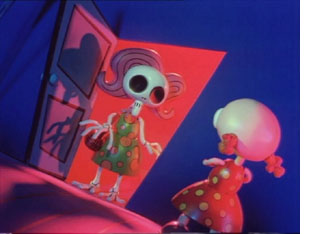 American viewers restricted to Region 1 DVDs have far less available to them. The American DVD of Creature Comforts (now out of print) contained only three other Aardman films: Wat’s Pig, Adam, and Not without My Handbag (left)—among the best, no doubt, but far from the cornucopia on Aardman Classics.
Sledgehammer is included on the Peter Gabriel: Play the Videos DVD. I assume the quality there is distinctly better than the many copies available on YouTube and elsewhere on the Internet. By the way, the Quay Brothers did the rest of the animation for Sledgehammer.
Some of the TV series are available on DVD. Both seasons of “Rex the Runt” were released as a boxed set in the U.S. It’s rather pricey but has a 260-minute running time and some minor extras. The British DVD of the first season of The Angry Kid is now out of print. Both seasons of the British series Creature Comforts are available as a set in the U.S. The ill-fated “Creature Comforts America” has also been released. So far the two “Shaun the Sheep” series are only available in the U.K., separately or in a boxed set containing both.
Chicken Run, Wallace & Gromit in The Curse of the Were-Rabbit, and Flushed Away are all out on DVD. (The Were-Rabbit disc includes the classic 1997 Steve Box short, Stage Fright, as well as some good making-of supplements.) I had held off ordering Flushed Away in the hope, probably vain given the film’s weak U.S. box-office showing, that an edition with making-of bonuses will be forthcoming. Now, however, a re-issue (NTSC, but with no region coding) is coming out on February 19. (U.K. here.) It includes a second “all-new slugtacular disc,” 1000 Sing’n Slugs (not sold separately). Forget the making-ofs, my pre-order is in!
Finally, the all-important question: which DVD of the three classic Wallace & Gromit shorts to purchase? For once the American disc, “Wallace & Gromit in Three Amazing Adventures,” has the advantage, in that it includes all ten episodes of the “Cracking Contraptions” series. These are all available on the Aardman website, but for a larger image and better visual quality, fans will want the DVD. The British disc, “Wallace & Gromit: Three Cracking Adventures!” has only the three films and a bonus, “The Amazing World of Wallace & Gromit,” a brief history of Aardman that I remember as being pretty good.
Apart from its own website, the official outlet for Aardman shorts on the Internet is AtomFilms, which currently has lists 37 titles under the category The Best of Aardman. A group of very short films, Non-Domestic Appliance, Chunga Chui, Comfy, Ernest, and Hot Shot (all copyright 2000 but posted in 2003) look to me as if they might have been training exercises for young animators who also worked on Chicken Run. A group of classic films are available: Creature Comforts, Minotaur and Little Nerkin, War Story, Wat’s Pig, Stage Fright, Hundrum, Pop, Owzat, Adam, Al Dente, and Loves Me, Loves Me Not. The original Pib and Pog is also there, as well as a Pib and Pog series of five original shorts posted in 2007. Another series, A Town Called Panic, has six episodes; it is a Belgian production (copyright 2002; see the Wikipedia entry for episodes, characters, and links) which Aardman distributes. It was posted on Atom Film in 2007. There are also several Angry Kid episodes.
There are many Aardman items on YouTube. Many are bad copies of films available elsewhere, but there are some treasures to be found among them. I leave it to you to continue the search.
I would appreciate any corrections, additions, or other significant links that readers can provide.
In a 2006 post, I discussed the problems Dreamworks had in distributing Flushed Away in the US, and in a 2007 post, I discussed the departure of Aardman from Dreamworks.
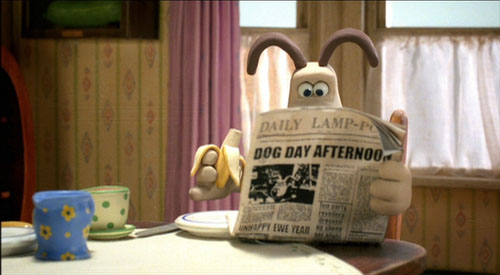
Cracking Contraptions: The Autochef.
Annies to Oscars: this year’s animated features
Awards scene in The Pirates! Band of Misfits.
Kristin here:
On February 1, the Annie Awards were given out. These are the honors bestowed by the International Animated Film Society. Up for best animated feature were the five Oscar nominees in the same category–Brave, Frankenweenie, ParaNorman, The Pirates! Band of Misfits, and Wreck-It Ralph–plus three others–Hotel Transylvania, Rise of the Guardians, and The Rabbi’s Cat. Rather to my surprise, Wreck-It Ralph took the top honor.
This seems like a good occasion to follow up on some of my entries on animation posted here years ago and to present some comments on the five Oscar nominees.
Mainstream fare
Remember when entertainment journalists were suggesting that there were getting to be too many big-studio animated features in the market each year? Remember when supposedly there just wasn’t that much demand and that cartoons were starting to eat into each other’s box-office takings? No? I do, partly because back on January 23, 2007, I blogged on the subject. I said at the time, “The ‘too many toons’ issue looks to me like a tempest in a teapot.”
For one thing, animated features were actually doing very well at the box-office:
In 2006, the ten highest domestic box-office grossers included four CGI hits: Cars, #2, Ice Age: The Meltdown, #7, Happy Feet, #8, and Over the Hedge, #10. On the worldwide chart, these four films rank high as well: Ice Age: The Meltdown, #3, Cars, #5, Happy Feet, #10, and Over the Hedge, #11. In the domestic market, 6 other toons make the top 100. So, 4 out of 10 toons are in the top ten, while 6 out of 90 live-action films make that short-list. I’m no math whiz, but that looks like 40% versus 6.6% to me.
Since 2006, animated features have increased in number, as witnessed by the fact that the Academy of Motion Picture Arts and Sciences upped the number of nominees in that Oscar category from three to five for the 2010 awards. Actually, the rules are more complicated than that:
All submissions sent to the Academy will be screened by the Animated Feature Film Award Screening Committee(s). After the screenings, the committee(s) will vote by secret ballot to nominate from 2 to 5 motion pictures for this award. In any year in which 8 to 12 animated features are released in Los Angeles County, either 2 or 3 motion pictures may be nominated. In any year in which 13 to 15 films are released, a maximum of 4 motion pictures may be nominated. In any year in which 16 or more animated features are released, a maximum of 5 motion pictures may be nominated.
The 2010 and 2012 Oscars each had five nominees in the category, while for 2011 there were again only three. This year there are again five, and it seems likely that this will continue to be the case.
In 2012all but one Hollywood studio had at least one animated feature among its five top-grossing films. So much for such films crowding each other out of the market. Totals below are worldwide and include the grosses only to December 31:
Sony: Hotel Transylvania, #4 ($313.2 million, still in release; $324.3 million as of Feb. 3)
Warner Bros.: none
Fox: Ice Age: Continental Drift, #1 ($897.3 million)
Disney: Brave, #2 ($538.3 Million)
Disney: Wreck-It Ralph, #3 ($283.6 million, still in release; $376.6 million as of Feb. 3)
Universal: Dr. Seuss’ The Lorax, #3 ($349.6 million)
Paramount: Madagascar 3: Europe’s Most Wanted, #1 ($743.3 million)
Paramount: Rise of the Guardians, #3 ($261.2 million, still in release; $297.8 million as of February 3)
The first six of these films were in the 20 top-grossing American films of 2012; Rise of the Guardians was #30.
(These figures are from “Studio figures hit sky high” by Ian Sandwell, in the January 25, 2013 issue of Screen International. Unfortunately the charts of studio hits aren’t in the online version of the article.)
People no longer suggest that there are too many animated films. In fact, they’re a predictable mainstay of the studios, partly because they have proven themselves capable of generating lucrative franchises, just like those big action-packed CGI fantasy and sci-fi films. People are now suggesting that maybe there are too many of those in the market, cannibalizing each other’s grosses.
The Return of Handmade Animation
In recent years, some members of the industry, the punditry, and the general audience have complained that small, independent films and even foreign fare have elbowed their way into the live-action categories. The best-picture category was reportedly increased from five titles to up to ten slots specifically to make sure that some blockbusters would make the list and draw in a larger audience for the televised Oscar ceremony. Still, The Hurt Locker beating Avatar has been pointed to innumerable times in order to claim that the Academy voters are out of touch with the broad popular audience’s tastes.
Wait a minute. The box-office charts are themselves in touch with the broad audience’s tastes as expressed by tickets sold. The Oscars are supposed to be about honoring the year’s best films, not the biggest earners, aren’t they? This year’s best-picture nominees again reflect the Academy’s willingness to cast a somewhat wide net, with a very low-budget film (Beasts of the Southern Wild) and a foreign one (Amour) sitting cheek-by-jowl with hits like Django Unchained and Les Misérables. Despite the expansion in the number of nominees, the really big hits that also garnered critical acclaim, notably The Dark Knight Rises and Skyfall, didn’t make the list.
The same phenomenon has crept into the animated-feature list. Only two of the nominees come from those six that were in the top-twenty box-office hits: Brave and Wreck-It Ralph. The other three were all box-office disappointments to some extent: Frankenweenie, ParaNorman, and The Pirates! Band of Misfits. (Or, to call it by its funnier British release title: The Pirates! In an Adventure with Scientists!)
These three were all created via stop-motion animation. In contrast, all the hits in the list above were CGI, as was the mid-level grosser, Rise of the Guardians.
This is not to say that the three stop-motion film completely avoided computer effects. As Iain Blair pointed out recently in Variety, they made use of new technologies. ParaNorman worked innovatively with 3D laser printing to create huge numbers of slightly different faces for the puppets. (More on that below)
The Pirates! mainly used puppets, but there digital effects done in-house, creating water, fire, smoke, fog, and so on, including the whale. Basically, Aardman’s using special effects in a puppet film the way live-action films use them. (A 3D printer was used to create different mouths to achieve variety of expression, a technique somewhat comparable to that used for ParaNorman.)
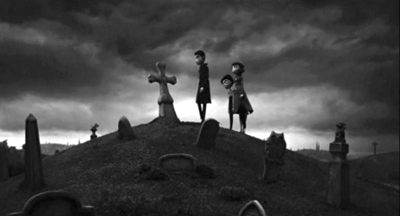
While Frankenweenie used puppets and miniature sets, it also included digital technology, like scenes done against greenscreens with clouds and background vistas added as effects:
So why were the three films made mostly by hand all less successful than the year’s big CGI toons? I would have thought that most people can’t tell the difference, and those who can don’t care. The characters in most CGI animation are basically imitations of puppets, and good stop-motion animation can look nearly as smooth as the digital equivalent. I doubt that audiences are consciously avoiding puppet-based films.
On the basis of these three films, one might almost believe that stop-motion films are become the art-house fare of the animated sector of the industry. I don’t think that’s the case, though. It’s probably just an odd coincidence likely to be limited to 2012. If anything, I suspect that the dominance of the list of nominees by stop-motion films reflects the Academy’s animation wing’s appreciation of the work and skill that goes into such painstaking work. They clearly took note of films that used this technique, including The Pirates!, which was released way back in April. Which is not to say that CGI-based animation involves less work or skill. It just isn’t quite so vivid and obvious.
The Pirates! was unquestionably a failure in the USA. This harks back to my entry kvetching that Flushed Away was sunk by DreamWorks, for lack of trying to turn Aardman into a recognizable brand like Pixar. Now Sony has done the same with The Pirates! In 2011, Sony also released Arthur Christmas to poor business; it’s a hilarious and charming film, well worth a watch. I suspect The Pirates! has little chance for an Oscar, especially without the magical Nick Park name. (Park has won five Oscars on six nominations. He couldn’t win six, since Creature Comforts and A Grand Day Out were nominated opposite each other!) But suppose The Pirates! did win. It would join Wallace & Gromit in The Curse of the Were-Rabbit, that other DreamWorks “flop” that won Best Animated Feature. It made 71% of its worldwide gross outside North America.
Moving on to the other two stop-motion films: One thing that struck me last year after watching previews for ParaNorman, Frankenweenie, and Hotel Transylvania was that there were a surprising number of kids’ films based on horror-film premises. Some kids can take comic-scary stuff, some can’t. The ParaNorman DVD has garnered 246 five- and four-star reviews on its amazon.com page, but also 76 one- and two-star comments, mainly complaining that the film is too scary for young children. Frankenweenie probably aroused similar reactions. No doubt many parents anticipated this problem and didn’t take their kids to see these films. (I haven’t seen Hotel Transylvania, which has done better at the box-office, but it doesn’t seem to have the kind of morbid fascination with dead people and animals that the other two do.)
This year’s nominees
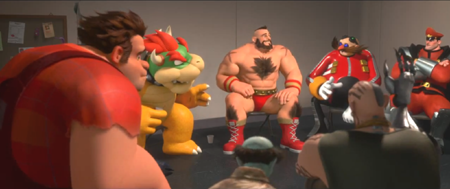
Wreck-It Ralph
I’ve seen all five of the features nominated for the animation Oscar this year. I try and see the big animated films of each year. I’ve been doing that for years now, and in late 2006 I posted an entry about why that is:
Among the new films I’ve seen in the past couple of years, I find that a significant proportion are animated. I don’t think that’s because I prefer animated films but because these days they are among the best work being created by the mainstream industry.
Why would that be? There are probably a lot of reasons, but let me offer a few.
Animated films, whether executed with CGI or drawings, demand meticulous planning in a way that live-action films don’t. David has written here about directors’ heavy dependence on coverage in contemporary shooting. Coverage means that many filmmakers don’t really know until they get into the editing room how many shots a scene will contain, which angles will be used, when the cuts will come, and other fairly crucial components of the final style. This is true even despite the fact that filmmakers increasingly have storyboarded their films (mainly for big action scenes) or created animatics using relatively simple computer animation.
People planning animated films don’t have the luxury of lots of coverage, and that’s probably a good thing. Storyboards for animated films mean a lot more, because it’s a big deal to depart from them. Every shot and cut has to be thought out in advance, because whole teams of people have to create images that fit together—and they don’t create coverage. There aren’t many directors in Hollywood who think their scenes out that carefully. Steven Spielberg, yes, and maybe a few others.
A similar thing happens with the soundtrack. In animated films, the voices are recorded before the creation of the images. That’s been true since sound was innovated in the late 1920s. Pre-recording means that images of moving lips can be matched to the dialogue far more precisely than if actors watched finished images and tried to speak at exactly the right time to mesh with their characters’ mouths. The lengthy fiddling possible with ADR isn’t an option. Most stars are used to recording their entire performances within a few days, picking up their fees, and moving on to more time-consuming live-action shooting.
I think the same remains true, though I would now credit David Fincher with planning his films down to each shot and cut. Still, even the increased use of pre-viz doesn’t seem to keep directors from shooting scenes from multiple angles and in many takes, encouraging a looseness in the editing.
Interestingly, Peter Ramsey, director of Rise of the Guardians, got his start as a storyboard artist for directors that included both Spielberg and Fincher. Ramsey was quoted in a recent Hollywood Reporter story on Rise of the Guardians, discussing that phase of his career: “You start learning to tell stories economically with the camera, connecting ideas on screen with the camera, blocking things so that they are simple but still dynamic.” I think that sort of planning still accounts for the excellence of such a high proportion of animated films.
That’s also why some of this year’s nominated animated films were among the best I saw last year. If David and I were in the habit of making up ten-best lists for current years, The Pirates! and Wreck-It Ralph would undoubtedly be on mine, right alongside films like Holy Motors and Leviathan. But we don’t, so I’ll just offer a few comments, starting with the film I would most like to see win the Oscar and ending with the one that least deserves it.
The Pirates! should win. It has the technical virtuosity that all Aardman features share. It also has a breakneck pace of clever and witty action and jokes.
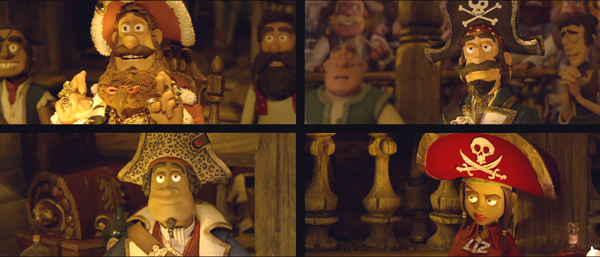
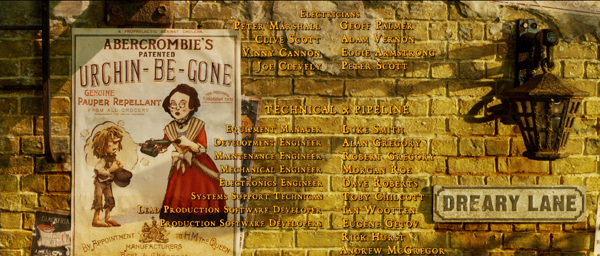
The main plot premise has four pirates vying for the Pirate of the Year award, and the ceremony itself is handled as a parody of Oscar-style shows, down to the split-screen views of nominees in the audience (see top). Aardman films are known for putting jokey items in the sets, to be noticed or not. This time there are so many posters, objects, street and shop signs, and other throwaway gags that the filmmakers felt obliged to reprise them during the final credits!
One thing I noticed in watching the DVD, however, is that a lot of these small posters and maps and so on are not big enough to be read, at least on an ordinary-sized video monitor. Academy voters who didn’t see the film in theaters but watch it on screeners are likely to miss a lot of what makes The Pirates! so funny. Below is one frame of some of the larger items, from the Blu-ray version:
For me, a hair’s breadth behind The Pirates! comes Wreck-It Ralph. Besides winning the Annie for best feature, Wreck-It Ralph also won for in the feature categories for best direction, animated effects in an animated film, voice acting (Alan Tudyk as King Candy), and writing. Wreck-It Ralph has the same rapid-fire humor and inventiveness that characterizes The Pirates! without seeming derivative of Aardman’s approach. The notion of an old-style video-game villain trying to become a hero is original, with Ralph attending AA-style 12-step sessions with other villains (see top of this section). Pulling several characters from different games into the same plotline works well, too. Not being a gamer, I’m sure I missed a great many allusions to real games, but apparently a supplement on the Blu-ray disc will provide that information.
And another hair’s breadth behind Wreck-It Ralph comes ParaNorman, which won Annies in the feature categories for character animation and character design. The filmmakers innovated new 3D laser-printing technology that allowed them to make thousands of separate replacement faces so that the characters’ expressions could be changed frame by frame.
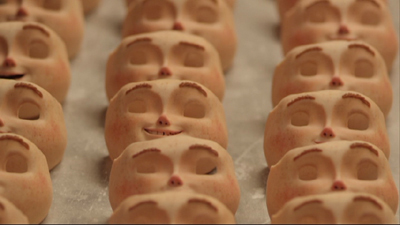
These replacement faces incorporated the color during the printing process, so that features like pink cheeks and freckles no longer had to be hand-painted and thus could be used more freely. (Even the most carefully applied pink applied by hand would shimmer from frame to frame.) As the making-of documentary Peeping through the Veil points out, Coraline, made with a similar face-replacement technique but with hand-painted color, could only use 13 freckles on the heroine’s face, with no pink on the cheeks. In ParaNorman, Norman’s friend Neil (some of whose replacement faces are shown in the illustration above) has innumerable freckles, as well as a pink nose and cheeks–all of which stay exactly in place.
The laser-printed faces also are translucent, allowing for subsurface light-particle scattering, allowing the puppets to have an appearance of realistic human skin (comparable to what was done digitally to create a believable Gollum in The Lord of the Rings and The Hobbit). The effect is particularly noticeable in the many backlit shots, where light passes through Norman’s prominent ears:
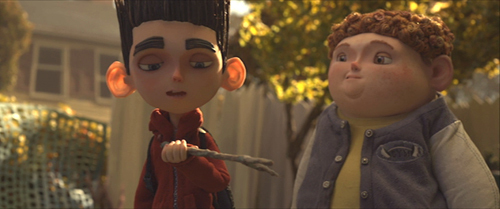
The effect of the new facial technology is a remarkably expressive set of characters.
The film’s premise is that Norman can see and interact with dead people, which makes him an outcast at his school, victimized by bullies and avoided by the rest of his classmates. The exception is Neil, equally bullied for his chubbiness and eccentricities. The setting is a New England town that exploits its history of witch-hunting for touristic purposes. As a threat from a real witch’s curse threatens the town, its modern inhabitants prove just as intolerant and prone to mindless violence as their ancestors. Confronted with the ghosts of past witch-hunters, they whip out their guns and become a mob. The whole thing is treated with grotesque stylization in the settings, character designs, and action. It’s highly entertaining, though certainly there are gruesome moments too strong for some children. But the result is a lesson in tolerance that softens the grotesquery.
I’d be pleased if any of these three films won the Oscar.
Distinctly behind these three comes Brave. Our regular readers know that we’re big admirers of Pixar. I’ve posted about Cars; we chatted about Ratatouille; David described a visit by Bill Kinder, Pixar’s Director of Editorial and Post-Production, to our campus; and their films frequently feature in our general discussions of animation. They have their own category in the menu at the right.
Brave represents a distinct recovery for Pixar after the disappointing Cars 2. I’m a fan of the original Cars, but it seems to me that the filmmakers made a huge mistake by turning Mater, so hilarious in the original, into a pathetic figure and Lightning McQueen, so charming to begin with, into a nasty guy who is barely in the film. Brave was definitely better, though I thought it a bit thin. It needed a subplot, maybe involving the mischievous triplet brothers, to flesh it out. Famously including Pixar’s first female lead character, it seemed to me to present an all-too-obvious story of a girl striving to do what everyone tells her girls don’t do (compete successfully with the guys, resist an arranged marriage). Are we really still at that early stage of creating “positive images” for girls? Having just seen Hayao Miyazaki’s extraordinary Nausicaä of the Valley of the Winds for the first time (in a 35mm print as part of the currently touring Miyazaki retrospective), I watched a princess of roughly the same age doing all sorts of daring things to save her country from ecological and military disasters, with none of the other characters ever mentioning that girls are supposed to leave such actions to the boys. It’s just not an issue, but Nausicaä is a pretty positive image. That in a film from 1984. The desire to be politically correct seems to have made the Pixar screenwriters rein in their imaginations a bit.
That said, it’s still a thoroughly entertaining film. Perhaps the most obvious strength is its sumptuous, evocative depictions of Scottish landscapes (see bottom). It’s no surprise that Brave won the Annie for best production design in a feature (as well as best editing).
I’m looking forward to Monsters University. Maybe it will have to inventiveness and density that we associate with the best Pixar films.
Fifth comes Frankenweenie. I enjoyed it, but it seemed to betray its origins as a short. Moreover, the logic of its premises escapes me. The early section that shows Victor’s love for his dog Sparky, Sparky’s death, and Victor’s resurrection of him using lightning à la Dr. Frankenstein is consistently amusing. Victor’s appropriation of household gadgets to rig his laboratory in the attic wittily captures the 1930s Universal horror films without trying to stick too closely to them. But then his creepy “friend” Edgar (read Igor) wants to try the experiment on a dead goldfish, which is resurrected–but invisible. This invisibility is never really explained, but it contradicts what happened with Sparky. Other kids try their luck or accidentally turn a rat and other dead animals into monsters, a tactic that seems designed to pad out the plot and generate danger to the community. These creations of monsters all seem to involve the same simple lightning strike that brought back Sparky, so why is he the same loving, cheery pet as before?
There’s also a sense that Tim Burton is drawing on auteurist tropes that have become distinctly familiar. We have a black-and-white film about the interaction of the living and the dead, as with Corpse Bride. Again there’s a character that resembles a classic figure from horror films of yesterday. In Edward Scissorhands it was Vincent Price, played by himself. In Ed Wood it was Bela Lugosi, played by Martin Landau. Here Landau is back to channel a similar figure, the teacher Mr. Rzyukruski, modeled on Price:
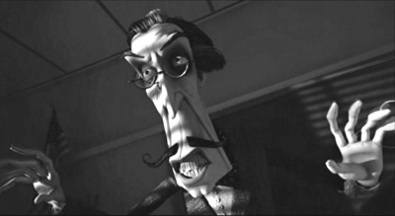
Again, Frankenweenie is an entertaining film, and the combination of smooth stop-motion animation and the CGI backgrounds make for an eerie combination, as in the pet-cemetery scene illustrated above. But it’s not Oscar-worthy. It didn’t win any Annies, but sadly, neither did The Pirates!
One last note. People complain, or at least point out, that a lot of live-action features these days are quite long, well over two hours in many cases. Yet animated features manage to tell their quick-paced, eventful tales succinctly: Brave (93 minutes), Frankenweenie (87 minutes), ParaNorman (92 minutes), The Pirates! Band of Misfits (88 minutes), and Wreck-It Ralph (108 minutes). This, of course, is partly for the benefit of the children in the audience, and partly because animation is so complex and expensive. Still, an adult walking out of any of these films can feel he or she has seen a movie satisfyingly packed with incident that moves along at a lively pace. Live-action directors might want to take a look at just how these films achieve that feeling.
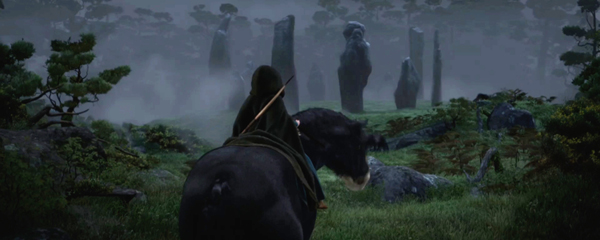
Brave.
Showing what can’t be filmed
DB, again:
People tend to think that documentary films are typified by two conditions. First, the events we see are unstaged, or at least unstaged by the filmmaker. If you mount a parade, the way that Coppola staged the Corpus Christi procession in The Godfather Part II, then you aren’t making a documentary. But if you go to a town that is holding such a procession and shoot it, you are making a doc—even though the parade was organized to some extent by others. Fiction films stage their events for the camera, but documentaries, we tend to think, capture spontaneous happenings.
Secondly, in a documentary the camera is seizing those events photographically. The great film theorist André Bazin saw cinema’s defining characteristic as its capacity to record the actual unfolding of events with little human intervention. All the other arts rely on human creation at a basic level: the novelist selects words, the painter chooses colors. But the photographer or filmmaker employs a machine that impassively records what is happening in front of it. “All the arts are based on the presence of man,” Bazin writes; “only photography derives an advantage from his absence.” This isn’t to say that cinema can’t be artful, only that it offers a different sort of creativity than we find in the traditional arts. The filmmaker works not with pure imaginings but obstinate chunks of actual time and space.
Given these two intuitions, unstaged events and direct recording of them, it would seem impossible to consider an animated film as a documentary. Animated films consist of almost completely staged tableaus—drawings, miniatures, clay, even food or wood shavings (in the works of Jan Svankmajer). And animated movies offer no recording in Bazin’s sense of capturing the flow of real time and space. These films are made a frame at a time, and the movement we see onscreen doesn’t derive from movement that occurred in reality. And of course you can make an animated film without a camera, for instance by painting directly on film or assembling computer-generated imagery.
Recently, however, we’ve been faced with animated films that claim documentary validity. How is this possible? Maybe we need to rethink our assumptions about what documentary is.
In certain types of documentaries, especially those in the Direct Cinema or cinéma vérité traditions, the assumption that we’re seeing spontaneously occurring events holds good. But a documentary can consist wholly of staged footage. Think back to those grade-school educational shorts showing a tour of a nuclear power plant. Every awkward passage of dialogue recited by the hard-hatted, white-coated supervisor was scripted. The whole show was planned and rehearsed, but that doesn’t detract from the factual content of the film.
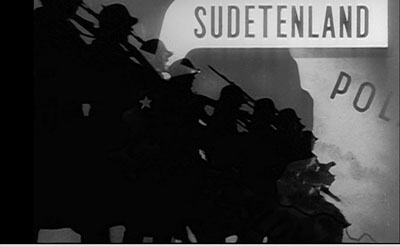
Go further. Recall those attack maps that are shown in war films, tracing the progress of an army through enemy terrain. Now imagine an entire film made of those animated maps. The maps might even be enhanced with a few cartoon images, as in the above shot from one of the Why We Fight films. The film would be entirely designed, presenting no spontaneous reality being captured by the camera. Yet it would plainly be a documentary, telling us that, say, the Germans marched into the Sudetenland in 1938 and proceeded on to Poland. So we don’t need photographic recording of actual events to count a film as a documentary either. Both the staging and the recording conditions don’t have to be present for a film to count as a documentary.
I’m not saying that the claims advanced in my nuclear-power film or my attack-map movie would necessarily be accurate. They might be erroneous or inconclusive or false. But that possibility looms for any documentary. The point is that the films, presented and labeled as documentaries, are thereby asserting that the claims and conclusions are true.
Film theorist Noël Carroll defines documentary as the film of “purported fact.” Carl Plantinga makes a similar point in saying that documentaries take “an assertive stance.” Both these writers argue that we take it for granted that a documentary is claiming something to be true about the world. The persons and actions are to be taken as representing states of affairs that exist, or once existed. This is not something that is presumed by The Gold Rush, Magnificent Obsession, or Speed Racer. These films come to us labeled as fictional, and they do not assert that their events and agents ever existed.
This isn’t just a case of a professor stating something obvious in a fancy way. Once we see documentary films as tacitly asserting a state of affairs to be factual, we can see that no particular sort of images guarantees a film to be a doc.
Take the remarkable documentaries made by Adam Curtis. These are in a way very old-fashioned. Blessed with a voice whose authoritative urgency makes you think that at last the veils are being ripped away, Curtis mounts detailed arguments framed as historical narratives. Freudian theory shaped the emergence of public relations, which was in turn exploited not just by business but by government (Century of the Self). Islamic fundamentalism grew up intertwined with US Neoconservatism, both being reactions to perceptions that the West was becoming heartlessly materialistic (The Power of Nightmares). Mathematical game theory came to form politicians’ dominant conception of human behavior and civic community (The Trap). The almost uninterrupted flow of Curtis’s voice-over commentary could be transcribed and published as a piece of nonfiction. True, there are some interpolated talking heads, but those experts’ statements could be printed as inset quotations.
What’s particularly interesting is that Curtis’ rapid-fire declamation accompanies images that often seem not to illustrate it, or at least not very firmly. Like the found footage in the preacher’s sermon “Puzzling Evidence” in True Stories, Curtis’ images are enigmatic, tangential, or metaphorical.
Here are a few seconds from the start of The Power of Nightmares. Eyes are staring upward, as if possessed.
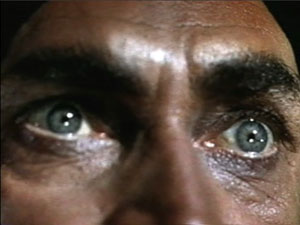
We hear: [Our politicians] say that they will rescue us from dreadful . . .
The eyes are replaced by a shot of a man wearing a cowl, and as this image zooms back the commentary continues.
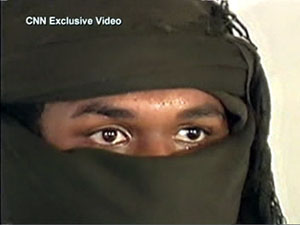
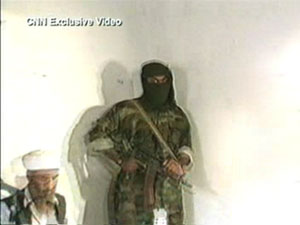
. . . dangers that we cannot see and do not . . .
Cut to a magician or mime demanding silence.
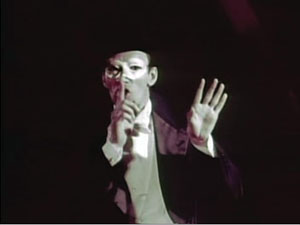
. . . understand.
Cut to rockets being fired.

And the greatest danger . . .
Cut to a procession of cars, seen from above, rounding a corner into a government compound at night.

. . . of all is international terrorism.
Cut to shot of security agent staring at us.
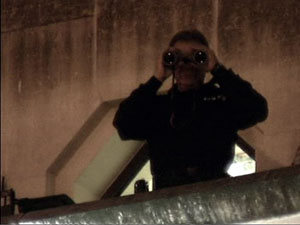
The ominous, not to say paranoid, tenor of the sequence is aided by the unexpected juxtapositions. For instance, you’d think that the shot of the iconic terrorist (anonymous, with automatic weapon) would be synchronized with the final line of the commentary, referring to “international terrorism.” Instead the commentary links the mention of terrorism to an image of government deliberation, and then to an image of surveillance (aimed at us, but also perhaps suggesting the previous high-angle shot was the spy’s POV). The wild-eyed close-up might belong to a terrorist, but is accompanied by claims about rescuing us from fearsome threats, so the eyes could also belong to someone panicked–especially since they contrast immediately with the sober eyes of the gunman in the cowl. Perhaps the first shot represents the fearful public ready to be led by the politicians playing on fear. And the insert shot of the mime becomes sinister but also comic, perhaps debunking the official position that our dangers are unseen and unknowable. In all, the sequence bubbles with associations that are less fixed and more ambiguous than we’re likely to find in a more orthodox documentary, like Jarecki’s Why We Fight.
My point isn’t to analyze the image/ sound relations in Curtis’s work, a task that probably demands a whole book. (This sequence takes a mere eleven seconds.) I simply want to propose that regardless of what pictures Curtis shows, his films are documentaries in virtue of a soundtrack constructed as a discursive argument that makes truth claims. The picture track often works on us less as supporting evidence than as a stream of associations, the way metaphors or analogies give thrust to a persuasive speech.
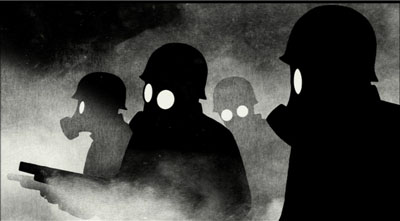
Just as we could have an account of Germany’s 1938 invasion of Czechoslovakia presented in cartoon form, we could imagine The Power of Nightmares illustrated with political cartoons. Once we’ve pried the image track loose from the assertions on the soundtrack, anything goes.
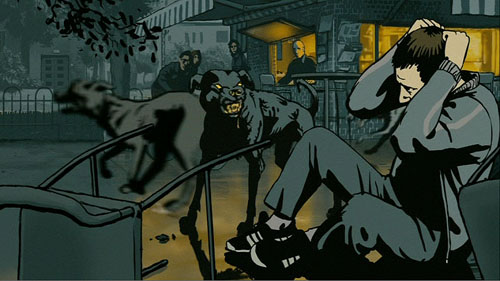
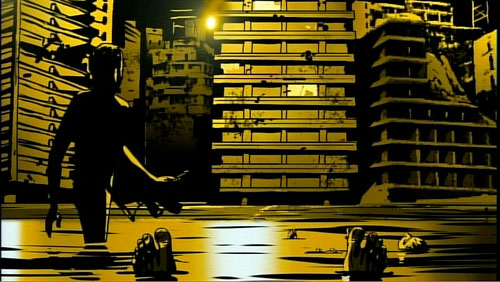
One example much on our minds now is Waltz with Bashir. Ari Folman interviews former Israeli soldiers. But instead of using film footage of their conversations and, say, still photos of the events in Lebanon they took part in, he provides (until the final sequence) drawings a bit in the Eurocomics mold of Tardi or Marc-Antoine Mathieu. The result takes the form of a memoir, admittedly. But in both literature and cinema, memoir is a nonfiction genre.
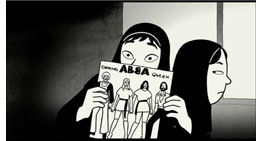 Another memoir supports the point. Marjane Satrapi’s autobiographical graphic novels, Persepolis and Persepolis 2, assert factual claims about her life. The claims are presented as drawings and texts rather than simply as texts, but that doesn’t change the fact that she presents agents and actions purported to have existed. True, on film the people whom she remembers are represented through voice actors speaking lines she wrote. But as with written memoirs (especially those that claim to remember conversations taking place fifty years ago), we can always be skeptical about whether the events presented actually took place.
Turning Satrapi’s published memoir into an animated film did not change its status as a documentary. If we had contrary evidence, we could charge her with fibbing about her family life, her rebelliousness, or her life in Europe. But we’d be questioning the presumptive assertions the film makes, not the fact that it is drawn and dubbed rather than photographed from life.
We’re tempted to see the animation in these films as adding a level of distance from reality. We’re so used to fly-on-the-wall documentaries that we may be suspicious of the cobra-like caricatures of the female teachers in Persepolis or the hallucinatory dawn bombardment in Bashir. Yet animation can show things, like the Israeli veterans’ dreams, that lie outside the reach of photography. And the artificiality doesn’t dilute the claims about what the witnesses say happened any more than does purple prose in an autobiography. In fact, the stylization that animation bestows can intensify our perception of the events, as metaphors and vivid imagery in a written memoir do.
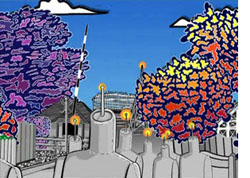 I realize I’m pointing toward a slippery slope here. Strip off the image track from Aardman‘s Creature Comforts and you have impromptu recordings of ordinary people talking about their lives. Those monologues could have been accompanied by documentary-style talking heads. Does that make Creature Comforts a documentary? I’d say not because the film doesn’t come to us labeled that way; it’s presented as comic animation using found soundtracks (like the movie based on the Lenny Bruce routine Thank You Mask Man). Then there are Bob Sabiston‘s rotoscoped films like Waking Life and The Even More Fun Trip, recently released on Wholphin no. 7. The latter (left) takes another documentary form, the home movie, as the basis for its animation. This seems to me an instance where the documentary category has the edge, but it’s a surely a borderline case.
Animated documentaries are likely to remain pretty far from our prototype of the mode. Still, we should be grateful that even imagery that seems to be wholly fictional—animated creatures—can present things that really happen in our world. This mode of filmmaking can bear vibrant witness to things that cameras might not, or could not, or perhaps should not, record on the spot.
André Bazin’s arguments for the documentary basis of cinema are set out in “The Ontology of the Photographic Image,” in What Is Cinema? ed. and trans. Hugh Gray (Berkeley: University of California Press, 1967), 9-16. Noël Carroll’s argument that documentaries are framed as presenting “purported fact” can be found in Theorizing the Moving Image (Cambridge: Cambridge University Press, 1996), 224-259. On the “assertive stance” of documentaries, see Carl Plantinga, Rhetoric and Representation in Nonfiction Film (Cambridge: Cambridge University Press, 1997), 15-25. Errol Morris interviews Adam Curtis here. Thanks to Mike King for pointing me toward The Even More Fun Trip.
PS 10 March: Harvey Deneroff writes:
Very much enjoyed your post on animated documentaries, a topic of some interest to and often discussed in the animation studies community. There was a panel on it during last year’s Society for Animation Studies conference and there will also be one at this year’s as well.
Two recent Oscar recipients for Best Animated Short Subject are also documentaries: Chris Landreth’s wonderful computer animated Ryan (produced by the NFB about animator Ryan Larkin, and features a lot of talking heads) and John Canemaker’s The Moon and the Son: An Imagined Conversation, which is about Canemaker’s father and mixes animation with home movies and photographs.
At least two winners in the Oscar Documentary Short Subject category were largely animated: Chuck Jones’ So Much for So Little (WB, 1949, which I believe was made for the US Public Health Service) and Norman McLaren’s Neighbours. The Story of Time, a 1951 British documentary which featured stop motion animation was nominated in the same category.
Also, the International Leipzig Festival for Documentary and Animated Film includes a section for animated documentary films.
Thanks to Harvey for this. I’m not sure I’d categorize Neighbours as a doc, but it’s a long time since I’ve seen it. On Harvey’s site he also has a note quoting Ari Folman on the difficulty of funding animated docs. And thanks to Ryan Kelly and Pete Porter for reminding me of Winsor McCay’s Sinking of the Lusitania from 1918.
Tracking down Aardman creatures
Cracking Contraptions: The Tellyscope
Kristin here—
David and I are currently plugging away on revising our Film History textbook. In setting out to update the section on Aardman animation, I ran into difficulties pinning down the dates of certain television series or the director of a given short film. Indeed, I was quite surprised at the dearth of complete chronologies or filmographies for such a famous and important company.
The obvious sources such as Wikipedia and the Internet Movie Data Base, are helpful but sketchy. Aardman’s own “History” section on its official website is even briefer–and ends in 2005. The filmography in Peter Lord and Brian Sibley’s coffee-table book, Creating 3-D Animation (p. 189), is far from complete. (I must confess that I’m still using the first edition, but even so the filmography is sketchy for the period it covered. The revised edition came out in 2004.) Each source was, however, incomplete in different ways. I decided to try and compile as comprehensive a chronology/filmography as I could as a research and reference tool. This turned out to be a considerable task. Given how little of this work will end up in the textbook, I decided that I might as well offer it to the world.
I expected to find one or more fan-originated sites that would provide additional information, as so often happens in the world of popular culture. The main “unofficial” site that came up when I Googled Aardman is actually an online shop with scarcely any actual information.
What follows is not by any means complete. It’s more like a rough draft for a filmography, though it’s more detailed than any that I have found so far. No doubt it has gaps and perhaps inaccuracies. One problem I encountered is that dates given in various filmographies seem to waver between when a film was made, when it was copyrighted, and when it was released to theaters or first shown in TV. I’ve tried to stick to release/broadcast dates when I could find them.
Aardman has produced many ephemeral animations for station-identification logos, credit sequences, and websites, as well as perhaps hundreds of commercials. I’ve made no attempt to include commercials, apart from the Heat Electric series, which are available on DVD. The following primarily includes television shorts and series, as well as films.
My main sources of information are: The Internet Movie Datebase; the history section of Aardman’s official website (which ends with 2005); the Big Cartoon Database’s Aardman page; Lord and Sibley’s Creating 3-D Animation; Insideaard (a booklet included in the British DVD Aardman Classics); and the credits of various Aardman films on DVD and on AtomFilms. Some details have been filled in from the Wikipedia entries on Nick Park and Steve Box. The main Aardman entry is so far rather sketchy, though it includes some films not listed in other filmographies and links to entries on the individual films and series, given below.
[Added January 29: Aardman itself might seem to be the ideal place to start, but the company doesn’t currently have a list of all its productions. It recently hired an archivist who, among other tasks, plans to compile such a list, including the commercials. In the meantime, this entry can serve as a stop-gap reference source.]
* indicates a music video, as identified in Lord and Sibley.
1970s
c. 1972, Friends and amateur animations Peter Lord and David Sproxton sell an untitled cel short featuring a “Superman” gag (illustrated on p. 10 of Lord and Sibley) to the BBC for about ₤15, for its “Vision On” series (producer Patrick Dowling; aimed at deaf children). The superhero’s name, Aardman, would give the pair’s company its name.
1976 Aardman Animation founded
1978 Two films for “Animated Conversations” series, BBC: Down and Out (copyright 1977) and Confessions of a Foyer Girl (left; both dir. Lord and Sproxton). First use of real-life interviews for soundtracks.
1980s
1979-1982 Morph shorts for BBC. Initially part of “Vision On” series, then “Take Hart,” and finally on its own as “The Amazing Adventures of Morph” (dated 1981-83 in Lord and Sibley; 1980-81 on imdb).
c. 1982 Aardman starts making commercials. This becomes the financial staple of the studio and allows the company to move into larger facilities and hire more staff. Thereafter Aardman has produced 25-30 commercials a year. Lord and Sibley’s filmography contains a list of the products/companies for which Aardman made commercials from 1982 to 1998, but listed alphabetically without individual dates. (A few of these are on YouTube, such as this one for Chevron.)
1983 “Conversation Pieces” series: Sales Pitch, Palmy Days, Late Edition, Early Bird, and On Probation (dir. Lord and Sproxton). All shown during one week on Channel Four for its first anniversary.
1985 Nick Park joins Aardman full time
1986 Babylon (Lord and Sproxton) First film that Nick Park worked on. Channel Four
* Sledgehammer (dir. Stephen Johnson; Aardman’s portion animated by Park, Lord, Richard Goleszowski) Peter Gabriel music video.
1986-91 Aardman provides the “Penny” segments for five seasons of “Pee-wee’s Playhouse,” CBS.
* 1987 My Baby Just Cares for Me (dir. Lord; right)
Going Equipped (dir. Lord)
* Barefootin’ (dir. Goleszowski) On YouTube
* 1988 Harvest for the World (one sequence, dir. Sproxton, Lord, and Goleszowski)
1989 “Lip Sync” series: Next (dir. Barry Purves; left), Ident (dir. Goleszowski; first appearance of Rex the Runt), Going Equipped (dir. Lord), Creature Comforts (dir. Park), War Story (dir. Lord) Channel Four
Creature Comforts spawns the “Heat Electric” series of ads
A Grand Day Out (dir. Park) Produced by the National Film & Television School and finished with help from Aardman. The introduction of Wallace & Gromit.
Lifting the Blues (dir. Sproxton)
1990s
1990 Steve Box joins Aardman
1990-91 Rex the Runt: How Dinosaurs Became Extinct (dir. Goleszowski)
1991 Adam (Lord; right)
Rex the Runt: Dreams (Goloeszowski)
1992 Never Say Pink Fury Die (dir. Louise Spraggon)
Love Me … Loves me Not (dir. Jeff Newitt)
1993 The Wrong Trousers (dir. Park). Co-financed by Aardman and the BBC. Shown during the Christmas season.
Not without My Handbag (dir. Boris Kossmehl) Channel Four
1994 Pib & Pog (dir. Peter Peake; left)
1995 A Close Shave (dir. Park), shown on the BBC at Christmas.
The Title Sequence (dir. Luis Cook and Dave Alex Riddett)
The Morph Files (dir. Lord and Sproxton) BBC
1996 Rex the Runt: North by North Pole (Goleszowski) “Pilot”
Wat’s Pig (dir. Lord) Channel Four
Pop (dir. Sam Fell)
* Never in Your Wildest Dreams (dir. Bill Mather)
1997 Dreamworks pre-buys the U.S. rights to Chicken Run
Stage Fright (dir. Box, right)
Owzat (dir. Mark Brierly)
1998 Humdrum (dir. Peake) Channel Four and Canal +
Al Dente (dir. Brierly)
“Rex the Runt” (dir. Goleszowski) 13 episodes for BBC2, aired December 1998 to January 1999
“The Angry Kid” series (dir. Darren Walsh) 3 episodes posted on the internet by AtomFilms
* Viva Forever (dir. Box)
1999 “The Angry Kid” (dir. Darren Walsh) 13 episodes distributed on the internet by AtomFilms
Minotaur and Little Nerkin (dir. Nick Mackie) Theatrical release
Rabbits! (dir. Sam Fell)
2000s
2000 “The Angry Kid” (dir. Walsh) episodes 14-25 (continuation of season one)
Chicken Run (dir. Lord and Park) Aardman’s first feature. Released in the U.S. by DreamWorks and in the U.K. by Pathé.
Non-Domestic Appliance (dir. Sergio Delfino) This and the next four films were posted on AtomFilms in 2003.
Chunga Chui (dir. Stefano Cassini)
Comfy (dir. Seth Watkins)
Ernest (dir. Darren Robbie)
Hot Shot (dir. Michael Cash)
2001 “Rex the Runt” (dir. Golwszowski; left) second season, BBC2, 13 episodes, aired September to December
The Deadline (dir. Stefan Marjoram) A CGI short imitating Aardman’s traditional claymation style, made for an Aardman retrospective in New York. Nickelodeon subsequently commissioned twenty one-minute episodes with the same characters to create the series The Presenters (The Deadline on YouTube.)
2002 “Cracking Contraptions” (dir. Lloyd Price and Christopher Sadler) Ten episodes shown by BBC during the Christmas season.
Chump (dir. Fell) Theatrical
2003 “Creature Comforts” (dir. Goleszowski) First season, 13 episodes, ITV1
“The Angry Kid” moves from the internet to BBC3
2004 The Angry Kid: Who Do You Think You Are? (dir. Walsh) 22 minute film outside the series.
2005 Wallace & Gromit in The Curse of the Were-Rabbit (dir. Box and Park) Released in the U.S. by DreamWorks and in the U.K. by United International Pictures.
“Planet Sketch” (dir. ?) 13 episodes, 2005-2006. For a breakdown of episodes, see the Wikipedia entry.
Creature Comforts, second season, ITV starting in October.
2006 Flushed Away (dir. David Bowers and Fell) Distributed in the U.S. by DreamWorks and in the U.K. by United International Pictures. Aardman’s first CGI feature.
Purple and Brown (dir. Richard Webber) 21 episodes, Nickelodeon U.K. (Episode list on Wikipedia; a collection of the YouTube postings have been collected here, with some repetition.)
2007 January, DreamWorks terminates its five-feature contract with Aardman (claiming a write-off of $25 million for Wallace & Gromit in The Curse of the Were-Rabbit and $109 million for Flushed Away)
“Pib and Pog” (dir. Peake) Five shorts for the AtomFilms site: The Kitchen, X-Factor, Peter’s Room, Daddy’s Study, and The Dentist (copyright date 2006)
April, Sony announces that it has a deal to distribute Aardman features
“Shaun the Sheep” (dir. Sadler) 20 episodes, BBC, first series March, second series September.
“Creature Comforts America” (dir. ?) CBS, seven episodes. Three episodes aired in June, and the rest were cancelled due to low ratings.
The Pearce Sisters (dir. Cook) Theatrical
“Chop Socky Chooks” (dir. Delfino) 26 episodes, Cartoon Network (For character list, see Wikipedia entry)
2008 “Creature Discomforts” (dir. Steve Harding-Hill) Four public-service spots featuring disabled characters (with sound provided by people with disabilities), on ITV beginning January (also online).
Wallace and Gromit in Trouble at Mill (dir. Park) Half-hour Wallace & Gromit film to be shown by the BBC at Christmas.
[February 19, 2009: This films was shown under the title Wallace and Gromit: A Matter of Loaf and Death. The DVD is currently available for pre-orders on Amazon.UK and will be released March 23.]
1000 Sing’n Slugs (dir. ?) Bonus disc for re-issue of Flushed Away
2009 Announcement of “Timmy” (dir. Jackie Cockle) Spin-off from “Shaun the Sheep” aimed at pre-schoolers. 52 ten-minute episodes for BBC.
These features are currently announced as in progress: Tortoise vs. Hare (2009), Pirates (2009), Untitled Wallace & Gromit project (2010), Operation Rudolph (2010), and The Cat Burglars (2010).
Aardman has a CGI department mainly used for commercials and station-identification logos, including BBC’s three “Blob” spots, Nickelodeon’s “Presenters,” and BBC2’s “Booksworms”
Lord and Sibley list an undated, untitled public-information film on HIV/AIDS.
DVDs and the Internet
I won’t attempt a complete list of DVDs, given that some of these films have been repackaged in various compilations. I’ll mention the ones in our own collection, which cover most of what is available on DVD.
Leaving aside the Wallace & Gromit films for now, the crucial DVD for the studio’s output is Aardman Classics, which contains 25 shorts plus 12 “Heat Electric” ads that use interviews with animals in the style of Creature Comforts. Unfortunately this DVD was issued only in the U.K. [Added January 22: It was also issued in Australia with Region 4 coding.] It’s still available, and if you have a multi-standard player and are interested in Aardman, I can’t recommend it highly enough. It contains most of the films to 1998, going back to Confessions of a Foyer Girl and Down and Out. Presumably for rights reasons, it does not include the classic music video, Sledgehammer.
American viewers restricted to Region 1 DVDs have far less available to them. The American DVD of Creature Comforts (now out of print) contained only three other Aardman films: Wat’s Pig, Adam, and Not without My Handbag (left)—among the best, no doubt, but far from the cornucopia on Aardman Classics.
Sledgehammer is included on the Peter Gabriel: Play the Videos DVD. I assume the quality there is distinctly better than the many copies available on YouTube and elsewhere on the Internet. By the way, the Quay Brothers did the rest of the animation for Sledgehammer.
Some of the TV series are available on DVD. Both seasons of “Rex the Runt” were released as a boxed set in the U.S. It’s rather pricey but has a 260-minute running time and some minor extras. The British DVD of the first season of “The Angry Kid” is now out of print. Both seasons of the British series “Creature Comforts” are available as a set in the U.S. The ill-fated “Creature Comforts America” has also been released. So far the two “Shaun the Sheep” series are only available in the U.K., separately or in a boxed set containing both.
Chicken Run, Wallace & Gromit in The Curse of the Were-Rabbit, and Flushed Away are all out on DVD. (The Were-Rabbit disc includes the classic 1997 Steve Box short, Stage Fright, as well as some good making-of supplements.) I had held off ordering Flushed Away in the hope, probably vain given the film’s weak U.S. box-office showing, that an edition with making-of bonuses will be forthcoming. Now, however, a re-issue (NTSC, but with no region coding) is coming out on February 19. (U.K. here.) It includes a second “all-new slugtacular disc,” 1000 Sing’n Slugs (not sold separately). Forget the making-ofs, my pre-order is in!
Finally, the all-important question: which DVD of the three classic Wallace & Gromit shorts to purchase? For once the American disc, “Wallace & Gromit in Three Amazing Adventures,” has the advantage, in that it includes all ten episodes of the “Cracking Contraptions” series. These are all available on the Aardman website, but for a larger image and better visual quality, fans will want the DVD. The British disc, “Wallace & Gromit: Three Cracking Adventures!” has only the three films and a bonus, “The Amazing World of Wallace & Gromit,” a brief history of Aardman that I remember as being pretty good.
Apart from its own website, the official outlet for Aardman shorts on the Internet is AtomFilms, which currently has lists 37 titles under the category “The Best of Aardman.” A group of very short films, Non-Domestic Appliance, Chunga Chui, Comfy, Ernest, and Hot Shot (all copyright 2000 but posted in 2003) look to me as if they might have been training exercises for young animators who also worked on Chicken Run. A group of classic films are available: Creature Comforts, Minotaur and Little Nerkin, War Story, Wat’s Pig, Stage Fright, Hundrum, Pop, Owzat, Adam, Al Dente, and Loves Me, Loves Me Not. The original Pib and Pog is also there, as well as a “Pib and Pog” series of five original shorts posted in 2007. Another series, “A Town Called Panic,” has six episodes; it is a Belgian production (copyright 2002; see the Wikipedia entry for episodes, characters, and links) which Aardman distributes. It was posted on Atom Film in 2007. There are also several “Angry Kid” episodes.
There are many Aardman items on YouTube. Many are bad copies of films available elsewhere, but there are some treasures to be found among them. I leave it to you to continue the search.
I would appreciate any corrections, additions, or other significant links that readers can provide.
Cracking Contraptions: The Autochef



