





Archive for the 'Actors' Category
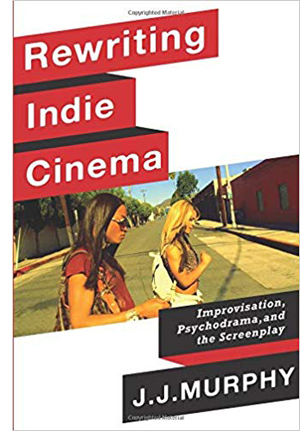
Accident forgiveness: J.J. Murphy’s REWRITING INDIE CINEMA
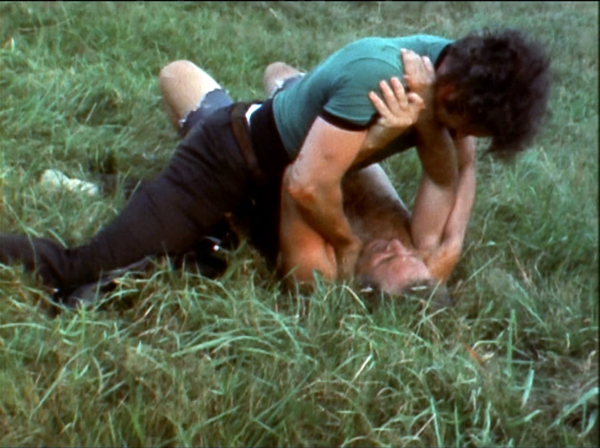
Maidstone (1970).
DB here:
Did you ever want to beat up Norman Mailer? The impulse must have flitted through the minds of many who paged through his work, saw him on TV, or encountered him swaying pugnaciously at a party. Rip Torn took the opportunity. One day in 1968, he whacked Mailer with a hammer and started to strangle him. As the distinguished author tried to bite off Torn’s ear, Mailer’s wife leaped into the fray and his children shrieked with fear.
This scene, totally unscripted, appears in Mailer’s film Maidstone (1970) and opens J. J. Murphy’s new book Rewriting Indie Cinema: Improvisation, Psychodrama, and the Screenplay. Nothing could better prepare us for his exploration of the traditions–and sometimes jarring consequences–of spontaneous performance in modern American movies.
 I couldn’t have predicted that J. J., who was in grad school with Kristin and me, would turn to research. He began as part of the Structural Film movement, achieving wide renown with Print Generation (1974) and (my personal favorite) Sky Blue Water Light Sign (1972). After he was hired here at Wisconsin, he rejuvenated our production program and went on to make independent features: The Night Belongs to the Police (1982), Terminal Disorder (1983), Frame of Mind (1985), and Horicon (1994).
At the same time, he was teaching both production and screenwriting. His books reflect his deepening interest in the creative process of making a film outside the Hollywood system. His initial study, Me and You and Memento and Fargo: How Independent Screenplays Work (2007), focused on the principles of screenplay construction that emerged with US indie cinema. Then, in The Black Hole of the Camera: The Films of Andy Warhol (2012), J. J. offered the most complete analysis of this superb body of work. In the process, he opened up a new vein of exploration. The idea of psychodrama proved an exciting way of explaining the fascinating, awkward performances in films like Kitchen (1965), Vinyl (1965), and Bike Boy (1967).
Now the concept of psychodrama gets full play in an ambitious account of the changing role of improvisation in off-Hollywood cinema. What happens, J, J. asks, when filmmakers give up the screenplay? How do they construct a story, define characters, build performances? Rewriting Indie Cinema sweeps from the 1950s to recent films like The Rider and The Florida Project. By looking for alternatives to the fully prepared screenplay, it posits a fresh way of thinking about American film artistry.
Human life isn’t necessarily well-written
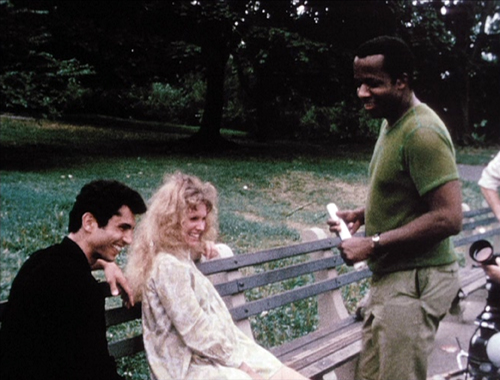
Symbiopsychotaxiplasm: Take One (1968).
To start off, J. J. proposes that we think of improvisation in a systematic way. Of course, the concept can be treated broadly. Even Hitchcock, we learn from Bill Krohn, improvised on the set much more than he claimed. But J. J. suggests that improvisation can be considered as a basic creative concept, a founding choice for art-making.
In the 1950s, many American artists began to embrace chance, accident, and personal expression. Abstract Expressionism, bebop, the Judson Dance Theater, Robert Frank’s snapshot aesthetic, and other tendencies valued spontaneity as both authentic self-expression and a challenge to conformist culture. The idea of spontaneity was carried into cinema by Jonas Mekas and fueled what became the New American Cinema of John Cassavetes, Shirley Clarke, and other filmmakers.
But the idea had deeper sources in another trend that J. J. painstakingly brings to light. The Austrian theater director Jacob L. Moreno developed in the 1920s what he called the Theatre of Spontaneity (Das Stegreiftheater). Performances consisted of purely improvised dialogue. When Moreno emigrated to America, he founded “Impromptu Theatre” in the same vein. His 1931 performance at Carnegie Hall was greeted by the New York Times with some disdain:
The first play, like the ones that followed, turned out to be a dab of dialogue uneasily rendered by its hapless players. . . . It became more and more evident that heavy boredom, rather than “forms, moods and visions,” were [sic] the product of the actors. Demanding wit above all else, the Moreno players lacked that essential as fully as the premeditation upon which they frown so heartily. The legitimate theatre, it can be reported this morning, is just about where it was.
Of course improvisation had already proven its worth in vaudeville and in jazz and other musical idioms. Today versions of Moreno’s “spontaneous theatre” flourish in comedy clubs.
Before coming to America, Moreno had discovered that improvisation had therapeautic functions as well. When a couple enacted the frustrations of their marriage, the audience was moved and Moreno was convinced that this “psychodrama” harbored artistic possibilities. Moreno’s wife Zerka called psychodrama “a form of improvisational theatre of your own life.”
J. J. shows Moreno’s pervasive influence on the postwar American scene. Psychodrama became one trend in social psychology, used to help prisoners, narcotics addicts, and even business executives. Woody Allen, Arthur Miller, and other artists were aware of Moreno’s work as well.
Drawing on Moreno but recasting him for film-related purposes, J. J. proposes a spectrum of improvisational options. There’s the completely improvised, ad-lib option, seen in Maidstone and much of Warhol’s work. Here the performers just make it up as they go, though with minimal framing of a situation. Then there’s the possibility of “planned” improvisation, in which there’s a story outline and more or less pre-set scenes. Sean Baker’s Tangerine (2015), for example, was made from a seven-page treatment that included only a couple of lines of dialogue. Then there’s the “rehearsed” option, in which the players collaborate to prepare the scenes and develop the characters, workshop fashion. In production the performers mostly stick to the “script” they’ve created. J. J. points to the films of Cassavetes as a clear case.
Any given film can mix these options, so that some scenes are planned roughly while others are purely ad-lib. And a filmmaker can explore the spectrum across several films, as Joe Swanberg has done.
Where does psychodrama come in? J. J. shows that any of the three points on the improvisation spectrum–pure, planned, and rehearsed–can yield performances that are based in the actual mental states and personal histories of the players. In our Cinematheque screening devoted to his book, Abel Ferrara’s Dangerous Game (1993) served as an example. Harvey Keitel invested his character, an intransigent film director, with the still simmering emotions he felt after his breakup with Lorraine Bracco. Meanwhile Ferrara set up scenes that would provoke Madonna, playing Keitel’s actress, to break character and reveal her immediate responses.
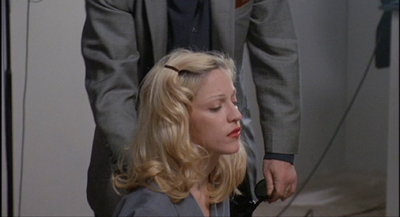
Ferrara wanted to attack Madonna’s celebrity image, and J. J. reads the aftermath to a rape scene in the film being made as projecting the star’s own stammering outrage at having been exploited.
Throughout the book, when improvisation becomes psychodrama, fiction moves closer to documentary. The last chapter examines how certain films considered documentaries, like Robert Greene’s Actress (2014) and James Solomon’s The Witness (2015), cross over into psychodrama from the other side, so to speak.
A detailed study of William Greaves’ Symbiopsychotaxiplasm: Take One (1968) shows how Greaves used psychodramatic techniques to create an even more complicated film-within-a-film than Dangerous Game. Two characters, Freddie and Alice, are played by five different pairs of actors, with all their scenes recorded by a bevy of camera and sound staff.
Greaves also incorporates self-criticism. When crew members object to the script, another participant remarks: “Human life isn’t necessarily well-written, you know.”
Given these conceptual tools, J. J. goes on to trace the production methods employed by a wide range of filmmakers, from Morris Engel in The Little Fugitive (1953) and Cassavetes in Shadows (1959) to Mumblecore and after. Through a mixture of film analysis and background research, he brings to light a vast variety of creative options that can bypass fully-scripted cinema.
Rewriting the unwritten
Paranoid Park (2007).
J. J.’s survey of production methods is embedded in a new historical argument about the shape of off-Hollywood filmmaking. The New American Cinema of the 1950s, which Mekas called “plotless cinema,” was wedded to a sense of realism. But it operated within limits. Cassavetes serves as a benchmark: “I believe in improvising on the basis of the written work and not on undisciplined creativity.” By balancing the planned with the impromptu, his films allowed for the actors to surprise one another. At the same time, Shirley Clarke’s Portrait of Jason (1967) showed how psychodrama could pass easily into documentary, exemplifying Erving Goffman’s theory that everyone is playing theatrical roles in everyday life.
This open approach to screenwriting and screen acting was explored by many filmmakers in the 1960s and a little after: not only the well-known Warhol and Mailer but also Kent Mackenzie, Barbara Loden, William Greaves, and Charles Burnett. J. J. examines all this work in admirable detail. I was especially happy to see that he includes Jonas Mekas’ The Brig (1964), the harrowing film that showed me, in my undergrad days, what the New American Cinema could do in filming a play.
By the time Ferrara made Dangerous Game, most independent filmmaking had moved away from improvisation toward more tightly scripted expression. J.J. traces the institutional pressures operating here. The Sundance Film Festival and PBS’s American Playhouse favored fully-planned projects compatible with the Hollywood standard. The Sundance Institute, launched in 1981, explicitly aimed to correct what was considered the two faults of independent production: screenplays and performances.
The success of polished work like sex, lies, and videotape (1989) and Pulp Fiction (1994) created new norms for American indie cinema. Director-screenwriters like Soderbergh, Tarantino, David Lynch, Hal Hartley, Todd Haynes, the Coens, and Todd Solondz were models for younger filmmakers. As J. J. points out, their screenplays were often published as part of the marketing of the films. Framing the new trend as dominated by the screenplay helped me understand why Bryan Singer, Doug Liman, Karyn Kusama, and other indie filmmakers who came up in the wake of this generation moved so easily to mainstream genres and big-budget projects.
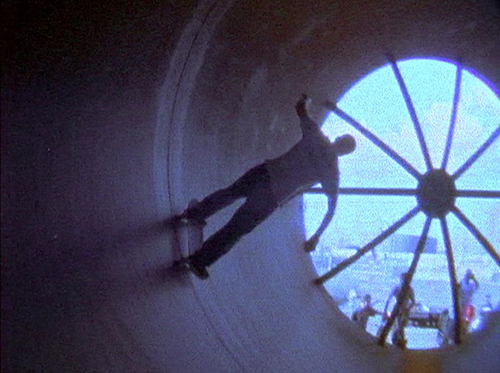
But history plays strange tricks. In the 2000s, filmmakers who felt constrained by the demands of tight scripting began to try something else. J. J. pays special attention to Gus Van Sant, who after proving his commercial craft, made some films with varying degrees of improvisation: Gerry (2002), Elephant (2003), Last Days (2005), and Paranoid Park (2007). Some of the Mumblecore directors relied on screenplays, but the prolific Joe Swanberg adopted a free-form approach, to which J. J. devotes a chapter.
J. J. goes on to survey the work of Sean Baker, the Safdie brothers, Ronald Bronstein, and other directors who have revived the New American Cinema’s impulses in the digital age. He concludes:
Digital technology in effect, democratized the medium, allowing young filmmakers to revive cinematic realism precisely at a time when indie cinema was at risk of losing its identity. In the new century, the use of improvisation and psychodrama provided a sense of continuity with indie cinema’s roots.
J. J. retired from UW–Madison at the end of 2018, and last Saturday night he was honored at our annual screening of student projects. He has been a constant force for good in our department, and we owe him more than we can say. Among those debts is this outstanding contribution to US film studies.
The book’s title carries a double meaning. American independent cinema has been, at crucial periods, “rewritten” by filmmakers who relied on spontaneity rather than a cast-iron screenplay. At the same time, J. J.’s panoramic research in effect rewrites that history. I’m sure that other researchers will build on his wide-ranging arguments, which put the creativity of artists–filmmakers, performers–at the center of our concerns.
J. J.’s books join a cascade of recent work by other colleagues here at Wisconsin. This blog has highlighted Jeff Smith’s Film Criticism, the Cold War and the Blacklist (2014), Kelley Conway’s Agnès Varda (2015), Lea Jacobs’ Film Rhythm after Sound (2015), Lea’s and Ben Brewster’s enhanced e-book of Theatre to Cinema (2016), and Maria Belodubrovskya’s Not According to Plan: Filmmaking under Stalin (2018).
P.S. 9 May 2018: Thanks to Adrian Martin for correction of a misspelled name!
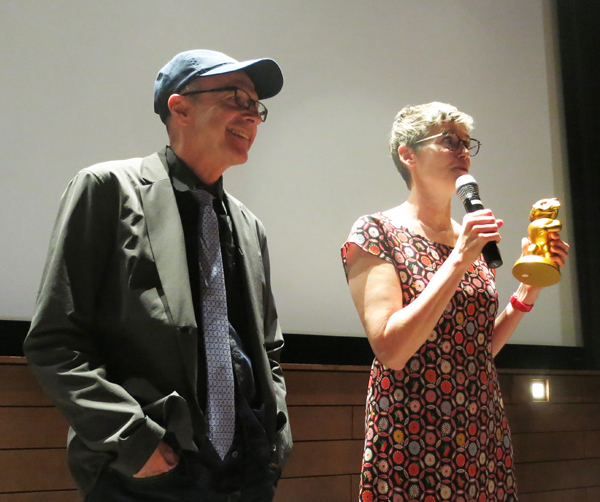
Kelley Conway awards J. J. Murphy a gilded Badger at the Communication Arts Showcase, 4 May 2019.
Wisconsin Film Festival: Not docudramas, but docus as dramas
Making Montgomery Clift (2018).
DB here:
Our days and nights at our annual film festival would have been hopelessly frustrating if we hadn’t already seen several of the fine items on offer. At other festivals we caught Asako I and II, Ash Is Purest White, Dogman, The Eyes of Orson Welles, The Girl in the Window, Girls Always Happy, The Image Book, Long Day’s Journey into Night, Lucky to Be a Woman, The Other Side of the Wind, Peterloo, Rosita, Shadow, Styx, Transit, and Woman at War. As you can see, our programmers assembled a spectacular array of movies. Most of these we’d happily watch again, but there were so many new offerings we had to resist.
With this elbow room I could pay attention to three documentaries I’d been looking forward to. They had all the appeal of a fictional film, with keen plots and tricky narration and fascinating characters. It didn’t hurt that two were about world-class celebrities and the third appealed to my deepest conspiracy-theory instincts.
Heart of Glasnost
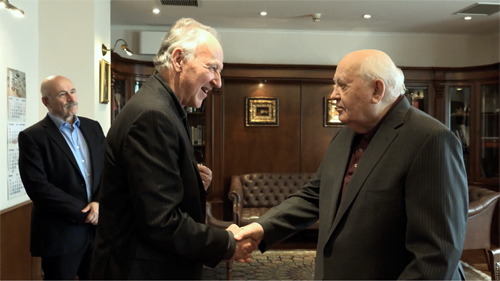
Werner Herzog’s Meeting Gorbachev was a surprisingly conventional effort for this legendarily odd filmmaker. As my colleague Vance Kepley remarked, Herzog typically makes documentaries of two types. He probes eccentric personalities (the “ski-flyer” Steiner, or a man trying to hang out with grizzly bears) or he treks into remote, dangerous landscapes (Antarctica, a swift-moving volcano, the fires of Kuwait).
But this portrait of Mikhail Gorbachev is neither. Herzog’s interview with the elderly but still vigorous Soviet leader is interrupted by biographical inserts tracing his career, his struggles, and his policies. Newsreel footage and other talking heads provide context in a mostly straightforward account of the man’s life and work. Only a story about tree slugs briefly diverts Herzog’s attention.
The film revives our appreciation of a politician many people have tried to bury. Gorbachev emerges as a thoughtful, upbeat man who tried to make the Soviet Union more democratic and open to the popular will, to create Communism with a human face. But he triggered events that cascaded too quickly. He broke up the USSR but also cleared a path for economic collapse and a corrupt kleptocracy. His suggestion for his tombstone inscription: We tried.
Herzog’s montages dramatize the breakdown of national borders, the fall of the Berlin Wall, and the coup that destabilized reforms while Gorbachev was away from Moscow. The main principle of swimming with sharks in a bureaucracy is: Don’t tell anybody what you’re going to do until you do it. The 1991 unseating of Gorbachev by Yeltsin reminds me of a second: Don’t take vacations.
Meeting Gorbachev is actually a double portrait, because Herzog puts a good many personal feelings into it. He remembers the emotion he felt as Germany reunited. Gorbachev’s call for “a common European home” rouses him to recall his youthful Wanderjahr when he walked across the continent.
Although I don’t think the name Trump is mentioned, his shadow falls over the whole film. Portraying a sane, reasonable leader today seems virtually a bid for controversy. Gorbachev reminds us of the reductions in nuclear weaponry that he negotiated with Reagan and Thatcher. “People say that Reagan won the Cold War. Actually, it was a joint victory. We all won.” The idea of pursuing policies that benefit the whole world seems oddly old-fashioned right now.
When Herzog gives us a glimpse of a robotic Putin peering down into the casket of Gorbachev’s beloved wife, we’re forced to register what Russia has become, and how the US is now complicit with it. Maybe this film has more of the director in it than I initially thought. As Herzog dared to declare in an earlier film, Nosferatu lives.
Unmaking an icon
Whenever I see Elizabeth Taylor and Montgomery Clift kiss in A Place in the Sun, I think: Here are the two most beautiful people in the Western world. I’m not alone. Clift was one of Hollywood’s most celebrated stars after the war, partly because he didn’t easily fit the molds of either the old guard or the new.
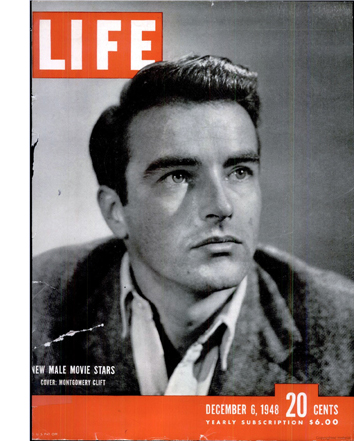 The dapper guys with mustaches (William Powell, Fredric March, Melvyn Douglas) and the bashful beanpole boys (Cooper, Fonda, Stewart) were being challenged by what I’ve called in an earlier entry the brawny contingent. I’m thinking chiefly of Robert Ryan, Kirk Douglas, and Burt Lancaster, beefcakes with big hands and thrusting, sometimes confused energies. The hero might be a heel (Douglas) or a beautiful loser (Lancaster) or a bit of both (Ryan).
In this context, Clift looks like cannon fodder. Put him alongside Lancaster in From Here to Eternity, and you’ll find it hard to believe he’s the prizefighter; in that movie, only Sinatra looks skinnier. Delicate, with an innocent stare and an angular body, a wide-eyed Clift takes over his debut film, Red River (1948), from the lumbering John Wayne. Hawks claimed he told Clift that if he quietly watched the action from behind his tin coffee cup, he could steal every scene.
Clift carved out a space all his own. Late in his career, the tremor in his voice and a wary tilt of the head gave him antiheroic quality, as in Wild River (1960). Not for him the over-underplaying of Brando or the unpredictable gestures and dialogue cadences of James Dean. He has his own method, not The Method.
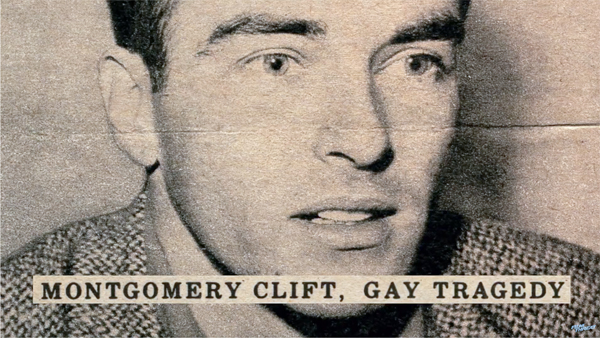
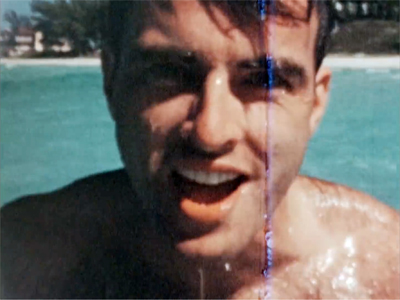
One of the many merits of Making Montgomery Clift, a fascinating documentary by Robert Clift and Hillary Demmon, is that it triggers such thinking about the actor’s craft. Emerging from a hillock of papers, home movies, video tapes, and audio tapes, the film documents two dramas–that of Clift’s life, and that of the process through which complex human beings get flattened into media clichés. As a bonus, we reap many insights into how actors shape their performances, sometimes against the grain of the script they’re handed.
On the life, we learn that Clift was often a buoyant, bisexual fellow, not the brooding and moody figure of legend. He was also a demanding artist who turned down juicy parts. When he signed up for a role, he insisted on vetting the script and sometimes rewriting it. In split-screen Clift and Demmon present the page on the left, scribbled up with Monty’s notes and excisions, and then run the scene alongside. The excerpts they give us from The Search and Judgment at Nuremberg show how a committed actor can strip an overwritten scene down to an emotional core.
If nothing else, Making Montgomery Clift shows us how performances shape movies: the actor as auteur. But it’s exactly this analysis of craft that’s missing from most film biographies. Those doorstop volumes revel in scandal and exposés because publishers think that a straightforward account of hard-won artistry–the sort of thing we routinely get in biographies of composers or painters–doesn’t suit movies. The result is glamor, excitement, sad stories, and banal interpretations rolled into one fat book.
This is the other drama so patiently traced by Clift and Demmon. They show how two 1970s biographies set a mold for the Tragic Homosexual story that has dogged the Clift legend ever since. Just as the filmmakers pay attention to the movies, they provide close readings of passages in the books, and the evidence of sensationalism, inaccuracy, and offhand speculation is pretty damning. One description of Clift’s injured face after his 1957 car crash savors brutal detail. And it’s not just the ambulance-chasers; passages from John Huston’s autobiography also radiate bad faith.
Clift understood that cookie-cutter journalism would oversimplify him. Thanks to the endless tapes he and his brother Brooks made of their phone conversations, we hear his quick condemnation of “pocket-edition psychology.” There’s a continuum between the tabloid headline, the talk-show time-filler, the celebrity memoir, and the bulging star bio. All try to iron out the wrinkles. During the Q & A, Robert Clift talked about traditional biographies as exercises in taxidermy: “It feels so real because it’s dead.” Hillary Demmon remarked that they wanted to “open up Monty to more readings.”
Making Montgomery Clift proves that academic talk about the “social construction” of this or that isn’t hot air. The film ranks with Errol Morris’s Tabloid as combining a fascinating life story (full of, yes, drama) with a serious argument about how celebrity culture reduces that story to captions and soundbites. Let’s hope the film makes its way to wider audiences, in theatres and on disc and streaming services. It belongs in the library of every college and university, so that students can get acquainted with an extraordinary performer, appreciate the art of star acting, and witness how the media shrink people to less than life size.
In the crosshairs of history
Like other baby boomers, I’m a connoisseur of conspiracy theories. But we have an excuse. Today’s kids grow up with school lockdowns and street shootings; we had assassinations. Patrice Lumumba (1961), Medgar Evers (1963), John Kennedy (1963), Lee Harvey Oswald (1963), the Freedom Summer murder victims (1964), Malcolm X (1965), Martin Luther King (1968), and Robert Kennedy (1968): this cavalcade of killings made political life seem a theatre of Jacobean intrigue.
Not the least of these was the 1961 death of the UN Secretary-General Dag Hammerskjöld. Hammerskjöld had pressed for peace in the Middle East and was a patient advocate for decolonization in Africa. En route to the breakaway Congolese province of Katanga, his plane crashed. For years many people, including former President Harry Truman, believed that the plane was shot down in order to murder Hammerskjöld.
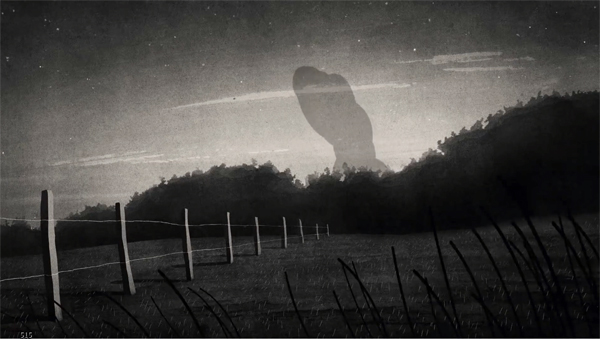
So of course I had to see Mads Brügger’s Cold Case Hammerskjöld. It did not disappoint.
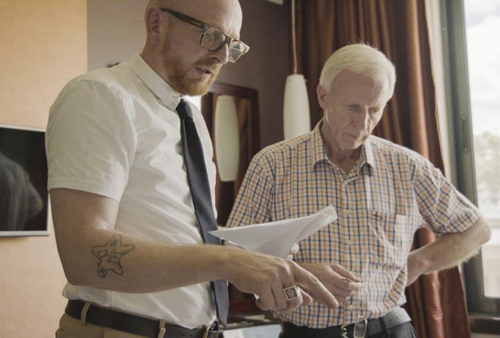
At first it seems cutesy, with the filmmaker dictating his findings to two African women typists, who occasionally turn to question him. He’s both pedantic and flamboyant (wearing white clothes to match the habitual outfit of a villain he will expose). In contrast there’s the veteran Hammerskjöld researcher Göran Björkdahl (on the right above beside Brugger). Björkdahl is a steady presence as the men question witnesses to the crash and then, crazily, set out to dig up the site. When they’re forbidden to do so, you might think that we’ve got another film about not making a film.
Instead, in the spirit of Morris’s Thin Blue Line, the story we’re investigating drifts into another story, and then another, as documents and witnesses and people who refuse to talk to the filmmakers lead to some appalling charges. Let’s simply say, to preserve the film’s shock value, that the Hammerskjöld case reveals SAIMR, a white supremacist militia for hire. The most horrifying claim about SAIMR and its leader is broached by a well-spoken mercenary purportedly haunted by guilt. His claim has been contested by researchers (as reported in the New York Times). Even if his charge doesn’t hold water, though, the existence of SAIMR seems well-documented.
We conspiracy theorists are often told that history proceeds by accident, not by intention. Yet some intentions succeed splendidly (viz. the killings itemized above), and some succeed by luck. Perhaps the darkest intentions chronicled in Cold Case Hammerskjöld were too crazy to be implemented. But that doesn’t lift responsibility from the feverish minds who dreamed them up, or from the institutions–perhaps mining companies, perhaps MI6 and the CIA–that gave them a hand. In an era when white supremacy has come on strong, Brügger’s film will remain the provocation it was intended to be.
One more entry will talk about still more films at this festival which so generously spoils us.
Thanks to film festival coordinators Jim Healy, Ben Reiser, Mike King, Zach Zahos, and their dedicated staff for this year’s wonderful event.
Cold Case Hammerskjöld.
Biomechanics goes to the Big House: BRUTE FORCE on the Criterion Channel
DB here:
If there’s one film technique that probably everybody notices, it’s acting. Reviewers are obliged to judge performances, and viewers often comment that this or that actor was admirably controlled, or wooden, or over the top. Yet acting is surprisingly hard to describe; the critic who can do it engagingly, as Pauline Kael could, wins plaudits.
I think it’s fair to say that film analysts haven’t on the whole found good ways to analyze acting. There are books about historical acting styles, and there’s a very good theoretical overview by—no surprise—Jim Naremore. Our colleagues Ben Brewster and Lea Jacobs have produced a superb study of acting in the early feature film, with careful attention to the conventions of the period. But I think there’s still more to be done in terms of analyzing how performers achieve their expressive effects.
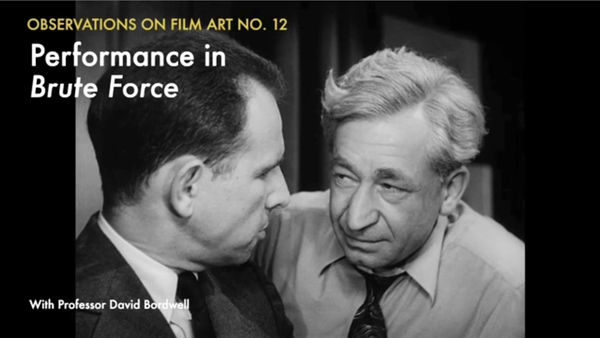
Or so I suggest in the newest installment of our series, “Observations on Film Art,” on the Criterion Channel of FilmStruck. Using Brute Force as an example, I try to lay out in brief compass some primary tools that actors wield. There’s an excerpt here. Today I’ll sketch out what I tried to do.
Bits selected and amplified

Talk about acting tends to set “realism” or “verisimilitude” against “artifice” or “stylization.” The Method, we sometimes say, is an example of realism, while Expressionist acting à la Caligari is at the opposite pole. Classic Hollywood acting, from the late 1910s into the 1940s, we might say ranges across the middle.
Accordingly, some theorists of acting are realists, favoring one zone and finding the other too artificial. Others are conventionalists; they argue that all acting, even the most apparently realistic, is actually stereotyped. It looks realistic because we accept the conventions of a time or tradition as the way people actually behave.
I think it’s worth suspending this polarity and simply looking at how performances are built up out of pieces. Like Meyerhold’s Biomechanics and Kuleshov’s engineering approach to acting, my perspective here is that of seeing performances as clusters of controlled choices about specific bodily behaviors.
As a first approximation, I propose that acting of any sort starts with some norms of human facial, vocal, and bodily expression.
Many of those norms might be universal. I’m risking disagreement here, since the US humanities are predicated on a fairly radical relativism. But I think that’s implausible. Is there any culture where smiling reliably indicates unhappiness? When frowning and shaking your fist in someone’s face indicates affection? Where pointedly turning your back on someone shows a willingness to engage socially? Where sloping your shoulders, tipping up your inner eyebrows, rearing back your head, turning down your mouth, and wailing indicates joy rather than misery? (The guitar-hugging rocker’s cry of anguished teen spirit draws on the ensemble of cues we see in the mother cradling her wounded child.) Nobody expresses pride by dropping to a crawl.
The context can qualify or negate these signals, of course. One may smile and smile and be a villain. But exactly because cordial smiling isn’t the default signal of villainous purpose, Shakespeare is able to make his point about deception. Any expression can be faked; that’s what acting is. At bottom, though, taken singly and reinforced by other inputs and circumstance, there are some reliable expressive cues in the typical case.
But even if you believe in the social construction of everything, my point still carries. Humans in any community emit a stream of behaviors in face, voice, hands, posture, stance, and so on. Maybe those bits are wholly constructed socially, or maybe universal proclivities play a role too. In any case, what the actor does, I posit, is survey the range of such behavioral possibilities for the role she is to play. She then does two other things.
First, she selects only a few. Any performance depends on picking a few behavioral bits to carry expressive impact.
Second, at any given moment, the selected features are emphasized, even exaggerated. The actor bears down on the selected behavioral bit, dwelling on it. The clumsy, sometimes contradictory flow of real-life behavior gets simplified and streamlined for easy uptake.
For example, certain body parts may dominate the impression. If we’re to watch the hands, the face can be fairly neutral.
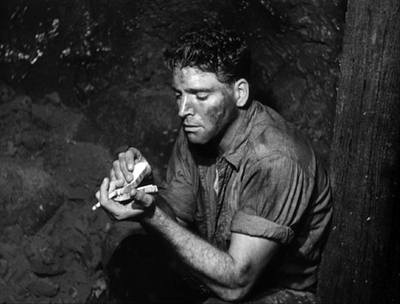
Correspondingly, in cinema the shot can be scaled to stress the one gesture—in this case, a pat of comradeship.
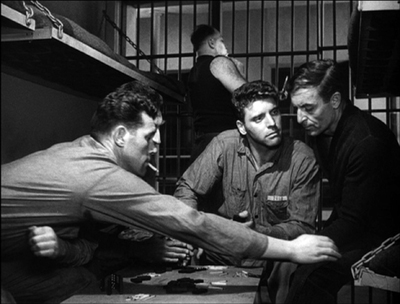
If we’re to watch the face, keep the hands and body still. Film technique can help you by recruiting our old friend the facial view. I talk about several examples in Brute Force, of which this is one of my favorites—two frontal faces, blatantly unrealistic but riveting (as Eisenstein knew; see below).
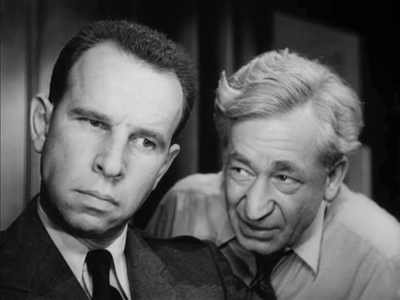
Only the eyes move, and one mouth, barely.
Or, if we’re to watch an eye-flick, keep the face neutral.
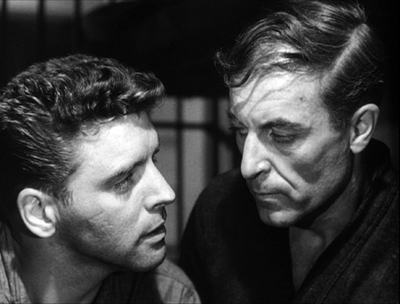
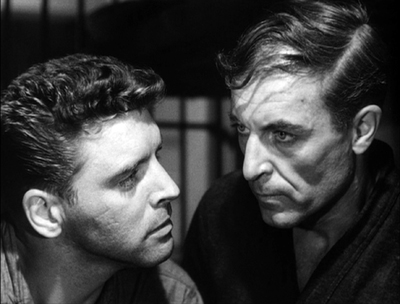
Indeed, you can argue that the development of the intensified continuity style, which concentrates on facial close-ups, gave the actors less to do with their hands and bodies than did the greater range of shot scales available to studio cinema from the 1910s to the 1960s.
To smack us with a bigger impact, the filmmakers add up the channels. In this scene of Brute Force, the commissioner takes control of the prison from the warden, and the two men’s facial expressions—determination on one, fear on the other—are amplified by their paired gestures of wrestling for the loudspeaker.
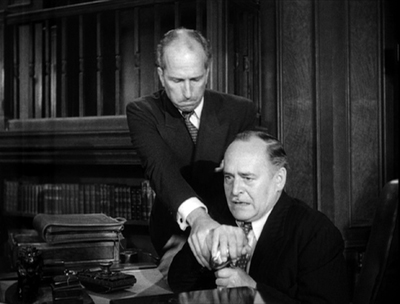
The effort shows not only in their postures and fingers but their faces.
At high points, we can go for all-over acting, face and gesture and bearing and voice, as when the snitch faces his fate in the machine shop.
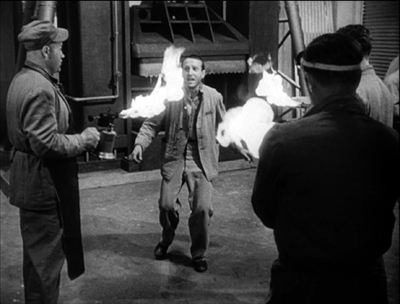
But note that even here, as an ensemble element, other factors are neutralized. The attackers are seen from the rear and poised or moving stiffly and inexorably. Similarly, the pure animal outburst of Lancaster’s performance at the climax depends on several factors of expressive movement swept together.
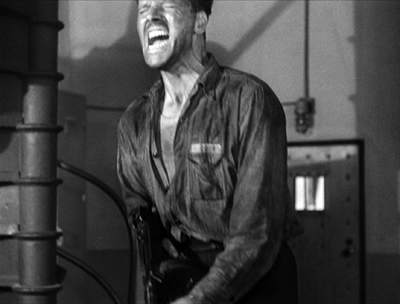
Wounded, he lets his boiling rage explode; even the frame can’t contain him. But even here there’s selection and emphasis. The head and voice and straining neck do all the work, while the arms remain taut.
The tools I survey are simple ones: eye areas (not so much the eyes as the lids and brows), mouth, tilt of the chin; bearing and stance; hand gestures; and rhythm of walking. In the Observations installment, I look at how the performances in Brute Force play off against one another, and I sum up the resources in Lancaster’s fierce performance, using all of the tools he had. That wedge of a back. Those mitts. Those slightly shifting eyes.
For preparing the Criterion Channel installment, thanks as usual to Kim Hendrickson, Grant Delin, Peter Becker, and all their colleagues.
The theatrical tradition is discussed by Alma Law and Mel Gordon in Meyerhold, Eisenstein, and Biomechanics (new ed., McFarland, 2012). On Kuleshov, see Kuleshov on Film, ed. Ron Levaco (University of California Press, 1974), pp. 99-115. I discuss Eisenstein’s approach to these problems, what he called mise en geste, in The Cinema of Eisenstein, pp. 144-160.
On actors’ use of eyes, go here; on hands, try this. I’ve discussed Lancaster’s skills before, here. More generally, when it comes to pictorial representation I defend a moderate constructivism against pure relativism here.
Ivan the Terrible Part II (1958).
Picturing performance: THEATRE TO CINEMA comes to the Net
Ma l’amor mio non muore! (aka Love Everlasting, 1913). Lyda Borelli.
DB here:
The core of cinematic expression is editing. Since the 1920s, that view has been part of the lore of film aesthetics. Editing, people said, is what distinguishes film from other media. After all, the single shot is both a picture (like a painting) and a dramatization (like a scene in a stage play). But put one shot with another and you’ve got a technique impossible to parallel in other media.
But if we look closely, we find that the film image is as “uniquely cinematic” as editing. After all, a film is an image, but it’s a moving image, which is sharply different from a painting. And although a shot is a dramatization, it’s two-dimensional (unlike a stage scene) and the space it captures is quite different from that of the theatre. Anyhow, maybe editing isn’t uniquely cinematic. Comic strips juxtapose discrete images, and some forms of theatre (such as pageants, or turntable stages) can shift rapidly between scenes. Once we start to compare adjacent media, we find many overlaps in their expressive resources.
Why did early film theorists make editing so important? They were often defending the view that film was a new art, in the teeth of opponents who claimed that it was simply photographed theatre. Accordingly, film’s defenders looked for features of films that seemed to have no counterpart in theatre, such as the close-up and, more pervasively, editing.
Since then, we’ve come a long way in our understanding of film’s artistic capabilities. Filmmakers, particularly those in the early sound era (Renoir, Ophuls, Dreyer, Mizoguchi), showed the expressive power of the single shot. This tendency was amplified in the 1950s and 1960s with Antonioni, Jancso, Andy Warhol, and many other directors. Now nobody blinks if a filmmaker like Hou or Yang presents a lengthy, unedited sequence.
Informed by what’s possible in the single shot, we ought to find the earliest filmmakers using the resources of staging, composition, and performance in felicitous ways. So we do. Once we foreswear the cult of the cut, we can see that early cinema made extensive use of cinematography and mise-en-scene for powerful artistic effects. And conceding that, we suddenly find ourselves back in the lap of the other arts–painting and theatre.
Living pictures
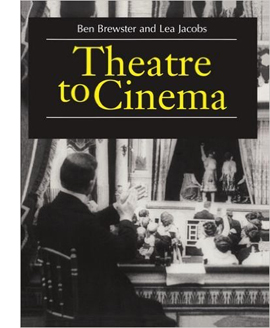 No one has done more to clarify the debt of early cinema to theatre than our colleagues Ben Brewster and Lea Jacobs. In the spirit of Wisconsin Revisionism, they have embraced early film’s stagy side. They’ve taught us to appreciate the ways in which dramaturgy and performance of 1910s cinema derive, in unexpected ways, from the theatre. Their trailblazing book Theatre to Cinema: Stage Pictorialism and the Early Feature Film (Oxford, 1997) showed how to appreciate early films in a whole new way: by seeing them as borrowing and modifying conventions of the stage. What may look artificial or backward to us were actually tools of subtle, supple expression.
Here’s the authors’ statement of the book’s argument:
While previous accounts of the relationship between cinema and theatre have tended to assume that early filmmakers had to break away from the stage in order to establish a specific aesthetic for the new medium, Theatre to Cinema argues that the cinema turned to the pictorial, spectacular tradition of the theatre in the 1910s to establish a model for feature filmmaking. The book traces this influence in the adaptation and transformation of the theatrical tableau, acting styles, and staging techniques, examining such films as Caserini’s Ma ľamor mio non muore!, Tourneur’s Alias Jimmy Valentine and The Whip, Sjöström’s Ingmarssönerna, and various adaptations of Uncle Tom’s Cabin.
The twist here is that turn-of-the-century artistic culture had already blurred the boundaries between theatre and painting. Painters drew upon the stock gestures and poses of the stage, while plays presented vivid visual effects that were indebted to painting. The term “tableau,” referring at once to a picture and a poised stage image, captures this convergence between the media. That’s why Ben and Lea refer to “stage pictorialism” as the nexus of their inquiry.
Thanks to their research, we can see the unbroken long- or medium-shot of early features as permitting a complex choreography of facial expressions and bodily attitudes, which were in turn indebted to both pictorial and dramatic traditions. Standard gestures were summoned up and reworked to suit dramatic situations–as, for example, clutching.
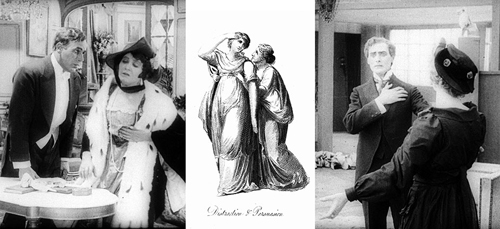
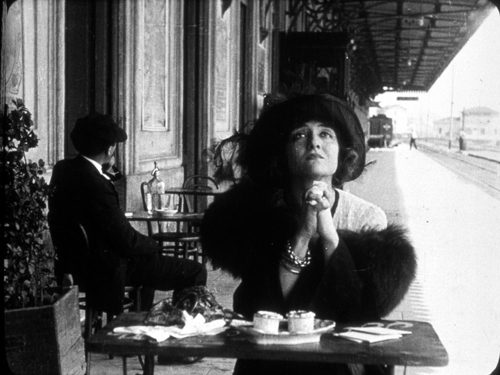
When we do find editing or camera movements in these films, they’re often at the service of the performance style. Ben and Lea powerfully make the case that the expressive human body was at the center of storytelling in the first years of silent cinema. (If nothing else, the book is an in-depth analysis of diva acting from the likes of Lyda Borelli and Asta Nielsen.) By studying the history of theatre, we can learn to appreciate aspects of acting that might otherwise escape our notice.
Theatre to cinema to pixels
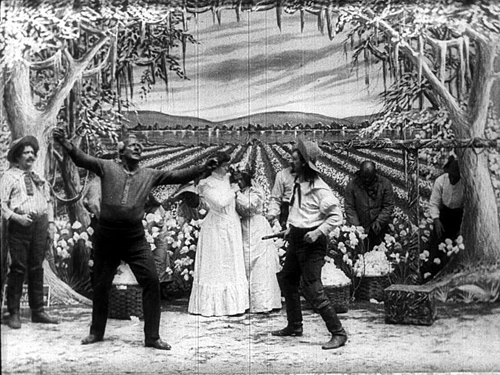
Uncle Tom’s Cabin; or, Slavery Days (Edison, 1903).
How, you’re asking, can you gain access to the ideas and information and images in this fine book? It’s now criminally easy.
When Theatre to Cinema was published, all the illustrations came from 35mm film prints. Those originals were gorgeous. But in some printings of the book the stills came out badly, and when the book moved to print-on-demand status, the images suffered even more. A couple years ago, Ben and Lea rescued their book and took the opportunity to make a digital version. It’s unrevised, largely because updating a twenty-year-old volume would be a major overhaul, but errors have been corrected and–very important–the stills have been much improved.
Start here, with the introduction to the project. You can download the new edition of the whole book, section by section, here.
Naturally, Kristin and I are sympathetic to this effort. Since we started our website back in 2000, we have explored ways to amplify and extend our ideas by means of the web. In the beginning, and inspired by Philip Steadman’s Net-based supplements to his excellent Vermeer’s Camera, I added material that would enhance arguments I made in Figures Traced in Light. Then we set up our blog, now in its tenth year. Over the same period, we posted web essays, as you can see in serried ranks page left. We also used the site to preserve older material, such as film analyses dropped from editions of Film Art: An Introduction and even entire books, as in Kristin’s 1985 monograph Exporting Entertainment. We’ve mounted video lectures. And we’ve produced a new edition of an older book, Planet Hong Kong 2.0, and original e-books such as Pandora’s Digital Box and Christopher Nolan: A Labyrinth of Linkages.
Ben and Lea have found another way to expand a book’s Web life. They have put Theatre to Cinema at the heart of a digital collection sponsored by the University of Wisconsin–Madison Libraries. Here’s what they offer:
In this collection, we try to supplement the description and illustration that accompanied the book in a way that makes it easier for readers to appropriate our work—both to understand it, and to make use of it in research and teaching. What were illustrations in the pages of the book are also presented here as better-quality downloadable images.
For example, you can pick a still, find its mates in a single display, and blow it up for scrutiny. If you want import it into your own files, you may choose among four different file sizes.
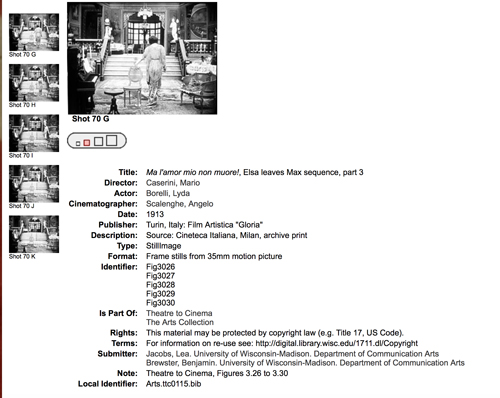
The provenance of each still is provided, so scholars can compare prints from different sources. In addition, there’s a master index of the visual documentation, in sequential groupings across the book.
Finally, Ben and Lea plan to add video extracts from some of the films they discuss. When those go up, we’ll announce it here.
Every admirer of silent film, and everyone who studies the interrelationship of the arts, should read this book. Hard copies are still being sold online, but they’re apt to be versions with weakly reproduced stills. Get one if you want, because a book is a good object to have in hand. In addition, for free, you can own a beautiful, searchable edition with superb stills. I think you need both.
The digital collections set up by UW Libraries are breathtaking. Check them out here.
Some entries on our site intersect with Ben and Lea’s research. See the category Tableau staging.
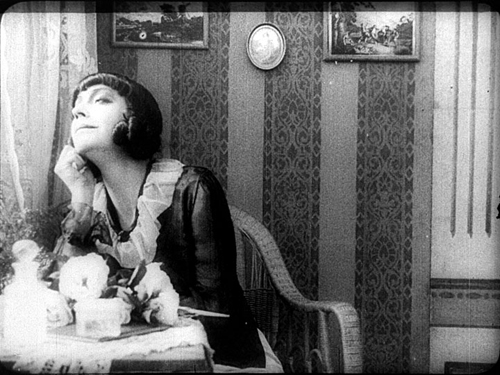
Weisse Rosen (White Roses, 1915). Asta Nielsen.