





Archive for the 'Readers’ Favorite Entries' Category
ASTEROID CITY adrift in the cosmos
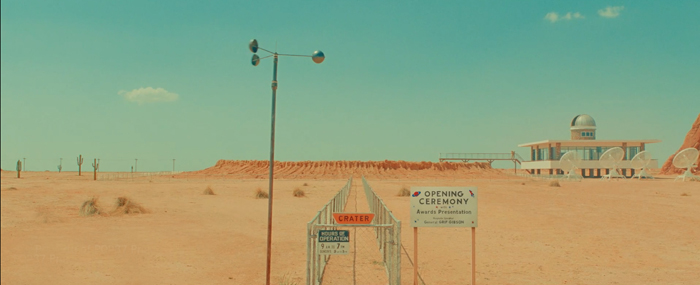
Asteroid City (2023).
DB here:
Asteroid City tells two stories. One ends more or less happily, the other more or less sadly.
The first one takes place in roadside America, 1955. In a minuscule town made famous by an asteroid crater, five finalists for Junior Stargazer awards assemble with parents and siblings for the ceremony. They mingle with the locals, the scientists at the observatory, a batch of primary-school kids, a military unit, and an itinerant cowpoke band. The big day is interrupted by the arrival of an alien bent on retrieving the asteroid. This exceptionally polite invasion spurs all of the visitors to reconsider their life options. After a second visit from the alien, the travelers leave. Enlightened? A little bit.
This story is shot in anamorphic widescreen and color as glowing as Kodachrome. The second story, interwoven with the first one, is presented in 4:3 black and white. It presents episodes from a television program purporting to document the production of a typical American play. But the host, a generic, all-knowing announcer, tells us that the play “Asteroid City” does not exist, was never performed and has only an “apocryphal” existence, whatever that means.
But instead of the usual behind-the-scenes chronicle of putting on a show, we get only glimpses of preparation and performance, arranged out of chronological order. We hear alternative speeches and learn of scenes that will eventually be cut. The last stretch of the second story is a morose reflection on what the play might mean, with the director’s response to that question a simple: “Just keep telling the story.” As if in reply, the epilogue of the visitors’ Asteroid City adventure is the (rousing) conclusion of the whole movie we’re watching.
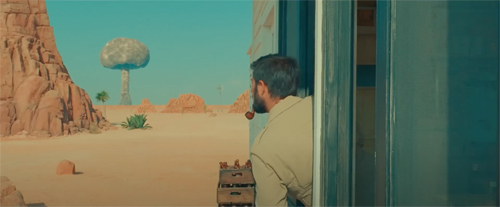
Like Marianne Moore’s “imaginary gardens with real toads in them,” Asteroid City (the town) is a fantasy world, but it’s not free of danger. There’s death. Atomic tests are conducted next door.
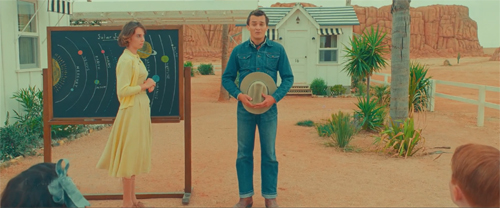
Within this carpentered world, all right-angled motel cottages and perpendicular lanes and train tracks, two forces are at work. There is Science, embodied in the astronomical research of Professor Hickenlooper and her fanciful accounts of cosmic activity. The Junior Stargazers have all come up with wild breakthroughs–a tethered jet pack, a way of projecting pictures on the moon–that prove that these teenagers are both brilliant and eccentric. From one angle the film, like Rushmore and The Life Aquatic, is a defense of visionary nerds.
Counterposed to Science is, not to put a fine point on it, Christianity. The kids brought to the ceremony by June recite prayers on command. Faith enters more poignantly with the Steenbeck family, headed by the photojournalist Augie. His wife has died, but not until they stop in Asteroid City does he break the news to his son Woodrow and three little daughters. It impels the girls to bury her cremated remains in a Tupperware bowl as they try out proper reverence. Is she in Heaven? Augie doesn’t believe in it, and Woodrow is uncertain, but it’s real for the girls, Augie says, because they’re Episcopalian.
Neither Science nor Christianity can account for the alien, or the strange indicia it has inscribed on the asteroid. The creature’s arrival comes at almost exactly the film’s midpoint, and thereafter hazy outlines of happy endings emerge. No spoilers, but here’s a hint: Love is involved.
All of which makes the film sound terribly abstract. It’s not. The clumsy online parodies of Anderson’s style make us forget how crisply economical it is. Forget movies padded out with cars pulling up or pulling away, close-ups of coffee being made, characters hunched over cellphones and workstations, roundy-roundy camera movements, and drone shots floating over a metropolis. Every shot here carries its fair weight.
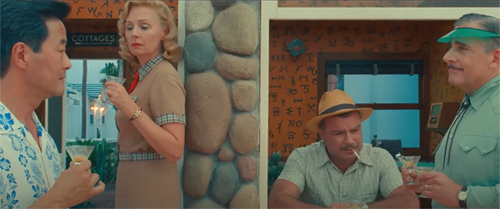
Anderson’s geometric framing and staging demand a stream of small details. Moment by moment we have to take in gorgeous Populuxe furnishings, rapid dialogue, enigmatic signage, non sequiturs, abbreviated gestures and glances, and flickers of facial expression. For a few seconds a cigarette lighter is casually refilled with a squirt of gasoline (a good example of Brecht’s gestus, the piece of performance that crystallizes a social attitude: we’ll have oil forever). Soon enough a gizmo pulled from Augie’s decrepit engine thrashes on its own: Is this the alien? Just the range of cultural references dazzles. Anderson’s love of theatre emerges in recollections of plays from The Petrified Forest to Bus Stop, by way of Wilder and Williams. And are all the variants on a nonexistent play text his contribution to multiverse storytelling?
The embedded film has opened with a roaring freight train to a male voice singing “Last Train to San Fernando,” a song that celebrates a desperate chance for love. The whole film ends with a version of “Freight Train, Go So Fast” about a man being hanged, yet it’s sung by a mourning woman with sheer exhilaration. Asteroid City (the film) is poised between love and death, in the process celebrating the muted joy and welcome eccentricity of everyday life.
Not to mention hot dogs, chili, and strawberry milk.
Asteroid City has attracted many favorable Cannes reviews, but I’ve been disappointed in the dismissive comments offered by reviewers I respect. Many have taken the obvious line of objection (trademark whimsy, too many stars, too much artifice) without coming to grips with the distinctive qualities of the film. (But Bilge Eberi , Manohla Dargis, Richard Brody, and Glenn Kenny get it.) This seems to me one of Anderson’s very best works. It has a richness that my sketch here can’t capture, and I hope to write more about it later.
For more blog entries on Anderson’s films, go here.
PS 11 July: The streaming version of Asteroid City just released on Amazon Prime is of very poor photographic quality: low contrast and desaturated color. A version more faithful to the film is available on Apple +. I haven’t checked other sources.
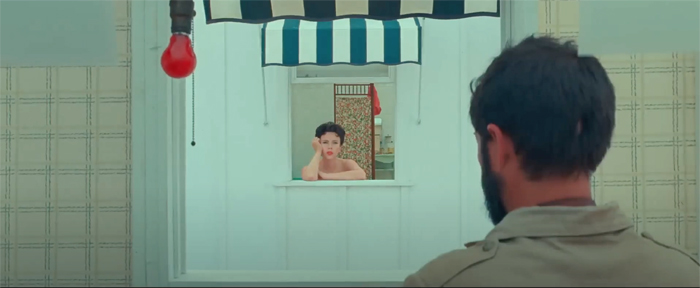
Asteroid City (2023).
Calm that camera!
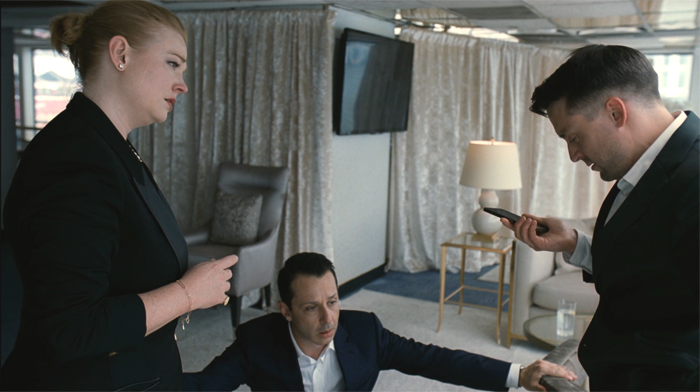
Succession (2023).
DB here:
Thanks to our Wisconsin Film Festival, Ken Kwapis paid us a visit. Director of The Sisterhood of the Traveling Pants and many other features, Ken also has experience directing TV, notably The Office. He’s a generous filmmaker, and he radiates enthusiasm for his vocation. I took the opportunity to talk with him about camera movement in contemporary media. He taught me a lot, and what I’ve come away with I share with you.
Camera ubiquity, with a vengeance
In the early silent era, fiction filmmakers around the world discovered what we might call camera ubiquity—the possibility that the camera could film its subject from any point in space. This resource was more evident in exterior filming than in a studio set, so early films often display a greater freedom of camera placement when the scene is shot on location.
At the same time, filmmakers began realizing the power of editing. This technique offered the possibility of cutting together two shots taken from radically different points in space. Yet an infinity of choices is threatening, and some filmmakers, mostly in the US, constrained their choices by confining the camera to only one side of the “axis of action,” the line connecting the major figures in the scene. Different shots could cut together smoothly if they were all taken from the same side of the 180-degree line. The result was the development of classical continuity editing. The director was expected to provide “coverage” of the basic story action from a variety of angles, but all from the same side of the line. Classical continuity was in force for American films by 1920 and was quickly adopted in other national cinemas.
The one-side-of-the-action constraint was encouraged by the fact that much filming of staged action took place on a set, designed according to the theatrical model. The camera side of the space was behind an invisible fourth wall, like that in proscenium theatre. To some extent directors compensated for the limitation on camera position by fluidly moving actors around the frame, from side to side and into depth or toward the viewer. Still, the “bias” in choosing setups was reinforced by the increasing weight of the camera in the sound era, which made it hard to maneuver within both interior and exterior settings. Camera movement in a more or less wraparound space was possible, but it was usually very difficult. It commonly required a dolly or crane on tracks to prevent bumps.
Technicolor filming, with its monstrously big camera units, reinforced the bias toward proscenium sets, 180-degree space, and a rigid camera. So did the postwar vogue for widescreen cinema. But in the 1950s filmmakers were also exploring the possibility of lighter, more flexible cameras. The body-braced cameras often produced bumpy, slightly disorienting images but yielded a more “immersive” space that gave the story action immediacy and spontaneity. By the early 1960s, handheld camerawork was being seen in both documentaries and fiction films. At the same time, fiction filmmakers were gravitating toward more location filming. In addition shooting on location with portable cameras promised greater savings on budgets, an attractive option for both independent and mainstream directors.
Handheld shooting was becoming more common in the 1970s, when its problems were overcome by the invention of the Steadicam, first displayed to audiences in Bound for Glory (1976). This stabilizer permits the operator to move smoothly through a space.
The new device was more than simply a substitute for a camera on a dolly and tracks. Ken pointed out to me that the Steadicam encouraged the increasing use of the walk-and-talk shot showing two or more characters striding toward a constantly retreating camera. This proved to be an efficient way of covering pages of dialogue. Beyond that, the Steadicam became an all-purpose camera for filming any sort of scene.
Over the same years, directors embraced multiple-camera shooting—originally aimed at handling complex stunts—for every scene, and they recruited A and B cameras, often mounted on Steadicams, for ordinary dialogue scenes. In most cases, the B camera was mounted alongside the A, but with the B camera in other spots there was a certain erosion of the axis of action. Now a conversation may be captured from a greater variety of angles than classical coverage would favor. Filmmakers have replaced 180-degree staging and shooting with what’s called 250-degree coverage. In The Way Hollywood Tells It I drew an example from Homicide: Life on the Streets. A free approach to the axis of action is common today, as in this example from Succession (2023).
A rough sense of the axis of action is maintained, and there are matches on action, but our vantage “jumps the line” as well. Moreover, the camera is constantly moving within the shots. It’s panning to follow or reframe the characters, sometimes circling them or abruptly zooming, and always wavering a bit, as if trembling. What some Europeans call the “free camera” is very common nowadays, and Ken and I talked mostly about this creative option.
Eye candy
By now, many filmmakers have chosen to make nearly every shot display some camera movement independent of following moving characters. This tactic was noted and recommended in a manual by Gil Bettman (First Time Director, 2003). (Readers of The Blog know of my fondness for manuals.) “To make it as a director in today’s film business, you must move your camera” (p. 54). The risk is making the audience more aware of the camerawork than of the story, so Bettman adds:
A good objective for any first time director would be to move his camera as much as possible to look as hip and MTV-wise as he can, right up to the point where the audience would actually take notice and say, ‘Look at that cool camera move.”
Like cinematographers in the classical tradition, Bettman declares that the camerawork should be “invisible” (p. 55). By now, you could argue, the predominance of camera movement has made it somewhat unnoticeable. Ordinary viewers have probably adapted to it.
One factor that aids the “invisibility” of camera moves is the speed of cutting. If the shots are short, the viewer registers the camera movement but probably doesn’t have time to notice whether it’s distracting or not. The effect of this isn’t restricted to action scenes. Even dialogue scenes may catch conversations up in a paroxysm of character reactions, camera movement, and swift editing. Creating these rapid-fire impressions, it seems to me, is what a lot of modern filmmaking seeks to do, at least since the early 2000s. It’s sometimes called “run and gun” shooting. Here’s an instance from The Shield (2003), with sixteen shots in less than a minute.
Arguably, Hill Street Blues (1981-1987) popularized this look for the police procedural genre, when DP Robert Butler urged his team to “Make it look messy.”
This sequence and the Succession passage points up another factor. Knowing that their films would ultimately be displayed on TV, some directors began “shooting for the box” by using tighter shots and closer views. TV directors such as Jack Webb were already working in this vein of “intensified continuity,” and many others had started their careers in broadcast drama and accepted the impulse toward forceful technique. Television has long demanded that the image seize and hold viewers, likely sitting in living rooms and prey to many distractions. Fast cutting and constant camera movements keep the viewer’s eye engaged. No surprise, then, that our TV programs present a fusillade of images that make it hard to look away.
Constant camera movement has another benefit. Many camera movements tease us. The start of a shot suggests that the camera will bring us new information, so we must wait for the end. Filmmakers love a “reveal,” and even a small reframing can suggest the camera is probing for something new to see. By now, however, filmmakers can play with us and use camera movement to flirt with our attention: the shot can begin with a clear image but drift away to conceal the main subject. I first noticed this almost maddening stylistic tic in The Bourne Ultimatum (2007), but it crops up occasionally elsewhere. In one scene of The Shield (2006), the camera slides behind a character, finds nothing to see, and slides back.
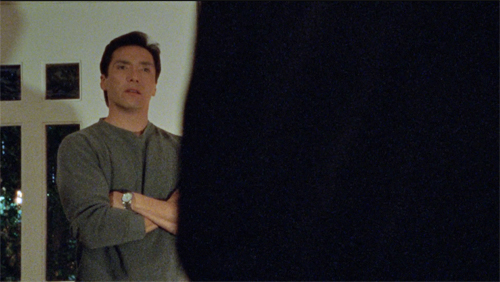
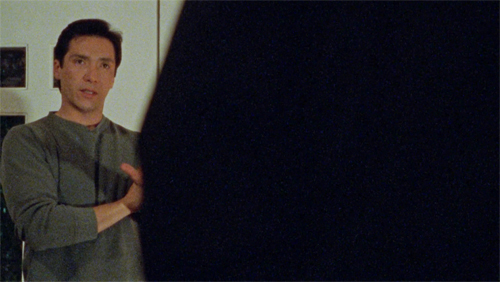
The peekaboo reframing would seem to throw the viewer out of the story in just the way that worries Bettman. I’m inclined, though, to think that it is part of a general, and fairly recent, expansion of viewers’ tastes. Self-conscious technical virtuosity has long been an attraction of mainstream filmmaking, and audiences have responded with appreciation. Think of Busby Berkeley or Fred Astaire dance numbers, or the railroad junction scene in Gone with the Wind. I suspect that many members of today’s audiences now happily say, “Look at that cool camera move” and don’t mind being pulled out of the story. (I’d say, though, that they aren’t being pulled out of the film, but that’s matter for another blog entry.)
This tendency would accord with what Bettman calls the taste for eye candy. For him, this seems to consist of bursts of light or color, usually produced by camera movement. More generally, I think audiences would consider impressive sets, striking costumes, and good-looking people to be eye candy. And now, I suspect, flashy camera work counts as eye candy too. The case is obvious with the showboating following shots in Scorsese and De Palma, but I think it applies to the jagged, in-your-face techniques seen in run-and-gun sequences. Advocates of the silent film as a distinct art never tired of insisting that cinema was above all pictorial. “The time of the image has come!” thundered Abel Gance. It took a while, but now that people compete for bigger home screens we have to admit, for better or worse, that everybody acknowledges that film is a visual art.
Many flies on many walls
Most moving shots today don’t utilize the Steadicam, whose usage needs to be budgeted and scheduled separately. The run-and-gun look is well served by modern cameras designed to be handheld. DPs and operators know that a wavering, even rough shot is acceptable to most modern audiences, and filmmakers seem to assume that handheld images lend a documentary “fly-on-the-wall” immediacy to the scene. In addition, wayward pans, swish pans, and abrupt zooms are felt to enhance that sense that we’re seeing something immediate and authentic. (Flies are easily distracted.)
Problem is, this approach is far from what a real documentary film looks like. True, the individual images might be rough, but their relation to one another is quite different from those in a documentary. For one thing, they occupy positions that documentary shots can’t achieve. Shot B may be taken from a spot we’ve just seen to be empty in shot A, as in the sequence from Succession. As Ken put it, “There’s no such thing as a reverse angle in a documentary.” Or shot B may be taken from a very high or low angle, where a camera is unlikely to perch, as in this passage of The Shield (2007) which hangs the camera in space peering through a railing.
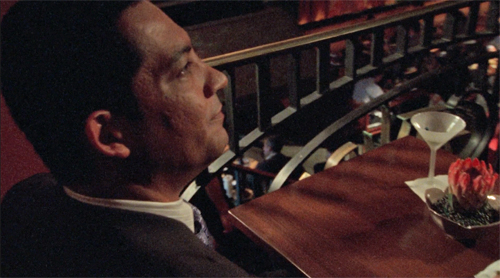
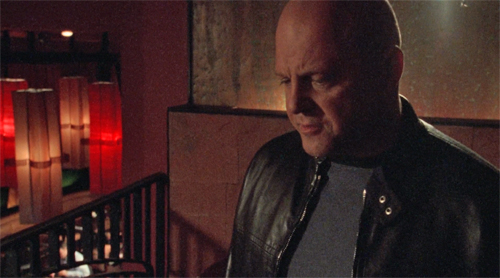
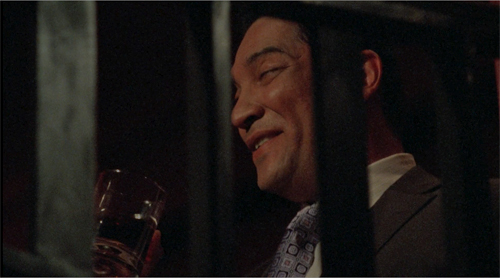
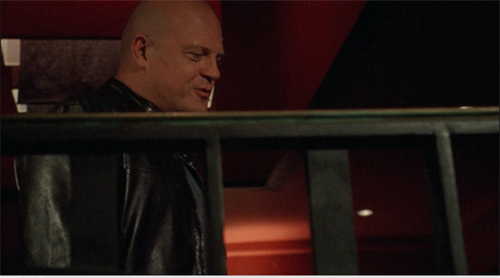
Sometimes shot B will represent the optical viewpoint of a character, which is unlikely in an unstaged documentary. Putting it awkwardly, the free-camera style achieves a greater degree of camera ubiquity than we can find in a standard documentary. (Years ago, I made this point in relation to The Office.)
For another thing, the flow of run-and-gun shots always captures the salient story points. A documentarist, with one or two cameras following an action, is still likely to miss something significant (and to cover the omission with elliptical editing and continuous sound). But the modern method offers its own rough-edged equivalent of classical coverage. The action remains comprehensible. Sometimes the camera will even wander off on its own to frame something the characters aren’t aware of, providing a modern equivalent of classical “omniscient” narration.
What we have, I think, is a modern variant of the one-point-per-shot mandate of traditional editing, but featuring shots of that evoke greater “rawness” than studio filming did. And maybe it’s not as modern as we think. Here’s a sequence from Faces (1968), complete with walk-and-talk, or rather stagger-and-talk, as well as camera ubiquity and matches on action that would be difficult in a documentary.
I’d argue that John Cassavetes, much admired by filmmakers who followed, supplied the prototype for today’s run-and-gun look. Admittedly, it’s been stepped up; I suggested in The Way Hollywood Tells It that intensified continuity has been further intensified.
Nervous energy
Intensified how? Apart from all the swishes and zooms and focus changes, some bells and whistles aim to enhance the sense of “energy” attributed to the style. The peekaboo framings I mentioned would be one instance. Here are some others.
The shot, distant or close, which simply trembles. Let’s call it the wobblecam. It suggests the handheld shot, but it’s brief and seems shaky just to evoke a sort of vague tension. Wobblecam shots are so common now that entire scenes are built out of them, as in the Succession clip.
The arc: In filming TV talk shows, how do you keep viewers glued to the screen? One option is what a 1970 manual calls the arc. Here the camera travels in a slow partial circle that refreshes the image gradually. The framing reveals constantly changing aspects of the panelists and is a nice change from master shot/ insert editing. I remember this as common in 1950s programs.
 The “roundy-round” (thanks, Ken): This extends the arc to 360 degrees, circling around one or more characters, urging us to watch for bits of action or dialogue—usually timed for maximum visibility. It’s also used to convey a character at a loss, say mystified by which way to turn, or characters embracing (whoopee). The technique can be found sporadically before the 1990s, when it becomes quite common. Ken pointed out that the roundy-round was extensively used on E. R. to underscore time slipping away during life-and-death surgery.
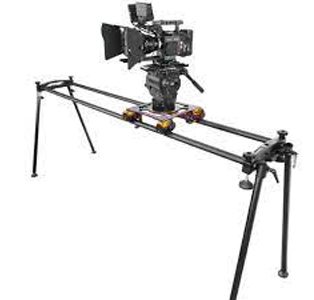
The slider: The enhancement I find most distracting is the camera’s slow leftward or rightward drift while filming static action. Usually it’s a master shot, but it doesn’t have to be, and it can sometimes interrupt a series of close views. Unlike the wobblecam, this is more teasing because we’re used to such a shot revealing something. It doesn’t, but I think it holds out the promise and keeps us watching.
Writing The Classical Hollywood Cinema I came to realize that supply companies created lighting and camera devices designed to meet the developing needs of filmmakers. Thanks to Ken, I learn that this tradition continues. You can buy or rent gear that will enable arcs, roundy-rounds, and the slider (right). Both in technique and technology today’s Hollywood is a continuation of yesterday’s.
If a director constantly relies on camera movement, there’s no reason to object. The elegant moves of Ophuls or Mizoguchi or of McTiernan in Die Hard provide the sort of continuous engagement and ultimate pictorial payoffs that justify the technique. My examples illustrate more gratuitous camera moves, choices that “add energy” but once they’ve become conventional, seem wasteful. Usually, they reveal nothing and end up minimizing the power of a gradual reveal when it comes along.
But who am I to complain? Film styles change under production pressures and artistic inclinations. As a student of film history, I have to study what’s out there. Still, run-and-gun remains only one option. There are still lots of films and shows, like Tär and The Woman King and Barry, that rely on rigid camera setups and discreetly motivated movements. (Ken’s Dunston Checks In (1996), shown to an appreciative crowd at the festival, is a good example.) Another alternative is providing precise shot breakdowns that feature unusual “eye-candy” angles, as in Better Call Saul’s views from inside mailboxes and gas tanks. That trend constitutes another way to expand options within camera ubiquity. There are also the long-take films in which complicated camera moves preserve the patterns and emphases of classic continuity. (See the discussion of Birdman.) And then there’s the effort by Wes Anderson to go in the other direction, to submit to constraints far more severe than classical shooting—an austere refusal of camera ubiquity.
I must ask Ken about all these options too. Next time, I hope.
Thanks to Ken Kwapis, who enormously expanded my sense of the practical choices available to the filmmaker.
The TV production manual discussing the arcing shot is Colby Lewis, The TV Director/Interpreter (New York: Hastings, 1970), 131-132. Other mobile framings are reviewed in the same chapter.
For examples of filmmakers believing that the rough-edged style is like documentary shooting, see remarks on Succession in Zoe Mutter, “Fury in the Family,” British Cinematographer and Jason Hellerman, “How Does the ‘Succession’ Cinematography Accentuate the Story?” at No Film School. Butler’s comments on Hill Street Blues are quoted in Todd Gitlin, “’Make It Look Messy,’” American Film (September 1981) available here.
You can feel the thrill of silent-era creators and critics in realizing the possibility of camera ubiquity. Dziga-Vertov celebrated the power of the Kino-Eye to go anywhere, while Rudolf Arnheim saluted cinema’s ability to provide unusual angles that bring out expressive qualities of the world. What would they make of a shot like this below?
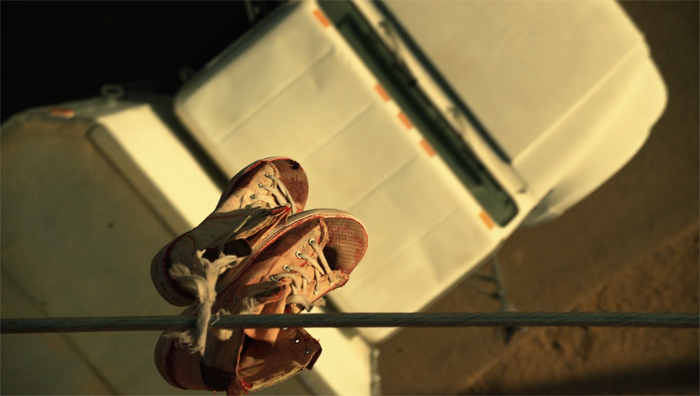
Better Call Saul (2015): Extremes of camera ubiquity.
Streaming media: All you can eat, until it eats you
DB here:
In 2013 Spielberg and Lucas declared that “Internet TV is the future of entertainment.” They predicted that theatrical moviegoing would become something like the Broadway stage or a football game. The multiplexes would host spectacular productions at big ticket prices, while all other films would be sent to homes. Lucas remarked: “The question will be: ‘Do you want people to see it, or do you want people to see it on a big screen?’”
I wrote the preceding paragraph two years ago, and the Covid outbreak and enhanced technology have made the split between theatrical distribution and streaming distribution even sharper. (And as the Movie Brats predicted, multiplexes are raising ticket prices.) A crisis point was reached last month when Netflix glumly reported that instead of adding 2.5 million customers as it had expected, it lost some 200,000. Worse, the firm announced a likely loss of 2 million more in the next quarter. The news led Netflix stock to fall by over 30%, wiping out over $45 billion in value.
This stunning decline, coupled with Warner Bros. Discovery’s decision to cut the recently launched CNN+, sent shock waves through the industry. Stock values dropped for Disney, Warners, Paramount, and Roku as well, even though some had strong subscription growth. At the moment, disillusion seems to be settling in. A Wall Street analyst has noted:
We think the industry is facing a point of no return in which the economics of the old models look increasingly frail while the potential of the brave new world now appears overly hyped.
Discussions of mergers, acquisitions, and big company restructuring are ongoing, with layoffs already starting.
As researchers, we at The Blog try to see past current convulsions to larger patterns. But it seems plausible that we are approaching some significant changes. Without trying to predict much, and being no expert on streaming tech, I still thought I’d try to think through some ideas about the state of streaming and its historical significance.
An interim report
The Future of Content, Variety Intelligence Platform April 2022, p. 10.
Best to start with some basic information. Here’s what I came up with, all subject to correction and nuancing.
Streaming is now firmly established as a distribution/exhibition platform. It’s now the focus of all major US media conglomerates and it’s a market force every independent producer and company must reckon with. Broadcast television is waning. Viewership is declining, and this year saw a ten-year low in the number of pilot shows ordered by the networks. Cable subscriptions are likewise plummeting. Over the last ten years, cable channels lost 30-50% of viewers. Only the Discovery channel managed to grow, and live sports (e.g., ESPN) hung on, though damaged by the pandemic. Globally, streaming is growing rapidly, with both Hollywood majors and national and regional media firms plunging in.
Theatrical film, severely curtailed by the pandemic, is staggering. In nearly every country of the world, 2021 attendance was half or less that of 2017-2019. Studios are now releasing far fewer features, even in the crowded summer months. About 1000 theatre locations have not reopened since early 2020. Los Angeles has lost the Arclight and Pacific Theatres chains and the Landmark Pico theatre. In my home town a five-screen second-run house shuttered during the pandemic, and a six-screen multiplex is rumored to close soon.
As Lucas and Spielberg foresaw, the films that fill multiplexes are blockbuster franchises. So far this year, Spider-Man: No Way Home and Dr. Strange in the Multiverse of Madness have done robust business, and exhibitors confidently expect big turnout for Top Gun: Maverick and Jurassic World Dominion. The surprise success of Everything Everywhere All at Once ($47 million box office) doesn’t mitigate the bleak prospects for most offbeat theatrical fare. Prestige films, romantic comedies, arthouse films, and many genre pictures can’t usually yield big enough returns, and the aftermarket–cable, DVD, and other ancillary outlets–which helped support them in the past scarcely survives.
Which leaves streaming as a primary source of filmed entertainment. At least 86% of US households access streaming services, either by subscription (SVOD) or as ad-supported services. The result is an immense amount of choice. You can browse studio libraries, imports, straight-to-streaming features (e.g., the latest Pixar releases) and series (e.g., Inventing Anna, Tokyo Vice).
Except for Netflix, Amazon Prime, and Apple+, the major streaming services are aligned with US entertainment conglomerates. Indeed, streaming made Netflix and Amazon entertainment behemoths, as attested by recent Academy Awards and Emmys.
Exact figures fluctuate, but the principal subscription streamers vary enormously in scale. At the beginning of this year, pre-meltdown, Netflix declared a global subscription base of about 220 million, with Disney+ at 196 million. Paramount claimed about 56 million (incuding Showtime and other offshoots), Discovery 22 million, and Peacock 24.5 million, including both paid and free. According to Amazon, over 200 million Prime members streamed material in 2021. As of March, Apple+ was estimated to have 25 million paid subscribers, with about twice that number benefiting from access via promotions (e.g., purchase of Apple hardware).
The simultaneous theatrical/streaming release (Dune, Wonder Woman 1984) is becoming rare as audiences return to theatres, but it remains an option (e.g., Firestarter). More common is a strategic delay far less than the usual ninety-day window that was common before the pandemic. The Batman opened in multiplexes on 4 March and was streaming 18 April. Universal and Paramount are prepared to send a feature online 17 days after theatrical release.
Fickle audiences and fluctuating “content” create churn. As a monthly subscription transaction, paid streaming lets consumers depart at will. Canceling cable subscriptions was difficult due to long-term contracts and obstreperous bureaucracy. Unsubscribing to Netflix or Apple+ is a lot easier. In addition, cable programming had a considerable stability, with long seasons and evergreen attractions. Studios signed extensive licenses for films and series, since cable was a perpetual money machine. Moreover, a movie might be available on several cable outlets. Now, however, the streaming industry faces audience churn.
Defections are common, especially among the young. An April survey found that nearly a third of Gen X subscribers and nearly half of Millennial and Gen Z subscribers have both added and dropped at least one streaming service in the last six months. Overall, nearly a third of subscribers say they have canceled at least one service in the same period. Web-experienced viewers are adept at hopping onto and off the latest thing.
Churn is accentuated by the exclusivity of the new media oligopoly. As the majors discovered the money to be made, they regained control of their library licenses. Netflix had The Office, its most popular attraction, until Warners took it back in 2019–soon after Netflix had renewed it for $100 million. The turnover is ongoing: this month Netflix lost Top Gun, the Ninja Turtles, the Muppets, Marvel TV series, and the first six seasons of Downton Abbey. The majors have gradually reasserted the exclusivity of their product.
As competition has intensified, streamers have been forced to acquire their own programming, both films and series. The pool must be refreshed to retain current subscribers and attract new ones. The problem is that once the new material has run its course, viewer loyalty can wane. This is especially true when the streamer dumps a full season of a series for bingeing: it encourages newcomers to sign up briefly and then defect. Disney has executed a powerful balancing act between legacy material and new offerings (Pixar features, Marvel spinoffs) that keep audiences faithful.
Streaming is not yet profitable. Broadcast and cable television are far more lucrative because they gain revenue from advertising and fees. Disney and Universal each lost about$2 billion on streaming in 2021.
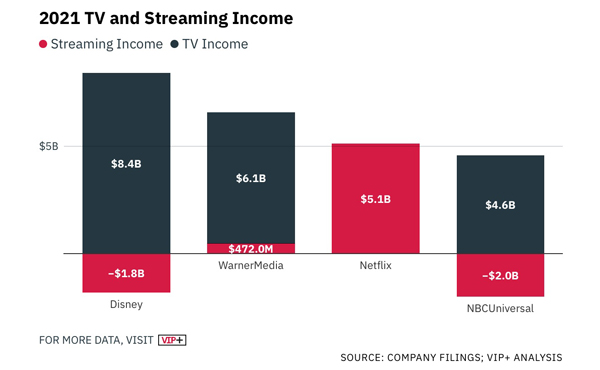
Hence the concern over Netflix’s April report of decline in subscriptions. Streaming is its core business. A loss of $2 billion for the Disney conglomerate (parks, cruises, ABC TV, etc.) amounts to a rounding error. The majors’ deep pockets can sustain streaming enterprises for some time, but Netflix is far more vulnerable.
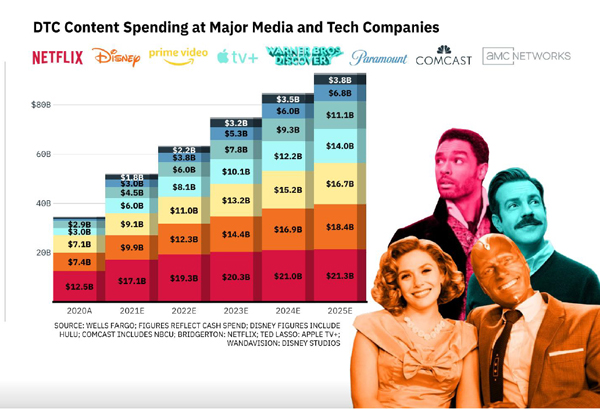
The streaming services are investing huge amounts in new “content.” The major providers are estimated to spend $50 billion acquiring projects this year. Producers are in a powerful position to demand big budgets to outmatch the competition. The costs are exacerbated by the high demands of talent, who now expect to be paid largely up front, since there is little opportunity for the deferred fees and back-end deals that depend on ancillary revenue.
No wonder then that several services have raised subscription rates. More drastically, in its current crisis Netflix has announced plans to offer an ad-supported tier of the sort already provided by Universal/NBC’s Peacock. Other services, Disney included, will probably shift to a similar option, especially since there is some evidence indicating that consumers will accept commercial interruptions in exchange for lower fees. Netflix also plans to control password-sharing, which helped it grow recognition but in the face of intense competition depletes its audience. It may be harder to combat the use of virtual private networks, aka VPNs, which allow roundabout access to region-based offerings.
One monetization strategy seems to be the rebirth of windows. Once a high-demand film is released to streaming, the service can add an upcharge for accessing it. Blockbusters like The Batman and the new Spider-Man trilogy were launched online with an extra fee for initial viewing. Over time, the prices fell gradually, just as in the old first-run/ second-run days. Even classics can benefit from premium treatment: The Godfather is free on Paramount+, but a rental costs $3.99 on Amazon Prime and Apple+. Arthouse fare is even more privileged; I paid $19.99 to see Drive My Car in its online release, though now it’s free on HBO Max.
It’s still TV
Bill Amend, Foxtrot.
In the late 2000s, streaming video entertainment was the province of mostly smallish, scattered companies like Twitch, Pluto, and others. Netflix and YouTube also took the plunge. Hulu, a consortium of Fox, Universal, and Disney, represented the majors’ initial effort to explore the market. As download speeds improved, problems with buffering and latency were overcome by new streaming protocols.
Soon enough, a familiar cycle emerged. Tim Wu’s book The Master Switch shows that mass information technologies (telegraph, telephone, film, TV) tend to consolidate into oligopolies. Major companies buy or kill off the competition. This happened with streaming, as one by one the big players came to the foreground. Netflix had early-mover’s advantage, having pioneered the distribution of DVDs by mail, and Amazon had a massive customer base in place already. The studios had helped Blockbuster wipe out small video-store chains, which had demonstrated the existence of a massive market, then turned their attention to selling discs directly to consumers. In 2019 the big players began to consolidate control over the expanding streaming landscape.
By acquiring other services (e.g., Paramount’s buying Pluto) and assembling proprietary components already in hand (e.g., WarnerMedia’s repurposing HBO Go), the firms have come up with integrated platforms. Disney+ launched in 2019, Peacock and HBO Max in 2020. Discovery+ and Paramount+ appeared in 2021, and Amazon bought MGM earlier this year. Sony, while licensing its film releases to its counterparts, has focused on animation by picking up Crunchyroll, which will absorb Sony’s Funimation service.
It’s early in the game, and it will take time for the companies to reassemble libraries that have licenses yet to expire. Doubtless many titles will be available for premium rental on rival sites, since no company wants to leave money on the table. Still, it seems clear that a considerable siloing of “content” will enable firms to enhance their power over their intellectual property. From this standpoint, we can think of streaming as a new phase in the development of home video.
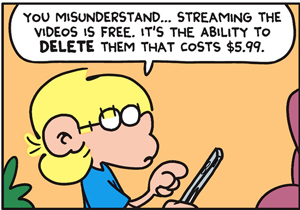
In the earlier entry, I argued that home video formats gave the consumer a great deal of freedom. Even cable promoted “appointment viewing,” but tape, and then DVD, allowed the consumer a lot of flexibility. You could buy or rent a movie and watch it when you pleased. You could copy it too. Convenience is always a plus in a consumer item, and home video added to it a welcome price point: renting a tape or disc was cheaper than buying a movie admission, and in discount bins you could find a DVD for a few bucks.
With physical media, movies became manipulable by the audience. Ripping a DVD yielded a file that could be remade. Mashups, Gifs, and other transformations were feasible. Video essays changed film studies, and satire, homages, and fan analyses filled the internet. You could play with your movies.
Streaming withdrew this flexibility but offered greater convenience. A platform combines the array of a video store (think of those tiled pages as display racks) with push-button access. You still have the option of time-shifting, and you can share home viewing with others. But there’s no longer a physical medium. You don’t own or rent the film as object; you have bought access to it as a display, and only when you’re online. (“Buying” a digital copy is no guarantee of possession, if the service loses its license to the title.)
For decades, movie exhibition was a service business. We paid for the experience. Briefly, between 1980 and 2020, films became consumer artifacts as well. Ordinary folk enjoyed the sense of possession shared by film collectors of earlier decades. But with the decline of discs, we are once more paying for the experience while the object lies elsewhere.
Because of Hollywood’s preternatural fear of piracy, turning the artifact back into a service is a way to secure intellectual property. Not that people will stop trying to make personal copies. It’s possible to record streaming transmission, but the majors are counting on several factors. Just as people became tired of piling up DVDs they probably won’t watch, they could tire of filling hard drives with rips.
A few hardcore headbangers will enjoy sticking it to the man, but most people will reckon if you already pay for streaming the movie, why copy it? Given customer inertia and the convenience of streaming, why bother to pirate a movie that’s probably on streaming somewhere, available whenever you want? The trouble and expense of ripping may be greater than simply signing up for another subscription service. There are certainly overseas markets for pirated streaming shows, but as the companies expand their platforms abroad, piracy may diminish.
In sum, streaming has become the next step in the majors’ reassertion of control over their IP. It surpasses the old video store’s inventory, offers the convenience of click-ordering and time-shifting, and retains the advantages of in-home consumption. All we relinquish is ownership of a copy. Now that SVOD services are generating new attractions, providing long-running series with spaced-out hour-long episodes, and exploiting advertising-supported tiers, we are getting a version of fully on-demand cable TV.
We can glimpse this prospect in the demand for bundling, or aggregation. Customers’ biggest complaint is that there’s too much choice. The 200 channels of maximal cable are dwarfed by the streaming torrent. Nielsen estimates that as of last February there were 817,000 unique program titles available. Hence the emergence of streaming MVPDs, the “multichannel video programming distributors.” They provide a mix of movies, broadcast network series, classic TV, sports, and cable news. The best example is YouTube Live, which charges $64.99 per month, far beyond most of its SVOD competitors and reminiscent of classic cable fees. Yet YouTube Live is the most popular MVPD.
Add to this the number of FAST outlets, free ad-supported streamers such as Pluto, Tubi, Roku, Freevee, et al. With MVPDs these already constitute about a third of streaming offerings. One survey found that 34% of US consumers would prefer a free streaming service with 12 minutes of ads per hour. Streaming is starting to look like. . . well, just good old TV. The free platforms approximate broadcast TV, and the paid ones are cable reborn.
It takes time to make a classic
Atom Egoyan, Artaud Double Bill (2007).
Streaming demands a constant flow of new material, compared with the relative stability of broadcast TV, so the problem has been how to release it all. Netflix made a splash by dumping entire seasons at once, encouraging bingeing and getting immediate buzz and uptake. Viewers came to expect the big gulp. One survey found that over half of viewers under sixty now want firms to provide all the episodes of a series at once. But this strategy can damage long-term subscriptions by encouraging churn.
It also makes the product forgettable. Most direct-to-streaming films have a short shelf life. Does anybody watch War Machine (2017) or Bird Box (2018) now? Most auteur efforts seem to me to have had little cultural impact, not even Scorsese’s The Irishman (2019, with a mild theatrical release as well) or Soderbergh’s The Laundromat (2019). They came and went fairly quickly. A rolled-out theatrical film had an afterlife, it could circulate through the culture in many ways, and it could find niche audiences. Could The Godfather (1972) have its standing today if it were released straight to SVOD? Are there now “classic” streaming features?
This applies to art films too, I suspect. The international festival circuit allowed films to trickle from the big events to national and regional festivals over months, so outstanding films could build critical response and whet audience interest. Eventually some would find commercial distribution city by city. The pandemic compressed that process as festivals began to allow remote viewing of their screened titles, sometimes to audiences outside the locality. Kino Lorber’s Kino Marquee plan, which allowed simultaneous online access to new releases across the country, was a creative effort to maximize a film’s reach. Sponsored by local theatres, the plan in effect yielded a quick nationwide release on a scale that couldn’t easily be matched in pre-Covid days. It’s hard to imagine, though, that L’Avventura (1960) would have its standing today if it had played so quickly throughout the country.
Producers are belatedly realizing that the slow rollout characteristic of classic film distribution had the advantage of building audience awareness. A theatrical trailer is targeted toward habitual moviegoers and word of mouth. Theatrical releases garner promotion and extensive critical coverage that last longer than a Twitter alert. Theatrical screening can make a film an event–not always successfully, but at least it offers a chance. At a 19 May Cannes panel, a Swiss distributor pointed out that theatrical releases do better on streaming than straight-to-streaming ones.
The rationale is partly financial, of course. Here is the new head of Warner Bros. Discovery David Zaslav:
When you open a movie in the theaters, it has a whole stream of monetization. But more importantly, it’s marketed and builds a brand. And so when it does go to a streaming service, there is a view that that has a higher quality that benefits the streaming service.
There’s also the fact that a film on the big screen has a force that even a home theatre display can’t match. Another executive notes: “The undivided attention you get from an audience in a theater is where franchises are born.”
Classics, too. Even if most people see most films on monitors and personal screens, there need to be places for the proper display of them–living museums of cinema, in archives and cinémathèques but also in multiplexes and art houses. If streaming is making films ephemeral, we need to hang on to screening situations that let films claim our full engagement. If cinema becomes more like opera, as Lucas and Spielberg prophesied, let’s all become patrons and devotees, even snobs. Let films ripen over the years in a shared cultural space. Then we may get future masterpieces. Or so we might hope.
Thanks to Erik Gunneson, Peter Sengstock, and Jeff Smith for information and ideas.
Thompson/Bordwell online books now available for free
DB here:
For some years we’ve offered digital books for sale via our site. These are either original works, like Pandora’s Digital Box and our Christopher Nolan study, or updatings of out-of-print publications like Planet Hong Kong and On the History of Film Style. Those have been available through purchase via PayPal.
I was never comfortable with using that service, but its ubiquity favored it. Now that its chieftain, billionaire Peter Thiel, is bankrolling Ohio Senate candidate J. D. Vance and other mega-MAGA figures, we see no reason to add to PayPal’s revenues, not even the few cents it receives from a purchase here.
So starting today, all the books formerly for sale are free to all. They sit in a stack on the right of this page. They are unlocked pdf files, and can be read or downloaded as you wish. Click on whatever interests you.
Thank you to all our readers who purchased some books in the past. We hope that making other titles easily available will attract you as well. Thanks as well to those educators who have asked students to use these in course work. If you haven’t acquired any of these so far, you’re welcome to pick them up!
Thanks as ever to our web tsarina Meg Hamel for setting up our online book sales originally, and for liberating them today.
P.S. 17 May 2022: Some readers have noted that Peter Thiel may no longer have an association with PayPal, as he sold his founding interest in the company in 2002. But he may still be one of several stockholders. Still, if we’re in error, we regret it and apologize. We don’t regret highlighting his deplorable political activities. And we’re glad to release the books.