




Archive for 2013
Tony and Theo
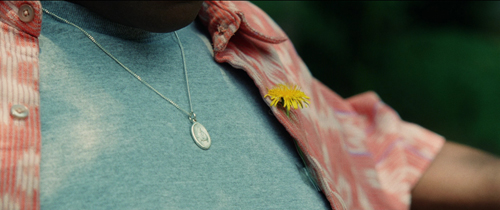
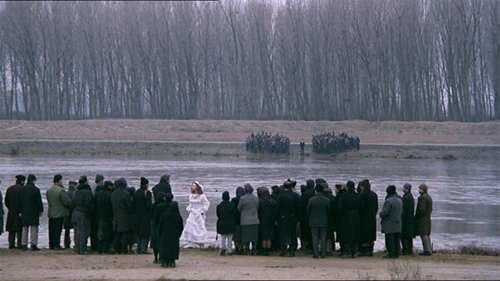
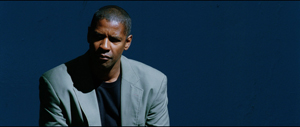
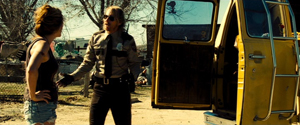
Man on Fire (Tony Scott, 2004); The Suspended Step of the Stork (Theo Angelopoulos, 1991).
DB here:
In January of 2012, while shooting The Other Sea, Theo Angelopoulos was struck by a motorcyclist and died soon afterward. In August, Tony Scott committed suicide by jumping off Los Angeles’ Vincent Thomas Bridge.
Both men mattered to cinema. But which cinema?
From 1970 onward, Angelopoulos produced solemn films about Greek history, world war, emigration, and the collapse of struggles for political change. His hallmark was the extended—some said excruciating—long take. He presented his work as that of a thoughtful and passionate intellectual, a witness to history (or as he sometimes said, History) who was telling us hard, melancholy truths. His work received little mainstream distribution outside Europe and Japan, and some of his best films weren’t circulated nontheatrically or on video. Severe and abrasive, he alienated powerful members of film culture and was reported to have responded sourly when he did not win Cannes’ top prize.
By contrast, after Top Gun (1986), Tony Scott came to be the prototype of the ADD Hollywood director, a master of the blockbuster action picture. He gleefully marshaled visceral technique to jolt the eye and hammer the ear. His movies were unabashed booty calls, spotlighting female pulchritude in a tone of laddish camaraderie in an all-male milieu (sports, the military, the workplace). Not lacking intelligence, he avoided the sweeping pronouncements that made Angelopoulos look pretentious, but his early partnering with Simpson and Bruckheimer stamped him as raucously vulgar. He even dated Brigitte Nielsen.
Extremes meet
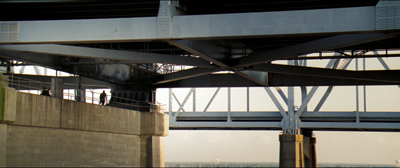
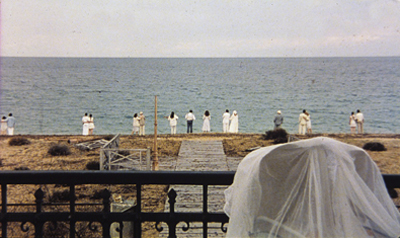
Déja vu (2008); Eternity and a Day (1995).
The statuesque versus the kinetic, the monumental versus the ephemeral, ponderousness versus cheap flash: To all appearances, these men lived in different cinematic worlds. Their careers were oddly counterpointed too. Angelopoulos, a festival darling in the 1970s and 1980s, became more unfashionable. By the time of his last release, The Dust of Time (2009), some critics were openly scornful. Scott faced gibes from the start but won some critical respect in the 2000s. After his death, critics were calling him a master. To many, Angelopoulos’s stubborn allegiance to 1970s modernism looked old hat, while Scott’s bodaciousness and eye candy seemed to have finally seduced audiences and critics alike.
I confess that both give me qualms. When Angelopoulos strains for significance, as he does at many moments throughout his oeuvre and almost constantly in The Dust of Time, he arouses all my impatience with pretentious Eurocinema. When Scott builds a scene out of Fuck-you-motherfucker dialogue and lingering views of pole dancers he reminds me of just how low contemporary American cinema can sink. And the style of each one can become predictable–an angled shot down a street portends a pan in Angelopoulos, while once somebody sits down in a Scott movie the camera is likely to start to twirl.
Despite these misgivings, I find that I can admire and enjoy both men’s films quite a lot. Their most venturesome work offers us powerful experiences, and they can teach us things about cinema—not least, how creative filmmakers can rework the medium and its historical traditions.
And their worlds overlap at least a little. Both men treat cinema as an art of scale. To see Man on Fire (2004) or Alexander the Great (1981) on home video, no matter how big your monitor, is to shrink the films fatally. Correspondingly both men relied on spectacle, stuffing the screen with sweeping, startling effects. True, Scott’s spectacle is maximalist, while Angelopoulos’s is austere. Yet once you’ve calibrated your bandwidth, the train that rumbles through the migrant camp in The Weeping Meadow (2004) becomes no less rattling than the rogue locomotive in Unstoppable (2010). “Go big or go home” might be each man’s motto.
Both play games with narrative as well. As early as The Hunger (1983) Scott’s incessant crosscutting uses the soundtrack of one line of action to comment on another. The time looping of Domino (2005) and Déja Vu (2008) creates flashbacks, replays, revised outcomes, and jumping viewpoints. More sedately, Angelopoulos perfected the time-shifting long take. The camera movements of The Traveling Players (1975) glide among different eras. From scene to scene, Angelopoulos will provide few marks of tense. Scene B may follow A, or precede it by several years, and no Hollywoodish superimposed title will help us out. It may be several minutes before we realize that decades have passed.
Yet the time-scrambling both directors enjoy isn’t wholly at the service of drama. Storytelling takes on a curiously subsidiary role in their work. Neither filmmaker, it seems to me, is centrally interested in probing what many of us take to be the core of narrative—character psychology. This isn’t to say there aren’t poignant moments and glimpses of inner lives. But each director also leaps beyond them.
I think in fact that Tony and Theo explore what happens when narrative slips away, when cinematic textures and patterning are allowed to override drama—to inflate it, deflate it, thrust it to one side, take it as a pretext for something more tangibly enthralling. Both filmmakers seek to shape our perception and emotion, letting the fluctuations of images and sounds engender a kind of mesmeric attention in themselves.
They accomplish this within two different traditions, that of modern Hollywood and that of “art cinema.” Yet they share a commitment to going beyond the given: Each director pushes his tradition to a limit.
Pulp fictions
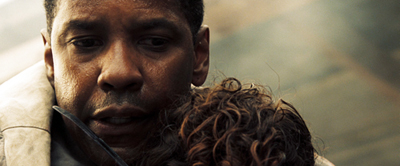
Déja vu (2008).
Scott’s tradition is, most broadly, Hollywood narrative cinema, and up to a point he plays along. The plots are propelled by goal-directed characters who clash with others, and the results are contests (Top Gun, Days of Thunder, 1990), investigations (Beverly Hills Cop II, 1987; Man on Fire, Deja Vu), pursuits and conspiracies (Revenge, 1990; The Last Boy Scout, 1991; True Romance, 1993; The Fan, 1996; Enemy of the State, 1998; Spy Game, 2001; Domino), and ticking-clock suspense situations (Crimson Tide, 1995; The Taking of Pelham 123, 2009; Unstoppable).
At the center there usually stands one man, or a duo, who must undergo a test of courage and resourcefulness. In The Fan, an example of what Kristin has called the parallel-protagonist movie, a normal guy finds himself pursued by an obsessed admirer. A woman might serve as a gutsy partner, as in True Romance, or the object of the quest (Revenge, Spy Game), or the reward for success (The Last Boy Scout, Unstoppable). Only Domino has a female protagonist who survives through being as abrasive, dirty-minded, and foul-mouthed as her male partners and adversaries. Yet by her own admission, she has daddy issues and a longing to return to cozy wealth.
At bottom, then, Scott worked with straightforward pulp stories, and for about a decade he played them in the proper spirit. But with Enemy of the State (1998) he began to use the slipperier narrational strategies spreading through Hollywood of his time. Like Tarantino, who supplied the script of True Romance, Scott became willing—inspired, he suggests, by rock’n’roll and the films of Nicholas Roeg—to go a little wild.
His scripts started playing with what we usually call point of view. Some films become markedly, not to say traumatically, subjective. Spy Game splits the protagonist figure into two and gives us each one’s standpoint on the action. The Fan, from Peter Abraham’s fine novel, tracks a man’s obsession as it turns deadly. Man on Fire plunges into John Creasy’s mental world as he distills pain, guilt, piety, and alcoholism into a merciless sadism.
By the time we get to Domino, story presentation is pitilessly disjunctive. The main action is bracketed by a conventional frame showing the heroine telling her story to a police officer. A good thing, too; we couldn’t follow the action without her commentary. The tale fractures into quickfire AV displays, with pauses, backing-and-filling, alternative outcomes, and even written titles, as if we were getting the most juice-jangled PowerPoint talk in history.
Another multiplication of perspective takes place via spy games. Most directors situate modern surveillance techniques within their story world; Paul Greengrass seems happiest shooting people bent over workstations. When your average director gives you a swooping helicopter shot, you don’t take it as the POV of a sinister government agency or a sensationalistic TV livecam. In Scott’s late films you’re likely to. He realized that all today’s security cameras, cellphones, and hostile eyes in the sky can do two useful things. They can chop story space and time into teasing fragments, and they can refresh the shot’s visual texture.
For quite some time Hollywood movies have used television for exposition. Characters tap into the flow of story events via TV broadcasts, and sometimes, as in The Siege (1998), the film simply cuts in news clips presented directly to us, without any mediating character. Passages like these, a contemporary equivalent of the newspaper headlines and radio broadcasts of classic studio cinema, usually smooth out the plot, linking things concisely.
But Scott takes pleasure in playing up the disparities among the footage, cutting from “direct” presentation of material to mediated images and sounds. In the conspiracy films, the video images seem to be coming from a vast image bank or database that the film is sampling on the fly. Moreover, the constant interruption of one shot by another, seen on computer or news broadcast or spycam, creates a nervous visual narration. In effect, Scott imports the mixed-format collages of Stone’s JFK (1991) into the action film (with more skill than Stone summoned up for Natural Born Killers of 1994 and U-Turn of 1997).
At the level of presentation, though, a narrower tradition shapes Scott’s style. In interviews and director commentaries he ceaselessly reminds us that he started out as a painter, and he has, I think, brought a fresh pictorial intelligence to the action film.
Too much is not enough
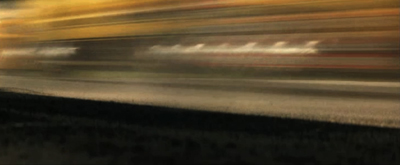
Days of Thunder (1990).
Like Michael Mann, Scott seems to have felt the need to give the action picture a dose of self-conscious artistry. The problem was the competition. The gold standard of the genre emerged in 1988 with the poised, tightly-woven classicism of John McTiernan’s Die Hard. How was an ambitious director to match that? Most directors were embracing variants of a style I’ve dubbed “intensified continuity”—fast cutting, simple staging, polar extremes of lens lengths, almost constant camera movement. The efficient but routine Richard Donner and Renny Harlin worked along these lines, while Michael Bay represented the style in almost pristine form. But what if a director who had trained as a painter at the Royal College of Art could take intensified continuity into new territory?
So yes, go along with the trend toward fast cutting; but make it even faster. In an era in the average shot in the average film runs between 3 and 5 seconds, why not make them 2 seconds? Or less? This was Scott’s choice from The Fan (1996) on. He seldom repeats a setup, largely because he has so many cameras stationed on the perimeter of the scene. Man on Fire contains at least 4100 shots, Domino over 5000, but perhaps we will never know just how many. Long passages are built out of multiple exposures, superimpositions, stop-and-go motion, and color shifts within a “shot.” The cut ceases to be a firm boundary as layers float up and slip away.
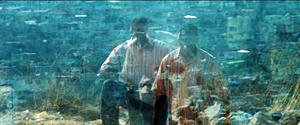
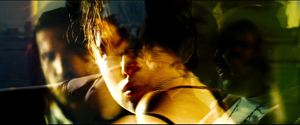
At times Scott, like Vertov in Man with a Movie Camera and Pat O’Neill in Power and Water, simply abandons the concept of a discrete shot, letting images seep through his frame.
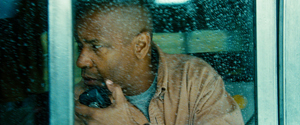
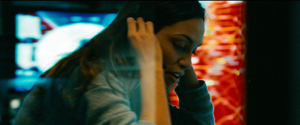
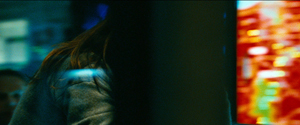
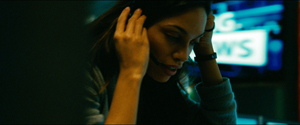
And yes, move the camera; but move it in arabesques quite different from McTiernan’s unfussy following shots and tense track-ins. In particular, take the swirling camera as a given but then pivot your subject a bit as well. Cutting from one rotation to another can yield a little ballet of sculptural solidity, with barriers gliding by in the foreground and bursts of tonal values throughout. Here’s an example from Unstoppable.
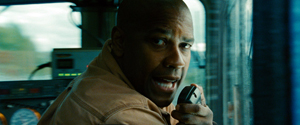
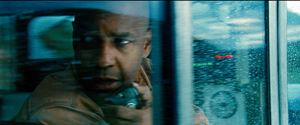
In the 1980s and early 1990s films, Scott mixed haze and sharpness. Some scenes would be shot in metallic or earth tones and swathed in those smoky layers brother Ridley had popularized in Blade Runner. Other scenes would boast silhouettes, crisp edges, and blocks of bright color. Consider these images from Revenge, The Last Boy Scout (2 frames) and True Romance.
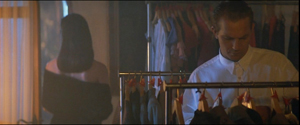
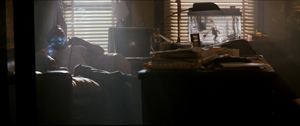
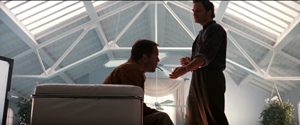
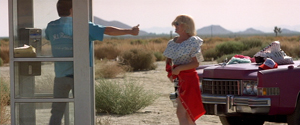
All framings–long-shot, medium-shot, close-up–tend to be covered by several cameras with very long lenses, which flatten and abstract the image. Later, having discovered the power of cross-processing reversal stock, Scott mostly gave up haze for what he called hyperrealism: high contrasts, along with Hockneyish color ripeness and thick but still transparent shadow regions.
Scott adds to the canons of intensified continuity the punch of the axial cut, that shot change that yanks figures toward or away from us (an effect that his last films mimicked by snap-zooms). Combined with long lenses set at various distances, this option creates a sense of constantly losing and refinding the point of the shot. As Connie swivels during a later stretch of the Unstoppable scene, the axial cut with different backgrounds pins her against varied blocks of color.
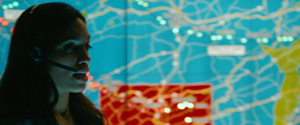
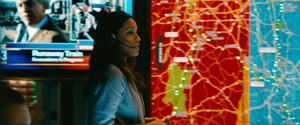
Critics complained that Scott’s style reminded them of MTV videos and commercials, a great number of which the Scott brothers produced. But there’s nothing inherently wrong with filmmakers drawing inspiration from advertising (as painters like Warhol and Stuart Davis did) or from video clips (as Wong Kar-wai seems to have done). What matters is what you do with your sources. It seems clear that Scott subjected these techniques to a new pressure, using them to thrust current norms to new extremes.
Intensified continuity, as I argued in The Way Hollywood Tells It, offers a mannerist version of classic continuity. If that’s accurate, then we might say that Scott provides a Rococo variant of intensified continuity itself. Michael Mann, another pictorialist, is more of a purist, seeking a sober gravity, while Scott doodles and scrawls across the surface of his scenes. Not only does he interpose reflections, rain, dust, and other particles between his subjects and us, but he reiterates lines of dialogue via supered titles.

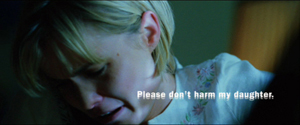
Mann lets us soak up his images, but Scott tosses out one gorgeous composition after another in bewildering profusion. In the accelerated late films, they barely have time to register. The film seems to whisk away under our eyes. Shots lack an organic arc; they’re lopped off. Partial impressions pile up, defeating our urge to dwell on a composition. Sometimes you can’t trust your eyes. During the kidnap scene of Man on Fire, a thug prepares to shoot back at Creasy as a burst of flame is reflected in his car.
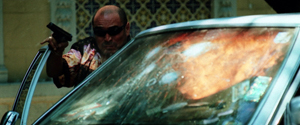
Problem is, nothing has caught fire in the scene; for once, no explosions. It’s purely a crazy jolt, literalizing the idea of a “firefight” without any realistic motivation.
These techniques are motivated to some degree by story demands: the need to suggest a mental state, to portray a heroic posture, or to amp up a fight or chase. But Scott’s visual and auditory handling exceeds the demands of clear storytelling. He wraps the most perfunctory dialogue scene in a dazzling embroidery that arrests attention in its own right. Mere decoration? I’d agree. Still, decorative art isn’t an unworthy calling, and decoration pursued with conviction and inventiveness demands our notice.
And this decoration isn’t dainty. Domino, Unstoppable, and the second half of Man on Fire have a grunge dimension, with shots that make our world look at once harsh and dazzling. Scott could be our Sam Fuller (complete with cigar), and Domino could be his Naked Kiss. Fuller might echo Scott’s gaffer, who said of Domino: It isn’t pretty, but it is beautiful.
Threnody
Ulysses’ Gaze (1995).
From The Birth of a Nation to Lincoln, American studio cinema tends to show grand historical events intertwining with the private dramas of great leaders or common folk. But there were other options. Eisenstein’s first three films—Strike, Battleship Potemkin, and October—floated the possibility of the “mass protagonist.” In these films, history is made by groups, and individuals are given largely symbolic roles. During the politicized 1960s, this model was taken up by filmmakers on the left.
The filmmaker who explored this option most fully was the Hungarian Miklós Jancsó. Although his films seem to be little-known today, he was a major force in reviving the idea of presenting history through group dynamics. Individuals play a role in The Round-Up (1965), Silence and Cry (1968), and The Confrontation (aka Bright Winds, 1969), but they are usually bereft of personal psychology. These figures are defined by their roles in a struggle—a civil war, a revolution, a clash with a domineering regime—and they are often pawns in a game of shifting power.
The Red and the White (1967), available on DVD, is a good example. This saga of the Russian Civil War that followed the 1917 revolution takes us through skirmishes between clashing armies, the tactics pursued by a squadron of Hungarian volunteers, and episodes in a Red Cross station. Individuals come to the fore briefly but are likely to vanish from later scenes, or simply die on the spot. One young Hungarian threads his way through the action, but he can hardly be said to be a point-of-view character, and we learn nothing of his background or motives. A great deal of the film is taken up with rituals of questioning prisoners, torturing and shooting captives, and ravaging innocents caught in the crossfire. At the climax, a tattered Red unit marches defiantly toward a superior White force, the entire confrontation played out in a stupendous landscape.
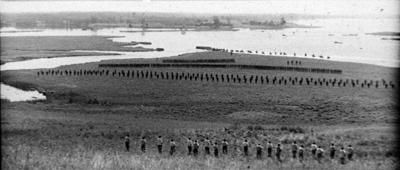
The Red and the White could defend itself from charges of formalism through its affinity with Soviet-style war dramas, but as Jancsó went on to examine episodes in Hungarian history, he soon gave up realism. He staged historical events in symbolic forms, on a bare plain or as obscure rituals in festivals rippling with music and dance. Examples are Agnus Dei (1972), and Red Psalm (1969; available on DVD). These films relied on endlessly tracking, craning, and zooming; the camera floats, and space stretches and squashes. The result was long-take extravaganzas. The Red and the White has fewer than two hundred shots; The Confrontation (1969) only thirty-five; Sirocco (1969) and Elektra, My Love (1974; on DVD) fewer than a dozen.
It seems to me that after Angelopoulos’s first film, he picked up and expanded Jancsó’s idea of investigating a nation’s history through mass dynamics and stripped-down spectacle. He proceeded more or less chronologically through modern Greek history. Days of ‘36 (1972) examines the dictatorial rule of General Metaxas (1937-1941) while The Traveling Players of 1975 covers the Nazi occupation and postwar civil strife. The Hunters (1977) revives the years from the civil war (1944-1949) to the mid-1960s through an arresting narrative device: present-day hunters find the corpse of a civil war partisan, as fresh as if killed yesterday. Alexander the Great (1980) doubles back to a period from the turn of the century until the 1930s, showing a bandit taking power over a remote village.
This tetralogy did pick out individuals, but it made them symbols of larger forces, often through names drawn from history or mythology. The travelling players are named Electra, Orestes, and the like; Alexander the bandit is a brutish version of his legendary namesake. Nevertheless, Angelopoulos’ presentation did little to acquaint us with them from the inside. He drew on none of Scott’s subjective tricks to convey instant impressions or fragments of memory; even his quasi-subjective flashbacks were likely to include the protagonist as he is today in the scene from the past.
Popular filmmaking depends on our accessing characters’ thoughts and feelings, but Angelopoulos largely gave that up. He made his plots depend on large-scale political forces. Sometimes, as in Days of ’36 and The Hunters, we are taken behind the scenes and shown the machinations of power, but usually history unfolds through impersonal forces—often outside the frame. When the apparatus of power is made visible, it’s through visions of police, soldiers, or other authorities. And those are often presented as rigid and impersonal.
Below, in Ulysses’ Gaze, a candlelight march is confronted by row upon row of police. The calm, mechanical way the officers fill up the middle ground makes the impending conflict quite suspenseful. When you think the composition, and the confrontation, have exhausted the shot’s duration and space, a crowd of citizens appears in the foreground to bear witness. All three groups are made into homogeneous blocks through the distant framing and the consistency of texture (flickering candles, uniforms, umbrellas).

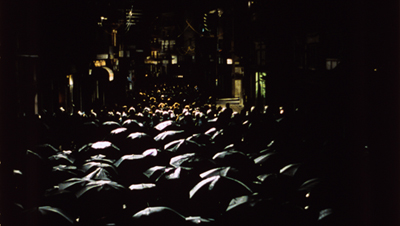
The drama comes when our characters are forced to respond to the forces of oppression. They flee, they hide, or they’re captured and sent to prison or execution or exile. It’s an inglorious version of history, filtered through a Brechtian belief that distancing us from charged situations, presenting emotions dryly rather than melodramatically, can bring lucidity and a grasp of macro-dynamics. But Angelopoulos also traced his the origins of his oblique, sometimes opaque style to the pressures of censorship. Under the Greek junta, it was impossible to speak about history directly.
So I sought a secret language. Tacit understanding of the story. The temps morts in plotting a conspiracy. The unsaid. Elliptical discourse as an aesthetic principle. A film in which everything that is important takes place outside the frame.
Even after censorship ceased, Angelopoulos continued in this taciturn vein, making his films thoroughly decentered and dedramatized.
Yet in the 1980s, he tried to offer audiences more. He began to put distinct and individualized characters at the center of his films, and he achieved his survey of political change by sending them on modern Odysseys. In Voyage to Cythera (1983) a film director is conceiving a new project, and he visualizes the story of an elderly Communist let out of prison and returning to his village. In The Beekeeper (1985), a schoolteacher abandons his family and embarks on a trip across a bleak modern Greece. Landscape in the Mist (1988) follows two children convinced that their emigrant father is waiting for them just across the border. In The Suspended Step of the Stork (1991) a television journalist tracks down a prominent politician who seems to be hiding in a refugee village.
Two 1990s films plumb the characters’ pasts in more detail. Ulysses’ Gaze (1995) follows an archivist (called simply A) searching for a lost film and his own family history in the Balkans. In Eternity and a Day (1998), a poet in the last days of his life reflects on his life while accompanying a boy trying to return to Albania.
In the 2000s Angelopoulos began again thinking on an epic scale. Trilogy: The Weeping Meadow (2004) announced itself as the first installment in nothing less than a history of the twentieth century told through the experience of a single family. Concentrating on a refugee couple—one Russian, one Greek—it sets their fugitive romance against the events of World War I, the rise of Fascism, and the Greek Civil War, while also hinting at parallels to Attic tragedy. The second installment, The Dust of Time (2009) runs parallel to Voyage to Cythera and Ulysses’ Gaze in centering on a filmmaker, but he becomes less central to the plot than his father, his mother, and his mother’s lover–all victims of 1950s Soviet Communism who survive to see the fall of the Berlin wall.
Over these years, Angelopoulos collaborated with the Italian screenwriter Tonino Guerra (who died about two months after the director). Guerra, who worked with Antonioni, Fellini, the Tavianis, and many other directors, may have helped turn Angelopoulos toward less forbidding storytelling. The more vividly drawn protagonists of the late work were often played by well-established actors (Mastrioanni, Moreau, Ganz, Keitel, Dafoe, Piccoli), and two of the films center on children, one common way to kindle emotion. Eleni Karaindrou’s scores, full of threnodies rising up from massed strings, by also gave the films after Cythera a plangent warmth reminiscent of doleful musical pieces by Henryk Górecki and Arvo Pärt.
Still, these late films are only comparatively more accessible. Their stories come across as downbeat, episodic, relatively empty of conventional drama, full of “dead time” and unmarked time shifts, and deeply somber. Which is to say that they belong to the broader tradition of postwar European art cinema, its norms given fresh realization through echoes of Greek mythology and a signature style of exceptional rigor.
Stasis and sublimity
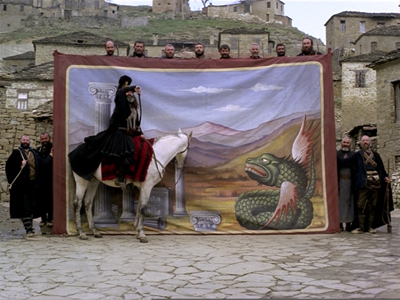
Alexander the Great (1981).
At the level of technique Angelopoulos again emerges as a synthesizer. An admirer of Mizoguchi and Antonioni, and again probably influenced by Jancsó, he became identified with the long take. From The Traveling Players on, scenes are presented in very few shots, often only a single one. Three films of the tetralogy contain between 125 and 150 shots, while The Hunters makes do with 49. And most of the films are very long (two nearly four hours), so the average shot length runs from 72 seconds (Days of ’36) to 206 seconds (The Hunters). As the later films became more accessible, the editing paced quickened only a little: no film has more than a hundred shots, and in all the average shot runs between fifty seconds and two minutes. Add together all the shots in Angelopoulos’ thirteen features and you have less than a third of the shots in, say, Scott’s Enemy of the State.
Most long-take filmmakers scale their framings to human activity; think of Ophuls and Renoir, capturing gestures and reactions as time flows through the image. But Angelopoulos combined the long take with the long shot, putting landscape at the center of his work. The stunning shot I’ve excerpted from The Red and the White above isn’t wholly typical of Jancsó’s films, which tend to have many close framings and to save vast views for climactic moments. By contrast, Angelopoulos makes very distant shots his default mode for exteriors, even for moments of high drama: a conversation in The Hunters, a death in Alexander the Great.
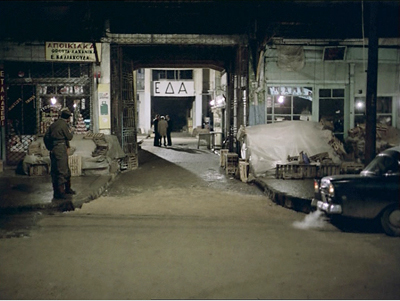
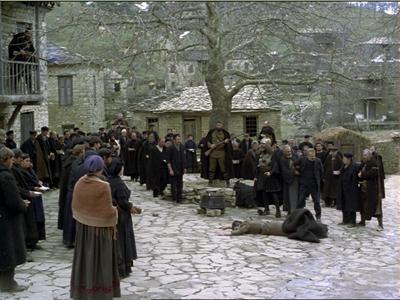
There are very few conventional close-ups in his films, and mid-shots are often forced on him by fully-built interiors, either locations or sets, as in the frame below from The Weeping Meadow. Even then, the camera often keeps its distance, subordinating characters to impersonal architecture and making their encounters seem fragile (The Suspended Step of the Stork).

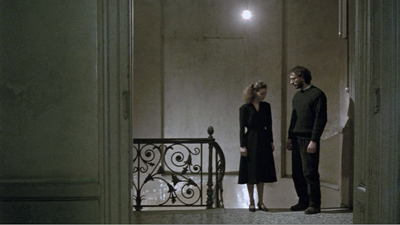
Sometimes the tableau that results has considerable depth, as with groups gathered in interiors (The Hunters, below). More pointedly, a horrifying scene in Landscape in the Mist almost cruelly forces our eye back into the distance. In each shot, the most important action is furthest from the camera.
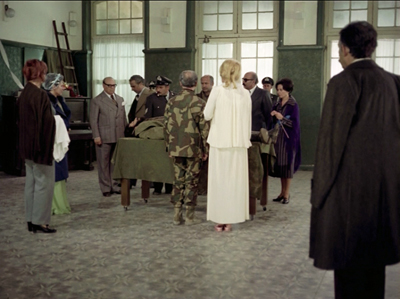
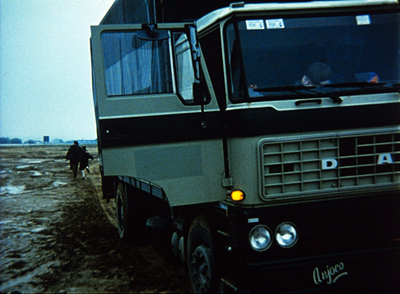
At other moments the long shot yields what I’ve called planimetric images. There’s still a fair amount of depth, but the shot is framed perpendicular to a back plane and figures are spread out in strips or layers. Some images earlier in today’s entry afford examples, particularly the developing street confrontation in Ulysses’ Gaze. The Weeping Meadow shows that this principle can be applied to a raft and rowboats too.
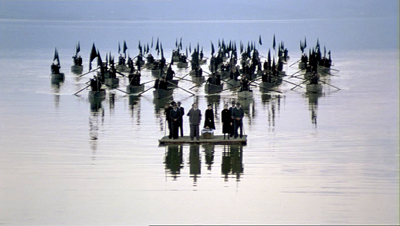
Like Scott, Angelopoulos relies on very long lenses, but he holds the shot so that the flattening effect of the lens creates a gradually changing pattern.
Both depth framings and planimetric ones were exploited by European filmmakers of the late 1960s and early 1970s, but Angelopoulos focused rigorously on them and joined them with consistently distant camera positions. As the dramaturgy downplays individual psychology, the shot scale makes individuals figures in a landscape. The result is often a rhythmic organization of the frame, a pattern of symmetries and abstract geometries (Traveling Players, The Dust of Time).
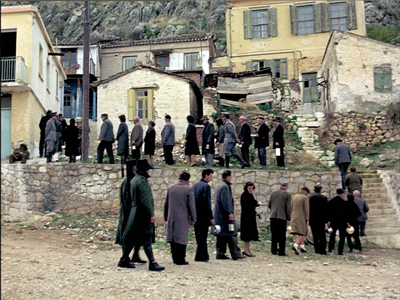
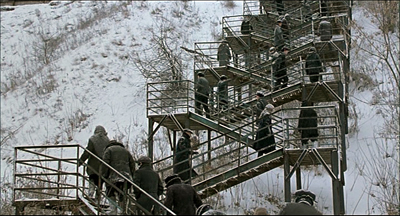
In the later films, moments of personal drama are played out in no less opaque distant shots. In Voyage to Cythera, the exile’s wife goes to their old cottage and coaxes him out. They must be exchanging a look of understanding, but only on the big screen is it visible.
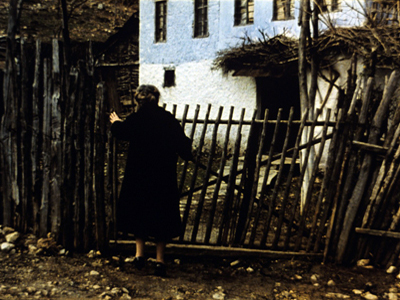
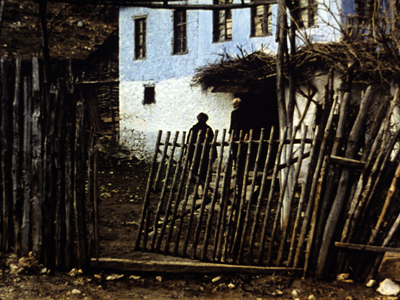
Such fixed shots are riveting enough, but how can the filmmaker dynamize them and prepare for them? The answer for Angelopoulos was keeping the frame mobile. He refuses the giddy sweep and beguiling tempo of Jancsó. Angelopoulos is severe. Like Scott, he will use the zoom, but his enlargements or de-enlargements are stately, not staccato. (Again, that Red and the White shot may have been an early model for him.) In all, his mobile framings are as austere as the color palettes (earth and metal tones) and the lighting (subdued, often chiaroscuro, with usually a drab sky).
His camera pans with passing characters, sometimes letting them come close enough for us to identify them or catch an expression; a prolonged traveling shot follows Spyros’ wife in the scene above as she approaches the fence. But the very plainness of this technique can sharpen our expectations. As often in postwar European film, the extended, dialogue-free walk creates its own arc of interest. We rarely know where a character is headed on that walk, or what they see that makes them approach. In a way this technique recalls the thriller or horror film: show the reaction and pan to the cause of it. But with Angelopoulos that cause will tend to be something stupefying in scale, a revelation of a side of the world we haven’t suspected, perhaps a realm closer to surrealism (The Suspended Step of the Stork; Trilogy: The Weeping Meadow).
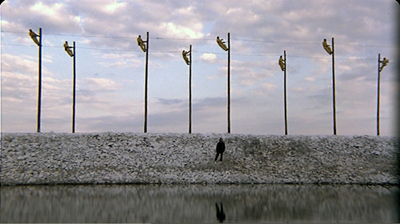
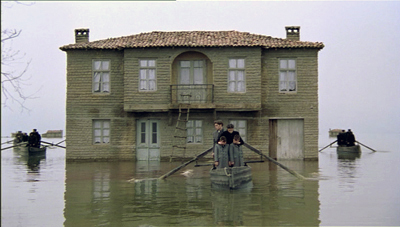
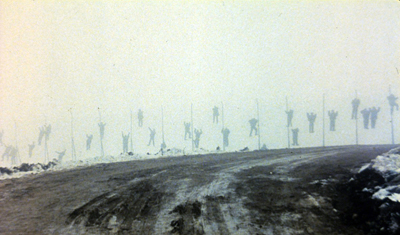
Hallucinatory images like these, presented with a calm gravity, suggest that the forces of history, like Goya’s dreams of reason, bring forth monsters—not raging and tumultuous ones, but ones displaying deathly, disturbing stillness. The emotional shock of the characters communicates itself to us as a pictorial shock, itself achieved by the simplest means. In Eternity and a Day, the protagonist and the boy come upon a refugee camp where the detainees, clinging to the fence, seem suspended in the mist.
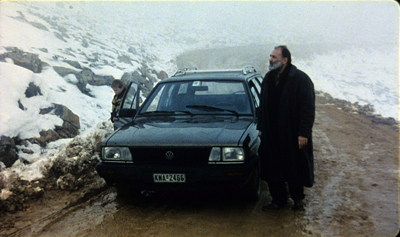
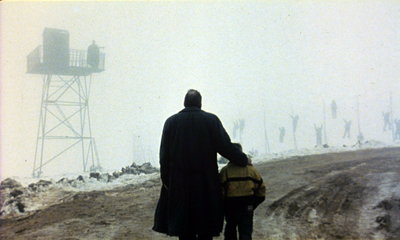
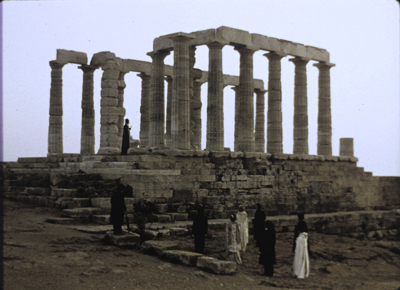
The result of all these creative choices is a cinematic pageant, and not only because of its splendid imagery. Like the medieval pageant wagons that rolled scene after scene past a crowd, Angelopoulos’ scenes become a procession of tableaux. They are broken by movements—sometimes slow, sometimes sudden, almost always small. Only he could imagine this shot in Alexander the Great in which a tourist edges out from behind a pillar at the Temple of Poseidon and lifts his finger for silence. His arm arrests our attention without losing the monumental context.
If Tony Scott’s images are hurled out in a mad rush, Angelopoulos gives us time to see the smallest changes. Sometimes these emerge in cramped interiors, guided by aperture staging or a gliding camera. At other moments we must scan a vast space to spot our protagonists. What eighteenth-century thinkers called the Sublime, the fearsome majesty we apprehend in the enormity of the world outside ourselves, as during a storm at sea, has been given a political weight. Not despair, Angelopoulos insists, or even pessimism: rather, a collective melancholy at recognition of a sad destiny.
Like Scott, Angelopoulos pushed to new extremes certain premises of the traditions he chose to work in: Dedramatization, depersonalization, the long take, a reliance on staging that is dense or spacious, deep or planar, and the urge to represent history and contemporary life in a more abstract, majestic way. Heir to Antonioni and Jancsó, he carried their visual ideas to new limits and showed what more they could do. That strategy laid bare his own artifice, to the point that the minute fluctuations of style–no less “cinematic” than Scott’s–fascinate us in their own right.
All I’ve done is to trace some curves and whorls of each filmmaker’s signature, his characteristic principles of handling story and style in relation to the norms of his time. I haven’t tried to launch fine-grained analyses of particular scenes or entire films. Both are necessary, of course. Still, the sort of analysis I’ve outlined seems to me essential to appreciating their work fully.
That work has something broader to teach us about film and film criticism. Too often critics think that their job is to expose a film’s meanings. For most critics, that often entails a Zeitgeist interpretation. The movie is held to reflect the events, popular mood, or wish-fulfillment needs of its time. For academic critics, the hunt for meaning may also entail mapping a set of theoretical concepts onto the film, as with psychoanalytic or postmodernist interpretations.
But filmmakers like Scott and Angelopoulos remind us that we should say, more accurately, that films produce effects, of which meanings are only one type. The film provokes us to have an experience, part of which may be the search for themes and implications, but another part–perhaps the biggest and most basic one–is a guided process of perception, thinking, and emotion.
Of course, meanings matter. Enemy of the State warns us about how surveillance and data-mining can obliterate personal identity. Landscape in the Mist suggests that in the age of migrant labor, disputed boundaries, and ethnic wars, Europe has destroyed childhood. So far, so good; and we should go further. But tracing the dynamics of theme still obliges us to analyze the perceptible force of these films. That, I think, can best be recognized through a study of how the resources of cinema are deployed to give us an experience that isn’t reducible to paraphrasable ideas.
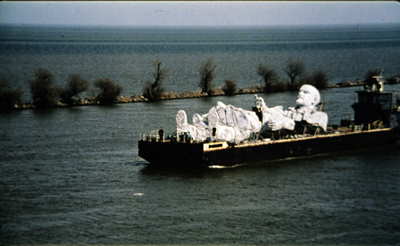
These cinematic resources, flaunted without apology from moment to moment, are the fabric of the movie. In fact, both men pretty relentlessly drain their scenes of thematic meaning. In Enemy of the State, Scott piles up so many surveillance and counter-surveillance stratagems that the anti-technology message seems just a pretext to multiply images, switch points of view, and futz up our own information-processing. In Ulysses’ Gaze, the shot of a dismantled Lenin statue floating down the river on a barge makes its “statement” immediately, but Angelopoulos won’t let it go. He follows its progress, shows people on the river banks kneeling and praying to it, and accompanies the whole sequence with Karaindrou’s surprisingly lilting music. The Symbol of Dead Communism has been drained of its portent and has become a curiously lyrical audio-visual display. These men go so far that they come out the other side.
Accordingly, both have been called heavy-handed: one is shallow, the other hollow. Granted, many viewers find art works that depend on kinetic impact or slow accumulation unsubtle. Yet sometimes force, bursting out or released in minute doses, is welcome. The Rite of Spring and Threnody for the Victims of Hiroshima both strike with a physical impact. Here the odd couple Tony and Theo find one more affinity: They suggest that subtlety in the arts may be overrated.
Information about the posse Tony Scott ran with in his early days can be found in Charles Fleming, High Concept: Don Simpson and the Hollywood Culture of Excess (Main Street, 1999). The gaffer discussing Domino is Bruce McCleery, and I’ve paraphrased his original comment: “It’s definitely not pretty, but on some level it can be truly beautiful.” See Pauline Rogers, “Lady Killer,” ICG Magazine (October 2005), 35.
Scott’s death has provoked a lot of good writing on the Net. See for example Manohla Dargis, “A Director who Excelled in Excess”; Jim Emerson, “Films on fire”; Christoph Huber and Mark Peranson, “World Out of Order: Tony Scott’s Vertigo”; Ignatiy Vishnevetsky’s “Smearing the Senses: Tony Scott, Action Painter”; and, for discussions of individual sequences, see “Tony Scott, a Moving Target,” the remarkable round-robin hosted by MUBI and Daniel Kasman and Gina Telaroli. Reliably, David Hudson has compiled web critics’ reactions at Fandor.
Jancsó’s films deserve closer scrutiny than they’ve received. My Narration in the Fiction Film includes an analysis of The Confrontation (not, so far as I know, available on DVD).
Perversely, having claimed that these directors’ images suffer when reduced, I’ve given you postage-stamp illustrations, and for this I apologize. Take them as waving you toward the need to see the films at full stretch. As for their quality, I’ve drawn as many illustrations from 35mm prints as I had available, but I’ve been obliged as well to rely on DVD copies, and those yield uneven results in the Angelopoulos frames. For discussions of the versions of his films available on DVD, see the Criterion Forum and Mubi.
The critical and academic literature on Angelopoulos is decently varied. Dan Fainaru’s Theo Angelopoulos: Interviews is a very good place to start. The best overview of most of the oeuvre is Andrew Horton’s Films of Theo Angelopoulos, which provides essential historical and biographical background. See also Andy’s anthology, The Last Modernist. For Cineaste Andy also wrote a touching reminiscence on the occasion of the director’s death. Catherine Grant has assembled a vast online dossier at Film Studies for Free, and David Hudson has charted immediate web responses here.
The French journal Positif was a loyal supporter of Angelopoulos, publishing articles and informative interviews for decades. My quotation above comes from Angelopoulos’s essay, “In my end is my beginning,” Positif no. 463 (September 1999), 62.
A little discussion of Angelopoulos, in the context of the fortunately short-lived ruckus about eat-your-vegetables cinema, can be found in this entry on our site. Chapter 4 of Figures Traced in Light: On Cinematic Staging is an expanded version of my essay in Andy Horton’s collection, and I’ve borrowed some of its ideas here. I hope to write more about Tony Scott’s work on this website later this year.
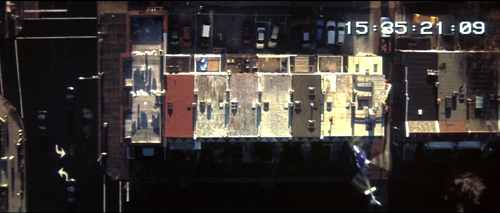
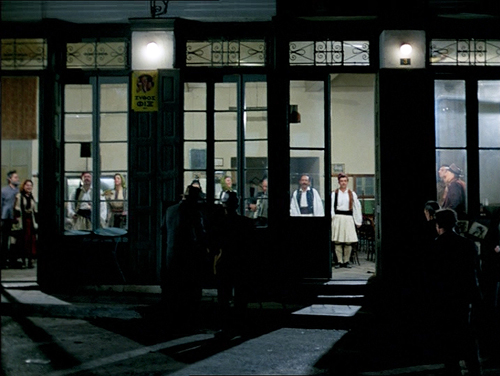
Enemy of the State (1998); The Traveling Players (1975).
Rebooked
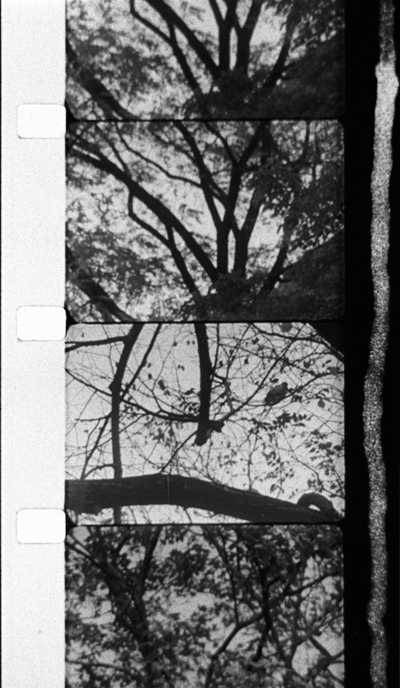
3/60 Baum in Herbst (Kurt Kren, 1960). Hand-drawn soundtrack.
DB here:
It’s time again to write up books that fate and friends have sent my way. And I do mean books, as in printed matter on paper held together by string and glue and wrapped in a decorative cover.
Nothing against e-books, mind you. I’ve put out a couple myself (see right sidebar), and I’ve become more inclined to use them for my research. Every academic sometimes needs to read only parts of a book–a chapter that touches on your project, a bibliography that can help you, chatty footnotes that can suggest a new idea. If your library hasn’t got a copy and Inter-Library Loan is difficult, an e-book can be worth the investment. The only real problem is the prospect of buying, in any format, a book that you must read but that you know will be dire. (Names and titles omitted for the sake of the new year’s mood.) Then at least the e-book, being less expensive, can mitigate the pain of paying, if not of reading.
Direness isn’t on the agenda for the books I have on the desk today. All are worth your attention, in whatever format you can get them.
Before Jan Wahl became a prolific writer of children’s books, he left the US to study in Denmark. There he had the great fortune to be a dogsbody for Dreyer on the making of Ordet. Wahl left the country after the exterior shooting, but he kept in touch with Dreyer for some time afterward. His daily notes of their conversations were vetted and corrected by Dreyer, in hopes of eventual publication. Now, nearly sixty years later, the book has arrived.
Dreyer took a shine to the young Fulbright student and confided to him ideas about his earlier work and his plans for his Jesus film. Dreyer was at that point fairly undecided about many aspects of the Jesus script, including how to end the story. But these are sidelights compared to the central action of Wahl’s memoir, the making of Ordet in the cloudy and rainy summer of 1954.
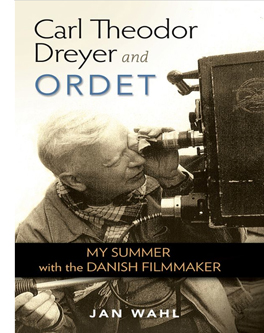 Despite the inhospitable weather, Dreyer planned and shot much more action in exteriors than appeared in the final film. The film’s hermetic “theatricality” seems to have been arrived at through pruning landscape images and shots of characters coming and going. An especially intriguing shot of Anne and Anders meeting in a field took a great deal of time:
Anne sets out to deliver a pair of trousers for her father, Peter Tailor, but she takes the long way around in order to have a tryst with Anders. The lovers meet in the field, lingering at a corner in the rye.
The camera had a long traveling movement, its tracks laid on a wooden platform in the shape of an immense letter L whose angle was parallel to the field. On that day, between three and five o’clock there was sufficient light for five takes. . . .
We’re also reminded of Dreyer’s fastidiousness—arranging sheep in ranks around the Borgen farmhouse and demanding that 1925 newspapers should line the drawers in the household. (Seeing a recent paper would “break the spell of concentration should an actor happen to see it.”) It’s a pity that Wahl could not stay through the whole production, which moved to the Palladium studio in the fall, to provide more details like this.
Just as ingratiating are Wahl’s accounts of the village where the film was shot, a tiny place taken over by Dreyer’s project. Wahl lingers over hearthside meals in a land where coffee has almost sacramental significance.
“There is something about coffee that soothes the Danes,” [Dreyer] said, “and puts them in touch with God. . . . On the winter days, which last so long here in Jutland, a warm cup is a balm; they take everyday communion in it.”
The primary value, I think, of Carl Theodor Dreyer and Ordet lies in atmospheric moments like these. I’ll always remember Wahl’s portrait of the gentle but obstinate Dreyer at sixty-five: dreaming of a film on Christ, smoking cigars, and tossing pastry crumbs to the bird that visits his garden every afternoon at three-thirty.
Pop quiz, hot shots:
What firm had the initial idea for VOD rentals? (Hint: Not Netflix.)
What firm had the initial idea for video kiosks? (Hint: Not Redbox.)
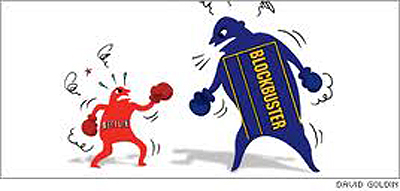
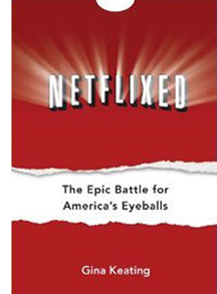
The answers, along with a solid story, can be found in Netflixed: The Epic Battle for America’s Eyeballs. Gina Keating’s brisk business reportage pits upstart Netflix against the well-entrenched Blockbuster in a cage match worthy of its title. Keating starts by demolishing Reed Hastings’s tale that he conjured up the service when he was annoyed by late fees on Apollo 13. In fact, tech entrepreneur Hastings entered the start-up as a fairly passive money guy, while the more retiring Marc Randolph devised the Netflix business model, which included what Keating calls an “intuitive user interface and peerless customer service.”
Keating shows how Randolph’s idea for an online video store on the Amazon model tapped into the expansion of internet retail. Randolph, according to Keating, “had what it took to conceive and launch Netflix. What came next—ruthless optimization and relentless growth—were not his strong suits.” By 2002, Randolph had left the company and Hastings ruled.
 In counterpoint Keating chronicles Blockbuster’s ups and downs, mostly downs. It was already feeble when Netflix launched, and Viacom was perpetually trying to unload it. The decline was evident, however, in 2007 with the coming of CEO Jim Keyes, who had turned around 7-Eleven. Keyes decided to try to make Blockbuster outlets into “full-service entertainment destinations” where, according to Keating,
. . . customers would drop in for pizza and a Coke, or buy a book or a flat-screen television or hang out with their kids on weekends while waiting for a movie to download.
It was at this point that the Onion posted its YouTube video of the Living Blockbuster Museum. Still, Blockbuster should be credited with seeing the future of VOD. Execs tested it in 2001 (answer to Question One), but the concept had to wait until Internet access widened and download speeds picked up.
Netflix made missteps too. The firm let the staff who developed the video kiosk concept depart and form Redbox. (Answer to Question Two.) Hastings was also caught off-guard when Blockbuster Online began to surpass Netflix’s customer base. Still, you come away largely admiring the adroitness of the company. I hadn’t realized the power of Netflix’s software innovations, especially its recommendation engines.
Netflixed concentrates on major players, but Keating does introduce many economic-structural factors to provide higher context. And concentrating on personalities makes for a gripping read. Hastings, who declined to be interviewed for the book, is depicted as a math-mind who could inspire software engineers but who dealt coolly with human feelings in a way reminiscent of Steve Jobs. Carl Icahn, who stalks through many other histories of modern US media, has his moments too, mostly ones of fulmination.
Non-fun fact: A 2005 survey indicated that only 22% of Americans preferred to see a movie in a theatre rather than at home on video. And this was before the surge in VOD.
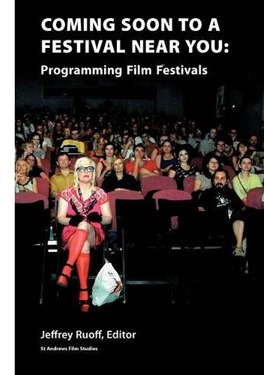 Netflix treated the Sundance Film Festival as a venue for dealmaking and PR. This is just one measure of the importance of such events for film as an art and a business. For decades our bookshelf devoted to film festivals harbored only a few volumes, mostly official histories of Cannes and Venice. By now, however, “festival studies” has become a teeming area of research. This is all to the good. International film culture after World War II, as we pointed out in Film History: An Introduction, has depended centrally on festivals, and film historians have to realize that these gatherings shape the history of cinema in many ways.
Jeffrey Ruoff’s new volume, Coming Soon to a Festival Near You: Programming Film Festivals, gathers several essays about the principles and pragmatics of deciding what’s shown. As Ruoff claims in his introduction, festivals perform many functions: they “celebrate film as an art, affirm different kinds of identity via film, [and] facilitate the marketing of films.”
Given these missions, the programmer functions minimally as a critic who aims to satisfy the audience’s tastes while steering it in novel directions. But the programmer can also be a celebrity in him- or herself, making the festival an extension of the programmer’s tastes, as happens with Michael Moore (Travers City), Roger Ebert (Ebertfest), and Tony Rayns’ Asian selections at Vancouver. This is what Ruoff calls the programmer as auteur.
The programmer is also a historian—reviving work from the past in retrospectives, while acting as a kind of future historian, laying down the conditions for later development in cinematic sensibility. The praise awarded to Bergman and Antonioni at 1950s and 1960s European festivals created a narrative of artistic development that historians who followed would elaborate.
Coming Soon to a Festival Near You offers a potpourri of pieces, from academically inflected accounts of festival history to personal memoirs from programmers and critics. Focus Features producer James Schamus provides a pungent entry on the economics of red-carpet galas, and Bill Pence, a long-standing fest entrepreneur, recounts the development of Telluride. All in all, Ruoff’s volume helps us understand the role of festivals as tastemakers and gatekeepers of world cinema.
 “It is a country, culturally speaking, that respects its avant-garde filmmakers, present, past, and future,” writes Adrian Martin. He’s describing Austria, from which comes the magnificent volume Film Unframed: A History of Austrian Avant-Garde Cinema. Peter Tscherkassky, a major filmmaker himself, has created a collection that manages to be at once sweeping and in-depth. Many of us (but not enough) know work of the “old” masters Peter Kubelka and Kurt Kren, but this anthology skips back to the early 1950s. There we find artists like Kurt Steinwendner, whose Der Rabe (The Raven, 1951) looks to be a stark exercise in neo-Expressionism, done to electronic music.
As the chapters move toward the present, some names and films were familiar to me, most were not, but all emerged as intriguing and provocative. The diverse directions of experimentation are traced by some of our best writers (Maureen Turim, Jonathan Rosenbaum, Steve Anker, Andréa Picard, and Christoph Huber, among others). The hefty volume is filled out with color photographs and many pages of -graphies: bio-, filmo-, and biblio-.
Martin’s foreword, from which my initial quotation comes, sets the stage for a comprehensive reappraisal of this major tradition. We have to thank the film collective sixpackfilm and the Austrian Film Museum, which has become a leader in publishing books and DVD editions that mightily expand our horizons. Thanks also to the government subsidies that allow the book to be available at a very decent price. Next up, one hopes: A big fat DVD compilation.
In the fall of 1988 there materialized at my office an elvish man with a neat white beard and a Compaq laptop. He was perpetually smiling, and he soon revealed why: he had one of the quickest wits and sharpest senses of humor I’d encountered. The Lilly Endowment had awarded him a year’s grant to improve his knowledge of film. Very sensibly, he came to UW.
The faculty all welcomed him, and he became friends with Kristin and me. Tapping away quietly on his laptop, sitting on the far side of the front row (to keep plugged in), he took the most extensive and precise notes on my blahblah that I have ever seen. Recalling those days, I have to smile when I realize that the oldest person in the class was the only one who brought a computer. His notes circulated in samizdat among the grads for years.
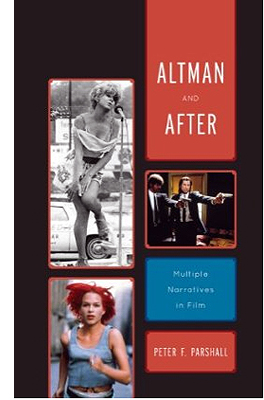 His name was Peter Parshall. A film fan from his youth, Pete had taught film and literature at Rose-Hulman Institute of Technology. He became famous as a beloved, highly demanding teacher: the student slogan was “Peter Parshall picked apart my perfect paper.” After his year in Madison, Pete went on a Fulbright Award to teach American film at the Technical University of Dresden. He retired from Rose-Hulman some years ago but kept active (bicycling, especially) and still teaches film courses.
Now Pete has published a probing book on a broad storytelling strategy that goes by many names—thread structure, hyperlinked plots, network narratives. Altman and After: Multiple Narratives in Film provides incisive analyses of several films, while also offering an illuminating set of categories for understanding them. Nashville is a “mosaic narrative,” an effort to surrender forward-driving plot in favor of fragments that pull the characters into teasingly incomplete patterns. Network narratives, with intersecting and culminating plotlines, are exemplified by Pulp Fiction, Amores Perros, Code Unknown, and The Edge of Heaven.
A new and intriguing category is the “database narrative.” Here the film launches a set of events but then replays them differently, providing alternative pathways for events. Sometimes this strategy is motivated as reflecting different points of view, as in Rashomon. But other tales question the very solidity of the narrative world, as in The Virgin Stripped Bare by her Bachelors, Run Lola Run, and The Double Life of Véronique.
Pete’s book has already received praise, with Sarah Kozloff noting in Choice: “For several of these films, Parshall’s discussion is the best analysis available, and teachers and students have much to learn from his searching intelligence.” Altman and After is a fine addition to the growing list of books seeking to understand the permutations of today’s cinematic storytelling.
 Torkell Saætervadet, a Norwegian expert on film technology and cinema design (and on aviation!), won our thanks with his authoritative 2005 text The Advanced Projection Manual. Now the International Federation of Film Archives, which co-sponsored the earlier volume, has brought out his new FIAF Digital Projection Guide.
It’s a comprehensive overview, written with great lucidity and packed with charts and specs. Sætervadet covers the Digital Cinema Package file system, projection systems, 3-D systems, sound formats, and best practices for projectionists, including advice on preparing one’s own DCP hard drive. Along with judicious presentation of rival formats, Sætervadet provides informed opinions, including a persuasive account of why 4K projection is much to be preferred to 2K. As an inveterate sitter in the Raccoon Lodge, I was happy to learn of the importance of the “front-row rule” in measuring resolution in relation to screen size.
This is an indispensable book for anyone interested in current cinema technology. I wish it had been available when I wrote Pandora’s Digital Box. The Guide is available direct from FIAF and from Amazon.uk.
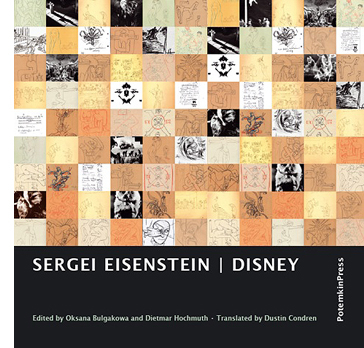
Finally, from the enterprising Potemkin Press comes a new edition of Eisenstein’s writings on Disney animation. An inveterate cartoonist himself, usually somewhere between Cocteau and Keith Haring, the polymath director reflected on Uncle Walt the artist throughout his career, but most deeply while he was at work on Ivan the Terrible. SME made no bones about it:
The work of this master is the greatest contribution of the American people to art–the greatest contribution of the Americans to world culture.
As often happens, Disney furnishes Eisenstein the occasion to launch a fantasia on what he’s been reading and thinking about since the last time he wrote. He hits on the ceaseless, “amoeba-like” change that animation permits and that Disney cartoons exploit. SME’s ruminations lead him into myth, ritual, medieval art, the drawings of Thurber and Steinberg, and much more. Typical is this:
TUSHMAKER’S TOOTHPULLER by John Phoenix, of course, stands in line with other plasmatic fancies. (Never observed this before.) Now I’ve just read some verses on the same topic by Walter de la Mare….
Much of the material is irreducibly private and may never be fully understood. Feel free to unleash your own associations on passages like this:
 NB: Fishes! Cf. Ferenczi.
Octopi: Most plasmatic.
Merbabies.
The tiger is a goldfish.
↓
Lawrence.
↓
Horses like butterflies.
St. Mawr like a fish.
Back in 1986, Jay Leyda and Alan Upchurch gave us Eisenstein on Disney, a fine selection from these energetic, perplexing jottings. Unfortunately that book is currently rare and expensive. Now we have Sergei Eisenstein: Disney, edited by Oksana Bulgakowa and Dietmar Hochmuth. Based on recent archival discoveries, it incorporates more pieces and includes a more extensive commentary and an index. Dustin Condren’s translation reads fluently, and there are many illustrations. The editors employ varying fonts to label passages in different languages, although all passages, including SME’s obsessive cut-and-pastes from books, are fully rendered in English.
Oksana’s Afterword provides a historical account of the manuscript and an in-depth guide to the development of SME’s ideas at the period. She’s particularly helpful in explaining Eisenstein’s flirtation with psychoanalytical ideas. She flavors her account by itemizing the archaeological artifacts the researcher encounters:
Eisenstein writes on an incredible variety of paper–on the back of his own manuscripts and others’ screenplays, on Mosfilm’s or the film committee’s stationery, on concert programs. The annotations from the year 1944 are scribbled on 1942 calendar sheets. Call numbers for books from the library, telephone numbers, doctors’ prescribed diets, and a grocery list are all found in the text–cream meringues, sultanas, nuts.
When I learn things like this, I like him even more.
Sergei Eisenstein: Disney is a remarkable addition to the Eisenstein literature and ought to provoke lively debate in the animation community as well. But try to find or photocopy the Leyda/Upchurch volume too. It includes SME’s earlier 1932 notes on his drawings, where he floats his ideas about “plasmation,” and it has some different illustrations and its own helpful commentary. Both collections are invaluable to every Eisensteinian, which in a just and righteous world should mean everybody.
P.S. 28 January 2013: Thanks to Manfred Polak for correcting a misspelled name.
Thanks also to Peter Parshall for corrections in my memory of his visit (Compaq, not Apple as I’d said; Lilly grant; 1988; all duly adjusted above.) Details, details. He adds:
You probably don’t remember but the other students complained to you after the first day’s class because of the noise my computer keys made as I clattered away, trying desperately to keep up with the barrage of information coming at me. So when I came up to speak to you in my turn, you suggested that perhaps I shouldn’t use the computer. I was stunned! (All that money! That was one of the very first laptop models manufactured and it had cost a bundle!) The next day, instead of sitting in the back, I sat in the front row so that your voice would drown out my clatter and I announced at the class break that I’d put my notes on reserve. The complaints suddenly stopped.
Then on the first day of spring term, I was startled when a student rushed up to me and asked very anxiously what had happened to my notes!!! (I had taken them off reserve after exams were over, thinking they would no longer be needed.) No, No, he exclaimed. All the students wanted copies for prelims. So I put them back on reserve.
The climax to the joke came three or four years later when I flew into Rochester, NY, for a film conference and taxi-pooled with several other conferees to the hotel. I was delighted to learn that they were all grad students from UW, although I didn’t know any of them. I didn’t mention my name, it being of no scholarly importance, but simply said I taught in Indiana and had spent a sabbatical year at UW. A female voice with a rich British accent popped up from the back seat: “Oh, you’re Peetah Paahshall.” Turns out she had acquired a set of the samizdat. I chuckled at the thought of them still being handed on, from one generation of students to the next. . . . I know I learned a ton that year in Madison and if I could help the learning process for some UW students in return for all your hospitality, I was happy to do so.
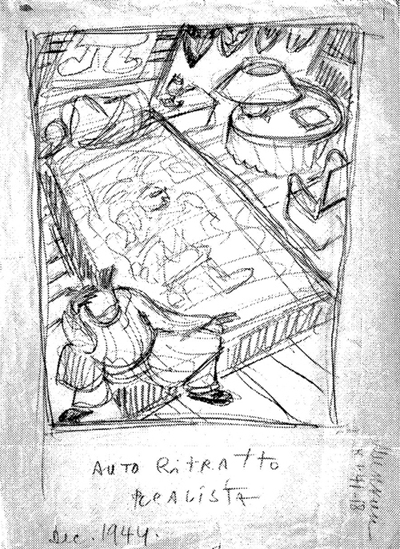
Eisenstein, Self-Portrait (1944).
Sometimes two shots . . .
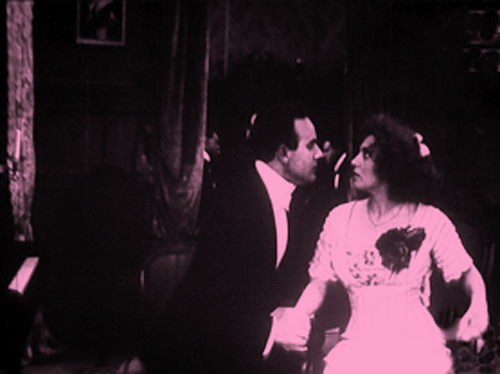
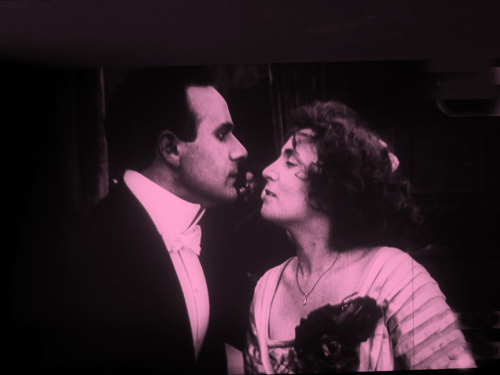
The Mormon’s Victim (1911).
DB here:
. . . just knock you out.
Last summer during a trip to the Royal Film Archive of Belgium I came across a single camera setup that bloomed like a flower in an almost casual way. This entry is in the same spirit, but there’s nothing casual about this cut. I spotted it during my current visit to the Danish Film Archive in Copenhagen.
Nina Gram is engaged to Sven Berg, best friend of Nina’s brother Olaf. But Andrew Larsson, a Mormon, fascinates Nina with his courtliness and his gripping sermons. One night, during a visit to her family’s home, Larsson gets Nina alone while Sven, Olaf, and others are playing cards in another room. She’s starting to succumb to Larsson’s charm offensive (though we think he has offensive charm).
As The Mormon’s Victim (Mormonens Offer, 1911; Nordisk Films, directed by August Blom) develops, Larsson will induce Nina to flee to Utah with him, where he’ll keep her prisoner. Sven and Olaf will track them down by train, ship, and auto, the entire flight and pursuit joined through crosscutting reminiscent of Griffith. The Mormon’s Victim has several memorable shots, including some striking ones taken from a car. But in particular there’s this cut. The two shots surmount today’s entry.
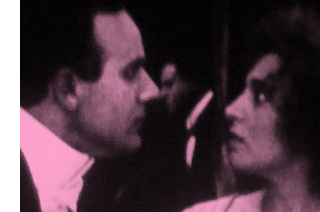
A full shot shows Larsson and Nina in the parlor. Earlier in the scene Sven has left the card game in the distant room to check on what his fiancée is up to. He comes forward hesitantly; this is partly to express his vague worries about Larsson, but it’s also Blom’s way of making sure we know it’s Sven in the rear of the tableau. When Sven returns to the game, he settles in directly behind Nina and Larsson, so that he becomes the most visible figure at the card game.
When Larsson entices Nina away from the piano, they place themselves on the settee in the foreground. And in my first image up top, we can see solid, oblivious Sven right behind them. A blow-up of that area of the shot is on the right.
Then Blom cuts directly in. The axial cut was the most frequent sort of editing found within scenes at this period, and Blom’s cut is more or less along the camera axis, though displaced a bit to the right. The result is a medium two-shot of Larsson staring almost hypnotically at Nina and her responding with rising passion.
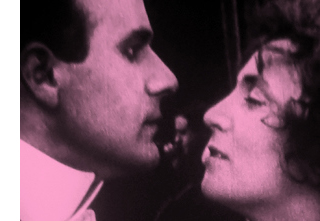 You see where I’m going with this. There’s actually a third person in the shot. Sven is still sitting behind them, but now even more tightly sandwiched between the faces–a tiny figure but fully discernible in the 35mm print. On the right I enlarge that portion of the image for you. Dead center, Sven’s tiny head floats between their profiles like a bubble from Nina’s lips or a rose between her teeth.
This is a remarkable shot. Since Nina eventually turns away and refuses Larsson’s kiss, we’re tempted to say that the shot creates a visual metaphor, suggesting that Sven “comes between” them. Fair enough, especially since the Danes have the same figure of speech (at komme i mellem). But I’d also want to signal how this possibility of thinly-sliced depth fits smoothly into the tableau style I’ve discussed many times on this blog and in my recently posted video lecture. It relies on hyper-precise staging in depth, accentuated by the axial cut (always a cut that accentuates depth).
It’s all the more remarkable because in those days, the camera viewfinder was mounted alongside the lens. We’re so used to reflex viewing–that is, seeing exactly what the lens of our camera or phone is framing–that we tend to forget that until the 1960s, in most cases a cinematographer had to compose the shot allowing for the parallax difference between the viewfinder and the lens. True, in most tableau shots the camera is far enough back to give some leeway for background planes, and some cameras could swivel (“toe in”) the viewfinder inward as the framing got closer. But this scene remains an extraordinary piece of filmmaking. The cinematographer Axel Graatkjaer, only twenty-six when he shot this film, deserves credit for pulling off a rare stunt.
The Mormon’s Victim is yet another example of the great variety and boldness of the cinema of the 1910s. Had I known it, I would probably have squeezed it into my video lecture, “How Motion Pictures Became the Movies.” Maybe I can work it into the followups I plan to post later this year. In the meantime, take this as another instance of why we should thank film archives for preserving fairly obscure films that have a lot to teach us about what talented creators have done with our favorite medium.
Ron Mottram surveys the local films of this period in his indispensable The Danish Cinema before Dreyer. For more on the tableau style, see the lecture I just mentioned, along with the blog entries in the category. I have more on Danish films and the tableau tradition here, and I discuss that tradition as a background to Dreyer in an essay on the Danish Film Institute’s Dreyer site.
Thanks to Thomas Christensen and Mikael Braae of the archive for all their help. I have devoted other entries to their archive and Danish film culture, but this might be the most relevant today.

Mikael Braae surveys a recently received collection of over 400 35mm film prints. He’s in the process of sorting and examining them. There are still big 35mm collections out there!
A hobbit is chubby, but is he off-balance?
Kristin here–
I first read J. R. R. Tolkien’s work during what might be described as the second generation’s discovery of The Hobbit and The Lord of the Rings. The Hobbit was very popular from its initial publication in 1937, enough so that the publisher asked for a sequel. Though Tolkien wanted LOTR to come out in a single volume, postwar austerity dictated that it be divided into three separate volumes. After their publication in 1954-55, a devoted following grew. The real explosion, however, came in 1965, when the Ballantine paperback editions appeared in the USA.
I was fifteen at the time and already an aficionado of Victorian literature (H. Rider Haggard, Jules Verne, Arthur Conan Doyle). I was used to reading long books (David Copperfield, Don Quixote). Like so many other people who were in high school or college in the 1960s, I loved Tolkien from the start. Eventually I became an academic writer. At some point, I decided to write a book on the two Hobbit novels.
I had done a lot of reading and note-taking for that project by the time of the release of Peter Jackson’s film version, The Lord of the Rings: The Fellowship of the Ring. With reservations, I liked that film. What fascinated me more, though, was the incredible success of the innovative marketing and merchandising side of the LOTR franchise. I decided this film was going to be historically significant in a major way. In 2002, I decided to write a book about it.
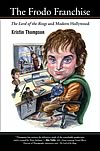
The Tolkien study was put way back behind even the back burner. The franchise book needed to be written now, when I could (I hoped) get access to the filmmakers and to information that would not be available after the last part was released. With enormous good luck and help from many interviewees, I managed to write The Frodo Franchise (2007). My Tolkien project came forward onto the stove and is now in progress.
I’ve kept up my interest in the films, though. Editors have asked me to write short pieces on Jackson’s LOTR, and I’ve done four of those so far. I maintained my Frodo Franchise blog until it became apparent that I would not be granted access to the filmmakers for a book on The Hobbit. Now I’m on the staff of TheOneRing.net, for which I write occasionally. Naturally I’ve kept up on the progress of Jackson’s new trilogy.
Not long ago in these pages, I wrote about the fact that The Hobbit had been expanded from its originally announced two parts to a three-part film. To those who accused the filmmakers of doing this for strictly mercenary purposes, I countered that there were reasons why such an expansion could work well. Mainly these relate to the extra material in the appendices of The Lord of the Rings, which provide information on two kinds of events: those taking place during the time period when The Hobbit’s action unfolds (most importantly an attack on Sauron’s [aka the Necromancer] lesser dark tower Dol Guldur) and those which took place in the past but which relate to characters and actions in the novel (e.g., Smaug’s attack on Erebor and Dale, the Dwarves Pyrrhic victory over the troops of the Orc Azog at Moria).
Having now seen The Hobbit three times, I want to suggest how successfully, if at all, the filmmakers have incorporated this material. For the most part the non-Hobbit material has been brought in well, or in some cases acceptably.
It’s a prequel now
One objection to the division of The Hobbit into three parts is that the book won’t support a narrative nearly as long as that of the filmed LOTR. Over and over, fans and critics have complained that Peter Jackson’s adaptation of The Hobbit (1937) isn’t designed as Tolkien wrote it, as a children’s story, lighter in tone and shorter than LOTR. They often also object to those who refer to it as a “prequel.” The novel’s events took place years before those of LOTR. It was also published first, appearing in 1937, while LOTR came out in three volumes published in 1954-55. The implication is that Jackson should just have ignored the other film and stuck strictly to the novel, which is about a quarter the length of the LOTR tome. As literature, LOTR is a sequel to The Hobbit.
But the films are different. Even if The Hobbit were adapted page by page, speech by speech exactly as written, those of us who have seen the LOTR film or read the book could not see it as a separate tale. We know already what the Ring is and what eventually happened to it, while readers, if they started with The Hobbit, do not. We know that Elrond is a powerful leader among other powerful Elf leaders, destined eventually to leave Middle-earth for the Undying Lands. We know Gandalf is a wizard who will guide the various peoples through the War of the Ring. And so on. Only viewers who see The Hobbit without having seen LOTR first or having read the book or having read any of the extensive media coverage of both could come to the prequel unaware of such things. And while the novel The Hobbit is not a prequel, the film adaptation certainly is.
Because most of us do know about these major characters and premises, Jackson and his team could hardly avoid trying to make the new film match his version of LOTR. He had to treat events, characters, tone, and setting with some consistency, and he had to link the films as one long account of historical events in the same era of Middle-earth.
Tolkien himself tried to smooth out the disparities between The Hobbit and LOTR, both in tone and causal connections. He revised The Hobbit slightly in 1947, mainly to make the Riddles in the Dark scene work better in the light of what the Ring eventually became when he brought it back as a more crucial plot element in LOTR. In 1951, those revisions got into the second edition of The Hobbit and have remained canonical ever since. In 1960 Tolkien was again disturbed by the differences between the two books and launched into a more thoroughgoing revision of The Hobbit to make it conform exactly to the later events in LOTR. Others convinced him that this was a mistake and that it damaged the charm of the earlier book, already a classic of children’s literature. Eventually he allowed those disparities to remain. He did, however, write passages in the appendices that at least briefly described events that helped stitch the two books’ narratives together.
I don’t see that it’s a problem for the filmmakers to use those passages to try and make their films flow more smoothly from the first to the second. In a few years we will be able to watch all six parts of what will then essentially be a single narrative with a sixty-year gap in the middle. For better or worse, depending on one’s opinion, this is Jackson’s Hobbit. Unlike Tolkien, he is making it after already having made LOTR. He can include the links between the two tales, as well as extra plot material that Tolkien published in the 1950s but hadn’t conceived in the 1930s. The question is not whether those links and that material should have been included but whether they have been well handled.
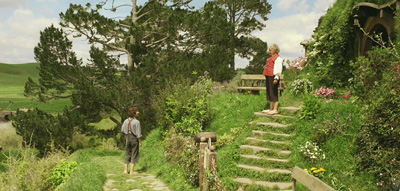
In terms of the links, many of the ones in An Unexpected Journey seem effective. The notion of starting The Hobbit at a point just before Gandalf’s arrival for Bilbo’s 111th birthday party seems a good one: we see Frodo nailing up the “No Admittance” sign from the early LOTR scene and then heading off to read in the woods and await the wizard (above). There’s an immediate recognition factor. The younger Bilbo mentions Bree, a locale seen in LOTR, and he recalls Gandalf’s fireworks from his youth. A fireworks display also figures in Bilbo’s birthday party scene in LOTR. Bilbo’s initial awe upon arriving in Rivendell and his reluctance to leave it tie in with the fact that he goes to live there after leaving The Shire early in LOTR. Certainly the inclusion of Balin, made into a more prominent character than he is in the novel and played with considerable humor and charm by Ken Stott, should make the discovery of his tomb in LOTR a more meaningful and poignant scene. On the whole, the stitching together of the two films so far is quite accomplished, and I assume it will continue to be so through the other two parts.
But is it padded?
Most of these links between The Hobbit and LOTR are brief references or gestures, made in passing. They are not the reason that Jackson’s team decided, to considerable critical and fan uproar, to make The Hobbit in three parts rather than the originally announced two. In the earlier entry, I suggested that there was material in the appendices of LOTR that fills in information relevant to The Hobbit’s plot.
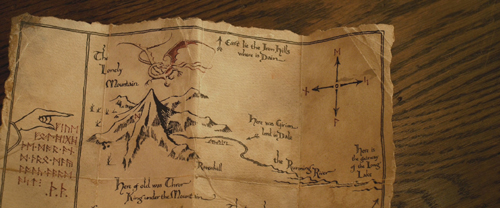
There’s the backstory of the Dwarves, involving two major events. Bilbo’s exposition at the beginning establishes their great kingdom within Erebor (the Lonely Mountain). Its king, Thror (Thorin Oakenshield’s grandfather), oversees the accumulation of a huge horde of gold and gems, and it attracts the dragon Smaug. Smaug’s destruction of the Dwarves’ home and the neighboring city of Men, Dale (portrayed briefly in a sort of Renaissance Italian style), leads to the Dwarves’ exile and hereditary king Thorin’s eventual decision to try and retake Erebor.
Second, there is the great battle fought between the Dwarves and Orcs at Moria, in which Thror is killed and Thorin earns the respect of his people by defeating the great Orc leader, Azog—chopping off his arm and leaving him, as Thorin wrongly assumes, to die.
All of this the film explains in flashbacks derived from the LOTR appendices, and this embedded material seems to me to come off well. In my opinion, most of the other scraps of text used as the inspiration for scenes not in the original Hobbit novel results in reasonably successful scenes—with one major exception, which I will deal with in the next section.
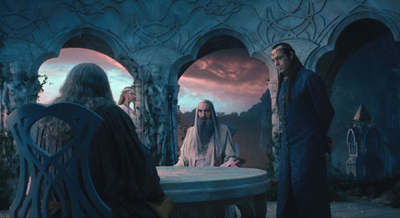
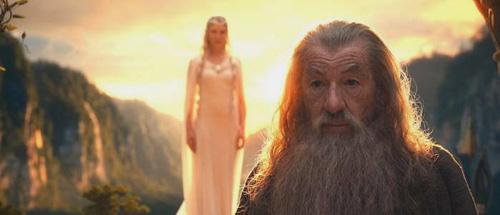
The most important extra plotline concerns the White Council (not so named in the first part of the film). Initially I speculated that the White Council scene would be a flashback to an early meeting. That’s not the case, since Gandalf meets with Elrond, Galadriel, and Saruman during the visit to Rivendell (above). In the novel, when Bilbo and Gandalf revisit Rivendell on their way back to The Shire, the Hobbit simply overhears Gandalf talking to Elrond: “It appeared that Gandalf had been to a great council of the white wizards, masters of lore and good magic; and that they had at last driven the Necromancer from his dark hold in the south of Mirkwood.”
Here, by the way, is an example of the sort of inconsistent plot points that Tolkien presumably hoped to eliminate when he struggled to revise The Hobbit in the early 1960s. By then he had written LOTR and given the Wizards their emblematic colors, so Saruman (and later Gandalf) was the only “White” wizard. The “Necromancer” would become Sauron; the “dark hold in the south of Mirkwood” gained a name, Dol Guldur. What Jackson and the other writers have done is to move that meeting of white wizards (which took place somewhere to the south, presumably either in Lothlórien and Orthanc) to Rivendell. That simplifies things.
Now the question remains, to what degree does the White Council hint that Saruman has already become treacherous? Is he dismissing Gandalf’s worries as exaggerated merely because he’s conservative and just doesn’t much respect the Grey Wizard, or is he secretly searching for the Ring himself (as Tolkien revealed in the appendices)? I hope these questions will be explored further in one or both of the upcoming parts.
Interestingly, Gandalf is already visibly frustrated by Saruman’s presence at Rivendell, and the two are at odds about the degree of danger evidenced at Dol Guldur. Saruman favors inaction, meaning that he opposes the Quest of Erebor. Gandalf sees all sorts of ramifications in the presence of the dragon and the odd goings-on at Dol Guldur. Obviously we know Gandalf is right, especially since Galadriel sides with him from the start. The explicit representation of this action within The Hobbit’s plot is, I think, off to an excellent start. I look forward to seeing how it develops.
Gandalf’s seems to regard Saruman with a mixture of frustration, annoyance, and forced friendliness and deference. How will this attitude affect our perception of Gandalf’s words about Saruman when he prepares to go and consult the White Wizard in The Fellowship of the Ring? There, as Frodo prepares to take the Ring and head to Bree, Gandalf says, “I must see the head of my order. He is both wise and powerful. Trust me, Frodo, he’ll know what to do.” In retrospect, Ian McKellen’s reading of these lines in Fellowship works in remarkably well with Gandalf’s attitude toward Saruman in the White Council scene in The Hobbit. He speaks the first two sentences quickly, without inflection, as if reciting them; we could interpret them as arising from a sense of duty rather than hope that Saruman really can or will help. The “Trust me, Frodo” sentence is accompanied by a tight smile, perhaps the sort of forced smile that Gandalf assumes as he turns to greet Saruman in the White Council scene. Given that neither director nor actor was presumably looking forward to someday adding such a scene, they turned out to be lucky that Gandalf’s speech was delivered in such a way that it could imply a lurking dislike or distrust of Saruman. (There is evidence for such distrust in the novel. In his long conversation with Frodo about the Ring, Gandalf remarks “I might perhaps have consulted Saruman the White, but something always held me back …. His knowledge is deep, but his pride has grown with it, and he takes ill any meddling.”)
One admirable thing about the Rivendell sequence is that the friendships among Elrond, Galadriel, and Gandalf are portrayed. In the book, these three have known each other for two thousand years. They are the bearers of the Three Elven Rings. Those who know only the film of LOTR are unlikely to be aware of that, since only in the penultimate scene at the Grey Havens are the three openly wearing their Rings—barely noticeable even on the big screen. Oddly, however, the licensed tie-in products for LOTR included replicas of Narya, Nenya, and Vilya, made by the Noble Collection. The three characters are able to communicate telepathically. Elrond, portrayed as rather aloof in LOTR, is a warmer figure here, embracing and teasing Gandalf, and the scene after the White Council meeting in which Galadriel reassures Gandalf and offers him her help is one of the most genuinely moving moments in the film (see top). (We never saw Galadriel and Gandalf together in the LOTR film, though they are together in some of the late book chapters that were cut in the adaptation.)
Radagast the Fool
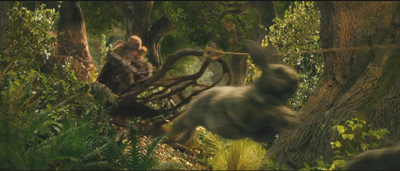
Then there’s Radagast. The Brown Wizard appears in one scene in the novel version of LOTR, but Jackson and company eliminated him. Radagast is only mentioned in The Hobbit, but now he appears in two extended scenes and presumably will return in the later parts. Many fans object to Radagast’s being made into a comic figure, driving a sled pulled by large rabbits and hosting birds in his hair, with a resulting streak of droppings down the side of his head. Never mind that in Radagast’s one scene in LOTR, Tolkien portrays him as faintly comic, as well as timid and ineffectual. While pumping up the humorous side of the Brown Wizard, Jackson develops him into a character with considerably more gumption.
It has also been claimed that his role in the drama isn’t significant enough to warrant his presence. Did we really need all this time devoted to someone who’s there mainly to give Gandalf the Morgul blade as evidence of foul goings-on at the seemingly deserted Dol Guldur? Yet the dialogue does help motivate his importance. Gandalf declares to Bilbo, “He keeps a watchful eye over the vast forest lands to the east, and a good thing, too, for always evil will look to find a foothold in this world.” That dialogue hook leads to the first scene with Radagast, walking through the forest and finding death and decay, evidence of a mysterious force that he traces to Dol Guldur.
And the blade brought to Gandalf is definitely a significant object. When Gandalf presents it to the Council, Galadriel is very perturbed by it, and Elrond loses his initial certainty that Middle-earth is at peace. By the end of the scene, only Saruman denies the need to investigate what’s going on at Dol Guldur. Gandalf’s visit to Dol Guldur and the White Council’s subsequent actions in relation to the Necromancer’s presence there will form a crucial subplot in the upcoming parts; we’ve already glimpsed part of Gandalf’s exploration of the stronghold in the trailers.
Radagast also serves to draw the Orc band away from the Dwarves, Bilbo, and Gandalf. He drives his infamous bunny sled across the rolling hills, allowing the group time to find the hidden entry into Rivendell. But is the bunny sled so very ridiculous? Teanna Byerts, aka swordwhale, a member of the Message Boards at TheOneRing.net, has written an informative and amusing essay, “Radagast’s Racing Rhosgobel Rabbits: A Recreational Musher Looks at the Realities of Bunny Sledding.” It turns out that a sled would not be a bad vehicle for a woodland environment, and, allowing for the fact that this is a fantasy film, large rabbits not entirely implausible beasts for pulling them. (A Google Image search on “large rabbit” brings up some bunnies about the size of Radagast’s–and no, they’re not all Photoshopped.) The main problem is that ordinary rabbits would not pull as a team, but as Radagast says with relish, “These are Rhosgobel Rabbits!”
Although there is probably too much silliness relating to Radagast, on balance I think that he is a plus for the film and shouldn’t be dismissed as mere padding. Tolkien’s novels suggest that Radagast is a member of the White Council, one of the “white wizards” Gandalf met with down south. He lives in southern Mirkwood at Rhosgobel, a short way north of Dol Guldur. As Gandalf’s speech quoted above (not in the book) indicates, despite Radagast’s hermit-like ways and fascination with nature, he keeps an eye on things in the area. He also seems to maintain a system of bird messengers and spies for the use of the White Council. (In the novel he, not some passing moth, is responsible for the eagle Gwaihir appearing at Orthanc to rescue Gandalf.) Though Radagast never visits Dol Guldur in the book, he generally does the sorts of things that he does in the film. Although he perhaps contributes little in the first part of the film, we should withhold judgment on his importance to the plot until we see what he does in the second and perhaps the third.
The chase of the Orcs after Radagast’s sled, by the way, exemplifies one of the several lapses of causal motivation in the film. Why do the Orcs try to catch Radagast? They are specifically after Thorin, and the Orcs have no way of knowing that Radagast has any connection to the Dwarves. If they take off after every passing stranger when they are supposed to pursue a specific mission, these Orcs make very poor hunters. And while we’re on the subject, how does Radagast get all the way from southern Mirkwood, which is on the far side of the Misty Mountains, and find Gandalf so quickly?
A final note on Radagast. For those of us who were lucky enough to see Sylvestor McCoy play the Fool to Ian McKellen’s Lear during the stage tour, there is a bit of added resonance in their scene together.
Unjolly giants
The scene of the stone-giants has been criticized as well. They occupy four minutes of screen time, putting the Dwarves and Bilbo in extreme danger without having any real link to the plot. The scene’s only causal function is to give Thorin another opportunity to belittle Bilbo. The episode derives from a few brief remarks in the middle of the novel’s description of a terrible thunderstorm the group encounters in the high mountain pass:
When he [Bilbo] peeped out in the lightening-flashes, he saw that across the valley the stone-giants were out, and were hurling rocks at one another for a game, and catching them, and tossing them down into the darkness, where they smashed among the trees far below, or splintered into little bits with a bang …. They could hear the giants guffawing and shouting all over the mountainsides.
Douglas Anderson has suggested that by “stone-giants” Tolkien meant a particular type of troll; he mentions the “Stone-trolls of the Westlands” in Appendix F. (See the second edition of The Annotated Hobbit, p. 104.) If so, they would probably only be a little larger than the three trolls in the earlier forest scene. But whatever they are, they are clearly not fighting but playing a game. Moreover, the Dwarves, Bilbo, and Gandalf (who does not stay behind in Rivendell in the novel) are inside a cave when all this happens. Jackson could have chosen to leave out such a brief references, but he instead turns the creatures into immense giants made of stone, and they are having a flat-out battle rather than a game. I don’t think this was part of an effort to stretch the film into three parts but results from Jackson’s tendency to add or extend action scenes.

Finally, the film considerably lengthens the Goblin-town episode and includes a great deal more combat. In the book, Gandalf quickly kills the Great Goblin and leads the Dwarves and Bilbo in a race for the entrance, with a couple of skirmishes with small groups of Goblins. Again, I don’t think the expansion was created in order to necessitate a third part to the film. This scene had almost certainly been planned and shot well before the decision to ask Warner Bros. for permission to add a third part. Extending the scene is another instance of Jackson’s penchant for big action sequences, and especially battles. I find it a bit overlong myself, but many fans probably like it.
Azog the Defiler of Plots
There is, however, a plotline that does seem to me to be padding. The placement of scenes involving its action damages the narrative rhythm of the film as a whole. The plotline centers around Azog the Defiler, the “Pale Orc” whom Thorin grievously wounded in the battle at Moria (below) and who turns out not to be dead. Instead, he and his band of Orcs, bent on revenge and mounted on wargs (giant wolves) are hunting for Thorin. Making room for this line of action evidently led the filmmakers to cut other scenes that I, and undoubtedly some others, would have preferred to see.
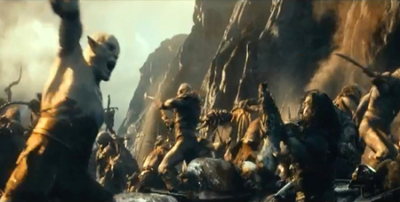
Critics have pointed out a pattern of rescues and respites in both The Hobbit and LOTR. At fairly regular intervals, the characters get into dangerous situations and are rescued, often by someone completely unexpected and even unknown. They then spend a peaceful time with their rescuers before going on to the next challenge. This pattern is so consistent and evident that Ursula K. Le Guin termed it the “rocking-horse gait” of the books.
Obvious examples of down-time are the interludes in Rivendell in both books and the stay in Lothlórien in LOTR. These aren’t dull stretches. They’re occasions for introducing new characters, giving exposition, and bringing a new population with a distinctive culture into the mix of peoples uniting to battle evil. They’re about character development and revelation. They’re about showing off the beauties and wonders that make Middle-earth such an attractive, fully realized fantasy world. And between the battles and chases, they give us, as well as the characters, a bit of respite. This rescue pattern is one of the most basic structures of both of Tolkien’s novels. (I’ve devoted a chapter about it for my book-in-progress.)
The Azog plotline throws off the rescue/respite pattern (which Jackson’s team respected more consistently in LOTR). Worse, it tips the dramaturgical balance of the whole film. First there is the ten-minute troll battle, and then a pause while the group explores the cave. That moment of quiet action lasts only four minutes, and then Radagast shows up. I take this to be the beginning of the next scene of fear and danger, since the Brown Wizard agitatedly launches into a tale about his visit to Dol Guldur, presented as a flashback full of menace and threat. Almost as soon as he finishes, the chase begins. The Radagast scene to the point where the Dwarves’ group hides and Elrond’s Elves drive the Orcs away lasts 9:39 minutes, roughly the same length of time as the trolls scene.
The big Azog battle, in which the Defiler shows up in person and Thorin at last realizes that he’s alive, similarly comes very soon after the end of the huge Goblin-town battle and the concurrent Riddles in the Dark scene. The Goblins/Gollum action lasts 28:37. Once it ends, there’s an all-too-brief scene while the Dwarves and Gandalf think Bilbo has lost or has deserted the group, only for him to show up and explain why he has decided to stay with them (2:53).
Then Azog and his band arrive. The rather straightforward scene in the book, with ordinary Goblins and wolves trapping the company in some fir trees (not on the edge of a cliff), becomes a full-blown battle with Thorin nearly killed and Bilbo prematurely summoning up his submerged courage to save him (11:00). After three viewings, my basic response when the final forest confrontation with Azog begins is, Oh, not again! We’ve just had nearly half an hour of suspense and violence, with considerable variety and impressive filmmaking. The Goblin/Gollum scene should be the high point of the film. To have a shorter battle immediately after it makes the Azog fighting suffer by comparison while undercutting our memory of the earlier, longer one. I don’t think the Azog scenes in general add anything except brute action. Yes, they give Thorin a new revenge motive, but it kicks in only at the end of the film, and he already has plenty of dark motives with his hatred of Smaug and the Elves, particularly Thranduil. Far better to have stuck to Tolkien’s simpler version, ending the film with the group treed by generic Goblins and wolves and then get to the eagles’ rescue as quickly as possible.
The decision to end part 1 by moving away from the group and following a thrush to the Lonely Mountain is, I think, one of the more inspired additions to the story. As the thrush cracks a snail, the sound seemingly carries through the rock and into the cavernous interior, where we see a close view of Smaug’s eye emerging from a great heap of gold and popping open. Smaug is a great villain, unlike Azog, and I suspect his first conversation with Bilbo will be the equal of the Riddles in the Dark scene.
The Azog plotline also introduces a massive coincidence. Just after Balin has told the group the tale of the Moria battle and Gandalf and Balin have exchanged glances suggesting that they do not assume Azog is dead, there’s a cut to Azog’s Orcs appearing and discovering the group. We don’t know how long it has been since the Moria battle, but has this group of hunters been combing Middle-earth for Thorin ever since, while Azog cools his heels at Weathertop waiting for them to report to him? Possibly some sort of motivation for this will be supplied in part 2, but it’s really not a good idea to leave such a flagrant coincidence unexplained within this part.
Doing the numbers
Some have complained about the slow beginning of the film, which, apart from the early flashback to the kingdom of Erebor and city of Dale and their destruction by Smaug, takes place entirely in and around Bilbo’s home, Bag End. As has been endlessly pointed out, Bilbo’s race down the Hill to catch up to the Dwarves starts fully thirty-nine minutes into the film (not counting the open series of logos). To those interested in character and plot–and faithfulness to Tolkien’s book–this makes perfect sense. To those just waiting for the big action scenes, it’s frustrating. But the long exposition has to accomplish something that never challenged Tolkien: differentiating thirteen Dwarves. In the novel, only a few members of the group get any significant amount of characterization, and they mostly remain shadowy background figures whom we don’t have to visualize as individuals. But in a film they’re all there on the screen, and Jackson has to at least give them distinctive appearances. He goes further and assigns them traits, however simple, and on the whole does a good job of it.
To me, apart from the overly coarse behavior of the Dwarves (does Kili really have to be so boorish as to scrape his muddy boots on Bilbo’s furniture?), this early part of the film consists mostly of entertaining, lovely stuff. Kudos to Jackson’s team for keeping not one but both Dwarf songs, which nicely display the contrast of comedy and determination that underlies the group’s nature. The contract-reading scene and Gandalf’s attempts to persuade Bilbo to join the Dwarves’ quest are both entertaining and nicely revealing of Bilbo’s character. I particularly like the quiet conversation between Thorin and Balin, with Balin trying to talk Thorin out of the quest and Thorin revealing his reasons for confidence and hope. (In some ways, this makes little sense, given that it is Balin who later rashly sets out to try to retake Moria and ends up getting himself and his colony of Dwarves killed, but at this point it’s a minor matter.)
Again, though, there’s a problem of balance. So much of this fascinating material is crammed into the opening, and so much of the rest of the film is taken up with dangerous action scenes. It’s notable that the Goblins/Gollum sequence and the final Azog battle add up to 39:37, almost exactly the same length as the opening of the film up to Bilbo’s departure from home. The string of action scenes that begin with the trolls proceeds with only brief letups. A major exception is the Rivendell interlude, with the crucial White Council scene.
Then there’s the Riddles in the Dark, by common consensus the best thing in the film. It’s a relatively quiet and riveting scene, though here, too, Bilbo is clearly in danger from Gollum. Amusing though some of the latter’s antics are, he frequently drops from his Smeagol to his Gollum personality and tries to attack Bilbo. The part after Bilbo puts on the Ring is extremely well done, with him gradually realizing that Gollum can’t see him, and Gollum’s feelings at the loss of the Ring slowly settling from rage to anguish as his big eyes shift and look straight through the invisible Hobbit. Letting Bilbo see Gandalf and the Dwarves escaping and yet not being able to join them because Gollum crouches in the way is a clever touch–a slight improvement on the book, perhaps, since it makes it more plausible that Bilbo can find the group so quickly once he jumps over Gollum and escapes.
A sense of imbalance isn’t just my impression of the film. Timing the individual scenes reveals a remarkable pattern. Without logos or final credits, the film runs about 158 minutes. The mid-point would be roughly 80 minutes into it. The mid-point of a film usually comes at a particularly important dramatic turning point. In this case, at 80:40 minutes, the Elves drive the attacking Orcs away, leaving the Dwarves, Gandalf, and Bilbo safe and free to follow the secret passage into Rivendell. Thus the Rivendell interlude begins the second half.
I’ve timed the individual scenes and divided them up into action (threat, flight, battle) and quiet (conversations, meals, peaceful traveling) scenes. In the first half of the film, there are roughly fifty-one minutes of quiet scenes and 31 minutes of action. In the second half, the pattern is reversed with a surprising precision. The peaceful scenes run a total of 31 minutes, and the action scenes 48 minutes. (These figures don’t exactly add up to 158 minutes, because I’ve rounded off to the nearest half minute–and it’s not easy to time these things to the second!) Moreover, since the Rivendell scene opens the second half (being in the position of the Bag End scene for the first half), there are about 46 minutes of action in the rest of the film, versus 10.5 minutes worth of peaceful scenes. Hence my sense that the film is unbalanced.
Of course we would expect an adventure film to build toward bigger action scenes near the end, but the first part of The Hobbit has come close to squeezing much of its plot-centered scenes toward its beginning and the action ones toward the end. The stone-giants, Goblins/Gollum, and Azog scenes come all in a row. Imagine the Helm’s Deep battle in The Two Towers ending and the filmmakers ramping up another scene of combat. As it is, ending that part with Gollum’s quiet, menacing plotting against Frodo and Sam is far more effective.
Throughout the second half of The Hobbit, there are precious few pauses for simple conversations when the characters are not scared stiff. One seizes upon the few moments of this type with gratitude, as when Bilbo is about to leave the Dwarves and go back to Rivendell and ultimately home. He has a brief exchange with Bofur, who sadly realizes the truth of Bilbo’s statement that the Dwarves have no place where they belong and yet still summons the friendly good nature to wish the Hobbit well. More touching moments like that are needed.
Azog’s collateral damage
My impression is that Azog has muscled his way in by crowding out material of the quiet sort. Still images on the internet and shots in the trailers show moments that should be in this part of the film but are not. McKellen and others have mentioned in interviews that there was to be a flashback to Gandalf putting off fireworks at a Hobbit party long before and meeting the very young Bilbo. A production image of that scene (below) appeared on the internet, but there’s no such moment in the film. Logically, it could only come early on, perhaps in the conversation between Gandalf and Bilbo after dinner, to show the contrast between the adventurous, eager youth and the staid, middle-aged Bilbo who is determined to resist the Tookish side of his nature.
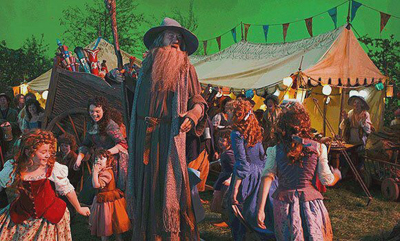
Some of the trailers and TV spots showed Bilbo at Rivendell, walking up some stairs and coming upon the statue holding the shards of Narsil (below). That blade, which we see cutting the Ring off Sauron’s hand in the prologue battle of The Fellowship of the Ring, will be reforged for Aragorn and renamed Anduril in The Return of the King. The idea that Bilbo might see the pieces of that sword so shortly before finding the Ring itself seems a strong addition to the film.
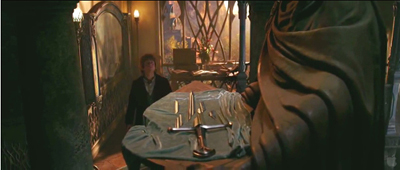
The frame I used as the top illustration in my earlier entry is from a trailer, but it is not in the film either. It showed Bilbo on a bridge at Rivendell, looking up admiringly at the building or landscape. That might have been part of the scene with Narsil, showing Bilbo wandering around Rivendell. There was supposedly going to be a conversation between Elrond and Bilbo, perhaps also part of the same scene with Narsil, but that, too, is missing. I would much rather hear what Elrond had to say to Bilbo, whether about the sword or Rivendell or Elves in general, than sit through yet more of Azog ordering his characterless Orcs around. (The brief scene, cut into the Rivendell interlude, in which one of those Orcs reports failure to Azog and is thrown to a warg to be devoured is particularly gratuitous and unpleasant. Yes, we need to know that Azog is still alive, but that revelation could have come later.)
I hope and expect that the cut scenes and others like them will be restored to their proper places in the extended-version DVD/Blu-ray release, already announced.
All this promising material was cut, evidently to give more room to Azog. What prompted the filmmakers to add him? I have no idea. In a press junket interview about a week before the release of the film last month, Philippa Boyens was asked about scenes added to The Hobbit’s plot. She responded:
I love Azog, Azog the Defiler. Because we just loved that name and he is a character that we just loved that back story and thought we can’t have him be dead, we’re going to keep him alive. So we enjoyed that … bringing him back. And I think we do that quite powerfully, he’s got a good journey to go on.
This baffles me, since ordinarily Boyens has specific, narrative-based justifications for changes made during the adaptation process. But how can one love Azog as a character? In the book, he’s an unusually large Orc who leads the troops at Moria. He has two lines of dialogue that just establish him as nasty, which is what one would expect of any Orc (see the “Durin’s Folk” section of Appendix A of LOTR). He survives the Moria battle depicted in the film, but Tolkien killed him off in that battle in LOTR. He is referred to in passing in The Hobbit novel as Azog the Goblin. The filmmakers have added “the Defiler.” Either the filmmakers thought they needed to pump up a story that already had enough action, or they for some reason did love this bit player of an Orc and let that feeling blind them to the damage he did to their plot. If by “journey” Boyens means a character arc, so far I don’t see any sign of Azog having one. I doubt he’ll reform.
Admittedly, a lot of fans of the film seem to like the Azog scenes. Many of them are probably unfamiliar with the novels and unaware of what is being left out or distorted. But I am far from alone in my opinion. Eric Wecks of Wired has written two short but perceptive commentaries, one on the trailer before he had seen the film and one after seeing the first part. He declares the Azog plotline and particularly the final battle as “wholly unnecessary.” But overall, like me, he admires the film. Many fans aren’t keen on Azog, either. TheOneRing.net has a large cache of fan reviews (1,815 last time I checked) They include one by Sirwen, who, although he or she likes the film and gives it 4.5 out of 5 “Rings,” lists several complaints. Number one is, “I understand that they wanted to have villain since Smaug is essentially MIA until much later in the story, but Azog just seemed random. I am assuming that he will turn out to be working for Sauron, because otherwise it makes no sense why he would wait a century for revenge.” I’m not assuming that Azog will turn out to be working for Sauron, though it’s possible. But Sauron is at this point in hiding, trying to regain physical form–at least, he is in the book. The Nazgûl are also in hiding. How would Sauron know about Thorin’s quest?
The Azog plotline is the only thing in the film that strikes me as truly superfluous. The screenwriters might not see it that way, but it also happens to be the only thing added to the story that has no justification in the appendices or anywhere else in Tolkien’s writing.
This doesn’t mean, however, that the notion of filling out the plot of Tolkien’s novel with other material was a mistake. So far, the importation of Radagast, the White Council, and the Dol Guldur menace work reasonably well and presumably will continue to do so. The scenes that I’ve mentioned as having been cut probably would have worked well, too. But if in the next parts Azog keeps popping up to have yet another attempt at killing Thorin, that plotline will become even more distracting, tedious, and, yes, padded.
[January 19, 2014: To find out where my speculations about the extended edition of Journey and The Desolation of Smaug, see my follow-up entry. Warning: spoilers for both Desolation and the third part, There and Back Again, plus some criticism of what I consider flaws in the film.
LeGuin remarks on the “rocking-horse gait” of Tolkien’s novels in “The Staring Eye,” included a collection of her essays, The Language of the Night: Essays on Fantasy and Science Fiction, Susan Wood, ed. (1974; New York: G. P. Putnam’s Sons, 1979), p. 173.
The generalizations I’ve made here about fan and critical opinions about The Hobbit were gleaned mostly through perusing many fans’ comments on Facebook pages and the Message Boards on TheOneRing.net, and reviews, often rather ephemeral online ones. I haven’t kept track of all of these and can’t give links, as I normally would.