by Kristin Thompson. Berkeley: University of California
Press, 2007.
400 pages, 6 × 9 inches, 12 color illustrations;
36 b/w illustrations.
[go
to Amazon | go to The Frodo Franchise blog]
On Monday, I offered an overview of the five nominees for Best Original Score as well as a prediction regarding the winner. Today, I do the same for the Best Original Song nominees.
The usual caveats apply for those readers interested in the online betting markets. My picks are for “entertainment purposes only.”
As we’ll see, the race in the Best Original Song category is extremely competitive. Indeed, I almost flipped a coin to make my final decision. I didn’t. But the very fact that I thought about it indicates the low level of certainty I have about my prediction.
I should add that there are a few SPOILERS AHEAD. If you don’t want to know some of the key plot twists in Eurovision Song Contest: The Story of Fire Saga or a small but important plot point of The Life Ahead, you can skip to the last section.
Best Original Song: The Underdog
One striking detail about this year’s nominees is the fact that four of the five function as “needle drops” introduced as the film’s closing credits start to roll. Perhaps a steady diet of television episodes streamed during the pandemic has accustomed viewers to expect that this is the way songs now function in movies. Several shows, both old and new, have used these needle drops quite creatively. (I’m thinking here of Mad Men, The Marvelous Mrs. Maysles, and WandaVision. I’m sure you all have your own favorites.)
Set off from the narrative flow of the episode, music supervisors found they could use a song as a curtain closer to highlight elements of theme, tone, or mood without worrying about things like time period or the musical tastes of the show’s characters. Such transmedial influences eventually might establish this as the primary function of popular songs in films. If this year’s nominees are any indication, the trend is already well on its way.
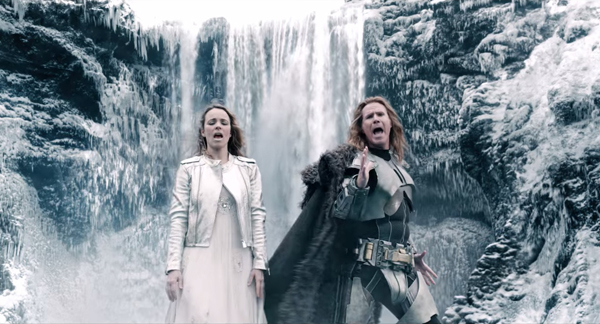
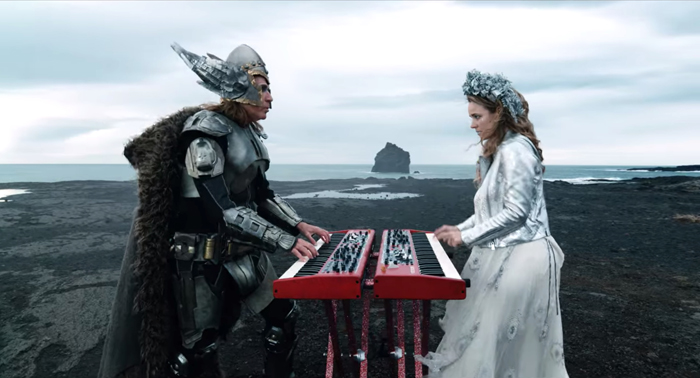
The one exception is “Husavik (My Hometown)” from Eurovision Song Contest: The Story of Fire Saga. The film, of course, is a vehicle for star Will Ferrell. He plays an Icelandic version of his usual man-child persona. It adds, though, a musical competition element borrowed from other comedies, like Pitch Perfect, and from popular music shows, like American Idol.
Ferrell plays Lars Ericksong, a humble “meter maid” whose lifelong dream is to compete in the Eurovision Song Contest. Eurovision, of course, is an annual event in real-life. It remains the longest running internationally televised music competition. The contest played an instrumental role in launching the careers of artists like ABBA, Céline Dion, and Julio Iglesias.
Lars hopes to follow in their footsteps, but his ambitions are mocked by the other residents in his small town.
Lars’ only defender is Sigrit, his childhood friend and his partner in the musical duo Fire Saga. Fire Saga plays a vital role in the town’s musical culture, performing regularly at a local bar. Yet their audience mostly rejects their musical offerings. Instead, they prefer “Ja Ja Ding Dong,” a sexually suggestive nonsense song that is the antithesis of past Eurovision winners.
Sigrit, played winningly by Rachel McAdams, is steeped in Icelandic folklore. She makes offerings to a small den of elves that she hopes will prompt Lars to return her considerable affections for him. She also believes in the “speorg note,” a mystic tone that Sigrit’s mother tells her represents the truest expression of the self.
Fire Saga enters the national competition hoping to earn the honor of representing Iceland. During an Icelandic Public Television meeting, their song is picked at random simply to meet Eurovision’s requirements for a country’s eligibility. At Reykjavik, Lars and Sigrit nervously wait backstage for their performance. Sigrit wishes that she could sing in their native language since it would calm her down. Lars, though, warns against it noting that a song in Icelandic would never win Eurovision.
Fire Saga loses to a talented competitor named Katiana, played by Demi Lovato in a nice cameo. Embittered, Lars refuses to attend a party celebrating the winner and Sigrit joins him in solidarity. When the boat hosting the party explodes, killing everyone aboard, Fire Saga becomes the Icelandic entry as the only surviving runner-up.
Once in Edinburgh, the site of the 2020 competition, Lars and Sigrit clash regarding the best way to present their music. (In reality, the 2020 Eurovision contest was to be held in Rotterdam but was cancelled due to the pandemic.) Lars wants to wow the audience with elaborate costumes and stagecraft. He also hires a K-Pop producer to remix their recording, giving it a hip new arrangement. Sigrit would rather just let the music speak for itself.
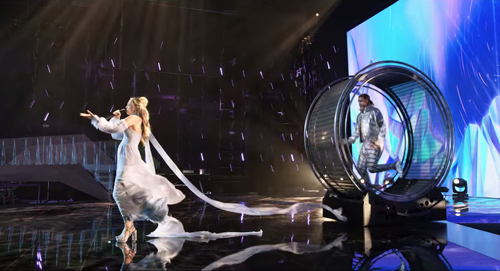
During the semi-finals, Fire Saga’s performance of “Double Trouble” seems to be going well. But Lars’ desire for showmanship backfires when the absurdly long scarf he has given Sigrit gets caught in the gears of his giant hamster wheel.
Sigrit is able to free herself before she suffers the fate of Isadora Duncan. But the hamster wheel breaks free and crashes into the audience. Although Lars and Sigrit recover just in time to finish the song, they are initially met with stunned silence. This is followed by some snickers scattered amongst the crowd. Lars and Sigrit leave the stage dejected, smarting from their humiliation.
Crestfallen, Lars returns to Húsavik, reconciled to life as a fisherman rather than a musician. Sigrit stays behind to continue her dalliance with Alexander Lemtov, a rival contestant from Russia. Sigrit is gobsmacked when she learns that Fire Saga has been voted through to the finals, a plot twist perhaps inspired by the real-life hate-watching that produced surprisingly long runs by American Idol contestants like Sanjaya Malakar.
Lars makes a mad dash back to Edinburgh, both to participate in the finals and to declare his love for Sigrit. Looking like the Gorton Fish guy, Lars sneaks onstage just as Sigrit has begun “Double Trouble.” He stops her mid-phrase and persuades her to sing a new song even though he knows the change will result in Fire Saga’s disqualification. Sigrit begins tentatively but soon grows in confidence as she reaches the chorus, sung in Icelandic much to the delight of those watching in Húsavik. The song builds to its climactic final note, a high C# that is held for several seconds, leaving both the audience and Lars rapt in awe. This time Fire Saga’s performance is met with thunderous applause. In an aside just for the viewer, Lars exclaims, “The speorg note!”
There’s a lot wrong with Eurovision. Some of the film’s gags misfire badly. The race to get Lars from the airport to the auditorium features the kind of crazy stunt work that’s grown stale from overuse. (Think spinning car and reaction shots of screaming passengers!) And at 126 minutes, Eurovision has two or even three subplots too many.
Yet the filmmakers definitely stick the landing with Fire Saga’s triumphant performance of “Husavik (My Hometown).” Seeing Lars cede the spotlight to Sigrit and her rise to the moment brings a lump to the throat, just as it does in other show-biz success stories like 42nd Street (1932) and A Star is Born (2017). (It’s an old formula but a potent one.)
Moreover, the sequence pays off several dangling causes (the reference to Icelandic lyrics in the scene backstage, the rekindled romance of Lars’ father and Sigrit’s mother, the speorg note). Even Fire Saga’s disqualification strikes the right tone by making the duo the musical equivalent of Rocky. They win by losing, content in the knowledge they were worthy contenders and in the realization of what they truly value. Watching the folks back in Húsavik swell with community and nationalist pride is just the cherry on top of a very satisfying sundae.
Any one of Eurovision’s Europop pastiches would have been worthy of nomination. For example, the faintly ridiculous quality of Lemtov’s “Lion of Love” makes it a perfect surrogate for the character’s ostentation and vanity. But only “Husavik (My Hometown)” both tickles the fancy and tugs the heartstrings.
Still, despite its appositeness for Eurovision’s story, I think it is a long shot when it comes to claiming the trophy. You have to go back to The Muppets in 2011 to find an Oscar-winning song in a live action comedy. And that was a strange year in which there were only two nominees. Before that, you have to reach all the way back to 1984’s The Woman in Red. That year, the winner was “I Just Called to Say I Love You,” written and performed by the great Stevie Wonder. Despite its considerable craft, “Husavik (My Hometown)” seems unlikely to alter a trend that rewards songs in dramas rather than comedies.
The Bridesmaid (as in “Always the…”)
This past February, Diane Warren received her twelfth Academy Award nomination for “Io Sì (Seen),” featured in the Italian film, La Vita davanti a sé. Warren has won an Emmy, a Grammy, and two Golden Globe awards, but has yet to claim an Oscar. This puts Warren in some pretty good company. Her colleague, composer Thomas Newman, has been nominated fifteen times without winning. Composer Victor Young received 21 nominations before finally breaking through with Around the World in 80 Days (1956). Sadly, Victor Young didn’t live long enough to actually receive the award. He died at age 57 just months before the ceremony.
Warren’s latest effort, “Io Sì (Seen),” is the type of soaring power ballad she has spent much of her professional life perfecting. The song starts with a modest piano figure that accompanies Laura Pausini’s indomitable voice at a moderate tempo. The lyrics offer a simple but powerful declaration of emotional support regarding the need to be “seen.” Pausini’s voice rises in the chorus as she vows in Italian, “But if you want, if you want me, I’m here.” The addition of a string orchestra and tasteful percussion accents provides additional emotional heft.
The modest arrangement allows the song’s simple beauty to shine through. Its mood and Pausini’s vocal delivery seem miles away from the bombast that made Aerosmith’s “I Don’t Want to Miss a Thing,” one of Warren’s earlier nominees, a chart-topping single.
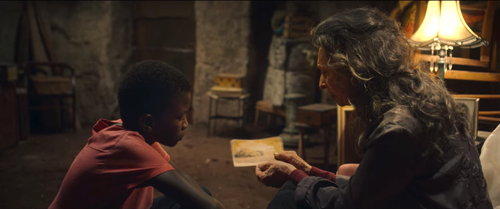
For me, though, that is all to the good. La Vita davanti a sé is itself an unassuming coming-of-age tale that depicts the unlikely friendship that develops between Madam Rosa, an elderly Holocaust survivor, and Momo, a 12-year-old orphan from Senegal.
Buoyed by Sophia Loren’s valedictory performance, the song reflects the strong filial bonds that form when Momo becomes Rosa’s ward. The lyrics’ reassurance that “I’m here” capture the ways in which Momo and Rosa have learned to care for one another. Placed just after the funeral ceremony that closes the film, “Io Sì (Seen)” sustains the scene’s bittersweet, melancholy tone and carries it into the credits. The song also reiterates the story’s central themes regarding the need for unconditional acceptance and love’s ability to overcome differences in gender, race, and age.
La Vita davanti a sé has become an unlikely hit for Netflix. At the peak of its popularity, it reached the streaming service giant’s top ten in 37 different countries. Perhaps that sleeper success will bolster Warren’s chances among Academy voters. She is eminently deserving of the award as a sort of career honor.
Could this be Warren’s year? Perhaps. Still, the fact that more famous songs by Warren, like “Because You Loved Me” and “How Do I Live,” also suffered defeat raises some doubts.
Panthers and Boxers and Yippies (Oh My!)
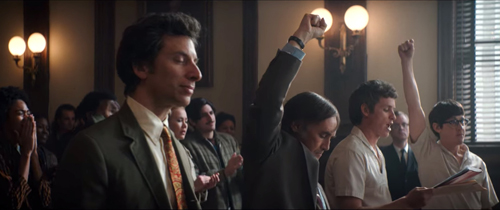
The three remaining nominees are all songs featured in films that look back at the legacy of sixties political activism. Unlike Eurovision Song Contest and La Vita davanti a sé,Judas and the Black Messiah, One Night in Miami, and The Trial of the Chicago 7 all received multiple nominations. Often the halo effect created by that reflected glow can make a difference in very competitive races. Moreover, the two titles receiving Best Picture nominations – Judas and Chicago – also benefit from the massive “For Your Consideration” ad campaigns that appear in trade publications like Variety. All of this suggests that, if you are looking for this year’s winner, you might look here.
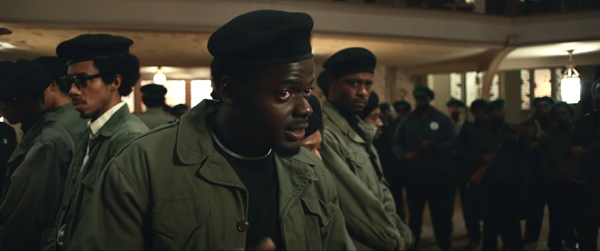
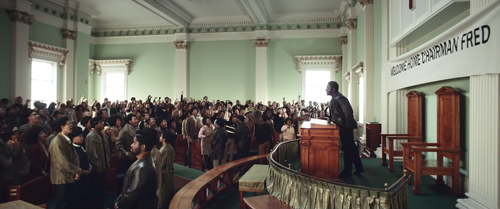
Let’s start with “Fight for You,” the groovin’ track by H.E.R. that closes Shaka King’s Judas and the Black Messiah. The song self-consciously evokes music from the period depicted in the film. As H.E.R. told Variety, she wanted the music to have a hopeful vibe, but lyrics that connected to the Black Panthers’ historic fight against injustice. She drew upon the classic soul music of Marvin Gaye, Nina Simone, and Sly and the Family Stone, artists who made records that were both popular and politically astute.
The final product is a remarkable synthesis of these different elements. The syncopated brass and organ chords recall vintage Sly and the Family Stone tunes like “Stand.” The spare but funky bass line and the supple guitar melody wouldn’t be out of place on Gaye’s classic, “Let’s Get it On” while the doubling of H.E.R.’s voice, sometimes in octaves and sometimes in thirds, conjures up his masterful What’s Going On album. The string arrangements and choral melody also bring to mind Curtis Mayfield’s classic score for Superfly (1972) for good measure. Only one of the five nominees will make you want to get up dance, and this is it. With its Funk Brothers arrangement and uplifting social message, “Fight for You” educes a bit of folk wisdom from P-Funk guru George Clinton: “free your mind… and your ass will follow.”
Celeste and Daniel Pemberton’s “Hear My Voice” from The Trial of the Chicago 7 also evokes sixties soul, albeit with more of pop flavor and even a dash of Northern soul. Celeste grew up around Brighton on England’s southern coast. Her interest in music was nurtured by her early exposure to American jazz vocalists like Ella Fitzgerald and Billie Holiday. Those influences can be heard in Celeste’s elegant phrasing on “Hear My Voice.” (Beware ads.) But her vocal style has also drawn comparisons to more contemporary British soul singers like Amy Winehouse and Adele.
The end result doesn’t slavishly duplicate any of those other singers, emerging as something else entirely. In fact, although Celeste’s voice has a timbre all her own, to my ears, the slightly retro vibe of “Hear My Voice” evokes sixties pop and blue-eyed soul artists like Dionne Warwick and Dusty Springfield. The song itself is a mid-tempo ballad with a loping, syncopated beat and an arching upward melody furnishing the tune’s main hook. Pemberton’s arrangement heightens the pop elements in the recording by emphasizing the piano and strings climbing steadily upward.
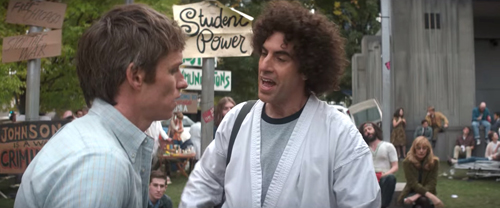
The Trial of the Chicago 7’s title is fairly self-explanatory, dramatizing the prosecution of activists from the Black Panthers, the Yippies, and Students for a Democratic Society after protesters violently clashed with police at the 1968 Democratic Convention. David’s blog on Aaron Sorkin shows, among other things, how the screenwriter/director drew upon the “drama of ideas,” a tradition associated with “turn of the century” playwrights like Henrik Ibsen and George Bernard Shaw. In a slight break from that tradition, though, Sorkin sought to end the film on a note of optimism and hope that would yield a sense of empowerment.
According to Pemberton, the director’s first choice for an end-title song to reflect that tone was the Beatles’ classic from Abbey Road, “Here Comes the Sun.” The composer, though, gently persuaded Sorkin to try something fresh, a new song unburdened by the enormity of the Beatles’ legacy. He also reminded Sorkin of the huge licensing fees that any Beatles song would inevitably command. Pemberton and Celeste’s much-deserved Oscar nomination vindicates the composer’s instincts. Had Sorkin used “Here Comes the Sun,” viewers would have soaked in its upbeat vibe. But The Trial of the Chicago 7 would have gotten only five nominations rather than the six it ultimately received.
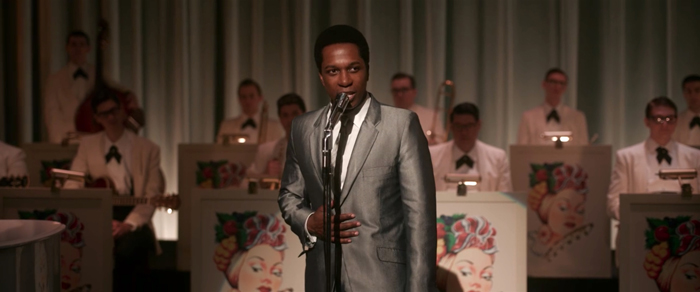
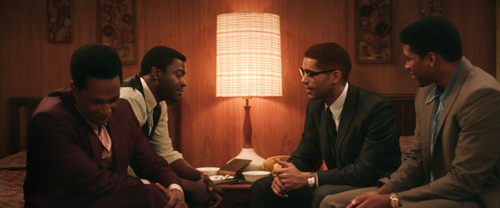
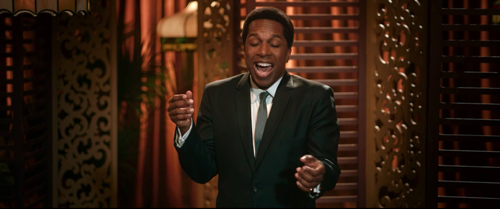
Last, but certainly not least, we have Leslie Odom Jr. and Sam Ashworth’s “Speak Now,” featured in Regina King’s directorial debut, One Night in Miami. The film offers a fictionalized account of a fabled meeting of four icons of the 1960s: Malcolm X, Jim Brown, Muhammad Ali, and Sam Cooke.
The group assembles in a room at the Hampton Hotel to celebrate Ali’s victory over then heavyweight champion Sonny Liston. Yet, with only some vanilla ice cream and a flask of booze as party favors, the good-natured banter soon devolves into a debate about the best ways to achieve social change on the path toward racial equality.
Both musically and lyrically, “Speak Now” seems keyed to an important scene in the film where Malcolm chides Cooke for recording trifling love songs rather than music that speaks to the ongoing struggle for civil rights. He pulls out a copy of The Freewheelin’ Bob Dylan and plays “Blowin’ in the Wind.” Malcolm then asks Sam why it is that a white boy from Minnesota makes music that seems so perfectly attuned to the historical moment. Isn’t “Blowin’ in the Wind” the type of song Cooke should write? Malcolm’s criticism becomes a dangling cause that is picked up in the film’s epilogue. As a guest on The Tonight Show, Sam performs “A Change is Gonna Come” for the first time, showing how he embraced Malcolm’s challenge to him.
Beginning with a syncopated acoustic guitar riff, “Speak Now” not only recalls several moments of the film where Cooke pulls out his own guitar, but also evokes the type of folk music that was Dylan’s stock in trade during the early sixties. The guitar is soon joined by a swirling Hammond B-3 organ. The instrument’s timbre evokes both the gospel music that inspired Cooke throughout his career and Al Kooper’s distinctive organ stylings on two Dylan masterpieces recorded after he went electric: Highway 61 Revisited and Blonde on Blonde. Floating above both is Odom’s plaintive voice, urging the film’s viewer to “Listen, listen, listen.” Providing the link between past and present, the lyrics entreat the audience hear to the “echoes of martyrs” and the “whispers of ghosts.” Odom’s soaring falsetto suggests both vulnerability and hope. The song gradually builds, adding strings and percussion, until it reaches a rousing climax.
With its simple arrangement and its mixture of styles, “Speak Now” sounds like the musical child that Bob Dylan and Sam Cooke never had the opportunity to conceive. It provides a fitting end to One Night in Miami by reminding us that the struggle for civil rights continues, especially at a historic juncture where America is challenged to confront the structural and institutional foundations of white privilege and white supremacy.
Prediction
On Oscar night, I will be watching with bated breath to see if…..
…singer Molly Sandén hits the “speorg note” during the performance of “Husavik.” If she does, it will bring down the house (or at least break a few champagne glasses).
But the winner? Your guess is as good as mine. This is among this year’s most competitive races. In Variety, Jon Burlingame notes that Diane Warren’s past nominations made her the early favorite, but adds, “You can’t count out anyone, however, in this year’s level playing field.”
If the vote reflects the song that is most clearly integrated into the film’s story, it’s “Husavik.” It is also rumored to be making a late charge, aided by late campaigns by Netflix and the tiny town of the title.
If, on the other hand, the vote reflects the song that I’d want next in my iTunes queue, it’s “Fight For You.” It’s got a funky groove that just keeps on keepin’ on.
That being said, I don’t think either of those two songs will carry the day. Ever since the nominations were announced, it’s generally felt like a two-horse race: Diane Warren vs. Leslie Odom Jr. The voting could split between those who desire to finally recognize Warren after so many nominations and those who find Odom deserving of the award for Best Supporting Actor but who still voted for Daniel Kaluuya instead.
The fact that Odom is a double nominee would seem to help his chances. But his song’s social significance also gives it a slight edge. In 2015, Common and John Legend took home the prize for “Glory,” their inspirational song from Selma. Like “Speak Now,” the lyrics of “Glory” captured the zeitgeist surrounding the Black Lives Matter movement, particularly the protests in Ferguson, Missouri. The message of “Speak Now” is just as relevant and just as timely. It is possible that voters will want to acknowledge it for that very reason.
Still my gut tells me this is Diane Warren’s year. Thirty-three years ago, Warren sat in the venerable Shrine Auditorium as a first-time nominee. She came in with a fighter’s chance. Her song, Starship’s “Nothing’s Gonna Stop Us Now,” had a fighter’s chance having hit the top of the charts in five different countries, eventually earning gold or platinum record status in four of them. But it was aced out by an even more popular song, “(I’ve Had) The Time of My Life” from Dirty Dancing. It had gone to #1 in six countries and earned gold or platinum status in seven different markets.
Warren’s been waiting ever since for a chance to pop the cork in a champagne bottle at an Oscars afterparty. I think the bubbly finally flows for her this Sunday.
Once again, a shoutout to Jon Burlingame for his coverage in Variety of the Academy Awards’ music categories. His analysis of the Best Original Song nominees can be found here, here, and here.
After a short hiatus, I’m back with a preview of this year’s Oscar nominees for Best Achievement in Music Written for Motion Pictures. As with everything else in the COVID pandemic, this year’s nominees represent a slight departure from previous years. With the massive shuffling of release schedules, some films like No Time to Die, Dune, and In the Heights that would have been strong contenders in these categories will have to wait until next year. At the same time, the closure of theaters, and the attendant changes regarding Oscar eligibility, meant that some smaller films’ fortunes were boosted by their availability on top streaming services like Netflix and Amazon Prime.
Here I survey the five scores that received nominations and offer a prediction regarding the eventual winner. Later this week, I’ll do the same for the Best Original Song nominees.
The usual caveats apply for those readers interested in the online betting markets. My picks are for “entertainment purposes only.”
Moreover, I admit that my track record hasn’t exactly been stellar. If memory serves, I’ve gone five for eight in my previous predictions. That’s about a 62% accuracy rate. Better than chance but hardly anything to brag about.
Consequently, I advise readers to treat both predictions as the equivalent of a handicapper’s pick for a daily double. It feels really good if you are right. But truth be told, odds are against it.
Let’s turn now to the nominees for Best Original Score. At first blush, it would be hard to imagine a more disparate group of nominated films. It includes a Western, an adventure film, a family drama, a retro-styled biopic, and a metaphysical comedy in cartoon form.
Composers Trent Reznor and Atticus Ross are heavy favorites going into Sunday as double nominees. They were recognized both for their jazz-flavored orchestral score for Mank and, along with fellow nominee Jon Batiste, for their electronic atmospherics in Soul. As previous winners for The Social Network (2010), they stand a good chance of adding more little gold men to their mantles.
The long shot
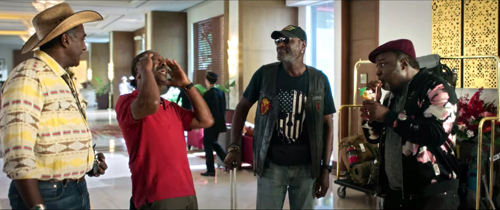
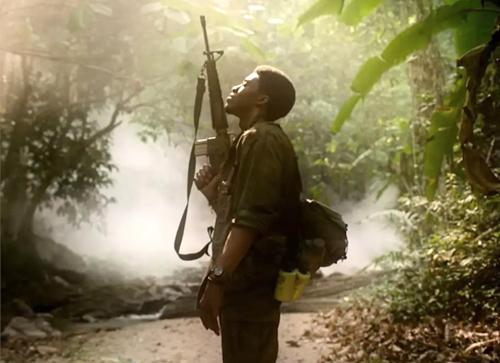
The Oscar betting markets have Terence Blanchard’s score Da 5 Bloods as the nominee with the longest odds. That is a shame insofar as Blanchard remains one of the most underrated composers writing for films. Using a 90-piece orchestra, Blanchard provides an epic sound for Spike Lee’s clever take on The Treasure of the Sierra Madre. I wouldn’t say Blanchard and Lee’s collaboration on Da 5 Bloods is a career best. For me, their peak is represented by the magisterial score in 25th Hour (2003), one of the best films of the 2000s. Still, Blanchard’s music for Da 5 Bloods is awfully, awfully good.
Besides the resources of a conventional orchestra, Blanchard also engaged the services of Pedro Eustache to play the duduk, an Armenian double reed instrument that adds an unusual tone color to some of the score’s melodies. The duduk adds a touch of exoticism as a reminder that the protagonist Paul and his crew of Vietnam vets are strangers in a strange land. Yet the score wisely avoids the kinds of Orientalizing musical gestures that are common in many Hollywood films with South Asian settings. The duduk is heard in a handful of cues that underscore Otis’ relationship with Tien, his old Vietnamese girlfriend.
In contrast, strings and brass are key to several cues pitched in an elegiac register. As Todd Decker notes in his book, Hymns for the Fallen: Combat Movie Music and Sound after Vietnam, this style of music became especially common in Hollywood war films after Samuel Barber’s famous Adagio for Strings was used so memorably in Oliver Stone’s Platoon (1986). A good example is “MLK Assassinated” where the squad reacts to Hanoi Hannah’s announcement of the civil rights leader’s death.
Blanchard, too, mines this vein in cues accompanying scenes where the crew recalls the death of their squad commander Stormin’ Norman Earl Holloway.
Da 5 Bloods is a film of greed and grief, rage and remorse. Blanchard’s score not only captures the frustrations occasioned by America’s racial reckoning, but also reveals the deep sadness beneath, paying tribute to the sacrifices Black soldiers made while serving in Vietnam.
The Newbie
Our second nominee is Minari, which features the music of composer Emile Mosseri. Mosseri studied film scoring at the prestigious Berklee College of Music in Boston. But he also is a member of an indie rock band, The Dig, which has released three albums and four EPs since their debut in 2010. Mosseri got his first major film assignment in 2019 when he wrote the score for Joe Talbot’s acclaimed debut, The Last Black Man in San Francisco. Mosseri soon established himself as an up-and-comer in the world of American Indie cinema. In 2020, Mosseri not only wrote the music for Minari, but also scored Miranda July’s Kajillionaire.
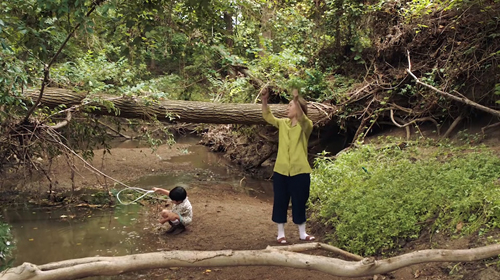
Minari tells the autobiographical story of a Korean-American family’s move to Arkansas in the 1980s. When Mosseri offered to help with the film’s music, director Lee Isaac Chung gave the composer only one directive. He told him not to do something Korean. Instead, Chung and Mosseri discussed the work of Maurice Ravel and Erik Satie, seeing their impressionistic, delicate tone as an idiom more fitting for the story. Mosseri took the unusual step of writing some sketches before production began. This assured that the tone of the score was “baked in” to the film throughout post-production. It also allowed Chung and his film editor to adjust the duration of shots and select takes to better fit Mosseri’s already existing music.
Given Ravel’s and Satie’s influence on the score, it is not surprising that Mosseri’s melodies and orchestrations emphasize piano and strings. Mosseri, though, varies the tonal palette by occasionally adding voices, winds, and vintage LFO synthesizers, instruments whose timbre helps to suggest the feeling of a “dream-memory” soundscape. Many of the cues unfold as patterns of slowly shifting harmonies. This is evident in “Outro” which can be heard below.
Mosseri notes that the real challenge in the film was to communicate Minari’s warm and gentle tone without being saccharine. The score’s modesty makes it appear to be the polar opposite of Blanchard’s epic style in Da 5 Bloods. Whereas Blanchard goes for emotional sweep and impassioned sorrow, Mosseri strives for reserve and subtlety. Moreover, although Blanchard writes for a 90-piece orchestra, Mosseri’s ensemble is less than half that size. Lastly, whereas Da 5 Bloods contains a lot of music — not just Blanchard’s score, but also another ten period-appropriate songs — Minari has a little over thirty minutes of underscore, heard for less than a third of the film’s 115-minute running time.
Still, Minari and Da 5 Bloods have one thing in common. A film composer’s first job is to serve the story, tailoring their music to the specific needs of each scene. Blanchard and Mosseri have done that as well as anyone this past year. I would be happy to hear either one of their names called out as the winner come Sunday night.
The Oater
The third film nominated for Best Original Score is the Paul Greengrass Western, News of the World. Unlike Mosseri, who is a first-time nominee, this is composer James Newton Howard’s ninth nomination. During a career in Hollywood that spans more than 35 years, Howard has enjoyed close collaborations with directors like M. Night Shyamalan and Francis Lawrence. His music has also been a vital component of popular franchises like The Hunger Games and the Harry Potter spinoff, Fantastic Beasts and Where to Find Them.
On a personal note, Howard played a key role in my own musical biography. Earlier in his career, Howard did string arrangements and played keyboards on Elton John’s Blue Moves (1976), an album that was among the first dozen or so I bought as a teenager. I also listened repeatedly to its biggest hit, “Sorry Seems to Be the Hardest Word,” trying to slavishly duplicate both Elton’s piano part and Howard’s nifty keyboard solo. Elton won last year for Rocketman in the category of Best Original Song. It somehow seems fitting that Howard could take home an Oscar this year for Best Original Score.
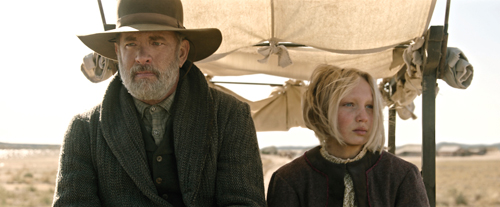
News of the World tells the story of Captain Jefferson Kyle Kidd, a Civil War veteran who travels across Texas, reading news stories aloud in frontier towns for both entertainment and edification. Early on, Kidd comes across an overturned wagon and discovers a lost child. Abducted by the Kiowa, Johanna was being escorted back to her family by a federal officer when their party was bushwhacked. Kidd learns that Johanna will have to wait several months for the return of the Bureau of Indian Affairs representative. So the Captain decides to deliver Johanna to her surviving family. The rest of the film dramatizes their growing bond as Kidd and Johanna make the 400-mile trek through hostile territory to her aunt and uncle’s homestead.
Adapted from Paulette Jiles’ 2016 novel, News of the World feels a bit like a mashup of The Searchers (1956) and the Coen Brothers’ remake of True Grit (2010). Its kidnapped-child premise seems inspired by the former while the picaresque journey structure and “father-daughter” emotional dynamic derive from the latter.
Several of the film’s plot elements, though, offer comment on contemporary politics. The brusque handling of Johanna by Union Army officials in Texas can’t help but remind us of the Trump administration’s family separation policies. Similarly, when Kidd and Johanna are stopped by brigands from a radical militia, they are taken to a town governed under White Supremacist principles, an episode that serves as a grim reminder of contemporary threats of domestic terrorism.
Like Mosseri’s score for Minari, much of Howard’s music in News of the World strives to capture the intimacy and deepening trust that develops between the central characters. That relationship is reflected in one of Howard’s main musical themes heard here in a cue entitled “Kidd Visits Maria.”
Howard’s cues often feature long languid melodies in the strings, but he also nominally adheres to genre convention by incorporating harmonica, mandolin, banjo, guitar, and scratchy fiddle airs to flavor the score with a folksy, period sound. For a handful of scenes involving shootouts, hazardous travel, and hair’s breadth escapes, Howard furnishes the rhythmic drive and dynamics that give them their emotional punch. But the score is most effective in its quiet and reflective moments. Kidd and Johanna both suffer from a sense of loss and loneliness. As they gradually come to realize how much they need each other, Howard’s music communicates that well of feeling, expressing what the characters themselves are too reticent to admit.
Souls and the Soulless
This brings us to the final two nominees: Mank and Soul. For Mank, Trent Reznor and Atticus Ross sought to create a score that would seem experimental if it were featured in a film made in 1940. To some extent, they succeed. By opting for an orchestral jazz sound, they evoke a style that did not become common until the 1950s when it was popularized by later Hollywood composers like Alex North, Elmer Bernstein, and Henry Mancini. Still, despite that disjuncture, Reznor and Ross’ score still seems period appropriate insofar as it recalls much of the popular music recorded during the 1930s.
In preparing Mank’s score, Reznor and Ross decided to write cues in two different, but related styles. One set of cues involved big-band and foxtrot arrangements that would underscore scenes involving studio politics. An example is the cue “Fool’s Paradise” heard below.
The other set of cues deployed an orchestral palette and speak more to Mank’s emotional journey over the course of the film.
Notably, Reznor also admits that they often referred back to Citizen Kane during the writing process. Not surprisingly, some cues, like “Welcome to Victorville” and “Absolution,” sound a bit “Herrmannesque” in their evocation of Kane’s famous score.
A few, such as “San Simeon Waltz,” are even in the lyric mode Bernard Herrmann used in scores like The Magnificent Ambersons (1942) and The Ghost and Mrs. Muir (1947). The latter, not coincidentally, was directed by Herman Mankiewicz’s younger brother, Joseph.
For the most part, Mank’s music hits all the right notes, as bracing as a warm breeze on a summer day. The score is aptly sweet and tender for the heart-to-heart talks between Mank and Marion Davies, arch and mischievous for moments that display Mank’s acrid wit. In fact, Mank’s score seems most period-appropriate on the rare occasions when it indulges a bit of “Mickey-mousing.” An example of this occurs in the scene where Mank drunkenly stumbles as he exits a car in front of Glendale Station. As Ross notes, the music “gets drunk” as well with muted horn figures that could easily have been pulled from an MGM or Warner Bros. cartoon. All that’s missing is the sound of Mank’s hiccup.
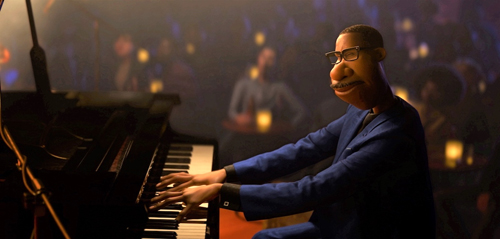
And then there’s Soul. Reznor and Ross’ collaboration with New Orleans musician Jon Batiste is a favorite with good reason. The film’s protagonist is a jazz pianist, an element of the story that makes music integral to the viewer’s experience. Such narrative motivation has certainly helped several previous winners, like La La Land, The Red Violin, and Round Midnight. It also helps that Soul has swept almost all of the year-end critics’ awards for Best Score as well as winning a Golden Globe, a BAFTA, and a Society for Composers and Lyricists Award.
Like the score for Mank, most of the music for Soul consists of two types. On the one hand, there is the earthbound jazz performed by Joe Gardner, the film’s protagonist. These cues provide Jon Batiste an opportunity to shine. Anyone who knows Batiste from his regular gig with Stay Human, the house band on Late Night with Stephen Colbert, are well aware of his enormous talent. For me, even more amazing is Pixar’s skill in animating Joe’s pianistic skills which mimic Batiste’s virtuoso scale runs and arpeggios.
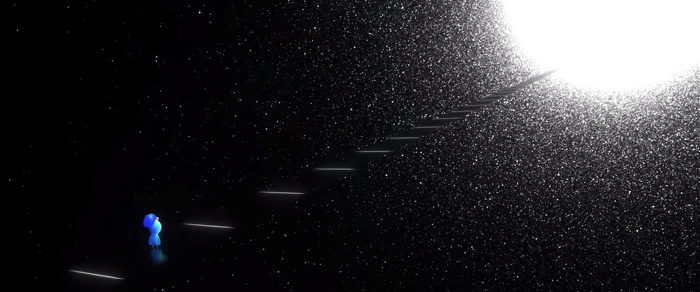
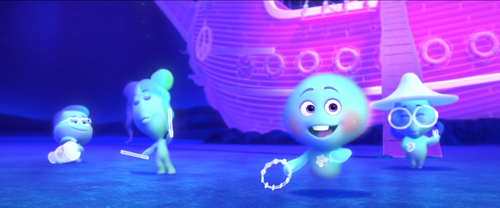
On the other hand, though, we have the music Reznor and Ross wrote for the film’s depiction of the “Great Before,” the way station where counselors prepare unborn souls for their journey to Earth.
And for the zone, a place where souls can experience euphoria upon realizing their life’s passions.
Some reviewers have characterized these cues as spacey New Age music, and that description has a grain of truth to it. Yet, the sounds created by Reznor and Ross seem more like an extension of the electronic experiments they explored in their cutting-edge work on The Social Network, Gone Girl (2014), and Waves (2018).
According to Reznor, to convey the sense of the afterlife as a world both strange and comforting, he and Ross brought in some ideas about microphone placement, vocal textures, and scraping noises they had tried out in their studio. They also processed the sounds from samples and recordings of instruments to give them a slightly off-kilter quality. Such techniques were intended to underline the “imperfections of humanity” in an interesting way. The end product is a “very sublime synthetic score,” in the words of sound designer Ren Klyce. To it, Klyce added the sounds of waving wheat fields and children’s voices to create an environment that felt safe, peaceful, relaxing, and nurturing.
The tranquil score is a perfect fit for director Pete Docter’s vision of the “Great Before.” Yet it also feels a bit uncanny coming from Reznor, a pioneer of industrial music, a style of rock music as cacophonous, abrasive, and propulsive as its name implies. Reznor’s primal howl as the frontman for Nine Inch Nails remains a cultural touchstone of premillennial, post-adolescent angst. Reznor’s contributions to Soul not only show he has mellowed with age, but also that the guy has got extraordinary range.
Prediction
This is the easy one. Barring some groundswell of support that would produce a Minari sweep, Soul will take home the Oscar for Best Original Score. All of its previous awards are very strong indicators. It’s hard to see how the Academy will be any different from any of the 35 other organizations that have recognized Soul’s score as the best of the past year.
As always, my go to source for information about the Academy Awards’ music categories is Jon Burlingame, Variety’s film music specialist. Burlingame’s coverage of these races is always informative and insightful. Some examples of his reportage can be found here, here, and here.
The Hollywood Reporter also has published some useful articles about this year’s nominees, which can be found here.
Besides the interviews mentioned above, one can find many other interviews through the web. An interview with James Newton Howard about his work on News of the World can be found here.
Discussions with Emile Mosseri about the collaboration with Lee Isaac Chung can be found here, here, and here.
Terence Blanchard talks about the music for Da 5 Bloods and his long partnership with Spike Lee here, here, and here.
Trent Reznor and Atticus Ross discuss their approach to Mank here.
The duo are featured in a long video discussing and demonstrating their creative process here.
Lastly, a link to Todd Decker’s Hymns for the Fallen can be found here.
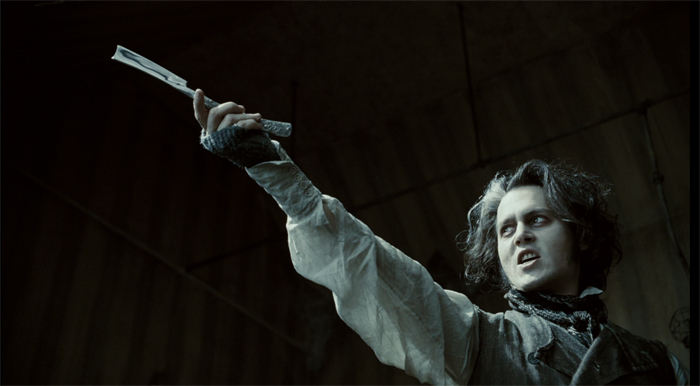
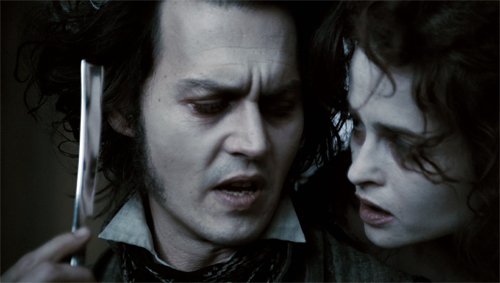
Sweeney Todd: The Demon Barber of Fleet Street (Tim Burton, 2007).
DB here:
Last month Stephen Sondheim celebrated his ninety-first birthday. By coincidence, I just finished a section on him in my current book on popular storytelling.
The argument there is that art at all levels, high and low, mass and elite, depends on novelty. That demanded accelerated in the twentieth century, with the explosion of book publishing, magazines, film, radio, theatre, and television. I see this process as a vast energy of crossover. Popular and “middlebrow” storytelling picked up on avant-garde innovations. But it seems to me that modernism, even the High Modernism of Joyce, Woolf, and Faulkner borrow more than is usually noted from conventions of popular storytelling. I hazard the view that it’s enlightening to look at how experimentation, innovations that open new avenues of artistic expression, emerge in mass-audience art.
Nowadays, most intellectuals have found something to love in mass culture. (“We are all nerds now.”) It wasn’t always so. In England and America, the “battle of the brows” had as one consequence the idea that true art, usually typified by High Modernism or the more radical avant-garde, was being squeezed. On one side was mass culture, manufactured as a commodity designed to sooth the masses. On the other was “middlebrow” art, which mimicked the techniques of modernism but made them simple enough for suburbanites to follow. By the 1960s, the people who believed in this trinity were in the minority, partly because they began to realize that centering on the most difficult side of modernism created too austere a prototype of all ambitious art. Irving Howe called this “The Decline of the New.”
Not that everything is a mashup. But I think now we all realize that crossover is a valid expressive option, probably the most pervasive one. The mass media make room for a huge amount of creativity that can’t simply be dismissed as lowbrow or middlebrow. And one reason it can’t is because we can still be excited by unexpected innovations.
Hence the importance of the nearly seventy-year career of a man who confessed a “taste for experiment in the commercial theatre.”
Experiments that are fun
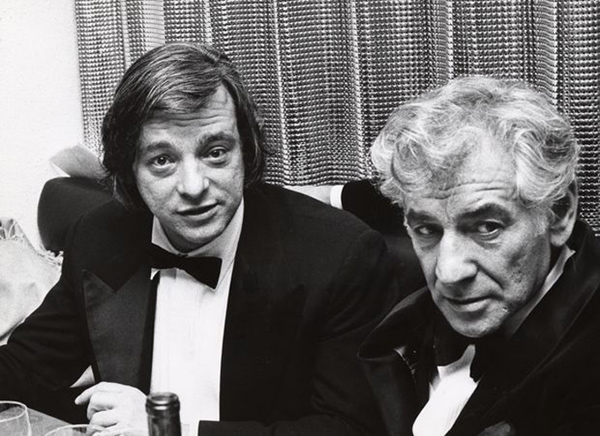
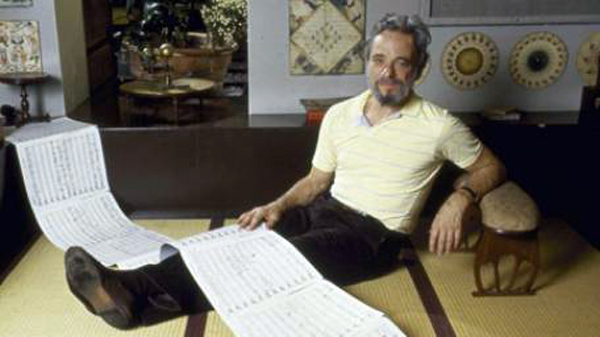
Stephen Sondheim and Leonard Bernstein.
You couldn’t, I think, find a better case for the prospects for experiment in popular culture than his work. His fondness for stage games is part of a theatre tradition we might call “light modernism,” a merging of avant-garde strategies with traditions of popular entertainment. It stretches back to Cocteau’s Parade (1917) and includes the work of Pirandello. Similarly, a trend in British theatre fused aspects of modern theatre (Pinter, Beckett, Ionesco) with the comedy of P. G. Wodehouse and The Goon Show. Tom Stoppard’s Rosencrantz and Guildenstern Are Dead (1966) showed that what was “offstage” in one story could constitute the amusingly doom-laden plot of another.
Alan Ayckbourn dedicated his career to formal experimentation with space (three bedrooms as one in Bedroom Farce, 1975) and time (simultaneous action in How the Other Half Loves, 1969). Intimate Exchanges (1983) spreads forking-path plots across eight separate plays and sixteen possible endings. (Two of the variants are on display in Resnais’ films Smoking/ No Smoking of 1993.) House and Garden (1999) consists of two plays performed simultaneously in two auditoriums, with actors dashing between them. Ayckbourn’s most famous cycle, The Norman Conquests(1973) displays a “stacked” structure; each play gathers all the action taking place in one location and skips over scenes elsewhere, which are assembled in the other plays. The audience must construct the overall story, remembering what has happened just before the scene we see now.
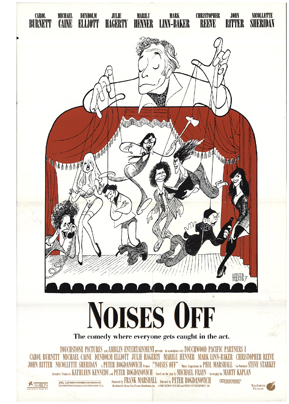
Michael Frayn’s virtuoso Noises Off (1982) probably owes something to Stoppard and Ayckbourn, but it offers its own switcheroo. The opening scene of a sex farce is rehearsed in our first act, is performed skillfully in our second, and collapses in our third view. Crucially, the smooth show of the second act is presented to us in a backstage view displaying the intricate timing involved. Again, an abstract formal concept is mapped onto a conventional scenario, the comedy of a bungled stage production.
Mystery plots make useful targets for this sort of popular experiment. Ayckbourn plotted some plays as quasi-thrillers, and Stoppard’s The Real Inspector Hound (1968) is a parody of the country-house murder. Stoppard undercuts the mystery by a Pirandellian device: two critics down in front are commenting as the performance unfolds. This gives Stoppard a chance to mock pretentious reviewing language. The standard whodunit device of reenacting the murder transforms into a replay of the opening act, but now with the critics taking the roles of detective and victim.
Also not surprisingly, both Ayckbourn and Stoppard declared themselves influenced by cinema, a reliable marker of crossover in modern media. Ayckbourn plays were adapted, with ingratiating wit, to film, while Stoppard wrote several scripts, most famously Shakespeare in Love (1998), which if the term means anything must count as defiantly middlebrow entertainment.
Sondheim is on the same frequency as these masters, but has, I think, greater bandwidth. He plunged into cinephilia more deeply. His early musical influences were Hollywood scores, notably that for Hangover Square (1945); Sweeney Todd, The Demon Barber of Fleet Street (1979) was his tribute to Bernard Herrmann. A Little Night Music (1973) and Passion (1994) were adapted from films. Many of his songs refer to movies, and he composed music for Stavisky (1974), Dick Tracy (1990), and other projects. He was even a clapper boy for John Huston on Beat the Devil (1953).
Instead of parodying mysteries, he has been deeply committed to them. Detective fiction is his favorite reading, and as a puzzle addict he has spent hours devising murder games. “I have always taken murder mysteries rather seriously.” Both Company (1970) and Follies (1971) were initially planned as mysteries, with the latter concerned not with “whodunit?” but “who’ll do it?” Sweeney Todd is a paradigmatic revenge thriller. Asked by Herbert Ross to write a film, Sondheim and Anthony Perkins (another admirer of “the trick kind” of mystery practiced by John Dickson Carr) came up with The Last of Sheila (1973).With George Furth, Sondheim wrote a play, Getting Away with Murder (1996), and with Perkins he planned the unproduced Chorus Girl Murder Case, an homage to 1940s Bob Hope movies. The clues would be hidden in the songs.
Fiddling with formula
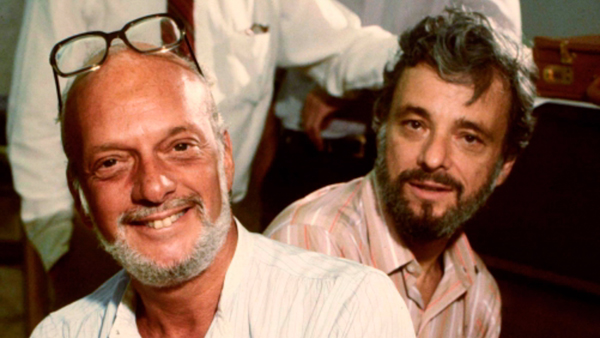
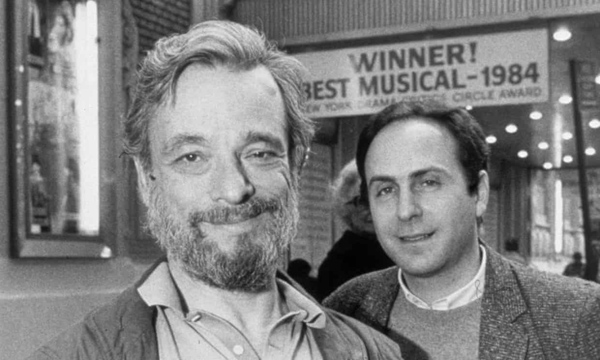
Sondheim and producer/director Hal Prince (left) during rehearsals for Merrily We Roll Along.
Sondheim’s zest for film and mystery fiction reflects a deep admiration for popular culture. It’s one thing to enjoy it, as Ayckbourn and Stoppard clearly do, while also poking fun at its silly side. It’s something else to appreciate its artistry in depth and try to master the conventions yourself. Despite learning “tautness” from the austere avant-gardist Milton Babbitt, Sondheim took as his mentor Oscar Hammerstein II. Tin Pan Alley, with its finger-snap rhythms and suave wordplay, pushed him toward a brisk cleverness. The virtuoso rhymes in his bouncy “Comedy Tonight” (A Funny Thing Happened on the Way to the Forum, 1962) inevitably bring a grin: Panderers! Philanderers! Cupidity! Timidity! . . . Tumblers, grumblers, bumblers, fumblers!
While executing these pirouettes, the song provides a Cliffs Notes guide to Roman New Comedy by contrasting it with tragedy. Tonight, weighty affairs will just have to wait. Sondheim similarly lays bare a convention in his script for the unproduced movie Singing Out Loud, where the couple gradually learn that it’s okay to express emotion in song. “They have to learn to overcome the unreality of it and break into song in the conventional manner of all musicals.”
By taking fun seriously, Sondheim ransacks culture high and low for occasions for experimentation. He was crucially influenced by Allegro (1947), an ambitious Rodgers and Hammerstein musical he considered “startlingly experimental in form and style.” Its use of sliding screens to create “cinematic staging” would become standard in later musicals. He calls Hammerstein “the great experimenter” who used the verse sections of songs to explore possibilities of structure, melody, and harmony.
Sondhim’s breakthrough experiment was Company (1970). It consists of flashbacks framed by the protagonist Robert’s thirty-fifth birthday party. Sondheim claimed it offered “a story without a plot.” The flashbacks don’t supply a goal-directed character arc and instead sample Robert’s bachelor lifestyle and its effects on his three girlfriends and the five married couples in his circle. The result is a compare-and-contrast pattern of parallels. Complicating things further, bits of action are accompanied by a chorus-like commentary from characters not in the scene. Still, there is a certain progression to the whole, indicated by Robert’s disillusioned but faintly hopeful final song, “Being Alive.”
The nonlinearity of Company poimts up Sondheim’s impulse to play with time, viewpoint, and other techniques. Assassins (1990) moves freely back and forth across a hundred years. In Follies characters argue with their former selves. Sunday in the Park with George (1984), built on parallels between two painters, assigns inner monologues to artist and model; characteristically, Sondheim expresses jumbled thoughts by avoiding rhymes. Another duplex structure (Before/ After) shapes Into the Woods (1987), s a virtuoso braiding of classic folktales into a single plot.
Several plays utilize a narrator, who may take a role or converse with the characters. The Narrator of Into the Woods is killed fairly early in the action. Alternatively, Sondheim conceived Passion as an epistolary musical. Characters writing or reading letters operate “somewhere between aria and recitative,” rendering the emotional climaxes as “read rather than acted.” In this excerpt, Giorgio goes to bed with Clara while Fosca is reading his letter breaking up with her. This is a concert performance; in a full production the couple undress on one side of the stage, while Fosca reads the letter. Time floats uncertainly
Working in musical theatre gave Sondheim a layer of implication beyond what Stoppard and Ayckbourn had available with spoken dialogue. A score can evoke earlier scenes through leitmotifs and can enhance characterization. Starting with Anyone Can Whistle (1964) Sondheim created pastiche songs that vary from the show’s overall style. Merrily We Roll Along incorporates cabaret acts (“Bobby and Jackie and Jack”) while Assassins integrates various popular musical traditions, from vaudeville to melodrama. We might think of these pastiches as akin to the “polystylism” of the chapters of Ulysses, which Sondheim strongly admires.
Pacific Overtures (1976), a chronicle of Japan’s early engagements with the west, has the structure of a “portmanteau” film composed of exemplary episodes. It too has a narrator, the Reciter, and its experiments include turning renga linked verse into a passed-along song. The most formally daring scene, “Someone in a Tree,” stages the March 1854 signing of the treaty opening up ports to American ships. We do not see the ceremony, which is held in a secure house.
The Reciter questions an old man who claims that as a boy he watched the negotiations from a tree. During their dialogue, a boy clambers up the tree, and he and his older self collaborate in reporting the event he sees but cannot hear. Then the Reciter discovers a samurai guard hiding beneath the floorboards. He reports what he hears but cannot see. (Beware the YouTube ad at the start.)
As the singers’ accounts intertwine, a moment is assembled through partial perceptions. In a gesture reminiscent of Joseph Conrad’s novels, the event is broken up, made accessible only through partial viewpoints. And only the witnesses attest to the event; without them, we have no access to history. “I’m a fragment of the day./ If I weren’t, who’s to say/ Things would happen here the way/ That they’re happening?” In adapting novelistic techniques for relativistic point of view to the stage, Sondheim, as an experimental storyteller, is ready to plunder any tradition that can yield something fresh.
Form, “content,” and everything in between
Sondheim and collaborator James Lapine.
In his invaluable creative memoirs, Finishing the Hat (2010) and Look, I Made a Hat (2011), Sondheim claims as a basic creative principle “Content dictates form.” But his puzzle-addict efforts to seek out difficulties to be overcome makes me think that this is more alibi than axiom.
I’d rather think that like many experimental artists, Sondheim uses “content” (whatever that is: subject matter, theme, bare-bones story) as at best one ingredient and often as a handy excuse. Sometimes audiences need help when faced with radical novelty. People may have been more receptive to Debussy’s daring pieces because of the “atmospheric” connotations of their titles. The stratagem of labeling one movement of “La Mer” as “From Dawn to Noon on the Sea” was pointed out by Erik Satie: “I liked the part at quarter to eleven best.”
Granted that Sondheim tries to suit his words and music to the genre and story he has selected, he often seems to take “content” as a pretext for solving problems he sets himself. Who else would decide to write all the songs for A Little Night Music in waltz tempo, not least for the challenge of avoiding monotony?
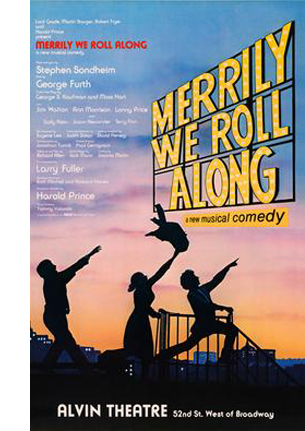
I think Merrily We Roll Along is a good example of how, accepting an initial problem, Sondheim complicates matters “unnecessarily.” This largely forgotten 1934 Kaufman and Hart comedy was formally daring: its scenes play out in reverse chronology, so the last scenes we see in the plot are the first events of the story. In adapting the play to a musical, Sondheim created a story of three twentysomethings trying to break into show business.
The purported rationale for telling their story backward is that it poignantly traces the loss of youthful idealism. But that arc could be just as poignant laid out in chronological order–or, if you want advance knowledge of how the struggles will turn out, via chronological flashbacks wrapped in a contemporary time frame. The reverse chronology seems both an experiment in whether audiences can follow the string of events and an effort to end a sad story in an upbeat way, with the characters still vigorous and hopeful–while we know what awaits them.
Sondheim faced an initial task of making the time scheme clear. He came up with transitional choral passages by the whole company that signal the shift to an earlier block of time. Different productions experimented with ways of reinforcing these musical tags, such as a synoptic slide show reminiscent of the “News on the March” sequence of Citizen Kane.
But the inverted chronology of Merrily We Roll Along also justifies experiments in musical texture. Because the play is about friendship, melodic motifs are swapped among the characters in their soliloquy songs. Moreover, in a 1-2-3 plot, Sondheim explains in Finishing the Hat, fully vocalized melodies are given reprises, shorter versions of the original number. Sondheim could have followed this convention. Instead, in relentless adherence to the reverse chronology, he made the reprises come first, as appetizers for songs yet to be fully heard. The puzzle addict will try to fit everything together in surprising ways, whether the audience realizes the fine points or not.
Solving one problem can launch a cascade of further problems. To introduce a 1980s audience to the musical ambience of Broadway’s heyday, Sondheim opted to revive the thirty-two bar song that he and his generation had “stretched out of recognition.” But then his penchant for pastiche posed a new problem. How to use that schmaltzy song form not just to satirize superficial characters like Joe the producer but to sustain connection to the sympathetic characters when they express authentic emotion?
Sometimes the problem is set not by “content” but by genre, tradition, or purely practical contingencies. Sondheim embraces show-biz conventions to discover what he can do with them. Hammerstein told him that the opening number can make or break a show, so Sondheim strives for a grabber when he can. The eleven o’clock number, a hangover from the days when shows began at eight-thirty, demands a show-stopping vehicle for the stars–e.g. “Anything You Can Do” in Annie, Get Your Gun. For Anyone Can Whistle, Sondheim wrote “There’s Always a Woman,” a rapid-fire comic confrontation between the two stars Angela Lansbury and Lee Remick, dressed identically. He conceived it as “the eleven o’clock number to end all eleven o’clock numbers.” It didn’t achieve what he wanted (“more like a ten-fifteen”) but it indicates his inclination to display virtuosity in response to purely formal demands.
Look, he made a show
Finishing the Hat and Look, I Made a Hat take us into the artisan’s kitchen–not only the studio or the stage where a team comes together but also the kitchen that’s the mind of the creator, who sweats out as much as possible beforehand. Sondheim shares with us the “choices, decisions and mistakes in every attempt to make something that wasn’t there before.”
This is a rarer accomplishment than you might think. Relatively few artists in any medium have the wish or ability to probe their creative process in detail, from conception to minutiae of execution. There are plenty of artists who talk of story sources and bursts of inspiration, but they seldom get down to the compromises, workarounds, and failed efforts. The best such books on popular storytelling, Sidney Lumet’s Making Movies and Patricia Highsmith’s Plotting and Writing Suspense Fiction, are illuminating, but nothing compared to the multilayered self-consciousness Sondheim brings to the task. He notes: “The explication of any craft, when articulated by an experienced practitioner, can be not only intriguing but also valuable.”
It helps when the artist works in brief, segmented forms, such as the songs that make up a musical. They can be analyzed line by line, and can illustrate the challenges of word choice, rhythm, and rhyme as they relate to the ongoing story, the portrayal of character, and of course the score. This engineering side of construction, basic to popular art, is attractive to a practitioner who happens to be a puzzle fiend. He makes every choice a challenge to his ingenuity.
Take one example, “A Little Priest” from Sweeney Todd. Sweeney has decided to turn his lust for personal vengeance into random barber-chair homicide. This scheme suits Mrs. Lovett’s need to produce better meat pies. The result is a list song, a Sondheim favorite. Here’s the rendition of the Broadway original with Len Cariou and Angela Lansbury, for most of us the definitive version.
The couple deliriously catalogue what citizens might furnish appropriate ingredients. Sondheim’s founding choice: the list will consist not of individuals, who would need naming, but of social types whose titles can rhyme more easily. Sweeney role-plays a customer checking Mrs. Lovett’s imaginary wares.
Todd: What is that? Mrs. Lovett: It’s priest./ Have a little priest. Todd: Is it really good? Mrs, Lovett: Sir, it’s too good, at least./ Then again, they don’t commit sins of the flesh./ So it’s pretty fresh. Todd: Awful lot of fat. Mrs. Lovett: Only where it sat. Todd: Haven’t you got poet/ Or something like that? Mrs. Lovett: No, you see the trouble with poet/ Is how do you know it’s/ Deceased?/ Try the priest.
Second choice: the song must be constructed so that the rhyming emphasis falls on the types, so the lines end on the name of the profession, as above. Third choice, new constraint: Throughout the play, Sondheim tries for triple rhymes, so one- or two-syllable professions (priest, poet) will allow for that. Fourth choice: the need to build the song out of short lines, which will permit “an increasingly intricate rhyme scheme.” That’s on display here, with priest–least–deceased–priest threaded with flesh–fresh and fat–sat–that and poet–know it.
The song surveys a range of social types, while reminding us of Sweeney’s main target Judge Turpin (“I’ll come again/ When you have judge on the menu”). The climax of the song declares a perverse commitment to equity. “We’ll not discriminate great from small/ No, we’ll serve anyone/ Meaning anyone–/ And to anyone/ At all.” The catalogue culminates in a sprightly celebration of mass murder.
Finicky as ever, Sondheim confesses that he never liked the line “Meaning anyone,” which is a place-filler, but now he says he knows how to improve it.
Why probe the artist’s craft in such detail? Sondheim notes that journalistic reviewers aren’t trained in technique or don’t know the trade secrets; they’re just declaring what they like or dislike. More intellectual and academic critics are inclined to write broad overviews, usually about the cultural sources and effects of the music. A practitioner who explains the cascade of decisions, freely made or imposed from without, can provide something rare. Just as the sports fan enjoys learning the fine points, learning the tricks of the artist’s trade can boost our appreciation. We can learn to enjoy “the spectacle of skill.”
No surprise: I was reminded of the historical poetics of cinema. This approach to film studies tries to analyze how filmmakers draw on the menus of options normalized in particular times and places. In trying to discover principles of craft practice, we seek out any information we can glean from artisans. For this purpose, we’ll not discriminate great from small.
At the movies
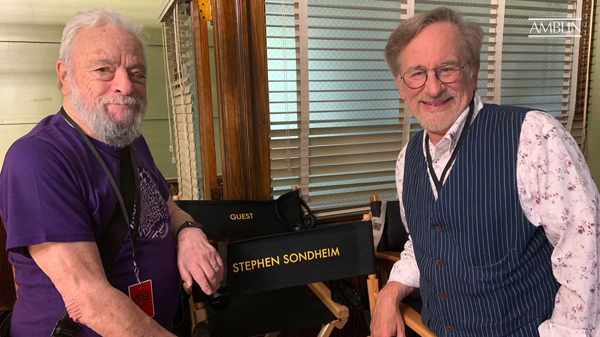
Sondheim with Steven Spielberg on the set of the remake of West Side Story.
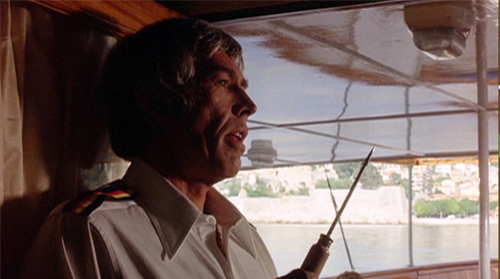
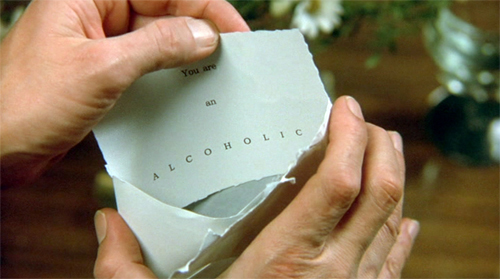
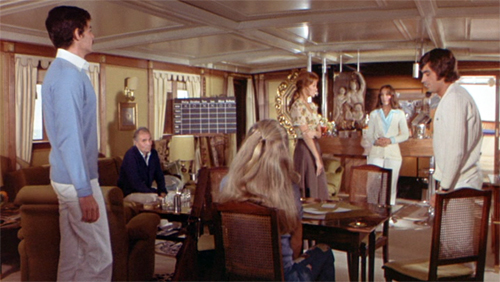
The Last of Sheila is a brittle, cynical satire on the film industry while being a well-designed classic mystery. Sheila Greene is struck down by a hit-and-run driver after she storms out of a party she and her husband Clinton have been holding. Under the promise of a potential movie deal, Clinton gathers six suspects on a pleasure cruise on the French Riviera. Once they’re are aboard, Clinton announces the entertainment: a mystery game. Each guest receives a card declaring a secret, such as “You are a homosexual” and “You are an alcoholic.” Clinton assures them that each is simply “a pretend piece of gossip,” but it becomes clear that the game is designed to expose someone, not necessarily the recipient, as guilty of the card’s charge. Meanwhile, Clinton tries to discover Sheila’s killer.
Every night, at the port they visit, the guests must follow clues to link one of them to a past transgression. The game is interrupted when one of the travelers is killed, and so the survivors embark on their own investigation. As in an Agatha Christie novel, the characters are stock types. There’s the vapid star, her hanger-on husband, the over-the-hill director, the rapacious talent agent, the second-tier screenwriter, and his heiress wife. Again, as in Christie novels like Death on the Nile and Murder on the Orient Express, the yacht cruise isolates the suspects and allows them to debate the identity of the culprit but also also to reveal Clinton’s scheme. In response, the killer has conceived a counterplot for baffling the other guests. Instead of these Christie novels, there is no designated Great Detective to take Hercule Poirot’s place. Any of the people hazarding solutions could be guilty.
In the spirit of the “fair play” detective novel, the audience is provided some clues that flit by, but can be checked on a replay. It’s not a spoiler to note the casual early appearance of an icepick, or the glimpses of some–but not all–of the clue cards.
By contrast, as John Dickson Carr points out, the really skillful mystery writer rubs your nose in the clues. It’s not a matter of a passing mention of the color of a man’s tie, or the way a character pronounced a word.
The masterpiece of detection is not constructed from “a” clue, or “a” circumstance. . . . It is not at all necessary to mislead the reader. Merely state your evidence, and the reader will mislead himself. Therefore, the craftsman will do more than mention his clues: he will stress them, dangle them like a watch in front of a baby, and turn them over lovingly in his hands.
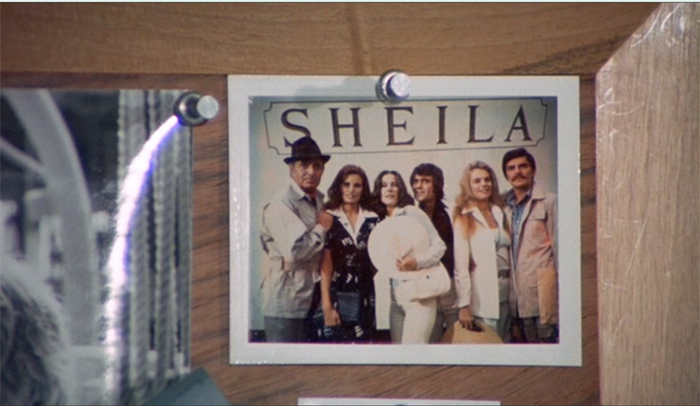
The best example of this tactic in the film is the photograph at the bottom of this entry. The shot lets us dwell on Clinton’s apparently innocuous photo of his guests. Elsewhere the script plays up that old favorite, the discarded cigarette butt.
Sondheim and Perkins’ passion for classic detection is revealed in a long sequence of pure ratiocination. Across twenty-one minutes in the yacht’s lounge, one guest reconstructs the scenario behind Clinton’s game. The layout of space, in both long shots and shot/reverse shot, is quite precise and varied. Of course there are clues in the behavior of certain characters.
Part of the reconstruction turns out to be erroneous, as in the detective-novel convention positing an initial, faulty solution. In all, The Last of Sheila, while memorializing the sort of scavenger hunts and elaborate games Sondheim put his friends through, remains a rare example of an updating of the classic whodunit.
By contrast, the film adaptation of Sweeney Todd is a suspense thriller. The plot doesn’t hinge on an investigation but a pursuit (although that does yield a surprise revelation). Sondheim considers it the only satisfactory film version of one of his shows. “This is not the movie of a stage show. This is a movie based on a stage show.” But then what was the show? Opera? Operetta? No. “What Sweeney Todd really is is a movie for the stage.”
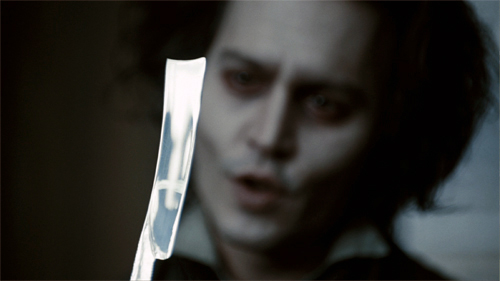
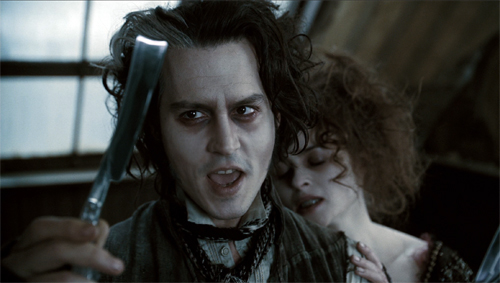
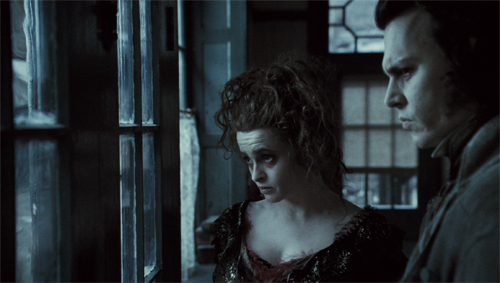
And a grim, brutal one at that. Tim Burton has developed Sondheim’s original through several cinematic strategies. One emphasizes Sweeney’s willed estrangement from humanity. If the stage Sweeney, often played by a large man, has a certain sweeping bravado, Sweeney on film scowls in soft-spoken fury. His puckered brows and pinched lips are set in a face as unearthly pale as a cadaver’s, or a clown’s. This seething little man is presented as virtually locked in his quarters, peering out at the world on which he will wreak vengeance.
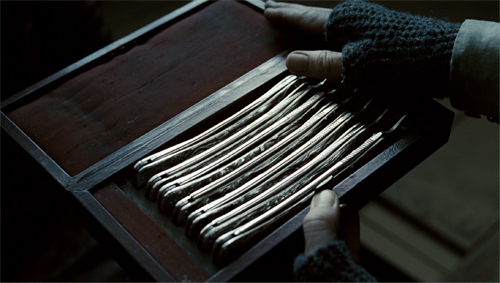
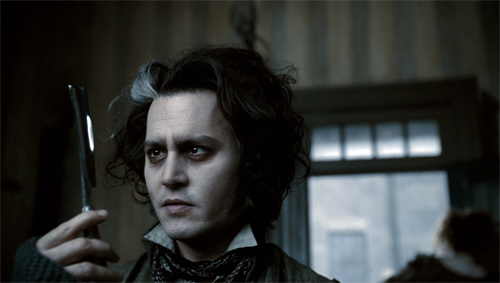
Sweeney’s isolation is given a narcissistic cast when he unpacks his razors. He who has no human ties croons to “my faithful friends.”
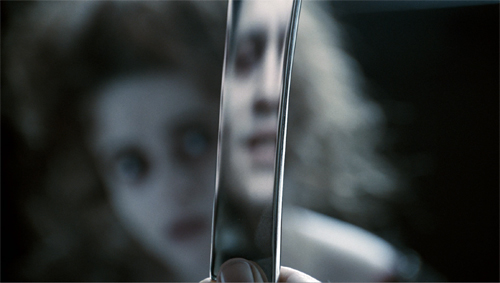
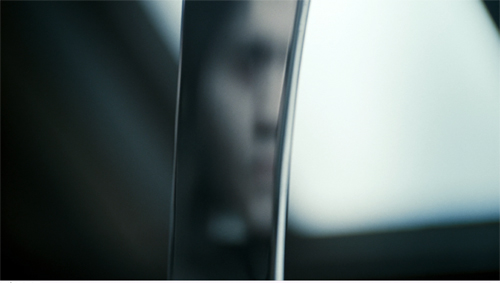
Mrs. Lovett looks on, trying to secure a connection: “I’m your friend, too.” But he ignores her. Burton provides POV shots of Sweeney’s face reflected in his razor blade, a neat way of showing his self-absorption passing into violence.
At one point, he seems to register Mrs. Lovett’s gestures of affection, and Burton neatly shows the POV reflection shifting to her.
His contemplation of her as an ally can, it seems, only see her as another reflection of himself and an instrument of his vengeance–a tool, not a lover.
He rejects her affection (“Leave me”) and he twists the razor, turning the reflection back to him. He’s still locked in his solitary obsession.
He finishes the song alone, now even more committed to his mission. A final shot shows him gleefully peering out the window at the city he and his faithful friends will ravage.
Mrs. Lovett becomes his genuine accomplice in the song, “A Little Priest.” In the stage directions, Sondheim asks that Sweeney and Mrs. Lovett use pantomime to evoke the meat pies they want to harvest from Sweeney’s customers. In the film, however, the pies she has already made are surrogates for the ones she proposes.
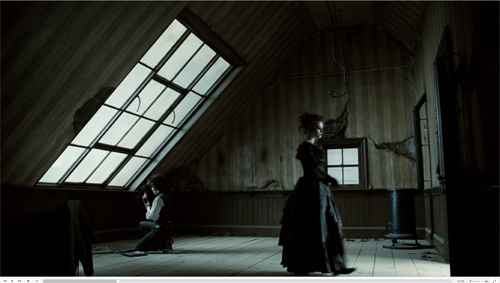
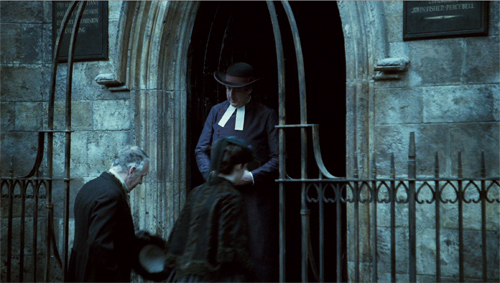
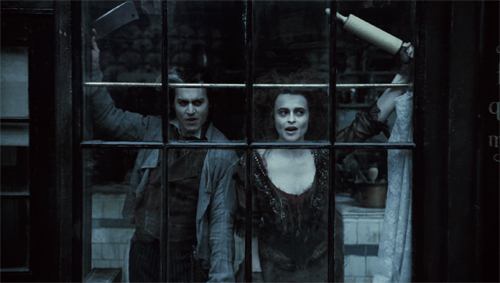
Given the more tangible setting, Burton returns to the window motif; Mrs. Lovett’s shop becomes an extension of Sweeney’s enclosed world. The couple’s list-song takes place with the two of them at the windows, scanning the street for victims. As you’d expect, they spot a priest first.
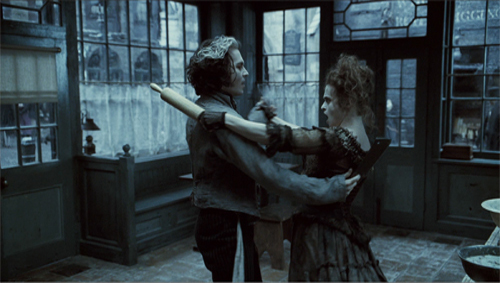
If the barber shop upstairs is Sweeney’s mission control, the pie shop becomes his supply center. Mrs. Lovett realizes that she can get his friendship only by joining his plan for vengeance, and once he realizes her commitment, she becomes an attractive partner. They pledge their partnership in a rolling-pin waltz, and the sequence ends with a shot that echoes the earlier capstone, but including Mrs. Lovett.
There’s a lot more to be said about The Last of Sheila and Sweeney Todd, but I invoke them just to show that Sondheim’s talents can create robust, innovative, sometimes disturbing cinema.
I could imagine someone criticizing Sondheim as the ultimate middlebrow artist. Adapting foreign films (Smiles of a Summer Night, Scola’s Passion) and Grand Guignol to the American musical; turning Seurat’s Grande jatte into a living tableau (and naming the painter’s model Dot!); imposing games with time and viewpoint on a showgirls’ reunion; investing fairy-tale optimism with sinister implication–all can seem too clever by half. An objector might say that a Sondheim show doses schmaltz and hokum with just enough formal ingenuity to let audiences feel clever. But I think that sort of having-it-both-ways defines a great deal of popular entertainment, and it has its own value. Bergman and Seurat and Little Red Riding Hood remain unharmed by plays that take them as pretexts for ravishing music and cunning theatrical games. Formal ingenuity is not a small thing.
Sondheim opened new vistas for the musical to explore. I suppose you can call Lin-Manuel Miranda’s Hamilton middlebrow too, making rap and hip-hop safe for people who can afford a Broadway ticket. But if you think Miranda opened new paths, note that he thinks that Sondheim pointed the way. He took advice from Sondheim while writing the show, and he paid tribute in a preface to an interview:
He is musical theater’s greatest lyricist, full stop. The days of competition with other musical theater songwriters are done: We now talk about his work the way we talk about Shakespeare or Dickens or Picasso.
You don’t have to go that far to see that artists at all levels of taste innovate, and their efforts sometimes oblige us to see fresh expressive possibilities in their artforms. If we are all nerds now, we can become connoisseurs of the experimentation–sometimes subtle, sometimes bodacious–that pervades popular entertainment. Sondheim, meticulous and generous and tirelessly exploring, coaxes us to do that.
Sondheim discusses the composition of “Someone in a Tree” in this interview with Frank Rich. The second part is especially revealing about Sondheim’s combining music and lyrics through a vamping figure. That accompaniment, detached from the sung melodies, depends on a “gradual change” principle that reminds me of the minimalist music of Glass (Einstein on the Beach, 1975) and Reich (Music for 18 Musicians, 1976) at the same period. A musicologist would probably correct me, but if the affinity holds good it would further show Sondheim’s pluralistic appropriation of many traditions. Thanks to Jeff Smith for discussions of this and for help with other musical matters.
The John Dickson Carr quotation comes from his 1946 essay, “The Grandest Game in the World.” The most complete version of it is in The Door to Doom and Other Detections, ed. Douglas G. Greene (Harper, 1980), 334-335.
Many fine appreciations of Sondheim appeared around his birthday, but I especially like this one by Jennie Singer, packed with clips.
The Last of Sheila (Herbert Ross, 1973). This shot harbors a clue–actually, more than one.
P. S. 18 April 2021: Sondheim has been extraordinarily generous in sitting for interviews describing his creative process, and many are stimulating. Alert reader and master interviewer Brian Rose kindly sent me a link to the remarkable 2020 interview with Adam Guettel that you might enjoy.
Over the last couple of years I’ve been writing a book on common strategies of popular storytelling in film and other media. I go on to trace how those strategies get worked out in detective stories and thrillers. If you follow this blog, you know that these genres are ones I enjoy and like studying.
So I was happy to offer as one installment of our Criterion Channel series, Observations on Film Art, a short analysis of storytelling strategies in Blood Simple. In it I suggest that although the film has the trappings of a neo-noir–the somewhat downmarket characters, the seedy milieu, the chiaroscuro lighting–in its narrative techniques it’s closer to a Hitchcock thriller. That’s because its manipulation of point of view, one of the resources of popular storytelling, is close to the “partial and misleading omniscience” of the thriller genre and Hitchcock’s narration in particular.
Put it another way. We aren’t restricted to what only one character knows, as in a detective story like The Big Sleep (1946). Instead, Blood Simple steers us selectively from one character to another. So we always know more than any one of them does. That creative choice increases suspense–knowing the dangers that lurk ahead–but it also summons up an ironic detachment from them, as we watch them make their foolish mistakes. In a word, if you know the film: fish. Here’s another: lighter.
This shifting viewpoint doesn’t give us absolute knowledge, though. There is still some information that slips through the cracks. So we can enjoy superior knowledge in long stretches, while still getting some sudden surprises, or even shocks. (Consider the climax with the perforated wall and the knife at the window.) In their first feature, the Coens prove themselves already fully in control of finely-tuned cinematic storytelling. We’re a step ahead of the characters, but the film is a step ahead of us.
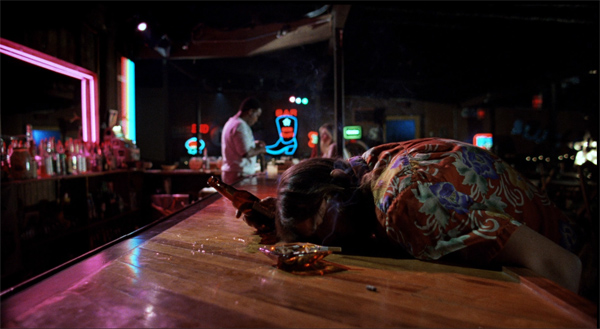
The Coens are also aware of our pleasure in their control. The characteristic Coen awareness, a sly recognition of letting the audience share their power over our access to the story world, is everywhere in evidence. I didn’t have time to mention the shot that everybody remembers, the tracking shot down the bar that simply lifts over the drunk sprawled on the bar top. We become aware of how the movie’s unfolding narration is absolutely ruling how we see this world, and the Coens make a gag out of it. Even the camera-god has a sense of humor.
If you have a chance to watch it, Jeff Smith, Kristin, and I hope you enjoy it–and, of course, the film, which is endlessly rewatchable.
As usual, thanks to the team at Criterion: Peter Becker, Kim Hendrickson, Penelope Bartlett, and their superb postproduction boffins. We recorded the commentary under Covid conditions, with the expert guidance of Erik Gunneson, Meg Hamel, and James Runde.
For more on the Coens’ mastery of storytelling technique, check out the analysis of their fine TheBallad of Buster Scruggs.
You can sample other blog entries on mysteries and thrillers in several entries, in particular our discussions of Hitchcock (of course), and the genre as a whole (here and here and here). An early version of one chapter of my book in progress is devoted to the great Rex Stout. Another chapter will revise what I said about Gone Girl. I also discuss Hollywood’s approach to crime and mysteries in the book Reinventing Hollywood: How 1940s Filmmakers Changed Movie Storytelling.