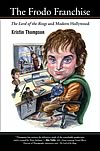
by Kristin Thompson. Berkeley: University of California
Press, 2007.
400 pages, 6 × 9 inches, 12 color illustrations;
36 b/w illustrations.
[go
to Amazon | go to The Frodo Franchise blog]
The Europeans have long been fascinated by the subject of cinephilia. The French supplied not only the word but the most outstanding instances, from the founding of Cahiers du cinéma to the passions of the Nouvelle Vague. (1) In the last decade particularly, French critics have often returned to the subject–worrying, for instance, that home video might have changed or even decimated cinephilia–and this has led critics from other countries to join in.
I was reminded of how strongly the idea persists when, at Il Cinema Ritrovato this year, I was invited to sit in on one of several lunches at which critics and historians talked about the subject. The discussion consisted mostly of recollections of the guests’ first encounters with cinema, of the films that affected them most powerfully, of the film-related activities they engaged in during their salad days. Some of us hadn’t done this exercise in autobiography before, but others had had practice. Jonathan Rosenbaum and Eric de Kuyper had both written a fair amount about the sources of their affinity for film. (Sometimes I feel I remember Jonathan’s life better than my own.)
What is cinephilia? Literally, the love of film. But everybody likes, even loves film, no? The term “cinephilia” connotes an overwhelming passion for film, even an obsession about it. And not just particular films. I meet civilians all the time who are devoted to their favorites—The Godfather, The Princess Bride, The Matrix. But they’re not cinephiles. So is it just a matter of quantity? Is it just that the cinephile enjoys a great many movies? Partly, but there’s still more to it.
The cinephile displays symptoms of cinemania, as chronicled in the film of the same name. If you haven’t seen it, Cinemania tracks five people who organize their lives around watching movies. As I watched it, some of my reactions ran to “Wow, that is really hard-core,” but every now and then I thought: “Well, that‘s not so weird. I do that.” So I see the similarities.
Most obviously, both the cinephile and the cinemaniac show symptoms of compulsiveness. Each one makes lists, checks off titles seen, plans a day of moviegoing with care. When visiting a new city, s/he first scans the cultural scene for what’s playing. Both types of film lover are strict—no pan-and-scan, no colorization, no dodgy projection. Either type might have a weblog or a diary or just patient friends. If s/he has friends.
But I do see differences. For one thing, most cinemaniacs like only certain sorts of movies—usually American, often silent, sometimes foreign, seldom documentaries. Do cinemaniacs line up for Brakhage or Frederick Wiseman? My sense is not.
Cinephiles by contrast tend to be ecumenical. Indeed, many take pride in the intergalactic breadth of their tastes. Look at any smart critic’s ten-best lists. You’ll usually see an eclectic mix of arthouse, pop, and experimental, including one or two titles you have never heard of. Obscurity is important; a cinephile is a connoisseur.
The real crux, I think, is this. The cinephile loves the idea of film.
That means loving not only its accomplishments but its potential, its promise and prospects. It’s as if individual films, delectable and overpowering as they can be, are but glimpses of something far grander. That distant horizon, impossible to describe fully, is Cinema, and it is this art form, or medium, that is the ultimate object of devotion. In the darkening auditorium there ignites the hope of another view of that mysterious realm. The pious will call Cinema a holy place, the secular will see it as the treasure-house of an artform still capable of great things. The promised land of cinema, as experimentalists of the 1920s called it: that, mystical as it sounds, is my sense of what the cinephile yearns for.
This separates the cinephile from the lover of novels or classical music. They love their art, I suspect, because of its great accomplishments. Who with literary or musical taste would embrace the subpar novel or the apprentice toccata? But cinephiles will watch damn near anything looking for a moment’s worth of magic. Perhaps this puts cinephiles closer to theatre buffs. They too wait hopefully for the sublime instant that flickers out of amateur performances of Our Town and Man and Superman.
That’s also why I think that the cinephile finds the desert-island question so hard to answer. What movies would I want to live with for the rest of my life? All of them, especially the ones I haven’t yet seen.
Another difference: Fussiness and solitude. The cinemaniac has a favorite seat, even if it’s way off to the side. To secure it, the cinemaniac shows up early and tries to be first in line. Your average cinephile isn’t so picky about where to sit, and so may slip in at the last minute. While waiting for the show to start, the cinemaniac seldom acknowledges others; a book is the faithful companion. But the cinephile is, if not extroverted, at least gregarious and wants to talk with other cinephiles.
What sort of talk? I’m glad you asked.
Cooperative games: Playing well with others
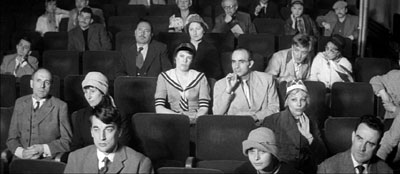
Jules and Jim leave a screening.
Jules: Great movie!
Jim: Yeah, great!
Jules: Well, see ya.
Jim: Yup, later.
This is the minimal, polite cooperative game. When the energy level is cranked up, you get something like this.
Jules: Great movie! I love M*x *ph*ls.
Jim: God, yes. Those camera movements knock me out.
Jules: But then there’s R*n**r too!
Jim: God, I love R*n**r. And M*z*g*ch*–there’s a man for camera movements.
Jules: My man! M*z*g*ch* is just terrific.
This can go on indefinitely. To get a sense of how special cinephiliac enthusiasms are, imagine littérateurs talking about Keats, Shelley, Coleridge, and iambic pentameter in these terms.
A cooperative game can go a little further.
Jules: What a fantastic movie!
Jim: Yes, fabulous. M*nn*ll* movies get better and better, the more you see them.
Jules: I completely agree—except for The S*ndp*p*r.
Jim: Yeah, that’s kind of weak, but it’s got some good points.
Jules: Really? I haven’t seen it in twenty years.
Jim: I have a pretty good copy off Turner. Let me dub it and send it to you.
Jules: That’s really nice of you.
Even if Jim never sends the disc, he has played the game charitably and Jules has accepted graciously.
Jim: What a terrific movie.
Jules: I wasn’t so impressed. Want to grab a coffee and talk about it?
Jim: Good idea!
This is probably the optimal way to play Cinephilia cooperatively.
But many cinephiles want to play rougher. The extreme option is flat-out disagreement, usually expressed in terms that bluntly doubt the competitor’s sanity, intelligence, or good will. I won’t dwell on this abrasive strategy here. There are stealthier ways to go.
Competitive games: Upsmanship
Jules and Jim leave a screening.
Jules: I loved it. What did you think?
Jim: Well. . . Have you seen earlier films by H*ng S*ng-s**?
This is an opening gambit. If Jules says no, then Jim can say something like: It’s really one of his weaker movies or His films get worse and worse. Now Jules would be playing defense, on unfriendly terrain. If he hasn’t seen the other films, the comparison-strategy will be his undoing. So:
Jules: Yeah, I’ve seen all of them. I thought that this was a strong one.
Now Jim can fight to at least a draw. Maybe Jules was bluffing and hasn’t seen all the films; or maybe Jim remembers them better.
Jules has used what we can call the breadth strategy: I’ve seen more than you. This need not bear only on other films; it can work along other dimensions.
Jim: I was so impressed by St*g* Fr*ght, but I never heard anybody refer to it among H*tch’s best.
Jules: Well, in the critical literature it’s often considered a masterpiece. Have you read . . .?
Or:
Jules: Yes, it’s a great movie, but what a terrible print! The reel ends were chopped off, and there were splices all the way through. I remember seeing a pristine print at the Director’s Guild Theatre. [The haymaker:] Jane Wyman was there to talk about it.
With a silent film you can extend the strategy to multiple versions: I remember a MoMA screening that ran an extra half-hour or The DVD from Austria fills in the missing scenes with stills. Oh, you didn’t know there were missing scenes…? Jim doesn’t have many options here.
If Jules sticks to the breadth strategy, this can go on quite a while. Once I got cornered after a friendly critic asked me about 1930s Ozu. Yes, I’d seen them all. Naruse? Yes. Shimizu? Quite a lot. I held my own, but then he changed up his pitching rhythm: “And how about 1930s English comedies? No? Oh, you must see them—they’re wonderful.”
Akin to the breadth approach is the longevity strategy, aka I was here first. We old guys like to use this. It can get pretty brutal.
Jules: Great movie!
Jim: First time you saw it?
Jules: Um, yeah.
Jim: It gets better on multiple viewings. I liked it when I saw it in 1971. In fact, I liked it so much I wrote about it for Sight & Sound. Let me send you a copy of the essay.
Jules: Um…thanks…
There’s also the depth strategy. Here the player goes very specific, invoking details that suggest sensitivity and massive memory power.
Jules: Great movie!
Jim: You said it. I especially liked the scene when the camera tracks sideways, picking up the back of the guy who’ll turn out to be so important at the end.
Jules: Yeah. . . Actually, I didn’t notice that.
Jim: You didn’t? Gosh, that’s the key to the whole movie. It sets up the last scene beautifully. Of course there’s also that killer opening line.
Jules (who doesn’t even remember the opening scene): Yeah, that was really effective.
Jules lost, and Jim knows it.
Another strategy relies on eloquence. Both Jules and Jim are evenly matched on range and depth and longevity, but Jules has the edge in using language.
Jules: What’d you think?
Jim: I liked the opening shot.
Jules: Me too. Most long-take crane shots look pretentious, but this one had a sinuous grace that’s hard to achieve on location.
This strategy can be amped up into philosophical disquisition that usually sounds better in French but can occur in English too.
Jim: I just don’t see why people take W**dy *ll*n seriously. Cr*m*s *nd M*sd*m**n*rs is heavy-handed in its metaphors of blindness and sight.
Jules: What’s remarkable about W**dy is the way his metaphors hover between the banal and the extraordinary. They’re at once familiar and unfamiliar, both distant and near. They lie, we might say, in a zone of zigzag indeterminacy.
Okay, this plays better on the page than in conversation, but I have encountered it occasionally face to face. It’s a hard serve to return. Resorting to I just don’t know what that means usually makes you look dumb, whereas Do you buy effluvia like that in ten-gallon drums? would be considered hostile.
Then there’s the insider strategy.
Jules: Solid movie, but a little choppy.
Jim: Yeah, the director sent me a rough cut on DVD a few months ago. Looks like she dropped a lot. And the producer’s son attempted suicide, which probably screwed up the whole project.
Advantage: Jim.
What we talk about when we talk about talk
I’ve taken face-to-face dialogue as my default, but you can find these strategies at play in those monologues we call film criticism. The maneuvers are usually a bit subtler, though. For instance, the longevity strategy often surfaces guilelessly, as a homey touch of autobiography. Some critics like to start their pieces with a chatty narrative recounting how they learned about this film—that is, way before you, loser.
And of course these strategies are all over forums and chat threads. In those settings the players can be anonymous and can loose a barrage that they might hesitate to launch in person.
One last question: Are these games for boys only? Is cinephilia itself defined as a guy’s thing? In my experience, no, not wholly; but mostly. Have women opted out? Do they play it differently? I might have to recast my dialogues in order to include Catherine.
In any case: Substantively speaking, this is a minuet. Jules’ claims might be right or wrong. Ditto Jim’s. Any of the competitive strategies can produce information and ideas. We just have to remember that lots of life is about playing games.
And remember that you can always change the subject to sports or rock and roll. No one-upsmanship in those domains!
(1) Antoine de Baecque’s entertaining La cinéphilie: Invention d’un regard, histoire d’une culture 1944-1968 (Paris: Fayard, 2003) has become the standard history of this tendency.
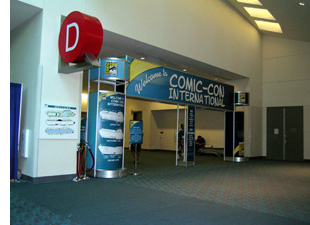
From July 23 to 27, I was at Comic-Con for the first time. For the past few years I have contemplated attending, since it is the largest pop-culture fan event in the world. Last year the Con sold out its 125,000 tickets for the first time, and that feat was repeated this year. Comic-Con has become important for the launching of blockbuster fantasy and sci-fi movies. Ian McKellen, on break from playing Gandalf, made a surprise appearance there in 2000 to promote the first X-Men film. Innumerable franchise items for big-budget films have made their debut at the Con.
This year I received an invitation from TheOneRing.net to participate on the site’s first Comic-Con panel in five years (i.e., since 2003, the year of The Return of the King). My fellow panelists were Chris “Calisuri” Pirrotta (co-founder of TORN), Cliff “Quickbeam” Broadway (long-time contributor to the “Green Books” section), and Larry “MrCere” Curtis (contributor to TORN and coordinator of many line parties for the trilogy). That was the extra push that made me decide that this was the year to take the plunge. (See MrCere’s coverage of Comic-Con here, here, and here.)
Coincidentally, pop-culture expert Henry Jenkins was also attending his first Comic-Con. We never spotted each other during the Con itself, but after it ended on Sunday afternoon, we got together for a conversation about our thoughts and reactions. Henry’s now on vacation and wisely not checking email, but I’m going to write up another entry with lengthy excerpts from that conversation. Once I get a chance to run the result past Henry and get his suggestions, probably in a couple of weeks, I’ll be posting that as well. Here I’ll just give an account of my own experiences and what I learned about Comic-Con. I’ll also be blogging specifically about the news-media coverage of the event.
Four-day passes were already sold out by the time our panel was officially accepted (early June), but TORN took care of reserving “Professional” passes for the group. The basic passes seem to be Four-Day, Professional, Press, Exhibitor and One-Day. Eventually I received an email confirmation, complete with barcode to be scanned when I picked up my pass.
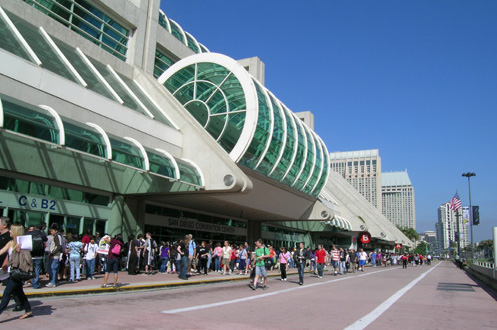
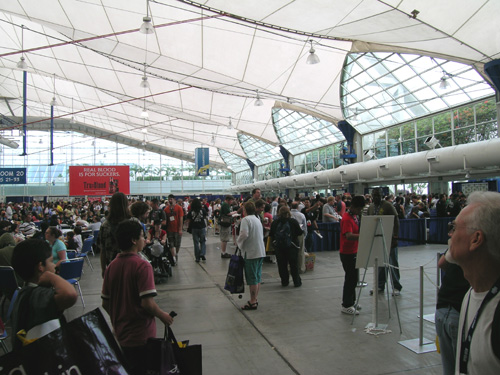
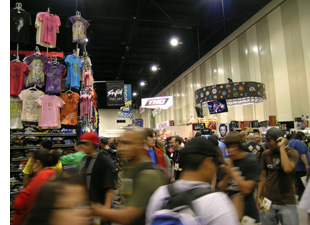
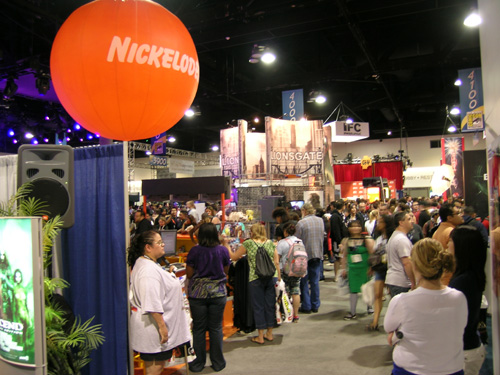
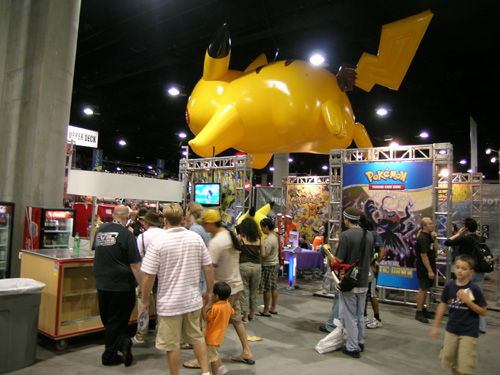
Comic-Con takes place every year at the San Diego Convention Center. There’s no way a photo or even a bunch of photos can convey how big the place is. The space centers around an exhibit hall divided into sections A to H, corresponding to the lobby doors through which one enters. I assume these can be closed off from each other for smaller events, but in this case the entire space apart from Hall H was open. The total exhibition space is 525,701 square feet, with Hall H being 64,842 of that. (More about Hall H later.) David and I live in a large house, but this exhibition hall has about 100 times more floor space.
There’s only one other floor, apart from the mezzanine. The mezzanine was fairly small and taken up by gaming and some small booths which I didn’t investigate. On the second floor are the meeting rooms, varying considerably in size but adding up to 204,114 square feet. The “Sails Pavilion,” a large, column-free open space, is a further 90,000 square feet. That’s where people lined up to get the autographs of major guests, and where the freebies tables and “portfolio review” area were set up. Apart from all that, there are large halls and lobbies where lines form, people socialize, and snack carts sell expensive food and drink. These zones total 284,494 square feet. Rumor has it that after its contract with the Convention Center ends in 2012, Comic-Con may seek an even bigger venue, most likely in Las Vegas or Los Angeles.
Wednesday evening (July 23), there was a three-hour preview for anyone with a pass for the entire event. Arriving at the Convention Center was an overwhelming experience. Thousands of people were heading for the same place, and tens of thousands already there in line. I arrived at the building and saw vast lines on either side of me along the sidewalk. The one to the left seemed to stretch to the horizon; the one to the right looked somewhat less daunting.
Apparently newbies at Comic-Con commonly get into a line, wait until they reach the front, and realize that they were supposed to be in the other one. Luckily I had arrived at about the mid-point of the building and noticed that the big line was for people picking up purchased four-day passes. The other was for professionals and press. After a short hike, I took my place at the end. The wait was enlivened by people constantly pausing and asking which line this was. Occasionally fans in costume passed by, though these represented a much smaller portion of the crowd than the media would lead us to believe.
The wait seemed long but was probably only about 25 minutes. Once I got inside, the registration process was speedy, with the barcode read and a badge generated and slipped into its plastic case in the blink of an eye. There were no events scheduled that night. It was simply an opportunity to get a look at the exhibition hall, with its thousands of booths and, in the case of the big companies, display areas. Familiar logos were everywhere, and the place stretched out further than one can see.
I mostly spent the evening checking out the companies related to The Lord of the Rings: Weta Workshop, Sideshow Collectibles, and the tiny booth shared by TheOneRing.net andSlave Boy Films (which produces fan-related video, mainly for websites). I was to do three one-hour signings there in the course of the Con, and it became my pied à terre for the duration of the event. (Thanks to producer Justin Sewell and his team for their hospitality!) I also visited the New Line display, but it was mainly there to sell DVDs of Harold and Kumar Escape from Guantanamo Bay. Sure, people could order it online, but the official release date wasn’t until July 29—two whole days after Comic-Con ended.
Many types of activities go on simultaneously. There are continuous movie and television previews with stars, directors, and/or writers present. There are autographs to be had, with the most famous people signing in the Sails Pavilion (above) and others at booths in the exhibition hall. (I spotted Marcia Wallace, aka Mrs. Crabapple in The Simpsons, signing at one table.) There are things to be bought, though numerous small promotional items are given away. There are panels and artists’ lectures to attend. There are open spaces in which costumed fans can perform or pose for pictures. Aspiring comics artists can show their profiles to representatives from big publishers like Dark Horse. Gamers can try out previews of forthcoming games. Lots of socializing goes on. After the Harry Potter fandom panel ended, I saw the owners of The Leaky Cauldron meeting ardent fans whom they had only known online up to that point. In short, one cannot possibly do and see more than a small fraction of what happens.
Apart from my signing sessions, I concentrated on panels. I was afraid from the long line that I would get shut out of the “Masters of the Web” panel on Thursday morning, but I got in easily—and indeed, throughout the event I didn’t get shut out of anything, though I didn’t try often to get into the big Hollywood previews. The panels, by the way, start at the civilized hour of 10 am. Those of us taking the shuttle buses from distant hotels could still get up at a reasonable time, get breakfast, and make it to them.
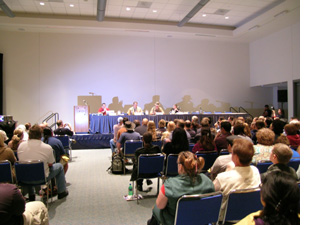
Our TORN panel took place on Friday morning. Not everyone who wanted to attend could get into the room. Apparently one fan who was shut out got unruly and had to be subdued by security staff! Those who did get in were an enthusiastic bunch, and we spent the session speculating on casting and on possible approaches to adapting The Hobbit and especially to writing the mysterious “Film 2” that is to create a “bridge” covering the sixty-year gap between The Hobbit and The Lord of the Rings. Judging from the applause, Martin Freeman (familiar in this country mainly as Declan in Shaun of the Dead) would be a popular choice for Bilbo. He does look like he would make a plausible hobbit. My suggestion of Mark Ruffalo for Thorin should definitely be taken seriously by the filmmakers.
Other panels I attended involved the Disney “story process,” Sideshow and Marvel toys, and HP fandom. I heard Tolkien artist John Howe’s and comics master Lynda Barry’s talks, definitely two of the highlights of the Con for me. I had long loved John’s Tolkien illustrations and had corresponded with him during the writing of The Frodo Franchise, and it was a huge treat to get to meet him in person—and find that he had read and admired my book. Immediately we were talking like old friends.
Arriving early for Lynda’s talk, I sat through the end of a presentation on an animated series that I had never heard of. During this, Lynda came in and happened to sit down right next to me! (No one who has seen her self-portraits in her comics could fail to recognize her.) I hesitated to ask for her autograph, since some people don’t like to be bothered when they’re about to go onstage. When someone else asked and she didn’t seem to mind, I took my chance. I introduced myself as a fellow Wisconsinite, and she was most charming about signing my program. A good thing, too, since I didn’t figure out her schedule of autograph sessions at the Drawn and Quarterly table until after they were over.
The only disappointing panel was “The Culture of Popular Things: Ethnographic Examination of Comic-Con.” The panelists were a bunch of undergrads (and one grad students) doing a class project which consisted of interviewing exhibitors and fans on various subjects! I’m sure the students are smart and enthusiastic, but they didn’t belong on a panel. If Comic-Con organizers want to add an academic thread—and given the miniscule attendance at these events, I don’t see why they would—they should find some pop-culture experts to make up the panels.
[August 2: I have heard from Dr. Peter Coogan concerning my remarks on the panel “The Culture of Popular Things: Ethnographic Examination of Comic-Con 2008.” He offers some information about the Comic Arts Conference.
The CAC, which has been associated with the Comic-Con since 1992 and a formal part of the Comic-Con since 1998.We run four panels per day for over 20 hours of programming and are one of the largest programming tracks at Comic-Con.Last year the CAC was a small part of the successful argument that the Comic-Con made against San Diego’s attempt to get it reclassified as a for-profit corporation in terms of the rate it would be charged for city services.
Regarding attendance, the CAC was originally located down in room 17 (about 80 seats), but moved up to 7A (about 150 seats) after a few years, and last year to 30AB (about 200 seats). We have consistently filled or overfilled our space, and so have been rewarded with ever larger venues.Attendance was down at CAC panels this year, as it was at many non-media panels across the con.Because of the increased attendance at the con, the lines for the larger Hollywood panels have increased, and attendees, paradoxically, are less free to attend other panels because of all the time they spend waiting in lines.
No doubt I generalized too much on the basis of one panel, for which I apologize. More information on the CAC can be found at its Website.]
The exhibition hall, previews, and panels officially end at 7 pm. Films are screened at night, but I didn’t go to any of them. The main evening events are parties put on by big studios and manufacturers at hotels and screenings held by the studios in local movie theaters. I had a sample of each.
As a member of the TORN panel, I got invited to the Gentle Giant/ Lucasfilm/ Weta/ Sideshow party on Friday evening. I expected that there would be some sort of promotion for upcoming films and products, but there wasn’t anything at the party itself. An adjacent room held a large stack of swag-bags, but I didn’t think I would want to haul home most of what was in them, so I never found out what they contained. I had another chance to talk with John Howe, then briefly with Richard Taylor, and then went off to get a solid eight hours in preparation for the next day.
One of the films being shown in its entirety was Hamlet 2. Our good friend James Shamus of Focus Features got me onto the VIP/Press list, so on Saturday night I was off to the Gaslamp 15 multiplex. The film, which was a hit at Sundance this year, is an amusing and cheerily offensive film which has the potential to be one of this year’s indie sleepers. Director-writer Andrew Fleming, co-writer Pam Brady, and star Steve Coogan were there for a Q&A after the screening. It was definitely a more relaxed and personal session than the one I witnessed for a big studio films, where the guests were tiny dots in the distance and had to be viewed on giant TV screens.
That one preview and Q&A that I witnessed was for Terminator Salvation, which I had sort of assumed that I would miss. I had been avoiding the giant Hall H, where the big studios held their promotional events, because I had heard horror stories about hours waiting in line for one of the 6500 seats. There was plenty to do elsewhere. But I definitely wanted to see the 2:30 Pixar presentation of scenes from upcoming features Bolt and Up. That was at I decided to go early and get in the Pixar line just after Terminator Salvation started at 1:15.
It turned out that there was in fact just one line for Hall H, moving continuously as seats became available. This makes it difficult to gauge when to queue up for a specific event. That line snaked from the entrance across the plaza and made several long loops across the grass. Some people had settled in for lunch. But at about 1:20 we began to move surprisingly quickly. Turned out that the Terminator Salvation show was running a bit late, and I made it just as the preview reel started. It looked like it might be good, though my ears hurt for two days afterward (especially since they showed it again at the end). Director McG and some of the actors held a Q&A afterward—mostly the usual stuff about how wonderful it was to be working with each other. The high point came when a young Asian-American man from the audience asked a question in a perfect “Arnold” voice. He was called up to the stage to help field questions, keeping up the Arnold imitation flawlessly. By the way, Christian Bale (starring as John Connor) wasn’t there, though maybe if he had showed up, he could have avoided a spot of trouble he got into in London a few days earlier.
The Pixar session was a double preview. Co-directors Byron Howard and Chris Williams introduced some lengthy clips from Bolt, to be released November 26. It’s about a dog who plays a super-dog on TV and thinks he really has super powers. The footage cut together storyboard images, unrendered animation, and finished shots, which the audience didn’t seem to mind in the slightest. We’re used to seeing DVD supplements on pre-viz or storyboarding, but to see them all mixed together and edited into sequence, the way the filmmakers themselves see them during post-production, is a rare treat.
Then it was co-director Peter Docter’s turn to introduce Up. This sounds like one of the odder Pixar premises: a 78-year-old man avoids life in a nursing home by tying a giant bunch of helium balloons to his house and flies it to South America, discovering a stowaway boy and ending up in the jungle. The footage shown looked charming. Up is due out May 29. What with WALL-E this summer and these two coming soon, it looks like Pixar is managing to pick up the pace of production to more than one feature per year.
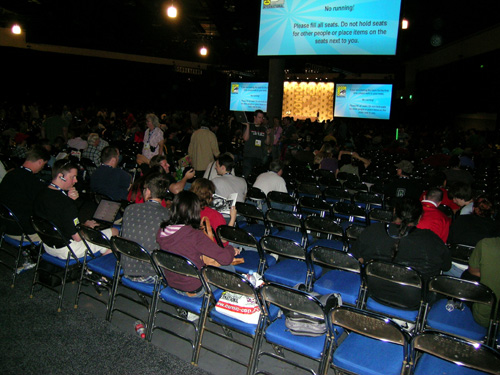
Hall H is essentially impossible to photograph. It’s too dark to shoot without flash, and flash only lights up a small area. To give a sense of scale, though, that orange rectangle near the center of the photo is the stage where the celebrities sit for their sessions. Sitting near the back, I could see them only as small dots, except on the monitors.
On Sunday I wandered around the exhibition hall, which I hadn’t really explored up to then. It’s divided into general sections by type of display. There’s an aisle for upcoming video games; that round thing in the photo at the right is the Electronic Arts sign. Gamers crowded it to try out the new titles. Artists’ Alley is where independent artists and aspiring artists can rent small display tables. Despite the proliferation of media publicized and sold at Comic-Con, comics still command a substantial portion of the floor. Dealers may offer old comics, original artwork, animation cels, and posters. Henry was delighted to find and purchase an original newspaper page with a well-preserved Winsor McCay comic-strip on it.
The big studios have large display areas for films and TV shows. Aisles around them seemed always to be choked with people, I gather getting autographs from cast members. I never did get close enough for a good look, but obviously these booths are very popular.
Action and collectible figures are represented, there’s an area for comic and graphic-novel publishers, such as Drawn and Quarterly.
Overall I enjoyed Comic-Con. I don’t think it will be one of those events I long to attend every year, but I would like to go back. Presumably in a year or two publicity for The Hobbit will start showing up at the Con, and that I definitely would like to see.
I came back from a month in Europe to find a stack of magazines, books, and DVDs waiting. There was Before the Rain, much Cecil B. DeMille, and a mass of Anthony Manns (some discussed on Jonathan Rosenbaum’s blog). How will I ever catch up? I was reconciled to the idea that I’d die before reading every book I owned, but now I have to face the same conclusion about movies on discs.
Herewith some items from my trip to Amsterdam, Bologna, and Brussels that I couldn’t squeeze into earlier blogs. I end with the movie I watched upon my return.
DaViD’s DVD depredations
In Bologna, I learned that Oksana Bulgakowa is at work studying how cinema captured everyday human gestures at earlier points in history. Visit her site, where a DVD is available on her research.
Speaking of DVDs, travel inevitably brings them into your baggage, despite the high prices and the abysmal exchange rate.
*At Bologna our Copenhagen pals gave us the new Danish Film Institute DVD, Danish Experimental Classics 1942-1958. Not quite yet available for sale, it should show up here—as has a third collection of Jørgen Leth movies. While you’re sniffing around the site, eyeball the archive’s new state-of-the-art storage facility.
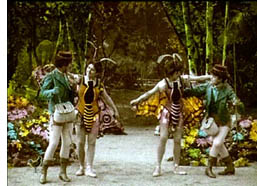
*Isabel Biver passed along the latest installment of Imagination in Context, a series of books and discs about early cinema and Antwerp. Animalomania includes English-language text and some nice films, including a hand-colored fantasy about butterfly collectors who wind up with pretty girls dressed as butterflies.
*At a sale table I found the Index DVD of Ivan Ladislav Galeta’s works, which includes the remarkable Two Times in One Space (1976/1984). I caught up, finally, with the Austrian Film Museum’s reconstruction of Frank Borzage’s The River.
*Also snagged a batch of Gosha and Uchida swordplay movies, but in the Japanese line my real finds were a French edition of Night and Fog in Japan, one of Oshima’s finest (also just out in the UK) and the Carlotta set of three 1930s Mizoguchi films: The Downfall of Osen, Oyuki the Virgin, and Poppies. All drawn from 16mm copies, these items vary drastically in quality. Osen is superb, but Oyuki is iffy, and Poppies is a rain of scratches, the worst copy I’ve ever seen.
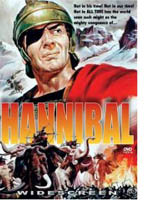
*To top things off, Tom Paulus of the University of Antwerp, bestowed upon me his extra copy of Edgar G. Ulmer’s Hannibal(1960) in SuperCineScope. This is what friends are for.
Interlude: Some Europix, arty and otherwise
My last sigh x 3
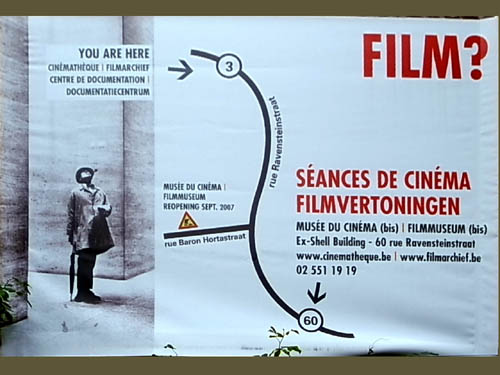
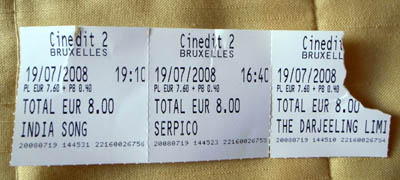
Every summer the Arenberg cinema holds a retrospective season, Ecran total, and it helps make Brussels a great film city. This time there were cycles dedicated to Delphine Seyrig, Al Pacino, the Japanese New Wave, and children, as well as a batch of classics. Prints are usually fresh, and the programming is very eclectic. So Saturday, the day before I flew home, I saw three movies at the Arenberg. I liked the West Anderson better than I expected to, though the clash between the overall feyness and a child’s death left me a little stranded emotionally. I had forgotten the Lumet since the initial release; not up to Prince of the City methinks, but a sturdy, earnest piece of work. The Duras proved as mesmeric as ever, and still unthinkable on DVD (even though I have two DVDs of it). All in excellent prints and pinpoint-sharp projection. Cinephilia satisfied: No need to watch anything on the plane home the next day.
No need to eat much either, because of a delicious late meal with our old friend Geneviève van Cauwenberge, head of the film and media program at the University of Liège.
Trafficking
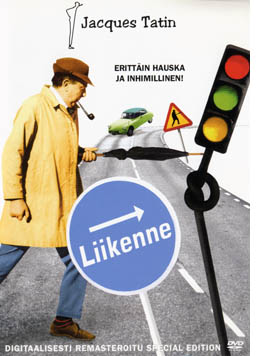
For my avant-birthday, Kristin (a) bought me a beautiful Krazy Kat page; (b) took me out for sushi; and (c) settled in with me to watch the new Criterion disc of Jacques Tati’s Trafic. It’s been one of our favorites for a long time; I saw it on initial release in Paris while researching my dissertation. It’s not as densely loaded as Play Time, nor as structurally rigorous as M. Hulot’s Holiday. (Kristin wrote about both these films in her book Breaking the Glass Armor; my bias aside, her analyses are really illuminating.) Trafic has its own charms, though, and Gary Giddins gets at several of them here. We’ve collected versions on tape and even a Finnish DVD, which calls him Tatin, but the Criterion looks to be the best version yet. (Still, why not anamorphic?)
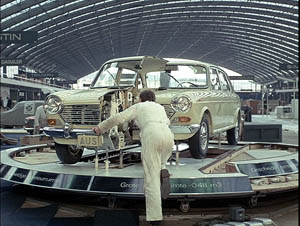
Trafic is definitely odd, with a choppy opening and quickly-cut extreme long shots. This time around I was struck by how much a landscape artist Tati was. Sometimes he built his own massive milieu, as in Play Time, and sometimes he merged his constructed spaces with the real world, as in the houses of Mon Oncle. In Hulot and Trafic he exploited the vastness of real spaces, usually the backdrop for human foibles made minuscule. Trafic gives us a un-picturesque European countryside. Sliced by superhighways, the bland vistas are dotted with rusted cars, empty fields, and forlorn gas stations. Drivers hiking off for fuel or trying to patch up their vehicles dwindle to pathetic dots in the image. Cities are no better, choked with pale cars that advance fitfully. Then there’s the huge convention center housing the auto show. The opening gag of men stepping carefully over stretched strings that we can’t see etches tiny gestures into a monumental frame. Masters of ambivalent vastness: Antonioni, Angelopoulos, Tarr….and Tati?
The setpiece of Trafic is of course the car crash, and it, like Tati’s characteristic running gags (e.g., cheap busts of historical figures as bonuses for gas fillups), reminds us of the follies of the car culture. In a sense, the entirety of Trafic seems an outgrowth of Play Time‘s final sequence, which turns a traffic roundabout into a carousel. But here there’s little sense of a mundane world transformed into a playground. Instead, modern misery remains the norm, as pedestrians zigzag their way through infinite gridlock.
Beyond the satire, which can get fairly caustic, I have always loved Tati for juxtapositions so weird and remote that you wonder if they could count as gags. Then you wonder if you’re the only person to notice them. In Play Time, everybody gets the running gag about the drunk at the bar of the Royal Garden tipping over on his stool. Far less evident is a moment I always find disconcerting. When the air-conditioning at the restaurant is finally switched on, the air vents make the loose skin on one woman’s back ripple. The denunciation of flabby bourgeois comfort comes and goes in a flash, and when I first noticed it in the 1970s I thought: Is it accidental? Did Tati mean for me to see it? Does anybody else notice? And does this count as a gag, or just, well, peculiar?
Likewise, in Trafic, Tati can cut from a bisected car on display to a quasi-abstract angle on traffic, with one fender sliding past an identical one.
We’re supposed to notice the purely sculptural analogy of split cars. And we’re supposed to find it at least a little funny. Right? Right?
Whether you agree or not, Tati’s vacant long-shots and unpredictable cutting leave space for such musings. Comedy with a question mark, from one of the dozen or so greatest directors who ever lived.
Kristin is now at Comic-Con, armed with fan-friendly T-shirts and a carrier bag from Lambiek. Her mission: to sell a copy of The Frodo Franchise to each of 125,000 attenders. Expect dispatches from her in the days to come.
P. S. My thanks to the staff of the vaults at the Royal Film Archive of Belgium, who were extremely helpful during my visit. I didn’t manage to photograph everybody, but I owe special gratitude to the supervisor Marianne Winderickx, pictured below.
PPS 24 July: Olli Sulopuisto clears up my Tatin puzzlement: “In Finnish the trailing n is the mark of a possessive, similar to ‘Jacques Tati’s…'” Thanks to Olli.
The first moving-pictures, as I remember them thirty years ago, presented more or less continuous scenes. They were played like ordinary plays, and so one could follow them lazily and at ease. But the modern movie is no such organic whole; it is simply a maddening chaos of discrete fragments. The average scene, if the two shows I attempted were typical, cannot run for more than six or seven seconds. Many are far shorter, and very few are appreciably longer. The result is confusion horribly confounded. How can one work up any rational interest in a fable that changes its locale and its characters ten times a minute?
H. L. Mencken, 1927
DB here:
Between about 1913 and 1920, the way movies looked changed, and we are still living with the results. What were the changes? What brought them about?
I’m just back from Brussels, after a two-week visit to the archive. During earlier trips, I’ve concentrated on examining films from the 1910s that exemplify the tableau tradition. That’s what we might call the stylistic approach that tells the story and achieves its other effects predominantly through staging—by arranging the actors within the frame, forming patterns that reflect what is important at a given moment.
The tableau tradition dominated European cinema of the early and mid-1910s, and it was also on display in the U. S. It is sometimes considered “theatrical” and “uncinematic,” but that’s a shortsighted view. The tableau tradition is one of the great artistic triumphs of film history. For backup on this, consult Ben Brewster and Lea Jacobs’ Theatre to Cinema and my On the History of Film Style and Figures Traced in Light. And you can go here and here on this site.
As the 1910s moved on, the staging-driven approach gave way to one dominated by editing. Roughly speaking, this strategy surfaced at two levels. Directors began to use crosscutting, aka parallel editing, more strenuously. By alternating shots, you could show events taking place at two or more locations. This technique was not used only for last-minute rescues; it was a way of keeping track of all the characters in nearly every sequence, whether they were going to converge or not.
Second, within a single strand of action, 1910s directors exploited analytical editing, breaking down a scene’s space into a host of details. Griffith often gets the credit for this tactic (and he happily claimed to have invented it), but it’s probably most fairly understood as a collective innovation.
Directors in the tableau tradition didn’t entirely avoid crosscutting or analytical editing, but there was a measurable shift of gravity in the second half of the 1910s. In the U.S., many filmmakers pushed editing techniques very hard. You can sense their exhilaration in discovering how editing lets them control pacing, make story points concisely, build suspense, and force the viewer to keep up.
During the 1910s, American movies became breathless. The hurtling pace of Speed Racer or The Dark Knight has its origins here; seen today, The Battle at Elderbush Gulch (1913) and Wild and Woolly (1917) still look mighty rapid-fire. And then as now some observers, like Mencken, complained that it was all too fast and furious.
Over the last thirty years, many scholars have studied this change, but for a glimpse of some supporting data, you can visit the remarkable website Cinemetrics. Yuri Tsivian, Barry Salt, and a corps of volunteer scholars have been measuring Average Shot Lengths in films from all eras. The data from the 1910s are pretty unequivocal. In the US around 1916-1918, movies became editing-dominated, shifting from an ASL of over 10 seconds, sometimes as much as 30 seconds, to 5-6 seconds or less. A 4-6 second average per shot persists in Hollywood through the 1920s, so Mencken’s guess about the “scenes” (as shots were then known) changing ten times a minute was more or less right.
Back in the 1980s, Salt and others, including Kristin and me, picked 1917 as a plausible point of reference for the consolidation of the continuity style. That was the point at which virtually every US film we watched contained at least one example of specific continuity techniques. (Most contained many more instances, of course.) We talk about that magical year in this entry, which you might want to read as an introduction to what follows today.
In just a few years, continuity editing became a coherent, supple means of expression, and it has defined Hollywood film style up to the present. What brought this about? Kristin and Janet Staiger offered an explanation in our 1985 book, The Classical Hollywood Cinema: Film Style and Mode of Production to 1960. They traced out several factors that encouraged and sustained this style. Especially important were the development of longer films, a conception of filmic quality, and the emergence of a specific division of labor.
Lately I’ve been revisiting these early years, chiefly to watch how directors pick up and refine the stylistic schemas that were coming into broader use. I want to know more about the little touches that directors had to control in creating this style. I’ve also been interested in to what extent these techniques were picked up by directors in Europe and Asia. The evidence is pretty clear that continuity cinema became a lingua franca of film style.
So if last year I pondered the minute compositional adjustments of Evgenii Bauer, this year it was all cutting. I focused on three filmmakers, but I’ll save discussion of two of them for a rainy day, or a book. In all, it was a thrill, as ever, to watch a stylistic system coalesce across a batch of films that are seldom mentioned in the history books.
The trail to continuity
The extraordinary films starring William S. Hart typify early American continuity techniques. After a distinguished career on the stage, Hart began as a film actor in 1914, when he was nearly fifty. He was intent on bringing realism to the newly burgeoning Western genre. His films were at first made under the auspices of Thomas Ince, a pioneer of rationalized production techniques, and with his Ince pictures Hart found worldwide success. He followed a rousing feature debut (On the Night Stage, 1915) with many shorter films. In 1917—mark the year—Hart broke with Ince and set up his own firm for The Narrow Trail. He continued to make films into the early 1920s, with Tumbleweeds (1925) marking his farewell to cinema.
Hart often directed his own pictures, though he also had the services of strong directors like Reginald Barker. The films have an assured brio, thanks to careful cutting and some felicitous touches.
They are fast-moving: In the five 1915 Hart films I watched, the ASL ranged from 8 to 11 seconds, but in 1916, the average jumped to 5-6 seconds per shot. The Narrow Trail seems to have an ASL of 3.7 seconds, but I can hardly believe it and I must verify it with another viewing. The 1918 and 1920 films I viewed average between 4.9 and 5.4 seconds per shot.
Just as important as the speed of cutting, naturally, is what Hart does with his cuts. In one scene from Between Men (1916), you can see the tableau aesthetic undermined by analytical editing. Gregg is a shifty stock trader, a species we still nurture. He’s trying to destroy Hampton’s fortune because he thinks that when the old man is destitute he’ll force his daughter to marry Gregg. Hampton has asked Bob White (Hart) to help get the goods on the suitor.
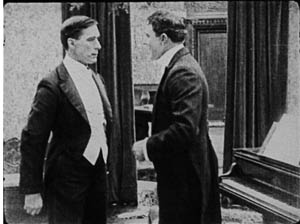
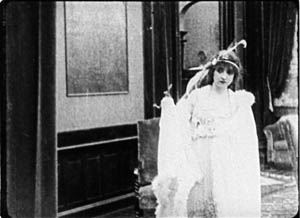
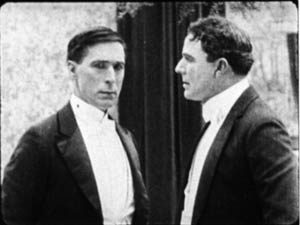
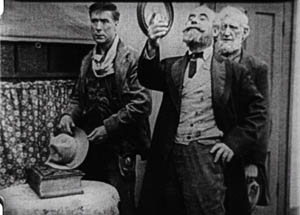
In one scene, the master shot approximates a tableau setup: Bob and Gregg stand in the middle ground, with a room visible behind them.
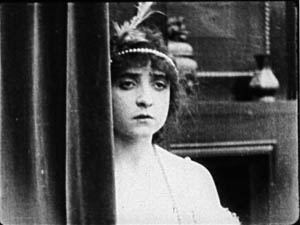
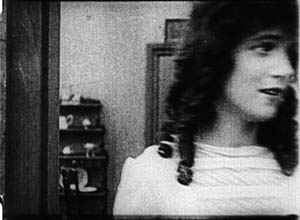
As the men swap increasingly tense challenges, Margaret Hampton enters the adjacent room and stands behind them as they talk. A director in the tableau tradition would have sustained the master shot and shown Margaret approaching in the background and drawing closer, reacting to what the men say. She could easily have been stationed hovering at the curtain on the right.
Instead, director C. Gardiner Sullivan has her arrive from another doorway in the adjacent room, one not visible in the master shot of the two men. He then cuts back and forth between the men and Margaret, and he positions her at the left curtain–so that the men block her from our view! The blockage motivates cutting to Margaret for her reactions to what Bob and Gregg say.
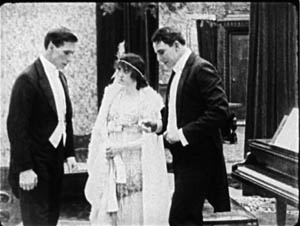
Only when she wants to challenge Bob’s suggestion that he might marry her does Margaret come into the same frame as the men, who part to make room for her.
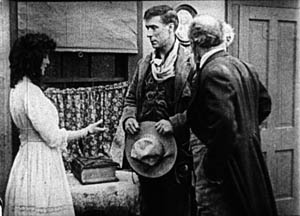
It turns out that this sequence is but a rehearsal for a lengthier passage in which Hampton will come in from the adjacent room (via the door we do see in the background). As with Margaret’s entrance, his arrival will be blocked by Gregg’s body, and Sullivan will cut among the trio in the foreground and Hampton’s approach behind them. That passage, which could also have been handled in a single framing in the tableau style, consists of four distinct setups and eighteen shots!
So even depth-based scenes can be recast as rapid découpage. The passage is probably overcut, but you can sense the filmmakers’ exhilaration in their power to chop up the world into separate, slightly jolting bits, forcing the audience to keep abreast of each item of information.
Managing details
The variety of setups is worth noticing in another film, for here we can see the filmmakers taking pains to show each bit of action most clearly and emphatically. In The Return of Draw Egan (1916), when Egan sees the mayor’s daughter Myrtle he decides to stay on as marshal of Yellow Dog. The first shots show them looking at each other.
The next pair of shots shows the two looking at each other in close-up.
This gradual enlargement of the figures in a reverse-shot sequence would of course become a staple of analytical editing—perhaps it already was in 1916. Cut back to another framing of Egan, as the mayor signals Myrtle to join them. The slightly off-center composition reiterates her position off left.
Cut back to Myrtle, exiting her close-up. The next shot shows her joining the men, to be introduced to Egan.
But this is a different camera position than the one showing the men just previously. The daughter’s entrance has motivated a slightly changed composition. In the 1910s, cutting began to dictate staging, so that each composition had to fit smoothly into the flow of shots.
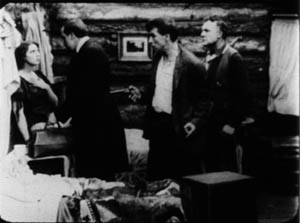
This sequence from Draw Egan doesn’t utilize axial cuts, those cuts that keep to the same angle and move straight in or out. Here the actors are angled to suggest that we are to some degree in between them. Indeed, sometimes the camera will put us directly between the characters. Here is a climactic confrontation from The Disciple (1915). A doctor has cuckolded Hart, but Hart brings him to save his daughter. As the doctor enters, the wife’s shameful look is met by Doc’s anxious expression, with a furious Hart pressing a pistol to his back.
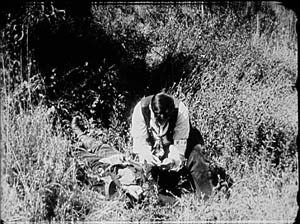
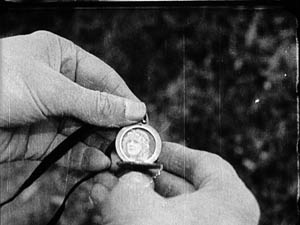
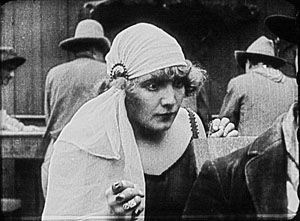
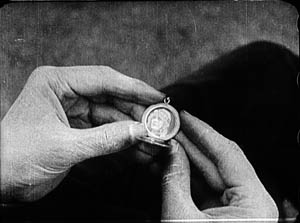
This freedom of camera placement extends to point-of-view cutting. Again, this is an old technique, but like other old techniques, it was revived and refined as part of the synthesis that became the continuity style. So Keno Bates, Liar (1915; a splendid title) can make use of a cameo picture that captivates Bates after a shootout with the man who robbed him.
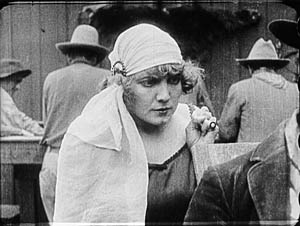
Later, the dance-hall girl catches sight of her rival when Bates muses on the cameo.
The pov framings don’t change much, but the angle chosen easily approximates both Bates’ view and her view over his shoulder. Moreover, the shot of Bates’ hands isn’t the sort of vacuous insert we often see at the period, with a letter or an object isolated against a blank ground. Here, the backgrounds change, so that the first shot is situated naturally in the wild, while the second is consistent with the barroom locale.
Putting the pieces together
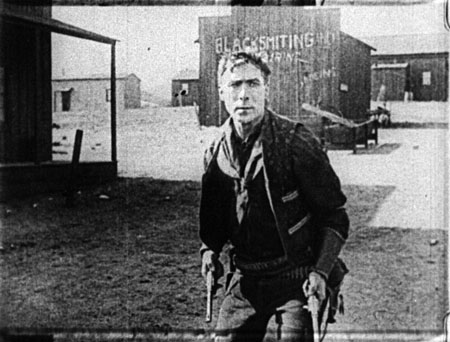
From very early in the history of Westerns, the main street shootout seems to have been a solid convention. Already in The Return of Draw Egan, it’s treated with a vitality and ingenuity that suggests creative reworking of a staple. The climactic shootout also shows just how flexible the new technique could be.
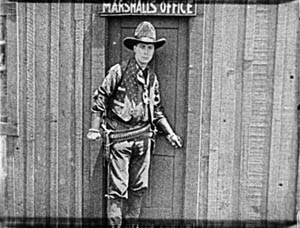
Egan has told his enemy, Arizona Joe, that he’ll meet him when the setting sun’s rays hit the saloon window. So the film crosscuts Egan in his marshal’s office with a nervous Joe, seen in close-up, eyeing the window.
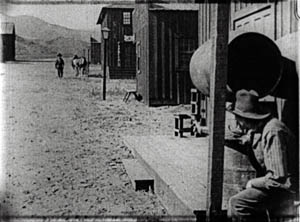
When Joe gets up the nerve to leave, he hides behind a barrel and waits to ambush Egan. When Egan leaves his office, a reverse tracking shot follows him striding toward us.
Then we get an orienting long shot with Joe in the foreground and Egan approaching.
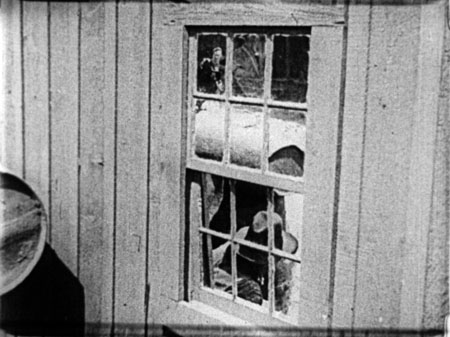
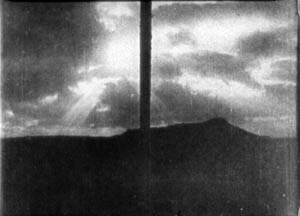
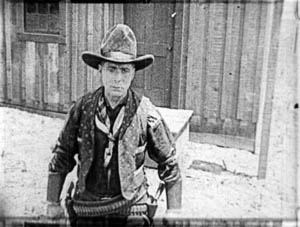
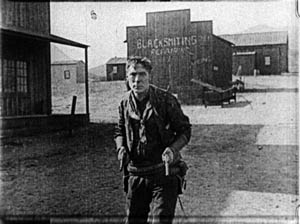
Edging sideways, Egan spots a reflection of Joe’s head in a window. These shots surmount today’s blog entry. You can see Egan’s reflection in the upper left pane.
Now aware of Joe’s tactic, Egan steps diagonally forward, coming ominously right up to the camera.
He fires and dispatches Joe. The townsfolk, who have been huddled in a house watching, declare they want Egan to stay on as marshal, despite his outlaw past. Myrtle chimes in, and we get a happy ending. Chaotic fragments? Mencken couldn’t have been more wrong. Or maybe he was just being grumpy.
The trail to Hollywood
There’s plenty more in these films—beautiful, sometimes minuscule matches on action; subtle timing of frame entrances and exits; and even proto-over-the-shoulder reverse shots. And we don’t have to claim that Hart’s films are the only innovative ones. They take their place within a broader, collective achievement that we still haven’t fully grasped.
Editing permitted everyone to act at small scale; the bargirl who sees Bates’ cameo need only lower one fist, tighten the other, and narrow her eyes to express her jealousy. The new style nurtured laconic stars like Hart. His films are full of pathetic situations that demand he display stoicism but also sensitivity. The long shots could emphasize his gestures and stances, while close-ups could display his worn, haunted face and pale eyes. He acts with those eyes, glancing aside to recall a traumatic event or looking downward as he hesitates to break bad news. Often the plot demands that he conceal his feelings or hide the truth behind an event, and the changing shots could penetrate the surface drama and highlight his slightest reactions. Hart could underplay his role because the editing shows us everything he might have said.
Known in France as Rio Jim, Hart was very influential on the Europeans. His pictures, along with De Mille’s The Cheat (1915) and the films of Chaplin and Fairbanks and many others, offered tutorials in the new style. Arguably, the cumulative force of these mainstream releases was greater than the influence of Griffith’s more prestigious output of the moment. There was only one Intolerance (1916), the film by which Griffith was most widely known abroad, but week by week the Westerns and comedies and dramas pouring out of Hollywood flaunted a new, almost frighteningly energetic approach to cinema.
Timing favored the Americans. The style emerged at around the start of World War I, when hostilities gave U. S. films a chance to displace the big French and Danish companies in many markets. Kristin explains how this happened in Exporting Entertainment, and she talks about the exceptional case of Germany in Herr Lubitsch Goes to Hollywood.
Some European directors picked up the new style immediately, others took a bit longer, and a few, like Feuillade, never fully adjusted to it. The principles of the older tableau style never utterly died out, as I try to show in Figures Traced in Light. But the future belonged to the editing-based aesthetic. Canonized, tweaked, updated, dismantled, undermined—however filmmakers reacted to classical continuity, it became the basis of international cinematic storytelling.
My epigraph comes from H. L. Mencken, “Appendix from Moronia: Note on Technic,” from Prejudices: Sixth Series (New York: Alfred A. Knopf, 1927), rep. in Phillip Lopate, ed., American Movie Critics: An Anthology From the Silents Until Now, expanded edition (New York: The Library of America, 2006), 35-36.
Silent film speeds can vary, so shot counts can yield different averages. I saw some of the Harts I mention in projection at last year’s Il Cinema Ritrovato, and they were projected at 18 or 19 frames per second, a common speed for the period. My ASLs are based on the running time. For the titles I saw in Brussels on a flatbed viewer, my basis was the length in meters. From that I’ve calculated running times and averages, assuming 18 frames per second. Projectionists of the time had freedom to screen at different speeds, so it’s possible that late 1910s Hart films were sometimes shown at 20 frames per second, which of course would make their cutting pace even faster.
For more on Hart’s career, see Diane Kaiser Koszarski, The Complete Films of William S. Hart: A Pictorial Record (New York: Dover, 1980). Koszarski devotes space to each film, with credits, excerpts from contemporary reviews, and excellent production stills. She also provides a sensitive critical overview. In William S. Hart: Projecting the American West (Norman: University of Oklahoma Press, 2003) Ronald L. Davis has given us a brief, engrossing biography based on interviews and extensive archival research. Hart’s memoir, My Life East and West (1929, reprint 1994) is of course indispensable.