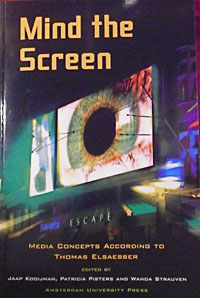
by Kristin Thompson. Berkeley: University of California
Press, 2007.
400 pages, 6 × 9 inches, 12 color illustrations;
36 b/w illustrations.
[go
to Amazon | go to The Frodo Franchise blog]
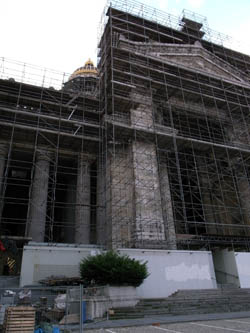
Kristin and I think of Brussels as a gray city—gray skies, gray pavements, gray buildings, even gray, if often fashionable, clothes. It isn’t usually a fair description, though. In the twenty-plus summers we have been visiting, many days have been bright. I suppose our impression comes chiefly from one rainy fall we spent here in 1984, on a Fulbright research grant. Still, the public monuments bear us out, especially the Palais de Justice: except for its gold dome, it is gray, and has been encased in gray scaffolding for as long as we can remember.
Indeed, Brusselians assure us that the scaffolding will never go away because it’s holding the Palais up.
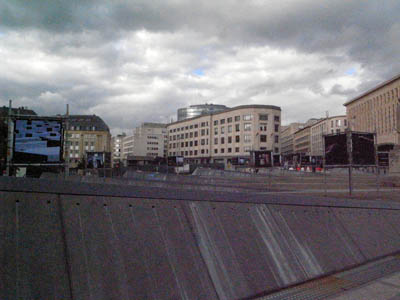
The gray motif continues this summer; during my visit, there have been almost no sunny days, just rain and chill. To prove that Belgians have stayed loyal to their favorite color, I took a shot of a new piece of public architecture near the Central Station: a half-circle of tipped-over pyramids that are, ineluctably, gray.
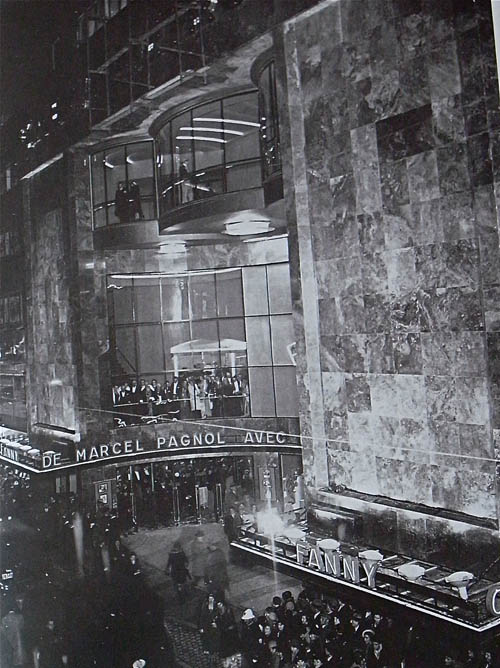
Still, the movies provide my light and color. I talked about Brussels as one of the great film cities in last year’s entry.I found further proof in a 2003 Marc Crunelle’s Histoire des cinemas bruxellois (in a series announced here), a small book with some fine pictures, one of which you will find at the end of this entry.
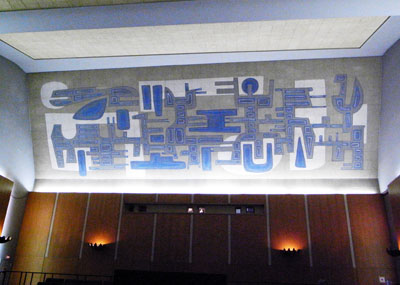
As usual, my host was the Royal Film Archive of Belgium. The archive offices remain in their splendid old building, the Hotel Ravenstein, but the new museum complex is still under construction. So the screenings continue to be held in the ex-Shell building, a piece of postwar Europopuluxe that I seem to enjoy more than most of the locals.
During my days, I watch films (very, very slowly) in the archive vaults; more about that project in my next entry. At night the event was Cinédécouvertes, the annual festival of new films that don’t yet have Belgian distribution. That festival, going back decades, has now been attached to a bigger event, the Brussels European Film Festival, which this year began on 28 June. BEFF showed thirty new titles, plus eight older items in open-air screenings, and it gave several prizes.
Kristin and I were in Bologna for Il Cinema Ritrovato and so I missed all of these, including the big Flemish film of 2007, Ben X. But Cinédécouvertes, running on during the BEFF, had its second and final week while I was in town. Films screened were competing for a 10,000-euro prize to be awarded to a distributor that would pick up the film. In addition, the venerable L’Age d’or prize would be awarded to a film that maintained the spirit of Buñuel’s scandalous masterpiece.
Herewith some notes on what I saw, and the prize results. Of course on the day I posted this, the sun came out.
Women, prep school, and manga
Cargo 200.
The two Iranian films in the program were earnest but varying in quality. Unfinished Stories (Pourya Azabayjani) is a network narrative following three women across a single night. A suicidal teenager doesn’t return home; her path crosses with that of a wife cast out by her husband; and she in turn brushes past a young woman who tries to smuggle her newborn baby out of the hospital. The situations are engagingly melodramatic, but the links among them (a footloose soldier, a compassionate taxi driver, an enigmatic old man) seemed to me forced, and as is often the case in these tales, the problem is how to conclude each story line in a satisfying way. The use of sound was very fresh, however. I especially liked the teenager’s obsessive replaying of taped conversations with her boyfriend. Often these “auditory flashbacks” are played over a black screen, and they come to exist as discrete, almost virtual scenes.
I like it when a film begins with a sharp, defining gesture, and Three Women (Manijeh Hekmat) had one. In close-up a car drives up to a tollbooth and the driver’s hand tosses a cellphone into a Charity Box there. Someone is on the run and cutting ties, but we won’t find out more for some time.
The first stretch of the movie concentrates on Minoo, a divorced professor and expert in Persian textiles. A rug dealer has promised to keep a precious carpet in the care of her museum, but he changes his mind and tries to sell it. In a fit of temper she grabs the carpet from its owner and takes it to her car, where her somewhat senile mother waits patiently for a trip to the hospital. Then the old lady vanishes. The emphasis shifts to Minoo’s daughter Pegah, who has set out on her own. The maddening Tehran traffic of the early scenes gives way to the empty quiet of the countryside. In the second half of the film, a favorite theme of Iranian cinema—the urban intellectual confronting rural life—is played out vividly when village elders debate whether to stone a woman who has had an abortion.
Like many of the best Iranian films, Three Women tells its story with dramatic force, offering robust conflicts and a degree of suspense rare in arthouse fare. Manijeh Hekmat, who made her name with Women’s Prison, manages the story threads skilfully, creating a continuous revelation of backstory and hints about how the tale will develop. I especially liked the way Minoo gradually realizes that she has had no idea how her daughter is living. As Alissa Simon points out in her perceptive review, Hekmat can spare time for a subtle composition as well. The ending came as a quiet surprise, deflating some dramatic issues but emphasizing the comparative unimportance of carpets, cellphones, and pop music in the face of the deeper problems facing Iranian women.
Add another woman and you have Adoor Gopalakrishnan’s Four Women. The quartet of stories, all adapted from literature and evidently set in the 1940s and 1950s, shows the fates befalling women in different roles, each identified with a title: The Prostitute, the Virgin, the Housewife, and the Spinster. Not much fun to serve in any of them, it turns out. The film has a sharp eye for details of local life and ceremonies, an ambition helped by the high-definition format: a slow-moving river is off-puttingly scummy. A little didactic and schematic, but it’s enlivened by a long sequence of a husband who methodically and endlessly eats everything put in front of him, with a seriousness he cannot bring to his marriage. The sequence starts in bemusement, moves to humor, and persists to the threshold of nausea.
The Argentine La sangre brota (Pablo Fendrik) was a little reminiscent of City of God in its relentless handheld assault on your senses, with the camera grazing faces and people racing in pursuit of drugs and money, with a beleagured taxi driver trying to do the right thing. La maison jaune (Amor Hakkar), from Algeria, appealed more to me. How much we owe neorealism! Quietly and simply, Hakkar tells of a father learning of his son’s death, fetching the body home for burial, and then trying to find a way to relieve his wife’s grief. So he paints his house yellow. Quiet and moving and not as simple, in story or pictorial technique, as it might sound.
Antonio Campos’ Afterschool (US) is a very assured first feature about drug-overdose deaths in a prep school. The story is told almost completely through the consciousness of Rob, an introspective and awkward freshman who indulges in internet porn. Passive to the point of inertia, Rob remains largely a mystery. This effect is often due to Campos’ bold use of the 2.40 widescreen frame, which often excludes some of the most important dramatic information. People are split by the left or right edge, or are decapitated by the top frameline, so we must strain to listen to the conversation and catch glimpses of the characters. This may sound arbitrary, but Campos finds ways to motivate the lopped-off compositions. One shot, when the parents of dead students record their thoughts on video, is one of the strongest pieces of staging I’ve seen this year.Unlikely to get U. S. theatrical release, if only because of its pacing, Afterschool marks Campos as definitely a director to watch. It won one of the two top Cinédécouvertes prizes.
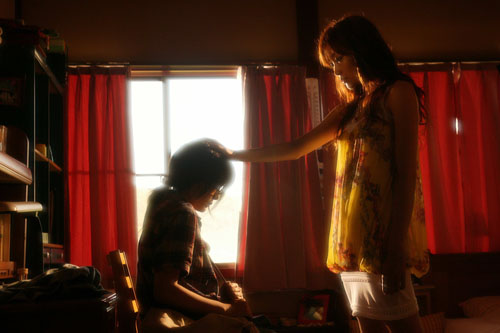
The other top prizewinner was Yoshida Daihachi’s Funuke, Show Some Love, You Losers! It’s another insane Japanese family movie—that is, the family is insane, and the movie acts the same way, out of sympathy or contagion. After the parents are killed trying to save a cat from an oncoming truck (nice overhead shot of bloody skid marks), a new household takes shape. There’s the phlegmatic brother Shinji, his maniacally cheerful wife, his adolescent sister Kyomi, and his sister Sumika, who comes to stay after failing to make it in Tokyo as an actress. Family secrets emerge. Sumika starts turning tricks and Kyomi draws violent manga inspired by Sumika’s adventures. The comedy turns blacker when Kyomi’s comic books become best-sellers and all the family problems regale the reading public. With some scenes shot in high-contrast video, as if they were TV episodes, and a climax that blends film and manga, panel by panel, the film’s style is as all over the map as the characters and their complexes. Good dirty fun from the title onward.
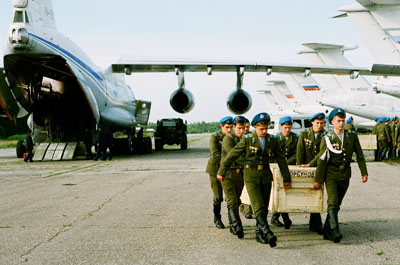
The L’Age d’or prize went, deservedly, to Cargo 200 from Russia. Another black comedy, but one that gets blacker and less funny as it goes along, it becomes sort of a post-Glasnost’ Last House on the Left. (Seriously, maybe there’s an influence of Saw and Hostel here, with hints of Faulkner’s Sanctuary.) Set in 1984 and stuffed with retro clothes, hairstyles, and music, the plot spins crazy-eights around the corpse of a returning Afghan war hero; a teenager trying to buy homebrew vodka; a bootlegger who keeps a Vietnamese refugee as an assistant; a small-town policeman with a penchant for voyeuristic sex; and a professor of dialectical materialism who wanders, blinking, in and out of the lurid plot twists. Director Alexei Balabanov, who did the pioneering rough genre picture Brother (1997), gives no quarter here.
Strength in simplicity
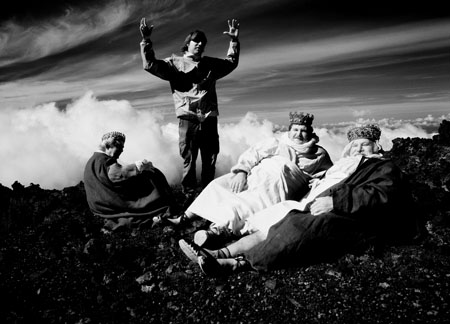
Albert Serra directs the three kings in El cant dels ocells.
My three favorites were all resolutely unfancy. Shultes, a Russian item by Bakur Bakuradze, is a minimalist study of a pickpocket. Shultes lives with his mother, gives some of his loot to his legit brother, and takes up with a boy whom he tutors in thievery. At slightly over 200 shots, the movie is staged, shot, and cut with a precision that reminded me of Apichatpong Weerasethakul (Syndromes and a Century). On the inexpressiveness scale, Shultes, with eyes and mouth too small to fill up much of his face, makes Bresson’s pickpocket look positively other-directed.
As with all movies about stealing, the pleasure lies in trying to figure out the plan and spot the telltale moves—sort of like the misdirection of a magic act. Here the drama is cunningly contrived. What is Shultes writing in his little brown book? Who is Vasya? What’s his big plan? The plot jumps a level when we realize that all we’ve seen is a flashback, and the ensuing conversation puts things in a startling perspective. Our blankly amoral protagonist even becomes a shade sympathetic. Too rigorous and unemphatic to be an arthouse import, I fear, but ideal for a festival.
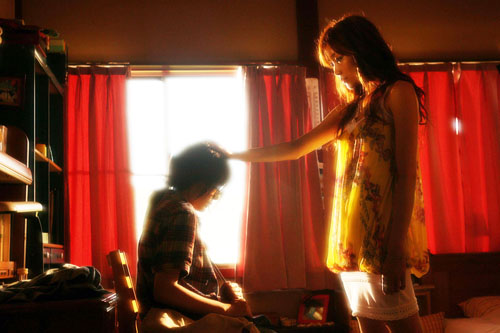
Shinji Aoyama is best known for Eureka (2000), which won a prize at an earlier Cinédécouvertes. Sad Vacation is one of those films that try to do justice to the ways in which humans become tangled in relationships based on acquaintance, momentary bits of kindness, and sheer chance. Kenji helps smuggle Chinese workers into Japan, but when one dies, Kenji takes the orphan boy under his wing. Soon characters and connections proliferate. There is the salariman and his dumb pal searching for the runaway Kozue. Kenji cares for a slightly daft girl, and he becomes romantically involved with the bargirl Saeko. Accidentally he finds the mother who deserted him, and he joins her new family, complete with mild-mannered father and rebellious brother. Always hovering around are several men and women who work for the father’s trucking company—people rescued, it’s implied, from crime or neglect.
Aoyama manages the crisscrossing relationships delicately, without losing sight of the fact that behind Kenji’s laid-back appearance is a boiling desire to avenge himself on his mother. But she’s his match. A woman of smiling serenity, or smugness, she seems infinitely resilient. The final confrontation of the two, in a prison visiting room, has the giddy sense of one-upmanship of the prison visit in Secret Sunshine. Things turn grim and bleak, yet Sad Vacation manages to feel optimistic without being sentimental; even a flagrantly unrealistic soap bubble at the close seems perfectly in place. I notice that Aoyama has made nearly a film a year since Eureka; why aren’t we (by which I mean, I) seeing them?
Some films, like those of Angelopoulos, seem to spit in the face of video. You can’t say you’ve seen them if you haven’t seen them on the big screen. Such was the case with my favorite of the films, The Song of the Birds (El cant dels ocells, 2008) by the Catalan director Albert Serra. It merges an aesthetic out of Straub/ Huillet—black and white, very long static takes, drifts and wisps of action—with a joyous naivete recalling Rossellini’s Little Flowers of St. Francis. Serra’s film also reminded me of Alain Cuny’s L’Annonce fait à Marie (1991) and one of the greatest of biblical films, From the Manger to the Cross (1912). All make modest simplicity their supreme concern.
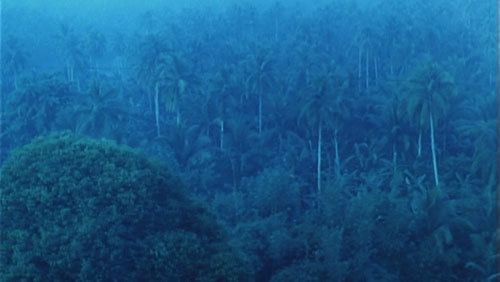
We three kings of Orient are . . .well, definitely not riding on camels. We are in fact trudging through all kinds of terrain, scrub forests and watery plains and endless desert, to visit the baby Jesus. We are also quarreling about what direction to go, whether to turn back, and why we have to sleep side by side so tightly that our arms go numb. And in an eight-minute take we are struggling up a sand dune, vanishing down the other side, and then staggering up again in the distance.
The three kings aren’t characterized, and they are sometimes unidentifiable in the long-shot framings; only their body contours help pick them out. Intercut with their non-misadventures are glimpses of an angel (whom they may not see) and stretches featuring Joseph and Mary, who caress a lamb. Eventually the infant Himself puts in an appearance, burbling. When the kings finally arrive, one prostrates himself. The image settles into a tidy, unpretentious classical composition and we hear the film’s first burst of music, Pablo Casals’ cello rendering of the folk tune Song of the Birds.
The kings get a chance to bathe in a scummy pool before returning home. Off they trudge. “We’re like slaves!” one complains. In a final shot that would be sheer murk on a DVD, they swap robes and set off in different directions. Did I see them embrace one another? Did they murmur something? I couldn’t tell for sure. Night was falling and they were far away.
Like Casals’ cantata El Pessebre, The Song of the Birds gives us a Catalan nativity. The simplicity is genuine, not faux-naif, and the humility doesn’t preclude humor. Although the shots are quite complex, the spare surface texture invests a familiar story with a plain, shining dignity. Discovering films like this, which you will never see in a theatre and could not bear to watch on video, makes this ambitious festival such a worthy event. It maintains the heritage of one of the world’s great cinema cities.
Next up: A report on films I’m watching at the archive’s vaults on–no kidding–the Rue Gray.
The Metropole, Brussels, 1932.
Thanks to Jean-Paul Dorchain of the Archive for help in finding illustrations. And apologies to readers who came here and found only a stub earlier. An internet gremlin somehow purged the first version of this entry a few hours after it was posted.
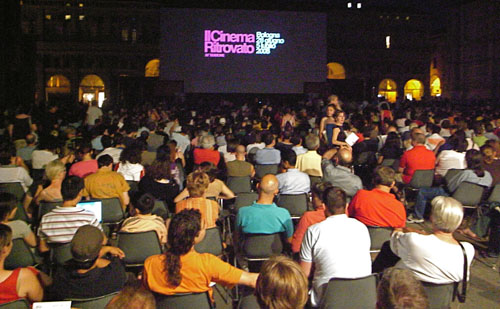
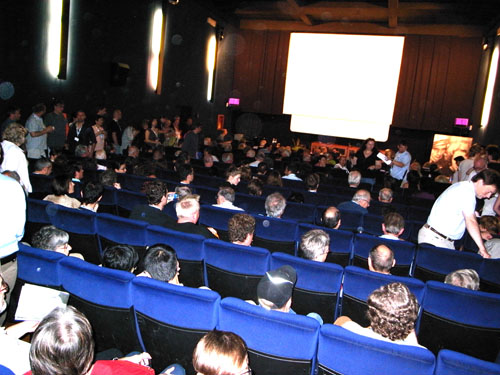
A big crowd assembles for one of the nightly screenings on the Piazza Maggiore.
Not laziness or old age (we hope) but sheer busyness has reduced our Bologna blogging to a single entry this year. Last year we managed three entries, but this time there was just so much to see, from nine AM to midnight, that we couldn’t drag ourselves away to the laptop. That it was blazing hot and surprisingly humid may have given us less biobloggability as well. Still, DB has many pictures, so maybe a followup blog with unusual images of critics and historians disporting in the sun….
Some backstory: Hosted by the Cineteca of Bologna, Il Cinema Ritrovato is an annual festival of rediscovered and restored films. Every July hundreds of movies are screened in several venues. For our 2007 report, with more background and some orienting pictures, go here and then here and here. Watch a lyrical trailer for the event here.
As before, both KT and DB contribute to this year’s entry. But first, the breaking story.
Freder and Maria, together again for the first time
While we were there, the news of a long version of Metropolis broke. The estimable David Hudson offers a quick guide and an abundance of links at GreenCine. A rumor went around Bologna that fragments of the new Buenos Aires print would be screened, but instead there was a twenty-minute briefing anchored by Martin Koerber of the Deutsche Kinemathek. Along with him, Anke Wilkening (Friedrich-Wilhelm-Murnau Stiftung), Anna Bohn (Universitat der Kunste, Berlin), and Luciano Berriatua (Filmoteca Espanola) provided some key points of information.
*Provenance: The “director’s cut” was released in Argentina during the 1920s, with Spanish intertitles and inserts made at Ufa. A collector acquired a print. (Once more we have a collector to thank for saving film history.) When the Argentine film archive (Museo del Cine Pablo C. Ducros Hicken) received the copy in the 1960s, a 16mm dupe negative was made, and the nitrate original was discarded, a common practice at the time.
*Condition of the copy: The print is very worn, as the frame reproduced by Die Zeit indicates. Can the torrent of lines and scratches be eliminated? The rescue isn’t likely to be perfect; the damage is perhaps “beyond the reach of our algorithms,” as Martin puts it. To my eye, judging from the Die Zeit frames, many images are lacking in texture and contrast as well.
*Completeness: Contrary to some reports, virtually all the missing scenes are present on the Argentine print, the single exception being a small portion at a reel end. Among the new sequences are scenes filling in the roles of three characters (Georgy, Slim, and Josaphat), a car journey through the city, and moments of Freder’s delirium.
How can the researchers be confident that the print is so complete? It’s a fascinating story.
Metropolis has been reconstructed many times since the 1960s. In 2001, the Murnau foundation presented a digital restoration of the film supervised by Martin Koerber in collaboration with Enno Patalas. In this version, which is available on DVD (Transit Film, Kino International) about 30 minutes of the original material are missing. In 2003-2005 Enno Patalas and Anna Bohn together with a team at the University of the Arts in Berlin created a “Study Edition” version in which the missing footage was represented by bits of gray leader. For the first time the full length of the film was reconstructed with help from the the original music score.
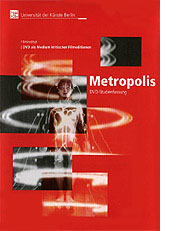
In 2006 a “DVD study edition” was released by the Film Institute of the Berlin University of the Arts (Universität der Künste Berlin; DVD-Studienfassung Metropolis). This scrupulous version includes the original score, a lot of production material, and the complete script by Thea von Harbou. It’s a model of how digital formats can assist documentation of film history. The DVD incorporates production stills and intertitles from the missing scenes, and presents each scene in its original duration (sometimes with only gray leader onscreen). The editors determined the duration of each scene by a critical comparison of the remaining film materials with the music score and other source materials. This DVD edition was released in a limited edition available to educational and research facilities. For information see here or here.
Bohm and Patalas’s comparative method proved itself valid: The Buenos Aires footage fitted the gaps in their study edition perfectly!
A viewing copy will not be forthcoming immediately, given the restoration task, but sooner or later we will have a good approximation of the fullest version of one of the half-dozen most famous silent movies. Getting news like this while among archive professionals is one of the unique pleasures of Cinema Ritrovato. (Special thanks to Dr. Bohn for clarification on several points and to enterprising film historian Casper Tybjerg, who helped me get a copy of the Die Zeit issue.)
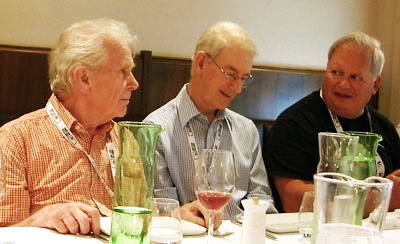
Two Davids and a Kevin: Robinson, Brownlow, and Shepard at a critics’ lunch.
Powell meets Bluebeard and Bartók
KT: One of the high points of the week for me was Michael Powell’s 1964 film of Béla Bartók’s short opera Bluebeard’s Castle. It was made for German television and shown in Bologna as Herzog Blaubarts Burg. Unfortunately it was programmed opposite the screening of fragments from Kuleshov’s Gay Canary, but Powell’s post-Peeping Tom films are so difficult to see that I made the difficult choice and gave up hope of seeing the entire Kuleshov retrospective.
Despite being relatively recent in comparison with most of the films shown during the week, Herzog Blaubarts Burg is one of the most obscure. I felt it was an extremely rare privilege to see it, one which I will probably never have again, at least in so splendid a print.
The film belongs to the late period of Powell’s career, after the controversial Peeping Tom had made it impossible for him to work within the mainstream film industry. It was produced by Norman Foster—though not the Norman Foster who directed Journey into Fear and several of the Charlie Chan and Mr. Moto films. This Norman Foster was an opera singer whose stage career was cut short by a dispute with Herbert von Karajan. His widow, Sybille Nabel-Foster, explained this and described how Foster produced and starred in two television adaptations, Herzog Blaubarts Burg and Die lustigen Weiber von Windsor (1966). Foster had originally approached Ingmar Bergman to direct the former, but when that proved impossible, Powell stepped in—and probably a good thing, too. It was definitely his kind of project.
The two performers are perfect for their roles. Foster plays Bluebeard brilliantly, having both a powerful bass voice and the necessary combination of handsomeness and a sense of threat. His co-star, the excellent soprano Ana Raquel Satre, recalls the pale beauties of some of Powell’s earlier films (Kathleen Byron as the increasingly mad Sister Ruth in Black Narcissus, Pamela Brown in I Know Where I’m Going!, and particularly Ludmilla Tcherina in The Tales of Hoffman), but she also bears a resemblance—perhaps deliberately enhanced through costuming and make-up—to Barbara Steele and other horror-film heroines of the 1960s.
The film was shot cheaply in a Salzburg studio, using garish, modernist settings against black backgrounds. These create a labyrinthine, floating space that avoids seeming stage-bound. (Hein Heckroth, the production designer, had previously worked on several Powell films, including The Red Shoes and The Tales of Hoffman.) I was reminded of Hans-Jürgen Syberberg’s Parsifal (1982), which looks somewhat less original in the light of Powell’s film.
As Nabel-Foster explained, after its initial screening on German television, Herzog Blaubarts Burg has been shown seldom because of rights complications with the Bartók estate. Non-commercial screenings have occurred on public television in the U.S. and Australia, but basically the film is off-limits until the copyright expires in 2015, seventy years after the composer’s death. Nabel-Foster has been providently preparing for a DVD release, gathering the original materials.
The print shown was a privately held Technicolor original from the era, in nearly mint condition. (The British Film Institute has a print as well.) The sparse subtitles written by Powell himself were added for this screening.
I’m not convinced that the film is quite the masterpiece that some claim, but it is a major item in Powell’s oeuvre nonetheless, and I felt privileged to have seen it in ideal conditions.
[July 12: Kent Jones, a great admirer of Powell and Bluebeard’s Castle, tells me that he programmed it at the Walter Reade in New York for a centenary retrospective of the director’s work in 2005. Foster’s widow introduced that screening as well.]
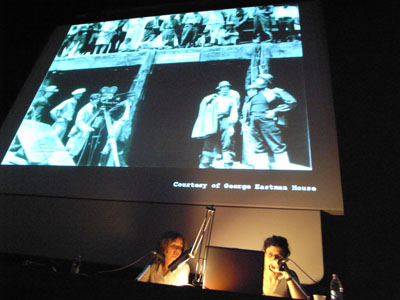
Janet Bergstrom and Cecilia Cenciarelli summarize their research on von Sternberg’s lost film The Sea Gull.
1908 and all that
KT: There were several programs of silent shorts, which I could only sample, as they tended to play opposite the Kuleshov films. As usual, the Bologna program included selections of short films from 100 years ago, so we were treated to numerous films from 1908. I was particularly pleased to see The Dog Outwits the Kidnappers, directed by Lewin Fitzhamon, who had made Rescued by Rover two years earlier. That film had been so fabulously successful that it had actually been shot three times as the negatives wore out from the striking of huge numbers of release prints.
The Dog Outwits the Kidnappers at first appears to be a sort of sequel (as it is described in the program), since it stars the same dog (Blair) who had played Rover, and again there is a kidnapped baby. It’s not really a sequel, though, since Cecil Hepworth, who had played the father in the earlier film, here appears as the kidnapper, and the dog is not named Rover. The new film is more fantastical than the original, since the dog races after the car in which the child is abducted and rather than fetching its master, effects the rescue itself by driving the car back home when the villain leaves his victim unattended!
Other 1908 films I particularly enjoyed: In Pathé’s Le crocodile cambrioleur,a thief hides inside a huge fake crocodile and crawls away, creating fear wherever he goes. The Acrobatic Fly by British director Percy Smith, provides a very close-up view of an apparently real fly juggling various small objects. (How was it done? It’s a mystery to me.)
Another retrospective series was “Irresistible forces: Comic Actresses and Suffragettes (1910-1915).” The suffragette films were rather depressing, despite the fact that many were meant at the time to be comic and amusing. Mostly the joke was how masculine these determined women were, a self-verifying proposition when the filmmakers often chose to have the suffragettes played by men. My favorite program was one involving early French female comics. I’ve long been fond of Gaumont’s Rosalie series since seeing a few at an early-cinema conference in Perpignon, France back in 1984. Rosalie, a chubby, cheerful little dynamo played by Sarah Duhamel, was highly entertaining in three films in the “France—Rosalie, Cunégonde et les autres…” program.
As Mariann Lewinsky, who devises these annual series, pointed out, Duhamel is the only early female French comic whose name we know. Léotine, represented here in Rosalie and Léotine vont au théâtre, is played by an anonymous actress. I had not encountered Cunégonde, also anonymous, before, but she proved to be quite amusing as well. I particularly liked Cunégonde femme du monde, where she plays a maid who dresses up as a society lady when her employers go off on a trip; the carefully constructed story and twist ending are impressive for such an apparently minor one-reeler.
It was a treat to see a succession of gorgeous prints of von Sternberg’s films. I particularly enjoyed seeing Thunderbolt (1929) again after many years. Back in 1983 I taught a survey film history course in which I used the director’s first talkie as my example of the transition to sound. Not a good example, I must admit, since Thunderbolt is completely atypical, with its highly imaginative use of offscreen sound. The second half, set primarily in a prison block, involves shouts from unseen cells and a small band that breaks into songs, often completely out of tone with the action, at unexpected moments. Eisenstein and the other Soviet directors would have thoroughly approved of its sound counterpoint. I have to admit that I prefer von Sternberg’s George Bancroft films (Underworld, Docks of New York, and Thunderbolt) to the Dietrich ones. Not only are the plots simpler and more elegant, but they contain a genuine element of emotion that is not, as in the Dietrich series, frequently undercut by irony.
I didn’t make it to many of the CinemaScope films playing on the very big screen in the Cinema Arlecchino theater, but I did enjoy two westerns. Anthony Mann’s Man of the West (1958) and John Sturges’ Bad Day at Black Rock (1954) both looked terrific and were highly popular with everyone we talked to. The latter was particularly a revelation, since in contrast to the Mann, it hasn’t had much of a reputation among cinephiles.
A Rodchenko angle for Yuri Tsivian.
Teacher and experimenter
DB: As Kristin mentioned, we missed a lot of the “Hundred Years Ago” series—a pity, since 1908 is a miraculous year—in order to keep up with one of our favorite directors, Lev Kuleshov.
In the 1960s and 1970s, it was common to say that Eisenstein and Vertov were the most experimental Soviet directors, while the others were more conventional. Then we realized that in films like Arsenal (1928), Dovzhenko had his own wild ways. Then we discovered the Feks team, Kozintsev and Trauberg, and the bold montage of The New Babylon (1929). A closer look at Pudovkin, particularly his early sound films like A Simple Case (1932) and Deserter (1933), revealed that he too was no timid soul when it came to daring cutting and image/ sound juxtapositions. But surely their mentor Kuleshov, admirer of Hollywood continuity and proponent of the simplest sorts of constructive editing, played things safe?
Wrong again. Just as we must reevaluate the other master Soviet directors (even in their purportedly safe Stalinist projects), so too does Kuleshov deserve a fresh look. He got this thanks to Yuri Tsivian, who with the help of Ekatarina Hohlova (right; granddaughter of Kuleshov and his main actress Aleksandra Hohlova) and Nikolai Izvolov, mounted a superb retrospective. It ranged from Kuleshov’s first solo effort, Engineer Prite’s Project (1918) to his final film, the short feature Young Partisans (1942-3, never released).
My admiration for Kuleshov, confessed in an earlier blog entry, already led me to spot some weirdnesses in Mr. K’s official classics. The Extraordinary Adventures of Mr. West in the Land of the Bolsheviks (1924) boasts some very un-formulaic cutting in certain passages (including an upside-down shot when cowboy Jeddy ropes the sleigh driver), and By the Law (1926) makes chilling use of discontinuities when the scarecrow Hohlova holds the Irishman at gunpoint. But thanks to the retrospective we can confidently say that Kuleshov was no less venturesome, at least in certain projects, than his pupils.
Soviet specialists already suspected that The Great Consoler (1933) was K’s sound masterpiece, and another viewing confirmed it. It incorporates three registers. William S. Porter, in prison but serving in the pharmacy, witnesses brutality and oppression and is driven to drink. Under the name O. Henry he writes cheerfully sentimental tales as much to console himself as to charm readers. His stories are in turn consumed by shopgirls like Dulcie, a romantic who may not realize how unhappy she is. Kuleshov adds a level of sheer fantasy, represented by a pastiche silent film dramatizing O. Henry’s “A Retrieved Reformation,” in which a safecracker trying to go straight reveals his identity by saving a girl trapped in a bank vault. The embedded story features characters from the other two levels, convict Jimmy Valentine and Dulcie’s lover, a vaguely sadistic businessman in a ten-gallon hat.
The Great Consoler reminds us of the popularity of O. Henry in the Soviet Union, both among readers and the Russian Formalist literary theorists, who were fascinated by his flagrant, playful artifice. (Boris Eikhenbaum’s essay on the writer is one of the most brilliant pieces of literary analysis I know.) Even though Kuleshov must denounce Porter for reconciling the masses to their misery under capitalism, the zest of the embedded film and the unique architecture of the overall project pay tribute to another entertainer who did not forgo experimentation. And Kuleshov’s image of a writer in prison probably had Aesopian significance for artists in the era of Socialist Realism.
K’s other major sound experiment, less widely seen, is Gorizont (1932). The title is at once a man’s name and the Russian word for “horizon”—a metaphor literalized in the final shot of a train leaving a tunnel. As Yuri pointed out, it is one of the few Soviet films centered on a Jew, and so the formulaic growth-to-consciousness plotline takes on a new resonance in the light of Slavic anti-semitism. Lev Gorizont is an amiable, somewhat thick young man who dreams of emigrating to the US to make his fortune. But in New York he finds only poverty and disillusionment, eventually returning home to help make a better society. Famous for its use of sound, Gorizont contains a passage of imaginative “counterpoint.” Both Lev and his friend Smith have been jilted by the social-climber Rosie. As they talk, we hear warm piano music, but not until the end of the scene does Smith speculate that probably Rosie is somewhere listening to Chopin. The music has retrospectively functioned somewhat like crosscutting, suggesting that Rosie now lives among the wealthy.
Kuleshov, like Eisenstein, gained his fame for his ideas on editing and sound montage, but both men were deeply interested in performance. Kuleshov’s idea that the film actor should become an angular mannequin carries on the impulse of Meyerhold’s biomechanics, and he anticipated CGI software in suggesting that human action could be plotted on a three-dimensional grid. Still, Kuleshov usually gives his figures a fluid dynamism that doesn’t seem mechanical. The three narrative registers of The Great Consoler are delineated largely through acting: naturalistic and slowly paced in the prison scenes, rigid and posed in the shopgirl romance, and broad and eccentric in the embedded silent movie.
Kuleshov’s performance theories popped out of other films in the series. What survives of The Gay Canary (1929) centers on a cabaret actress courted by lustful reactionaries during the civil war, and her scenes of fury, as she flings around flowers, vases, and pieces of furniture, come off as acrobatic rather than realistic. Naturally, the circus milieu of 2 Buldy 2 (1929) encourages stunts. A father and son, both clowns, are to perform together for the first time, but the civil war separates them, and the elder Buldy, tempted for a moment to acquiesce to the White forces, casts his lot with the revolution. At the climax Buldy Jr. escapes the Whites thanks to flashy trampoline and trapeze acrobatics; the gaping enemy soldiers forget to shoot. Even Kuleshov’s more naturalistic films show flashes of kinetic, stylized acting. A partisan listens to a boy while draping himself over a door. A Bolshevik official answers the phone by reaching across his chest, twisting his body so the unused arm can hike itself up, right-angled, to the chair.
The interaction of the body with props occurs with a special flair in Young Partisans. A Bolshevik partisan tells some children how a boy saved his life in a German-occupied town (This flashback was directed by Igor Savchenko and functions as a short film on its own.) Having learned their lesson, the kids gather in their schoolroom and under the teacher’s eye draw a map of the partisans’ camp. But when Nazi soldiers burst in, the teacher flips the blackboard over; now all we see is algebra.
A scene of Hitchcockian suspense ensues: Will the Germans turn over the blackboard and discover the map? The tension is enlivened by a grotesque moment, when one alcoholic soldier finds a jar holding a pickled frog and decides to drink the formaldehyde. “Draw a map—show me where the partisans are!” the officer demands. He flips the blackboard, and in a split-second we see a boy crouching behind it; the blackboard swings into place toward us, the map now erased. The boy ducks into his seat, brushing off chalk dust.
There were plenty of other revelations. We got the reconstructed Prite (was it the first really modern Soviet film?), a bit of an original Kuleshov experiment in constructive editing, and a tantalizing fragment from The Female Journalist (1927), with a surprisingly pensive Hohlova as a modern-day reporter. Sasha (1930), directed by Hohlova herself, was a sympathetic portrait of a pregnant woman. An educational film called Forty Hearts (1930) explained the need to electrify the Soviet countryside and was brightened by faux-naïve animation. Timur and His Crew (1942), with some of the charm of a Nancy Drew movie, showed Young Pioneers helping on the home front; it unexpectedly centered on a girl’s devotion to her military father.
One of the biggest surprises was news of Dokhunda (1936), an ethnographically based fiction set in Tazhikistan. Although the film is lost, Nikolai has reconstructed its plan, revealing that Kuleshov adopted a strange preproduction method. He prepared “living storyboards,” photos of the cast enacting the scenes. He then drew and scratched on them, creating busy, nervous backgrounds or changing the figures’ features and hair styles—Kuleshov as pre-Warhol scribbler, or a graffiti artist tagging his own images.
Nikolai has also finished a DVD edition of Prite that exemplifies what he calls hyperkino, a way of annotating and comparing a film’s images, texts, and supplementary materials for instant access. Another project involves the Yevgenii Bauer classic, The King of Paris (1917), which Kuleshov completed. We haven’t had the intertitles for this, however, but now Nikolai has discovered them, and they will go on the DVD version that is being completed. For more information on these projects and Dokhunda, go to hyperkino.net.
So Kuleshov stands revealed as more supple and ambitious than most of us once thought. Once more Bologna plays to its strengths—filling in gaps but also forcing us to rethink what we thought we knew.
The key issue: What the hell am I going to be seeing now? From left, Olaf Muller, Jonathan Rosenbaum, Don Crafton, Haden Guest, and KT.
So much else to report, so little time. Besides The King of Paris, there was a string of fine 1910s films. Raoul Walsh’s Pillars of Society (1916), while not a patch on his Regeneration of the previous year, offered a solid adaptation of Ibsen. The Dawn of a Tomorrow (1915), James Kirkwood’s Mary Pickford vehicle, seemed to me flat and talky, but others liked it. For me the outstanding item was Paul Garbagni’s In the Spring of Life (1912).Beautifully directed in the tableau style, with precise depth choreography and a stirring scene of a theatre consumed by fire, it starred three men who would become great directors very soon: Sjöström, Stiller, and Georg af Klercker.
Not to mention the von Sternbergs (I liked An American Tragedy much more on this outing), the Scope revivals (Man of the West, Ride Lonesome in a handsome digital restoration from Grover Crisp), my first viewing of Duvivier’s La Bandera (1935), the Monta Bell items (most notably the incessantly energetic Upstage from 1926), and on and on.
What can Gianluca Farinelli, Peter von Bagh, and Guy Borlée, along with their devoted staff members, do for an encore? Bravo! Now take a rest.
Standing Room Only for the rarely seen Children of Divorce (Sternberg/ Lloyd, 1927).
The first leg of our summer trip was a brief stopover in Amsterdam. It’s a city of canals and bicycles, some of them parked in patterns recalling a scrimmage. (See end of blog.) We visited the excellent comics shop Lambiek, strolled around, and tried to get over jet lag. Kristin did. Always does. I didn’t. Never do.
Our reason for coming was the series of events surrounding the official retirement of Thomas Elsaesser from the University of Amsterdam. Thomas is renowned for several accomplishments—his remarkable essays on Hollywood melodrama and 1970s cinema, the major books on New German Cinema and Fassbinder, his enormously wide-ranging comparative study of European and American cinema, his reflections on cinema’s ties to nineteenth-century media. He also established an excellent book series at the University Press.
Thomas is also an old friend, a big influence on our work ever since his days at Brighton Film Review and Monogram, and a generous host when we were visiting London in the 1970s and early 1980s to work on our book, The Classical Hollywood Cinema. He kindly published Kristin’s Lubitsch book in the Amsterdam series. I wrote a little tribute essay for his sixtieth birthday festschrift, available in English here.
In 1991 Thomas left the University of East Anglia to form a film department at the University of Amsterdam. Many members of the university looked askance at the study of cinema, but he grew his program spectacularly. A department with scarcely half a dozen faculty members expanded to sixty staff members and 1400 students. The range of study is now immense, from classical cinema and Dutch moviegoing in the silent era to theorizing about contemporary digital media.
During our visit there were three main events. On Thursday 26 June a large and warm symposium featured brief papers from 21 of his students, many of them known to English-language readers—Ginette Vincendeau, Peter Krämer, and Warren Buckland. The topics included cultural history of media (evenadvertising movies), gender and melodrama, the relation of European cinema to US cinema, and “mind-game films.” We had to miss the final sessions in order to check into our hotel, but what we heard was stimulating. One session was graced by an image that metamorphosed from Elsaesser to Hitchcock and back again. You can see it here.
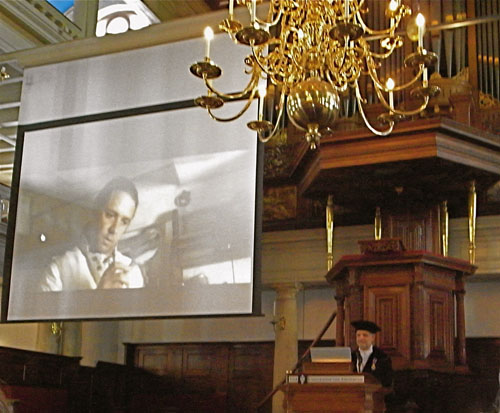
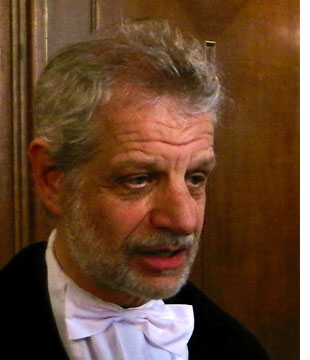
The following day was the formal ceremony: Thomas’ farewell speech in the University Auditorium, a converted chapel. Thomas and other professors, garbed in robes and caps, filed in and Thomas took the floor to present his talk, “Of Feedback and Phasmids: A Farewell to Film Studies.” He offered both an oblique account of his institutional political battles and a broader account of trends in film theory across the last three decades. He wove clips from Master and Commander into his talk, which sometimes bolstered a comparison between his tough-minded handling of the program and Captain Jack’s nautical tactics.
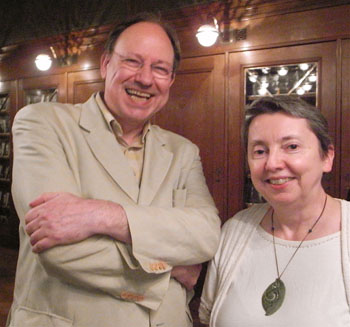
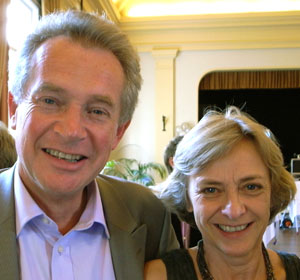
Other colleagues paid glowing tribute, and there followed a reception, where Thomas received people’s formal congratulations. We also had a chance to catch up with old friends and make new acquaintances. We saw Noll Brinckmann and Peter Krämer.
Kristin caught up with Karel Dybbets, historian of Dutch cinema and a pioneer in the study of local movie theatres.
And though we met John Ellis and Roz Coward back in the 1970s, we hadn’t seen them since. They were great company.
The final event was held that evening, in a reception room looking onto the Amsterdam Zoo. The department holds an end-of-year party, and this one had special meaning as Thomas’ last official one. He’ll continue to supervise dissertations, and he intends to keep living in Amsterdam—when he’s not doing guest teaching in other places (at the moment, Yale).
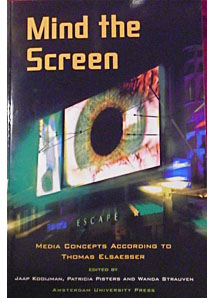
It was a terrific two days for us, not least for witnessing the great admiration and devotion that his colleagues and students displayed. They even edited, in secret, a book in homage to him (left). Thomas has not only reshaped our sense of how film works, but his dedication to media education has created a generation of lively and original young scholars.
The Cannes screening of Ashes of Time Redux reminds us that Wong Kar-wai has been an incessant reviser of his work. Versions proliferate in different markets—one for Hong Kong, one for Taiwan, one for the international market—and he has sometimes promised online versions, or bonus DVD features. Buenos Aires Zero Degree (1999) by Kwan Pung-leung, provides tantalizing bits of scenes between Tony Leung Chiu-wai and Shirley Kwan. Yet it makes us wonder about the film we might have had if Wong had not decided to cut the whole plot strand out (after keeping Shirley in Argentina for several weeks).
We can add to the list Days of Being Wild (1990), Wong’s breakthrough movie. It’s been circulated for years in an international version, which is currently available on DVD. But some people people have recalled seeing a fugitive, somewhat hallucinatory cut of the film. Some time ago I examined that alternative, and I figured it’s worth showing what I saw. This rareversion prefigures some aspects of Wong’s later style, particularly as seen in In the Mood for Love (2000). I don’t have solutions to all the puzzles it poses, but I’ve gathered some information. If you know something about this “obscure” version, feel free to write to me and I’ll append your comments to this entry.
I need hardly add that there are spoilers galore here. In the images, differences in tonality and aspect ratio spring from my two sources, DVD and 35mm film (which itself fluctuates a little in aspect ratio from shot to shot).
Last things first
Days of Being Wild begins in 1960 Hong Kong. It follows the wanderings of Yuddy (Leslie Cheung), a preening young man who casually seduces women, notably the brassy Lulu (Carina Lau) and the subdued, naïve Lai-chen (Maggie Cheung). Living with his aunt, Yuddy wonders why his mother abandoned him. He finds her living in the Philippines but doesn’t confront her.
At the climax in Manila, Yuddy meets a sailor (Andy Lau) and picks a fight with local thugs. The two men flee by hopping aboard a train. By chance, the sailor was formerly a Hong Kong cop, who was attracted to Lai-chen. On the train, Yuddy is shot by a vengeful thug. The film concludes with a series of shots of Lulu, Lai-chen, and—the big mystery—a slick young man in a seedy apartment who files his nails, combs his hair, equips himself with handkerchief and cigarettes, and sets out for a night on the town. He doesn’t speak, and he has never appeared in the film before. It’s one of the boldest narrative maneuvers in contemporary cinema, and it has occasioned a lot of comment.
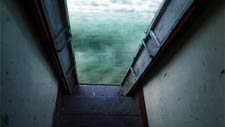
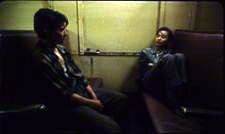
The differences in the final sequences begin on the train. In the international version, a shot of the landscape seen from between the cars is followed by a high-angle medium shot of the cop.
This constitutes a mini-flashback, since Yuddy has already died from the gunshot. The cop’s voice-over initiates the exchange: “The last time I saw him, I asked him a question.” (As usual in Wong’s work, we have no way of knowing whom is being addressed; this could be an inner monologue, a report to an unseen character, or simply a self-conscious address to the audience.) For a little more than two minutes, the camera shows only the cop. He asks if Yuddy remembers what he was doing at a certain time. Yuddy understands immediately that the cop has met Lai-chen, and he replies from offscreen, asking about the cop’s relation to her and asking him to tell her that he, Yuddy, has no memory of her. The cop worries that Lai-chen may not even recognize him.
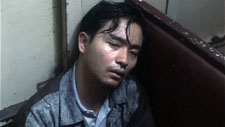
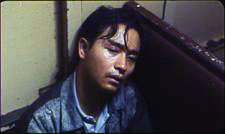
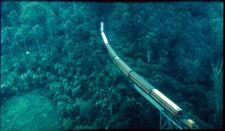
The exchange ends with a wordless shot of Yuddy sitting against the seat, eyes barely open, as an orchestral version of “Perfidia” rises up. The scene ends with an extreme long-shot of the train. The tune was heard earlier when the cop walked away from a nighttime encounter with Lai-chen, so this refrain reminds us of the cop’s yearning for her.
The alternate version doesn’t alter the overall situation much, but it presents different emphases. After the shot between the train cars, we have an off-center long shot of the cop; it’s then that we get the voice-over: “The last time I saw him, I asked him a question.” Cut to a medium close-up of Yuddy, which replaces the shot of the cop. Now for about two minutes he speaks and the cop’s reactions are kept offscreen.
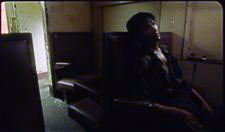
As far as I can tell at this point, the dialogue is identical. In effect, we have a virtual shot/ reverse-shot exchange between the two films! And instead of holding on the framing of Yuddy, or cutting to the cop’s reaction, Wong simply gives us a shot of the two men in facing seats. This is followed by a very different shot of the train, winding through the sort of greenish-blue foliage seen in a famous earlier shot, and there is no music.
The international version puts the emphasis on the cop, who is both challenging Yuddy and obliquely reflecting on his own situation.; hence perhaps the “Perfidia” theme, which is associated with him. The alternate version keeps us focused on Yuddy throughout, our final stare at him, as it were, before a two-shot reasserts an equivalent weight between the two men, and perhaps their memories as well.
The very end
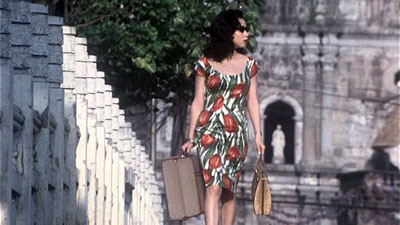
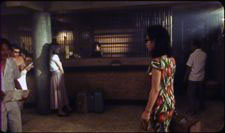
The variations continue in the final shots. Both versions begin with the shot of Lulu striding to the camera in a telephoto framing, above. Now she’s in the Philippines.
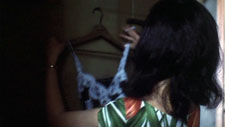
In the international version, this shot is followed by Lulu swanning into a bedroom, hanging up her dress, and saying to the landlady, “There’s someone I want to ask you about.”
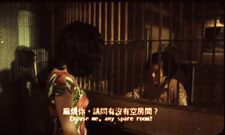
In the other version, we see her passing through a somewhat sleazy hotel lobby and asking for a spare room. As a result, it’s somewhat less clear that she’s pursuing Yuddy.
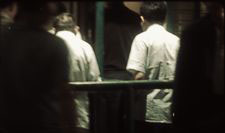
The scene shifts to the stadium where Lai-chen works as a ticket seller. (Stephen Teo’s stimulating book on Wong specifies that it’s the South China Athletic Association.) Customers are swarming in for a football match. The obscure version gives us two quick tracking shots of the crowd, with the second ending on a profile shot of Lai-chen in her booth.
The standard version offers only one of the tracking shots and ends with a static framing of the profile composition. But this version adds a shot, beginning the scene with a head-on composition of her at her window.
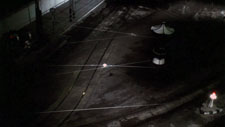
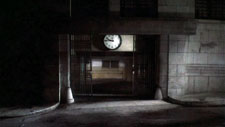
At this point the alternate version omits two shots that have attracted a lot of critical commentary. Before the shot of Lai-chen shutting up shop, we see a high-angle view of tramway tracks and a shot of a clock outside the stadium.
The clock shot recalls Lai-chen’s meeting with Yuddy, while the tramcar lines recalls her rainy-night encounter with the cop. Instead of these empty shots, the alternate version cuts from Lai-chen in her booth to a shot of a soccer match, evidently seen through a slot in her cabin.
The rest of what follows corresponds in both versions. Lai-chen is seen reading a newspaper before closing the booth.
Both versions likewise wind down with a shot of the phone booth, the one that Lai-chen and the cop had lingered beside, followed by a closer view of the interior. The phone is ringing.
The first shot of the pair recalls, in its high-angle composition, the rainy night that the two met. (Wong’s characters are haunted by memory, but he forces us to use ours too.)
The cop had asked Lai-chen to call him, and the previous scene showed her closing her window, so we might infer that now she’s trying to get in touch with him—not knowing, as we do, that he’s quit the force, become a sailor, and watched her boyfriend die. But we can’t be sure that she’s the one making the call.
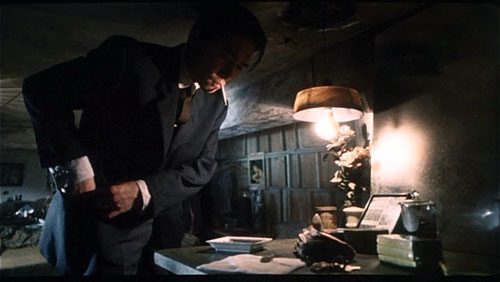
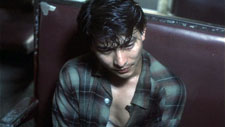
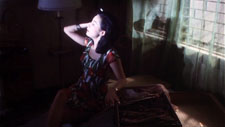
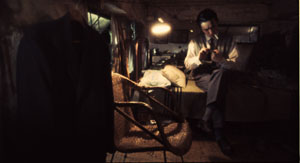
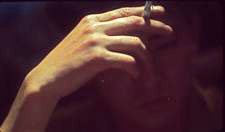
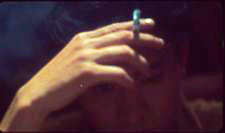
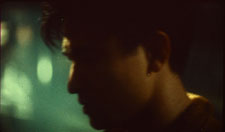
The very last shot, showing Tony grooming, is also the same in both versions. (One stage of it is at the very top of this entry.) It is a real crux. Why is Wong showing us this down-at-heel gambler for two and a half minutes? He has no evident connection to any of the characters we’ve followed, and we will never see him again.
Most critics have also accepted Wong’s explanation that he had planned a sequel, one showing how Yuddy’s influence over others lingered long after his death. Patrick Tam told Stephen Teo that the shot was his idea, a setup or trailer for the next film, turning everything we had seen up till now into a lengthy prologue. (1) But Days of Being Wild was a fiasco at the box office, taking in HK$9.7 million, or about $1.25 million US (in a year in which Stephen Chow’s All for the Winner earned over four times that). So the sequel was never made.
Yet these intriguing circumstances don’t really justify the epilogue’s purposes and effects. A causal explanation doesn’t necessarily yield a functional explanation. What role does this disruptive shot play in the film’s overall dynamic? If Wong had made the sequel, it might have been seen as a brilliant stroke; without the followup film, how can we justify its presence?
It’s reasonable to argue, as Teo does, that this vision of Tony’s primping generalizes Yuddy’s case, suggesting that his rootless narcissism is a condition of many young men of the day. You might also suggest that he provides a sort of male equivalent of the playgirl Lulu; just as the cop played by Andy Lau is a good, though unachieved, match for Lai-chen, Tony would pair up better with Lulu than Yuddy’s pal (Jacky Cheung), who pines for her.
Actually, the alternate version sheds a little light on the problem. It doesn’t provide a definitive answer to what Tony is doing there, but it does offer some tantalizing possibilities. In the alternate version, Tony is not only the last character we see, but the first one. And he’s embedded in a sequence that looks ahead to the style for which Wong has been both admired and castigated.
Languor and ellipsis
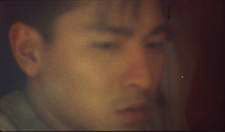
After the credits, the international version opens with Yuddy striding forcefully into the soccer stadium and mesmerically flirting with Lai-chen. But the print I examined of the obscure version interrupts the credits and shows us none other than the nameless young spark played by Tony Leung Chiu-wai, buffing his nails. (It seems to be an earlier stretch of the final shot, which continues this action.)
Over his image, we hear this in a male voice (no subtitles on the print):
I saw him one more time. He had just returned from the Philippines. He was much thinner than before. I asked him what happened to him. He replied that he just recovered from his sickness. He didn’t want to chat anyway, so I asked him what his sickness was.
Afterwards, we didn’t see each other any more.
This is very mysterious. Whose voice is speaking—Tony’s, Yuddy’s, Andy Lau’s? I can’t identify it. And who is the he referred to? The most plausible candidate is Andy, who may have returned to Hong Kong; and he is looking fairly ill in the film’s final scenes. But it might be the Tony character, as described by one of the other men, or even at a stretch Yuddy himself, who has somehow survived the shooting and returned to Hong Kong.
These ruminations assume that this opening shot frames a flashback by rhyming with the final image of Tony rising from the bed and dressing for his night out. It provides a sheerly formal justification for the final shot, which now completes the action begun at the start. But substantively, we’re still left with a variant of the original question. Instead of asking why end the movie with this remote character, we now ask why he’s used to frame the movie.
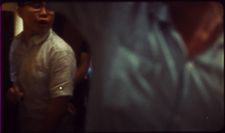
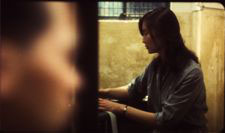
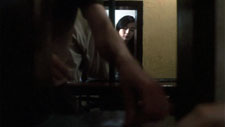
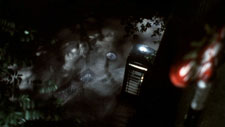
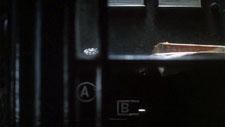
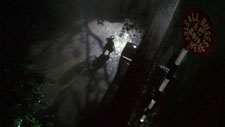
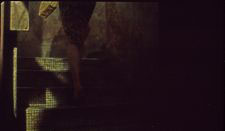
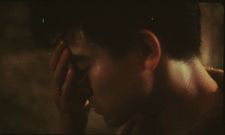
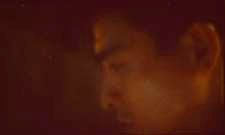
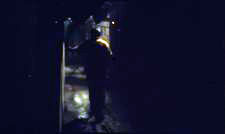
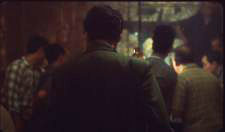
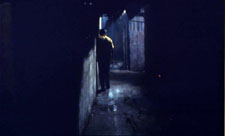
The questions have just begun, however. After this eighteen-second shot of the dapper Tony, we get a music montage lasting about eighty-three seconds. It’s quite perplexing. We’re in a warren of corridors, a bit reminiscent of the byways of Chungking Mansions in Chungking Express, and everything is in slow motion. We follow Andy Lau, in a yellow pullover, striding through the darkness and sweating profusely. Then we find him playing cards with some unidentified men. At one point, we see a woman climb the stairs, at other points we glimpse a man with an enormous snake coiled around him. The sequence ends with shots of a hand seizing a cleaver and shots of Andy, back in the corridor, striding away from us. The whole sequence is accompanied by the song “Jungle Drums,” which continues from the shot in Tony’s apartment but is now sung by a female voice (Anita Mui’s).
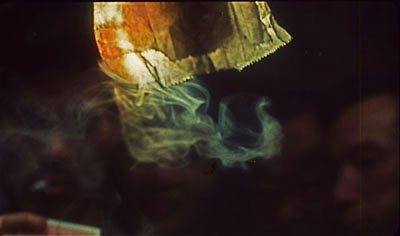
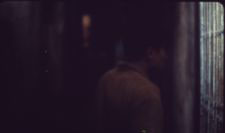
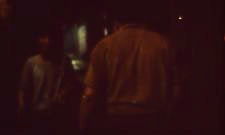
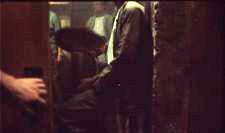
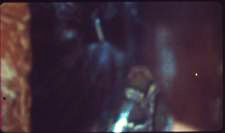
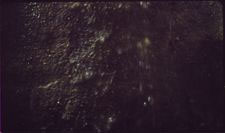
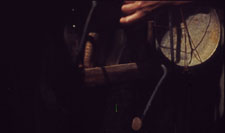
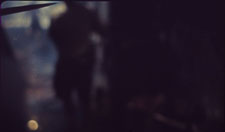
I was able to take stills of these shots, so I’ll go through them one by one, despite their iffy quality. (The images are very dark, and the print was worn and a little speckled.) After the opening shot of Tony, we get eighteen shots, all in slow-motion, many out of focus, and nearly all using camera movement. Often the cuts are matched in the normal fashion, but sometimes the connection is purely kinetic. As often in Wong’s work, the timing of the cuts synchronizes with beats or melodic lines in the music.
The first shot shows a woman ascending a staircase (pre-echo of the cheongsams in In the Mood for Love), and we pan quickly to Andy looking up after her before setting out down the corridor, where he passes a man with a snake.
Track left with Andy in medium close-up, wiping sweat from his face, then cut to an out-of-focus shot of him still walking.
Andy rounds a corner and proceeds down the hall, extending his hand to the wall. In one of those pseudo-matches, another hand slides open a door, as if completing his gesture. We see a card game inside. The framing suggests Andy’s point of view, but the camera glides back.
In close-up, a hand holds a cigarette. A slight tilt and rack-focus reveals that the card player is Andy.
Suddenly, there’s an out-of-focus shot of the snake sliding along the man’s arm; the shot lasts only 16 frames, or two-thirds of a second. (Here I go again, frame-counting.) This is followed by a blurry shot, only 19 frames, of Andy turning his head. It’s almost as if the snake-shot had attracted Andy’s peripheral vision.
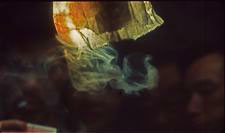
The man with the snake, still out of focus, rises and goes behind a curtain. Cut to a shot of a light bulb shielded by a scrap of paper, with cigarette smoke wafting up.
A classic misterioso shot: A powerfully built man in a suit, seen from the rear, dominates the composition, and the camera tracks back from him. But instead of revealing his identity, the narration cuts back to Andy, who, out of focus, turns back to the game.
A new phase of the sequence starts. The camera pans up a rock wall, showing water trickling down it. Confirming that we’re back in the corridor, we see a hand seizing a chopper from a wall rack. There’s an odd effect of matching movement, with the pan upward picked up by the upward-lifting movement of the cleaver.
From another angle, the hand draws the cleaver across the frame.
Now we get opposing lines of movement—up and to the right in the first chopper shot, horizontally to the left in this shot. The rhythmic bump is accented by the brevity of the shots (30 frames, 21 frames). At the end of this second shot, we can glimpse someone walking away in the dark background.
The cleaver shots are followed by a close-up of Andy walking along the corridor, much like those at the start of the sequence. The final shot shows him walking far away from us. This take seems to be a continuation of the earlier one, when he put out his hand against the left wall. It fades out as the song does.
After the fade-out of Andy walking down the corridor, the credits resume and the scene introducing Yuddy and Lai-chen begins the main plot.
Wong had used a music montage in As Tears Go By (the remarkable “Take My Breath Away” sequence, which I analyzed in Planet Hong Kong). But there it functioned as a lyrical commentary on a sharply delineated, somewhat conventional narrative situation: Wah visits Ngor in Lantau Island and awkwardly communicates his affection for her. This sequence in Days is puzzling because it doesn’t have very clear narrative import. It does set the mood of languor that dominates the film, but it also hints at a situation of criminal danger (gamblers, the hand with the chopper) that is never actualized in the story that follows.
Coming after the fairly opaque opening shot of Tony, this sequence poses other questions. We’ll later learn that Andy is a diligent patrolman; what’s he doing in this den of thieves? Local audiences would recognize the location as the Kowloon Walled City, a sort of island of sheer criminality in the middle of Kowloon. Was Andy an undercover cop before taking up the uniform?
And who is seizing the cleaver? At first I thought it was Andy, but closer inspection shows that’s not likely; there’s nothing in his hands in the final extreme long-shot. Is someone stalking him? We never find out.
Wong is fond of giving us mere impressions of events, sometimes linked to characters’ consciousness, sometimes soaring cadenzas of images blended with music. But unlike the music montage of As Tears Go By and those in later films, this one is almost indecipherable in story terms. Nothing else in Days of Being Wild is as free-form as this stretch of footage. It can stand as an emblem and limit-case of Wong’s interest in using genre conventions poetically, and his reluctance to pay them off in plot terms.
Partial solutions, more mysteries
Back in 2001, Shelly Kraicer, impresario of the Chinese Cinema List, wrote about having seen this version, and several people chimed in with their recollections and opinions. In 2004, I asked several Hong Kong friends about it. Filmmaker, critic, and educator Shu Kei, who has a long memory for Hong Kong film, replied:
I remember the footage you describe. If I’m right, this was the version WKW re-edited after the disastrous midnight premiere of the film, and it was the “official released version” for the regular shows in the following week.
Days was released on 15 December 1990 and played until 27 December, so perhaps this was indeed the version that was seen in its Hong Kong run. In 2001 correspondence on Shelly’s list, Bérénice Reynaud, who saw the “pre-premiere version” of a print straight from the lab, was “positive” that the prologue material was not in that print.
Shu Kei offers some further information about the gambling sequence:
The shots with Andy Lau in a card game and fighting afterwards [sic] were done in a very early stage of the film’s lengthy shoot, in which Lau was playing a gangster-like character in the Kowloon Walled City. (The role, and much of the original concept of Days of Being Wild, were reprised in Jeff Lau’s Days of Tomorrow, 1993.) Andy’s character was later changed to that of a cop.
Two other Hong Kong observers told me that the revised version was designed to make sure that the big stars Tony Leung and Andy Lau had early and prominent entrances, since without the prologue, they play minor roles. Michael Campi reported in the 2001 correspondence: “I was told that in a frantic attempt to retrieve some revenue from the film, it was decided crassly to include Leung Chiu-wai in the opening as well as the closing.”
If this was the strategy, it’s reminiscent of the changes made to the international (originally, Taiwanese) version of Ashes of Time, with the prologue and epilogue showing explosive fighting scenes. Those passages were designed, explains Hong Kong Film Festival programmer Li Cheuk-to, to assure viewers that there would be swordplay in this rather talky movie.
Things are far from settled, though. The prologue is a major crux, but assuming that the last reel I saw was that of the 1990 retooled version, how do the circumstances outlined above explain the disparities in the endings? Why would audience dissatisfaction or producers’ demands force Wong to eliminate the empty shots of the stadium and the clock? Or substitute a different (and more opaque) scene of Lulu in the Philippines? Or change the découpage of the train dialogue between Yuddy and the cop? Or supply a different long shot of the train? Or eliminate the haunting “Perfidia” theme?
Moreover, we still don’t know what the premiere version screened at midnight shows was like. Was it congruent with today’s international version, or was it yet a third variant? In other words, did Wong un-revise the original, or re-revise it? At what point did he or his distributors replace the obscure version with the one in general circulation?
Earlier in June our blog discussed Grover Crisp’s visit to Madison, in which he argued that in an important sense every film exists in alternative versions. We simply have to accept that. It’s especially true of Hong Kong films, which are recut for circulation in many markets. And I like knowing that there’s an especially puzzling variant of Days of Being Wild—one that lets us imagine virtual narrative possibilities and adds to the appeal of this enigmatic movie. Nonetheless, I’d welcome more information about all this, especially from Wong Kar-wai himself.
(1) Stephen Teo, Wong Kar-wai (London: BFI, 2005), 45.
Thanks to Alex Wong for translating the prologue’s voice-over narration for me.
















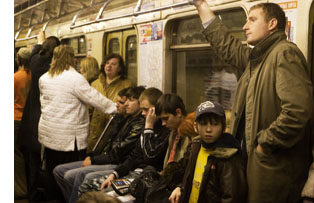 As with all movies about stealing, the pleasure lies in trying to figure out the plan and spot the telltale moves—sort of like the misdirection of a magic act. Here the drama is cunningly contrived. What is Shultes writing in his little brown book? Who is Vasya? What’s his big plan? The plot jumps a level when we realize that all we’ve seen is a flashback, and the ensuing conversation puts things in a startling perspective. Our blankly amoral protagonist even becomes a shade sympathetic. Too rigorous and unemphatic to be an arthouse import, I fear, but ideal for a festival.
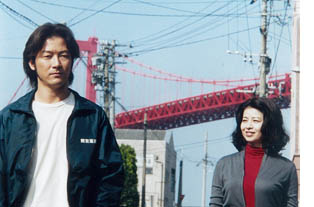 Aoyama manages the crisscrossing relationships delicately, without losing sight of the fact that behind Kenji’s laid-back appearance is a boiling desire to avenge himself on his mother. But she’s his match. A woman of smiling serenity, or smugness, she seems infinitely resilient. The final confrontation of the two, in a prison visiting room, has the giddy sense of one-upmanship of the prison visit in Secret Sunshine. Things turn grim and bleak, yet Sad Vacation manages to feel optimistic without being sentimental; even a flagrantly unrealistic soap bubble at the close seems perfectly in place. I notice that Aoyama has made nearly a film a year since Eureka; why aren’t we (by which I mean, I) seeing them?