by Kristin Thompson. Berkeley: University of California
Press, 2007.
400 pages, 6 × 9 inches, 12 color illustrations;
36 b/w illustrations.
[go
to Amazon | go to The Frodo Franchise blog]
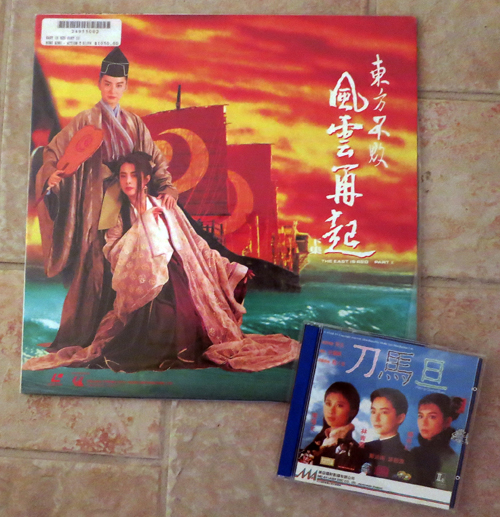
A laserdisc of The East Is Red; a VCD of Peking Opera Blues.
DB here:
On my first visit to Hong Kong in early 1995, one of my missions was to acquire video copies of all those HK films I wanted to study. The VHS tapes I’d seen in the States had grimy images and pan-and-scan framing. So, armed with my credit card, I focused on a higher-end format, the laserdisc.
For those too young or too sequestered to know this format, I should explain. A laserdisc was twelve inches in diameter, the size of a vinyl LP record, and coated with aluminum. A movie’s image track was inscribed optically on the disc, while the soundtrack was encoded digitally. The disc held about fifty minutes per side in the standard format, but some discs held less because they encoded the film exactly shot for shot. In that encoding system (called CAV), a still video frame was one film frame; the next still was the next actual frame. This was great for a frame-counter like me.
In the US, laserdiscs were for sale, but Hong Kong ones typically weren’t. They were a popular rental format, though, and you could use them to make nice tape copies. Needless to say, neither laserdiscs nor video tapes had copy protection.
As I made the rounds during my trip, I persuaded many shops to sell me some LDs, unfortunately for me at rather high prices. Although rentals remained brisk, the shopkeepers knew that LDs were on the way out. One charming young lady at Laser People, in Causeway Bay, told me of a new format they were waiting for. It would use a blue laser. Was it going to be as good as LD? I asked. She grinned: “Much, much better.”
On the same trip I met the LD’s downmarket cousin.
VCD = Very Curtailed Definition
Video Compact Discs (VCDs) were 4.8 inches across, flimsy, and cheap (US$4 for a legit one, much less for a bootleg). They could be played on computers or dedicated players. On the VCD format I found a copy of Peking Opera Blues, one of my favorite HK movies and one that was elusive on LD. So I bought it, along with a basic player.
The results were pretty feeble. Since the VCD was a CD-ROM, it could carry only about sixty minutes of video, at MPEG-1 compression. So a film was typically squeezed onto two discs. (Sometimes it was trimmed to fit.) Improvements were made over the years, but at a resolution of 352 x 240 pixels, the picture quality was hardly better than VHS tape. In a way, the image was more annoying than VHS because it tended to go very blocky and jerky. Some VCDs were letterboxed, but that compromised picture quality even more, since there were fewer lines devoted to the image.
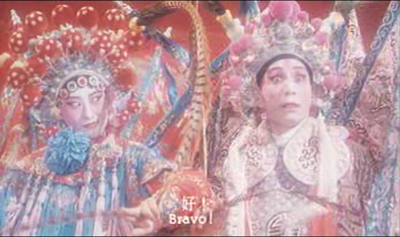
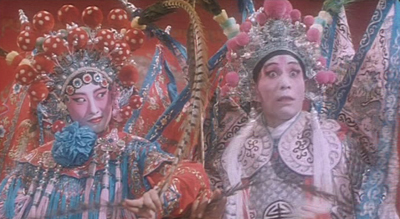
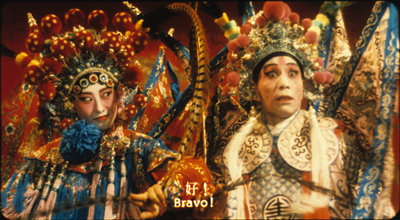
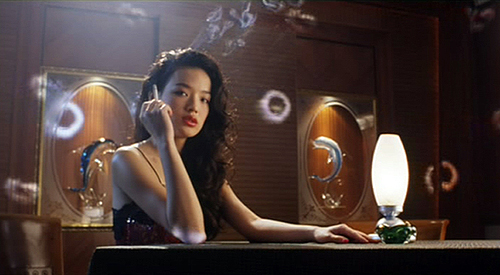
Want some measure? Just above you find a VCD image from Peking Opera Blues, compared with an image copied (on photographic film) from a 35mm print. Sandwiched between the two, just for fun, is a frame grab from a recent Hong Kong DVD. (For more on these images, see the end of this entry.)
Debuting in 1993, the VCD was the answer to a film pirate’s prayers. VHS bootlegs degraded with each generation of copying, but digital video enabled every copy to be identical to the source disc. The pressing plants that manufactured music CDs could pump out VCDs en masse. By 1998 China had over 500 VCD companies and produced twenty million players per year. By 2000, players were in about a third of urban households. It became identified with low-end, Asia-centered piracy.
In the early 2000s, I saw boxes of VHS tapes chucked out onto the Hong Kong streets, and films were being released on DVD and VCD simultaneously. Piracy turned to the DVD, with results even more massive than with VCD. The newly affluent Chinese could afford the slightly costlier pirate DVD.
Meanwhile, the clumsy and heavy laserdisc was gone, preserved and on the shelves of fanatical, or just plain stubborn, collectors like me. The arrival of affordable DVD players in China in 1999 somewhat cut the interest in VCD, but recent releases today still come out on the junior format. In Hong Kong, VCDs outsell DVDs at a ratio of three to one, and titles older than a year or so go for US$3. VCDs rent more briskly than DVDs, at a cost of less than one dollar US.
Historically, I think, the VCDs played an important role. VCD made commercial movies available on a digital platform aimed at consumers. Invented by big Western companies, it was pushed aside in the rush to make the DVD the international standard. In addition, with the emergence of digital cinema, we might take the VCD as an emblem of a side pf the digital changeover that we often ignore. In surveying the results of opening Pandora’s digital box, we can’t neglect the ways that a triumph of Western research gets turned to ends that undercut the nations and companies originating it.
16mm: Digital exhibition’s dry run
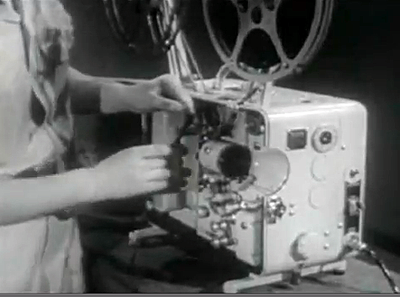
Cinema has a long history of repurposing exhibition formats. A striking example is 16mm film. Invented by Eastman Kodak in 1923, 16 was suited to amateur moviemakers and news photography. Since the stock was non-flammable, 16mm films could safely be exhibited at home, in schools, in public meeting places, and in the newsreel theatres that sprang up during the 1930s and 1940s. The format was also used in screenings for the armed services. After the war, schools and community centers bought 16mm projectors, many from military surplus. My college film society had a pairs of 16mm JANs (Joint Army-Navy) machines, hulks that look like they could survive a torpedo attack. (See above.)
Throughout the 1950s and 1960s, no public school was complete without 16mm projectors for screening educational movies, cartoons, and uplifting Hollywood features. At the same time, local TV stations broadcast from 16mm prints bought from the studios. These prints became sought-after by collectors, a group whose membership expanded with the rise of 16. The format became the standard for independent and experimental filmmaking, of course, but we tend to forget that it was also the bedrock of nontheatrical exhibition. In those days, Audio-Brandon, Contemporary Films, Janus, and other companies could actually make money circulating 16mm films.
For the US and Western Europe, with few exceptions, 35mm was the standard theatrical format, but other countries were more adaptable. The data on 16mm penetration of theatrical markets are very sketchy. (See the end of this post for more information.) Still, we have some bits of evidence. In 1961, Hungary reported having over 3600 16mm installations, as opposed to 803 35mm ones. In the same year, Romania claimed only 462 35mm screens and over 3100 in 16mm.
It seems that sectors of Asia relied heavily on 16mm. As late as the 1980s, India reported over 4500 16mm installations (as opposed to 8221 35mm venues) and Korea claimed nearly 400 (significantly more than its 280 35mm screens). The proportions are probably higher in countries like Thailand and the Philippines, where commercial entertainment films were made in 16mm.
With the expansion of 16mm, a format aimed for home, school, church, and other specialty situations was repurposed for a general public. “Nontheatrical” became theatrical.
The same thing happened, more clandestinely, with videotape after the 1970s. In large cities throughout Asia you could buy or rent bootleg VHS copies of Hong Kong and Indian movies. And there was no restraint on where you could show them. Throughout what was still called the Third World, video copies were exhibited in public venues, from town squares and pubic halls and to tour buses and work sites. Asian cities boasted “video parlors” and “video clubs” and “MTV parlors,” where friends could assemble in small rooms to drink, snack, flirt, and watch a movie, often a pirated Hollywood one.
This unofficial exhibition circuit is acknowledged in the warning that preceded many videos circulated in Asia.
The copyright proprietor has licensed the film (including its soundtrack) comprised in this Video Disc (including Laser Disc) for private home use only. All other rights are reserved. The definition of private home use excludes the use of this Video Disc at locations such as clubs, coaches, hospitals, hotels, motels, oil rigs, prisons, and schools.
Which is the same as admitting that tapes and discs were widely shown in clubs, coaches, hospitals, oil rigs, and other venues.
Much more recently, this “peripheral repurposing” of home technology for public use was taken to its logical conclusion in Nigeria. In 1992, local filmmakers began making VHS films for direct sales to customers. The market expanded with the rise of digital technology, and by 2008 production companies issued dozens of new releases on VCD and DVD each week. A few single-screen and multiplex facilities have been built to show Hollywood films on 35mm, but local movies are still largely screened at home and in informal public venues like restaurants and video halls using TV monitors rather than projectors. A $200 million dollar film industry emerged from technology designed for nontheatrical exhibition.
Overshoot and good enough
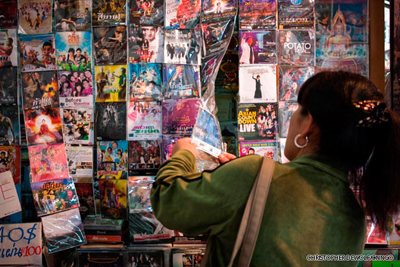
A stall selling Thai VCDs in Kowloon City, Hong Kong; from CNN Go.
The VCD fit smoothly into this pattern of low-end distribution and exhibition. But that wasn’t what Western firms had in mind when they invented the digital disc.
In 1993, JVC, Sony, and Philips created the Video CD. A year later the Hollywood majors announced that they would back a single standard for high-quality digital video. The companies laid down demands as to length (135 minutes per side), picture quality (better than laserdisc), compatability with high-quality audio systems, and, among other criteria, content protection. As usual, two major rivals emerged, but they were reconciled. Patents were pooled, and after more wrangling about copy protection the DVD more or less as we know it made its debut at the end of 1997. After more fixes, the format took off in 1999, aided in no small measure by the DVD release of The Matrix.
It seems to me that Western firms’ concentration on the DVD and the sidelining of the VCD exemplify what management analysts have come to call “overshoot.” In the theory of disruptive technologies pioneered by Clayton Christensen, established firms aim to sustain an existing technology, either through incremental improvements or radical innovations. As the technology improves, these sustaining firms target the upper end of the market. Thus Eastman Kodak strove to improve its film stocks to satisfy and win the approval of the world’s top cinematographers. Likewise, Sony and other firms collaborated to create the DVD as an improvement on broadcast video, VHS, and laserdisc.
But in the process they left lower-end markets behind. Entrenched sustaining technology tends to be complicated, inconvenient, and expensive. Christensen posits that the big firms’ overshoot often leave space for firms that develop technology that is cheap, convenient, and “good enough” for what might be a very big segment of purchasers. To the professional eye, VHS was inferior to Beta tape and laserdisc, but for most consumers that tape format was good enough. Then DVD proved more convenient—smaller, more portable, easier to use—and of noticeably better quality. Experts knew that the DVD was still a compromise format, especially compared to 35mm, but for consumers it was good enough.
Overshoot encouraged the spread of the VCD. Concentrating on the DVD and its MPEG-2 protocol, Sony and its co-developers licensed the downmarket format to Asian companies. It was clear that the Chinese market, massive though it was, couldn’t afford DVD players and discs. (In 2000, China’s per capita income was about $1500; a cheap DVD player cost about $200.) But local entrepreneurs rushed to expand the low end of the market. Shujen Wang, in her very informative bookFraming Piracy: Globalization and Film Distribution in Greater China, explains that it was easy for Chinese manufacturers to convert audio CD players into VCD players, thereby undercutting the imported models. By 2000, a China-made VCD player cost $30. As a further incentive, some makers included up to 100 free VCDs with purchase of a player.
Millions of players were sold in the mid-1990s, and many were installed in what Variety called “illegal video projection rooms that had screened pirated videos and movies not previously shown in China.” By 1994 there were more than 150,000 public video venues showing tape, laserdisc, and VCDs in the mainland. The following year, piracy was reckoned at a stunning 100% of the market.
Probably Western companies couldn’t have satisfied the market in Asia; local manufacturers, distributors, and retail outlets were needed to make the sales happen. So it probably wasn’t simple neglect that made VCD a de facto regional standard. Nonetheless, the VCD became a disruptive technology. For Asian consumers, laserdiscs were too expensive, VHS was comparatively inconvenient, and digital discs and players suddenly became much cheaper. And with so many movies, mostly illegal, available on the format, the buyer’s and renter’s choice was simple.
VCD was good enough–not just for private consumption but for public exhibition. Once film exhibition on tape had become widespread, the VCD made that practice far more feasible. It provided something like the world’s first “digital cinema” experience.
I’m not competent to trace the VCD’s fortunes in other countries, although it proved popular in India and Latin America. In cities and towns, entrepreneurs set up “electronic cinemas”–that is, video parlors or auditoriums screening discs, usually pirated, to paying audiences. A 1999 report in Variety Deal Memo notes:
Electronic cinema is nothing new in emerging countries with dilapidated or non-existent conventional film projection cinema infrastructure. Small-scale mobile electronic cinemas have set up in small towns for years. . . . Cinetransfer International, for example, offered rural areas in Mexico electronically-screened Mighty Joe Young, A Bug’s Life, The Water Boy, and other films over the years.
Once again, the nontheatrical becomes theatrical, but this time aided by digital technology.
Good enough is better than what we had?
From the rise of the VCD and later the DVD, it’s only a short step to digital exhibition as the West might recognize it. Again, Asia played a key role. Initially, the Western digital cinema projection standard was 1.3K resolution (1280 x 1024 pixels). This became a bone of contention. A Variety article from 2002 asks the disruptive-technology question: “How good a picture is good enough to replace film?”
One end of the spectrum says, ‘Let’s do it now. This is good enough,” says Charles S. Swartz exec director and CEO of USC’s Entertainment Technology Center, which tests digital cinema systems. “At the other end, they’re figuring out the theoretical best we can do and want to hold off.”
While filmmakers in the West debated whether 2K was good enough, exhibitors in developing countries didn’t hold off. In Brazil, small cinemas and chains began adopting 1.3K projection. In India, UFO Moviez and E-City Digital installed low-resolution projection systems in hundreds of theatres, often fed by satellite. Many local observers considered these video displays worthwhile improvements on the battered prints and faded arc-lamps that were staples of most village screenings. Now good enough was better than what went before.
Through the early 2000s, China and the US led the world in digital screens, most on the 1.3K format. The US leaped ahead in 2005, when the Digital Cinema Initiatives standardized 2K resolution. But China will pick up velocity because it’s opening new screens daily. From 2009 to 2010, China leaped from 1788 D-screens to 7920. At the current rate China is opening five new screens each day. You will not, I expect, find a piece of 35mm film in any of them.
In China and India, despite some movement toward 2K projection, the “good enough” strategy persists. Many domestically made Chinese films are released in 1.3K versions, and some are even shot in .8K (1024 x 768 resolution). These can’t be encrypted, and so pirates are making the most of the situation. Even television channels show pirated copies of local movies. And India’s major supplier of digital projection, UFO, works with the MPEG-4 codec used in Blu-ray. This has caused complaints from viewers, but the company’s managing director claims, “In a market with ticket prices averaging between Rs 10-50 [US$.20-$1.00], there is no way DCI standards will take off in India.”
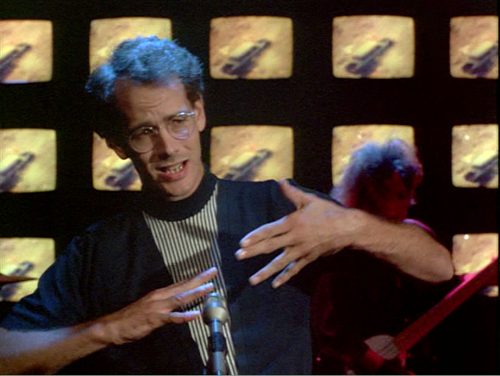
It’s worth remembering,then, that movie viewing on the “periphery” was digital before digital was cool. The swift rise of digital exhibition in China, India, and other major markets has led Hollywood down the same path. You might recall the techno-nerd’s prophetic line in David Byrne’s True Stories: “The world is changing. And this is the center of it right now. Or the one of many centers.”
Much of the information above comes from the indispensable IHS Screen Digest. Other sources, not available online as far as I know, are “Electronic projection rollout excites, worries cinema industry as cost, quality, retrofit issues loom,” Variety Deal Memo (5 July 1999), 5-8, and “Country Profile: China,” Variety Deal Memo (11 October 1999), 5-8. I’ve mentioned Shujen Wang’s valuable book in the text, but go here for her 2003 paper on digital piracy in China.
See also Hu Ke, “The Influence of Hong Kong Cinema on Mainland China (1980-1996),” in Fifty Years of Electric Shadows, ed. Law Kar (Hong Kong International Film Festival, 1997), 164-178, and Darrell William Davis and Emilie Y. Y. Yeh, “VCD as Programmatic Technology: Japanese Television Drama in Hong Kong,” in Feeling Asian Modernities, ed. Koichi Iwabuchi (Hong Kong University Press, 2004), 227-247. A Google Reader version of the latter is available here. In Playing to the World’s Biggest Audience: The Globalization of Chinese Film and TV, Michael Curtin goes beyond technology and analyzes other market forces affecting VCD.
For basic historical and technical information on digital formats I always turn to Jim Taylor, Mark R. Johnson, and Charles G. Crawford, DVD Demystified, 3rd ed. (McGraw-Hill, 2006). Useful reports on the progress of VCD appeared in The Economisthere and here. I talk a bit about the rise of digital exhibition in China and Hong Kong in Planet Hong Kong, available here. For background on current VCD trends I’m grateful to a friend in Hong Kong who wishes to remain anonymous.
My comparison of VCD, DVD, and 35mm isn’t entirely fair to the digital formats. Frame grabs tend to look worse than an image displayed on a video monitor, and an HDMI display of the VCD and DVD improves them. Moreover, the Hong Kong DVD isn’t particularly well-authored. A Blu-ray of Peking Opera Blues that I’ve ordered hasn’t yet arrived, so I will update this entry with a frame from that when I can. Finally, my 35mm frame enlargement is a bit too warm and could use some adjusting. But to keep comparison reasonable, I didn’t apply Photoshop to any of the images shown here.
It’s hard to know how widely 16mm film was exhibited commercially around the world, but some indications are given in Statistics on Film and Cinema 1955-1977 (Paris: Unesco, 1981) and various editions of the UNESCO Statistical Yearbook. A pleasant video devoted to JAN 16mm projectors is here; I grabbed a shot from that video above, so thanks to maynardcat for posting the footage.
Why are oil rigs singled out as targets of pirate screenings? My guess: Many Asians emigrated to work on oil extraction throughout Northern Europe and the Middle East, and it wouldn’t be far-fetched to assume that videos were screened for them on site. If anyone reading this can confirm, deny, or nuance, please correspond.
Clayton M. Christensen’s influential formulation of the theory of disruptive technologies is in The Innovator’s Dilemma (orig. 1997). Thanks to Jim Cortada for discussing these ideas with me. Volume 2 of Jim’s Digital Hand trilogy remains the best guide to how computers transformed the media landscape.
“Things fall apart. It’s scientific.” True Stories (1986).
Of the thirty-three titles I saw at the Toronto International Film Festival this year, only nine were projected on 35mm film. The rest were shown on HDCam or Digital Cinema Package. At the first TIFF I attended in 2002, I saw a comparable number of films and all were projected on 35mm or 16mm film.
Do you complain about ads before movies? In the Digital Age you can expect more of them because there will be ads for the theatre’s projector and server and even the financing agent that supplied them.
The most aggressive preshow attraction, which I saw before every digital screening at this year’s Vancouver Film Festival, is the one promoting Dolby servers. Play when ready.
A dirty film countdown leader explodes into sleek digitalia, alchemizing cinema into the four elements. Photochemical imagery can’t bear trial by fire and is annihilated Terminator-style. But the flames are extinguished by earth (flowers), air (blue vapor) and icy water. McLuhan said film was a hot medium, but does that automatically make digital cool?
Take the clip as a victory dance. By September, when I saw the Dolby Armageddon trailer, things had already tipped. Digital projection, the immediate future for multiplexes and for small-town houses, has become a festival mainstay too. But the problems are more marked on the fest scene than in commercial venues. If you visit a festival and there’s a hiccup during a screening, count to ten before hollering. The staff, already overstretched, is facing something far less tranquil than the concluding frames of the Dolby ad–something more like the hellfire frames you see at the start.
Screener savers
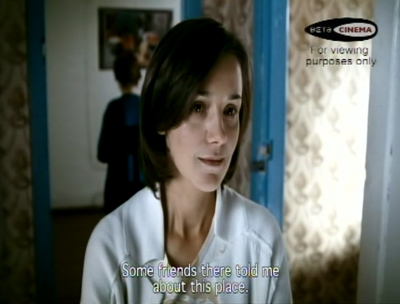
Screener for Target (Alexander Zeldovich. 2011).
Films get into festivals two ways: By being invited or being submitted blind. A programmer might invite a film solely on the filmmaker’s reputation. For instance, every festival wants the next Wong Kar-wai film (assuming he ever finishes it), and you would probably accept it sight unseen. More often the programmer catches the film at another festival, or in a private screening, or in a privately circulated video copy. That first viewing might be on any format. If the filmmaker submits the work, it will typically show up on a DVD copy, called a “screener.” Some festivals prefer the film to be uploaded to the site Withoutabox. The selection committee watches the submission to make an initial decision about the work.
Members of the press who attend a festival can usually get a look at some of the films via screeners. Often local critics watch screeners, especially if they have to write a review in advance of the festival and they’ve missed a press screening. Visiting programmers also borrow screeners from the festival because they usually can’t see all the films they might want to.
The problem is that screeners tend to be of wretched quality. Burned to DVD-R, sometimes from a VHS tape, and often in the wrong ratio or anamorphically squeezed, they are usually garnished with a more or less prominent watermark, either a “property of” one or simply a timecode readout chattering away. I can’t imagine claiming to have seen the movie after watching the typical screener. Kristin and I have used them to pull frames for our blog entries when we visit festivals, but only after we watch the films in projection.
Screeners look shabby by design. Anything approaching the finished film in image quality will be pirated, and the watermark announces that the dub you bought from the blanket on the street is stolen. I have seen a screener assigned to a particular person, his name as a caption throughout, so the distributor will know whom to pursue if it’s leaked.
Screeners made it much easier for filmmakers to afford to submit work to many festivals; imagine what costs were like in the days before videotape, when films were sent out on prints. But the emergence of screeners, I think, cheapened the film. VHS tape and many commercial DVDs make movies look ugly, but DVD screeners are far worse. Nonetheless, they are a fixture of the festival scene. As with so much about digital video, we can’t go back.
Screeners are watched mostly behind the scene, treated as tools for programmers and critics. What about the things the audience sees?
For commercial projection in your local ‘plex, Hollywood companies realized that a proliferation of digital standards was bad for business. So they set up the Digital Cinema Initiative, which established specifications for the Digital Cinema Package—the ensemble of files packed onto that matte silver brick that is replacing traditional film rolled up on reels. The DCP files are encrypted and opened up with passkeys that are supplied separately. The DCP plays 2K or 4K digital video on the two standard projection systems, the DLP one established by Texas Instruments and the SXRD one established by Sony. It’s Microsoft vs. Apple all over again: the DLP format is licensed to several projector manufacturers (Christie, NEC, Barco) but the Sony format is used only on Sony machines.
Besides the DCP, there are many other digital formats for displaying moving images. Erik Gunneson, a filmmaker and teacher here at the University of Wisconsin—Madison, ran through some of the most common ones with me. They’re distinguished by many factors, but two common measures are resolution and compression. The more lines, the higher the resolution; the less compression, the better the image (although some compression is inevitable in any digital video projection.) Many of these are capture formats—that is, means of recording—that are also used for playback.
The earliest to emerge were the DV formats, all consumer/ prosumer platforms. They use “standard definition” video codecs, as opposed to High Definition ones. There’s a bewildering number of DV cameras and playback devices, because Sony and Panasonic developed different improvements on the basic standards (720 x 480 resolution). The most common versions, Mini DV and DV Cam, use tape for capture. They are fading out in independent filmmaking, but some festivals still screen in these formats.
Home viewers are probably most familiar with the DVD, which in the NTSC standard uses MPEG-2 video compression at 720 x 480 resolution. On a large screen, your typical DVD is unsightly. Blu-ray discs, of course, look better, partly because of their higher definition (as high as 1920 x 1080 resolution).
At the professional level, you have several options, mostly provided by Sony: Betacam SP, an analog format, and Digital Betacam, known as DigiBeta. They use tape, not hard drives, to record image and sound. But they’re falling into disuse now because of the rise of HDCam. It can use either tape or optical drives as recording media. HDCam playback can through up-sampling yield standard HD images of 1920 x 1080 pixels, and this makes it a popular option for independent filmmakers. PBS documentaries are often shot on HDCam.
There’s also HDCam SR, which yields, as they say, “native” 1920 x 1080 resolution and audio features. The SR format was initially designed for high-end special effects (bluescreen/ greenscreen) and became allied with Panavision in the creation of the Genesis camera. SR is sometimes used for television series. As you’d expect from a studio-based format, it’s expensive. According to Sony, an HDCam SR system runs about $230,000, and a 124-minute blank cassette (the same engineering as the old Sony Beta cassette) costs about $424.
Many of these formats come in various flavors: PAL or NTSC, anamorphic or unsqueezed, progressive or interlaced, recent upgrade or older specs, settings for various frame rates, and on and on. And there are still other recording and playback formats, such as HDV, DVCPro, and D5 HD . When talkies came in, maybe there were as many competing sound systems floating around alongside the two studio standards. But back then, there weren’t film festivals.
Format flare-ups
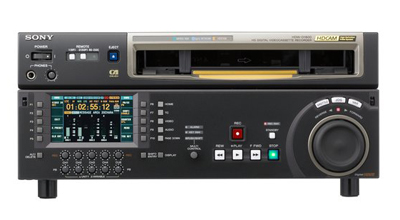
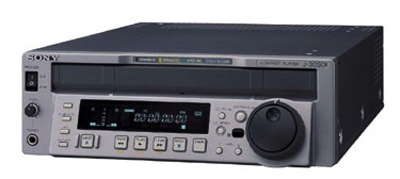
Sony J30SDI Compact Betacam Player; plays Betacam, Digital Betacam, Beta SP et al. Price: $21,000.
You the programmer have accepted a digital film for your festival. When it arrives to be shown, what format will it be on? Viewers used to home formats may expect that they’ll watch it on DVD or Blu-ray. But DVD isn’t usually suitable for projection to large audiences. Professionally produced Blu-ray discs are feasible for some public showings, but home-made Blu-rays burned by filmmakers on their own computers are notoriously unreliable. They’re likely to freeze up during projection. (This is one reason that many festivals insist that filmmakers not submit work on Blu-ray; DVD remains less unstable.) And good as Blu-ray looks on your home monitor, it’s inferior to the best professional projection formats.
So a higher-end playback is needed for most festival exhibition. Usually filmmakers say that they’d like the film screened on the format it was shot on, but this isn’t always possible. Remember that festivals move into existing venues, either multiplexes or arthouse theatres. What you can show will be constrained by what equipment is already in the booths, or what can be rented or purchased, then squeezed in for the occasion.
To keep things manageable, festivals have to restrict what exhibition formats they will use. Here are the formats listed in the submission requirements of some major festivals:
Telluride: Only 35mm or DigiBeta.
Seattle: 35mm, 16mm, or HDCam.
Toronto: 35mm, DCP, or HDCam.
Sundance (as of 2010): 35mm, 16mm, HDCam (NTSC 2), or HDCam (PAL 3).
Ann Arbor: 35mm, 16mm, Mini DV, or Beta SP.
Los Angeles: 35mm, 16mm, DCP, HDCam, DigiBeta anamorphic.
Rotterdam: 35mm, 16mm, Betacam SP (PAL), DigiBeta (PAL), or DVCam.
Filmmakers who want to submit a digital movie to lots of festivals will sooner or later have to convert the original files to another format. This process is expensive, and low-budget filmmakers may be tempted to try it at home, with dire results. If the filmmaker’s conversion turns out to be unplayable, the festival may have to try converting the movie itself or revert to the film’s original platform, which means bringing in other playback equipment.
Festivals have always been the bridge from the traditional to the latest, greatest technology and everything in between. Whatever the filmmaker could afford to finish on is what we have to work with. At times I have managed as many as 13 formats.
Worse, for any specific screening there may be several formats in play. The festival trailer-and-sponsor reel is unlikely to be on film these days, more likely on Blu-ray or HDCam. The feature may be accompanied by a short, which can be on any number of formats. A program of short films presents its own problems, since they may come in a bevy of formats.
Moreover, recall the central situation of festival screenings—many different movies played in a few venues continually. Let’s say that a given screen is used for five movies in a day, at 10 AM, 1 PM, 4 PM, 7 PM, and 10 PM. The schedule leaves very little time, at most half an hour, to test how a given film will play before its show starts. Of course, the film can be previewed days or weeks ahead of the screening—if it arrives in plenty of time. (Most don’t.) So projectionists, programmers, and technical staff are constantly juggling time slots, formats, and different auditoriums. Can we play this HDCam copy of Dark Bohemian Days on Screen 1? No, because the HDCam deck is only in Theatre 2 and Theatre 4. But Bohemian Days is over two hours long, and all the other long films are in 2 and 4 so we don’t have a slot available. We could move Dad Was a Transvestite, which is on DigiBeta, to a smaller screen, but we expect a big crowd for that, and we’d shut people out, and anyhow Screen 1 won’t have DigiBeta playback . . . .
Moreover, most festivals want to be flexible—adding screenings of popular titles, or substituting a film when another doesn’t arrive in time. Multiple formats make on-the-fly adjustments more difficult.
When you reflect on all the permutations of schedule, equipment, venues, formats, and staff assignments, it’s rather miraculous that most festival screenings start on time and are well-projected.
Then there’s DCP.
DCP = Damn Cinephile Problems?
The Digital Cinema Package and its shipping case.
2011 has been the first big testing period for digital cinema at the major festivals. Several screenings have been delayed (by hours) or canceled. Occasionally digital copies were replaced by DVDs or 35mm prints (coming to be known as “analog backups”). In correspondence with several programmers and consultants, I’ve garnered a sample of eye-opening reasons for the breakdowns. Most have to do with the Digital Cinema Package.
The DCP, that gleaming brick drive seen above, is part of a larger digital environment. There’s the projector. There’s the server in the booth that stores the film, along with trailers and other material, and allows the operator to build playlists for the show. There’s the Theatre Management System, an umbrella device that coordinates all the servers and projectors, along with lighting, curtains, and other aspects of presentation that can be automated. But all this hardware and software is inert without the Key Delivery Message, or KDM. (Get ready: We are living in the Age of Acronyms.)
The Key Delivery Message is a security device. It’s a very long alphanumeric string, usually sent to the exhibitor by email, that opens the DCP’s files. It will work for only one movie on one server for a specified time period. If you want to play the same movie on a different server or projector, you need a second KDM. The KDM is tailored to the projector or server’s media block, and it won’t work if it can’t “talk to” that block. The arrangement keeps the DCP from playing on equipment that isn’t certified as compliant with the standards of the Digital Cinema Initiative created by the Hollywood studios. The KDM also detects any tampering; if someone has tried to access the files impermissibly, the DCP won’t play.
Clearly the KDM, like the DCP, is optimized for commercial theatres playing the same movie on the same screen for many days or weeks. In a festival, it creates headaches because the staff are cycling many titles through a single screen, or shifting one title from screen to screen.
Nonetheless, festivals must accept some DCPs. Today’s big-name “commercial arthouse” films supported by major overseas companies and US distributors are likely to show up on DCP–films like Melancholia, Certified Copy, and similar high-end titles. These titles are the backbone of festival ticket sales.
What could possibly go wrong?
Projector problems: At one festival, the only DCP-capable projector broke down and had to be replaced by one that was flown in. An entirely new set of KDMs had to be generated.
Christie Digital provided us with their best new projectors and Dolby provided us with their best new servers. Both Christie (in Ontario) and Dolby (in California) are sponsors of VIFF and give full attention to quality control and technical support. The problem was that the stuff was so new and improved that it didn’t work, and no one knew why. . . . Since these two pieces of equipment had never interfaced before, there was unanticipated software incommunicability.
Alan indicates that once the software was amended, projector and server could communicate, but “it took expert technicians 48 hours (without much sleep) to figure that out.”
DCP damage: Like all computer files, a DCP can be corrupted. Often a duplicate DCP is sent as a backup. But sometimes not, or sometimes that’s corrupted too.
Ingestion digestion:A booth’s server has only a certain capacity, say seven hours. Alan Franey: “Assayas’ Carlos barely fit.”
Under festival conditions DCPs are constantly being loaded into the server (“ingested”) and extracted from it (“dumped”). For a feature-length movie, this can take an hour or more. Alexandra:
Ingesting, dumping, and reingesting are common. We are showing so many titles that server space becomes an issue.
KDM time intervals:The permissible play period may be too confining. Shelly Kraicer, a Chinese cinema expert who has programmed at many festivals, points out:
A screening could be aborted because of time-zone issues. A KDM has a start and stop date. If it too closely fits the screening dates (and that seems like what’s been happening), then a twelve-hour time zone offset (say, Asia to East Coast USA) can put the KDM off by one day, and it could refuse to play.
KDM/ DCP matchups: Even multiplexes are finding problems getting the KDM to open the DCP, with projectionists having to phone companies to walk through the security steps. The problems are exacerbated with foreign titles on DCP. Alexandra again:
What if the hard drive is coming from Poland and the KDM is being issued from a French lab that is closed for two weeks over Christmas? And the filmmaker is on location in the Philippines? This is a current real scenario.
Inflexibility of programming: Obviously DCP titles can only be screened in houses equipped with compliant projectors. Most booths in most festivals don’t have such projectors and may not be getting them soon. Whereas 35mm prints can be lugged from spot to spot, a given DCP with its attendant KDM is locked to one house.
Shelly notes that switching venues or adding showings is difficult:
If you need to move a DCP film from Screen A to Screen B tomorrow, you need to urgently request from the distributor that a new KDM be generated and sent and tested in time. This often doesn’t work. (Try doing it over a weekend.)
Alexandra agrees:
If one wants to change venues in response to audience demand, that is usually not possible unless the DCP is unencrypted, there’s sufficient time for ingestion, and if there’s a KDM that allows for it.
You can argue that these are teething pains. Venues will acquire servers and projectors, staff will become adroit at handling DCPs and KDMs, software will get standardized and hardware will get more reliable. Then things will run smoothly. And of course, 35mm was never free of snafus—bad splices, wrong aspect ratios, reels run out of order.
Still, the new problems are of a different kind. 35mm was stable as a standardized format, however bollixed it could become in execution. Since about 1930, you bought a projector and you threaded the film into it and set your sound and ran your show. Now we’re in an environment in which nothing is stable in a long-range time scheme. Alan Franey suggests why:
Everything we know about the constant rapid evolution of computers seems to suggest that we’re in for rapid obsolescence, constant upgrades, and at showcases like VIFF, a lot of on-site beta testing. . . . We have every reason to fear a five-year replacement cycle. Robust, no; expensive, yes.
Doubtless festival directors and their teams will come up with something. Perhaps a less stringently secured format could replace DCP for festivals and arthouses, or films could be stored in the cloud. For non-DCP programs, perhaps filmmakers can project straight from their laptops. In all cases, accessible backups need to be available as well. In the meantime, Pandora’s box has opened wide for the festival circuit.
Long live the analog backup
Can a festival simply go its own way—refusing arcane digital formats, avoiding DCP, and showing good old 35mm? No. The big festivals will have to follow the lead of Cannes, which screened 60% of its titles last year in DCP. The midsize and small festivals are already disadvantaged. Distributors and producers want their films to premiere at the highest-tier festivals, and the few 35mm prints that exist are reserved for the bigger events.
As a result, programmers who want desirable titles are being nudged—or shoved—to digital. Peter Porter, professor and Director of the Spokane International Film Festival, observes:
While we will always hear “We can’t premiere with you,” more often have I been hearing, “If you will screen non-35, you can have the title.” In any case, if I insisted on 35mm prints, I would have no film festival. Of the forty or so features that we will screen, my guess is that fewer than ten will even be available on 35mm.
At Vancouver this year, Kristin and I looked forward to seeing Kore-eda Hirokazu’s I Wish. But when we learned from the catalog that it was screening digitally, snobby purists that we are, we thought we’d wait for a chance to see a 35mm copy elsewhere. Yet our friends who went to the show came back delighted: A 35mm print was shown instead, with electronic subtitles. Fortunately, Kristin and I were able to catch the second screening, the same very pretty 35mm print.
If the VIFF team had had to switch formats at the last minute, it was surely tough; but the smooth-running screening of I Wish made me think: This could be the only time I’ll ever see it on film.
For the same reason, I went to our Cinematheque screening of Play Time in mid-December. This film has been central to the way I think about cinema since my first encounter with it in the summer of 1973. It’s an old friend. Maybe some day that well-traveled Janus print will serve as a backup for a digital screening. I might attend, with fingers crossed that the old reliable will be pressed back into service.
This entry is one in a series about the conversion of film to digital-based systems. Earlier entries are here and here.
Thanks very much to Alexandra Cantin, Alan Franey, Erik Gunneson, Jim Healy, Shelly Kraicer, and Pete Porter for sharing their knowledge with me. Thanks to Alissa Simon, programmer of the Palm Springs International Film Festival, as well. I’m also grateful to James Bond of Full Aperture Systems for a fact-filled lunch.
PS 5 January: Mark Peranson, Programming Associate at the Vancouver International Film Festival, writes to say that both DigiBeta and 35mm were options for I Wish. The staff were hopeful of getting a film print, but they were prepared to show digitally if the 35 didn’t come through. Thanks to Mark for correcting the first version of the entry, which claimed erroneously that a DCP had failed. Serves me right for believing gossip.
PPS 7 January: Thanks to Antti Alanen for reminding me to mention 4K as another format played in DCP. By the way, his Film Diary is always worth visiting; the latest entry surveys programs currently playing at major film archives.
PPPS 31 January: David Dinnell, Program Director of the Ann Arbor Film Festival writes:
I thought it might be of interest to you that the Ann Arbor Film Festival hasn’t exhibited any works on tape for the past four years. We have moved to a digital file playback system, which has been able to accommodate the various SD, HD and compression codecs independent filmmakers use. I think we are one of the first festivals to go this route.
Thanks to David for the information.
PPPPS 1 February 2012: Thanks to Sven Jense of Rotterdam for pointing out that I should stress that the DCP is the collection of files on the hard drive, not the hard drive itself. In practice, people speak of both as the DCP, the way that speaking of a package of anything refers both to the contents and the container.
Jacques Tati explains Play Time in a prologue included with the film during its New York release in 1973. From a 35mm print, scanned at 2000dpi.
In the Web age, physical books become e-books, and virtual books, often self-published, can mutate into tangible things of paper and glue. That’s what has happened to Planet Hong Kong 2.0.
The story so far: In 2011 I revised the old version. I updated the existing chapters and added four new ones. Our web tsarina Meg Hamel designed a very nice pdf version of it, with over 400 color pictures and an ingratiating layout. That is still available for $15 elsewhere this site.
I had pretty good luck with selling the e-book online, having earned enough to pay the costs of designing it. It would be nice to sell more and pay myself a little for my work. Did I mention that it’s still available for purchase here?
In the meantime, last spring I had Park Printing of Verona (Wisconsin) make some physical copies. We used high-grade paper, and the result is a very fine-looking book, measuring 11 x 8 ½ inches. I prepared them as presentation copies to the many people, particularly in Hong Kong, who had helped me in writing the 2000 edition and this one.
I’ve presented those copies to those people. I have a few copies left.
I could just hang on to them, but some people have told me they would a prefer print copy to the pdf. A few libraries have likewise expressed interest in a physical book.
So I’m making Planet Hong Kong 2nd ed. available for $60 plus postage Amazon and at Biblio. The vendor is 20th Century Books, an outstanding shop here in Madison specializing in comics, fantasy, s-f, and mysteries. (Thanks, Hank and Deb.)
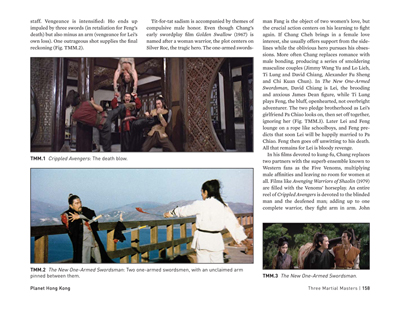
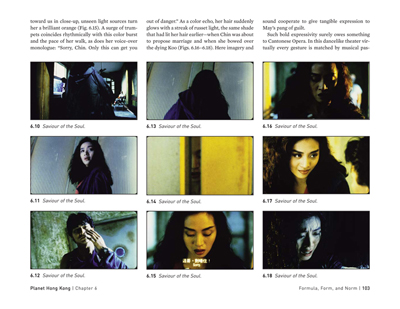
The list price of PHK 2.0 analog reflects the costs of making a small print run of a heavily illustrated book. Here are a couple of sample pages. Illustrations were scanned from 35mm frames.
If I’d had my wits about me, I’d have done this before the holidays so I could advertise it as the perfect gift for that hard-to-please film fan on your list. In any case, if you’re a reader, collector, or librarian, you can acquire a hard copy of the book from Amazon or Biblio. And the e-edition remains available on this very site. . . .
Coming up later this week: Another entry in our series, Pandora’s digital box. This one is about how digital formats have affected film festivals. It’s not a pretty tale.
To end the year, we’re continuing our tradition of picking the ten best films not of the current year but of ninety years ago. Our purpose is twofold. We want to provide guidance for those who may not be particularly familiar with silent cinema but who want to do a bit of exploring. We also want to throw in occasional unfamiliar films to shake up the canon of classics a bit.
Like last year, it was strangely difficult to come up with ten equally great films. There were some obvious choices, but beyond them there were a lot of slightly less wonderful items jostling for the other places on the list. The problem had several causes. Some master directors who routinely figure in our year-end ten choices had off-years. In 1921 D. W. Griffith released only one film, Dream Street, a notably weak item. (What I have to say about it can be found on pp. 108-113 of the British Film Institute’s The Griffith Project, Vol. 10.) Ernst Lubitsch released two films that seem like less interesting attempts to repeat earlier successes: Anna Boleyn (a pale imitation of Madame Dubarry) and Die Bergkatze (nice, and I was tempted to include it, but it’s less amusing than the Ossi Oswalda comedies, here and here). Cecil B. DeMille’s The Affairs of Anatol is not nearly as well structured as his earlier sophisticated rom-coms.
In other cases, films simply don’t survive. John Ford released seven films in 1921, all of which are lost.
Death comes calling, twice
Probably the easiest decision was to include The Phantom Carriage (also known as The Phantom Chariot), by Victor Sjöström. As I noted recently, the Criterion Collection has recently issued a beautiful restoration of it (DVD and Blu-ray).
When I first saw The Phantom Carriage, I was probably still an undergraduate. Given its reputation as a great classic, I was somewhat disappointed. No doubt it was partly the battered 16mm copy I watched, but the film is a bit formidable for someone not accustomed to the aesthetic of silent cinema–and especially of the great Swedish directors of the era. Its protagonist, played by Sjöström himself, is a thoroughly, determinedly unlikeable fellow, and the complex flashback structure can be a bit disconcerting on first viewing. But the effort to watch until one “gets” Sjöström is well worth it, since he’s undoubtedly one of the half dozen greatest silent directors.
The story opens on New Year’s Eve with Edit, a young Salvation Army volunteer, on her deathbed. She unexpectedly begs her colleague and mother to fetch the town drunk, David Holm, to her bedside. At the same time, Holm sits drinking in a graveyard as midnight approache. He tells two fellow inebriates the legend of the phantom carriage, the vehicle that picks up the souls of the newly dead; it is driven each year by the last person to die at the end of the previous year. Holm then dies, and the carriage arrives, with its current driver ready to turn over the job to him. Flashbacks enact both the circumstances of how the heroine met Holm and the happy family whom Holm had alienated through his drunkenness.
It’s a deeply affecting story, wonderfully acted and staged. In most scenes the lighting and staging are impeccable, and the famous superimpositions that portray the carriage and the dead are highly ambitious for the period and impressively executed. The filmmakers have managed to make the carriage, superimposed on real landscapes, appear to pass behind rocks and other large objects. In short, a film that has everything going for it.
Death himself appears in Der müde Tod (literally “The Tired Death,” often called Destiny, or occasionally in the old days, The Three Candles). Here the great German director Fritz Lang hits his stride, and you can expect him to figure on most of our lists from now on.
In Destiny (available on DVD from Image Entertainment) a young woman’s fiancé is killed early on. Death, a sympathetic figure who regrets what he must do, gives her three chances to find another person whose demise can substitute for her lover’s. The three episodes in which she tries take place in Arabian-Nights Baghdad, Renaissance Venice, and ancient China; each story casts her as the heroine and her lover as the hero.Things don’t go well, and Death actually gives her a fourth chance when she returns to the present.
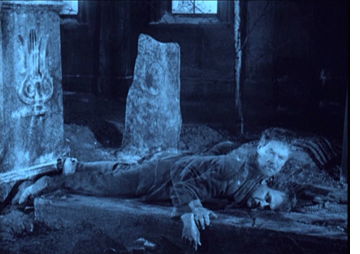
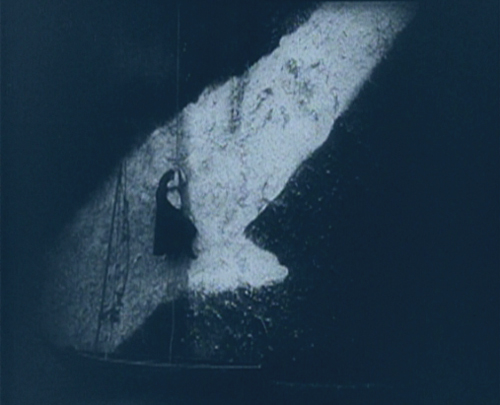
This was Lang’s first venture into the young German Expressionist movement, which had been launched the year before with Das Cabinet des Dr. Caligari. The style shows up only intermittently, perhaps most dramatically in the Venetian episode when the lover shinnies up a rope along a wall painted with a gigantic splash of light. (See bottom.)
Each film has a “happy ending.” I leave it to you to determine which is grimmer.
I’m turning over the keyboard to David now, to describe a film he knows better than I do.
More Northern European drama
Mauritz Stiller alternated urban comedies (Thomas Graal’s Best Film, 1917; Thomas Graal’s Best Child, 1918; Erotikon, 1920) with more lyrical dramas and romances set in the countryside (Song of the Red Flower, 1919; Sir Arne’s Treasure, 1919). Johan (1921) is in the pastoral vein. Its integration of landscape into the drama suggests it was an effort to recapture the production values that overseas critics had praised in Sjöström’s Terje Vigen (1917) and The Outlaw and His Wife (1918). Like the Sjöström films, however, Johan offers more than splendid spectacle; it’s the study of the undercurrents of a marriage.
At the core is a love triangle. The fisherman Johan is the somewhat thick-headed son of a domineering mother. He is fond of the girl Merit, whom he and his mother rescued as a waif and brought into their household. But this synopsis is actually skewed, because Stiller and the scriptwriter Arthur Norden have told the story in an unusual way.
We’re introduced to the couple by following the rogue Vallavan’s entry into the town; Johan seems almost a secondary character until Vallavan leaves. When Johan breaks his leg, Merit agrees to be his wife. Now we’re attached to her standoint and see her life of drudgery under the petty tyranny of Johan’s mother. Vallavan returns, and Merit falls under his spell. Taking her hand, he says, “I want to rescue you.” After she has fled with him, Johan clumsily wanders the rocky shore. “Will I ever see Merit again in this life?” The narrational weight passes to him as he decides to pursue the runaways.
Like Sjöström’s Sons of Ingmar (1918-1919), Johan presents marriage as a trap for unwary women. Our shifting attachment, from Vallavan to Merit and eventually to Johan, allows us to see the situation in many dimensions. As a sort of parallel, Stiller makes fluid use of the now solidly-established conventions of continuity editing. Vallavan’s seduction of Merit is played out in tense shot/ reverse-shot, and there’s an engrossing moment involving delicate shifts in point of view. When the bedridden Johan sees Merit leaving, after his mother has cast her out of the house, he must smash a window pane with his elbow in order to call to her. Stiller’s dynamic eyelines, direction of movement, and precise changes of camera setup here show that he had mastered the American style.
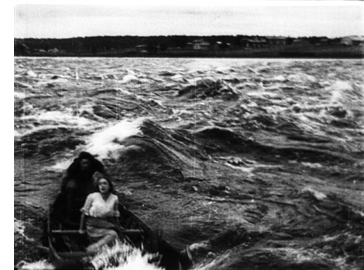
Alongside this finesse, there is still plenty of outdoor action, highlighted when Vallavan rows Merit away in the tumultuous river. Filmed from another boat, the actors are all but engulfed by the waves. It was presumably scenes like this that the parent company, Svensk Filmindustri, hoped would attract international attention. At this period Svensk, dominant in the local industry, was hoping to sell its films on a global scale. That ambitious plan failed, but it left us with many outstanding movies and soon brought Stiller, along with Sjöström, to Hollywood.
Johan is available on a Region 2 PAL DVD, coupled with Kaurismaki’s Juha, another adaptation of the Juhani Aho story.
The joys of small-town life
Last year I included two films by William C. deMille, the considerably less famous brother of Cecil B. The year 1921 saw the release of what is today his best-known film, Miss Lulu Bett. It was based on the popular novel and play by Wisconsin author Zona Gale, who received her MA here at the University of Wisconsin-Madison and in 1921 became the first woman to win a Pulitzer Prize for drama. The story centers around the heroine, a spinster who lives with her sister’s family, including her niece, nephew, and brother-in-law, Dwight Deacon. Dwight is a tyrant who delights in taunting Lulu over her unwed status, and the rest of the family treats her as a servant.
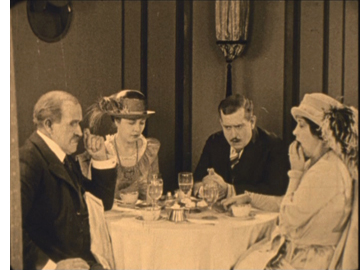
The return of the husband’s globetrotting younger brother Ninian after a twenty-year absence injects some life into the situation. Taking the family out to dinner, he realizes just how boring the family is (right), and to liven things up, suggests that he and Lulu perform mock marriage vows. Dwight realizes that the ceremony is legally binding, and, already attracted to Lulu, Ninian suggests that they treat it as a real marriage. Desperate to escape her dreary situation, Lulu agrees. The relationship proves agreeable, and Lulu declares that she will learn to love Ninian–when he reveals that he had previously been married, though he doesn’t know whether his first wife is dead (in which case he and Lulu are married) or alive (in which case they aren’t). Unwilling to take a chance, Lulu returns to the Deacons, who consider her disgraced and treat her even worse.
The film avoids melodrama. Ninian is not a villain; he’s kind to Lulu and sorry for the position he’s placed her in. It remains to Lulu to summon the gumption to leave the family and find her own happiness.The whole thing is told with restraint and little touches of humor that draw the viewer into a deep sympathy with Lulu’s plight.
Lois Wilson’s performance as Lulu is crucial in this. She is at once plain enough that we can believe she is in danger of becoming an old maid and pretty enough to plausibly attract the attention of the handsome local schoolteacher. Wilson’s most prominent role came two years later, when she starred as the heroine in James Cruze’s The Covered Wagon.
Miss Lulu Bett is the only one of William’s films available on DVD, paired with Cecil’s Why Change Your Wife? As so often happened, William seems to take a back seat to his famous brother, but the pairing is a logical one, in that William wrote the script for Why Change Your Wife?
Another small-town drama of the same year is Lois Weber’s The Blot. In 1981, when I was teaching a course on American silent film at the University of Iowa, I wanted to quickly demonstrate to the students that the silent period was not an era of exaggerated acting and naively melodramatic plots. I showed a double feature of The Blot and King Vidor’s Wine of Youth (1924). The latter portrays changing sexual mores through the story of three generations of the same family, with a young woman of the Roaring Twenties questions the necessity of marriage when she discovers that her mother is contemplating divorce. I think Wine of Youth (unfortunately not available on video) and The Blot convinced my class that silent films could be both sophisticated and subtly acted.
The “blot” of Weber’s title refers to the notion that people in professions depending on intelligence and education are poorly paid, while tradespeople and children from rich families are well off. The representatives of the underpaid are a college teacher, Prof. Griggs, and a young, idealistic minister. The parallels to recent events are striking. College professors may not be so badly paid as in the 1920s, but the move toward institutions of higher learning depending on adjunct lecturers has created a similar issue. In general, the income gap is familiar: the rich young wastrels taking Prof. Griggs’s course represent what we now call the one percent, while the professor and minister live on a much lower plane.
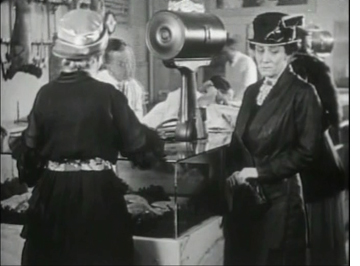
Weber’s drama is not quite this bald, however. Various levels of prosperity are represented. The professor’s family lives in shabby gentility, his wife grimly struggling to keep food on the table and his daughter Amelia, in delicate health due to a lack of nourishing food, working in the local library. Their neighbors are the family of a successful shoemaker, who live well but lack education. The shoemaker’s wife in particular resents what she perceives as intellectual snobbishness in the professor’s family and takes every opportunity she can to flaunt her comparative wealth.
Her son, however, has a crush on Amelia, as does the poor minister. Into this situation comes Phil West, the professor’s rich but indolent and mischievous student. Also attracted to Amelia, Phil for the first time encounters real poverty and is shocked by it. As the plot develops, Amelia falls ill, and her mother’s increasingly desperate efforts to obtain the food necessary to nurse her to health become one of the main threads of the drama. To say that a large part of the action in the second half of the film centers on Mrs. Griggs’s temptation to steal a chicken from her neighbors might make the situation seem a trifle comic, but Margaret McWade’s remarkable performance vividly conveys the wife’s struggle in the face of real lack and her humiliations in the eyes of the shoemaker’s gloating wife. When Mrs. Griggs succumbs to temptation, the result is a brief but wrenching scene.
The plot is remarkably dense and unpredictable. Every scene involves glances that lead to new knowledge or serious misunderstanding, deflecting the plot into new directions. Early on it is impossible to say which of the three young men Amelia will end up with, and even by the late scenes, when only two plausible romantic candidates remain, we have no idea which she will pick. As in many of Weber’s films, she does a bit of preaching about the social problem involved, but in The Blot she leaves this until near the end and gets it over quickly and fairly believably. The considerable but gradual change in Phil’s attitude toward education and the problems of poverty is also made believable. The prosperous neighbor’s change of attitude may seem a bit sudden, though it is somewhat motivated by a line early on.
But on the whole, even more than with Miss Lulu Bett, this is an absorbing story with characters for whom we care. Weber uses motifs as skillfully as any director in the early phase of the classical Hollywood cinema. Watch in particular how many different ways she uses the Griggs family’s cat and her two kittens: to demonstrate the family’s poverty, to be the main means of the neighbor lady’s spite, to introduce some comedy, and so on. Even more pervasive is the way that shoes become tokens of characters’ various social positions.
The Blot is available on DVD from Image. Those interested in Weber as a director should note that next summer’s Il Cinema Ritrovato festival in Bologna plans a retrospective of her work.
Which is best? Damfino.
In past year-end lists, we’ve watched Harold Lloyd, Charles Chaplin, and Buster Keaton creeping toward their great features of the 1920s. This year two of them move cautiously into longer films, and the other releases two more terrific one-reelers.
The Boat is one of Keaton’s most admired shorts. In it, he, his wife, and their two young sons build a boat, the Damfino, and unwisely launch it on the open ocean. Everything that can go wrong does: the life-preserver sinks, the anchor floats, and naturally a storm hits. The wife’s pancakes aren’t edible, but one temporarily patches a leak. Throughout the intrepid band carries on against all obstacles.
Less perfect but more dazzling and (perhaps) funnier is The Playhouse. The premise of a small variety theater creates an episodic, messy narrative, but it allows Keaton to play out a series of four “acts.” Initially we see Keaton buy a ticket and enter an auditorium where the audience, the orchestra, and all the performers are played by “Buster Keaton.” As one of the audience members remarks, “This fellow Keaton seems to be the whole show,” which is true in more way than one. The multiple images of Keaton were accomplished entirely in the camera, by cranking back the film with precise timing and uncovering a different part of the lens at each pass. The precision when one Keaton figure talks to or dances with another is amazing.
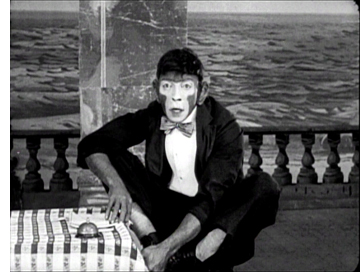
This all turns out to be a stagehand’s dream. (Keaton being the stagehand.) The multiplication motif returns as an act involving two pretty girls who happen to be twins–something Buster doesn’t know, making his encounters with them ever more baffling. Later an orangutan escapes, and Buster dons make-up and costume to replace him. All hilarious stuff, though unfortunately the final act, a Zouave Guard drill, is the least funny one. Still, it’s a terrific film with a big dose of the surrealist quality that will run through the later shorts and the features.
The Boat is included on Kino’s disc of The Navigator and The Playhouse with their out-of-print DVD of The General. Still in print, however, is Kino’s eleven-disc set of the features and shorts. For those in the UK and other region-2 countries, Eureka! has a “Masters of Cinema” three-disc set, “Buster Keaton: The Complete Short Films 1917-1923,” which includes many of his earlier films with Fatty Arbuckle.
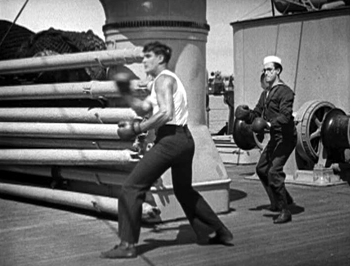
The year saw Lloyd and Chaplin make their first feature films, though both releases were still fairly short. I’m not really counting A Sailor-Made Man as one of the top ten of the year, since it’s a delightful but decidedly light item. Just another reminder that Lloyd is inching toward greatness.
Lloyd presents his “glasses” character as a brash young man who impulsively proposes to a rich man’s daughter. When the father demands that he get a job to prove his worth, Harold enlists in the navy. Highjinks ensure, culminating in a lively chase-and-rescue scene when the heroine gets kidnapped by a lecherous Arabian sheik.
The shipboard scenes allow Harold to get in some funny bits, mainly involving him trying to be tough and succeeding at first by sheer accident. Later, however, he is inspired by the heroine’s danger to become a real rescuer. It’s a sign of bigger things to come.
New Line’s Harold Lloyd boxed set is out of print, but you can still get the volumes separately. A Sailor-Made Man is in Volume 3, along with such delights as Hot Water and For Heaven’s Sake.
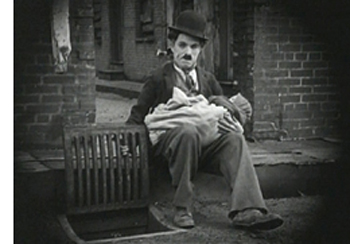
Chaplin’s first feature, The Kid, is a skillful blend of the rough-and-tumble slapstick that had characterized his early shorts and the sentimentality that would gradually become a more prominent trait of his films. A unmarried woman (played by Edna Purviance, the elegant beauty who made such a contrast with the Little Tramp in many of his films) abandons her infant in an expensive car which happens to get stolen moments later. Charlie finds the baby, and after numerous attempts to get rid of it–including a brief contemplation of an open storm-sewer grate–decides to raise it. The baby grows into the adorable and amusing Jackie Coogan.
In the meantime, the mother has become a rich singer, and coincidentally she comes to the slums doing charitable work. The authorities eventually try to remove the Kid to an orphanage, and later a flop-house proprietor turns him in to receive a reward. Still, Chaplin doesn’t milk the pathos, and a happy ending duly arrives.
The Kid is available in a decent print along with A Day’s Pleasure and Sunnyside on the “Charlie Chaplin Special” DVD. Our recording off Turner Classic Movies strikes me as being slightly better quality, so you might keep an open to see if they reshow it. It was also announced this week that The Kid has been added to the National Film Registry of the Library of Congress.
Fuzzy movies, big and small
Soft-style cinematography had been tried in some films of the late 1910s, most notably in Griffith’s Broken Blossoms. But in the 1920s it spread. In Hollywood, it was mainly a technique for making beautiful images and especially for creating glamorous close-ups of actresses. In France, it was a way of tracking a character’s inner life.
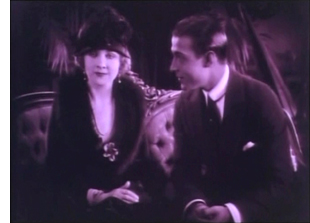
Vicente Blasco Ibáñez’s 1918 novel, The Four Horsemen of the Apocalypse was a huge bestseller, and the first film adaptation in 1921, directed by Rex Ingram, was equally successful. To many, it is remembered for having made a super-star of its main actor, Rudolph Valentino. Anyone who has seen him as the caricatured Latin Lover of his later films will be pleasantly surprised to discover that the man could act, as could his leading lady, the lovely Alice Terry.
Ingram was the quintessential middlebrow director of the 1920s, doing big-budget, respectable adaptations of popular literature (e.g., Scaramouche, The Prisoner of Zenda). To me, Four Horsemen escapes the stodginess of the later films, at least to some extent (as does his other 1921 film, The Conquering Power). It and the other film in this section were borderline cases, chosen as much for their historical importance as their quality, perhaps, but definitely worth watching.
One of Four Horsemen‘s greatest strengths is its photography. Ingram worked consistently with one of the greatest cinematographers of the 1920s, John F. Seitz, who created glowing images of sets and actors with selective lighting and all sort of means of softening the image. This film, more than Broken Blossoms, brought the soft style into vogue. It eventually culminated in the Dietrich films of Josef von Sternberg before a more hard-edged look came to dominate the 1940s.
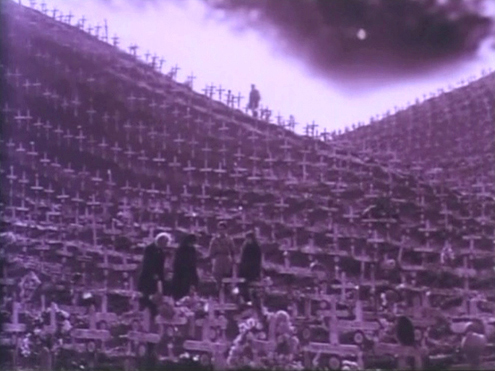
Four Horsemen was also an early entry in the anti-World War I genre of the 1920s and 1930s. Its final scene in a vast military cemetery of identical white crosses remains a powerful one. (See above.) Here, however, the Germans are still stereotypes, militaristic puppets with no redeeming features. Even that notion would gradually change, however, until nine years later All Quiet on the Western Front could recount the war from the German point of view.
(For more on this photographic style, see my “The soft style of cinematography,” in The Classical Hollywood Cinema, pp. 287-293.)
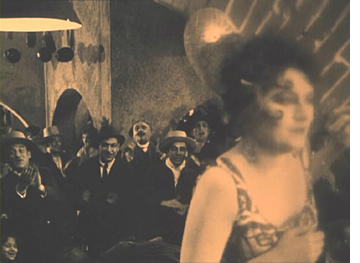
I’m not a huge fan of Marcel L’Herbier, and I’m not entirely sure that El Dorado is a full-fledged masterpiece. But it has many virtues, and arguably it’s historically important as the first film of the French Impressionist movement to thoroughly explore ways in which camera techniques could convey perceptual and psychological states. It focuses largely on Sibilla, a singer-dancer who is the main attraction in a tawdry Spanish bar. She and some other women are performing as the story begins, but Sibilla is distracted by worries about her sick son. L’Herbier experimented with tracing her attention by placing gauzy filters over her face when she starts thinking of the boy. In the frame at the left, for example, she is in sharp focus when onstage, but as she passes into the backstage area, she goes fuzzy.
In a way this is a somewhat silly, literal notion, and yet it’s exciting to see filmmakers exploring new devices relatively early in film history. Gauzy filters, distorting mirrors, slow-motion superimpositions, rhythmic cutting, and subjective moving camera were soon to be in common use by a small group of French directors. El Dorado was also the first film to be filmed within the Alhambra, which lends it considerable visual interest.
If we’re still writing this blog in 2019, our list will probably include the culminating film of the movement, and arguably L’Herbier’s best silent film, L’Argent.
Not many French Impressionist films are available in the U.S. If you have a multi-region player, El Dorado is paired with L’Herbier’s earlier L’homme du large (1920) on a French DVD.
Tigers and lepers and a mysterious yogi
We tend to think of serials as having many episodes and being low-budget additions to programs. That’s the American model, but in Europe things were different. Louis Feuillade’s serials are among the gems of the 1910s. In Germany, serials tended to have fewer episodes but bigger budgets–much bigger. Many were only two parts, most famously Dr. Mabuse, der Spieler (coming next year to our top-ten list) and Die Nibelungen (coming in 2014). Lang had launched into serials with Die Spinnen (1919 and 1920). The two parts have terrific things in them, but Lang never went on to finish it.
He was, however, still collaborating on screenplays for director Joe May, who specialized in epic serials set in exotic countries and starring his wife, Mia May. Highly entertaining though these films are, they are largely forgotten, even by most lovers of silent cinema. Das indische Grabmal is the exception, though even now few have had a chance to see it. In 1996 it was shown at “Il Gionate del Cinema Muto” festival in Pordenone and was all too briefly available on an Image DVD (as The Indian Tomb) now out of print. Track it down if you can.
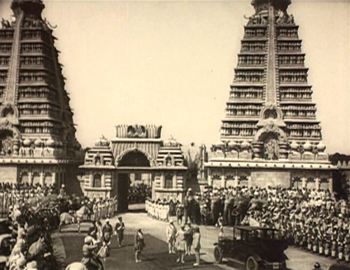
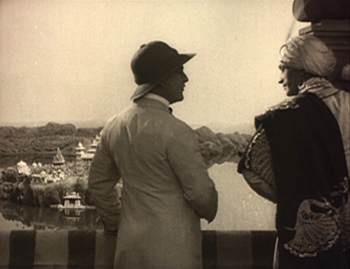
Full of the stars of its day, Das indische Grabmal is set largely in India, and its plot was inspired by the Taj Mahal. A ruthless maharajah (played with relish by Conrad Veidt) cloaks his cruelty under a veneer of European courtesy. He plots to shut his unfaithful princess (Erna Morena) in a beautiful tomb along with her lover (Paul Richter, better known to modern audiences as Siegfried). He calls in a famous European architect (Danish star Olaf Fønss) to build it, and the architect’s fiancée (Mia May), rightly fearing dirty work afoot, follows. One pit full of tigers and one of lepers lie waiting to endanger the visitors. The sets are beautiful. The Germans by this point could do them at full scale (above left) and as marvelously deceptive miniatures (above right). Das indische Grabmal is constantly entertaining and perhaps the best of its type, at least of the films we have access to.
Lang directed a two-part remake of this film in 1959. Both are good, but I prefer the silent one.
Some runners-up
As I mentioned, we had trouble narrowing down our list this year. Here are some others that could have replaced some of our prime choices. The German stage director Leopold Jessner adapted the play Hintertreppe (Backstairs). It’s a Kammerspiel, set in two apartments and the courtyard between them, and concerns a simple love triangle among a maid, her absent lover, and the postman who loves the maid so much that he forges letters from her sweetheart to keep her happy. Antti Alanen kindly reprinted my notes on the film here.
Carl Dreyer’s third feature, Leaves from Satan’s Book, remains one of the most widely-admired variants on the Intolerance formula of presenting thematically linked historical episodes. The dynamic final last-minute non-rescue shows that Dreyer learned a good deal from Griffith’s crosscutting too. Leaves is available on a Danish DVD with English subtitles and an alternate ending. Murata Minoru’s Japanese feature Souls on the Road, another exercise in complex crosscutting, and Feuillade’s polished L’Orphéline are solid runners-up as well. Neither is available on commercial DVD, as far as we know.