Wednesday | April 11, 2012

Too long has this scrolling site ignored the Sacred Text. In a gesture of penance, I return to the true path. Like all Sacred Texts, this one attracts worshippers in different degrees: the Seekers, the Initiates, the Adepts, and the Exegetes. There are Heretics too. Today, I wish merely to introduce you, who may not yet be even a Seeker, to the serenity of The Way.
The Word, in plenty
Seekers who have become Initiates agree: Their blinding moment of conversion came when they realized that the words of the Sacred Text speak to all times, all places.
Other Sacred Texts dispense a few trinkets of wisdom (“I have a bad feeling about this.” “We’re gonna need a bigger boat.” “Show me the money.”) These are tag lines, sound bites, not poetic glimpses of glory. Uniquely and universally, passages in our Text raise the spirit and cast out doubt and despair. But far from being otherworldly, they carry practical wisdom and illuminate every situation. What crisis in your life, brother or sister, would not be piercingly clarified if you were able to utter one of these lines?
It’s nice to see a smart kid for a change.
I’d say he’s so good he doesn’t feel he has to prove it.
That’s what I’d do if I were the kind of girl you think I am.
Sorry don’t get it done, Dude.
You look a little used.
Aw, I’m not gonna hurt him.
If I’m gonna get shot at, I might as well get paid for it.
Let’s take a turn around the town.
I’m glad we tried it a second time. It’s better when two people do it.
Borachone talking big.
You’d better go easy on that stuff.
Don’t set yourself up as being so special. You’d think you invented the hangover.
Aw, hell, what’s the difference? We’d all be dead by then.
Nobody’s run in here./ We’ll remember you said that.
Found yourself another knot-head who don’t know when he’s well off?
A game-legged old man and a drunk. That’s all you got?/ It’s what I’ve got.
Think you’re good enough?
Is he as good as I used to be?/ It’d be pretty close. I’d hate to have to live on the difference.
To become an Initiate, the Seeker must commit these to memory and meditate upon them intently. An Adept will be able to summon them up, half-consciously, in a range of situations–the more far-fetched, the more enlightening. One will always be appropriate.
The Name
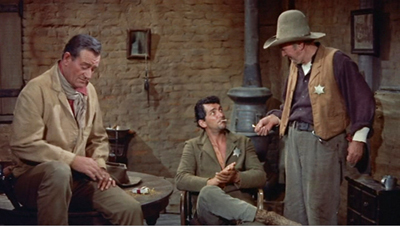
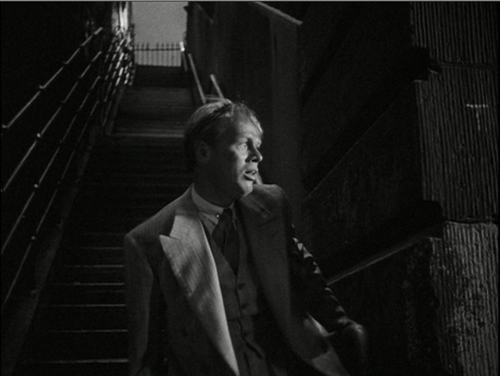
Exegetes have pointed out that the figures of light in the Sacred Text do not have the usual names. They are, emblematically, called Stumpy, Dude (aka Borachone), Colorado, Feathers. He Who Is Called Chance is named John T., but even the middle initial is turned into an epithet (“T for Trouble”).
Far from being an accident, the names in the Sacred Text are there to impel the Initate into deeper mysteries. Is, for instance, Stumpy The Elder called Stumpy because of his lameness—always a sign of grace in sacred texts? Because of his inertness (as stiff as a stump)? Or because a tree, even though harvested, retains its attachment to the earth by remaining rooted? Perhaps He Who Is Called Stumpy is “grounded,” as the current saying has it.
The Text is figural, both metonymic and metaphoric. Young Colorado is son of Rocky Ryan from Denver. He Who Is Called Wheeler is a man of wagons. She Who Is Called Feathers wears feathered clothes, but also has a teasing lightness of manner. He Who Is Called Dude constitutes a crux. Is he a “dude,” an Easterner who has come west, or is he a dude because he favors fancy outfits? (See “Raiment,” below.)
The central fact is that in this text, the mystery of naming opens on to the Mystery of Being. Everyone is named something, but many are not named by their name.
Raiment
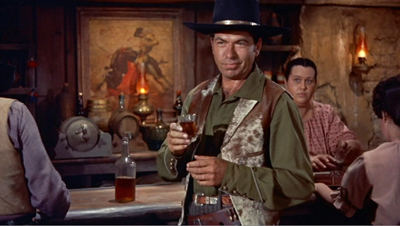
Once the devout Seeker has sensed the limitless depths of the The Words, the more inquisitive will turn to the images. In the opening scene of the Sacred Text, a largely wordless series of encounters in barrooms, a world is created before our eyes. It is a world of debasement, treachery, and sudden death. A contemporary text called Variety, secular but still enlightening, notes: “…gets off to one of the fastest slam-bang openings on record.”
Exegetes have long praised this eloquent passage. They note that a text so replete with Words benefits from an extended passage of muteness. Not silence, for the almost continuous music attributed to Dmitri Tiomkin provides its own wordless “commentary” on the action. This sordid, barbarous world will be redeemed; those who are left low on the saloon floor will rise three days afterward (note!) to triumph.
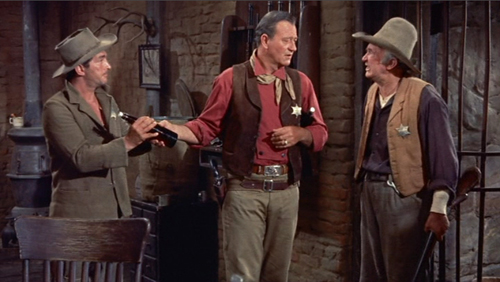
Serious study of the Text’s images drives the Adept to note the raiment in which the figures are clothed. The Nemesis Joe Burdette wears a bright cowhide vest, suggesting his animalistic anima. He Who Is Called Dude begins in dirty garments, earns the right to garb himself in splendor, but through weakness of soul he is once more soiled.
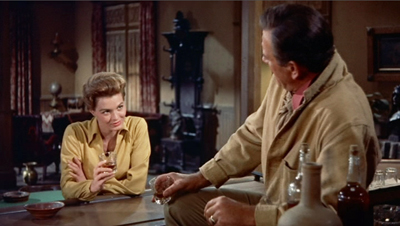
She Who Is Called Feathers manifests the most dazzling changes in raiment.
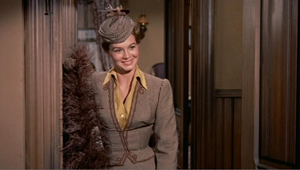
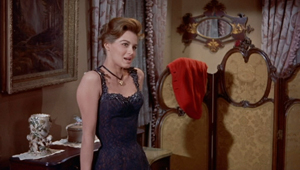
Hers receive commentary within the Text, while the garments of He Who Is Called Chance are noticed only by her.
Those things have big possibilities, but not for you.
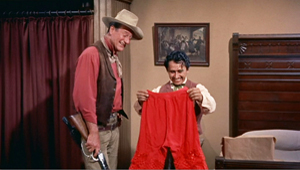
Hey, Sheriff, you forgot your pants.
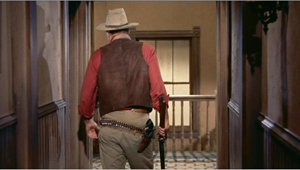
But these may be interpolations by later hands.
Disputed passages
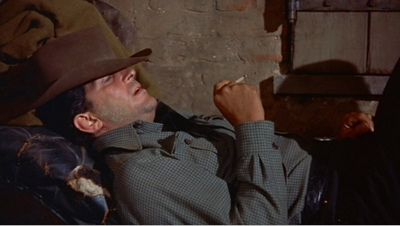
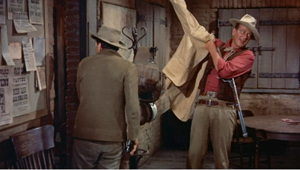
Like all Sacred Texts, this contains stretches that excite puzzled commentary. What, in the opening scene, is Wheeler supposed to “tell his men”? Why so many flying insects at night? Why is He Who Is Called Chance once, and only once, seen awkwardly grappling with his rifle, trying to hold it while he shrugs into his jacket?
There is the curious verbal slippage in the song sung by He Who Is Called Dude. He sings of “My three good companions—my rifle, pony, and me.” To the heathen mind, this is a flagrant error. You can have a rifle and a pony as a companion, but you can’t have you as your companion. Can you?
To doubt the Sacred Text at this point is to underestimate the subtlety of the Authors. Recall that the tale told by the song is a dream (“It’s time for a cowboy to dream“). As in other venerable texts (e.g., Bible, Ramayana), dreams are to be taken as warnings, prophecies, or hints as to the true meaning of the story. And so it proves here. We know that He Who Is Called Dude is a divided man: Borachone and pistolero, drunk and deputy. The singer, as we’ve seen, has an untamed side that bursts out into violence against nearly everyone, including his Savior, He Who Is Called Chance.
Hence the split identity of the rider in the song. He is a me, but he also has a me. And around the bend, waiting for both of them, is another divided figure, a woman called “my sweetheart darling.”
There are Exegetes who would see in this passage the source of another worthy text, Western Redundancy Playhouse Theatre, but exploring that would take us too far afield.
More obvious is the Text’s great cosmic sign: The sun rises and sets on the same horizon.
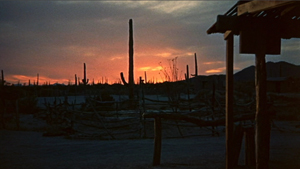
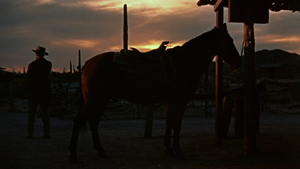
No further proof is needed of the miraculous nature of this narrative.
Heresies
I do not refer to callow efforts to dishonor the Text (e.g., “I think we need a few more scenes in the jail”). Instead, I mention simply the most important efforts by believers, often Adepts, to sow petty doubts. There is, for instance, the efforts to replace the canonical status of this Text by later, more derivative ones (El Dorado; Rio Lobo). Uneven and fragmentary, they have never achieved widespread recognition of Sacredness. Other heresies claim our text itself is derivative, and one offers the biggest challenge to the devout.
I refer of course to the Heresy of the Spittoon.
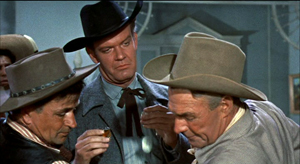
In the Genesis section already mentioned, Nemesis Burdette flips a coin into a spittoon, and He Who Is Called Dude, needing to buy drink, stoops to retrieve it from the rancid vessel.
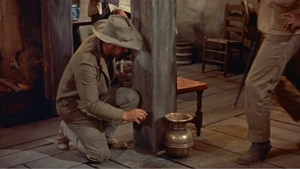
Only the intervention of He Who Is Called Chance saves He Who Is Called Dude from this act of degradation. This passage has a parallel later in the Text, when another nemesis must fish a coin out of a spittoon.
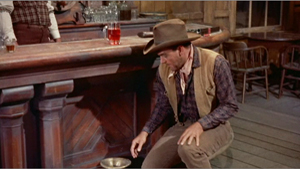
The reversal in power is also a step in the redemption of He Who Is Called Dude.
But Adepts have noticed that in Decision at Sundown, a text attributed to one Budd Boetticher and dated 1957 (the Sacred Text we have is dated 1959), a sheriff refuses to accept the money of the protagonist and drops the coins into a spittoon.
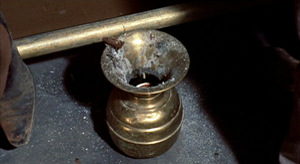
Consider another passage in another Boetticher-signed text of the era, Buchanan Rides Alone (confirmed to be from 1958). Here the protagonist, prosaically named Buchanan, disarms a young gunslinger and drops the boy’s bullets into a spittoon.
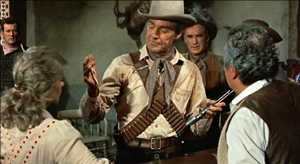
The vessel, offscreen below frame, announces its presence by the tinkling sound made by the falling rounds.
Heretics have hinted at plagiarism, especially in the light of a reference in another text of the period, Ride Lonesome (dated February 1959, two months before the appearance of our Sacred Text). Here a nemesis tells of a poster “gun-tacked to every tree and stump (!) between here and Rio Bravo.”
While undeniably puzzling, these correspondences do not point to plagiarism. There may have been an earlier, Ur-version of our Sacred text, that has simply not survived. In moments like these we must put our faith in the Authors.
Recurring formulae
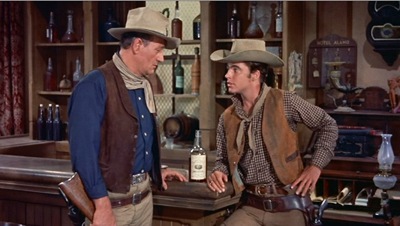
Finally, we must return to the Word. Seeker, Initiate, Adept, Exegete: All acknowledge the Text’s verbal echoes. As with Homer’s wine-dark sea and Vergil’s pious Aeneas, formulaic tags recur in our tale, but with more variation than in classic texts.
Our first business is business.
We have important business …. Me and my friend we make our business alone.
I’ll tell you what I’m a lot better at, Mr. Wheeler. That’s minding my own business.
I figure why is not my business./ You’ve got peculiar ways of choosing what is your business.
You think I’ll ever get to be sheriff?/ Not unless you mind your own business.
As if to signal to the devout the importance of every word, the Text provides its own meta-commentary. As a French exegete has said: “Discourse cleansing discourse, backchat ruling over chatter and chitchat.”
I’ll go outside so you can talk more freely.
I guess I talk too much.
He’ll keep talking till we get out of here.
Can’t you talk plainer than that?
Young Colorado says that Nemesis Nathan Burdett is “talking now” through the Deguelo tune./ I guess we made him talk after all.
Me, I just talk all the time./ You most certainly do./ You’ll get used to that. You’ll have to. Either that, or start talking to me.
Now I’m running out of breath. You talk if you want to.
Like all Sacred Texts, for all this talk of talk, this one knows that the ultimate truth lies beyond words.
Just stop talking. Just let it be.
Good advice.
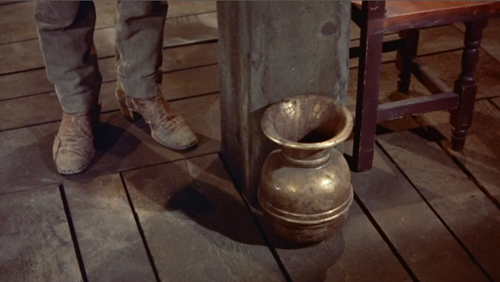
Before I followed the Way, the spittoon was a spittoon. As I began to learn the Way, the spittoon was more than a spittoon. When I had learned the way, the spittoon was once again a spittoon.
Addendum 15 April 2012: This humble guide to the Text has aroused further passion among Exegetes. Three have pressed even more fiercely the Heresy of the Spittoon, claiming that it derives from a much more ancient text than the Boetticher-attributed ones mentioned above.
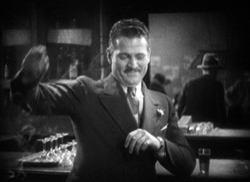
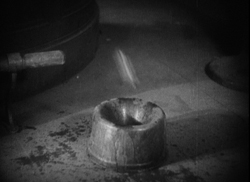
Antonio of the Red Palace writes:
Regarding the scene involving the spittoon, I think it’s a shout-out to another one from Sternberg’s Underworld. You know, that one involving an equally “Borachone” character (Rolls Royce Wensel) being humiliated by “Buck” Mulligan. Interestingly, the “hero” (in this case Bull Weed) stands for the weak one.
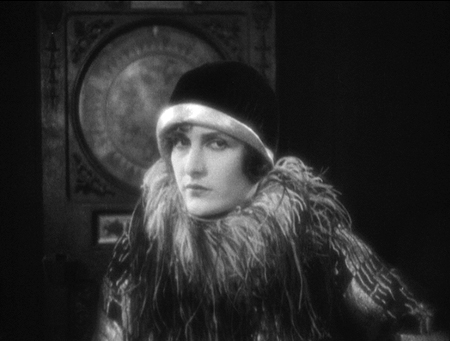
Even in both films, the female character is called Feathers. ¿ Coincidence?
The Exegete declares a heartening willingness to believe, as all Seekers must, that There are no coincidences. From David Cairns, Sifu of Shadowplay, Exegete Extraordinaire of many other texts, comes further observations:
The spittoon . . . derives first from Sternberg’s Underworld, which also has a leading lady called Feathers. We do know that Sternberg and Hawks were (unlikely) friends and unofficial collaborators. Hawks claims to have suggested Dietrich’s tuxedo in Morocco, which, given his interest in androgyny, may be true.
Interesting that the scene made it out West and stayed there — I guess because the spittoon just seems to naturally belong there. But Sternberg’s version, in which a man tries to humiliated a drunk by throwing money in a spittoon, is closest of all spittoon scenes to the one in Rio Bravo. It’s also so close to Sterberg’s typical concerns that it must surely have either been devised by him, or else by Hawks in a spirit of “I bet he’ll love this…”
Like Antonio of the Red Palace, Shadowplay Sifu displays admirable historical awareness and interpretive ingenuity. But there is still room for disputation about sources and the path of influence. Here is Lea Jacobs of the School of the Badger to open another avenue:
The earliest version of the coin in the spittoon that I know is Underworld. Charles Furthman, brother of Jules [scribe who co-penned Rio Bravo], worked on the adaptation [of Underworld]. So I have always assumed the bit was “in the family.”
It is a measure of the spiritual power of the Sacred Text that it so stirs the imagination of the devout. And in truth, this scrolling blog’s little guide should have pointed out the strongest evidence for the Spittoon heresy (as well as the philological question of “Feathers”). These Exegetes are hereby thanked for extending the already vast commentary on the Text. But let us remember that the earlier text in question is regarded by many Adepts as itself derivative.
In Underworld, the nemesis who flings a ten-dollar bill into the spittoon is called “Buck” Mulligan–a transparent trace of literary lineage. For what readers text do not recognize the reference?
Stately, plump Buck Mulligan came from the stairhead, bearing a bowl of lather on which a mirror and a razor lay crossed.
Let us not forget that this literary “Buck Mulligan” has the proper first name Malachi, usually translated as “God’s messenger.” This surely changes our understanding of the blowhard who mockingly offers the ten-dollar bill to Rolls Royce; for he starts Rolls Royce on his path toward sobriety and self-respect.
For such reasons, Ulysses is most fruitfully read as a gloss on Underworld.
Nonetheless, consultation with wiser heads than this chronicler’s yields a change in the Canon. Henceforth the Heresy of the Spittoon will be known as the Cuspidor Crux.
Addendum 21 April 2012: Another Adept, Simone Starace, has disclosed more evidence for the Cuspidor Crux. She points to a passage in the secondary writ, Joseph McBride, Hawks on Hawks (1982), p. 131:
JMB: There are several things in Rio Bravo that are similar to Underworld, which you and Furthman also helped write.
HH: I stole two things, the dollar in the spittoon and the girl’s name, Feathers.
Simone adds that on page 159, according to McBride’s filmography: “Hawks claimed to have contributed to the script of Underworld.” The palimpsest thickens.

Posted in Directors: Hawks, Film criticism | open printable version
| No Comments »
Monday | April 9, 2012

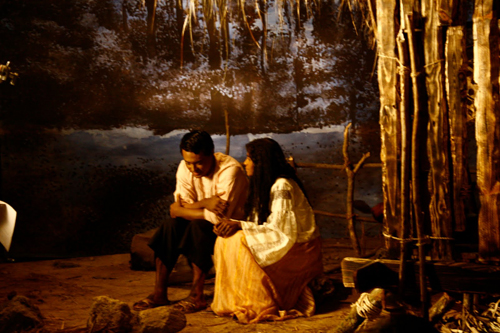
Independencia (Raya Martin, 2009); set photo by Alexis Tioseco. Our comment here.
DB here:
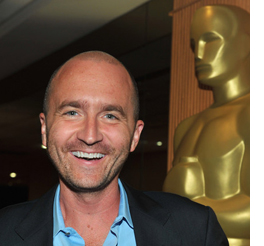
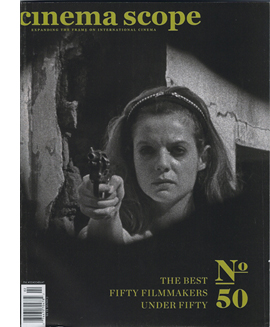
I received the newest Cinema Scope after we had posted our book roundup last week. Awkward timing, but I can still alert you to this splendid effort. In the tradition of Cahiers du cinema (every film magazine wants to be Cahiers), this enterprising Canadian journal has celebrated a benchmark issue with a compendium–issue 50 devoted to 50 filmmakers (all under 50).
It’s a gimmick, but a good one, and of ancient lineage. Cahiers and other French journals established an admirable tradition of obsessively gathering brief entries on filmmakers under a thematic rubric. (The organizing principle: alphabetical order.) In this contribution to the tradition, Mark Peranson, Andrew Tracy, and the rest of the Cinema Scope équipe have outdone themselves.
We get, of course, critics aplenty, and they offer short, sharp takes: Kent Jones on Maren Ade, Scott Foundas on Wes Anderson, Andrea Picard on Liu Jiayin, Shelly Kraicer on Pema Tseden, Chuck Stephens on Apichatpong Weerasethakul, and many more admirable matchups.
This sort of thumbnail catalogue works best when encapsulation is kept to the scale of American menu squibs, or even fortune-cookie apothegms. The phrases don’t have time to turn gently, so they careen. Tony Rayns on Jia Zhangke:
With a sensibility pitched at the exact mid-point between Robert Bresson and Arthur Freed….
Christoph Huber on Paul W. S. Anderson:
Brit-born Paul W. S. is the elder, least pretentious, and most consistently amusing Anderson of the current director trifecta: its termite artisan.
Michael Koresky on Kore-eda Hirokazu:
He’s at his best when there’s the least mess.
It’s not all praise, either. Adam Nayman contributes a vinegar-doused write-up of Paul Thomas Anderson, although he likes one cut in There Will Be Blood. Alex Ross Perry finds that Fincher’s latest work is uninspiring, but at least now “he can screw around all he wants.”
As if this weren’t enough, filmmakers (another Cahiers tradition) add their voices, and images, to the chorus. So there are Weerasethakul on Lucrecia Martel, Ben Rivers on Bertrand Bonello, James Benning on Sharon Lockhart, and Albert Serra on Zhao Liang, among others.
One purpose of such a Baedeker’s is to alert you to new work. I counted a dozen directors I hadn’t heard of, and another four or five whose films I hadn’t seen. But this kind of enterprise has long-range impact too, especially right now. Cinema Scope 50-50-50 is a bracing psychic antidote to the usual complaints about today’s empty, worthless cinema, and its inferiority to the dazzlement on view on HBO and AMC. For a recent example of this litany, see Wolcott, who yearns for the days of An Unmarried Woman. Projects like the Cinema Scope celebration lift your eyes to the horizon. You can start to believe in cinema’s future.
Are these directors marginal? Not really. The fretful, wayward margins can, when they hit critical mass, become a mighty phalanx. That’s what happened with auteurs in studio Hollywood, art-house movies in the 50s and 60s, new and young cinemas thereafter, etc. The future often lies on the periphery.
We get all this, along with the usual provocative columns by Cinema Scope regulars Peranson, Picard, Rosenbaum, Möller, and Stephens; a sort of storyboard for a new Benning project; Denis Côté musing on his Bestiaire; Hubler’s encyclopedic tribute to Sherlock Holmes movies; an interview with Hoberman (“The decline of the Voice has been going on longer than the death of cinephilia”), and much more. Even the ads are intriguing.
Sooner or later, you know you will obtain this. Why not now? A mere $5.95 Canadian, almost exactly the US price, at least today. This issue is so new that it apparently hasn’t been registered on the website yet, but go there anyway. You might as well subscribe.

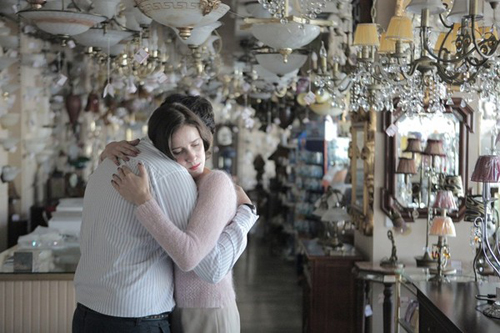
Alps (Yorgos Lanthimos, 2011).
Posted in Books, Film comments, Film criticism, People we like | open printable version
| No Comments »
Tuesday | April 3, 2012


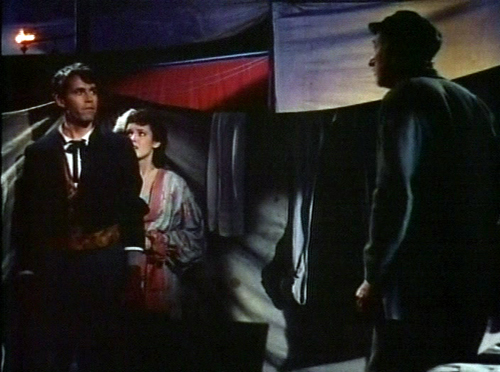
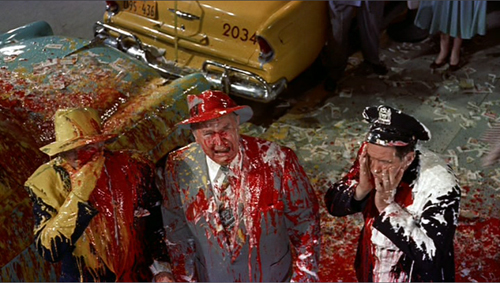
Artists and Models.
Blushing from Bryce Renninger’s generous article about us and the new edition of Film Art can’t keep us from offering another of our occasional entries devoted to new books we like. Get ready for lots of peekaboo links.
The rise of the Soviet Montage film movement of the 1920s and western countries’ knowledge of those films came about largely because of Germany. After pre-revolutionary film companies fled the Soviet Union, taking much of the country’s film equipment with
them, the re-equipment of studios with lighting equipment, cameras, and raw stock was made possible largely through imports from Germany. Once Eisenstein and other directors began making films, they were exported to Germany, where their theatrical success led to further circulation in France, the United Kingdom, the USA, and elsewhere.
There was a direct link between Soviet and German socialist film production and distribution that is too little-known today. In 1921, Willi Münzenberg forms the Internationalen Arbeiterhilfe (the IAH, known in Russia as Meschrabpom), based in Berlin. In 1924, the organization founded a film studio in Moscow, Rus. A year later, a sister company, Prometheus, was formed in Berlin. Both produced films, and they cooperated in distributing each other’s output.
Meschrabpom-Russ produced many of the familair Soviet classics: early on, Polikuschka and Aelita, and later the films of Pudovkin (including Mother and The End of St. Petersburg) and Boris Barnet (including Miss Mend and House on Trubnoya). Prometheus produced films highly influenced by the Soviet exports, both in terms of style and subject matter. These included Leo Mittler and Albrech V. Blum’s Jenseits der Strasse, Phil Jutzi’s Mutter Krausens Fahrt ins Glück, and, mostly famously, Bertolt Brecht and Ernst Ottwald’s Kuhle Wampe oder wem gehört die Welt.
Prometheus, not surprisingly, disappeared in 1933. Meschrabpom-Russ continued until 1936.
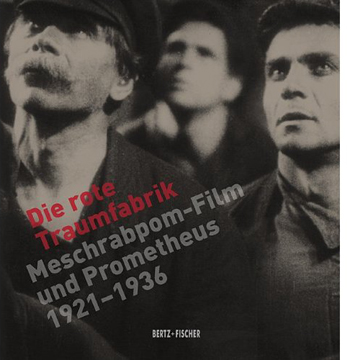
A retrospective at the Internationale Filmfestspiele in Berlin in 2012 has occasioned a comprehensive, beautifully designed catalogue, Die rote Traumfabrik: Meschrabpom-Film und Promethueus 1921-1936. With numerous expert essays and beautifully reproduced illustrations, both in color and black and white, of posters, production photos, film frames, and documents, this is the definitive publication on the subject. Even those who don’t read German will be able to use the extensive filmography and the biographical entries on the directors and other people involved in the making of the films. The illustrations make this the perfect combination of academic study and coffee-table art book. (KT)
Closer to home, our friends have been very busy. From Leger Grindon, a deeply knowledgeable specialist in American film, comes Knockout: The Boxer and Boxing in American Cinema. The prizefight movie isn’t usually discussed as a distinct genre, but after reading this comprehensive and subtle study, you’ll likely be convinced that it’s been remarkably important. While discussing movies as famous as Raging Bull and as little-known as Iron Man (no, not that one; this one comes from 1931), Leger also introduces you to the finer points of genre criticism. The way he traces basic plot structures, key iconography, and historical patterns of change is a model of how thinking in genre terms can illuminate individual films.
Then there’s Tashlinesque: The Hollywood Comedies of Frank Tashlin. Ethan de Seife goes beyond the usual recounting of peculiar, often lewd gag moments to treat Tashlin as not only a gifted director but a representative figure in 1940s-1950s American cinema. Ethan traces how Tashlin became a program-picture director who never acquired the status of auteur, at least in the eyes of the studio system. The book situates Tashlin in the context of the Hollywood industry, both the cartoon shops (Tashlin did animation work for both Disney and Warners, among others) and the live-action production units. There’s as well a fascinating chapter on Tashlin’s influence on directors as different as Joe Dante and Jean-Luc Godard, who coined the adjective “Tashlinesque.” A blend of critical analysis, cultural commentary, and industry history, Tashlinesque is surely the definitive book on this cheerfully dirty-minded moviemaker. Ethan maintains a lively blog here.
Not strictly about cinema, but a book that’s indispensible for film researchers, is James Cortada’s History Hunting: A Guide for Fellow Adventurers. A founding member of the Irvington Way Institute, Jim is at once an IT guru, a historian of computer technology, and a scholar of Spanish history, particularly of the Civil War. History Hunting, the fruit of forty years of spelunking in archives, museums, and the world at large, is an enjoyable handbook on doing historical research. It ranges from help with genealogy (case study: the colorful Cortadas, from Spain to the US) to suggestions about how to frame a doctoral thesis. Jim reminds us that the historian must turn into an archivist: the materials you collect are documents for future historians to use. You are, to use the new buzzword, a curator. Jim provides a welter of practical suggestions along with his own tales of the hunt. Jim devotes part of a chapter to Kristin and me, which just goes to show his impeccable taste in neighbors.
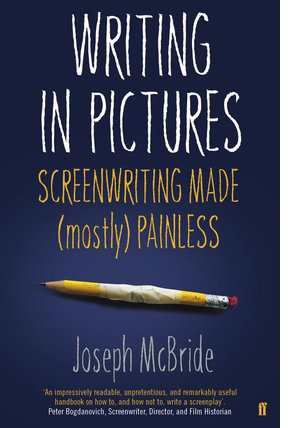
Joseph McBride is known as a film historian—his biographical books on Ford, Welles, and Spielberg are scrupulous and insightful—but he also teaches screenwriting. Why not? He wrote the cult classic Rock and Roll High School. Writing in Pictures: Screenwriting Made (Mostly) Painless is a unique manual in that it minimizes how-to instructions. Joe acknowledges the centrality of the three-act structure, but he takes a step back and asks what engages us about stories to begin with. His advice is clear-sighted. Don’t follow trends; don’t worry about “high-concept” ideas or “character arcs” or “plot points.” Closely study the masters of storytelling in fiction and drama and film, and absorb not formulas but a feeling for the flexibility of narrative technique.
One of the most original aspects of Writing in Pictures is Joe’s emphasis on adaptation. This is sensible because (a) a great many films are adapted from other sources (today, even comic books); (b) a professional screenwriter is often called upon to reshape an earlier script draft by another writer; and (c) adapting a preexisting source swiftly gets the novice screenwriter thinking about the relative strengths of verbal and visual storytelling. Joe takes us through the script-building process step by step, each time reworking London’s story “To Build a Fire.” Somewhat like the European “conservatory” approach to film education, McBride’s emphasis on organic interaction with classic traditions is something new, even radical, in the world of American screenplay education.
Then there’s Film and Risk, edited by the boundlessly prolific and enthusiastic Mette Hjort. Probably the most conceptually bold cinema book of the year, it assembles several scholars and filmmakers to assess how films and filmmakers deal with risk. The subject is of course broad. There’s risk in performance; risk in breaking stylistic boundaries; risk within film institutions (such as producing); risk in social and political contexts such as facing censorship; environmental risks, as in the costs that filmmaking exacts from the natural world; and even the risks of viewing movies—exposing yourself to horrifying or depressing stories and images. Film scholars like Hjort, Paisley Livingston, and Jinhee Choi mingle with film producers and industry observers to reflect on how cinema takes chances.
Our colleague J. J. Murphy has been researching and teaching the films of Andy Warhol for years, and today–literally, today–his monograph The Black Hole of the Camera: The Films of Andy Warhol comes out from the University of California Press. This is the most comprehensive, in-depth study of Warhol’s filmmaking that has ever been published, and of course a must-have for anyone interested in experimental film or the American art scene.
The ideas are fresh, especially the explorations of Warhol’s debt to psychodrama. At the same time, The Black Hole of the Camera clears away many misconceptions about Warhol (no, Sleep and Empire are not single-shot films) while also offering detailed information about and analysis of little-known stunners like Outer and Inner Space. There are several pages of color frames, which remind you that Warhol was as good at color as Tashlin was. JJ maintains a remarkable blog on independent cinema and is a leading figure in the Screenwriting Research Network.
Not a book, but a publication of great value: Three major researchers have collaborated on a cogent, nontechnical review of experimental investigations into film perception. All of the authors have had face time on this site. Dan Levin has executed breakthrough experiments on “change blindness”–how we miss discontinuities and anomalies in everyday life. (On another dimension, Dan’s film Filthy Theatre is coming up at our Wisconsin Film Festival.) James Cutting, a venerable figure in visual perception research, has ranged across many key areas in his consideration of cinema. He also wrote a wonderful book, available free here, on Impressionist painting. And Tim Smith, virtuoso eye-tracker, is author of one of our all-time most popular blog entries, “Watching you watch There Will Be Blood.”
With three top talents, you’d expect the collaborative paper to be a triumph of synthesis, and so it is. It supplies the best case I know for why we cinephiles should welcome psychologists who test the ways we watch movies. It should be required reading in every film theory course in the land. Access to the published paper requires a purchase or a library subscription, but you can read the preprint version here. Check in at Tim’s blog Continuity Boy for plenty of videos exploring his research (DB).
Finally, we’re sometimes asked why we don’t allow comments on our blog. The simple answer is that we’re not nearly as good at responding to comments as John Cleese is.
The cover of Joe McBride’s book pictured above is from the Faber & Faber edition, which makes a better still than the US edition from Vintage. Same good stuff inside, though.

Posted in Books, Film comments, Film genres, Film history, Film theory, Hollywood: Artistic traditions, National cinemas: Russia and USSR, People we like | open printable version
| No Comments »
Monday | March 26, 2012

DB here:
I had thought I was finished with my series on digital projection that started back in December. That was before a late-night trawl of the Internets brought the JEM Theatre to my attention. Sometimes reality has a taste for a dramatic story, and this was one I couldn’t resist.
So I went to Harmony.
All in the families

A birthday party at the JEM Theatre.
For decades exhibiting movies has been a family business. Many regional chains were founded by fathers and brothers and staffed by sons, daughters, and in-laws. The Midwest’s Marcus chain of 700 screens originated in 1935 with grandfather Ben and is run by son Stephen and grandson Gregory. More modestly, Smitty’s Cinema, a nine-screen movies-and-eats circuit in Maine and New Hampshire, was the brainchild of three brothers.
The smaller the venue, the more likely you’ll find a family in charge. The Goetz Theatre of Monroe, Wisconsin, which I profiled earlier, has been in the family from the start. The single-screen Cozy in Wadena, Minnesota, has been run by the Quincers since 1923, with the founder’s great-grandson in charge today. Dirk and Jeri Reinauer have the Sunset Theatre in Connell, Washington. Tom and Barbara Budjanek, who bought Pennsylvania’s Ambridge Family theatre in 1967, are still running it in 2012.
Families pass theatres to each other. The venerable Roxy in Forsyth, Montana, was bought by a couple in 1967. They sold it to their projectionists, one of whom kept it going with his wife. (The theatre went digital in 2010, just in time for its eightieth birthday.) From 1947 to 1959 the Wayne Theatre in Bicknell, Utah, was operated by a husband and wife. Another couple bought it and ran it until 1994, when they sold it to a third husband and wife. A fourth family acquired it in 2008.
The record for husbands and wives running a single-screener might be held by the little town of Harmony, Minnesota. The JEM Theatre on the main street, closed in 1947, was reopened by Bob and Hazel Johnson in 1961. They ran it for twenty-five years. It passed through the hands of five more couples before Michelle and Paul Haugerud acquired it in 2002.
Paul and Michelle met in San Francisco, where Michelle was working for Bear Stearns and Paul had served in the Navy. In 1994 they moved to Harmony to be near Paul’s family. There they raised six children while Paul started a paint and drywall business and Michelle began a career in Web design. “When we bought the theatre,” Paul explained, “we knew it was gonna make no money. We knew it was gonna be basically like doing community service.”
To an extent that people living in cities and suburbs may not appreciate, the JEM has held a central place in the life of the town. By 2011, digital conversion threatened to end that.
Harmony, not far from Prosper

With a population of about a thousand, Harmony sits in farm country close to the Iowa border. As Prairie Home Companion reminds us every week, people of Norwegian descent are found all over Minnesota. What you may not know is that certain areas are also home to Amish communities. Waves of migration made Harmony a center of Minnesota’s Amish culture. Local businesses serve the five hundred households in the town, and tourism brings in some income too. One of the big attractions is Niagara cave, containing fossils pre-dating the dinosaurs. There’s also a major biking trail and a fall foliage tour.
The JEM was named, supposedly, for the first letter in the names of the original owner’s three children (but see the PS below). It helped knit the town together, and under the Haugeruds it became a unique institution.
They made a solid team, with Paul’s expertise in carpentry and engine repair matched by Michelle’s money-management skills. Paul, with no previous theatre experience, learned to thread up the platter projector. “The first few weeks, I would literally sit there with sweat rolling down my face as I pushed the start button. I’d be so nervous I did something wrong.” Paul introduced screenings with announcements and jokes. The Haugeruds knew most of their patrons, but at every screening there were fresh faces from nearby towns in Minnesota, Iowa, and Wisconsin.
The JEM screened only on weekends, once each day at 7:30. Paul’s and Michelle’s day jobs made any other schedule impossible. During football season, Fridays brought in few teenagers, but Saturdays were better and Sundays were quite good. Overall, the 200-seat house averaged around 55 each night. On snowy nights, a few souls still braved the Minnesota winter to come see a movie.
The Haugeruds ran the JEM as a family business. There was no paid staff. The Haugerud kids sold tickets and snacks and helped with cleanup. Friends and volunteers came out as well. Michelle made the pre-show video slides of ads for local businesses. Even with low overhead, the theatre barely broke even. All tickets were $3. “We’ve always kept prices low,” Michelle explained, “so families that are financially hardshipped can still get their kids out of the house.”
Most of the JEM’s programs were subruns—movies that had opened nationally two or three weeks before. To avoid courier service costs, Michelle and Paul would make midnight drives to pick up prints from other towns. “I’d call and they’d just be breaking down their print from their last show on Thursday,” she says. “I’d say, ‘I’ll be there in fifteen minutes,’ and at midnight I’d go get the print for Paul to make up on Friday.”
Snack concessions are the core of every theatre’s income, but even here Paul and Michelle offered deals. They priced their candy at a dollar and a big tub of popcorn at four bucks. Soda was sold in plastic bottles, to allow for recycling and to keep costs down. Instead of getting concession items from theatre suppliers, Michelle bought them in bulk at Sam’s Club.
The JEM popcorn developed a following. High schoolers came to pop and bag it for football games. Paul and Michelle encouraged people to bring their own buckets to be filled with corn at a fixed price; some people showed up with shopping bags. The Amish didn’t come to the films, of course, but on some days you could see a horse and carriage lingering outside while the driver was buying a supply of popcorn.
The Haugeruds were generous with free passes as well. Over the years, they have donated hundreds of free passes to help local organizations raise money. At other times, Michelle realized, passes are a good form of marketing. “Give out one, and three more people will come along to pay.”
The JEM wasn’t just for movies. Youth groups held meetings there. Many local kids had their birthday parties there, accompanied by a movie or a videogame. The Haugerud daughters had slumber parties in the auditorium; after a movie, they settled down, if that’s the right word for a slumber party, in sleeping bags down front and in the aisles.
Many in Harmony believed that the JEM brought business to town. Julie Barrett, owner of the Village Square Restaurant across the street (and famous for her daily pies) said, “When people go to the movie, they stop at the Kwik Trip, our hardware store is open until 6:30, so you know they might try to kill two birds with one stone when they come to town.”
Over the situation hovered the fate facing every small town—the hollowing out of the center by the big-box stores down the road. Pull off any interstate highway, and you’ll see that the main streets of small towns have turned into empty storefronts, municipal offices, or struggling boutiques. When the JEM faced the need to go digital, Paul was concerned. “If we take one more thing away it’s going to hurt the community. I’m scared to death that main street is going to look like Harmony in the 1980’s when I was growing up. It was pretty bare.”
Single-screeners

Tonja Lawler selling tickets, Michelle Haugerud selling concessions.
The major distributors and the National Association of Theatre Owners now seem to take for granted that thousands of screens will close over the next few years. Some will fail to convert; others will struggle to pay for the conversion but still fold up. What are the likeliest victims? Those at the bottom of the food chain, the single screens and the “miniplexes” holding between two and seven screens.
These two categories account for over half of all exhibition sites in the US. But they amount to only a small slice of the total number of screens, which is what matters. And the number of small houses is shrinking. During the bankruptcy convulsions of the 1999-2001 period, circuits shed hundreds of screens. Since 2007, the total number of U. S. screens has remained fairly constant, but multiplex and megaplex installations have swollen by 2000 screens. Smaller facilities have lost about the same number—by going out of business.
Hollywood, people like to say, doesn’t want to leave money on the table. But more and more the long tail is a waste of resources. Why bother to prepare and ship a DCP to a theatre that yields a box-office take of less than $300 per day? Many decision-makers among the major distributors would be just as happy to let people in small towns wait a couple of months and catch the film on VOD or disc (rented from a gas station, since the video stores are gone too). As long as the megaplexes publicize the must-see movies, people will know what to buy or rent or stream. If you live in the countryside and you really feel the urge to catch the latest hit, get in your car or pickup and drive an hour to a ‘plex. No vehicle? Too young to drive? Wait for the video.
While digital projection allowed the major distributors to consolidate their power, it also offered a way to streamline and downsize exhibition. The 1600 American single-screen venues are especially vulnerable. For the industry, it seems, any part of film culture that preserves some history or takes root in a community is simply a nuisance. Michelle Haugerud puts it simply. “They don’t care if we go out of business.”
A digital jug
In late spring of 2011 Paul and Michelle decided to try to go digital. A new projection system and sound processor would cost $75,000. “We’ve tried to run it by ourselves and keep it independently owned, but it’s gotten to the point now where we’re looking for some help,” Paul said in July. “It was a difficult decision to ask for the community’s help,” Michelle wrote on her website. “We never wanted to ask for support, but we knew the public deserved to know why we may have to go out of business.”
They began a fundraising drive. A young patron named Kirsten Mock decorated an old red juice jug for donations and put it on the candy counter. Paul and Michelle set up a designated savings account with a local lawyer’s name attached to make sure people understood that any donations would go only to the projector. A list was kept of all who put their names on donations, and the money would be refunded if the target sum weren’t reached.
The problem was that the JEM, privately owned and operated, wasn’t a nonprofit. Donations were not tax-deductible, and local government agencies couldn’t normally supply grants or other aid. During 4 July celebrations, however, a “Harmony Goes Hollywood” event featured a room in the Historical Society set up with an old projector and theatre seats, with clippings and photos showing the JEM over the years.
A local woman tipped Twin Cities media to the campaign. It was good timing: The US press was starting to notice the nationwide digital conversion. News outlets and TV stations covered the JEM’s crisis. Minnesota Public Radio picked up the story.
By fall, when the campaign had raised about $7200 locally, Paul and Michelle found a nearly new projector for $55,000. They managed to borrow the $48,000 they needed from a local bank. By shouldering the loan themselves, they showed the public that they were committed, and this gesture boosted donations.
As a result, on 11 November, the JEM screened its first movie on the Digital Cinema Package format, Dolphin Tale. On that weekend Paul thanked Kirsten for kicking off the fundraising and gave her a lifetime pass to the JEM. For the older crowd there was Football Monday, when Paul and Michelle projected a Vikings-Packers game. They couldn’t charge admission, but they sold tickets for drawings of prizes donated by local businesses.
Even though they had the equipment, Paul and Michelle still needed to pay for it. Later in November, the Trust for a Better Harmony stepped in to help. Enabled by a generous gift from Ms. Gladys Evenrud, the Trust and a Minnesota agency for community development arranged for a flexible loan package. As a result, the JEM now needed only $28,000, to be paid from community donation. The loan sparked still more offerings to the projection bank account.
New decisions

Paul Haugerud, son Peter (in overalls), and local boys tour the JEM booth.
On 13 January of this year, Paul died.
Commander of the local American Legion, he was cremated with military honors. He left behind Michelle, his six children, his parents, four brothers, and two grandchildren. The town grieved. “There’s nothing he wouldn’t do to help someone else,” a friend said.
Michelle remembers weeks going by in a blur. Friends brought over way too much food. “I had to freeze a lot of it.” She decided she simply had to move forward. She had a full-time job and had Peter, Julia, and Sierra at home, but she would keep running the JEM.
In February, a fundraiser was held at Wheelers Bar & Grill. The event had been planned before Paul’s death, but now it gained a new urgency and poignancy. Wheelers is named for its big roller rink, where Paul had helped out often. Across the day Wheelers held a silent auction and some bean-bag and darts tournaments. Those, along with food, drink, and music, raised an astonishing $16,000. That, plus the balance in the digital account, yielded enough to pay off the bank note for the projector. There have been more fundraising events, including a pancake breakfast. Michelle will soon pay the rest of the money owed. Any funds left over will be used for upgrades. Michelle is considering 3D conversion in a year or two.
Saturday night at the movies

Things have happened so quickly that Michelle hasn’t had time to thank everyone fully on her website, but she adds in a note to me:
It is so overwhelming to think of how the entire community and beyond has come together to make this all happen. I know that even though I am now the owner/ operator of the JEM, this theatre will be here for generations to come. I have had so many thanking me for staying in business. I know this is part due to the conversion and part due to Paul’s passing. I am very grateful for Paul’s family and my friends for being there helping me through all this.
Last Saturday, The Hunger Games drew a robust crowd, mostly groups of boys, groups of girls, and families, with a few elders sprinkled in. Nearly everybody bought concessions. Many carried in buckets for popcorn. The ticket booth was decorated with Easter rabbits and a Darth Vader helmet.
Upstairs, I saw a little room off the projection booth with a porthole. It was Michelle’s and Paul’s “private screening room,” she explained. They would watch the show from an old car seat there.
On the sidewalk outside, Girl Scouts were selling cookies. In the tiny lobby, dozens of construction-paper stars were pinned up, each bearing the name of someone who donated money. Above the booth was hung a framed lobby card for It’s a Wonderful Life.
Thanks to Michelle Haugerud for all her cooperation and enthusiasm. Her informative JEM website starts here. The page devoted to the digital upgrade traces the fundraising process and records her gratitude to the community. , On the same page, scroll down to see a video of Paul running the last 35mm show. Michelle supplied the photo of Paul and Peter above. Many of my quotations come from news stories that are linked on the JEM site.
Statistics on the number of theatres and screens in the US come from the annual reports of the Motion Picture Association of America and from The NATO Encyclopedia of Exhibition. Patrick Corcoran of NATO kindly supplied me with further information.
During my time in Harmony, I couldn’t get access to much material about the JEM in the old days. According to The Film Daily Year Book, the original JEM Theatre (sometimes called the Gem) opened in the mid-1930s. It burned down in 1940. The building next door was renovated as the New JEM, which opened in September of that year. A plain-spoken house of 325 seats, it had fluorescent lighting, satin curtains, three layers of acoustic tile, and a big furnace for the cold months. Its estimated cost was $18,000. For the premiere, a four-page color brochure was printed and sent to 3000 homes in the area. The publication was “made possible thru the whole-hearted cooperation of the businessmen of Harmony who fully realize the value and convenience of this modern, good-looking theatre.” This information comes from “Harmony, Minnesota, Salutes New Jem Theatre, S. E. Minnesota’s Finest Showplace!” The Harmony News, flyer dated September 1940.
Three years later the JEM closed and became a bowling alley. It sat vacant from 1947 to 1961, when Bob and Hazel Johnson reopened it. For a fuller chronology, go to Michelle’s page on JEM history.

Michelle Haugerud and daughter Julia, 24 March 2012.
PS 1 April 2012 Marilyn Bratager writes with this correction about the source of the JEM’s name.
Relatives of mine were the original owners: Joseph Milford Rostvold and his wife, Emma. The J was for Joseph Sr. and Jr., the E for Emma and their daughter Elizabeth, and the M for the senior Joseph’s middle name, Milford, which was the name he was known by. There was a third child, Richard, but they didn’t use his initial as they didn’t want the theatre to be called JERM. 🙂
Thanks to Marilyn for the information!
Posted in Digital cinema, Hollywood: The business, Movie theatres, PANDORA'S DIGITAL BOX: The Blog Series, People we like | open printable version
| No Comments »

|