Monday | March 11, 2013
From Lost & Found Film Club.
DB back:
While I was semi-snowbound in Evanston, IL, messages kept rolling in. Many of them were responding to my account of surrendering my 16mm movies and gear. That post’s whiff of nostalgia was caught by Gary Meyer, co-director of the Telluride Film Festival.
Don’t get me started on 16mm memories. I started showing movies in 8mm at about ten years old and by thirteen I had two for changeovers on silent classics rented from Cooper Films in Chicago. For about $2 I got a full feature and short including postage. Using my parents’ record collection I could score the films. . . .
Graduated to 16mm in high school when a local church and the library each offered use of their projectors and I started collecting prints seriously. In college I got a job in the media center showing films, cleaning prints and projectors. When the department decided to buy Bell & Howell Auto-Shreds, they sold off the old projectors for $50. I knew each machine intimately and selected the quietest, gentlest RCA 400 which I still have in a booth in my basement. One of my favorite projectors.
With 16mm projectors I have shown movies on garage doors from my apartment, in a barn, an orchard or two, and most famously on clouds, which resulted in the police department getting many phone calls about aliens.
Gary reports that his former venue, the Balboa Theatre, has given its theatrical Eiki projector to the San Francisco State University film department, but it can be borrowed back if ever needed. A more acute sense of the passing of an era was reported by program curator and Czech arts consultant Irena Kovarova:
One of the sad moments in my film history was being invited to the Czech Embassy in Washington, DC to visit a room of 16mm film piles. I was asked to pick and choose which ones should be saved and which would be chucked away (the majority). It was a collection of films that the Embassy inherited from the Communist-era offices when the staff was shipped films for their entertainment (Czech popular comedies) and of course tons of “travel” and “propaganda” stuff. It was impossible to know what was really there and a lot was mediocre, but still such a sad thing that no one could really dig in and explore.
Secrets of the Incas, and non-Incas
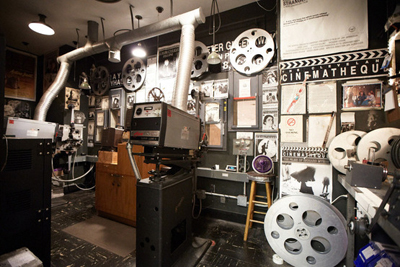
Projection booth, Cleveland Cinematheque.
But there was good news too. In the course of that entry, I said that 16 was “nearly dead” as an exhibition format. Trust this blog’s alert readers to give a more upbeat emphasis and offer some weighty counterexamples. Don’t hesitate to use the hyperlinks!
I was confirmed in my belief that archives will keep the format going. I hear from our old friend Antti Alanen of the National Audiovisual Archive of Finland, that 16 flourishes in Helsinki.
We still keep screening 16mm regularly at Cinema Orion, and for the moment print access is still good. We recently showed three programs of Stan Brakhage movies (from Canyon Cinema) and one programme of Rose Lowder movies (from Light Cone of Paris), all in the original format of 16mm, all prints and colours perfect.
I haven’t seen Brakhage on DVD, but those who have remarked that it is not the same thing. There is something about the special sensuality of 16mm which is essential to the Stan Brakhage experience. All of those films fill up the senses.
Besides Canyon Cinema and Light Cone, LUX in London still seems to be well-stocked with good 16mm prints in commercial distribution.
Bracing news. Antti mentions as well that he used to be able to access 16mm films made for the Finnish Broadcasting Corporation, but now the agency has realized that the prints are irreplaceable and provide digibeta copies instead. The loss for showing is a gain for preservation.
I indicated as well that colleges, universities, and museums will probably maintain 16mm prints and showings. My correspondents have confirmed it, and offer some ripe local detail. Tracy Stephenson of the Museum of Fine Arts, Houston, tells me that they have shown films since the 1930s and may be the only venue in Houston that still screens 16. They have a program of jazz shorts coming up in June.
Here’s John Ewing of Cleveland:
I still show 16mm on occasion (and two-projector 16mm at that) at both of my venues: the Cleveland Cinematheque and the Cleveland Museum of Art. In fact, I just ran the 16mm program from the 50th Ann arbor Film Festival tour last Thursday night at the Cinematheque. Last time I showed 16 at the art museum was in December when we screened an IB Tech print of Secret of the Incas, from the Academy Film Archive.
From the Oklahoma City Museum of Art, Brian Hearn writes:
We are pretty serious about 16mm and maintain a modest collection of about 500 prints, ranging from Lumiere Brothers shorts to studio features to avant-garde to educational films to 70s exploitation trailers. As the film medium dematerializes it makes me appreciate our collection even more, vinegar and pink fading prints included!
Calling a collection of 500 titles modest makes me grin (in envy). On the university side, Jon Vickers supplies other breathtaking information:
Indiana University Cinema programs from the University’s 16mm collection on a regular basis, with 16mm screenings at least once each month. In the IU Libraries Film Archives, there are over 80,000 items, the majority being 16mm. Within that collection is Lilly Library’s David Bradley Collection, spanning the history of cinema in the US and Europe, including classic, obscure, and some unique titles. We dedicate a series each semester to the holdings within the Bradley Collection (programmed by Film and Media Studies grad students), as well as program from the educational/non-theatrical collections and holdings.
We can’t imagine a day when we will stop screening 16mm.
With that treasure house, I can see why! Pablo Kjolseth of the University of Colorado at Boulder also defends the format resolutely. Pablo has written one of the most fiery and persuasive polemics on digital cinema. Not only does his program have an extensive library, but they are still actively collecting in 16. Moreover, as home to the annual Brakhage Center for Media Arts symposium on experimental film (coming up next week), Boulder’s campus relies constantly on 16.
Hipsters, nostalgics, and toddlers
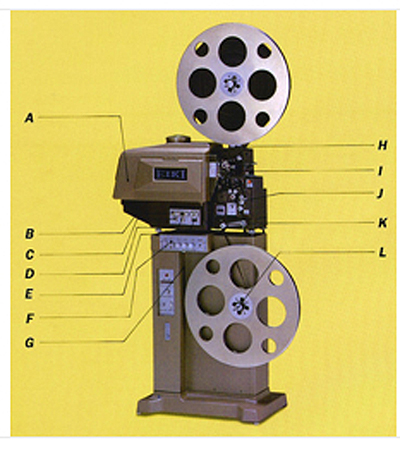
Eiki EX-9100 Professional 16mm Sound Optical/Magnetic projector with 2000-watt lamp. Currently available on eBay for $8,500.
Perhaps the most cheering news comes from those enterprising programmers of films for public venues, both for-profit and not-. Barak Epstein of the Texas Theater uses Kodak Pageants (of my fond memory) with manual changeovers and a manual audio fader. Pittsburgh Filmmmakers, writes Gary Kaboly, uses its Kinoton and Eiki machines every couple of months. He adds:
Throwing around the idea of a “classic 16mm experimental” series in the fall. Young Hipsters see attending a 16mm show as an “event.” Old Hipsters always describe what an Art House was “back in the day.”
The Cinefamily venue of LA has established itself as home to what the local paper called “pathologically idiosyncratic programming,” and 16 adds sharp spice to the mix. Here’s Hadrian Belove, the Head Programmer, on his personal quest and the formation of the Lost & Found Film Club:
I’m definitely of an age that would be post-16mm collecting, but still got hooked. One of the great appeals of 16mm for me is it feels like the final frontier for discovering true rarities. . . . It’s kind of the ultimate format for a “digger.” Finding Christian experimental films, industrial films, student films, and copies of TV movies, episodes, and even theatrical features that simply never made it to any form of video is de rigueur.
Nothing gives me more pleasure as an explorer than trolling eBay for 16mm.
I began showing things I would buy after hours to the staff here at Cinefamily, and hadn’t even considered it as a public show. Over time, some of the “kids” on the staff started buying their own 16mm ephemera, and finally proposed taking our private show public. I thought what the hell, cost is low, and we were doing it anyway. I gave them a terrible time slot I wasn’t using (10:30 on a Wednesday).
They launched this:
http://vimeo.com/58685558
https://www.facebook.com/LostFoundFilmClub
Anyway, the first show had 100 people, even at 10:30 on a Wed night. Maybe it’s those grilled cheese sandwiches!
Finally, I had noted that FOOFs (Fans of Old Films) had a noble tradition of gathering in annual conventions. Jessica Rosner, film scout extraordinaire, writes of screenings at the upcoming Syracuse Cinefest: “The majority of films will STILL be in 16mm and they will be films that are rarely available to be seen any other way.”
A further note from Pablo Kjolseth brings things back to Gary Meyer’s childhood and the FOOF in us all. Pablo hosts summer screenings in his back yard.
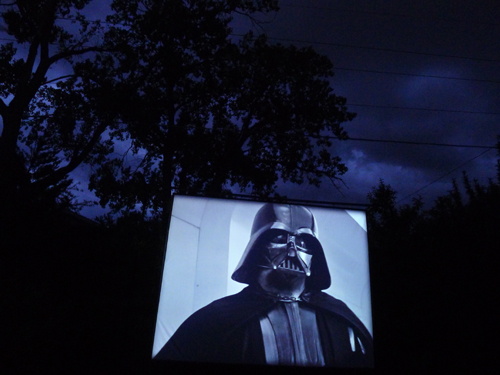
My Eiki Xenon projector shoots through a guest-room window to the screen in the backyard – transforming the guest room into a “projection booth” of sorts. The next [picture] is a nice ominous shot of Darth under stormy skies. . . . Although I’ve played around with some digital screenings, everyone prefers the 16mm shows. And this even though I don’t do reel-changes or employ a take-up tower – thus having small intermissions between each reel change. These intermissions are quite popular, as it allows folks time to refill their drinks, go to the bathroom, and comment on what they’ve seen so far.
As many as 60 people might show up for any screening. As the children in the neighborhood are always entranced by the projector, I try to make sure to have a couple family-friendly screenings every summer. My neighbors are great: they’ve even tolerated backyard screenings of such titles as DAWN OF THE DEAD and THE TEXAS CHAIN SAW MASSACRE – admittedly poor choices, given that in the summer heat most people sleep with their windows open and late at night they might not appreciate all the screaming and, well, chainsaws. But, so far, no complaints!
None from my end, either. Is it just me, or does Darth look more menacing here than in any other setting?
After reading these communiqués, two thoughts. First, a great many programmers are working very hard to track down and screen unusual items for their audiences. These folks and their peers are committed to exploring cinema along routes that bypass the multiplex. Who wouldn’t rather watch Secret of the Incas than, say, The Last Exorcism Part II?
My second thought comes with a pang. Was I wise to clear out my 16 collection? Our department and other collectors benefit, but still… A basement will dry out, but films that are gone are gone.
Thanks to all who wrote me, and to the Art House Convergence list serve for its stimulating conversations.
Posted in Art cinema, Experimental film, Film archives, Film history, Movie theatres |  open printable version
| No Comments » open printable version
| No Comments »
Monday | March 4, 2013
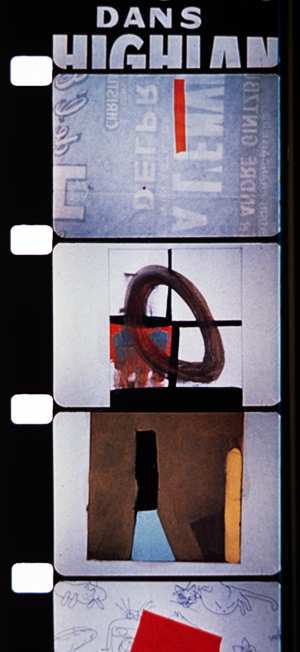 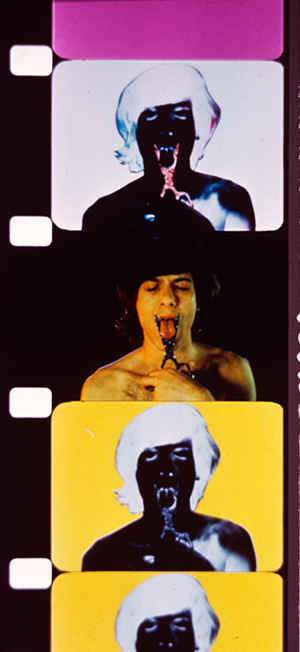
REcreation (Robert Breer, 1956); T.O.U.C.H.I.N.G (Paul Sharits, 1969).
DB here:
Snows and thaws and refreezing, amplified by a torrential rain, gave water a new path into our basement. We’ve spent about two weeks emptying bookshelves, drying them out, and shifting books to other places. No volumes were damaged, but we had to make space in the dry areas for the migrant titles.
That meant facing up to the problem of 16mm.
The solution was drastic.
Narrow-gauge movies
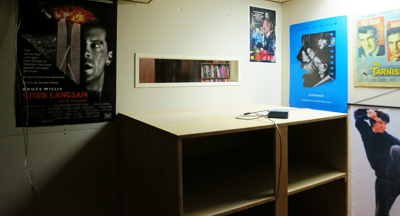
My film collecting started with 8mm. Not super-8; that was invented later. (Imagine how old I am.) I made my own movies in 8, but I also bought, from the venerable Blackhawk Films of Davenport, Iowa, copies of films in that format. Most memorable was the Odessa Steps reel from Battleship Potemkin, which I projected often on my bedroom wall.
Not until I went to college and joined a film club did I lay my hands on 16mm. I suppose if you start out handling 35mm, 16 looks skinny and 8 looks like a toy. But moving from 8 to 16, I could see only improvement. You could, with the sharp eyes of the teenage geek, actually see the image on the strip. I projected many films on our JAN surplus projectors, and one weekend I hauled a print of Citizen Kane to my apartment to watch several times. Do I need to add that all this was in the 1960s, long before films became available on videotape?
Arriving in Madison in 1973, Kristin and I bought a Kodak Pageant, the 16mm workhorse. Not as good as a Bell & Howell, most aficionados would tell you, but fairly cheap and easy to handle. When we moved from apartment to apartment, the Pageant went with us.
In 1977 we bought a house, and I set up a jerry-rigged projection room in the unfinished basement. In our second house, where we still live, I was able to set up something more permanent. Now there were two projectors encased in a booth and mounted on a platform.
We spent many hours watching movies in that currently soggy basement, with its burgundy carpet and dark wood paneling. Although the room lacked the comforts of what we think of as a home theatre, we sometimes screened things for big groups, either a party or once in a while students in a seminar.
In both venues, we previewed movies we were showing in courses and revisited some of our growing collection: The Shop Around the Corner, High and Low, True Stories (must blog about that some time), You Only Live Once, and so on. I’ve already expounded on the key role of His Girl Friday in our mini-cinémathèque.
By then Kristin and I had also started working with 35mm prints in archives and with 35mm trailers we scavenged to make slides for lectures. For a brief while we even had 35mm in our screening space, but with only one projector, shows stretched too long. Although home video had taken off, Betavision, VHS, and even laserdiscs couldn’t compare to a good 16 copy. We continued to collect and show on film, as did our department.
In the last decade, improvements in digital projection, along with the arrival of Blu-ray, led to the decline of 16 in our local media ecosystem. Our department still shows a lot of 35, but 16 seems mostly the province of our experimental and documentary courses. As for us, we hadn’t screened 16 at home for some years. Then came the February leak, and we had to face the problem.
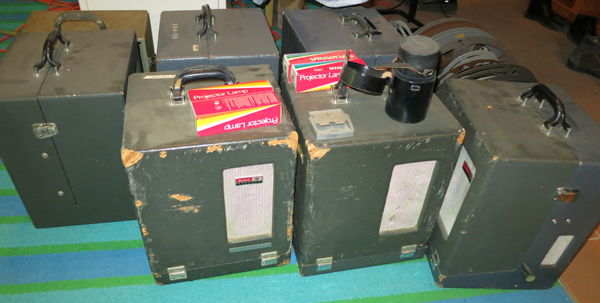
We’d already given many of our 16mm titles to the department, keeping our most fond treasures at home, thinking we’d watch them some day. Now we needed the space that those cans and cases occupied. Anyhow, it was probably time to let go. So we decided to surrender the features, the shorts, the cartoons, the splicers and the rewinds and the six Pageants—everything.
Our house is a museum of defunct technology. Just recently I surrendered my lovely Teac reel-to-reel tape recorder. Packed away are hundreds of Beta and VHS tapes. On groaning shelves sit hundreds of laserdiscs, mostly Asian. Yet under a roof that houses no fewer than six laserdisc players, there is no trace of the predominant nontheatrical film format of the twentieth century.
FOOFs
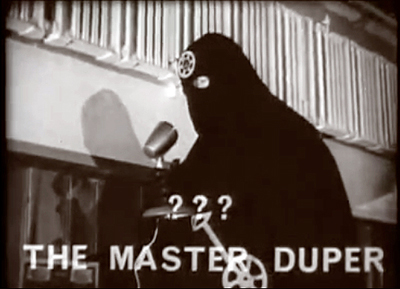
Captain Celluloid vs. the Film Pirates (1966).
Nowadays it’s easy to own a “film”—or rather a disc or file or stream of pixels fed to your display. (Though I wonder what it means to “own” something sitting on the Cloud in your virtual locker.) Back in the day, joining the ranks of 16mm collectors meant a real commitment. You needed to buy gear, you needed to clean and inspect the films, and you needed to learn a little projector maintenance. You probably subscribed to The Big Reel and Classic Film Collector, tabloids that ran ads selling or swapping prints and equipment. And you usually went to film collectors’ conventions, jamborees of selling, trading, and movie watching. The three biggest events, Cinecon (Los Angeles), Cinefest (Syracuse), and Cinevent (Columbus, Ohio), brought together the overwhelmingly male tribe of FOOFs: Fans of Old Films.
FOOF collectors had good hunting in those days. There were plenty of 16mm prints floating around, but quality varied. The best were those cast off from legit distributors. Made from internegatives drawn from 35mm positives, they usually had good tonal values. At the other end of the scale were the dupes, copies pulled from 16mm distribution prints. These ranged from acceptable to awful; but if you wanted a rarity, you might have to spring for a dupe.
In the middle zone were TV prints, probably the majority of copies in circulation. When studios licensed their pre-1948 libraries to television, go-between companies like C & C put together packages of prints to be sold to local stations around America. Small stations in the hinterlands harbored scores of 16mm copies, to be trimmed, filled out with commercials, and broadcast outside prime time, and sometimes within it as “Million Dollar Movie” or whatever. It’s still not fully appreciated, I think, how many baby-boomer auteurists around the country caught classics in the pre-dawn hours on local television.
But as network and syndicated programming expanded, there was less room for old movies. Why run a 1936 Paramount picture when you could show color re-runs of Bewitched or The Six Million Dollar Man? The stations’ 16mm prints were headed for landfill when enterprising collectors and entrepreneurs salvaged them. You could tell when you got a TV print. It might carry a packager’s logo; it would have low contrast; and splices between scenes would signal where the commercials had been jammed in.
FOOFs had their demons and demigods. Principal among the demons was one colorful character, who had the habit of bothering collectors circulating versions of old classics to which he claimed current rights. In The Sneeze, FOOFs made fun of the man who, releasing recovered prints of Birth of a Nation and Keaton films, made sure his own name featured prominently in the credits.
Among the demigods were Kevin Brownlow, he who had rescued Napoleon, and David Shepard, who started out at Blackhawk and eventually founded Film Preservation Associates. Most legendary of collectors was William K. Everson, who died in 1996. Thousands of prints were squeezed into his two Manhattan apartments and spilled over into the storage areas of NYU’s film department. He acquired many of his films in exchange for services he rendered to Hollywood studios. His gems were screened in his courses, in sessions of the Theodore Huff Memorial Film Society, and in lectures he presented around the world. I remember his excellent presentation on Joseph H. Lewis at Chicago’s Art Institute Film Center, where he showed clips from Lewis’ Poverty Row productions and even some credit sequences Lewis had crafted.
Bill brought a magnificent selection of titles to Madison in the early 80s, and many of them, such as Bulldog Drummond (1929) and Justin de Marseille (1935), remain rarities. Generous beyond measure, he also let NYU faculty and students borrow his movies. When Annette Michelson needed to see East of Borneo (1931) for her essay on Joseph Cornell’s Rose Hobart (1936), she turned to Bill. All of this largesse was made possible by the portable, user-friendly format of 16mm.
Freezing the frame
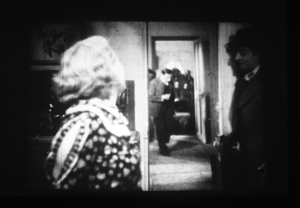
Teachers, filmmakers, and collectors had a special relation to 16mm. In addition, as researchers, we developed an unusually intimate rapport with the format. When I started teaching, I felt the need to illustrate my lectures with images from the films. My first efforts involved setting up a 35mm still camera on a tripod and photographing from the screen. If the projector could stop on a frame, so much the better; but even if not, you might snag an acceptable shot. The projected image would be surrounded by darkness. Today I wince at the results, as with this shot from Crime of M. Lange, one of the few old slides we haven’t cast out.
You could get sharper slides with a gadget called a Duplicon, but it cropped the 4 x 3 image to something like 3 x 2.
When Kristin and I decided to write Film Art: An Introduction, the few introductory textbooks relied almost entirely on production stills, those images shot on the set and circulated to promote the film. The Museum of Modern Art had an archive of production stills, and then as now, publishers turned to such collections for illustrations. As part of the first generation of university-trained film researchers, we doggedly insisted that all our examples would be actual film frames.
Today, digital video has made grabbing frames easy. But before the late 1990s, it was hard. Videotape frames looked terrible, as some books from the 1980s attest. To get decent quality, you needed access to prints. You needed a way to put a reel onto rewinds or, ideally, a flatbed editor like a Steenbeck. And you needed a camera with an enlarging attachment. When you’d copied your frames, you took the exposed film to a lab, where you hoped for a passable result. Black-and-white shots were easier than color, which required blinding lamps of a color temperature matched to Ektachrome or Fujichrome or Agfachrome.
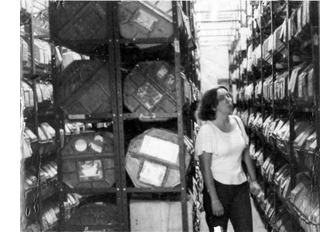 When we could get access to 35mm prints, they were our prime sources for stills. I went to Copenhagen to copy frames from Dreyer films for my first book, and for her dissertation and first book Kristin made frames from 35mm copies of Ivan the Terrible loaned her by Janus Films. Before that, for the first edition of Film Art (1979), we took our color shots from 35mm prints, most of them in the New Yorker Films library. Dan Talbot and José Lopez kindly granted us permission to go to Bonded Storage in Fort Lee. There in the tall aisles of shipping cases we set up a rewind and patiently hunted for the frames we needed. When we could get access to 35mm prints, they were our prime sources for stills. I went to Copenhagen to copy frames from Dreyer films for my first book, and for her dissertation and first book Kristin made frames from 35mm copies of Ivan the Terrible loaned her by Janus Films. Before that, for the first edition of Film Art (1979), we took our color shots from 35mm prints, most of them in the New Yorker Films library. Dan Talbot and José Lopez kindly granted us permission to go to Bonded Storage in Fort Lee. There in the tall aisles of shipping cases we set up a rewind and patiently hunted for the frames we needed.
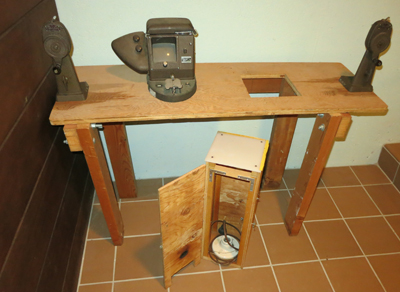
But most of the films we wanted to illustrate we could find only on 16. We rented prints and then took stills on a rickety gadget built for us by our friend David Allen. David bolted a pair of rewinds to a plank of plywood. That plank rested on a little table. Into the plank was cut a square slot for an upright light box. The box contained a bulb and was surmounted by a square of translucent plexiglass. The bulb could be put at the bottom of the box, for a photoflood lamp, or near the top with a cooler and dimmer appliance bulb for black-and-white. You positioned the film on the plexiglass and aimed the camera down at the film. A crude zoom lens allowed us to photograph a couple of frames of 16mm and one of 35.
We took the light box on our travels. Archivists certainly looked at us oddly when we brought the thing in, but they usually gave us permission to use it. We’d watch the film on a flatbed and bring the light box over alongside it. Laying the film gently on the surface, we’d poise the camera above it.
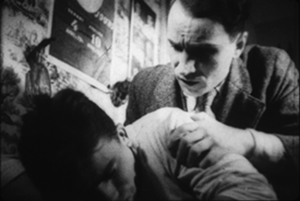
Here’s an example of what we got with our plywood setup, from Bill Everson’s print of Bulldog Drummond.
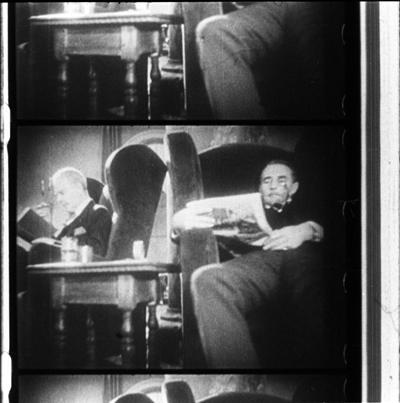
Over the years we improved our system. We bought better cameras, with sharper lenses. We found purpose-built attachments that hold the film strip firmly in place. (Alas, Canon and Nikon seem to have discontinued these rigs.) We used smaller lighting units rather than our curious box. For the last few decades we’ve shot horizontally rather than vertically.
Even in this age of video grabs, we make many frame enlargements on analog stock with 35mm cameras. Even if a film is available on DVD, some of the things we study aren’t preserved in that format. Of course many films aren’t available on video at all, and a great many of those were made to be seen on 16mm.
Format churn catches up with us
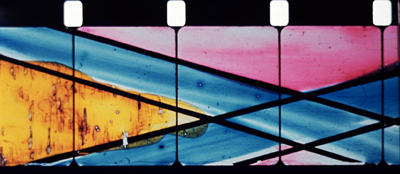
Notebook (Marie Menken, 1962).
Super-16 lives as a production format, but its older brother is nearly dead. True, a few die-hards like Ben Rivers continue to shoot on 16mm, but its future is mostly all used up. James Benning could make 16mm look like 35; when I asked him how he did it, he answered: “I use a light meter.” But even Jim has switched to digital. As for projection, many colleges and art centers have pitched out their 16 equipment.
Since our earliest editions, Film Art included discussions of two remarkable films: Bruce Conner’s A Movie (1958) and Robert Breer’s Fuji (1974). These have not been, and might never be, released on digital disc. Yet by the end of the 2000s, we found that virtually none of the users of our book screened these films for their classes, and curious readers without access to 16mm projection couldn’t easily see them. Reluctantly we cut them from the tenth edition of last year. We replaced A Movie with Koyanisqaatsi to illustrate associational form, and Fuji was replaced by Švankmajer’s Dimensions of Dialogue as an instance of experimental animation. Both titles are available on DVD.
Thanks to the Internet we’ve been able to revive our original discussions of the Conner and Breer films on our site here. We hope that will help the few loyal chevaliers who told me that they did indeed use the films in their courses. But our choice points up a larger problem.
So many documentary and avant-garde films were made and circulated on 16mm that we are at risk of losing a very large slice of film history. We’re lucky to have some Stan Brakhage and Hollis Frampton films on DVD, but what about all the other titles that were distributed by Canyon Cinema, the Film-Makers’ Coop, and other groups? We can get DVDs of Frederick Wiseman documentaries, and some classic ones have been made available on archival collections; but there are many more that depended on 16mm platforms. Even bigger is the set of everyday 16mm movies: amateur films, home movies, and hundreds of miles of newsfilm, from both big TV networks and local affiliates. A great many of the “orphan films” championed by Dan Streible and his colleagues are in this narrow-gauge format.
Recall too that the films of those animators and experimentalists who work frame by frame, such as Breer and Paul Sharits and Paolo Gioli, cannot be studied closely on DVD. How could DVD reveal to us the nifty paintwork of Marie Menken’s Notebook? For that you need a light table, or someone able to photograph it and show you.
Archives will retain 16mm projectors and viewing tables as long as they can. They will preserve prints, perhaps migrating the most sought-after ones to digital formats. Passionate collectors like Tim Romano, who zealously pursues lost films and then donates them to the AFI, will find a way to use our cast-off gear. Our Film Studies department will hang onto the format until the last aperture plate cracks.
16mm was so much a part of our work, our play, our education—in short, our lives—that the separation was inevitably poignant. Pinned to the bulletin board in my basement booth was Ellen Levy’s poem, “Rec Room.” It is, I think, about the fragility and faultiness of the 16mm image, as made palpable in home screenings, and about how that fragility nonetheless carries a pulse of vitality. It begins:
The film assumes the texture of its screen
on the first projection. Audrey Hepburn’s face
creases where the rec room paneling once
took exception to it for the sake of
rephrasing it slightly—a lesson
these late viewings have brought home. Home
screen or revival house . . . .
Thanks to Erik Gunneson and Tim Romano for helping us recycle our 16mm stuff.
Media historian Eric Hoyt, in our Communication Arts Department, studies among other things how the American studios disposed of their film libraries. He talks about his research and his book project, Hollywood Vault, here.
The FOOF contingent was unequivocally a force for good. To sample some of its wonkish hijinks, watch Captain Celluloid vs. the Film Pirates.
New York University’s Cinema Studies Department has created an extensive online collection of William K. Everson materials. For more on Bulldog Drummond, see this entry and this essay on the great William Cameron Menzies. Annette Michelson’s essay on Joseph Cornell, “Rose Hobart and Monsier Phot: Early Films from Utopia Parkway,” was published in Artforum 11 (June 1973), 47-57.
Bonded Storage in Fort Lee is part of the history of American cinema, as this article shows.
Paradoxically, you can study films frame by original frame on some laserdiscs, and on VHS tapes too if you are aware of the 3:2 pulldown. See my entry here. As so often happens, progress along one dimension means regression on another. So I cling to my rotting laserdiscs and demagnetizing old tapes.
James Benning discusses how digital cinema changed his artistic practice at Bombsite. An earlier entry of ours showcases the efforts of the Academy of Motion Picture Arts and Sciences to preserve experimental cinema.
Ellen Levy’s fine “Rec Room” is available in its entirety in The New York Review of Books (9 October 1986).
To watch a video about our Film Studies program, go here.
Posted in Experimental film, FILM ART (the book), Film piracy, Film scholarship, UW Film Studies | open printable version
| No Comments »
Thursday | February 28, 2013
Kristin here:
Most years when I’m at home, I join in our departmental Oscar party, where grad student and faculty get together to watch the broadcast and match wits at predicting the winners. It beats the grimness of sitting home watching the show.
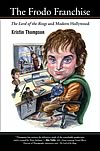
But this year, being a relatively new staff member on TheOneRing.net, I decided to attend their celebration, “The One Expected Party,” for The Hobbit. TORn put on three Oscar parties for The Lord of the Rings, in 2002, 2003, and 2004. Those parties became the stuff of legend within the fandom, having rapidly sold out each time. The nominees and winners from the trilogy dropped by the TORn party each year (fueling the next year’s ticket sales). I wrote about the Oscar parties as part of my coverage of TORn in my book, The Frodo Franchise, but I had never been to any of them.
In planning my trip, I quickly discovered that there are a lot of other activities around the run-up to the Oscar ceremony. I knew, of course, that the Academy of Motion Picture Arts and Sciences offers screenings of the nominated films to their members and to anyone else lucky enough to get a ticket. But our old friend Chen Mei, who works for the Academy library, told me about panel sessions featuring the nominees in various categories and kindly obtained tickets for me to attend two of them.
Obviously the nominees take these events seriously. For both of those I attended, with one exception all the directors of the nominated films showed up to answer questions from a moderator. Obviously they couldn’t hope to influence the members’ votes, since the ballots had already been turned in. They generously gave time to offer insights into their work to audiences who clearly were knowledgeable about filmmaking.
“Oscar Celebrates Animated Features”
This panel discussion took place on the evening of February 21, the day I arrived in Los Angeles. When I got to the Academy’s Samuel Goldwyn Theatre, more than an hour before the 7:30 event, there was already a long line of ticket-holders hoping to get good seats. I gathered from conversations with people around me in line that tickets are getting harder to obtain each year.
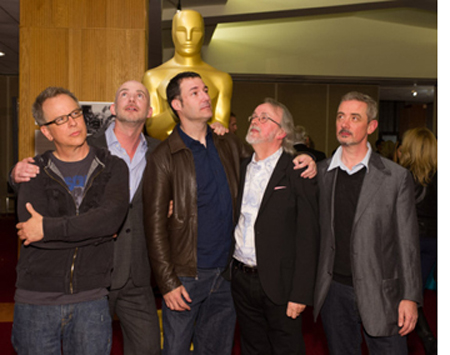 Most of the best seats were roped off, reserved for Academy members and the guests of honor. I got an unreserved one in the second row but way over on the side. It actually gave a pretty good view of the stage. Unfortunately photos are strictly forbidden inside the Samuel Goldwyn Theatre, so I have none to show you. Most of the best seats were roped off, reserved for Academy members and the guests of honor. I got an unreserved one in the second row but way over on the side. It actually gave a pretty good view of the stage. Unfortunately photos are strictly forbidden inside the Samuel Goldwyn Theatre, so I have none to show you.
Almost all of the directors of all five nominated features were there: Peter Lord for The Pirates! Band of Misfits; Sam Fell and Chris Butler for ParaNorman; Mark Andrews for Brave (co-director Brenda Chapman being unable to attend); Rich Moore for Wreck-It Ralph; and Tim Burton for Frankenweenie. (All but Burton stuck around to pose for the press; left to right, Moore, Butler, Andrews, Lord, and Fell.)
This line-up of talent should have made for an enlightening evening. Unfortunately the AMPAS had chosen as MC a comic actor, Rob Riggle (Talladega Nights, The Hangover) who turned out to know less about animation than most of the people in the audience did. He was obviously more concerned with being entertaining than with drawing out any solid information about the films. He kept asking the guests what inspired them to make their films, while very little got said about the films’ innovative techniques and the challenges the filmmakers faced–in short, about the films. Despite this obstacle, the guests managed to say some interesting things. There was obviously no audio recording either, so I frantically took notes.
One motif that cropped up several times was the fact that this year’s nominees included three stop-motion films. But as some of the animators emphasized, despite their love for the slow, frame-by-frame manipulation of puppets and objects, they do mix in new technologies. Fell described himself and fellow director Butler as “Luddites who’ve embraced the loom.” For example, although ParaNorman‘s young witch Aggie was animated as a puppet, her dress was an added digital effect. As Butler said, although they basically work with puppets, they will use whatever animation technique will look best on the screen. (Earlier this month, I discussed the use of color laser printing that made the wide variety of character expressions possible.)
Lord twice mentioned the convivial atmosphere created at Aardman’s Bristol studio, where people who love puppet animation have come together as a team. They avoid computer animation whenever possible, preferring “the lovely, amazing toys in the world, stuff the animators work with at Aardman.”
Fell and Butler described their influences as the horror films they saw during their childhoods in England. Butler had watched Night of the Living Dead at age 6, and Fell referred to “video nasties,” as they are labeled in England, very violent films that were banned or at least difficult to see. The age of VHS made such films as Driller Killer available, as Fell pointed out, though Butler hastened to point out that that particular film had not influenced ParaNorman.
Moore, who had directed episodes of both The Simpsons and Futurama, made Wreck-It Ralph as his first feature. Asked the difference between episodic animated TV and features, he responded that in features, characters move through an arc that changes their situation by the end. In TV, the characters start at square one, play out an action, and end up on square one by the end, ready to do the same thing the following week.
Burton was asked the difference between the original Frankenweenie short and the feature. Because the feature was animated, he considers it “a more pure version” of the original live-action short. In working on the style of the set designs for the feature, he went back not to the short itself, but to the drawings he had originally done for it. He also admitted that during the early days when he was had a job at Disney drawing cels for The Fox and the Hound (1981), his drawings of the fox looked “like road kill.”
Interlude: Ground Zero, the Dolby Theatre
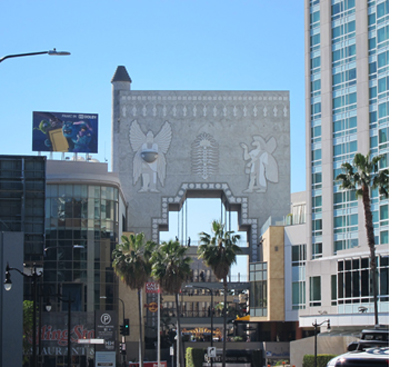
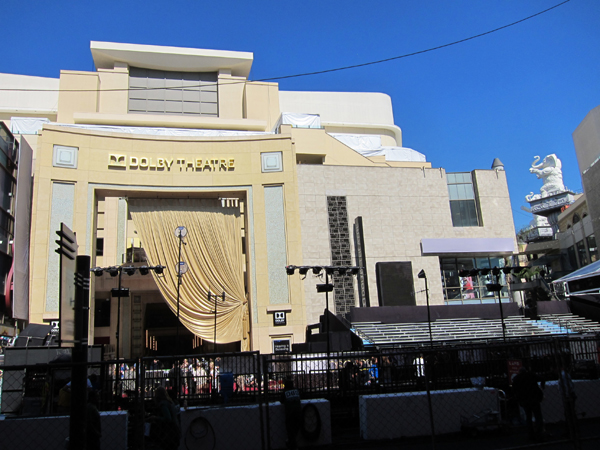
The grand theater on Hollywood Boulevard where the awards ceremony takes place may now be named the Dolby, but it remains the Kodak Theatre on Google Maps and in the minds of the many who still call it that. Then again, I heard people at one of the Academy panels refer to “Grauman’s Chinese Theatre,” despite that fact that the Mann’s chain acquired it decades ago and it has again changed hands.
I was staying in the Hilton Garden Inn, on Highland Avenue a few blocks north of where it intersects Hollywood Boulevard at the corner dominated by the Dolby Theatre’s huge complex. Having a free morning on Friday, I wandered down, looking to take some pictures of the Oscar preparations.
The Dolby Theatre is also a shopping mall. It is surely the only mall in the world modeled on the work of D. W. Griffith, specifically his Babylon sets from Intolerance. Giant white elephants on pillars loom over tourists. (Top, and at left, a view looking toward the back of the complex from the north.)
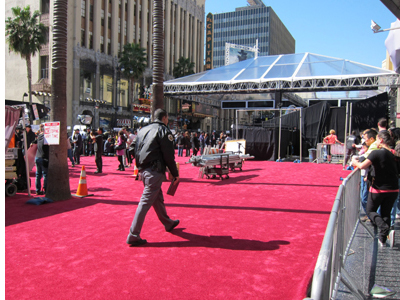
Naturally the block of Hollywood Boulevard in front of the theatre was closed to traffic. Online one could find a complicated schedule of road and even sidewalk closings that went on for as much as a week before the day of the ceremony. Fortunately on this day the sidewalks were still open, so I could join the tourists watching the preparations and snapping photos. The bleachers had been installed, as had the famous red carpet. A larger nearby parking lot was filled with trailers sprouting satellite dishes. The infrastructure for this event is vast, as one would imagine. It’s also far from glamorous.
“Oscar Celebrates Foreign Language Films”
On Saturday morning I got to the Samuel Goldwyn Theatre earlier, about 8:30 am for a 10:00 event. This time I was among the first twenty-five or so in line and got an excellent seat in the third row opposite the podium. Mark Johnson, who until recently ran the foreign-language category, was the MC. David and I have known Mark for years, since the early 1970s, when we were all in graduate school in film studies at the University of Iowa. Between his film education and extensive work in the industry (including producing the Chronicles of Narnia films, Rain Man, Galaxy Quest, A Little Princess, and Breaking Bad), Mark was an excellent choice to host the event, as he had done several times in past years.
All the directors showed up: Michael Haneke for Amour; Kim Nguyen for War Witch; Pablo Larraín for No, Nikolaj Arcel for A Royal Affair; and Joachim Rønning and Espen Sandberg for Kon-Tiki. (I discussed No and A Royal Affair in a report from the Vancouver International Film Festival last year.)
As each director came onstage, Mark graciously asked him to acknowledge any members of his filmmaking team who were in the audience. These included three of the four producers of Amour, Stefan Arndt, Veit Heiduschka, and Michael Katz. When Mark asked where the fourth producer, Margaret Menegoz was, Haneke got off the first zingy of the evening, saying that she would be arriving that evening: “She was picking up the Césars.” (On Friday, Amour won five, for best picture, director, original screenplay, actor, and actress).
Mark’s excellent questions solicited much information. I can’t summarize it all, but here are some highlights, film by film.
Arcel emphasized how difficult it was to finance A Royal Affair, given that it was a big, expensive costume picture: “It’s a risk in Denmark, where we have more the kitchen drama.” Although Zentropa Productions made the film, there was considerable investment from other European countries. One of the film’s stars, Mikkel Boe Følsgaard, was an acting student when he was cast as the eccentric Danish king, and he won the best actor prize at Berlin. Arcel revealed that after making A Royal Affair, Følsgaard went back to resume his acting-school education, where the next unit was on film acting. A Royal Affair was the only nominee shot on 35mm. Rather than following the European art-cinema tradition, he was influenced by his favorite Hollywood films, like Gone with the Wind and Lawrence of Arabia.
No was the third film in a trilogy about the Pinochet years in Chile, the earlier ones being Tony Manero (2008) and Post Mortem (2010). Mark asked Larraín if he had initially planned a trilogy. He said no, “I would say it is mostly the press who have named this a trilogy.” On the other hand, he thinks the term makes sense when applied to these films, and he has no objection. He commented that the film depicts how the same tools of propaganda Pinochet used on the people were turned against him. Rather than staging a violent takeover, “They put him out with the tools of beauty.” His filmmaking team had intended the lead role for Gael García Bernal from the start, despite his being a Mexican actor. The other actors had been with Larraín on previous films and all are well-known in Chile.
Larraín also talked about the four 1983 video cameras that were used to simulate older footage, each of which produced footage with a slightly different look. The team was worried about the various shots not cutting together smoothly with each other and with the archival footage that was integrated into the film. During editing, however, they began to forget which footage was new and which was archival and realized that they were succeeding. “What we shot became documentary, and the documentary shots became fiction.”
Nguyen talked about casting War Witch. Seventy-five per cent of the cast were non-actors. Rachel Mwanza, who played a young African girl forced to serve as a child soldier, was recommended by some documentarists who had filmed her as part of a group of homeless street kids; she had been abandoned by her parents at age 6. The film was shot with an Alexa. Tires constantly burning in the streets of Kinshasa created a haze that the filmmakers used as a filter for the natural light. Nguyen read many autobiographies of child soldiers as models for the voiceover narration in the film.
Rønning and Sandberg were inspired by the story of Thor Heyerdahl’s raft voyage from South America to Polynesia in 1947. Heyerdahl was a national legend, and his documentary record of the trip, Kon-Tiki (1950), won the only Oscar so far awarded a Norwegian film. Heyerdahl’s life was extremely well-documented in his diaries, which guided the scriptwriting. The filmmakers were lucky enough to gain access to a replica of the original raft, which had been made by Heyerdahl’s grandson to repeat the original voyage. The shooting at sea lasted for a month. In addition, however, there were over 500 special-effects shots–making Kon-Tiki, like A Royal Affair, a big-budget, Hollywood-style film. The directors said that with so much drama on TV, they wanted to create an epic that cried out to be seen on a big theatre screen. The effects were mainly for creating sharks and other creatures, extending sets, and occasionally erasing boats or shorelines in backgrounds.
Mark pointed out to Haneke that a lot of Americans know Amour is good but avoid seeing it because they think it’s too grim. Haneke blamed the American media for giving that impression of the film, saying that he considers it to be about love rather than death. But with a smile he also admitted, “I’m afraid it’s partly my fault.” He has gotten a reputation “for inflicting pain on audiences.” From the start he had planned the film around Jean-Louis Trintignant and would not have made it had he refused the part. Emmanuelle Riva, however, he found through the conventional casting process of auditions.
Mark mentioned the fact that the film juxtaposes wide views with close-ups, with few camera distances in between. Some scenes play out in a single long shot. Haneke responded “I want to give my audience time to reflect […] I try to manipulate the audience as little as possible.” Mark pointed out that in spite of this, the spectator always knows where to look. Haneke replied: “It’s all a question of craft.” (This drew applause from the audience.) The apartment in the film was a set, a choice made mainly because the older actors could not work long hours in difficult circumstances. The views seen through the windows were added with computer effects. Haneke dislikes non-diegetic music in films, and so he writes characters who would naturally be playing or listening to music within the story. In the case of Amour, he chose all the classical music before writing the script.
“The Art of Production Design”
The AMPAS isn’t the only organization hosting events around the presence of so many Oscar nominees being in Los Angeles. Straight from the foreign-film event I went with our friend Jonathan Kuntz, who teaches film and television at Los Angeles City College and the University of California at Los Angeles, to the Egyptian Theatre on Hollywood Boulevard. There the Art Directors Guild, the Set Decorators Society of America, and the American Cinematheque were presenting a similar panel discussion on “The Art of Production Design.” Nearly all the nominees were present (with production designer listed first and set 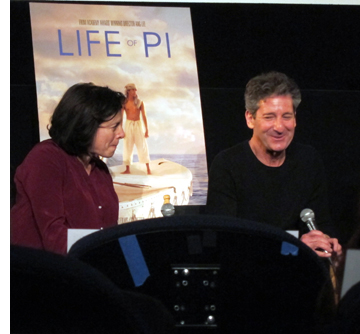 decorator(s) second): Sarah Greenwood and Katie Spencer for Anna Karenina; Dan Hennah and set decorators Ra Vincent and Simon Bright for The Hobbit: An Unexpected Journey; Eve Stewart and Anna Lynch-Robinson for Les Misérables; David Gropman and Anna Pinnock for Life of Pi (at right); and Rick Carter for Lincoln (set decorator Jim Erickson couldn’t attend). The co-moderators were Thomas A. Walsh, Production Designer and Co-Chair ADG Film Society with Academy Governor Rosemary Brandenburg, SDSA. decorator(s) second): Sarah Greenwood and Katie Spencer for Anna Karenina; Dan Hennah and set decorators Ra Vincent and Simon Bright for The Hobbit: An Unexpected Journey; Eve Stewart and Anna Lynch-Robinson for Les Misérables; David Gropman and Anna Pinnock for Life of Pi (at right); and Rick Carter for Lincoln (set decorator Jim Erickson couldn’t attend). The co-moderators were Thomas A. Walsh, Production Designer and Co-Chair ADG Film Society with Academy Governor Rosemary Brandenburg, SDSA.
Greenwood stressed how little time there had been to prepare the sets for Anna Karenina. The production at first was intended to be a conventional version, and location-scouting was done in Russia. The team decided to shoot in London, but there was no unifying conception until twelve weeks before principal photography director Joe Wright decided to stage the action in a set representing a theatre. There ended up being twelve days to actually construct the set, with the designers marking the sets in chalk on the floor and starting to build before there were drawings of them. She describes the theatre set as “rich but minimalist,” since the approach was to remove as many items as possible.
Hennah answered a question from the audience concerning where conceptual design, done for The Hobbit by illustrators John Howe and Alan Lee, ends and production design begins. He responded that conceptual design involves creating the environments as a whole, as if they were real places. “The production design kicks in in terms of what takes place in the parts of that set.” The sets were drawn digitally and then built as 3D models that went to the pre-viz department. Howe and Lee worked in at Weta Digital rather than in the art department, as did an assistant art director. Vincent and Bright both consulted on the color grading, among other roles.
Hennah spoke of the design of the huge Goblin Town set. He conceived it as having been built within a great diagonal rift inside the mountain caused by an earthquake. The Goblins being thieves, they constructed the buildings and bridges out of random stolen items like carts. The layout of the Dwarves kingdom within the Lonely Mountain derived from the idea that the space expanded randomly as the workers removed stone to follow veins of gold.
According to Stewart, the filmmakers did not try to make Les Misérables a faithful reproduction of the stage play. They wanted to do what the stage version couldn’t: “You can’t see big wides and you can’t see up people’s nostrils.” Hence the film utilized sweeping cityscapes with huge buildings and crowds, while the musical numbers are filmed in relentless close-ups. Tom Hooper likes to “make things up on the day,” so Stewart had to make the sets bigger than usual, since she couldn’t plan ahead for what he might improvise during filming.
 Given how much of Life of Pi was shot in tanks, what did the designers have to do? Gropman explained that they designed the interior of the Indian house where the early part of the story is set, with the interiors being constructed in Montreal and the exteriors shot in India. The apartment in the frame story had to be simple and bland, so that it would not reflect the character at all. Since the film was not shot in continuity, a big challenge was keeping track of the deterioration of the lifeboat, which becomes more worn and damaged. Given how much of Life of Pi was shot in tanks, what did the designers have to do? Gropman explained that they designed the interior of the Indian house where the early part of the story is set, with the interiors being constructed in Montreal and the exteriors shot in India. The apartment in the frame story had to be simple and bland, so that it would not reflect the character at all. Since the film was not shot in continuity, a big challenge was keeping track of the deterioration of the lifeboat, which becomes more worn and damaged.
Gropman asked artist Haan Lee, director Ang Lee’s son, to design the raft that Pi builds, and he came up with the idea of the raft as a triangle. The island was based on a single huge banyan tree in southern Taiwan, which was filmed for a day and then built in the studio.
Carter described having spent part of a day in the White House in preparation for Lincoln, including being left alone in the evening in the Lincoln bedroom. He graciously emphasized the importance of the set decoration, by the absent Erickson, as the main aspect of the settings that makes an impression on the audience. Virtually every day during the president’s last year of life was heavily documented, and research informed the set dressings. The designers also spent much time in Richmond, Virginia, the capital of the Confederacy, which Carter considered a city almost as much influenced by Lincoln as was Springfield, Illinois.
A member of the audience asked what effect 3D had had on the designers’ work. The two designers of 3D films gave similar answers. Gropman remarked, “There’s nothing you do where you’re not thinking about foreground, middle ground, and background. […] We’re creating the environment primarily for the actors.” Hennah’s response was, “It doesn’t change anything in terms of how you approach it. […] It’s about giving a feeling of depth and a feeling of separation, which you would do in the real world anyway.” In other words, 2D films have always had plenty of depth cues.
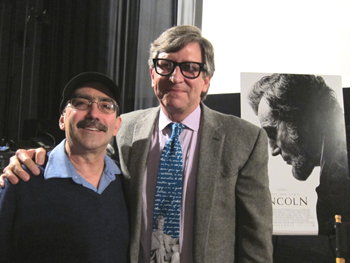
Afterward Jonathan introduced me to Rick Carter, a long-time friend with whom he had gone to school (Jonathan on the left, Rick on the right). He turned out to be the one from the group who won the Oscar the next evening.
The Hobbit, win or lose
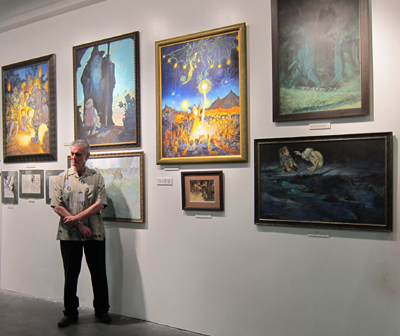
TheOneRing.net’s celebration of The Hobbit‘s three nominations (production design, makeup and hairstyling, and visual effects) began on Friday night with an art show. I was one of many volunteers helping out with setting up that and the Sunday night party, so I ventured into the labyrinth of old warehouses east of downtown, an area now established as an arts district.
The show drew some major exhibitors, including veteran Tolkien illustrator Tim Kirk, seen above posing with his most famous paintings. I was also delighted to meet some fellow TORn staff members whom I had previously only known from the group email messages we exchange and from their postings on the site. They’re an enthusiastic group who all work on a strictly volunteer basis.
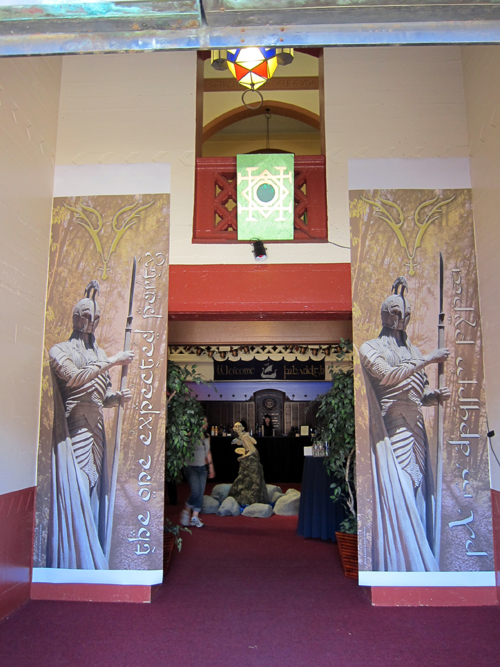
The big event was on Sunday at the Hollywood American Legion hall (at bottom, the entrance, with a representation of the Arkenstone above the door and a life-sized Gollum statue lurking inside to provide a photo op). I helped out with the setup that morning, hanging signs and folding a great many “One Expected Party” T-shirts to be sold in the “Rivendell” room (aka the shop).
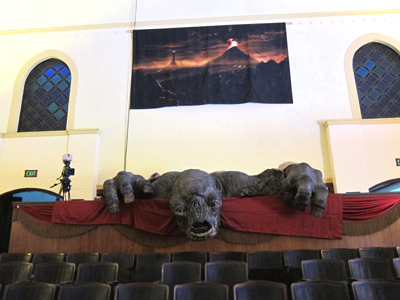
The main auditorium, dubbed “The Hall of the Elven-King” for the occasion, was where most of the celebrants gathered to watch the Oscars on a vast TV screen. If they turned around, they would notice that a full sized cave troll from The Fellowship of the Ring was watching along with them:
I managed to watch the first half of the show but then was slotted to help sell T-shirts and CDs by the band that would be playing after the Oscar show ended: Billy Boyd’s “Beecake.” I was there long enough to sit through two of the categories for which The Hobbit was nominated and to be nearly deafened by the cheers–and then groans of disappointment. The fans reassure each other that as with The Lord of the Rings, the third part will scoop up Oscars serving to reward the whole trilogy.
Being in “Rivendell” selling stuff, I missed the second half of the show, but I gather that was not much of a loss. The Oscar fever being exhibited elsewhere in the building and around town turned out to be more interesting than the ceremony itself.
Posted in Animation, Awards, Film technique | open printable version
| No Comments »
Monday | February 25, 2013

Donald Richie and students. Kitakamakura, July 1988. Photo by DB.
DB here:
He died last week, aged 88.
What was his life about? The public dimensions involved, of course, his status as unofficial spokesman, principal gaijin, the gatekeeper and guide to anyone interested in Japan. He hosted grad students as genially as he played tour guide to Truman Capote and Susan Sontag and Jim Jarmusch. I don’t know of any other situation in which an American (from Lima, Ohio, no less) became the spokesperson for a foreign culture. From the 1950s into the 2010s, in a stream of writings and lectures, he interpreted how the Japanese lived, worked, thought, and created. Although he wrote about everything from landscape to tattoos, he became best known as the supreme expert on Japanese cinema. His particular love was the postwar “Golden Age” of the late 1940s through the early 1960s.
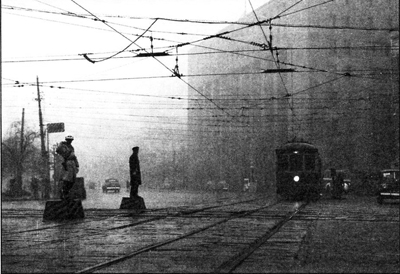
Tokyo/Hibiya crossing; Dai-Ichi Building, 1947.
Japan was still terra incognita to Westerners when he came there in 1947. When the outer world demanded to understand this very strange place that had fought so tenaciously against America, there arose a generation of interpreters. Of that cadre, though, he stands out as the man you can’t quite place.
The oldest of the group was Edwin Reischauer, who worked largely in international policy. A somewhat younger man, Donald Keene, became the dean of Japanese literary studies. Keene has provided translations and magisterial overviews of the Japanese novel, drama, and poetry. An almost exact contemporary of Keene’s is Edward Seidensticker, who has been a renowned translator and cultural historian.
Only a little younger was our author, who came to Japan in the Navy and soon became a prolific writer. Yet his work didn’t fit the mold of the other American experts on Japan. He was neither a traditional scholar (he read little Japanese, though he spoke it fluently) nor a pure journalist (he refused to be tied to topicality). He remained resolutely in-between. What academic would have the brass to sum up “The Japanese Way of Seeing” in a seven-page essay? Yet what journalist would write subtle critical monographs on Ozu and Kurosawa?
In my copy of Partial Views: Essays on Contemporary Japan, he wrote: “For David, from Donald, particularly pp. 157-205.” On those pages you find his “Notes for a Study on Shohei Imamura.” It’s a fertile survey of recurring themes and techniques in Imamura’s films. In the hands of a professor it could certainly become a tightly argued book. Was his inscription telling me that, when he wanted to, he could execute criticism with an academic accent? If so, it was unnecessary. I didn’t need convincing. I think he could have done whatever he wanted.
What he wanted, I think, was to join the tradition of European belles lettres. He earned his living by writing, and doubtless his championship typing skills steered him toward the quick turnover of daily deadlines. More deeply, I think, he found the shorter piece suited his flair for precise evocation. Even in his books, his approach is essayistic, faceted. His tone—thoughtful but not severe, conversational, projecting wide knowledge and good sense and humane modesty—won the reader by its quiet conviction that the subject was important. This essay wouldn’t be the last word; indeed, he would likely return to the subject years later, testing out new ideas. Much of his output consists of occasion-based pieces, and any of these might be recast, cut, or expanded. A craftsman knows how to recycle scraps and spruce up old projects.
This commitment to fluent reflection on daily changes, along with a quality of seeing everything around him afresh, put him in the tradition of the Continental “man of letters.” He was an aesthete, a moralist, and a bit of a dandy. His natty clothes were like his literary style, crisp and elegant but not flamboyant.
His preferred mode was description. He was convinced that whereas Westerners struggle to probe the depths, “The Japanese realize that the only reality is surface reality.” During a visit to Madison, he was delighted to find a translation of the Goncourt brothers’ journals. I couldn’t help thinking that he took them as a model of the urbane curiosity and pellucid prose he cultivated.
Above all he was interested in people. He was an excellent observer but also a well-tempered listener. He chatted with barbers, students, masseuses, neighbor ladies, potters, delivery boys, executives, and celebrities. He listened to their complaints, their dreams, and their reports on the texture of their lives. Sometimes they quarreled with him or disappointed him. But each one gave him a glimpse of the wavering mirage that was Japan, or at least his Japan.
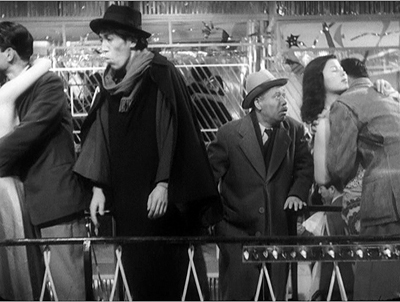
Ikiru (Kurosawa, 1952).
His writing skills worked on a big canvas in The Japanese Film: Art and Industry (1959). He wrote the text while his collaborator Joseph Anderson, who read Japanese, provided the research. The book came at just the right moment, when Americans were starting to appreciate the power of this nation’s cinema. To this day, despite many specialized studies of directors, periods, and genres, it remains the standard overview of one of the great national film traditions.
Just as important, for me at least, was The Films of Akira Kurosawa (1968). The first edition, a magnificent buff volume with razor-sharp illustrations and double-column text, is a triumph of book design, as solid and imposing as the films it canvasses. Along with Robin Wood’s works on Hitchcock and Hawks, it showed that cinema could be studied with intellectual seriousness. To the auteurist’s search for the guiding themes of a director’s vision, the Kurosawa book brought a sharp eye for technique and a direct access to the artist himself. (Our author’s first visit to a movie set was to Drunken Angel.) And it proved that a great film could sustain shot-by-shot scrutiny.
Turn to any chapter and you will see a probing intelligence. For Ikiru, we get a detailed layout of image/ sound relations in the nighttown sequence, bracketed by Watanabe’s funeral. The analysis carries us to this conclusion:
He has become much more than simply dead. Just as, dying, he learns to live; so, dead, he becomes more alive for others than he ever was before.
The Kurosawa book remains an exceptional achievement in sympathetic imagination. The critic is so finely in tune with the creator’s sensibility that each chapter illuminates and amplifies the dynamics of the film. There are other ways of understanding Kurosawa, but this book will remain the compass that orients us to this essential director’s career.
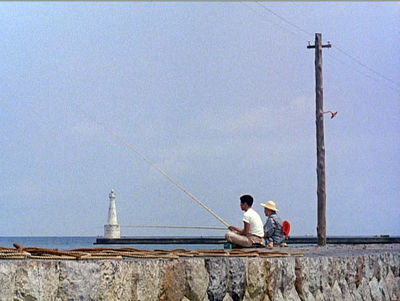
Floating Weeds (Ozu, 1959).
There were other books, of course. Among the best is the rare 1961 Japanese Movies, published by the Japan Travel Bureau. It is a compact survey of the major directors working in the postwar era. You sense that its intense aesthetic appreciation of particular films arises from portions cut from The Japanese Film. Here the critic is working at full stretch, and his thoughts on Naruse, Mizoguchi, and others are still worth reading. In its fifteen pages on Ozu, then unknown in the West, lie the seeds of his book on the director.
We have him to thank for our awareness of Ozu. He persuaded the reluctant Shochiku company to release the films in Europe and the US. His ten years of effort were crowned by the release of several Ozu films in New York in 1971-1972. At that point, largely as a result of accidental access, Tokyo Story emerged as the director’s official masterpiece. Soon afterward there appeared Ozu: His Life and Films (1974), another monograph informed by personal acquaintance with the director.
The Kurosawa book dealt in depth with each film, but this took a more horizontal and modular approach, tracing a skein of similarities across Ozu’s work. As one would expect, the emphasis falls on the postwar films, which were more easily available and which the author saw as they were released. (“Revisionist” takes on Ozu, and Japanese cinema as a whole, would soon return to the 1920s and 1930s and find there an earlier Golden Age.) The chapter layout tends to assume that Ozu films are more uniform than they are, but for its attention to themes and script construction in particular Ozu is indispensable. The author’s love for the films shines through every page.
It’s sometimes said that he brought Japanese cinema to the west, but apart from his championing of Ozu, this is inexact. Rashomon opened in New York in 1951, and Gate of Hell won an Academy Award in 1955. Daiei and Toho studios exported several films to Europe and America, while distributor Thomas Brandon sought to bring less-known Kurosawas to the US. The Japanese Film arrived at a propitious moment in 1959, when it could capitalize on the wider circulation of titles. Not until the 1970s was America to see a resurgence of interest in Japanese cinema, thanks to the Ozu releases, the Ozu book,the circulating programs sponsored by the Japan Film Library Council, and the efforts of Daniel Talbot’s New Yorker Films.
Still, our author did something quite important. By talking about Japanese cinema in terms amenable to Western tastes, he integrated it into our film culture. Kurosawa as a robust humanist; Ozu as the serene contemplator of life’s transience: these became familiar figures thanks to his eloquent critical rhetoric. At the same time he retained a sense of their uniqueness, insisting in particular on the irreducible Japaneseness of Ozu’s aesthetic.
Although his major books remained essential for film lovers and film courses, it’s fair to say that he got a second wind in recent decades. He won a wide and keen following with his commentaries and liner essays for Criterion DVD releases of Japanese classics. The outpouring of grief after his death comes in large part from viewers who knew him best as a warm, calm voice talking through scenes of Tokyo Story or When a Woman Ascends the Stair or, surprisingly, Bresson’s Au hasard Balthasar. He adjusted well to the new world of video. He treated it as a new conduit for his commitment to civilized discussion.
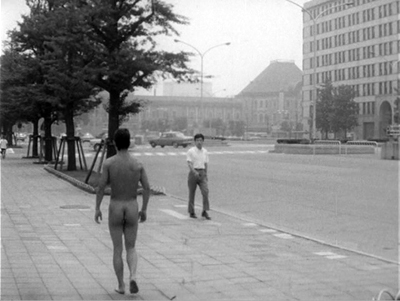
Five Filosophical Fables (Richie, 1967).
So much for the public man, writer and speaker and animator of film culture. Another side of him was an intense erotic interest. On your first meeting, he made sure you knew what he found appealing. In the Journals, cruising and pickups blend with a swarm of local details of landscape and custom, although consummations are elided.
I had noticed that his suteteko, being thick cotton, are still damp from the swim, and so I suggest he take them off and hang them on a branch to dry. He does so.
*
Later, in the afternoon, I take a train around the coast. . . .
The juxtapositions between moments of artistic ecstasy and sexual passions give the journals a collage-like snap.
[Hiteki] got into all this ten years or so ago. Has no particular feeling for it but it is now all he knows. . . . Does everything but only, I feel because he does not know what else to do. It apparently means little. Small excitement. . . It represents, I guess, something better than nothing.
6 October 1990. Haydn quartets—the delicious Opus 50. They are made up only of themselves.
The diaries we have are very polished products, the results of much rewriting, and stretches are calculated to render the guilt-free sexiness that the wanderer finds all around him. Consider the finesse of this passage about a visit to Aoshima island:
Later we shop in the empty tourist arcades and buy some beautiful and indecent objects—cups you turn over to discover a coupled couple, an articulated vagina disguised as a shell, and a sake cup with a mushroom-shaped penis attached. One is to suck the sake from the mushroom head.
Some readers expect the Journals to be among the author’s most lasting work. They’re valuable as chronicles of the daily life he observed with sympathetic but dispassionate acuity, but they also record the mind and feelings of a man of Wildean sensitivity wandering among dazzling surfaces that kept his senses, and his libido, ever on the alert.
The surfaces might be rough. The journals record his enjoyment of living near Ueno Park, where the homeless and the prostitutes gather at night. He strolls through them, meeting the occasional cop and seeking, as he puts it, someone who can typify Japan in all its contradictions.
Beautiful and indecent: You can find this mixture in some of the experimental films he made too. The most inoffensive of these, Wargames (1962), was circulated among American film societies during the 1960s, but others are more audacious. In the allegorical satire Five Filosophical Fables (1967) a young man abandons a snooty party, strips to the buff, and strolls smiling through Tokyo streets, past the sea, and into the countryside. Cybele (1968), a documentary of an avant-garde theatre performance, presents an orgiastic rite of sex, degradation, and bloody sacrifice.
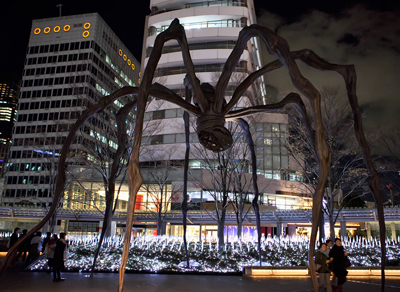
Roppongi Hills, Christmas 2010.
He was assailed by bouts of illness across two decades, but he seems never to have lost his buoyancy and spiky wit. He was especially mordant on the New Japan. He notes that the thrusting high-rise apartments of the 1980s bubble offer more for Godzilla to whack. “Originally [he] had to content himself with a mere Diet building.” Manga and the Sony Walkman were very much alike, he maintained. Each offered not visual or aural stimulation but a convenient way to shut oneself off from the ugliness of a money-grubbing society: solitary withdrawal amounted to a critique of contemporary life. With mock pathos he told of a salaryman so preoccupied with talking on his cellphone that a passing subway train snagged him and carried him off, the handset dropped squawking to the platform.
The humor could be self-deprecating. One of our conversations:
DB: I liked The Inland Sea.
DR: I traveled for three months and wrote it in three weeks.
DB: And I read it in three hours.
DR: You took too long.
When asked if he loved Japan, he replied, “That’s complicated . . . I love Tokyo.” Yet by the end of his life, his city had become alien to him. His Japan Journals begin by sketching the vibrant colors of a blasted landscape returning to life.
Winter 1947. Tokyo lies deep under a bank of clouds which move slowly out to sea as the sun climbs higher. Between the moving clouds are sections of the city: the raw gray of whole burned blocks spotted with the yellow of new-cut wood and the shining tile of recent roofs, the reds and browns of sections unburned, the dusty green of barely damaged parks, and the shallow blue of ornamental lakes. In the middle is the palace, moated and rectangular, gray outlined with green, the city stretching to the horizons all around it.
The final entry in the journals is dated nearly sixty years later and records a 2004 trip to his old neighborhood. Tansumachi of 1947 had become the fashionable Roppongi Hills district, “the new Japan—gargantuan, expensive, and wasteful.” A Louise Bourgeois statue looms over the pavement like a tarantula. He recalls the street once named Dragon’s Way and the friend’s house that used to stand at that corner. He knows that his nostalgia must seem tiresome and he acknowledges that rapid change is itself a Japanese tradition, a sort of high-tech version of the Floating World. Yet he cannot resist denouncing the Disneyland that the old place has become. He finds no arresting color or light in this world.
In just a number of years every place will look like it, and this kind of economic expediency will be the rule, as will those cute nods in the direction of retro and trad, that comedy team of contemporary design. Here, under the spider, I look into the future which is already here.
He was well aware of living in-between. Today we might say that he was perpetually “other,” too aesthetically sensitive for a mercantile society, too protective of tradition in a period of lightning change, too gay for straitlaced America, too eccentric and independent-minded for assimilation into his adopted nation. Painful as these tensions must have been, he proudly accepted being fundamentally out of place. At the end of one essay he claims his motto to be that of Hugo of Saint Victor:
The man who finds his homeland sweet is still a tender beginner; he to whom every soil is as his native one is already strong; but he is perfect to whom the entire world is as a foreign land.
Extracts from Richie’s writings come from The Films of Akira Kurosawa (1968 and later editions), A Lateral View (1992), and The Japan Journals, ed. Leza Lowitz (2005). Richie’s films are available on DVD as A Donald Richie Film Anthology from Image Forum Video. See also The Donald Richie Reader (2001), ed. Arturo Silva, for a varied collection of pieces, including articles on how he came to write about film, and his lively tour Tokyo: A View of the City (1999), with photos by Joel Sackett. The photo of Tokyo/ Hibiya crossing comes from the Journals, the shot of Roppongi Hills from Tokyofashion.com.
For a provocative review of The Japan Journals, see Richard Lloyd Parry’s “Smilingly Excluded.” Kim Hendrickson, who produced Richie’s DVD commentaries, provides a tribute on the Criterion site. A list of his commentaries and liner notes is on this page.
For more on how Japanese films came into the United States, see Chapter 6 of Tino Balio, The Foreign Film Renaissance on American Screens, 1946-1973.
Thanks to Tony Rayns for conversations and assistance.
Elsewhere on this site are other Richie-related entries, particularly here and here.
P.S. 25 February: Karen Severns has set up a Donald Richie tribute page here.
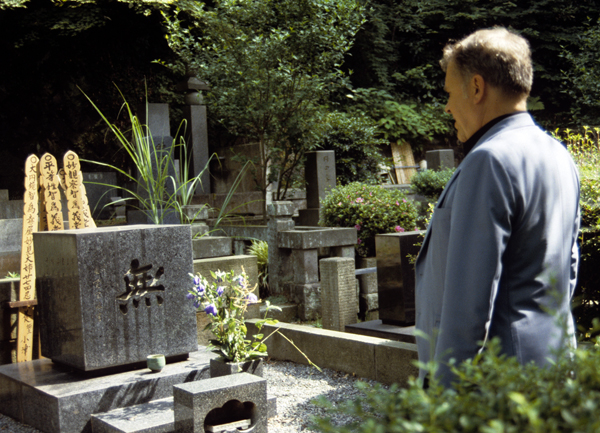
Donald Richie at the grave of Ozu. Kitakamakura, July 1988. Photo by DB.
Posted in Film criticism, National cinemas: Japan, People we like, Readers' Favorite Entries | open printable version
| No Comments »
|