Tuesday | August 5, 2014

Kristin here:
Long-time readers of this blog may recall that in 2008 I went to Comic-Con for the first time. I can’t recall exactly what led me to take the plunge. It may have been that by that time it was evident that the con had grown into a major opportunity for Hollywood studios to publicize their upcoming blockbusters to their core audience and I wanted to witness the process in person. Until this year, I hadn’t returned to Comic-Con. I was motivated in part by the fact that this was the last big promotional event for a film in the Lord of the Rings/Hobbit franchise. I had briefly discussed Comic-Con in relation to LOTR in The Frodo Franchise, but I had not witnessed any of the appearances of cast and crew promoting the first trilogy. This was my final chance, the end of an era.
I blogged about my first visit four times. I wrote about the LOTR/Hobbit presence on the Frodo Franchise blog. On this blog I gave an overview of the Comic-Con experience, analyzed why Hollywood poured so many resources into an event nominally about comic books, and posted a conversation between Henry Jenkins and me. Henry, who had helped found the area of fan studies back in the 1990s with such widely cited publications as Textual Poachers, was also a Comic-Con newbie that year, and we shared our reactions. (This year Henry was on a panel, “Creativity Is Magic: Fandom, Transmedia, and Transformative Works,” one of a number of panels on fan culture. I missed it because I was in line for Hall H. More on that below.)
A friend of mine who has a press pass assured me that they were not as hard to obtain as I had feared, so, based on my collaboration on this blog and my position on the staff of TheOneRing.net, I applied. To my delight, I was granted one, so I set out to cover Comic-Con more officially.
Going to Comic-Con alone isn’t nearly as fun, and I was lucky enough this year to meet up there with my friends, Professors Jonathan Kuntz and Maria Elena le las Carreras and their irrepressible daughter Rebecca, who are always terrific company.
Preview night
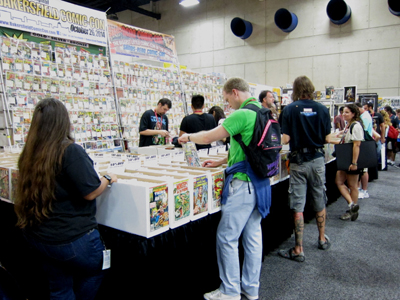
On the Wednesday evening before Comic-Con begins, there is a preview. This means that people with various special passes can get into the big exhibition hall where most of the booths are set up. These range from dealers in rare comic books to the biggest entertainment companies, like Warner Bros. and Lego. Many of them offer unique items only for sale or give-away at Comic-Con.
Many attendees have realized this, and they buy tickets that include the preview evening. The floor was much more crowded than when I attended the preview night in 2008. There were lots of lines with people trying to get those unique collectibles.
Others were there to look at comics. Yes, there are still plenty of comics at Comic-Con. There are dealers offering rarities, as in the image above. There are comics publishers with their latest offerings.
A particular favorite of ours is Fantagraphics, which specializes in reprinting comics. They’ve launched a set of hard-cover volumes of Walt Kelly’s syndicated Pogo strips. They also, I discovered, are doing a series of Don Rosa comics, also in hardback. In fact, when I was strolling around the booth, I realized that Rosa himself was signing autographs until 8 pm. It was then 7:59, so I grabbed volume 1 and was the last person to get my copy signed. By the way, it includes “Cash Flow,” one of the Uncle Scrooge stories I mentioned in our first blog entry on Inception. Volume 1 hasn’t actually been published, but it’s available for pre-order on Amazon.
The big moment of my evening, entirely by chance.
My first press conference
Once you’re granted a press pass, your name is put on a list made available to the exhibitors and publicists planning events. Companies big and small send you announcements about signings, press conferences, swag available at booths, parties in downtown venues, and so on. Many of these events promote video games, graphic novels, and television, but one sounded intriguing to my film interests: a press conference for Penguins of Madagascar, an entry in Dreamworks’ animated Madagascar franchise. The odd thing was that the event was scheduled in the morning at 11:15, fifteen minutes before the DreamWorks panel in Hall H. If we came to the conference, we couldn’t get into Hall H–unless the PR people reserved seats there for us. The big attraction was that some of the voice talent, including Benedict Cumberbatch and John Malkovich, as well as the two directors would be there.
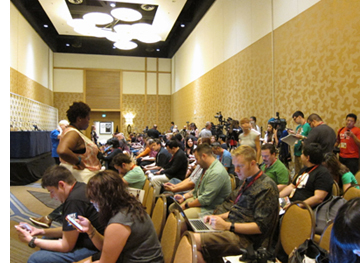
I showed up and got a front-row seat off to the side. The room filled up (right).
The event itself started somewhat late, and two gentlemen who were not Benedict Cumberbatch or John Malkovich appeared and answered some questions. (I would give their names, but the usual signs put on the table in front of guests were not in evidence.) We were approaching 11:25. John Malkovich and another gentleman appeared. Another couple of questions were asked, and someone announced that Benedict Cumberbatch’s plane had gotten in late the night before and besides we had to leave to make room for the next event scheduled in the room. We were not escorted to reserved seats in Hall H, where I hear that Benedict Cumberbatch did appear.
I can only trust that this is not how most press conferences turn out. Perhaps I will be invited to another one and find out.
Bill Plympton in person
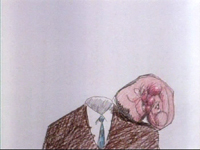
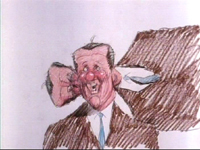
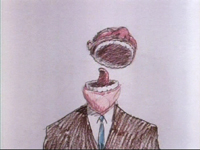
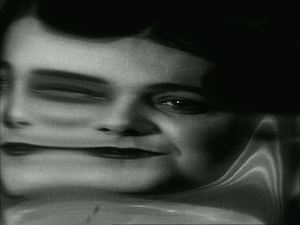
Given that I had no option to go to the Hall H DreamWorks Animation presentation, I sought out an alternative among the several items offered during the noon slot. I had had my eye on a panel which had as its guests the well-known animator Bill Plympton, as well as Jim Lujan, the co-director of the feature-length Revengeance, in progress. David and have long been fond of Plympton’s work, especially his laugh-out-loud classic, Your Face (1987), which was nominated for an Oscar. It’s just a series of distortions of a man’s face as he sings an utterly wimpy love ditty (above).
Plympton continues to be remarkably prolific. He has worked on fourteen episodes of The Simpsons, including doing twelve couch gags. Now he has a feature, Cheatin’, which will be shown for a week starting on August 15 at the downtown independent in Los Angeles. (Earlier this year it played at Slamdance, but I can find no theatrical release date.) You can see a short appeal animated by Plympton for the film’s Kickstarter appeal; its quite informative about the animation techniques used. The campaign itself is over, having raised $100,916, exceeding the goal of $75,000.
Apart from clips from Revengeance, Plympton also showed a brand new short, Footprints, a charming tale of a man’s search for a mysterious house invader. It will be shown on August 14 as part of the Hollyshorts Film Festival, which will honor Plympton with the Indie Animation Icon Award. The film was entirely hand-drawn in black and white and then colored digitally.
During the panel there was a contest for a T-shirt. The question was: What is Bill Plympton’s middle name? Despite a plethora of cell phones, laptops, and tablets in the audience, no one could come up with the right answer. A second question was put forth: what was Plympton’s first theatrically released film? “The Tune,” came a cry from the audience. It was Sam Viviano, art director of Mad Magazine; he walked off with the shirt. Plympton then sheepishly confessed that his middle name is Merton.
Plympton’s films have been hard to find online, but this fall they will become available on Source HD: “It’s the entire catalog, everything I’ve ever done.” That includes about 60 shorts. As a result of this online exposure, he says, “I expect that when I come back to San Diego next year they’re going to have to give me one of those huge 2000-seat rooms.” I hope so, and I hope it will be filled–but not so jammed that I could not get a seat.
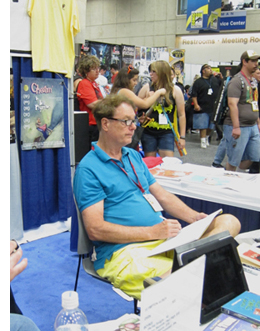
Plympton offered all attending his panel a free autographed drawing. I went to collect mine at his booth in the exhibition hall and found him drawing (right), as he must constantly be doing. Note the Cheatin’ poster behind him at the left and the usual bustle of Comic-Con in the background. He paused to dash me off a delightful image of his famous Dog character. (An animator who doesn’t use cels has to be really fast at drawing.)
Plympton DVDs are not all that easy to find, though you can get them and other merchandise at his website’s shop. If you don’t know his work, it’s time to start catching up.
A new experience: The Indigo Ballroom
Seeking to accommodate more fans without violating fire regulations, Comic-Con has expanded into nearby buildings. One of the facilities utilized this year was the Hilton San Diego Bayfront, just across from the Convention Center on the Hall H end. That’s where the DreamWorks press conference sort of took place. Its biggest room was the Indigo Ballroom. I’m not sure it had 2000 seats, but I wouldn’t be surprised.
My colleagues at TheOneRing.net have been presenting panels on the Hobbit series for several years now. In fact, my visit to Comic-Con in 2008 was as a participant on one of those panels, speculating much before the fact on the shape that the Hobbit project would take. At that point the cast hadn’t even been chosen. I suggested that Wisconsin’s own Mark Ruffalo would make an excellent Thorin. I still think he would have, but Richard Armitage has gained a large fan following in that role. I’m not sure that at that early stage Martin Freeman was everyone’s favorite candidate for Bilbo, but he soon became so–including mine. The man is a born hobbit.
That 2008 panel took place in a relatively small room in the Convention Center. In more recent years, the TORn panel has been joined by such luminaries from the filmmaking team as Richard Taylor. It has gained such a following that this year it was booked into the Indigo Ballroom.
Then we learned that George R. R. Martin was booked into the same room in the time-slot directly before TORn. (I’m sure you all know who he is, but for the few who don’t, I’ll just say, he’s the author of the “A Song of Fire and Ice” series, of which Game of Thrones is the first book.) We were all convinced that Martin’s session would be jammed and furthermore that an overlap in fandoms would mean that the audience there for Martin would stay for the TORn panel, excluding those who showed up just before the TORn session. There was much discussion as to how TORn staff not on the panel (like me) could get in and be sure of a seat. How many seats could be reserved? We didn’t know.
I determined to support my colleagues and attend the TORn panel. The question was, how many sessions would I have to sit through to make sure I could get a seat? (Rooms are never cleared between sessions at Comic-Con, since doing so would take too much time and would mean that people in one room for a session would not be able to get in line for the next session in that room. Hence the strategy of sitting through multiple panels in the same room to guarantee a seat at the one you really want to see.)
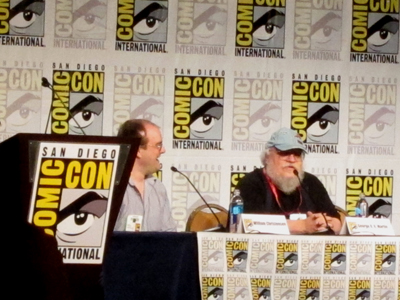
I arrived early in the afternoon in the middle of a session about some show on Comedy Central. This finally ended and the George R. R. Martin panel began. To my surprise, it was only about two-thirds full. I learned later that Martin often attends Comic-Con. Moreover, this time he wasn’t talking specifically about Game of Thrones. The session was billed as “George R. R. Martin Discusses In the House of the Worm.” The title in question is a new comic-book series that Martin is involved with. (Above, William Christensen, publisher at Avatar Press, interviews Martin.)
I had expected to sit through Martin’s session merely waiting for the TORn one to begin. I had read Game of Thrones, widely assumed to be heavily influenced by The Lord of the Rings. Game of Thrones was entertaining, but by the end I found it repetitious. I figured that the series could only become more so, so I quit there. I haven’t seen the TV episodes. Yet Martin turned out to be quite entertaining. He is a long-time fan, and his reminiscences about fandoms during the 1960s and onward were fascinating. He’s a lively, knowledgeable, and entertaining speaker with a wide experience in both reading and creating fantasy works in those days. His presentation made me wish that I liked that first book better.
The next session was “An Unofficial Look at the Final Middle-earth Film: The Hobbit: The Battle of Five Armies.” (Actually in the program the title said “Final Middle-Earth Film,” but I’m sure my colleagues did not make that capitalization error when they proposed the panel.)
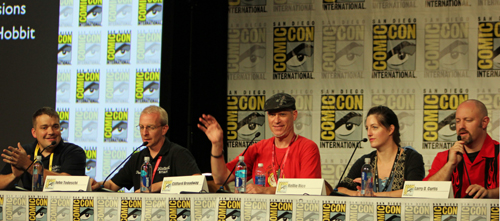
The panel consisted of, from the left, Chris “Calisuri” Pirotta, a TORn co-founder; John Tedeschi, long-time staffer; Cliff “Quickbeam” Broadway, frequent contributor to the site; Kellie Rice, staffer and half of the “Happy Hobbits” fan duo; and Larry D. Curtis, another long-time staffer and frequent contributor. Chris and Cliff were among several TORn interviewees when I was researching The Frodo Franchise.
TORn has made annual appearances at Comic-Con, usually speculating in expert fashion on what might be included–or not–in the next film. Staffers comb the previous films, trailers, Peter Jackson’s production diaries, publicity photos, and cast and staff interviews, seeking for clues. While presenting their findings, they point out things in the earlier parts that people might not have noticed or may have forgotten.
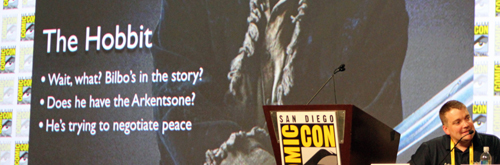
The first line in the Powerpoint image above refers to widespread fan annoyance that Bilbo seems to have been pushed to the periphery of his own story in The Desolation of Smaug. This is a topic of frequent comment on the website. The TORn panel was held on Thursday, two days before any of us had a chance to see the first teaser-trailer’s premiere on Saturday in Hall H. (More on that below.) Although there are shots of Bilbo in that trailer, they mainly show him staring offscreen and reacting. I was left hoping that this is not an indication of more sidelining of our protagonist. In Tolkien’s book Bilbo decides to sit out the Battle of Five Armies and gets knocked unconscious early in the fighting; given that he’s our point-of-view figure, the battle is mainly told through other characters describing it afterward. No one expects Peter Jackson to stay true to that action and sacrifice the chance for another epic battle scene, so maybe Bilbo will get to do his share of fighting.
This year’s celebrity guest made an appearance at the end and took a few questions: Jim Rygiel, multi-Oscar-winning visual effects supervisor for The Lord of the Rings (and more recently Godzilla and The Amazing Spider-Man):
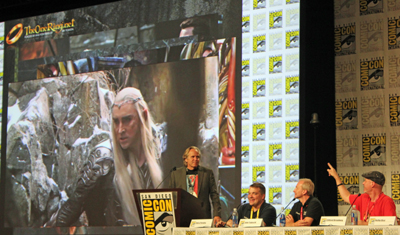
Whether the panel members were right in their speculations will not be known until December 17 (in the USA). Right or not, it was an entertaining and informative session.
What were they really there to see?
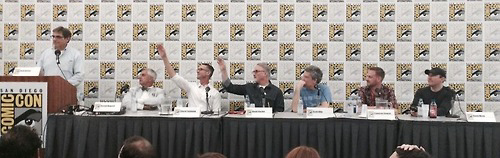
There are many rooms devoted to Comic-Con events, not to mention the various open-air booths and attractions set up in open spaces near the convention center. Room 25ABC is fairly large, but it’s considerably smaller than the Indigo Ballroom, 23ABC, and of course, Hall H. I was not alone in being puzzled as to why the panel “Fight Club: From Page to Screen and Beyond,” was scheduled in 25ABC at 7 pm on Saturday evening. Sure, the topic was an older film, and the panel was largely devoted to a forthcoming graphic-novel sequel to the story. Still, the participants included David Fincher, making his first Comic-Con appearance. I can only suspect that Fincher was a late addition to the panel’s line-up and it was too late to change the venue.
The result was that anyone determined to hear what Fincher had to say was bound to line up for the panels just before the Fight Club one and sit through them in order to see it. I decided to line up for “Disney’s Gargoyles 20th Anniversary” at 5 pm, having no idea what the Gargoyles are, and “Publishing 360: Building a Bestseller” at 6 pm, having no intention of trying to build a bestseller.
I got into a line that looked fairly short and was defined by lines of tape laid down on the carpets in the broad corridor outside 25ABC. It turned out to be one of those Disneyland-style ribbon-candy set-ups, where the line folds back on itself time after time, and you end up walking in one direction, turning around to walk in the opposite direction, only to realize that there is another group of people doing the same thing ahead of you in the same line. Fortunately most people seem to stick to the rules pretty closely, perhaps being aware of the wrath they would call down upon themselves by attempting to cut ahead of others.
I ended up about ten people back in line when the room was full. I never did learn what the Gargoyles were, but I suspected some people behind me had been hoping to get into that panel and were not there for the Fincher event. Indeed, as it became clear that no seats were going open up, a small number of people departed, leaving me about six people back from the front. It was looking good for me to get into “Publishing 360.”
At this point, from behind me I heard “Pardon me, but are you Kristin Thompson?” or words to that effect. Thus I met Ryan Gallagher, one of the stalwarts of The Criterion Cast, which describes itself as “A podcast network and website for fans of quality theatrical and home video releases.” (It is not officially associated with The Criterion Collection.) I recognized his name because he has sent many a reader to Observations on Film Art. Ryan’s latest podcast is a preview of Comic-Con, and I expect he will add one looking back on his experiences there.
What are the odds, I thought, and still think, that with 125,000+ visitors to Comic-Con, I would end up in line next to someone who recognized me? Turns out Ryan had been in line for the Gargoyles panel, so after a brief conversation, he departed. Eventually I was among the first into the room for the “Publishing 360″ panel, though there were people already there who didn’t leave, and I suspect the audience for Gargoyles doesn’t overlap all that much with the audience of people longing to write a bestseller. The procedure for building a bestseller, by the way, seems to consist primarily of getting the best agents and editors in the world. Aspiring writers, take note. Before the session began, I located an unoccupied electrical outlet and recharged my recorder. (This is a serious business at Comic-Con. The convention center is full of cell phones, tablets, and cameras dangling from outlets.)
The panel as pictured above consists of, from the left: moderator Rick Kleffel, Doubleday executive editor Gerald Howard, Fight Club author Chuck Palahniuk, David Fincher, and three artists and/or editors from Dark Horse Comics, which will bring out the Palahniuk-penned ten-part sequel starting in May, 2015.
A lot of the panel was about the graphic-novel sequel, of course. The main bit of new information about the film was that although it didn’t do particularly well at the box-office, Fincher finally got 20th-Century Fox to give him figures on how many DVDs were sold. Sales totaled around 13 million, so Fincher reckons the film must have made a profit in the long run. Probably the quotation from Fincher that will be remembered is: “My daughter had a friend called Max. She told me Fight Club is his favorite movie. I told her never to talk to Max again.” Fincher may not have been to Comic-Con before, but he knows how to please the fans.
Check out the Film website for an audio recording of the panel.
Hall H: Getting in
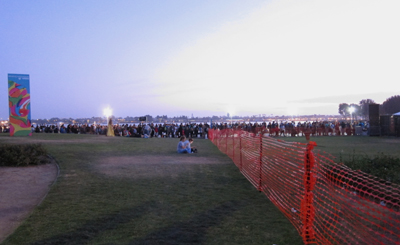
Hall H tends to draw much of the attention accorded to Comic-Con in the media. It’s the largest venue, with 6500 seats–including a large number reserved for representatives of the studios presenting publicity events there. That’s a big venue, but compared to the roughly 125,000 people attending the con each day, it’s not big enough. Although not everyone at Comic-Con wants to get into Hall H, most days the lines snake down and across the street, along the sidewalks. (A video moving along an entire Hall H line at a walking pace was posted on Youtube last year. It runs for over fourteen minutes, despite the fact that the people toward the front of the line are walking forward past the camera; if they were standing or sitting still, it would have run even longer.) In previous years the only way to guarantee getting into the hall for the first events of a day was to get there the previous evening and stay in line overnight. Short departures were possible if someone held your place, but basically you were there for the duration.
I was lucky enough to benefit from the innovation of a new policy on Hall H admissions. Color-coded wristbands would be handed out as the line formed, pausing at 1 am and resuming at 5am. The first portion of the line got a red band, with other colors for the next portions. The purposes were 1) the management could gauge how many people were lined up; 2) those in line could know whether they would get in or not; and 3) for the first time some people could leave for longer stretches of time than required for a rest-room break, as long as someone from their group with the same color wristband remained.
At least, that was how it was described in the online announcement. Those charged with distributing the bands and keeping order informed us that “a majority” of the group had to remain. To what degree that was enforced, we never learned. Fortunately that worked for Jonathan, Maria Elena, and I, since Rebecca had formed a “Hall H-line” group on Facebook and assembled a bunch of friends to camp out in line together. We adults, with our less flexible bones, departed for dinner and some sleep at our hotel. The next morning when we came to rejoin our group, the people in charge of keeping order asked if we had been to the rest room. Yes, we had. That and other things. Apart from everything else, the parking garage under the convention center has to be cleared after 10 pm, so the Kuntzes had to leave to get their car out. Clearly some clarifications of the guidelines are in order, but based on our experience the new wristband policy has improved the Hall H-line experience considerably.
The announced wristband-distribution schedule also had to be adapted. In the past, the Hall H line has started forming in the late afternoon or early evening, depending on the popularity of the first event scheduled for the following morning. Jonathan presciently went and got in line at 2:30 pm, and he was far from the first. Our party gradually grew as other members arrived, and inevitably groups ahead of us also swelled. Soon the line was very, very long. (A small portion of it is pictured above; the line had taken a U-turn a few hundred feet behind us, off right here.) Somewhere around 6:00 the wristbands started to be handed out, and small groups were escorted across the street to line up in the relatively luxurious area on the grass near the entrance to Hall H. There were white canopies overhead and the inevitable red plastic barriers dividing the area into rows approximately one reclining person wide. Those further back in line were less fortunate, having the sidewalk to call their bed. Our group of young stalwarts settled in for games, sleep, and an endless supply of trail mix and donuts. Rumor has it that anyone who arrived after about 9:30 pm didn’t get in. The last wristbands were handed out at around 2:30am. Presumably the handout did not pause at 1 am as planned, since clearly everyone who was going to get in when the hall opened was already there.
The next morning we received a call from Rebecca saying the group had been moved into the “chutes,” a process which had started at 7 am. These are slightly narrower strips of grass with the same plastic barriers; the chutes are opened one at a time, allowing the people in each to go in before the next chute is opened. More people are moved into the emptied chutes, and the process continues until the hall is full.
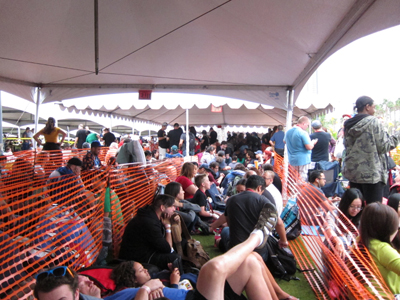
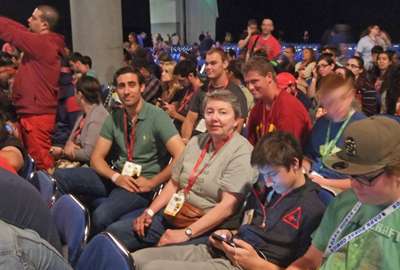
Although the handlers had said we would be let in at 9:30 for a 10:00 start, they got the process going at 9 am. By 10 we were all seated and ready for the Warner Bros. extravaganza to begin. There I am, wearing my vintage licensed Fellowship of the Ring T-shirt and the crucial pink wristband:
Expensive flash
Warner Bros. had two hours in Hall H on Saturday morning to promote their films. The full program is not announced in advance. People were assuming that The Hobbit: The Battle of Five Armies, as the biggest item on tap, would be saved for the end. That turned out to be correct.
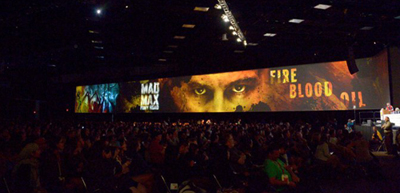
The event started with curtains sliding back to reveal a long, panoramic screen on either side of the big central one. This surrounded about the front half of the audience in a U-shaped set of images. Warners installed these screens at a cost of hundreds of thousands of dollars; naturally no other studios were allowed to use them.
Some short presentations opened the program, beginning with Zack Snyder coming onstage. He introduced Ben Afleck, Henry Cavill, and Gal Gadot, none of whom spoke. We saw a very brief clip from Batman vs. Superman. The two lead characters’ first meeting had them glaring at each other with glowing eyes, white and red respectively. (Naïve me, wondering why if they’re both good guys, they don’t just join forces to fight evil.) My main impression was that Batman looks like he’s wearing a small tank turret on his head. The fans were apparently pleased with what they saw.
The moderator then introduced Channing Tatum, who stood below the screen as a montage of footage from Jupiter Ascending was shown. This made no impression on me, and I have no memory of it, except that the big action scene looked pretty conventional.
The event really got going with a much longer promotion with George Miller talking about Mad Max: Fury Road. This used the side panels to good effects (above). David and I have been fans of Miller and the Mad Max series ever since Mad Max II (aka The Road Warrior in the USA) appeared. It was a treat to hear him talk about the new film, though what he said is pretty much what he has said in other interviews: there’s little CGI in the film, he storyboarded the whole thing rather than writing a script, it’s an attempt to do a continuous chase sequence for an entire film, etc.
Miller presented a montage of quick scenes from the film. It looked good but familiar. There’s Max, chained up on the front of one of the villains’ vehicles, as were some of the captives in The Road Warrior. A lot of the minor characters recall those of the same film. The digital image looked brighter and sharper than the previous films–not necessarily a good thing, since the three first films were muted, conveying a sense that everything and everyone was coated with dust. Unseasonal rains in Australia forced the new film’s shoot to move to Namibia, which looks like it stands in for the Outback pretty well. We must trust that, just as the first three films were significantly different from each other, this fourth film will have a unique flavor not apparent in the footage shown.
This was, by the way, the second preview I’ve seen recently of a film that imitates the awesome (in the old and literal meaning of that word) dust-storm in this well-known National Geographic clip online. And why not, though CGI can never equal the real thing in this case.
Hall H for Hobbit
Quasi-Spoilers ahead:
The second half of Warners’ slot was given over to The Battle of Five Armies. An opening blast of music accompanied the appearance from left to right of a panorama of images from all three Hobbit films:
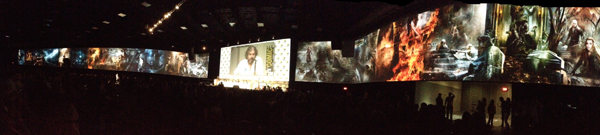
Even this fairly comprehensive view of the screens leaves out two or three images on the far right. The most revelatory of these shows Galadriel, Elrond, and Saruman at Dol Guldur, rescuing Gandalf. The panorama stayed up throughout the presentation. (A rather juddery pan around the whole things can be seen on Youtube.)
Steven Colbert, widely known as a devoted and highly knowledgeable Tolkien fan, MCed the panel, dressed in his costume from the third film, in which he has a nonspeaking bit part. He expressed his love for Tolkien and the films and showed the brief scene in which he appears. Then he introduced the impressive eleven-person panel Warner Bros. had managed to assemble:
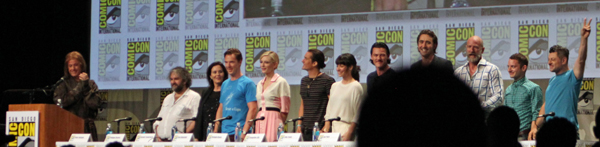
From the left, Colbert, Peter Jackson, Philippa Boyens, Benedict Cumberbatch, Cate Blanchett, Orlando Bloom, Evangeline Lilly, Luke Evans, Lee Pace, Graham McTavish, Elijah Wood, and Andy Serkis
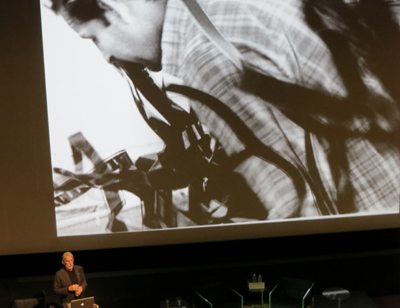
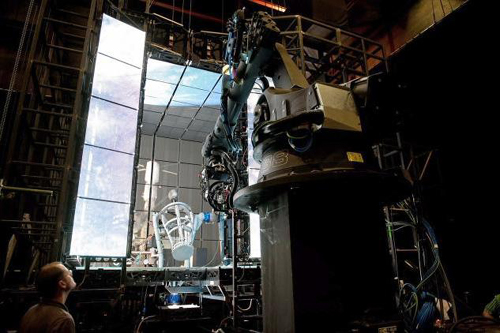
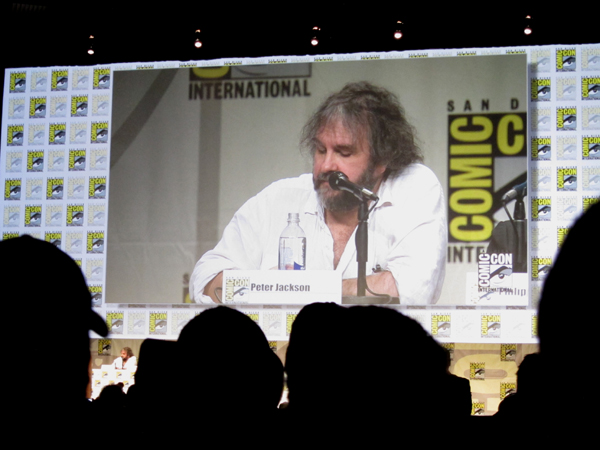
Of course, most of us couldn’t see them this clearly with the naked eye. Seated about a third of the way back in the auditorium, my view was as shown in the image at the top of this entry. Peter (that’s he in the lower left corner) looked mighty small in reality, but in Hall H three large screens magnify the proceedings for the crowd. (Similar video screens are used in the other very large auditoriums, notably the Indigo Ballroom.)
One highlight was the first screening of the long-awaited teaser trailer. This was released online two days later; the best place to see a large, sharp image that starts streaming almost instantly is on Peter’s Facebook page. I have to say that it looks pretty promising, apart from the continued presence of the distracting and tedious Azog and Bolg.
I won’t give a complete run-down on this panel, since a good video of it has been posted on Youtube (with the two screenings of the teaser trailer cut out). Much of it consists of typical star chit-chat. The most interesting thing said came from Peter. There has been considerable speculation among fans as to whether the filmmakers will stick to the book and let some characters die during the battle. Peter stated that the grim parts of the book are being retained and implied that several characters will indeed die. (This should mean that here will be much lamentation among the “hot Dwarves” aficionados.)
There has also been much speculation as to whether Peter Jackson or anyone else will be filming other adaptations of Tolkien’s work. This question wasn’t addressed during the panel, but the obvious answer is no. The production and distribution rights to The Hobbit and The Lord of the Rings were sold by Tolkien and his publisher Allen and Unwin to United Artists in 1969. Rather than placing a time limit on the rights, as is customary, they sold them in perpetuity, and any control over the use of those rights forever passed out of the hands of Tolkien and subsequently of his estate. His son Christopher Tolkien has objected to the films that have been made, and he quite possibly will find a way to prevent any sale of film rights relating to the other books, even after his death. The Silmarillion, which takes place primarily in the First and Second Ages of Middle-earth, is, I think, virtually unfilmable. The most filmable single work, The Children of Hurin, is unremittingly grim and would be unlikely to attract any support within the industry. Apart from all that, Peter probably has no desire to prolong the franchise, either as a director or a producer.
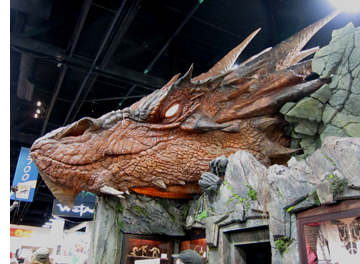
In short, we have almost certainly seen the final “Middle-earth” presentation at Comic-Con. I’m glad I was there to see it. The franchise as a whole will undoubtedly have a presence at Comic-Con for years to come. Weta Ltd. has become a major force in the world of film and its future seems assured in a way that it did not a decade ago, when Peter Jackson’s projects were its main customers. Weta Workshop now has taken over making the collectible figures not only for Peter’s work but for other films, and it develops its own original projects for collectibles, television, and publishing. Its booth this year (below) was considerably bigger than the one I saw in 2008. (See the top image here.) It was doing very good business every time I passed by. The full-size Smaug head (above right) attracted considerable attention.

It’s still the case that the vast majority of Comic-Con attendees are not in costume.
All photos down to the one of George R. R. Martin, plus the two of lines for Hall H and the Smaug head on the Weta booth were taken by me.
My camera failed me during the Fight Club panel, so I have borrowed one from Anie Bananie’s Tumblr site, “David Fincher Stole My Life.” The photo of the panoramic screen with the Mad Max image is by Albert L.Ortega for Getty Images and illustrates the Variety story linked as “Warners installed …” in the second paragraph below it.
I mentioned that I was at the con with my friends Jonathan, Maria Elena, and Rebecca. Jonathan and Rebecca provided all the photos taken inside Hall H. (That’s Maria Elena’s TA James Shetty beside me in the green shirt.) Rebecca took the photos of the TORn panel, and Jonathan the ones directly above and below.
Many thanks to Jonathan for booking me a San Diego hotel room while I was in Egypt this past spring, and to Rebecca and her Facebook group for heroically camping out and holding our place in the Hall H line.
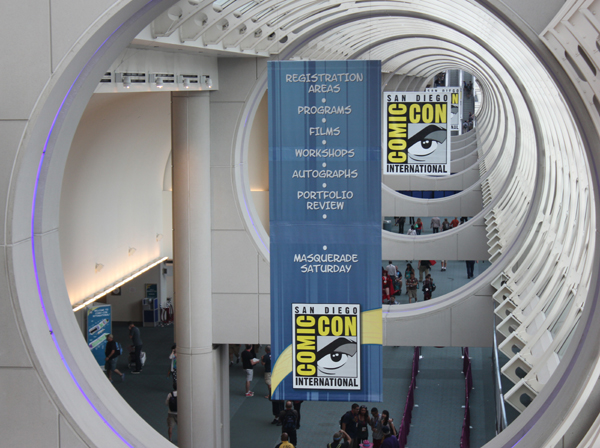
The San Diego Convention Center: an escalator’s point of view

Posted in Directors: Fincher, Directors: Jackson, Fans and fandom, Festivals, Film industry | open printable version
| No Comments »
Tuesday | July 29, 2014

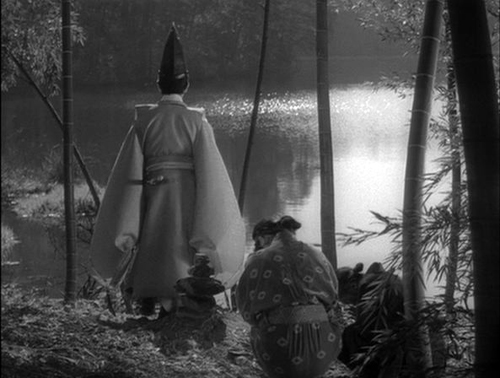
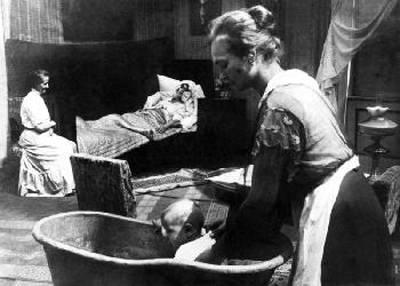
Der Tunnel (William Wauer, 1915).
DB here:
Being a cinephile is partly about making discoveries. True, one person’s discovery is another’s war horse. But nobody has seen everything, so you can always hope to find something fresh. There’s also the inviting prospect of introducing a little-known film to a wider community–students in a course, an audience at a festival, readers of a blog.
A festival like Bologna’s Cinema Ritrovato (we covered this year’s edition here and here and here) offers what you might call curated discoveries. Expert programmers dig out treasures they want to give wider exposure. Such festivals are both efficient–you’re likely to find many new things in a short span–and contagiously exciting, because other movie lovers are alongside you to talk about what you’re seeing.
A year-round regimen of curated discoveries is a large part of the mission of the world’s cinematheques. This is why places like MoMA, LACMA, MoMI, BAM, TIFF, ICA, and other acronymically identified showcases are precious shrines to serious moviegoing.
But other discoveries are made in a more solitary way. Film researchers, for instance, ask questions, and some of those can really only be answered by visiting film archives. Sometimes we need to look at fairly obscure movies. And despite the rise of home video, there are plenty of obscure movies that can be seen only in archives. It’s here that the programmers of Ritrovato and Pordenone’s Giornate del Cinema Muto come to select their featured programs.
Archive discoveries aren’t predictable, and many are likely to be of interest only to specialists. Such was the case, mostly, with our archive visits this summer. But as in years past (tagged here), all our archive adventures yielded pure happiness.
This time I concentrated on films from the 1910s-early 1920s films because I hope to make more video lectures about this, the most crucial phase of film history. (One lecture is already here.) In our archive-hopping, we saw films I was completely unfamiliar with. I re-watched some films I’d seen before and found new things in them. I detected some things of interest in films I hadn’t known. Most exciting was our viewing of a major film that has gone unnoticed in standard film histories.
In the steps of Jakobson and Mukarovský

Love Is Torment ( Vladimír Slavínský, Přemysl Pražský, 1920); production still.
First stop was Prague, where I was invited to give two talks. At the NFA we saw two films on a flatbed: a portion of Feuillade’s Le Fils du Filibustier (1922) and a cut-down version of Volkoff’s La Maison du mystere (1922), the latter a big gap in our viewing. The expurgated Maison came off as rather drab, lacking nearly all the big moments much discussed in reports like James Quandt’s from a decade ago. So we search on for the full version. . . .
As for the Feuillade: Le Fils du Filibustier was his last “ciné-roman.” Our two-reel segment, which seemed fairly complete, confirmed his late-life switch to fairly fast, Hollywood-style editing, with surprisingly varied angles.Again, though, we yearn to see the entirety of this pirate saga.
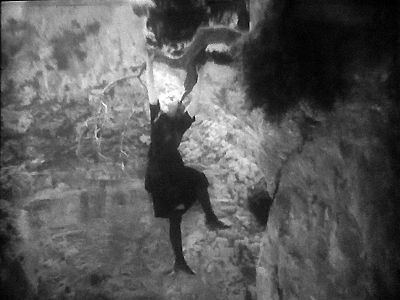
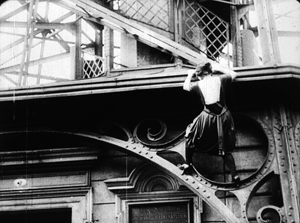
On another day the archive kindly screened several 1910s-early 1920s Czech films for us. Our hosts Lucie Česálková and Radomir Kokes translated the titles and provided contexts. Among the choices were Devil Girl (Certisko, 1918), with a protagonist who’s more of a tomboy than a possessed soul; and the full-bore melodrama Love Is Torment (Láska je utrpením, 1919). The plot, outlined here, involves scaling and jumping off a tower, twice. Once it’s a stunt for a film within the film, the second time (below) it’s the real thing.

Radomir explained to us that one of the co-directors, Vladimír Slavínský, seemed in his 1920s films to specialize in building two reels (often the third and fourth) in a “classical” fashion before letting the other three become more episodic. And indeed, most of the late 1910s-early 1920s films we saw were up to speed with other European filmmaking, in their staging, cutting, and use of intertitles.
We look forward to viewing more Czech films as the opportunity arises. A culture that gave us Prague Structuralism is definitely worth getting to know better. In the meantime, the journal Illuminace, edited by Lucie, is injecting a great deal of energy into local film studies, and the archive is entering a fresh phase with its new director, Michal Bregant.
3D excavations

Der Hund von Baskerville (1914).
In Munich, we reconnected with our old friends Andreas Rost, now retired from administering the city’s cultural affairs, and Stefan Drössler, director of the Munich Filmmuseum. We also reunited with the stalwart archivists Klaus Volkmer, Gerhard Ullmann, and Christoph Michel. Talking with them, we realized we hadn’t been back for over ten years. Klaus and Gerhard were warm and helpful during our earlier visits.
One rainy afternoon, Stefan shared his research on the history of 3D. He presented a spectacular PowerPoint, with rare images and some truly startling revelations. He has given this talk at intervals over the years, but it grows and deepens as he discovers more. Accompanying it, he screened some Soviet 3D films, including the 1946 Robinzon Cruzo. This mind-bending item was made with diptych images, so that the projected image turned out to be slightly vertical. The soundtrack runs down the middle.

The director, Aleksandr Andriyevsky, made excellent use of 3D to evoke the stringy vines and protruding leaves of Crusoe’s island. Amid all the talk today about glasses-free 3D, it’s interesting to learn that Soviet researchers prepared such a system. Stefan’s archaeology of 3D, for me at least, was a pretty big discovery.
At Munich we also saw three silent German titles. Two were associated that resourceful self-promoter Richard Oswald. Sein eigner Morder was a 1914 version of Dr. Jekyll and Mr Hyde, directed by Max Mack from Oswald’s screenplay. Shot in big sets, it spared time for the occasional huge close-up. The other film was Oswald’s semi-comic adaptation of The Hound of the Baskervilles (Der Hund von Baskerville, dir. Rudolf Meinert, 1914), which he had already turned into a play. The sleuth isn’t exactly our idea of Holmes (see above), and he isn’t as quick-witted, I thought, but it was an enjoyable item. Dr. Watson has a sort of tablet which picks up messages; Holmes’ orders are spelled out in lights on a grid. Stefan rightly called it a 1914 laptop.
As for the third film: More about that coming up.
The shadow of Hollywood

Les Deux gamines (1921).
At Brussels, thanks to the cooperation of the Cinematek, I was able to see several items for the first time, and two held considerable interest. The short The Meeting (1917), by John Robertson, showed a real flexibility in laying out the space of a cabin both in front of the camera and behind it. Most interior scenes in 1900-1915 cinema bring characters in from a doorway in the rear of the set (as Feuillade does in his 1910s films) or straight in from the sides, perpendicular to the camera (as Griffith tends to do). The Meeting shows that the diagonal screen exits and entrances that we see in exteriors were coming into use in interior sets as well.
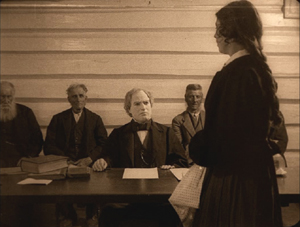
Another 1917 film, Frank Lloyd’s A Tale of Two Cities, was further support for the idea that American continuity filmmaking was well-established and already being refined at the period. Dickens’ classic tale is handled with dispatch–rapid exposition, smooth crosscutting to set up the plot lines–and the film makes dynamic use of crowds surging through well-composed, starkly lit frames. There are also some remarkably expressive close-ups, evidently made with wide-angle lenses.
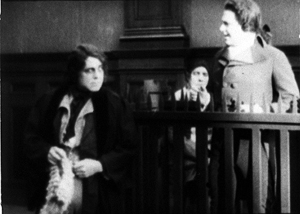
To clinch a plot point, the resemblance of aristocrat Charles Darnay to British solicitor Sydney Carton, the star William Farnum plays both characters. Not much of a problem if you keep the characters in separate shots; the good old Kuleshov effect (aka known as constructive editing) makes it easy. At this period, though, filmmakers were perfecting ways to show one actor in two roles within a single shot. The most famous examples involve Paul Wegener in The Student of Prague (1913) and Mary Pickford in Stella Maris (1918).
Cinematographer George Schneiderman contrives some really convincing multiple-exposures showing Farnum as both Darnay and Carton. There are some standard trick compositions putting Farnum on each side of the screen, but several images take the next step and let the actor cross the invisible line separating the two halves. At another point, we get a flashy passage showing the two facing one another in court, followed by a “Wellesian” angle of the two characters’ heads in the same frame.

Hollywood’s pride in photorealistic special effects, so overwhelmingly apparent today, has deep roots.
Part of my Brussels visit involved checking and fleshing out notes on certain films I saw many years ago. Some were wonderful William S. Hart movies like Keno Bates, Liar (1915; surely one of the best film titles ever). There was, inevitably, Feuillade as well. The influence of Hollywood was powerful in the ciné-roman Les Deux gamines (1921). This baby, released in 12 parts originally, runs nearly 27,000 feet. At 20 frames per second, it would take six hours to screen. What with changing reels, making notes, counting shots, pausing to study things, and taking stills, Kristin and I took about ten hours to watch it.
Was it worth it? An adaptation of a popular stage melodrama, it can’t count as one of Feuillade’s major achievements. Two girls are left alone when their mother is reported dead. They are adopted by their gloomy grandpa and tormented by his overbearing housekeeper. They become the target of kidnapping by gangster pals of their father, who has divorced their mother and turned to a life of petty crime. Their allies are their young cousins, a wealthy benefactor, and their godfather and music-hall star Chambertin. Everything ends happily, if you count the father’s redemptive sacrifice on behalf of a pregnant woman.
Les Deux Gamines is determined to delay its ending by any means necessary. Form here definitely follows format; Feuillade fills out the serial structure with plots big and small. (Shklovsky would love it.) There are incessant abductions, escapes, rescues, coincidental meetings, and timely reformations, plus at least three cases of people wrongly assumed to be dead. All of this is accompanied by an endless exchange of telegrams and letters. People are forever piling into and out of carriages, train cars, and taxis. Such material serves as makeweight for some genuinely big moments, including a cliff-hanging scene and a stunning climax in a smuggler’s warehouse stuffed with gigantic bales of used clothing.
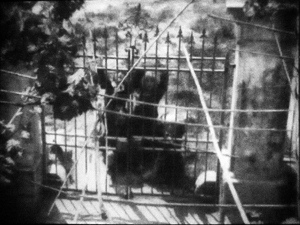
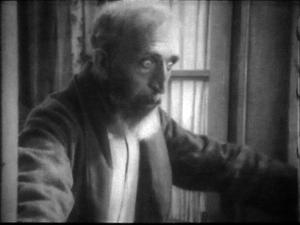
Like Le Fils du Filibustier, this film shows Feuillade trying to change with the times. The supple long-take staging of Fantômas and Les Vampires and Tih-Minh mostly goes away, to be replaced by rapid editing. Feuillade employs standard continuity devices, as when the grandfather discovers that the kids have sneaked out at night and are trying to return by scaling the gate.


Feuillade varies his angles and lighting to accentuate the moment of visual discovery. Elsewhere, some appeals to “offscreen sound” (cutaways to doorbells and telephones) built up to a surprise effect.
But by the energetic standards of, say, Robertson or Lloyd several years earlier, Les Deux gamines is fairly timid. Feuillade doesn’t explore editing resources very much here, not even as much as in Le Fils du Filibustier. The fairly quick cutting pace stems partly from the stratagem of having dialogue titles interrupt static two-shots of characters talking to one another. This sort of proto-talkie-technique yields efficient storytelling but not much visual momentum. Feuillade tried flashier things in other films of the period (see here).
Hours and hours of nothing but Bauers

The Alarm (1917).
Yevgeni Bauer, one of the master directors of the 1910s, remains lamentably unknown. About two dozen of his over seventy films survive, but many of the ones we have lack intertitles. A few of his films are available on DVD (most obviously here; less obviously here). He died of penumonia in 1917, between the February revolution and the Soviets’ coup d’état in October. He was only 52.
My first archive-report entry back in 2007 recorded my interest in Bauer, and I’ve returned to his films over the years. Now here I was watching some again, confirming things I found of interest then, and discovering (that word again) new felicities. I hope to say more in those short video lectures on the 1910s, but I can’t leave without giving you a taste of his qualities.
Two of the films I saw this time were from 1917. The Alarm (Nabat) came out in May 1917, just before Bauer’s death in June. Originally running eight reels, it was cut down after the initial release, and that’s evidently the version we have. For Luck (Za Schast’em, September 1917) was directed by Bauer from his sickbed. Both films are fairly hard to follow. The Alarm lacks intertitles, and For Luck has many fewer than it had originally.
The two films are of exceptional interest, though. For one thing, there’s the involvement of Lev Kuleshow, who at the age of eighteen served as art director for the earlier film and, apparently reluctantly, as an actor in the later one. More important, the films remain as beautifully designed, staged, and acted as ever.
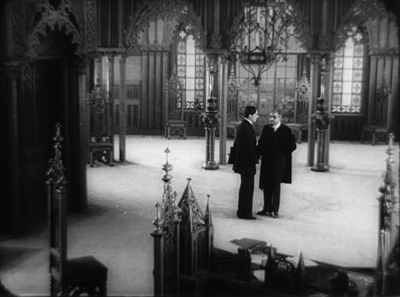
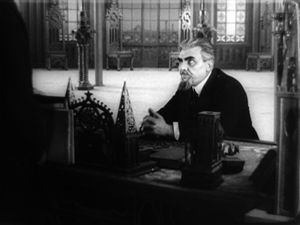
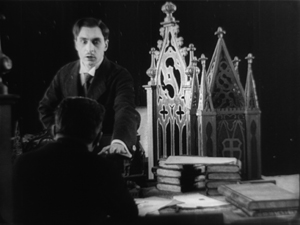
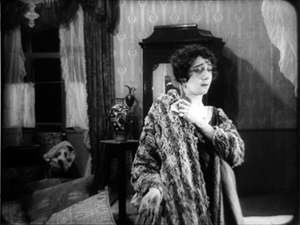
The Alarm is a wide-ranging drama set before the February upheaval. The drama involves romantic intrigues among the upper class, interwoven with a workers’ rebellion against a master capitalist. The millionaire Zeleznov holds court in a vast office with chairs bearing ominous spires and spiky arches; the windows open onto a view of his factory. A long-shot view is above; here’s a sample of how Bauer shows off his decor in something akin to shot/ reverse-shot.

The idea of capitalism as an overreaching religious striving is evoked by turning Zeleznov’s headquarters into a Symbolist cathedral. And looking at the second shot, you wonder whether Kuleshov’s inclination to stage his own scenes against pure black backgrounds has its source in his work for the man he called “my favorite director and teacher.”
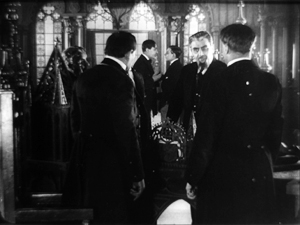
As ever, Bauer makes fluid use of depth. He choreographs meetings of Zeleznov’s brain trust in ever-changing arrangements, and he eases a man out of a boudoir through a mirror reflection over a woman’s fur-draped shoulder.

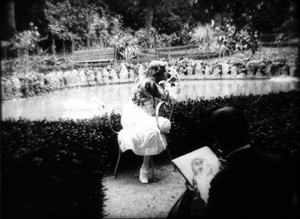
Compared to the scale of The Alarm, For Luck is decidedly low-key–a bourgeois melodrama that extends barely beyond an anecdote. Zoya has been a widow for ten years, and she hopes to marry the loyal family friend Dmitri. But Zoya’s daughter Lee hasn’t yet reconciled to losing her father. The couple hope that Lee has worked out her grief during her dalliance with a young painter (played by Kuleshov), but she reveals that all along she has hoped to marry Dmitri.
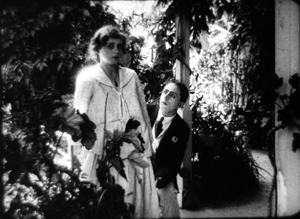
The Alarm used some extravagant sets, both for interior and exterior scenes, but a good deal of For Luck takes place in parks and terraces. The sincere Enrico sketches Lee in front of swans, and they steal some moments in a bower.

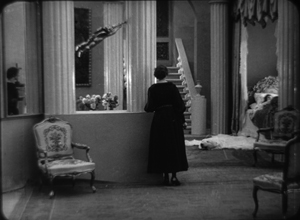
Still, there are some interiors boasting Bauer’s famous pillars and columns, which create massive, encapsulated spaces. Here Zoya looks off, in depth, at the ailing Lee, in bed on the far right.

Sharp-eyed Bauerians will notice the mirror set into the left wall, reflecting Zoya. Kuleshov, who did art direction on this as well as The Alarm, worried more about the trumpet-blowing Cupid floating between the pillars on the left. (“It turned out bad on the screen–incomprehensible and inexpressive.”) He did think that the tonalities of the set worked well: “As an experiment, I put up a set painted in shades of white that were ever so slightly different from one another.”
“Ever so slightly different” isn’t a bad evocation of the tiny variations of shape and shade, light and texture, that characterize Bauer’s ripe, sometimes overripe, imagery. This is a social class on the way out, but it leaves behind a great glow.
Tunnel: Vision

The Tunnel (1915).
In 1913, the popular novelist Bernhard Kellermann published Der Tunnel. It’s not quite science-fiction, more a prophetic fiction or realist fantasy in the vein of Things to Come. The book became a best-seller and the basis of a 1915 film directed by William Wauer.
The plot would gladden the heart of Ayn Rand. A visionary engineer persuades investors to fund building an undersea railway connecting France to the United States (specifically, New Jersey). No meddling government gets in the way of this titanic effort of will. Max Allan buys land for the stations, hires diggers from around the world, and risks everything he has. The obstacles are many. An explosion scares off workers; there is a strike; impatient stockholders raid and burn the company headquarters.
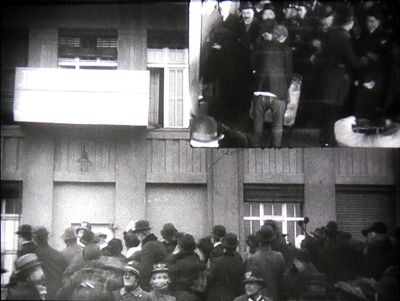
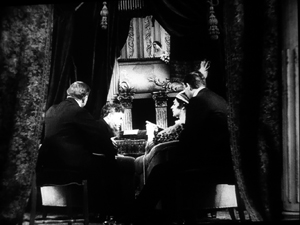
Max Allan moves forward undeterred, though he hesitates when his wife and child are stoned to death by a mob. After twenty-six years, the railway is opened. Max, along with his new wife (the daughter of his chief backer), proves it’s safe by taking the first transatlantic train. The event is covered by television, projected on big screens around the world (above). In the original novel, a film company was commissioned to document every stage of work.
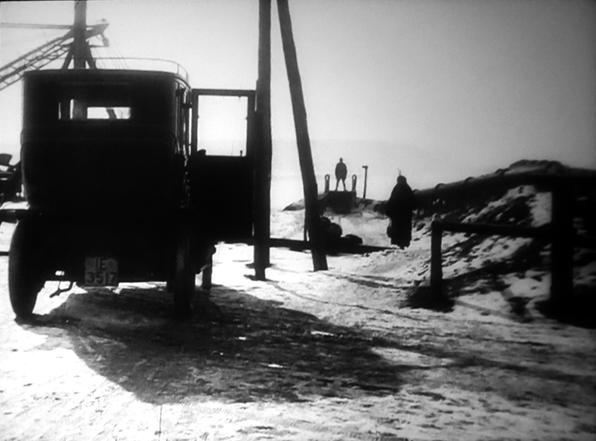
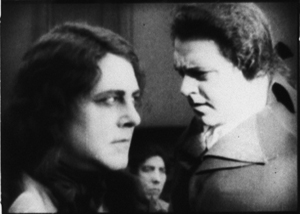
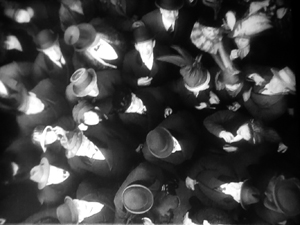
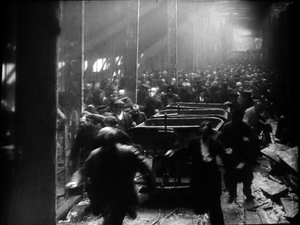
The book skimps on characterization, and the film is even less concerned with psychology. Once the character relations are sketched, Wauer goes for shock and awe. The Tunnel‘s thrilling crowd scenes of work, fire, devastation, riots, and panic look completely modern. Bird’s-eye views of stock-market frenzy anticipate Pudovkin’s End of St. Petersburg, and Wauer creates an Eisensteinian percussion of light and rushing movement as workers flee the tunnel collapse.


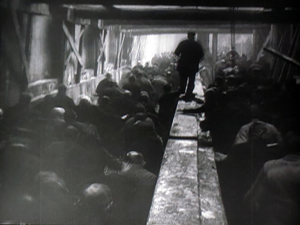
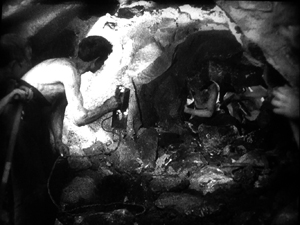
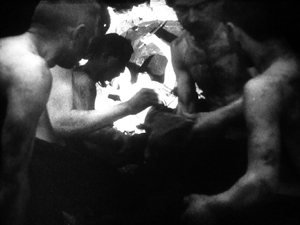
For the sequences showing the tunnel construction, Wauer supplies violent alternations of bright and dark as men, stripped and sweaty, attack the rock face. The variety of camera positions and illumination is really impressive.

Comparisons with The Big Film of 1915 are inevitable. The intimate scenes of The Tunnel are far less delicately realized than the romance and family life of The Birth of a Nation, and the battle scenes in Birth have a greater scope than what Wauer summons up. But Wauer’s handling of crowds is more vigorous than Griffith’s riots at the climax of Birth, and his pictorial sense is in some ways more refined, even “modern.” There’s little in Birth as daringly composed as the static long shot surmounting today’s entry.
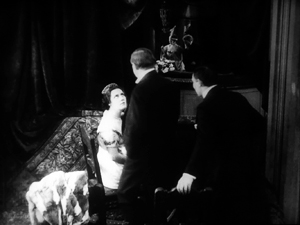
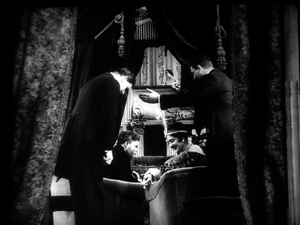
Wauer can handle small-scale action very crisply. The opening scene in an opera house creates low-angled depth compositions more arresting than Griffith’s depiction of Ford’s Theatre. Max’s wife, in one box, is watching his efforts to attract funding from the millionaire Lloyd. Wauer constantly varies his camera setups to highlight Max’s wife in the background studying Lloyd’s daughter, sensing in her a rival for her husband. Whether the angle is high or low, the wife’s presence in her distant box is signaled at the top of the frame.

The second and third shots above present similar but not identical setups, adjusted to reset the depth composition.
It was at Munich’s Filmmuseum a decade ago that I first encountered the brooding power of Robert Reinert’s Opium (1919) and Nerven (1919), the latter now available on DVD. I was convinced that Nerven was as important, and in some ways more innovative, than the venerated Caligari. Now the conviction grows on me that in The Tunnel we have another galvanizing, outlandish masterwork of the 1910s. I hope it will somehow get circulated so that wider audiences can discover it. Yeah, that’s the word I want: discover.
Without archivists, no archives. We’re grateful to Michal Bregant, head of the Czech Republic’s archive, for access to films and for his companionship during our visit. Thanks as well to Lucie Česálková, our host; her knowledgable colleague Radomir Kokes (who kindly corrected the initial version of this post); Petra Dominkova, our Czech translator; and Vaclav Kofron, editor of the Czech versions of our books. Lucie supplied the frame enlargement from Love Is Torment. As well: Good luck to the Kino Světozor!
In Munich, we owe a huge debt to archive chief Stefan Drössler, for his generous sharing of information and his and Klaus Volkmer’s rehabilitation of The Tunnel. Stefan also provided the images from Robinson Crusoe and The Hound of the Baskervilles. Coming up is his work for the annual Bonn International Silent Film Festival, 7-17 August. Thanks as well to Gerhard Ullmann and Christoph Michel.
In Brussels, as ever, the Cinematek has made us welcome, and we thank archive director and long-time friend Nicola Mazzanti and vault supervisor Francis Malfliet. Over the last thirty years, a great deal of our research has depended upon the cooperation the Cinematek leadership: Jacques Ledoux, Gabrielle Claes, and now Nicola.
My quotations from Kuleshov come from Silent Witnesses: Early Russian Films, 1908-1919, ed. Yuri Tsivian and Paolo Cherchi Usai (Pordenone: Giornate del Cinema Muto, 1990), 388-390.
There’s a chapter on Feuillade in my Figures Traced in Light, where Bauer is discussed as well. My essay on Robert Reinert is in Poetics of Cinema.
Thanks to Antti Alanen for correction of a misspelled title. Speaking of discoveries, you’ll find plenty on his wonderful Film Diary site. During his recent trip to Paris, he’s writing about art exhibitions, Dominique Paini’s Langlois exposition at the Cinémathèque, and Godard’s Adieu au langage.

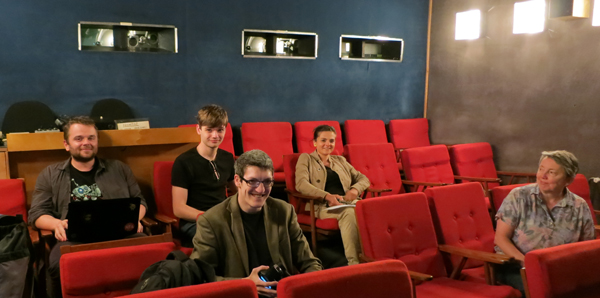
Screening at the Czech Republic’s National Film Archive. From left: Michal Večeřa, Tomáš Lebeda, Radomir Kokes, Lucie Česálková, and Kristin.
Posted in Directors: Bauer, Directors: Feuillade, Film archives, Hollywood: Artistic traditions, National cinemas: Eastern Europe, National cinemas: France, National cinemas: Germany | open printable version
| No Comments »
Sunday | July 27, 2014

DB here, sort of:
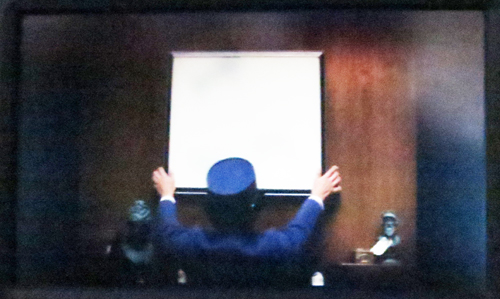
Even doggedly determined readers of this blog may not have seen the codicil to my infuriatingly long entry on The Grand Budapest Hotel. I revisit those remarks now, only because coming back from my trip to Yurrrp, I have evidence of a version that many cinephiles may not see. Here’s what I appended to the old post:
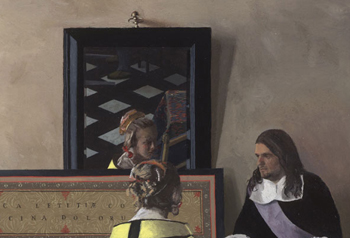
Flying here the other evening, I watched The Grand Budapest Hotel on the plane, just to see what adjustments might have been made. (“This film has been modified to fit this screen and edited for content.”) Surprisingly, the aspect ratios were all preserved. The cuss words were cut out, as was the fellatio shot (but not the guillotined fingers). The most startling change was that the painting of female sexual congress had become a big, blank white one in the Rauschenberg mold. Was it an alternative shot for the airline version, or was the naughty one digitally whitewashed?
Flying back, diligent film researcher that I am, I took a shot of the bowdlerized image. My questions remain. I could imagine it as an Anderson joke, but also as a default for a censorious post-production.
Sorry about the image quality. No way to take a frame enlargement.
Posted in Directors: Anderson, Wes, Film industry | open printable version
| No Comments »
Sunday | July 20, 2014

DB here:
“An auteur is not a brand,” argues Richard Brody. Not always, I’d suggest; but it can happen. And it’s not necessarily a bad thing.
Wes Anderson has found a way to make films that project a unique sensibility while also fitting fairly smoothly into the modern American industry. He has his detractors (“I detest these films,” a friend tells me), but there’s no arguing with his distinctiveness. The Grand Budapest Hotel is perhaps the most vivid example of Andersonian whimsy as signature style.
In any case, before summer’s end I want to look at the auteurish aspects of another Anderson film. Whether you admire him, abominate him, or have mixed feelings, I think that studying this film can show us some interesting things about authorship in today’s film culture.
Toy worlds

When I’m making a movie, what I have in mind, first for the visuals, is how we can stage the scenes to bring them more to life in the most interesting way, and then how we can make a world for the story that the audience hasn’t quite been in before.
Wes Anderson
A film auteur is often described as having a characteristic tone, an attitude, and recurring themes. But we also find more tangible marks of authorship. One is a tendency to create distinctive story worlds. Hawks gives us milieus filled with stoic, sometimes grimly resigned professionals. Scorsese presents manic, sometimes vicious worlds that encourage his protagonists to go too far.
If the auteur’s story world is the what, plot patterning and cinematic narration give us the how. How are the actions arranged to create an arc of engagement? How are the events rendered in film style—the texture of images and sounds?
It seems clear that no auteur can be absolutely unique; each one works with norms and conventions given by tradition. For instance, a great many US independent films subscribe to the Hollywood convention of the goal-driven protagonist. Moonrise Kingdom accepts it too: Sam and Suzy want to be together, and their aims propel the action. Anderson and co-screenwriter Roman Coppola even give us the classic formula of lovers, kept apart by society, who escape to freedom in the wilderness. Likewise, the film maintains the convention of multiple lines of action: it creates parallels between the idealistic Suzy-Sam romance and the pallid routine of her parents’ marriage, as well as the hint of emerging affection between the phone operator Becky and Scoutmaster Ward.
Like a mainstream film, Moonrise Kingdom is at pains to build the plot toward a crisis—the second elopement of the couple and the massive storm that hits the region. The film turns the storm into a deadline: It will hit, says Bob Balaban’s narrator, “in three days’ time.” And as in a classical Hollywood film, the couple’s problems are solved and we get an epilogue showing their happy, if somewhat covert union.
Anderson has absorbed some lessons from mainstream cinema in more specific ways, I think. Since the Star Wars series (1977-on), we’ve seen Hollywood ever more eager to try “world-making”—adapting the traditions of fantasy, science-fiction, and comic books to creating fairly separate realms governed by their own rules. Batman and Superman adaptations of the 1980s and after followed this line, with Lord of the Rings proving that world-making could sustain long-running franchises (Harry Potter, the Marvel universe).
Anderson follows Lucas in creating his own worlds, but outside the conventions of space opera. We can find more or less parallel worlds in The Royal Tennenbaums and The Life Aquatic with Steve Zissou, but Moonrise Kingdom may be the most elaborate example. It takes place in terra incognita, a cluster of imaginary islands presumably on the upper Atlantic coast. The name of the primary island, “New Penzance,” reminds us of the fantasy-worlds of Gilbert and Sullivan. There are make-believe Amerindians (Chickchaws) and the Khaki Scouts are parallel to the Boy Scouts, with Accomplishment Buttons instead of Merit Badges. The Scout regalia are given us in the sort of fussy detail that Anderson has long enjoyed.

Parts of the story are relayed by a gnome-like Narrator whose range of knowledge includes past, present, and future. He suggests a fairy-tale wizard or bard. An ancillary film tells us that he’s the librarian of New Penzance—the tribal chronicler as small-town administrator. (The existence of this short film serves to reinforce the pretense that New Penzance exists.) Then there are the young-adult books that Suzy carries with her. They’re fictitious but they get strongly tagged to aspects of the action. The books and the scouting gear take on the same solidity as retro details like Suzy’s battery-powered phonograph and Sam’s jar of Tang: 1965 stuff is recruited to flesh out Anderson’s miniature world.
Suzy’s books remind us that New Penzance, like other Anderson story worlds, is redolent of childhood. The film’s opening presents a family’s home as a dollhouse filled with toys and games. Once we’ve seen the fabric pictures rushing past on the walls, the landscapes they preview retain a miniaturized quality.

Those landscapes themselves have a childish defiance of gravity, as when we’re introduced to the poles at the tidal canals and when the Scouts build their tree house improbably high. This motif of top-heaviness eventually yields a sight gag when we learn the implausible fate of Redford’s motorcycle.

Childhood is everywhere. The music we hear in the opening is Britten’s Young Person’s Guide to the Orchestra, played by three little brothers on a phonograph and narrated by a child for one of Leonard Bernstein’s Young People’s Concerts. Throughout the film we hear grownup music designed for kids, such as bits of Bernstein’s rendition of Saint-Saens’ Carnival of the Animals.
Benjamin Britten’s music is central to the film’s soundtrack, from his juvenilia (Simple Symphony, songs from Friday Afternoons) to his later opera A Midsummer Night’s Dream and its chorus of child fairies. A performance of Britten’s church parable Noye’s Fludde is the occasion of Sam’s first encounter with Suzy, and it prophesies the devastating storm of a year later. Carrying this kid-friendly ethos further, Anderson designs his closing credits so that Sam’s voice-over can anatomize Alexandre Desplat’s score, instrument by instrument.
If Britten suggests childhood vitality, the mournful Hank Williams tunes evoke adult disappointment. They’re associated from the start with the lonely, not-overbright Captain Sharp. When Sam’s canoe odyssey is accompanied by the fantasy Williams song “Kaw-Liga,” about a wooden Indian yearning for the carved woman across the street, Anderson suggests a parallel between two lonely, yearning males, and tagging it to Sam prefigures his eventual alliance with his surrogate father.
A tradition of twee

The density of this childish New Penzance, like that of other DIY cinematic worlds, supports a tendency I talked about in The Way Hollywood Tells It. For some time now, filmmakers have been filling their films with details that can be discovered on re-viewing, particularly on the DVD format, which allows us to stop and study a frame. The musical citations I just mentioned can be researched after an initial viewing, and perhaps cinephiles will notice that the therapy book’s cover is a riff on Saul Bass’s credit sequence for Bonjour Tristesse (like Françoise Hardy, a link to Left Bank pop culture).

Still, on the first pass we’re unlikely to notice that the stamp on Sam’s postcard to Suzy bears the likeness of Commander Pierce.

Likewise, only after many viewings did I notice that the peculiar flaming-scissors abstraction during the skirmish in the woods is given the same design as that on the motorcycle and helmet of the despicable, and rightfully lacerated, Redford.

And in the epilogue, we might spot that Sam, having cast off his Accomplishment Buttons, has kept his mother’s pin on his new Island Police uniform.

Art and commerce again: What exec could object to loading every rift with ore when it supports ancillary sales to the fan faithful?
Some people find an inward-turned world like this to be fey, coy, twee, infantile, precious, or self-indulgent. It seems to me, though, that Anderson’s work from The Life Aquatic onward links up with a literary tradition we associate with J. M. Barrie and G. K. Chesterton. These writers employed childhood fantasy in an effort to imagine a richer, livelier realm behind prosaic reality. Another kindred spirit would be Winsor McCay, like Anderson an obsessively meticulous stylist who gives heft and lilt to dream worlds. In cinema we might recall Greenaway’s The Falls (1980), as obsessive and precious a project as can be imagined.
Indeed, why not mention the most famous figure of all? There is a trace of Lewis Carroll in Moonrise Kingdom’s looking-glass world—its strangely safe tree house, its deadpan absurdity, the habit of lawyers talking as if always in court. Like Carroll, Anderson doesn’t shrink from cruelty; the death of Snoopy is as perfunctory as that of the oysters on which the Walrus and the Carpenter tearfully dine.
Significantly, modern efforts to reenchant the world are often framed by loss. Wendy comes back from Neverland, Little Nemo awakes with a thump, Alice must return to lazy and boring afternoons. Anderson too evokes the fading of enchantment. Moonrise Kingdom takes place at the onset of autumn, and Suzy’s family lives at Summer’s End. Unlike other modern explorations of faerie, however, this one lets its characters wake up in something approximating their dream life.
Day by day, with interruptions

In accord with the child-based story world, the plot of Moonrise Kingdom provides something of a modern fairy tale. A runaway orphan who retains a token of his parentage heads out for the wilderness. A princess imprisoned in a tower scans the horizon for her rescuer. Lovers exchange messages before they escape into a realm of danger and death. They are rescued by a beneficent authority who will allow them to stay together.
Of course it’s a meta-exercise, since its authors and audiences are self-consciously deploying fairy-tale conventions. But as Barrie and Chesterton and Carroll show, enjoyment of artifice is central to art. Anderson accordingly stylizes both his plot structure and his narration.
He has long been drawn to block construction, building his plots out of big chunks that are often signaled explicitly. In Moonrise Kingdom, the chunks divide up in unusual ways—part, again, of this auteur’s cinematic signature.
At first we might think we can just track the adventure day by day. On 2 September 1965 Sam goes AWOL from scout camp and Suzy sets out with her belongings. On 3 September the couple fend off their pursuers—the battle of arrow, BB gun, and scissors—and make camp on Mile 3.25 Tidal Inlet. There they swim, dance, and spend the night. On 4 September they’re captured and separated.
But that night the scouts help them escape again, and all head for New Lebanon. The “marriage” of Sam and Suzy on the 5th leads to their flight to Saint Jack Wood Island just as the storm hits. Before they can make a lovers’ leap from the church steeple, Captain Sharp rescues them and arranges to be Sam’s foster parent. These four days are sporadically marked by changes from day to night and some remarks, as when Scoutmaster Ward dictates into his tape recorder. An epilogue is reserved for 10 October.
Running athwart the day-by-day divisions are other blocks. Actually, the first day is shown us three times, via shifts in narrational attachment. First we’re with Scoutmaster Ward, his charges, and Captain Sharp, all of whom are searching for Sam. After Ward dolefully ends his audio diary entry (“Let’s hope tomorrow is better”), Anderson cuts to Sam in the stolen canoe.

You might think this scene of Sam paddling is taking place the next day, but actually it skips back to the morning of the 2nd, when he sneaked off. Thereafter we’re attached to him when he meets Suzy in the meadow and they share their first day on the run. Then the plot skips back again to earlier that night, when Mrs. Bishop calls Suzy to dinner and discovers that she’s gone.

The 2 September section is even more complicated than I’ve suggested. When Suzy and Sam rendezvous in the meadow, their encounter is interrupted by a flashback to their first meeting a year earlier (signaled by a title). Later, the Bishop-centered evening section is interrupted by another block, a flashback montage triggered by Mrs. Bishop’s discovery of the couple’s love letters.

Here Anderson provides important backstory paralleling the two kids’ reasons for running away. Sam is bullied by the older boys in the foster-family-compound run by the Billingsleys, and Suzy blows up at her parents and schoolmates. By the end of the third iteration of 2 September, all the major forces in the drama have been delineated.
The two expository flashbacks give us more reason to care about Sam and Suzy in the following scenes, particularly during their skirmish with the Khaki Scouts squadron. Redford’s bullying ways, ignoring Ward’s orders to avoid violence, earn him a lumbar thrust from Suzy’s scissors, and it’s a mis-aimed arrow that wipes out poor Snoopy.
The couple’s idyll, presented as more or less another block, becomes the center of the film. It ends, at the midpoint of the running time, with Suzy reading: “Part Two.”
After they’re captured, Mr. Bishop vows to keep Suzy from Sam. Worse, Captain Sharp learns that Sam is headed for an orphanage and maybe shock therapy. This will encourage Sharp to defend and rescue the two kids at the climax.
With this crisis looming, the plot gives us a sort of nocturne on the evening of September fourth and the dawn of the fifth. In the night, all the players mull over what has happened: Suzy and her mother, Sam and Captain Sharp, Mr. and Mrs. Bishop, and Scoutmaster Ward. But this isn’t merely downtime. The Scouts in their treehouse decide they’ve treated Sam unjustly and set out to help the couple. This decision propels the climax.
By the morning of the final day, Sam and Suzy are reunited and ready for their mock marriage. All that remains is for the storm to disrupt things (even giving Sam some shock therapy by lightning), but also to set things right. The epilogue shows the new stable state of the story world, tying together the plot action neatly. Scoutmaster Ward, reinstated from disgrace, has replaced Captain Pierce’s picture with Becky’s. Sam has a foster father, and he can covertly see Suzy every day.
The magic power of binoculars
Narration involves the moment-by-moment flow of story information, organized around the key question: Who knows what, when?
A simple example: Early in the film Suzy finds a letter in the family mailbox. She takes it to the bus shelter and reads it. When she’s done, she looks up resolutely at us and slips the letter into a shoe box.

What was in the letter? The narration has suppressed that information, stirring up curiosity and preparing us for what, many scenes later, Mrs. Bishop will reveal when she finds it: Sam’s final message about their rendezvous. Moreover, the narration flaunts its suppressiveness: She looks at us as if insisting that the message is private.
Unlike the letter scene, which suppresses information, the opening tours of the house give us a fair amount, but we’re not yet in a position to understand it. This applies to our glimpses of the scissors and the New Penzance locations, but there’s also the vertically rising shot showing Suzy’s suitcase in the attic along with her cat peeping out of the fishing creel.

This becomes significant only later, when we realize that Suzy is preparing to bolt.
The narrational process mobilizes film style, both visual and auditory, to engage us in a constant process of expectations—stated, prolonged, fulfilled, or cheated. Consider Suzy’s binoculars. Early in the film we see her looking through them, but we don’t see what she sees. What is she looking at? Or looking for? Soon enough we’ll see that she manages to learn of her mother’s affair with Captain Sharp.

Once we’re set up for the binoculars device, Anderson can use it elliptically. In the meadow we see Sam through binoculars, so we’ll assume that Suzy is looking at him, even if Anderson doesn’t show the customary head-on reverse shot of her.

In effect, this image of Sam is the answering POV shot that has been missing in the early sequences.
But at the climax, when Sam rushes back to camp to fetch Suzy’s binoculars, he’s again caught in their field of view. This immediately leads us to ask: Who’s watching him? Anderson has stuck to Sam in the scene, so we get a gratifying surprise when we learn that the odious Redford has grabbed the glasses and is watching Sam’s search.

Or consider the film’s opening as a narrational gesture. The toy world that the tracking shots present is packed with story information. The very first image shows a fabric version of the Bishops’ house, flanked by Suzy’s left-handed scissors; the picture will soon be echoed by an establishing shot.

Shot by shot, the film channels information in order to set up expectations, to prolong them, to confirm them, or to deflate them. This is how cinematic narration can engage us.
The gnome-like narrator is another source of information. Anderson has compared him to the Stage Manager in Our Town, who can address the audience but also interact with other characters. His opening explanation supplies factoids about this imaginary landscape, while foreshadowing things explicitly (the storm) and implicitly, as with this image that looks forward to Sam and Suzy’s interlude at Mile 3.25 Tidal Inlet.

Narration doesn’t just pass along information; sometimes it suppresses it. It can point out when it’s hiding something, as when the film refuses to show us Suzy’s letter. Sometimes information is noticeably incomplete, as when only bits of Suzy’s and Sam’s correspondence are relayed to us. Another instance is the elliptical handling of the Khaki bullies’ attack on the couple, with a glimpse of an arrow and Paul-Sharits-ish flashes of scissors. Only quite a bit after the assault do we see the damage.
At other moments a film’s narration can create an informational gap that it doesn’t fill, only to do so later. During the central idyll Moonrise Kingdom omits a crucial piece of information and puts it in place only at the very end.
Down the aisle and face to face
Cinematic narration involves stylistic choices as well, and here again Anderson has sought an identifiable look and feel. In an earlier entry on The Grand Budapest Hotel, I talked about his adherence to planimetric images, the tendency to fix the camera at right angles to a background plane and then arrange figures either horizontally, like clothes on a line, or in profile.

Likewise, Anderseon employs what I’ve called compass-point editing. He usually puts the camera between the characters so that they face us in shot/ reverse-shot.

Or he films the action from straight-on, straight-back, or at a right angle. This geometry can be extended to camera movements: moving lateral and parallel to the planes of the shot, or panning at right angles, or zooming along the lens axis. Another extension is the straight-down angle, which is another variant of shooting at a different right angle to the action.

Planimetric shots and compass-point editing aren’t absolutely new with Anderson, but he uses them more thoroughly than most other filmmakers do. They govern his staging to the extent of pushing him away from realism. How plausible is it that all the Khaki scouts would line up on one side of the picnic table? Or that Ward wouldn’t notice, in a later scene, that all of them are gone?

Anderson’s use of such imagery evokes silent-film comedy, especially the compositions of Keaton, but these shots also suit a fairy-tale world. The stylized naivete of these compositions recalls children’s drawings, which tend to spread figures out against a flat background. (This was prefigured in the squashed perspective of the Bishop house as portrayed in the fabric picture.)
When a director commits to a particular style, he or she may have limited choices on other fronts. A good example is the climactic confrontation of all the adults in the St. Jack Wood church. Anderson might have staged this in many ways, but his stylistic preferences make the central aisle the most feasible arena. So we get the groups facing one another, in reverse-angle depth, moving from one planimetric composition to another, the cutting being either 180-degree reverses or simple axial cuts (zero-degree changes of angle). Sometimes the actors pivot to provide foreground profiles and frontal faces in the distance.


Once you the filmmaker embrace such a marked style so thoroughly, how can you signal special moments? In Moonrise Kingdom, Anderson does this by reverting to more commonplace technical choices.
When Suzy and Sam meet in the dressing room in 1964, we get straightforward 180-degree reversals.

And when they re-meet in the meadow, we get a mixture of profile and head-on shots.


But then Anderson starts to exempt them from the usual spatial strictures. The correspondence montage, for instance, retains the perpendicular framing but decenters his protagonists in mirror-image fashion.

As they get to know one another on their camping trip, the facing-front staging becomes less severe, more modulated.

And finally, when they admit their love to each other, Anderson gives us conventional ¾ views of faces and over-the-shoulder angles. These setups are reiterated when they embrace and dance.


At an emotional peak, Anderson sharply violates the film’s intrinsic norm by bringing in a common technique—which now gains a force it doesn’t customarily have.
Summer’s end

The epilogue recapitulates both narrative and stylistic features. There’s another lateral tracking shot of the Bishop house, but now Sam is painting in a space that was empty at the start.

Again Suzy is using her binoculars, but now, dressed in cheery yellow, she has something worth seeing.

On the soundtrack we hear Britten’s “Cuckoo” song, a reiteration of the summer’s-end motif. The cuckoo, born in spring, enjoys the summer but must eventually fly. As we hear this over Sam’s departure through the window, Anderson’s camera slides down to reveal that Sam’s picture presents a landscape that has now vanished.

Here is the big ellipsis that Anderson didn’t flag in the central idyll. When Sam was painting a stretched-out Suzy at Mile 3.25 Tidal Inlet, they had agreed that the name of the place was insipid. She says she’ll think of a new name. But we’re told no more about the matter. In the epilogue, when we see Sam’s picture, we realize that they have given the place a better name: Moonrise Kingdom, inscribed in white on the shore.
“This is our land!” Sam had shouted when they looked out at the inlet. Like Anderson’s imagining of a parallel world of childhood, Sam has recreated, in the manner of modern fairy tales, something that is gone. As if in sympathy with the gesture, the film’s closing shot updates one that was given us during the scenes on the shore, with the yellow pup tent now pitched as the mist rolls in.

Did the couple really write MOONRISE KINGDOM on the shore during their stay? Hard to say. What matters is that, provoked by Sam’s picture, the film’s narration concludes by asserting the power of imaginative artifice.
Selling directors

Floating Real Scarab Beetle Earrings.
Thinking about auteurs has always obliged us to focus on the interchange between industrial demands and artistic aims.
In general, I don’t see an inevitable conflict between market demands and artistic expression. (I argue for this here and elsewhere.) True, often producers and executives and censors mangle creators’ efforts. But some directors know how to do what they want with what they have. For example, Hitchcock’s artistry benefited from his status as a celebrity director. He won substantial budgets and greater control of his work. And sometimes the suits’ demands improve a film (as I suggest here).
Historically, it isn’t easy to separate auteurs from their brands. Let’s assume that a branded auteur is one who is known to a broad public for certain qualities of his or her films. A simple measure would be an ordinary viewer saying “I like X movies,” where X is the name of the director.
Hitchcock is nearly everybody’s clear-cut example of an auteur, but by the time the Cahiers du cinéma critics were forging their conception of cinematic artistry, Hitch was a brand too. How else to explain the 1940s-1950s book collections bearing his name, or The Alfred Hitchcock Mystery Magazine, or the tag, “The master of suspense”? Hitchcock participated in this image-building with his jokey interviews, his walk-on appearances in his movies, and his reputation as a bland-faced prankster. Few directors today foster such shameless self-promotion. Also branded were Chaplin, Disney, Welles, and Cecil B. DeMille. Among the cinephilic public there was recognition of Huston, Sturges, and a few other hands.
Of course many of the auteurs discovered by the Cahiers critics were unknown to the public at large, and they didn’t make profitable pictures. In 1940s Hollywood, the successful Lang was Walter, not Fritz. But as the film industry developed, and as auteur criticism became prominent, directorial distinctiveness became a marketing angle. By the 1970s, the movie brats, along with older hands like Altman, were presenting themselves as having “personal visions” carried by their films.
More recently, US independent cinema has come to depend on several appeals (sex, social comment, and the like), but surely authorship is a central one. The indie scene exploits the signatures of directors as different as Lynch, Jarmusch, and Paul Thomas Anderson. The emergence of younger talent like Nicholas Winding Refn and Kelly Reichardt conforms to a similar pattern; people follow and support emerging directors, and distributors publicize the films that way. No wonder James Schamus, founder of Good Machine and late of Focus Features, once remarked: “I’m in the business of selling directors.”
This is just a fact of life for ambitious independent filmmakers. Wes Anderson’s cultivation of a distinct style is probably partly a genuine reflection of his personality and partly a matter of willed self-presentation. But of course we’re all indulging in self-presentation, using Goffman’s “impression management,” every time we interact with others.
Like an indie band, Anderson has created a marque unusual enough to let the fans feel they’re in on something keyed to their nonconformist tastes. He has provided the usual panoply of ancillary items, like soundtracks and bonus DVD tracks, but he has allowed others to participate in his world. Amateur videos comment on his style; graphic artists render their own versions of his posters. There are dozens of unlicensed Moonrise Kingdom tchotchkes. Anderson’s willingness to permit all manner of “tribute” memorabilia fits the handmade quality evoked by his films.
Call it Geek Chic if you want, but it exemplifies an important and potentially valuable part of modern popular culture. For such reasons, I don’t see anything inherently bad about being an auteur with marketing possibilities. People don’t seem to object to David Lynch’s coffee and his nightclub. With eccentricity, spontaneous or willed, all is permitted.
My argument assumes that the term “auteur” picks out something neutral. For some people, though, it’s not a description but a compliment; there can be no bad auteurs. But I think we can have both weak auteurs—filmmakers distinguished only by technique or tone or narrative strategy—and downright bad ones as well. I have my own list.
This piece is based on a talk I gave earlier in July at the Hochschule für Fernsehen und Film in Munich. Thanks to Andreas Rost and Michaela Krützen for arranging my visit.
In the New Yorker column I mention, Richard Brody develops an argument along a different line than mine. As I understand it, he’s replying to critics who claim that the auteur approach overrates individual creativity at the expense of collaborators. He’s also objecting to the expanding search for ever more auteurs, who turn out to be minor artisans at best. My remarks are focused on different issues.
For much more on Moonrise Kingdom consult Matthew Zoller Seitz’s indispensable The Wes Anderson Collection. Michael Newman’s Indie: An American Film Culture examines Anderson’s cinema as a development of the “Quirky Indie.” The fan-generated merchandise exemplifies what Henry Jenkins, in his book Textual Poachers, called “participatory culture.”
The three-part anatomy of film narrative I use here is explained in greater detail in this chapter from Poetics of Cinema and this blog entry.
My stills showing Sam’s painting and the extreme long shots of the shore can’t do justice to the originals; I tried bigger proportions, but the MOONRISE KINGDOM inscription remains hard to see. I have to assume that most readers have seen the movie, or will. The image below will have to do.
P.S. 21 July 2014: One sign of a distinctive authorial approach is that it can be parodied. James Fiumara writes to recommend the Saturday Night Live parody of Anderson, applying his style to domestic horror. “I frequently show this to students in discussions of both auteurism and genre conventions. The students all laugh at the parody and then I get them to try to recognize what the parody depends on (namely, their recognizing recurring styles and patterns distinct to Anderson films, recognizing the conventions of the horror home-invasion subgenre, and of course seeing the incongruity between Anderson’s films and the horror genre).” Thanks to James for the link.
P.P.S. 12 September 2014: Guillaume Campeau-Dupras writes to point me toward his 2012 blog on the film, which looks at the film from a perspective related to what Kristin and I have written about (but with many original ideas of his own). I think readers interested in Anderson would benefit from his entry.
P.P.P.S. 2 October 2020: The branding continues! See this story about Anderson-style buildings around the world. Here is a filmmaker who has truly changed how people see their environment.

Posted in Directors: Anderson, Wes, Film technique: Editing, Film technique: Staging, Independent American film, Narrative strategies, Readers' Favorite Entries | open printable version
| No Comments »
|