






Archive for the 'Film technique: Staging' Category
Hands (and faces) across the table
DB here:
In books and blogs, I’ve expressed the wish that today’s American filmmakers would widen their range of creative choices. From the 1910s to the 1960s (and sometimes beyond), US filmmakers cultivated a range of expressive options—not only cutting and camera movement but other possibilities too. Studio directors were particularly adept at ensemble staging, shifting the actors around the set as the scene develops.
You can still find this technique in movies from Europe and Asia, as I try to show in Figures Traced in Light and elsewhere on this site. But it’s rare to find an American ready to keep the camera still and steady and to let the actors sculpt the action in continuous time, saving the cuts to underscore a pivot or heightening of the drama. Now nearly every American filmmaker is inclined to frame close, cut fast, and track that camera endlessly. I’ve called this stylistic paradigm intensified continuity.
As Los Angeles agent and former editor Larry Mirisch once put it in conversation with me: “They used to move their actors; now they move the camera.” Most of today’s prominent directors prefer kinetic camerawork and machine-gun cutting. This tends to make their staging rather simple and static: we get stand-and-deliver or walk-and-talk (subject of a blog entry here).
The result is a split in contemporary American style. Action scenes are often gracefully and forcefully choreographed (though sometimes the editing fuzzes up character position and overall geography). By contrast, conversation scenes, which could be choreographed as well, are handled either as a Steadicam walk-and-talk or simply as seated actors talking to one another, with cuts breaking up the lines and the camera on the prowl. (I discuss some examples in The Way Hollywood Tells It, pp. 128-173.) (1) You sometimes suspect that today’s directors are most at home shooting lots of people hunched over workstations, making the principal form of suspense a LOADING command.
Don’t get me wrong. Like all styles, intensified continuity isn’t a bankrupt option; many fine directors, from the Coens to Michael Mann, have worked vigorous variants on it. What I’m arguing for is more plurality, more tones in the director’s palette. I’ve revived these cranky ideas in discussing a single shot, this time in Variety. Today’s blog entry expands on that brief piece, so you may want to hop over to it here before reading what follows.
Directing us
One task facing any director is to direct—not only actors but us. The filmmaker must direct our attention to what’s important for responding to the drama at any moment. Since the late 1910s, we’ve known that close-ups and frequent cutting do just that. Tight framings and rapid cuts can steer the audience’s attention through a scene. So the question becomes: How can you direct attention without using close views and fast cutting?
Well, for one thing you can place the main action in the center of the picture format. If there are several points of interest in the shot, which is usually the case, you can arrange them symmetrically around the central zone of the shot—in film, usually an zone just above the geometrical center of the picture format. You can also position your main players so that the most important ones are closer and/or facing toward the camera. By turning a character away from the camera, you can drive the audience’s eye to someone else. There are other pictorial cues worth mentioning (lighting, color combinations, patterns in the set design), but these will hold us for now. Add in movement—characters shifting their position, especially coming closer to the camera—and you have a suite of cues that a film shot can provide.
Apart from these purely compositional factors, you the director can exploit some cues that are part of our social proclivities. When we watch other people, we’re attracted to areas of high information—which, for creatures like us, are faces and hands. Faces send signals about what people are thinking and feeling, with the areas around the eyes and mouth telling us most. Hands are the source of gestures, as well as potential threats. And of course if someone is speaking and others are listening, we are likely, all other things being equal, to look at the speaker.
The crucial fact is that in ensemble staging all these cues, and more, are at work at the same time. The director’s skill is orchestrating them so that they support one another, guiding us to see this or that. (On rare occasions, the director will use them to misguide us, but let’s stick with the default for the moment.) For a long time, filmmakers knew intuitively how to coordinate these cues to create rich and intricate shots; I fear that they no longer know how. (2)
That’s what makes one passage in Paul Thomas Anderson’s There Will Be Blood of interest to me. The scene presents Paul Sunday explaining to Daniel Plainview that there’s oil on his family’s property. Daniel and Paul are bent over a map on a tabletop, with Daniel’s assistant Fletcher Hamilton and Daniel’s son HW watching. The scene is presented in a single shot, with a slight camera movement forward at the start.
The composition could hardly be simpler: four people lined up, three at the edge of the table. The heads cluster around the center of the format, with HW lower and off-center; no surprise that he’s the least important character in the scene (though his question to Paul foreshadows action in the film to come). Paul is explaining where the oil is, and the two men’s faces and hands command our attention as they speak.
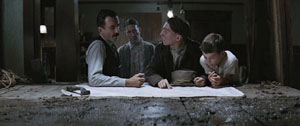
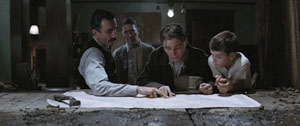
Many directors would have cut in to a close-up of the map, showing us the details of the layout, but that isn’t important for what Anderson is interested in. The actual geography of Plainview’s territorial imperative isn’t explored much in the movie, which is more centrally about physical effort and commercial stratagems.
Questioning Paul about his family, Daniel turns slightly away. This clears a moment for HW to ask about the girls in Paul’s family, and for a moment our attention is steered to the right, to pick up their interchange.
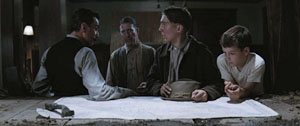
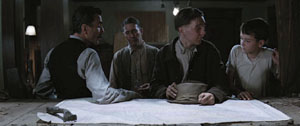
Then Fletcher asks about the farm, and as Paul and Daniel tilt their faces to him, he earns his place in the center of the frame. Before, when we could see the faces of the two men closest to the camera, he was subsidiary, but now he becomes salient. On the left, Daniel shifts away uneasily, turning almost completely away from the camera. In answering Fletcher, Paul turns away in the opposite direction, as if shy or guilty; his awkward gesture of stroking his hat seems to confirm Daniel’s doubts about him.
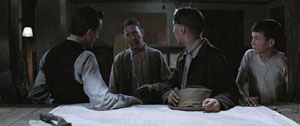
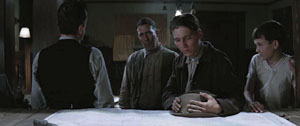
During a pause, Paul turns back to stare directly at Daniel, saying quietly, “The oil is there.” At the same time, Daniel, still turned away, is exchanging a glance with Fletcher. At this point, Anderson’s training of us pays off: we’re ready to detect the slight shift in Fletcher’s eyes, which confirms that Daniel’s looking at him. “Watch their eyes,” as John Ford liked to say.
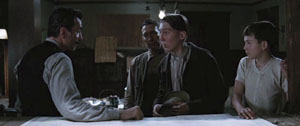
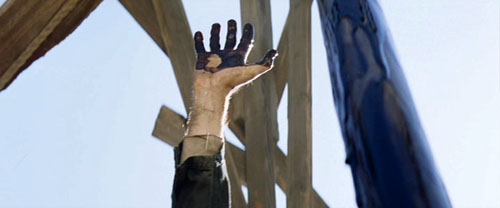
Paul sets out to leave, and he refuses the invitation to stay the night. At this point comes the scene’s biggest gesture. Daniel raises his hand, in the dead center of the frame.
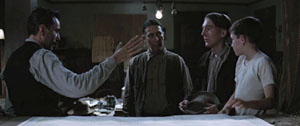
Spreading his long, thin fingers, Daniel commands our attention. He seems at once to be halting the young man and threatening him. But the gesture becomes the prelude to a handshake. Daniel’s characteristic blend of bluff assurance, friendliness, and aggressiveness are packed into this single gesture. (At the climax, other gestures will recall this one.)
Daniel steps closer to Paul, blocking out Fletcher, to make his threat: If he travels so far and doesn’t find oil, he’ll find Paul and “take more than my money back.” Paul agrees and moves away. “Nice luck to you, and God bless.”
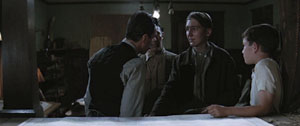
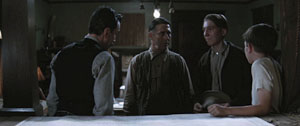
The men watch Paul leave the building. End of scene.
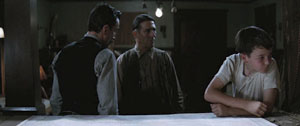
Without any close-ups or cutting, Anderson has skillfully steered us to the main points of the scene, which are carried by the performers. The drama builds through small changes of position, shifts of weight, and facial expressions that accompany the dialogue. (The somber, plaintive music adds an uneasy edge.) Daniel seems more threatening when we don’t see his reaction, and Anderson’s camera forces us to scrutinize Paul’s expressions and body language for signs that this is a scam. It takes confidence to make a raised hand the climax of a scene, but the gesture gains its force by being the most aggressive moment in an arc of quietly accumulating tension.
All the principles involved here—frontality, spacing of figures, slight shifts of compositional focus, actors’ body language—are simple in themselves, but they gain a strong impact by cooperating with one another. The scene’s quiet obliqueness is characteristic of the film, which, at least until the last few minutes, carries us along with hints about where the action might go and what drives its characters.
Yet simplicity shouldn’t imply simplification. Anderson’s willingness to give the shot several points of interest, some more stressed than others, creates an understated tension. The shot’s gravity stems from its conciseness, a quality that Anderson admires in 1940s studio films like The Treasure of the Sierra Madre.
Two more tabletops
The staging strategies Anderson uses aren’t new, as I’ve suggested. They’re part of the history of film as an art form, and many directors have continually relied on them. I don’t think that this is always a matter of influence, although surely filmmakers learned from watching earlier films. Often, directors working within similar constraints intuitively rediscover what other directors have already done.
Consider this scene from Kurosawa Akira’s The Most Beautiful (1944). The setting is a plant where Japanese workers, mostly girls and women, are manufacturing bombsights. The workers have vowed to increase production for the war effort, and they are working to the point of exhaustion. The plant supervisors are worried that the pace will take its toll on the girls.
The scene starts with the eldest supervisor studying the output chart, lying on a table below the frame edge. His colleagues are turned away, at the window. He is the one who must decide how to keep the girls healthy and the output steady. The table and the window will be the two poles of the action, and the actors will oscillate between them. The process starts when the eldest retreats to the window, and one comes forward to study the report.
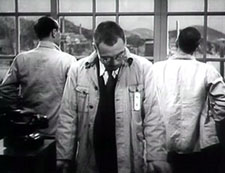
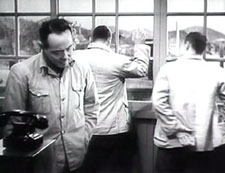
He’s followed by his opposite number, and they echo one other in rubbing their necks. They’re as tired as the assembly-line girls. Their superior turns and says that there’s no point in lowering the quota because the girls are so devoted that they’d push harder anyway.
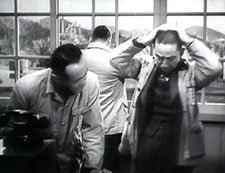
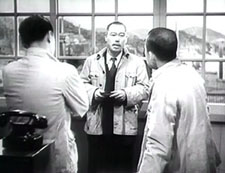
The men have turned to listen to him, driving our attention to his centered, frontal figure. After the elder has turned away again, the man on the right says that this might be the critical juncture. Remarkably, all three men remain turned from us, creating a slight pictorial tension.
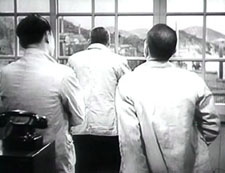
This tension is extended when the supervisor on the left states his confidence in the children, their team leader, and their teacher. This makes the eldest turn around.
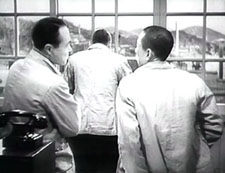
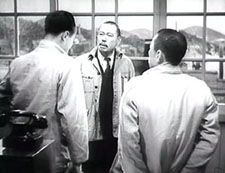
The speaker walks to the window, arguing that the girls will succeed, but the leader turns away again dubiously. He doesn’t offer a decision because an offscreen voice announces that a teacher has come to see them, and they all turn to look.
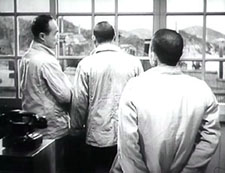
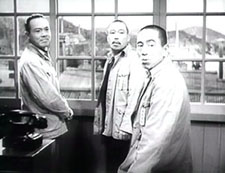
The factory’s problem isn’t solved; the seesawing of the staging has presented that irresolution dynamically. In a single shot, the difficulty of the administrative decision has been expressed in counterweighted movements in and out, by the figures’ frontality and dorsality. Again, it can seem simple, but where a contemporary American director would have given us a prolonged passage of stand and deliver, with intercut close-ups, Kurosawa has created a little ballet out of the men’s uncertainties. Like Daniel’s raised hand, but with even less emphasis, the assistant’s plea on behalf of the girls’ commitment has gained a subtle prominence. Yet all he has done is walk to the window.
I’m not saying, of course, that Anderson took the idea from Kurosawa. Given the initial choice to stage the scene behind a table, and the inclination to present the action in one shot, both directors spontaneously drew on basic staging principles. This is what film directors have always done. So as a finisher, here’s one last tabletop interlude from Cecil B. DeMille’s Kindling (1915). The entire scene is a dense and intricate affair, but let’s pick just one moment. Maggie has become a servant to a rich woman, Mrs. Burke-Smith, and she’s about to be arrested for theft. Detective Rafferty is ready to handcuff her, but Mrs. Burke-Smith changes her mind.
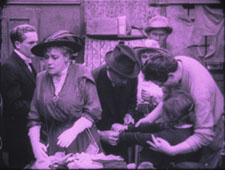
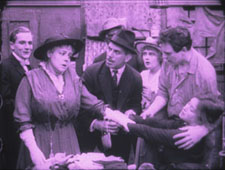
DeMille arranges his actors so that we can’t miss the rich woman’s moment of decision. She is in the foreground, and her face is in the upper center of the frame. The other actors are blocked, so that her expression is the only one we can see clearly at the crucial moment. Her hand gesture, stretching across the central axis of the frame, confirms that she won’t charge Maggie. (For a similar use of “blossoming” actors’ movements in 1910s cinema, go here and look at Figs. 2A10-2A11.) What DeMille knew, Kurosawa discovered afresh, and Anderson hit upon it again.
Strategies of staging, like other principles shaping how films tell stories, lie behind each concrete creative decision the film artist makes. They run as undercurrents through film history, almost never discussed by critics. They form a body of tacit knowledge, flowing across our usual distinctions of period, genre, director, national cinema. We can trace continuities and changes, examining how the strategies are revived, revised, or rejected. They can provide us with subtle but powerful experiences. They constitute a skill set that is available to filmmakers today. . . if any will, like Anderson, seize the chance.
(1) True, Wes Anderson keeps the camera still, but in his frontal, family-portrait framings the cutting and line readings do all the work; dynamic staging isn’t on his menu.
(2) I survey the development of these and other tactics in Chapter 6 of On the History of Film Style. On this site, for one example go here and scroll down to the Bauer material.
Happy birthday, classical cinema!, or The ten best films of … 1917
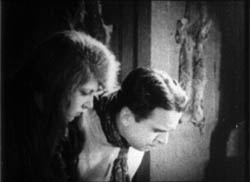
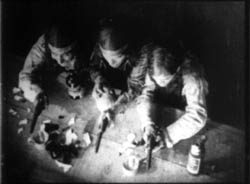
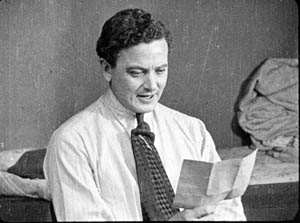
Wild and Woolly (1917).
KT:
Periodization is a tricky task for historians, and there are a lot of disputes about how to divide up the 110-plus years of the cinema’s existence. We all have to deal with it, though, if we want to organize our studies of the past into meaningful units. How to do that?
Do we divide the periods of film history according to major historical events? World War I had a huge impact on the film industry, to be sure, and we might say that one significant period for cinema is 1914-1918. Yet 1919 didn’t mark the start of a new period. The major European post-war film movements didn’t start then. French Impressionism arguably began in 1918, German Expressionism in 1920, and Soviet Montage in 1924 or 1925.
Carving up film history partly depends on what questions the historian is asking. If you’re studying wartime propaganda, 1914 and 1918 would provide significant beginning and end points. If you want to trace the development of significant film styles, it doesn’t seem very useful.
While historians have difficulties agreeing on periodization, just about everyone concurs that there were two amazing years during the 1910s when filmmaking practice somehow coalesced and produced a burst of creativity: 1913 and 1917.
One can point to stylistically significant films made before 1913. Somehow, though, that year seemed to be when filmmakers in several countries simultaneously seized upon what they had already learned of technique and pushed their knowledge to higher levels of expressivity. “Le Gionate del Cinema Muto” (“The Days of Silent Cinema”), the major annual festival, devoted its 1993 event to “The Year 1913.” The program included The Student of Prague (Stellan Rye), Suspense (Phillips Smalley and Lois Weber), Atlantis (August Blom), Raja Harischandra (D. G. Phalke), Juve contre Fantomas (Louis Feuillade), Quo Vadis? (Enrico Guazzoni), Ingeborg Holm (Victor Sjöström), The Mothering Heart (D. W. Griffith), Ma l’amor mio non muore! (Mario Caserini), L’enfant de Paris (Léonce Perret), and Twilight of a Woman’s Soul (Yevgenii Bauer). .
1917, by contrast, was primarily an American landmark. As 2007 closes, we thought it appropriate to wish happy birthday to the most powerful and pervasive approach to filmic storytelling the world has yet seen. That would be classical continuity cinema, synthesized in what was coming to be known as Hollywood.
DB:
In The Classical Hollywood Cinema and work we’ve done since, we’ve maintained that 1917 is the year in which we can see the consolidation of Hollywood’s characteristic approach to visual storytelling. This idea was first floated by Barry Salt, and our research confirms his claim. Over the ninety years since 1917 the style has changed, but its basic premises have remained in force.
Before classical continuity emerged, the dominant approach to shooting a scene might be called the tableau technique. Action was played out in a full shot, using staging to vary the composition and express dramatic relationships. Elsewhere on this site I’ve mentioned two major exponents of this approach, Feuillade and Bauer.
When there was cutting within the tableau setup, it usually consisted of inserted close-ups of important details, especially printed matter, like a letter or telegram. Occasionally the close-up of an actor could be inserted, usually filmed from the same angle as the master shot. The tableau approach was more prominent in scenes taking place in interiors; filmmakers were freer about cutting action occurring outdoors.
We shouldn’t think of the tableau as purely “theatrical.” For one thing, the master shot was typically closer and more tightly organized than a scene on the stage would be. Moreover, for reasons I discuss in Figures Traced in Light, the playing space of the cinematic frame is quite different from the playing area of the proscenium theatre. The filmmaker can manipulate composition, depth, and blocking in ways not available on the stage.
The tableau approach was the default premise of US filmmaking through the early 1910s. You can see it at work, for example, in this shot from At the Eleventh Hour (W. V. Ranous, 1912). Mr. and Mrs. Richards are in the study of Mr. Daley. After Richards has refused to sell his railroad bonds, Daley’s wife shows off her diamond necklace to the visitors.
At first the two couples are separated in depth, the men in the foreground and the women further back. In the first frame below, a new necklace has just been delivered, and a servant gives it to Mrs. Daley. Only the servant’s hand is visible, as she is blocked by Richards in the foreground. In the second frame, the two women come forward. Mrs. Daley holds the necklace up and Mrs. Richards oohs and ahhs over it, while her husband glances at Daley as if to wonder how he could afford it.
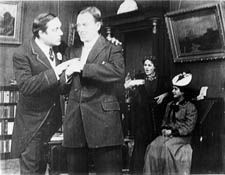
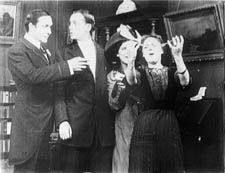
Instead of breaking the scene into closer views, spreading the characters’ reactions across separate shots, Ranous squeezes all of their actions and expressions into a tight space across the center of the shot. Nor does he provide a close-up of the necklace, which will be important in the plot. (1) We might be inclined to say that this is a “theatrical” shot, but on a stage the actions in depth (the women chatting, the servant handing over the parcel) wouldn’t be visible to everyone in the auditorium. Likewise, on a stage the packed faces in the later phase of the scene wouldn’t be visible to people sitting on the sides.
As films became longer, American filmmakers were starting to organize their plots around characters with firm goals. Conflicting goals would set the characters in opposition to one another, and at a climax, usually under the pressure of a deadline, the protagonist achieves or fails to achieve the goals. The plot also tends to build up two lines of action, at least one involving romance.
There’s no reason this conception of narrative could not have been applied to the tableau style; in many cases it was. But hand in hand with the rise of goal-driven plotting came a new approach to filming. Sporadically before 1917, filmmakers in many countries were exploring ways to build scene out of many shots. (If you want to know the process in the US in more detail, check out Early American Cinema in Transition by Charlie Keil.) By 1917, American filmmakers had synthesized these tactics into an overall strategy, a system for staging, shooting, and cutting dramatic action.
We know the result as the 180-degree system. This encourages the filmmaker to break a scene into several shots, taken from different distances and angles, all from one side of an imaginary line slicing through the space. Around 1917, this stylistic approach comes to dominate US feature films, in the sense that every film made will tend to display all the devices at least once. The system remains in place to this day, and it came to form the basis of popular cinemas across the world. (2)
Once you break a scene into several shots, some characters won’t be onscreen all the time. So you need to be clear about where offscreen characters are; you need to supply cues that allow the audience to infer their positions. So 1910s filmmakers developed various ways of “matching” shots.
Shots can be connected by character looks, thanks to the eyeline match. Here’s an instance from Victor Schertzinger’s The Clodhopper (1917). First there is a master shot of the mother and son in their farm kitchen.
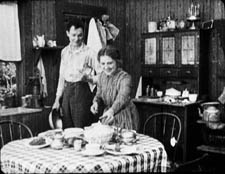
This is followed by a separate shot of each one. Their bodily positions and eyelines remind us that the other is just out of frame.
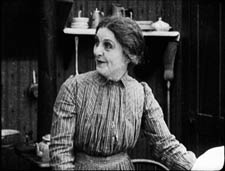
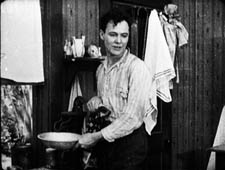
Although over-the-shoulder shooting hadn’t yet been developed, a conception of the reverse angle is at work here too. Schertzinger’s camera doesn’t shoot the actors perpendicularly, but takes up an angle on one that becomes an echo of that filming the other. Here’s another example of reverse angles from The Devil’s Bait (1917, director Harry Harvey).
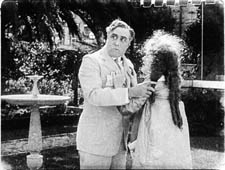
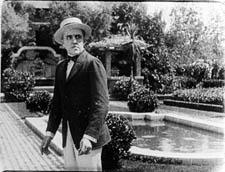
The camera doesn’t just enlarge a portion of the space, as in the inserted shot in a tableau scene. The angle of view has changed significantly.
Changes of angle within the scene have become fairly complex by 1917. This strategy is apparent when the action takes place in a theatre, a courtroom, a church, or some other large-scale gathering point. The camera position changes often in this scene from The Girl without a Soul (director John Collins).
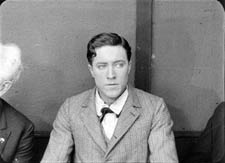
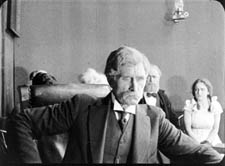
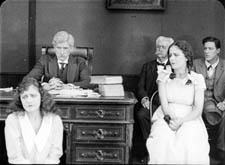
The concept of matching extends to physical movement too, through the match on action. This device allows the director to highlight a new bit of space while preserving the continuity of time. In Roscoe Arbuckle’s The Butcher Boy, the cut-in to Fatty (with a change of angle) also matches his gesture of putting his hands on his hips.
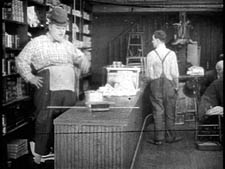
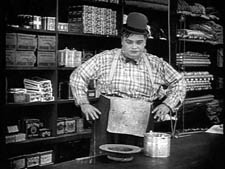
Interestingly, even this early, directors have learned to leave a little bit of overlapping action across the cut. If you move frame by frame, you’ll see that Fatty’s gesture is repeated a bit at the start of the second shot.
When a character leaves one frame, he or she can come into another space, from the side of the frame consistent with the 180-degree premise. This is matching screen direction. A cut of this sort lets us know that the next portion of the locale that we see is more or less adjacent to the previous one. In Field of Honor (director Allen Holuban), Wade crosses to Laura, who’s waiting in a carriage. A few years earlier, the director might have presented his greeting in a single deep-space long shot. Instead, Wade exits one shot and enters the next.
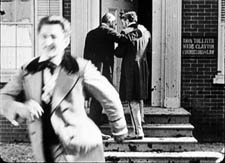
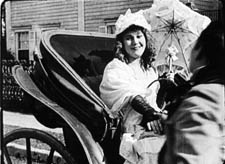
Again, the reverse-angle principle governs the camera setups. Wade moves along a diagonal toward the camera and away from it.
More generally, Field of Honor exhibits a polished handling of the new style: lots of reverse shots and eyeline matches, fades that bracket flashbacks, binocular points of view, rack-focus shots, and rapid cutting (there’s even a ten-frame shot). The point is not to claim Field of Honor as an undiscovered masterpiece but rather to indicate that by 1917 a director could handle all the devices with assurance.
Match-cutting devices had been used occasionally before 1917, but by that year filmmmakers melded them into a consistent and somewhat redundant method of guiding the audience through each scene.
The continuity system not only creates a basic clarity about characters’ positions. It can as well generate a speed and accentuation not easily achieved within a single shot. For example, Wade’s frame exit and entrance above is cut so as to skip over moments that he consumes crossing the driveway. Continuity editing enhances the rapid pace of US films, a quality immediately noted by foreign observers in the 1910s and 1920s.
Two of the best films of 1917 exploit the dynamism of continuity cutting. The Doug Fairbanks comedy western, Wild and Woolly, seems designed to prove that American films could proceed at breakneck speed. In climactic scenes, we’re caught in a whirlwind of fast cutting, with the pace set by the hyperactive protagonist, a financier’s son who longs to prove himself as a cowboy.
John Ford’s Straight Shooting proceeds at a more measured pace, but in its final shootout we see a prototype of all the main-street gundowns that will define the Western. Ford provides alternating shots of the cowboys advancing toward each other, framing each man more tightly and concluding with suffocating close-ups of each man’s face, highlighting the eyes.
Sergio Leone, eat your heart out.
Propelled by goal-driven characters and a linear arc of action, films like Wild and Woolly and Straight Shooting are completely understandable and enjoyable today. (But when will we have them on DVD?) Their stories are engrossing and their performances are engaging, but just as important their storytelling technique has become second nature to us. The narrative strategies that coalesced in 1917 remain fundamental to mainstream cinema.(2)
The Mystery of the Belgian Print
KT:
For decades now we have been visiting Brussels and working at the Cinémathèque Royale de Belgique/Koninklijk Belgisch Filmarchief. Sometimes I feel that we would know half as much about the cinema were it not for the unfailing hospitality we have been shown, initially by the great archivist Jacques Ledoux and now by his successor Gabrielle Claes. Our indebtedness to this institution and its staff are reflected in David’s named professorship; he is the Jacques Ledoux Professor of Film Studies. We dedicated our Film History: An Introduction, to Gabrielle.
We do whatever favors we can in return for such wonderful help. David lectures regularly at the biannual summer school run by the Flemish Service for Film Culture in partnership with the Royal Film Archive. (David wrote about the 2007 event in an earlier entry.) I try to identify silent films. I am not always successful, but I suppose over the years I have been able to put names to thirty-some mystery prints.
Silent films are more likely to be unidentified than sound ones because it was standard practice to splice in intertitles in the local language. Sometimes too the film’s title was changed. The film’s actors may be forgotten today, or the print may be incomplete, lacking the opening title and credits. Sometimes even the country of origin is unknown.
Back in the early 1990s I was asked to identify a five-reel nitrate print with the title Père et fils. It was an original distribution copy from the silent era. The information on the archival record card listed some possible identifications: Father and Son, a 1913 Vitagraph film or Father and Son, produced by Mica in 1915. It was tentatively thought to be American.
As I watched the film, it quickly became apparent that it was indeed American. It centered on the rivalry between a small dime store owned by the heroine’s father and a modern dime store being built in the same town. The hero is charged with the mission of driving the older store out of business.
So we had our typical goal-driven plot. The style was what David has described as typical of 1917, so that was my tentative dating. I felt almost certain that the reels I was watching were not from a 1913 or 1915 movie. The film was a fairly modest item, done on a relatively low budget and not starring any actors that would be familiar to most modern viewers. I had seen the actor playing the hero before, however, and I thought he might be Herbert Rawlinson. By the time I finished the film, those were my clues: a medium-budget American film of c. 1917 concerning dime stores and perhaps starring Rawlinson.
My task turned out to be fairly simple. A little research after we returned home confirmed the Rawlinson guess. In preparing the write The Classical Hollywood Cinema, I had seen him in The Coming of Columbus (a 1912 Selig film) and in Damon and Pythias (Universal, 1914).
My next step was to consult the monumental, indispensible reference book, The American Film Institute Catalog. This multi-volume set, many years in the making, was originally published as books. It is now online, but available only to AFI members or through libraries. The catalogues were published by decade—thus obviating the problem of periodization. Each decade gets two volumes, one of entries on all the films, listed in alphabetical order. Credits, production companies, release dates, plot synopses, and other information are included. A second volume indexes the films by chronology, personal names, corporate names, subject, genre, and geography (i.e., where the films were shot).
Until now I had found little use for the subject index, but now it came to my aid. I turned to the Ds to see if there was an entry for dime stores. The AFI indexers were thorough, and sure enough, there was one entry: Like Wildfire. A check of the personal names index under Rawlinson, Herbert revealed that he had acted in a film called Like Wildfire, made in 1917 by Universal. Once I had the title, I checked its catalog entry and found that its plot description matched the film I had seen. Case closed.
Admittedly, in this instance the date wasn’t a crucial clue. Still, determining a film’s year of release can narrow down the possibilities. Thanks as well to the development of classical cutting, a close view of an actor helps in identifying him.
The Best of 1917
DB:
This is the season when everybody makes a list of best pictures. We have stopped playing that game. For one thing, we haven’t seen all the films that deserve to be included. For another, the excellence of a film often dawns gradually, after you’ve had years to reflect on it. And critical tastes are as shifting as the sirocco. Never forget that in 1965 the Cannes palme d’or was won by The Knack . . . and How to Get It.
Still, enough time has elapsed to make us feel confident of this, our list of the best (surviving) films of 1917, both US and “foreign-language.” Titles are in alphabetical order.
The Clown (Denmark, A. W. Sandberg)
Easy Street (U.S., Charles Chaplin)
The Girl from Stormycroft (Sweden, Victor Sjöström)
The Immigrant (U.S., Charles Chaplin)
Judex (France, Louis Feuillade)
The Mysterious Night of the 25th (Sweden, Georg af Klercker)
The Narrow Trail (U.S., Lambert Hillyer)
The Revolutionary (Russia, Yevgenii Bauer)
Romance of the Redwoods (U.S., Cecil B. De Mille)
Terje Vigen (Sweden, Victor Sjöström)
Straight Shooting (US, John Ford)
Thomas Graal’s Best Film (Sweden, Mauritz Stiller)
Wild and Woolly (US, John Emerson)
Next year, maybe we’ll draw up our list for 1918.
(1) For more on this scene and the film as a whole, see Kristin Thompson, “Narration Early in the Transition to Classical Filmmaking: Three Vitagraph Shorts,” Film History 9, 4 (1997), 410-434.
(2) Beyond The Classical Hollywood Cinema, see Kristin’s Herr Lubitsch Goes to Hollywood and Storytelling in the New Hollywood. I’ve talked about these issues in On the History of Film Style, Planet Hong Kong, Figures Traced in Light, The Way Hollywood Tells It, and essays included in Poetics of Cinema. The basics of classical continuity are presented in Chapter 6 of Film Art: An Introduction, and we trace some historical implications of it in Film History: An Introduction.
Godard comes in many shapes and sizes
DB here:
James Quandt started it.
The indefatigable Senior Programmer of the Cinémathèque Ontario emailed me in early 2004 to ask if I had any thoughts on the aspect ratios of Godard films. He attached an essay which eventually appeared in the gorgeous anthology, For Ever Godard. Reading a Quandt essay is like eating a ripe nectarine, tangy and nourishing. So you should find the original and indulge yourself. (1)
You might be asking what the term aspect ratio means. It refers to the ratio of the width to the height of the film image. The image was fairly square in the early silent era, then became roughly standardized at 4 x 3, or as the pros say, 1.33:1. Sound filming made the format a tad more horizontal, at 1.37. Anamorphic widescreen (CinemaScope and its brethren) was more or less standardized at 2.35 (more recently 2.40). Various non-anamorphic, or “flat” aspect ratios have appeared since the early 1950s. The US has favored 1.85, Europe has been known to use the squarer 1.66, and some films, like E. T., are designed for 1.75. Widescreen TVs are set at 16:9, or about 1.78:1, so that’s likely to be a common proportion in the future. We discuss aspect ratios at more length in Film Art: An Introduction (pp. 183-185 in the newest edition).
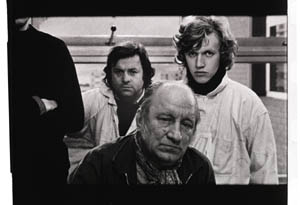
Filmies care about aspect ratios because shot composition matters. Sometimes the print is “hard-matted,” with the correct proportions given as black bars at the top and bottom of the frame, like video letterboxing. Here’s an example, from a 16mm print of Godard’s 1972 Tout va bien. It is hard-matted to 1.66. (The original film is in color.)
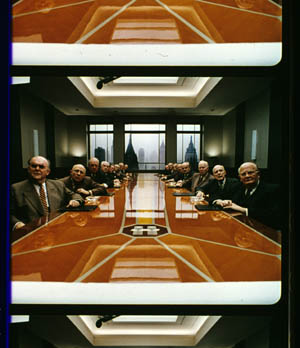
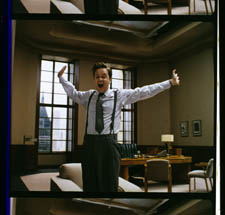
If the image isn’t hard-matted, the projectionist must insert an aperture plate that will mask the image properly. But what plate? Should she set it for 1.37? That’s a very rare option nowadays, and many theatres aren’t really designed to show it. Typically, if the print doesn’t indicate, the US projectionist will fall back on 1.85. Nowadays, if a Hollywood film isn’t in Scope, the projectionist is expected to use that ratio. Some shots will be problematic if the projectionist includes more than the 1.85 format allows. Here’s a full-frame film strip from The Hudsucker Proxy, where you can see that a chunk of the set is blocked or missing in the bottom area, and a microphone peeks into the frame from the top. (2)
Like many other movies, the films made by Godard since the mid-1970s show up at the projection booth without hard matteing. So at what ratio do we show them?
A great many careful viewers have voiced their views on the Internets, and I’ve learned a lot from the discussions here and here. In part this blog entry is an effort to introduce readers to this debate.
Moreover, this apparently film-wonkish question has wider implications. It can teach us a fair amount about how film images work, and the implications of any masking, matteing, or cropping of an image—especially on DVD. So if you’re interested in Godard, keep reading. If not, skip to the final section, “Relationships: The fundamental question,” where I talk about some artistic effects of cropping any film image.
It’s a just image, not just an image
James Q was mounting one of his typically ambitious retrospectives, this time on JLG, and so his essay posed a question that had long been ignored.
A disturbing discovery of the retrospective was how frequently the full-frame compositions of Godard’s late films have been ignored and overruled. Many of the prints are clearly marked by the lab with the widescreen ratios of 1.66 or (the almost standard) 1.85, and their subtitles are printed in the frame at the height indicated by those standards. Our meticulous projectionist Kate Mackay experimented with whole reels of films, showing them first in 1.33 and then in the prescribed wider screen ratio, revealing the violence done to the compositions when shown the latter way.
James found that several films, including Passion, Je vous salue Marie (Hail Mary), Nouvelle Vague, Hélas pour moi, and For Ever Mozart, looked “abjectly constricted” in 1.85. So James wrote the man himself.
Disturbed by some oddly cropped compositions in Éloge de l’amour, which result in seemingly unintentional beheadings and concretions, I consulted Godard by fax about the aspect ratio and he confirmed that it was indeed, as stated, 1.66 (rather old-fashioned in its own way). That he occasionally still seems to be jamming a 1.33 composition into a frame that cannot accommodate it suggests his instinctual preference for the open image.
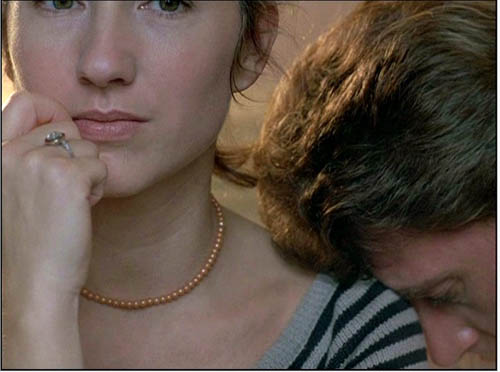
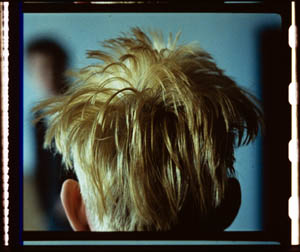
I couldn’t help James much at the time, but I did send him a couple of frames that favored squareish compositions and that came from 35mm prints. Other frames we reproduced, at 1.37, in both editions of Film History: An Introduction. The still that pretty much settles the matter for me is the gorgeous shot of Nathalie Baye and Johnny Hallyday at the top of this entry. Here’s the image as it is on a 35mm print.
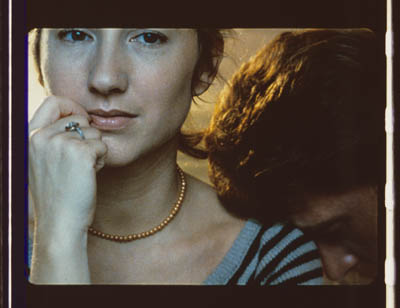
Downsize that to 1.66 without losing those eyes!
Later I sent James another killer example, drawn also from a 35mm print of Detective. (It’s in the new Film Art, p. 46.)
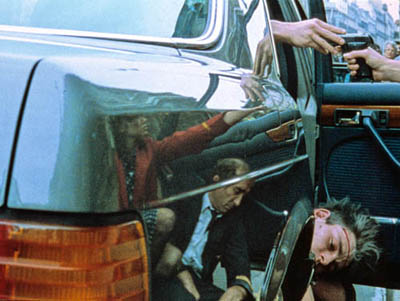
Here’s what it would look like in one try at 1.66 matteing.
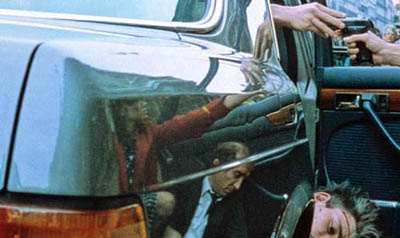
I say “one try” at a matted version because I didn’t take as much off the top as a normal aperture plate would; I didn’t want to slice into the hands and the gun. Not only is the 1.37 image preferable (we get to see Claude Brasseur’s slumping posture) but 1.66 looks, as James says, jammed. The 1.37 ratio lets Godard load information in the very top of the shot, as we’ll see often in the examples to come. And, needless to say, at 1.85 the shot would make no sense.
Soon after James and I had our exchange, Godard—perhaps prodded by James’ query—sent a diagram to Cahiers du cinéma. (3) (Thank you, Craig Keller, aka evillights, who called attention to it on this thread.) The Cahiers editors report that Godard has asked that Notre musique be shown in 1.37. His photomontage lines up two shots from the film and arranges them according to the three major “flat” ratios, and for each one he supplies a tart annotation.
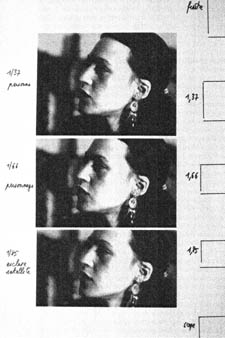
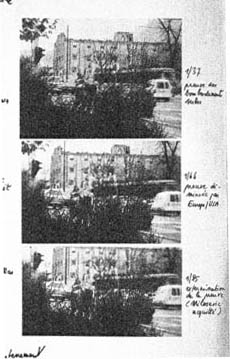
For the close-up of the woman, the captions translate as: 1.37 person. 1.66 character. 1.85 satellite slave. For the long shot of the street, we get: 1.37 Proof of Serbian bombing. 1.66 Proof diminished by Europe/ USA. 1.85 Extermination of proof (Milosovec acquitted).
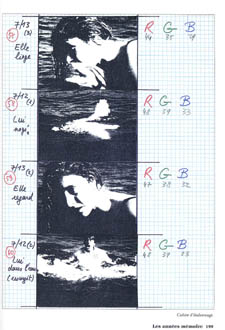
Pretty strong evidence that JLG doesn’t like cropping the classic format. But these remarks are about Notre musique. What about the other films? Apart from the evidence onscreen and on the film strip, we can add one thing. Evidently he shoots at 1.37, but there’s also evidence that in the late stages of postproduction he seems to preserve that ratio. Here, for example, is a sheet of color timing instructions for Nouvelle Vague. (4) Godard has pasted in a frame for each shot in the sequence, and alongside he notes how much red, green, and blue he wants. The frames he mounted are 1.37.
Recently our Cinematheque has been holding a Godard retrospective, and I’ve taken the opportunity to revisit the aspect ratio issue. As an archival venue, we can screen at any ratio, even the squarish silent and early-sound ones. Our projectionist Jared Lewis has run the Godards at 1.37. They look fine.
Jared pointed out to me that one other factor leans toward screening them in the 1.37 format: the thickness of the spaces between frames. In a modern “full-frame” film like Hudsucker Proxy, there is very little space between the frames. The line separating one from another is quite thin. That tends to make the frames squarer, closer to 1: 1.2, as I mention in endnote 2.
In a classic sound film, there is often more space between the frames. Usually that space is black, but I can’t resist showing what it looked like in Technicolor.
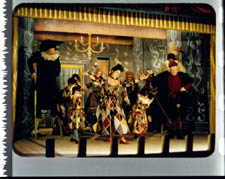
This frame, from Renoir’s Golden Coach, shows the characteristic silver frame surround (and silver soundtrack) of a true Tech print. Nifty, huh?
Anyhow, the sort of thick spacing between frames that we get usually find in Godard prints, and that’s visible in the Baye/Hallyday frame above, favors the classic ratio. The thickness of these spacers is similar to what we find in a modern film that was explicitly designed for 1.37 screening, Hans-Jürgen Syberberg’s Parsifal (1982).
This array, Jared points out, gives different frame proportions than one would find in a print hard-matted to 1.66 or 1.85.
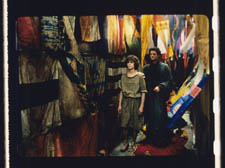
One more wrinkle. On the film strip, Godard’s frames aren’t all the same dimensions. Here are two from Je vous salue Marie; note that the first is taller, with narrower spacers, than the second.
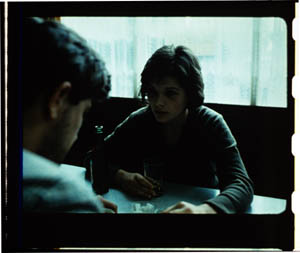
Both, however, would be appropriately shown at 1.37.
How then are we to explain Godard’s saying the films should run at 1.66? Perhaps, as one of the online commentators has suggested, Godard assumed that 1.66 is the closest that most commercial venues can come to 1.37. Perhaps too he was just being contrary–that is, just being Godard.
Fortunately, some DVD producers seem to recognize his full-frame aesthetic. The UK version of Detective is full-frame and preserves my nifty shots. Also, the Cahiers du cinéma discs for Prénom Carmen, Hélas, and so on are at 1.37. Bowing to Godard’s wishes, Wellspring’s version of Notre Musique announces that it is presented “in its original theatrical aspect ratio of 1.33.” Although purists may say that virtually no theatres showed it that way, we should appreciate the gesture.
Relationships: The fundamental question
Even if you’re not that interested in Godard, everybody should be aware of what video cropping can do to the film image. I’m not talking about panning and scanning, that process which begins with a widescreen film, typically one of an aspect ratio 1:2.40, and extracts a 1.37 frame out of it for video purposes. This is deplorable, but most of us are alert to it. What’s more interesting is the sort of thing that happened when a film is cropped inaccurately, either in projection or for DVD.
My example will be from the first reel of Godard’s Éloge de l’amour/ In Praise of Love, which is available on DVD in a full frame version from Optimum in the UK and in a cropped version from New Yorker in the US. I won’t be focusing on the quality of each transfer, though the Optimum one looks superior to me.
Nor will I do a detailed narrative account, because I find the characters and their interactions still fairly baffling. I’m always amazed that critics can praise a Godard film without ever getting down to explicating what’s literally happening in a scene. They write as if these films were telling their stories straightforwardly. Without help from the presskits, could journalists discern even the sketchy plots they refer to? A great deal of the fascination of Godard’s late works comes from his refusal of the most elementary forms of exposition–picking out characters, explaining their relations, and the like. There is always a story, but it’s about three-quarters hidden, and this seems to me to require a lot more analysis than people tend to give it.
Anyhow, in studying Éloge de l’amour‘s video versions, I learned that there can be a big difference between tiny numbers. For instance, the Optimum version is prepared at 1.35:1. No big deal between this and 1.37:1, surely? Except that the New Yorker version seems to have started from a 1.37 frame. Even though it’s cropped on the top and bottom, it consistently supplies a tad more information on the right and left edges, and these extra bits are visible in side-by-side comparison. First, a 35mm frame.
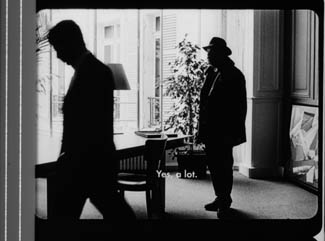
Needless to say, the projector’s aperture plate won’t preserve everything in the physical frame; at a minimum it masks off the curved corners. But if we look at the two video versions, there are some surprises.
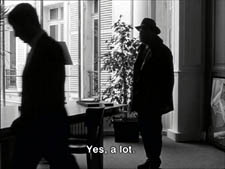
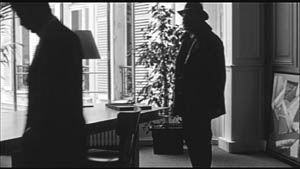
The 1.37 version of this shot is of course much closer to the overall composition of the original. But more areas of the window frame (on the left) and the painting (on the right) are visible in the widescreen version than in the full-frame one. Did going for 1.35 shave off those areas? Moreover, New Yorker’s cropping is at 1.77, for all intents and purposes the same as 1.75. But to achieve this wide frame, the transfer of some shots seems to have been optically stretched a little. In some upcoming examples the faces are a bit plumper and the surroundings a bit more horizontally spacious.
Okay, maybe I’m splitting hairs. So let me assume that the UK DVD preserves a reasonable amount of the 35mm original. I want to consider some effects of the cropping we get in the US DVD. Some are obvious, some more subtle, and all go beyond this individual case to suggest the results of overcropping any movie.
(1) Of course we lose the top and bottom. In the full-frame shots from Hudsucker Proxy, no problem; the filmmakers are counting on the projectionist to mask the frame. But in Godard the cropping makes us lose stuff. Godard likes to frame heads pretty high in the shot, and this means that we often lose part of them.
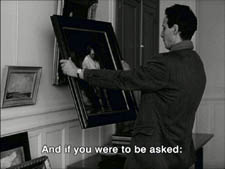
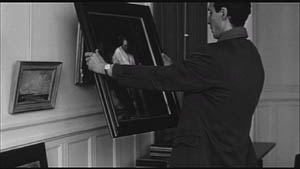
Heads are trimmed in movies all the time, and it doesn’t much matter in close views. But in Éloge, Godard is composing long shots with heads quite high up. He will even daringly chop off heads himself. This is partly a strategy to conceal who is present, to block our recognizing characters by their faces. It also has the effect of activating areas of the frame that aren’t usually so important. We have to strain to see partially visible things, tucked away in bits of the shot.
In the example below, I submit, the original composition creates a tension among three centers of interest: the two very visible paintings and the almost indiscernible face of the art dealer standing by the rear window. That tension is lost when the 1.77 cropping lops off the head in the background. Significantly, the man offscreen left is talking about how classic painting displayed “relationships” (rapports)–presumably both personal and pictorial. “That’s the fundamental question.”
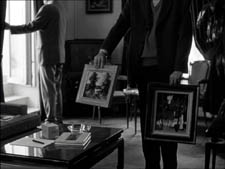
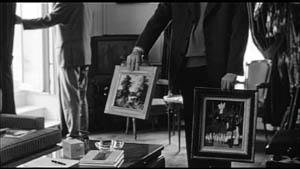
The framing of the assistant in the foreground, incidentally, shows that spotting a decapitation in a video version doesn’t necessarily mean that Godard wanted every head to be seen.
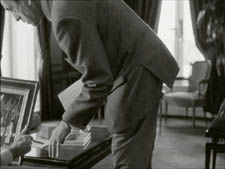
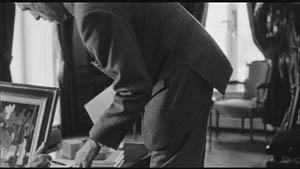
In a later scene, we strain to see the older man’s face as he bends over Bruno. As he speaks Picasso’s immortal line, his profile scrapes the very top of the shot, but not in the cropped version.
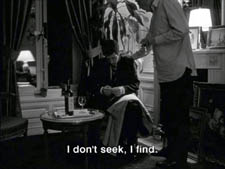
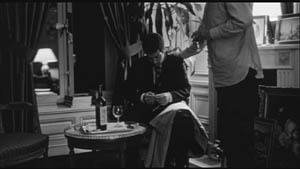
In most film shots, the upper half of the frame harbors what we look at first, so we’re probably most likely to notice when something goes missing there. But actually, the area at the bottom of the frame is important too, especially as part of Godard’s all-over approach to composition.
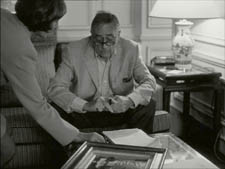
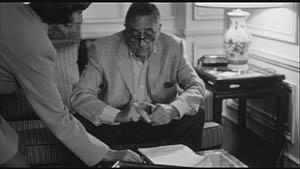
Throughout early scenes of the film, Godard’s compositions favor the art works and minimize the humans trafficking in them. So the picture (by Delacroix? Matisse?) on the coffee table is foregrounded when the art collector signs the papers proffered by a mostly unseen woman, but it vanishes in the cropped version.
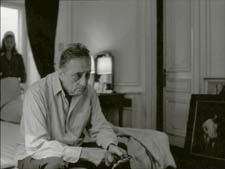
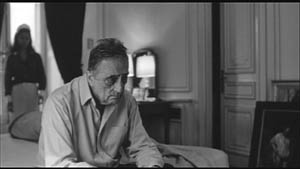
Likewise, the old man on the bed can rub his glasses fretfully at the very bottom of the 1.37 format, but that performance detail goes for naught in the 1.77 format.
More generally, even when we scan the top half of the frame for major information, we tend to take for granted that people are anchored to a ground plane, the earth or the floor or whatever. Often, of course, film shots don’t show us this ground. But the material at the bottom of a distant view can weight the shot, providing a sense of gravity. Here, the dealer peering over his balcony is minimally tied to the patio ground (as minimally as he was visible in the earlier shots when his head grazed the upper edge, I suppose). But in the 1.77 version he floats free.
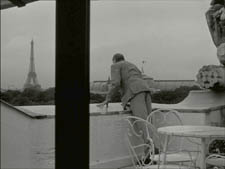
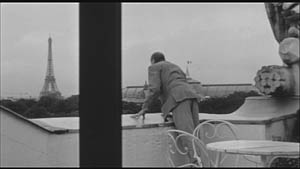
(2) The top and bottom zones include the corners of the frame as well, but I single them out for special mention because I like them so much. Again, we don’t expect key information to be tucked there, but it can happen—in Godard, in Tati (a big influence on the late Godard), and even in one remarkable shot in Lumet’s recent Before the Devil Knows You’re Dead. In the first reel of Éloge de l’amour, the best example I can find comes with the long-shot of the woman, turned from us, standing at the window. In the lower right corner of the shot sits a woman’s photograph on a table. The 1.77 frameline chops it off and makes it less segregated for our notice: we lose the spacing that separates it from the other objects on the table. Since the voice-over is meditating on memory, the photo adds an overtone to the shot, but less clearly in the cropped version.
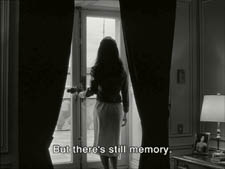
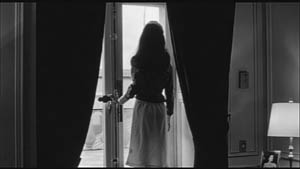
Maybe it matters, maybe not; but it’s a lot harder to see in 1.77 than in the 1.37 transfer. Something similar happens with the businessman’s hand in the lower left of this shot.
(3) Cutting off top and bottom alters the shot scale. All other things being equal, cropping not only eliminates; it enlarges. Figures come closer to us. A medium shot becomes a medium close-up. All of the examples so far indicate this to some degree, but it comes across clearly in these variants.
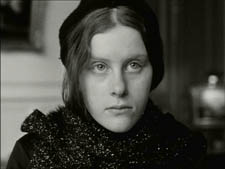
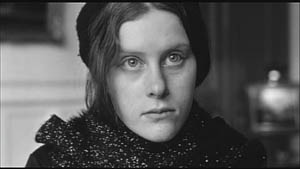
Again, note the stretching. It seems that someone decided that the image had to be 1.75 and instead of cropping it, stretched the 1.66 one. Yikes!
(4) Overambitious cropping changes the compositional dynamics. In reducing information, it reorganizes the composition. Rudolf Arnheim (I blogged about his achievements here) suggested that we consider a picture as a field of vectors and forces, pushes and pulls, balance and imbalance, rival centers of attention. By changing the framing we change the relation of the figures to the edges, and this can alter the composition.
The clearest examples come from the sort of reframings we find when a Super-35mm film is rendered in home video versions in both 2.40 and 1.37.
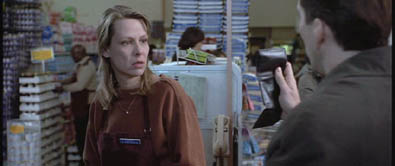
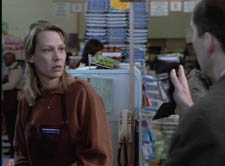
In this shot from 8mm (the movie, not the gauge), the cashier questioned by Cage looks more isolated in the Scope framing, while in the full frame they seem closer together and he seems to press in on her. Cropping can change a lot.
Now consider this comparison.
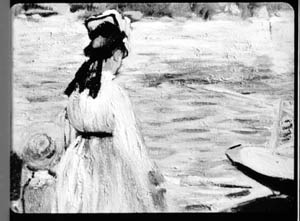
Godard’s original shot (here from 35mm) keeps the painting’s upper horizon, the darker, frothy waterline as a kind of backboard, halting the water’s recession into the distance. Graphically, the water on the right center becomes a negative space for the two figures, with the boy counterbalanced by the tip of the skiff.
But the cropped version loses the distant waterline, creating an infinite stretch of space top to bottom, and the boy’s head seems to float more freely. Most starkly, the skiff, by losing its shadow, seems to have swung more toward us.
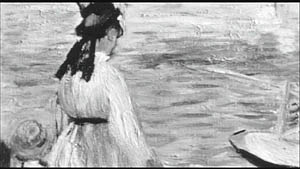
It’s worth noting that Godard himself is a mean hand at radical cropping. I’ll forebear from rambling on about what his original framing above does to the original, Manet’s Seine at Argenteuil (1874), but it could constitute a lesson in how framing changes effect and meaning.
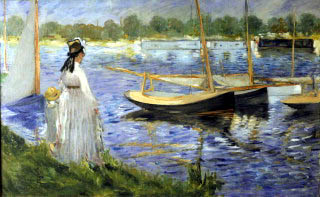
Several factors come into play when we look at this shot from the two DVD versions.
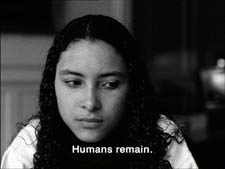
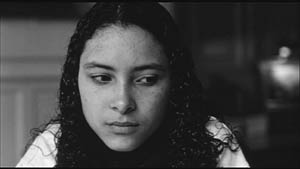
The woman’s face is off-center in both images, but it looks more off-center in the 1.77 transfer. In fact, despite the extra bits on left and right, it is measurably more off-center, because of this transfer’s optical stretching. Yet I’d argue in addition that the cropping of the frame has squeezed the pictorial elements into a stronger horizontal to-and-fro, giving a sense that she has been pushed more out of the middle. You can see it more markedly if we crop it more drastically, and it may help to hide the others when you look at this.
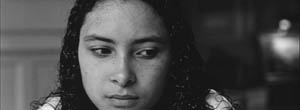
This effect is akin to what happens in the cropping of the 8mm example: the spatial relations have reorganized in relation to the frame edges. Rapports again.
(5) Overcropping can affect the way we experience the time of the shot. Before you call the men in the white coats, I hasten to say that cropping is purely a spatial effect, but in cinema space is bound up with time.
We’ve seen that Godard manipulates the vertical dimension of the frame to an unusual degree, and the effect on time becomes apparent in one scene of Éloge in which Bruno talks with an older man, in a sort of casting session for his project. First we see Bruno alone, and as he walks to the window the old man comes in, his back to us. We presume it’s a man by the bulk, the gait, and the fedora, making its appearance in the upper right corner.
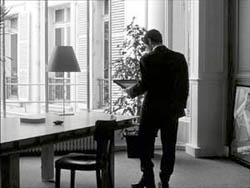
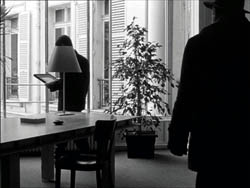
Or does a man come in? In the 1.77 version, at the corresponding point in the shot, we can’t tell it’s a man until the figure comes further into the room.
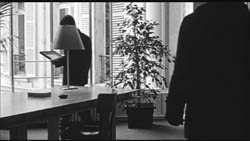
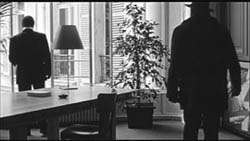
Godard’s reliance on the upper part of the frame allows us to discern the caller sooner in the 1.35 version. Seconds, even split-seconds, matter in cinema. Insofar as cropping affects the timing of a shot’s unfolding, it affects our experience.
( 6) Cropping affects perspective, the perceived distances and volumes of objects in the visual array. Blowing up the center of an image creates a flatter, more friezelike space than we discern in the original. This becomes evident in a later phase of the scene I just mentioned. After Bruno leaves the shot, the old man is left standing in the office.
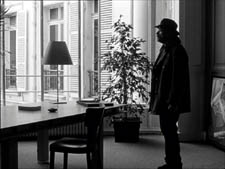
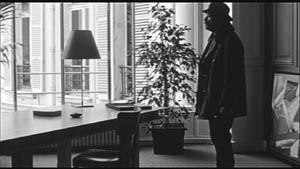
The 1.77 image looks more like it was shot with a long lens than does the full-frame version. The result recalls the sort of perpendicular telephoto framings so common in the 1970s, in films like The Parallax View and The Conversation (below).
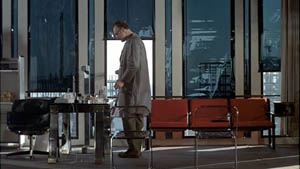
Godard has said that he preferred 30-40mm lenses for much of Sauve qui peut (la vie) because a focal length of 50mm (and presumably one longer than that) will “destroy perspective.” (5)
Many of these differences wouldn’t matter in most films, which aren’t composed as meticulously or as daringly. Hollywood images aren’t typically as dense as those in late Godard. (I must do a blog some day on fussbudget filmmakers like him.) But even if these niceties seem negligible, I think you’ll grant that the film would be much more compromised by being shown in a 1.85 ratio, the squarest option available in most commercial theatres today.
Critical discussions of Godard’s late films have treated them as poetic meditations, and that seems partly right to me. Yet few critics ask how they manage to create their lyrical, associative quality. I think, as I hope to show in a future blog, this has to do with his treatment of narrative (naturally) and his layout of scenes. But even before we get there, I think that we find in the very texture of his images (let alone his sounds) a daring decentering of faces and bodies—the usual nodes of our attention. If he often blocks the flow of our glance, it’s in order to rechannel it to unexpected areas and textures, crannies and gaps, within the image. And so we want all those areas and textures, along with the crannies and gaps, available to our eyes and minds.
(1) James Quandt, “Here and Elsewhere: Projecting Godard,” in For Ever Godard, ed. Michael Temple, James S. Williams, and Michael Witt (London: Black Dog, 2004), 126-139.
(2) Geek note: You may notice that this “full-frame” image isn’t itself in the 1.37 ratio. It’s very square. The reason is that many 1.85 frames will be exposed in the camera at a ratio of 1: 1.2! I believe this was standardized for the Panavision cameras of the 1970s and afterward, though I’d appreciate more information about this. See the entry on Panavision cameras in American Cinematographer Manual, fifth ed., ed. Charles G. Clarke (Hollywood: American Society of Cinematographers, 1980), 104. See also Rob Hummel, “Comparison of 1.85, Anamorphic and Super 35 Film Formats,” American Cinematographer Manual, eighth ed., ed. Rob Hummel (Hollywood: ASC Press, 2001), 24-29.
(3) Jean-Luc Godard, “Formats,” Cahiers du cinéma no. 591 (May 2004), 78.
(4) This image is taken from Jean-Luc Godard par Jean-Luc Godard, vol. 2: 1984-1998, ed. Alain Bergala (Paris: Cahiers du cinéma, 1998), 199.
(5) Jean-Luc Godard, “Propos rompus,” in Godard par Godard vol. 2, 466.
Thanks to Suzy Buenger and Nancy Marshall for identifying the Manet painting for me.
PS 15 Dec: And thanks to James Quandt, Michael Kerpan, and Yogesh Raut for a name correction I’m too embarrassed to specify further.
PS 7 April 2008: The issue is raised anew with Gus van Sant’s Paranoid Park. It’s designed to be shown at 1.37, with more than a few shots reminiscent of Godard. Joe Beres explains here.
PPS 25 January 2009: Ranjit Sandhu provides a lively and detailed discussion of aspect ratios and matteing strategies, along with remarks on Godard’s frames.
PPPS 21 Sept 2009: Thanks to editor John Olivio for a correction on the 1.78 aspect ratio.
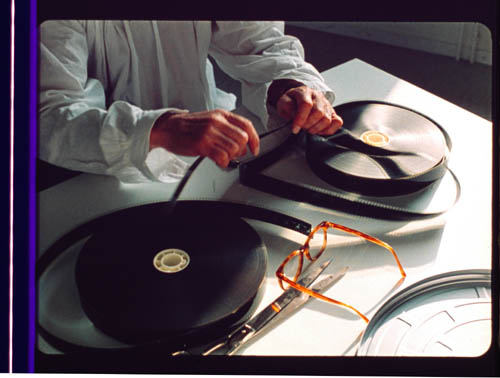
JLG par JLG (1995).
Sleeves
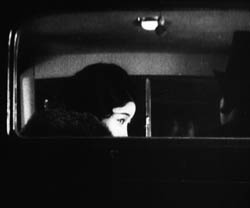
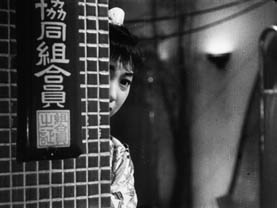
DB here:
Earlier this month, when I was giving a lecture on Mizoguchi Kenji at our university museum, I showed two images from A Woman of Rumor (Uwasa no onna, 1954). It’s a little-known film of his, and it’s probably not up to his finest, but seeing the stills again on the big screen made me want to write about one scene. That scene displays aspects of Mizoguchi’s artistry that I touch on in one chapter of Figures Traced in Light and in the website supplement here.
This blog entry constitutes, I suppose, another supplement. After all, I couldn’t include in the book all the moments in Mizoguchi’s work that I find fascinating. But since comparison is a good way to get under a movie’s skin, my examination of a parallel scene from another movie may have more general interest. Even though Woman of Rumor doesn’t seem to be available on video, maybe looking at this pair of examples would inspire some readers to take an interest in one of the two or three greatest filmmakers who ever lived.
In the court of Regina
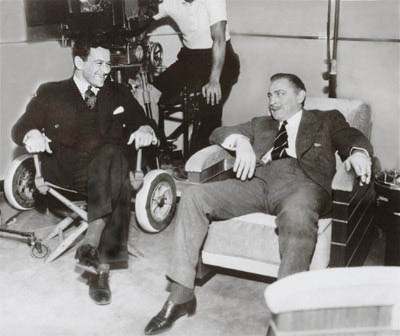
William Wyler and John Barrymore.
What a year 1941 was in the American cinema! We remember it for Citizen Kane but it also brought us How Green Was My Valley (a better film than Kane, I think), and items like Sergeant York (the biggest box-office hit), Dumbo, The Philadelphia Story, Suspicion, Ball of Fire, High Sierra, The Lady Eve, Meet John Doe, The Maltese Falcon, They Died with Their Boots On, and one of the most daring movies ever made in America, The Little Foxes.
An adaptation of Lillian Hellman’s play, The Little Foxes offers a study in unbridled capitalism. It shows how economic interests pit the South against the North and white against black. Psychologically, it analyzes a household gripped by the ruthless domination of the matriarch Regina (Bette Davis), the wiliest member of a family of grasping entrepreneurs. Regina has all but flattened her husband and is trying to make her daughter Alexandra oblivious to the family’s corruption.
The Little Foxes was also bold in its style—in its own way, as venturesome as Citizen Kane. It hasn’t been fully appreciated because Wyler is still thought of as a rather middlebrow talent, an overcautious director who toned down the flamboyance of Gregg Toland’s deep-space and deep-focus compositions.
Some day I hope to blog in defense of Wyler, middlebrow movies, and Midcult art in general. That would involve a detailed analysis of Little Foxes. (1) For now let’s just say that Wyler’s direction of the film won the admiration of no less than André Bazin. Bazin taught us to appreciate Wyler’s work, though with some prompting from Wyler and Toland (as I suggest here). Wyler was also appreciated by Mizoguchi, who, apparently grudgingly, told his screenwriter Yoda that he admired Wyler’s use of the “vertical frame.” (2) Later I’ll suggest one way of understanding that phrase. Mizoguchi met Wyler at the 1953 Venice Film Festival, when Ugetsu Monogatari was up against Wyler’s Roman Holiday for the Silver Lion.
One scene not discussed by Bazin or Mizoguchi, as far as I’m aware, has always gripped me. Regina’s brother Oscar has a wife, Birdie, who has turned into a passive alcoholic. Birdie has learned of plans to marry Xan off to Leo, her shallow son. Her will has been broken by Regina and Oscar, but she summons up the courage to blurt out to Xan that she mustn’t marry Leo, no matter how strongly the family insists. Xan, who has no inkling of how her family twists people to suit their ends, protests that no such thing could happen. But Oscar overhears Birdie warning Xan off.
Birdie and Oscar are about to leave at the end of the evening. Wyler begins with a standard two-shot, very slightly off-center. But as Birdie frantically warns Xan, Oscar’s sleeve and pant leg appear in the lower left of the frame, with the swagged curtain at the doorway hiding his face.
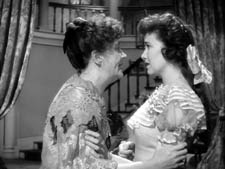
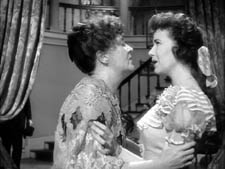
For us, this creates suspense. Only after Birdie has babbled out her warning do the two women notice he’s there. Xan, not knowing how Oscar abuses Birdie, heads off to bed.
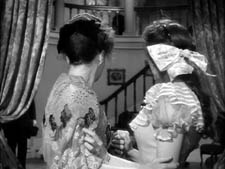
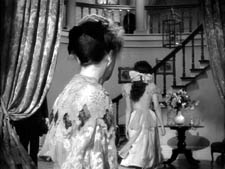
As she climbs the staircase (very important in the film and the original play, this staircase) and heads off to her bedroom, Wyler’s camera arcs to reveal Oscar. Wyler now cuts to show, more or less from Birdie’s point of view, Xan going into her room.
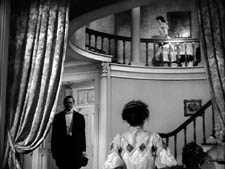
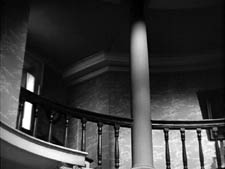
Birdie watches anxiously, then turns to face Oscar, with a look of resigned apprehension.
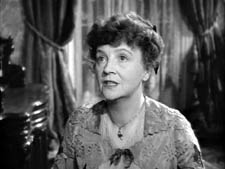
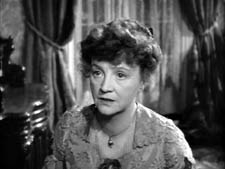
Again suspense: Oscar won’t punish Birdie with Xan watching, but the girl’s departure puts Birdie in jeopardy. In addition, Wyler’s shot of her reaction anticipates the wrath she’ll face. (Patricia Collinge’s fluent performance is equal to the dynamics of Wyler’s visuals.) These cuts anchor our empathy; Wyler has been saving the close-up of Birdie for this moment.
We return to the master framing as Birdie heads toward Oscar, passing into a patch of shadow. As she does so, he raises his hand abruptly.
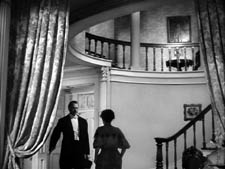
Wyler cuts to a two-shot. Oscar slaps Birdie so hard she seems to bounce against the left frame edge. She cries out and then tries to stifle her voice—a psychologically apt gesture for this woman who muffles her sorrows throughout the film.
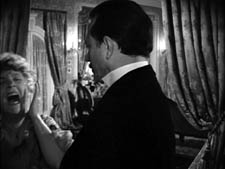
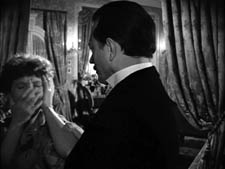
Again, Wyler daringly sets a key action off-center. The brutal discontinuity of the cut, which crosses the axis of action and sharply changes shot scale, accentuates Oscar’s violence. It’s also rather elliptical; run the cut slowly, and you never see his hand strike her.
Xan hurries out of her room and comes to the banister, her face on the upper right balancing the placement of Birdie’s in the prior shot. In the next shot, we see, over her shoulder, Oscar stride out. Birdie follows meekly, assuring Xan that nothing’s wrong. The coda of the scene will emphasize Xan’s puzzled anxiety, a phase in her process of coming to understand the domineering fury that rules her family.
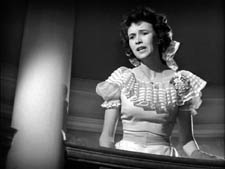
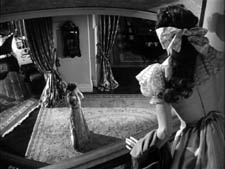
Low- and high-angle shots like this last pair recur throughout The Little Foxes, and I suspect that these are the sorts of thing Mizoguchi was invoking in mentioning Wyler’s “vertical” space. Wyler’s steep angles activate upper areas of the frame that many American directors hadn’t explored.
The act of overhearing a revealing conversation is a standard dramatic convention, but Wyler has refreshed and nuanced it. We know how it would be normally handled. We’d see either a shot showing Oscar stepping fully into the background, or a series of cuts showing first Birdie and Xan and then Oscar listening and watching. Wyler revises the standard schema, taking it for granted that we can pick up on a subtler cue than usual: just a bit of Oscar’s body intrudes.
As a result we have to be more alert. The information isn’t centered, but rather tucked into the lower left. And this option conceals Oscar’s face. Not that we’re doubting he’s angry, but delaying showing his anger builds up greater tension. Wyler, unlike today’s directors, knows when to build up to revealing things that we anticipate, making the final outburst more forceful when it comes. Further, the rest of the scene continues to deny us a clear view of Oscar’s anger, all of which gets squeezed into his gesture of slapping Birdie. It’s Birdie’s reaction that Wyler stresses, and Oscar’s contempt for her is conveyed simply by his bearing, his gesture, and his manner of stalking out of the foyer.
It’s not too much to talk about rigor here. The schemas dominating today’s filmmaking, the stylistic paradigm I call intensified continuity, would demand tight close-ups of everybody from the start. But providing them would make it harder for Wyler to raise the emotion when the startling slap comes. Maybe a contemporary director would render this spike in slo-mo, or with a wobbly handheld camera, but that tends to seem overbearing and pumped-up—as a lot of current stylistic pyrotechnics do. In any case, I’m betting that no American director today would use Oscar’s sleeve in the quietly ominous way Wyler does.
Mizoguchi’s game of vision
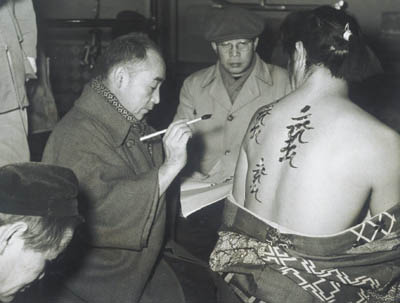
Mizoguchi Kenji, in glasses, during the making of Ugetsu.
Mizoguchi is renowned for his long takes, which are often sustained in distant views featuring considerable camera movement. In the Mizo chapter in Figures Traced in Light, I suggest that these stylistic choices spring from his effort to engage the viewer mesmerically—as he put it, “to work the viewer’s perceptual capacities to the utmost.” He asks us to downshift our attention to the finest details of the action, which he then modulates for expressive effect. I draw examples from various films across his career to show how he creates drama out of remarkably slight differences in character position, lighting, and other factors.
But what happens when he foreswears virtuoso camera movements and single-take scenes and breaks the drama up into several shots? Today, many ambitious directors seem to take pride in stretching out their takes, so cinephiles are sometimes inclined to see a cut as a loss of nerve and a concession to the audience. But I try to show in Figures that Mizoguchi sustains his concern for nuance when he creates an edited sequence. The modulation of fleeting details is to be found in his closer shots too.
In A Woman of Rumor, Hatsuko runs a teahouse that funnels customers to the geisha establishment behind it. She has tried to protect her daughter Yukiko from the shame of her profession. Hatsuko has also been cultivating a young doctor she hopes to marry, giving him money to set up a clinic. Now the doctor, Matoba, has become attracted to Yukiko. The scene I’m examining takes place during the performance of a noh drama. Hatsuko leaves the auditorium and finds Yukiko talking with Dr. Matoba.
As she passes around a screen, she hears Yukiko saying she wants to learn piano in Tokyo. Hatsuko looks left, and Mizoguchi cuts to an approximation of her optical point of view on the couple in the lounge.
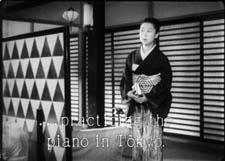
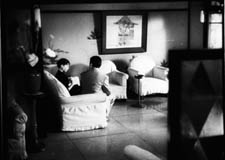
So far, so conventional. Mizoguchi seems to follow the intercutting option for treating a scene of overheard conversation. But he goes further. Having laid out the action, Mizoguchi starts the lesson in just-noticeable-details . . . with a sleeve. He cuts to a reverse shot putting Matoba and Yukiko in the foreground. Hatsuko is still back there, though. We can see her kimono sleeve on the left, poking out from behind the screen.
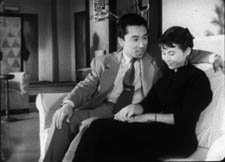
A sharp-eyed viewer might also spot Hatsuko’s shadow on a wall, in the center of the shot, over Matoba’s shoulder. This blow-up shows both the sleeve and her silhouette.
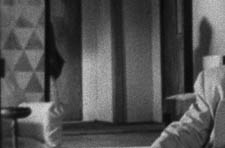
Here, friends, is one reason we want to watch films in 35mm, and projected really big.
It’s now that Yukiko says that she may leave her mother, and Matoba replies, “Maybe I’ll go too.” This is devastating to Hatsuko. The two people whom she loves most seem to care nothing for her. Her shocked reaction is given in a medium-shot showing her shifting out from behind the screen, her face partially hidden.
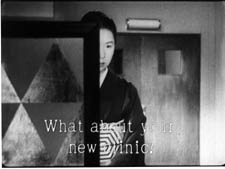
Mizoguchi has picked one variant of the overheard-conversation schema: shot of speakers/ reaction shot of eavesdropper. But he’s done so in his own way, using the barely discernible kimono sleeve to signal Hatsuko’s presence in the full shot of the couple. Likewise, the shot of Hatsuko listening is far from the usual close-up. Like other Japanese directors, Mizoguchi was fond of this arresting single-eye image. He used it earlier in his career, as shown in the first frame at the top of this entry, from Hometown (Furusato, 1930). The second frame is the last shot of his last film, Street of Shame (Akasen chitai, 1956). Quite a shot to end your career on, I’d say.
Most Japanese directors use this single-eye framing as a one-off flourish, but not Mizoguchi. The device epitomizes his demand that we concentrate on a detail. Isolating half a face gives impact to the slightest shift in the eye and eyebrow. Moreover, the split face reappears as a pictorial motif later in the scene.
As Matoba says he’ll go back to Tokyo for his doctorate, Mizoguchi cuts back to the setup for the second shot. Hatsuko moves left to sit on a chair around the corner from the sofa. This prepares for another, more prolonged game of visibility.
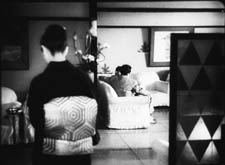
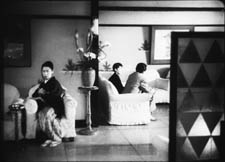
Now we get a thirty-second take of the couple on the sofa. As the scene develops, it becomes evident that Matoba is seducing Yukiko. Hatsuko slips in and out of visibility, her actions responding to and even echoing Matoba’s pressure on the girl. First, as he talks with Yukiko, we see Hatsuko’s sleeve and shoulder, between the vase and his shoulder. But as he slips his arm around Yukiko, her elbow moves aside, in an echo of his gesture.
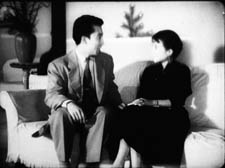
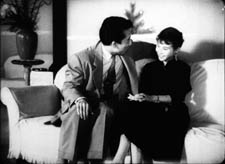
Then, when Matoba presses his attention (“We’ll help each other . . . Depend on me”), Hatsuko’s face pops into view as her fingers emerge to grip the edge of her chair. Mizoguchi then lets her face subside, again slicing it in half.
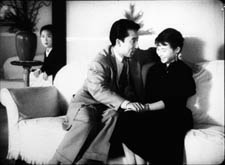
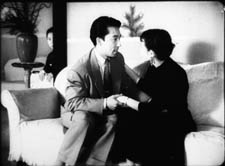
In effect, this shot replays and expands upon the tactic governing the earlier two shots. Again we get the just-noticeable presence of the sleeve, but now rhyming with the action in the foreground. And again we get the facial reaction, impeded by a vertical cutoff, but this time in the distant shot rather than in a closer view. It turns out that those first four shots were training us for this more intricate game of vision.
At the moment Hatsuko’s face is sliced in half, Mizoguchi cuts. Now he prolongs the close view as he had extended the full shot of the couple. In this thirty-second shot, we watch her reaction, played out in slight modulations—changes in her facial expression, changes in the aspect of her face that we see, and changing relations to the curling palm plant in the vase before her.
We get a new angle on Hatsuko, slightly high, as Matoba says, “I’ll tell her.” Hatsuko stands up abruptly and the camera tilts to follow her.
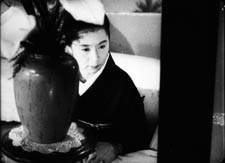
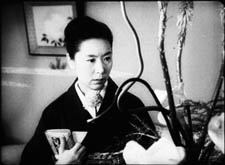
With the simple action of her rising up, Mizoguchi changes his composition sharply. Hatsuko’s position in the frame changes only a little bit, but the massive vase on the left gives way to the curling stalks on the right. Radically refreshing a shot through minimal means is one felicity of Mizoguchi’s art.
Then, as if the full import of Matoba’s betrayal dawns on her, Hatsuko lowers her head sadly. Again her eyes are split up, this time thanks to the twisting stalk. In a characteristic Mizoguchi gesture, she turns from the camera, as if ashamed to face us, but also summoning up reserves for the next emotional shift.
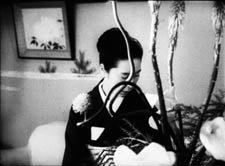
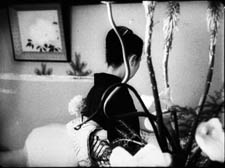
When she turns back, her face burns.
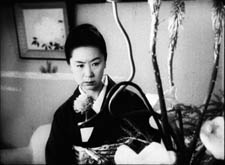
I take this to be the scene’s emotional climax. Mizoguchi could have given it to us much sooner, by having Hatsuko turn angry as she peeped out from behind the screen. Instead, his game of vision allowed him to build patiently toward this unimpeded shot of her reaction. It prepares us for the next stages of the drama, later scenes in which she will confront her patron and launch jealous accusations at Yukiko.
Now we hear the performance ending, and Hatsuko lifts her head. This phase of the scene ends when Mizoguchi cuts to audience members coming into the lounge and greeting her.
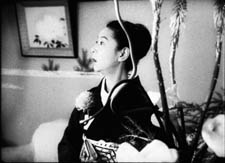
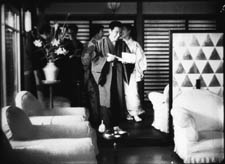
By 1954 Mizoguchi had surely seen The Little Foxes. Had he decided to redo Wyler’s virtuoso staging in his own manner?
Both directors work with similar ingredients: overheard conversation, depth shots, judicious close-ups, and partial views. But the narrational weightings differ. Wyler’s film aligns and allies us with the people talking, whereas A Woman of Rumor ties us to the listener. (3) Wyler’s eight shots take eighty-one seconds; Mizoguchi’s eight shots take about two minutes.
Wyler’s handling is brisk, tense, and remarkably nuanced within the Hollywood tradition. Mizoguchi gives us his scene more sedately, wringing just-noticeable differences out of unassertive performances and simple elements of setting. No slap here, just a drama of wounded pride, lost love, and jealousy played out in the face, back, and sleeve of Tanaka Kinuyo, shifting behind a floral arrangement. What Wyler gives us as one sharp effect, Mizoguchi turns into a delicate, prolonged game of vision.
Am I fussing over minutiae? No; Wyler and Mizoguchi did. We just have to follow where they lead. As I try to show in my essay on blinking in cinema (4), directors attend closely to things that might seem trivial. Our analysis needs to be as fine-grained as their craft and artistry.
Oh, yes: at Venice Ugetsu won the Silver Lion. Wyler had to be content with Roman Holiday’s three Academy Awards.
(1) I sketch some of the possibilities in On the History of Film Style (Cambridge: Harvard University Press, 1997), 225-227.
(2) For more on Mizoguchi’s competition with Wyler, see Figures Traced in Light (Berkeley: University of California Press, 2005), 134.
(3) I’m referring to Murray Smith’s deft analysis of what he calls alignment and allegiance in our relation to film characters. See Engaging Characters: Fiction, Emotion, and the Cinema (Oxford: Oxford University Press, 1995), Chapters 5 and 6.
(4) “Who Blinked First?” in Poetics of Cinema (New York: Routledge, 2007), 327-335.
PS 3 December: Thanks to Michael Kerpan for a name correction, and for the information that Woman of Rumor was once available on a French DVD.
PPS 27 February 2008: Good news. Now Woman of Rumor is available on the wonderful Eureka! Masters of Cinema series, along with the superb Chikamatsu Monogatari. The discs come with voice-over commentary by Tony Rayns and essays by Keiko McDonald and Mark LeFanu.



