






Archive for the 'Film technique: Staging' Category
Do filmmakers deserve the last word?
DB here:
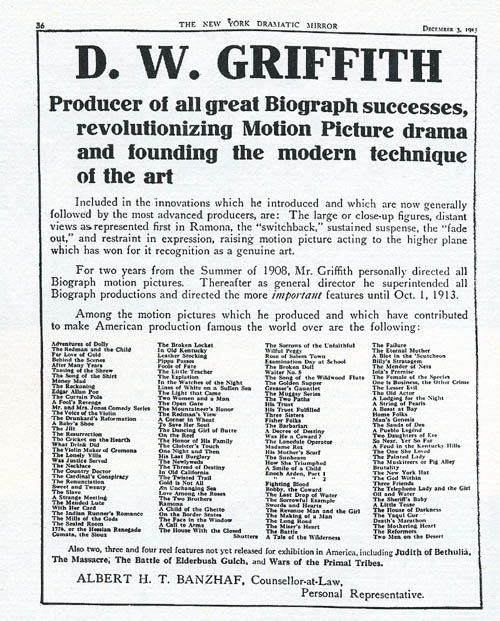
On 3 December 1913, the above advertisement appeared in the New York Dramatic Mirror. D. W. Griffith had left the American Biograph company and set out on an independent path that would lead to The Birth of a Nation and beyond. Because Biograph never credited directors, casts, or crews, he wanted to make sure that the professional community was aware of his contributions. Not only did he point out that he had made several of the most noteworthy Biograph films; he also took credit for new techniques. He introduced, he claims, the close-up, sustained suspense, restrained acting, “distant views” (presumably picturesque long-shots of the action), and the “switchback,” his term for crosscutting—that editing tactic that alternates shots of different actions occurring at the same time.
Griffith’s bid for credit was a shrewd move for his career, and it had repercussions after the stunning success of The Birth of a Nation two years later. Many historians took Griffith at his word and credited him with the breakthroughs he listed. He became known as the father of “film grammar” or “film language.” The idea hung on for decades. Here’s the normally perceptive Dwight Macdonald, criticizing Dreyer’s Gertrud for being anachronistic:
He just sets up his camera and photographs people talking to each other, usually sitting down, just the way it used to be done before Griffith made a few technical innovations. (1)
Filmmakers believed the Griffith story too. Orson Welles wrote of the “founding father” in 1960:
Every filmmaker who has followed him has done just that: followed him. He made the first close-up and moved the first camera. (2)
In the late 1970s a new generation of early-cinema scholars gave us a more nuanced account of Griffith’s place in history. They pointed out that most of the innovations he claimed either predated his Biograph work, (3) or appeared simultaneously and independently in Europe and in other American films. Some Griffith partisans had already conceded this, but they maintained that he was the great synthesizer of these devices, and that he used them with a vigor and vividness that surpassed the sources.
That judgment seems right in part, but Eileen Bowser, Tom Gunning, Barry Salt, Kristin Thompson, Joyce Jesniowski, and other early-cinema researchers have drawn a more complicated picture. (4) Griffith did speed up cutting and devote an unusual number of shots to characters entering and leaving locales. But these innovations weren’t usually recognized as original by previous historians. More interestingly, much of what Griffith did was not taken up by his successors. His technique was idiosyncratic in many respects. By 1915 younger directors like Walsh, Dwan, and DeMille were forging a smoother style that would be more characteristic of mainstream storytelling cinema than Griffith’s somewhat eccentric scene breakdowns. Instead of creating film language, he spoke a forceful but often unique dialect.
The New York Dramatic Mirror ad coaxes me to reflect on how filmmakers have shaped critics’ and historians’ responses to their work. Hawks and Hitchcock developed a repertory of ideas, opinions, and anecdotes to be trotted out on any occasion. Today, directors write books, give interviews, appear on infotainment shows, and provide DVD commentary. We know that many of the talking points are planned as part of the film’s publicity campaign, and journalists dutifully follow the lead. (In Chapter 4 of The Frodo Franchise, Kristin discusses how this happened with Lord of the Rings.) For many decades, in short, filmmakers have been steering critics and viewers toward certain ways of understanding their films. How much should we be bound by the way the filmmaker positions the film?
Deep focus and deep analysis
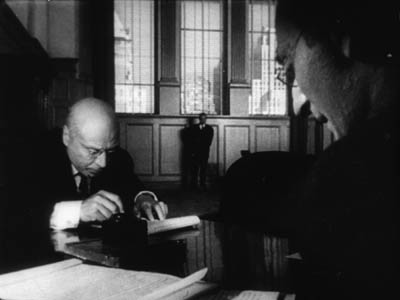
Citizen Kane (1941).
Determining intentions is tricky, of course. Still, I think that in many cases we can reconstruct a plausible sense of an artist’s purposes on the basis of the artwork, the historical context, surviving evidence, and other information. (5) This may or may not correspond to what the artist says on a particular occasion. For now, I want simply to point to one instance in which filmmakers have shaped critical uptake, with results that are both illuminating and limiting.
In the late 1940s and early 1950s, André Bazin, one of the great theorists and critics of cinema, argued that Orson Welles and William Wyler created a sort of revolution in filmmaking. They staged a shot’s action in several planes, some quite close to the camera, and maintained more or less sharp focus in all of them. Bazin claimed that Welles’ Citizen Kane and The Magnificent Ambersons and Wyler’s The Little Foxes and The Best Years of Our Lives constituted “a dialectical step forward in film language.”
Their “deep-focus” style, he claimed, produced a more profound realism than had been seen before because they respected the integrity of physical space and time. According to Bazin, traditional cutting breaks the world into bits, a series of close-ups and long shots. But Welles and Wyler give us the world as a seamless whole. The scene unfolds in all its actual duration and depth. Moreover, their style captured the way we see the world; given deep compositions, we must choose what to look at, foreground or background, just as we must choose in reality. Bazin wrote of Wyler:
Thanks to depth of field, at times augmented by action taking place simultaneously on several plane, the viewer is at least given the opportunity in the end to edit the scene himself, to select the aspects of it to which he will attend. (6)
While granting differences between the directors, Bazin said much the same about Welles, whose depth of field “forces the spectator to participate in the meaning of the film by distinguishing the implicit relations” and creates “a psychological realism which brings the spectator back to the real conditions of perception” (7).
In addition, Bazin pointed out, this sort of composition was artistically efficient. The deep shot could supply both a close-up and a long-shot in the same framing—a synthesis of what traditional editing had given in separate shots. Bazin wove all these ideas into a larger theory that cinema was inherently a realistic medium, bound to photographic recording, and Welles and Wyler had discovered one path to artistic expression without violating the medium’s biases.
There are many objections to Bazin’s argument, some of which I’ve rehearsed in On the History of Film Style. My point here is that Bazin was presenting analytical points that stemmed from publicity put out by Welles, Wyler, and especially their talented cinematographer Gregg Toland.
In a 1941 article in American Cinematographer, Toland talked freely about how he sought “realism” in Citizen Kane. The audience must feel it is “looking at reality, rather than merely a movie.” Key to this was avoiding cuts by means of long takes and great depth of field, combining “what would conventionally be made as two separate shots—a close-up and an insert—into a single, non-dollying shot.”(8) Toland defended his sometimes extreme stylistic experimentation on grounds of realism and production efficiency, criteria that carried some weight in his professional community of cinematographers and technicians. (9)
Toland’s campaign for his style addressed the general public too. For Popular Photography he wrote an article (10) explaining again that his “pan-focus” technique captured the conditions of real-life vision, in which everything appears in sharp focus. A still broader audience encountered a Life feature in the same year (11), explaining Toland’s approach with specially-made illustrations. Two samples show selective focus, one focused on the background, the other on the foreground.
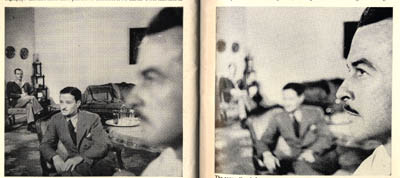
An accompanying photo shows pan-focus at work, with Toland in frame center, an actor in the background, and Toland’s camera assistant in the foreground.
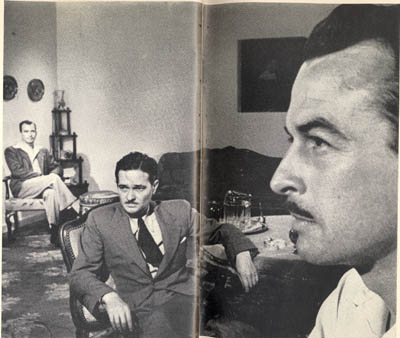
In sum, Toland’s publicity prepared viewers, both professional and nonprofessional, for an odd-looking movie.
Throughout the 1940s, Welles and Wyler wrote and gave more interviews, often insisting that their films invited greater participation on the part of spectators. In a crucial 1947 statement, Wyler noted:
Gregg Toland’s remarkable facility for handling background and foreground action has enabled me over a period of six pictures he has photographed to develop a better technique for staging my scenes. For example, I can have action and reaction in the same shot, without having to cut back and forth from individual cuts of the characters. This makes for smooth continuity, an almost effortless flow of the scene, for much more interesting composition in each shot, and lets the spectator look from one to the other character at his own will, do his own cutting. (12)
Some of this publicity material made its way into French translation after the liberation of Paris, just as Kane, The Little Foxes, and other films were arriving too. Bazin and his contemporaries picked up the claims that these films broke the rules. Deep-focus cinematography became, in the hands of critics, a revolutionary new technique. They presented it as their discovery, not something laid out in the films’ publicity.
But the case involved, as Huck Finn might say, some stretchers. Watching the baroque and expressionist Kane, it’s hard to square it with normal notions of realism, and we may suspect Toland of special pleading. Some of Toland’s purported innovations, such as low-angle shots showing ceilings, had been seen before. Even the signature Toland look, with cramped, deep compositions shot from below, can be found across the history of cinema before Kane. Here is a shot from the 1939 Russian film, The Great Citizen, Part 2 by Friedrich Ermler.
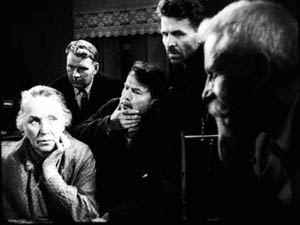
More seriously, some of Toland’s accounts of Kane swerve close to deception. For decades people presupposed that dazzling shots like these were made with wide-angle lenses.
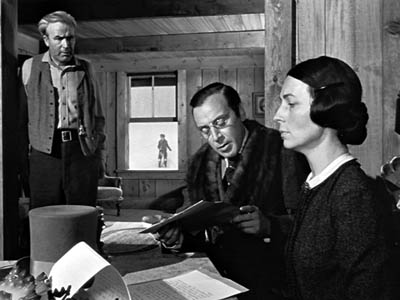
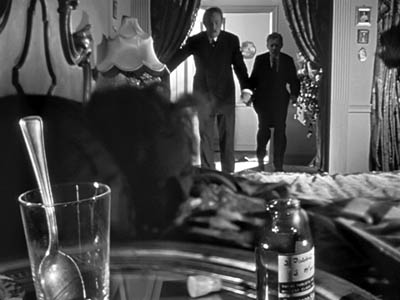
Yet the deep focus in the first image was accomplished by means of a back-projected film showing the boy Kane in the window, while the second image is a multiple exposure. The glass and medicine bottle were shot separately against a black background, then the film was wound back and the action in the middle ground and background were shot. (And even the middle-ground material, Susan in bed, is notably out of focus.) I suspect that the flashy deep-focus illustration in Life, shot with a still camera, is a multiple exposure too. In any event, much of the depth of field on display in Kane couldn’t have been achieved by straight photography. (13)
RKO’s special-effects department had years of experience with back projection and optical printing, notably in the handling of the leopard in Bringing Up Baby, so many of Kane‘s boldest depth shots were assigned to them. But here is all that Toland has to say on the subject:
RKO special-effects expert Vernon Walker, ASC, and his staff handled their part of the production—a by no means inconsiderable assignment—with ability and fine understanding. (14)
Kane’s reliance on rephotography deals a blow to Bazin’s commitment to film as a medium committed to recording an event in front the camera. Instead, the film becomes an ancestor of the sort of extreme artificiality we now associate with computer-generated imagery.
Despite these difficulties, Toland’s ideas sensitized filmmakers and critics to deep space as an expressive cinematic device. Modified forms of the deep-focus style became a major creative tradition in black-and-white cinema, lasting well into the 1960s. Bazin’s analysis certainly developed Toland’s ideas in original directions, and he creatively assimilated what Toland and his directors said into an illuminating general account of the history of film style. None of these creators and critics were probably aware of the remarkable depth apparent in pre-1920 cinema, or in Japanese and Soviet film of the 1930s. Their claims taught us to notice depth, even though we could then go on to discover examples that undercut Toland’s claims to originality.
Some little things to grasp at
I assume that Toland and his directors were sincerely trying to experiment, however much they may have packaged their efforts to appeal to viewers’ and critics’ tastes. But sometimes artists aren’t so sincere. By the 1950s, we have directors who started out as film critics, and they realized that they could guide the agenda. Here is Claude Chabrol:
I need a degree of critical support for my films to succeed: without that they can fall flat on their faces. So, what do you have to do? You have to help the critics over their notices, right? So, I give them a hand. “Try with Eliot and see if you find me there.” Or “How do you fancy Racine?” I give them some little things to grasp at. In Le Boucher I stuck Balzac there in the middle, and they threw themselves on it like poverty upon the world. It’s not good to leave them staring at a blank sheet of paper, no knowing how to begin. . . . “This film is definitely Balzacian,” and there you are; after that they can go on to say whatever they want. (15)
Chabrol is unusually cynical, but surely some filmmakers are strategic in this way. I’d guess that a good number of independent directors pick up on currents in the culture and more or less self-consciously link those to their film.
Today, in press junkets directors can feed the same talking points to reporters over and over again. An example I discuss in the forthcoming Poetics of Cinema is the way that Chaos theory has been invoked to give weight to films centering on networks and fortuitous connections. As I read interview after interview, I thought I’d scream if I encountered one more reference to a butterfly flapping its wings.
More recently, Paul Greengrass gave critics some help when he suggested that the jumpy cutting and spasmodic handheld camera of The Bourne Ultimatum suggested the protagonist’s subjective point of view–presumably, Jason’s psychological disorientation and frantic scanning of his surroundings. I expressed skepticism about this on an earlier blog entry, Anne Thompson replied on her blog, and I returned to the subject again. Any director’s statement of purpose is interesting in itself, but it should be assessed in relation to the evidence we detect onscreen.
Another recent instance: the new Taschen book on Michael Mann. The luscious pictures, mainly from Mann’s archive, are the volume’s raison d’etre, but the filmmaker seems to have placed unusual demands on the text. F. X. Feeney writes:
An earlier version of this book completed by another writer attempted (in a spirit of sincere praise) to treat Mann’s films as reactions against film traditions, as subversions of genre. This fetched a rebuke from Mann: “It’s irrelevant and neither accurate nor authentic to compare my films to other films because they don’t proceed from genre conventions and then deviate from those conventions. They proceed from life. For better or worse, what I’ve seen and heard and learned on my own is the origin of this material. Maybe the film medium by nature spawns conventions, because we all built on what’s gone before, but the content and themes of my films are not facile and derivative. They are drawn from life experience.” (16)
We have to wonder if Mann’s objection played a role in eliminating the earlier writer’s version. If that happened, it’s an unusually strong instance of a director’s holding sway over critical commentary. (17)
In the text we have, Feeney provides a chronological account of Mann’s career: plot synopses, thematic commentary, production background. There’s no discussion of broader historical trends, such as the migration of TV directors into film, the creative options available in 1980s-1990s Hollywood, the development of self-conscious pictorialism in modern film, the possibility of genre films becoming art-films or prestige pictures, or the changes in media culture or American society. All of these lines of inquiry would require comparing Mann with other filmmakers. It remains for other writers, perhaps without the director’s cooperation, to put Mann’s achievement into such contexts.
It’s always vital to listen to filmmakers, but we shouldn’t limit our analysis to what they highlight. We can detect things that they didn’t deliberately put into their films, and we can sometimes find traces of things they don’t know they know. For example, virtually no director has explained in detail his or her preferred mechanics for staging a scene, indicating choices about blocking, entrances and exits, actors’ business, and the like. Such craft skills are presumably so intuitive that they aren’t easy to spell out. Often we must reconstruct the director’s intuitive purposes from the regularities of what we find onscreen. (For examples, see this site here, here, and here.) And it doesn’t hurt, especially in this age of hype, to be a little skeptical and pursue what we think is interesting, whether or not a director has flagged it as worth noticing.
(1) Macdonald, “Gertrud,” Esquire (December 1965), 86.
(2) Quoted in Orson Welles and Peter Bogdanovich, ed. Jonathan Rosenbaum, This is Orson Welles (New York: HarperCollins, 1992), 21).
(3) Such would seem to be the case of the close-up, which of course is found very early in film history. But Griffith’s idea of a close-up may not correspond to ours. More on this in a later blog, perhaps.
(4) I give an overview of this rich body of research in Chapter 5 of On the History of Film Style. See also various entries in the Encyclopedia of Early Cinema, ed. Richard Abel (New York: Routledge, 2005).
(5) The most detailed argument for this view I know is Paisley Livingston’s book Art and Intention: A Philosophical Study.
(6) “William Wyler, or the Jansenist of Directing,” in Bazin at Work: Major Essays and Reviews from the Forties and Fifties, ed. Bert Cardullo (New York: Routledge, 1997), 8.
(7) Orson Welles: A Critical View, trans. Jonathan Rosenbaum (New York: Harper and Row, 1978) 80).
(8) Toland, “Realism for Citizen Kane,” American Cinematographer 22, 2 (February 1941), 54, 80.
(9) See the discussion in Bordwell, Janet Staiger, and Kristin Thompson, The Classical Hollywood Cinema: Film Style and Mode of Production to 1960 (New York: Columbia University Press, 1985), 345-349.
(10) Toland, “How I Broke the Rules in Citizen Kane,” Popular Photography (June 1941), 55, 90-91.
(11) “Orson Welles: Once a Child Prodigy, He Has Never Quite Grown Up,” Life (May 26, 1941), 110-111.
(12) Wyler, “No Magic Wand,” The Screen Writer (February 1947), 10.
(13) Peter Bogdanovich was to my knowledge the first person to publish some of this information; see “The Kane Mutiny,” Esquire 77, 4 (October 1972), 99-105, 180-90.
(14) Toland, “Realism,” 80.
(15) “Chabrol Talks to Rui Noguera and Nicoletta Zalaffi,” Sight and Sound 40, 1 (Winter 1970-1971), 6.
(16) F. X. Feeney, Michael Mann (Cologne: Taschen, 2006), 21.
(17) Mann’s reasoning puzzles me. He insists that his films can’t be compared to others along any dimensions, especially thematic ones. Yet in saying that his films are lifelike, he suggests that other films aren’t as realistic as his. Moreover, what about comparisons on grounds of technique, surely one of the most striking and admired features of Mann’s work? For reasons that are obscure, the director discourages any critical consideration of style; Feeney tells us that Mann hates the very word (p. 20).
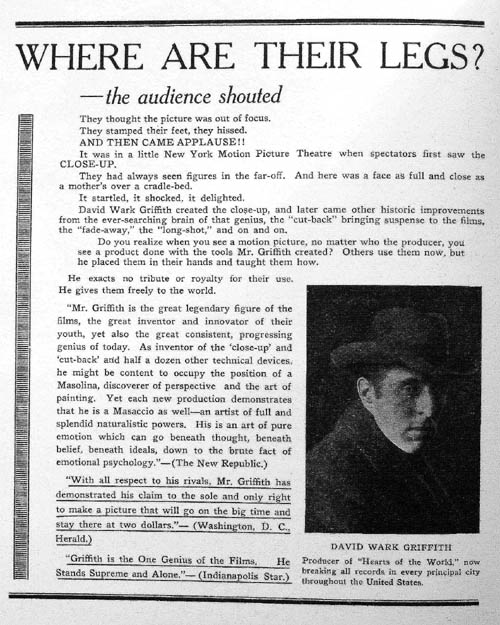
Ad in Wid’s Year Book 1918.
PS: 15 October: I’ve received a clarification from Paul Duncan, editor of F. X. Feeney’s Michael Mann book for Taschen. He expresses general agreement with my suggestions about how directors shape the uptake of their work, but he explains that the Mann book isn’t an instance of it. Here are the comments bearing on my blog entry.
In reply to my suggestion of other avenues to explore about Mann’s career:
In fairness to F.X. Feeney, he only had 25,000 words to cover Mann’s career, and all the subjects you write about are really outside the scope of the book. It sounds as though these are subjects that you would like to explore, and I can’t wait to read them in a future book or blog.
As for whether Mann exercised some control over the book’s final form, which I float as one possible explanation for its compass:
First, you speculate whether Mann caused the first version of the book to be scrapped, i.e. He exerted editorial control/censorship over the book. This is not the case, and if it was, do you think that he would have allowed F.X. to write that in the published version of the book?
In Note 17 appended to Feeney’s quote, you write: “Yet in saying that his films are lifelike, he suggests that other films aren’t as realistic as his.” If you had continued Mann’s quote, you would have reported the following: “I don’t look at the excellent French director Jean-Pierre Melville to decide how to tell the story in Thief. I meet thieves. And I guarantee you the reason Melville’s Le Samourai 1967) has authenticity, the reason Raoul Walsh’s White Heat (1949) has authenticity, is because those film-makers knew thieves, too.” I do not see any evidence here that Mann suggests that his films are more lifelike than other directors’. Only that his films stem from life like other films stem from life.
Also, in Note 17, you write: “For reasons that are obscure, the director discourages any critical consideration of style; Feeney tells us that Mann hates the very word (p. 20).” The reason Mann hates the word “style”—and I apologize for not making this clear in the book—is because after producing the Miami Vice TV show, he was forever referred to as a stylist, and the “style” of the show was all anybody ever talked about. The implication was that Mann is a director of style without substance. Subsequently, Mann has been very wary of the word, and discussion of it, because it puts undue weight on one aspect of his work.
Finally, I would like to explain a little of the working method with Mann on the book. The book was researched and written during rehearsal, filming and editing of Collateral. F.X. wrote the text and was given full access to everything that Mann had said in interviews. Mann then read and annotated the text, and this was discussed face-to-face with F.X. Most of these annotations were of a factual nature, correcting dates, being precise about the sequence of events, and to correct misinterpretations of his comments in previous interviews. However, they would also bring up new comments from Mann about his work. F.X. then rewrote some texts to include Mann’s comments, and then F.X. wrote his replies. In this way, the book became more of a dialogue between Mann and F.X. and is stronger for it I feel. So, in this case, the filmmaker did not get the last word.
I thank Paul for his clarifications, which should be of interest to all the book’s readers. On only two matters do we disagree.
First, Feeney’s book achieves what it set out to achieve, and it deserves credit for giving us valuable information about Mann in a clear, pungent style. And no one expects a Taschen book to be an in-depth monograph covering all aspects of a director’s career. But I still think that length limits don’t prevent an author from raising the contextual issues I mention. Many articles manage to address matters that go beyond the sort of career survey that Feeney provides, so there are ways to sketch such issues in an abbreviated way. I inferred, erroneously, that the choice not to tackle them could have been related to Mann’s own views on the comparative dimension that such issues tend to rely on.
Secondly, a minor matter: The fact that Mann can invoke Melville and Walsh on films about thieves suggests that a comparative perspective is valuable; he’s including himself in the company of directors who know their subjects from life, in explicit contrast to those who don’t. I didn’t include the extra sentences because I thought that they simply provided further signs of the contradiction I found in Mann’s own position—that his films can’t be compared to other directors’ works.
Vancouver visions

Drizzle every day can’t dampen audiences’ enthusiasm.
DB again:
More dispatches from the Vancouver International Film Festival.
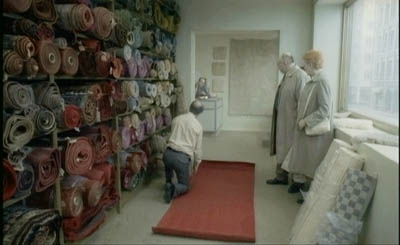
“Be pleased, then, you living one, in your delightfully warmed bed, before Lethe’s ice-cold wave will lick your escaping foot.” As a tram destination, Lethe makes a brief appearance in the Swedish film You, the Living, Roy Andersson’s latest comedy of trivial miseries. The line from Goethe is apt. After ninety minutes of drab apartments and Balthus-like figures, all bathed in sickly greenish light, you’re ready to stay in bed forever.
As in Songs from the Second Floor, Andersson gives us a loose network narrative, with barely characterized figures threading their way through urban locales. Long-shot, single-take scenes turn clinics and dining rooms into monumentally desolate spaces. Humans, either bulbous or emaciated, trudge through torrential rain and peer out from distant windows. The bodies may be distorted and careworn, but the spaces are even more so. We get a sort of dystopian Tati, in which gags, near-gags, and anti-gags are swallowed up in the cavities we call home and workplace. A carpet store stretches off into the distance, and a cloakroom seems like a basketball court.
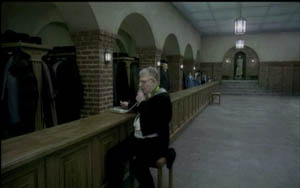
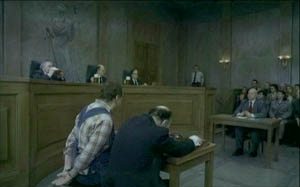
In You, the Living, Andersson’s characters recount their dreams, and these open onto areas only a step beyond our world in their lumpish crowds and eerie vacancy. Judges at a trial are served beer as they condemn the accused. Spectators at an electrocution snack on popcorn from supersized buckets. How can I not like a filmmaker so committed to moving his actors around diagonal spaces, even if the frame is either sparse or uniformly packed, and though he does treat his people like sacks of coal? Don’t look for hope here, only a sardonic eye attracted by banality and pointlessness, images made all the bleaker by an occasional song.
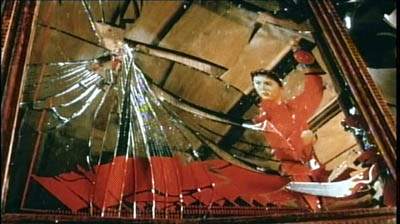
I’m drawn to directors who create a powerful visual and auditory world more or less out of phase with reality as we usually see it (in life and in movies). Andersson is one such director; Jiang Wen is another, whose audacious The Sun Also Rises is one of my favorites of the festival so far. Not doing so well with Mainland Chinese audiences, according to the International Herald Tribune, it hasn’t warmed up a lot of Western critics either. Amazingly, it was declined for competition at Cannes.
It seems impossible to discuss The Sun Also Rises without using the word “magic,” as in magic realism, but I saw it as more of a fairy tale or fable. Set in the Cultural Revolution, it tells two stories in the first two sections. A young boy’s mother goes a little mad on a labor farm; in another village, a teacher is compromised by the passionate love of a nurse and an accusation of sexual misconduct. The two stories intersect in a third section, which leads to a jubilant, if disconcerting, final stretch.
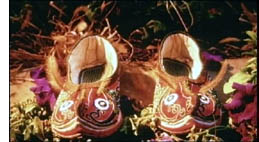 At the center of each plot stands a vivacious, passionate woman who unleashes a cascade of unhappy events. Yet the tone of the film is cheerful, almost giddy, thanks not only to Joe Hisaishi’s buoyant score (he may now be the Nino Rota of Asian cinema) but to Jiang’s fresh, assured technique. The movie starts with tight close-ups—the fish-design shoes the mother wants, her feet and hands, her son’s hands at the abacus—edited at a cracking pace. Staccato movements in and out of the frame give the whole passage a visual snap that launches the movie. Characters lunge through the shots, running this way and that without catching breath, and Jiang’s camera follows them without pausing for the sort of stately scene-setting that audiences may expect. Likewise, the second story opens with hands at play and work, the teacher stroking his guitar strings and a bevy of woman kneading bread dough.
The exuberance of the characters and the style contrasts with the usual presentation of this cruel era of PRC history. Jiang finds real pleasure in Cultural Revolution kitsch, and he links a snapshot of the missing father to an iconic image from The Red Detachment of Women. It’s another knot joining the two plot strands; in the second section, villagers watch a screening of that film. Jiang makes the event a real festivity, with couples courting, the teacher humming along with the tunes, and an old lady feeding fish in a pond. Jiang dares to suggest that the force-fed popular culture of Maoism, so scoffed at now, gave genuine enjoyment
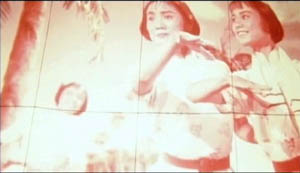
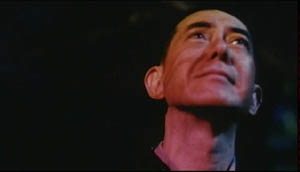
The fairy-tale atmosphere is conjured up by little mysteries, such as a talking bird and the possibility of taking dictation on an abacus, and bigger ones about fatherhood, a stone hut in the forest, and a shadowy figure named Alyosha, whose identity is more or less revealed in the film’s final long sequence. Variety‘s Derek Elley found The Sun Also Rises both rushed and dawdling, but you could say that about 8 ½ too. Like Fellini’s film, Jiang’s shows a filmmaker at the top of his powers inviting us to savor the exhilarating attractions of imagination.
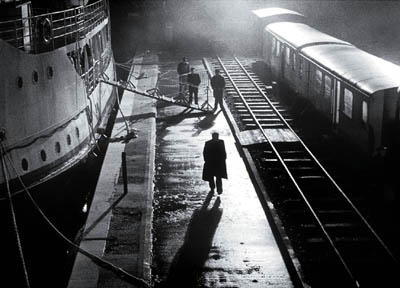
Another world, another vision. The camera frames a rope descending into black water and tilts slowly, really slowly, up to reveal the ship’s prow and the deck, swathed in darkness. Two silhouettes are visible, and one says, “Don’t follow me too soon.” Soon we’re following the transfer of a small suitcase, the disembarking of passengers making their way to a train. This nearly thirteen-minute shot (!) gives way to another long take, in which we see, in the distance, a murder on the quay.
Béla Tarr has called The Man from London a film noir, and he explained that to me by saying, “Not an American film noir. They were done by bad directors. More like the original French film noirs.” Indeed, the opening shot, with its mists and murky waterfront, suggests Quai des brumes. But here the plot action is slight, presented at a distance, and opaque in its motives; 10 % story, we might say, but 90 % atmosphere. The camera coasts across the waterfront town with the same grave deliberation we see in Damnation, Sátántangó, and Werckmeister Harmonies, swallowing up the Simenon situation in Tarr’s fluid way of seeing, a scanning of ever-shifting surfaces and vistas.
With fewer than thirty shots across about 133 minutes, The Man from London is another exercise in long-take virtuosity, but I thought I noticed some fresh departures. For one thing, there are few characters and relatively few locales, and situations are brought out with unusual explicitness (for Tarr). Instead, it seemed to me that Tarr was exploring new possibilities in one of his pet techniques, the over-the-shoulder long shot I mentioned in an earlier entry.
The opening shot, at first an apparently objective survey of the moored ship, turns out to be a view from the tower manned by Maloin. In shooting the wharf, the camera is forever oscillating, within a single shot, between what we can see outside, at a distance, from a high angle, and glimpses of Maloin at his post, his head or shoulder sliding into the foreground. Imagine Rear Window without the reverse shots of Jimmy Stewart watching.
In earlier films, Tarr tended to be quite clear when his foreground character was noticing something in the distance; his chief interest lay in suppressing the character’s reaction. What we get here can be seen as a refinement of the opening shot of Damnation, with its awesome landscape gradually reframed by Karrer looking out his window, or of passages of the doctor at his window in Sótántangó. Several of the tower scenes in The Man from London, are elaborations of that image scheme, but with more ambiguity. The camera, slipping from long-shot background and close-up foreground, coasts along without telling us whether Maloin has seen exactly what we’ve seen. The result is a suspenseful uncertainty not only about what’s happening in the noir plot but also about what Maloin knows.
There are many other points of interest in the new film, and after one viewing I can’t claim to have a grip on them. But I do think critics have overlooked its sheer visual beauty and Tarr’s efforts to turn his style toward a fluid pictorial suspense.
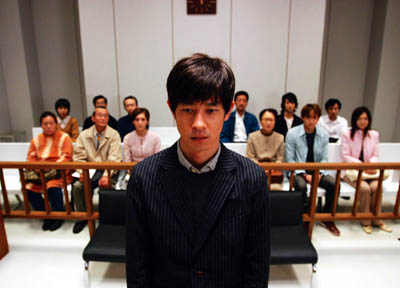
Altogether less flamboyant than any of these was Suo Masayuki’s I Just Didn’t Do It (Japan), which I’d been looking forward to since my February entry. It’s definitely a change of pace for a director known for comedies that satirize youth culture and middle-aged boredom. A young man is accused of groping a schoolgirl on a crowded traincar. The police advise him to confess and pay a fine, but he insists on his innocence. This decision drops him into a judicial mill that grinds slow and altogether too fine.
The script carpentry seems to me excellent. The presentation of each phase of the boy’s case could have been dry, but Suo makes each step hinge on a detail of fact or inference, so small questions keep popping up—including questions about whether the boy really might have done it. The finale, which recalls Kurosawa’s Ikiru in its methodical summing up of everything we have seen, becomes grueling, but in a salutary way. In Japan, the film is a trailblazing critique of the criminal justice system, where most people arrested confess in order to avoid the almost inevitable guilty verdict in a trial. Eliminating a jury, barring defense counsel’s discovery of prosecution evidence, and capriciously replacing one judge by another midway through a case, the system encourages cynical submission.
Suo avoids stylistic pyrotechnics. He plays down his signature mugshot framings (the publicity still above is an exception) and has recourse to handheld camerawork simply to distinguish the train scenes from the rest of the film. Still, his shooting displays a quiet agility. The high point is probably the testimony of the schoolgirl, her identity protected by screens set up around her. Suo finds a remarkable variety of camera setups here, each well-judged to impart a particular piece of information. (In its resourceful changes of viewpoint, the sequence reminded me of Mizoguchi’s courtroom scenes in Taki no Shiraito and Victory of Women.) The title suggests a strident social-problem film, but Suo’s calm plainness of handling yields a quality rare in the genre: tact.
Many more films to report on, including Johnnie To’s latest, but I must rush off to—what else?—another movie. I’ll try for a wrapup on Thursday, while I’m on that highway in the sky.
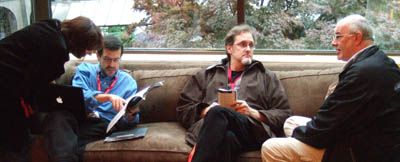
The critics line up: Bérénice Reynaud, Shelly Kraicer, Chuck Stephens, and Tony Rayns.
Bergman, Antonioni, and the stubborn stylists
DB here:
Jonathan Rosenbaum has created quite a stir. His New York Times Op-Ed piece, “Scenes from an Overrated Career,” offers a fairly harsh judgment on the films of Ingmar Bergman. In one sense the timing was awkward; the poor man had just died. But the article wouldn’t have attracted much attention if Rosenbaum had waited a few months, so if creating a cause célèbre was his goal, he chose the right moment.
Timing aside, there wasn’t much in the piece that hasn’t been said by certain cadres of cinephiles for decades. Back in the 1960s, people called Bergman “theatrical,” “uncinematic,” pretentious, and intellectually shallow. He was even accused of hypocrisy. His spiritual, philosophical films always seemed to depend on a surprising number of couplings, killings, rapes, and gorgeous ladies, often naked. Rosenbaum contrasts Bergman with Bresson and Dreyer, more austere religious filmmakers as well as great formal innovators, and this gambit too is familiar from late-night film-society disputes. Jonathan’s case is news in the good, grey Times, but it’s an old story among his (my) generation.
I think that this generational antipathy has many sources. While Bergman had considerable academic cachet, this may have hurt him with smart-alecks like us. Cinephile priests and professors told us that Bergman was a great mind, but we suspected them of snobbery, for they often disdained even foreign filmmakers who dabbled in popular genres. Kurosawa was admired for Rashomon and I Live in Fear rather than for Seven Samurai and Yojimbo. And many of Bergman’s intellectual fans despised the classic tradition of American studio film. Hitchcock had not yet convinced literature profs of his excellence, and Ford was a gnarled geezer who made Westerns. Bergman and his acolytes seemed just too square. Our money was on Godard, especially after Susan Sontag’s magisterial essay on him.
Furthermore, some critics were on our side. Pauline Kael, with her nose for elitism, mocked ambitious European experiments like Marienbad. Andrew Sarris, who had a huge influence on our generation, initially registered respect for the arthouse kings. They proved that an artist could put a personal vision on film, thus buttressing the auteur approach to criticism. But Sarris retreated fairly fast. He was more unflaggingly enthusiastic about American popular cinema, and by contrast he often characterized the new Europeans as gloomy, middlebrow, and narcissistic. (He did, after all, coin the phrase “Antonionennui.”) Sarris made it possible for us to argue that, say, Meet Me in St. Louis was a better film than L’Eclisse or Winter Light. (1)
Of course I’m generalizing; no Boomer’s experience was identical with any other’s. Speaking just for myself, I didn’t have a deep love for Bergman, and I still don’t. I was drawn to his early idylls (Monika, Summer Interlude) and impressed but chilled by the official classics (Smiles of a Summer Night, The Seventh Seal, The Virgin Spring). Persona, I admit, was a punch in the face. Seeing it in its New York opening, I felt that all of modern cinema was condensed into a mere eighty minutes. But no Bergman film afterward measured up to that for me, and after The Serpent’s Egg I just lost interest, catching up with Cries and Whispers, Scenes from a Marriage, Fanny and Alexander, and a very few others over the later decades.
We can talk tastes forever. Maybe you think Bergman is great, or the greatest, or obscenely overrated. I think that there’s something more general and intriguing going on beyond our tastes. What makes this hard to see is that the venues of popular journalism don’t allow us to explore some of the ideas and questions raised by our value judgments.
Critical semaphore
Take some of Rosenbaum’s criticisms, which Roger Ebert has persuasively answered. I’d add that Jonathan is sometimes applying criteria to Bergman that he wouldn’t apply to directors he admires. Bergman isn’t taught frequently in film courses? So what? Neither is Straub/Huillet or Rivette or Bela Tarr. Bergman is theatrical? So too are Rivette and Dreyer, both of whom Rosenbaum has written about sympathetically.
More importantly, Jonathan’s critique is so glancing and elliptical that we can scarcely judge it as right or wrong. A few instances:
*Bergman’s movies aren’t “filmic expressions.” There’s no opportunity in an Op-Ed piece for Jonathan to explain what his conception of filmic expression is. Is he reviving the old idea of cinematic specificity—a kind of essence of cinema that good movies manifest? As opposed to theatrical cinema? I’ve argued elsewhere on this site that we should probably be pluralistic about all the possibilities of the medium.
*Bergman was reluctant to challenge “conventional film-going habits.” Why is that bad? Why is challenging them good? No time to explain, must move on….
*Bergman didn’t follow Dreyer in experimenting with space, or Bresson in experimenting with performance. Not more than .0001 % of Times readers have the faintest idea what Jonathan is talking about here. He would need to explain what he takes to be Dreyer’s experiments with space and Bresson’s experiments with performance.
In his reply to Roger Ebert, Jonathan has kindly referenced a book of mine, where I make the case that Dreyer experimented with cinematic space (and time). Right: I wrote a book. It takes a book to make such a case. It would take a book to explain and back up in an intellectually satisfying way the charges that Jonathan makes.
Popular journalism doesn’t allow you to cite sources, counterpose arguments, develop subtle cases. No time! No space! No room for specialized explanations that might mystify ordinary readers! So when the critic proposes a controversial idea, he has to be brief, blunt, and absolute. If pressed, and still under the pressure of time and column inches, he will wave us toward other writers, appeal to intuition and authority, say that a broadside is really just aimed to get us thinking and talking. But what have we gained by sprays of soundbites? Provocations are always welcome, but if they really aim to change our thinking, somebody has to work them through.
I’ve suggested elsewhere that too much film writing, on paper and on the Net, favors opinion over information and ideas. Opinions, which can be stated in a clever turn of phrase, suit the constraints of publication. Amassing facts and exploring ideas in a responsible way—making distinctions, checking counterexamples, anticipating objections, nuancing broad statements—takes more time. Academics are sometimes mocked for their show-all-your-work tendencies, and I grant that this can be tedious. But we’re just trying to get it right, and that can’t be done quickly.
Now you know why our blog entries are so damn long.
This one is no exception.
Too often film talk slides from being film comment to film chat to film chatter. Even our best critics, among whom Rosenbaum must be counted, make use of a kind of rapid semaphore, signaling to the already converted. Evidently his ideal reader agrees that good cinema is challenging and experimental, directing actresses is a minor talent, and being admired by upscale Manhattanites is a sign of a sellout. Readers will self-select; those who have congruent tastes will pick up the signals. But these beliefs aren’t really knowledge. They’re just, when you get right down to it, attitudes.
I’ll try to explore just one of the issues Jonathan raises but can’t pursue: the question of how stylistically innovative Bergman was. Of course, I can’t write a book here either. I offer what follows as simply the start of what could be an interesting research project.
One stylistic arc
The rise of European arthouse auteurs in film culture of the 1950s and 1960s put the question of personal style on the agenda, but back then we didn’t have many tools for analyzing stylistic differences among directors. We didn’t know much about the local histories of those imported films; as Sarris recently pointed out, L’Avventura was Antonioni’s sixth feature but was his first film released in the US. Moreover, we didn’t know much about the norms of ordinary commercial filmmaking, in the US or elsewhere. (2) Today we’re in a better position to characterize what went on. (3)
In most countries, quality cinema of the late 1940s relied on variations of the Hollywood approach to staging, shooting, and cutting that had emerged in the silent era. Directors moved their performers around the set fairly fluidly and used editing to enlarge and stress aspects of the action. You can see a straightforward example of this approach on an earlier entry on this blogsite.
Many directors of the period built upon this default by creating deep space in staging and framing. Using wide-angle lenses, directors could allow actors to come quite close to the camera, sometimes with their heads looming in the foreground, while other figures could be placed far in the distance. Several planes of action could be more or less in focus. Here’s a straightforward example from William Wyler’s The Little Foxes.
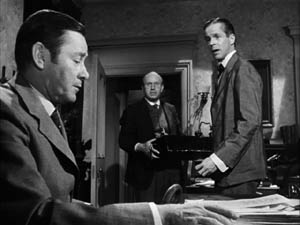
We find directors exploiting this approach not only in the United States but in Eastern and Western Europe, Scandinavia, the Soviet Union, Japan, Mexico, and South America. Here’s an instance from the French film Justice est faite (1950).
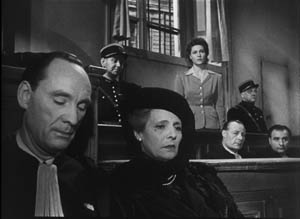
Why did this approach emerge in so many countries at the same time? We don’t really know. It wasn’t simply the influence of Citizen Kane, as we might think. The Stalinist cinema had developed deep-space shooting in the 1930s, and we can find it elsewhere. Probably Hollywood’s 1940s films helped spread the style, but there are likely to be local causes in various countries too.
In any event, during the 1950s two technological changes posed problems for this style. One was the greater use of color filming, which renders depth of field much more difficult. The other innovation was anamorphic widescreen, a technology seen in CinemaScope and Panavision. These systems also had trouble maintaining focus in many planes when the foreground was close to the camera. The flagrant depth compositions we find in black-and-white ‘flat’ films were quite difficult to replicate in color and anamorphic widescreen.
Through the 1960s, the deep-focus style became a minor option and directors found other alternatives to presenting character interactions. The most basic one was simply to station the camera at a middle distance and create a more porous and open staging, with fewer planes of action and simple panning movements to follow characters.
One new approach relied not on wide-angle lenses but on lenses of long focal length. Instead of staging scenes in depth, putting the camera close to a foreground figure, filmmakers began keeping the camera back a fair distance and using long lenses to enlarge the action. This accompanied a trend toward greater location shooting; it’s easier to follow actors on a street or highway if the camera shoots with a telephoto lens. The long lens also reduces the volumes of each plane, so that figures tend to look like cutouts (4). This lens facilitated the development of those perpendicular images I’ve called, in some writing and on this blog, planimetric shots.
What fascinates me about this general pattern of stylistic change in the US is how many of the Euro auteurs go along with it. Take Fellini, who shifts from the bold depth compositions of I Vitelloni to the fresco-like flatness of Satyricon.
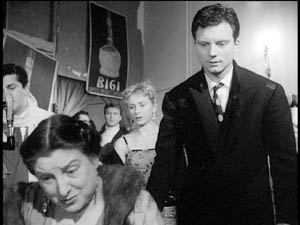
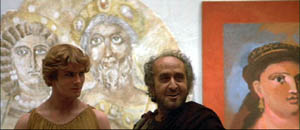
Likewise, Luchino Visconti’s early black-and-white work affords textbook examples of deep-focus cinematography, but in the 1960s he embraced the telephoto look, heightened by what we can call the pan-and-zoom tactic. In Death in Venice, the camera often scans a scene, searching out one player to follow then zooming back to reframe the figure in relation to others. One shot starts with the boy Tadzio, pans right across the hotel salon, to end on von Aschenbach, staring at the boy, and then zooming back to take in the larger scene.
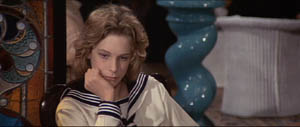
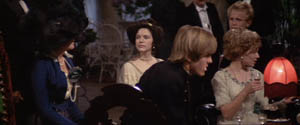
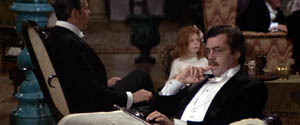
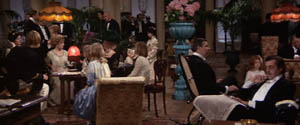
Probably Rossellini’s 1960s films, such as Viva l’Italia! and Rise to Power of Louis XIV, were key influences on this look.
Leaving Europe, there’s Kurosawa, who was the first major director I know of to build zoom and telephoto lenses into his style. Satayajit Ray followed much the same trajectory from the Apu trilogy’s flamboyant depth to the pan-and-zoom close-ups of The Home and the World. Not every filmmaker took the long-lens option, but as it became commonplace in the 1960s, many major directors tried it.
What about Bergman? It seems that in most respects he went along with the general trends. We find deeply piled-up bodies early in his career (e.g., Port of Call, below) and through the 1950s and early 1960s (The Face, below).
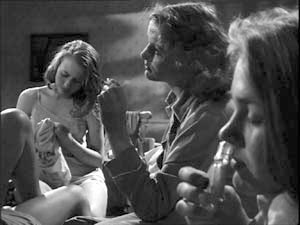
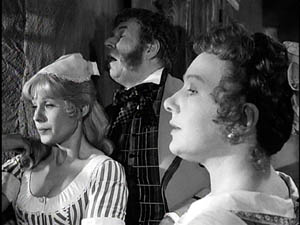
Like his peers, with color and widescreen he shifted toward more open staging, long lenses, and zooms. For example, one telephoto shot of Cries and Whispers zooms back as the little girl emerges, zig-zagging, from behind the lace curtain.
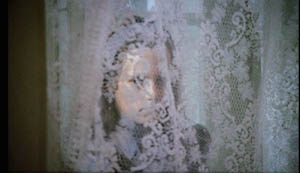
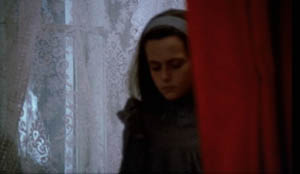
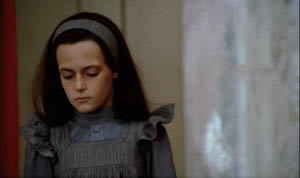
We might conclude that Bergman mostly worked with the received forms of his day. At the level of shot design, The Face might have been shot by the Sidney Lumet of Fail-Safe. But Bergman did innovate somewhat, I think. Most obviously, he sometimes had recourse to the suffocating frontal close-up, as in a childbirth scene from Brink of Life.
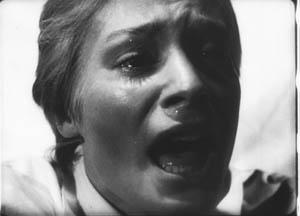
He develops this visual idea by creating heads floating unanchored in both foreground and background. Here’s a famous image from Persona.
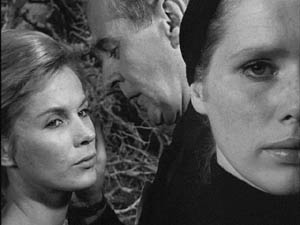
Pace Rosenbaum, I’d say that this sequence, with Elisabeth Vogler apparently quite oblivious to her husband’s mating with Alma, definitely “challenges conventional film-going habits”—or at least conventional ways we read a scene. It seems to combine the deep-space, big-foreground scheme of the 1940s with the tight close-ups of Bergman’s early work, and instead of specifying space it undermines it. We have to ask if what happens in the background is Elisabeth’s hallucination.
My case is very schematic, and we would need to study Bergman film by film and scene by scene to confirm that he stuck to the broad norms of his time. The norms themselves also deserve deeper probing than I’ve given them. (5)
But let’s push a bit further and examine Antonioni, that perpetual foil to Bergman. Broadly speaking, he passed through the same arc, from deep-focus compositions in the 1950s and early 1960s to telephoto flatness in his color work. Yet there are some important differences.
In the 1950s, unlike Bergman, Antonioni employed quite intricate staging, sustained by long takes. He usually didn’t opt for big foregrounds, favoring more distant framings and sidelong camera movements. The most famous instance is the startling 360-degree long take on the bridge in his first feature, Story of a Love Affair, but Le Amiche is also full of intricate staging in mid-ground depth. One scene shows fashion models bustling around after a successful show, congratulating the shop’s owner Clelia. She opens a card from her lover, is distracted by the arrival of her friends coming to congratulate her, and goes off with them. One model darts diagonally forward to investigate the message. All of this is handled in a single graceful take.
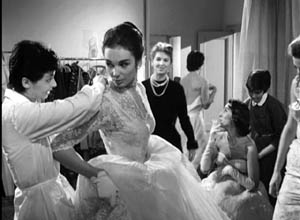
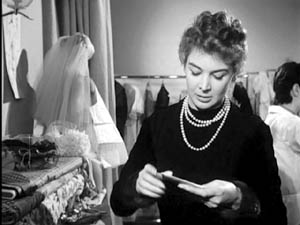
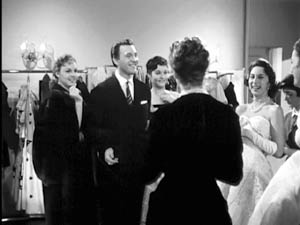
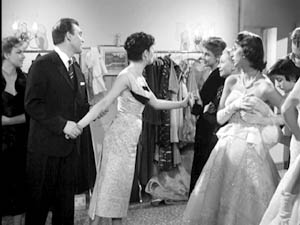
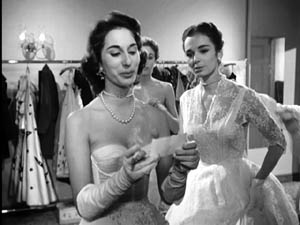
Antonioni relies on the fluid staging techniques developed in the early sound era and taken in diverse directions by Renoir, Ophuls, Preminger, Mizoguchi, and other directors of the 1930s and 1940s. Often, however, Antonioni’s characters move rather slowly and hold themselves in place, and as a result the overall spatial dynamic unfolds in marked phases. (6)
In the trilogy starting with L’Avventura, Antonioni relies on shorter takes and less florid camera movement. Now he emphasizes landscape and architecture so as to diminish the characters. If the expressionist side of Bergman plays up the psychological implications of the drama, the more austere Antonioni plays things down, “dedramatizing” his scenes by keeping the camera back, turning the figures away from us, and reminding us of the milieu. (You see the Antonioni influence on similar strategies in the work of Edward Yang, as I discussed recently on this blog.)
Once color came along, Antonioni changed his style, moving toward less dense staging and at times almost casual framing (as in The Passenger). He also had recourse to the telephoto technique, but I’d argue he brought something new to it. With Red Desert he accepted the abstraction inherent in the long lens and combined that with color design to create a pure pictorialism.
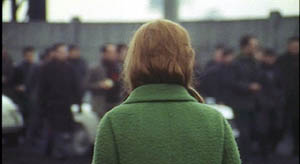
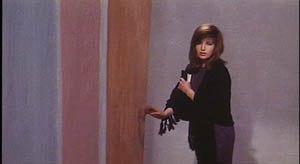
Ironically, Red Desert may have made Antonioni another sort of ‘expressionist’ than Bergman. The stylized palette of the film encourages us to ask if the industrial landscape is really so smeared and bleached out, or if we’re seeing it as Giuliana does. The same sort of painterly abstraction can be found in Zabriskie Point. In one scene, a pan over the travel decals on a family’s car window treats the boy inside as no more than another thin slice of space. Other scenes turn campus policemen into figures in grids.
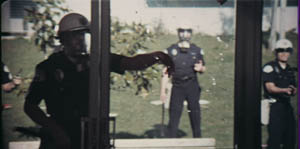
You might even argue that the pan-and-zoom style gets a kind of meta-treatment in the climactic shot of The Passenger. There in a grandiose technical gesture Antonioni’s concern for architecture, his refusal to underscore a melodramatic plot twist, and his love of camera movement blend with the technology of the zoom. At the time, several of us (maybe Jonathan too) saw this shot as a response to Michael Snow’s Wavelength, relayed through the sensibility of Passenger screenwriter and avant-garde filmmaker Peter Wollen. Now it looks to me like a natural response of a very self-conscious artist to a stylistic trend of the moment.
A bestiary of stylists
To get crude and peremptory: Let’s say that once a director has reached maturity and become a confident artisan, several choices offer themselves. The filmmaker can be a flexible stylist, a stubborn stylist, or a polystylist (sorry for the awkward term).
A flexible stylist adapts to reigning norms. Bergman could be an aggressive-deep-focus director, then a pan-and-zoom director. Both approaches to staging and shooting preserved the expressive dimensions that mattered most to him: performance (chiefly face and voice), Ibsenesque bourgeois tragedy, Strindbergian play with dream and dissolution of the ego, and other elements.
Most of the major 1960s arthouse directors, from Truffaut and Wajda to Pasolini and Demy, were flexible stylists in this sense. So were a great many Hollywood and Japanese directors, such as Lubitsch and Kinoshita. Perhaps Ousmane Sembene, who also died recently, would be another instance. Buñuel becomes a fascinating case: He adopts the blandest, calmest version of each trend, creating a neutral technique, the better to shock us with what he shows.
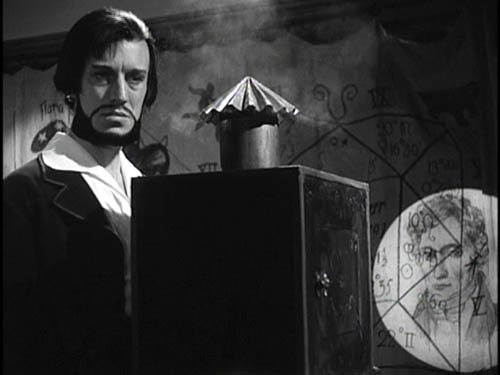
A stubborn stylist pursues a signature style across the vagaries of fashion and technology. Dreyer from Vampyr onward does this; I argue in the book Jonathan cites that he seeks to “theatricalize” cinema in a way that goes beyond the norms of his moment. Perhaps Hitchcock and von Sternberg (at least in the 1920s and 1930s) fit in here as well. Bresson, Tati, and supremely Ozu were stubborn stylists. Give them a western or a porno to shoot, and they’d handle each the same way. (7)
This isn’t to argue that stubborn stylists never change or always do the same thing. Mizoguchi has a signature style and yet remains fairly pluralistic, at least at a scene-by-scene level. I think that the test comes in seeing how stubborn stylists persistently explore the constrained conditions they’ve set for themselves.
Signature styles help a filmmaker in the festival market, so we don’t lack for current examples of stubborn creators: Godard, Theo Angelopoulos, Hou Hsiao-hsien, Kitano Takeshi, Tsai Ming-liang, and Jia Zhang-ke. Granted, some of these may be rethinking their commitment to their stylistic premises.
A polystylist tries out different styles without much concern for what the reigning norms demand. Polystylistics holds a high place in modernist aesthetics. After the great triumvirate of Picasso, Joyce, and Stravinsky, with their bewildering arrays of periods and pastiches, the idea of the modernist as a virtuoso steeped in several styles became a powerful option. What’s been called postmodernism is no less favorable to polystylism; if you mix styles, you’ve presumably mastered them.
In cinema, some polystylists are just eclectic. Steven Soderbergh can give us the portentous pictorialism of The Underneath or Solaris, the grab-and-go look of Traffic, and the trim polish of Ocean’s 11. More deeply, there are directors like R. W. Fassbinder, Raoul Ruiz, and Oshima Nagisa who seem to pursue polystylistics on principle. It’s as if, rejecting the very idea of a signature style, they set themselves fresh, severe conditions for each project.
After The Boss of It All, we may want to count von Trier as a polystylist, not merely a director who changed his style from one phase of his career to another. Perhaps the best current example is Aleksandr Sokurov; who would dare predict what his next film will look like?
This whole entry is pretty sketchy, I grant you. The categories need further refining. I’ve ignored sound, which is very important. I’ve emphasized visual style, and just shooting and staging within that. (Nothing about lighting, cutting, etc.) So this is tentative—notes perhaps for a book-length argument. But I’ve made my point if you see that some ideas and some historical information can put intuitions about originality into a firmer framework.
And I’ve left the value judgments suspended. If you think originality trumps other criteria, then Bergman doesn’t probably come up as strong as Antonioni, let alone Bresson or Ozu or Dreyer. But if you can entertain the possibility that a great filmmaker can accept certain norms of his time, making those serve other channels of expression, then Bergman can’t automatically be faulted. At least thinking about him and his peers in the context of the history of film art gives us some data to ground our arguments. The world is more interesting and unpredictable than our opinions, especially those we formulated forty years ago.
(1) I actually hold this opinion.
(2) I assume that the arthouse auteurs were no less commercial filmmakers than their Hollywood counterparts. They were sustained by national film industries and supported by the international film trade. Eventually many were funded by Hollywood companies.
My friend and colleague Tino Balio is at work on a book tracing the role of overseas imports in the American film market of the 1940s-1960s, and it should be a real eye-opener to those who persist in counterposing art cinema and commercial production.
(3) Some of what follows is discussed in Part Four of Film History: An Introduction.
(4) I talk about both the deep-focus and long-lens tendencies in Chapter 6 of On the History of Film Style and Chapter 5 of Figures Traced in Light.
(5) For a wide-ranging account of art-cinema norms, see András Bálint Kovács’ forthcoming book, Screening Modernism: European Art Cinema, 1950-1980.
(6) I analyze this tendency, using other scenes from Le Amiche, in On the History of Film Style (pp. 235-236) and Figures Traced in Light (pp. 151-152).
(7) Suo Masayuki’s My Brother’s Wife: The Crazy Family is a softcore film made in a pastiche of Ozu’s style.
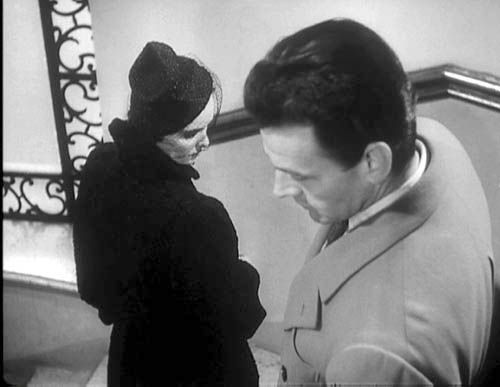
Story of a Love Affair (Cronaca di un amore).
PS, Sunday 12 August: Only a day later, new thoughts about something else I should have said about generational tastes. In the light of the Woody Allen eulogy that appears in the New York Times today, I think there’s more of a sub-generational split than I’d initially suspected. So here’s another gesture toward the sort of history of taste that Jonathan mentions.
Allen is in his seventies, a decade older than Jonathan Rosenbaum and me. He came of age in the affluent decade after the war. Allen saw Bergman films in the mid- to late 1950s, probably against the backdrop of Neorealism, British comedy, and French Cinema of Quality. In that context, Bergman’s movies looked pretty revolutionary.
But Jonathan and I came to maturity, if that’s the right word, in the mid-1960s. When I got to college in 1965, French directors (notably Resnais, Godard, Truffaut) and the Czechs, Hungarians, and others were getting established in US film culture. Bergman, Fellini, and Antonioni were already senior directors and soon they were starting to make what many of us perceived as career mistakes (Juliet of the Spirits, The Passion of Anna, even Blow-Up). Also, of course, concerns about their political alignments came more to the fore as the decade wore on. Many of my friends thought that The Battle of Algiers left all other films in the shade. These factors may have made the Boomers suspicious of “arty” foreign imports, of which Bergman’s work was a central instance. Interestingly, The Dove, a parody of The Seventh Seal and a film-society staple, came out in 1968, when Bergman may have been wearing out his welcome.
[Speaking of parodies, the SCTV skit, “Scenes from an Idiot’s Marriage”, in which Jerry Lewis (Martin Short) suffers the indignities of a cuckolded Bergman hero, is well worth checking out. The SCTV Fellini/ Antonioni parody, “Rome Italian Style,” is also pretty good, especially for its excellently awkward dubbing.]
Interestingly, Scorsese in age falls midway between Allen and us Boomers, and he contributes a Times tribute to Antonioni today. Maybe I have to split the generations even more: Bergman for 1955-1960, Antonioni for 1961-1965, Godard for 1965-1970? (Just kidding.) What strikes me are the differences in the essays. While Allen ranges widely, reports conversations, and praises Bergman in general terms, Scorsese’s piece evokes the texture of L’Avventura, suggesting how disturbing and demanding it was to watch. Maybe he inadvertently backs Jonathan’s claim that Bergman didn’t challenge his audience as much as he might have?
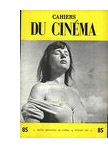 I’m grateful as well to readers responding to my arguments. Michael Kerpan kindly spread the word about my post on imdb and the Criterion Forum. Kent Jones wrote to point out that any argument about Bergman’s influence has to take into account the high regard in which he’s been held in France, among both critics and filmmakers. Kent itemizes not only Godard, Truffaut, and Rivette but Assayas, Téchiné, and Desplechin. It’s a fair point. Antoine de Baecque anchors much of his magisterial history of Cahiers du Cinéma around the mesmerizing power of that busty still of Harriet Anderson, flaunted on a 1958 Cahiers cover and swiped by Antoine in The 400 Blows. In 2003, my old friend Jacques Aumont published a large critical study on Bergman. Cahiers’ next issue will be devoted to the director.
Speaking of French critics and directors, on imdb above Bertrand Tavernier points out that my memory failed. I did see Scenes from a Marriage and Cries and Whispers before The Serpent’s Egg, not after, as my post suggests.
My late Bergman viewing remains gappy. I still haven’t seen the long version of Fanny and Alexander, which everyone assures me is a masterpiece. Last spring, my friend and Bergman scholar Paisley Livingston showed me portions of the TV film The Last Gasp (1995). It’s about Georg af Klercker, the fine Swedish director of the 1910s. It was intriguing, but I was put off by Bergman’s inadequate pastiches of af Klercker’s remarkably poised and complex shots. Now that’s fussy taste, I admit.
Two Chinese men of the cinema
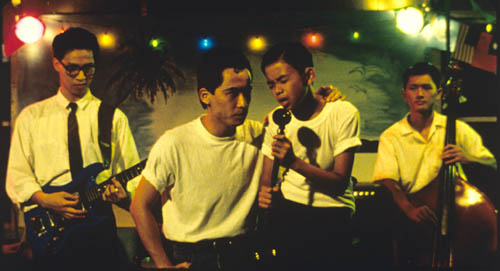
A Brighter Summer Day.
DB here:
This summer two major figures in Chinese filmmaking died. One was Edward Yang (Yang Dechang), one of Taiwan’s finest directors, who died on 29 June. But before I pay tribute to him, I want to acknowledge another figure who had a great impact on Asian cinema.
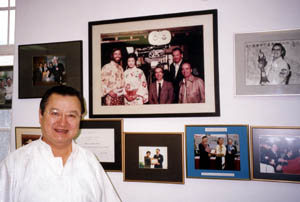
Charles Wang died on 6 July. Along with his brother Fred, Dr. Wang ran Salon Films, the major supplier of film equipment for Hong Kong and a principal one for East Asia and the Pacific Rim. Charles graduated with a degree in chemistry before inheriting the business from his father. As Hong Kong filmmaking grew in sophistication, Salon grew along with it. Most Hong Kong films bear the firm’s brand in their end credits.
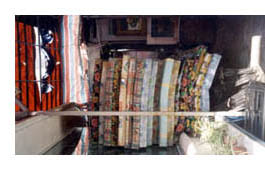 Since 1969 Salon has provided top-flight cameras, lenses, lighting gear and other technical support for both local and visiting productions, such as Mission: Impossible III‘s Shanghai shoot. An early triumph was winning the Panavision franchise for the region. The company even supplies trampolines and landing cushions for martial acrobatics, as this glimpse inside a Salon van shows.
When I interviewed Dr. Wang in 2003 he kindly gave me information about the company and the development of film technology in Hong Kong. He showed me his many awards and talked enthusiastically about Salon’s new efforts to assist mainland moviemaking. In recent years, Salon was investing in films such as Zhang Yimou’s Hero. Like most Hong Kong film people, he was very accessible and generous; he even gave me a lift back to my hotel. Charles Wang was a major force in the Hong Kong industry and will certainly be missed.
Laconic cuts and long takes
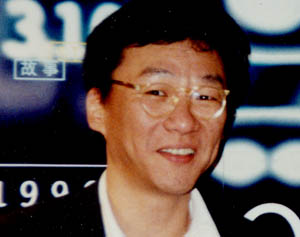
I met Edward Yang twice. First, at a Hong Kong Film Festival reception, we chatted about his film Mahjong (1996), which had screened. I got to know him a little better in fall of 1997, when we were both invited to the Kyoto Film Festival. We ate and watched films together, and we shared baby-boomer nostalgia; it turns out that he and I (and Hou Hsiao-hsien) were all born in the same year.
I found him friendly, thoughtful, and open to appreciating all film traditions. He spoke of enjoying Japanese swordplay movies in his youth, and he admired American films for their gripping stories. Still, his preference for ellipsis and understatement came through. When we met Kitano Takeshi for dinner, Edward praised a crisp transition in Sonatine: to show the gang going from Tokyo to Okinawa, Kitano simply gives us a quick pan of the sky accompanied by the sound of a jet plane.
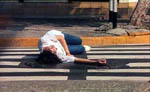
Yang was an accomplished cartoonist, and I thought that this background partly explained his early style, on display in the short film Desires (1982) and in the features That Day, on the Beach (1983), Taipei Story (1985), and The Terrorizers (1986). In these films Yang often breaks his scenes into simple but striking fragments. After the police shootout in The Terrorizers—one of the most enigmatic and elliptical opening sequences in modern cinema—the Eurasian girl staggers out to the street. Yang gives us her collapse in quite abstract, percussive images. Her foot hits the pavement. Cut. She takes a step and falls out of frame; the camera holds on the empty frame. Cut. She’s lying on the crosswalk. I imagine these as forceful, laconic comic-book panels.



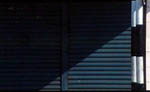
With A Brighter Summer Day (1991), my favorite of his works, Yang tells another gap-filled story but treats the scenes in long, distant, often decentered takes reminiscent of Hou. Now his frames are more dense with figures and furniture, and layers of action extend quite far back. In Figures Traced in Light, I devote a little—too little—analysis to one admirably staged passage. Another of my favorite scenes in A Brighter Summer Day shows the hero Xiao S’ir developing a romantic attachment to Ming, the girlfriend of the absent gang leader Honey. They sit in a brightly decorated café.
Suddenly Ming darts out of the shot, leaving Xiao S’ir and the other boys staring. From their point of view we see that Honey, dressed in a sailor suit, has returned and Ming has gone to meet him.
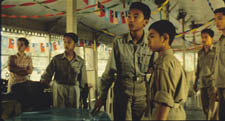
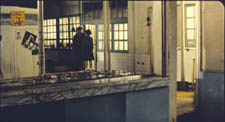
Yang cuts back to the boys as Honey’s gang starts to threaten Xiao S’ir. Abruptly, Ming runs into the shot, past the boys, down the long central aisle, and out of the café. (In a 35mm print you can see her pausing and lingering outdoors.)
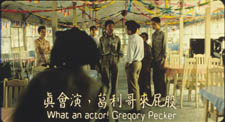
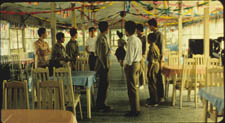
The group closes around Xiao S’ir; only Honey’s entry breaks the tension. He leads the boy into the depth of the shot, the camera following them.
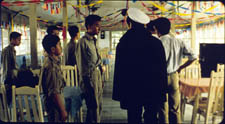
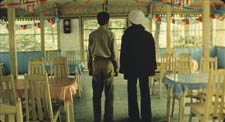
Honey warns Xiao S’ir off, and our hero goes outside, mimicking the path Ming had followed.
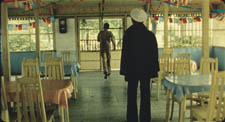
As Honey turns his attention to his gang and an upcoming skirmish with their rivals, he moves back down the aisle, the camera backing up. Once his business is done, Honey drifts back to the rear door.
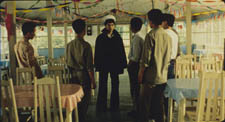
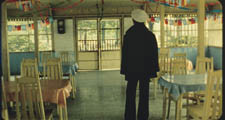
Honey pauses far from us, at the window. Yang cuts to show what he sees: Xiao S’ir, in flagrant violation of the warning, talking to Ming outside.
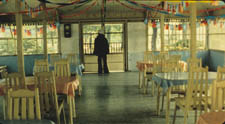
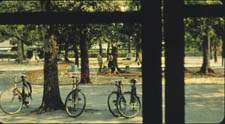
First we got Xiao S’ir’s point of view on Honey and Ming; now, in a reversal, we get Honey’s point of view on Ming and Xiao S’ir. In scenes like this, Yang merges his developing skills in long-take staging with cuts that develop not only the action but story parallels. Very distant framings, characters moving to the rear of the shot and turning their backs: Yang “dedramatizes” the scene. Further, by shifting point of view, he leaves us guessing about story information: What led to Ming’s running away from Honey? What are Xiao S’ir and Ming talking about now? Yang created a laconic visual approach that, I’d argue, invests fairly standard dramatic situations with a tantalizing uncertainty.
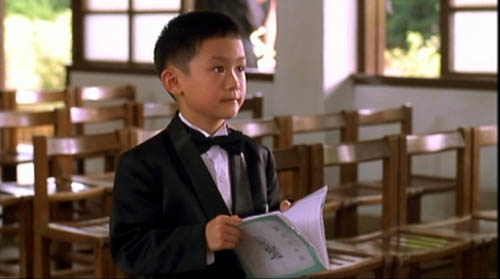
Yang’s best-known film is, of course, Yi Yi (2000), and it won him the wide appreciation that he had long deserved. It’s a warm and gentle work, less innovative than his earlier efforts but utterly typical of his vision of lives pervaded by melancholy routine and abrupt disappointment. People often remarked that the adolescent hero of A Brighter Summer Day resembled Edward himself. Perhaps too in Yi Yi Yang’s enigmatic pictorialism is echoed in the idea of a little boy who makes photographs of people’s heads seen from the rear. Like the director, the boy (named Yang-yang) displays a reticence that respects the mysteries of people’s private lives.
We already have a very useful guide to Yang’s work in one chapter of Emilie Yueh-Yu Yeh and Darrell William Davis’ book, Taiwan Film Directors. And Criterion’s Curtis Tsui has done a wonderful edition of Yi Yi, as Brian Hu shows here. We must hope that Criterion, Eureka, or another gilt-edged DVD publisher will soon bring us Yang’s other works in the pristine editions they deserve.
A Brighter Summer Day (1991)
In 1998, when we screened A Brighter Summer Day at our Cinémathèque, I wrote a program note. I reproduce it, lightly revised, as a quick pointer to one of the great films of the 1990s.
With Taipei Story (1985) and The Terrorizers (1986) Edward Yang established himself as one of the two leaders of the Taiwanese New Wave generation. At first it seemed that he and Hou Hsiao-hsien had agreed to a division of labor in their subjects and styles. Hou tended to concentrate on life in the countryside, or on rural characters transplanted, bewilderingly, to the modern city. Hou was also deeply interested in the history of Taiwan; his most acclaimed film, City of Sadness (1989), is a panoramic survey of Taiwanese society immediately after World War II. Hou’s tranquil style favored a contemplative mood and muted emotion.
Yang, by contrast, tended to focus on the lives of well-to-do urbanites in a contemporary setting, Taiwanese yuppies plagued by anomie and the desperation of love and work. His elliptical editing technique, reminiscent of Resnais, fractured time and space, while his compositions had a painterly starkness. The Terrorizers shuttles kaleidoscopically among characters at its beginning; their relations only gradually settle into intelligible patterns. Whereas Hou tended toward nuance and quiet drama, Yang was unafraid of shocking, inexplicable bursts of bloodshed.
Now it seems evident that this impression of a division of labor was somewhat schematic. Hou’s range of interests has widened, with new emphasis on the violent world of urban crime (Goodbye South Goodbye, 1996), and he has come to rely on quite disorienting transitions between past and present (Good Men, Good Women, 1995). Likewise, with A Brighter Summer Day Yang turned to history and cultivated a more sober style of filming, with lengthier shots and a fixed or barely moving camera. This approach throws down a challenge to the razzle-dazzle of contemporary popular cinema—from Hollywood, Hong Kong, and even the American “independents”—and invites us to scrutinize, moment by moment, the details of action unfolding on the screen.
Three years in the making, A Brighter Summer Day was a triumph of independent production. At a period when the Taiwanese film industry was virtually dead, Yang found money (mostly Japanese) to mount a project of remarkable ambition. Over half the cast and crew had never worked on a film before. At first released in a three-hour version, the film was re-released in a four-hour director’s cut, and this has become the standard version.
The historical event examined in A Brighter Summer Day took place in Taipei in the 1960s, when an adolescent boy about Yang’s age stabbed a young woman. At epic length Yang creates a web of circumstances around the event. He shows the interplay of traditional culture—filial duty, education as an ideal of social advancement—with popular culture, especially the rock n’ roll songs that recur throughout. Yang has said that Americans might not realize the shattering force of rock in other cultures: “These songs made us think of freedom.”
The film has over eighty speaking parts, most filled by nonactors, and it intertwines several characters’ destinies. On first viewing, the film can be somewhat bewildering to a non-Taiwanese audience, so a plot sketch may help. (Skip to the next paragraph if you don’t want to know the action in advance.) At the center is fourteen-year-old Xiao Si’r. He tries to be a dutiful student, but with his friends Cat and Airplane, he lives on the fringes of the Little Park gang of teenage thugs. When Xiao Si’r reports seeing a gang member with another boy’s girlfriend, he triggers a power struggle in the gang. As his friends fall by the wayside and rival gangs fight for control of local turf, Xiao S’ir becomes involved with Ming, a girl who’s attached to Honey, exiled leader of the Little Park gang. A major climax occurs during a gang rumble at a rock n’ roll concert. Interwoven with the juvenile intrigues are political matters; the police pursue and question Xiao S’ir’s father about his Communist friends. Xiao S’ir becomes friendly with Ma, a general’s son, before they start to compete for Ming’s favor. The rivalries build to a tense schoolroom confrontation and a tragic finale in the park. In the final scene and over the credits, a radio transmission broadcasts the names of the students who have passed their school entrance exams.
The plot is even more intricate than my bare-bones summary can indicate; I haven’t discussed the boys’ adventures in a film studio or Cat’s singing career or the slender line of action involving Xiao S’ir’s sister. The breadth of action is extraordinary, and a sense of the contradictory pulls of daily life emerges steadily. No less demanding is Yang’s style—scenes played in darkness, few close-ups, with medium-shots and long-shots keeping us at a distance from the characters. But the result is a dispassionate look at teenaged passions, a deromanticized treatment of young people growing up in a repressive milieu. A Brighter Summer Day (the English title comes from Elvis Presley’s “Are You Lonesome Tonight?”) is an elegy to the ideals and mistakes of youth, an analysis of the vanities of the male ego, and a view of a generation painfully facing the limitations of tradition, the constraints of political oppression, and the demands of the modern world.
Yi Yi.