





Archive for the 'Film technique: Staging' Category
Rio Jim, in discrete fragments
The first moving-pictures, as I remember them thirty years ago, presented more or less continuous scenes. They were played like ordinary plays, and so one could follow them lazily and at ease. But the modern movie is no such organic whole; it is simply a maddening chaos of discrete fragments. The average scene, if the two shows I attempted were typical, cannot run for more than six or seven seconds. Many are far shorter, and very few are appreciably longer. The result is confusion horribly confounded. How can one work up any rational interest in a fable that changes its locale and its characters ten times a minute?
H. L. Mencken, 1927
DB here:
Between about 1913 and 1920, the way movies looked changed, and we are still living with the results. What were the changes? What brought them about?
I’m just back from Brussels, after a two-week visit to the archive. During earlier trips, I’ve concentrated on examining films from the 1910s that exemplify the tableau tradition. That’s what we might call the stylistic approach that tells the story and achieves its other effects predominantly through staging—by arranging the actors within the frame, forming patterns that reflect what is important at a given moment.
The tableau tradition dominated European cinema of the early and mid-1910s, and it was also on display in the U. S. It is sometimes considered “theatrical” and “uncinematic,” but that’s a shortsighted view. The tableau tradition is one of the great artistic triumphs of film history. For backup on this, consult Ben Brewster and Lea Jacobs’ Theatre to Cinema and my On the History of Film Style and Figures Traced in Light. And you can go here and here on this site.
As the 1910s moved on, the staging-driven approach gave way to one dominated by editing. Roughly speaking, this strategy surfaced at two levels. Directors began to use crosscutting, aka parallel editing, more strenuously. By alternating shots, you could show events taking place at two or more locations. This technique was not used only for last-minute rescues; it was a way of keeping track of all the characters in nearly every sequence, whether they were going to converge or not.
Second, within a single strand of action, 1910s directors exploited analytical editing, breaking down a scene’s space into a host of details. Griffith often gets the credit for this tactic (and he happily claimed to have invented it), but it’s probably most fairly understood as a collective innovation.
Directors in the tableau tradition didn’t entirely avoid crosscutting or analytical editing, but there was a measurable shift of gravity in the second half of the 1910s. In the U.S., many filmmakers pushed editing techniques very hard. You can sense their exhilaration in discovering how editing lets them control pacing, make story points concisely, build suspense, and force the viewer to keep up.
During the 1910s, American movies became breathless. The hurtling pace of Speed Racer or The Dark Knight has its origins here; seen today, The Battle at Elderbush Gulch (1913) and Wild and Woolly (1917) still look mighty rapid-fire. And then as now some observers, like Mencken, complained that it was all too fast and furious.
Over the last thirty years, many scholars have studied this change, but for a glimpse of some supporting data, you can visit the remarkable website Cinemetrics. Yuri Tsivian, Barry Salt, and a corps of volunteer scholars have been measuring Average Shot Lengths in films from all eras. The data from the 1910s are pretty unequivocal. In the US around 1916-1918, movies became editing-dominated, shifting from an ASL of over 10 seconds, sometimes as much as 30 seconds, to 5-6 seconds or less. A 4-6 second average per shot persists in Hollywood through the 1920s, so Mencken’s guess about the “scenes” (as shots were then known) changing ten times a minute was more or less right.
Back in the 1980s, Salt and others, including Kristin and me, picked 1917 as a plausible point of reference for the consolidation of the continuity style. That was the point at which virtually every US film we watched contained at least one example of specific continuity techniques. (Most contained many more instances, of course.) We talk about that magical year in this entry, which you might want to read as an introduction to what follows today.
In just a few years, continuity editing became a coherent, supple means of expression, and it has defined Hollywood film style up to the present. What brought this about? Kristin and Janet Staiger offered an explanation in our 1985 book, The Classical Hollywood Cinema: Film Style and Mode of Production to 1960. They traced out several factors that encouraged and sustained this style. Especially important were the development of longer films, a conception of filmic quality, and the emergence of a specific division of labor.
Lately I’ve been revisiting these early years, chiefly to watch how directors pick up and refine the stylistic schemas that were coming into broader use. I want to know more about the little touches that directors had to control in creating this style. I’ve also been interested in to what extent these techniques were picked up by directors in Europe and Asia. The evidence is pretty clear that continuity cinema became a lingua franca of film style.
So if last year I pondered the minute compositional adjustments of Evgenii Bauer, this year it was all cutting. I focused on three filmmakers, but I’ll save discussion of two of them for a rainy day, or a book. In all, it was a thrill, as ever, to watch a stylistic system coalesce across a batch of films that are seldom mentioned in the history books.
The trail to continuity
The extraordinary films starring William S. Hart typify early American continuity techniques. After a distinguished career on the stage, Hart began as a film actor in 1914, when he was nearly fifty. He was intent on bringing realism to the newly burgeoning Western genre. His films were at first made under the auspices of Thomas Ince, a pioneer of rationalized production techniques, and with his Ince pictures Hart found worldwide success. He followed a rousing feature debut (On the Night Stage, 1915) with many shorter films. In 1917—mark the year—Hart broke with Ince and set up his own firm for The Narrow Trail. He continued to make films into the early 1920s, with Tumbleweeds (1925) marking his farewell to cinema.
Hart often directed his own pictures, though he also had the services of strong directors like Reginald Barker. The films have an assured brio, thanks to careful cutting and some felicitous touches.
They are fast-moving: In the five 1915 Hart films I watched, the ASL ranged from 8 to 11 seconds, but in 1916, the average jumped to 5-6 seconds per shot. The Narrow Trail seems to have an ASL of 3.7 seconds, but I can hardly believe it and I must verify it with another viewing. The 1918 and 1920 films I viewed average between 4.9 and 5.4 seconds per shot.
Just as important as the speed of cutting, naturally, is what Hart does with his cuts. In one scene from Between Men (1916), you can see the tableau aesthetic undermined by analytical editing. Gregg is a shifty stock trader, a species we still nurture. He’s trying to destroy Hampton’s fortune because he thinks that when the old man is destitute he’ll force his daughter to marry Gregg. Hampton has asked Bob White (Hart) to help get the goods on the suitor.
In one scene, the master shot approximates a tableau setup: Bob and Gregg stand in the middle ground, with a room visible behind them.
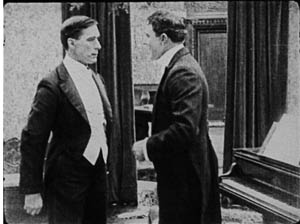
As the men swap increasingly tense challenges, Margaret Hampton enters the adjacent room and stands behind them as they talk. A director in the tableau tradition would have sustained the master shot and shown Margaret approaching in the background and drawing closer, reacting to what the men say. She could easily have been stationed hovering at the curtain on the right.
Instead, director C. Gardiner Sullivan has her arrive from another doorway in the adjacent room, one not visible in the master shot of the two men. He then cuts back and forth between the men and Margaret, and he positions her at the left curtain–so that the men block her from our view! The blockage motivates cutting to Margaret for her reactions to what Bob and Gregg say.
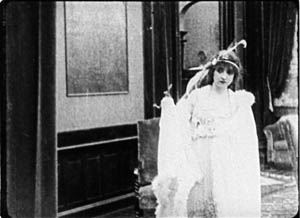
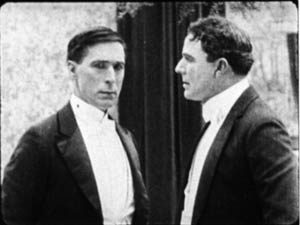
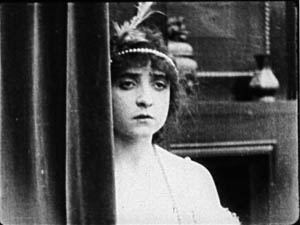
Only when she wants to challenge Bob’s suggestion that he might marry her does Margaret come into the same frame as the men, who part to make room for her.
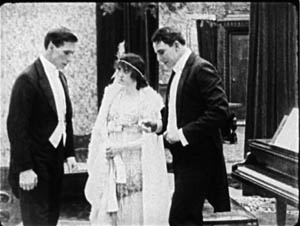
It turns out that this sequence is but a rehearsal for a lengthier passage in which Hampton will come in from the adjacent room (via the door we do see in the background). As with Margaret’s entrance, his arrival will be blocked by Gregg’s body, and Sullivan will cut among the trio in the foreground and Hampton’s approach behind them. That passage, which could also have been handled in a single framing in the tableau style, consists of four distinct setups and eighteen shots!
So even depth-based scenes can be recast as rapid découpage. The passage is probably overcut, but you can sense the filmmakers’ exhilaration in their power to chop up the world into separate, slightly jolting bits, forcing the audience to keep abreast of each item of information.
Managing details
The variety of setups is worth noticing in another film, for here we can see the filmmakers taking pains to show each bit of action most clearly and emphatically. In The Return of Draw Egan (1916), when Egan sees the mayor’s daughter Myrtle he decides to stay on as marshal of Yellow Dog. The first shots show them looking at each other.
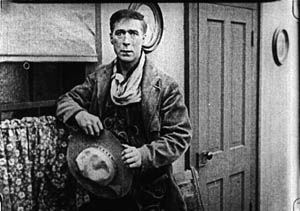
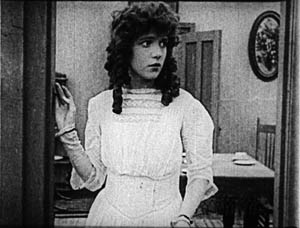
The next pair of shots shows the two looking at each other in close-up.
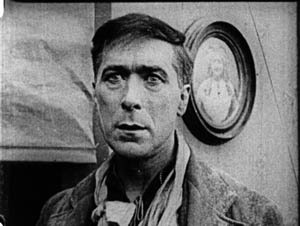
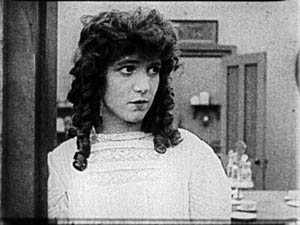
This gradual enlargement of the figures in a reverse-shot sequence would of course become a staple of analytical editing—perhaps it already was in 1916. Cut back to another framing of Egan, as the mayor signals Myrtle to join them. The slightly off-center composition reiterates her position off left.
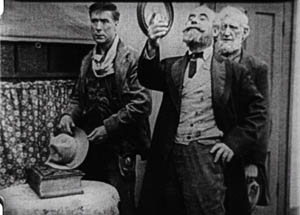
Cut back to Myrtle, exiting her close-up. The next shot shows her joining the men, to be introduced to Egan.
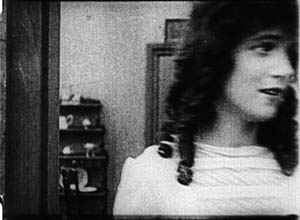
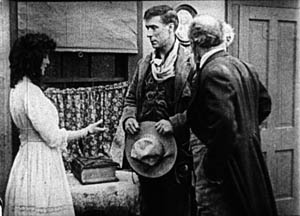
But this is a different camera position than the one showing the men just previously. The daughter’s entrance has motivated a slightly changed composition. In the 1910s, cutting began to dictate staging, so that each composition had to fit smoothly into the flow of shots.
This sequence from Draw Egan doesn’t utilize axial cuts, those cuts that keep to the same angle and move straight in or out. Here the actors are angled to suggest that we are to some degree in between them. Indeed, sometimes the camera will put us directly between the characters. Here is a climactic confrontation from The Disciple (1915). A doctor has cuckolded Hart, but Hart brings him to save his daughter. As the doctor enters, the wife’s shameful look is met by Doc’s anxious expression, with a furious Hart pressing a pistol to his back.
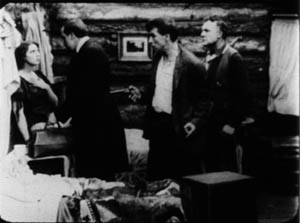
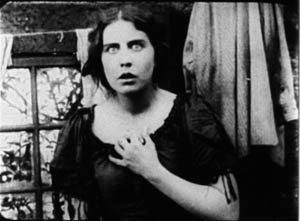
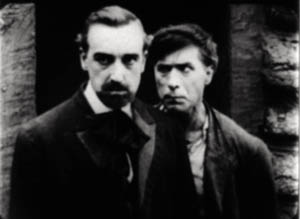
This freedom of camera placement extends to point-of-view cutting. Again, this is an old technique, but like other old techniques, it was revived and refined as part of the synthesis that became the continuity style. So Keno Bates, Liar (1915; a splendid title) can make use of a cameo picture that captivates Bates after a shootout with the man who robbed him.
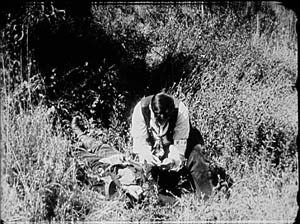
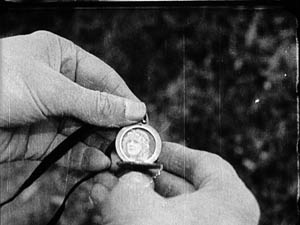
Later, the dance-hall girl catches sight of her rival when Bates muses on the cameo.
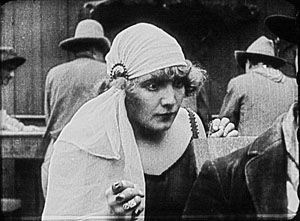
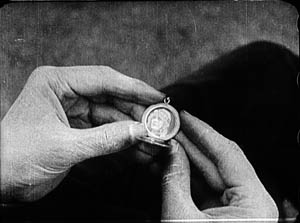
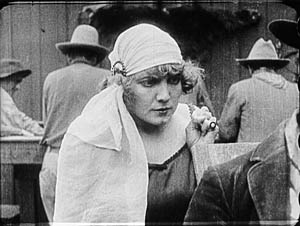
The pov framings don’t change much, but the angle chosen easily approximates both Bates’ view and her view over his shoulder. Moreover, the shot of Bates’ hands isn’t the sort of vacuous insert we often see at the period, with a letter or an object isolated against a blank ground. Here, the backgrounds change, so that the first shot is situated naturally in the wild, while the second is consistent with the barroom locale.
Putting the pieces together
From very early in the history of Westerns, the main street shootout seems to have been a solid convention. Already in The Return of Draw Egan, it’s treated with a vitality and ingenuity that suggests creative reworking of a staple. The climactic shootout also shows just how flexible the new technique could be.
Egan has told his enemy, Arizona Joe, that he’ll meet him when the setting sun’s rays hit the saloon window. So the film crosscuts Egan in his marshal’s office with a nervous Joe, seen in close-up, eyeing the window.

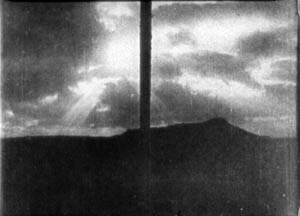
When Joe gets up the nerve to leave, he hides behind a barrel and waits to ambush Egan. When Egan leaves his office, a reverse tracking shot follows him striding toward us.
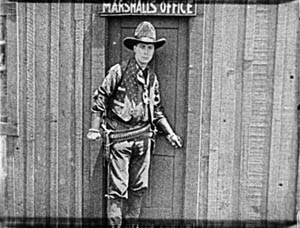
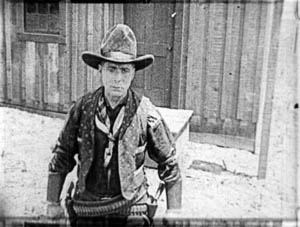
Then we get an orienting long shot with Joe in the foreground and Egan approaching.
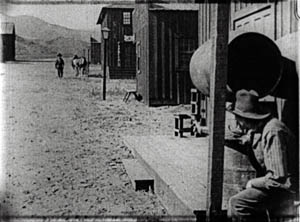
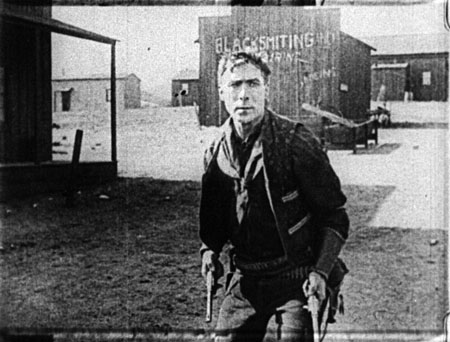
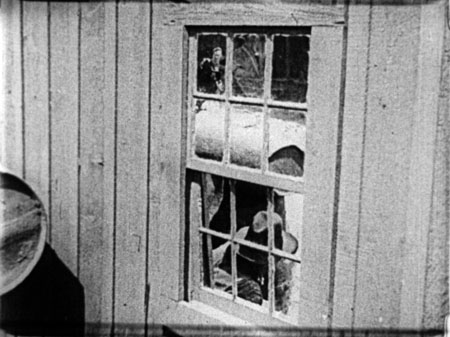
Edging sideways, Egan spots a reflection of Joe’s head in a window. These shots surmount today’s blog entry. You can see Egan’s reflection in the upper left pane.
Now aware of Joe’s tactic, Egan steps diagonally forward, coming ominously right up to the camera.
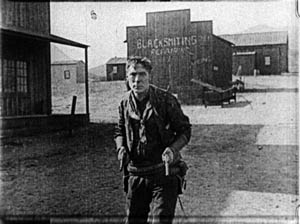
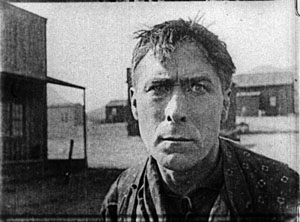
He fires and dispatches Joe. The townsfolk, who have been huddled in a house watching, declare they want Egan to stay on as marshal, despite his outlaw past. Myrtle chimes in, and we get a happy ending. Chaotic fragments? Mencken couldn’t have been more wrong. Or maybe he was just being grumpy.
The trail to Hollywood
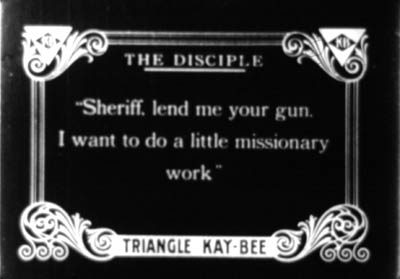
There’s plenty more in these films—beautiful, sometimes minuscule matches on action; subtle timing of frame entrances and exits; and even proto-over-the-shoulder reverse shots. And we don’t have to claim that Hart’s films are the only innovative ones. They take their place within a broader, collective achievement that we still haven’t fully grasped.
Editing permitted everyone to act at small scale; the bargirl who sees Bates’ cameo need only lower one fist, tighten the other, and narrow her eyes to express her jealousy. The new style nurtured laconic stars like Hart. His films are full of pathetic situations that demand he display stoicism but also sensitivity. The long shots could emphasize his gestures and stances, while close-ups could display his worn, haunted face and pale eyes. He acts with those eyes, glancing aside to recall a traumatic event or looking downward as he hesitates to break bad news. Often the plot demands that he conceal his feelings or hide the truth behind an event, and the changing shots could penetrate the surface drama and highlight his slightest reactions. Hart could underplay his role because the editing shows us everything he might have said.
Known in France as Rio Jim, Hart was very influential on the Europeans. His pictures, along with De Mille’s The Cheat (1915) and the films of Chaplin and Fairbanks and many others, offered tutorials in the new style. Arguably, the cumulative force of these mainstream releases was greater than the influence of Griffith’s more prestigious output of the moment. There was only one Intolerance (1916), the film by which Griffith was most widely known abroad, but week by week the Westerns and comedies and dramas pouring out of Hollywood flaunted a new, almost frighteningly energetic approach to cinema.
Timing favored the Americans. The style emerged at around the start of World War I, when hostilities gave U. S. films a chance to displace the big French and Danish companies in many markets. Kristin explains how this happened in Exporting Entertainment, and she talks about the exceptional case of Germany in Herr Lubitsch Goes to Hollywood.
Some European directors picked up the new style immediately, others took a bit longer, and a few, like Feuillade, never fully adjusted to it. The principles of the older tableau style never utterly died out, as I try to show in Figures Traced in Light. But the future belonged to the editing-based aesthetic. Canonized, tweaked, updated, dismantled, undermined—however filmmakers reacted to classical continuity, it became the basis of international cinematic storytelling.
My epigraph comes from H. L. Mencken, “Appendix from Moronia: Note on Technic,” from Prejudices: Sixth Series (New York: Alfred A. Knopf, 1927), rep. in Phillip Lopate, ed., American Movie Critics: An Anthology From the Silents Until Now, expanded edition (New York: The Library of America, 2006), 35-36.
Silent film speeds can vary, so shot counts can yield different averages. I saw some of the Harts I mention in projection at last year’s Il Cinema Ritrovato, and they were projected at 18 or 19 frames per second, a common speed for the period. My ASLs are based on the running time. For the titles I saw in Brussels on a flatbed viewer, my basis was the length in meters. From that I’ve calculated running times and averages, assuming 18 frames per second. Projectionists of the time had freedom to screen at different speeds, so it’s possible that late 1910s Hart films were sometimes shown at 20 frames per second, which of course would make their cutting pace even faster.
For more on Hart’s career, see Diane Kaiser Koszarski, The Complete Films of William S. Hart: A Pictorial Record (New York: Dover, 1980). Koszarski devotes space to each film, with credits, excerpts from contemporary reviews, and excellent production stills. She also provides a sensitive critical overview. In William S. Hart: Projecting the American West (Norman: University of Oklahoma Press, 2003) Ronald L. Davis has given us a brief, engrossing biography based on interviews and extensive archival research. Hart’s memoir, My Life East and West (1929, reprint 1994) is of course indispensable.
The show goes on
DB here:
Kristin and I had hoped to blog directly from this year’s edition of Ebertfest (formerly Roger Ebert’s Festival of Overlooked and Forgotten Films), but our blogging software failed us. We could post text but no pictures, and where’s the fun in that? Fortunately, the event was widely covered. The schedule, with very full film notes, is here. You can get a sense of what was happening by checking Jim Emerson at scanners and Peter Sobczynski at Hollywood Bitchslap and Kim Voynar at Cinematical and Lisa Rosman at A Broad View and P. L Kerpius at Scarlett Cinema and Andrew Wells at A Penny in the Well and many others. There is some coverage at the News Gazette, although the most informative stories from the paper aren’t on the net. Then there’s Roger’s own blog, Ebertfest in Exile, which in one entry goes off on an unexpected trajectory….toward Joe vs. the Volcano.
Now that we can again illustrate our entry, we offer you an ex post facto blog, like last year’s, which makes up in bulk for its tardiness. I hope to follow soon with a picture gallery.
This year’s Ebertfest lacked an essential ingredient: Roger Ebert. But Chaz Ebert took over hosting duties superbly, aided by the terrific organizational skills of Nate Kohn and Mary Susan Britt. At every screening, one person or another paid tribute to Roger’s gifts to film culture—his writing, of course, but also his tireless championing of deserving movies that should be brought to wider audiences.
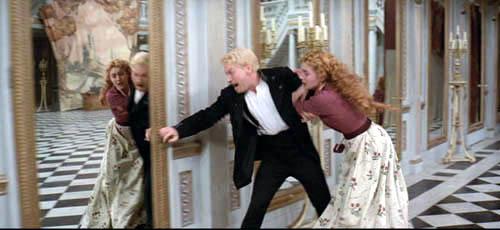
The format of Ebertfest offers something for everyone. Traditionally, the opening night is an older film screened in classic 70mm, a format that’s almost vanished. Past years have included shows of Lawrence of Arabia, Play Time, and My Fair Lady. 70mm looks gorgeous on the vast screen of the Virginia Theatre. This year the film was Kenneth Branagh’s Hamlet, at four hours the most complete version of the play ever put on film. It looked grand.
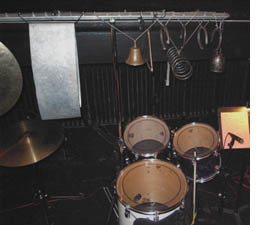 Another slot is reserved for a silent movie, often accompanied by the Alloy Orchestra. (Part of their armory, including bells, springs, and a thunderstrip, can be found on the left.) Having programmed The Black Pirate, The General, and The Eagle in earlier years, Roger picked von Sternberg’s sumptuous Underworld (1927), which Kristin introduced and led a discussion about. The Alloy boys’ scores are getting more nuanced by the year, and this one did as much justice to von Sternberg’s quiet passages as to the gunplay.
Yet another Ebertfest mainstay is a children’s show on Saturday morning, and last year’s wonderful Holes was followed by an unexpected pick—Ang Lee’s Hulk, with the director in attendance. The place was packed, Lee was his charming self, a trio serenaded him, and the audience left well-pleased.
Prime spots are reserved for less-known films, with an emphasis on independent and personal cinema. We saw Tom DiCillo’s Delirious, Sally Potter’s Yes, Joe Greco’s Canvas, and Jeff Nichols’ Shotgun Stories. A highlight for me was Eran Kolirin’s The Band’s Visit, which I’d missed elsewhere. This unassuming, warm, funny movie recalled Tati and 1960s Czech films like Intimate Lighting. Then there was The Cell by Tarsim Singh at a late-night screening, with John Turturro’s Romance and Cigarettes to wrap things up on Sunday. For kaleidoscopic commentary on all these, see the above-mentioned weblogs.
Princely contradictions
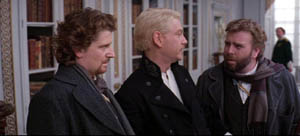
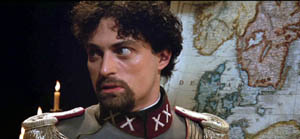
I hadn’t seen Hamlet in 70mm in its initial 1996-1997 run, and at first the idea of taking this fairly intimate piece to a wide-film format seemed counterintuitive. But on the Virginia screen the film lost none of the play’s intensity and it gained a welcome monumentality. The central set, the Danish throne room as a gigantic hall of mirrors flanked by a warren of corridors and fissured by secret passageways, is made for the wide image.
Scale of time also matters. By playing the full version, Branagh can give full weight to the father/ son parallels that riddle the play. If Olivier’s Hamlet was about a son’s love for his mother, Branagh makes the play about the strife between fathers and sons, with women caught in the middle. Hamlet Sr./ Hamlet Jr., Claudius/ Hamlet, Jr., Polonius/ Laertes, old Norway/ Fortinbras, and even the Player’s speech about the murder of Priam: the parallels are in Shakespeare’s text but played out at proper length they snap into sharp relief. Once Laertes is off to Paris, Polonius makes sure he’s spied on, just as Claudius orders Rosenkrantz and Guildenstern to watch Hamlet. In his turn, Hamlet assigns Horatio surveillance duty during the play-within-a-play (a piece of action nicely caught in the opera glasses that Branagh’s choice of period allows). Branagh’s decision to emphasize the military politics around Fortinbras’ march into Denmark helps justify the 70mm format and his decision to set the action in late nineteenth-century Europe; it also allows him to expand, through crosscutting set up early in the movie, the plot of another son at odds with his father.
Sex is important in this game. Branagh presents flashbacks to Hamlet and Ophelia in bed together, accentuating the prince’s later indifference and motivating her despair at his rejection. Not that the fathers don’t clock some mattress time too. Claudius the urbane politician becomes an infatuated newlywed, and Derek Jacobi gives to my mind a definitive performance. Even Polonius, usually treated as a pompous ass, smokes worldly little cigars and has a drab tucked into his bed, so that his advice to Laertes and Ophelia about proper conduct becomes not only patronizing but hypocritical.
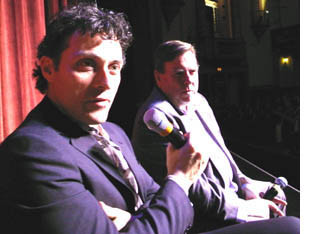 During the Q & A, Timothy Spall and Rufus Sewall emphasized something that Branagh explains on the DVD set: the need to create ensemble performances out of footage shot at different times. Sewall (a dark and scary Fortinbras) was filmed in a few days, before full-blown production, with his bits cut into the film at intervals. Robin Williams, as Osric, was also filmed out of continuity; there are scarcely any shots of him in the same frame as other players.
Spall, a temporizing Rosenkrantz, was present for much more of the filming and was eloquent in explaining how shooting in long, wheeling takes demanded great precision from the actors—hitting marks, using body language, and timing speeches carefully.
Branagh put the bulky 70mm camera on a dolly, then reinforced the studio floors so that no tracks or boards were necessary; the camera could glide anywhere. “Walk and talk” technique, which I’ve blogged about before, comes home to roost in a Shakespeare film; Branagh wanted continuous shots so that the audiences could follow the flow of the speeches, and it works very well.
In fact, Branagh’s editing varies in a patterned way across the play. Acts I and III are briskly cut, averaging about 5 seconds per shot. Acts II and IV rely on much longer takes, typified by the tracking-shot arabesques, and they average 10-11 seconds per shot. And Act V? Here, as you might expect, Branagh pushes the pace to suit the converging plotlines and the burst of poisonings at the climax: the average shot runs about 3 seconds. This seesawing rhythm helps sustain viewer interest across four hours, and it shows an unusually geometrical approach to a movie’s overall architecture.
In his program review, Roger points out that the play remains deeply mysterious, even in a production as lucid and buoyant as Branagh’s. Hamlet is of course one of the most fascinatingly inconsistent characters in literature. I’ve read the play probably a dozen times and seen many film versions of it, and I’m inclined to think that in Hamlet Shakespeare is experimenting with how indeterminate a character can be and still be intelligible to us. It’s not that he’s indecisive; we have to decide what he truly is, and Shakespeare makes our task very hard.
All the other characters in the play are complicated but consistent. Only Hamlet seems to reinvent himself at every entrance. He tells us that he will put on an “antic disposition,” but before he’s gotten very far with his fake madness, he tells Rosenkrantz and Guildenstern of his strategy, knowing that they are likely to report it to Claudius. This has the effect of letting Hamlet behave any way he wants, sincere or duplicitous, calculating or mad. When he’s around others, he’s always “on,” and this makes his true nature and purposes difficult to divine.
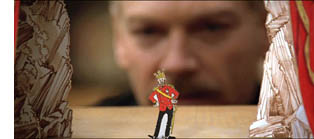 I liked Branagh’s idea of having Hamlet consulting a book on demonology, for in a revenge tragedy the protagonist has to be sure that the aggrieved spirit urging revenge isn’t a demon in disguise. More generally, the Victorian milieu lets Branagh give us a truly bookish Hamlet, one who retreats to his stuffed library when overcome by the strife unfolding in the vast throne room. At the same time, that library contains players’ masks and a curious miniature theatre that Hamlet toys with thoughtfully. He lives among books, but also among images of pretense and deceit.
The questions tease you right to the end. Hamlet finds Laertes’ plunge into Ophelia’s grave overdramatic, but he goes on to declare that he himself loved her with the strength of forty brothers. Before the climactic duel, Hamlet apologizes to Laertes (“I have shot my arrow o’er the house/ And hurt my brother”), but it seems almost bad faith, given all the misery he has helped cause. Is this a morally obtuse sincerity, or another masquerade? It’s this Hamlet, reliably unpredictable, that Branagh’s manic-depressive performance brings home so forcefully.
The unwitting wisdom of the suits
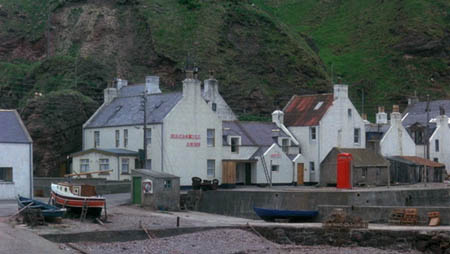
It’s common to say now that the 1970s was the last great era in American cinema, followed by the degradations of the blockbuster 80s, but that remains little more than PR. Putting aside the “revolution” of the 1970s, which seems to me overrated, I’ll just offer the opinion that the 1980s brought us many worthy films, some of them quite daring. For example, one of the sweetest “little movies” of the era is Bill Forsyth’s Local Hero (1983).
It’s a comedy, at once dry and warm, about an oil executive sent to buy a small Scottish town and beachfront in preparation for the installation of a pumping rig and refinery. Forsyth’s script reverses the cliché. The townsfolk, far from clinging to their beloved tradition, are in fact anxious to sell and look forward to being rich. The young executive, Mac, doesn’t try to drive a hard bargain but settles into the rhythm of a life different from that he has known. His boss, a passionate amateur astronomer, surprises everyone with his final decision about the deal. You might call Local Hero one of the first films about the clash of global capitalism and community values, but though that’s accurate, the schematic formula doesn’t capture the understated humor and humanity of Forsyth’s treatment.
Forsyth is at Ebertfest for a screening of his no less brilliant Housekeeping; see Jim Emerson’s eloquent and poised review here. But I wanted to ask about Local Hero. The Scottish village is rendered with the affectionate good humor we find in Ealing comedies, and Forsyth mentioned that after he’d made the film he discovered an Alexander Mackendrick movie, The Maggie (1955), that prefigured his. For me, there were echoes of Jacques Tati in the long-shots and sound gags, and Forsyth confirmed that one of the formative films in his youth was M. Hulot’s Holiday, screened by an indulgent school head.
 Forsyth talked about certain choices he made. The Mark Knopfler score, bringing together Scottish tunes and a Texas twang, helped open out the film in a way that a more conventional lyrical score would not. Forsythe talked as well about the final shot, one of the most satisfying I’ve ever seen. The original cut ended with Mac returning to his Houston apartment and staring out at the dark urban landscape—beautiful in its own way, but very different from the majesty of the Scottish shore. There the original film ended, but the Warners executives, although liking the film, wanted a more upbeat ending. Couldn’t the hero go back to Scotland and find happiness, you know, like in Brigadoon? They even offered money for a reshoot to provide a happy wrapup. Forsyth didn’t want that, of course, but he had less than a day to find an ending.
The movie makes a running gag of the red phone booth through which Mac communicates with Houston. Forsyth remembered that he had a tail-end of a long shot of the town, with the booth standing out sharply. He had just enough footage for a fairly lengthy shot. So he decided to end the film with that image, and he simply added the sound of the phone ringing.
With this ending, the audience gets to be smart and hopeful. We realize that our displaced local hero is phoning the town he loves, and perhaps he will announce his return. This final grace note provides a lilt that the grim ending would not. Sometimes, you want to thank the suits—not for their bloody-mindedness, but for the occasions when their formulaic demands give the filmmaker a chance to rediscover fresh and felicitous possibilities in the material.
Salvation through self-punishment
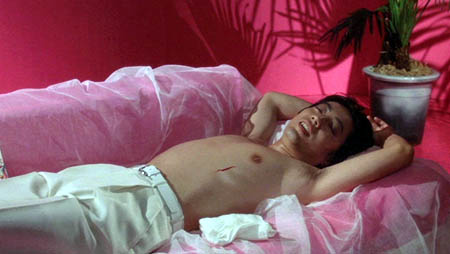
Another outstanding film of the 1980s is Paul Schrader’s Mishima: A Life in Four Chapters (1985), which he brought to Ebertfest in a sparkling print. Schrader is one of two American film critics who became major directors (Peter Bogdanovich is the other), and there’s little doubt that he’s the most cerebral and theoretically inclined of that group known as the Movie Brats. Even if he hadn’t written milestone screenplays (Taxi Driver, Raging Bull) and made provocative films (Blue Collar, Hard Core, Affliction), he would be remembered for his critical writing. A trailblazing essay on Joseph H. Lewis, “Notes on Film Noir,” the essay on the yakuza film, and the book Transcendental Style in Film (1972) made Schrader a distinctive voice in American film culture. Fortunately you can now read his entire oeuvre online at paulschrader.org.
While the youthful Schrader expresses admiration for Bonnie and Clyde and The Wild Bunch, he’s no cheerleader for the New Hollywood. It’s bracing to watch him tear Easy Rider and Alice’s Restaurant limb from limb. The website displays each article in situ, on its original page of print. Since he wrote for many alternative weeklies, ads for bongs and day-glo paint lie alongside Schrader’s reflections on Bresson and Boetticher.
Although I also admire Patty Hearst, Mishima is my favorite Schrader-directed project. I think it’s one of the most artistically courageous films in American cinema. Putting the dialogue almost entirely in Japanese and focusing on a writer few Americans know, it compounds its difficulty with a daunting structure. On one axis, we get four chapters: Beauty, Art, Action, Harmony of Pen and Sword. On another axis, there are three interwoven strands: an account of the final day of Mishima’s life, when he seized control of a general’s office in order to address the garrison; a chronological biography, from his childhood to his adulthood; and stylized, efflorescent scenes taken from three Mishima novels. All these strands knot in the film’s final moments, when Mishima commits seppuku in the office and we see the culmination of the action shown in the novels’ tableaus. A “cross-hatched” structure, Schrader calls it.
The three strands are kept distinct through some technical markers: black and white for the biographical scenes, cinema-verite color for the 1970 attack on the garrison, and stylized color and setting for the extracts from the novels. Schrader explained that he had originally wanted to use video for the novel scenes, but his brilliant production designer Ishioka Eiko told him that the results might not be effective. Instead, she supplied designs of a dreamy radiance.
At the same time, both the biographical scenes and the tableaux take us through different eras of Japanese history, but in a way that sharpens comparisons among them. In the 1930s the boy Mishima glimpses a female impersonator at the kabuki theatre, but in his novel of the period, Runaway Horses, the young men formulate their plan to restore the emperor through an attack on corrupting capitalists. The sets for Kyoko’s House have, Eiko explained, ugly design because in the 1950s the Japanese were copying ugly American designs (though the results look pretty ravishing onscreen).
Schrader wanted to avoid the classic plot trajectory of a hero overcoming obstacles. He sought instead to present the way that a person’s life “becomes more and more fascinating, but you never really understand it.” The shuffling of chronology let him juxtapose different aspects of Mishima’s nature. The man wasn’t exactly contradictory, Schrader says, but rather “compartmentalized”: He could keep his aesthetics, his homosexuality, his militarism, and his childhood distinct, and the film aims to show these different facets of his career.
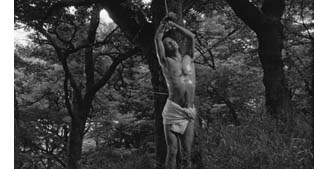 Nevertheless, I’d argue, the film has a marked trajectory. “Perfection of the life or of the art?” Yeats asked. Schrader’s Mishima wants both, together. He seeks to fuse physicality (eroticism, violence, endurance of pain) with spirituality (given as the realm of art). The emblematic image is the poem written in a splash of blood. He finally realizes that for him this fusion can come only in death, because his life has come to embody, literally incarnate, his literary themes and techniques.
Schrader’s film enacts the blending of art and life in its very imagery. At the climax, in the biographical strand Mishima climbs into a jet and the black-and-white imagery gains radiant color as he stares into the sun. The shift brings the biography up to 1970, and so provides a transition to the color footage of the writer’s last day, but it also recalls the opening credits, with the sun rising, and the closing shot of the cadet Isao about to slash himself.
Schrader regrets the transition showing Isao running to the beach, because the imagery shifts from Ishioka’s stylized world to something more realistic (albeit with glowing amber rocks). So for the upcoming Criterion DVD release he has fiddled with the final shots so that the sun and sky look far more abstract. Evidently he wants the world of art and the world of life to remain stubbornly apart—denying to his film what his protagonist yearned for.
You might object that the film’s formal intricacy and specialized themes make for a fairly chilly experience. It isn’t a wildly emotional movie, that’s true; it has some of that ceremonial, contemplative quality you get from a Philip Glass opera, which provides a theatre of pictorial attitudes rather than action. (For an example, see coverage of the current Met production of Glass’s Satyagraha.) No coincidence that Glass provided the score for the film, which he wrote without seeing any footage and which Schrader cut and shuffled to provide cues. Glass obligingly rescored the film to fit the musical collage Schrader wanted.
The film provides a visceral and a sensuous experience, but it doesn’t carry you off on waves of emotion. It will never be popular on a massive scale, because it makes almost no concessions to what people like in biopics. But if you can adjust yourself to a solemn celebration of blood and beauty, Mishima offers unparalleled rewards.
More from Schrader
“Inspiration is just another word for problem-solving.”
Schrader’s intellect never lets up. What other filmmaker could produce such a thoroughly informed academic case as he does in the 2006 “Canon Fodder” (available on his site)? One on one, I peppered him with questions and he answered with seriousness and subtlety. Two themes ran through his comments: his approach to direction and his view that cinema is dead.
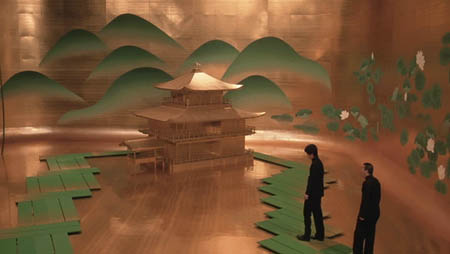
On his directing: Until his last project, he embraced the “well-made film.” He shoots with a single camera, and plans his takes cut to cut. (That is, not a lot of coverage from many angles that will be winnowed out during editing.) He doesn’t storyboard because he wants to develop the staging organically on site. He visits the set, tries out blocking with the actors and DP, then decides on the spot about the breakdown into shots. For the Temple of the Golden Pavilion scenes of Mishima, like the one above, he and cinematographer John Bailey played “dueling viewfinders,” pacing around the actors to test points of view and then settling on tracking shots which incorporated the best angles.
But for his latest project, Adam Resurrected (2008), Schrader switched to a rougher style. Now, he says, he uses two cameras and he likes the bouncing and swaying frame yielded by the Bungee Cam. “I’m sick of the well-made film.”
On new media: Schrader’s stylistic turnabout comes from his conviction that cinema, “the dominant art form of the twentieth century,” is coming to an end. Today’s audience demands new forms of moving-image media. Thanks to television, young people have seen every conceivable story, so narrative is “exhausted” as an expressive resource. They expect their media products to be free, available on demand, and interactive. The result is a challenge to traditional media on every front: financial, cultural, and artistic.
Schrader looks to the Internet as not just an intriguing option but film’s destiny. So while he is planning a traditional “three-act” film, he also has written a screenplay for a 75-minute Net movie. In his essay, “Canon Fodder,” he predicted the end of traditional cinema but thought that he could keep going before the revolution. Now, he says, the sun is setting faster than he expected and if he wants to make more films he has to adjust.
I’m no prophet, but I don’t share his beliefs about the imminent collapse of traditional cinema. I also think that Web-based films, with viewers tempted to browse and graze and fast-forward, will limit aesthetic options. The computer monitor is not as hospitable to contemplative cinema, which demands that the audience patiently submit to unfolding time. When I worried at a panel that an Ozu or a Bresson could not have originated in the age of YouTube, he told me, “Get over it, David!” Though we disagree, talking with him was terrifically stimulating. I left with the hunch that Schrader will continue to devise some characteristic provocations for new media, for which we should be thankful.
Envoi
Dusty Cohl was one of the mainstays of Ebertfest, as well as the founder of the Toronto Film Festival and a shot in the arm to world film culture. He died last fall. He was honored by several events at this year’s festival, notably the biographical film, Citizen Cohl: The Untold Story, by Barry Averich (The Last Mogul). On my first visit to Ebertfest, the tough, salty guy with the quick grin and the cowboy hat immediately made me feel welcome, and he did the same when Kristin came along the following year. Everyone whose life he touched was grateful for Dusty’s generosity of mind and spirit.
Truly madly cinematically
DB here, still in Hong Kong:
You are a film director. How do you convey to an audience that a character mysteriously sees hidden personalities in other characters?
Filmmakers are problem-solvers, at least sometimes, and I’ve argued elsewhere that we can often explain their creative choices as efforts to pose and solve problems. I ran across an intriguing example during my stay here in Hong Kong. I interviewed Tina Baz, the editor for Johnnie To’s film Mad Detective (2007), which I blogged about from Vancouver in October.
 Tina has a fascinating history. Lebanese and French-educated, she attended art school in Beirut and film school in Paris. Armed with a maitrise from the Sorbonne, she began editing. Over a dozen years, she has built up an impressive career. She was editor on The Mourning Forest (2007), A Perfect Day (2005), and several other high-profile projects.
Mad Detective was Tina’s first film for Johnnie To, as well as her first experience with the Hong Kong crime genre. She was accustomed, she says, to the more psychologically-driven narratives of French cinema, and she had to work in a new way during the seven weeks it took to edit the film. This is an unusually long editing time for Hong Kong filmmaking, and it reflects the complicated tasks this film set her.
If you haven’t seen Mad Detective, you will probably want to stop reading. The scenes I’m discussing come fairly early in the film, but they do contain some surprises you might not want to know about in advance.
Headquarters
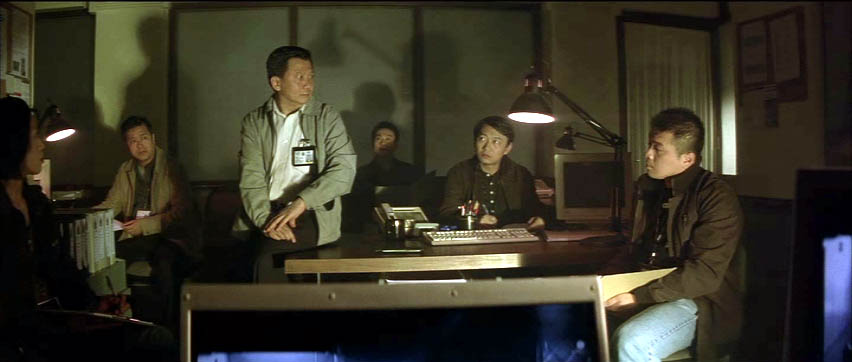
The rough cut of the film, adhering closely to Wai Ka-fai’s script, displayed a complicated flashback structure. The plot began fairly far into the action and then jumped back to establish the exposition. Central to that exposition is the film’s premise: Detective Bun, played by Lau Ching-wan, solves cases by extraordinary telepathic/ intuitive/ visionary insights. But the original cut blurred that concept, mixing it with an early revelation of the identity of the villain, a corrupt cop named Ko Chi-wai, and background on Bun’s young partner Ho. How to cut through the clutter?
The first step to a solution was to straighten out the chronology and to focus tightly on Bun from the start. The audience needed to understand the film’s eccentric psychological premise—specifically, that Bun’s gift allows him to detect multiple personalities buried within another person.
In talking with me, Tina went over three scenes that establish Bun’s peculiar abilities. (1) The sequences furnish striking examples of how filmmakers find precise technical solutions to storytelling problems. This trio of scenes also follow Hollywood’s Rule of Three. According to this, a key piece of information should be presented three times, preferably in different ways. (2) (Once for the smart people, once for the average people, and once for slow Joe in the back row.) Tina smiled. “This is not something that French directors would say.” The Rule of Three can be seen as another aid to solving the broad problem of clarity—making sure that the audience understands the story.
Discussing all three scenes adequately would take a lot of space and require dozens of stills, so I’ll concentrate on the first two. These should suffice to show how the filmmakers solved a tricky narrational problem.
The first scene takes place in police headquarters and it’s the simplest. It starts with Bun absorbing details of Ho’s investigation. We hear, offscreen, a whining woman complaining that a maniac can’t solve a case. We think at first that it’s the voice of another cop, but after a second complaint from offscreen, Bun looks up. Cut to the whining woman, who stands among the cops.


Bun rises and walks to a pudgy cop who grins ingratiatingly. Now cut from the cop to the whining woman, in a similar composition against the same background.


An over-the-shoulder shot presents Bun staring as we hear the fat cop asking, “Do you recognize me?”


After the fat cop flatters him, Bun head-butts him. Bending over the fallen cop, Bun says, “Shut up. I see and hear you, bitch!” Cut from the bloody-nosed cop to Bun to the bloody-nosed woman.


After Ho dismisses the team, Bun slowly approaches and confides: “I can see the inner personalities of a person” (below). This line of dialogue crystallizes what we’ve seen–the bitchy woman inside the ingratiating man–and prepares for the next few scenes.
On the street
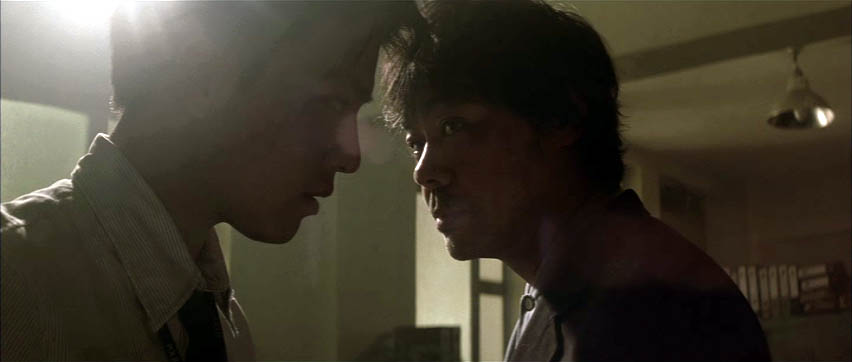
The second vision scene is more complicated, and Tina had several discussions with To and Wai about whether to include it. The new problem, based on the key line above, is to establish that Bun can see not one but several hidden personalities in Ko, the crooked cop. How can this premise be shown?
The major scene coming up shows the two partners confronting Ko at a restaurant. There Bun will envision some of Ko’s inner people manifesting themselves. But there’s also dramatic conflict to be conveyed in the scene, which culminates in a beating in the men’s room. Again, too much information! Tina, To, and their colleagues decided to include an intermediate scene, one that had little dramatic consequence but got audiences more comfortable with the premise.
Ho and Bun trail the suspect along the street, first in a car and then on foot. The results have the kind of precision I’ve pointed to in another Milkyway film, PTU.
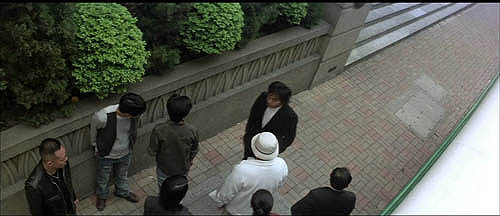
In the car, Tina’s cutting establishes the differences between the two cops’ points of view. A two-shot of Ho and Bun yields to a straightforward POV shot of Ko striding along the sidewalk.


But a cut to Bun watching is followed by a shot of seven people in Ko’s place. In a nice instant of uncertainty, a few heads emerge from behind a parked van and are only partially visible. At first glance we might take them for passersby walking ahead of Ko.


Before we can fully identify this band of spirits, and as the car draws abreast, a cut to Ho watching leads to a shot of Ko, whistling.


Another cut to Bun, and now we see, as he apparently does, a full view of the platoon of Ko-personalities striding along whistling.


This mildly wacko variant is consistent with the narration’s mixed attitude toward Bun’s visions: are they supernatural insights or hallucinations?
Bun leaps from the car and pursues Ko’s band of personalities, and a new variation shows him and them in the same frame. But this is re-framed by Ho’s POV, which reasserts that to anyone but Bun, Ko is all by himself.


Abruptly, the visions halt and turn, staring at Bun. By now we are trained to understand what’s happening without a corresponding objective shot of Ko. Ko, we infer, has turned around to check on who’s following him.

Likewise, we can grasp the image of Bun passing through the group of figures as simply Bun walking past Ko.

At this point, we have no need to see the objective action. To and Tina have stressed the absence of an objective view by showing Ho, in the background, looking in another direction and missing this byplay (above). After Bun has passed, the troupe of avatars walks in their new direction, and then we get the objective shot of them “as” Ko.


This effect is anchored when Ho turns and notices Ko going into the restaurant.

As a meticulous touch, Ko’s departure from the frame reveals Bun still walking away in the distance. The geography is simple and impeccable.

The idea of seeing “inner personalities” has been made concrete while undergoing a lot of variation. Sometimes shots of the spirits are sandwiched between shots of Bun looking; sometimes not. Sometimes we have Ho to verify what’s really happening, but sometimes not. And sometimes Bun can be in the same frame as the avatars. Otherwise, Tina points out, the scenes would become boring.
Once the street scene has laid out how Bun sees Ko Chi-wai, the next scene, unfolding in the restaurant and a men’s toilet, can play with the premise still more. Tina explains that the creative team constantly asked, “How far can we go with Bun’s point of view, his vision?” Quite far, it turns out. The premise gets varied further across the whole movie, in imaginative ways. Which is to say that a solution to a problem can pose new problems, which the filmmakers go on to grapple with.
In our discussion, Tina noted that the street scene goes beyond simply giving us information. There’s a disquieting emotional effect when the spirits turn and confront Bun, their expressions ominously blank. Finding a solution to a creative problem often yields an unexpected payoff like this.
Bonus features
As I indicated, I can’t pursue the felicities of the restaurant scene here. Instead, here are some quick final thoughts.
*Mad Detective shows once more the power of basic techniques of performance (e.g., the act of looking), framing, and editing. To and Wai have no need for fancy CGI effects to evoke the “inner personalities” of Ko or the other cop. Our minds make the necessary connections. Lev Kuleshov would have admired the engineering economy of this sequence.
*In passing Tina and I talked about actors’ eyes, a special interest of mine. (3) Tina had noticed that actors try not to blink. She agreed that blinks pose problems for editors: “Blinking is very hard on cutting.” She remarked that Elia Suleiman would strain to keep from blinking until tears flowed from his eyes.
*Mad Detective was signed by both Johnnie To and Wai Ka-fai, but their joint projects are usually filmed by To, with Wai supplying the script and consulting as production proceeds. Tina confirms To’s habit of shooting with the whole scene’s layout in his head, using very few takes per shot and not a lot of coverage. The film is “very pre-cut,” she says. You can see this, I think, in the way To relies on matches on action and ends one shot with something that prepares you for the next one.
*To follows Hong Kong tradition of adding all the sound in postproduction. This makes for economy and efficiency in shooting, but it also gives HK films the fluency of silent cinema. The filmmaker gains a freedom of camera placement and is encouraged to think about how to tell the story visually. Tina and Shan Ding, To’s all-around assistant, pointed out that sync sound might make the director depend more on dialogue and static conversation scenes. Still, I think that sometimes they wish for a scene shot with direct sound.
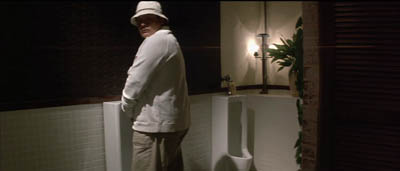
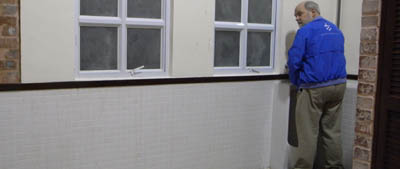
*As with many Milkyway films, several scenes were filmed at the company headquarters. An earlier blog here discussed the ambitious rooftop set for Exiled. For Mad Detective, the fistfight in the restaurant toilet was filmed in the main men’s room of the Milkyway building, with a fake urinal added. Shan Ding provides documentation in the snapshot below, using a double for Lam Suet.
To come: Another Milkyway interview, this one with ace sound designer Martin Chappell. And a final batch of impressions from the Hong Kong International Film Festival, which ends on Sunday.
(1) If you know Mad Detective, you’re aware that Bun’s ability to discern hidden personalities is displayed in an earlier scene. But given the way in which that story action is presented, we can’t say that that his powers are established there. This scene is one of many clever narrational stratagems in a film that benefits from being rewatched.
(2) See Bordwell, Janet Staiger, and Kristin Thompson, The Classical Hollywood Cinema: Film Style and Mode of Production to 1960 (New York: Columbia University Press, 1985), 31.
(3) Laugh if you must, but I wrote an essay about this. “Who Blinked First?” is available in Poetics of Cinema.
Creating a classic, with a little help from your pirate friends
DB here:
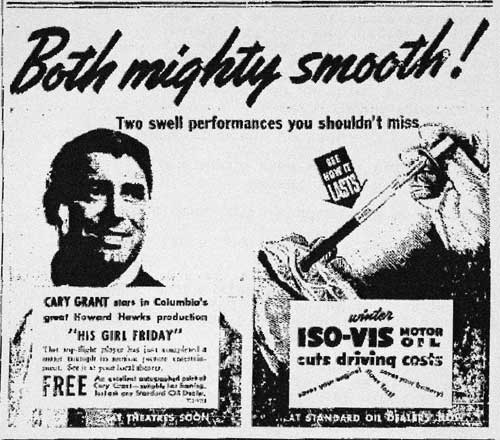
In early April of 1940, His Girl Friday came to Madison, Wisconsin. It ran opposite Juarez, The Light that Failed, Of Mice and Men, and a re-release of Mamoulian’s Dr. Jekyll and Mr. Hyde. Pinocchio was about to open. Most screenings cost fifteen cents, or $2.21 in today’s currency.
Before television and home video, film was a disposable art. Except in big cities, a movie typically played a town for a few days. Programs changed two or three times a week, and double bills assured the public a spate of movies—nearly 700 in 1940 alone. People responded, going to the theatres on average 32 times per year. Given the competition, it’s no surprise that His Girl Friday didn’t stand out in the field; it was nominated for no Academy Awards and honored by no prizes. On just a single day in Madison, the cast of His Girl Friday was up against icons like Muni, Colman, March, and Bette Davis.
Nowadays, of course, nearly everyone regards HGF as one of the great accomplishments of the studio system. Most would consider it a better movie than any of the others it played opposite in my home town. A typical example of critical exuberance is Jim Emerson’s comment here. Or read James Harvey’s 1987 encomium:
It would be hard to overstate, I think, the boldness and brilliance of what Hawks has done here: not only an astonishingly funny comedy, but a fulfillment of a whole tradition of comedy—the ur-text of the tough comedy appropriated fully and seamlessly to the spirit and style of screwball romance. His Girl Friday is not only a triumph, but a revelation.
Oddly, this extraordinary film lay largely unnoticed for three decades. How did it become a classic? The answer has partly to do with the rising status of Howard Hawks, the director, among critics. It also owes something to changes in how academics thought about film history. And a little movie piracy didn’t hurt.
An unseen power watches over the Morning Post
Hawks the Artist is a creation of the 1960s. Before that, American film historians almost completely ignored him. Andrew Sarris often reminds us that he’s absent from Lewis Jacobs’ Rise of the American Film (1939), but he’s also missing from Arthur Knight’s The Liveliest Art (1957), the most popular survey history of its day. Apart from press releases and reviews of individual films, there were few discussions of Hawks in American newspapers and magazines. The most famous piece is probably Manny Farber’s “Underground Movies” of 1957, which treats Hawks along with other hard-boiled directors like Wellman and Mann.
From the start, Hawks was more appreciated in France. There film historians acknowledged A Girl in Every Port (1928), in part because of the presence of Louise Brooks, and they usually flagged Scarface (1932) as well, which they could see and Americans couldn’t. (Howard Hughes kept it out of circulation for decades.) But Hawks is barely mentioned in Georges Sadoul’s one-volume Histoire du cinéma mondiale (orig. 1949) and he’s ignored in the 1939-1945 volume of René Jeanne and Charles Ford’s monumentally monotonous Histoire encyclopédique du cinéma (1958).
The essay that marked the first phase of reevaulation was evidently Jacques Rivette’s “The Genius of Howard Hawks” in Cahiers du cinéma in 1953. Inspired by Monkey Business, Rivette’s philosophical flights and you-see-it-or-you-don’t tone helped define the auteur tactics identified with Cahiers’s young Turks. Rivette and his colleagues became known as “Hitchcocko-Hawksians.” The essay, however, doesn’t seem to have been immediately influential. Antoine de Baecque claims that within Cahiers, an admiration for Hawks was controversial in a way that liking Hitchcock was not. (1) It took some years for Hawks to ascend to the Pantheon.
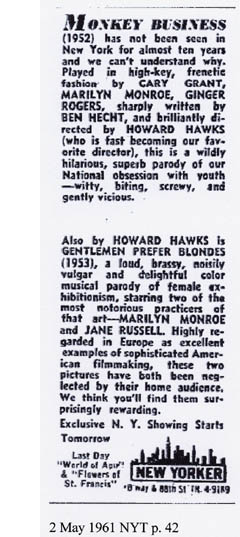 The story of that ascent has been well-told by Peter Wollen in his essay, “Who the Hell Is Howard Hawks?” In France, the Young Turks’ tastes had been nurtured by Henri Langlois, who showed many Hawks films at the Cinémathèque Française. In New York, Andrew Sarris and Eugene Archer had become intrigued by Cahiers but were ashamed that as Americans they didn’t know Hawks’ work. They persuaded Daniel Talbot to show a dozen Hawks films at his New Yorker Theatre during the first eight months of 1961. The screenings’ success allowed Peter Bogdanovich to convince people at the Museum of Modern Art to arrange a 27-film retrospective for the spring of 1962. The package went on to London and Paris, sowing publications in its wake.
For the MoMA retrospective, Hawks granted Bogdanovich a monograph-length interview, which was to be endlessly reprinted and quoted in the years to come. (2) Sarris, now knowing who the hell Hawks was, wrote a career overview for the little magazine, The New York Film Bulletin, and this piece became a two-part essay in the British journal Films and Filming. Both Bogdanovich and Sarris made brief reference to His Girl Friday, as did Peter John Dyer in another 1962 essay, this one for Sight and Sound. At the end of 1962, another British magazine, Movie, published an issue on Hawks. At the start of 1963, Cahiers devoted an issue to him, including an homage by Langlois himself. Thanks to the work of Archer, Bogdanovich, Sarris, and MoMA, Hawks was rediscovered.
Sarris provided a condensed case for Hawks in his far-reaching catalogue of American directors, published as an entire issue of Film Culture in spring of 1963. There followed an interview with Hawks’s female performers in the California journal Cinema (late 1963), an appreciation by Lee Russell (aka Peter Wollen) in New Left Review (1964), another Cahiers issue (November 1964), J. C. Missiaen’s slim French volume Howard Hawks (1966), Robin Wood’s Howard Hawks (1968), and Manny Farber’s Artforum essay (1969). There were doubtless other publications and events that I never learned about or have forgotten. In any case, by the time I started grad school in 1970, if you were a film lover, you were clued in to Hawks, and you argued with the benighted souls who preferred Huston. . . even if you hadn’t seen His Girl Friday.
Light up with Hildy Johnson
One of my obsessions in graduate school was the close analysis of films. But I was also interested in whether one could build generalizations out of those analyses. My initial thinking ran along art-historical lines. My Ph. D. thesis on French Impressionist cinema sought to put the idea of a cinematic group style on a firmer footing, through close description and the tagging of characteristic techniques. But that approach came to seem superficial. I wasn’t satisfied with my dissertation; although it probably captured the filmmakers’ shared conceptions and stylistic choices, I couldn’t offer a very dynamic or principled account of formal continuity or change.
Watch a bunch of movies. Can you disengage not only recurring themes and techniques, but principles of construction that filmmakers seem to be following, if only by intuition? As I was finishing my dissertation, reading Russian Formalist literary theory pushed me toward the idea that artists accept, revise, or reject traditional systems of expression. These become tacit norms for what works on audiences. My reading of E. H. Gombrich pushed me further along this path. We should, I thought, be able to make explicit some of those norms. Eventually I would call this perspective a poetics of cinema.
I was assembling my own version of some ideas that were circulating at the time. In the early 1970s, several theorists floated the idea that different traditions fostered different approaches to filmic storytelling. People were seeing more experimental and “underground” work, as well as films from Asia and what was then called the Third World. Being exposed to such alternative traditions helped wake us up to the norms we took for granted. The mainstream movie, typified by what Godard called “Hollywood-Mosfilm,” seemed more and more an arbitrary construction.
People began examining films not as masterworks or as expressions of an auteur, but as instances of a representational regime. Films became “tutor-texts,” specimens of formal strategies that were at play across genres, studios, periods, and directors. Again, the French pointed the way, particularly Raymond Bellour, Thierry Kuntzel, and Marie-Claire Ropars. At the same moment, Barthes’ S/z was published in English, and it seemed to provide a model for how one might unpick the various strands of a text, either literary or cinematic. Screen magazine was a conduit for many of these ideas in the English-speaking world.
Some of my contemporaries disdained the mainstream cinema and moved toward experimental or engaged cinema. Others read the dominant cinema symptomatically, for the ways it revealed the contradictions of ideology. I learned from both approaches, but I believed that the current analysis of how Hollywood worked, even considered as a malevolent machine, was incomplete. Could we come up with a more comprehensive and nuanced account of the mainstream movie? This line of thinking was already apparent in non-evaluative studies of form and style, such as essays by Thomas Elsaesser, Marshall Deutelbaum, and Alan Williams. (3)
At some point in graduate school at the University of Iowa, between fall 1970 and spring 1973, I saw a screening of His Girl Friday. I fell in love with its heedless energy. It seemed to me a perfect example of what Hollywood could do.
In my admiration I was channeling the cultists. Rivette, in a review of Land of the Pharoahs: “Hawks incarnates the classical American cinema.” (4) Bogdanovich: He is “probably the most typical American director of all.” Richard Griffith, then film curator of MoMA, had slighted Hawks in his addendum to Paul Rotha’s The Film Till Now, but in his foreword to the Bogdanovich interview he caved to the younger generation: “Hawks works cleanly and simply in the classical American cinematic tradition, without appliquéd aesthetic curlicues.” As for HGF, in the 1963 Cahiers tribute Louis Marcorelles called it “the American film par excellence.”
Praising Hawks, and HGF specifically, was part of a larger Cahiers strategy to validate the sound cinema as fulfilling the mission of film as an art. What traditional critics would have considered theatrical and uncinematic in HGF—confinement to a few rooms, constant talk, an unassertive camera style—exactly fit the style that Bazin and his younger colleagues championed. (For more on that argument, see Chapter 3 of my On the History of Film Style.)
These niceties didn’t inform my reaction at the time. I was already primed to like Hawks, though, having caught what films I could after reading Wood et al. (During my initial summer in Iowa City, I went to a kiddie matinee of El Dorado and got Nehi Orange spilled down my neck.) On my first viewing His Girl Friday delighted me with the sheer gusto of the pace and playing. Clearly the cast was having fun. A press release sent out before the film claimed that during one scene, with Cary Grant dictating frantically to Rosalind Russell, she cracked him up by handing over what she had typed.
Cary Grant is a ham. Cary Grant is a ham. Now is the time for all good men to quit mugging. You don’t think you can steal this scene, do you—you overgrown Mickey Rooney? The quick brown fox jumps over the studio. Cary Grant is a ham.
Even discounting this tale as PR flackery, we know from Todd McCarthy’s excellent biography that Hawks encouraged competitive scene stealing and wily improvisation. Russell hired an advertising copywriter to compose quips she could “spontaneously” conjure up in her duels with Grant.
If there was a “classical Hollywood cinema”—a phrase that was in the early ’70s coming into circulation via Screen—the buoyant forcefulness of His Girl Friday embodied it. Here was a film pleasure-machine that hummed with almost frightening precision. What else do you expect from a director who studied engineering and whose middle name is Winchester?
Production for use
When I saw His Girl Friday, little had been written about it. Despite Langlois’ screenings, before the 1962 touring program, the Cahiers critics seemed to have had limited access to Hawks’ prewar work. His Girl Friday wasn’t released theatrically in France until January of 1945 (not perhaps the most propitious moment), and it apparently made no long-lasting impression on the intelligentsia. I can’t find any critical commentary on it in French writing before the 1963 issue of Cahiers.
In the United States, HGF earned Hawks a courteous write-up in the New York Times by, of all people, Bosley Crowther, (5) but it wasn’t acknowledged as an instant classic like Mr. Smith Goes to Washington or The Philadelphia Story. After the initial flurry of mostly favorable reviews, the movie seems to have been forgotten until Manny Farber’s 1957 essay, and even there it’s only mentioned in a list. Interestingly, it wasn’t screened during the 1961 New Yorker series. Robin Wood’s sympathetic but not uncritical discussion in his Hawks book of 1968 seems to have been the most comprehensive account available since the movie’s release.
At about the time Wood’s book was published, something big happened. Columbia Pictures failed to renew its copyright, and His Girl Friday fell into the public domain.
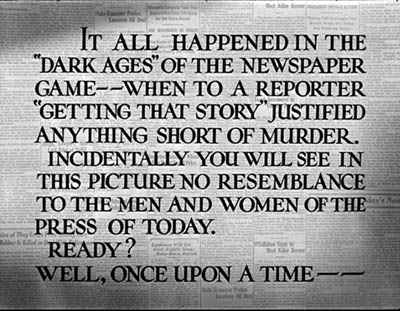
Entrepreneurs made dupe copies, in quality ranging from okay to terrible. You could rent one for peanuts and buy one for only a little more. Some of these bleary prints have been telecined and turned into the DVD versions of the film that fill bargain bins today. After I got to the University of Wisconsin, where Hawks films stoked the two dozen campus film societies, I bought a public domain print. The copy was better than average, although it lacked the fairy-tale warning title at the start. From 1974 on, I showed the poor thing constantly.
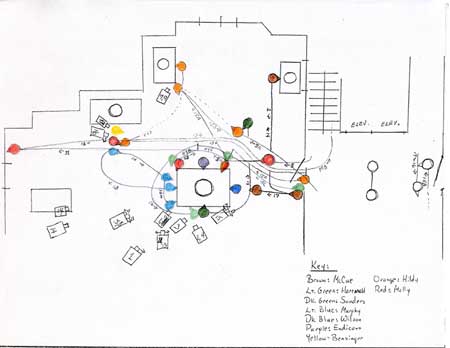
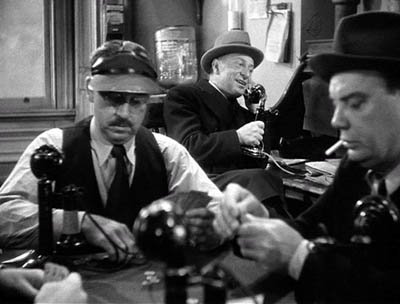
In Introduction to Film, taught to hundreds of students each semester, HGF illustrated some basic principles of classical studio construction. It had the characteristic double plotline (work/ romance), a careful layout of space, an alternation of long takes and quick cutting, manipulation of point-of-view, judicious depth framing (see frame below), and cascading deadlines. In Critical Film Analysis, I asked students to map out scenes shot by shot (see diagram above) and to show how different approaches (genre-based, feminist, Marxist) would interpret the film. In a seminar on “the classical film and modernist alternatives” HGF grounded comparisons with Bresson, Dreyer, Ozu, Godard, and Straub/Huillet. By steeping ourselves in such alternative traditions, could we resist the naturalness of Hollywood artifice?
The movie became a UW staple. It went into the first edition of Film Art (1979) as an instance of classical construction; even the telephones were scrutinized. Marilyn Campbell’s paper from our seminar was published in 1976. (6) Over the years, many of our grad students, exposed to the film in our courses, have gone on to use it in their teaching.
Doesn’t have to rhyme
I can’t let HGF go. I still use moments to illustrate points in my writing and lectures. Madison colleagues and I swap banter from it; Kristin and I talk in Hawks-code, as she explains here. I’ve been told that grad students in another PhD program compared our program to the Morning Post pressroom (favorably or not, I don’t know). Thanks to Lea Jacobs, the invitation to my retirement party was surmounted by a picture of Walter Burns whinnying into his phone.
But seriously, His Girl Friday, isn’t a bad guide to a lot of social life. You can learn a lot from its Jonsonian glee in selfishness and petty incompetence, as well as its sense that virtue resides with the person who has the fastest comeback. Think as well how often you can use this line in a university setting:
If he wasn’t crazy before, he would be after ten of those babies got through psychoanalyzing him.
I’m not claiming special credit for the HGF revival, of course. Plenty of other baby-boomer film professors were teaching it. It became a reference point for feminist film criticism, particularly Molly Haskell’s From Reverence to Rape (1974), and it has never lost its auteurist cachet. Richard Corliss’s 1973 book on American screenwriters flatly declared that “His Girl Friday is Hawks’s best comedy, and quite possibly his best film.”
Most important of all, TV stations were screening their bootleg prints. HGF didn’t become a perennial like that other public domain classic It’s a Wonderful Life, but its reputation rose. Its availability pushed the official Cahiers/ Movie masterpieces Monkey Business and Man’s Favorite Sport? into a lower rank, where in my view they belong.
Once HGF became famous, the proliferation of shoddy prints became an embarrassment. In 1993 it was inducted into the National Film Registry, which gave it priority for Library of Congress preservation. Columbia managed to copyright a new version of the film. A handsomely restored version was released on DVD, and a few years back I saw a 35mm copy whose sparkling beauty takes your breath away.
The lesson that sticks with me is this. If Columbia had renewed its copyright on schedule, would this film be so widely admired today? Scholars and the public discovered a masterpiece because they had virtually untrammeled access to it, and perhaps its gray-market status supplied an extra thrill. Thanks mainly to piracy, His Girl Friday was propelled into the canon.
Epilogue
In May of 1940, His Girl Friday hung around Madison, shifting from its first venue, the Strand downtown, to an east side screen, the Madison. The film came back in late September to yet a third screen, the Eastwood (now a music venue).
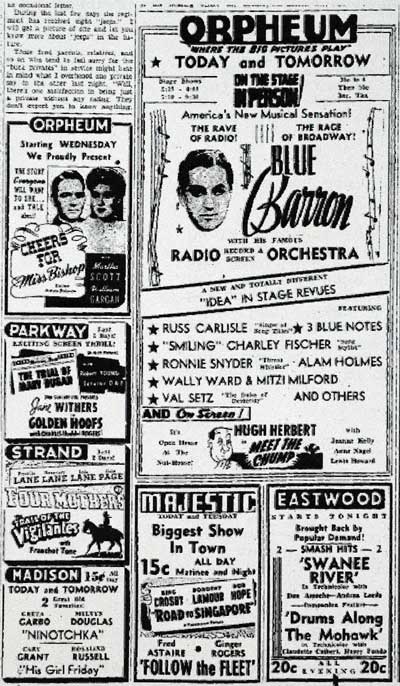
HGF was revived in March of 1941, as the second half of a double bill at the Madison (bottom left below). Check out the competition: some killer re-releases from Ford, Lubitsch, Astaire-Rogers, and Hope-Crosby. A Midwestern city of 60,000 could become its own cinémathèque without knowing it.
(1) Antoine de Baecque, Cahiers du cinéma: Histoire d’une revue, vol. 1: À l’assaut du cinéma, 1951-1959 (Paris: Cahiers du cinéma, 1991), 202-204.
(2) Bogdanovich has published a much fuller version in Who the Devil Made It? (New York: Knopf, 1997) , 244-378.
(3) Thomas Elsaesser, “Why Hollywood?” Monogram no. 1 (April 1971), 2-10; “Tales of Sound and Fury,” Monogram no. 4 (1972), 2-15; Marshall Deutelbaum, “The Structure of the Studio Picture,” Monogram no. 4 (1972), 33-37; Alan Williams, “Narrative Patterns in Only Angels Have Wings,” Quarterly Review of Film Studies 1, 4 (November 1976), 357-372.
(4) Jacques Rivette, “Après Agesilas,” Cahiers du cinéma no. 53 (December 1955), 41.
(5) Bosley Crowther, “Treatise on Hawks,” New York Times (17 December 1939), 126. “He brings to his work as a director the ingenious and calculating brain of a mechanical expert. . . . He pitches into the job just as though he were building a racing airplane.”
(6) Marilyn Campbell, “His Girl Friday: Production for Use,” Wide Angle 1, 2 (Summer 1976), 22-27.
For a helpful collection of conversations with the master, see Howard Hawks Interviews, ed. Scott Breivold (Jackson: University of Mississippi Press, 2006). Go here for a 1970s piece by James Monaco on then-current controversies.
PS 24 Feb: Jason Mittell responds to my post with some nice nuancing and draws out the implication for copyright issues: contrary to current media policy, the wider availability of a work can actually enhance its value.
Coming attraction: Kristin is preparing a blog entry commenting on fair use in the digital age.