





Archive for the 'Film technique: Staging' Category
Niceties: how classical filmmaking can be at once simple and precise
DB here:
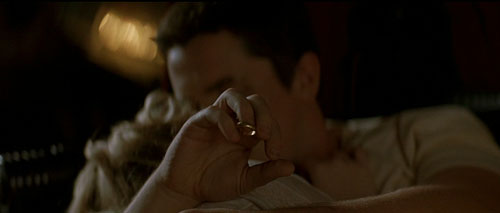
A film academic once complained that I was too preoccupied with “formalistic niceties.” So here I go again. But read no further if you haven’t seen Christopher Nolan’s The Prestige.
Dueling magicians: The film’s premise might be considered high-concept. In turn-of-the-century London, two young conjurers launch their careers with different attitudes toward their craft. Robert Angier favors audacious showmanship, while Alfred Borden is committed to finding a trick that will baffle the experts. Their rivalry is ignited when Alfred accidentally kills Angier’s wife during a dangerous underwater stunt. Their struggle peaks around each one’s supreme trick: transporting himself from one point to another instantaneously.
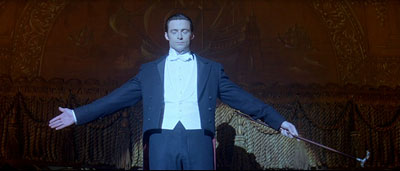
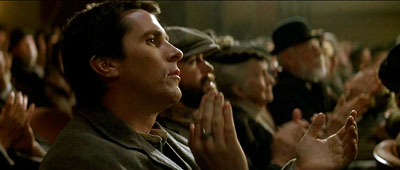
The item that attracts my attention today is established in the film’s opening sequence. As the voice of Cutter (Michael Caine) explains a magic trick’s three acts, we see a climactic confrontation between the competitors. Hoping to discover Robert’s secret, Alfred watches the Real Transported Man performance from the audience.
As Cutter’s narration mentions “a man,” the camera picks out Alfred in the crowd. Cut to Robert onstage, a shift that establishes the two as our protagonists.
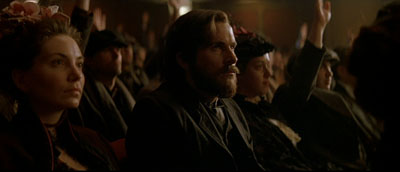
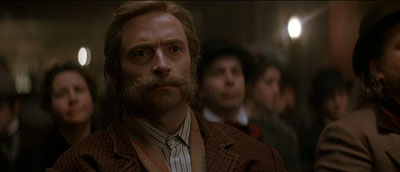
What interests me is the view of the bearded Alfred: a medium-shot framing him nearly in profile facing right. This framing will be repeated, but varied, when Alfred’s voice-over diary entry introduces both him and Robert as apprentices, working as audience shills for another magician:
We were two young men at the start of a great career—two young men devoted to an illusion, who never intended to hurt anyone.
The new shot parallels the introduction of Alfred in the first scene, but varies it. Again we see Alfred in the audience, but now without a beard, and the camera tracks rightward to show Robert in another row.
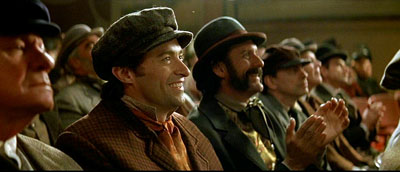
In this sequence, our protagonists are connected by a camera movement rather than the cut employed in the opening. The two men’s reactions—Robert grinning (his wife is onstage), Alfred more pensive—add to the characterizations that we will see played out.
This simple camera motif gets varied further in the course of the film. The disastrous immersion illusion that drowns Robert’s wife is initiated by another tracking shot of the two men in the audience, a variation of the earlier shot.
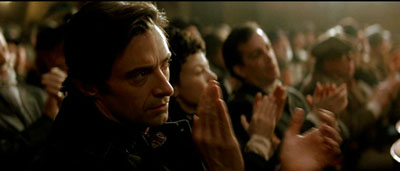
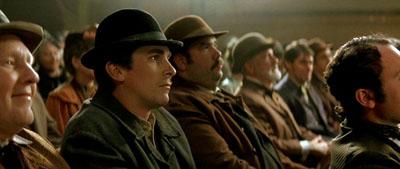
The new combination starts with Robert and ends on Alfred. At this point, not only are the two men linked but they replace one another. If you want to push your luck, you could say that this variant quietly affirms the film’s overall dynamic of substitution (doubles, twins, clones).
Earlier, a contrasting way of showing the men in an audience is given us when they attend a performance of the wizard Chung Ling Soo. Cutter provides a dialogue hook, warning Robert that “the blokes at the ends of row three and four” can see him kissing his wife’s leg.
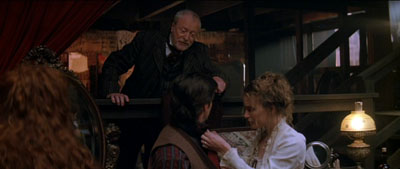
Cut to our protagonists, sitting at the end of a row watching the Chinese magician.
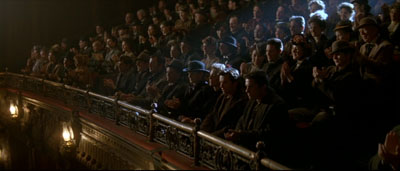
A nicety: Now the men are sitting side by side and facing left rather than right. Just through camera placement and character position, we know we’re in a different performance, one in which our apprentices play no role.
As they study the trick, Nolan gives us another characterizing shot: Robert is amazed, but Alfred grins: He’s worked out Chung’s secret.
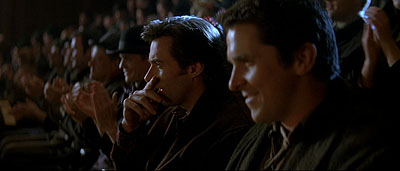
What would have happened if Nolan had framed the men sitting apart and/or facing to the right? For an instant we might have thought we were back in the act they shill for. Simple but reiterated differences assure immediate comprehension: medium shot/ long shot, looking rightward/ looking leftward, men in different rows/ men in the same row. Just as the repeated framings of their own act clarify the situation, so do these little polarities. Call it redundancy, if you like, but it’s also precision and economy.
With Julia’s death, the men become enemies. But each will still slip into the audience of the other’s performances. From now on, the magician is always on the right, the onlooker on the left. Nolan and company could have handled their rivalry in camera setups that exactly mimic the early ones. Instead, a new pattern of parallels comes into play, building on the earlier ones but different enough to heighten the symmetries.
The new pattern is set up by restricting our range of knowledge. First, we are attached to Alfred when he performs his bullet catch in a barroom theatre. Robert, seeking vengeance for Julia’s drowning, steps up to spoil the trick, but we don’t know he’s there until Alfred does, and then it’s too late.
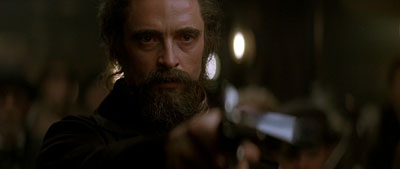
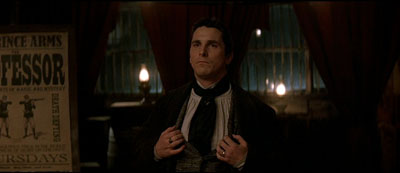
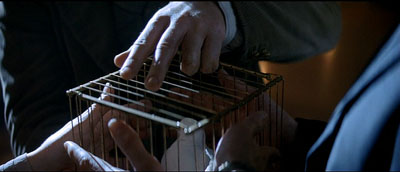
Similarly, we’re restricted to Robert’s range of knowledge when he tries to execute his disappearing dove trick. Only when Alfred is about to trigger the collapsing cage—killing the dove and wounding a lady from the audience—does Robert realize that his adversary has struck back.
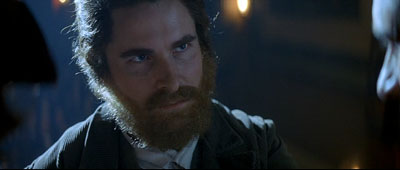
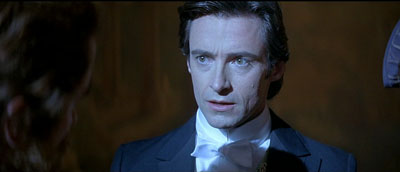
Another nicety: The two shots of each man in similar disguises, seen in 3/4 view, reset the stylistic parameters. But the image of the bearded Alfred is given extra punch through a tilt up from his missing fingers–the result of the parallel, bullet-catch scene before.
The whole pattern shifts yet again when Robert sneaks in to watch Alfred’s Transported Man illusion. We get a shot of him (in a beard again) that fuses two of the cues from the earlier scenes: He’s in the audience, as in the early sequences, but he’s shown from an angle congruent with that of the earlier beard shots.
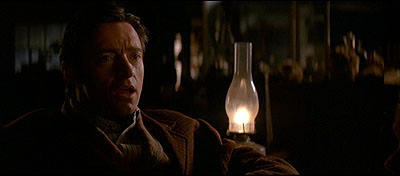
And perhaps we can take the shot of Robert at home, telling of his amazement at Alfred’s illusion, as an echo of the initial prototype: A magician staring intently rightward at a dazzling trick played out offscreen, but now in memory.
Robert returns from Colorado with the Tesla-designed “Real Transported Man,” and Alfred’s visit to watch the stunt reworks the givens of this pattern yet again. Alfred is seated, minimally disguised, in the standard audience spot looking right, but he is not in profile and the camera position is much closer than before. The answering shot of Robert onstage recalls the gesture we saw at the film’s outset and anticipates what we will see when that opening scene is replayed, with the wicked Alfred climbing onstage.
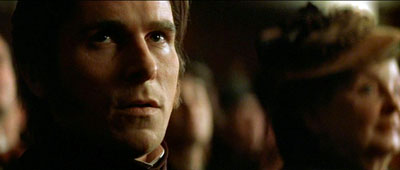
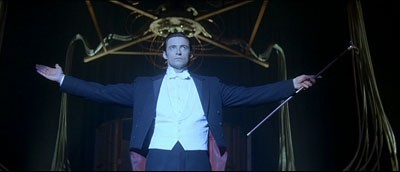
At the close of the trick, yet one more variant: Robert appears in the rear balcony and the crowd all turns to watch him off left.
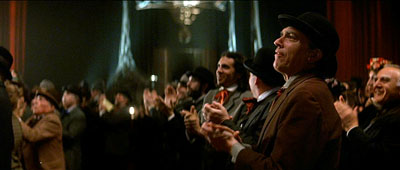
After a glance back, Alfred turns away, looking right–the first time any character has flinched from the performance. His puzzlement is mixed with anger (at last a trick he can’t see through), a less charitable response than we saw in Robert’s stunned fireside recollection of Alfred’s Transported Man.
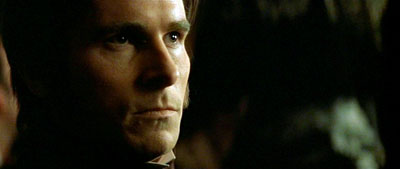
The things held constant, such as camera placement and position in the locale, set off the differences in characters’ disguises and reactions, while this shot carries faint echoes of our very first view of Alfred during Cutter’s voice-over monologue. That view, and its answering shot of Robert in the spotlight, will recur when Robert’s pseudo-death is replayed.
Nolan’s audacious film is built out of more marked parallels than these, but I wanted merely to highlight the ups and downs of one small pattern. Many films work varied repetitions like these into their shot-by-shot texture. Back in the 1930s, Eisenstein saw this possibility clearly, as I try to show in my book on his work. In the 1960s and 1970s, Raymond Bellour called our attention to such patterns in films by Hitchcock, Hawks, and Minnelli. His collection of essays The Analysis of Film includes pioneering studies of how fine-grained such things can become.
I wouldn’t go as far as Bellour does in seeing varied repetition as the motor force of classical filmmaking, but it surely plays an important role. What he takes as a manifestation of pure textual difference I’m inclined to psychologize: these differences help the audience understand, usually without awareness, the ongoing narrative dynamic and have the extra payoff of creating tacit narrative parallels. But from either perspective, object-centered or response-centered, studying such microforms is enlightening. It’s a way to understand films as wholes, dynamic constructions that shift their shapes across the time of their unfolding. Moreover, by examining things this closely, we can try to understand not only how this or that film works, but how this or that film relies on principles distinctive of a filmmaking tradition. Consider this another plug for poetics.
I’d add that such principles neatly fuse two pressures: toward narrative coherence and comprehension on the one hand, and toward production efficiency on the other. It’s cheaper and easier to repeat camera setups if you can. Artistic economy and financial economy can work together, nicely.
Speaking of repetitions….
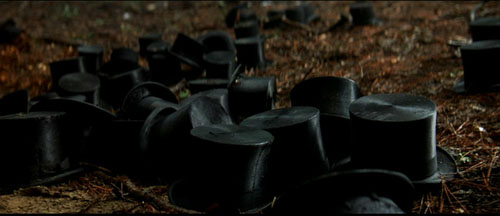
The eyeline match goes way, way back
Kristin here—
It’s late January as I write this entry, and in about a month, I’m due in Egypt for my annual three weeks of volunteer work on the Amarna Project at Tell el-Amarna, in Middle Egypt. (For the project’s website, see here, and for my part in it, click on “Recent Projects,” then “Material Culture,” and finally “Statuary.”) So as not to leave David with the entire blogging burden during that period, I’m writing this to be posted during my absence.
Given the occasion, I decided to write about a topic that has popped into my mind now and then: a little connection I observed between techniques of ancient Egyptian art and those of continuity film editing. In their reliefs, Egyptian artists were very conscious of the directions of figures’ gazes, and their strove in most cases to match the orientation of the accompanying hieroglyphs to those directions. This topic is not only appropriate, but it gives me a chance to show off my new hieroglyphic font—and to practice composing texts with it.
The connection between eyelines in reliefs and in film editing first occurred to me several years ago when our colleague Noël Carroll was giving a talk in the film-studies colloquium in the Dept. of Communication Arts here at the University of Wisconsin-Madison. He dealt with eyeline matches, or glance/object editing and took a cognitive-studies approach.
Noël’s argument was that such editing is not an arbitrary convention and that it draws upon an “innate perceptual behavior” shared by humans to look not just at other people but also at what those people are looking at. (I’m quoting here from the publication of his talk as “Toward a Theory of Point-of-View Editing: Communication, Emotion, and the Movies,” in his 1996 collection, Theorizing the Moving Image, from Cambridge University Press.) This tendency naturally manifests itself when babies begin at two to three months to follow the directions of their parents’ gazes. He claims that eyeline matching “can function communicatively because it is a representational elaboration of a natural information-gathering behavior” and also that such a link to our everyday perception helps make continuity editing easy to grasp.
If we can find comparable sorts of devices in art of a different era and culture, those devices help support claims about “cultural universals.” These are patterns of perception that all cultures share, though they will manifest themselves in art in different ways. Let’s take a look at a sort of eyeline matching that’s used in Egyptian reliefs. Only here it’s not an eyeline and a seen object being matched. It’s a match between an eyeline and the direction its accompanying hieroglyphs face.
Hieroglyphs and their orientation
First, let me get a pet peeve out of the way. A lot of people these days call hieroglyphs “hieroglyphics.” There is no such word, or shouldn’t be. “Hieroglyphic” is an adjective, as in “hieroglyphic text” or “hieroglyphic inscription.” But don’t just take my word for it; look under Etymology in the Wikipedia entry on hieroglyphs. (I note with annoyance that my spell-checker doesn’t highlight “hieroglyphics,” but it does think “eyeline” is wrong.)
Now, about directions. Egyptian hieroglyphs can be written horizontally or vertically, facing left or right. The default orientation is facing right, to be read right to left. How do you know which direction they’re facing? Even if you can’t read hieroglyphs, just look at the signs representing living things. Birds, people, animals, bugs, with rare exceptions they all face the front of the text.
There are all sorts of complicated exceptions to the rightward orientation. The late Henry George Fischer, curator of Egyptology at the Metropolitan Museum of Art, wrote a large book on the subject: The Orientation of Hieroglyphs, Part 1. Reversals (Alas, he never wrote Part 2.)
As Fischer says at the outset, “It is essential to stress the fact that Egyptian art and writing are interrelated to a degree that is unparalleled in any other culture. For it is from this fact that the orientation of hieroglyphic texts derives its logic.” And Egyptian art, despite its strangeness to many eyes, is intensely logical. Each person, creature, and object portrayed in relief will be shown from its most characteristic, recognizable view, whether that be in profile (such as a person’s face, legs, and stomach) or frontal (that person’s eye and shoulders).
In reliefs, the hieroglyphic texts in reliefs function as labels and descriptions of the things depicted or to quote the words of the people present. Hence, logically, the particular inscription relating to one person, creature, or object depicted will face the same direction as it does.
Two straightforward examples
The image below is a detail from a false door (the entrance and exit for the dead person’s soul in a tomb). It comes from an Old Kingdom tomb at Saqqara (5th Dynasty, roughly 2453 BCE). The relief depicts a husband, Nikaure, and wife, Ihat, along with two of their children.
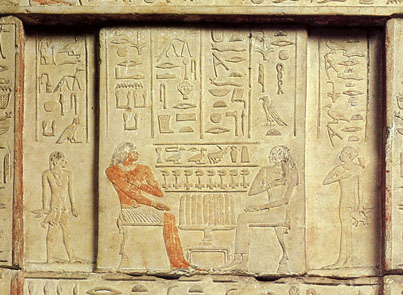
Egyptian Museum, Cairo, inventory CG 1414
The pair sit opposite each other across a table full of offerings: long loaves of bread, portrayed vertically even though they are assumed to lie on the table. The two columns above Nikaure face rightward, as does he. They give his official titles and name. The two above Ihat face left and do the same for her. The son at the left faces right, as does the text above him, and his sister, at the right, faces leftward, as do her hieroglyphs. Despite the fact that this particular door belongs to Ihat, there is a slight male bias here, since the list of offerings above the table face right, as he and his son do—the favored, “stronger” orientation for hieroglyphs and people.
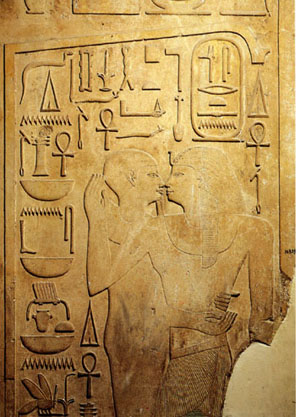 The basic conventions of Egyptian art were amazingly stable for a period of about three thousand years. We find the same principles in the Middle Kingdom. This relief (Egyptian Museum, Cairo, inventory JE 36809) on a column shows Senwosret I (12th Dynasty, reigned 1971-1929 BCE) being embraced by a statue of the god Ptah in its shrine. You wouldn’t think that statues embrace people, but pharaohs were considered divine and could communicate with gods’ statues in temples. The king is at the right, facing left. His name is in the oval cartouche above his head, and the columns of signs at either side of it give some of his titles. All face left.
The rest of the signs face right. They identify Ptah and describe all the things he’s giving the king: life, dominion, stability, health, and happiness. The column at the far left is a direct quotation of the god’s words. As in these two examples, almost any relief where figures are present facing different directions, the orientation of the hieroglyphs will be determined by which one they refer to. Obviously the Egyptians considered this sort of directional consistency very important.
Facing one way, looking the other
Indeed, the directions in which figures’ faces and eyes were turned seems to have been of particular importance. It’s not uncommon for a figure to be facing one way and looking back. In that case, that figure’s hieroglyphs will face backward as well.
The relief below reveals the logic of this device very well. Two gods, Atum at the right and Montu with the falcon head (not all falcon-headed gods are Horus) are leading Rameses III to the king of the gods, Amen. (I copied this from Fischer’s book, and unfortunately he doesn’t specify where this relief is.) As they proceed, Montu turns back to hold the signs for “life” and “dominion” to the king’s face. The five right-most columns of text above refer to Amen and mimic him in facing leftward; they represent his speech to the king. The next five represent Montu’s speech and, because his eyes look leftward, so do the hieroglyphs. But not the little column of text in front of his stomach and kilt. That describes his action of leading the pharaoh to Amen, so those signs, written beside the part of his body facing right, also face right. Charmingly logical.
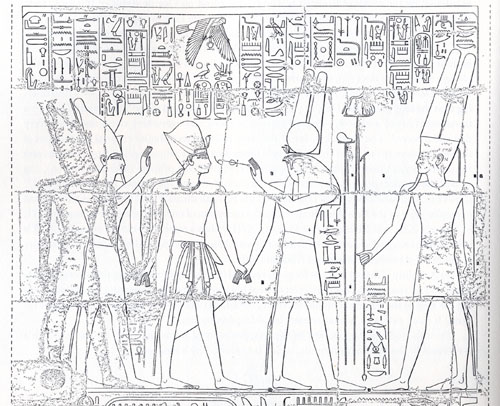
That sort of thing is one small part of what makes Egyptian art so appealing to me. Perhaps it gives you a better feel for why Fischer claimed that Egyptian art integrates writing and pictorial representation more thoroughly than that of any other culture. It also bolsters David’s recent entry about how studying the techniques and conventions of an artform enhances one’s enjoyment of individual artworks.
Amarna examples
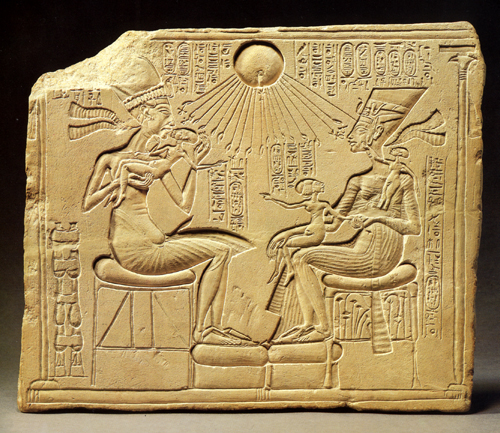
My favorite examples of head-turning reversed hieroglyphs come, not surprisingly, from the period I study, the Amarna era (18th Dynasty, New Kingdom, roughly 1350 BCE). One trait of Amarna art is its relatively casual depiction of the royal family. Previously the king had not been shown “behind the scenes,” playing with his children. Compare the Old Kingdom relief of Nikaure and Ihat, seated stiffly with their children at attention behind them, with the stela at the top of this entry. There the pharaoh Akhenaten lifts his eldest daughter, Meritaten, to kiss her. Opposite him sits his wife Nefertiti, holding the second daughter, Meketaten, on her lap, and balancing her third, Ankhesenpaaten, who stands on her arm or hip, playing with the decoration on Nefertiti’s familiar tall, flat crown. (A repaired crack has destroyed the child’s feet and some other elements of the relief). There’s a similar relief in the Louvre, by the way, where Nefertiti and at least two of the daughters sit on Akhenaten’s lap, but unfortunately only the lower part survives.
This stela is my favorite piece of Amarna art. I must confess that standing back in 1992 in the Ägyptisches Museum in Berlin and studying this sentimental little image (inventory 14145) was what finally suckered me into an obsession with the art of the era. It’s not just the appeal of the family scene, though. There’s an underlying complexity and innovativeness about this piece that makes it unique in the history of Egyptian art. It’s also not just sentimental. Such a stela would have stood in a private chapel in the garden of a rich family. The fecundity and nurturing shown in the image would be seen as indicative of the pharaoh’s protective role toward his country.
As is typical of Egyptian art, each figure has a label identifying him or her. Akhenaten’s and Nefertiti’s names and titles are in the vertical columns at the top, alongside the name and titles of their sole god, the Aten, or globe of the sun, which casts its life-giving rays down upon the group. Literally life-giving, since two of the rays’ little hands hold ankh-signs to the king’s face, and another two do the same for Nefertiti. Each daughter, though, has a label identifying her, all in the very formulaic phrases used on endless reliefs for this purpose.
Here’s a detail of the part of the relief I want to focus on:
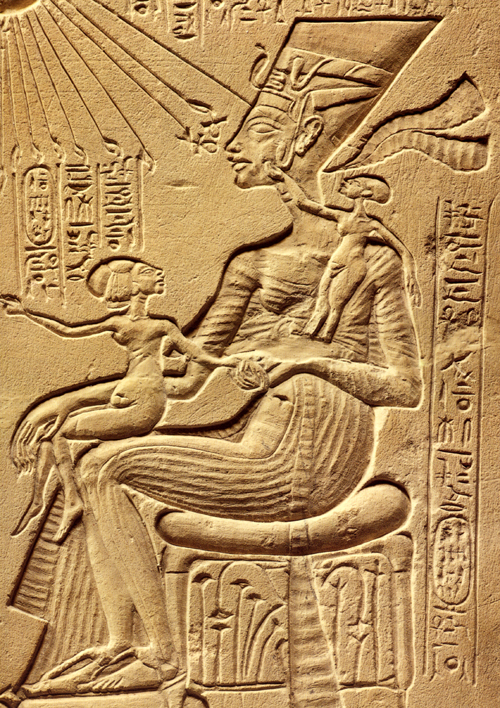

In contrast to the beautiful carving of the figures, the hieroglyphs here are rendered very badly, and it’s partly because they are so formulaic that one can read them all. I’ve used my new font program to lay them out legibly so you can see which way the inscriptions face. (The font couldn’t cram the four nfr-signs that appear side-by-side in Nefertiti’s name into the cartouche, so I settled for putting them on two lines.)
In the text running down the side, the youngest daughter is described: “King’s daughter, Ankhesenpaaten [i.e., “She who lives for the Aten”] of his body [i.e., Akhenaten’s biological offspring], whom he loves, born to the Great Royal Wife, Nefertiti, may she live forever and continuously.” The two other daughters have the same texts with their names substituted.
I’ve analyzed this stela in print, suggesting an interpretation of the brief narrative action that is going on in the scene (“Frontal Shoulders in Amarna Royal Reliefs: Solutions to an Aesthetic Problem,” The Journal of the Society for the Study of Egyptian Antiquities Vol. XXVII [1997, published 2000]: 79-98 and Pls. IV-VII). All I’m concerned with here is the fact that Meketaten has turned her head to look at her mother while pointing across at her father and sister. The short columns of text above her have been reversed accordingly:
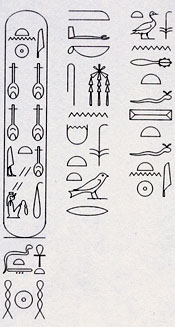
There are other Amarna reliefs where a daughter turns her head, including one where the upper part of the princess is missing, and we can only tell she was turning to look at her mother because the few surviving hieroglyphs face the opposite direction from her feet. The reversal isn’t used in every case where a princess turns her head. In more formal offering scenes, where the princesses stand in a group behind their parents, a continuous row of short vertical columns above them gives the name and title for each. With all the rows lined up this way, the reversing of one daughter’s signs would look odd, and so the Egyptian artist kept all the columns facing the same direction. That’s another convention of Egyptian art: keep the graphic layout of the signs neat and pictorially appealing. They’re an important part of the overall image.
Reversed hieroglyphs and eyeline matches
I’m not trying to claim that Egyptian reliefs are just like film because the hieroglyphs are oriented by which was the figures are facing. There’s nothing comparable to an eyeline match in such images, since we see all the figures of a scene present at the same time, always depicted from head to toe. There is no need to match a figure’s eyeline to what he or she is looking at, since that, too, is present in the scene. There is no “offscreen space” in Egyptian reliefs.
Still, the Egyptians matched the orientation of hieroglyphs not just to the general direction a figure was facing but also to the specific eyeline created by head position. There was a logic to this, based on the fact that the direction of the gaze was deemed important and hence could be used to organize important elements of the composition of a scene—a static one in this case rather than one unrolling temporally across separate shots. That a culture so different from our own could come up with an artistic convention reminiscent of a technique in classical filmmaking suggests to me that claims about the naturalistic basis of eyeline matching and shot/reverse shot have merit.
Coraline, cornered
DB here:
It’s common for academics in one field to borrow ideas from other domains of research. But people outside academe sometimes object when a film scholar talks about movies using a term or idea originating elsewhere. These people usually think of themselves as hard-headed pros. Everything we need to understand film, they think, can be derived from the concepts already used by practitioners.
No doubt, we should be attentive to the ways in which filmmakers think and talk about their work. There’s a lot to be learned from shop talk and insider information–hence the enduring value of interviews, DVD commentaries, and the like. Yet no activity explains itself. Often practitioners do things intuitively, without making their background ideas explicit. We can often illuminate a filmmaker’s creative choices by spelling out the unspoken premises behind the work.
Further, filmmakers themselves have traditionally drawn ideas from other arts and sciences. For example, storytelling techniques referred to as exposition, point of view, or motivation have their origin in theories of literature and drama. Filmmakers have been quite pluralistic in their creative practices; why can’t critics and historians be open to outside influences?
Back in the 1980s I began speculating on how the film image represented space, and I adopted the then-current terminology of perceptual psychology. Researchers spoke of depth cues, those features of the real world that prompt our visual system to make fast inferences about a three-dimensional layout. Classic depth cues are the Gestalters’ figure/ ground relation, da Vinci’s “atmospheric perspective” (the haze that envelops more distant planes), and Helmholtz’s “kinetic depth effect,” the way that when you’re moving, closer objects change at a different rate than more distant ones.
These features can also be invoked in two-dimensional images, as I tried to show in Narration in the Fiction Film. Nowadays, deeper explanations of these effects are available using geometrical or computational approaches to perception. But depth cues remain a useful informal way of studying how artists manipulate images. For this reason, in Film Art: An Introduction, we’ve continued to itemize some depth cues that are important in cinema. These concepts furnish analytical tools for understanding things that filmmakers do spontaneously when they compose or light a shot.
So imagine my happiness when I hear filmmakers talk directly about depth cues.
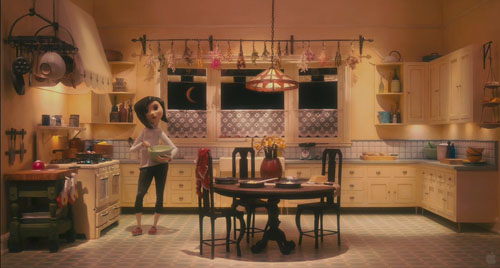
In a fascinating article in American Cinematographer, Pete Kozachik, Director of Photography on Coraline, explains that the filmmakers were very conscious of perceptual factors throughout, and not just in creating the stereoscopic effect. For example, they designed and filmed our heroine’s alternative world in normal perspective, but her boring normal world was designed to seem off-kilter and flat by means of inconsistent depth cues within the shots. “The compositions match in 2-D, but the 3-D depth cues evoke a different feel for each room.”
This is hard to illustrate in a two-dimensional medium, but the Coraline trailer offers some examples. Consider this image.
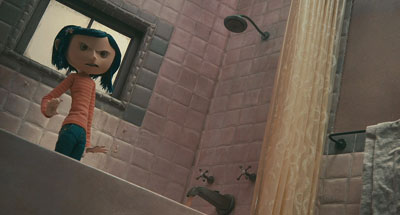
The tiles in the family shower don’t recede into the distance, either across or upward. They are more or less the same size, just arrayed along a diagonal. A degree of recession is supplied by tonality and lighting, but the corner of the shower stall remains somewhat ambiguous. If you try to do a Gestalt flip, you can see the corner as a chimney poking out at you rather than one receding inward. (To see this, try covering the rest of the shot with your hands.)
In the garden of the “Good Household,” however, the bricks recede naturalistically in shape and size. The lighting and tonal gradients create a strong sense of depth.
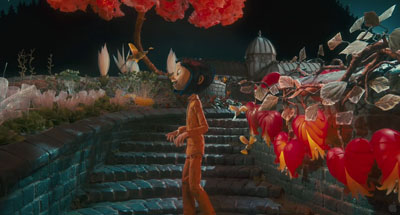
Here is the Good Family’s hallway.
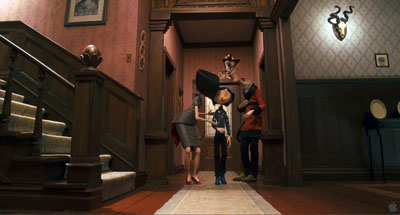
It displays central perspective, with everything receding as it should (as if seen by a wide-angle lens).
By contrast, here is an oblique shot of Coraline’s real-world bedroom. The doorway’s edges recede pretty steeply, but the baseboard doesn’t taper as it moves toward and past the corner. Instead, it moves in parallel lines. The same thing is happening with the floor planks.
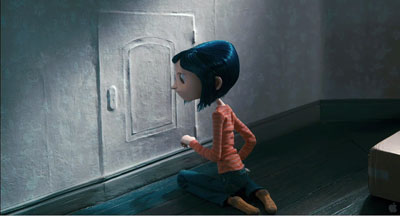
You can see the effect more clearly if we drain the color and lower the contrast. (Sorry, Messrs. Selick and Kozachik.)
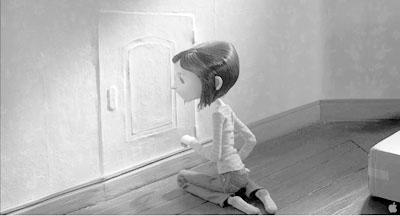
Now you can also see the weird, almost cubistic edges of floorboards poking up just behind the carton. Again, lighting and tonality create a sense of depth that the geometry of the edges denies. The depth cues within Coraline’s normal life are inconsistent.
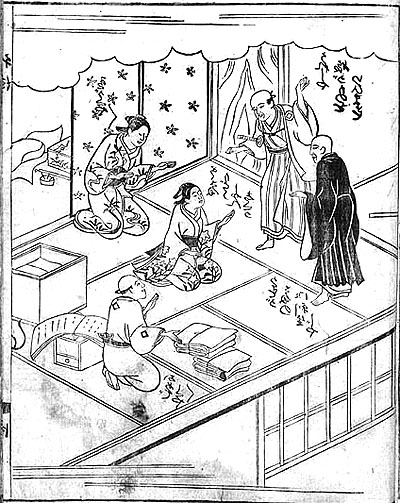
Stare at the rear stretch of the baseboard awhile, and you’ll find that its contours may look a bit wider than those in the foreground. This sort of “parallel perspective” can be found throughout Asian art. Here is a Japanese book illustration from 1713, in which many of the edges run in parallel perspective. Again, instead of meeting in the distance, diagonals seem to be converging out in front of the picture plane, making some areas appear wider in the rear than in the front.
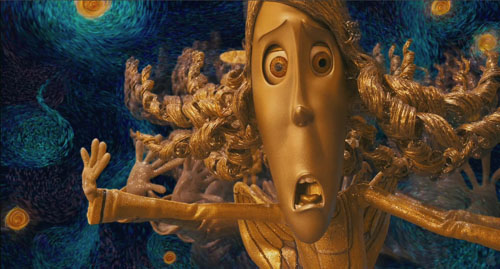
If my invocation of other artistic traditions seems a highfalutin way of talking about an animated movie, check the Van Gogh joke in the Coraline frame at the bottom of this entry.
Kozachik also explains how he spent a lot of time trying to vary the two images’ interocular distance, the distance between our two eyes, in order to give a greater sense of volume. The care paid off, at least for me. Coraline is the best 3D film I’ve seen, as well as the scariest. (For our take on Beowulf see this entry.)
In addition, Coraline helps me push a general point: Cinema is at least partly an affair of perception. Filmmakers are practical psychologists, artists who have mastered the skill of playing with our senses. We can open up their secrets a little by using tools borrowed from the sciences of mind.
For more on Coraline, see Bill Desowitz’s Animation World interview with Tadahiro Uesugi and his interview with Henry Selick. Background on the production is supplied by Thomas J. McLean’s article from last year.
For an overview of spatial perception, see Maurice Hershenson, Visual Space Perception (MIT Press, 1999). A more detailed account is Stephen E. Palmer, Vision Science: Photons to Phenomenology (MIT Press, 1999). A geometrical explanation of the kinetic depth effect is offered in James E. Cutting, Perception with an Eye for Motion (MIT Press, 1986).
Three from Palm Springs
Four Nights with Anna.
DB here:
Three high points from the Palm Springs International Film Festival. Soon Kristin will offer some entries.
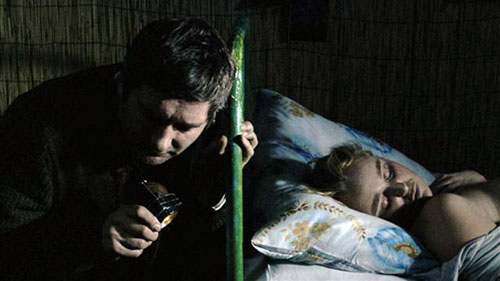
Four Nights with Anna is a GOFAM—a Good Old-Fashioned Art Movie. Set in a muddy Polish town, it follows a loner as he stalks a zaftig nurse. Leon watches her from around corners, studies her through her apartment window, and eventually sneaks sleeping powder into her sugar jar. This puts her out soundly enough to allow him to break into her apartment and watch her at close quarters.
My synopsis, like most retellings of this spare movie, not only spoils the experience but fundamentally changes it. Instead of laying out the premises explicitly, the film’s narration supplies them in tantalizing, equivocal doses. Skolimowski follows the great tradition of distributed exposition, so that we get context only after seeing something that can cut many ways. Early we see Leon buying an axe; soon he fishes a severed hand out of a sack and tosses it into a furnace. Is he a serial killer? No. After a while we learn that he’s the disposal officer for the hospital crematorium. Retrospectively fitting together these data provides a classic art-film pleasure, the equivalent of the curiosity-arousing clue sequences in a mainstream mystery.
The same goes for the ambiguous inserts that suggest a police interrogation. Only halfway through the film do these snippets become lengthy and explicit enough for us to place them in the story’s time sequence. Just as the Nouveau Roman of Robbe-Grillet owed a great deal to the classic detective story, the European art cinema tradition has drawn heavily on the investigation plot, from Les mauvais rencontres (1955) to The Spider’s Stratagem (1970). The premises of the thriller surface as well. The central conceit of Four Nights and of Kim Ki-duk’s 3-Iron, of a stranger who quietly and obsessively prowls around homes, was also explored in Patricia Highsmith’s 1962 novel Cry of the Owl, but not with Skolimowski’s playful indeterminacy about who and what and why.
The trick, then, is in the telling. By accreting details that cohere gradually, Skolimowski’s film not only engages curiosity and suspense, but also allows room for wayward, if dark humor. Leon’s quaking abasement leads to embarrassment, pratfalls, and comically strenuous efforts to melt into his surroundings. Objects take on a precise life, as Leon crushes his grandmother’s sleeping pills to powder and uses plastic silverware to fish a fallen ring from cracks in the floor. We never see Anna apart from Leon; she’s either in the same locale or glimpsed in precisely composed shots of her at her window. The exact, constrained handling of optical point-of-view owes a lot to Rear Window, but Jimmy Stewart never went so far as to install a new window to enhance his peeping.
In its diffuse exposition, its teasing inserts, and its gradually unfolding implications, a GOFAM also asks us to appreciate unresolved uncertainties. During the Q & A, Skolimowski remarked that he liked “to play with a little ambiguity . . . to leave it for the audience to interpret.” The locale? Indefinite, he says. The time period? Deliberately left vague. The mysterious final shot? “A third ambiguity.” For the man who made the kinetic Identification Marks: None (1964), Walkover (1965), Barrier (1966), and Le Départ (1967), film is something of a sporting proposition. It’s good to see him back in the game.
By contrast, The Shaft by Zhang Chi is a NFAAM, a Newfangled Asian Art Movie. That means minimalism. Single-shot scenes are captured by a distant, stable camera. Characters mutely go about their business, or just stand there. Pivotal plot moments take place outside the frame or between two static scenes. Any dramatic climaxes and grand passions are muffled or simply sufffocated.
The proximate sources of this Asian minimalism are probably the late 1980s films of Hou Hsiao-hsien. A European predecessor of the style, I think, is Fassbinder’s Katzelmacher (1969), but its most famous early instance would be Akerman’s Jeanne Dielman (1975).
Such a quiet style poses a problem: How to show plot changes and character development without lengthy dialogue? A common solution is to repeat setups in ways that diagram changes in character relationships. Have a young man pedal his bike up to his girlfriend and offer her a ride. Later as their relationship cools, show him in a similar framing riding callously past her.
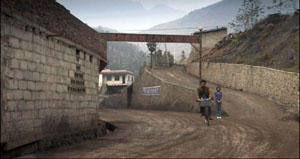
Or show the couple wordlessly visiting a lake, but after they break up, show the girl standing there alone.
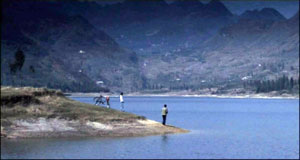
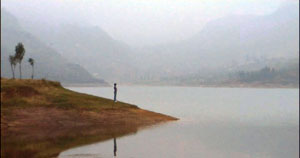
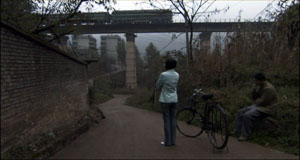
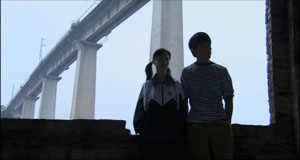
Tableaus can be used to parallel couples. Each pair meet near the village railroad trestle, but the compositions distinguish the couples.
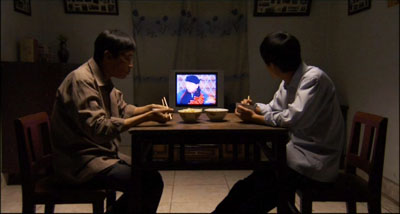
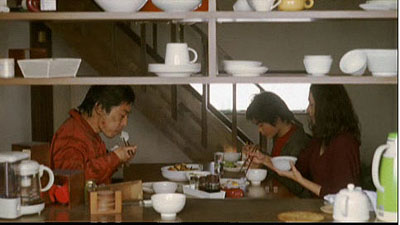
Likewise, the shots showing the central family eating in front of the TV can be recalled through variation. The number of people at the table and their identities can change over the course of time.
The Shaft puts such conventions to solid use. In a rural Chinese town, young people face the choice of going to work in the mine or moving to Beijing. The film is built out of three stories, centering on a daughter, then her brother, and finally their father. At the end, the eventual revelation of what happened to the family’s mother throws the preceding love stories into sharper relief.
Once the innovators have mastered a style through dint of effort, others can glide down the learning curve and pick it up quickly. But then they should try to add something new. Today the rudiments of the minimalist style are comparatively easy to acquire. To go beyond those, you need something else—a more elaborate play with pictorial variations, or more ingenious staging (the Hou solution), or a gift for adjusting to the contours of landscape (the Jia Zhang-ke alternative). The Shaft is well-carpentered. It is measured and poignant (especially in its final story), and it concludes with a stunning trio of shots. Its very modesty, though, suggests the conventions of NFAAM need some renewal, even some shaking up.
Shaking things up is what Kurosawa Kiyoshi’s Tokyo Sonata is all about. A salaryman is downsized, but he can’t bear to tell his family. He pretends to go off to work while he actually tries to find a new job, any job. In the meantime, his sons display more ambition and courage in their limited worlds, than he does, while the mother tries to defuse the emerging tensions.
For an hour or so, this story is engrossing on naturalistic terms, alternating comedy and pathos. It might continue in a vein of gentle realism characteristic of that perennial Japanese genre, the shomin-geki, ending with everyone’s stoic reconciliation to the vagaries of life. But the director of Cure and Charisma will go along with this formula only up to a point. Why not break the form? You can argue that the simple purity of The Shaft plays too cautiously; once you’ve figured out how things will probably unfold, who cares to see the rest? A smooth cup is lovely, but a cracked one possesses its own enigmatic appeal.
So Kurosawa careens his homely tale into grotesque territory. The tone and plot logic that he’s cultivated so carefully are fractured by some violent emotions, implausible coincidences, and unexpected twists. Granted, his technique remains unruffled.Kurosawa follows Japanese traditions of enclosing faces in apertures and arranging people in gridwork patterns that still leave room for natural movement. The beginning of the story’s wild detour is discreetly signaled by a variant of the film’s first shot. But the composure of the handling makes the challenge to our expectations all the more disruptive.
I shouldn’t say much more, except to note that I meant the word fracture to suggest that the film mends its bones eventually. The final moments are taken up with a delicate performance of Debussy’s Clair de lune. Neither GOFAM nor NFAAM, risk-taking and in the end quite moving, Tokyo Sonata attests to the unpredictable innovativeness of Japanese filmmaking.
I may add other thoughts to Kristin’s upcoming dispatch, but for now I just note that Palm Springs is the only festival I know that uses Béla Tarr soundtrack cuts for pre-show music.
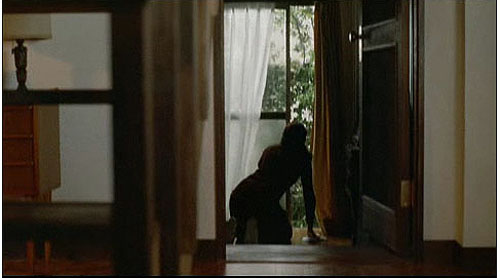
Tokyo Sonata.