





Archive for the 'Film technique: Staging' Category
Cinema in the world’s happiest place
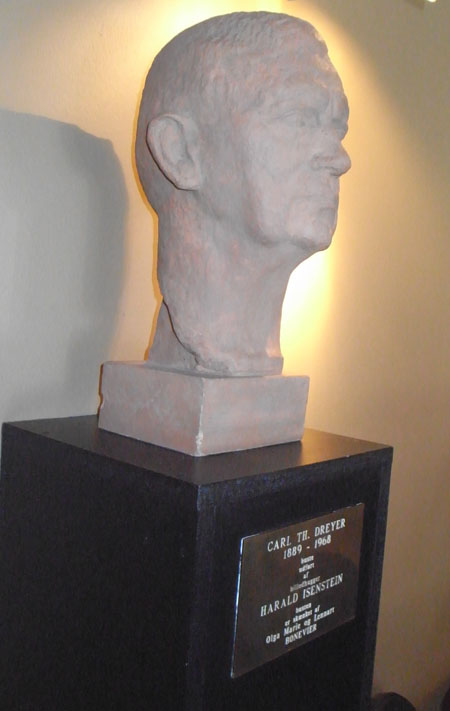
Bust of Carl Theodor Dreyer in the Dagmar Bio, the film theatre he once managed.
DB here:
Denmark was the first foreign country I ever visited. Having never been to Canada or Mexico, I took off in the early summer of 1970. Technically, I touched down in Reykjavik first because I was flying Icelandic Airlines, the Ryanair of its day. You flew Icelandic to get to Europe as cheaply as possible. Although a few people got off at Reykjavik, most of us sat patiently on the tarmac before heading off to Copenhagen.
Ever since that summer, when blinding light invaded my basement room at 4:00 AM, I’ve had a soft spot for Denmark. Ib Monty, then head of the Danish Film Archive, kindly screened for me all the Dreyers I hadn’t seen, and in spare moments I learned the joys of Copenhagen’s canals and restaurants. Six years later I would spend nearly another whole summer there watching the same Dreyer films on a flatbed viewer in the archive vaults, a somewhat renovated army fort. Many visits later, including a couple to the charming city of Aarhus, I’m still a fan of the Danes. They manage to be modest yet accomplished, hard-working yet hard-partying. They put cultural figures like composer Carl Nielsen on their currency. We’re told that they are the happiest people in the world. I don’t doubt it.
So it was with special pleasure that I returned to Copenhagen for two weeks in June. The second week was consumed by a day of talks and seminars at the University of Copenhagen and then by the convention of the Society for Cognitive Studies of the Moving Image. I’ve given two long-winded previews of the latter event, and I hope to have more coverage of it in a later entry. Today, a smorgasbord of other things Danish–without, alas, mention of H. C. Andersen, Vilhelm Hammershøi, or Victor Borge.
Chaos reigns, more or less
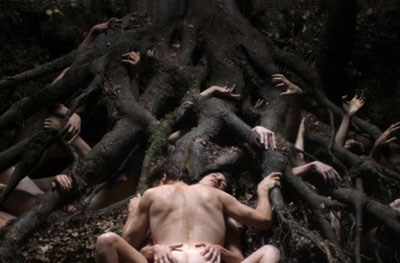
The organizers of our SCSMI event pulled off a coup: Not only were we shown Antichrist in Asta, one of the Danish Film Institute‘s fine theatres, but along came Lars von Trier to spend an hour talking about it afterward.
The film struck me as mid-level von Trier, not as good as The Idiots, The Kingdom, Dancer in the Dark, and The Boss of It All (though others would call me out for admiring this last). It lacks the element of game-playing that I enjoy in what von Trier calls his “mathematical” works, most famously The Five Obstructions. Instead, Antichrist provides perhaps the most unadulterated surge of emotion and mystical/ mythical implication to be found in all his work. It tries to be an intellectual horror film somewhat in the David Lynch mode, with a plaintive, roiling soundtrack and unearthly visions, including a fox snarling, “Chaos reigns!”
I was surprised that the elements so sensationalized by the press are pretty brief; snip out four brief shots and you’d have a ferocious but much less controversial movie. It starts as your basic two-handed psychodrama, with a couple tearing at each other. As in those other duologues Strindberg’s The Stronger and Bergman’s Persona, the film presents a fluctuating power struggle–the man trying to rule through cool rationality, the woman tapping depths of grief and repressed anger.
Yet the film goes beyond psychodrama into realms of history and myth. The grieving mother rises into demonic fury by getting in touch with witchcraft, the subject of her unfinished university thesis. Antichrist could thus be read as an exercise in misogyny or as a celebration of woman’s primal energies. (For what it’s worth, several women in our audience said they liked the film a lot.) Of course the whole thing looks very fine, with a stylized black-and-white prologue (some shots taken at 1000 frames per second), and the rest rendered in that dodging, wandering camera style von Trier and the brilliant cinematographer Antony Dod Mantle have made their own.
The entire Q & A with von Trier, moderated by Peter Schepelern, is available as an audio file on the SCSMI conference website, perhaps to be followed by a video record. Some excerpts:
 Von Trier explained that the film came out of a period of prolonged depression. “I used this project to get out of bed [every day].” Yet it’s less personal than his other works, he thinks, because it lacks his usual interest in rules, obstacles, and formal play–“a little more messy.” And he feels that by not operating the camera, he lost some intimacy with actors.
The Antichrist project seems to have brought out a mystical side of von Trier that hasn’t been so prominent in his public image. Years ago he conceived a film in which Satan created the earth, but that dissolved. Certain elements of the film, especially the emblematic forest creatures–blackbird, deer, and fox–come from his interest in shamanism. He has, he claims, traveled in alternative worlds with animal guides. “Never trust the first fox you meet.”
Is it a horror film? At least it has sources in the genre. Uncharacteristically, von Trier prepared for the project by revisiting not only classic horror films he admired, The Exorcist, The Shining, and Carrie, but also The Ring and Dark Water. He was particularly influenced in his youth by Altered States, another venture into “fantasy travels.”
He commented on how his free-camera technique imposed certain constraints in sound work. If you execute a “time cut”–that is, cutting directly to a new scene starting on a shot of a character–you must alter the sound somehow; otherwise the audience is likely to think that the action is continuous. This got me thinking about how The Boss of It All violated that convention, when each continuity cut actually yields a different sound ambience because each of the many cameras is miked separately.
Why is the film dedicated to Tarkovsky? “It was a way of getting rid of psychology.”
“I do not work with the audience in mind. I make films I would like to see myself.”
The Last is not least
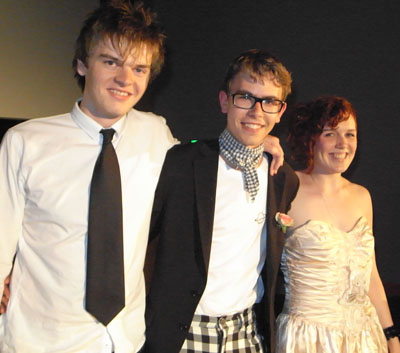
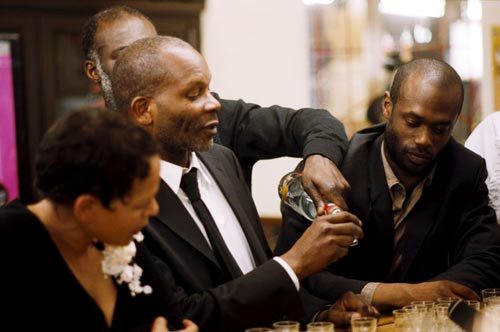
Last Friday night the filmmaking program at the University of Copenhagen gave out its student film awards. The crowd was large and boisterous, the atmosphere festive and tipsy. I was honored to present the prize for the best fiction film, which went to desidst (punning on De sidst, “The Last”). The three winning filmmakers, pictured above, were Sissel Marie tonn-Petersen, Niels Holst-Jensen, and Toke Westmark Steensen.
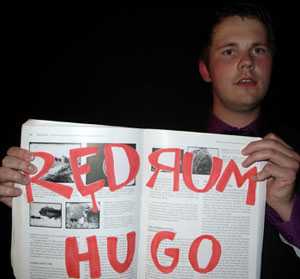
Before I read the result, though, I was confronted with some damaging evidence in a copy of Film History: An Introduction.
Peaking in the 1910s
During my first week in Copenhagen, I was viewing Danish films from 1911 to 1915. As long-time readers of this blog know, I’m fascinated by the films of the 1910s, and Denmark boasts some of the most sophisticated works of the time. Thomas Christensen and Mikael Brae of the Danish Film Archive kindly let me watch several films, mostly from the once-mighty Nordisk film company.
The most remarkable films I saw were Ekspeditricen (1911), Dyrekøbt Aere (“Hard-Won Honor,” 1911), and Under Blinkfyrets Straaler (“Under the Beam of the Lighthouse,” 1913). All three of these offer sophisticated examples of the dominant storytelling technique of that period, what has been called the tableau style.
I can’t offer any visual analyses here, as I don’t have frame stills available in digital form, but here’s an example of the kind of thing I’m studying, taken from August Blom’s The Ballet Dancer (1911). Camilla (Asta Nielsen) has been seduced by Jean, a man-about-town, and she has come to sing for a society soirée at which Jean is present. But Jean is also carrying on an affair with the host’s wife.
The scene starts with the host Simon walking with his wife to the middle of the salon. Note the mirror in the upper area of the frame, just left of center.
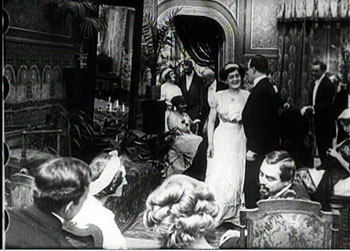
She goes out frame right, and the host welcomes Camilla, bringing her to the central zone of the shot.
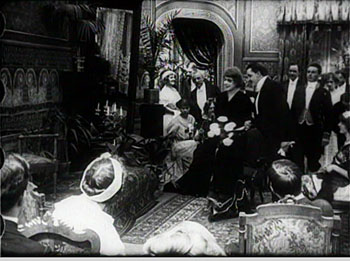
The hostess returns from off right to greet Camilla. Now we can see Camilla’s lover Jean in the mirror.
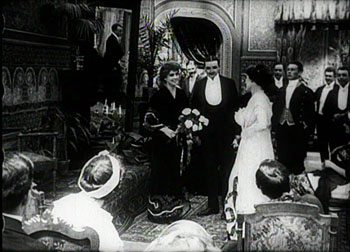
The hostess leaves the frame again, her husband settles into a chair, and Camilla starts to sing. But in the mirror we can see Jean bending over to kiss the hostess.
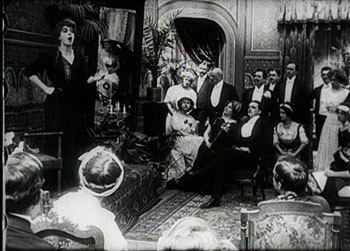
Soon Camilla notices Jean’s flirtation, and he straightens up.
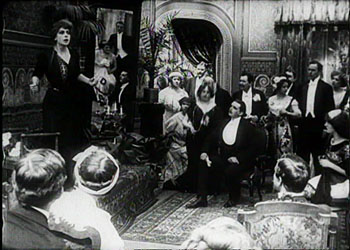
Camilla interrupts her song, shouting and thrusting an accusing finger at the couple across the room.
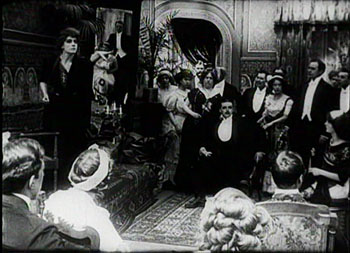
I especially like the way in which Camilla’s finger points both at the offscreen couple and directly at her guilty lover’s reflection. If we haven’t noticed Jean’s infidelity yet, we certainly should now.
Today the same scene would be handled with lots of cutting and point-of-view framings, but the mirror allows Blom to pack a single long shot with simultaneous actions. (Mirrors were something of a signature device in Danish films of the period.) It’s a nice example of Charles Barr’s notion of gradation of emphasis, a principle that was at the heart of the intricate, sometimes exquisite ensemble staging we find so often in the 1910s.
Far from being a static, “theatrical” rendering of the action, the tableau technique looks forward to the deep-space stagings we associate with Welles and Wyler, as well as the distant long-take style of Theo Angelopoulos and Hou Hsiao-hsien. Studying film history is often our best way to understand the cinema of our moment, and perhaps of our future. At a more primal level, a week of prime examples of the tableau tradition gave me a fine dose of Danish happiness.
For background on the Society for Cognitive Studies of the Moving Image conference this year, try here and here. Earlier blog entries on this site have dealt with other aspects of 1910s cinema: director Yevgenii Bauer, tight staging in De Mille’s Kindling (1915), the emergence of classical film style around 1917, editing in William S. Hart movies, the years 1913 and 1918, and the triumph of Doug Fairbanks. I’ve proposed more complete accounts of 1910s staging strategies, and their impact on film history, in On the History of Film Style and Figures Traced in Light: On Cinematic Staging.
An excellent introduction to Danish cinema of this period is Ron Mottram’s 1988 Danish Cinema before Dreyer, a book which deserves to be reissued or put online. You can sample Danish 1910s films at the DFI archive database, where several clips are posted. Try these fragments: København ved nat (1910), Den frelsende Film (1916), and Kaerlighedsvalsen (1920). DVD versions of some 1910s classics, including The Ballet Dancer, can be ordered from the DFI Cinemateket shop; in the US, the titles are available for institutional purchase from Gartenberg Media. Everyone interested in silent cinema should own the Dreyer, Christensen, Psilander, and Asta Nielsen discs.

Pierced by poetry
DB here:
If I had a time machine, I’d zip over to Japan between 1924 and 1940. I’d trade a year of my life here and now for a year there and then.
Why? First, because the world I see in the movies of that period holds an irresistible fascination for me. I’d like to walk through Ginza, take a train to a spa, wander through Asakusa, have tea at the Imperial Hotel, hike around the temples of Kyoto. Second, if I could go back, I could see all the films I will never see—the lost Ozus and Mizoguchis, of course, but also the films we don’t even know are important.
For Japanese cinema in the 1920s and 1930s was one of the triumphs of world cinema. That era produced not only the two directors who are arguably the very greatest but also a host of talents you can’t really call “lesser.” The bench had depth in every position.
There are good reasons for this burst of genius. Quantity affects quality, but not the way snobs think: The more movies a country makes, the more good ones you’re likely to get. Although Japan had only a little more than half the US population, before 1940 it turned out about as many features as America did.In 1936, both countries released about 530 domestic productions.
The Japanese directors who started in the 1920s had, like Ford and Walsh in their salad days, to feed this audience. We tend to forget that even exalted figures entered the industry as high-volume producers. Mizoguchi averaged about ten releases per year in his first three years, Ozu about six. Everyone’s pace slowed with the coming of sound, but the sheer volume of movies pouring from studios big and small reminds us that young directors had plenty of opportunities to hone their skills.
Probably the most startling instance is Shimizu Hiroshi. In a career that ran from 1924 to 1959, he’s credited with directing 163 films. The earliest one of his that I’ve seen is Seven Seas Part I; this 1931 feature was his seventy-fifth. “Next year,” he remarked in 1935, “I’m going to make only three films the way the company wants me to, and in exchange I can make two films that I want. I want a little more time. I’m too busy right now.” As things turned out, he signed seven films in 1936.
The great bulk of his work, 139 titles, falls before 1946. Fewer than two dozen of these seem to survive. With only about 17% of the films available, we have to keep our generalizations modest. Who knows what we would find in Love-Crazed Blade (1924) or Flaming Sky (1927) or Duck Woman (1929)? Shimizu contributed to a series, the “Boss’s Son” or “Young Master” films, of which only his first, The Boss’s Son at College (1933) seems to survive. What would we find in The Boss’s Son’s Youthful Innocence (1935) or The Boss’s Son Is a Millionaire (1936)?
Luckily, we’ve wound up with some extraordinary movies, not a clunker among the ones I’ve seen. If only a smattering of 1930s and 1940s titles is available, we should be happy that it was this smattering. Shimizu had concerns in common with Naruse Mikio and Ozu Yasujiro, but he established his own world, a rich tone, and a simple but subtle visual idiom. Along the way, he created some of the most heart-rending films in world cinema.
From the city to the spa
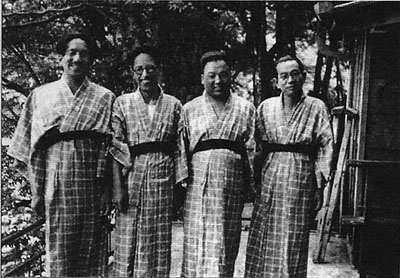
Shochiku talent at Izu hotspring, July 1928: Ozu Yasujiro (left), Shimizu Hiroshi (third from left), and screenwriters Fushimi Akira and Noda Kogo. Ozu and Shimizu were 23 years old.
Once more, all hail Criterion. TheTravels with Hiroshi Shimizu DVD collection released this spring includes Japanese Girls at the Harbor (1933), Mr. Thank You (1936), The Masseurs and a Woman (1938), and Ornamental Hairpin (1940). They were previously released on an expensive Japanese set (with English subtitles), but Criterion’s Eclipse series offers them at a more reasonable price, along with brief but helpful notes in English by Michael Koresky.
The collection’s title highlights the image of Shimizu that emerged in the 1980s. The films that struck Western critics then were typically shot outside the usual big cities (Tokyo, Kyoto, Osaka), in the mountains and seaside towns of the Izu peninsula. John Gillett’s 1988 National Film Theatre program, the first extensive survey of Shimizu’s work outside Japan, was entitled “Travelling Man.” Not only did Shimizu take his crew on the road, thanks to the expansion of the railway system, but he also exploited what became known as his signature technique: lengthy tracking shots down a road, following characters walking toward us.
Like Ozu, Shimizu worked in modern-day genres (gendai-geki), from slapstick comedies to college sports films. Most of what survives from before 1936 are social dramas of families, friendship, and fallen women. Seven Seas (1931-1932) deals with class conflicts, as a poor girl marries into a rich family and discovers that her husband is a bounder. Eclipse (1934) centers on the failure of young people from the countryside to succeed in a recession-hit Tokyo. The title of Hero of Tokyo (1935) is ironic, in that the stepson who abides by a mother held in disgrace by her other children, winds up destroying her last scrap of respectability. In Japanese Girls at the Harbor, two schoolgirls are driven apart by one’s passion for a young man. After a violent confrontation, she becomes a prostitute and her estranged friend winds up marrying him.
The Shochiku studio deliberately pursued a female market, and these tales of family intrigue and endlessly suffering mothers, wives, and daughters offer obvious figures of sympathy. Less predictably, the films simmer with criticism of modernizing Japan. They focus on the corruption of the upper classes, the collapse of traditions in the countryside, and the uprooting of the extended family.
Most significantly, Shimizu’s films indicate quite explicitly that Japan’s growing prosperity in the 1910s and 1920s was built on the backs of the rural poor, particularly the young women who flocked to textile mills, city shops, and brothels. Like many films of his contemporaries, Shimizu’s urban films mix sentiment and comedy with a harsh appraisal of social tendencies. I’d bet that we’d find both qualities in his Stekki garu (1929), a film apparently about the current craze for “walking stick girls,” women whom men hire to accompany them on strolls.
The manager Kido Shiro summed up the Shochiku spirit in the formula “smiles mixed with tears.” Ozu offered this blend in films like I Was Born, But… (1932) and Passing Fancy (1933), but there are precious few smiles in Shimizu’s surviving early thirties output. Then he took to the road.
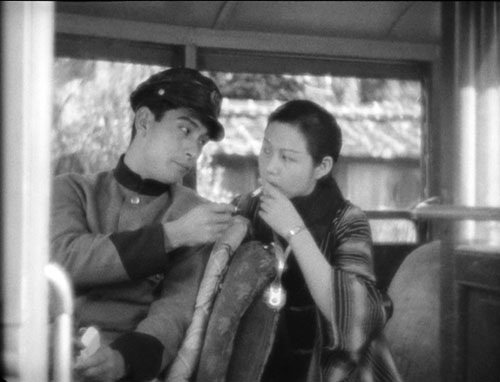
 In his films of travel Shimizu still offered social criticism, but he leavened it with off-center comedy. Indeed, he intensified Kido’s mandate: In Mr. Thank You, jaunty jazz and Latin American music accompany moments of sheer pathos. Now as well Shimizu’s intricate plotting, driven by the chance meetings and startling revelations of melodrama, could relax. Films like Mr. Thank You (1936), Star Athlete (1937), and The Masseurs and a Woman (1938) are expanded anecdotes, strings of situations that accumulate in casual fashion. Dramas emerge fleetingly, on the road or in hot-springs inns. The films tend to be brief, flowing toward abrupt, muted epiphanies in the manner of a short story. These movies make you ask whether 60-75 minutes might not be the ideal length for a movie.
The easygoing plots echo the movies’ production process. Shimizu wasn’t an obsessive planner. Whereas Ozu sketched every shot and checked the composition through the camera, Shimizu wrote minimal screenplays and seldom budged from his chair, even when the camera was traveling. He shot quickly, making up dialogue as needed and giving actors the most cursory direction imaginable. (“Run.”) Yet this wasn’t a high-pressure situation. Some days, uncertain about what to do, Shimizu would shut down the shoot and take people swimming.
Tears and smiles

I don’t want to leave the impression that Shimizu was careless; below I’ll try to show that he set himself some powerful storytelling problems. And his relaxed manner yielded a unique mixture of traditional drama and more vagrant appeals. Take Mr. Thank You, my pick for the crown of the Criterion set.
It’s a road movie, although the trip runs only twenty miles. A rickety bus winds through the mountains around the Kawazu region of Izu, an area of hot springs and tiny villages. The handsome, kindly young driver is known only as Mr. Thank You (Arigato-san) because whenever he forces walkers off the road he waves and calls his thanks. He has earned the devotion of people in the region, who entrust him with messages and duties on their behalf. On this particular day, his bus is carrying a stuffy real-estate agent; a wisecracking moga (modern girl); and a young girl whose mother is accompanying her to Tokyo, where she is to be sold into prostitution. Other passengers—wedding guests, lonely old men—get on and off in the course of the trip.
The bus stops often, and the encounters give us vignettes of the deteriorating life of the countryside. We hear of the magic attractions of Tokyo, reported by a prosperous woman about to get married. A Korean woman working on road construction asks Mr. Thank You to visit her parents’ grave, reminding us that this oppressed minority has contributed its sweat to the new Japan. Counterbalancing these stabs of pure feeling are simple running gags, such as one involving rude auto drivers who insist on passing the bus. And across the trip, the fate of the girl draws ever closer.
The moga (evidently a hooker) becomes our raisonneur, commenting on everyone’s motives, denouncing hypocrisies, flirting with Mr. Thank You, and eventually offering advice on how to save a life. Shimizu fills his film with talk and music, but in quieter moments imagery takes over: shimmering valleys below zigzag mountain roads, tunnels and forests and glimpses of steep paths along which road workers trudge. Within the bus, point-of-view is channeled fluidly. At one point we watch the moga watching the driver watching the girl. The climax of the action is simply omitted, yielding a quick, upbeat coda. In sum, Mr. Thank You radiates the cheerful, compassionate resilience of its namesake.
The mixture of tears and smiles is present as well in The Masseurs and a Woman. In Japan, blind people traditionally have taken up the trade of massage. So we start on the road, tracking back from two masseurs feeling their way along. The gags start immediately, with one praising the view, but poignancy comes just as fast: “It’s a great feeling to pass people who can see.” And again a gag undercuts it: “I bumped into some horses and dogs, though.” Shimizu sets up his brand of incidental suspense—uncertainty about matters of no dramatic moment—when the two begin to guess how many people are advancing to them. Eight and a half? We wait and, when the shot comes, we quickly count to check.
This seesawing between humor and pathos defines the tone of the whole film. Once the men arrive at the inn, we’re introduced to several guests, and a notably piecemeal plot: an aborted romance, a mysterious theft, and the attraction of one masseur toward an enigmatic woman. On the light side, students who tease the blind get extreme massage makeovers, reducing them to hobbling the next morning in a parody of the blind men’s halting gait. Shimizu assures their humiliation by head-on shots of modern girls hiking into the midst of them. And of course the blind-guy jokes multiply when several masseurs are trying to navigate a room or a street. Again, the film is over before you know it, leaving that Shimizu tang of chance encounters and what-if possibilities.
Blind masseurs play a minor role in another spa movie, Ornamental Hairpin (1941), but an almost-begun romance is there as well. Two women, Okiku and Emi, pass through an inn, and after they’ve left Emi’s hairpin jabs a young soldier’s foot. He will spend the rest of the story recovering his ability to walk. Emi returns to the inn and joins its summer guests: a cranky professor, a grandfather and his two pesky grandsons, and a married couple.
“Pierced by poetry,” says Nanmura casually about his wound, but the professor extrapolates on the phrase, trying to weave a romantic plot out of the accident. Shimizu declines to share the fantasy. A bit like Tati’s M. Hulot’s Holiday, the film is threaded with mundane vacation routines that become running gags, overwhelming what we expect to shape up as a courtship.
Bronzing in the sun and helping Nanmura recover his ability to walk, Emi comes to believe that she has found happiness. She has fled Tokyo and wants to start fresh. But her past, either as wife or kept woman, is kept vague. In two remarkable scenes, one a phone conversation and the other a dialogue with Okiku, her situation is sketched. We start to fear that her man will even come looking for her.
But these bits of conventional plotting are drop away among prolonged scenes of spa gossip and lazy pastimes. The most suspenseful sequences are devoted to Nanmura’s gradual recovery—a sort of deadline, since when he walks again, he will leave. If ever a climax refused to arrive, it’s during the last ten minutes or so of Ornamental Hairpin. The moments of pathos or conflict we would ordinarily see are skipped over, and the surroundings of “minor” scenes become infused with regret.
Shimizu’s ramblings through Izu didn’t lead him to abandon his probing of urban anomie, as we can see in Forget Love for Now (1937). (This must be one of the great Anglicized Japanese titles. I rank it with Blackmail Is My Life and Go, Go, Second-Time Virgin.) And at the same time he consolidated that talent for which he was best known in his lifetime: the exploration of childhood. Children in the Wind (1937), Four Seasons of Children (1939), and Introspection Tower (1941) offer unsentimental portrayal of boys’ rituals and their tenacity in the face of hardship. Shimizu founded an orphanage after the war, and he employed some of his charges in postwar films like Children of the Beehive (1948). Shochiku’s second boxed set, also with English subtitles, gives us the first three I’ve mentioned, plus the schoolteacher drama Nobuko (1940).
East meets West, and North meets South
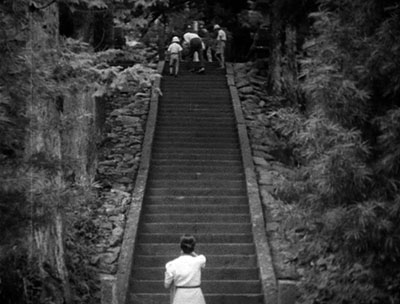
Ornamental Hairpin.
Japanese film studios differed from their American counterparts in encouraging directors to cultivate individual styles. Kido supposedly fired Naruse by saying, “We don’t need two Ozus.” While Shimizu is not as daring or meticulous a stylist as Ozu, he managed to cultivate a visual approach that, however straightforward, was capable of delicate refinements.
In general, the Shimizus we have conform to trends in Japanese films of his period. His silent films from the years 1931-1935 adhere broadly to the Shochiku house style, using plenty of cuts and single framings of individuals. Most of the surviving silents have average shot lengths between 5 and 6 seconds, completely normal for both Japanese and US silent movies.
More remarkable is the number of dialogue titles, which make up between 24% and 44% of all shots. This would be exceptional for an American film of the 1920s. Other Japanese films, particularly Mizoguchi’s, are heavy with intertitles, but Shimizu took the trend somewhat farther. The preponderance of dialogue titles may owe something to the presence of both American and a few Japanese talking pictures at the time, which justified more spoken lines. In addition, at this period the influence of the benshi, the vocal accompanist to silent films, was waning, and the movies were becoming more self-sufficient in their narration. The hundreds of titles flashing by in Shimizu’s films would specify the scene’s action and curb the benshi’s urge to improvise.
Shimizu’s silent films that survive also contain several instances of a technique I’ve called the “dissolve in place.” The camera setup remains fixed, but one or more dissolves convey the changes in the space across a period of time. It’s commonly used to show long periods; in A Hero of Tokyo, the family’s growing poverty is shown through dissolves that gradually remove the furniture they’re been forced to sell. The technique can be seen in American silent films, a major source for most Japanese directors. Here’s a lovely example from Frank Borzage’s Lucky Star (1929), as the partly paralyzed Tim struggles to climb onto his crutches.
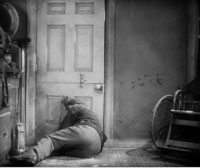
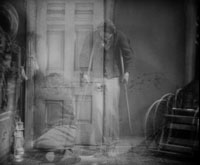
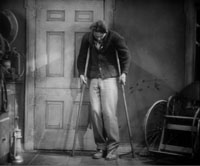
Shimizu often goes a little further by matching the figures precisely across a dissolve. In The Boss’s Son at College, the hero comes home but then sneaks out in his bare feet, and the dissolves concentrate on the reversal of movement, first upstairs, then down.
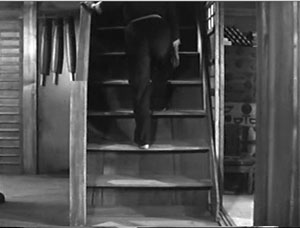
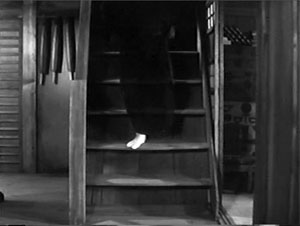
Again, this device was used by other Japanese directors, even Ozu in some early works, but Shimizu seems to have clung to it longer than most.
In general, Shimizu’s silent films don’t borrow his pal Ozu’s more idiosyncratic techniques. Shimizu doesn’t employ intermediate spaces to link scenes, or create elaborately disruptive transitions, or embed characters in 360-degree shooting space. Sometimes he offers mismatched eyelines in reverse shots, but these don’t usually cultivate the graphically exact alignment we find in Ozu’s editing. Still, Shimizu does often construct a scene’s space in a distinctive way.
For one thing, he will stage many scenes in long shot or even extreme long shot. Within that sort of shot, he’s often drawn to deep perspective, often with a central vanishing point. This is most apparent as a visual motif throughout The Boss’s Son at College.
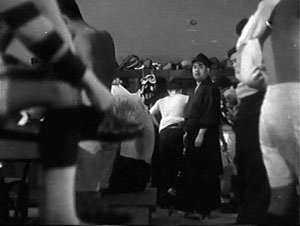
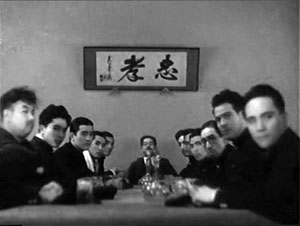
More interestingly, his fascination with perpendicular depth governs staging and cutting. Imagine a line stretched straight out from the camera lens. By 1935 this lens axis has become Shimizu’s lifeline, his equivalent of the surveyor’s level. Rather than filling the foreground with a big figure or a face or prop, and rather than spreading his depth items wide across the background, he will pack the most important people along the center axis, like crystals growing out from a string. Here are instances from Japanese Girls at the Harbor and Eclipse.
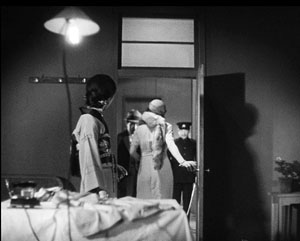
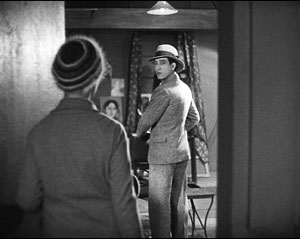
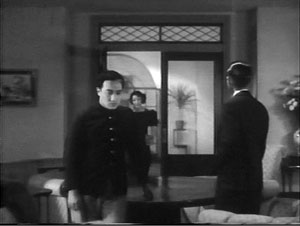
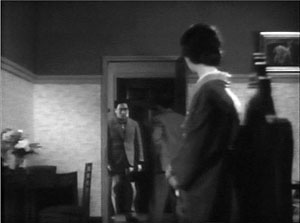
Shimizu’s co-workers have testified that he cared little for the 180-degree rule. Like many Japanese filmmakers, he played fast and loose with it. Instead of an axis running between the characters, he was more concerned with the axis of the lens itself. He often respects that by cutting from one shot to a point (along the axis) 180 degrees opposite.
He also respects the lens axis by cutting straight in and out. In Hero of Tokyo, the mother learns that her husband has pulled a swindle and fled; then the officials leave her alone with her children. Shimizu simply enlarges and shrinks her systematically along the axis. He takes us to the other side of the group for the climax, when her birth children pull away from her stepson. We see no other camera positions in the scene.
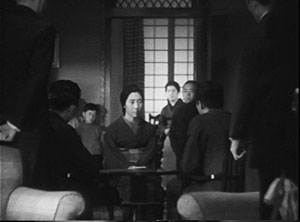
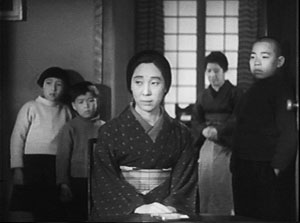
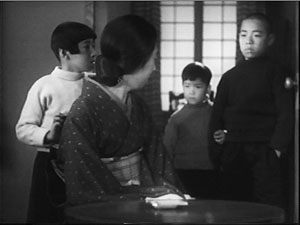
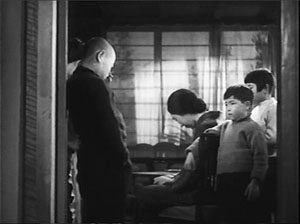
This patterning is less abrasive than it might appear because intertitles are sandwiched in among these shots. It’s an intriguing strategy for thrifty filmmaking, since it requires only a rudimentary set, but it also offers a simple way to inflect the drama. Similar axial cuts, though not cushioned by titles, can be found in the shooting scene of Japanese Girls at the Harbor (which may owe something to French and Soviet cutting experiments of the period).
The depth stretching out from the camera lens is crosscut by another plane, perpendicular to it. This plane is often a patterned surface—windows, grillwork, a bedstead. Again, instead of Mizoguchi’s or Ozu’s angular foregrounds, we have an east-west axis slicing through the shot. The frames become boxes, and the characters play out their dramas within the cells of a grid, as in Seven Seas Part II and Japanese Girls at the Port.
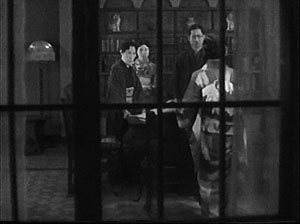
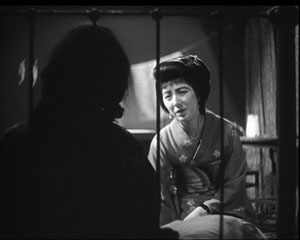
Here again, Shimizu is relying on a device that other directors were using at the time. Many compositions of the 1930s play peekaboo with characters and setting. Here’s a flamboyant example from First Steps Ashore (Shimazu Yasujiro, 1932).
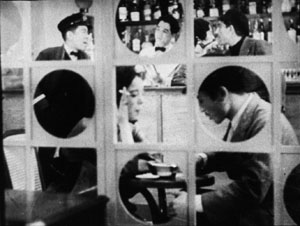
So instead of defining space through exaggerated foregrounds, plunging diagonals, or curvilinear edges, Shimizu goes Cartesian on us. His most distinctive layouts rely on two dimensions, one running straight into depth, the other running left to right. The result is a discreet, foursquare style well-suited to concise storytelling (and presumably, to turning out films quickly). Shimizu’s peers indulged in flashier shots, but his persistent choices yield a quiet variant of that continuity system that was already the lingua franca of world cinema.
Hitting the road
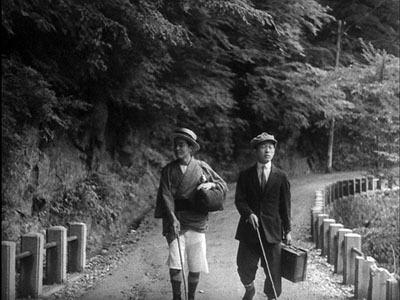
What about the sound films? Many Shimizu films still rely on distant planes of depth, as in this shot from Children of the Wind, when, after the father’s arrest, the boys’ buddies arrive at a far-off vantage point.
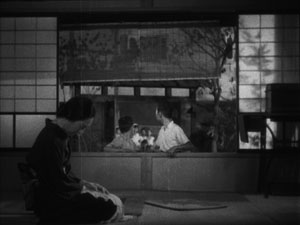
Interiors will sometimes be given the axial-cutting treatment, as in this passage from Ornamental Hairpin.
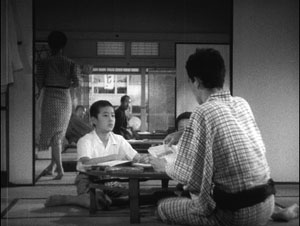
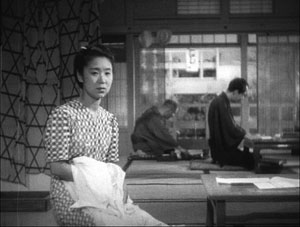
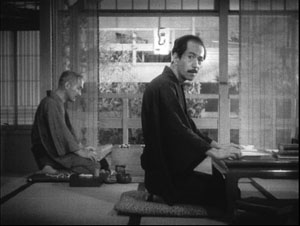
And now the crosscut horizontal plane often gets actualized as rooms gliding by the lens in lateral tracking shots. But in general, interior scenes in this 1941 film aren’t as strictly organized as in the silent films. This corresponds to a general move toward more orthodox technique in Japanese films of the period.
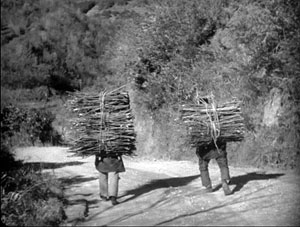
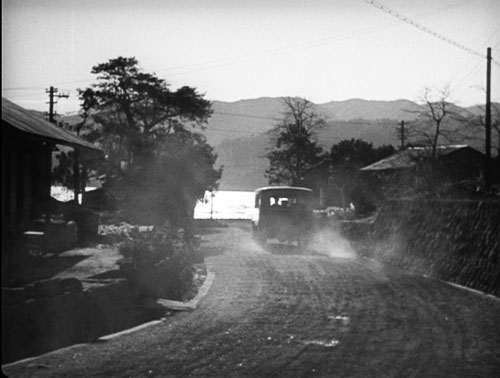
Something more original happens in the outdoor traveling shots. Now Shimizu’s beloved camera axis finds tangible expression in the highway. His much-vaunted tracking shots up and down the road translate the silent films’ axial depth into forward and backward movement, and characters, again organized in relation to the axis, are presented with a new simplicity and directness. Rather than being a one-off device, the road shots seem to be a development of the Cartesian coordinates that Shimizu has experimented with in the interior spaces of his silent films.
Star Athlete offers some remarkable examples of the push-pull effects built around the axis—tracking back from advancing characters, or tracking toward retreating ones. But Shimizu’s most thoroughgoing exploration of the camera axis in transit takes place in Mr. Thank You. The first thirteen shots lay out a stylistic matrix, with variants dropped in to prepare us for more compact expression later.
Shot 1: A long shot of the bus approaching.
Shots 2-4: We get the bus’s point of view of the road, with road workers in view; head-on shot of the driver calling “Thank you!” as the men step back; and the bus’s pov of the road receding, with the workers resuming. Dissolve to:
Shots 5-7: Bus’s pov of horsecart ahead; reverse angle of driver calling, “Thank you!”; bus’s pov of cart receding. Dissolve to:
Shots 8-9: Bus’s pov of men toting wood; we hear, “Thank you!” as we dissolve to bus’s pov of men receding. Dissolve to:
Shots 10-11: Bus’s pov of women carrying bundles; we hear, “Thank you!” as we dissolve to bus’s pov of women receding. Dissolve to:
Shot 12: Bus’s pov of chickens in road. They scatter as we get closer.
Shot 13: Long shot of bus going into the distance as we hear, “Thank you!”
The cycles move from three-shot clusters to two-shot clusters to a single shot, and a gag at that. (This driver even thanks poultry for traffic courtesy.) As another touch, Shimizu’s prized dissolves-in-place are recalled when the pedestrians approached from the back transform themselves into figures dwindling into the distance.
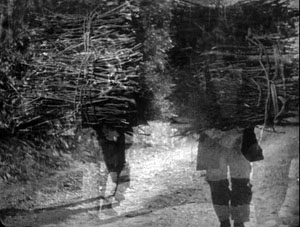
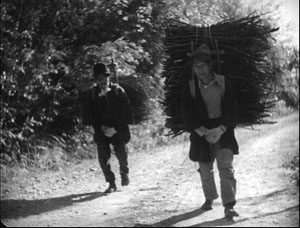
The same insistence on rectilinear framing takes place on the bus. Using 180-degree reversals, Shimizu creates a remarkable variety of shot scales in the cramped space of a real vehicle, always obeying his self-imposed geometry–facing either forward or backward.
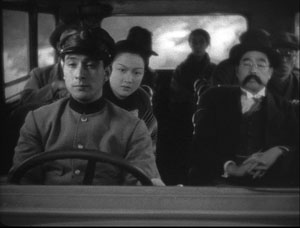
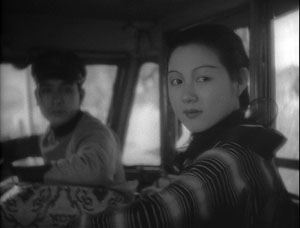
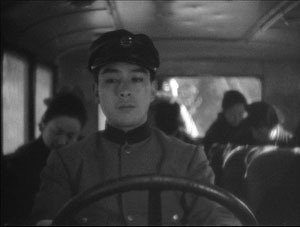
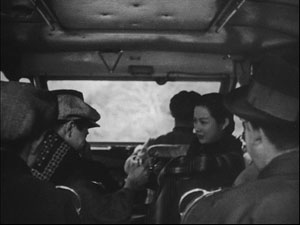
As the trip gains emotional intensity, Shimizu will vary his treatment of these principles. For example, the middle section’s emphasis on forward movement will be counterbalanced near the end by a string of shots of passengers already off the bus, passing into the distance as we roll away.
In Shimizu, compact storytelling is matched by a pictorial strictness that doesn’t seem forced or stiff. After all, people do tend to line up to face one another in depth, and roads and buses do seem to run in two directions. Poetry in language demands strictures of meter, rhythm, rime, and the like, for these can pressurize expressive energies. Shimizu’s films present a disciplined lyricism: powerfully oblique emotions are shaped by simple but rich techniques of storytelling and style.
Most of my information about Shimizu’s work habits comes from essays and interviews in Shimizu Hiroshi: 101st Anniversary, ed. Li Cheuk-to (Hong Kong: Hong Kong International Film Festival, 2004). For more on Shimizu’s surviving silent films, see William Drew’s penetrating essay in Midnight Eye. Alexander Jacoby offers a sympathetic career overview atSenses of Cinema. For a filmography, see Jacoby’s A Critical Handbook of Japanese Film Directors: From the Silent Era to the Present Day Stone Bridge, 2008). Isolde Standish reviews Shochiku’s studio policies in Chapter 1 of her A New History of Japanese Cinema: A Century of Narrative Film (Continuum, 2005).
Noël Burch was one of the first Western writers to appreciate Shimizu’s artistry. His indispensible 1979 book To the Distant Observer: Form and Meaning in the Japanese Cinema is available in its entirety here. The Shimizu chapter, concentrating mainly on Star Athlete, starts here. I offer discussions of stylistic trends in Japanese cinema in Ozu and the Poetics of Cinema (Princeton University Press, 1988), available in toto here, and in two essays in Poetics of Cinema (Routledge, 2008), 337-395.
You can find passionate conversations about Shimizu and the release of these DVDs at the Criterion Forum. See especially the comments of Michael Kerpan.
Passion, mortality, and everyday life
DB, flying back from Hong Kong:
Some of the most important films playing at the Hong Kong International Film Festival were already familiar to me—Still Walking, Il Divo, Gomorrah, Ashes of Time Redux—and some of my discoveries in Hong Kong have been covered in more recent entries.
What remains? Accentuating the positive, I’ll not talk about the disappointing items, some with strong reputations. I hope to blog about others in the months to come, when I’ve had a chance to study DVDs.
In the meantime, Kristin has already touched on Beaches of Agnès, a real charmer. Varda can be whimsical without turning fey; even dressed as a potato she doesn’t seem to be trying to grab attention. The film is a digressive, passionate memoir. The background on her early life is captivating, and her career as a photographer, shooting snaps of Pierre Vilar and Gerard Philippe, furnishes a stab of pathos. A montage of beautiful boys and girls: gone. Soon we get Varda’s straightforward acknowledgment of Demy’s death from AIDS. “All the dead lead me back to Jacques.”
Götz Spielmann’s Revanche, which I’d passed up at other fests, was a very solid psychological thriller. It’s built around two contrasting worlds, the sex trade of Vienna and the placid, churchgoing lifestyle of a village. From the first comes Alex, a man-of-all-work in a brothel. He falls in love with a Ukrainian hooker, and between bouts of cocaine he vows to help her escape the business. In the village live the policeman Robert and his wife Susanne, trying to have a child. Their life is secure and cozy, though Robert is wound a bit tight. The two worlds intersect during a bank robbery, and the rest of the drama plays out in the countryside, with Alex taking refuge on his grandfather’s farm. Alex and Robert become two variants of masculine anxiety, each defined by his way with a pistol, and their decisive confrontation is deftly postponed until the very last moments of the film.
I admire the way that Spielmann uses a spare long-take technique to increase suspense. Each scene usually consists of a single shot, taken from a judiciously chosen angle that unfolds the drama smoothly. There are barely 200 shots in nearly two hours, but the scenes don’t seem stiff because the framing and staging are quietly varied. Shot/ reverse-shot cutting is reserved for two turning points, one in the middle and one at the end. It’s nice to see a movie with no filler material, no passages of people driving in cars or going into the buildings, none of those time-wasting aerial shots of cities.
Some nice sound work too! No Country for Old Men has been rightly praised for its use of offscreen noise, but the Coens look rather showoffish compared to what Spielmann has accomplished here. A shot of Robert and Susanne on their patio is accompanied by the faintest rustle on the right channel: Alex, spying on domestic happiness like a character out of Highsmith or Ruth Rendell, has slipped away.
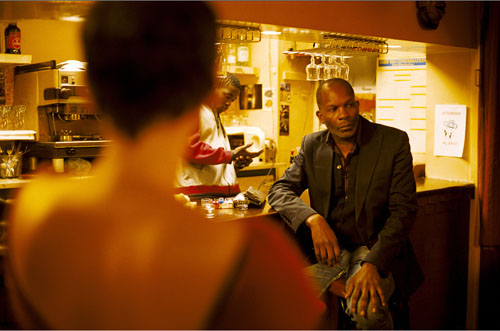
Similarly elegant in its staging and sound work is Claire Denis’ 35 Shots of Rum. The teasing exposition—a man watches commuter trains, a young woman rides one—dares us to imagine scenarios that could involve both. Our speculations turn out to be too wild, since their relationship is the most uncomplicated to be imagined. Based frankly on Ozu’s Late Spring, 35 Shots builds up its drama through daily routines, following its principals and their neighbors in everyday situations until, quite unexpectedly, a quiet crisis blossoms. Soon one scene ends: “We could be like this forever.” Next scene: everything has been overturned, and characters must change their lives. Visually the film is a marvel, with glowing scenes of semidarkness and discreetly out-of-focus details. As in her masterful Beau Travail, Denis supplies a powerful last shot, this time of an object we’ve nearly forgotten.
Two more thoughts: In my discussion of Revanche and 35 Shots, I’ve had to be coy in explaining basic plot situations and character relationships. That’s because these films work elliptically, holding back the sort of expository information that would be given in a concentrated dose early in most classical narratives. This narrational strategy poses no problem for an academic analysis, which tends to assume that the reader has seen the film. But it’s more difficult to handle when you’re writing a review. You don’t want to spoil the viewer’s surprise by explaining a core situation that the filmmaker has chosen to unfold gradually. If reviewers of Hollywood movies can’t give away the ending, the reviewer of an art film probably shouldn’t give away the beginning, or at least the information that it keeps in suspension for some time.
In other respects, though, there isn’t a clear dividing line between the “psychological” drama of international festival cinema and the more “externally driven” action of mainstream entertainment. Popular cinema relies on physical props like clues, souvenirs, messages, and gifts to help drive the plot. So, less obviously, do art films. The two photographs in Revanche deepen the character drama while triggering a major realization. The accidentally discovered letter (a convention of melodrama akin to the overheard conversation) in 35 Shots not only explains past actions but primes us to expect some conflict to come. As Aristotle knew, stories seem to need tokens to drive character revelation and plot reversals. A narrative universal?
Japanorama
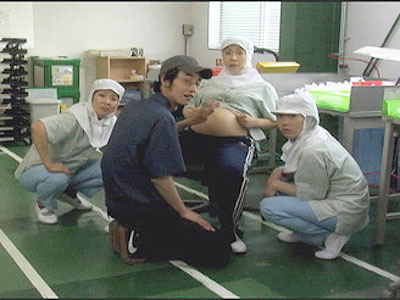
Naked of Defenses.
Many of the movies I most enjoyed were Japanese. No surprise there. I know I’m prejudiced in favor, but objectively speaking the Japanese industry has long combined high output with great diversity and depth. I’m inclined to think that across film history, the three most consistently excellent filmmaking nations have been America, France, and Japan.
During Filmart, Yoshizaki Masahiro gave a swift but informative report on the current state of Japan’s “content industry.” It is the currently the world’s second-largest national film market , but it will sooner or later be replaced by China. Currently Japanese films are reclaiming the local audience, sometimes grabbing over half the annual box office. Unfortunately, that audience isn’t growing, and with a plunging birthrate, it’s unlikely to do so. Moreover, Japanese cinema has always been difficult to export, even in Asia. The great exception, of course, is anime, but even that is starting to slump. Anime is largely a television/ video format, yielding about twice in those platforms what it yields in theatrical income. But as advertising dollars have withered in the recession, anime has been cut back.
Despite all this, Japanese companies manage to release a staggering 400 or so films per year. (What counts as a release—theatrical? direct to video?—we leave for another day.) And the variety remains remarkable, judging by what I saw during my stay in Hong Kong. Put another way: Japan makes movies that are sweet, touching, funny, silly, and peculiar to the point of perversity. Not necessarily perversion, but that’s there too. And yes, schoolgirls’ panties are involved.
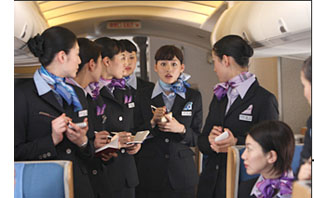 Not part of the festival, but playing in town was the diverting comedy Happy Flight. Like Airport and Airplane!, it weaves together various characters involved with a single flight. It concentrates almost completely on the professionals, from gate agents and mechanics to pilots and air hostesses. The one passenger depicted in detail rings true: After being allowed to bring an oversized bag into the cabin, he becomes a browbeating jerk.
The film maintains its infectious pacing, adorning the action with minor-key gags like the airport’s “Somkin Room” for smokers. I also liked the moments of teamwork. When the stewardesses need a cake, they concoct one out of various packaged snacks. A young mechanic, constantly berated by his boss, thinks he’s dropped a wrench into the plane’s engine, and the whole ground crew searches the hangar for it. As with Airplane!, the final credits resolve several plotlines and add a few gags. If you like Waterboys and Swing Girls, also directed by Yaguchi Shinobu, you’d probably enjoy this.
Just as light, but a lot more intricate is Nakamura Yoshihiro’s Fish Story. Another network narrative, this one traces how Japan’s purported first punk song changed the course of history. The plot skips among periods from 1953 to 2012, when a comet is about to incinerate the earth. With many pop-culture in-jokes, from Beatles albums to The Karate Kid, this breezy, off-kilter item gets by on sheer adrenaline and on a cascade of puzzles. Why does the Fish Story song make no sense? Why does it contain a one-minute passage of silence? How are all these stories connected? And how can a song save the world? The narration cleverly withholds the basic relationships among the characters until a dizzying montage at the end wraps everything up.
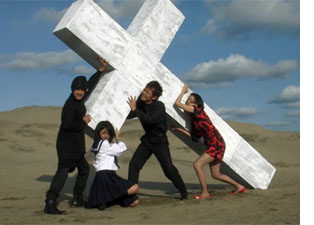 Still further out there on the Nutsometer is Love Exposure, your basic four-hour inquiry into Christianity, cross-dressing, superheroics, and schoolgirl underwear. The story starts with a boy who promises his mother he’ll marry a woman like the Virgin Mary, but thanks to digital photography and an acrobatic approach to filming schoolgirls’ nether regions, he becomes known to his peers as King of the Perverts. Director Sion Sono satirizes cult religions, which seems to include Catholicism (“Your sin is that you can’t remember your own sin”), while devoting some attention to pornographic movies and “Candle in the Wind.” Rambling and digressive, but rapidly paced, Love Exposure proves that nobody beats the Japanese for cheerful dirty fun.
A more straightforward Japanese entry in the Asian Digital competition was Ichii Masahide’s Naked of Defenses (the most awkwardly titled film I saw). Two women work at a factory making plastic parts. Ritsuko, a plain but dogged supervisor, is becoming alienated from her husband after her miscarriage. She envies the pregnant and insouciant new hire Chinatsu, whose marriage is overcoming its problems. Plain and sincere in its technique, Naked of Defenses ends with an astonishing sequence. By all the evidence onscreen, Ichii got a pregnant woman to play Chikatsu and filmed her giving birth. Balancing this powerful ending is the striking performance of Moriya Ayako as a woman sinking into depression but who may be saved by friendship and maternal love.
I took the occasion to catch Departures at a local theatre, since I had missed it at earlier festivals. And I’m happy to report that it’s distributed in the US by Regent Entertainment, run by Wisconsin graduate and old friend Steven Jarchow.
By now you’ve probably seen Departures too. At one level, it’s a good old-fashioned Shochiku movie, mixing tears and good-natured humor. Some decry it as middlebrow sentiment, but I found it a touching, fluent tale. For me, the central attraction is the repertory of gestures. Our two professionals handle the recently deceased tenderly, but that doesn’t preclude a crisp efficiency in flaring out a sleeve. I don’t think I’ll forget the way the undertaker grasps the dead person’s clasped hands and then executes a circular snap. Precise manipulation becomes a sign of respect.
And it isn’t all sunniness. Handling dead bodies is hazardous cultural territory in Japan. It is traditionally a task for the burakumin, a minority group long looked down upon. Although discrimination against the group has apparently diminished, the fact that a big star like Motoki Masahiro could play the role of a corpse-preparer could help dispel a lingering social stigma.
You could almost mount a Japanese film festival about mortality. Some musts would be Ozu’s Brothers and Sisters of the Toda Family and Tokyo Story, Kurosawa’s To Live, and Kore-eda’s After Life. Another required item would be Dying at a Hospital (1993), a rarely seen Ichikawa Jun film screened as part of a tribute to the recently deceased director. It consists of staged episodes showing a few cancer patients in their last months. An elderly husband and wife both have cancer, but must separate and be treated in different hospitals. A widow laments her rotten luck. A lively young man can’t accept the fact that he won’t see his children grow up. A homeless man is brought in, filthy and disoriented, and as he becomes aware of his plight, he still apologizes for accidentally turning up his pocket radio.
These and other cases are accompanied by voice-over narration from the doctor and nurse who treat them. Interspersed with these scenes are rapid documentary montages of people enjoying life—eating, drinking, viewing cherry blossoms, celebrating festivals, just walking down the street. The intimate facial reactions we’re denied in the hospital scenes are supplied in these vérité passages.
Dying at a Hospital is gentle and sympathetic, but its manner of shooting gives it special resonance. The hospital scenes are shot in planimetric fashion, with the camera rigidly facing a row of three beds, or a pair of beds, or only a single one. Everything is played in long shot, with no close-ups or camera movements to enlarge the faces.
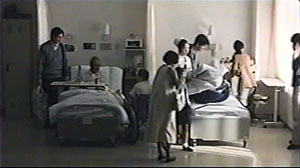
Patients, visitors, and hospital staff move through these blocks of space. The lighting effects are particularly subtle, accentuated by very gradual fade-ins and fade-outs, as if dawn were breaking or night were coming on. As the film goes on, Ichikawa introduces variations in scale and new cutting patterns, creating what I called in Narration in the Fiction Film a sparse version of parametric narration. For instance, the spaces become more compact as terminal patients are shifted from a shared room to a private one, which permits nuanced effects of distant depth.
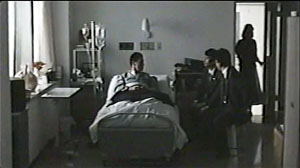
Ichikawa’s dry, physically detached treatment lets the poignancy of each situation emerge without any directorial boosting. The glimpses of daily life outside the hospital, zestful and shot on the fly, generate a powerful contrast: the preciousness of ordinary pleasures, and the dignity that must be accorded everyone about to leave them behind.
For a brief but sensitive appreciation of 35 Shots, see Ryland Walker Knight’s comments here–perhaps best read, for reasons mentioned above, after you’ve seen the film.

Departures.
Happy birthday, Film Workshop
Tsui Hark is the mad genius of Hong Kong cinema. The problem comes with assigning proportions. 10 % mad, 90% genius? 50-50? 99 % mad, 1 % genius?
Across a career that’s lasted more than thirty years, Tsui has had more ups and downs than the local economy. On the twenty-fifth anniversary of Film Workshop, the company he founded, the Hong Kong International Film Festival mounted a tribute. That provides an occasion to examine what he did and didn’t accomplish.
25 years old, but who’s counting?
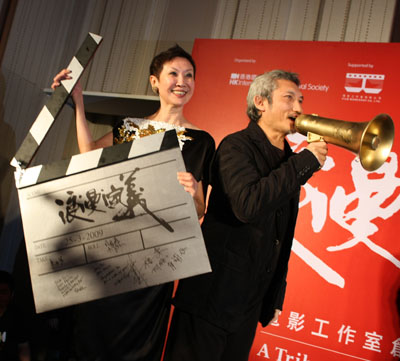
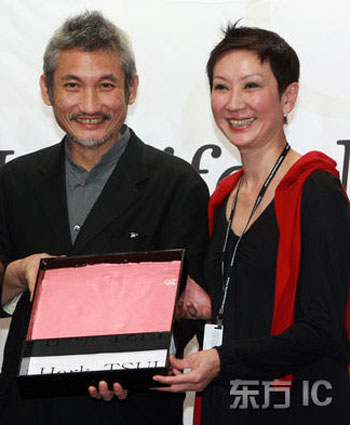
Nansun Shi and Tsui Hark.
At this year’s Asian Film Awards, Film Workshop was given a special prize for outstanding achievement. On another evening there was a party gathering many Workshop alumi, from which the above photo comes. You can see more pictures from that party here. At the agnes b. gallery, a small show featured posters, a looped video documentary, a photocopy of the Better Tomorrow script, and some memorable props.

Nat Olsen has other pictures at his lively Hong Kong Hustle site.
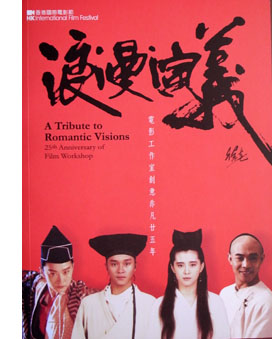 The catalogue, A Tribute to Romantic Visions: 25th Anniversary of Film Workshop, is a must for all aficionados of Hong Kong film. Consisting largely of interviews, it offers many glimpses of creative choices and business strategies governing the company. Nansun Shi, Tsui’s partner and business manager, recalls how they placed films in overseas markets and won critical acclaim in Europe. She also explains matter-of-factly how frantic the midnight-show system was. In those days, Hong Kong filmmakers test-screened a movie to a midnight audience, and then reedited the film based on perceived reaction. Shi explains:
Cinemas often wondered what could be done to a film in the eight hours between the midnight show and the day-time show the next day. I ran some calculation with the technicians: what is the least amount of time for them to do this and that, and then sent them to the cinemas to do the work. If worse comes to worst, they could do the re-editing when the show was running (80).
There isn’t much sugar-coating in the interviews. Collaborators often found Tsui a harsh taskmaster. At peak pressure, he seldom halted shooting for sleep and instead took cat naps on the set. Those who couldn’t keep up his pace, or adjust to his demands, left the company. There are also some comments on production practices. Herman Yau, for instance, notes: “Directors, in general, use most of the shots to tell the story. Tsui prefers images that look good on their own” (121).
Overall, the catalogue confirms that what started as a “workshop” designed to enable directors to realize individual creative visions became a company built around Tsui’s restless ideas about cinema. This was more or less the premise of the panel on Friday afternoon. Two critics, Keeto Lam and Longtin, discussed the Film Workshop enterprise largely as an extension of Tsui’s interests. Keeto had been a screenwriter at the company and shared information about the making of A Chinese Ghost Story 2, while Longtin speculated on Tsui’s interest in transcending polarities, particularly those between human and demon and male and female. Another scriptwriter was in the audience and contributed information as well.
One of Keeto’s points set me thinking. Having characterized Leslie Cheung as the “Golden Boy” of Film Workshop, he asked who the Golden Girl was, and he and audience members discussed candidates for the honor. (My vote, obviously, would go to Brigitte Lin.) But I began to speculate that one of Film Workshop’s main contributions was in star-making. Tsui has mentioned that his early films with gorgeous women tried to create a “comedy of pretty faces” opposed to the “comedy of ugly faces” that ruled in the 1970s and early 1980s. (Think of Michael and Ricky Hui, Karl Maka, Jackie Chan, and Sammo Hung.) By coaxing Brigitte Lin to Hong Kong and by giving Sally Yeh, Leslie Cheung, Chow Yun-fat, and other younger players big roles, Film Workshop created a new generation of glamorous stars.
A better yesterday
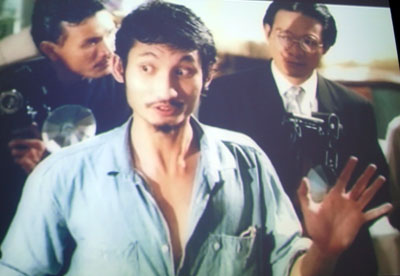
This celebration comes at a parlous period in Tsui’s career. Over the last dozen years Tsui directed some weak, even awful movies. Granted, even a bad Tsui movie is bad in a unique way, but that doesn’t make Tri-Star (1996), the Van Damme outings (Double Team, 1997; Knock Off, 1998), and The Legend of Zu (2001) any better. Some films he has produced, like Era of Vampires (2002) and Xanda (2003), are best forgotten. Today, after the only moderate success of Seven Swords (2008) and the disappointments Missing (2008) and All About Women (2008), many local film professionals consider him a spent force.
I’d argue that Tsui and Jackie Chan were the two most ambitious young filmmakers of 1980s Hong Kong. Tsui was the more daring and mercurial; he seemed to be trying a dozen things at once. He made some bad films, but others changed the face of local film: Shanghai Blues (1984), Peking Opera Blues (1986), A Better Tomorrow III (1989), Once Upon a Time in China I and II (1991, 1992), The East Is Red (1993), and The Chinese Feast and The Blade (both 1995). He also produced, and often co-directed, A Chinese Ghost Story and A Better Tomorrow (both 1986), The Big Heat and Gun Men (1988), The Killer (1989), the demented Wicked City (1992), and Iron Monkey (1993). These films had enormous impact locally, and they made Hong Kong film a major force in world cinema.
The problem is the mad-genius thing. Tsui is uneven, not only from film to film but within each one. Tsui can create a fairly unified tone, as The Blade and Seven Swords show. But more likely a Tsui film will contain something brilliant, something banal, something silly, and something just weird. Labored facetiousness is a virus plaguing Hong Kong film generally, but Tsui seems entirely too fond of bursts of dumb comedy. He replies: “Sometimes it’s fun to be stupid.”
Yet the thrown-together quality of many of his movies also means that even a troublesome one is likely to have a passable sequence. More important, his best films use the lurches in tone to create a grotesque, sweeping verve. Things happen so fast you can’t protest; either go with it or walk out.
Tsui’s strategy is based upon a breathless rhythm. He chops off scenes without warning, and he bustles his actors around the set maniacally; the poor things seldom rest long. Almost never do characters simply sit down and talk to one another, as in those bland American indie films. The beginning of Triangle (2007) shows how nervous, even opaque, Tsui’s style becomes when characters have to sit still.
For Tsui, story action is a matter of physical movement, and the film frame becomes a force-field, with actors popping in and out with abandon. He carries the staccato choreography of martial-arts film down to the most straightforward dramatic scene. He’s not alone in this; you can find it in the 1980s martial-arts films too, but Tsui gives it a special force with his pitched angles, his wide-angle lenses, and his love of comic-book-rococo compositions. Try, for instance, this shot of a woman getting an injection in Missing.
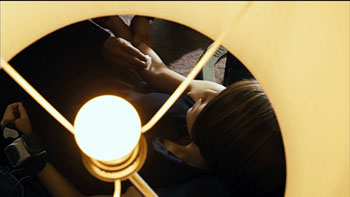
Such images can seem merely cheap flash, but what saves the best ones from preciosity is their constant but disciplined rhythm. In Once Upon a Time in China, Wong Fei-hung is about to be arrested after a clash with local thugs. The shot starts with the police official pointing his pistol to Wong’s head.

Another cop comes in to tell the official that the invaders left something. Any other director would have shown the cop’s face, but why? He’s important only to get the official out of the frame, so he becomes just a red hat poking in from the lower right corner.
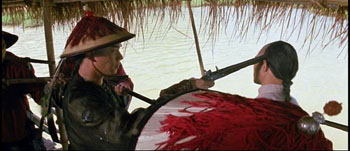
The official dodges out, moving rightward across the frame.
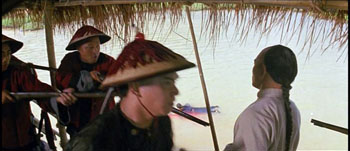
There’s a pause, then Wong, now isolated in the shot, snaps his head around to follow what’s happening.
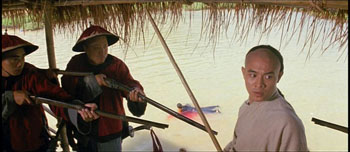
Tsui isn’t usually considered an economical director, but it’s hard to imagine a more crisp way to handle this routine bit of action. The shot takes less than eight seconds.
The same restless energy rules Tsui’s cutting, which has a punch and recoil derived, I think, partly from New Hollywood (Spielberg especially; see the Jaws example here) and partly from the local martial arts tradition. (Some proto-Tsui cutting is on display in Lau Kar-leung’s Legendary Weapons of China, 1982.) Watching Once Upon a Time in China at the retrospective, I was reminded that Tsui not only cooks up sequences that you can’t forget (three words: fight on ladders), but he risks audacious cuts on movement that few contemporary directors could bring off. When he wants to emphasize a moment, he channels Eisenstein. During the final combat of Wong and Iron Robe Yim, the iron weight sliding down the platform gets the Potemkin treatment. Four shots stretch out the instant through overlapping movement.
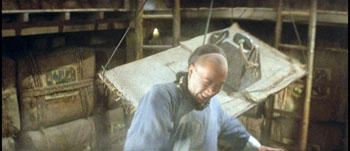
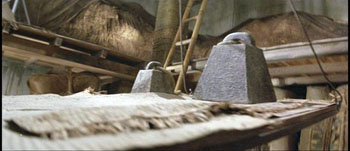
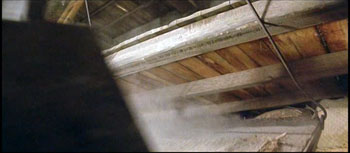
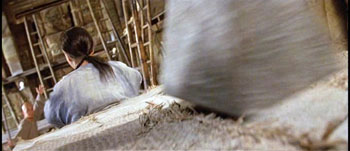
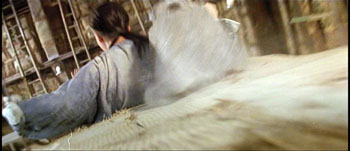
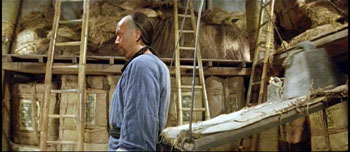
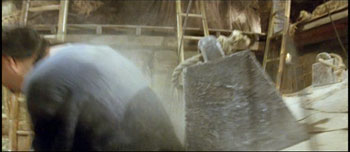
As we might expect, Tsui goes beyond Eisenstein by accentuating major points of impact with swift camera movements forward.
Tsui thinks visually. True, some sound is important—he is a master at merging music and image—but words are a last resort. He has been known to change dialogue in post-production so radically that the dubbing doesn’t match the actors’ lip movements. Shooting without sound gives Tsui, like other Hong Kong directors, a freedom of camera placement that recalls the silent cinema. And like a silent director, he thinks that every story point needs to be pictured. Kenny Bee is looking for the girl he met years ago (Shanghai Blues)? So let’s have an image that dramatizes the problem.
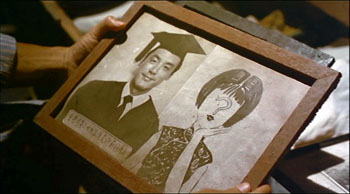
The inclusion of Kenny’s graduation picture might seem superfluous, but it makes the frame an anticipatory wedding picture, and it gives us a sense of his pure, if naïve, romantic impulses.
Motion plus or minus emotion
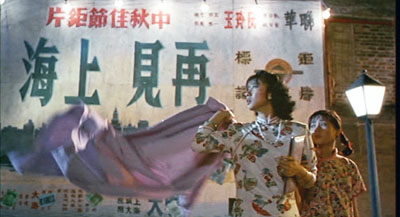
Shanghai Blues.
If you disapprove of what Spielberg and Lucas did to the American cinema, you will hate Tsui’s love of remakes, sequels, and spinoffs, his frequent confusion of SPFX with imagination, and his efforts to milk franchises to a point that can be considered cynical. Yet historically, he pushed Hong Kong cinema forward.
Before the star-making efforts I’ve already mentioned, indeed before Film Workshop was created, Tsui’s Dangerous Encounters: First Kind (1980) offered a blistering attack on class disparity in Hong Kong. He updated Cantonese fantasy swordplay in Zu: Warriors from the Magic Mountain (1983), and he tried his hand at a local version of low-budget exploitation in We’re Going to Eat You (1980). Keeto’s catalogue essay argues that Film Workshop pioneered six new genres in Hong Kong film, from comic-book adaptations to science-fiction and animation. And there’s more variety than we might expect. Film Workshop directors might have sometimes mimicked his style, but John Woo’s Workshop projects managed to do something quite different. Despite Tsui’s hands-on involvement, the lyrical Iron Monkey and the more hard-edged Gun Men and The Big Heat avoid the eccentricities of his signed work while maintaining his love of flamboyant set-pieces and visual creativity.
 Tsui’s scripts often seem like patchwork, granted, but I tried to show in Planet Hong Kong that the episodic, additive plotline is a convention of Hong Kong cinema. Tsui—like Wong Kar-wai, though in a different key—took advantage of this formula to explore the power of the arresting image and an infectious rhythm. (You might say that Wong’s rhythm is that of cool jazz, while Tsui’s is closer to the percussiveness of Chinese opera.) Shanghai Blues and Peking Opera Blues, two of Tsui’s most ingratiating movies, jump smartly from one thrusting scene to the next, shifting emotional registers with dazzling speed. These movies can turn on a dime.
Part of what pulls us along is characters we care about—especially strong women. In the old days, we Hong Kong fans used to love the idea that John Woo, carrying on the Chang Cheh tradition, specialized in the sorrows of masculine obligation, while Tsui was much more interested in women. He gave us the comedy of pretty faces, the wide-eyed innocence of Joey Wong, and the severe beauty of Brigitte Lin who, in the final installment of the Swordsman series, becomes a sheer force of nature. (Her bi-gendered role in Ashes of Time stems from Tsui’s creation of her as such in Swordsman II and The East Is Red.) When Tsui took over the Better Tomorrow franchise, his prequel showed that Woo’s ideal hero Mark (Chow Yun-fat) learned his combat crafts from, of all people, a woman. Even the non-stop testosterone fervor of The Blade, all sweaty torsos and clanking weaponry, may be the hallucination of a madwoman.
These were rousing yarns. Yet at some point, I think, Tsui lost interest in telling a story. This tendency can be detected already in the Van Damme projects; the opening of Knock Off revels in visual effects (microscopic close-ups of the ripping fibers inside running shoes) but doesn’t dwell on what we need to know. Tsui’s task in the collaborative film Triangle was to simply to set up the premises of the action, but dialogue-driven exposition seems to bore him, and the opening scene is a frenzy of eccentric angles and barely registered plot points. His SPFX extravaganza The Legend of Zu has a fairly incomprehensible story to begin with, but by swamping it in explosions and magical transformations, Tsui makes a movie that is, like Spinal Tap’s amplifier knob, permanently set at 11.
With the lack of interest in economical storytelling comes a resistance to emotional engagement. Time and Tide has some virtuoso passages—the tenement sniping, the finale in Kowloon Station (with a woman giving birth during a gun battle)—but the film’s jittery momentum and lack of a coherent point of view sacrifice everything to momentary visceral impact. The death of a little boy caught in the crossfire is not a stab of pathos but the pretext for the visual shock of a ricocheting skateboard.
Tsui’s first films often shied away from sustained romantic scenes, a point made by Sylvia Chang in a catalogue interview. Still, he sometimes translated the awkwardness of love into gesture and motion, from the race to the train at the end of Shanghai Blues to the tender exchange of morsels of food between reconciled husband and wife in The Chinese Feast. Even Once Upon a Time in China can pause for a moment to let Aunt Yee reveal her growing affection for Wong Fei-Hong by having her shadow stroke his.
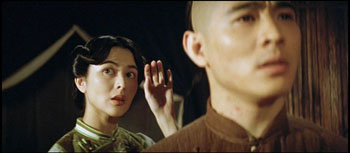
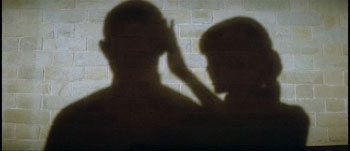
In the early FW films, emotion was translated into movements large or small. Losing her love makes a woman turn abruptly and snap out her cape, underneath a billboard advertising her lover’s song. But more recently Tsui seems to suffocate emotion in a welter of one-off effects. The lustrous HD shots of Missing make it visually striking, but the lacquered technique doesn’t seem to me to serve the story’s core drama of loss.
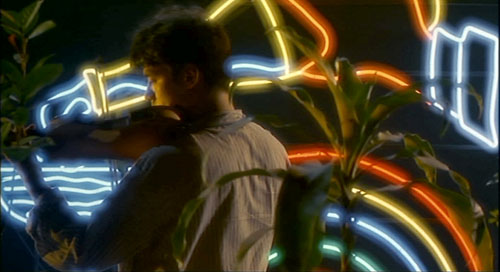
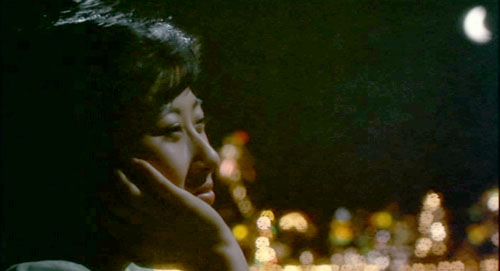
We can’t write Tsui off. He’s not yet sixty, and his new project, the Tang era mystery Detective Dee, sounds promising. Whatever happens next, his many admirers thank him and the FW team for some of the most radiant moments in modern cinema. Everyone who has seen Shanghai Blues needs only the stills at the top and bottom of this entry to conjure up the scene: Kenny plays his violin on the rooftop, we hear the soaring tune “Shanghai Nights,” and as we see Sally listening on another balcony, a chill goes up your spine. A little mad, but mostly genius.
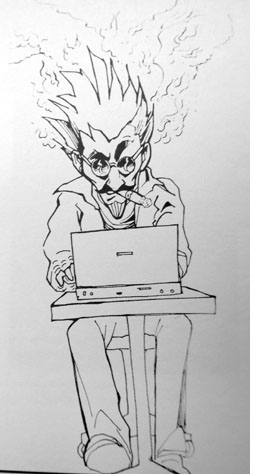
Thanks to Alvin Tse for the illustration from the Film Workshop party.