




Archive for the 'Film technique: Staging' Category
Kurosawa’s early spring
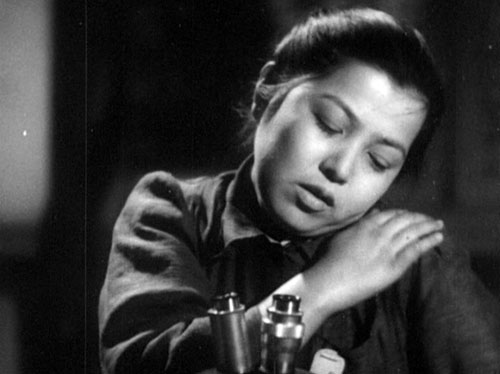
The Most Beautiful (1944).
For Donald Richie
DB here:
Cinephile communities aren’t free of peer pressure. Sometimes you must choose or be thought a waffler. In postwar France, the debate within the Cahiers du cinéma camp often came down to big dualities. Ford or Wyler? German Lang or American Lang? British Hitchcock or American Hitchcock? In the America of the 1960s and 1970s, we had our own forced choices, most notably Chaplin or Keaton?
This maneuver assumed that a simple pair of alternatives could profile your entire range of tastes. If you liked Chaplin, you probably favored sentiment, extroverted performance, and direction that was straightforward (“theatrical,” even crude). If you liked Keaton, you favored athleticism, the subordination of figure to landscape, cool detachment, and geometrically elegant compositions. One director risked bathos, the other coldness. The question wasn’t framed neutrally. My generation prided itself on having “discovered” the enigmatic Keaton, in the process demoting that self-congratulatory Tramp. Keaton never begged for our love.
Of course it was unfair. The forced duality ignored other important figures—Harold Lloyd most notably—and it asked for an unnatural rectitude of taste. Surely, a sensible soul would say, one can admire both, or all. But we weren’t sensible souls. Drawing up lists, defining in-groups and out-groups, expressing disdain for those who could not see: it was all a game cinephiles played, and it put personal taste squarely at the center of film conversation.
In the 1950s another big duality slipped into Paris-influenced film talk. Virtually nobody knew about Ozu, Shimizu, Gosho, Naruse, Shimazu, Yamanaka, et al., so two filmmakers had to stand in for the whole of Japanese cinema. Mizoguchi or Kurosawa?
A problematic auteur
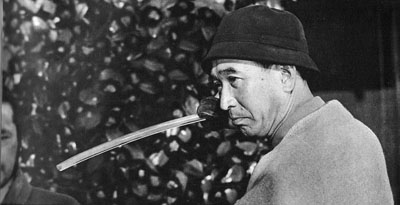
For Cahiers the choice was clear. Mizoguchi was master of subtly shaping drama through the body’s relation to space, thanks to quiet depth compositions and modulations of the long take. In Japan, land of exquisite nuance, the dream of infinitely expressive mise-en-scene seemed to have come true.
There seemed to be nothing nuanced about Kurosawa, whose brash technique, overripe performances, and propulsive stories seemed disconcertingly “Western.” Sold, like Satyajit Ray, as a humanist from an exotic culture, he played into critics’ eternal admiration for significance. This director wanted to make profound statements about the bomb (I Live in Fear), the relativity of truth (Rashomon), the impersonality of modern society (Ikiru), and the complacency of power (High and Low, The Bad Sleep Well). Even his swordplay movies seemed moralizing, with the last line of Seven Samurai (“The victory belongs to these peasants. Not to us.”) summoning up a cheer for the little people. Kurosawa could thus be assigned to Sarris’s category of Strained Seriousness. “He’s the Japanese Huston,” said a friend at the time.
But there was no overlooking his cinematic gusto. He made “movie movies.” He flaunted deep-focus compositions, cunningly choppy editing, sinuous tracking shots (through forests, no less), dappled lighting, and abrupt addresses to the viewer, by a voice-over narrator or even a character in the story. He exploited long lenses and multiple-camera shooting at a period when such techniques were very rare, and he may have been the first director to use slow-motion for action scenes. Bergman, Fellini, and other international festival filmmakers of the 1950s didn’t display such delight in telling a story visually. If you liked this side of his work, you overlooked the weak philosophy. On the other hand, if you found the style too aggressive, it could seem mere calculation on the part of a man with something Important to say.
The case for the defense was made harder by the fact that he was a controversial figure at home as well. Japanese critics I met over the years expressed puzzlement about Western admiration for the director’s style. I was once on a panel in which an esteemed critic blamed Kurosawa for influencing Western directors like Leone and Peckinpah. His violence and showy slow-motion had helped turn modern cinema into a blunt spectacle. No wonder Lucas, Spielberg, Coppola, and Walter Hill have loved this macho filmmaker.
Today passions seem to have cooled, but I should confess that my own tastes remain rooted in my salad days (1960s-1970s). I could live happily on a desert island with only the films of Ozu and Mizoguchi. I’d argue forever that Japanese cinema of the 1920s through the 1960s is rivaled for sheer excellence only by the parallel output of the US and France. (For more on this matter, see my blog entry on Shimizu.) On Kurosawa, however, my feelings are mixed. I still find most of his official classics overbearing, and the last films seem to me flabby exercises. But there are remarkable moments in every movie. Overall, I’ve responded best to his swordplay adventures; Seven Samurai was the first film that showed me the power of the Asian action aesthetic. I think as well that his earliest work up through No Regrets for Our Youth (1946), along with the later High and Low and Red Beard, are extraordinary films. And, like Hitchcock and Welles, he is wonderfully teachable.
We don’t live on desert islands, and gradually we’re gaining easy access to the range of Japanese filmmaking of its great era. We can start to see beyond the fortified battlements set up by generations of critics. With so many points of entry into Japanese cinema, mighty opposites lose their starkness; polarities dissolve into the long tail. Nevertheless, personal tastes take you only so far, and objectively Kurosawa still looms large. Whatever your preferences, it’s important to study his place in film history and film art.
Gauging that place involves thinking outside some traditional conceptions of how films work. Like most ambitious Japanese directors, Kurosawa provides bursts of cinematic swagger. This six-shot passage from Rashomon revels in its own strangeness.
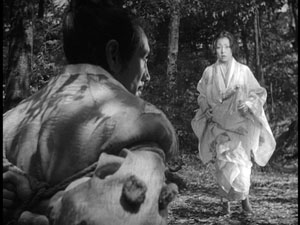
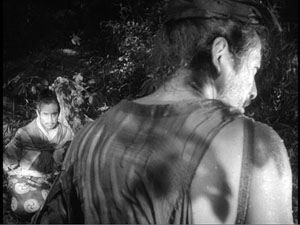
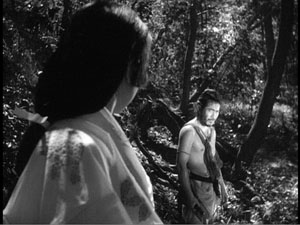
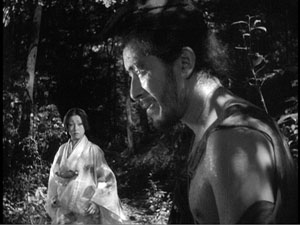
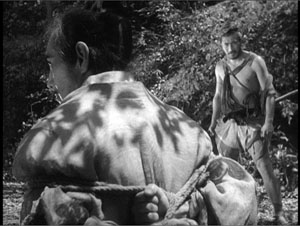
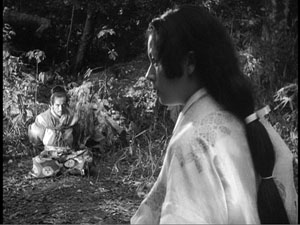
Here traditional over-the-shoulder shots submit to a brazen geometry. Out of an ABC film-school technique Kurosawa creates a cascade of visual rhymes and staccato swiveled glances. Yes, an ingenious critic could thematize this bravura passage. (“The symmetries put the central characters, each of whom asserts a different version of what happened, on the same visual and moral plane.”) Instead I’m inclined to think that the shots constitute a little thrust of “pure cinema,” a brusque cadenza that keeps our eyes, if not our hearts or minds, locked to the screen. From this angle, Kurosawa claims some attention as an inventor of, or at least tinkerer with, the disjunctive possibilities of film form.
His centenary arrives in 2010, and the occasion is celebrated by Criterion with a set of twenty-five DVDs. Most of these titles have already been available singly, and the discs lack all the bonus features we have come to admire from the company. Yet the crimson and jet-black box, the discreet rainbow array of slip cases, and the subtly varied design of the menus add up to a good object, like the latest iPod—something you want even if it means re-buying things you already have. There’s also a handsome picture book with notes by Stephen Prince on each film.
To viewers who need the assurance of cultural importance, this behemoth announces: You must know Kurosawa to be filmically literate. And that’s more or less true. Just as important, the inclusion of four rarities from his early years gives the collection a claim on every film enthusiast’s attention. One hopes that those titles will eventually appear separately, perhaps in an Eclipse edition. [See 15 May 2010 update at the end.] For now these copies of the wartime features are far better than the imports I’ve seen.
The Big Box makes it tempting to mount a career retrospective on this site, but that’s far beyond my capacity. Future blog entries may talk more of this complicated filmmaker, but for now I’ll confine my remarks to these early works. They offer plenty for us to enjoy.
Audacious propaganda
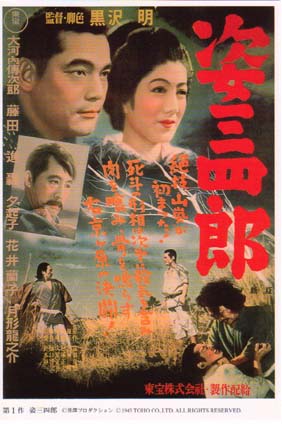
Although Kurosawa was only seven years younger than Ozu, he belongs to a distinctly different generation. Ozu directed his first film in 1927, at the ripe age of twenty-four. He grew up with the silent cinema and made masterful films in the early 1930s, during the long twilight of Japanese silent filmmaking. Kurosawa became an assistant director in the late 1930s. Although he evidently directed large stretches of Yamamoto Kajiro’s Horse (1941), he didn’t sign a feature as director until he was thirty-three. His closest contemporary, and a director whom some Japanese critics consider his superior, is Kinoshita Keisuke. Kinoshita was born in 1912 and his first feature, The Blossoming Port, was released in the same year as Kurosawa’s debut.
Kurosawa and Kinoshita began their careers making wartime propaganda. Their task was to display Japanese self-sacrifice and spiritual purity in stories of both the past and the present. In the Sanshiro Sugata films (1943, 1945), Kurosawa presents judo as an integral part of Japanese tradition and a path to enlightenment. Much of the external conflict is devoted to uniting martial arts (ju-jitsu, karate) under the rubric of the less aggressive but more powerful judo, and to showing how it can defeat American-style boxing. But the internal dimension is also important. Judo is a means of tempering character and accepting one’s proper place. Humble, unflagging devotion to one’s vocation becomes heroic.
The same quality can be found in The Most Beautiful (1944), a story of teenage girls working in a factory manufacturing lenses for binoculars and gunsights. Vignettes from the girls’ lives dramatize the need for cooperation and sacrifice, even as wartime demands for output threaten the girls’ health.
A more detached conception of the Japanese spirit underlies The Men Who Tread on the Tiger’s Tail (1945). This adaptation of a plot from Noh and Kabuki theatre shows officers escorting a general through enemy territory. Disguised as monks, the bodyguards are forced to bluff their way through a checkpoint. The situation is one of hieratic suspense, made more tonally complex by Kurosawa’s addition of the movie comedian Enoken. Enoken plays a dimwitted porter reacting to the charade played out by his betters. By dramatizing one of the most famous episodes in Japanese literature, Kurosawa was reasserting the tradition of devotion to duty and honor. The Men Who Tread on the Tiger’s Tail was released the same month that the atomic bomb fell on Hiroshima.
During earlier decades, Japanese cinema had created a complex tradition. In part, it conducted a sustained dialogue with Western cinema. Tokyo had access to a wide range of Hollywood movies, and directors studied American technique closely. Just as Ozu would not be Ozu without his early fondness for Lubitsch and Harold Lloyd, Mizoguchi learned a good deal from von Sternberg. Between 1938 and 1942, alongside German imports Tokyo theatres screened Fury, Only Angels Have Wings, The Sea Hawk, The Awful Truth, Angels with Dirty Faces, Boys Town, Young Tom Edison, Only Angels Have Wings, and many French titles. In 1942, with Hollywood films now banned, one could still see René Clair’s Le Million and À Nous la liberté—films that had been circulating in Japan since the early 1930s and could have served as models of flashy sound technique. It’s misleading to talk of Ozu as “purely Japanese” and Kurosawa as “Western”: All Japanese directors of the 1920s and 1930s were deeply acquainted with Western cinema, and American cinema in particular furnished a foundation for most local filmmaking.
Yet there are crucial differences. Japanese cinema welcomed extremes of stylistic experimentation that would have been rare in Western cinema. The 1920s swordplay films (chambara) pioneered rapid editing, handheld camerawork, and abstract pictorial design. (I supply some examples here.) Directors working in the contemporary-life mode (the gendai-geki) experimented similarly, often achieving remarkable visual effects and bold stylization. Mizoguchi and Ozu have become our emblems of this creative rigor and richness, but they are the peaks of what was a collective approach to filmic expression. Not every film was an experiment—indeed, most behave like Hollywood or European productions—but many ordinary movies, signed by unheralded directors, exhibit flashes of unpredictable imagination. This was the tradition of permanent innovation that directors of the Kurosawa-Kinoshita generation inherited.
As the war dragged on, however, Japanese studio productions lost much of their audacity. Production fell from over 400 films in 1939 to fewer than 100 in 1943. Censorship may have made filmmakers cautious about style as well as subject and theme. Most of the fifty-plus films I’ve been able to see from the period 1940-1945 are quite conservative aesthetically. Several of these seem to me quite good, but they rely on fairly standard Hollywood technique sprinkled with touches that had become markers of Japanese cinema (sustaining scenes in rather distant shots, using cuts rather than dissolves to shift scenes, and so on). Swordplay films become more severe and monumental. Even Mizoguchi’s Genroku Chushingura (1941-42) and Ozu’s There Was a Father (1942), superb as they are, are more elevated in tone than the directors’ earlier works.
Against this backdrop, Kurosawa’s films stand out; they are the most extroverted works I know in this period. Their innovations remain vivid; Sanshiro Sugata, for one, with its hierarchy of competitors, its rivalry among schools, and its visceral technique, may have invented the modern martial arts film. But we should also realize that these early films build upon the traditions already firmly established in Japanese cinema.
Playing with the passing moment
Consider transitions. Kurosawa is famous for his elaborate links between sequences, from the hard-edged wipes to swift imagistic associations. But we should recall that transitional passages offer moments of flashy style in American and European cinema of the 1920s and 1930s, and indeed right up to this day. (For examples, go here and here.) In the same year as Sanshiro, Kinoshita gave us this moment in Blossoming Port. A con artist is trying to bilk money from a town. He bows, leaving an empty frame.
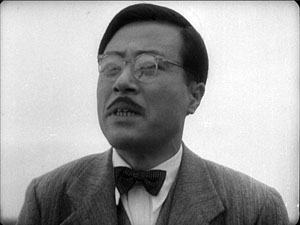
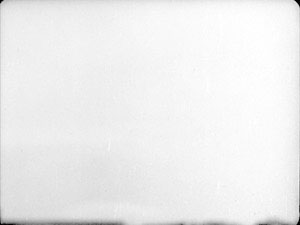
Without a discernible cut, heads pop into the empty frame, rocking to and fro.
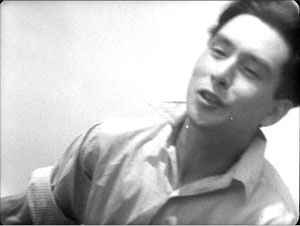
Another cut reveals that the people we see are in a boat tossing on the waves, and the conman’s partner is enjoying an outing with the locals. Kurosawa’s scene-changes—sites of what Stephen Prince has called “formal excess”—can be seen as prolonged, imaginative reworkings of this tricky-transition convention.
Japanese filmmakers were more willing to play with the expressive and “decorative” side of filmmaking than most of their Western peers. Directors created not only flashy transitions but moments of stylistic playfulness within scenes. Sometimes this just adds to the overall tone of comedy, as in this pretty passage in Heiroku’s Dream Story, another 1943 release. The hero, played by Enoken, is squatting and talking to a charming girl (Takamine Hideko). She twirls her parasol between them, and we get a straight-on cut that creates a moment of abstraction as the parasol glides across the frame in contrary directions. (The vertical pair of frames shows the cut.)
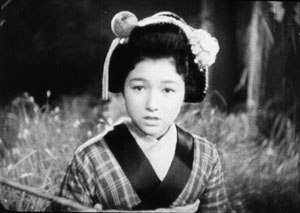
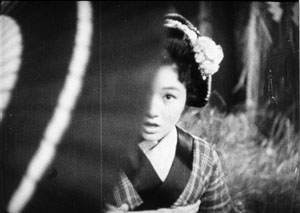
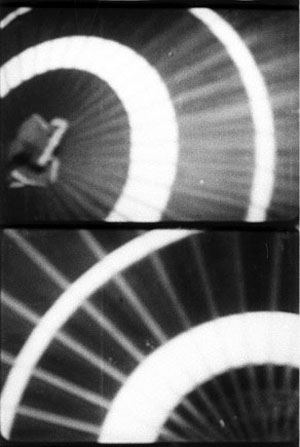
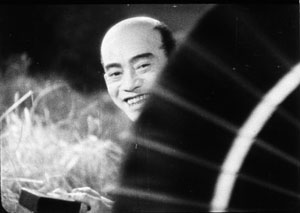
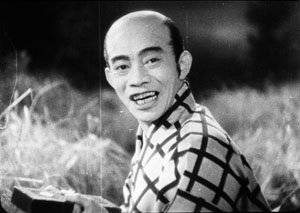
This decorative symmetry would be rare in Hollywood outside a Busby Berkeley number, but it enlivens the characters’ exchange in a way similar to the more dramatic Rashomon sequence. To borrow a phrase that Kepler applied to nature’s way with snowflakes, a filmmaker may seek to ornament a scene by “playing with the passing moment.”
Likewise, in The Blossoming Port, as an older woman recalls a romance of her youth, the natural sound fades out and the back-projection behind the carriage shifts from the seaside to urban imagery of the period she’s remembering.
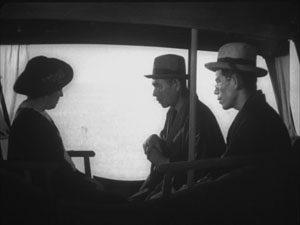
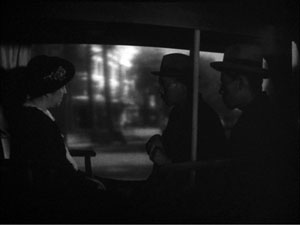
The frank artifice of this shot shows that Japanese filmmakers were eager to let us enjoy the forms with which they were working.
A similar explicitness about style can be seen in one of Kurosawa’s signature devices, the axial cut. This technique shifts the framings toward or away from the subject along the lens axis. If the shots are short enough, we sense a bump at the abrupt change of shot scale.
Kurosawa often uses this cutting to stress a momentary gesture or to prolong a moment of stasis. But it can structure a simple dialogue scene as well. In Sanshiro Sugata, the hero’s first conversation with Sayo takes place as they descend a stair toward a gateway. Kurosawa uses axial cuts to keep up with them as they move away from us down the steps. Illustrated with stills, this technique looks like a forward camera movement, but in fact these images come from separate shots.
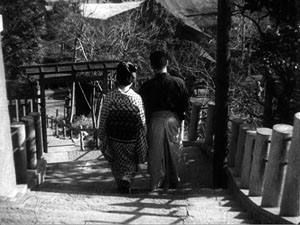
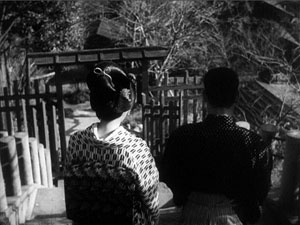
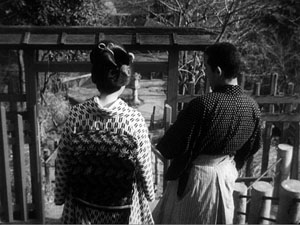
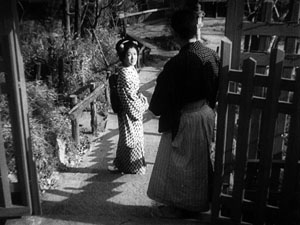
The crux of the scene is Sayo’s revelation that the man Sanshiro must fight is her father, and instead of big close-ups to underscore his reaction, Kurosawa simply lets his hero halt while Sayo continues down the steps. The steady pattern of cut-ins to the characters’ backs makes Sayo’s sudden turn to the camera more vivid, and Sanshiro’s reaction is underplayed by not giving us direct access to his face.
An earlier entry traces theaxial cut back to silent film, when its jolting possibilities were exploited in Soviet montage cinema. Japanese directors also used the device often. Yamanaka Sadao, one of the most-praised directors of the 1930s, used axial cuts prominently in an early dialogue scene of Humanity and Paper Balloons (1937). The cuts are accentuated by low-height compositions that maintain the steep perspective of the street.
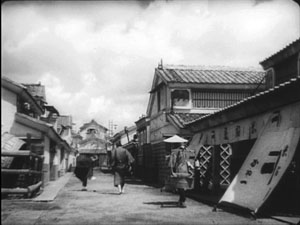
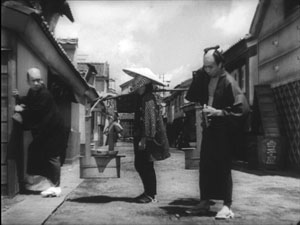
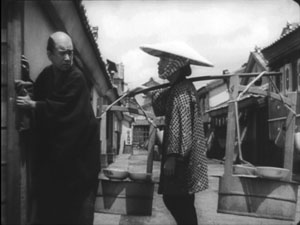
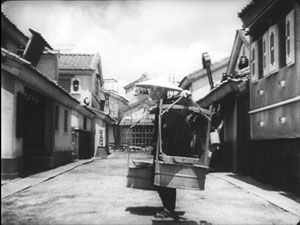
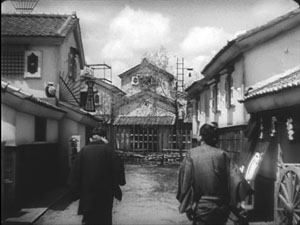
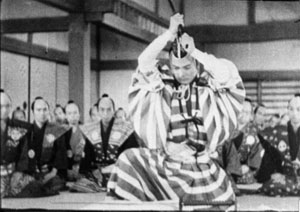
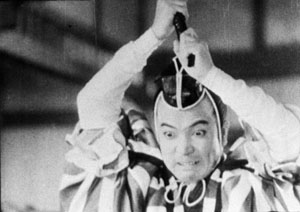
The technique gains more punch in Japanese swordplay films. Here is a percussive instance from Faithful Servant Naosuke (1939), four short shots yanking us inward in a way that Kurosawa would make his own.
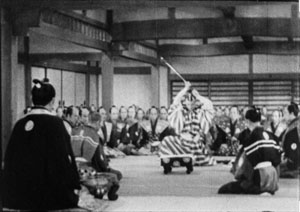
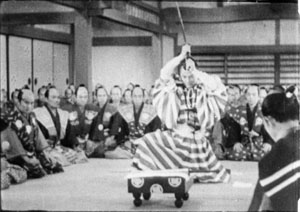
Tom Paulus reminds me that Capra films sometimes make use of this technique, as in this string of concentration cuts from Mr. Smith Goes to Washington (1939).
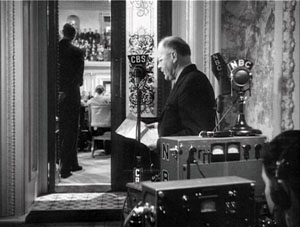
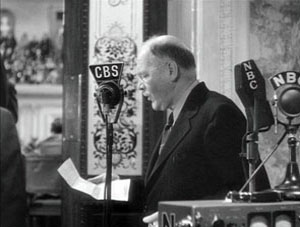
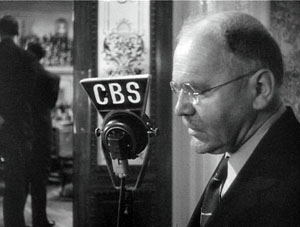
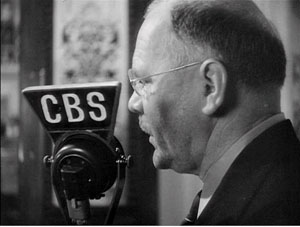
Interestingly, Mr. Smith ran on several Tokyo screens in October 1941; it may have been the last Hollywood feature to receive theatrical distribution before the attack on Pearl Harbor.
To say that Kurosawa adapts traditional devices doesn’t take away from his accomplishment. No artist starts from zero, and in commercial cinema, filmmakers commonly revise schemas already in circulation. So Kurosawa puts his own spin on the axial cut, not only by using it frequently, but also by varying it in the course of a film. Sanshiro Sugata 2 makes the axial shot-change a sort of internal norm, but then varies it: inward or outward, cuts or dissolves, how great a variation of scale? When Sanshiro leaves Sayo, the three phases of his departure are marked by simple repetition: each time he halts and looks back, she responds by bowing.
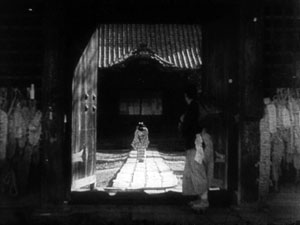
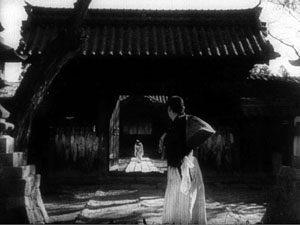
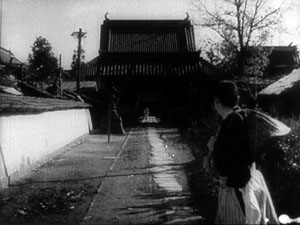
Like the Rashomon sequence, this shows Kurosawa’s fondness for permuting simple patterns. But there’s an expressive payoff too. The framings that make Sayo dwindle to a speck give the axial cuts the forlorn, lingering quality we usually associate with dissolves. In addition, for viewers who know Sanshiro 1, the scene calls to mind the staircase passage we’ve already seen. Their first extended encounter is paralleled by their last one.
Axial cuts are easier to handle when the subject is unmoving, or moving straight toward or away from the camera. What about other vectors of motion? In The Men Who Tread on the Tiger’s Tail, as the general’s bodyguards file out of the compound, they pass a line of soldiers in the foreground. Kurosawa combines concentration cuts with lateral cutting, so our men stalk leftward through the frame once, then again, then again, each time both closer to us and further along the row of soldiers.
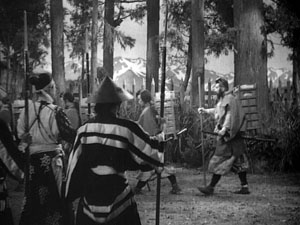
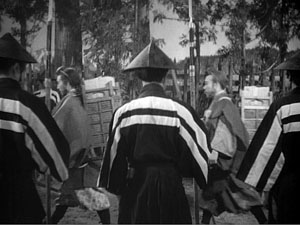
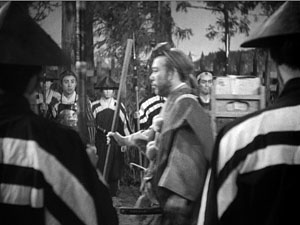
Kurosawa revises other traditional techniques. You can find moments of extended stasis in swordplay films of earlier decades, and the technique surely owes something to the prolonged mie poses in Kabuki. But Kurosawa’s early films turn long pauses into living freeze-frames. Instead of using an optical effect, he simply asks his actors not to move! One combat in Sanshiro shows the audience caught in absolute stillness, staring at the result of Sanshiro’s throw. In Sanshiro 2, our hero and the boxer stand like statues in the prizefight ring until the American collapses. And in The Men Who Tread on the Tiger’s Tail, the groups gathered at the checkpoint are absolutely unmoving for nearly fifty seconds as Benkei leads them in prayer.
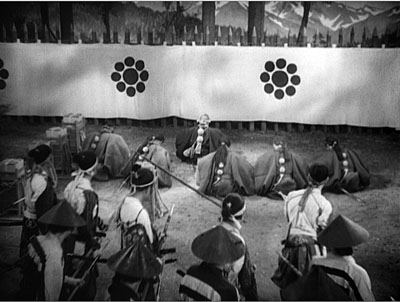
This shot’s tactful, reverential composition echoes a fairly standard image for showing loyal retainers; here’s an example from a 1910s version of Chushingura.
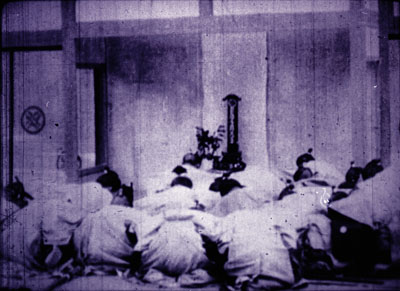
In sum, I think that for his “manly movies” Kurosawa sifted through the Japanese film tradition and pulled out the most vigorous techniques he could find, all the while recognizing that rapid pacing needs the foil of extreme immobility. He compiled a digest of many arresting visual schemas available to him, and then pushed them in fresh directions. He realized as well that he could apply this sharp-edged style to genres dealing with modern life.
A most stubborn young woman
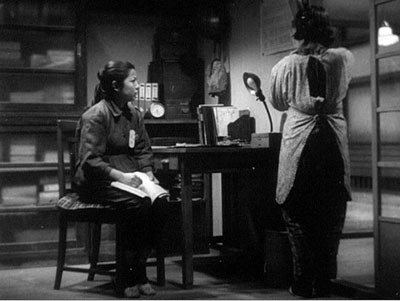
Although we think of Kurosawa as a “masculine” director, two of his finest films center on women. The Most Beautiful and No Regrets for Our Youth can be thought of as propaganda, but this label shouldn’t put us off. Propaganda works partly because it taps deep-seated emotions, and I’d argue that the formulaic nature of a “social command” can allow filmmakers a chance at emotional and formal richness. Because the message can be taken for granted or read off the surface, an ambitious director can go to town—nuancing the presentation, complicating its implications, taking the clichéd message as an occasion for pushing formal experiment. (Which is one aspect of what the Soviet montage filmmakers did.)
The Most Beautiful, probably the best movie ever made about child labor, starts off as a doctrinaire effort. Before even the Toho logo fades in, a title declares: “Attack and Destroy the Enemy.” The first fifteen minutes are filled with pledges to help the war effort, work to meet an emergency quota, obey orders, display filial devotion, build noble character, and think constantly of how making flawless lenses saves soldiers’ lives. The rest of the movie focuses on the pain of doing all this. This story of patriotic affirmation is steeped in tears.
The film’s structure looks forward to the ensemble-based, threaded plotlines employed in Red Beard and Dodes’kaden. We follow various stories, if only briefly, as the teenage girls push themselves beyond the limits proposed by their overseers. The factory directors and the dormitory mother are barely characterized, so that the focus falls on the girls who have left their homes to serve their country. One looks out the window when a train passes; another walks sobbing across a garden made of heaps of earth from each girl’s native village. When one girl falls from a roof, she promises to keep working on crutches. Another hides the fact that she has a fever. In this movie, workers cry out “Mother!” in their sleep.
Sanshiro Sugata pulses with the exuberance of a young man’s body itching for constant movement. Kurosawa’s second film applies his muscular techniques to a static situation: Girls bent over machines. True, there are interludes of a marching and volleyball, the latter calling forth a standardized stretch of montage, but the director’s central task is to dynamize conversations. He finds a remarkable array of options. We get good old axial cutting, but there are also jump cuts (as if the action were too urgent to wait for dissolves), resourcefully simple staging (see this entry), abrupt close-ups, quick flashbacks, and judicious long takes jammed with actors.
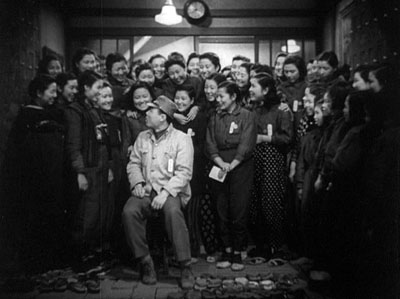
Off on the right stand two tall girls frowning and looking down; their quarrel will burst out in a later scene.
The virtuosity here is quieter than in Sanshiro, largely because of the insistent threat of shame. A Hollywood film of the period might play up the triumphant achievement of the quota, but here this goal fades away. Instead, the plot is driven by a nearly desperate fear of failure. The men in charge offer bluff reassurance, but in a reprise of high-school nerves, the girls fret constantly about doing less than their mates. Their anxiety is translated into gesture-based performance—not through Western hysteria but through gestures of lowering the eyes, bowing the head, turning one’s back. The Most Beautiful has some of the greatest back-to-the-camera scenes in film history, and Kurosawa doesn’t hesitate to insert some of these moments in wide shots, creating a delicate emotional counterpoint. At one moment the girls are distracted by a passing airplane but their leader is sunk in thought; at another moment the girls challenge the leader while her accuser can’t face her.
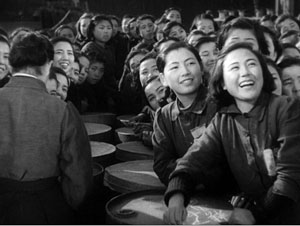
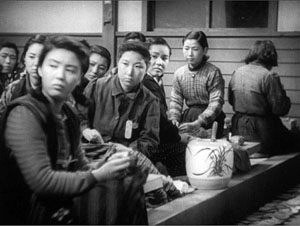
The girls’ stories are woven around Watanabe, the section leader. Somewhat older than the others and nowhere near as spontaneous or joyous, she’s the emblem of unremitting self-sacrifice. If Sanshiro matures in the course of his films, learning the humbling responsibilities of becoming a supreme fighter, she comes to her more mundane task already grown up. Noël Burch has pointed out that Kurosawa’s protagonists are notably stubborn, and Watanabe offers a prime instance.
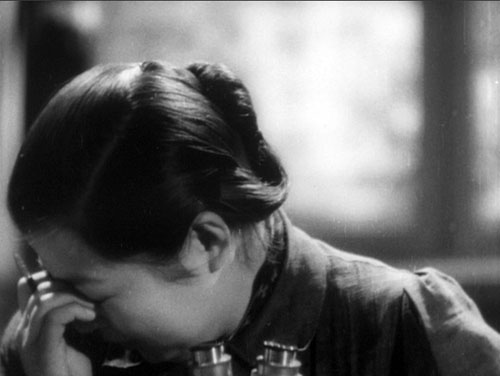
At the climax she has to search through thousands of lenses for a flawed one that she accidentally let through. Kurosawa forces us to watch her, exhausted from hours of work, hunched over her microscope and keeping awake by singing a patriotic song. One shot holds on her groggy efforts for over ninety seconds, so we register both the enormity of her task and her obstinate refusal to quit. This shot will be paralleled by the film’s final one, which lasts almost exactly as long, when she returns to her workbench. Now her concentration is broken, again and again, by quiet weeping. Kurosawa claims that when he made the film he knew Japan would lose the war.
The ending of The Most Beautiful calls to mind a moment in another Kinoshita film, again one released in the same year as Kurosawa’s. Army (1944) ends on a similarly ambivalent note, with a frantic mother pushing through a crowd cheering recruits marching off to war. Through cries of “Banzai!” she stumbles along to get a last glimpse of him, but soon her trembling figure is lost in the excitement. It isn’t exactly an exalted note on which to close a patriotic film.
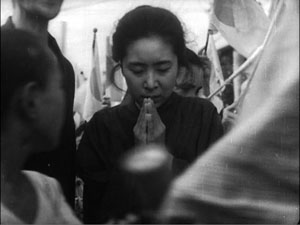
A mother is central to Watanabe’s sacrifice in The Most Beautiful as well, and her plight reminds me of historian John Dower’s telling me that Japanese soldiers may have charged into battle shouting the name of the emperor, but many died murmuring, “Mother.”
Like other filmmakers, Kurosawa had to execute an about-face when the Americans came to occupy Japan. Along with Mizoguchi, Kinoshita, and most others, he began to make films that condemned the “feudal” forces that had led Japan to war and affirmed the need for liberalizing the society, not least with respect to women’s roles. Kurosawa’s contribution was No Regrets for Our Youth (1946), a survey of the 1930s and 1940s through the experience of a daughter of the middle class. At first she’s oblivious to the authoritarian threat and then, awakened to her social mission, she plunges into what we would now call the politics of everyday life. With the same verve that Kurosawa dramatized sacrifice for the motherland, he quickens a liberal fable of emerging political consciousness. Again, he finds ways of making propaganda deeply moving, while leaving his unique stamp on the project.
I hope to write about No Regrets and other Kurosawa titles in the future. But one implication should already be clear. Kurosawa remains on our agenda through his commitment to a mode of storytelling that pursues vigor without lapsing into the diffuse busyness of today’s spectacles. He stretches our senses through staccato action, yet he drills into other moments so implacably that we are forced to see deeper. He lifts certain Japanese and imported traditions to a new pitch, in the process often creating something indelible and enduring.
The point of departure for all things Kurosawa is Donald Richie’s Films of Akira Kurosawa, first published in 1965 and updated since. It was a trailblazing auteur study, written from deep knowledge of the films and many encounters with the director. Another indispensible source is Kurosawa’s Something Like an Autobiography (Knopf, 1982). Although it stops after the success of Rashomon, the book offers fascinating information about Kurosawa’s early life and first films. (“The Most Beautiful is not a major picture, but it is the one dearest to me.”) Information on the later films is collected in Bert Cardullo, Akira Kurosawa: Interviews (University Press of Mississippi, 2008). A biographical overview, with details on each film’s production, is provided in Stuart Galbraith IV, The Emperor and the Wolf (Faber, 2001).
For background on Japan’s wartime cinema, the central work is Peter B. High’s The Imperial Screen (University of Wisconsin Press, 2003). See also John Dower’s magnificent surveys of the war and the postwar period, War without Mercy (Pantheon, 1987) and Embracing Defeat (Norton, 2000).
Noël Burch argues that Kurosawa is best understood as working within a tradition of indigenous Japanese art; his pioneering To the Distant Observer (University of California Press, 1979) is available online here. Linking formal preoccupations to changing subjects and themes, Stephen Prince’s The Warrior’s Camera (Princeton University Press, 1999) argues that Kurosawa was forging heroic figures appropriate to developments in Japanese society. In Kurosawa: Film Studies and Japanese Cinema (Duke University Press, 2000), Mitsuhiro Yoshimoto puts the films in political contexts, while also considering how Kurosawa has been understood within the Western academy.
Critics have long recognized that Kurosawa’s formal inventiveness came with an impulse toward large statement. Brad Darrach reconciled the two tendencies in an overheated specimen of Timespeak:
Not since Sergei Eisenstein has a moviemaker set loose such a bedlam of elemental energies. He works with three cameras at once, makes telling use of telescopic lenses that drill deep into a scene, suck up all the action in sight and then spew it violently into the viewer’s face. But Kurosawa is far more than a master of movement. He is an ironist who knows how to pity. He is a moralist with a sense of humor. He is a realist who curses the darkness—and then lights a blowtorch.
This comes from “A Religion of Film,” a remarkable primer on the art cinema in its American spring. It was published in Time of 20 September 1963 and is available here. The same antinomy of stylist vs. moralist persists, with less complimentary results, in Tony Rayns’ obituary in Sight and Sound (October 1998), p. 3 and in Dave Kehr’s recent review of the Criterion boxed set.
I wrote about Kurosawa’s work in our textbook Film History: An Introduction (third edition, McGraw-Hill, 2009), pp. 234-235 and 388-390. My larger arguments about classic Japanese film can be found in Ozu and the Poetics of Cinema (online here) and in two articles in Poetics of Cinema (Routledge, 2008), “A Cinema of Flourishes: Decorative Style in 1920s and 1930s Japanese Film” and “Visual Style in Japanese Cinema, 1925-1945,” which analyzes some of the films I’ve considered here. I talk a little more about editing in Seven Samurai in this entry. In another I discuss how Kurosawa’s “humanism” fits into one 1950s ideological framework.
Yamanaka’s Humanity and Paper Balloons is available on DVD in the Eureka! series. For a cinematic homage to early Kurosawa, see Johnnie To’s Throw Down.
Thanks to Komatsu Hiroshi for supplying the date of Faithful Servant Naosuke. And as a PS, thanks to Luo Jin for pointing out a “slip of the finger”: the original post had Kurosawa older than Ozu!
PPS: 9 December: The Criterion site has just posted a reminiscence of Kurosawa by Donald Richie.
PPPS: 15 May 2010: Criterion has just announced that the four films discussed in this entry will be released as a separate collection on the Eclipse label.
Daisies in the crevices
DB here:
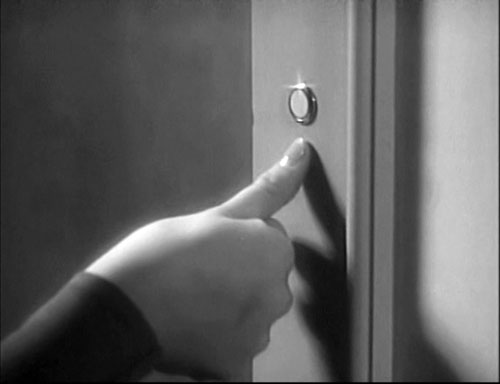
If you wanted a prototype of some unique visual pleasures of 1930s cinema, you could do worse than pick this innocuous image. It’s perfunctory in narrative terms, merely telling us that Sylvia Day is calling on Bill Smith. Beyond its plot function, though, it’s fun to see. We can enjoy the unfussy modern edge of the doorjamb, the curve of the manicured thumb, and soft highlights bringing out the hand and knuckles.
Above all, there is that starry gleam at the top of the doorbell. Who needs it? It’s just a doorbell. Why take so much trouble lighting a throwaway shot?
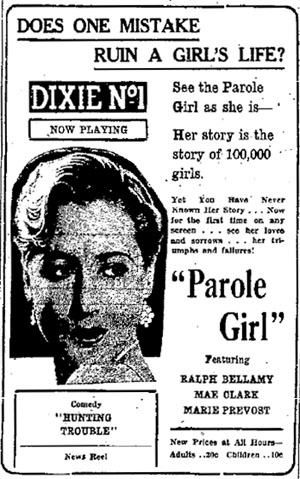
Add to this that Parole Girl (1933) is a program picture, and from Columbia, no less—the Poverty Row studio that had yet to break through with It Happened One Night (1934). We learn from Bernard F. Dick’s deeply-researched book on Harry Cohn that the budget for Parole Girl would have been about $250,000, when MGM B’s were running about $400,000. Why spend money on a shot like this?
Because that was the standard of good-looking moviemaking at the time. Most problems of converting to talkies had been solved, so films were regaining not only the fluent narration but the sparkling imagery of 1920s cinema. Under Cohn’s leadership, Columbia was trying to compete with the bigger studios’ movies, and looking classy was one way to do it. Recently I spent a day or so watching four titles, and I was reminded how pictorially sophisticated and refreshing low-end Hollywood can be. These movies also offer us an unusual window into what was already characteristic storytelling strategies of classical Hollywood. But there will be spoilers ahead too.
Welcome to 1933
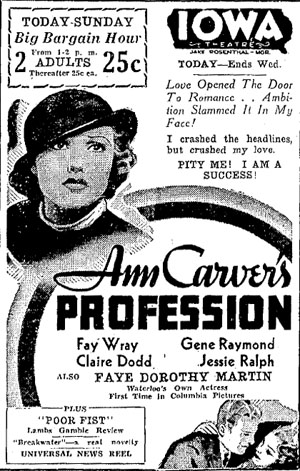
As so often, I have TCM to thank. Since their Jean Arthur tribute of 2007, they have been running a generous number of Columbia titles (all restored by the master hand of Grover Crisp). By including less-known 1930s items along with classics like The Awful Truth and the Capra titles, they continue their mission of serving American film culture every hour.
Lea Jacobs has convinced me that it’s useful to think of studio releases in those days as filling a season running from Labor Day to Memorial Day rather than a calendar year. Studio heads planned budgets and production schedules according to that time frame, like network TV broadcasters now. Unlike today, summer was not a big release period, maybe because of the competition of other leisure activities, maybe because with air-conditioned movie houses people would come watch anything thrown on the screen. In any case, the big pictures were saved for fall, winter, and spring.
So my frame of reference is the 1932-33 season. Columbia ushered in the new year with its best-remembered film of the season, Capra’s Bitter Tea of General Yen (6 January). The studio probably considered Washington Merry-Go-Round (15 October), Virtue (25 October), and No More Orchids (15 November) to be A projects, but the large output of Westerns, the absence of historical pictures, and the relative dearth of stars in this output confirm the studio’s status as a Poverty Row company.
My movies come from the winter and spring of 1933. Each was shot in two to three weeks and each runs about seventy minutes.
Air Hostess (15 January, directed by Albert Rogell) tells of the daughter of a WWI ace who marries a reckless young pilot. Trying to build a new type of plane, he shops his business plans to a rich woman investor, who tries to seduce him.
In Child of Manhattan (4 February, directed by Edward Buzzell), a wealthy widower falls for a taxi dancer and takes her as his mistress. When she becomes pregnant, he marries her. But the baby dies soon after birth and the wife flees to Mexico for a divorce while the husband tries to track her down.
In Parole Girl (4 March, directed by Edward Cline), a department store executive sends a woman con artist to prison. She vows revenge. When she gets out, she seduces the executive, although he’s unaware of who she is.
Ann Carver’s Profession (26 May 1933, directed by Buzzell) centers on a couple torn by career rivalry. After being a gridiron hero in college, the husband is failing as an architect. Meanwhile, his wife is becoming a celebrated trial lawyer. Eventually the husband leaves the household and takes up with a floozie, who winds up strangled. His wife must defend him against the murder charge.
For connoisseurs of naughty pre-Code movies, there are the usual attractions of double beds, extramarital sex, peekaboo negligees, and risqué dialogue. Child of Manhattan goes the farthest, perhaps because it’s an adaptation of a Preston Sturges play. “You’re a fascinating little witch,” says the millionaire. “Did you say witch?” the dancer asks. This is the same girl, played by perky Nancy Carroll, who thinks the man is trying to feel her up when he slips a thousand-dollar bill into her garter. Later she recalls her mother’s advice: “Never, ever walk upstairs in front of a gentleman.” And when she confesses to her Texan admirer in her mangled pronunciation, “I’m a courtesian,” he pauses and replies, “Well, religion doesn’t make any difference with me.”
Despite such pleasant moments, and two screenplays credited to Robert Riskin and Norman Krasna, these movies won’t win prizes for imaginative scripting. The tone is often uncertain, with comic banter clashing with scenes of melodramatic sacrifice. The long arm of coincidence becomes elastic. In Parole Girl, the heroine happens to meet the offending executive’s first wife in prison. During the taxi dancer’s stay in Mexico, she runs into the cowpoke who had wooed her aggressively in Manhattan. In Ann Carver’s Profession, the husband’s girlfriend accidentally strangles herself. Yes, you read that correctly.
Still, you have to give points for speed. Only Parole Girl has unusually quick cutting, at an average of 6.6 seconds per shot, but the overall pace of most of the plots is pretty rapid. (The exception is Child of Manhattan, whose lumbering dramatic rhythm is echoed in an average shot length of sixteen seconds.) Playing far-fetched action fast makes it less noticeable and more forgivable. Today any movie that can tell a moderately interesting story in a little more than an hour feels like a triumph. You can watch two of my pictures in the time it takes to groan your way through Funny People. And in these movies, the opening credits flash by in less than fifty seconds. Those were the days when crafts people under contract didn’t have to be acknowledged, and there were no executive producers.
Apart from Capra, whom do we remember as a Columbia director? Probably not my three guys. Albert Rogell, director of Air Hostess, began directing in the early 20s and worked for Columbia, Tiffany, Monogram, RKO, Universal, and Paramount. A prototypical B filmmaker, he signed over a hundred films in twenty-five years. Edward Buzzell was somewhat more prominent. After Ann Carver’s Profession, he left Columbia for Universal and eventually moved to MGM, where he directed (as if that were possible) the Marx Brothers in At the Circus (1939) and Go West (1940), as well as helming Song of the Thin Man (1947). Like Rogell, Edward Cline (Parole Girl) skipped among studios; like Buzzell, he landed on his feet with comedian comedy, steering W. C. Fields through You Can’t Cheat an Honest Man (1939), My Little Chickadee (1940), and other vehicles. In all, studio artisans, yes; auteurs, no.
Two Joes and a Ted
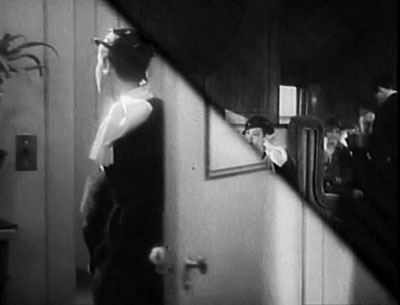
Parole Girl
If you’re interested in how Hollywood tells its tales, there’s a fair amount to chew on in these modest releases. The scripts tend to obey Kristin’s four-part model, adapted to very short running times, with the key turning point taking place midway through the film. Despite the coincidences, the characters’ goals and changes of heart tend to be planted early. In Ann Carver’s Profession, Ann’s intense ambition and Bill’s swaggering overconfidence prepare us for the crisis in their marriage, when each is unwilling to compromise.
 As for performances, perhaps the very speed of production forced actors to play naturally. True, Fay Wray is a bit arch as Ann Carver, but Gene Raymond as her husband moves convincingly from boisterousness to self-doubt. In Child of Manhattan, John Boles, trying to mingle with the little people, can be stiff, but Nancy Carroll has pep, and Buck Jones as her cowboy swain adds a welcome dose of naive gallantry. All three show how important distinct voices had already become: Boles mellifluous, Carroll up and down the scale, Jones slow and sincere. Reliable Columbia regular Ralph Bellamy shows up in Parole Girl, but more memorable is the performance, or rather presence, of Mae Clark. When she comes back from prison bent on vengeance, she’s a glowering figure in her stylishly chopped hairdo.
The films make fluent use of storytelling devices that predate the 1930s but are forever associated with that decade. Sequences are linked through headline montages and wipes, recently made possible by the optical printer. There are more elaborate techniques too, particular the visual or auditory hook connecting scenes. We’re not surprised to see commonplace instances, as when a note pad listing an apartment number dissolves to that number on the door. In Air Hostess, however, a spinning propeller gives way to a roulette wheel, and this association does a little more work, linking Ted Hunter’s reckless flying to his gambling and his general tendency to take risks.
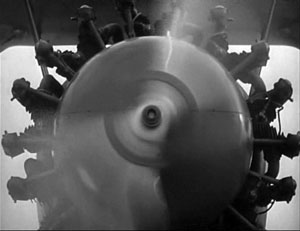
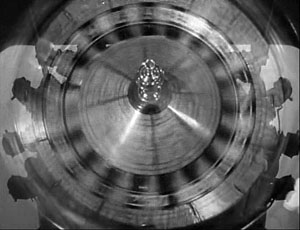
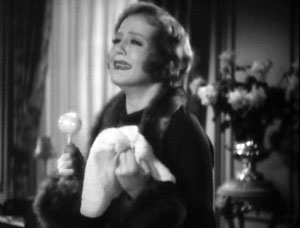
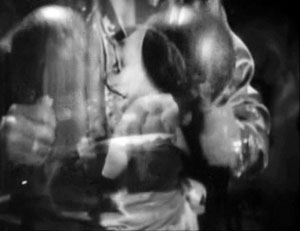
In Child of Manhattan, as Madeleine resolves to leave her husband after the death of her child, she tearfully shakes a baby rattle, and this dissolves to marimbas in a nightclub, swiftly turning her pathos into her effort to start a new life with a Mexican divorce.
But what is perhaps most striking about these films is their photography. Ten minutes into Air Hostess, the first one I watched, we get a lovely sustained track into a sunny airfield, our view guided by the walkway wheeled up to a plane door as passengers step out.
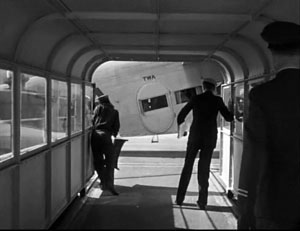
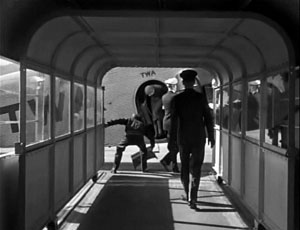
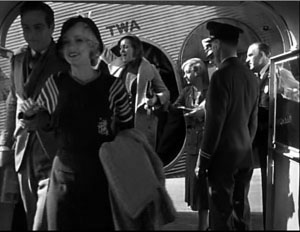
The relaxed play of light and shadow in this geometrical shot yields one of those fugitive visual delights that classic cinema so often supplies.
What’s it doing in a Columbia programmer? This Poverty Row studio realized that they could give their pinched budgets an upscale look with polished cinematography. Accordingly, you can argue that the biggest talents on the Columbia lot were the directors of photography. Our four films were shot by ace DP’s.
Joe August (Parole Girl) was the grand old man. He filmed some of the best-looking hits of the 1910s, including Ince’s Civilization (1916) and a great many William S. Hart movies (including Hell’s Hinges, 1916). In the 1920s and up to 1932 he worked at Fox on films by Ford, Hawks, and Milestone. At Columbia August would shoot Borzage projects like Man’s Castle (1933) before moving to RKO for Sylvia Scarlett (1936), Dance, Girl, Dance (1940), and the flamboyant All That Money Can Buy (aka The Devil and Daniel Webster, 1940).
Another Joe, somewhat younger, was no less gifted. Joseph Walker, the DP of Air Hostess came to Columbia early and soon teamed with Capra; he would shoot twenty movies with the director, including the splendid American Madness (1932), a particular favorite of mine. Walker stayed loyal to Columbia, shooting Only Angels Have Wings (1939), His Girl Friday (1940), Penny Serenade (1941), and on and on—returning to Capra for the independent production It’s a Wonderful Life (1947). Walker also patented an original zoom-lens design.
Ted, sometimes known as Teddy, Tetzlaff was another Columbia loyalist, and he certainly cranked them out. Hawks’ The Criminal Code was one of eleven movies Tetzlaff was credited with in calendar 1931. But by the spring of 1933 he seems already to have become a free lance, eventually working at Paramount on a string of classics (Easy Living, Remember the Night, Road to Zanzibar), then RKO (The Enchanted Cottage, Notorious), and occasional jobs back at Columbia. Tetzlaff became a director as well, remembered chiefly for the cult classic The Window (1949).
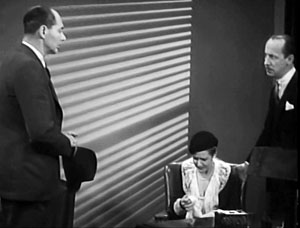
No wonder my four films dazzle, even on TV. According to Bob Thomas’s biography King Cohn, Columbia took special care to create a phosphorescent look through careful processing that enhanced the DPs’ efforts. Hence not only the sparkle on a door buzzer but glowing applications of then-standard edge lighting. Hence as well the use of striped shadows to suggest venetian blinds, a convention we associate with the forties but here in precise array (Child of Manhattan, Parole Girl).
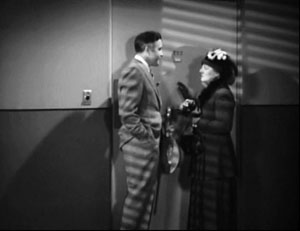
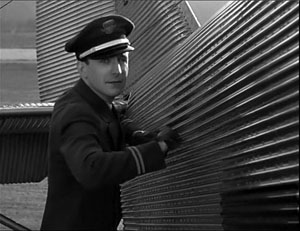
Trust Joe Walker to provide a little of that striped texture with a fuselage.
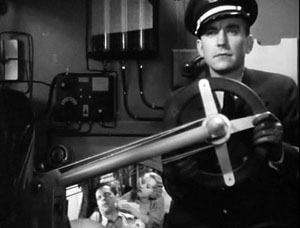
Hence too some striking depth. Here is the next-to-last shot of Walker’s work in Air Hostess, the sort of fancy aperture composition that crops up surprisingly often in the 1930s.
Tetzlaff, first in Child of Manhattan and then Ann Carver’s Profession, seems to be fooling around with faces and elbows.
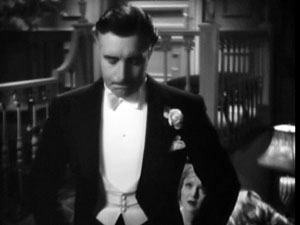
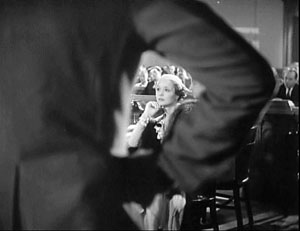
Probably the most visually and narratively complex of my films from spring 1933 is Ann Carver’s Profession. It’s possible that it was Columbia’s equivalent of an A production: Gene Raymond was a mid-range star known for a few Paramount and MGM pictures, and Fay Wray’s King Kong had premiered a week before filming started. Whatever the cause, Ann Carver has more complex plotting and more consistently inventive visuals than the three other titles.
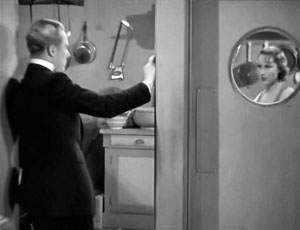
From the very start, when gridiron hero Bill promises to provide for Ann the waitress, we get the sort of offhand flash that I like in 1930s movies. As Bill follows Ann into the kitchen, she’s framed in a swinging door and the camera moves closer to pick up their clinch.
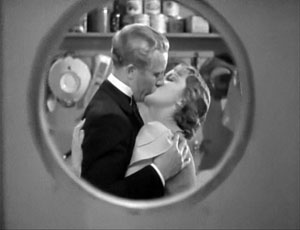
Once they’re married, the circle has become a rectangle, and trouble is on the way.
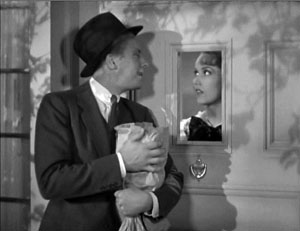
There are fancy mirror shots, pov constructions that lead characters to the wrong inferences, and examples of the big-foreground compositions that would come to prominence in the 1940s.
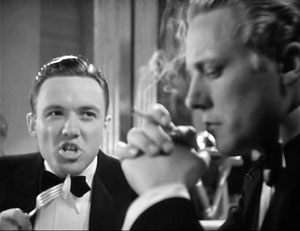
The trial recesses; crane up to the clock; spin the hands to cover a couple of hours; crane back to the trial resuming. Or start with Bill’s girlfriend, passed out and garroted by the necklace that has snagged on a leering chair carving. Dissolve to Bill’s night on the town, before ending that fuzzy montage with a dissolve back to the chair carving.
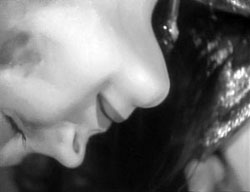
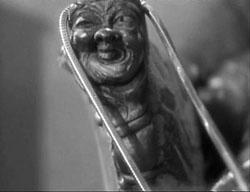
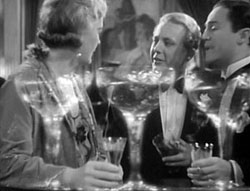
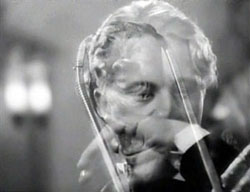
Bill didn’t kill her, but the pictorial logic makes him almost magically responsible, with the carving mocking him for what’s to come.
Above all there is one of the most laconic (and cheaply filmed) courtroom montages I’ve ever seen. A string of witnesses testifies, and after a newspaper pops out the first one, we get a fusillade of extreme close-ups, cut very quickly.
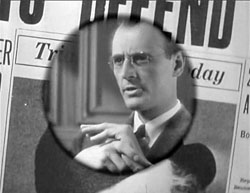
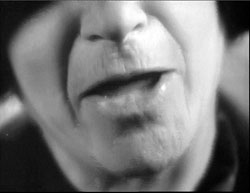
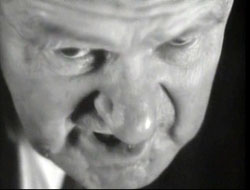
Just as striking is the coordinated sound montage, which reduces the testimony to clipped sentences, then phrases (“”Four-thirty!” “Quarter to five!” “Both of ‘em!”), then single words (“Drunk!” “Drunk!” “Strangulation!”), all damning Bill. Why take us through all the rigamarole—people sworn in and questioned at length—when you can give the essence of it in twenty-eight shots and twenty-five seconds?
My 1933 quartet contains no great film; perhaps none is worth more than one viewing. But what I learned from watching ordinary movies for our Classical Hollywood Cinema book is borne out by my soundings here. We can enjoy seeing a well-honed system steering us through a story, especially when gifted people like Teddy and the two Joes are shifting the gears. We can appreciate the opportunities for grace notes in what some call formula filmmaking. And we can see that this lowly studio, making films ignored in traditional histories, has something to teach filmmakers today: proud modesty. A film can radiate pride in being concise, in exercising a craft, and in telling a story that hurtles forward while shedding moments of casual beauty.
Most critical writing on early 1930s Columbia pictures focuses on Frank Capra, but there is good general background in Bernard F. Dick, The Merchant Prince of Poverty Row: Harry Cohn of Columbia Pictures (Lexington: University Press of Kentucky, 2009). My mention of budget levels comes from his discussion on pp. 119-120. An older, citation-free but still helpful biography is Bob Thomas, King Cohn (Beverly Hills: New Millennium, 2000). In-depth information on Joseph Walker as a Columbia cinematographer is available in Joseph McBride’s excellent biography Frank Capra: The Catastrophe of Success (New York: Simon and Schuster, 1992), 189-215. Walker’s engaging autobiography supplies nothing specific to these films, but he sprinkles technical information among its anecdotes. See Joseph Walker and Juanita Walker, The Light on Her Face (Los Angeles: ASC Press, 1984).
On 1934 as the end of naughtiness, see Tom Doherty’s Pre-Code Hollywood. For a skeptical account of the idea of Hollywood “before the Code,” see Richard Maltby, “More Sinned Against than Sinning [2003],” in Senses of Cinema here, and essays in “Rethinking the Production Code,” a special issue of The Quarterly Review of Film and Video 15, 4 (1995), ed. Lea Jacobs and Richard Maltby.
If you’re interested in more complicated narrative strategies in films of this period, try our entry “Grandmaster Flashback.” For another take on low-budget 1930s films, there’s our entry on Mr. Moto and Charlie Chan.
Searching for surprises, and frites
DB here:
Studying film history ought to be continually surprising. Yes, you often find your hunches and assumptions confirmed (which often means it’s time to check them again). But sometimes you find stuff coming out of left field that you had never expected. It would be too pompous to call these items breakthroughs, but every historian knows the little burst of pleasure that comes from seeing something that makes you say: How odd. I didn’t expect that. You might even allow yourself a Wow! now and then.
I was saying wow a fair amount during my two weeks in Brussels this summer. I go regularly, and not just for the moules, frites, and stoemp. I go to the Royal Film Archive, where I study old films. This time I was continuing to pursue some research questions that drove me in 2007 and 2008. What staging and editing strategies are at work in films of the crucial years 1910-1917? How might we explain the continuities and changes we find? I’m a long way from answering these questions fully, but I found some fresh and intriguing instances. One surprise is worth half a dozen confirmations.
Divas on parade
This year I concentrated on European movies. One of the most prominent genres of Italian cinema was the diva film, the movie whose dominant attraction was a beautiful, often fiery, somewhat otherworldly female star.The mesmeric charms of the genre have been celebrated in Peter Delpeut’s anthology film Diva Dolorosa, but the films really need to be seen in their entirety. The most comprehensive book on the subject is Angela Dalle Vacche’s Diva: Defiance and Passion in Early Italian Cinema, while my Wisconsin colleague Lea Jacobs has published detailed analyses of diva performance in Theatre to Cinema and here on the web.
In the 1910s, American cinema was turning out fast-paced films, but the diva films I saw provided less complex plots and remarkably protracted acting. An emblematic instance is the climax of Rapsodia Satanica (1917), starring Lyda Borelli. Alba has sold her soul to Mephisto in order to recover her youthful beauty. She toys with two men’s affections, and one kills himself (mysteriously leaving a scar on her face). The plot more or less halts.
Alba retreats into her chateau and wanders the grounds. She glides forlornly through her garden, idles at the piano keys, and drapes herself along a bridge. She strews flowers on the floor and even dresses herself up as a priestess. Most strikingly, she floats into a cluster of mirrors and drapes herself in layers of veils, creating a gauzy shroud.
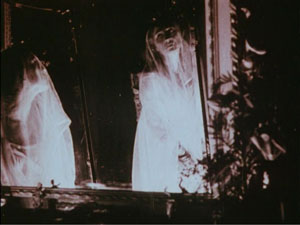
Run at 16 frames per second, this cadenza of apparitions consumes nearly a minute and a half. Such an exercise in atmospherics might be considered wasteful in an American film of the time, but it enhances the expression of Alba’s late-blooming spirituality—just before Satan comes to claim his pledge.
The same sort of languid choreography can involve other players. The diva’s performance, as Jacobs has shown, is often closer to dance than to orthodox acting, and she can weave arabesques around her more or less stationary suitors. At times the diva is a virtual acrobat. If you can call a contortion graceful, we can find it in the angular wrist maneuvers of Borelli in La Donna Nuda (1914).
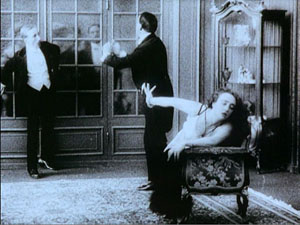
The diva’s divagations are usually shot from a distance, and often there are big sets that are cleared of other actors to allow the actress maximum freedom and minimum distraction.At key moments, there might be a straight cut-in to the diva in medium-shot, but the visual narration keeps our attention fixed on a single arresting figure.
This tendency varies from the sort of ensemble staging that I’ve studied in more detail in On the History of Film Style and Figures Traced in Light. The staging is based upon the diva’s decorative elaboration of her emotional states, rather than in the shifting configuration of several actors. This difference reflects a variation in pace as well: The diva’s subtle changes of expression and posture emerge gradually, but the behavior of actors in ensemble scenes tend to accelerate the flow of action and reaction.
The spotlighting of the diva was not a big surprise, perhaps, but at least a reminder that there are always several tendencies at work in film in any period. More unexpected was the opening sequence of Il Fuoco (1915), in which the heroine visits a lake for a sketching session. As she sits down, a painter arrives to do some painting of his own. There follows a sequence of fourteen shots taken from eleven camera setups, some quite close to the actors. The sequence displays the sort of orthodox continuity that we associate with American films of the same year (The Birth of a Nation, Regeneration, The Cheat).
Granted, European films of the 1910s display freer camera setups in exterior settings than in interior sets. Still, the director of Il Fuoco, Giovanni Pastrone, shows an intuitive mastery of angled shot reverse-shots and consistent eyelines. It makes me eager to see whether other European filmmakers were developing a tradition of continuity editing akin to the American one.
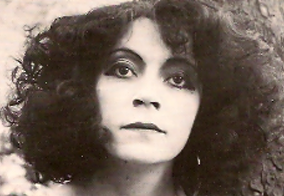
Asta Nielsen was, so to speak, a Danish-German diva. A beanpole with a long face and a slash of a mouth, she might seem an unpromising vessel for languid eroticism. Yet Die Asta became an icon of silent film after her sultry dance in Urban Gad’s Afgrunden (The Abyss, 1910) won her an international audience. In Germany she turned out a vast number of dramas and comedies, with her as undisputed main attraction. Lest we think that the term “star” is a modern one, the title card for S1 (1913) is already playing a coy game.
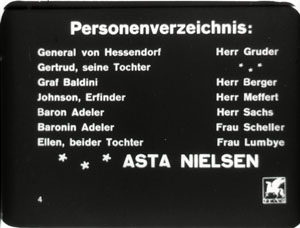
Again, with the spotlight on the heroine, the director’s decision can be simple. Evacuate the set and bring her closer to the camera, or if the set is cluttered, cut in to let Asta act.But she’s refreshingly unethereal, with changes of expression that are fleeting and unpredictable. At a lake with her lover, she flashes her legs at the camera and gives us a grin.
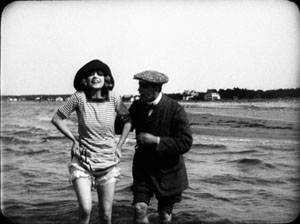
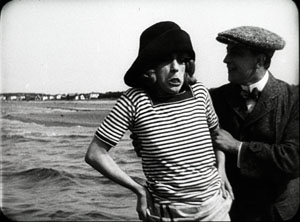
But a few frames later, her grimace becomes downright grotesque as she picks her way to shore. You can easily imagine her fear of losing her balance or stepping on a sharp stone.
Strong-willed and resourceful, Asta projects a wary intelligence. This, of course, doesn’t keep her from falling in love with worthless men.
Colorforms
Today’s archivists are determined to restore silent films to their original beauty, which includes the gorgeous colors achieved by tinting, toning, stencil coloring, and other techniques. Earlier this year Josh Yumibe came to our campus with a splendid collection of frames illustrating the range of possibilities. I saw several colored prints during my Brussels stay, including some original nitrate copies. Two from 1911 were films now acknowledged as “specialist classics.”
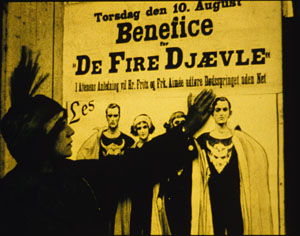
The Four Devils, directed by Robert Dinesen, is one in a cycle of circus films that was popular in Denmark at the period. A team of trapeze artists includes two men and two women; one couple has a steady romance, the other is fractured by the man’s attraction to a rich woman. Once Aimée is convinced of Fritz’s infidelity, she decides to kill him during a performance. The climactic “death leap” is rendered in about thirty shots, including one of an empty trapeze bar swinging. Under the big top, the compositions are full of detail and yet clearly laid out. And Dinesen reveals Aimée’s plan in one of the most ominous shots in silent Danish film.
Even more visually remarkable is Victorin Jasset’s Au pays de ténébres (In the Land of Shadows, 1911), a grim naturalistic drama set among coal miners. The film occasionally displays principles of depth staging that would be elaborated in some of the masterpieces of 1913. In one scene, the miners’ families gather in an anteroom. As they wait to identify the men killed in a cave-in, the bodies are barely discernible in the distance.
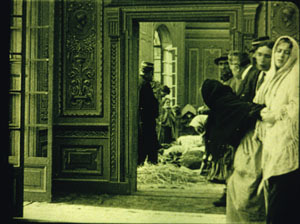
Au pays de ténébres illustrates a sort of structural usage of color. In scenes like the one above, the color is, in orthodox fashion, denoting a daylight interior. By contrast, the scenes in the mine are tinted blue, the standard hue for night and darkness.
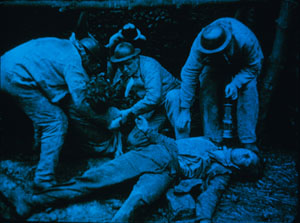
But in the final scenes of the bodies assembled in the room of the dead, the color retains a blue cast, recalling the mine.
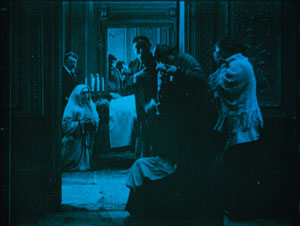
Thanks to the tinting, the living find themselves in the land of shadows.
Early auteurs
In the 1910s, we can find some distinct directorial approaches. One auteur is the German Franz Hofer, who liked to frame his actors in symmetrical architecture. Rectangular geometries are given a comic cast in Fraulein Piccolo (1915), a story about flirtatious officers and a schoolgirl forced to be both maid and bellboy. Here, two servants open doorways to watch a soldier starting to seduce the heroine.
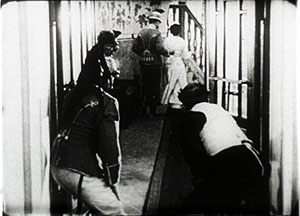
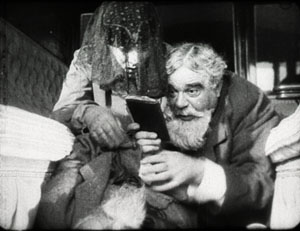
I hadn’t expected to find surprises in Henri Pouctal’s Chantecoq, a two-part French feature from 1916. Yet this espionage drama was consistently engaging, and not just because the popular comedian Pougaud played the deceptively naïve hero. Pouctal unrolls his scenes in an unusual variety of setups, including an astonishing low-angle view of two spies grappling with Chantecoq on the floor of a train compartment. The image recalls Anthony Mann’s steep railway compositions in The Tall Target.
Alfred Machin was Belgium’s preeminent director of the 1910s. He never seems to have seen a windmill he didn’t want to film, then burn down or blow up. Machin enjoyed recording Belgian folk culture, particularly village dancers, as is evident in classic one-reelers like Le Moulin maudit (The Accursed Mill, 1909), and he had a fondness for jungle cats like Mimur the leopard.
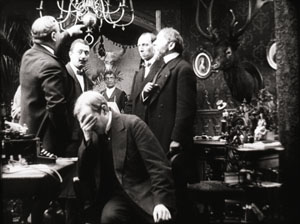
Each of the Machin features I saw shed light on my research questions. Le Diamant noir (The Black Diamond) confirmed that the European tableau style was by 1913 achieving considerable intricacy. In this film, Luc, a rich man’s secretary, is accused of stealing the daughter’s bracelet. The scene of the police interrogation is a muted ballet of figures retreating, advancing, blocking, and revealing.
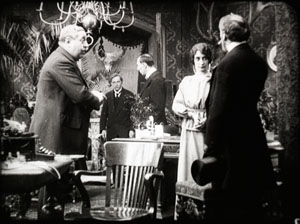
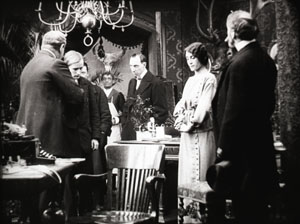
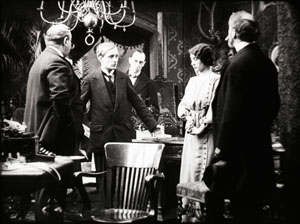
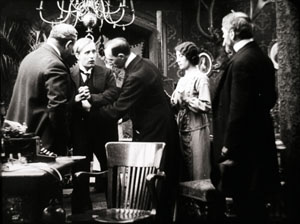
The servant in the far distance returns to visibility when he’s needed to show the cops to Luc’s room.
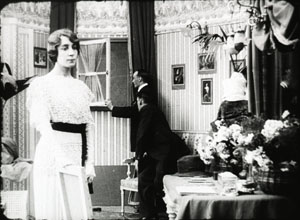
In Machin’s La Fille de Delft (The Girl from Delft, 1914), the tableau depth cooperates with some muted cutting. Kate is a famous dancer, visited by Jef, the young shepherd who has loved her since she was a girl. In her dressing room, while stage-door roués wait to take her out for dinner, she gets a message from him.
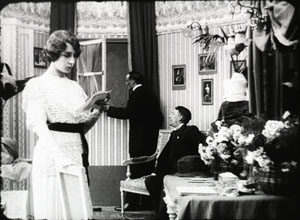
As she lowers the note, she makes her two playboy admirers more visible; we can see them opening the window.
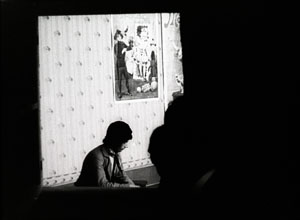
They peer out, and we get an over-the-shoulder shot of Jef waiting outside.
When we cut back to the master shot, the men are mocking him and Kate is deciding whether or not to admit him. She goes to the window herself and looks outside. Again we get the over-the-shoulder framing, but in two beats: Kate looking, then Kate looking away.
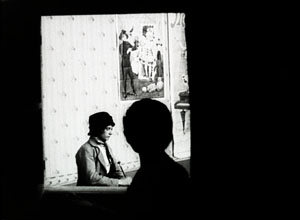
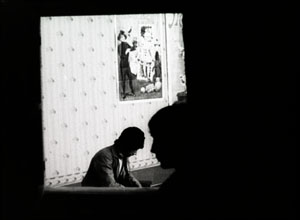
The poignant framing lets us linger on her moment of decision. When she closes the window, we know that she has decided to abandon her childhood friend.
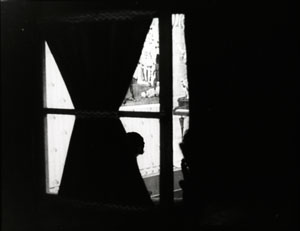
Simpler in its drama and staging is Machin’s official classic, Maudite soit la guerre (Cursed Be War, 1914). Adolphe, a young man from a country suspiciously similar to Germany comes to Belgium, or a place like Belgium, to learn aviation. Adolphe falls in love with his host’s daughter Lidia, but soon war breaks out between their countries and they must part. The rest of the film, which includes some spectacular aerial scenes (and, naturally, a burning windmill), pleads for peace and brotherhood. Released in May of 1914, Machin’s anti-war film now seems a futile warning.
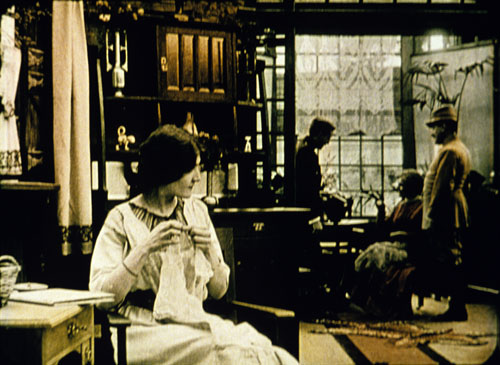
The Archive has restored the original’s Pathécolor, creating images of great loveliness. Some scenes show stenciled color, which helps articulate the planes of shots arrayed in depth. An example surmounts this blog entry. At other moments, deep red tinting enhances the battle scenes, notably one of an exploding dirigible.
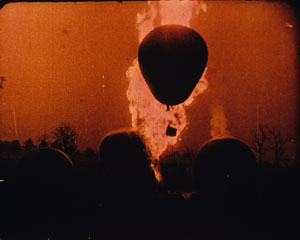
In all, this outstanding restoration of Maudite soit la guerre reminds us of what audiences actually saw—films of deeply felt emotion, often accentuated by spectacular action like that on display today, and employing color with both intensity and delicacy.
The restorer’s art

During my stay, I particularly enjoyed the time I spent with Noël Desmet, supervisor of restorations at the Belgian Film Archive. Noël invented the most robust method of recovering silent film color. Around the world, archivists have adopted the Desmet system.
Noël is scheduled to retire in April of next year. His research will be continued by his colleagues, and he will enjoy some well-earned time among his orchids. Film culture rests upon the shoulders of committed archivists like him. Noël Desmet and his peers are the guardians of treasures, the patient preservers of the secrets and surprises harbored by the twentieth century’s most powerful art form.
For more on tableau staging in Europe and the US, see the entries linked above, as well as my notes from this summer’s visit to the Danish Film Archive, some comments on acting styles, my discussion of Charles Barr’s idea of gradation of emphasis, and an entry on hands and faces around a table. The most thorough analyses of these and other staging principles are in On the History of Film Style, Figures Traced in Light, and certain chapters of Poetics of Cinema.
For more information on Machin and Mimur, see the bilingual book edited by Eric de Kuyper, Alfred Machin Cinéaste/ Film-maker (Brussels: Royal Film Archive, 1995).The Diva Dolorosa disc contains extracts from major films, but unfortunately they aren’t specifically identified, and the original cutting patterns aren’t always respected. The difficulty with such celebratory appropriations of silent films is that they are unreliable as historical evidence. Worse, in today’s commercial market, such compilations make it unlikely that other video producers will launch complete DVD versions of the films.
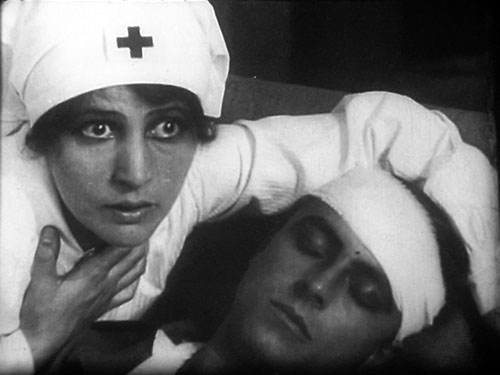
Tagebuch des Dr. Hart (Dr. Hart’s Diary, Paul Leni, 1916)
PS 18 August: Thanks to Armin Jäger for a name correction!
Back in Bologna
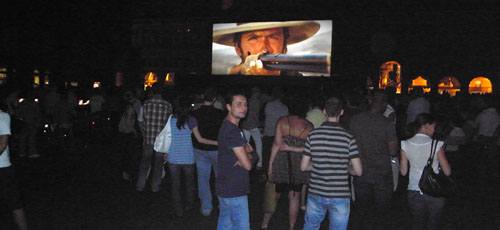
The newly restored version of The Good, the Bad, and the Ugly on the Piazza Maggiore.
Kristin here-
This year, the main complaint about Il Cinema Ritrovato, the annual festival held by the Cineteca Bologna, is that there’s too much to see. With three venues playing films against each other, plus the 10 pm screenings each evening in the Piazza Maggiore, there’s no way to see everything. Some people complain that the conflicts are becoming worse-but I remember these same complaints about the over-abundance of films coming in previous years as well. Yes, it’s frustrating at times, but being offered more films than one can watch is a problem a lot of people would love to have. Basically one either chooses a couple of threads to follow through or just goes to whatever appeals in any given time slot.
According to the 2009 festival’s newsletter, there were 810 attendees, including 557 from outside Italy.
This year there have been several main focuses: a retrospective of Frank Capra’s silent and early sound films; a portion of the Cinémathèque de Toulouse’s program of Jewish-themed Russian and Soviet cinema from the 1910s to the late 1940s; a selection of color films from the early years of the twentieth century to the 1960s; a survey of the work of Vittorio Cottafavi; the annual “100 years” program, this time from 1909; the sea films of Jean Epstein; the silent Maciste films; and many other items.
Even between the two of us, we could not take in nearly all of the riches on offer, so here’s some of what I managed to see, with David’s report to follow.
An annual hundredth birthday
Each year the festival has a thread of programs of films from one hundred years earlier. This tradition started in 2003, when Tom Gunning was asked to put together groups of films from 1903. Thereafter Mariann Lewinsky took over as programmer for these threads. In recent years, her choices have been supplemented by small groups of films chosen by individual national film archives. This year Tom programmed the 1909 Griffiths and a group of other U. S. titles.
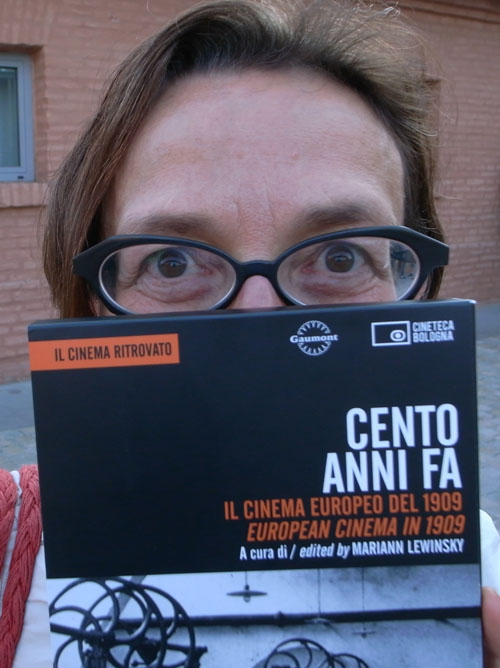
Maybe it’s just my impression, but the hundred-year packages seem to gain in prominence and popularity each year. Presumably in response to such popularity, the festival has just released a DVD with a selection of 22 shorts from this year’s 1909 program: Cento anni fa: Il cinema Europeo del 1909/European cinema in 1909 (running two hours and twenty minutes and presented below by Mariann). It contains only about a fifth of the roughly 100 films screened, but many of the others are available in online archives. DVDs of previous years’ programs are in the works, with 1907 soon to come. The DVD and other publications of the festival are available here.
I managed to see most of the 1909 programs but obviously can mention only a sampling. Undoubtedly the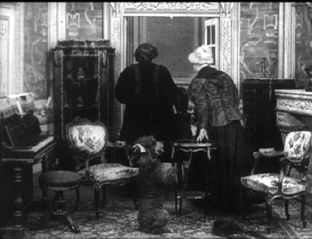 highlight for me and others I talked to was Albert Capellani’s L’Assommoir, notable for its skillful and intricate staging and splendid performances. It looked more like a film from 1912 or 1913. During the comedy, Un chien jaloux (a Gaumont one-reeler by an unknown director, left), pianist Donald Sosin had the audience in stitches by providing barks, whines, and growls as appropriate. (It’s included on the DVD, alas, without the sound effects.)
French director Alfred Machin contributed two excellent dramatic films, both involving windmills: Le Moulin maudit (also on the DVD) and, in the program of early color films, L’Ame des moulins. Comedy stars were represented by two Cretinetti films and a strange Max Linder film in which he becomes Amoreux de la femme à barbe (“Infatuated with the Bearded Lady”).
There were a great many documentaries giving glimpses into the world of 1909. Airplanes were much in 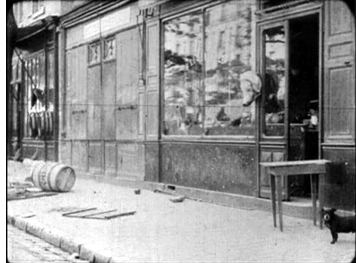 evidence, as were detailed depictions of industries in colonized countries. Mariann confessed herself to be fascinated by the random, unplanned events that intrude into both non-fiction and fiction films of this early period-particularly those shot in the street. As usual with early films, passers-by frequently come to a standstill and gawk at the camera. As she pointed out, the frequent intrusion of dogs into the frame reflected the reality of the time, when numerous homeless animals inhabited cities. We all became very aware of these animals, which David dubbed “Lewinsky dogs.” At the right, a little one that half-enters the end of one shot of a typical chase film, Les tribulations d’un charcutier (director unknown; also on the DVD).
Mariann watched a great number of 1909 films in order to make her selection. Her experience convinced her of what many of us feel, that this was a turning point for the development of film art, though perhaps not as dramatic a one as 1913. Apart from L’Assommoir, Griffith’s The Country Doctor could be pointed to as evidence that the year saw films of a greater complexity and beauty than had previously been released. Griffith may no longer be quite the lone giant of the pre-1920 era that film historians have portrayed. Still, there are touches in The Country Doctor that no other director could have conceived, such as the early shot of the central family strolling through a field of tall grass that hides everything except the doctor’s top hat floating above the stalks.
Reaching 1909 raises the question as to how long these 100-year anniversary programs can continue and what form they should take. With fiction films getting longer in years to come, particularly in Europe, there emerges a problem of including enough of them to give a sense of a single year without having the programs expand even more. Perhaps non-fiction films will figure as an increasing proportion of this thread-with more Lewinsky dogs inadvertently captured for posterity.
A garland of color films
Two programs of early color films demonstrated the various processes: hand-coloring with stencils, tinting, toning, and attempts at photographic color. The only really successful of the latter were two 1912 shorts using the Gaumont system, which provided images in sharp, reasonably true color.
I caught only a few of the features in the color thread. Victor Schertzinger’s Redskin (1929), in two-strip Technicolor, was a beautiful print. Despite its implausibly happy ending, this story was a sophisticated look not only at racial tensions between whites and Indians but also at equally divisive tensions among Indian tribes. Like the other occasional films of the early decades that show the action from the Indians’ standpoint (Griffith’s The Red Man’s View figured in the 1909 program) are remarkably sympathetic to their culture. The color portrays not only the beautiful desert landscapes of the American Southwest but also Navaho blankets and Pueblo sand paintings.
Toward the end of the week, when people asked me what my favorites had been so far, I forgot to mention Pandora and the Flying Dutchman, which had played way back on the opening Saturday. It has a reputation as a bizarre film, and I wasn’t expecting much beyond some glowing color images of two beautiful stars, Ava Gardner and James Mason. But I was pleasantly surprised by its well-handled fantasy tale of the Flying Dutchman visiting a contemporary Spanish seaside resort and finding his true love. In particular a lengthy flashback to the Dutchman’s original crime has a degree of stylization and intensity that allow it to avoid seeming absurd. The tale has an other-worldly quality that recalls some of Powell and Pressburger’s films-enhanced by the presence of cinematographer Jack Cardiff handling the Technicolor.
Unfortunately Track of the Cat (William A. Wellman, 1954) failed to similarly avoid a sense of the absurd in its overheated Tennessee William pastiche set on an isolated farm in the West. Lumbering dialogue lays out explicitly all the tensions among the members of the central family, exacerbated by the depredations of an elusive puma and a visit by the younger brother’s potential fiancée. The reason for its presence in the festival, though, was its color scheme. Wellman set out to make a “black and white film in color,” as the program describes it. Both the snowy landscapes and the interiors are dominated by white, black, and flesh tones, with the sole exception-the Robert Mitchum character’s bright red coat-disappearing from the action partway through.
Not only silents need restoring
Martin Scorsese’s influence hovers over the festival and the Cineteca Bologna. One of the two screening rooms in the Cineteca’s building is the Scorsese (the other being the Mastroianni). In recent years, films from the institution that Scorsese founded, the World Film Foundation, have been screened here. The WFF is dedicated to restoring and preserving films from countries whose archives might lack the resources to handle such major projects. This year’s presentations were Fred Zinnemann and Emilio Gómez Muriel’s Redes (The Wave, 1936), Shadi Abdel Salam’s Al Momia (known in English as The Night of Counting the Years, 1969), and Edward Yang’s A Brighter Summer Day (1991). The foundation also aided in the editing of Ingmar Bergman’s home movies into Images from the Playground (Stig Borkman, 2009).
I had seen The Night of Counting the Years in one of the faded 16mm copies that have long been the only form in which this Egyptian classic was available. The new copy is a vast improvement, finally revealing why this is considered perhaps the great Egyptian film. It is based around a true story from 1881, when a powerful tribe on the west bank at Luxor discovered a cave containing a huge cache of royal mummies and funerary goods that had been hidden away by ancient priests to preserve them after the extensive robbing of their original tombs. The tribe started selling items gradually on the illicit antiquities market, but one of its members revealed the location of the cache to the authorities, allowing them to salvage most of the mummies and their grave goods. The film was beautifully shot on location in the desert and temples of the west bank and provides a meditation on why the young man might have acted against the apparent best interests of himself and his family.
A 1991 Edward Yang film might not seem an obvious candidate for restoration, yet the complete version of A Brighter Summer Day was barely rescued from oblivion. The original negative does not exist, and the print materials on the shorter version were discovered to be moldy. Rescuing these and combining footage from both versions has resulted in a pristine new print of Yang’s greatest achievement. An in-depth look at Taiwanese society a decade after Chiang Kai-chek took over the island, it follows a middle-class boy drawn gradually into gang violence. The new version, which premiered at Cannes earlier this year, looked great on the big screen in the Arlecchino.
This and that
A brief tribute to Harry d’Abbadie d’Arrast included Laughter, the director’s first sound film. A romantic comedy, it stars Frederick March as a witty young composer aspiring to marry a wealthy society woman against her father’s wishes. The film has touches of Holiday and Design for Living, both films yet to be made. Laughter confirms d’Abbadie Arrast’s reputation as a good but lesser filmmaker in the Lubitsch mold.
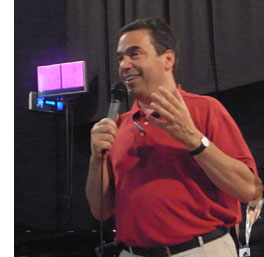 We all have reason to celebrate the fact that Georges Méliès’ films went into the European public domain this year. (The films have long been in the public domain in the U.S.) With obstacles to programming out of the way, the festival presented a program in homage, featuring twenty shorts presented by Serge Bromberg, who helped put together the extensive Méliès collection that came out in the U.S. and won the 2008 award for best DVD set here at the Cinema Ritrovato. (It came out in France earlier this year.) While all the films shown are on the DVDs, it was a treat to see them on the big screen. Bromberg provided a lively, if not entirely authentic, running commentary to “explain” the action of the final film, La Fée Carabosse.
Demonstrating that history repeats itself, Belgian film scholar Eric De Kuyper programmed a selection of titles dealing with financial speculation and crisis. These included perhaps the best of several items from Louis Feuillade shown during the week, Le Trust ou les batailles de l’argent (1911). It stars René Navarre, who would soon play Fantômas, as an unscrupulous detective, and the action is more in the thriller mode than a serious depiction of French finances. Also included was a 1916 German feature, Die Börsenkönigin (“The Queen of the Stock Exchange”), with a fine performance by Asta Nielsen as a woman more successful in finance than in love.
More to come from David, on Capra, DVD awards, and personalities glimpsed by a roving camera.
For our previous Cinema Ritrovato entries, see here for 2008 and here, here, and here for 2007. For a thorough discussion of dogs in early film, with comments by Mariann Lewinsky, see Luke McKernan‘s authoritative entry here. On the occasion of Edward Yang’s death in 2007, David offered an homage to him and A Brighter Summer Day here.