





Archive for the 'People we like' Category
Pictures, not moving, from Vancouver
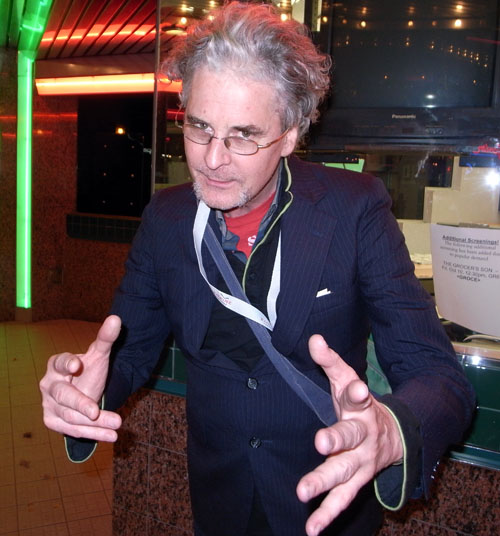
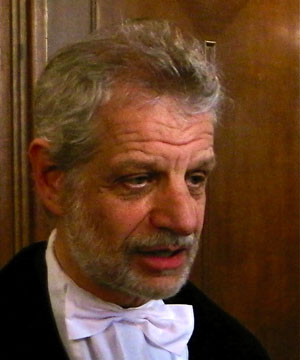
Craig Baldwin, upper half.
DB here:
Tonight we’re packing to leave the Vancouver International Film Festival, and we still have to write up comments on several more films. We’ll scribble as we drive back and try to post our final blog entry after we’ve returned to Madison. In the meantime, here are some snapshots from a superb two weeks and an aggregate of over forty movies between us.

First, the context. Vancouver must be one of the most gorgeous cities in North America, at least when it’s not raining. For the first time in my four visits to the festival, I actually had time to do a little exploring, thanks mostly to a longer stay but also to Kristin’s being along. It’s more fun to do touristic things with somebody else–especially if that somebody can read a map.
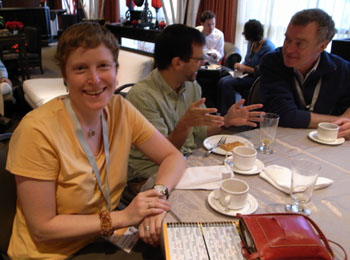
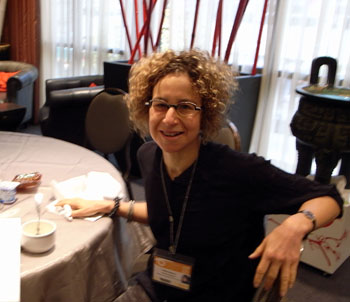
At the festival, guests gathered for breakfast in the reception room of the Listel Hotel. Over tasty waffles we could catch up with old friends and make new ones. Here is Lisa From Toronto, a long-time aficionado of Chinese film, with programmer Shelly Kraicer and Michael Walsh, former Wisconsin student and now a professor at Flinders University in Adelaide.
Pan-ek Ratanaruang, director of Last Life in the Universe and other major films, was always fun to have at the table. Here he regales Sean Axmaker, of the remarkable new website Parallax View, and in the background, Tony Rayns, VIFF programmer and coordinator of the Dragons and Tigers award.
Alissa Simon, Variety reviewer and programmer for the Palm Springs Film Festival, is another former Wisconsite. I saw her about a year ago, but Kristin hadn’t seen her in many years, so we had a chance to catch up with each other’s news.
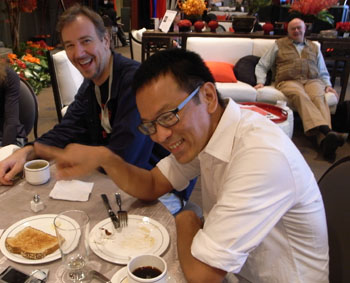
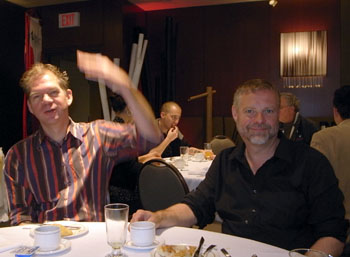
Gerwin Tamsma, programmer from the Rotterdam International Film Festival, makes a point as Nik Sheehan looks on. Nik is the director of FlicKeR, a remarkable movie about Brion Gyson and his Dream Machine.
When breakfast was over, we went to the movies, sometimes five per day. As often as not, we were sitting near Frank, one of Vancouver’s most passionate and knowledgeable cinephiles.
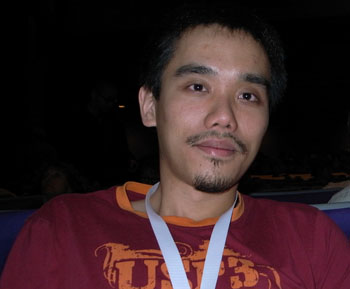
Frank is an ardent fan of Albert Serra‘s Birdsong (aka Song of the Birds, which I wrote about here), and he was there to hear Serra explain that the film’s final shot has the graphic shape of a goblet or chalice.
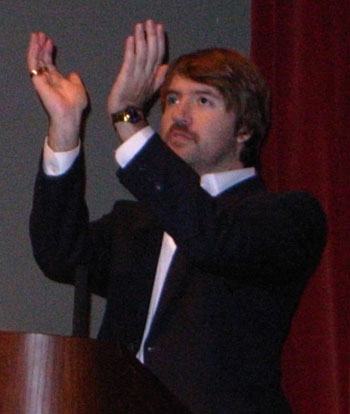
Another director I enjoyed talking to was Lance Hammer, whose admirable Ballast is now circulating throughout the U. S. (Go here for my comments in our prior entry.)
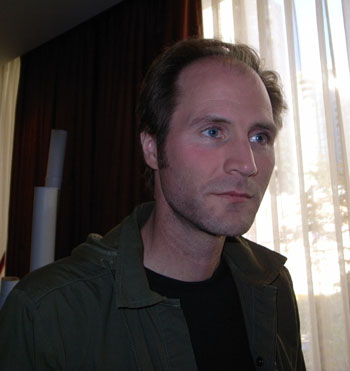
Old friends Tony Rayns (a long-running presence on this site) and Geoff Gardner, another Aussie with long-lived love of movies, were often found larking about, as they would say.
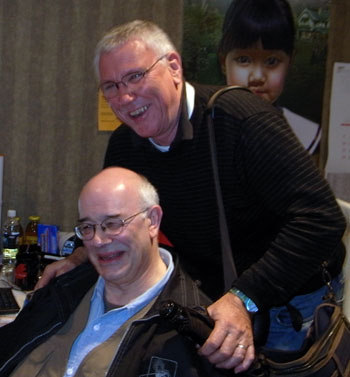
When we weren’t watching movies or talking with other viewers, we ate. A lot. Vancouver harbors many fine fooderies, at all levels of cost and taste. One thing you can get in profusion is crepes, of all sorts.

In Chinatown, at the Jade Dynasty, the mango pudding comes in cute shapes.

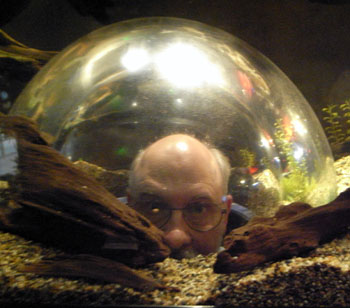
Speaking of fish, an inevitable tourist spot is the Vancouver Aquarium Marine Science Center in Stanley Park, where the jellyfish never take bad pictures but film profs are likely to.

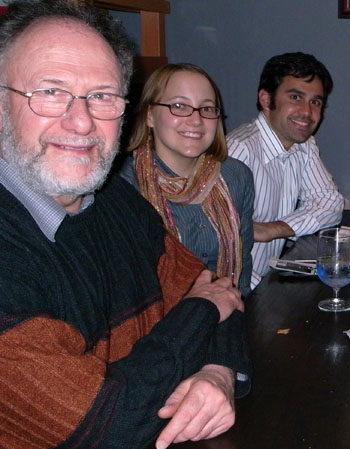
Our early days in the city were spent with nephew Sanjeev and niece-in-law Maggie, who came along from Seattle and proved excellent company. Which is to say, they were willing to laugh at my lamest jokes. Here they are with Michael Campi, cinephile nonpareil and scout for the Melbourne Film Festival.
That’s it for now; back to packing. More pictures, and lots more text, to come some time this weekend, we hope.
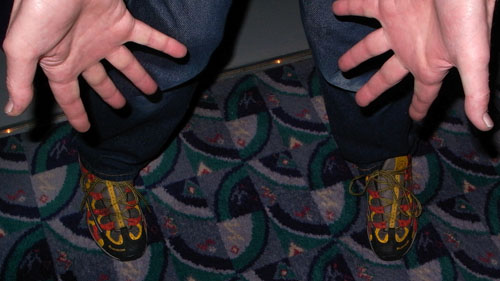
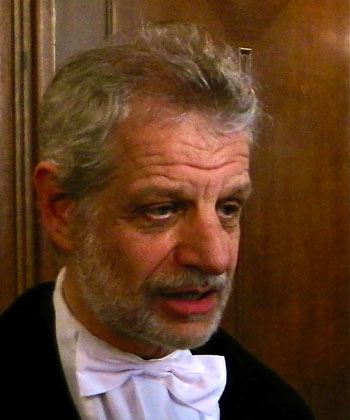
Craig Baldwin, lower half.
13 days without movies? Not desirable, but possible


DB yet again:
Our road trip started back on the twelfth of September. We drove to Iowa City and ate at our grad school hangout, Hamburg Inn no. 2. (We even remember Hamburg Inn no. 1, long since vanished.) We pressed on through Nebraska to Denver, for a meeting of the Amarna Research Foundation, which helps support the Egyptian expedition on which Kristin works. She gave a presentation about the unique composite statuary of the Amarna era containing a new hypothesis that Barry Kemp, head of the expedition, found promising. After enjoying the hospitality of ARF president Bill Petty and his wife Nancy, we visited the Rocky Mountain National Park.
After a long day’s drive west, we overnighted in Elko, Nevada, where we learned that Barack Obama was scheduled to give a stump speech the next morning. We hung around and joined an enthusiastic group from all over northern Nevada to hear what he had to say.
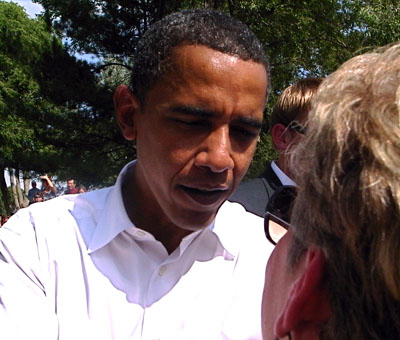
After shaking hands with Barack, we moved on, rolling through Utah and into Oregon and Crater Lake National Park. Then up the coast highway to Seattle, where our nephew Sanjeev works for Microsoft and lives with his wife Maggie. We did some nifty touristic things in Seattle, and then with Sanjeev and Maggie we pressed on to Vancouver for its annual film festival.
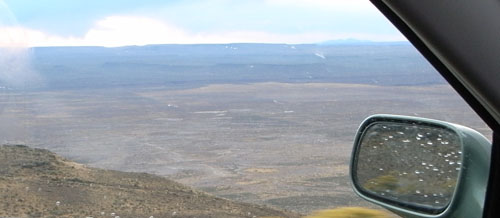
During our westward passage through Grand Island (neither grand nor apparently an island), Craig, Elko, Klamath Falls, Coos Bay, Tillamook, and Tumwater, we saw many intriguing things. There was, for instance, the perfect rainbow in the bleakly beautiful northwestern Nevada desert.

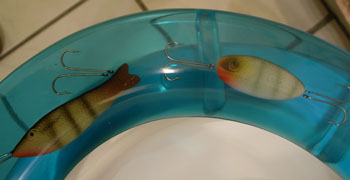
In a little Colorado town, we found the toilet seat with fishing lures embalmed within.
In Snoqualmie Falls, Washington, while we downed burgers and malts at the Candy Factory & Café, four red-hot mamas came in and spontaneously started singing 1940s swing, Andrews-sisters style.
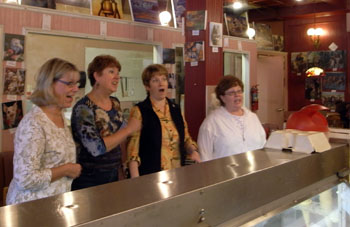
Yet such roadside attractions can’t compensate for our trip’s biggest drawback. We didn’t see a single complete film, not even on the free HBO available in motels. We used our late evenings to wolf down Subway subs and scan the Internets for news of lipstick, pigs, and less important things like the free fall of the U. S. economy.
Still, even without watching movies we did run across many traces of cinema. So don’t worry: This isn’t a travel entry, but rather an offhand effort to note the ways film keeps crossing our path, sometimes in surprising ways.
Movies everywhere
For instance, Bill Petty, an ardent Egyptomane, has created a home theatre unlike any other. The Pharaohs surely look with envy on this screening room.
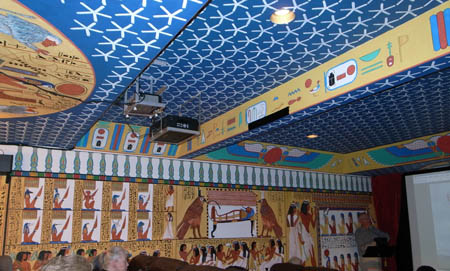
In this venue, Bill showed us his home-made mashup of the Lon Chaney Phantom of the Opera with the Andrew Lloyd Webber score. That was the closest we got to movie viewing on the trip.
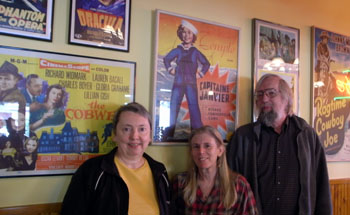
Also in Denver, we ate breakfast with Diane Waldman, old friend and film prof at University of Denver, and her husband Neil. We of course wound up in a restaurant with movie posters.
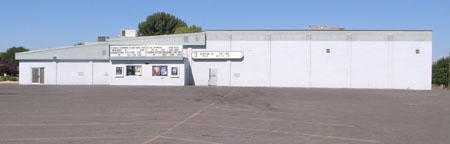
Passing through Vernal, Colorado, we spotted the most austere multiplex we’d ever seen.
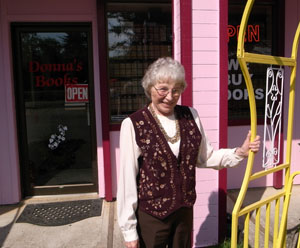
Then there was Donna Kupp’s Books in Reedsport, Oregon. Donna has an excellent collection of classic paperbacks and magazines.
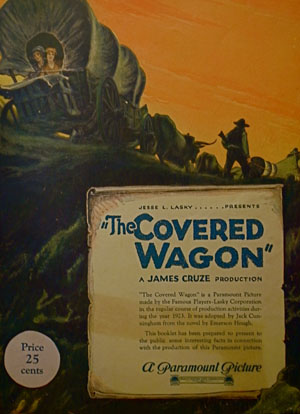
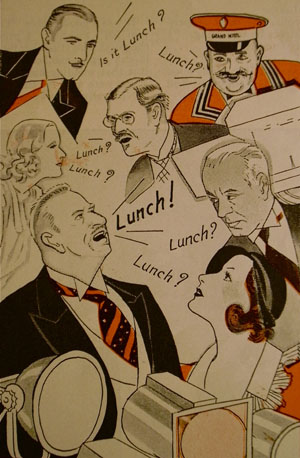
The high points of our purchases were an original souvenir program for The Covered Wagon and a pretty issue of Photoplay from 1932, which featured a gossipy story about the making of Grand Hotel.
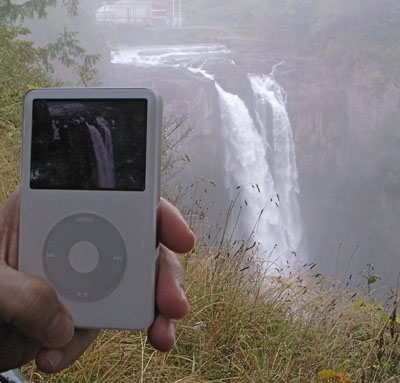
The ladies’ big-band quartet wasn’t our reason for stopping in Snoqualmie, of course. You know why. The town was the shooting location of Twin Peaks. Hence this inevitable snapshot.
In Seattle, we discovered Stephanie Ogle’s outstanding Cinema Books on Roosevelt Way, N. E. This store is stuffed to the rafters with film items old and new–books, magazines, posters, and stills. Kristin even autographed some copies of her books.
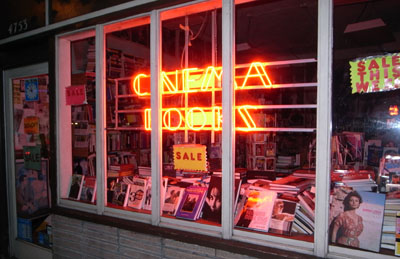
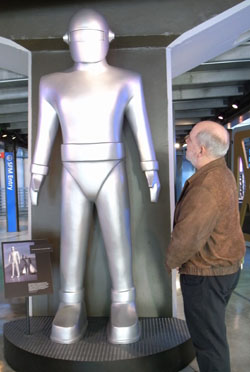
We picked up several items there. Earlier that day, we visited Paul Allen’s lively Science-Fiction Museum. Sumptuous exhibits, but we weren’t allowed to photograph them. We did, however, get a chance to study a clone of the alien from The Day the Earth Stood Still.
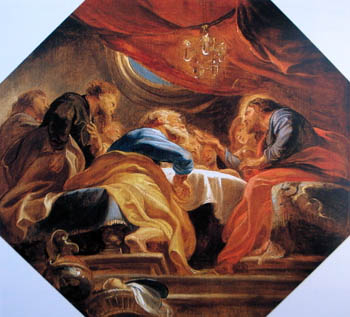
As usual, a trip to an art museum provokes me to think of cinema. You don’t need much nudging to see this Rubens prototype for a Last Supper ceiling as a steep low-angle Welles or Hitchcock shot.
Less obviously, Abraham Janssens’ Origin of the Cornucopia (c. 1619) suggests a wide-angle lens at work. The three dryads stuffing the cornucopia are monumental, and monumentally skewed.
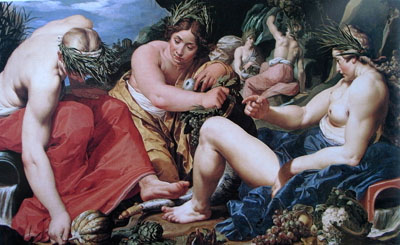
The stretched arm of the dryad on the left and the tipped knee of the one on the right seem to bulge right out of the picture plane. Check the hands, which thrust out of the picture and loom larger than the ladies’ heads. In particular, though you can’t see this in reproduction, the thumbnail of the figure on the right is a little blob of paint sitting on the painting’s surface, accentuating the sense that this hand is pointing right at us. Such images remind us that 2-D and 3-D are not so easy to keep distinct.
Our road trip confirms that movies are everywhere, waiting in the corners of our lives, ready to be activated with barely any prompting. Nonetheless, these are all merely teases, snacks making us eager for the banquet to come in Vancouver.
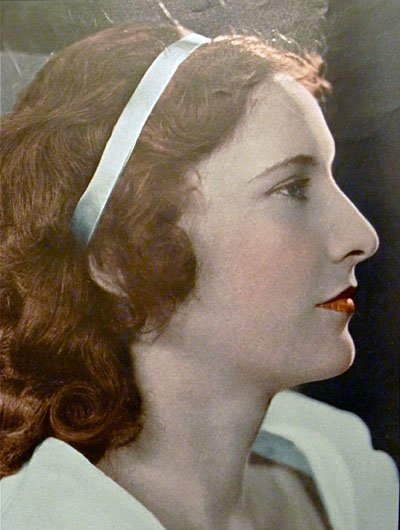
For Jim Emerson: Barbara Stanwyck, from Photoplay (Oct 1932).
Comic-Con 2008, Part 3: Two newbies share thoughts
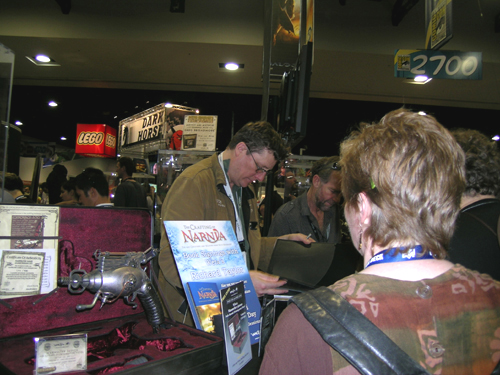
Autographs are big: Richard Taylor signing books about the designs for The Chronicles of Narnia
Kristin here–
Back in the early days of this blog, I posted an entry on our friend Henry Jenkins and his concept of the “aca/fan,” a scholar who studies fandoms while being a fan him- or herself. At that time his book Convergence Culture: Where Old and New Media Collide, had recently come out, and I highly recommended it. Fortunately the book has had a well-deserved success. On October 1 it will be coming out in paperback.
In that entry, I described Henry and our long friendship with him:
Henry doesn’t study fans to find out what makes them tick. He knows that. He’s one of them, a participant in fan cons, a player of video games, an explorer of the multimedia sagas like those of Star Trek and The Matrix that have grown up in the age of franchise culture. He received his doctorate here at the University of Wisconsin-Madison, where David was his dissertation advisor, and we have followed his career, as they say, with great interest. Straight out of the gate he was hired by MIT, where he is now the Director of the MIT Comparative Media Studies Program and the Peter de Florez Professor of Humanities.
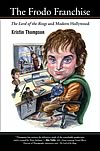
(You can find Henry’s blog, “Confessions of an Aca/Fan,” here. He interviewed me when The Frodo Franchise was published; you can find that in three parts, here, here, and here.)
The Frodo Franchise dealt with fan culture as well in Chapter 6, on fan-originated websites. Convergence Culture deals to a considerable extent with modern transmedia franchises. Yet neither of us had ever been to that Mecca of fandoms, Comic-Con. Of course, this year, when I got invited to participate on TheOneRing.net’s panel on the Hobbit project, I accepted. I emailed Henry just in case he happened to be going as well. It turns out he was, being on a long driving vacation through the west with his wife and son.
At first I thought maybe we could meet up early in the Con and then get together afterwards and share our impressions. (We bloggers look for material anywhere we can find it, and this seemed like a golden opportunity.) In fact we didn’t meet early on. There was so much going on, and we never glimpsed each other in the course of the entire event—not surprising, really, when you consider its size. But I made cell-phone contact on Sunday, and we sat down in my hotel lobby and spoke our thoughts into a microphone. Here are some excerpts.
(We talk about what we went to—him to the TV previews, me to artists’ presentation.)
On Different Tracks
We started off by talking about what we had each concentrated on.
HJ: It’s very clear that it’s like six or seven different conventions I could have gone to in the course of the weekend, and it would be a totally different experience depending on which one you went to.
KT: Yeah, I had that impression that there were probably people here mainly to buy stuff, some people here mainly to see celebrities and get autographs and so on.
HJ: And even on that there was a split between the film and the TV people. And there’s a whole comics track. Under other circumstances I would have just been spending my entire time at comics panels, because they’re the strongest comics sessions anywhere in the country.
Coming Alone vs. Having Something Specific To Do
KT: I was happy that I had something to anchor myself, though. I don’t think I’d like to come here, at least for the first time, alone and not having anything specific to do.
HJ: Luckily Henry and Cynthia were along, but it was overwhelming a bit, trying to negotiate and keep up with three people in a space that congested. So that was its own kind of challenge. Sometimes I was thinking it would be great just to be a single person navigating through the space and not have to have large-scale logistics! The scale of it just blows you away. I’ve been on the floor at E3, which is supposed to be one of the largest entertainment trade shows. I’ve done South by Southwest. But neither of them are anywhere near the scale of Comic-Con.
The Scale of the Event
KT: They always say 125,000, because that’s the number of tickets they sell, but then you’ve got all the exhibitors and the people who are presenting on panels. It must be another few tens of thousands packed into that building.
HJ: Yeah, at least.
KT: I was kind of amazed that it worked as well as it did
HJ: Yeah, they did a remarkable job in just managing crowd control. Getting people in and out of things with some degree of order. Some more bullying guards than others, but it was probably necessary to keep the peace.
KT: Yeah, there were a LOT of guards and guides and so on, but people seemed really to be polite, on the whole. I was taking the shuttle bus from a hotel down the street [from my hotel] every day and then coming back by shuttle bus. This morning the bus was quite late compared to other days. It was supposed to come every ten minutes, and we were there maybe twenty. And people who were arriving made this very neat horse-shoe shaped line on the sidewalk. It was very orderly.
HJ: Almost no signs of anyone breaking in line, despite the intensity of some people’s desire to get into things. Someone commented behind me about ‘honor among geeks,’ and that’s probably a good description. There’s a strong honor code.
KT: The venue seems to be up to having that many people in it. I hardly had to wait for rest rooms at all.
HJ: No, the facilities are good.
We ended up doing a fair amount of what they call here “camping,” which is sitting in several panels in a row because there was something we really wanted to see. But you end up trapped in a space with no access to food. Hall H at least has rest-room facilities in the space.
KT: I didn’t try that myself, that is, camping. But I was going to this action-figure panel because it involved Toy Biz, which did the action figures for Lord of the Rings. I heard from people in line that a lot of them were there for the next panel, which was on Sanctuary, which I know from nothing, but they were very devoted and were saying, “They shouldn’t have put this in such a small room.”
HJ: There is a certain sense that you vote with your body at Comic-Con. One of my newest fandoms is Middleman, which is a new ABC family show, and it was in a small room, but we packed it. There was a sense of accomplishment. The producer looked out and said, “This may be the whole audience for the show,” because it hasn’t gotten much publicity yet. There was a sense that just being there was show of support for things.
KT: I wonder how many of the companies have people at those panels—in the audience. I hadn’t realized it, but there was somebody from New Line—who’s probably not from New Line anymore—and then some Warner Bros. people, supposedly, sitting out in the audience for the Hobbit one. That kind of surprised me. Why bother?
HJ: At the larger sessions it seemed they had blocked off four or five rows of space just for the studio people. Rarely were they occupied to anywhere near that extent, so it was maybe overkill. But there were a few sessions where there were a significant number of people. The Battlestar Gallactica, for example. There was a large studio contingent there for that. Suits and friends and family and other writers, because that was a kind of last hurrah for that production. They just wrapped shooting the last episode two weeks ago, so this would have been a major last gathering of a lot of those people. They said they really hadn’t had a chance to have a wrap party yet, so in a sense it probably was.
The Hall H Experience
KT: Did you have the Hall H experience at all?
HJ: We went to see Heroes one morning, which was the first time, they said, a TV show had made it into Hall H. We managed to be there for Watchmen and a few of the other movies that followed it.
KT: I kind of avoided it for a while because I kept hearing that there would be incredibly long lines, and I pictured just sitting there for hours and hours and hours reading and possibly not getting into what I wanted to see anyway. So I avoided it until yesterday [Saturday], and I went to the Terminator Salvation one. I wanted really to go to the Pixar one, so I went to get in line very early, and ended up getting in on time for Terminator Salvation.
HJ: Well, for Heroes we waited for about an hour outside and then got in. Then there was a fairly long wait to get started, but then we knew that there were several things after that that we wanted to see as well.
KT: And was it full?
HJ: It was packed. But Heroes has been a kind of success story of Comic-Con. They showed the pilot there before it debuted, and Heroes is pretty desperate at this point to rekindle fan enthusiasm. Last season is largely seen as a bust. Hence their decision not to come back from the strike. They did a partial season and put it off to the fall, because the ratings were plummeting and they were getting bad buzz from fans. So they wanted to come back this year with a killer. They showed the entire opening episode, which was definitely a fan-pleaser. They had figured out what had gone wrong the first season and had put together something that was going to please. So there was lots of extended applause at key moments. It’s kind of fascinating to watch an episode of a TV show with 6500 other people.
The Exhibition Hall
KT: I only discovered the comics section today, as I was about ready to leave, because I hadn’t really been aware of which sections were devoted … I sort of thought it was all random, but obviously they do devote one big section to all the people who are selling old comic books. I suppose you could just stay in one part of the hall and never see the rest of it.
HJ: I felt I barely made a dent in the hall. The first day I didn’t quite realize how big it was, so I was just going up every aisle, and the second and third day I was going on targeted missions. But it still was just so immense that there’s no way you could see it all.
KT: And it’s SO congested.
HJ: Especially if you get to the studio side of things.
Autographs and Planning
KT: I could not figure out what was going on at the Warner Bros. exhibit, but they were constantly surrounded by lines and lines and lines of people who were obstructing the aisles around them. I guess they had people from their TV shows signing.
HJ: They seemed to. I kept stumbling into people. You wander around one corner and there’s Peter Mayhew of Chewbacca fame sitting there, and Will Frakes suddenly would pop up at another table. Neither particularly advertised. Then there were all the advertised autographed stuff. There were a lot of people there that you would know in another context.
KT: I don’t know how you would find out about all of those things in advance. I don’t think Lynda Barry was listed in the program as doing autographs, but she was at the Drawn and Quarterly booth at certain times. I missed her entirely. I got her autograph because I was sitting in the audience before her presentation and she sat down beside me.
HJ: They seemed to have a certain number of people who were there to do autographs, but then there were all these other people randomly. I guess you had to follow a particular company and maybe they posted on the Web.
KT: Yes, I was doing autographs at certain times for my book, and it was just on TheOneRing.net and The Frodo Franchise [websites]. You have to really investigate, go in with a plan.
HJ: It seems to be the case: The more you plan, the more you can get out of the experience.
KT: We were selling copies of my book at this very small booth, and I was there for an hour at different times of day on three days. I think almost everyone, if not everyone, who bought a copy came to the booth specifically to buy it. There were no impulse purchases. I don’t think people buy books at Comic-Con.
HJ: I looked at comics while I was there, but I would buy them from my dealer back in Boston or online at Amazon or My Line Comics [?]. Why I would weigh my suitcase down with comics in the age when it’s so easy to buy stuff digitally?
KT: Not new ones.
HJ: Not new ones. Collectibles, sure.
KT: Unless you have them signed.
Fan Culture hangs on at Comic-Con
HJ: Usually the cons I go to are small-scale, very intimate, you know a high number of the people who are coming. It’s fan-driven and fan-focused. This was like Creation Con on steroids!
KT: Though technically speaking, it is run by fans; there’s a committee.
HJ: It is, and they had a really bad art room with lots of cat pictures and dragon pictures and wolf pictures, which gave it a sense of fan authenticity, because they hadn’t closed out the really bad fan art, even in the midst of all the commercial takeover.
KT: Well, I missed that one.
HJ: You didn’t miss anything, other than the reaffirmation that this was still a con. There were still places and niches and corners where the fan stuff still ruled. You wouldn’t see fanzines there, but then you wouldn’t see them at most fan-run cons these days, since everything’s moved to the Web.
KT: Well, there’s Artists’ Alley, which is way over in the corner. That seems to be fans who are aspiring to be pros but haven’t really made it yet.
HJ: Well, it was a mix. I mean, you’d see Paul Chadwick there [author of “Concrete” series, published by Dark Horse Comics] or Kim Deitch [author of graphic novels such as The Boulevard of Broken Dreams and Shadowland], who were independent and weren’t necessarily going to be there with a company, but yeah, it’s definitely a lot of wannabes in some of that space.
And then fans show themselves through costumes. For all the jokes about women in Princess Leia costumes—and I saw maybe a dozen Princess Leia slave-girl outfits—it was still a way in which fans asserted their presence. There were some quite remarkable pieces of fan performance going on there. There was someone doing Cocteau’s Beauty and the Beast, which had quite a spectacular Beast costume—a little more arty than one expects at a fan con.
Genre
[I mentioned having seen Focus Features’ Hamlet 2 preview.]
HJ: The role of comedy here interests me a lot. I’m always intrigued: What’re the borders of what a fan text is and what isn’t a fan text? Here comedy seems to creep into fandom in a more definitive way than I’ve seen elsewhere. So there was the focus on Hamlet 2, there was Harold and Kumar, The Big Bang Theory [TV series, 2007-08], but then just a bunch of panels on writing for sit-coms. So it’s probably just the industry’s priorities, but it’s interesting that it doesn’t extend to drama. You can imagine a lot of people there being into The Wire or The Shield or some equivalent, and it didn’t cross over in that direction.
KT: I suppose it’s what the studios think the fans want. It’s true there were a lot of comedies, and martial arts, war.
HJ: I think martial arts probably has crept into fandom pretty definitively over time. But it’s interesting to see where the boundaries are. We stumbled across one booth that had just a porn star signing her pictures, and it sort of outraged my son. Pornography isn’t fandom in his world view, but he thought nothing of going up to get wrestlers to sign autographs. Probably in any other fan con, the strong presence of wrestling performers would be out of keeping with fandom.
The Economics of It
KT: I was struck by how cheap it is, basically. How much was it for a single day pass?
HJ: Twenty-five dollars for a single day pass. It’s not bad at all for the scale of what you get. [Four-day passes are $75.]
KT: Some of the smaller tables were something like $380 for the full period, which I thought was kind of cheap. But obviously they NEED both sides of it. They need the exhibitors to attract the people and they need the people to attract the exhibitors, so keeping the cost down makes perfect sense.
HJ: The scale at which companies brought in people was also truly remarkable. I certainly have been to cons where they might have two or three performers from a show, but they brought the entire regulars of Heroes down, as well as the entire writing team. And Heroes is a large, large cast. They scarcely had time for anyone to say anything, but all lined up there on a panel, it was a pretty spectacular display. And Watchmen did pretty much the same thing. All the main characters in Watchmen were there with the director.
KT: That reminds me of the coverage that the film events and I suppose the television events, too, get in the trade press. I’m sure you read some of these articles about how, “Oh, it’s all becoming SO much Hollywood. The big media companies are coming in and taking over,” and so on. It struck me that Hall H is really kind of a world unto itself.
HJ: It is.
KT: It’s separate. You have to go out of the building and get in this line, and then you have to go out of the building when you exit. It’s quite a hike to get there if you’re around D or C in the exhibition hall. I think probably they don’t see much of the rest of the con.
HJ: It does seem largely cut off. That’s the sort of classic place where people camp. And so there’s almost an interesting tactical advantage in being one of the filler programs between the main events, if you can really maneuver into that. It’s like being right after a hit TV show or between two hit TV shows. You’re going to get exposure to people who wouldn’t otherwise. Yesterday Chuck was between Battlestar Gallactica and the Fringe panel. I’ve never see Chuck, but I wanted to see Battlestar and I wanted to see J. J. Abrams [executive producer of Lost and one episode of The Fringe], so we stuck through it. And we’ll probably give it a shot come fall as a result of being exposed to it in that way. There’s lots of things that get sandwiched in that probably get a boost off of this. Or they could hurt themselves.
KT: Bring the wrong scenes or whatever.
HJ: Wrong scenes or just the people are inarticulate. There’s certainly a range of comfort level up there.
In terms of the press coverage, the fact that Entertainment Weekly put Watchmen on its cover this week a year before the film comes out, purely on the basis of it playing at Comic-Con, says something about the publicity value of this thing.
KT: Oh, yeah, for the films there’s no doubt about its publicity value. I just think that if the big entertainment journalists plant themselves in Hall H and don’t pay a lot of attention, then you get this coverage that makes it sound as though the movies are just taking over everything.
HJ: It’s odd. It’s certainly every bit as spectacular a place to do TV as it is to do film. And comics. I couldn’t believe the betrayal I was committing in not seeing the full writers of Mad magazine in the 1960s or seeing Forrest J. Ackerman and his staff—things that were really significant to me as a kid or now. But they were competing with other things that I valued even more. So there are things that you would have killed to get to in any other context that you pass up because there’s so much going on at once. You can’t get to it all.
KT: I just get the feeling that if you at Hall H you’re at one con, and if you’re at the rest of it, you’re in a completely different world. The trades just never talk about that other stuff because it’s not really high-powered.
HJ: The question is, to what degree does that other stuff provide the context that explains what goes on in Hall H? Geek culture is integrated. Probably there are lots of people who travel between Hall H and other things, but if the reporters stay at Hall H, they won’t see the full layering of this.
The Gender Composition of the Attendees and the Industry
HJ: One of the things that struck me was the gender composition here was much—well, certainly there were more guys than girls, but compared to, say, E3 or many other cons I’ve gone to, the gender balance was surprisingly solid. There were an awful lot of women there.
KT: Yeah, they remarked on that on the Harry Potter panel this morning, saying that, unlike those cons, there were probably more women than men in that particular room.
HJ: That makes sense.
KT: When I went to the One Ring Celebration, the ORC, for my book, as I said there, it was maybe 95% women. I suspect it’s partly a factor of whether a con has gaming facilities. Gamers will come, and they’re mostly going to be guys, although probably not as much as it used to be.
HJ: Historically, if you go to Creation cons, which are more star-centered, men turn out much more, whereas if you go to a fan-driven con, which is fanzine oriented, women turn out much more. But because this combines everything, you’ve got just such a spread of people.
I’ve seen people argue that Comic-Con is becoming powerful and it’s exaggerating the power of fan men at the expense of fan women, that the fan-boy mafia is taking over the entertainment industry. Certainly you see it on the producers’ side, that an awful lot of the guys onstage would have been in the audience a decade before—and they’re mostly guys. But what’s interesting is to see the audiences that they’re trying to respond to and engage with has a large female component, and that’s got to have an impact over time on what plays here and what doesn’t.
KT: One of the people on the “Masters of the Web” panel on Thursday morning was making the point that now the younger studio executives are either people who had their own Websites a few years ago or they were in college when the big Websites were being formed. Now they’ve grown up into adulthood reading that stuff, and they’re now in position of power and will continue to be in the industry.
HJ: It was fascinating just to watch the producers, writers, stars, to see which ones were really comfortable in the space and which ones weren’t. Someone like Joss Whedon just grew up in that space. That’s his world. He was totally in his element, and he would understand what questions were being asked and how to respond to them and could use in-joke references to the culture, whereas someone like Alan Ball (executive producer), who no doubt in another context would be totally articulate and interesting, really felt strongly uncomfortable. Moving from Six Feet Under to True Blood, he doesn’t yet know how to “speak fan.” Where Zack Snyder (director of 300) has got to be the most totally inarticulate person I’ve seen on a stage in a long time. Watchmen is going to be his second movie, and he totally works with images, but his ability to use words did not seem to be his strong suit. Some of them who have done multiple fan shows seem really comfortable, and others just looked in shell-shock up there.
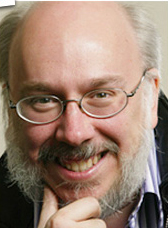
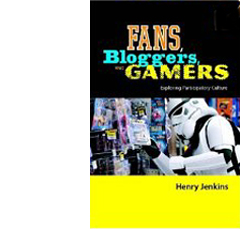
Henry and his other new book, Fans, Bloggers, and Gamers
A is for Amsterdam
DB from the road:
The first leg of our summer trip was a brief stopover in Amsterdam. It’s a city of canals and bicycles, some of them parked in patterns recalling a scrimmage. (See end of blog.) We visited the excellent comics shop Lambiek, strolled around, and tried to get over jet lag. Kristin did. Always does. I didn’t. Never do.
Our reason for coming was the series of events surrounding the official retirement of Thomas Elsaesser from the University of Amsterdam. Thomas is renowned for several accomplishments—his remarkable essays on Hollywood melodrama and 1970s cinema, the major books on New German Cinema and Fassbinder, his enormously wide-ranging comparative study of European and American cinema, his reflections on cinema’s ties to nineteenth-century media. He also established an excellent book series at the University Press.
Thomas is also an old friend, a big influence on our work ever since his days at Brighton Film Review and Monogram, and a generous host when we were visiting London in the 1970s and early 1980s to work on our book, The Classical Hollywood Cinema. He kindly published Kristin’s Lubitsch book in the Amsterdam series. I wrote a little tribute essay for his sixtieth birthday festschrift, available in English here.
In 1991 Thomas left the University of East Anglia to form a film department at the University of Amsterdam. Many members of the university looked askance at the study of cinema, but he grew his program spectacularly. A department with scarcely half a dozen faculty members expanded to sixty staff members and 1400 students. The range of study is now immense, from classical cinema and Dutch moviegoing in the silent era to theorizing about contemporary digital media.
During our visit there were three main events. On Thursday 26 June a large and warm symposium featured brief papers from 21 of his students, many of them known to English-language readers—Ginette Vincendeau, Peter Krämer, and Warren Buckland. The topics included cultural history of media (even advertising movies), gender and melodrama, the relation of European cinema to US cinema, and “mind-game films.” We had to miss the final sessions in order to check into our hotel, but what we heard was stimulating. One session was graced by an image that metamorphosed from Elsaesser to Hitchcock and back again. You can see it here.
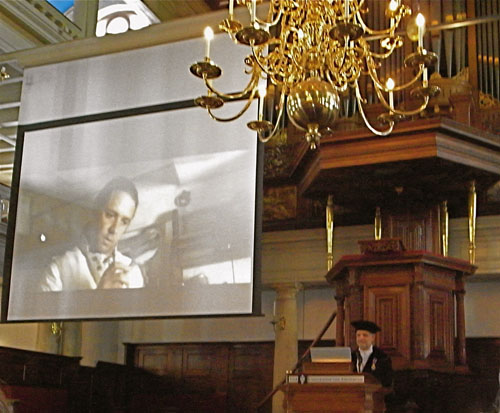
The following day was the formal ceremony: Thomas’ farewell speech in the University Auditorium, a converted chapel. Thomas and other professors, garbed in robes and caps, filed in and Thomas took the floor to present his talk, “Of Feedback and Phasmids: A Farewell to Film Studies.” He offered both an oblique account of his institutional political battles and a broader account of trends in film theory across the last three decades. He wove clips from Master and Commander into his talk, which sometimes bolstered a comparison between his tough-minded handling of the program and Captain Jack’s nautical tactics.
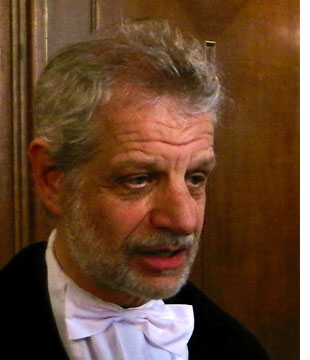
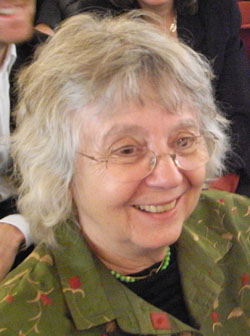
Other colleagues paid glowing tribute, and there followed a reception, where Thomas received people’s formal congratulations. We also had a chance to catch up with old friends and make new acquaintances. We saw Noll Brinckmann and Peter Krämer.
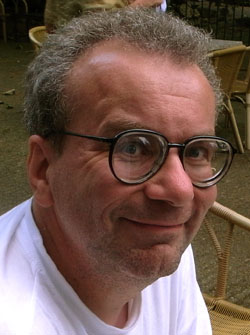
Kristin caught up with Karel Dybbets, historian of Dutch cinema and a pioneer in the study of local movie theatres.
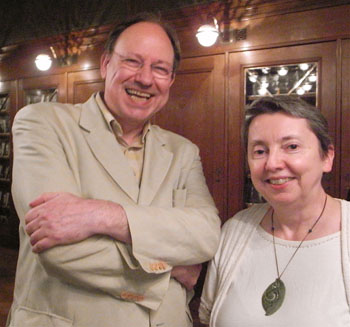
And though we met John Ellis and Roz Coward back in the 1970s, we hadn’t seen them since. They were great company.
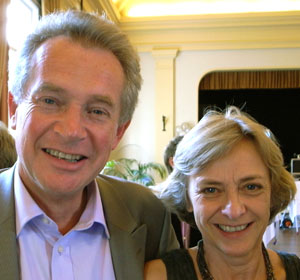
 The final event was held that evening, in a reception room looking onto the Amsterdam Zoo. The department holds an end-of-year party, and this one had special meaning as Thomas’ last official one. He’ll continue to supervise dissertations, and he intends to keep living in Amsterdam—when he’s not doing guest teaching in other places (at the moment, Yale).
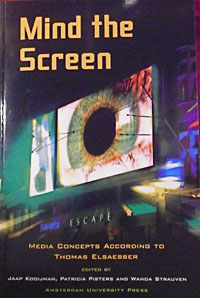
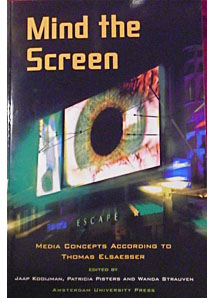
It was a terrific two days for us, not least for witnessing the great admiration and devotion that his colleagues and students displayed. They even edited, in secret, a book in homage to him (left). Thomas has not only reshaped our sense of how film works, but his dedication to media education has created a generation of lively and original young scholars.
Next up: B is for Bologna, a report from Il Cinema Ritrovato.