





Archive for the 'People we like' Category
Searching for surprises, and frites
DB here:
Studying film history ought to be continually surprising. Yes, you often find your hunches and assumptions confirmed (which often means it’s time to check them again). But sometimes you find stuff coming out of left field that you had never expected. It would be too pompous to call these items breakthroughs, but every historian knows the little burst of pleasure that comes from seeing something that makes you say: How odd. I didn’t expect that. You might even allow yourself a Wow! now and then.
I was saying wow a fair amount during my two weeks in Brussels this summer. I go regularly, and not just for the moules, frites, and stoemp. I go to the Royal Film Archive, where I study old films. This time I was continuing to pursue some research questions that drove me in 2007 and 2008. What staging and editing strategies are at work in films of the crucial years 1910-1917? How might we explain the continuities and changes we find? I’m a long way from answering these questions fully, but I found some fresh and intriguing instances. One surprise is worth half a dozen confirmations.
Divas on parade
This year I concentrated on European movies. One of the most prominent genres of Italian cinema was the diva film, the movie whose dominant attraction was a beautiful, often fiery, somewhat otherworldly female star.The mesmeric charms of the genre have been celebrated in Peter Delpeut’s anthology film Diva Dolorosa, but the films really need to be seen in their entirety. The most comprehensive book on the subject is Angela Dalle Vacche’s Diva: Defiance and Passion in Early Italian Cinema, while my Wisconsin colleague Lea Jacobs has published detailed analyses of diva performance in Theatre to Cinema and here on the web.
In the 1910s, American cinema was turning out fast-paced films, but the diva films I saw provided less complex plots and remarkably protracted acting. An emblematic instance is the climax of Rapsodia Satanica (1917), starring Lyda Borelli. Alba has sold her soul to Mephisto in order to recover her youthful beauty. She toys with two men’s affections, and one kills himself (mysteriously leaving a scar on her face). The plot more or less halts.
Alba retreats into her chateau and wanders the grounds. She glides forlornly through her garden, idles at the piano keys, and drapes herself along a bridge. She strews flowers on the floor and even dresses herself up as a priestess. Most strikingly, she floats into a cluster of mirrors and drapes herself in layers of veils, creating a gauzy shroud.
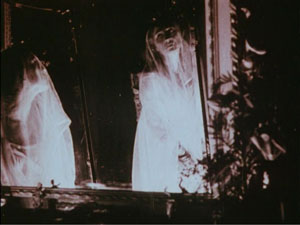
Run at 16 frames per second, this cadenza of apparitions consumes nearly a minute and a half. Such an exercise in atmospherics might be considered wasteful in an American film of the time, but it enhances the expression of Alba’s late-blooming spirituality—just before Satan comes to claim his pledge.
The same sort of languid choreography can involve other players. The diva’s performance, as Jacobs has shown, is often closer to dance than to orthodox acting, and she can weave arabesques around her more or less stationary suitors. At times the diva is a virtual acrobat. If you can call a contortion graceful, we can find it in the angular wrist maneuvers of Borelli in La Donna Nuda (1914).
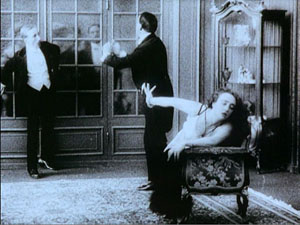
The diva’s divagations are usually shot from a distance, and often there are big sets that are cleared of other actors to allow the actress maximum freedom and minimum distraction.At key moments, there might be a straight cut-in to the diva in medium-shot, but the visual narration keeps our attention fixed on a single arresting figure.
This tendency varies from the sort of ensemble staging that I’ve studied in more detail in On the History of Film Style and Figures Traced in Light. The staging is based upon the diva’s decorative elaboration of her emotional states, rather than in the shifting configuration of several actors. This difference reflects a variation in pace as well: The diva’s subtle changes of expression and posture emerge gradually, but the behavior of actors in ensemble scenes tend to accelerate the flow of action and reaction.
The spotlighting of the diva was not a big surprise, perhaps, but at least a reminder that there are always several tendencies at work in film in any period. More unexpected was the opening sequence of Il Fuoco (1915), in which the heroine visits a lake for a sketching session. As she sits down, a painter arrives to do some painting of his own. There follows a sequence of fourteen shots taken from eleven camera setups, some quite close to the actors. The sequence displays the sort of orthodox continuity that we associate with American films of the same year (The Birth of a Nation, Regeneration, The Cheat).
Granted, European films of the 1910s display freer camera setups in exterior settings than in interior sets. Still, the director of Il Fuoco, Giovanni Pastrone, shows an intuitive mastery of angled shot reverse-shots and consistent eyelines. It makes me eager to see whether other European filmmakers were developing a tradition of continuity editing akin to the American one.
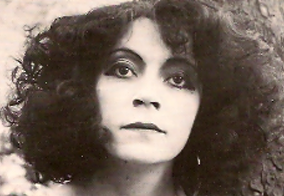
Asta Nielsen was, so to speak, a Danish-German diva. A beanpole with a long face and a slash of a mouth, she might seem an unpromising vessel for languid eroticism. Yet Die Asta became an icon of silent film after her sultry dance in Urban Gad’s Afgrunden (The Abyss, 1910) won her an international audience. In Germany she turned out a vast number of dramas and comedies, with her as undisputed main attraction. Lest we think that the term “star” is a modern one, the title card for S1 (1913) is already playing a coy game.
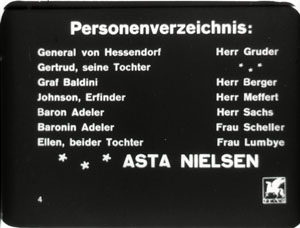
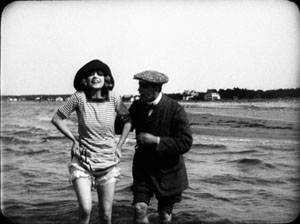
Again, with the spotlight on the heroine, the director’s decision can be simple. Evacuate the set and bring her closer to the camera, or if the set is cluttered, cut in to let Asta act.But she’s refreshingly unethereal, with changes of expression that are fleeting and unpredictable. At a lake with her lover, she flashes her legs at the camera and gives us a grin.
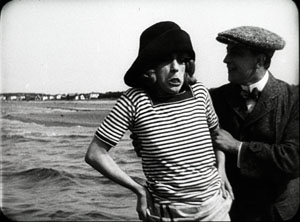
But a few frames later, her grimace becomes downright grotesque as she picks her way to shore. You can easily imagine her fear of losing her balance or stepping on a sharp stone.
Strong-willed and resourceful, Asta projects a wary intelligence. This, of course, doesn’t keep her from falling in love with worthless men.
Colorforms
Today’s archivists are determined to restore silent films to their original beauty, which includes the gorgeous colors achieved by tinting, toning, stencil coloring, and other techniques. Earlier this year Josh Yumibe came to our campus with a splendid collection of frames illustrating the range of possibilities. I saw several colored prints during my Brussels stay, including some original nitrate copies. Two from 1911 were films now acknowledged as “specialist classics.”
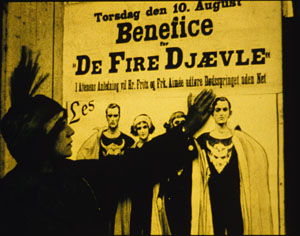
The Four Devils, directed by Robert Dinesen, is one in a cycle of circus films that was popular in Denmark at the period. A team of trapeze artists includes two men and two women; one couple has a steady romance, the other is fractured by the man’s attraction to a rich woman. Once Aimée is convinced of Fritz’s infidelity, she decides to kill him during a performance. The climactic “death leap” is rendered in about thirty shots, including one of an empty trapeze bar swinging. Under the big top, the compositions are full of detail and yet clearly laid out. And Dinesen reveals Aimée’s plan in one of the most ominous shots in silent Danish film.
Even more visually remarkable is Victorin Jasset’s Au pays de ténébres (In the Land of Shadows, 1911), a grim naturalistic drama set among coal miners. The film occasionally displays principles of depth staging that would be elaborated in some of the masterpieces of 1913. In one scene, the miners’ families gather in an anteroom. As they wait to identify the men killed in a cave-in, the bodies are barely discernible in the distance.
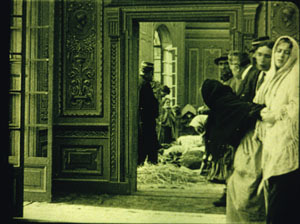
Au pays de ténébres illustrates a sort of structural usage of color. In scenes like the one above, the color is, in orthodox fashion, denoting a daylight interior. By contrast, the scenes in the mine are tinted blue, the standard hue for night and darkness.
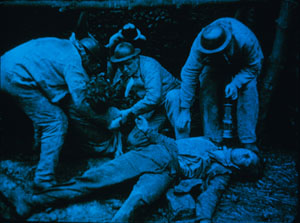
But in the final scenes of the bodies assembled in the room of the dead, the color retains a blue cast, recalling the mine.
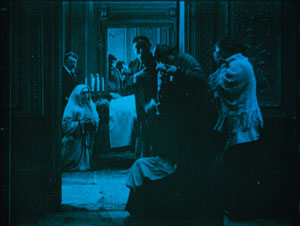
Thanks to the tinting, the living find themselves in the land of shadows.
Early auteurs
In the 1910s, we can find some distinct directorial approaches. One auteur is the German Franz Hofer, who liked to frame his actors in symmetrical architecture. Rectangular geometries are given a comic cast in Fraulein Piccolo (1915), a story about flirtatious officers and a schoolgirl forced to be both maid and bellboy. Here, two servants open doorways to watch a soldier starting to seduce the heroine.
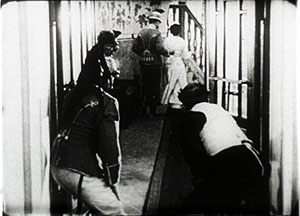
I hadn’t expected to find surprises in Henri Pouctal’s Chantecoq, a two-part French feature from 1916. Yet this espionage drama was consistently engaging, and not just because the popular comedian Pougaud played the deceptively naïve hero. Pouctal unrolls his scenes in an unusual variety of setups, including an astonishing low-angle view of two spies grappling with Chantecoq on the floor of a train compartment. The image recalls Anthony Mann’s steep railway compositions in The Tall Target.
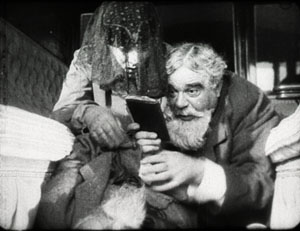
Alfred Machin was Belgium’s preeminent director of the 1910s. He never seems to have seen a windmill he didn’t want to film, then burn down or blow up. Machin enjoyed recording Belgian folk culture, particularly village dancers, as is evident in classic one-reelers like Le Moulin maudit (The Accursed Mill, 1909), and he had a fondness for jungle cats like Mimur the leopard.
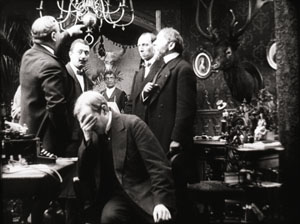
Each of the Machin features I saw shed light on my research questions. Le Diamant noir (The Black Diamond) confirmed that the European tableau style was by 1913 achieving considerable intricacy. In this film, Luc, a rich man’s secretary, is accused of stealing the daughter’s bracelet. The scene of the police interrogation is a muted ballet of figures retreating, advancing, blocking, and revealing.
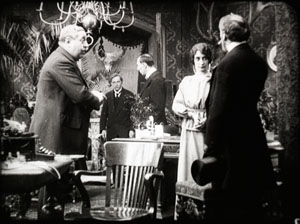
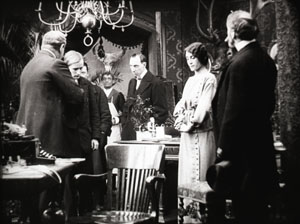
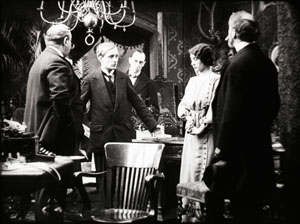
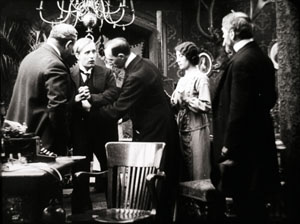
The servant in the far distance returns to visibility when he’s needed to show the cops to Luc’s room.
In Machin’s La Fille de Delft (The Girl from Delft, 1914), the tableau depth cooperates with some muted cutting. Kate is a famous dancer, visited by Jef, the young shepherd who has loved her since she was a girl. In her dressing room, while stage-door roués wait to take her out for dinner, she gets a message from him.
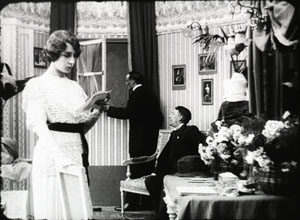
As she lowers the note, she makes her two playboy admirers more visible; we can see them opening the window.
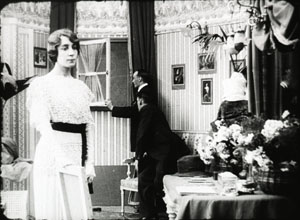
They peer out, and we get an over-the-shoulder shot of Jef waiting outside.
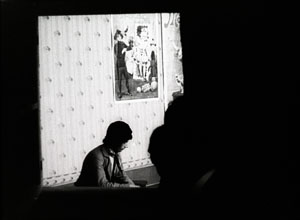
When we cut back to the master shot, the men are mocking him and Kate is deciding whether or not to admit him. She goes to the window herself and looks outside. Again we get the over-the-shoulder framing, but in two beats: Kate looking, then Kate looking away.
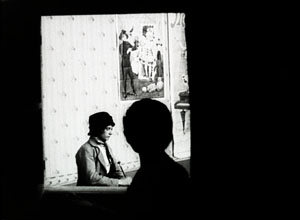
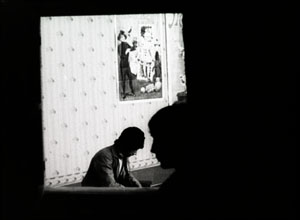
The poignant framing lets us linger on her moment of decision. When she closes the window, we know that she has decided to abandon her childhood friend.
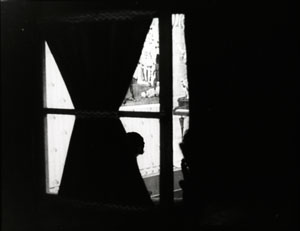
Simpler in its drama and staging is Machin’s official classic, Maudite soit la guerre (Cursed Be War, 1914). Adolphe, a young man from a country suspiciously similar to Germany comes to Belgium, or a place like Belgium, to learn aviation. Adolphe falls in love with his host’s daughter Lidia, but soon war breaks out between their countries and they must part. The rest of the film, which includes some spectacular aerial scenes (and, naturally, a burning windmill), pleads for peace and brotherhood. Released in May of 1914, Machin’s anti-war film now seems a futile warning.
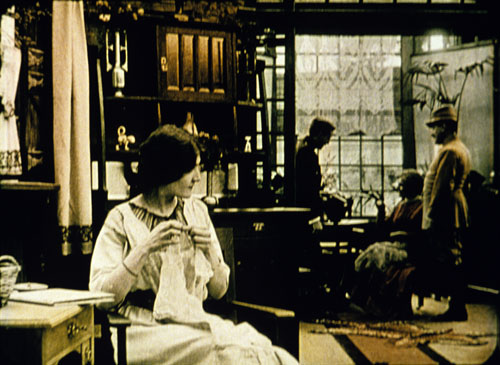
The Archive has restored the original’s Pathécolor, creating images of great loveliness. Some scenes show stenciled color, which helps articulate the planes of shots arrayed in depth. An example surmounts this blog entry. At other moments, deep red tinting enhances the battle scenes, notably one of an exploding dirigible.
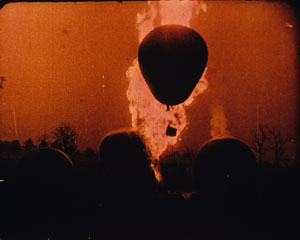
In all, this outstanding restoration of Maudite soit la guerre reminds us of what audiences actually saw—films of deeply felt emotion, often accentuated by spectacular action like that on display today, and employing color with both intensity and delicacy.
The restorer’s art

During my stay, I particularly enjoyed the time I spent with Noël Desmet, supervisor of restorations at the Belgian Film Archive. Noël invented the most robust method of recovering silent film color. Around the world, archivists have adopted the Desmet system.
Noël is scheduled to retire in April of next year. His research will be continued by his colleagues, and he will enjoy some well-earned time among his orchids. Film culture rests upon the shoulders of committed archivists like him. Noël Desmet and his peers are the guardians of treasures, the patient preservers of the secrets and surprises harbored by the twentieth century’s most powerful art form.
For more on tableau staging in Europe and the US, see the entries linked above, as well as my notes from this summer’s visit to the Danish Film Archive, some comments on acting styles, my discussion of Charles Barr’s idea of gradation of emphasis, and an entry on hands and faces around a table. The most thorough analyses of these and other staging principles are in On the History of Film Style, Figures Traced in Light, and certain chapters of Poetics of Cinema.
For more information on Machin and Mimur, see the bilingual book edited by Eric de Kuyper, Alfred Machin Cinéaste/ Film-maker (Brussels: Royal Film Archive, 1995).The Diva Dolorosa disc contains extracts from major films, but unfortunately they aren’t specifically identified, and the original cutting patterns aren’t always respected. The difficulty with such celebratory appropriations of silent films is that they are unreliable as historical evidence. Worse, in today’s commercial market, such compilations make it unlikely that other video producers will launch complete DVD versions of the films.
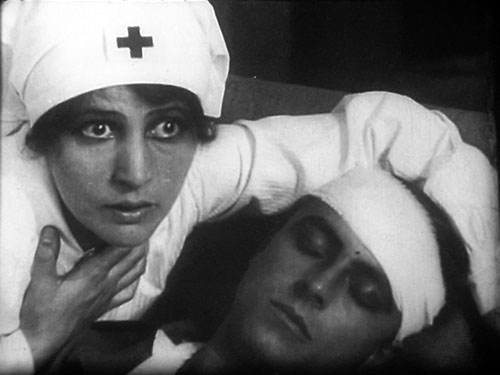
Tagebuch des Dr. Hart (Dr. Hart’s Diary, Paul Leni, 1916)
PS 18 August: Thanks to Armin Jäger for a name correction!
Virginia Theatre on our minds
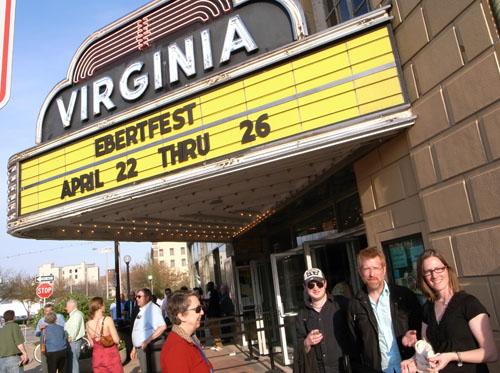
Left to right: Kristin, unidentified ardent moviegoer, Erik Gunneson, and Meg Hamel.
Kristin here–
A year ago, those of us attending Roger Ebert‘s Film Festival were forced to do without the presence of the moving force at the center of this lively annual event. Still in therapy from his health crisis of 2005, Roger fell and broke his hip. Characteristically, he struggled to convince his doctors that he could take an ambulance to Champaign/Urbana, but their caution prevailed.
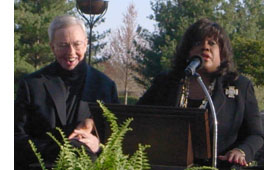 Since then, Roger has become ambulatory again, and this year he looked very happy to be back (an impression confirmed by his wrapup blog here). He still can’t talk, but he was a benign presence at the opening reception at the university president’s residence. There his wife Chaz took over the speaking duties, introducing the filmmakers and the critics who are this year’s guests.
Roger went onstage at intervals during the festival, and he made his first appearance to introduce the opening night’s film, the director’s cut of Woodstock: 3 Days of Peace and Music (1970). Thanks to dedicated software, Roger tapped out messages on a laptop and pushed a button. A voice with a British accent conveyed his words of welcome to us and to director Michael Wadleigh. Then Roger retired to the back of the theater, where a comfy chair is reserved throughout the festival for him.
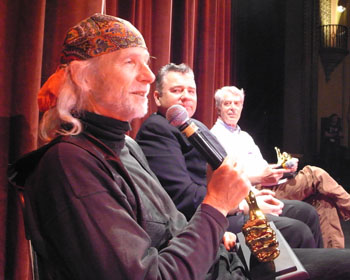
Michael Wadleigh, Jocko Marcellino, and Dale Bell discuss Woodstock.
From the perspective of nearly forty years, Woodstock has become both a record of remarkable musicians in their prime and a valuable document of the youth culture of the late 1960s. I was a junior at the University of Iowa at the time of the concert, only about five months away from taking my first film course and changing the direction of my education from tech theater to cinema studies. Working on props and make-up for productions every night, I was only dimly aware of the concert or the film that followed.
I also admit I don’t know much about pop music. I kept asking David “Who’s that?” Jefferson Airplane, The Who, Joe Cocker, and others were just names to me, not people whose appearance or music I recognized. But I could appreciate the remarkable way in which the filmmakers were able to capture live performances: the fluidity of multiple, 16mm cameras filming onstage only feet from the performers, the maintenance of focus even when events were recorded at night in less than ideal lighting conditions, and the excellent sound recording.
The screening heralds the release of the new version on DVD on June 9. Amazon has it on pre-order in 3-disc Blu-ray and DVD boxes, as well as a 2-disc set. The third disc has some making-of featurettes and about two hours of additional concert footage left out of even this extended version. I can’t imagine anyone who wants a compilation of performances by this remarkable group of musical talent settling for the smaller set.
Von Sternberg and Jannings, round one
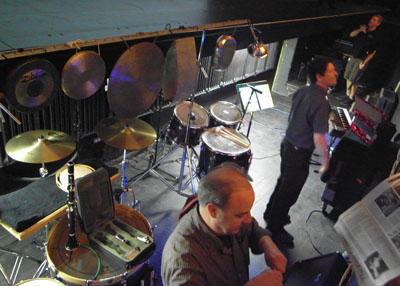
The Alloy Orchestra has become a fixture at Ebertfest. This year’s silent film was Josef von Sternberg’s The Last Command. I hadn’t seen it in thirty years or more, and it’s better than I remembered it being. Of course, seeing a gorgeous print on the big Virginia screen with an excellent musical accompaniment does it more justice than an old 16mm copy. Von Sternberg’s images were luminous, and his depiction of silent filmmaking as accurate as anything you’ll see on the screen.
In von Sternberg’s autobiography, Fun in a Chinese Laundry, he spends most of the six pages devoted to The Last Command badmouthing star Emil Jannings, with a brief sidetrack to badmouth William Powell. Presumably he’s talking about their behavior on the set, since their performances are both impressive, with Jannings emoting away and Powell as stone-faced as Buster Keaton. Von Sternberg reports that he and Jannings vowed never to work together again. Maybe winning the first Academy Award as best actor changed Jannings’ mind, for a few years later he invited von Sternberg to direct him and Marlene Dietrich in The Blue Angel. The rest, as they say, is history.
Drawing on their usual range of odd percussive objects, including a bedpan, the Alloy group provided a lively score. With Chicago Tribune critic Michael Phillips as moderator, Guy Maddin and I joined the orchestra members for a discussion afterwards. One of them hinted to me backstage that a score for Docks of New York might be in the offing, which would round off the von Sternberg series perfectly.
Saturday matinee
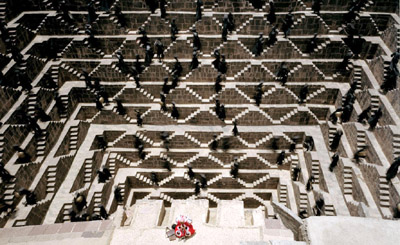
Last year the festival presented Tarsem Singh’s The Cell, with its delirious production design by Eiko. Tarsem’s 2008 follow-up, The Fall, got less attention in theatres, not having a star like Jennifer Lopez to carry it with audiences. It’s a complex fantasy set in a hospital during the silent-cinema era. There a suicidal, injured stuntman telling the tale of a band of mythical heroes bent on revenge to a seven-year-old girl with an arm cast. Her visions of the narrated events, set in spectacular landscapes and exotic buildings, mutate as she insists on changes in the story. The Fall was distinctly a crowd-pleaser, at least for the indefatigably enthusiastic audience in the Virginia Theater. Its Romanian child star, Catinca Untaru, is now twelve, and she proved an articulate charmer as she answered questions after the screening.
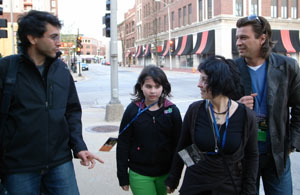
Ramin Bahrani with Catinca Untaru and her family.
The next film was Sita Sings the Blues, a marvelously imaginative animated feature by Nina Paley. I had seen the film two weeks earlier at the Wisconsin Film Festival, and it was a treat to see it on the big screen again. It’s available for download in various formats here. I had the pleasure of moderating the discussion afterward, and I like the film so much that I’ll be blogging on it separately, including a transcript of the Q&A.
Tattling and bullying
DB here:
A Belgian friend, the late Michel Apers, admired American films above all others. One of the reasons, he explained, was that our films analyzed our political system with uncommon clarity. No other national cinema, he claimed, focused so insistently on the mechanisms and purposes of government, on the duties of citizenship, and on the dilemmas of public life. Not wanting to seem too chauvinistic, I said that we often failed to fulfill our nation’s ideals. “Of course,” he said. “But at least you have ideals. And your films show that it is not easy to live up to them.”
Michel’s remarks reminded me that we do have a tradition of politically critical films: 1930s films opposing lynching and hate groups, 1940s films about political corruption, still later movies like Twelve Angry Men and The Best Man and The Manchurian Candidate. Directors who contributed to this tradition include John Ford (Young Mr. Lincoln, The Last Hurrah), Otto Preminger (Advise and Consent especially), and Alan J. Pakula (All the President’s Men, The Parallax View, Rollover, The Pelican Brief).
Rod Lurie’s favorite film is All the President’s Men, which ought to tell you where his heart is. He made The Contender (2000), a subtle drama about a woman nominated for Vice-President. It has the trappings of a political thriller (the conspiracy at its heart echoes Chappaquiddock, as well as Blow-Out), but that’s just the bait for its serious questions. Graced by a warm but steely performance by Joan Allen, The Contender asks whether a woman in politics is held to a higher standard of sexual conduct than a man would be.
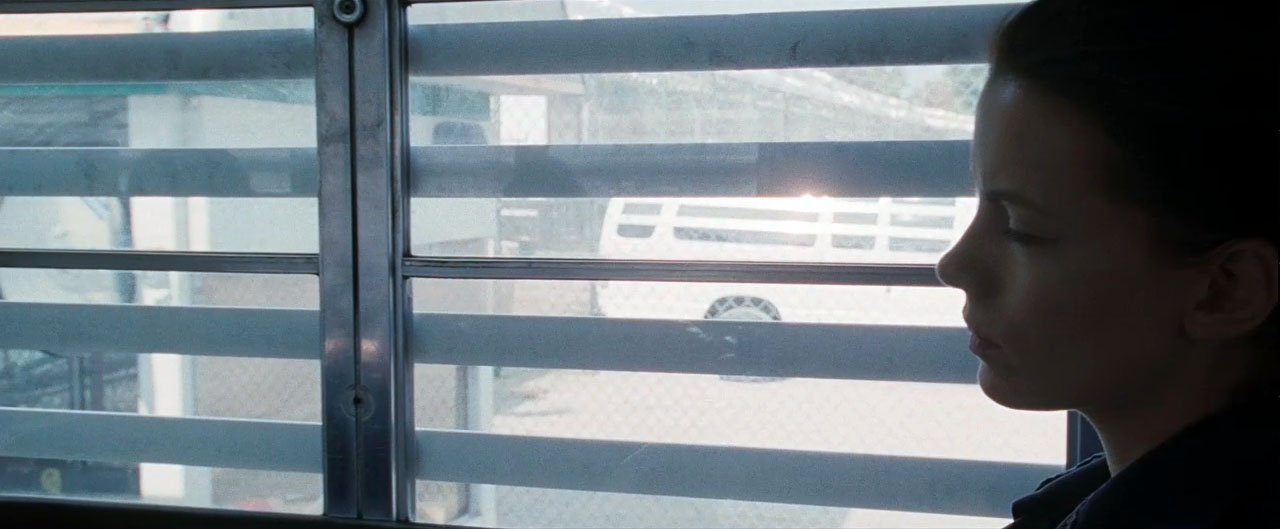
I thought of Michel Apers’ remarks when I watched Lurie’s Nothing But the Truth (2008) at this year’s Ebertfest. The plot revolves around a reporter, Rachel Armstrong (Kate Beckinsale), who outs covert CIA agent Eric van Doren (Vera Farmiga, her of the admirably crooked smile). Rachel refuses to divulge her source and goes to jail. Again, there’s a mystery to draw us through the plot: Who is the source? But more important is the problem of whether a reporter should be forced to name sources in a case that breaches national security. It’s the sort of issue that Preminger or Pakula would have loved to tackle.
 Lurie’s film is as close to a Shavian drama of ideas as I’ve seen in recent American movies. Patton Dubois (Matt Dillon), the prosecutor trying to worm the truth out of Rachel, has plenty of reasonable arguments on his side. During the post-film discussion, Dillon suggested that he leaned toward Dubois’ position: No one should have the power to destroy a person’s career in a sensitive job and go unpunished. In the film, Rachel’s lawyer Alan Burnside (Alan Alda) responds to Dubois with principled refutations, as well as a few pragmatic ones. After all, if Rachel is forced to talk, no whistle-blowers will be likely to step forward. See Roger’s recent review for more thoughts on the political implications.
While the debate plays out, Rachel languishes in jail, her family and career dissolving. The case has some analogies to the Valerie Plame incident, but Lurie stressed that the film takes on a similar situation but not comparable characters. He was inspired as much by Susan McDougal’s tenacious loyalty to Bill Clinton.
The film’s secret about Rachel’s source is no mere Macguffin. It provides a powerful supplementary reason for Rachel’s silence, yet it doesn’t wholly excuse it. The film’s last scene leaves you wondering whether Rachel exploited her source. The film’s last shot suggests that she’s wondering too. That shot also wraps up a visual motif that hangs Rachel’s face on one extreme edge of the 2.40 frame, making her look precarious and vulnerable.
All in all, Nothing But the Truth is a sober, unsensational, gripping film about the press’s rights and obligations. It’s not surprising that Lurie was a professional journalist. During the Q & A, the questions were probing and he responded with rapid-fire, well-shaped sentences. There was good humor as well. After Lurie promised to tell us who slept with whom on the shoot, he paused and said: “All I’ll say is that Alan Alda was a complete slut.”
The opportunity for ordinary moviegoers to talk with such gifted and committed filmmakers makes Ebertfest one of the great film festivals on this continent. Roger’s urge to communicate with as many people as possible naturally inclines him toward creating communities, and the folks who gather annually in the Virginia Theatre form one of the most genial and generous group of movie lovers I’ve ever encountered.
Jackhammers, parties, and markets
DB here:
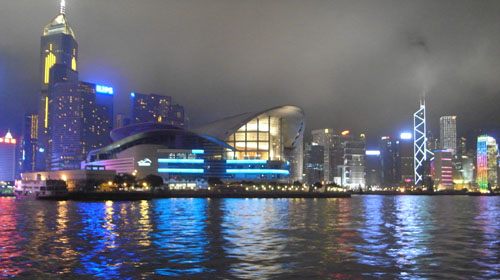
No matter how often you see this Ur-touristic view, it’s still spellbinding. Yes, I’m back at the Fragrant Harbor for the annual festival, front-loaded with Filmart, the film market. My 2008 report starts here, and the 2007 one starts here. Plenty of entries for those years; I’m not sure I’ll be able to roll out so many this time, but we’ll see.
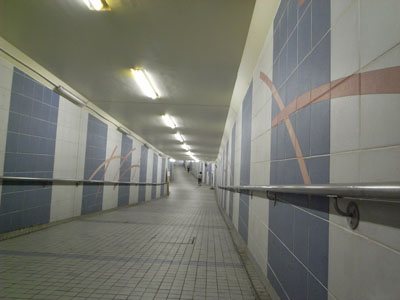
Start with the first impressions. Massive building projects and new traffic-flow strategies have made the tip of the Kowloon peninsula even more pedestrian-unfriendly than last year. Grim underground passages take you in loops away from your destination. No more direct routes anywhere, it seems, and construction projects I’ve watched for years continue to be unfinished. From the twenty-first story of my hotel I can hear a jackhammer at street level.
A striking case: My hotel is rather close to a multiplex in West Kowloon, located in an upscale mall called Elements. (More on Elements in a later communiqué.) But around this trendy spot stretches a vast vacant lot.
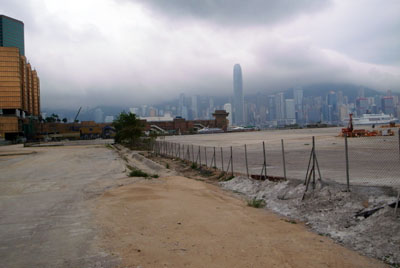
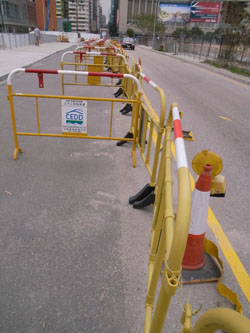
Again, there’s a lot of pedestrian control, including barriers to keep you from crossing the street. Still, it’s not hard to find places where enterprising passersby, perhaps armed with blades, have broken on through to the other side.

Moreover, the Star Ferry to Wanchai still offers a pleasantly sustained ride and the usual spectacular views, even in the rain and mist that have enveloped my first days here.
Wanchai is the location of Filmart, set up in the Convention Centre, the mammoth swooping building seen at the top and bottom of this entry. As usual, Filmart was stuffed with seminars, screenings, and dealmaking, as well as the Asian Film Awards.
The opening of Filmart included a party, where you could find Chris Doyle, accompanied by a beer, rubbing shoulders with Stefan Borsos, editor of the German magazine CineAsia.

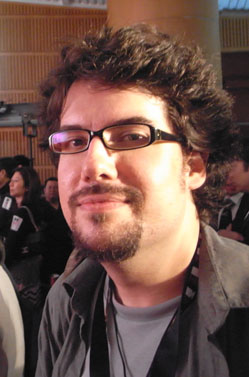
The party got stranger. This year’s festival logo is a dude in black tie with a black starburst head and a hollow look around the eyes. I thought he was only a graphic design until Karen Mok brought him onstage.
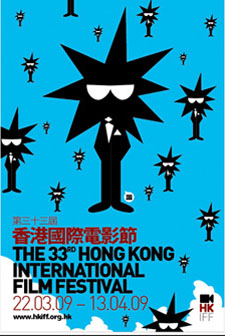

He seems a saucy fellow, at least judging from his hand gesture here.
Filmart opened with a screening of Derek Yee‘s new film Shinjuku Incident. Before the show, Yee, on left, lined up with his cast. You can recognize at least one of the ensemble, grinning as usual.

In the following days, I saw several good movies: More on them in the next post in a day or so. I also attended some sessions devoted to technology and marketing. The effects company Digital Magic sponsored a demonstration of various digital formats, of which the Red system seemed to me the best. Digital Magic also gave out cute Viewmaster-like toys promoting their work.
 I learned things from this session and the one sponsored by Salon Films, but the main live event I hit was the Hong Kong Film New Action Forum, a day-long series of sessions about the future of Chinese film. The first item was a brief discussion moderated by director Gordon Chan (Beast Cop, Painted Skin; left). Two experts discussed the current status of CEPA, the Closer Economic Partnership Arrangement that allows Hong Kong productions to count as mainland ones for purposes of financing and distribution. Across the last few years, half or more of the top-grossing pictures, such as the Zhang Yimou costume epics and Peter Chan’s Warlords, have been CEPA-enabled coproductions. Other countries, such as Singapore, Japan, and Korea, are investing in such projects.
The other session I attended was more high-profile. Philip Chan, screenwriter and former cop, moderated a discussion among John Woo, Oliver Stone, Andrew Lau Wai-keung, and Feng Xiaogang. The Chinese directors talked about the market. Stone talked about creativity. This division of labor reminded me of what Bernard Shaw supposedly told a Hollywood producer: “The problem is that you are only interested in art, and I am only interested in money.”
 Woo took the floor with a long discussion of making Red Cliff. He made the usual point about wanting to wed Chinese stories to Hollywood production values. Some other items:
*He built the project to have marketing appeal, designed both for Asian and western consumption. For instance, strong women appeal to female viewers in all countries. He claimed that one reason that Red Cliff broke attendance records in Japan was the support of women audiences.
*Woo also wanted to bring audiences in Hong Kong and China back to local films, away from Hollywood imports. Viewers, he claims, are bored with Hollywood’s formulas and want something fresh and authentic. But local audiences are getting tired of Chinese blockbusters too, so in Red Cliff Woo introduced humor along with Hollywood-level production values.
*He suggested that before making Red Cliff he had considered retiring. Now he’s planning more projects.

Lau and Feng likewise took up practical considerations. Lau said that filmmakers must go where the market leads. He suggested there was a period when Hong Kong filmmakers went to Hollywood, but now that route is risky. At the moment, the market is the Mainland, not the West. He was not rueful about his own experience in Hollywood (with The Flock), but he treated it as a chance to learn “a different set of rules. Every place has its own rules.” He also spoke of the unexpected success of Infernal Affairs, a “back-to-the-wall” effort that seemed risky in the market decline of the 2000s. No one expected the film to be so successful; the actors cut their asking prices to be in it.
Feng Xiaogang, Mainland director of Cell Phone and A World without Thieves, lived up to his reputation for stirring things up. Announcing that Hong Kong people “consider the Mainland a four-letter word,” he rattled off an account of the current PRC market. Feng indicated that a $20 million film can presently break even in the domestic market. This prospect interested me, because such benefits are rare in the history of movies. As film students know, the US used its big domestic market as a base to launch vast overseas distribution.
Box-office income is growing fast, but there aren’t enough screens. He claimed that there were about 4000 in the country, an absurdly small number for such a populous country. (Probably this figure counts only modern screens, not old or temporary ones.) The key, Feng suggested, was capitalizing the building of still more screens, especially in the 350 “small” cities. The government will subsidize theatre construction to some extent.
If 1000 more screens are added, Feng speculated that in five years the annual box-office receipts could hit 30 billion RMB. That’s about $4.5 billion, somewhat less than half of the 2007 US box-office take—but twice as much as the income in Japan for the same year. China is developing into a prepossessing market.
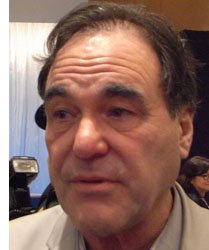 Finally, Oliver Stone confessed his love of Asian films, singling out their “iconic imagery” (Crouching Tiger, even Woo’s Face/Off) and lyricism (Ozu, Wong Kar-wai). His advice: Don’t withdraw from engagement with the West and “Make films that pop their eyeballs out.”
One theme I took away was the way in which regionalism continues to rule the Asian industries, a topic I raised in Planet Hong Kong and in late chapters of Film History: An Introduction. Who needs Western markets if the PRC market continues to swell and if other territories in the area hold up their end of financing, distribution, and the occasional regional hit? As far as mass-market cinema is concerned, we may be moving toward a bipolar world, with North America at one pole and Asia at the other. For an excellent, fact-filled analysis of the implications of this trend toward regionalism, see Darrell William Davis and Emilie Yueh-yu Yeh’s brand-new study, East Asian Screen Industries.
Soon, very soon, we go to the movies.
Screen Digest offers some slightly older statistics on the Mainland market here. For more recent information on Chinese exhibition in a worldwide context, see “Exhibition Breaks Revenue Record,” Screen Digest (September 2008), 274. The number of screens cited here is far greater, perhaps because it counts all the rural, unmodernized, or temporary venues. Karen Chu of the Hollywood Reporter sums up the New Action Forum event here.
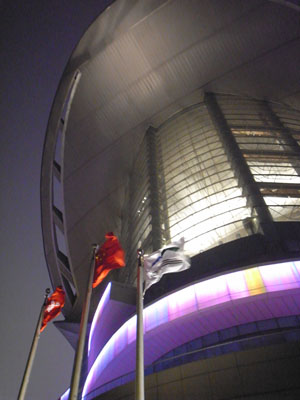
Hong Kong Convention Centre.
A tale of 2–make that 1 and 1/3–screens

DB here:
Last week family affairs took me back to my home area, the Finger Lakes region of New York State. About ten miles from our farm lies the village of Penn Yan (short for Pennsylvania Yankees). When I was growing up there in the 1950s and 1960s, Penn Yan boasted about 3500 people—enough to support one movie theatre. That theatre, the Elmwood on Elm Street, was where I saw most of the movies I didn’t see on TV.
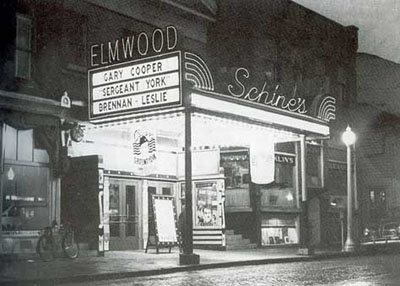
The Elmwood was my introduction to film. When my parents went to town, I was embedded with hundreds of other kids in Saturday afternoon matinees of Tarzan and Lone Ranger movies. On Friday nights, I might catch June Allyson, Donald O’Connor, or Martin and Lewis. When I got older I saw Lawrence of Arabia and From Russia with Love. The Elmwood showed a fair number of art films in the 1960s, including The Servant, The L-Shaped Room, and even 8 ½ (dubbed, I think).
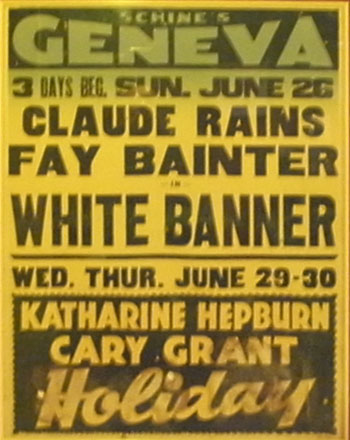
Built in the early 1920s, the Elmwood was acquired by the Schine brothers in 1936. Some towns in our area had two or three Schine theatres. Schine Amusements penetrated Auburn, Bath, Canandaigua, Corning, Cortland, Glens Falls, Gloversville (where it all started), Hamilton, Herkimer, Lockport, Massena, Oneonta, Oswego, Perry, Rochester, Salamanca, Seneca Falls, Syracuse (four houses), Tupper, and Watertown. Clearly, they were leaving the major cities to the big boys. The firm also owned venues in Kentucky and Ohio (none in Cleveland or Cincinnati, but three in Bucyrus). By snapping up screens in the sticks, Meyer and Louie Schine wound up holding nearly a hundred screens in their prime.
Although the brothers went for the smaller markets, they didn’t forget the amenities. They contracted some of the top theatre architects, notably John Eberson, a fantasist with eclectic tastes. The Elmwood didn’t benefit much from the Schines’ largesse as far as I can tell, but it was a sturdy place, with 838 seats, or one for every four people in town.
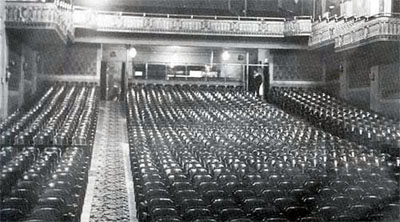
The Elmwood passed out of the Schines’ hands and eventually closed in the early 1970s. For awhile it was an indoor tennis court. The village offices now sit on the site. (Photo: Darlene Bordwell.)

But Penn Yan still has three screens, which I discovered when my sister Diane Verma and I went to Ken Kwapis’ He’s Just Not That Into You. It’s a network narrative like Kwapis’ earlier Sexual Life, and like that (and his Sisterhood of the Traveling Pants) it has some affecting and clever moments. There’s also a nice handling of shot/ reverse-shot when characters are turned away from each other. Mainly, though, I went to see the town’s multiplex, the Lake Street Plaza Theatres.
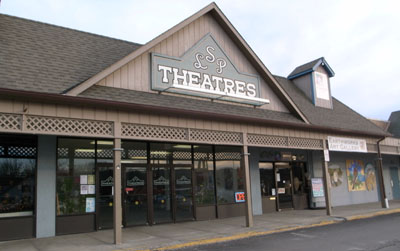
Converted from an exercise club, the LSP houses three screens in a bare-bones design typical of many multiplexes.
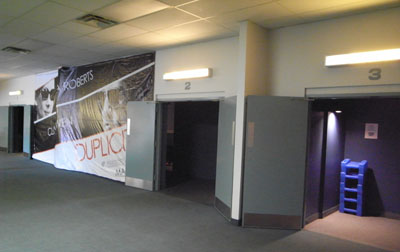
A young man, whose father owned the complex, sold the tickets and ran the projectors. A young woman handled the concession stand. Both were friendly and talkative. Diane and I, two of four people in the house, left happy, although the sugar in the Dots may have helped raise our mood.
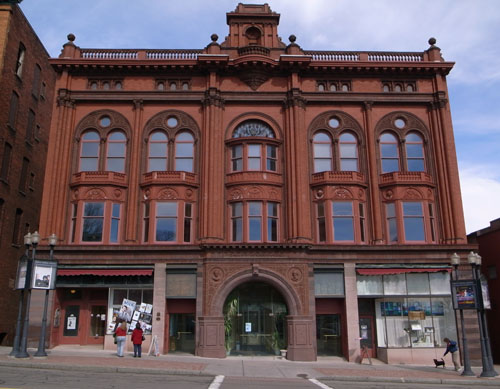
Earlier that day, Diane, my other sister Darlene, and I were driving around our childhood haunts. The towns here are hollowed out by the big-box stores and the recession. Mall parking lots are full, but the main streets are desolate and many storefronts are empty.
Yet in another lake town we came across a surprise. At first I was puzzled. How could the Geneva Theatre have been replaced by a much older and more dignified building, the Smith Opera House?
The door was ajar.
Inside Bruce Purdy, the Technical Director and professional magician, and Sharon Barnes were preparing for a children’s play. They kindly led us on an exploration of this half-hidden jewel. It may have assumed its old name, but the building has regained the delirious splendor that was the Geneva in its heyday.
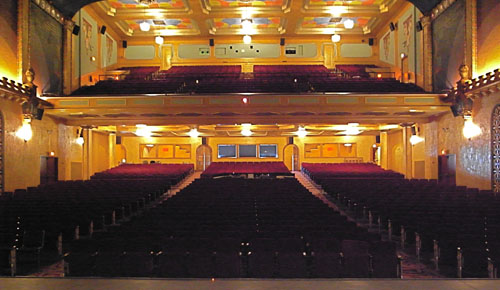
The Smith Opera House was built in 1894. To its stage came Sousa, Bill Bojangles Robinson, Ellen Terry, and traveling shows mounted by Belasco. The vaudeville programs started including short films during the 1910s, and the Smith was one of thirteen venues in which Edison screened his experiments in talking pictures. The Birth of a Nation played there. Soon the theatre became a movie house, called initially the Strand. It wasn’t the only film theatre in town, and by the late 1920s it had competition. The nearby Regent had already become a picture palace, with about 1000 seats; it screened its first sound picture, John Ford’s Four Sons, in 1928 (presumably in a music-plus-effects version).
Enter, on cue, the Schines. They bought the Smith, and after playing burlesque there for some months, they decided to revamp it as a picture palace. The process took several years. The interior was stripped; opera seats were sold for a dollar each. What emerged was an “atmospheric,” with the dome displaying shifting clouds that would slowly clear to reveal twinkling stars. The architecture was a fanciful mix of Art Deco, Baroque, Art Nouveau, and Moorish influence. The premise was that you were in a courtyard under the heavens, surrounded by facades of buildings that were implausible but vaguely familiar in their exoticism.
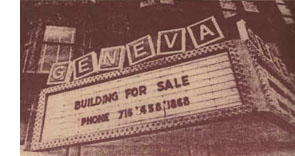
With over 1800 seats, the Geneva Movie Theatre was advertised as the largest movie house in central New York. The first film to play there was Keaton’s Parlor, Bedroom, and Bath in March 1931. The manager, Mr. Gerald Fowler, stayed in charge until 1965.
I didn’t go to the Geneva as often as the Elmwood. Not until I got my Learner’s Permit (a life-changing event to country youth) was I able to drive to Geneva on my own. At the Geneva I saw Mary Poppins, What’s New, Pussycat?, and the CinemaScope version of How the West Was Won. I have no memories of the décor, but by all accounts it was decaying.
Like the Elmwood, the Geneva was closed in the 1970s. Today it looks spanking new. It hosts musical acts (Ani DeFranco is coming up), local and touring stage productions, and on weekends films, “mostly foreign and arthouse,” as Bruce Purdy explained. When we were there the theatre was running a package of Academy Award Best-Picture nominees.
My sisters and I first paused in the lobby, with its fine hanging lamps.

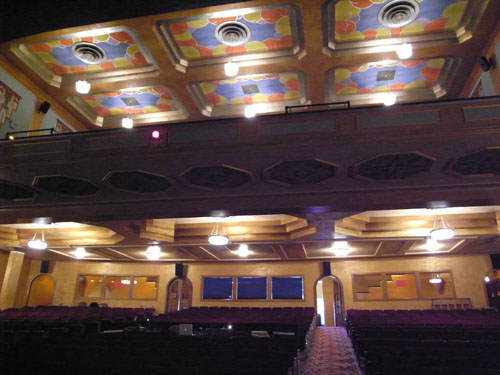
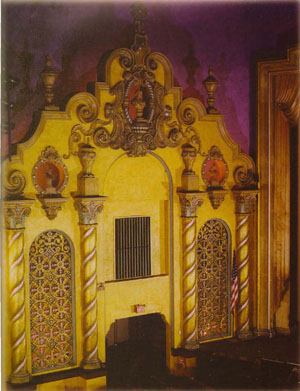
Inside, the auditorium area is of course very impressive, flanked by facades with corkscrew columns.
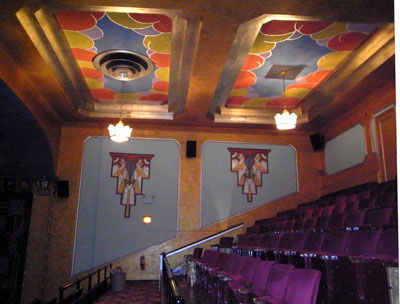
Along the balcony are vaguely ziggurat wall designs.
Just in case there was too much empty space, architect Victor Rigamount added some escutcheons.
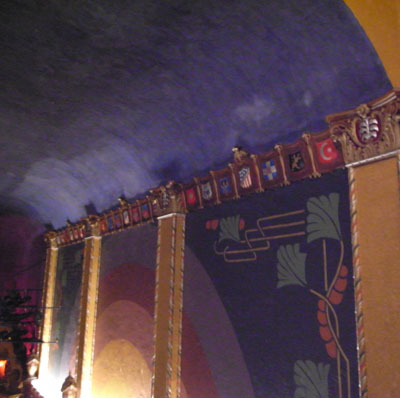
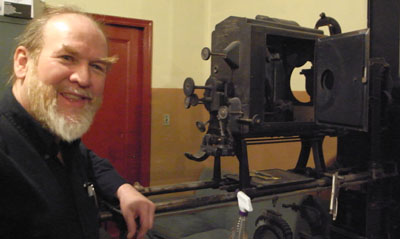
In the projection booth, Bruce showed us the Brenkograph, a marvelous old gadget for projecting lantern slides in dissolving views. The Brenkograph provided the milky clouds cast onto the ceiling: light was pumped through a swirling oil mixture.
In 1946, the year before I was born, US movie attendance reached its peak of about 82 million weekly. The industry had receipts of nearly $1.6 billion. It must have looked like filmgoing would never fall off. But it did, and fast. Enjoying Peter Pan, Moby Dick, and Davy Crockett, I was living through the first major decline in the film industry. By the time I left for college in 1965, weekly US attendance had dropped to 20 million, where it would hover for nearly three decades. Hollywood’s annual box-office receipts were then $927 million (about $657 million in 1947 dollars). In the course of my eighteen years the country had lost 5,000 screens and about 50,000 theatre jobs.
 I wish I could go back to see how these old theatres looked then. I wish I could photograph them, inside and out. I wish that I could return to the Elmwood in June 1954 to ask Mr. Norman Williams (unmarried) about the new screen, said to be twenty feet high and 35 feet long—redesigned, of course, for CinemaScope. He was planning to add stereophonic sound, which would, the newspaper story explains, “create the illusion that the sound travels with the movement of actors or objects across the screen.” But until the new system arrived, Mr. Williams said, only Warner Bros’ CinemaScope pictures would be run, because they didn’t require stereo. You mean movies like A Star Is Born and Rebel without a Cause? What wouldn’t I give to see those in their original form, from the front row.
Just before I left the area in 1965, I could have quizzed the managers and staff about the old days. After the war, had they suspected what was coming? What was it like to watch your livelihood shrivel year by year? I didn’t know enough to ask. I didn’t understand what had happened.
In the meantime, we haven’t lost everything. On one screen of the Lake Shore Plaza, you could have seen Watchmen on opening weekend. The projection is very good.
My general information about theatres and attendance is culled from back volumes of The Film Daily Yearbook. The Schine family entered history in another way; see here. Information about CinemaScope at the Elmwood comes from the Penn Yan Chronicle-Express of 10 June 1954, p. 1. My account of the Geneva Theatre is largely derived from two publications, The Smith Opera House (Geneva: n.d.) and Charles McNally’s The Revels in Hand: The First Century of the Smith Opera House, October 1894-October 1994 (Geneva: Finger Lakes Regional Arts Council, 1995). Both are available at the theatre; for contact information go here. The Elmwood photos come from wetlandspy. Check out Darlene’s photo page too.
For a panoramic study of American movie exhibition, see Douglas Gomery’s Shared Pleasures: A History of Movie Presentation in the United States. The first time I met Doug, he asked where I was from. I said Penn Yan. He nodded. “Okay, so you went to a Schine theatre.” The man knows his stuff.
Thanks to Bruce Purdy and Sharon Barnes for their hospitality. And thanks to Ryan Kelly for asking me to clarify the situation with Four Sons.