





Archive for the 'People we like' Category
A hundred years, plus a few thousand more, in a day
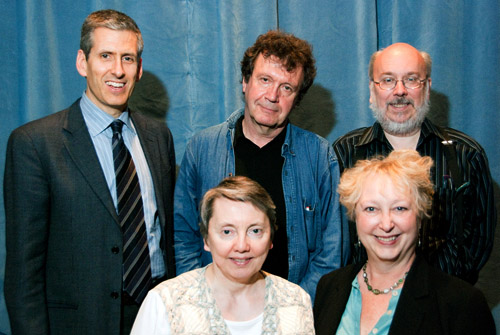
Charlie Keil, Yuri Tsivian, Henry Jenkins, Kristin Thompson, and Janet Staiger. Photo by Joel Ninmann.
Last Saturday we held the symposium “Movies, Media, and Methods” in honor of Kristin’s arrival at age sixty. Four distinguished scholars, all professors from major universities, presented top-flight talks. As a bonus, Kristin gave The Film People a glimpse into her Egyptological work. I report on this very full day in the hope of giving a sense of how stimulating we found it.
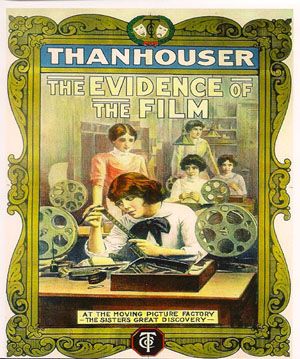
Thanhouser was an American film company that flourished between 1909 and 1917. It has been overshadowed by Biograph because that firm put out more films and, not incidentally, employed D. W. Griffith. But Ned Thanhouser has been diligently gathering his family company’s output from archives around the world and releasing it in informative DVD editions. The most famous Thanhouser production is probably Cry of the Children (1912), a powerful attack on child labor. You could also try the thriller The Woman in White (1917), adapted from Wilkie Collins’ masterful novel. A study in sadism, and more subtle than The Girl with the Dragon Tattoo.
Charlie Keil, an expert in 1910s US film from the University of Toronto, examined Thanhouser’s films with two questions in mind. Did the studio have a “distinctive personality” in its products? And does its output reflect the development of film style across the crucial transitional years of the early 1910s? Borrowing a method that Kristin had applied to Vitagraph films in an essay, Charlie took one film from 1911, one from 1912, and one from 1913. Charlie wasn’t ready to conclude that these specimens displayed a unique studio style, but it was clear that across just three years, big changes in storytelling were taking place.
The plot of Get Rich Quick (1911) involves a man who joins a business that is scamming innocent investors. The film uses only five locales and plays scenes in long takes. The Little Girl Next Door (1912) has a more complex plot, with two distinct lines of action that converge on a child’s drowning. It uses many more locales and an ellipsis of a year to trace the changes in a family’s fortunes. It also incorporates cut-in close views and point-of-view editing. The Elusive Diamond (1913) is less psychology-driven than The Little Girl Next Door, but its intrigue relies almost completely on dialogue titles and it includes many close-ups and variation of camera setups.
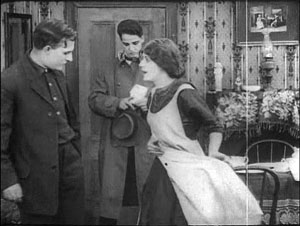
Three films and three years: A vivid cross-section of the rapid development of what soon became classical visual storytelling. Moving from 18 shots to 53 shots to 74 shots, the films became less dependent on staging and more dependent on editing. At the same time, Charlie didn’t fail to notice how the long takes in Get Rich Quick allow some felicities of performance, particularly the way that the wife’s handling of her apron charts her psychological states. She brushes it aside to show how poor they are, then she uses it as a giant hankie.
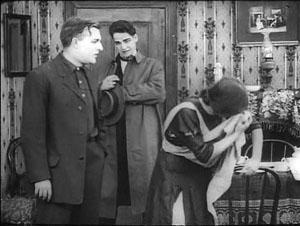
Like all good papers, Charlie’s left a lot to be discussed. People asked about how much pre-planning was done at Thanhouser, about the directors and screenwriters on staff, about the division of labor. We were left with a sense that here was another mostly unknown region that would reward further study.
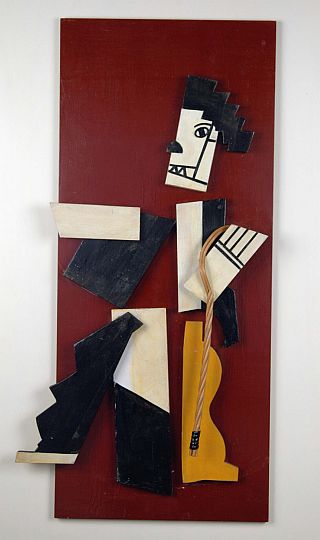
Fernand Léger, Cubist Charlot (1923).
Yuri Tsivian of the University of Chicago carried us into the twenties with an in-depth examination of early Russian reactions to Charlie Chaplin. The paper held many surprises. Chaplin was popular in many countries from 1915 onward, and very soon after he was celebrated by European intellectuals. But Russia lagged behind; there’s no concrete evidence that any Chaplin films were shown there until 1922. Yet the Soviet avant-garde embraced him. How and why?
Instead of looking for a dual relationship—Chaplin directly influencing Russian artists—Yuri postulated a “triangular” relationship, in which Chaplin’s image was mediated through other European sources. For instance, Léger’s numerous images of a fragmented Chaplin led Futurists and Constructivists to declare Charlie “one of us.” They loved the idea of man as a machine executing precisely articulated movement, and what they heard of Chaplin’s pantomime and gags led them to praise him. Chaplin, said Lev Kuleshov, is “our first teacher” because he knows bio-mechanical premises better than anyone. According to the photographer and graphic designer Rodchenko Chaplin instructs viewers in how to walk or put on a hat in the most perfect manner.
So strong was this “virtual” image that artists could read Chaplin into the slapstick comedians they did see. Yuri showed that Varvara Stepanova’s striking rendition of Chaplin as an airplane propeller derived from a film he wasn’t in!
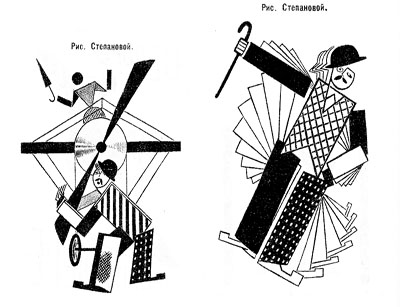
Perhaps she didn’t care: Nikolai Foregger suggested that Chaplin himself was unimportant, that the crucial fact was that he created a whole school of comedians within what Yuri called “a collaborative research community”—that is, Hollywood!
Yuri’s paper, in homage to the Russian Formalists, invoked the “law of fortuity” in art. This refers to the possibility that artistic borrowings, blendings, and crossovers are not determined by any broader social processes, as the Marxists were arguing, but are merely contingent. “Life interferes with art from below.” Accidents and unforeseen intersections, such as the Chaplin craze meeting the Constructivist movement, allow artists to seize on whatever is around them for new material. Yuri’s reference was to Kristin’s revival of Formalist methods in her “neoformalist” studies of Eisenstein, Tati, and other filmmakers.

Janet Staiger of the University of Texas at Austin collaborated with us on The Classical Hollywood Cinema, and she has for several years been the leading scholar of reception studies in film and television. In looking at the Indiana Jones series, her paper nodded to Kristin’s work on the Lord of the Rings franchise and her study of fans’ responses to the films.
“Nuking the fridge,” Janet explained, has become fan jargon for an outrageous plot twist. The phrase comes from a notorious moment in Indiana Jones and the Kingdom of the Crystal Skull (2008), in which Professor Jones escapes an atomic blast by diving into a lead-lined refrigerator. The moment becomes a crux for clashing fan judgments: This is totally unrealistic vs. Realism doesn’t matter. Janet went on to show how these and other fan responses, entwined in IMDB commentary threads, utilized several different interpretive frames.
One was authorship. Like academics and journalists, fan are auteurists. They assign the director responsibility for major aspects of the film. But this doesn’t mean that they agree in how to use this frame. In the case of Crystal Skull, a certain Kid Mogul asked if Spielberg’s willingness to reinvigorate the franchise was purely mercenary: “Is it just about the money?” Others took a more career-survey approach, noting that after prestige pictures like Schindler’s List Spielberg recalibrated his popcorn movies, particularly by handling violence more gingerly.
Another frame was story-based “lit talk.” Fans disparaging the film found it clumsily plotted and lacking in character development. Several were quite sensitive to narrative coherence, one-off gags (such as nuking the fridge), and pacing. Those defending the film appealed to the emotional burst of the final chase scenes.
Janet’s third frame of reference was what she called “formula dissonance.” She sought to capture what seeing the film would be like for those who knew Indy’s story only through the TV series or video versions of the earlier installments in the franchise. She suggested that the formula was by 2008 quite abstracted and idealized for many fans. Their sense of the franchise was thus tested by the extraterrestrial twist that resolved the Crystal Skull plot. Does it reframe the whole series in a cosmic context, or is it a violation of the premises of the Indy universe?
Janet’s survey of these types of responses made me notice that the assumptions of academic film studies and of journalistic criticism overlap with fan conversation. Fans who liked the film tried to make everything fit by appeal to organic unity, technical proficiency, emotional intensity, and other familiar criteria. It made me suspect yet another reason why “amateur” and “professional” film criticism seem to be merging: Perhaps their conceptual frames of reference aren’t so far apart. But their tastes and their degrees of commitment surely are.
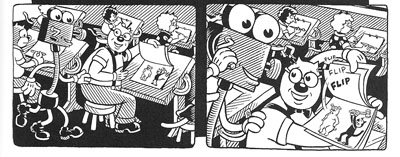
You might have expected Henry Jenkins of the Annenberg School at the University of Southern California to talk about fans too. After all, he practically invented the modern study of media fandom with his book Textual Poachers, and his work influenced Kristin’s study of fan promotion of The Lord of the Rings. Instead he turned to a survey of an artist’s oeuvre. He showed how Kim Deitch’s vast output of stories appropriate imagery from nineteenth and twentieth century mass media and present highly personal versions of the history of popular culture.
In a way, though, Henry’s talk involved fandom because Deitch is himself a prototypical fanman. He’s an obsessive collector, likely to turn his search for a rare toy or drawing into a Byzantine odyssey on the page. Fascinated by Hollywood scandal, he has constructed a phantasmagoric history of mass media through fictional characters (e.g., fake movie stars) who confront real people (e.g., Fatty Arbuckle). He’s particularly concerned about what he takes to be the warping of animated film by the influences of the mass market, epitomized by the Disney empire. The emblematic moment in Boulevard of Broken Dreams comes when Deitch’s Winsor McKay stand-in addresses torpid animators at a tribute dinner and denounces them for selling out.
Deitch’s most famous character is Waldo the cat, and Henry traced the powerful connotations of this emblematic figure. Waldo recalls Felix, the most heavily merchandised comics figure before Mickey, as well as the black cat as a figure of deception, witchcraft, and even African-American minstrelsy. Through Waldo, Deitch could hop across the history of film and comics, from McKay to Mighty Mouse and 1940s abstract films. In Alias the Cat!, Deitch finds in the 1910s everything that we associate with media today: serial narrative, stories shifting across different media platforms, an uncertain line between publicity and self-expression, and a mixing of news and sensational fiction.
Henry situated Deitch in a broader trend of comic artists trying to find a new history of their medium, one that dislodges superheroes from a central role. Deitch’s themes of old-fashioned craftsmanship, lovably antiquated technology, adult dread and degeneracy lurking behind children’s stories, and the commodity demands of comic art link him to contemporaries like Chris Ware and Art Spigelman.
Henry’s talk spurred a lot of discussion, including the question of whether we can treat an artist as offering a history that is comparable to academic research. Can Deitch’s hallucinatory vision of American media be a plausible basis for understanding what really happened? On the whole we don’t expect an artist to offer rigorous arguments. An artwork appropriates history for its own end. (Not all the Greek philosophers actually gathered together in the way Raphael depicts them in the School of Athens painting.) How cogent you find Deitch’s critique probably also depends on whether you share his disdain for Disney. His floppy-limbed denizens fuse headcomix grotesquerie with the 1930s animation that most prestige studios abandoned. As in Sally Cruikshank’s sprightly cartoon Quasi at the Quackadero, Deitch’s rubbery frames revive a style in which everything seems to throb and shimmy.
Kristin’s talk, “How I Spend My Winter Vacations: The Amarna Statuary Project and Techniques of Visual Analysis,” had two parts. In the second part, she reviewed her recent work in assembling statues out of tiny bits that had been dumped by archaeologists decades ago. You can read some of this story here. The side of her work most intriguing to students of film, I think, involves her attraction to Egyptian art in the first place.
Egyptian art is often thought of as unrealistic, but during his reign in the fourteenth century BCE the pharaoh Akhenaten introduced a peculiar sort of stylization into it. When he instituted a monotheistic religion centered on the sun god Ra (embodied in the Aten), he also demanded a new pictorial style. Thus the Aten is depicted as a disc shedding rays, a symbol of life and dominion. In addition, the royal family displays biggish hips and thighs, which fit the fecundity theme. More strikingly to our eye, Akhenaten’s family were represented as somewhat distorted, with long and narrow faces, hands, and feet. The ruler’s crown is elongated as well. Several aspects of the new style are present in Kristin’s favorite scene, a beautiful relief carving known as the Berlin family stela.
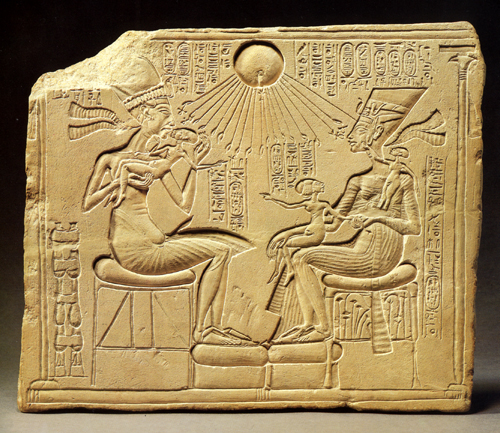
You can see the Aten’s rays ending in little hands holding ankh signs to the royal couple’s noses. But just as important is the human dimension of the scene, and two sorts of action displayed there: swiveled shoulders and pointing hands.
Unlike the flat, frontal portrayal we associate with Egyptian art, the family members are caught in twisting postures that bring one shoulder forward. Kristin explained:
Akhenaten is lifting his daughter, his foreground arm moving backward to hold her legs, the other moving forward to support her body as he kisses her. She reaches with her rear arm to chuck him affectionately under the chin, while her other arm moves backward in a pointing gesture. On the opposite site, Nefertiti’s foreground arm is held bent and backward to steady the youngest daughter of the three present, who is standing on her thigh and reaching up rather precariously to grab a golden decoration hanging from her mother’s crown. Nefertiti’s rear hand goes forward to steady the second daughter, who is also pointing, this time with her rear arm as she twists to look at her mother. These kinds of gestures can be found again and again in such scenes.
The twisting movement wasn’t unknown among images of workers and private individuals; Amarna artists, presumably encouraged by Akhenaten, applied the device to portraying the royal family.
Just as significant are the pointing gestures we find in the stela. Some scholars have interpreted them as protective gestures, which are found in other images. But Kristin points out:
 In those cases, the protecting figures hold their arms straight, they stare in the direction of the thing to be protected (as one presumably would in reciting a spell), and there is something dangerous present. None of this applies in the scene in the stela.
After pondering this scene quite a lot, it occurred to me that it looked like a really early film, a short scene, perhaps 30 seconds long, that we were to interpret as a tiny narrative. The pointing gestures seemed comparable to pantomime, where one has to interpret movements in the absence of intertitles.
Given that so much Amarna art is about displaying the royal couple as having created life by giving birth to their daughters and as sustaining that life, it seems to me that this stela is full of indications of nurturing. The columns and roof indicate that the parents have their kids in a little shelter to keep them out of the hot sun. The rows of pots behind Akhenaten’s stool are no doubt filled with cool drinks for them. Nefertiti carefully holds onto the two children on her lap while Akhenaten kisses the eldest. My interpretation is that the eldest is saying something like, why don’t you kiss sister, too?” and the one opposite is pointing out the kiss to her mother and saying something like, “Look, daddy’s kissing sister; I want a kiss too.”
This may not sound like the sort of thing kids would say, but the circulation of affectionate gestures among the family members in these casual scenes is nearly universal. The chucking under the chin gesture used by Meretaten here shows up again and again, as do embraces and kisses.
Despite all the stylization, then, Kristin concludes that the stela depicts a scene of intimate affection, complete with a child toying with a mother’s ornament. This homely realism chimes with other realistic tendencies in Amarna art, such as the differentiation of right and left feet and the presentation of plants and animals in non-stereotyped ways. In sum, Kristin’s ability to look closely at film style helped her make discoveries about visual narrative in a completely different domain.
So our Saturday talks included cinema-related material from 1911 to about 2010, and with Kristin’s lecture we flashed back about 3300 years. Every talk was crisp and lucid. We were spared the juggling of empty abstractions, the free-associative rambling, and the self-congratulatory cleverness that plague the humanities. We got knowledge and opinion presented with enthusiasm, modesty, and good humor.
Kristin and I are grateful to our presenters, as well to all the friends old and new who showed up: Leslie Midkiff Debauche from Stevens Point, Carl Plantinga from Michigan, Peter Rist from Montreal, Brenda Benthien from Cleveland, Virginia Wright Wexman from Chicago, Vicente José Benet from Spain (via Chicago) and many others. In all, a day to remember.
For more information on Kristin’s research see my earlier entry. For other cinematic implications of the Berlin stela of Akhenaten’s family , see Kristin’s blog entry here. Her article, “Frontal Shoulders in Amarna Royal Reliefs: Solutions to an Aesthetic Problem,” is available in The Journal of the Society for the Study of Egyptian Antiquities 27 (1997, published 2000).
All of our speakers are represented on the Web: Henry here, Charlie here, Janet here, and Yuri here (and of course on Cinemetrics). For more on Janet’s study of online critics and the frames they inherit, see her essay, “The Revenge of the Film Education Movement.”
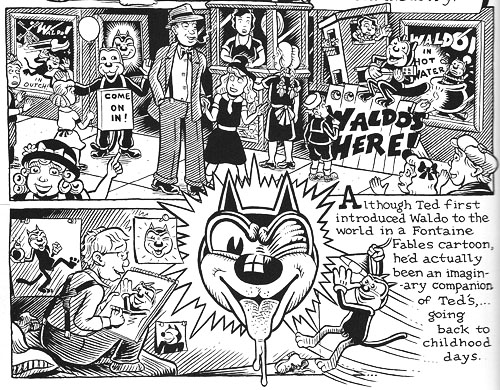
Kim Deitch, Boulevard of Broken Dreams.
All the prints that fit the news
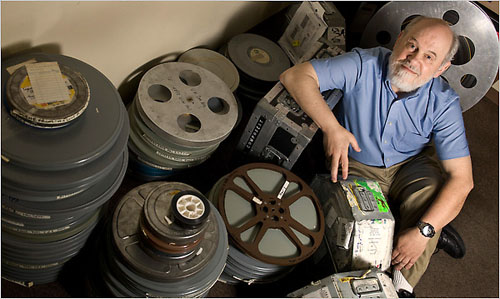
Blowing Your Own Horn Dept: The New York Times has an article about this blog and our academic work here. Thanks to Manohla Dargis for her kind remarks.
Notice: No films were harmed in the making of this picture.
Dragons on your doorstep

DB here:
Once more, Hong Kong. Still a spellbinding place, although the municipality is doing whatever it can to force pedestrians underground and surrender the streets to cars. Even a dragon has to wait for the pedestrian light. And now, thanks to the sandstorms in China, the air is thick with pollution. I have taken defensive measures. My students probably wished I’d worn one of these more often.

Yes, that is the Boy Scout logo behind me. Why? Answer here.
I’ve already seen a few films at the Hong Kong International Film Festival, but I’ll try as usual to fold my viewings into a few thematically related entries. In the meantime, amateur reportage and celebrity gawking take over. I’m surface-skimming, I grant you, but it’s quite a surface.
For some years now, the festival has meshed with Filmart, the regional film market and trade show, and the Asian Film Awards. So you need badges.

For most of this week, the big events take place at the Hong Kong Convention Centre.

The opening reception for the festival offered all the glitter you can ask for, literally, when a cascade of sparkling paper showered down on the group photo of the organizers.

Among those present: Tang Wei, star of Lust, Caution and featured alongside Jacky Cheung in Ivy Ho’s festival-opener Crossing Hennessy.

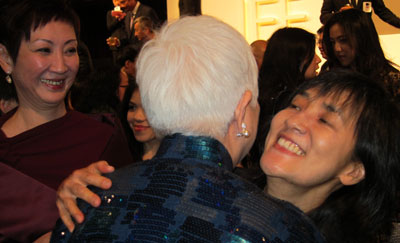
Then there was Lisa Lu, radiant as ever. She was a wonderful star in Shaws’ golden age and continues to visit the festival annually, while sustaining her acting career.

Clara Law, director of one of the opening films, Like a Dream, embraces Lisa while Nansun Shi, herself a legendary and still central Hong Kong producer, looks on.
Filmart this year teemed with mainland Chinese media firms, but the classic Hong Kong companies also put in their appearance.

It’s reassuring to see that Wong Jing, the brains behind Naked Killer and Naked Weapon, hasn’t abandoned his old ways.

New regional enterprises are emerging. Patrick Frater and Steven Cremin, old Asian hands, have created FilmBusinessAsia as a resource of news, industry analysis, and in-depth information. Based in Hong Kong, they are ably teamed with Business Development Executive Gurjeet Chima, who speaks five languages.
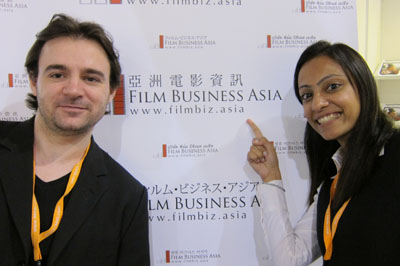
Anyone interested in Asian film will find their information-packed website a must.
Two more entrepreneurs are Joey Leung and Linh La of Terracotta Distribution, a London-based outfit with an already impressive library. I met them through King Wei-chu, on the right, a programmer for Montreal’s FantAsia.

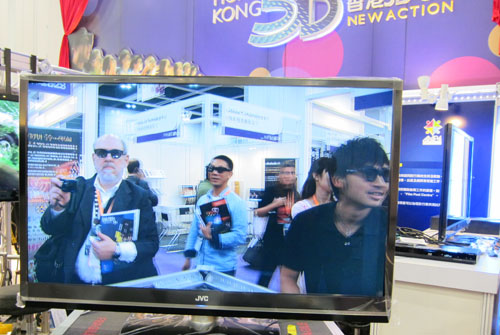
Three-dimensional film and TV were all over Filmart. Take a look at a 3D setup using the Red HD camera.

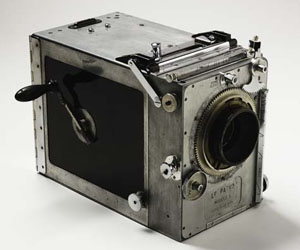
What a contraption! To shoot Potemkin, Napoleon, and a host of other 1920s films, you just needed a Debrie Parvo, that model of Style Moderne design.
Still, 3D television seems more or less ready for prime time. Can you tell the difference between reality and a 3D image?


Also at the Convention Centre was the Asian Film Awards ceremony, which whizzed by in two hours. On the red carpet runway you could see some celebrities, such as Wai Ying-hung, a Shaw Brothers ingenue and kung-fu warrior from the 1980s who would win for best supporting actress in Ho Yuhang‘s At the End of Daybreak.

Among the slinky models and standard-issue teen idols on the red carpet, a note of dignity was struck by Amitabh Bachchan, who got a lifetime achievement award. He might as well officially change his name to Megastar Amitabh Bachchan.

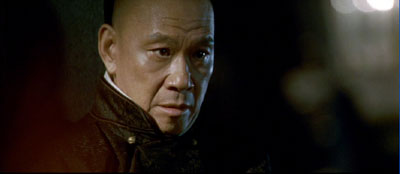
For a complete rundown on the award winners, you can go here. We wrote about three of them in earlier blog entries: Bong Joon-ho‘s Mother (best picture, best actress, best screenplay), Ho Yuhang‘s At the End of Daybreak (best newcomer, best supporting actress) and Chris Chong‘s Karaoke (best editing). Among the nominees, we also wrote about Love Exposure, About Elly (I really wish it had won something), Cow, Air Doll, and Breathless. I was particularly struck by the cheers and whoops the audience gave Wang Xueqi of Bodyguards and Assassins, which I caught up with today. He’s an actor of gravity, who unlike most Hong Kong performers believes that less (hamming) is more (engrossing).
With the big launching events over, we can get down to the real business: Watching movies and discovering some sublimity in them. More entries, as usual, to come.
Her design for living
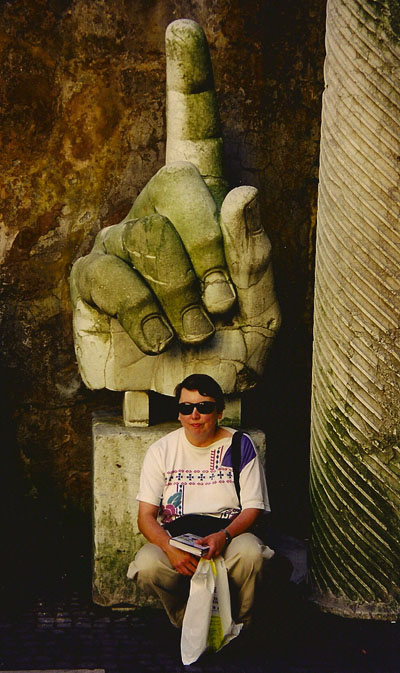
Kristin in Rome, 1997, in front of a “recent” hand from a colossal statue of Constantine. The Amarna statuary fragments she studies are twice as old.
DB here:
Kristin is in the spotlight today, and why not? She’s too modest to boast about all the good things coming her way, but I have no shame.
First, our web tsarina Meg Hamel recently installed, in the column on the left, Kristin’s 1985 book Exporting Entertainment: America in the World Film Market 1907-1934. It was never really available in the US and went out of print fairly quickly. Vito Adriaensens of Antwerp kindly scanned it to pdf and made it available for us. So we make it available to you. More about Exporting Entertainment later.
Second, Kristin is not only a film historian but a scholar of ancient Egyptian art, specifically of the Amarna period. (These are the years of Akhenaten and Nefertiti and their highly unsuccessful experiment in monotheism.) Every year she goes to Egypt to participate in an expedition that maps and excavates the city of Amarna. In recent years she’s focused on statuary, about which she’s given papers and published articles. Now we’ve learned that she has won a Sylvan C. Coleman and Pamela Coleman Memorial Fellowship to work in the Metropolitan Museum of Art’s collection for a month during the next academic year. So at some point then we’ll both be blogging from NYC. Think of the RKO Radio tower sending our signals to a tiny world below.
Third, she is about to turn 60, and in her honor the Communication Arts Department is sponsoring a day-long symposium. On 1 May we’ll be hosting Henry Jenkins, Charlie Keil, Janet Staiger, and Yuri Tsivian to give talks on topics related to her career interests. Kristin’s talk will survey her Egyptological work, with observations on how she has applied analytical methods she developed in her film research. You can get all the information about the event, as well as find places to stay in Madison, here.
Kristin came to Madison in 1973, a very good moment. Whatever you were interested in, from radical politics to chess to necromancy (there was a witchcraft paraphernalia shop off State Street), you could find plenty of people to obsess with you. Film was one such obsession.
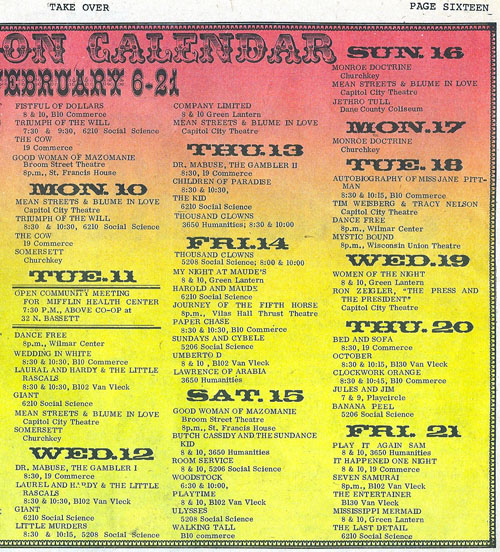
The campus boasted about twenty registered film societies, some screening several shows a week. Fertile Valley, the Green Lantern, Wisconsin Film Society, Hal 2000, and many others came and went, showing 16mm films in big classrooms in those days before home video. Without the internet, publicity was executed through posters stapled to kiosks, and the fight for space could get rough. Posters were torn down or set on fire; a charred kiosk was a common sight. Another trick was to call up distributors and cancel your rivals’ bookings. One film-club macher reported that a competitor had cut his brake-lines.
What could you see? A sample is above. What it doesn’t show is that in an earlier weekend of February of 1975, your menu included Take the Money and Run, The Lovers, Ray’s The Adversary, Page of Madness, Fritz the Cat, The Ruling Class, Dovzhenko’s Shors, Chaney’s Hunchback of Notre Dame, American Graffiti, Wedding in Blood, Pat and Mike, Camille, Yojimbo, Faces, Days and Nights in the Forest, King of Hearts (a perennial), Sahara, The Fox, Day of the Jackal, Dumbo, Investigation of a Citizen above Suspicion, Slaughterhouse-Five, Mean Streets, A Fistful of Dollars, Triumph of the Will, and The Cow. Not counting the films we were showing in our courses.
In addition, there was the Wisconsin Center for Film and Theater Research, recently endowed with thousands of prints of classic Warners, RKO, and Monogram titles. (There were also TV shows, thousands of document files, and nearly two million still photos.) When Kristin got here she immediately signed up to watch all those items she had been dying to see. She suggested that the Center needed flatbed viewers to do justice to the collection, and director Tino Balio promptly bought some. Those Steenbecks are still in use.
 Out of the film societies and the WCFTR collection came The Velvet Light Trap, probably the most famous student film magazine in America. Today it’s an academic journal, though still edited by grad students. Back then it was more off-road, steered by cinephiles only loosely registered at the university. Using the documents and films in the WCFTR collection, they plunged into in-depth research into American studio cinema, and the result was a pioneering string of special-topics issues. When I go into a Parisian bookstore and say I’m from Madison, the owner’s eyes light up: Ah, oui, le Velvet Light Trap.
Above all there were the people. The department had only three film studies profs–Tino, Russell Merritt, and me–though eventually Jeanne Allen and Joe Anderson joined us. Posses of other experts were roaming the streets, running film societies, writing for The Daily Cardinal, authoring books, and editing the Light Trap. Who? Russell Campbell, John Davis, Susan Dalton, Tom Flinn, Tim Onosko, Gerry Perry, Danny Peary, Pat McGilligan, Mark Bergman, Sid Chatterjee, Richard Lippe, Harry Reed, Michael Wilmington, Joe McBride, Karyn Kay, Reid Rosefelt, Dean Kuehn, Samantha Coughlin, and Bill Banning. Most of these were undergraduates, but Maureen Turim and Diane Waldman and Douglas Gomery and Frank Scheide and Peter Lehman and Marilyn Campbell and Roxanne Glasberg and other grad students could be found hanging out with them. A great many of this crew went on to careers as writers, teachers, scholars, programmers, filmmakers, and film entrepreneurs.
Into the mix went film artists like Jim Benning, Bette Gordon, and Michelle Citron. There were film collectors too; one owned a 70mm print of 2001 and didn’t care that he could never screen it. ZAZ, aka the Zucker brothers and Jim Abrahams, were concocting Kentucky Fried Theater. Andrew Bergman had recently published We’re in the Money, and soon Werner Herzog would be in Plainfield waiting for Errol Morris to help him dig up Ed Gein’s grave. Set it all to the musical stylings of R. Cameron Monschein, who once led an orchestra the whole frenzied way through Intolerance. The 70s in Madison were more than disco and the oil embargo. (To catch up on some Mad City movie folk, go here.)
These young bravos worked with the same manic passion as today’s bloggers. The purpose wasn’t profit, but living in sin with the movies. Film society mavens drove to Chicago for 48-hour marathons mounted by distributors. Traditions and cults sprang up: Sam Fuller double features, noir weekends, hours of debates in programming committees. Why couldn’t Curtiz be seen as the equal of Hawks? Why weren’t more Siodmak Universals available for rental? Was Johnny Guitar the best movie ever made, or just one of the three best?
There was local pride as well. Nick Ray had come from Wisconsin, and so had Joseph Losey, not to mention Orson Welles (who claimed, however, that he was conceived in Buenos Aires and thus Latin American). During my job interview, Ray came to visit wearing an eye patch. It shifted from eye to eye as lighting conditions changed. When he showed a student how to set up a shot, he bent over the viewfinder and lifted the patch to peer in. Was he saving one eye just for shooting?
In the big world outside, modern film studies was emerging and incorporating theories coming from Paris and London. Partly in order to teach myself what was going on, I mounted courses centering on semiotics, structuralism, Russian Formalism, and Marxist/ feminist ideological critique.
Back in placid Iowa City, where Kristin got her MA in film studies and I my Ph.D., we grad students had seen our mission clearly. Steeped in theory, we pledged to make film studies something intellectually serious: a genuine research enterprise, not mere cinephilia. Madison was the perfect challenge. Here cinephilia was raised to the level of thermonuclear negotiation, backed with batteries of memos, scripts, and scenes from obscure B-pictures. Confronted with a maniacal film culture and a vast archive, Kristin and I realized that there was so much to know–so many films, so much historical context–that any theory might be killed by the right fact.
Watch a broad range of movies; look as closely as you can at the films and their proximate and pertinent contexts; build your generalizations with an eye on the details. Our aim became a mixture of analysis, historical research, and theories sensitively contoured to both. The noisy irreverence of Mad City, where a former SDS leader had just been elected mayor and city alders could be arrested for setting bonfires on Halloween, wouldn’t let you stay stuffy long.

Kristin’s work in film studies would be instantly recognizable to humanists studying the arts. Essentially, she tries to get to know a film as intimately as possible, in its formal dimensions–its use of plot and story, its manipulations of film technique. I suppose she’s best known for developing a perspective she called Neoformalism, an extension of ideas from the Russian Formalists. Armed with these theories, she has studied principles of narrative in Storytelling in the New Hollywood and Storytelling in Film and Television. She has probed film style in Herr Lubitsch Goes to Hollywood and her sections of The Classical Hollywood Cinema. And she has examined narrative and style together in her book on Eisenstein’s Ivan the Terrible and the essays in Breaking the Glass Armor.
Contrary to what commonsense understanding of “formalism” implies, she has always framed her questions about form and style in a historical context. She situates classic and contemporary Hollywood within changes in the film industry–the development of early storytelling out of theatre and literature, or current trends responding to franchises and tentpole films. For her, Lubitsch’s silent work links the older-style postwar German cinema and the more innovative techniques of Hollywood. She situates Tati, Ozu, Eisenstein, and other directors in the broad context of international developments, while keeping a focus on their unique uses of the film medium.
Perhaps her most ambitious accomplishment in this vein is her contribution to Film History: An Introduction. She wrote most of the book’s first half, and though I’m aware of the faults of my sections, I find hers splendid. After twenty years of research, she produced the most nuanced account we have yet seen of the international development of artistic trends in American and European silent film.
Kristin has also illuminated the history of the international film industry. Everybody knows that Hollywood dominates world film markets. The interesting question is: How did this happen? Exporting Entertainment provides some surprising answers by situating film traffic in the context of international trade and changing business strategies. One twist: the importance of the Latin American market. The book also opened up inquiry into “Film Europe,” a 1920s international trend that tried to block Hollywood’s power. In all, Exporting Entertainment led other researchers to pursue the question of film trade, and I was gratified to see that Sir David Puttnam’s diagnosis of the European film industry, Undeclared War, made use of Kristin’s research.
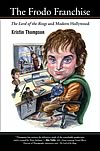
More recently, Kristin has turned her attention to the contemporary industry, the main result of which has been The Frodo Franchise, a study of how a tentpole trilogy and its ancillaries were made, marketed, and consumed. Her love of Tolkien and her respect for Peter Jackson’s desire to do LotR justice led her to study this massive enterprise as an example of moviemaking in the age of winning the weekend and satisfying fans on the internet. She maintains her Frodo Franchise blog on a wing of this site.
Most readers of this blog know Kristin as a film scholar. They may be surprised to learn that she also wrote a book on P. G. Wodehouse’s Bertie Wooster books. Wooster Proposes, Jeeves Disposes; or, Le Mot Juste is a remarkable piece of literary criticism. Here she shows how Wodehouse developed his own templates for plot structure and style. Again, the analysis is grounded in research–in this case, among Wodehouse’s papers. So assiduously did she plumb Plum that she became the official archivist of the Wodehouse estate. This is also, page for page, the funniest book she has yet written.
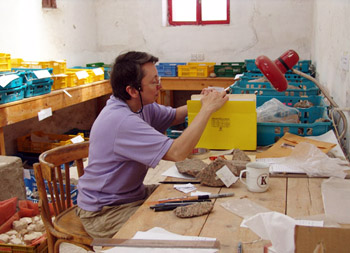
Her Egyptological work is no joke, though, and she has become one of the world’s experts on Amarna statues. She has published articles and given talks at the British Museum and other venues. Soon she’ll trek off for her ninth season at Amarna. There, joined by her collaborator, a curator at the Metropolitan, she’ll study the thousands of fragments that she’s registered in the workroom seen above. It’s preparation for a hefty tome on the statuary in the ancient city.
You can learn more about Kristin’s career here, in her own words. These are mine, and extravagant as they are, they don’t do justice to her searching intelligence, her persistent effort to answer hard questions, and her patience in putting up with my follies and delusions. You’d be welcome to visit her symposium and see her, and people who admire her, in action. While you’re here, you can watch a restored print of Design for Living, by one of her favorite directors, screening at our Cinematheque. In 35mm, of course. We can’t shame our heritage.
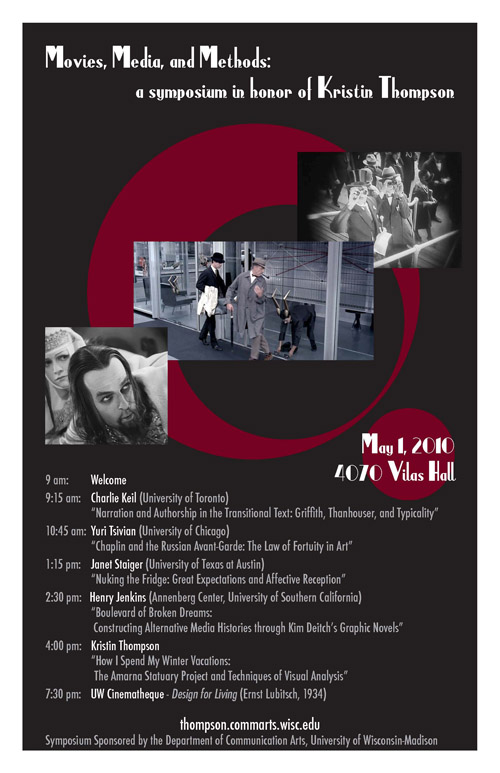
Poster design by Heather Heckman. Check out our Facebook page too.