















Archive for the 'People we like' Category
Spring: Forward

Ten days ago we returned to Madison and the political turmoil that we had watched from a distance. In just a few weeks, the Governor and the Republican majorities in the legislature thrust through a new budget and a bill drastically limiting the rights of state employees to bargain collectively. The actions, taken abruptly and perhaps in violation of Wisconsin law, triggered huge, peaceable protest demonstrations–the biggest yesterday, with perhaps as many as 100,000 people participating. A timeline of developments is here. A skeptical account of the Governor’s rationale is here. His telephone conversation with Not David Koch, which hasn’t lost any of its entertainment value, is here.








Wisconsin State Animal: The Badger.

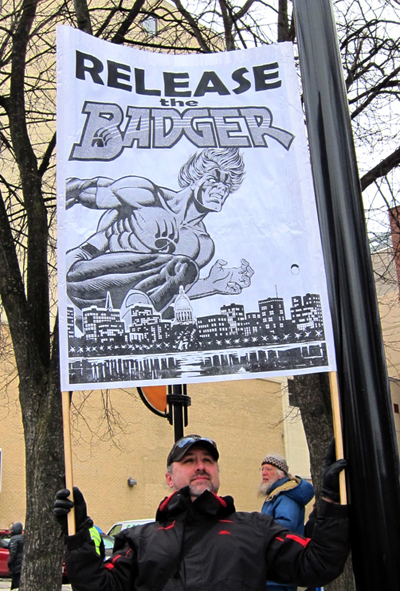
Saturday 12 March: A tractor cavalcade around the square.

The rally continued throughout the afternoon.

Photo from Milwaukee Journal-Sentinel.
Go here for information about what may happen next.
Wisconsin State Motto: Forward.
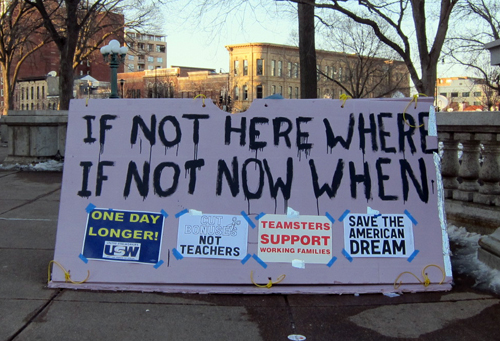
Unless otherwise credited, photos by DB.
PS 13 March: See video coverage, including cow parade, here.
Overbooked
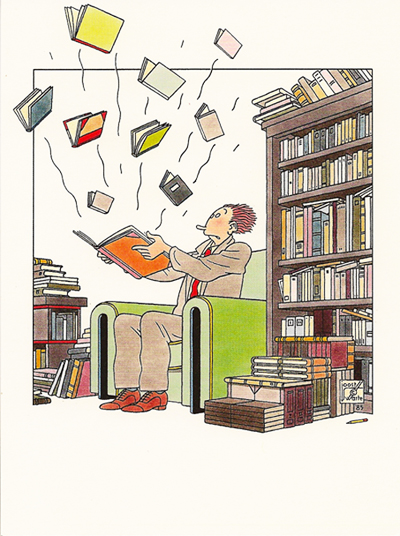
Reading Habits, ©Joost Swarte 1990.
DB here:
Are blog readers book readers, let alone book buyers?
I sometimes wonder. There are only so many hours in a day, and the Net is, among other things, the Celestial Magazine Rack. Day or night you can find something funny, informative, or provocative. Thanks to sites like Arts and Letters Daily, Boing Boing, and their mates, you need never run short of reading material. And if you need a full-length read, there are always e-books. Who needs print?
So I thought when we took off for NYC for the month of February. My grand experiment: To bring along no printed book that I wouldn’t discard en route or in the city. I don’t have an e-book reader of any sort. Instead, I would read only what was loaded on my laptop, including Joseph Warren Beach’s Method of Henry James. If I purchased a codex for bedtime reading (there I read on my stomach or side, so a laptop wasn’t practicable), the unlucky item would be abandoned in our rental apartment for the next occupant. Dave would travel light.
The experiment succeeded only partly. I convinced myself that I had to lug along books I needed for the blog entry on eye-scanning. So my no-book mandate was limited to recreational reading. While I was in New York, though, a visit to the Strand put too many tempting items in reach. Most of those I ransacked and left behind, except for Stanislas Dehaene’s Reading in the Brain, far too stimulating to part with, and a mystery novel to be named later. But as our departure day approached, the itch returned and I ventured to Barnes & Noble for three of the new Harper editions of Agatha Christie classics (The ABC Murders, Five Little Pigs, and Crooked House, all sturdy items). These I toted back to Madison, reading the first two on the plane.
When I got home, finding several parcels awaiting my touch, I faced facts. I had deluded myself. I am both a book person and a Net person. I like text in both formats.
I love storing webpages and pdfs for searching, but books let me savage them with markups. Yes, I know you can annotate e-books, but it’s not the same. I think highlighting is ugly. I like to draw marginal asterisks, make solid lines under key points and wiggly lines under weak or silly ones, and add faces with frowns or rolled eyes. (Though I’m not as obsessive as this guy.) So in NYC my pencil traced tattoos over Dehaene’s information and arguments. In my whodunits I more discreetly inserted question marks, exclamation points, and curses as I reacted to the plots’ feints and jabs. Now I’m stuck. Once marked up, the books can’t be abandoned; some day I might need to consult them, or at least those pages I dog-eared and defaced.
Worse, as the Joost Swarte illustration up top shows, one book leads you to an epidemic of others. That realization dawned on me back in high school, when I learned that Coleridge would go on to read every book that was mentioned in the one he’d just finished. Hypertext isn’t new; reading done right is a combinatorial explosion.
Booked for murder
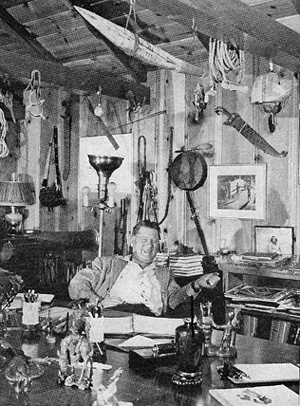
Erle Stanley Gardner.
So the Christies took me back to Robert Barnard’s A Talent to Deceive, a magnificent analysis of how Dame Agatha’s technical innovations changed the detective genre. (Creating a clue out of an apparent misprint—now that’s a tactic I can get behind.) Barnard’s book reminded me of another fine study in genre storytelling, Secrets of the World’s Best-Selling Writer by Francis L. and Roberta B. Fugate. I passed frrom The Method of Henry James to the method of Erle Stanley Gardner.
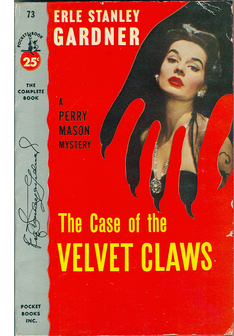 Now that we live in Harry Potter’s world, I suppose Gardner is no longer the sovereign of the best sellers. Does anyone still read Perry Mason or Doug Selby or Bertha Cool/ Donald Lam novels? But in his day, from the 1930s through the 1960s, Gardner was a central figure in US middlebrow literary culture. The Fugates’ book traces Gardner’s career, surveys the publishing scene he worked within, and compiles a great many notes on fiction techniques.
Gardner was probably the most fanatically productive and anally retentive of all mystery writers. In any month he could write a novel while turning out a hundred thousand words for the pulp magazines. He typed until his fingers bled, then he patched them with adhesive tape, and as he put it, “kept hammering.”
Typing was eventually replaced by dictation, putting Gardner in the same oral tradition as Edgar Wallace, Barbara Cartland, and Homer. By the time his first novel, the Perry Mason mystery The Case of the Velvet Claws (1933), was published he had already put his business on a rational basis. What he called his Fiction Factory employing up to seven full-time staff members. He composed all his stories himself, but his secretaries typed from his Dictaphone cylinders and kept track of characters, situations, and titles that he had used in published work, so that he could avoid repeating himself. (Shades of the bibles used for Star Wars and other sagas.) His success allowed him to buy a vast working ranch and build a compound where he and his staff could live together and maximize output.
Not that he withdrew completely from the world. The first Cool/Lam novel revealed that a California law could allow someone to get away with murder. After Gardner pointed out the loophole, the law was changed. Gardner also founded what he called the Court of Last Resort, a group of lawyers and criminologists who sought to overturn unjust convictions.
Along with pumping out fiction and crusading on legal matters, Gardner jotted copious notes to himself on story ideas, career goals, and general precepts of fiction writing. He tinkered with a “plot wheel” that would generate unexpected situations. The results do get you thinking: Locale: Wagon train. Character: Statesman. Predicament: Madness. . . Surely there’s a story there.
Dissatisfied with the wheels and gimmicks like Plot Genie and Plotto, Gardner decided to create his own machine for generating stories. The Fugates generously publish his outlines for “The Fluid or Unstatic Theory of Plots,” “Page of Actors and Victims,” “Character Components,” and so on. Some of these were synopses of discussions he would conduct with writers who were scripting the Perry Mason TV shows. They cut to the quick.
Every character in a story can and should have: 1. Point of strength; 2. Likeable or humorous weakness; 3. Prejudices; 4. Common characteristics. . . ; 5. Father, mother, other relatives dependent or wealthy; 6. Emotions—Love, hate, dislike, etc. for other characters; 7. Problems—And this is where you sell the character to the reader.
Gardner’s search for formulas led him to spell out, with unusual explicitness, the conventions of the form he worked with. (In this he intersects with those of us interested in poetics of media.) I would think that aspiring writers of fiction or movies could learn a lot from Gardner’s thoughts on craft.
If you’re interested in mystery plots, his ideas about the “murderer’s ladder” and “clue sequences” might provoke some ideas. He emphasized plotting a mystery from the criminal’s point of view, not from the investigator’s: It made for less contrivance. Consider as well Gardner’s notion of the “three-ring circus” plot. Take three conventional situations, he suggested, then hook them together in ingenious ways. The film example that occurred to me was the network narrative, which weaves several protagonists’ stories together. Pulp Fiction folds together a hitman story, a prizefighter story, a robbery story, and a few others to create something that felt fresh.
Gardner was a pack rat. The Fugates’ book could be very inclusive because his collection, donated to the Harry Ransom Center at the University of Texas, ran to over 36 million items. Among the memorabilia were Gardner’s notes on a book to which I often refer in lectures, J. Berg Esenwein and Arthur Leeds’ 1913 manual Writing the Photoplay. From Secrets I learned as well of two other books on popular plotting I needed to read, if not buy. I’m not saying what they are; you might beat me to them. Book information sometimes wants not to be free.
Crime on the set
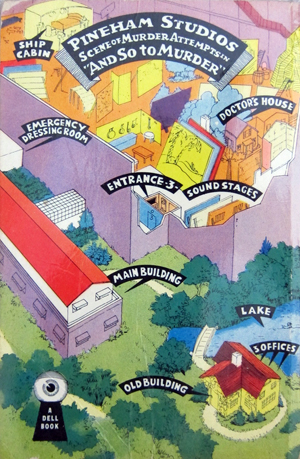
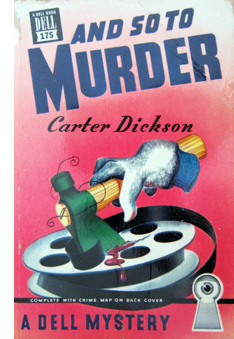
Why the old books? Why not Franzen’s Freedom? When it comes to fiction, more and more I’d rather read books I’ve read before instead of trying new things. Reader’s comfort food, I suppose; or at least the adolescent window. So at the Strand a 1947 mapback edition of Carter Dickson’s And So to Murder (1940) practically wriggled its way into my hand, like a cat begging to be stroked.
Carter Dickson was a pseudonym of the endlessly inventive John Dickson Carr, who throughout the 1930s and 1940s reliably turned out many detective novels and short stories. The Dickson ones feature Sir Henry Merrivale, a short, balding, profane doctor-barrister-baronet who is usually at the center of confusion. He once “sorta hit a cow with a train.”
The Old Man, as H.M. is known, enters And So to Murder rather late. The bulk of the action is occupied with a string of attempted killings during the preparation of a movie. It had been axiomatic in Golden Age detective stories that only homicide could justify a book-length tale, but here a tumble of conspiracies and Nazi espionage fill out the plot. There are as well the usual Carr chapter-endings, which unashamedly break off at points of high tension.
Experts rate And So to Murder not as highly as other Carr/ Dickson classics, although I find that several of my favorites, including gems like The Reader Is Warned (1939) and the short story “The House in Goblin Wood,” don’t score high numbers either. Of course all agree on the excellence of The Judas Window (1938), a virtuoso performance.
A cinephile can hardly resist the premise of my mapback. Monica Stanton, an unworldly provincial, writes a steamy novel called Desire. When it becomes a bestseller, Albion Films hires her as a screenwriter, but not in order to adapt her novel. Instead, she has to adapt And So to Murder, the novel by a handsome but deplorably bearded mystery writer, Bill Cartwright. Bill, of course, is assigned to adapt Desire. As flirtation and squabbling develop and a tough Hollywood screenwriter arrives to punch up the projects, Monica is threatened with poisoned cigarettes and sulfuric acid.
Carr novels like The Burning Court (1937) and The Crooked Hinge (1938, a masterpiece) carry a whiff of horror and brimstone, but the Dickson efforts are largely comedies. Like many Golden Age authors, Carr yoked his mystery to a developing romance, and his Dickson plots often treat the couple disrespectfully, showing how male vanity and female obstinacy create perpetual misunderstandings. His women, who typically wear no make-up, are smart and impertinent, and his men are clumsily chivalrous in their efforts to woo them.
And So to Murder is a good example of the sexual rivalry. Monica, barred from joining Bill at the War Office, decides to pay him back by plunging into the sordid side of London (short of visiting Soho) and picking up the first man she meets.
Bill Cartwright had done that deliberately, of course, to humiliate her. He had known all along that she would never be allowed into the War Office.
Her mind dwelt with hatred on the picture of Bill as he probably was now. He would be sitting in a spacious office, all mahogany and deep carpets, with bronze busts on bookcases, and an Adam fireplace. He would be drinking whiskey-and-soda—Monica herself, when she reached the Café Royal, was going to have absinthe—and listening to some thrilling anecdote of the Secret Service, told by a tall gray man with a deep voice, who sat at a desk with his back to the Adam fireplace.
Every film-goer knows that this is a true picture of the Military Intelligence Department, and Monica decorated it until pukka sahibs abounded.
 It is, of course, a setting straight out of a 1930s film. Carr cleverly gives his heroine a fantasy suitable for her movie-struck imagination. Here’s one screenwriter who really believes the myths the studios spawn.
The romance fulfills another purpose: it is a decoy. Carr fills out Bill’s and Monica’s embroglios with lively action, crisp descriptions, flashbacks, and fancies like the one just mentioned. Only later do you find that the smooth surface cunningly glides us toward quick reading, so that we’ll pass over hints that are ultimately of great importance. Carr was a connoisseur of magic, and although he could sometimes dwell on his clues, demanding that we puzzle them out, he was also skilled in the conjuror’s art of misdirection.
Carr’s affectionate mockery of stars, directors, producers, scenarists, and the down-at-heel British film industry holds up well. The plot centers on missing footage, and there are clues involving props and practical sets, along with a running gag about a coarse American mogul who keeps demanding big battle scenes filled with historical anachronisms.
There is no snobbery in this satire of moviemakers, only the zesty teasing that Carr aimed at aristocracy, pomposity, and pretension (especially when displayed by characters from the Continent). Although he was a deep-dyed Anglophile, Carr retained a vigorous American impatience with ceremony and circumlocution. At the same time, he could be serious about the gathering threat to his beloved Britain.
This was on Wednesday, the 23rd of August. Before a fortnight had elapsed there was a new noise in the earth. The dozenth pledge was broken; the gray mass burst loose; over London the sirens roared as the Prime Minister finished speaking; the great concrete hats of the Maginot Line revolved, and looked toward the West; Poland died, with all her guns still ablaze; the nights of the blackout came; and at Pineham, a small spot in England, a patient murderer struck again at Monica Stanton.
The passage ends with a typical Carr dodge (there will be no murder, so no murderer), but the lead-up has that rumble of thunder and kettledrums he could summon as occasion demanded. Still, the comic tone eventually wins out. The last line of the book is “It’s just one of the things that happen in the film business.”
The standard biography of Christie is Janet Morgan’s Agatha Christie. The recent Agatha Christie’s Secret Notebooks is not to my mind as illuminating as it might be. On Gardner, the unabashed puff piece by Alva Johnston, The Case of Erle Stanley Gardner, offers some insights. The only biography of Carr is Douglas Greene’s John Dickson Carr: The Man Who Explained Miracles. See also S. T. Joshi’s John Dickson Carr: A Critical Study. Old as it is, Howard Haycraft’s anthology, The Art of the Mystery Story, remains an excellent general source.
Thanks to Stef Franck and Gabrielle Claes for help with a Dutch translation.

To read the Readers’ Bill of Rights for Digital Books, go here. Image by Nina Paley, whom Kristin and Richard Leskovsky interviewed here.
PS 14 March: Jon Jermey kindly alerted me to the lively website he moderates on Golden Age Detective Fiction. It’s full of information and expert opinion, including Mike Grost’s overviews of John Dickson Carr’s works and Erle Stanley Gardner’s plotting tactics. Thanks to Jon for letting me know.
PLANET HONG KONG: Fanned and faved
DB here:
Planet Hong Kong, in a second edition, is now available as a pdf file. It can be ordered on this page, which gives more information about the new version and reprints the 2000 Preface. I take this opportunity to thank Meg Hamel, who edited and designed the book and put it online.
As a sort of celebration, for a short while I’ll run daily entries about Hong Kong cinema. These go beyond the book in dealing with things I didn’t have time or inclination to raise in the text. The first one, listing around 25 HK classics, is here. The second, a quick overview of the decline of the industry, is here. The third, on principles of HK action cinema, is here. A fourth, a portfolio of photos of Hong Kong stars, is here. The next entry is concerned with directors, and the final one focuses on film festivals, with a list of a few more of my favorites. Thanks to Kristin for stepping aside and postponing her entry on 3D.
For a long time film academics lived in a realm apart from film fans. But over the last decade or so, the borders have been dissolving. Following the pioneering work of Henry Jenkins in Textual Poachers (1992), academics have started to study fans. More strikingly, they have joined their ranks.
Aca-what?
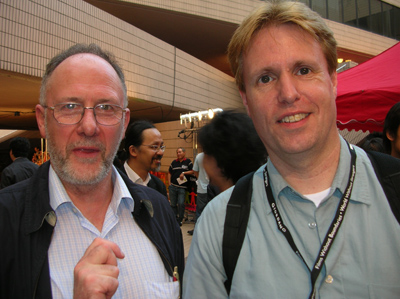
Michael Campi, fan, and Chris Berry, aca-fan. Hong Kong International Film Festival, 2006.
My generation of 1970s film academics looked down what were then called film buffs, the FOOFs (Fans of Old Films), and the star-gazers who dwelled in Gollywood. We were going to make film studies serious. We over-succeeded. Actually, many of us were fans without admitting it. Many of my peers were shameless fans of Ford, Hitchcock, Fuller, et al. Is the appeal of the auteur theory a form of fannery?
Still, things seem qualitatively different now. I think that the Internet, the arrival of new generations brought up on tentpole movies and HBO, and a boredom with the Big Theory that cast its spell over official film studies, hastened the arrival of what Jenkins has called the Aca-Fan.
The Aca-Fan is a researcher immersed in fan culture without a trace of guilt or condescension. In 1973, a film professor’s office was likely to display a poster for Blow-Up and maybe another for Singin’ in the Rain (approved classic). Today the professor’s office is likely to have something more downmarket—a poster for The Matrix or Fight Club or a Beat Takeshi movie. Look on a bookshelf and you might also find a few Simpsons or Buffy action figures. The emergence of aca-fans lends support to the idea that today geek culture is simply the culture. As Xan Brooks put it in 2003, “We are all nerds now.” Or as Patton Oswalt remarks in his funny Wired essay, “All America is otaku.”
Zapped by zines
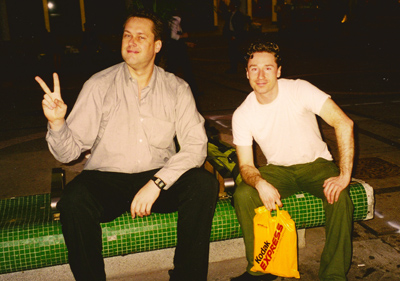
Stefan Hammond and Nat Olsen. Hong Kong City Hall, 1996.
Irresistibly drawn to Hong Kong films (the story is in the preface to PHK), I soon found myself in one pulsing zone of fan culture.
If you wanted to know something about this tradition in the late 1980s and early 1990s, your options were limited. There were the annual catalogues published by the Hong Kong International Film Festival, but they were hard to find overseas. Virtually no Western scholars had studied this popular cinema, and the occasional pieces in Sight and Sound, Film Comment, Positif, and Cahiers du cinema made you want more. That more was often delivered by the fans.
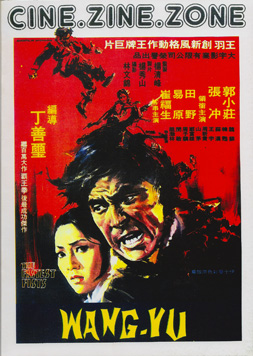
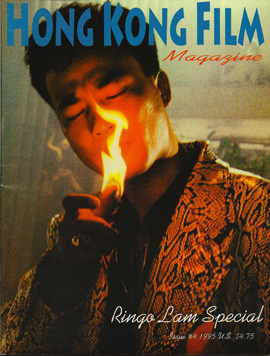
They were a mixed lot: followers of the splice-ridden 1970s martial-arts imports that played in hollowed-out downtown theatres; lovers of Godzilla, Ultraman, and Sonny Chiba who saw Hong Kong as another wild and crazy cinema; big-city cinephiles who sought out recent imports at the local Chinatown house; fanboys and –girls in flyover country renting videotapes from Asian food shops and crafts stores. While Internet 1.0 cranked up, they found an easier outlet: print. Designing pages with good old Xerox and cut-and-paste, they created magazines.
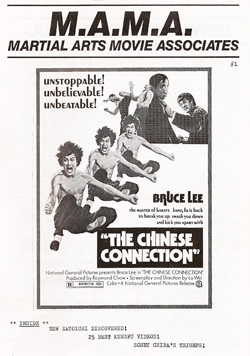
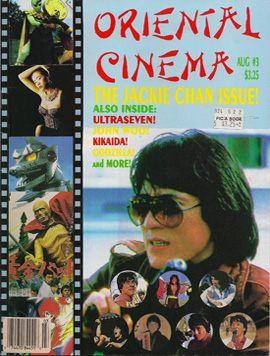
One distant progenitor was Greg Shoemaker’s Japanese Fantasy Film Journal (started in 1968), but the punkish Film Threat (1985) was also important, for it showed that deep-dyed fan publications with attitude could wriggle their way into magazine stands. Soon DIY Asian movie zines burst forth in gaudy profusion and gave the copy shops of the world a new clientele. The early production values recalled high-school poetry magazines, with ragged right margins and nearly illegible illustrations, but the content was compelling. An early entrant was the mimeographed M.A.M.A (Martial Arts Movie Associates, 1985), created by the authors of the still very useful From Bruce Lee to the Ninjas: Martial Arts Movies (1986). A step up in flair was Damon Foster’s Oriental Cinema. Lurid covers enclosed newsprint pages jammed with information, opinion, tawdry gossip, and pictures jaggedly assaulting text. Foster was probably the most colorful editor in the field, making his own films (notoriously, Age of Demons), offering his services as a mime for the blind, and boasting, “I’ve never gone to bed with an ugly woman, though I’ve woken up with quite a few.”
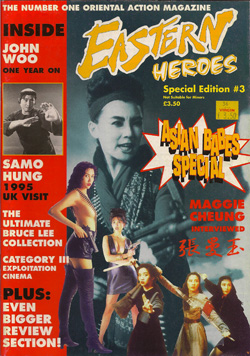
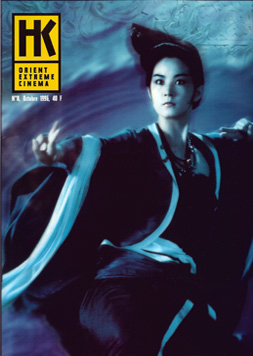
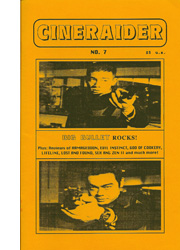 It was a far-flung community. Texas gave us Hong Kong Film Connection and Asian Trash Cinema (motto: “Good Trash Knows No Boundaries”). From Toronto came Colin Geddes’ Asian Eye (first issue: Guns Robots Ghosts Kung Fu). From Honolulu came Richard Akiyama’s Skam and then Cineraider, “published,” proclaimed the masthead, “a few times a year or less.” But soon real publishers brought out slicker magazines. San Francisco had Rolanda Chu’s Hong Kong Film Magazine. LA’s Giant Robot, a phantasmagoria of Asian lifestyles and pop culture, always ran some HK features, as did Tokyo Pop. The UK gave us Eastern Heroes (Free Van Damme Double Impact Poster Inside!) and Oriental Film Review. France had Cine.Zine.Zone, East Side Stories, and the Rolls Royce of the genre, the luxuriously printed HK: Orient Extreme Cinema. Some of these became fan magazines—professional magazines aimed at fans—as opposed to fanzines, magazines made by fans. The HK ones paralleled those devoted to anime, fantasy and science-fiction, and other realms of fandom. I couldn’t collect them all—I missed out on Fatal Visions, for instance—but in an era of scarce information, the ones I found were precious.
The fanzines were a rehearsal for the writerly gambits that would be played out high-speed on the web. Although wordage was costly in a print mag, an article could be as garrulous as a blog today. Concluding a report from a film set, the author notes: “If you found this report boring, then I am sorry. If you found it interesting, then I am glad.” The pages saw flame wars as well. “The retreading of that Amy Yip libel is but the tip of the proverbial iceberg for [your magazine] and other fanzines puking out unprovable sludge as though it were straight from CNN.” We watched all the games cinephiles play—exercising one-upsmanship, excoriating rivals, impressing newbies, and expressing pity or contempt for those wanting a snap course in hip taste. More often, there was the hospitality and a sincere urge to share l’amour fou that we find on fan URLs now. Within trembling VHS images, reduced to mere smears of color by redubbing, the writers glimpsed paradise.
I would read the zines for opinion-mongering, harsh or rhapsodic, and data delivery. Apart from pictures, usually of attractive women in swimsuits, the fanzines provided reviews (always with a ranking, usually numerical), interviews, and filmographies. There were lots of lists too; where is our Nick Hornby to commemorate the compulsive listmaking of this gang? Fandom is as canon-compulsive as any academic area, and as meticulous. One issue corrects an earlier Police Story review: “The synopsis indicated that Uncle Piao masqueraded as the aunt of Chan’s character. Actually, he disguised himself as Chan’s mother.”
Cultism reborn
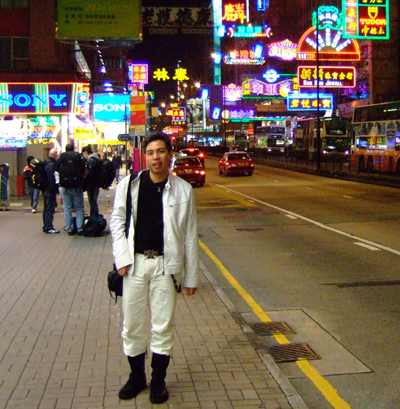
Ryan Law, founder Hong Kong Movie Database and film programmer. Hong Kong, 2007.
As I discuss in PHK, upper-tier journalists usually learned of 1980s Hong Kong cinema from a parallel route, the festivals that began screening the films, usually as midnight specials. Visionaries like Marco Müller, Richard Peña, Barbara Scharres, and the New York group Asian CineVision boldly programmed Hong Kong movies. Critics, particularly David Chute in a 1988 issue of Film Comment, acted as an early warning system too. Meanwhile, the fans were amassing documentation. One zine might be given over to a film-by-film chronology of Jackie Chan’s career; another might solicit Roger Garcia to write about the tradition of Wong Fei-hong films.
One of fandom’s lasting monuments is John Charles’ vast reference book The Hong Kong Filmography 1977-1997, a detailed list of 1100 films with credits, plot synopses, and the inevitable ratings. Charles, a Canadian who wrote for many zines, has been a contributor to Video Watchdog, another generous source of Hong Kong data from the 1980s to the present. Many of Charles’ reviews are available on his site Hong Kong Digital.
By the mid-’90s the modern classics had become known to cinephiles throughout the west. A 1997 editorial announced that Hong Kong Film Connection, despite having a circulation of over 5000, could not continue. Why? Clyde Gentry III explained.
The fandom base has dropped considerably because they have been hand-fed ‘the list.’ You know. The list of films like A Better Tomorrow, A Chinese Ghost Story, Police Story and others that signify the popularity of these films as a collective. It’s even more of a shame that these people will walk away leaving an entire industry with a lot more than that to offer.
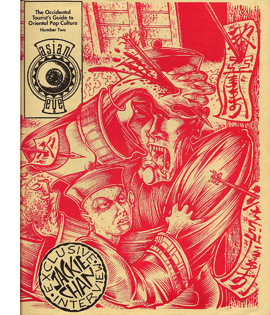 Once the canon was established, once everyone had reviewed the standard items and interviewed Michelle Yeoh, agitprop was no longer needed. Tarantino and Robert Rodriguez were spreading the gospel, and the surface dwellers could now get The List through real publishers like Simon & Schuster, which produced the still-enjoyable Sex & Zen and a Bullet in the Head. In the hands of Stefan Hammond, Mike Wilkins, Chuck Stephens, Howard Hampton, and other skilled writers, fan enthusiasm blended with turbocharged prose to bring the news to a broad audience in search of offbeat cinema.
Soon, the Internet created a new era in fandom, with sites like alt-asian.movies newsgroup, Brian Naas’s View from the Brooklyn Bridge, and Ryan Law’s Hong Kong Movie Database. Some zines, like Cineraider and Asian Cult Cinema (Asian Trash Cinema redux), continued for a time online. HKMDB, another monument bequeathed to us by fan passion, remains a central clearing house of information, as do LoveHongKongFilm, Hong Kong Cinemagic, and others. The Mobius Home Video Forum became a robust conversation space devoted to Asian film, and other forums sprang up, most maintaining the old zest for discovery, unexpected information, controversy, and nostalgia. At Mobius the perennial topic, So what have you been watching lately?, has amassed 32,209 posts.
The zines and the Net made fans more influential. Some turned into critics and film journalists, and a few, like Shelly Kraicer, Colin Geddes, Ryan Law, and Tim Youngs, became festival mavens too. Frederic Ambroisine became an accomplished maker of documentaries on classic and contemporary Asian cinema. With Udine’s Far East Film and New York’s Subway Cinema, enterprising fans launched their own superb festivals.
Academics respect knowledgeable people with vigorous opinions, so I found a lot to like in Hong Kong fandom. And since the phenomenon played an important part in bringing the movies to western attention, I devoted some pages in PHK to it. Wearing my historian’s hat, I wanted to trace how fans helped build up a climate of opinion that with surprising speed created a canon and gave stars and directors international fame.
There’s a personal side to it too. Otaku I was, otaku I remain. (Comics, detective stories, Jean Shepherd, Faulkner, certain TV shows, and chess as a teenager; movies came later.) As a professor, I turned late to studying fans, but once I started, it felt like coming home. “Fan” is short for fanatic, and outsiders speak of cult movies. Both terms suggest deviant, even dangerous religiosity. The analogy isn’t far-fetched. Fans pursue revelation, as often as the remote control will yield it up. This search gives their subculture its own strange sanctity. In their frenzies and ecstasies we can glimpse a quest for purity.
For a useful lineup of HK fan sites, go here. Nat Olsen maintains a gorgeous site on Hong Kong popular culture and street life from his base in the territory. Grady Hendrix is everywhere at once, but he’s often to be found at Subway Cinema, an enterprise he and Nat founded with their colleagues.
I’m inclined to think that most people who study popular culture have great fondness for the things they study. Many film academics are cinephiles (that is, lovers of the medium itself). Others confess to great admiration for films or directors they study. So there was a fan potential latent in many researchers. But some academics evidently hate the films they write about. One friend of mine, a meticulous scholar of film and culture, doesn’t seem to enjoy any movies at all. This attitude seems to be most common when the writer takes on the task of denouncing some ideological shortcomings in the movie–its covert political messages, or its portrayal of ethnic or sexual identity. How can you love a film that is criminal?
This is a complicated matter; I note in PHK that many Hong Kong films present questionable attitudes toward police procedure, women’s roles, and other topics of social importance. The problem is that by today’s standards, virtually every artwork ever made can be interpreted to be “complicit” (a favorite word), in league with some objectionable world view. Recall the critic who heard a passage in Beethoven’s Ninth Symphony as “the throttling murderous rage of a rapist” (though she later modified her claim). By these standards, who shall ‘scape whipping? In a perfectly just society, will we have to stop watching Minnelli movies?
Granted, there are ways for the denunciatory critic to save a film that is she or he admires. It can be found to be secretly subversive, open to a “counter-reading.” Or it can be a work that openly challenges social norms, as with Surrealist cinema, gay/Queer cinema, or the work of Straub/ Huillet. Since the 1970s we have had films, mostly avant-garde ones, that seem to anticipate every possible line of objection that an academic critic might raise. But in any case you have to acknowledge that mass-production cinema is likely to call on prejudices and stereotypes. You don’t have to go as far as Roland Barthes, who noted that a “fecund” text needs a “shadow” of the “dominant ideology.” Nonetheless, our tasks as students of film, I think, is to recognize these factors but not to let them halt our efforts to answer our questions about other aspects of the films. As for love: Well, up to a point you can love a person despite his or her failings. Why not a film?
Lisa Odham Stokes and Tony Williams are other early HK aca-fans. Both have written for fanzines and have produced insightful books on Hong Kong films. See Stokes’ City on Fire: Hong Kong Cinema, with Michael Hoover, and Historical Dictionary of Hong Kong Cinema. A specialist in horror and action pictures, Tony has most recently published a study of Woo’s Bullet in the Head.
On fan culture, Henry Jenkins’ most comprehensive followup to Textual Poachers is Convergence Culture: Where Old and New Media Collide. An important recent collection is Jonathan Gray’s Fandom: Identities and Communities in a Mediated World. Online fandom and its role in promoting a film are analyzed in Kristin’s book The Frodo Franchise (Chapter 6) and her blog here. Patton Oswalt’s newly published Zombie Spaceship Wasteland is in parts a memoir from within fandom.
Thanks to Shelly Kraicer, Yvonne Teh, Peter Rist, and Colin Geddes for help jogging my memory for this entry.
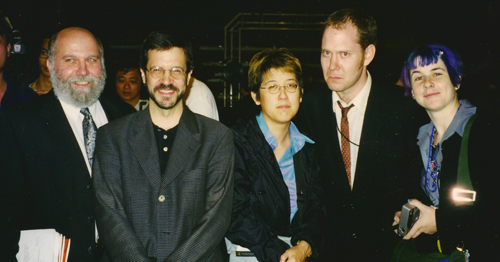
Fans all: Peter Rist, Shelly Kraicer, Erica Young, Colin Geddes, and Ann Gavaghan. Hong Kong Film Awards, 2000.
Once upon some times in Hong Kong
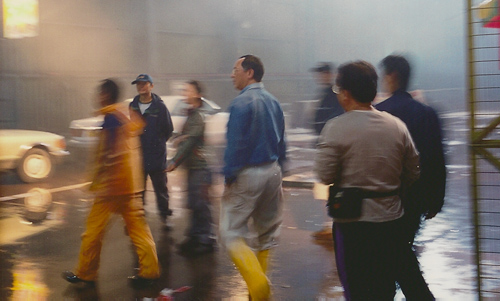
Johnnie To Kei-fung on the set of Running out of Time 2.
DB here:
Exactly nine years ago, Kristin and I were in Hong Kong. Lau Shing-hon, head of the film division of the Academy for Performing Arts, had arranged for me to be Sir Edwin Youde Memorial Fund Visiting Professor. It was a great honor, and Kristin and I enjoyed many happy sessions with Shing-hon, his colleagues, and his students. On this trip, though, something else happened. That lucky encounter has had consequences for my thinking about cinema throughout all the years since.
The encounter was the result of unintended networking. Jeff Smith, now a professor here at Madison, had been my TA in the early 1990s, when I was starting to include Hong Kong films in my courses. He caught the bug. While Jeff was teaching at NYU, a young Taiwanese man, Shan Ding, took some of his courses. Shan, who was naturally as keen on Hong Kong cinema as we were, wound up going to Hong Kong and eventually getting a job with Johnnie To Kei-fung.
So it was during our November 2001 stay that I got a call from a friend, who said that Shan was trying to reach me. Shan wanted to get together, but not in the customary coffee shop or noodle restaurant. He invited Kristin and me to come to a set.
Local heroes
Lifeline.
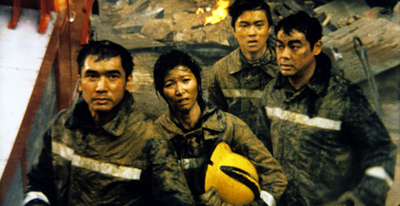
While doing research for my book Planet Hong Kong in 1996 and 1997, I managed to interview several directors, screenwriters, cinematographers, and action choreographers. Johnnie To was on my list of people to meet because of the cult classics The Big Heat (1988), Heroic Trio (1993), The Executioners (1993), and Loving You (1995). There was also his prestige picture, All about Ah-Long (1989) and an extraordinary movie I saw during one trip to Hong Kong, the firefighter drama Lifeline (1997). At about this time Mr. To was launching his own production company, Milkyway Image.
I keenly wanted to talk with Mr. To, but for various reasons it didn’t prove possible. I submitted my manuscript to the publisher in mid-1998, so I couldn’t incorporate discussion of the three Milkyway masterpieces of that year: Expect the Unexpected, The Longest Nite, and A Hero Never Dies. By the time the book came out in early 2000, there had been three more: Where a Good Man Goes (1999), Running Out of Time (1999), and possibly To’s finest work, The Mission (1999). There I was: the most important director of the late 1990s and early 2000s was largely left out of my book.
Ironically, soon after PHK came out, Wong Kar-wai’s In the Mood for Love and Ang Lee’s Crouching Tiger, Hidden Dragon triumphed at Cannes. Westerners’ perception of Chinese film changed forever. But in all this fuss, where was Johnnie To?
Making movies, that’s where. He emerged as a heroic figure of local film of the 2000s. True, Infernal Affairs (2002) and Stephen Chow Sing-chi and Wong Kar-wai sustained interest in Hong Kong movies on the international market. But Wong and Chow made films at long intervals, while IA was that rarity in Hong Kong, a “must-see” movie not starring Chow, Jet Li, or Jackie Chan. Johnnie To was just moving ahead, creating romantic comedies, cop dramas, and unclassifiable items like Running on Karma (2003) and Throw Down (2004). Election (2005) and Election 2 (2006) showed, in unprecedented detail, how triad societies governed themselves, and more daringly how they were still connected to mainland China. With his longtime collaborator Wai Ka-fai he went out on a limb with Mad Detective (2007), but on his own he gave us satisfying polars like Exiled (2006) and Triangle (2007) as well as lighter exercises like Sparrow (2008).
Unlike the reclusive Wong Kar-wai and Stephen Chow, To stepped into the public eye. He tried to sustain the local industry by hectoring the government, throwing his weight behind new awards, supporting student film contests. He worried, he has explained, that filmmaking in Hong Kong could collapse the way it did in Taiwan. And he kept surprising us—not least by signing arthouse demigod Jia Zhang-ke to make, of all things, a martial arts movie.
Most of those developments were in the future when we got the call from Shan.
One rainy street
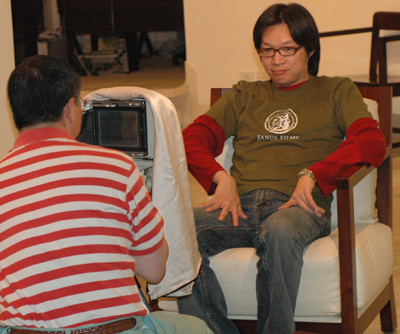
Johnnie To and Shan Ding, Milkyway Image office, 2005.
A van picked us up on a rainy night and we drove far into the New Territories. Along the way Shan was explaining that he was a sort of man-of-all-work for Mr. To. I would see over the years that Shan would assist in scripting and shooting, he might step in front of the camera, and he would help execute ad campaigns. He was sometimes billed as a film’s “Production Supervisor,” which is probably as good a description as any. Because he has fluent English, he was the ideal liaison between Milkyway and the west. Shan played a central role in helping critics and festival programmers learn about Milkyway’s projects.
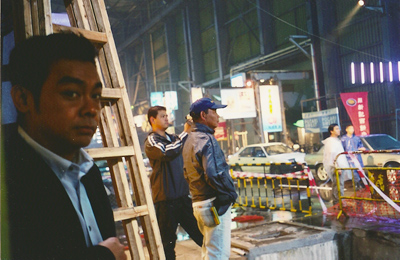
We arrived at a big abandoned storage facility in a grove of trees. A street set about a block long had been built, bathed in artificial rain and mist. Mr. To was presiding over things.
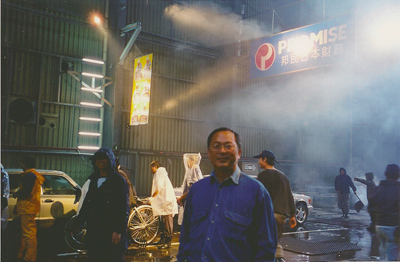
He greeted us warmly. I had met him briefly at a 1999 Hong Kong film festival event arranged by Athena Tsui and Li Cheuk-to. The festival’s Panorama section paid tribute to Milkyway’s big films of the previous year, and a seminar was held with Wai Ka-fai, Patrick Yau Tat-chi, Lau Ching-wan, and Mr. To.
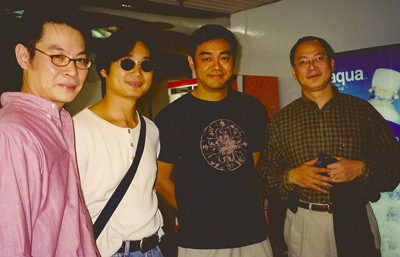
But by then Planet Hong Kong was in press. Nonetheless, I came to the seminar and took notes. I hoped that some day I would write about this team’s remarkable movies.
That November night Mr. To graciously said he remembered me from the seminar. But he soon went back to work as the crew prepared for what would be a bicycle race. A bicycle race? Who’d be racing? Kristin and I turned, and I gaped. There was Lau Ching-wan.
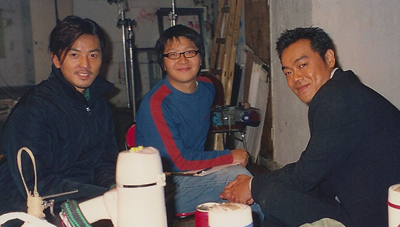
What Chow Yun-fat was to John Woo, Lau was to To: his exemplary protagonist. Chow was virtually born in a tuxedo, but onscreen Lau projects the image of an ordinary working stiff. In To’s films he usually plays the profane, irritable, unheroic hero; or if the film has no hero, as in The Longest Nite, he becomes a glowering, implacable force.
Not tonight, though. He was as friendly as Mr. To. His English was fine and we chatted a little. For the life of me I can’t recall what we said; I was too, as the Brits say, gobsmacked. I have long known I was a fanboy at heart, but here was the embarrassing proof.
Standing next to him was Ekin Cheng Yee-kin–at that point, one of the leading jeunes premiers of Hong Kong film. He had made his career as a teen idol, particularly in the young-triads cycle known in English as the Young and Dangerous series. He was also extremely cordial.
Both actors had to do a lot of waiting around between shots, of course. While we snacked on food from Styrofoam containers, there was time for pictures. Here’s one of Lau and Cheng flanking Yau Nai-hoi, Mr. To’s prolific screenwriter and later director of Eye in the Sky (2007).
We couldn’t get too close to the main set, but I did get some general shots of the crew at work. The crew filmed take after take of Lau and Cheng pedaling along the same short strip, over and over. I also got some shots of the stunt men, who were trying again and again to knock off some cars’ side mirrors. These guys take some serious spills.
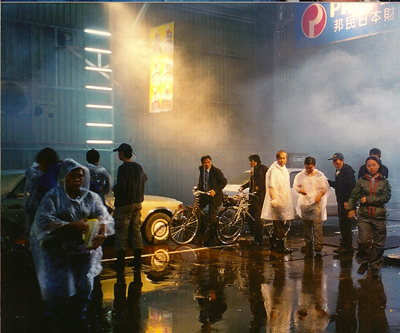
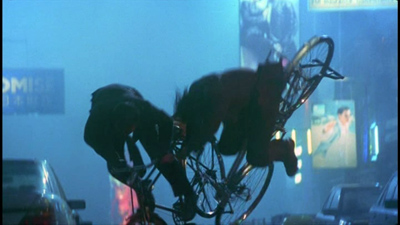
Only when I saw Running Out of Time 2 was it clear that our night’s shoot, and others before and after, yielded a charming scene in which Ekin, the unnamed magician figure, taunts and exasperates Lau as detective Ho. It’s crucial because the race teaches Ho that Ekin’s mysterious cat-and-mouse game is essentially benevolent, even joyful. Staring at the set, I was impressed by how fake it looked. But on film, swathed in darkness, rain, and mist, it looks fine.
Yesterday, re-watching the movie, I enjoyed spotting the moment when we pass from the location to the set. From a shot taken on location, To cuts to a tighter shot of Lau, on the set.
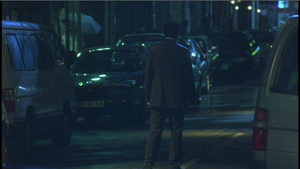
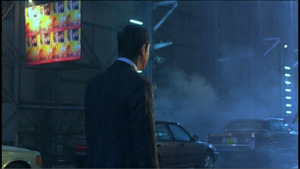
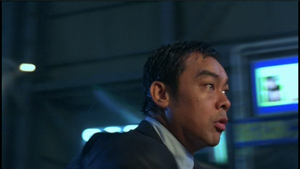
Track in to Lau’s face as we hear a bike bell and Ekin whizzes by.
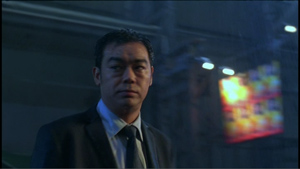
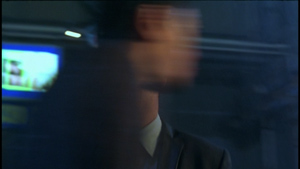
At Ekin’s urging, Lau grabs a bike and pursues him.
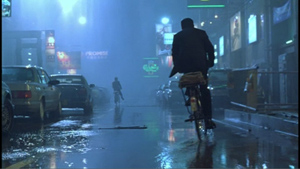
Once you see the film, you can notice how most of the shots are framed to conceal the fact that Lau and Ekin are pedaling down the same stretch over and over, sometimes in reverse directions on the set. Occasionally a changed background sign gives away the repeated takes.
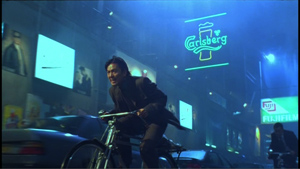
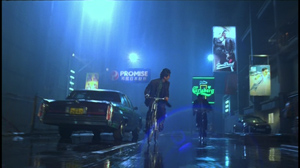
Elaborate as this is set was, it’s still more economical in Hong Kong to mount such a thing than to spend nights on location to get dozens of shots. The magic of the movies, after all. And the signs enable product placement to help cover costs.
Never a man to waste a chance, Mr. To re-dresses the set a bit for Running Out of Time 2‘s cheery epilogue, when Christmas breaks out.
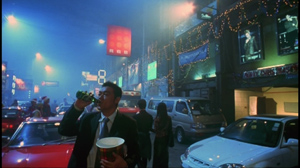
Just as in classical Hollywood cinema, scenes echo one another partly because it’s economical to re-use sets at different points in the movie.
This wasn’t my last encounter with Johnnie To. Shan kept in touch, and my spring visits to Hong Kong included a stopover at Milkyway headquarters. There I would run into Lorenzo Codelli, Shelly Kraicer, Todd Brown of Twitchfilm, Sabrina Baracetti of Udine’s Far East Film Fest, Grady Hendix of the New York Asian Film Festival, and other movers and shakers in film culture. Partly because of To’s promotional outreach to these tastemakers, he is much better known worldwide than he was in 2001. I managed to visit shoots for Throw Down, Exiled, and Triangle. He showed me work-in-progress versions of several films. Mr. To also sat down for interviews with me; my favorite is the one in which he went shot by shot through the “Sukiyaki” scene in A Hero Never Dies. Needless to say, I learned a lot from all these encounters.
These days I’m refurbishing my book for web publication, writing frantically while listening to Cantopop (Sammi and Faye and Gor Gor, mostly). Now I can give Milkyway its due. I’ve spent the last couple of weeks reviewing To’s oeuvre, and I’m more convinced than ever that he is one of the finest directors of the last fifteen years. Planet Hong Kong Redux will contain two lengthy sections on his films. Like all the illustrations in the new version, the stills (many from 35mm prints, not DVDs) will be in color.
As PHK Redux moves closer to online publication in mid-December, I’m mounting other items for the delectation of those discerning souls who know that Hong Kong has created one of the great traditions of film history. This week the site adds my DVD booklet essay on Mad Detective, courtesy Nick Wrigley and Masters of Cinema. And in a couple of weeks, as a run-up to PHK Redux, we’ll be putting up a gallery of celebrity snapshots I’ve taken since my first visit to Hong Kong in 1995.
Secrets
Oh, yes, what were the consequences of this evening in November 2001? Well, one was meeting a new batch of interesting people, Shan and Mr. To and Mrs. To and Martin Chappell and others. Their warm, informal hospitality constitutes one reason I come to Hong Kong every spring.
Another consequence: the conviction that I would have to write more about Hong Kong film. Having followed it since the 1970s, I thought I detected a dropoff in quality and energy in the late 90s. I wasn’t alone. The revised version of my book details how the industry went into a slump then. But the movies from Milkyway showed that you could still flourish in hard times. Seeing Mr. To’s movies made me want to stick with this tradition a little longer. So I continued to write, mostly short pieces about him, until PHK’s going out of print pushed me to update my thinking.
A third consequence of that set visit was broader and deeper. Getting to know filmmakers confirmed that I was a fanboy through and through, but I also felt it shifted me in new directions as a researcher. I’m fascinated by the practice of making movies. I still want to know, within my limited technical expertise, the tangible stuff that people do to build the images and sounds that captivate us. What tools do they use? What work routines have become standardized? What happens when technology or craft practices change?
As a graduate student, I thought that in order to understand movies we just needed to look at the screen. Although I had made some amateur films (bad ones), I failed to see that the fine grain of craft is exactly where artistry begins. By the time I started to write academic essays and books, especially The Classical Hollywood Cinema, I realized that knowing what goes on behind the screen sensitizes you to what’s there. You literally see more.
Most film academics aren’t interested in how craft can nourish artistry. In their eagerness to avoid “formalism,” they tend to neglect artistic traditions, trends, and choices. Movies are made, and the making—poeisis, as the old Greeks called it—demands concrete decisions about form and style. Filmmakers make different choices in different times and places, and we can try to analyze and explain some of those choices. As E. H. Gombrich once suggested, very simply, the artist’s key question is often: “What is there for me to do?” We need not stop there, but considering creative options and decisions is a good place to start if you want to do justice to the films, the filmmakers’ hard work, and the experiences we have as viewers.
I want to know directors’ secrets, especially the ones they don’t know they know. Planet Hong Kong was an effort to bring some of those secrets to light. I think I’ve found some more since then. Thanks to the courtesy of filmmakers like Mr. To, I’m compelled to try sharing them with you.
A fairly recent interview with Johnnie To is here. Especially interesting are his memories of growing up in Kowloon Walled City, a sort of criminal jungle. Corpses on the playground, that sort of thing.
Although the book will pay tribute to them, let me here signal two excellent online resources, now far more elaborated than when I wrote the first version of the book. Ryan Law’s Hong Kong Movie Database is indispensible for investigating people, companies, and films (detailed lists of cast and crew members). HKMDB also has a lively news section. Ross Chen’s vast and entertaining LoveHKFilm lives up to its name, with meaty reviews and news updates. There are many other fine sites, but these are the ones I’ve relied on most often. In addition, I must signal a book that came out too late for me to use; John Charles’ remarkable Hong Kong Filmography 1977-1997.
The friend whom Shan contacted was Li Cheuk-to. Since 1995 Ah-to has been my advisor, translator, editor, and host. I owe him more than I can say.
I have many other people to thank for my times in Hong Kong, and the revised PHK will do so. In the meantime, if you’re interested in Johnnie To and Milkyway, you can check my other blog entries here.
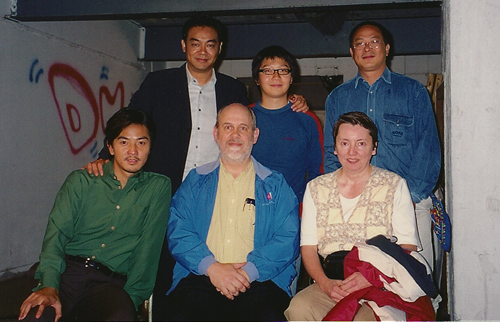
P.S. After I finished this entry there came the sad news of the death of Mr. Wong Tin-lam, a director from the classic era of Cantonese cinema. His Wild, Wild Rose (1960) is still remembered as a trail-blazer. The father of director Wong Jing, he brought a grassroots gravitas to some of the best Milkyway films, in which he was likely to play a Triad elder. Go here for more pictures and background information.
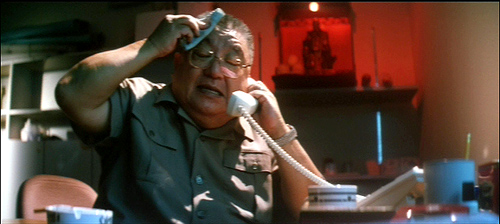
Wong Tin-lam in A Hero Never Dies.
P.P.S., 20 November: Thanks to Yvonne Teh for correcting my spelling! Check her enjoyable Hong Kong site Webs of Significance.



