





Archive for the 'Narrative strategies' Category
New media and old storytelling

DB asks: To what extent has the DVD changed viewing habits and movie storytelling?
As everybody knows, a DVD offers more interactivity than a movie you watch in a multiplex. In a theatre, the movie rolls on, unaffected by anything you may do. But with a DVD you can pause the film, run fast forward, skip to a particular second, shuffle chapters, even play the thing in reverse.
Most minimally, the DVD offers greater convenience. You can halt the film so you can answer a phone call or zip back to replay a bit you might have missed. But some of us wonder if this new interactivity harbors more radical implications. Does the new flexibility of use allow us to experience the film in new ways?
In a mystery film, say there’s a clue at the half-hour mark. In a theatrical screening, we’re pressed forward with no time to ponder it. Watching the film on DVD lets us halt the film, ponder the clue as long as we like, and maybe track patiently back to earlier scenes to test our suspicions about what that clue means. Or suppose you decide to sample the film, browsing through the opening bits of several chapters? More radically, suppose we decide to watch the DVD in reverse? Nothing stops us, and we’d have an experience of the story very different from that of someone who watched the film in the normal order. Doesn’t this all suggest that it’s hard to generalize about what the “ordinary” viewer’s experience of a movie might be nowadays?
Now consider the craft of fictional filmmaking. The movie’s creators make choices about what story information to impart, when to impart it, and how to impart it. They assume that the viewer follows the story in the order mandated by theatrical projection, scene 1, then 2, 3 and onward. Likewise, the pace of uptake is set by the film—no slowing down or speeding up at the viewer’s will. But given the new conditions of digital consumption, these assumptions may be wrong. So shouldn’t the filmmakers take those conditions into account? And more specifically, haven’t some filmmakers already taken them into account? In other words, hasn’t the DVD transformed cinematic storytelling?
This question is important to me. I’ve long argued, along with Kristin, that mainstream US filmmaking, dubbed long ago “classical Hollywood cinema,” has cultivated a sturdy and pervasive tradition of storytelling. (1) That tradition depends on clearly defined characters pursuing well-defined goals. This commitment in turn creates a plot that displays linear cause and effect: In pursuing goals, the protagonist makes one thing happen, and that makes something else happen, which in turn triggers something else. Moreover, the mainstream tradition lays these actions and reactions along a fairly rigid structural layout. And this tradition depends on a system of narration that constantly reiterates the characters’ traits, their goals, important motifs, and the overall circumstances of the action. This is a fairly abstract description, I know; go to my analysis of Mission: Impossible III for a specific example of how the system can work.
But now home video allows our consumption to be highly nonlinear. By skipping or skimming DVD chapters, we may not register the plot or narration as the makers intended. Doesn’t this make hash of goal-directed action, character arcs, and all the other features of classical storytelling? Might we not be moving toward a “post-classical” cinema?
Movie as book

Let’s tackle the question first from the standpoint of the viewer. I think we can get help by recognizing this basic point: The DVD made a movie more like a book.
This sounds odd, because we think of digital media as replacing print. Yet consider the similarities. You can read a book any way you please, skimming or skipping, forward or backward. You can read the chapters, or even the sentences, in any order you choose. You can dwell on a particular page, paragraph, or phrase for as long as you like. You can go back and reread passages you’ve read before, and you can jump ahead to the ending. You can put the book down at a particular point and return to it an hour or a year later; the bookmark is the ultimate pause command.
We tacitly acknowledge the resemblance between the DVD and the book when we call the segments on a DVD its chapters, the list of chapters an index, and the process of composing the DVD its authoring.
With these similarities in mind, we can ask: How many people, on first contact, would sit down to watch a film in a nonlinear way?
My hunch: Just about as many who would buy or borrow a book and then proceed to read it in a nonlinear way. Now we can grant that if you have a nonfiction book in hand, you might pick out certain chapters as more interesting than others and move straight to those. Similarly, with a DVD documentary on penguins, some viewers might want to move straight to the chapter labeled Mating Habits.
With a fictional film, though, we’re much less inclined to graze and browse, just as with a novel. True, we might sample the novel before buying or borrowing it, but I’d bet the portion we’re most likely to sample is the opening chapter. With a fiction film on DVD, some viewers might skip to a chapter opening or two, but I expect that soon they’d settle down to watching the show at the order and pace of a theatrical screening. This is more or less what happens with literary fiction. The person who starts a novel will proceed in linear order in order to follow the story. It’s a revealing phrase: we’re following a path laid down for us, not racing ahead or falling back.
This isn’t to say that all consumers of fiction move at the same pace or read the same way. I’m just indicating that following the mandated order, page by page or shot by shot, is the default that people adhere to in the overwhelming majority of cases.
This suggests that pausing is the most common way we play an interactive role. When reading a book you might call out to your friend and reread a particularly striking description or funny dialogue exchange. When watching a film, you might stop and replay some images to enjoy them again. Another common act is probably quickly “paging back”—rereading or re-viewing a bit that just preceded the pause to remind ourselves of what’s going on at the moment.
Our purpose in starting a book or film at the beginning is to get into the story world and start to think and feel in relation to the information we get about it. But we don’t have to take that as our primary purpose. More extreme acts of “creative” spectatorship are tied to different purposes than learning about the story world. I suppose that teenage boys might well rent 300 when it comes out on DVD and fast-forward looking only for the scenes showing carnage or naked ladies….the same way that my high-school contemporaries rummaged through Terry Southern’s Candy digging out the good parts. (2) But this doesn’t seem to be a radically new way of using any medium, because the purpose—scanning a text for immediate gratification rather than narrative involvement—was common well before DVD.
Of course we students of cinema use the DVD commands in order to study a film, spooling back and forth to analyze it. But that usage isn’t a radical reworking of consumption either. Typically before we start to analyze a movie, we’ve already experienced it in the ordinary beginning-to-end way. Students of literature execute the same sort of back-and-forth moves studying a text that they’ve read before.
Finally, I’d suggest that a highly unorthodox mode of consumption, like setting out to watch a film in reverse at 8x speed, would become quite boring fast. As with so many things in life, just because you can do something doesn’t mean you’d enjoy it.
Speculation 1: The actual uses that people make of DVD interactivity are limited; traditional beginning-to-end consumption is the default.
Speculation 2: Pausing, paging back, and scanning for the good bits suggest that the most frequent DVD interactivity is familiar from other media, particularly books.
Guided interactivity
Let’s now consider things from the side of the creators. Knowing that films are seen on DVD, don’t filmmakers adjust their art and craft to this new medium? Of course they can provide revised versions, or directors’ cuts, along with alternative endings, deleted scenes, and other material that shed light on the film and the production process. But does the DVD format change the very act of conceiving and executing the story presented by the film?
Yes, in certain respects. In The Way Hollywood Tells It, I argue that the possibility of rewatching a film with little fuss encourages ambitious filmmakers to “load every rift with ore,” to pack in details that might not be noticed on a single viewing. One of my examples is the 8/2 motif in Magnolia. Likewise, the looping plotlines of Donnie Darko and the reverse-order one of Memento are amenable to being picked apart after several viewings. But before home video, you as a viewer could scrutinize such movies by just going back to the theatre and watching the film over and over, very attentively.
Clumsy as it seems, film nerds of my generation did this. I remember my thrill as a junior in college when I discovered, after rerunning a 16mm print of Citizen Kane on my apartment wall, the snowstorm paperweight that Kane clutches on his deathbed sitting on Susan’s vanity table the night he first meets her. Welles had, as it were, planted this clue for attentive viewers to spot. When we were lucky, we might get a film on a flatbed viewer and go through it reel by reel. Granted, the random-access aspect of DVD allows this sort of micro-analysis to be done much more easily, but it’s not different in kind from rolling up your sleeves and threading up a Films Incorporated print one more time.
I’d add that this sort of scrutiny enriches the film in a very traditional way. Films that sustain this sort of attention, from Buster Keaton silent movies to Hiroshima mon amour and The Silence of the Lambs, long predate the arrival of DVD. Throughout Play Time Tati sprinkled details and gags that reward many viewings. When Paul Thomas Anderson and Christopher Nolan bury details in their films, or when The Simpsons flashes a jokey sign past us, they’re practicing a time-honored strategy of teasing the viewer to return to the work to get something more out of it. Having the DVD at your disposal makes it easier to find half-hidden motifs, jokes, ironies, and the like, but all of these are traditional elements of films both classical and non-classical.
There are, though, more radical cases. The experimental novelist Michel Butor pointed out that the fact that the book is an object to be manipulated at will harbored the possibilities of innovative storytelling. He pursued those in works like La Modification (1957) and Degrés (1960) and theorized about them in an essay, “The Book as Object.” (3) Along the same lines, once a film becomes a booklike object, it can be composed to encourage multiple replays not merely to appreciate little touches but just to make bare sense of what’s going on in it.
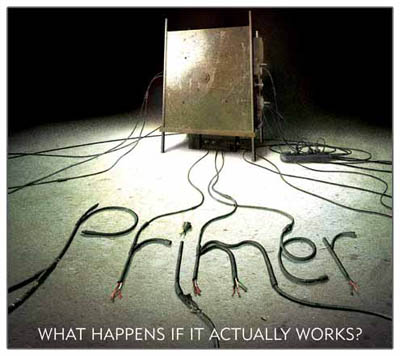
Memento and Primer would seem to be instances. Their makers seem to have designed the films to encourage admirers’ extensive, not to say obsessive, re-viewings. (For analyses of Primer, go here and here.) Again, however, the DVD serves not as a unique format for the film but as a tool that makes analyzing the plots a lot easier than would several visits to the theatre. (4)
There are other possibilities tied to the format itself. The DVD of Max Allan Collins’ Real Time: Siege at Lucas Street Market was designed to permit the viewer some choice of camera angle in certain scenes. At a few points we’re permitted to enlarge the monitors of different surveillance cameras in order to follow one or another strand of action. (Actually, I couldn’t get this feature to work on my players.) Still, in Real Time, the plot action is clear and redundant in the classical manner, so even if you don’t enlarge the screens, maybe you won’t miss much.
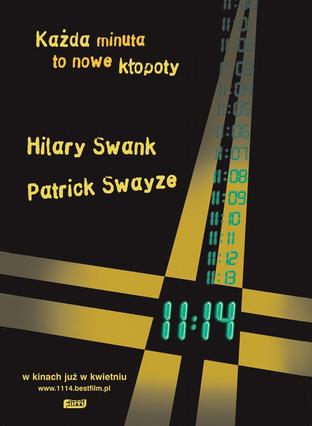
Butor suggested that since a book is an object, all in hand at once, a plot could be composed to permit many, equally valid points of entry and exit. Such seems to have been achieved by the DVD version of Greg Marcks’ 11:14. The film is a network narrative, following five characters in a small town as their lives intertwine. The plot is broken into five segments, each one following a character up to the critical moment given in the title. It’s a clever and enjoyable piece of work. In carrying it to DVD, Marcks chaptered it so that you could skip among storylines at will. He explains in an email to me:
It’s a feature on the DVD that I called “character jump,” which allows you to jump to what another character is doing at that same moment in time. Theoretically you could watch the film in an endless circuitous loop because the end is simultaneous with the beginning.
During some scenes of 11:14, a JUMP icon appears and if you press Enter, the scene switches to another character’s storyline—either earlier or later in the theatrical version’s running time. Once in that story, the icon stays on for a bit so that you can return to your point of departure if you want. (4) Presumably for reasons of engineering and disc space, the number of JUMP options remains fairly limited. Still, it’s a fascinating prospect, and it does seem to offer the possibility of your restructuring the plot in fresh ways.
Even in 11:14, however, the story possibilities are closed. As in a Choose Your Own Adventure book, you’re hopping among trajectories that are already designed. The opening remains the opening for every option; no Butor-style starting in the middle. Furthermore, the trajectories themselves are linear, running along a cause-effect pattern very familiar to us from classically constructed stories. (5) We find this often in branching or multiple-draft narratives. I argue in The Way that even the reverse-order disjunctions of Memento sort out along lines to be found in film noir.
Let’s also recall a simple point. Even though the book format offers the sort of mind-bending manipulations Butor celebrates, most literary fiction remains traditionally plotted and narrated. Likewise, we should expect that the arrival of the DVD permits filmmakers who want to tell orthodox stories in orthodox ways keep on doing so. The line of least resistance is straightforward linear presentation.
Speculation 3: The ease of DVD replay can encourage filmmakers to pack their films with more details that repay rewatching. The result might be films that are more “hyperclassical,” to use a term I suggest in The Way Hollywood Tells It –films that are even more tightly woven than we tend to find in the studio years.
Speculation 4: Some filmmakers have made their storylines harder to follow on a single viewing, encouraging DVD replays so we can figure out what’s going on. This strategy makes the films less classical in construction, to a greater or lesser extent.
Speculation 5: A few filmmakers have utilized DVD features to allow greater interactivity than a theatrical screening would grant. In most cases, however, this interactivity rests upon classical guidelines—protagonists with goals, confronting obstacles, conflicting with others, and arriving at a definite conclusion along a linear path.
A stubborn structure
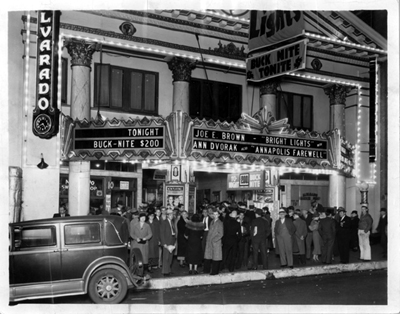
Once upon a time, roughly between the 1920s and the 1960s, movie theatres had a policy of continuous admissions. Metropolitan theatres were sometimes very crowded and patrons had to wait in line outside for seats to be freed up. (Hence the need for ushers to find vacant seats during the screening.) As a result, you might enter in the middle of the movie and watch the film through to the end, sit through shorts and perhaps another feature, and then stay for the opening of the initial film. Hence the expression “This is where we came in.” Doubtless many people planned to see films from beginning to end, but a lot also arrived in medias res.
Someone might speculate that this manner of viewing would encourage filmmakers to indulge in slack plotting. After all, if viewers can come in at any point, a vaudeville-like cascade of acts and incidents—what people are now calling a “cinema of attractions”—would be best. In fact, however, Hollywood feature filmmakers told complex, linear stories of the sort I’ve already mentioned. They didn’t seem to care if viewers were entering midway.
But they really had no choice. If the filmmakers wanted to tell a fairly coherent story, how could they cater to a viewer who might enter at any moment? The only feasible plan, then and now, is just to go ahead and present a story in the linear way, but make sure that it’s presented so clearly that even a viewer entering in the middle can pick up what’s happening. That was, and still is, the default practice. The redundancy of Hollywood storytelling, bent on clear and cogent presentation of the action, is the most effective response to fragmentary viewing.
Hollywood films have been shown in picture palaces, rural playhouses, college classrooms, churches, military bases, and submarines. They’ve appeared on TV, in drive-in theatres, on airline screens, on computer monitors, and now on iPods. In design and execution, the films have stayed remarkably stable. They have relied on our understanding of general principles of storytelling and more specific ones typical of Hollywood. In most cases, this default will stay in place. It works very well, and there’s no alternative that can anticipate all the different ways in which viewers can consume the movie.
Speculation 6: Odd as it sounds, fragmented viewing conditions can encourage coherent storytelling.
Speculation 7: We can’t easily draw conclusions about how films are constructed on the basis of how they’re presented and consumed. Changes in viewing practices don’t automatically entail changes in storytelling.
I’d just add that even in the age of digital media, spectators enjoy greatest freedom not in the way that they manipulate films but in the ways they can interpret them. But even an epic blog has to stop somewhere, so I’ll leave that matter for another time. (6)
(1) You can find the details of our case in Film Art, in Narration in the Fiction Film, in The Classical Hollywood Cinema, in Storytelling in the New Hollywood, in Storytelling in Film and Television, in The Way Hollywood Tells It, and in my forthcoming Poetics of Cinema. Also, see Kristin’s “contrarian” blog entry here.
(2) In high school I loaned Candy to a friend and it made its way among my peers with remarkable speed. When I got it back, the pages were falling out. Somehow, our principal Mr. Brown learned that I was the culprit. He gave me a starchy lecture and announced over the homeroom PA system that I was being reprimanded for “bringing a certain book” to school. Mr. Brown was unmoved by my defense that Candy had gotten fairly good reviews.
(3) Translated in his English-language collection Inventory (New York: Simon and Schuster, 1968), pp 39-56. The essay doesn’t seem to be available on the Net. So off to the library with you!
(4) Thanks to Colin Burnett, who tested the 11:14 DVD for me while I’ve been away.
(5) Marcks’ DVD version has allowed us to create a Griffith-style crosscutting of plot strands. Interestingly, network narratives are constructed in two main ways: crosscutting the storylines (as in SHORT CUTS) or presenting them in blocks that we must synchronize in our heads (as in PULP FICTION and GO). Marks’ theatrical version gives us the block version of 11:14, while the DVD reveals one possibility of an intercut one.
(6) I’ve discussed film interpretation in a book (Making Meaning) and in chunks of a forthcoming collection (Poetics of Cinema),
PS, 16 May (New Zealand time): Jason Mittell has a fascinating commentary on this topic at his site, Just TV (which isn’t actually just about TV). Jason argues that television narrative has become more complex in recent years and that videotape and DVD technologies have affected that in some unexpected ways. A must-read!
A many-splendored thing 5: Sampling

Sakuran.
From DB:
 While I’ve been here, Hong Kong has been embroiled in two big stories. First is the runup to the election for chief executive. Hong Kong has indirect elections, whereby groups purportedly representing constituencies, chiefly various business interests, are in turn represented by electors. On the day of the vote, I saw several demonstrations demanding both new environmental policies and universal suffrage. So much for the myth that Hong Kong people don’t participate in politics.
Current chief executive Donald Tsang Yam-kuen, Beijing’s appointee, won the election, with 649 votes out of 789 voting members. Tsang has promised to introduce direct voting and universal suffrage by 2012. We’ll see.
The other big story has been the aftermath of a 2006 shootout involving police constable Tsui Po-ko. The latter has the confusing intricacy of a Hong Kong cop movie. Some years ago Tsui allegedly killed another cop and stole his pistol; a year later he robbed a bank. (The Economist offers a summary here.) An inquest has been under way. Wednesday’s South China Morning Post (not available free online) reports on the contents of Constable Tsui’s notebooks. There are indications that he was tailing political figures and calculating how an ambush might be carried out beneath traffic underpasses.
The media have gone wild over this and even replayed the episode of the local version of Who Wants to Be a Millionaire? on which Tsui appeared as a contestant. Today’s edition of the SCMP reports an even weirder turn. An FBI expert has testified that Tsui suffered from schizotypal personality disorder. This is characterized by “social isolation, odd behavior and thinking, and often unconventional beliefs.” Sound like you or me?
Moving to the more comforting world of cinema, let me catch up on some of the films I’ve seen at Filmart and the Hong Kong International Film Festival.
Ying Liang’s The Other Half: A shrewdly constructed story about a young woman with marital troubles who becomes a legal stenographer. Ying interweaves her life crises with the monologues of locals who come to seek action from the lawyer. These incidents were derived, Ying explained in the Q & A, from actual cases the non-actors knew. Ying collected over 100 law cases and then showed his script to lawyers and legal professionals, some of whom appeared in the film. Single-take scenes predominate, making good use of the deep-focus capacities of digital video. A vivid angle into ordinary life in China, with insights as well into problems of industrial pollution.
Li Yu’s Lost in Beijing: Less interesting, I thought. A fairly traditional melodrama involving an innocent woman caught between two macho men, husband and boss, and the boss’s scheming wife. The glimpses of life in Beijing were more valuable than the supposedly scandalous sex scenes that feature heavily in the early reels.
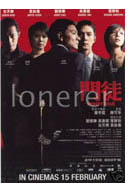 Derek Yee’s Protégé: Yee is a mid-range Hong Kong director who can turn out solid entertainment and sometimes, as with One Nite in Mongkok, some social criticism. In Protégé, you know you’re in for a rough time from the start. A smack-addled mom staggers onto a sofa to die, and her little girl waddles over to yank out the needle and drop it carefully into a wastebin. Whether you love or hate The Departed, Protégé reminds us that Hong Kong film can chop closer to the bone than anything from our purportedly hard-edged directors.
Daniel Wu plays an undercover cop who’s taken years to become virtually a son to drug kingpin Andy Lau. Their intriguing relationship counterbalances Yu’s efforts to wean an addicted mother off the stuff. There are some fascinating quasi-documentary scenes of cooking heroin and harvesting Thai poppies. The parallels between the drug addicts whom Andy despises and his own need for shots of insulin are insinuated, not slammed home. Yee mixes grim realism with some showy melodrama, adding an explosive drug bust. (That sequence contains a startling shot that in itself justifies the existence of CGI.) Despite an overlong denouement and a few loose ends, the film seems to me better than the average local genre fare.
Ninagawa Mika’s Sakuran: Anachronism has a field day in this story of a cunning girl’s rise to be top geisha. Riotous sets and costumes, along with big-band swing music, create the suffocating but ravishing world of courtesans and their patrons. A sentimental ending telegraphed far in advance, but no less welcome for that.
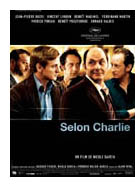 Nicole Garcia’s Selon Charlie: Screened in Filmart, this 2005 pic seemed to me a solid if somewhat academic drama. A network narrative about a fugitive archaeologist in a town full of philandering husbands and bored wives, it’s your basic bourgeois life-crisis tale, decorated with parallels to a mysterious hominid found at a dig site. It has the usual Eurofilm tact and shows how the French have adapted Hollywood’s screenplay structure to fit the well-upholstered stories they like to tell.
Benoît Delépine and Gustave Kervern’s Avida: Black and white almost throughout, in 35mm that looks like muddy 16, this surrealist pastiche starts strong. Early scenes offer a new riff on Tati’s Mon Oncle, in which a toff returns to his cyberautomated mansion and encounters problems with dogs and plate glass. Then we’re in Buñuel-Carrière territory (Carrière is in the movie), as a dognapping leads to an amazing scene of pooch decapitation. Things seemed to me to drag as the episodes got sillier and less visually expressive. Rhinos, lions, elephants, big beetles, and a highly diverse sampling of the human species do walk-ons. Not so much metaphysical as pataphysical.
Iran: A Cinematographic Revolution: A documentary on the pre-1990s Iranian cinema. It’s informative, cautious about the role of the mullahs, and filled with intriguing clips from Hollywood-style melodramas and the neorealist-flavored efforts of the 1970s. Good talking heads too (though no Kiarostami). The film reaffirms how single-mindedly the cinema agencies pursued film festivals as a way of increasing the profile of the nation’s culture; the motto was “No festival without an Iranian film.” But can Iran really have trained a total of 90,000 film-related workers, as the docu says?
Johnnie To’s Exiled: I hadn’t yet seen it on the big screen. That’s where it belongs. The first sequence evokes Once Upon a Time in the West‘s opening, and it’s followed by an exhilarating, utterly implausible gun battle. Watch out for that spinning door!
When Mr. To previewed this opening for me last spring, I didn’t think he could top it, but he does. The later scene in the underground clinic will rank with one of the great action sequences of all time. I won’t spoil it for those who haven’t seen it by previewing a still. Let’s just say that To finds fresh compositional tactics in close quarters, as in the hotel climax.
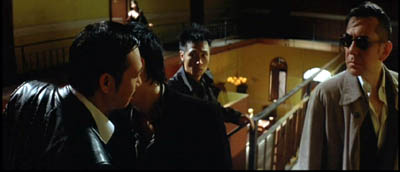
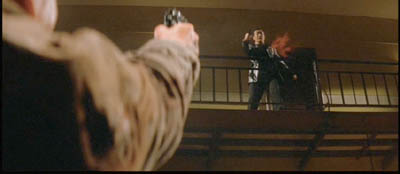
Full of visual invention and neat character bits, Exiled shows that To keeps trying new things. I wrote a little about To’s style in an earlier post, and some backstory on the Exiled rooftop sets can be found here.
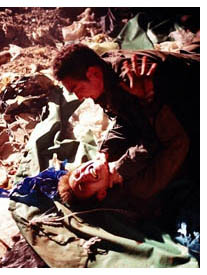 Cheang Pou-soi’s Dog Bite Dog: This tale of a hired killer from Thailand and the raging young cop who pursues him presents a world in Hobbesian frenzy, with all against all. The most unrelentingly violent Hong Kong film I’ve seen in years, Dog Bite Dog starts with imagery of the killer hiding in the bowels of a ship, scraping up flecks of rice from the floor. After consummating his hit, he moves through a landscape of garbage, hiding out in a landfill and rummaging in a recycle bin for scraps to doctor a girl’s wounded foot. I don’t know any film that insists so intently on the textures of urban offal.
The cop trembles under the pressure of his own torments, and the parallels between the two men climax in a knife fight in a crumbling Thai temple. As is often the case in local cinema, Father is to blame. This visceral movie surely couldn’t be released theatrically in the US. Even the most jaded action aficionado is likely to flinch from certain scenes.
Cheang’s previous film is the suspenseful Love Battlefield. Of Dog Bite Dog he remarked, “I wanted to show [the audience] this Hong Kong film that does not have choreographed action.” For more, see Grady Hendrix’s coverage here and Twitchfilm’s longish review.
Otar Iosseliani’s Gardens in Autumn: The first shot, in which old men quarrel over which one gets to buy a cheap coffin, puts us firmly in Iosseliani’s parallel universe. As often, he speaks for those who just opt out. A minister of agriculture loses his post and drifts among ne’er-do-well pals, hookers, and girlfriends. A film about drinking, eating, smoking, rollerblading, music-making, and middle-aged sex, Gardens in Autumn also satirizes the rich, who are just as lazy as our heroes but waste their lives shopping. There are also prop gags, including the pictures of heifers and boars that show up in quite unexpected places.
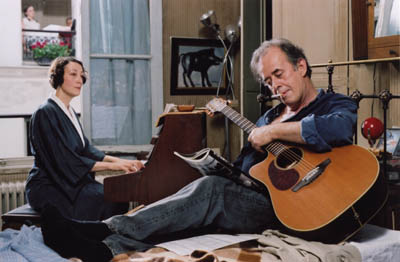
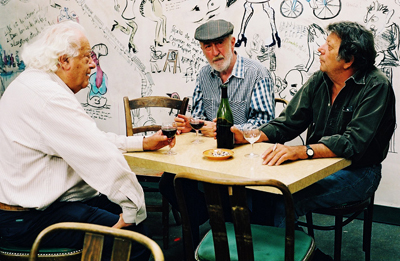
Iosseliani casts himself as an easygoing gardener who draws cartoons on a cafe wall. Some of these images recall people and shots we see in the movie, as if we’re watching the old buzzard create the film between swigs of vodka. An elegiac poem to the subversive force of idleness, with a final scene celebrating women.
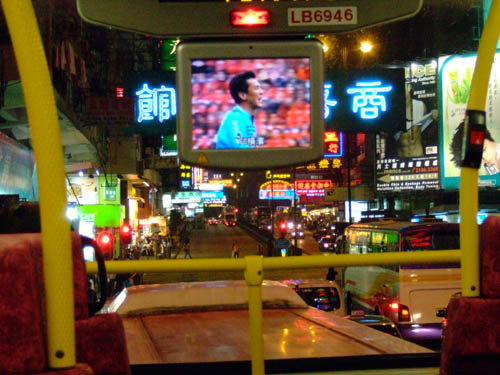
Over the next couple of weeks, more frequent posts, I hope, including glimpses of this highly photogenic city. For the moment, this from a double-decker bus must suffice.
Charlie, meet Kentaro
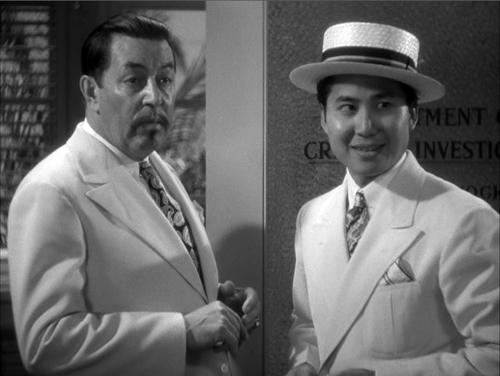
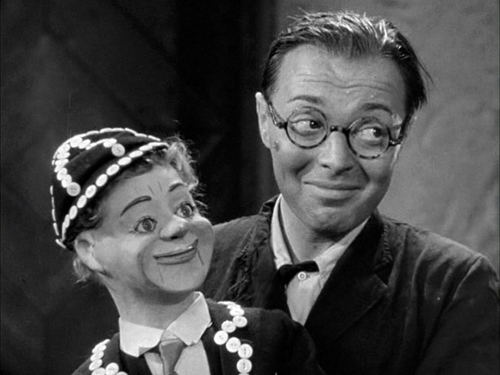
DB here:
Echoing an earlier virtual roundtable on this blog, I want to write about my two favorite B film series, now available in handsome DVD boxed sets. Both series were mounted at 20th Century-Fox, both were adapted from genre fiction, and both seem very much of their time: lots of exotic Orientalia, and probably too many middle-aged men in tiny mustaches and broad fedoras. But to my mind these films offer brisk, unpretentious entertainment, solidly crafted and surprisingly subtle. They also allow us to trace some changes in the ways movies were made across the 1930s.
There’s another reason for this blog. Tim Onosko, a friend of Kristin’s and mine, recently died after a battle with pancreatic cancer. Tim was an extraordinary figure, as you can find here. He was central to Madison film culture for forty years, and in his various creative activities, he shaped everything from The Velvet Light Trap to Tokyo Disneyland. He and his wife Beth also made a documentary, Lost Vegas: The Lounge Era. Tim and I enjoyed talking about the two series I’ll be mentioning. He loved these films, as he loved all films and popular culture generally, with a sharp-eyed dedication. So this is a small effort at an homage to Tim.
The Hawaiian and the Japanese
Charlie Chan, a Hawaiian police inspector of Chinese ancestry, became famous in a series of six novels by Earl Derr Biggers, from The House without a Key (1925) to The Keeper of the Keys (1932). Chan novels were brought to the screen at the end of the 1920s by Pathé and Universal, but for Behind That Curtain (1929) Fox took over the franchise. Warner Oland, a Swedish-born actor who had often played Asians, settled into the lead role in Charlie Chan Carries On (1931). He played Chan up through Charlie Chan at Monte Carlo (1937), then fled Hollywood under peculiar circumstances and went to Sweden, where he died soon afterward.
 The Mr. Moto films overlapped with the Oland cycle. John P. Marquand introduced Moto in the novel No Hero (1935) and made him more central to four novels that followed. Again, Fox bought the rights and launched the film series with Thank You, Mr. Moto (1937). It starred Peter Lorre as the mysterious Japanese, and I think it’s fair to say that the role made him a Hollywood star. The series ran for eight installments, ending in 1939 with Mr. Moto Takes a Vacation.
Each series echoed its mate. Tim claimed that in an early Chan, a character is reading a Moto story in the Saturday Evening Post, though I’ve never found that scene. When Charlie’s Number One Son turns up to help Moto in Mr. Moto’s Gamble (1938) it’s revealed that Charlie and Moto are old friends. There’s a more elegiac moment in Mr. Moto’s Last Warning (1939) when a theatre displays a poster for the Chan series—perhaps as well serving as an homage to the recently deceased Warner Oland. Despite Oland’s death, the Chan series continued until 1949, with Sidney Toler in the role, but with Lorre’s departure the Moto films ceased.
Having a Caucasian actor play an Asian protagonist was common at the time. Today, it seems condescending or worse, but we should recognize that the films featured Asian actors as well, often in significant roles. The most visible example is Keye Luke as Charlie’s highly Americanized son. Forever blurting out “Gosh, Pop!” Luke is a lively and likable presence.
Just as important, the portrayal of the detectives is remarkably free of racism. Charlie and Moto are clearly the quickest-witted characters, and both prove resourceful in all kinds of ways. Moto’s judo subdues thugs twice his size, and Charlie is up-to-date in the new technologies of detection.
The scripts go out of their way to show both men skilfully handling the prejudice they encounter. In Charlie Chan at the Opera (1936), a blatantly racist cop (William Demarest) who calls Charlie “Chop Suey” is mocked incessantly by everyone, most gently by Charlie. Moto excels at pretending to be the stereotypical Asian (“Ah, so!” “Suiting you?”). And both our protagonists are sympathetic to others who are in minorities. Charlie is notably unwilling to participate in guying black servants as the whites do, and Charlie Chan at the Circus (1936) shows his keen sympathy with the “freaks,” treating them with quiet courtesy. The Moto series presents a Japanese who doesn’t seem to share his country’s goal of ruling Asia. In Thank You, Mr. Moto, he enjoys a respectful friendship with a Chinese family of declining fortunes.
 The Chan series features straightforward detection. A murder is committed, and either Charlie is in the vicinity or the police ask for his help. A young and innocent couple is involved, adding pressure for Charlie to solve the case. Another murder is likely to take place, and a few attempts are made on Charlie’s life before he comes to the solution. In traditional fashion he tends to assemble all the suspects at the climax before exposing the guilty party.
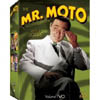 The Moto films aren’t as concerned with puzzles. Like the novels, they’re tales of international intrigue, involving smuggling, theft of archaeological treasures, and the like. There’s more violence and physical action, with shootouts and last-minute rescues. Moto Kentaro (his given name is visible only on his identity card) is a more shadowy presence than Charlie, often working under vague auspices. He’s either an agent of Interpol, a functionary of the Japanese government, or an exporter who takes up intrigue as a hobby. (1) In Mr. Moto’s Gamble, arguably the best of the series, he engages in old-fashioned detection involving murder during a boxing match. Unsurprisingly, the film was originally planned as a Chan vehicle, and it even includes Number One Son as Moto’s sidekick.
Looks and looking
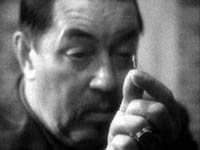
We can learn a lot by studying the two main actors’ performance styles. The plump Oland plays Chan as stolid but not ponderous. He floats across a room and gravely circulates among suspects, giving the films their deliberate pacing. Oland’s drawn-out delivery and pauses were due, people say, to his acute alcoholism, but he never seems to be struggling to find his lines. Charlie is at pains to be unobtrusive, modest, and tactful; his characteristic gesture is a simple one, letting the fingertips of one hand grasp one finger of the other.
He is a loving father, doting on his many children (all in tow in Charlie Chan at the Circus). Although Number One Son may exasperate him, you would go far in films to find as warm a portrayal of a father’s affectionate efforts to curb an impulsive boy. See Charlie Chan at the Olympics (1937) for the casual byplay between Charlie and Lee, now an art major and a member of the swimming team. Lee’s bubbling energy gives Charlie’s imperturbability even greater gravitas.
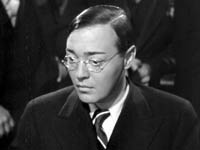
The short and slim Lorre plays Moto as a suave man-about-Asia, hand thrust casually into his trouser pocket. Moto is an art connoisseur, a graduate of Stanford (class of ‘21), and a master of many languages. Lorre, so easily caricatured at the time and now, hit on a brilliant idea: He didn’t give Moto stereotyped tricks of pronunciation. Unlike Oland, he didn’t usually drop articles or compress syntax.(2) Lorre just played the part in his lightly accented English, as he would in The Maltese Falcon and Casablanca. He added a soft-spoken delivery, a modest smile, and a trick he may have picked up from Marlene Dietrich–ending his sentences with a slight upward inflection, turning every statement into a polite question.
Reaction shots of suspects are a convention of these movies, but after several cuts show us everybody looking shifty, the reverse shots of our heroes show us that they miss none of this byplay. (3) Charlie is alert, but he hides his penetrating view behind a bland courtesy. As Moto, Lorre presents a more aggressive intelligence. Peering through round spectacles, those bug eyes, panic-stricken in M, can now become pensive or bore into a suspect. Charlie needs the force of law, but Moto, who usually acts alone, is dangerous by himself, and Lorre’s horror-show pedigree serves him well in giving his hero’s stare a sinister edge.
Listening and looking
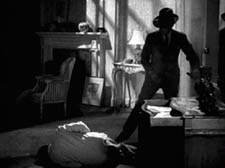
You can argue that Oland and Lorre, coming to their parts only a few years after sound had arrived, helped Hollywood develop a wider array of acting styles. We historians of Hollywood have rightly praised gabby comedies like Twentieth Century (1934) and It Happened One Night (1934) for finding a performance technique suited to sound films, particularly in the wake of technical improvements in acoustic recording. If movies had to talk, we think, they should really talk, fast and hard and heedlessly. In this church our Book of Revelations is His Girl Friday (1940).
Lorre and Oland, like Karloff and Lugosi, remind us of the virtues of being gentle, spacious, and deliberate. This isn’t a reversion to those hesitant, strangled mumblings of the earliest talkies. Rather, the movies’ plots surround our Asians with rapid-fire duels of cops and reporters, snapping out “Say!” and “Hiya, sister!” and “Watch it, wise guy!” and “Don’t be a sap!” Against clattering percussion Moto and Charlie deliver a melodic purr.
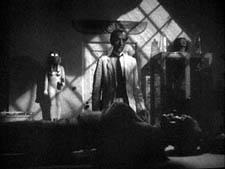
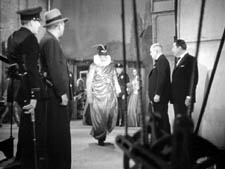
Some people still believe that in Citizen Kane Welles and Gregg Toland introduced American film to steep low angles, tight depth compositions, and noirish lighting. In The Classical Hollywood Cinema, I’ve argued that the Gothic, somewhat cartoonish look of Kane synthesized and amplified trends that were emerging during the 1930s. The Chan and Moto films are wonderful places to study these visual schemas.
 E
E
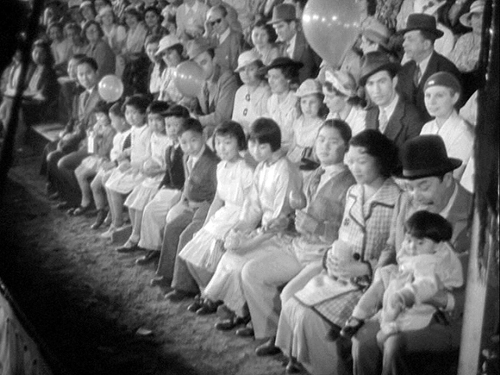
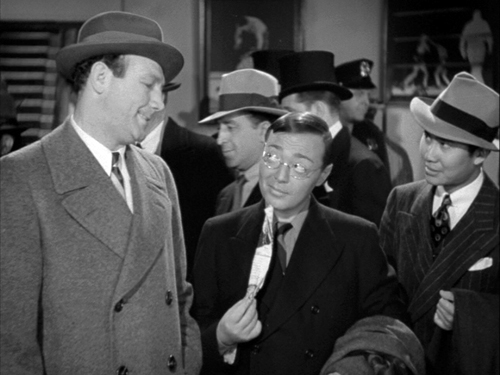
In Charlie Chan in Egypt (1935, above), cinematographer Charles G. Clarke (whom Kristin and I interviewed for the Hollywood book) offers flashy depth and silhouette effects, and nearly all the Chan films have moments of clever staging. Charlie Chan at the Opera, above, is particularly engrossing, with its huge set (recycled from the A-picture Café Metropole, 1937). The same film, incidentally, contains scenes of a fictitious opera, Carnival, composed by Oscar Levant. This was an ambitious gesture for a B film and looks forward to Bernard Herrman’s Salammbo sequences of Kane.
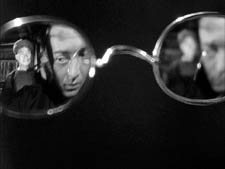
The Motos are even more remarkable. You want wild angles? Venetian-blind shadows? Telltale reflections in eyeglasses? Swishing bead curtains? Twisted expressionist décor? You’ve come to the right place.
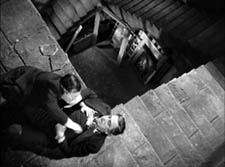
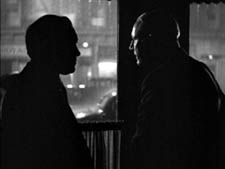
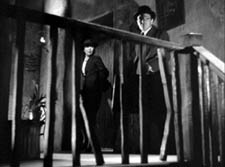
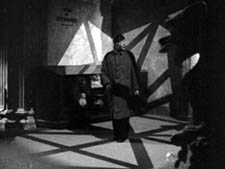
Some late thirties Fox sets seem to have been stored in Caligari’s Cabinet. Watching these films, it becomes clear that Kane applied the moody technique of crime and horror films to ambitious drama. One bold setup in Mr. Moto’s Gamble looks like a dry run for a Toland big-foreground composition (done here, as often in Kane, through special-effects). I like this shot so much I used it in Figures Traced in Light.
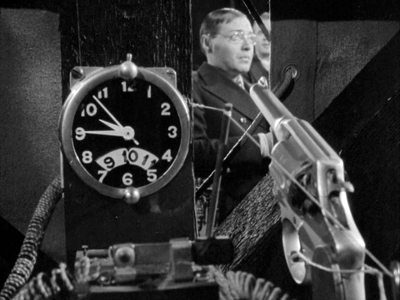
Yet all this creativity took place within severe constaints. These were B pictures, running under seventy minutes and shot in a month or so. Three or four would be released each year. They shamelessly used stock footage, leftover sets, and the same players in different roles from film to film. (Watch for Ray Milland, Ward Bond, and others on the way up.) The boys in the Fox cutting room seem to have enforced a remarkable uniformity: most of the Chans in these DVD sets, regardless of director, contain between 600 and 660 shots, while the faster-paced Motos average between four and six seconds per shot. The actors created hurdles too. Oland sank even further into drinking while the high-strung Lorre was addicted to morphine and periodically retired to sanitariums to recover. Those were the days; rehab wasn’t yet a matter for infotainment.
The Fox DVD boxes are model releases. The prints are well-restored (better on the second sets than the first) and filled with astute, informative supplements. We get a lot of detail about production matters, including why Oland left Hollywood. There is welcome biographical background on master minds like Sol Wurtzel and Norman Foster. I still want to know more about James Tinling, though; his direction of Mr. Moto’s Gamble and Charlie Chan in Shanghai (1935) belies his reputation as a hack.
“The cinema is not dangerous,” Moto reassures the Siamese tribesmen about to be filmed in Mr. Moto Takes a Chance (1938). Immediately, the woman who’s being filmed dies. The adventure begins. Who can resist movies like these? They have kept me happy since my childhood, when I watched them on Sunday afternoon TV. They can keep your children, and you, happy too.
For some good reading, see John Tuska, The Detective in Hollywood (Doubleday, 1978); Charles Mitchell, A Guide to Charlie Chan Films (Greenwood, 1999); Howard M. Berlin, The Complete Mr. Moto Film Phile: A Casebook (Wildside, 2005); and Stephen Youngkin, The Lost One: A Life of Peter Lorre (University Press of Kentucky, 2005).
For more on Charlie, click here. Charles Mitchell has a nice wrapup on Kentaro here.
(1) The involvement of an innocent romantic couple was a convention of slick-magazine fiction of the day (both the Chan and Moto novels were serialized in the Saturday Evening Post), and it recurs throughout mainstream detective fiction of the 1930s. Most writers of the period wrestled with the problem of how to make the couple interesting. See Carter Dickson/ John Dickson Carr’s short story, “The House in Goblin Wood,” for a brilliant handling of the device.
(2) As many commentators have noted, Charlie doesn’t speak pidgin English; he seems to be mentally translating. Interestingly, the generation gap is apparent here too, since Number One Son speaks peppy and perfect American slang.
(3) One hyperclever moment in Mr. Moto’s Gamble gives us the usual rapid-fire array of single shots of discomfited suspects but neglects to show us the real culprit.
Classical cinema lives! New evidence for old norms
Hero.
Kristin here—
Note: This entry was written for Jim Emerson’s Contrarian Blog-a-Thon (III).
When David and I got into film studies in the late 1960s and early 1970s, an era of Hollywood’s history was drawing to a close. Many of the great directors who had defined the classical studio era from the period of World War I to the early age of television were at or approaching retirement. Andrew Sarris’s pivotal book, The American Cinema: Directors and Directions 1929-1968 (1968) came out just in time to elevate their reputations by dubbing them with the fashionable French term auteur.
John Ford and Howard Hawks made their last films in this period (7 Women, 1966, and Rio Lobo, 1970). Alfred Hitchcock, Otto Preminger, and Vincente Minnelli kept driecting into the 1970s, though few would say their late films stacked up to their earlier ones. (Preminger did manage to struggle back after a string of turkeys to make a very creditable final film, The Human Factor, in 1980.) Sam Fuller kept working through the 1980s, but he had to go to France to do it. Billy Wilder’s last film came out in 1981, though most of us wish he had stopped with The Private Life of Sherlock Holmes in 1970.
The decline of these greats coincided with the rise of the New Hollywood generation, whose directors, originally dubbed “the movie brats,” have become the grand old men of the current cinema. It also coincided with the early rumblings of the blockbuster (Jaws, 1975) and franchise (Star Wars, 1977) age that we know today. Definitely a shift took place in the 1970s, but to what?
Many film historians have claimed that the films that have come out of Hollywood since roughly the end of the 1980s are radically different from those of the classical “Golden Age.” Factors like television, videogames, spectacular special effects, moviegoers with short attention spans, the internet, the acquisition of the old studios by multi-national corporations, and the resulting rise of franchises have all putatively given rise to a “post-classical” cinema. This phenomenon is sometimes also referred to as the “post-Hollywood” or “post-modern” era.
I’m suspicious of the “post” terms, vague as they are. Usually stylistic labels describe what something is, not what it follows. Do we speak of “post-silent” or “post black-and-white” cinema?
Post-classical films supposedly jettison the old norms of style and storytelling. Frenetic editing, constant camera movement, product placement, juggled time-schemes—these and other tropes of recent cinema have replaced the continuity system, the carefully structured screenplay, and the character-based storytelling of the classical era. Computer-generated imagery has enabled filmmakers to create action scenes, spectacular settings, and fantastical creatures that hold our attention so thoroughly that the plot ceases to matter.
Or not. David and I have spent much of our professional careers studying the norms of classical filmmaking. We’ve swum against the stream by claiming that, despite many changes in style and technique, the fundamental norms of classical storytelling have remained intact. The classical cinema is with us still, precisely because it enables filmmakers to present us with absorbing plots and characters. It also is a flexible filmmaking approach that can absorb new technologies and new influences from other media and bend them to its own uses.
It’s less seductive to proclaim a long-term stability in Hollywood than to trumpet revolutionary, transformational, epochal changes. Still, some things just work so well that people want to keep them going as is. American films have dominated world screens since 1915. Why tinker with an approach that works so well?
It’s amazing to think of it now, but back in the late 1970s, virtually no one had studied the traditional norms of Hollywood filmmaking. We all knew what the distinctive traits of the great auteurs were, but distinctive as opposed to what? Academics kept saying that someone should figure out just what the cinema of the classical studio era consisted of. What principles guided filmmakers? What assumptions did they share? Not realizing how much material was available on Hollywood cinema, we and our colleague Janet Staiger set out to document the norms of style, technology, and mode of production that composed the “classical Hollywood cinema.”
The result was a much larger tome than we had expected, The Classical Hollywood Cinema: Film Style and Mode of Production to 1960 (1985). After finishing it, David and I dusted off our hands, figuring that we had dealt with that topic. We went back to studying non-classical directors like Ozu, Eisenstein, Tati, Godard, Bresson, and Hou, confident that we had the knowledge to show exactly how and why their work differed from standard filmmaking.
Then claims about post-classical filmmaking started to appear. In our book, we had limited our survey to pre-1960 cinema because the breakdown of the studio structure and the competition from television led to a different situation in Hollywood. We did not, however, say that classical filmmaking died then. Quite the contrary; we said that it had endured through those changes in the industry.
Those favoring the post-classical explanation obviously disagreed with that. Bypassing our claims for the endurance of classical filmmaking, they borrowed our cut-off date of 1960, as if we had intended that year to signal the end of all aspects of the classical cinema—style, storytelling, mode of production, technology, the whole thing.
During the 1990s it became apparent that claims about post-classical cinema were becoming one very common way of dealing with modern Hollywood films. We decided to move well beyond 1960 and show that classical norms still prevail in American mainstream cinema. I wrote Storytelling in the New Hollywood (1999), which analyzes ten successful films of the 1980s and 1990s to show that they use narrative principles that are virtually the same as those that were standard in the 1930s and 1940s. Goal-oriented characters, dangling causes, appointments, double plot-lines, carefully timed turning points, redundancy—all these classical devices are still very much with us. The claim was not that every single film coming out of Hollywood adhered to classical norms, only that the vast majority did.
David went on to make a similar argument in The Way Hollywood Tells It (2006), though he deals with visual style as well as narrative. There he examines some of the new norms of storytelling, showing how they are variants of the older classical system. He discusses, for example, “intensified continuity,” where tighter framings on actors, faster cutting, and prowling camera movements have modified but not replaced the standard continuity approach to presenting a conversation scene.
One of the most persistent claims by proponents of a post-classical era is the spectacle made possible by CGI. With the thrilling fight sequences of The Matrix, the vast battles of The Lord of the Rings, the extensive recreation of historical places of Gladiator, and the fantastical creatures and places of The Chronicles of Narnia: The Lion, the Witch and the Wardrobe, the individual scene supposedly becomes more spellbinding than the story in which it is embedded.
David and I have tried to refute this claim to some extent. I talk about Terminator 2 in the first chapter of Storytelling, showing that it has a tightly constructed, character-based narrative. David has a chapter section called “A Certain Amount of Plot: Tentpoles, Locomotives, Blockbusters, Megapictures, and the Action Movie,” where he examines films like Judge Dredd and The Rock. He demonstrates that they, too, have plots that adhere to traditional Hollywood norms. He puts forth a more detailed analysis in this online essay.
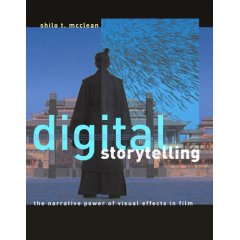 We’ve never really dealt much, however, with the issue of how CGI may or may not have elevated spectacle over narrative interest. Luckily now a new book does that and does it very well. Shilo T. McClean, in her Digital Storytelling: The Narrative Power of Visual Effects in Film (MIT Press, 2007), agrees with much of what we have claimed about the survival of classical filmmaking (though The Way Hollywood Tells It came out too late for her to have seen it). She builds upon our case by examining systematically and imaginatively the question of whether digital special effects support narrative interest. McClean convincingly demonstrates that DVFx (digital visual effects), as she terms them, are used in an enormous variety of ways, and most of these help to tell classically constructed stories.
McClean’s basic points are two. First, DVFx are not used just in the more obvious ways, for big action scenes or elaborate fantasy and science fiction settings. They are applied for a wide range of purposes, from dustbusting (removing dust and other minor flaws from frames) to spectacular scenes. Far from being inevitably spectacular, DVFx are often invisible. (1)
Second, McClean claims that whether modest or spectacular, DVFx usually serve the narrative in some way—and she points out that practitioners in the industry invariably make that same claim.
Digital Storytelling started out as McClean’s dissertation at the University of Technology Sydney. It betrays its origins in a survey of the literature that takes up the first two chapters. There the author is somewhat too conciliatory, for my taste anyway, to a number of theorists’ claims about the breakdown of narrative in the digital-effects age. She tries to find something useful in each writer’s position, even though some of those positions are irreconcilable with the general standpoint she adopts.
Chapter 3 sketches the history of computer graphics and how they came to be used in films. McClean points out that DVFx are perfectly suited to the three criteria for the adoption of new technology that David and Janet formulated in their sections of The Classical Hollywood Cinema: greater efficiency, product differentiation, and support for achieving standards of quality. Like sound and color, DVFx have marked a major technological shift for the film industry, but like them, DVFx have been readily integrated into the existing division of labor. A modern digital studio, as she says, functions in much the same way as a physical one does. Indeed, in watching the credits of a modern film, we see lighting, matte paintings, and so on listed as the specialties for the digital craftspeople.
In these early chapters, McClean points out that in many ways DVFx simply replaces the traditional special effects of the pre-digital age. Most of Citizen Kane’s many effects are not supposed to be noticeable, and indeed for years historians were unaware of just how many it contained. In cases where DVFx create a flashy effect, as in the virtual camera movements through walls in Panic Room, the function is to inform the viewer of the locations of various characters and create suspense. Probably the most vital lesson one could take away from this book is that techniques can serve multiple purposes in a film. Spectacularity, as McClean calls it, and storytelling can co-exist in the same digital images.
The author also explains that, unlike what many writers say about DVFx, they are not simply a post-production technique used to ramp up the visual appeal of a film. Computer imagery is used from the pre-production stages onward, and the mise-en-scene and camera movements must be planned around them.
After this setup, the author systematically explores the factors that might influence the storytelling—or merely spectacular—use of DVFx. As we did in The Classical Hollywood Cinema, McClean samples a large number of films, 500 including shorts. Any film using DVFx, however unobtrusively, qualified.
On this basis, the author has distinguished eight types of DVFx usage. Documentary is one, as in films where computer reconstructions of ancient buildings are shown. Such usage comes into films when information is presented as part of the mise-en-scene, as with the educational film that is screened in Jurassic Park. The second type of DVFx usage, Invisible, is fairly self-explanatory. We are not supposed to notice when buildings are extended, clouds are added to skies, or smudges on actors’ faces disappear.
Seamless DVFx are those we know must be faked, even though the results look photorealistic. The recreation of ancient cities, as with Rome in Gladiator or giant storms, as in Master and Commander, are of this type. Exaggerated effects involves actions or things posited to be real but created in a stylized fashion. McClean cites the comic effects in Steven Chow comedies, and puts wire-erasure for stunts into this category. I assume The Hudsucker Proxy would be another instance.
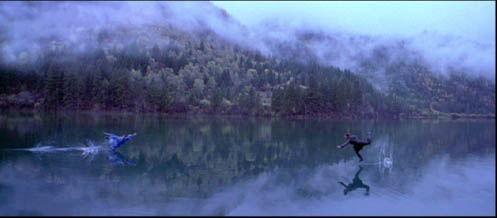
Fantastical DVXs obviously involve impossible beings like dragons, cave trolls, and a wide variety of X-Men. McClean also finds them in non-fantasy, non-sci fic films like Forrest Gump, Big Fish, and Hero. Surrealist uses of effects can include mental representations, as in Eternal Sunshine of the Spotless Mind and American Beauty, or a bizarre but objective world, as in Amélie.
Finally, there are New Traditionalist uses of DVFx, exemplified by Pixar’s films, and HypeRealist ones, like Final Fantasy.
Armed with this typology, McClean studies various approaches to film studies, testing what each one reveals about the use of DVFx. Since classical Hollywood cinema is based on character traits and goals, she begins by showing convincingly how DVFx can “establish, realize, and enhance” character. For example, films often use effects to put the protagonist in greater danger than would be safe to do in reality. The staged fights in Gladiator, the author argues, create a greater emotional engagement with the main character and make plausible the heroism that allows him to defeat his enemy in the end.
Next McClean tests how DVFx can change the impact of a film by analyzing a pre-digital film and its remake in the computer age. (As a method, this is similar to what David does in The Way Hollywood Tells It when he examines framing, editing, and other techniques in the two versions of The Thomas Crown Affair.) The case study chosen is the 1963 Robert Wise version of The Haunting and the Jan De Bont remake (1999). McClean presents considerable evidence that the inferiority of the later film has nothing to do with its expensive DVFx supernatural effects. Instead, she locates the problem partly in the removal of all the creepy ambiguity of the earlier version. De Bont also changes the heroine from a guilt-ridden, virtually suicidal woman (too wimpy in this politically-correct age?) to a strong, determined savior. The result is a conventional super-woman versus evil monster film where the digital effects stand out simply because the original story was stripped of its most intriguing elements.
McClean moves on to genre, an important subject given the apparent concentration of DVFx (the ones we notice, that is) in fantasy and sci-fi films. She rightly points out, “For all the many assertions that special effects are an emerging narrative form, no one has proposed the narrative structure that this new form demonstrates.” The author makes up for that lack herself, concocting an outline of a film based around a string of effects-laden action scenes. Her outline fits the descriptions of films as given by proponents of post-classicism. The result, however, doesn’t resemble any film I’ve ever seen.
In the genre chapter McClean uses an obvious research resource, but one that the post-classicists largely ignore. She has gone through the entire run of the special-effects journal Cinefex, on the assumption that the films it covers are those assumed to be most significant in terms of their DVFx. McClean lists the 291 films by genre, showing that sci-fi films and horror do not have a monopoly on DVFx. For example, thirty-three period and dramatic movies feature in her list.
To gauge the impact of the rise of franchises in modern Hollywood, McClean surveys the four Alien films, which begin in the pre-digital and move into the digital era. As with remakes, the author demonstrates through analysis that the decline in the series after its two first films had to do with a thematic shift and a change in the character of Ripley.
McClean does not overlook the auteur theory, tracing the work of Steven Spielberg during that same transition from pre-digital to digital cinema. Unlike the other effects-oriented giants of Hollywood, George Lucas and James Cameron, Spielberg has worked in many genres. As soon as DVFx became available, he used them in nearly all the ways listed in McClean’s typology, from the Invisible creation of the swooping airplanes in Empire of the Sun to the Exaggerated in the Flesh Fair setting in A.I. to the Fantastical Martians in War of the Worlds. Always in the service of the narrative.
Along the way McClean offers a number of astute observations. One of these is a novel argument against the “DVFx equals non-narrative spectacle” position. She points out that “In many instances technically weak DVFx will be forgiven if they are narratively congruent; it is the strength of the narrative that will carry them, rather than the other way round.” This claim is plausible when we consider how in the pre-digital age we tried to overlook the obvious back-projections and matte-work in Hitchcock films like The Birds and Marnie.
She also suggests some plausible reasons why bad films might be heavy with DVFx. In some cases the effects create a publicity hook that makes up for the lack of other production values. In others, an inexperienced director, carried away with the “cool” possibilities of DVFx, uses them to excess.
And finally someone has come out strongly against the use of the term “cinema of attractions” to describe modern films. Historian Tom Gunning originally coined this phrase in describing very early cinema, where magic acts with stop-motion disappearances and elaborately hand-colored dances were as common as narrative films. For that period, the label worked and was useful. Applying it to later eras just because films have spectacular sequences has rendered the term much less meaningful.
One thing that I particularly like about McClean’s book is that she shows respect for the films she discusses. She actually seems to enjoy both watching and writing about them. McClean asks questions of aesthetic import, and she treats films as artworks—some good, some bad, but all to be taken seriously as evidence for her case.
Her final chapter provides an excellent conclusion: “While DVFx have completely reequipped the storyteller’s toolbox, they have not rewritten the storyteller’s rulebook entirely.” Yes, classical cinema lives, and Digital Storytelling provides vital new evidence to bolster that claim.
(1) In Film Art, we have touched on this range in the section “From Monsters to the Mundane: Computer-Generated Imagery in The Lord of the Rings” (pp.249-251 in the 7th edition, pp. 179-181 in the 8th). McLean treats the topic in far more depth.