






Archive for the 'Narrative strategies' Category
Virtually true, or maybe not
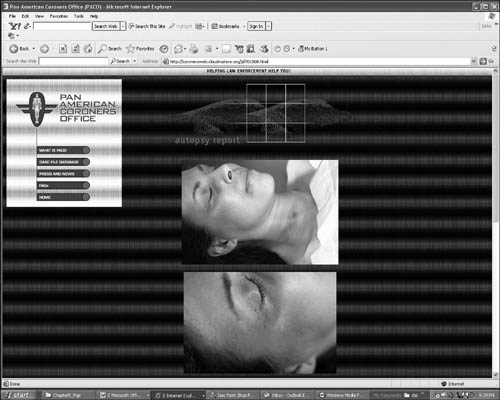
From DB, for once a brief blog:
Perhaps the most enduring legacy of The Blair Witch Project was the idea of promoting the film through a faux website that treated the lore around the Witch as genuine. Later, the promotion for Spielberg’s A.I. created an alternate reality game (ARG) by scattering clues to a murder among many websites. The murder wasn’t part of A.I.‘s plot, but it did take place in the film’s fictional world, and online participants pursued an elaborate para-narrative that connected obliquely to the movie. A key character in the ARG, researcher Jeanine Salla, was listed as an actor in the film’s final credits. Ms. Salla evidently died a grisly death herself, as the autopsy report above indicates. She led other lives in fanfiction and online comic strips.
Now, for The Great World of Sound, director Craig Zobel has created a website. Nothing new in that. But Zobel also provides a website for a fictional company in the film. Here’s Screen International’s take (19-25 January 2007, print ed., p. 36):
It’s the 21st century equivalent of the film within the film—the fictional website of the shark-like record company in the movie. It’s everything you’d expect from a shady music company—flashing primary colors, bad clip art, typos and scrolling fonts, all to the sound of a soul-killing MIDI song file.
It starts well (banner reading, “You’re ad here”) but I found it not as wild as the SI description implies. Still, the idea is good, the execution diverting. Visit it here.
In a parallel thrust from Bookland, Jacquelyn Mitchard’s forthcoming young adult novel Now You See Her is being promoted by a series of YouTube video diaries purportedly made by the heroine, Hope Shay. The first one is up, and already at least one viewer thinks it’s the McCoy. (1)
We can probably expect to see more extensions of fictional worlds to the webworld. Are Hannibal Lecter podcasts next? Or an online university for which reading Special Topics in Calamity Physics is a prerequisite? See Henry Jenkins’ fine Convergence Culture for more on the A. I. puzzle ARG (pp. 123-128) and reflections on cross-media storytelling in general.
(1) Full disclosure: Hope is played by Lauren Peterson, the daughter of old friends Sue Collins and Jim Peterson. They also live down the street from us. Jim, now an attorney, took a Ph. D. in film studies here at UW. He’s the author of Dreams of Chaos, Visions of Order, an outstanding study of American avant-garde film.
PS Monday morning: I don’t watch much TV; The Simpsons, Olbermann, Ebert & Roeper, and the movie channels are pretty much it. So I’m grateful to Olli Sulopuisto for telling me that Lost has created its own ARG, The Lost Experience and that there’s a website for the fictional Hanso corporation. Much, much more can be found on the fansite.
My Danish December
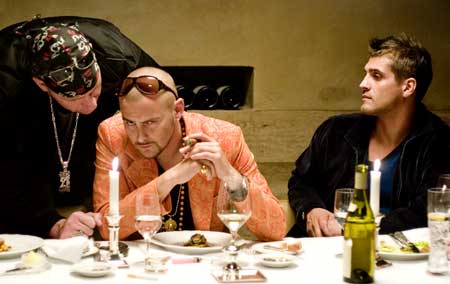
Easy Skanking (aka Fidibus).
DB here:
I’d intended to post this at the end of the year, but I fell behind. So in place of the New Year’s entry Kristin and I had hoped to write, we’ll just say: Best wishes for 2007!
And now the blog….
I haven’t bothered to draw up a list of best films of 2006, for lots of reasons. Some acute objections to the very idea of best-films lists are aptly summarized by Andy Horbal, and I find them convincing. But there have been practical concerns too.
My December movie-watching was dominated by 2004-2006 Danish films, in preparation for an essay. I think I couldn’t have spent my time better. Instead of being disappointed with critics’ official hits from the US, I was repeatedly excited by ingenious, moving, and enjoyable films….most of which I wouldn’t have known about otherwise.
First, some background.
Historically, it seems, the three greatest national cinemas are those of the US, Japan, and France. Their pervasive influence and their accomplishments in film art, film industry, and film culture make them consistently important in every era, from 1895 to the present.
But a lot of other national cinemas are important too, and I confess a fondness for those less salient ones, what Mette Hjort calls, without disparagement, cinemas of small nations. It’s partly because my academic life has been bound up with not only the Big 3 but a littler 3: Belgium, Hong Kong, and Denmark.
Denmark was the first foreign country I ever visited; I went there in 1970, just before starting graduate school, to do research on Carl Dreyer. I was received so hospitably by Ib Monty, Karen Jones, Marguerite Engberg, and others at the Danish Film Archive, that I came to believe that I could continue to do academic work on cinema.
Over the last 36 years, I’ve felt a kinship with Danish film culture. It has admirable directors like Dreyer and Benjamin Christensen, of course, but also without a lot of fuss the Danes keenly support artistic cinema in a commercial context. I’ve come to respect their open, unpretentious approach to filmmaking and film viewing. I’ve also made many strong friendships with Danish archivists and professors.
The Danish Film Institute not only helps fund most of the 15-20 titles theatrically released every year. It also proselytizes very actively for those films, helping them get festival slots and theatrical releases overseas.(Several Danish items will be screened at Sundance this month.)
The DFI’s job has gotten easier since the arrival of Dogme 95, which galvanized filmmakers around the world and made Danish film the flagship of Scandinavian cinema. Here is Norwegian director Aksel Hennie: “The effect of Dogme on my generation has been immense. More than anything else, it is the Dogme attitude, the ‘anybody can make movies’ idea. As a first time director with no formal training from a small European country, that was very inspiring.”
In 2002, Vicki Synnott of the DFI asked me to write an essay about post-Dogme Danish films for their publication Film, which appears in English in spring, summer, and fall. I reviewed about thirty titles, only a few of which I’d already seen. The result, “A Strong Sense of Narrative Desire,” can be downloaded here.
In 2005, Vicki asked me for a more up-to-date piece, and she sent me another passel of films to watch. Hence my December movie marathon, and the essay, which I’ve just submitted. After polishing, it will be published in print and will be available online.
I thought that a good way to start the new year would be to talk about the most intriguing and enjoyable films I saw. Most are little-known outside the festival circuit, and very few are as yet available on DVD. But all are well worth your time. So call it my Best Danish Films I Saw at the End of 2006 list.
Thrillers
The King’s Game (2005) offers journalistic-political intrigue in the vein of All the President’s Men. Efficiently directed and plotted, with some earned surprises, it also features those doyens of Danish acting, Anders W. Berthelsen (Mifune) and Søren Pilmark.
Murk (2005) shows off again the estimable talents of screenwriter (sometime director) Anders Thomas Jensen. A little implausible in the third act, but excellent suspense and fine performances from the ubiquitous Nicolas Bro and Nicolaj Lie Kaas.
Flies on the Wall (2005): Another political thriller, this one for the digital age. A documentary filmmaker (Trine Dyrholm, another fixture of modern Danish film) is commissioned to make a film promoting a political party. She finds a scandal instead. Director Åke Sandgren creates a dizzying montage of footage from the hidden cameras she plants among the offices and in her motel. At a certain point, though, we realize that some of the footage comes from cameras spying on her.

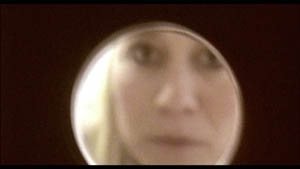
I plan to write more about this rather dazzling movie in another essay.
Ambulance (2005): The idea is worthy of Larry Cohen. A botched bank robbery forces the thieves to hijack an ambulance to make their getaway…with an attendant and a critically ill patient still inside. Unfolding in more or less real duration, the film barrels along breathlessly but still pauses for moments of character revelation and disputes about moral choices.
Pusher III (2005): Even grimmer than the first two installments, but completely gripping in its portrayal of a man whom we should consider utterly degenerate. Nicolas Winding Refn makes the milieu of The Departed look like a ten-year-old’s birthday party. There’s also an intriguing documentary, Gambler (2006) about the financial pressures that forced Refn to make the two final Pusher films.
Comedies
Clash of Egos (2006): A high-concept satire of the film industry by, once more, Anders Thomas Jensen. Through a legal settlement, working-class Tonny gets a chance to oversee a pretentious movie director’s next project.
Lotto (2006): Danish comedies often have a moral issue at their center, one that’s usually more subtly developed than the morality of Hollywood films. Here the situation is: If you and your workmates pooled to buy a lottery ticket and it won….should you tell them? Another fine Pilmark performance, this time in mild-mannered mode.
Easy Skanking (2006; illustration up top). Originally titled Fidibus, which refers to somebody serving as a gofer for a drug dealer. This is a lively venture into Pulp Fiction and Trainspotting territory, but with a sweeter tone and a happy ending. Rudy Køhnke, Denmark’s answer to the young George Clooney, works for the fearsome pusher Paten, but falls in love with Paten’s mistress. You can check out trailers here and here.
Adam’s Apples (2004): A little older, but I had to include it just because it’s one of my favorite films of recent years. Written and directed by Jensen, it tells of a daffily upbeat priest’s efforts to reform convicts, including the skinhead Adam of the title. Tough and warm-hearted at the same time. Mads Mikkelsen, now famous thanks to Casino Royale, plays the priest, with Ulrich Thomsen of Flickering Lights as the edgy miscreant.
Dramas/ Melodramas
Susanne Bier’s After the Wedding (script by Jensen) has already received plenty of praise. It’s another poised, sensitive study of love and family in the vein of Open Hearts (2002), but with a more socially engaged dimension. The protagonist, played by Mikkelsen, has transformed himself from a dissolute vagabond into a worker in an orphanage in India, but his past returns to threaten his redemption. If American critics had seen this film, or if it had been distributed in the US, it would have appeared on many ten-best lists.
1:1: Annette K. Olesen’s tale of the racial tensions surrounding an attack on a teenager. As often in Danish films, psychological drama is balanced by a consideration of social context. The opening credits play out against blueprints and documentary footage detailing the construction of the housing development that forms the center of the action.
Prague (2006): Christoffer, a hard-working businessman, comes to Prague to claim the body of his father, whom he never really knew. His stay leads to a crisis in his past, as he learns his father’s secrets, and one in his present, as he and his wife face the breakdown of their marriage. A severe, engaging film with some of the tang of mid-period Antonioni, starring Mikkelson and Stine Stengade.
A Soap (2006): Pernille Fischer Christensen’s debut has already racked up festival prizes. The action unfolds wholly in an apartment building, where Charlotte (Trine Dyrholm, another fixture of modern Danish film) and the transvestite Veronica (David Dencik) strike up a relationship. Almodovarish, but more subdued (Danes aren’t Spaniards, after all).
How We Get Rid of the Others (2007): In the near future, Copenhagen creates laws that eliminate all citizens who take more from society than they give. A dark, 1984ish vision that satirizes how communitarian social policies can turn tyrannical.
Unclassifiable
The Boss of It All (2006): I’ve already discussed this here, and have recently added a couple of updates. Surely one of the most artistically daring films of the year. Funny too.
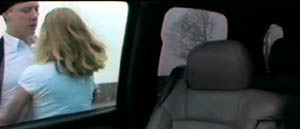
Day and Night
Bang Bang Orangutang (2005): Simon Staho is virtually unknown in the US, but his previous feature Day and Night (2004) takes minimalist cinema in a new direction. Perhaps inspired by Kiarostami’s Ten (2002), Staho pushes the camera/car conceit toward more classical staging and shooting. His followup, Bang Bang, opens up a bit more–now the camera occasionally leaves the car–but Staho goes on to create new formal constraints. The story? A heartless businessman sinks to the bottom of society and out of touch with reality.
Offscreen (2006): After the Neoromanticism of Reconstruction (2003) and Allegro (2005), Boe, in collaboration with Nicolas Bro, creates a more-or-less fictitious diary film. Bro becomes obsessed with recording his life on video, and that leads him to horrific violence. An absorbing exercise in first-person cinema, with viewpoints multiplied (as in Flies on the Wall) thanks to mini-cams.
I hope to write more on these formally adventurous films. (I did: here and here, both for the DFI.)
Watching these films over several weeks, I was even more convinced that today’s cinema encompasses far more than even the most pluralistic ten-best lists can allow. Lists are helpful for some purposes, but our time is better spent seeking out unusual movies, listed or unlisted.
An appetite for artifice
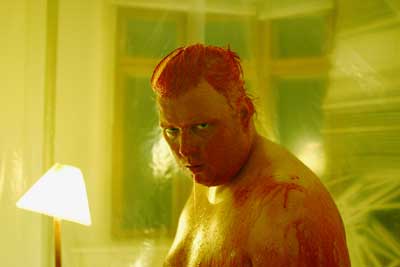
Offscreen (Christoffer Boe)
DB here (no, not above):
Catching up with several of the fall’s films, I was struck by how often they played quite self-consciously with the overall shape of their plots. Here are some examples.
Network narratives. This is the label I applied in The Way Hollywood Tells It to those films highlighting several protagonists inhabiting distinct, but intermingling, story lines. In Poetics of Cinema, I have an essay examining the conventions of this format. Several films I saw this fall continued this tradition.
*Bobby used the familiar device of gathering everyone in a single spot–a hotel–within a short time frame and interweaving personal stories with a fateful climax. I thought the film was fairly clumsy, but I was still moved. In 1964 I filmed RFK when he stumped our town for the presidential nomination, and in college, though leaning toward Gene McCarthy I thought Bobby was the only candidate who could beat the Republicans. “Dump the Hump!” (Hubert Humphrey) was the rallying cry.) His assassination, during the same year Martin Luther King was killed, was very traumatic to young idealists. Estevez’s film becomes most powerful, I think, by simply replaying footage and speeches, reminding us that there was once a rich politician who talked incessantly about helping the poor. Just as Stone’s JFK positioned Jack as the man who could have averted the Vietnam War, Bobby makes RFK the anti-Bush.
*Fast Food Nation was for me a more satisfying use of the network narrative format. Here the time scheme is more diffuse because Linklater is tracing a large-scale process, the burger from the hoof to the Happy Meal. By starting with the middle-management character (Greg Kinnear) and then easing us into the harsh working life facing Mexican illegals, the film builds sympathy for the immigrants. Gradually, the illegals’ stories take over, and the social conscience of one of the burger chain’s teenage workers is ignited.
The plotting makes some thoughtful moves. A more literal approach would have shown us the meat-processing plant’s killing floor early, as part of the step-by-step process. But here the shocking material isn’t presented until the very climax of the film, as the fate to which the immigrant working woman must submit. Likewise, the film drops the Kinnear character about halfway through, a ploy that conceals from us how he’ll act on his new knowledge. Will he blow the whistle on the plant, and endanger his job? A European film might have left his whole line of action open, but Linklater adheres to the tendency of American films to resolve a plotline one way or another. He does it, however, in an epilogue which leaves us with a sharpened sense of the acute problems of the system.
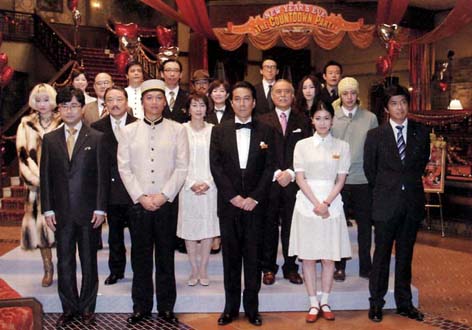
*The Uchoten Hotel (aka Suite Dreams, Japan, 2006). In the vein of Tampopo and Shall We Dance?, Mitani Koki offers gentle humor mixed with satiric social observation. Confusion reigns at the Avanti Hotel on New Year’s Eve, as a philandering professor, a corrupt Senator, low-end showbiz types, and the hotel staff become embroiled in one another’s lives. Lively long takes display subtle staging, and there’s a ventriloquist’s duck. A tribute to Grand Hotel, Billy Wilder, and Jacques Tati, this good-hearted survey of human aspirations was the most uncynical movie I saw all year.
Many critics seem to feel that the network format is tired out. At indieWire, Nick Schager calls for “a moratorium on second-rate Nashville-style ensemble pieces that seem increasingly to be the province of every Tom, Dick, and Emilio.” The key words are “second-rate”: Like any storytelling pattern, the network option can be used well or badly. Linklater and Mitani use it with flair.
The point I’d stress is that although the network model can claim to be a realistic device (in our world, our projects commingle), it’s almost always presented through a series of conventions–traffic accidents, people brushing past each other, narration that holds back information about the characters’ relationships, and so on. We recognize these as part of the artifice in this tradition of storytelling.
Broken Timelines. During his DVD commentary for Basic, John McTiernan uses this phrase to explain the film’s flashbacks and replays. In the terms we use in Film Art, the linear story action is scrambled or rearranged in the plot that that the film presents to us.
Screenwriters used to urge novices to avoid breaking up the timeline, but in the 1940s through the mid-1950s, films began to play around with story order. Citizen Kane (1941) probably encouraged the flashback form, as did film noir’s emphasis on mystery and crime detection. Siodmak’s fine The Killers offers a prototype. (I discuss its plot maneuvers in Narration in the Fiction Film.)
We don’t lack for flashbacks in contemporary films, but things are getting complicated. Today a film may open with a quite mystifying sequence, before backtracking to acquaint us with the situation. In itself, this isn’t very unusual, since flashback-based films have often opened at a point of crisis and then taken us back to the beginning of the action. The Big Clock and Written on the Wind are instances. The new wrinkle is to actually replay the opening situation or just the images from it in a new context.
*The Fountain by Darren Aronofsky offers one example. Using three time layers, it can keep replaying the opening portions in ways that recontextualize the material we saw at first. In its out-of-this-world realm, as well as its suggestion that the story is in some sense being written as we see it, it reminded me of Slaughterhouse-Five (1972)–another indication that these innovations aren’t brand new.
*Another instance: The opening image of Christoffer Boe’s Offscreen (2006), with a bloody Nicolas Bro in close-up advancing to the camera, gets explained only at the grisly climax.

*The recontextualizing replay isn’t an avant-garde device. Tony Scott’s well-done thriller Déjà Vu uses it in the context of a time-travel plot. It replays the opening sequence in a way that suggests both a branching or alternative future and a deeper understanding of what we saw initially. A similar pattern is found in Flags of Our Fathers, in which we reinterpret the opening differently now that we know the characters more fully. I suppose that Pulp Fiction‘s opening became a powerful influence on this formal choice.
When an action is replayed, it can be shown from different characters’ perspectives. Again, this was explored a lot in the 1940s, as in Mildred Pierce (a replay of the opening) and Crossfire (a replay of the crucial incident). The device is on display in The Killing and The Man Who Shot Liberty Valance as well. Kurosawa’s Rashomon made the technique more ambiguous, by not confirming which version of events is accurate. The same idea guides the money exchange in Tarantino’s Jackie Brown, which we discuss in the new edition of Film Art.
*The broken timeline of Three Burials of Melquiades Estrada uses multiple points of attachment mildly, in the murder scene. The replays are more significant and fragmentary in The Prestige. More films in this vein are in preparation, including Vantage Point, which shows an assassination attempt on a US president as seen from five characters’ points of view, “unfolding in 15-minute increments.”
Companion films. Back in the 1960s, Fox announced that it wanted to make Tora! Tora! Tora! with two directors, one Japanese and one American. My friends and I indulged in a game: Whom should they pick? (I favored Ozu and Samuel Fuller.) As you probably know, Kurosawa’s collaboration came to naught (though he did shoot some footage, discussed by Richard Fleischer in his book and his DVD commentary on the film). Fukasaku Kinji and evidently some other directors contributed to the Japan-based footage.
Now, instead of one film with two directors, Clint Eastwood gave us two complementary films from a single hand. I haven’t yet seen Letters from Iwo Jima, but the very idea of showing the same battle from opposite sides in two movies acknowledges a level of artifice.
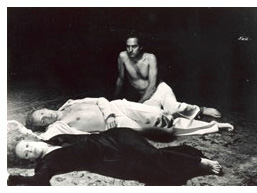 The French got here first, I think. Marguerite Duras made a companion film to her mesmerizing India Song (on right) called Son nom de Venise dans Calcutta desert. Son nom had exactly the same soundtrack as India Song but a wholly different image track–only landscapes around the site of action, empty (as I recall) of all human presence. A comparable instance is the alternate-worlds pairing by Alain Resnais, Smoking/ No Smoking, adapted from a cylce of Alan Ayckbourn plays.
The companion-film concept seems to be expanding. Red Road, directed by Andrea Arnold, is launching a series of films to based in Scotland and all featuring the same group of characters, but filmed by different directors. The characters are conceived by filmmakers Lone Scherfig (Wilbur Wants to Kill Himself) and Anders Thomas Jensen (Brothers). In a way, a sort of episodic-television idea applied to feature films.
What’s behind this? Why are today’s movies using such self-conscious artifice in their plotting? Is form the new content, the way gray is the new black?
Complex storytelling can be found in a lot of other media today. It’s common to point to Hill Street Blues and later TV shows as reinforcing tendencies toward network narratives in film. Jason Mittell discusses the tendency in Velvet Light Trap no. 58. His article “Narrative Complexity in Contemporary American Television” (available here), makes the case that shows like 24, Arrested Development, Buffy, Malcolm in the Middle, and so on have offered viewers ways “to be actively engaged in the story and successfully surprised through the storytelling’s manipulations”–a good way to describe some of the strategies I’ve been sketching.
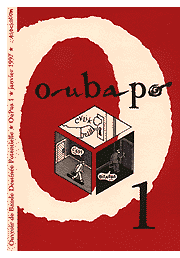 In graphic novels and comic art we’re seeing the same tendencies. Daniel Clowes and Chris Ware manipulate time and space in virtuoso ways, as does the highly formalized movement known as OuBaPo. You can check out an American version of OuBaPo in Matt Madden’s 99 Ways to Tell a Story.
In Everything Bad Is Good for You, Steven Johnson argues that people are just getting smarter, and so popular culture is pitched at a more sophisticated level. But quite complex artifice can be found in mass media of earlier eras. As I mention in The Way, we can find backward-told stories in popular fiction long before Memento, and Grand Hotel is an early prototype of the network narrative. Our ancestors weren’t necessarily dumber than we are, and popular art has long harbored experimental impulses.
I’d hypothesize some other causes. Regardless of IQ, more members of the audience have been to college today than in early eras. More of the creators have studied modern art and literature and are ready to borrow experimental devices they’ve encountered in other media. This process has a familiar ring. American filmmaking has often renewed itself by absorbing all manner of experiment, from German Expressionism (for 1930s horror films) to serial music (for 1950s psychological dramas). Usually, I feel compelled to add, the experimental devices are absorbed into existing forms, like classical script structure, genres, or stylistic principles.
I suspect as well that the new genre hierarchy that emerged in the last couple of decades cranked up the artifice level. The rise of science fiction, mystery, fantasy, horror, and comic-book movies probably encouraged clever juggling with story order, point of view, and states of knowledge. So did the rise of indie cinema, which needs narrative innovation to set itself apart from the mainstream. Again, Pulp Fiction fuses the two strands: an indie neo-noir that attracted attention through its bold manipulation of story/ plot relations.
At the same time, filmmakers in other countries have been eager to push the boundaries. Many of the broken-timeline devices have their sources in art cinema of the 1950s and 1960s. Younger European directors like Boe and Tom Tykwer (Run Lola Run) have revived this adventurous attitude toward storytelling, putting them somewhat in sync with American directors. Asian experimentalists like Wong Kar-wai and Hou Hsiao-hsien continue to exercise a comparable influence.
We need to think more about where this impulse toward innovation comes from and how it shows itself, but it seems likely that the flourishing trade in self-conscious storytelling will be with us for some time yet. Hollywood cinema has long been self-consciously, almost fussily formal, and it has a vast appetite for artifice.
Another little DA VINCI CODE mystery
Kristin here—
First, a little background. In the new edition of Film Art, we have added a new feature. At the end of each chapter we recommend DVD supplements that tie in with the respective subject matter. The task of watching lots of supplements—around 60 films’ worth—devolved upon me. That wasn’t always as fun as it might sound. There were some informative sets of extras, but all too many were mutually congratulatory fests, with directors praising actors, actors praising directors, actors praising other actors, and so on. “X was just perfect for that role. I can’t imagine anyone else playing the part.” You know the kind.
Film Art’s new edition is finished, but I keep looking for supplements we can recommend here or in the ninth edition. One promising-sounding DVD set was the recent “Special Edition” of The Da Vinci Code, with 90 minutes worth of extras.
I know The Da Vinci Code has a so-so reputation based on the reviewers’ responses. I went to it during its first run and was pleasantly surprised. It’s no masterpiece, but the idea that it is dull or slow seems very odd. It was entertaining and reasonably well-made, and I enjoyed it. It’s certainly miles above the overly long Dan Brown novel, which has a tendency to have information revealed in the dialogue and then redundantly summarized in the third-person narration. It also has those thudding cliff-hanger sentences at the end of just about every one of its choppy little chapters. The movie positively races along in comparison. And the washed-out historical flashbacks during the Grail explanations have a loony, experimental feel to them that appeals to me. It’s startling to see such epic scenes tossed in briefly in the midst of a modern thriller. I can see, though, where others might dismiss them as silly.
I don’t know how it happens, but sometimes a film comes along that all the critics simultaneously decide to trash, whether it deserves it or not. Some sort of telepathic thing, maybe, or perhaps in this case they all consulted each other during the famous long press junket on a special chartered train traveling from London to Cannes this past spring. (Ian McKellen has posted an amusing account of answering the same questions over and over during this journey.) The Da Vinci Code was the opening-night film at Cannes, and that’s where the lukewarm critical response began. The reviews were completely ignored by moviegoers, who made The Da Vinci Code the second highest grossing film of 2006 internationally.
Anyway, having enjoyed the film and knowing that its DVD was laden with supplements, I set out to purchase it. Investigation on the internet turned up the surprising news that there was an “extended version” available. That was news to me, and no wonder. When I searched further, I discovered that this longer cut was not available in the U.S. While the familiar 149-minute theatrical version can be had here—complete with a replica cryptex if you buy the deluxe version—the unknown 168-minute version cannot. Not only that, but though I Googled as hard as I could, I could find no explanation as to why there would be an extended version at all and why we Yanks have no access to it.
There’s a Region 2 French edition, as advertised on Amazon’s French site. The Germans seem to have the best selection, with the extended version available on a simple two-disc set, a deluxe edition that throws in a cryptex, and a boxed set of the two DVDs with six CDs containing the audiobook. The long version is also available on Region 4 DVDs in New Zealand and Australia. I have not been able to locate any Region 1 (U.S. standard) DVDs of this version. By the way, all the DVDs, regular, extended, fullscreen, and widescreen seem to have an identical set of supplements.
Perhaps an extended Da Vinci Code is not at the top of everyone’s Christmas list, but the lack of availability or even knowledge of this version in the States is puzzling. Was there something in this longer version that would bore, offend, or otherwise put off American viewers? Which version would one write about in doing some sort of analytical essay on The Da Vinci Code? Aided by eBay and a multi-standard DVD player, I set out to investigate.
The copy I bought, an Australian one, doesn’t have a list of where the extra footage comes. I didn’t sit down with two DVD players and two monitors side-by-side, so I can’t pinpoint every single difference. I had seen the film in a theater in June, and upon watching the extended version, I was able to spot ten additions, ranging from a couple of shots at the beginning of a scene to five new sequences. I don’t think these add up to an extra 26 minutes, so there are presumably some I missed. Those who are interested can have the pleasure of ferreting out all the details of the extra footage for themselves. (It does make one appreciate the Lord of the Rings extended-edition menus, where changes are marked with asterisks.)
One can understand why a longish film would be trimmed by 25 minutes. It’s enough to reduce by one the number of times it could be screened per day, which is clearly a significant obstacle. 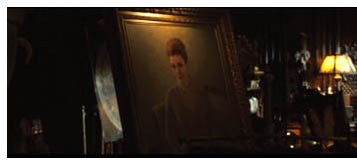 Still, the extra scenes and bits do make a difference, though it’s often minor. In the scene at Teabing’s (Ian McKellen) country house where the group moves from the kitchen to the study to look at the Last Supper slides, the establishing shot of the new setting has an oil painting of a woman framed prominently in the foreground. It presumably was meant to hint at a backstory for Teabing, some great lost love whose absence may have contributed to the man’s obsession with the Grail. The painting is clearly visible in one shot of the shortened version, but since it comes during the invasion of the house by Silas (Paul Bettany), the viewer is not likely to notice it.
Later, in the conversation between Fache (Jean Reno) and his assistant at the airport, Fache asks whom he has betrayed in using his ruthless means to pursue Langdon. In the release print, the assistant simply tells Fache that Teabing’s plane has changed course and is going to London. In the longer version, he goes on to say that he will bribe the airport official that Fache has beaten up. Thus rather than simply doing his duty and giving Fache information, the assistant firmly allies himself with his boss in his illegal doings.
Another brief extra moment comes in the second scene of Silas flagellating himself. The theatrical version cuts away from the action rather abruptly. In the extended version we see a quick series of flashbacks to previous murders that he has committed, presumably all at the behest of Bishop Aringarosa. Not really necessary to the plot, but it does make it clear that Silas realizes that his actions are reprehensible.
These are mere nuances, but the longer added scenes contribute more significant material. Two brief conversations show Aringarosa alone with the head of the Opus Dei council, basically establishing their collusion outside the council meeting itself.
Another new scene takes place aboard Teabing’s plane. It is a conversation in shot/reverse shot, with Sophie (Audrey Tautou) despairing and telling Langdon (Tom Hanks) to go to the U.S. embassy once they reach London, ending his efforts to help her. She suggests that she will simply throw the cryptex away. His insistence that he will stick with her creates one of the most emotionally charged moments between the two. Many critics complained that the Sophie-Langdon relationship lacks chemistry, but this scene’s restoration helps by showing a warm exchange between them. (Not that a lack of chemistry is a problem, given that the two are not supposed to be forming a romantic couple, just a friendship born of necessity.)
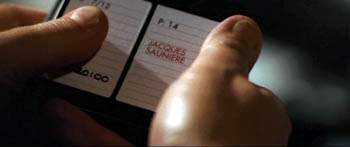
The second added sequence comes after the scene in the Temple Church, with a cut back to Teabing’s château. Fache’s assistant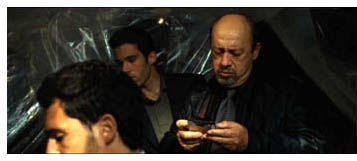 inspects an elaborate surveillance post in the barn, including recordings marked with the names of the four men killed by Silas. This event makes it quite clear why in the climactic scene at Westminster Abbey Fache arrests Teabing rather than Langdon and Sophie. In the shorter version, his change of quarry is rather fuzzily motivated by his realization that Aringarosa has duped him. (Maybe I missed some other plot point, but the surveillance-post scene certainly makes things clearer.)
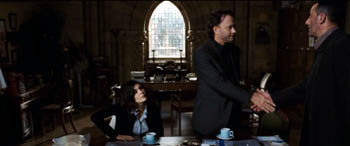
Finally, a new scene follows Fache’s arrest of Teabing. The detective meets with Langdon and Sophie in an office and expresses his regret over having wrongly pursued them: “I should have been smarter.” Although not necessary to the plot, this scene does give more prominence to Fache’s character, making him a more sympathetic figure.
It presumably made sense to cut these sections to allow for more screenings in theaters, but the question remains, why was the extended version not released in the U.S.? Along with all the commentaries and supplements that the studio added on, surely the words “extended edition” would have added some appeal to the DVD set. After all, the longer version was made and released elsewhere, so presumably the added expense wasn’t an issue.
The only reason I can think of is that the added scenes weren’t considered obvious or flashy enough for American audiences. Extended editions on the Lord of the Rings model tend to be done for fantasy and sci-fi films or other genre pictures that might be assumed to have a fan audience eager for any little extras they can get. Maybe that’s not assumed to be the case for other types of films. But then why bother to do such a version for the rest of the world? I’m baffled.
For those living in Region 1 territory who like The Da Vinci Code and who have a multi-standard DVD player, you might want to take the extra trouble to track down the extended version. There always seem to be a few on eBay (though watch out for the bootleg copies someone in Asia is selling there!), and they can be had through the big internet sellers in Europe and Australia.