





Archive for the 'Narrative strategies' Category
Unsteadicam chronicles
DB again:
A spectre is haunting contemporary cinema: the shaky shot.
Viewers have been protesting for some years now. I recall friends asking me why the images were so bumpy in Woody Allen’s Husbands and Wives and Lars von Trier’s Dancer in the Dark. The Bourne Ultimatum, this summer’s wildest excursion into Unsteadicam, has put the matter back on the agenda.
If you drop in at Roger Ebert’s website, you’ll find many annoyed comments from readers about what one calls the Queasicam. The writers make shrewd points about the purpose and effects of director Paul Greengrass’s technique. I’ll try to add some historical perspective and a little analysis.
From whose Bourne no traveling shot returneth
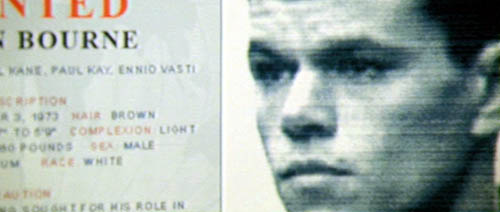
First, what exactly are we talking about? Some viewers and critics think the jarring quality of the movie proceeds from rapid editing. The cutting in Bourne Ultimatum is indeed very fast; there are about 3200 shots in 105 minutes, yielding an average of about 2 seconds per shot. But there are other fast-cut films that don’t yield the same dizzy effects, such as Sky Captain and the World of Tomorrow (1.6 seconds average), Batman Begins (1.9 seconds), Idiocracy (1.9 seconds), and the Transporter movies (less than 2 seconds).
As for the series itself, The Bourne Identity, directed by Doug Liman, was edited a tad slower, averaging 3 seconds per shot. The second entry, The Bourne Supremacy, also signed by Greengrass, was as fast-cut as this, coming in at 1.9 seconds. People noticed the rough texture of the second one, but it didn’t arouse the protests that this last installment does. Something else is up.
Partly, it’s not the pace of the editing but the spasmodic quality of it. Cuts here seem abrasive because they interrupt actions and camera movements. Pans, zooms, and movements of the actors are seldom allowed to come to rest before the shot changes. This creates a strong sense of jerkiness and visual imbalance.
Still, a lot of the film’s effect has to be laid at the handheld camera. The technique in itself, however, shouldn’t shock us. The handheld aesthetic has been with us a long time. There were silent-era experiments with the technique by E. A. Dupont (Variety, 1925) and Abel Gance (Napoleon, 1927). It recurred sporadically after that, but in mainstream cinema handheld shooting became common in 1960s films as different as The Miracle Worker, Seven Days in May, Dr. Strangelove, and the dramas of John Cassavetes. Today, many films from Asia and Europe as well as the US rely on the device all the way through. The Danes call it the “free camera,” and I write about it here. The trend is so widespread that it’s been satirized: In the Danish comedy Clash of Egos (2006), when an ordinary workman gets a chance to direct a movie, he insists that the camera be put on a tripod, and the cinematographer complains that he hasn’t done this since film school. Directors nowadays tell us that they are in search of energy, a moment-by-moment spiking of audience interest. You can get it through fast cutting, arcing camera movements, sudden frame entrances, the nervousness of the handheld shot, or all of the above.
Roughhouse
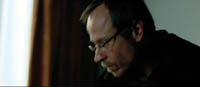
I think the upsetting qualities of the visuals in The Bourne Ultimatum derive principally from the particular way the handheld camera is used. Several of Ebert’s writers complain that the camerawork made them nauseated, and there seems little doubt that the shots are bouncier and jerkier than in much handheld work. Adding to the effect is the fact that Greengrass often doesn’t try to center or contain the main action. Sometimes, as in a fight scene, the camera is just too close to the action to show everything, so it tries to grab what it can. At other times Greengrass pans away from the subject, or shoves it to the edge of the 2.40:1 frame. In the standard technique of over-the-shoulder reverse angles, we see one character’s shoulders in the foreground and the primary character’s face clearly. Greengrass likes to let a neck or shoulder overwhelm the composition as a dark mass, so that only a bit of the face, perhaps even just a single eye, is tucked into a corner of the shot. This visual idea was already on offer in The Bourne Supremacy.


In The Way Hollywood Tells It, I described contemporary films as employing “intensified continuity,” an amplification and exaggeration of tradition methods of staging, shooting, and cutting. (I explain a little about it in this blog entry.) What Greengrass has done is to roughen up intensified continuity, making its conventions a little less easy to take in. Normally, for instance, rack-focus smoothly guides our attention from one plane to another. But in The Bourne Ultimatum, when Jason bursts into a corridor close to the camera, the camera tries but fails to rack focus on his pursuer darting off in the distance. The man never comes into sharp focus. Likewise, most directors fill their scenes with close-ups, and so does Greengrass, but he lets the main figure bounce around the frame or go blurry or slip briefly out of view.
Essentially, intensified continuity is about using brief shots to maintain the audience’s interest but also making each shot yield a single point, a bit of information. Got it? On to the next shot. Greengrass’s camera technique makes the shot’s point a little harder to get at first sight. Instead of a glance, he gives us a glimpse.
Although this strategy is more aggressive in this third Bourne installment, we can find it as well in Supremacy. An agent pulls a document out of a carryon bag, and for an instant we can see the government seal. In the next shot the agent bobs in and out of the frame, as if the camera can’t anticipate his next move.


Later in Supremacy, the camera jerks across a computer display and suddenly focuses itself, evoking the jumpy saccadic flicks with which we scan our world.


Greengrass claims that his creative choices were influenced by the cinema-vérité documentary school and cites as well The Battle of Algiers, which helped popularize the handheld look in the 1960s. At other times he says that the style is subjective: “Your p.o.v. is limited to the eye of the character, instead of the camera being a godlike instrument choreographed to be in the right place at the right time.” But our point of view isn’t confined to what Bourne or anybody else sees and knows. The whole movie relies on crosscutting to create an omniscient awareness of various CIA maneuvers to trap him. And if Bourne saw his enemies in the flashes we get, he couldn’t wreck them so thoroughly.
The Bourne Ultimatum belongs to a trend of rough-edged stylization sometimes called run-and-gun. The film has been described as bare-bones but it’s actually quite flashy. All the crashing zooms (accompanied by whams on the soundtrack), jittery shots, drifting framings, uncompleted pans, freeze-frame flashbacks, and other extroverted devices call attention to themselves. You can find earlier instances in Oliver Stone’s Natural Born Killers and U-Turn, along with stretches in Michael Mann’s latest films. In milder form you find the style on display in TV crime shows, as well as in the notorious docudrama The Road to 9/11.
The most extreme practitioner of this style is probably Tony Scott. From Spy Game through Man on Fire, Domino, and Déjà vu, he has taken this aesthetic in delirious directions. His framing is often restless, as if groping for the right composition. In this shot from Domino, the camera starts a bit too far to the right, shifts left to frame Frances a little better, zooms back hesitantly, then finally stabilizes itself as he grins at the Motor Vehicles worker.

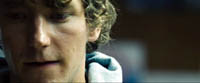


A single shot may give us not only changes of focus but jumps in exposure, lighting, and color; sometimes it’s hard to say whether we have one shot or several. The result is a series of visual jolts, as in Man on Fire.




Scott, trained as a painter, pushes toward a mannered, decorative abstraction, aided by long-lens compositions and a burning, high-contrast palette. For Supremacy, Greengrass adopted a toned-down version of Scott’s approach, while in Ultimatum, he favors drab surroundings and steely colors. Still, both men’s approaches to run-and-gun are frankly artificial, and both remain within the premises of intensified continuity. Of the Waterloo Station sequence Greengrass says: “It has got a sense of energy.”
The Bourne coverup

There’s one more function of Bourne’s style I want to consider. In an earlier post, I quoted Hong Kong cinematographers’ saying about the shaky camera. The handheld camera covers three mistakes: Bad acting, bad set design, and bad directing. It’s worth considering, as some of Ebert’s correspondents do, what Greengrass’s style may serve to camouflage. One suggests that because the cutting doesn’t let the viewer reconstruct the fights blow by blow, anybody can seem to be a superhero if the filming is flurried enough.
Just as important, the director who is just (apparently) snatching shots doesn’t have to worry about building up performances slowly; s/he can simply give us the most minimal, stereotyped signals in facial close-ups. Lengthier shots let the actor develop the character’s reactions in detail, and force us to follow them. Classic studio cinema, with its more distant framings and longer takes, lets you follow the evolution of a feeling or idea through the actor’s blocking and behavior. The villain in the average Charlie Chan movie displays more psychological continuity than the nasty agents in Bourne Ultimatum.
Moreover, run-and-gun technique doesn’t demand that you develop an ongoing sense of the figures within a spatial whole. The bodies, fragmented and smeared across the frame, don’t dwell within these locales. They exist in an architectural vacuum. In United 93, the technique could work because we’re all minimally familiar with the geography of a passenger jet. But in The Bourne Ultimatum, could anybody reconstruct any of these stations, streets, or apartment blocks on the strength of what we see? Of course, some will say, that’s the point. Jason himself is dizzyingly preoccupied by the immediacy of the action, and so are we. Yet Jason must know the layout in detail, if he’s able to pursue others and escape so efficiently. Moreover, we can justify any fuzziness in any piece of storytelling as reflecting a confused protagonist. This rationale puts us close to Poe’s suggestion that we shouldn’t confuse obscurity of expression with the expression of obscurity.
The run-and-gun style is indeed visceral, but let’s be aware of how it achieves its impact. I’ve argued in Planet Hong Kong that the clean, hard-edged technique of classic Hong Kong films allows extravagant action to affect us viscerally; by following the action effortlessly, we can feel its bodily impact. We’re shown bodies in sleek, efficient movement that gets amplified by cogent framing and smooth matches on action. But in the fancy run-and-gun style, cinematography and sound do most of the work. Instead of arousing us through kinetic figures, the film makes bouncy and blurry movement do the job. Rather than exciting us by what we see, Greengrass tries to arouse us by how he shows it. The resulting visual texture is so of a piece, so persistently hammering, that to give it flow and high points, Greengrass must rely on sound effects and music. As a friend points out, we understand that Bourne is wielding a razor at one point chiefly because we hear its whoosh.
What else does the handheld style conceal? Since the 1980s, in many action pictures the cutting has become so fast, and often capricious, that we can’t clearly see the physical action that’s being executed. That complaint is justified in Bourne Ultimatum, certainly, but here the style also seeks to make the stunts seem less preposterous. Instead of showing cars crashing and flipping balletically, Greengrass barely lets us see the crash. All the conventions of the action film are smudged in Bourne Identity, as if a sketchy rendering made them seem less outlandish. In a Hong Kong film, Bourne in striding flight, grabbing objects to use as weapons without missing a beat, would be presented crisply, showing him executing feats of resourceful grace. But many viewers seem to find this sort of choreography outlandish or cartoony. So when Bourne plucks up pieces of laundry and wraps them around his hands to protect them when he vaults a glass-strewn wall, Greengrass’s shot-snatching conceals the flamboyance of the stunt.
Finally, I’d argue that the style camouflages something else: plot problems. I’m not talking about the hero’s indestructibility, which is a given in this genre. John McClane in Die Hard 4.0 survives about as much mayhem as does Jason Bourne. But there are some howlers here that, because of the rapid pace and the just-barely-visible action, are somewhat muffled. By whisking the action past us and forcing us to keep up, the film doesn’t allow us to dwell on its holes and thin patches.
The plot, praised by so many, is actually a very simple one: Find Guy A, but when he’s killed, locate the clues that will lead you to Guy B, etc. until you get to Mr. Big. The mechanics of how the clues are pursued remain obscure. (Skip ahead to the next paragraph if you haven’t seen the movie.) Why would an all-powerful CIA operation house its key players in offices that can easily be watched from a neighboring building? How does Bourne get into Noah Vosen’s office, past all the security? Is the revelation of Bourne’s identity and his training regimen really much of a surprise? The wrapup, showing the bad guys exposed by the press and punished by government investigation, seemed risible, not only because of the current inability of either press or congress to right any wrongs, but because I had no idea to whom Pamela Landy has faxed the incriminating documents. “You can’t make stuff like this up,” remarks one sinister agency boss, but many, many films have done so.
I’m not against handheld styles as such, and even Late Tony Scott Rococo can have its virtues. Yet I find the style as practiced by Greengrass to be pretty incoherent and nowhere near as engaging as most critics claim. It just seems too easy. But then, I think that certain standards of filmmaking craftsmanship have pretty much vanished, and the run-and-gun trend is one more symptom of that. Given the praise heaped on The Bourne Ultimatum, however, things are unlikely to change. Next time you head to the movies, you might want to bring your Dramamine.
Thanks to Vance Kepley and Jeff Smith for engaging discussion about The Bourne Ultimatum.
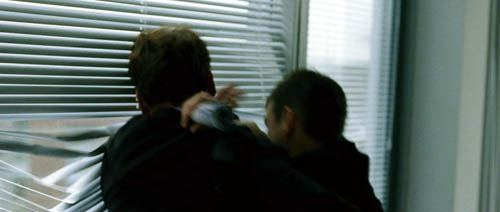
The Bourne Supremacy.
PS: I’ve done a followup entry on the Bourne series, elaborating on these points and adding some new ones.
PPS: One more, I hope final, cluster of comments on Ultimatum, this time on the plotting.
PPPS 5 January 2008: Spielberg weighs in on the Bourne style; thanks to Fred Holliday and Brad Schauer for calling my attention to this.
PPPPS 22 September 2008: This blog post and its mates have stimulated critical discussion in Spain. Manuel Garin has a lengthy piece on the Unsteadicam style in Contrapicado.
The latest updates
KT here:
On May 29 we posted an entry responding to the inevitable badmouthing of sequels that journalistic movie critics tend to indulge in when the summer season starts. “Live with it! There’ll always be movie sequels. Good thing, too.” gathered comments from current and present “filmies” of the University of Wisconsin-Madison. They defended sequels for a wide variety of reasons.
Now another ex-Madisonian, Henry Jenkins, has weighed in with “The Pleasures of Pirates and What It Tells Us about World Building in Branded Entertainment.” Despite its somewhat formidable title, this essay jumps into the fray, taking critics to task for their knee-jerk tendency to lump virtually all sequels together into a category fraught with prior expectations and to dismiss the latest entries as mindless, inept films.
Henry takes Pirates of the Caribbean: At World’s End as his point of defense. Somehow critics seem by telepathy to agree to take the same stance on a particular blockbuster. Here they claimed that AWE is far too complicated and gets bogged down in exposition at the expense of action. (So much for claims that blockbusters are all CGI pyrotechnics and no plot!) They also kvetched that there is too little of Jack Sparrow’s character, apparently their main focus of interest in the film.
Henry takes AWE to be, alongside The Matrix, an example of elaborate world-building, a trait of the best of the big film series. In the age of DVDs and cross-media franchises, such films, he argues, are meant to be watched more than once. They also place a lot of faith in the viewer to be able to follow a complicated plot. Henry, like Steve Johnson in his Everything Bad Is Good for You, credits modern media as challenging viewers/readers with dense works that require a lot of figuring out.
Critics assume the opposite, that summer movies are supposed to be mindless entertainment, and they treat them as such. Complexity, which they would hail in an art-house release, becomes a fundamental flaw. Henry has some cogent remarks on the circumstances of reviewers’ screenings and how they handicap the writers’ approach to pop summer movies.
Whether or not one admires AWE, Henry mounts a strong defense of the film and in the process shows how much most reviewers are out of touch with audiences’ tastes and miss the various ways in which summer blockbusters work.
In other news, David’s The Way Hollywood Tells It has just been slated for translation into simplified-form Chinese. He’s now preparing a blog entry paying tribute to the great art theorist Rudolf Arnheim, who died on Monday at the age of 104. The family’s obituary is here.
The Cinema Ritrovato, which we’ll be attending in July, has posted a provisional schedule here. David will go on from Bologna to Brussels for research and the annual Cinedecouvertes and L’age d’or festival; films and other info available here.
Can you spot all the auteurs in this picture?
DB here:
Some movies consist of several distinct episodes, each directed by a different filmmaker and all focused on a single theme. I’ve heard them called anthology films, omnibus films, and portmanteau films.
The earliest one I know is If I Had a Million (1932); later, Hollywood offered us Ziegfeld Follies (1946) and O. Henry’s Full House (1952). The Brits gave us the horror anthology Dead of Night (1945). Still, I think we associate the form chiefly with European cinema of the 1950s and 1960s. We got Love in the City (1953), Amori di mezzo secolo (1954), The Seven Deadly Sins (1962), RoGoPaG (1963), Les plus belles escroqueries du monde (1964), Paris vu par . . . (1965), Three Faces of Woman (1965), The World’s Oldest Trade (1967), and Amore e rabbia (1969).
Why the emergence of omnibus movies at this point in history? Some causes are surely financial. Most high-budget European films of the period had to be cross-national coproductions. Bringing in directors from several different countries could help guarantee funding under EU auspices and participating nations’ subsidy schemes. Just as important, the anthology format appeared when the festival scene was starting to become a vast clearing house for international film trade.
Although you can argue that many people seeing If I Had a Million would recognize the Lubitsch episode, Hollywood’s use of the form didn’t stress directorial differences. But as the Euro auteur was becoming a marketable commodity in the postwar era, a collection of short films could sell if they were signed by big-name filmmakers. “Paris As Seen by…” signals the importance of the different directorial approaches, and the very title of RoGoPaG invokes Rossellini, Godard, and Pasolini as brand-name labels. (Granted, the final G, Hugo Gregoretti, didn’t add much to the deal.)
For full enjoyment, the 1960s portmanteau film requires a degree of specialized film knowledge. At one level, we enjoy varied treatments of a theme, but at another we’re supposed to recognize each director’s personal vision, as we know it from other films. Even political-commentary portmanteau films like Far from Vietnam (1967), Lucía (1968), and Germany in Autumn (1978) gathered international attention because of the name recognition of the filmmakers who participated. The same branding operates in New York Stories (1989) and, more openly, in the documentary 12 registri per 12 città (“12 Directors for 12 Cities,” 1989).
The format has returned recently. We’ve had 11’09”01—Sept. 11 (2002), Eros (2004), Tickets (2005), and Paris, je t’aime (2006), the last virtually a rebooting of Paris vu par . . . . As we’d expect, such films continue to highlight the personal signatures of festival familiars. But we can spot some new twists too.
For one thing, the unifying idea may be formal as well as thematic. The episodes of 11’09”01 were all obliged to be the same length, eleven minutes, nine seconds, and one frame. Lumière et cie (1995) not only celebrated the centenary of film but obliged the directors to make their entries with a Lumière camera, to shoot without sync sound, to shoot no more than three takes, and to restrict the length to 52 seconds, the approximate running time of the earliest films. The Lumière homage also introduces the key themes of cinema and cinephilia, an angle that doesn’t seem prominent in the 1960s omnibus movies.
 The most prominent portmanteau film so far this year fits snugly into current trends. As Anthony Kaufman writes, “Chacun son cinéma. . . showcases a range of filmmaking aesthetics, and for the most part, the program is a dazzling and memorable array of current auteur cinema.” As in other eras, we get a stylistic buffet; as in recent years, we find formal constraints and the theme of cinephilia. Commissioned for Cannes’ sixtieth anniversary by festival head Giles Jacob, the project restricts filmmakers to three minutes per episode and dictates the subject: “their state of mind of the moment as inspired by the motion picture theater.” The result was 33 short films about the joys and sorrows of film viewing and, to some degree, an extended commercial promoting the cultural value of the Cannes event.
A half-dozen things strike me while watching the French DVD version (which has English subtitles but is unaccountably lacking the Coens’ entry). Most notable, I suppose, is the way that many of the shorts replay tendencies that are characteristic of art cinema generally (1).
1. Cinema invokes eroticism . . . We get a dreamy Wong Kar-wai scene of a man watching, or recalling, heavy petting in the theatre. Polanski’s episode plays amusingly on the similarity of orgasmic moans and painful groans. Gus van Sant’s First Kiss reinvents Sherlock Jr., while the Dardenne brothers give us a tight tale of hands in the dark. Olivier Assayas’ episode, a crisp piece of filmmaking, reveals its l’amour fou at the very end. Angelopoulos makes clever use of the Kuleshov effect to create a touching exchange between Jeanne Moreau and the lamented Mastroianni.
2. . . . and childhood, especially for the Chinese directors, who haven’t exactly risen to the occasion here. The international art film has long traded on the appeal of kids, but the treatment of them in these episodes is remarkably banal. Tsai Ming-liang, who already passed his benediction for classic cinema in Goodbye, Dragon Inn, gives us a dream of a family reunited at the pictures. Chen Kaige shows children watching—hold on now—a silent Chaplin film. Hou Hsiao-hsien provides a sepia-toned flashback to going to the movies in Taiwan, while Zhang Yimou takes us to movie night in a Mainland village. At least the Hou episode opens on a lengthy shot that nicely decenters areas of interest in a busy street scene.
3. The cinema is on the decline . . . . One way to interpret Kitano Takeshi’s cryptic sequence is that films, even his own Kids’ Return, are little more than an anachronism today. More explicitly, David Cronenberg’s single-take close-up, captured by a surveillance camera shows himself as the world’s last surviving Jew, on the threshold of suicide in a movie house.
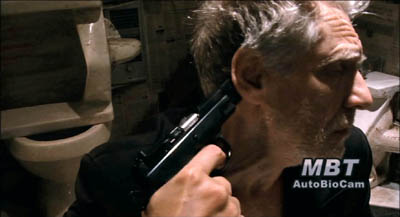
4. . . . yet it holds us in a magical spell. Some directors celebrate the simple folk at the movies. Claude Lelouch’s parents watch Top Hat and fall in love. Raymond Depardon takes us to a rooftop cinema in Alexandria, and Wenders shows a Congolese village running Black Hawk Down on video (more kids, but this time to disturb us). Kaurismaki seems to be poking fun at this arthouse commonplace by showing foundry workers blankly watching a rather different image of workers at the end of the day. The cinema, Ruiz and González Iñárritu suggest, mesmerizes even blind people.
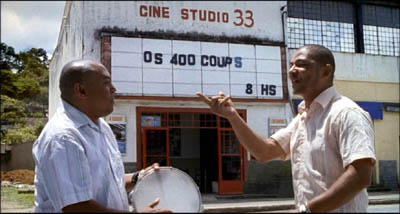
Walter Salles provides a charming, deflating musical dialogue (below) that might be called Far from Cannes, showing that this festival casts a quasi-religious spell felt across the world. In my favorite section, Kiarostami gives us shots of women responding to Zeffirelli’s Romeo and Juliet. The image/sound pairing hints at their own thwarted loves, while certain lines, such as “Where be these enemies?,” seem addressed to Westerners who try to dehumanize the people of Iran.
5. Film can be silly. Von Trier, decked out in a tux, silences a businessman through extreme means, and the rest of the audience hardly notices. Jane Campion, in an awkward episode, reveals a bug living in a theatre speaker. Probably the funniest contribution shows a mute Elia Suleiman preparing for a Q & A session after a screening. There are more gags in this three minutes than in all the other episodes put together.
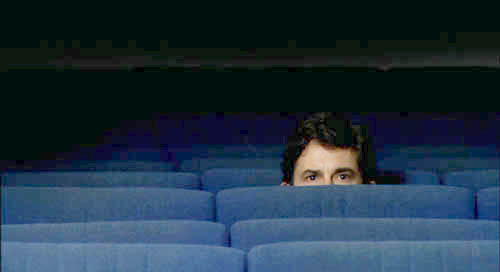
5. Lest we forget . . . This couldn’t help but be a nostalgia exercise, encouraging filmmakers to muse on their lives in cinema. This theme recalls Cinema Paradiso, Scola’s Splendor, and all the other films soaked in the melancholy sweetness of movie memories. Moretti (top image above), gives us an anecdotal monologue, while Youssef Chahine unashamedly thanks Cannes for giving him an award ten years ago. The most formally ingenious entry here is Atom Egoyan’s tale of a couple sitting in different screenings while texting each other. Eventually one grabs an image from La Passion de Jeanne d’Arc and passes it along, creating a parallel to what’s happening in the other film (Egoyan’s The Adjuster).
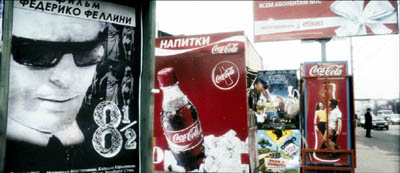
In particular, there’s nostalgia for the golden age of auteurs, the very period when the anthology film gained its purchase. Chacun son cinéma is dedicated to Fellini, and Konchalovsky’s episode centers on 8 ½. Bresson and Godard are the most frequently referenced directors. (More generally, in our new century Bresson seems to have become the prototype of the serious filmmaker.) Other icons of the 1960s, such as Mastroianni and Anna Karina, keep popping up.
6. Spot the auteur. Most episodes don’t reveal the director’s name until the end, so the cinephilia takes on a suspenseful dimension, forcing you to guess who filmed the bit you’re watching. You also have to identify movies within the movies on the basis of clips and soundtracks. It’s a great game for arthouse aficionados, but it also highlights festival cinema’s reliance on the cult of the director and the organic unity of his/her body of work.
Suppose that all these films omitted the director’s name and replaced the recognizable players with nobodies. Would any of these episodes have been accepted for Cannes’ short film programs? Probably not, but we shouldn’t be cynical about this. Clearly artworks can gain in interest by virtue of their place in history or an artist’s career. Renoir’s Sur un air de Charleston (1927), Bresson’s Les affaires publiques (1934), Dreyer’s They Caught the Ferry (1948), and Fassinder’s episode in Germany in Autumn are not masterpieces, but these shorts show fresh sides of great filmmakers, and our understanding of their accomplishment is enriched by having them.
So we’re right to recognize the director’s career as a meaningful whole. But we should also recognize that today such careers continue thanks to a distinct system of marketing. At the Cannes site, Rauol Ruiz says: “It’s a delight to be a preferred filmmaker and especially a favored filmmaker of Gilles Jacob.” The system depends on reciprocity. “Without the auteurs,” says Jacob, “there wouldn’t be a festival.” (2) In turn, auteurs are obligated to festival gatekeepers and tastemakers, the powerful critics, programmers, and impresarios. The filmmaker knows the drill. You showed my film last year, so yes, I’ll sit on a jury or offer a master class or show up on the red carpet this year.
We’re told by Anne Thompson that a more complete DVD edition, including the David Lynch entry, will be available before Christmas. That gesture makes the disc I bought the equivalent of the plain-vanilla DVD of a blockbuster that will be followed at the right moment by the Deluxe Edition. Who says the art cinema operates above pressures of business and the market?
(1) I discuss the idea of art cinema in a 1979 article, “The Art Cinema as a Mode of Film Practice,” revised in the forthcoming Poetics of Cinema.
(2) Nancy Tartaglione-Vialatte, “‘Without the auteurs there wouldn’t be a festival,'” Screen International (May 18-31, 2007), p. 15. See also the accompanying article by Nick Roddick, “The bucks start here,” pp. 14-15. These are available online to subscribers.
PS: Speaking of Cannes and the art cinema, I wrote an essay about camerawork in contemporary Danish film for the festival issue of the Danish Film Institute magazine. It’s now online here (pp 22-26). And speaking of Danish filmmakers. . . .
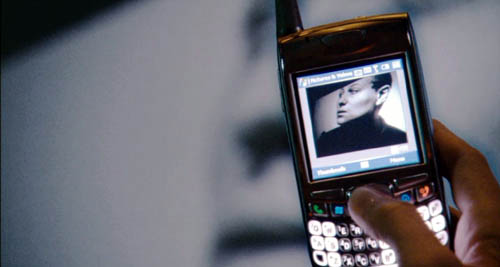
Atom Egoyan, Artaud Double Bill.
Live with it! There’ll always be movie sequels. Good thing, too.
DB:
You’ve heard it before. Facing a summer packed with sequels, a journalist gets fed up. This time it’s Patrick Goldstein in the Los Angeles Times, and his lament strikes familiar chords. Sequels prove that Hollywood lacks imagination and is interested only in profits. Sequel films are boring and repetitious. They rarely match the original in quality. And when good directors sign on to do sequels, they get a big payday but they also compromise their talents.
Me, I want more original and plausible ideas. So, I expect, do you. Time to call in the Badger squad, the ensemble of email pals drawn from various generations of UW-Madison grad students and faculty. I asked them if we can’t understand sequels in a more thoughtful and sophisticated way—historically, artistically, in relation to other media. The result is another virtual roundtable, like the one on B-films held here a few months ago.
There were enough ideas for several blogs, and I’ve regretfully had to drop a whole thread devoted to comics and videogames. Maybe I’ll compile those remarks into a sequel. For now, the participants are: Stew Fyfe; Doug Gomery; Jason Mittell (of JustTV); Michael Newman (of Zigzigger and Fraktastic); Paul Ramaeker; and Jim Udden. I throw in some ideas as well.
Are all sequels in the arts automatically second-rate?
DB: The Odyssey is a sequel to the Iliad, and the second, better part of Don Quixote is a sequel to the first. Tolkien’s Lord of the Rings trilogy is explicitly a followup to The Hobbit. After killing off Sherlock Holmes in “The Adventure of the Final Problem,” Conan Doyle resurrected him for more exploits. The Merry Wives of Windsor brings back Sir John Falstaff after his death in Henry IV Part II, because, supposedly, Queen Elizabeth wanted to see him again, this time in a romance plot.
Michael Newman: Sequels exist in all narrative forms–novels, plays, movies, television, videogames, comics, operas. What is the Bible but a series of sequels? Didn’t Shakespeare follow up Henry IV with a part II? What of Wagner’s Ring Cycle and Updike’s Rabbit novels? Many novelists of high reputation have written sequels, including Thackeray, Trollope, Faulkner, and Roth. There is nothing intrinsically unimaginative about continuing a story from one text to another. Because narratives draw their basic materials from life, they can always go on, just as the world goes on. Endings are always, to an extent, arbitrary. Sequels exploit the affordance of narrative to continue.
What about film sequels? What’s their track record?
DB: Goldstein grants the excellence of Godfather II, but what about Aliens, The Empire Strikes Back, Toy Story 2, and Indiana Jones and the Last Crusade (arguably the best entry in the franchise)? We have arthouse examples too, provided by Satyajit Ray (Aparajito and The World of Apu), Bergman (Saraband as a sequel to Scenes from a Marriage), and Truffaut (the Antoine Doinel films). If we allow avant-garde sequels, we have James Benning‘s One-Way Boogie Woogie/ 27 Years Later. As for documentaries, what about Michael Moore’s Pets or Meat?, the pendant to Roger and Me?
The world of film would be a poorer place if critics had by fiat banned all the fine Hong Kong sequels, notably those spawned by Police Story, A Better Tomorrow, Drunken Master, Once Upon a Time in China, Swordsman, and so on up to Johnnie To’s Election 2 and Andrew Lau’s Infernal Affairs 2. And arthouse fave Wong Kar-wai hasn’t been shy about making sequels.
Stew Fyfe: Other sequels of quality: The Bride of Frankenstein, Mad Max II (The Road Warrior), Spider-Man 2, X-Men 2, Dawn of the Dead, Sanjuro, Quatermass and the Pit. Personally, I’d also add Blade 2, Babe 2 and The Devil’s Rejects, but I’m sure those are arguable. Would The Limey be a sequel to Poor Cow? Del Toro speaks of Pan’s Labyrinth as a companion piece or “sister-film” to The Devil’s Backbone. If you want to include docs, there’s always the Up series.
Why are there film sequels in the first place?
DB: Most film industries need to both standardize and differentiate their products. Audiences expect a new take on some familiar forms and materials. Sequels offer the possibility of recognizable repetition with controlled, sometimes intriguing, variation. This logic can be found in sequels in other media, which often respond to popular demand for the same again, but different. Remember Conan Doyle reluctantly bringing back Holmes, and Queen Elizabeth asking to see Sir John in love.
Doug Gomery: Sequels happen because the studio owners have never figured out any business model to predict success. If #1 is popular, perhaps #2 will be almost as popular. Until recently, producers seldom expected the followup’s revenues to equal the first. The basics were keep costs low, keep risks low, and make a profit. Maybe not a large as the breakthrough initial film—but at least a profit.
But they’re not a contemporary development. As part of the Hollywood studio system, they have existed in all eras—the Coming of Sound, the Classical Era, and the Lew Wasserman era. They surely seem to be surviving Wasserman as well. Indeed, as much as I admire Wasserman, who can defend Jaws 2 and its successors?
In the classic era, it may seem that there were fewer sequels as such, but there was a variant called rewrites in another genre. Years ago as I did my first book, a study of High Sierra, I watched Colorado Territory with something close to awe. It’s a gangster film turned western almost line by line. After all, Warners owned the literary rights: why not recycle it?
Given the mercenary impulse behind sequels, does a director’s willingness to make one mean that he or she has sold out?
Goldstein: “Look at the great talent who’s on the sequel beat: Steven Soderbergh has done two Ocean’s sequels. Bryan Singer, the wunderkind behind The Usual Suspects, has done X-Men 2 and is at work on a sequel to Superman Returns. Christopher Nolan has left behind the raw originality of Memento to do Batman movies. Robert Rodriguez, who burst on the scene with El Mariachi, has done two sequels for Spy Kids, with a Sin City sequel on its way. After making Darkman and A Simple Plan, Sam Raimi seemed poised to be our generation’s dark prince of meaty thrillers but has turned himself into an impersonal Spider-Man ringmaster instead.”
Paul Ramaeker: To assume that the Spider-Man films must necessarily be less personal than Darkman or A Simple Plan (both of which are heavily indebted to the strictures of their genres) is to perpetuate a culturally snobbish perspective on comic books. I’ve not seen S-M3, but Raimi is a genuine fan of the character, a character with a long and complex narrative history, and given the way S-M2 continues and develops threads from the first film, I see no reason to assume he didn’t have some artistic investment in presenting his interpretation of the character over 3 films (or however many) to present a larger “story” about the character. Why should this not be seen as “personal” filmmaking to the same extent as any other kind of adaptation?
Moreover, speaking as a Soderbergh fan: I may not like Ocean’s 12 as much as Ocean’s 11, but it seems like an experiment made in good faith to me. It is a stranger movie than you would think from the way it gets picked up in articles like Goldstein’s. In fact, the way it plays with audience expectations is both dependent upon familiarity with the first film, and radically divergent from it- in many ways, it does the exact opposite of what sequels are supposed to do, which is to provide a “cozy” (Goldstein’s word) repetition of familiar pleasures. Perhaps it failed (again, I remain sort of fond of the film, which I think was best described as being like an issue of Us Weekly as put together by the editors of Cahiers du cinéma), but even so I think you’d have to call it a failed experiment rather than a rehashing.
Stew Fyfe: At a guess, I’d say that audiences or critics might evaluate the worthiness/mercenary nature of sequels by asking three questions:
(1) Has the sequel been made because there’s more story to tell?
(2) Has the sequel been made because the characters are great and people want to see them again?
(3) Has the sequel been made because there’s more money to be made?
Obviously, any combination of all three can be answered in the affirmative for any sequel and presumably the sequel wouldn’t get made if the answer to (3) was No. But with something like The Two Towers, (1) gets priority, while with Pirates 2 + 3, (3) nudges out (2). Even with (3), money, as the primary motivation, one could still make a good film. The suspicion of milking the franchise just makes the movie an easier target for critics.
Do sequels automatically equal predictability?
Jason Mittell: The line that most interests me in Goldstein’s piece is the last: “When it comes to entertainment, I’ll take excitement and unpredictability over familiarity every time.” This sets up a false dichotomy between the known and the unknown. As David and I both blogged about a few months ago, knowing a story doesn’t preclude suspense and excitement (and for some viewers, it might actually enhance it). And arguably knowing a storyworld actually allows for greater opportunities for excitement and unpredictability – a film/episode/entry in any series that doesn’t need to spend much time introducing already-established settings, characters, conflicts, etc. can literally cut to the chase. Think of the second Bourne film as a good example, or Spider-man 2 as a chance to deepen character once basic exposition is accounted for.
Paul Ramaeker: I have a theory. In the contemporary comic-book blockbuster, the sequels will always be better than the first entries. Spider-Man 2 is better than Spider-Man, X-Men 2 is better than X-Men, and I will bet that The Dark Knight will be better than Batman Begins, just as Batman Returns was better than Batman. The pattern seems to me to be that the first film in the series is relatively impersonal—the franchise must be established as a franchise, meaning that few boats will be rocked, and the director must prove that they can handle both a film on that scale, and can be trusted with the property with all the investment it represents.
But once they’ve done so, in the above cases where the first films enjoyed significant economic (and critical) success, the directors are given a bit more leeway, are allowed to drive the family car a little further and a little faster. In each case, the second film in the series by the same director has been significantly more idiosyncratic. Batman Returns has much more of Burton‘s sense of humor and interest in the grotesque; X-Men 2 is a much more serious and ambitious film narratively and thematically, more obviously the product of a prestige filmmaker (Singer’s never been an auteur by any stretch, so that will have to do). Spider-Man seemed sort of anonymous in terms of style, but Spider-Man 2 had a much more extensive and playful use of classic Raimi techniques: short, fast zooms; canted angles; rapid camera movements; whimsical motivations for techniques, like the mechanical-tentacle POV shot (virtually a repeat of his flying-eyeball POV from Evil Dead 2).
Who knows what The Dark Knight will be like, but I’m prepared to put money on the claim that it will have something to do with how people construct elaborate narratives around themselves to explain, justify, or obscure their actions and motives.
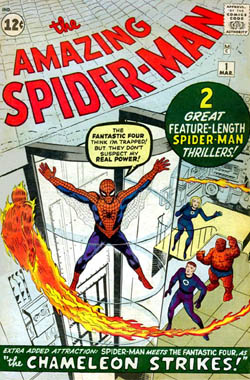
Are sequels part of a larger trend toward serial narrative?
DB: We can continue a story in another text within the same medium, but we can also spread the storyline across many platforms—novels, films, comic books, videogames. Henry Jenkins has called this process transmedia storytelling.
Michael Newman: Compared with literary fiction, there seems to be a strong propensity toward the never-ending story in genre storytelling like sci-fi and fantasy and superhero comics and spy novels and soap operas. Much of the cinematic sequel storytelling today might be considered as this kind of serialized genre storytelling. Such serials tend to have a low aesthetic reputation in comparison to more respectable genres. (The cinematic comparison would be summer blockbusters vs. fall Oscar bait.) Serial forms have historically been associated with children (e.g., comic books) and women (e.g., soaps). In other words, there is cultural distinction, a system of social hierarchy, at play.
Stew Fyfe: Yes, the longer-standing comics universes have made regular use of serial continuity to forge after-the-fact connections. It’s a form of what fans call retcon or “retroactive continuity.”
Sci-fi writer Phillip Jose Farmer used a similar concept, the “Wold Newton family” to link various mystery, pulp, crime, sci fi, adventure and spy fiction characters (so that Sherlock Holmes, Doc Savage, Sam Spade, The Shadow, Captain Blood and James Bond, among others, all become linked). Alan Moore did something similar with The League of Extraordinary Gentlemen, and Warren Ellis in Planetary. More limited filmic examples of this might be Zatoichi vs. Yojimbo, or Enemy of the State (which more or less sticks The Conversation‘s Harry Caul into a Bruckheimer film). There’s Freddy vs. Jason, which very adroitly observes and incorporates the continuities of two long-standing, mostly dormant franchises. In television, there’s that whole, rather insane St. Elsewhere continuity thing.
In the current crop of movie sequels featuring superheroes, one thing that has been noticeable is the casting of minor characters who might serve as springboards for later storylines. We’ve seen Dylan Baker play Dr. Connors in two Spidey films, for example, so if they decide to go with The Lizard as a villain in one of the later films, they’ve already set him within the film series’ continuity. Aaron Eckhart’s casting as Harvey Dent in The Dark Knight could similarly be used to set up Two Face as a villain for film 3.
This is similar to the idea of leaving a film “open for a sequel,” but it seems more closely integrated into the planning and execution of the film. It also points to a middle ground between the “We’re going into this making three unified films” model (Lord of the Rings) and the “We can make more money, so let’s see what plot elements we can build off of” (Pirates of the Caribbean). This is more of a “We’re probably going to make more films, let’s give ourselves something to work with” model.
It also raises the question, I guess, if you want to start speaking of dangling causes extending past the end of a film, or in the case of Pirates, the conversion of plot elements into something like dangling causes. In Pirates 1, we hear of Bootstrap Bill Turner getting chained to a cannonball and shot out into the ocean, but wasn’t it after he was made immortal by the curse of the Aztec gold? I guess you could call this a retroactive cause. Or, noting the similarity to “retcon,” a “retcause.” Never mind, that sounds lame.
Michael Newman: In the contemporary era of media convergence, serialized storytelling is becoming a mainstay across media and genres. Serial narratives supposedly facilitate spreading franchises out across multiple platforms. The media franchise demands long-format storytelling that can be spun off in multiple iterations. The rise of sequels is a much larger issue than a bunch of directors trying to make lots of money or audiences having unadventurous tastes–sequel/serial franchises are a central business model in the media industry today, supported and encouraged by the structure of conglomeration and horizontal integration.
The real point of the LAT article is that Hollywood is all commerce and no art, and sequels are a symptom. But this is such old news. And to connect it to a Squeeze summer tour is really stretching.
Jason Mittell: I think Michael’s cross-media point is crucial – continuity of a narrative world is a core part of nearly every storytelling form, but the language of “sequel” is applied predominantly to film. “Series” seems a more respectable term, as it suggests an organic continuity rather than a reactive stance of “Hey, let’s do that again!”
Are some serial/ sequel forms better suited to different media?
Jason Mittell: I think the LAT article is ultimately trying to valorize cinema’s potential to introduce something new, in reaction to the presumed rise of legitimate and praised series narratives on television (The Sopranos, Six Feet Under, Lost, etc.). And perhaps he has a point. Maybe film should stick to presenting compelling stand-alone short stories, since television has emerged as the leader in narrating persistent worlds? Or maybe I’m just saying that to pick a fight…
Jim Udden: I disagree that films should stick with one-off feature-length productions and leave ongoing series work to TV. Television has long had its Made for TV Movies, so why shouldn’t cinema think more in terms of series than it does? After all, if these are truly hard times for the film industry, as we’re always told, doesn’t it make more economic sense to adapt, just as TV has done in the last couple of decades?
True, there are things that cannot be matched on either side. I cannot imagine any film ever matching the daunting complexity of Deadwood or The Wire. Then again, some things work best as a stand-alone concern. Try to imagine a sequel to Pan’s Labyrinth or Children of Men, or try to imagine either film being made only for TV, for that matter. Moreover, some sequels should never be made. (Remember 2010?) On the other hand, some films would have been better off had they been pitched as an HBO series. (Syriana comes to mind.)
Yet film has proven its ability to take on a series format even when it is not called that. In a sense the oeuvres of most of the great art cinema auteurs are series of sorts. Aren’t Tati’s films a series with the ongoing presence of Hulot (or Hulots, if we include the false ones in Play Time)? And does anybody castigate Wong Kar-wai for following up Chungking Express with Fallen Angels, or In the Mood for Love with 2046, which are not series, but mere (gasp!) sequels? Clearly these examples were based not just on aesthetic visions, but on banking on previous success. Why do we give them a pass, but not more mainstream fare?
I think the more closely we look, the more we might find there are series and sequels even if they are not tagged by those names. It does happen in documentary, and not just in the 7 Up series. For example, American Dream does seem to me to a continuation of Harlan County USA, if not an outright sequel. Bowling for Columbine and Fahrenheit 9/11 combined make for a more complex argument about the relation of the defense industry to class issues than each one does on its own.
In other words, none of these formats has any value on its own. Everything depends on the type of stories to be told and the talent and economic wherewithal to find the best format for that story (or argument). The most appropriate format could be just a two-hour film, or it could be a television series going on for years. Or it could be something in between, such as the first two Infernal Affairs films, which got clumsily condensed into one film in The Departed. Both television and film can equally participate in such in-between formats.
DB: I don’t agree with all of these arguments and opinions, and I don’t expect you to either. The point is that compared to journalists’ rote dismissal of sequels, these writers offer more stimulating and more probing arguments. These guys are researchers and teachers, and they offer detailed evidence for their claim. They also write clearly, a point to remember when people say that film academics always talk in jargon and pontificate about gaseous theories.
To end on an upbeat note, I note that some journalists avoid the conventional wisdom. Consider Manohla Dargis’ recent and welcome defense of the blockbuster. Her case doesn’t seem to me spanking new: the artistic possibilities of the format have been defended for several years by film historians, as well in Tom Shone’s lively 2004 book Blockbuster. (1) Still, in the pages of the good, gray Times, Dargis’s piece remains something of a breakthrough. Maybe some day the paper will host a defense of sequels as well. If so, consider this communal blog a prequel.
(1) A sample, with Shone responding to the charge that the ’70s blockbuster drove out ambitious American filmmaking: “Any revolution that left it difficult for Robert Redford to make a movie as self-importantly glum as Ordinary People can be no bad thing” (Blockbuster, 312).
PS 30 June: Jason Mittell continues the conversation by contesting another journo’s claim that the public is tiring of sequels this summer.