




Archive for the 'Narrative strategies' Category
Seduced by structure
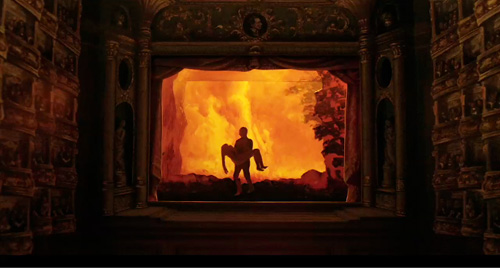
Mysteries of Lisbon.
DB here:
If you’re hungry to learn about the ways films can tell stories, a festival provides a feast. A huge array of narrative strategies is spread out for your delectation. You won’t like every movie you see, but thinking about the mechanics of each one can deepen your experience of it, as well as your appreciation for just how wide cinema’s resources can be. You also get to see how more unusual approaches to storytelling are often imaginative revisions of more traditional strategies.
We can usefully think about narrative from three angles. We can study the story world that a film conjures up: the characters, places, and actions we encounter. We can analyze plot structure, the distinct parts that are put together sequentially. They might be scenes or sequences or larger-scale parts, like the Hollywood screenwriters’ “acts.” We can also analyze narration, the patterned, moment-by-moment process of presenting the story world and the plot structure. Think of a narrative as like a building. The building’s furnishings correspond to the story world, and the architectural design of the building, plan and elevation, is like plot structure. Our real-time pathway through the building, from the front doorway into its depths, corresponds to narration.
The Vancouver International Film Festival that Kristin and I have been visiting offers a banquet of storytelling devices—some quite traditional, some fairly fresh. I’ll just survey some aspects of structure that I found intriguing.
The longest distance between points
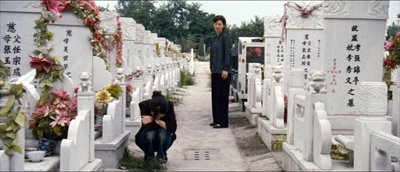
The Chinese blockbuster Aftershock, centering on the 1976 earthquake that struck Tangshan, has earned some complaints about weepiness and jokes about “Afterschlock.” Perhaps melodrama makes many critics uncomfortable. They seem more at home with comedy and noirish crime stories, perhaps because the emotions stirred by these are bracketed by a degree of intellectual distance. But tell a story about a happy family split apart by a catastrophe; show a mother forced to choose between saving her son and saving her daughter; show that the girl miraculously escapes death; present her raised by a pair of new parents; and dwell on the fact that her mother, living elsewhere, expects never to see her again—do all this, and you court mockery.
Well, mockery from everybody except the hundreds of thousands of people who have always enjoyed these situations. Aftershock is now the biggest box-office success in Chinese film history (presumably using today’s currency standards). Whatever the film owes to Chinese traditions, it is easily understandable in a Western context. Stories based on pseudo-orphans, separated siblings, and parents forced to give up children have long been sure-fire. Les Deux orphelines, an 1874 play, is one strong prototype. This pathetic tale of two sisters torn apart in post-revolutionary Paris was adapted by many directors, including Griffith (Orphans of the Storm, 1921). Feuillade developed similar motifs in Les Deux gamines (1921), L’Orpheline (1921), and Parisette (1922). A mother’s loss of her children through accident or social oppression is another stock situation, seen in sublime form in Mizoguchi’s Sansho the Bailiff. The obligation to pick a child to save is at the core of Sophie’s Choice, a more highbrow melodrama. Likewise, the discovery of unexpected kinship forms the climax of many stories, from Oedipus Rex to Twelfth Night and beyond.
You may call these conventions hackneyed, but it would be better to call them tried and true—proven effective by centuries of deployment, counting on emotions aroused by ties of love and blood. Such situations would be good candidates for narrative universals, which can be reshaped by local cultural pressures.
The premise of a fragmented family bears chiefly on the story world. The filmmaker still must choose how to structure the plot. For Aftershock, director Feng Xiaogang and his collaborators settled on the time-honored route: parallel stories across the years, shown by means of crosscutting. After the quake, scenes of the mother and son alternate with scenes showing the girl’s rescue and her life with her adopted parents, both soldiers in the People’s Liberation Army. For about the first sixty minutes, the segments are rather long, but after that shorter scenes from each plot line are intercut. The son moves off to a separate life, but his success as an entrepreneur is given short shrift. The plot concentrates on the daughter’s college career, her sometimes stormy relation with her foster parents, and her unexpected pregnancy. In the meantime, the mother survives, turning aside a kindly suitor in order to preserve her faithfulness to the husband who saved her life.
Narrationally, the alternation between the separated characters gives us superior knowledge. We know, as the mother and brother do not, that the daughter survives; we also know that she nurses a bitter memory of hearing her mother choose the rescue of her brother. Likewise, we know that the mother has tormented herself for decades over her forced choice. Thus the recriminations that will burst out after they rediscover one another will require some healing, which is provided in the plot’s last phase. Melodrama depends on mistakes, and they must be corrected. In a telling image of two sets of schoolbooks (not previously shown to us), we and the daughter realize that over the years the mother has been thinking of her as if she were still alive.
The dual structure can also tease us with suspense. At the hour mark, we learn that both the brother and the daughter are in Hangzhou, without each other’s knowledge. The brother even encounters the foster father. It’s the sort of coincidence that leads us to expect a reunion. Coincidences, I mentioned in an earlier entry, are fascinating narrative devices, and here the fortuitous convergence doesn’t actually pay off. But it does prepare us for the genuine reunion that will take place an hour or so later, when an earthquake hits Sichuan in 2008.
There’s a lot more to be said about Aftershock; I was struck by the fact that the children are left in the collapsing apartment because the parents have sneaked off to have sex in the husband’s truck. (So is the whole arc of suffering the punishment for a little carnality?) But just sticking with structure, we find that a cluster of ancient plot devices, fed into the established technique of crosscutting, can still find purchase in a contemporary film. In films like Aftershock, as in Hollywood’s romantic comedies and horror films and historical adventures, very old narrative conventions live on. Suitably spruced up with CGI, they still provide pleasure.
Sometimes, however, you get the sense that filmmakers in other cultures are borrowing conventions of recent Western films. This seems the case in City of Life from the United Arab Emirates. Faisal is a spoiled playboy who spends his nights with his pal Khalfan, a fistfight-prone club-hopper. Natalia is a Romanian flight attendant who gets romantically involved with an advertising man. Basu is a taxidriver with an uncanny resemblance to a Bollywood star, and so he tries to supplement his earnings by appearing in a nightclub. As all of them move through Dubai, their lives intertwine.
We have, in short, what I’ve called a network narrative. Mostly the plot lines are juxtaposed through crosscutting, but sometimes the characters in one line of action encounter those in another. Faisal is at a club on the same night as Natalia is there, with her boyfriend and her roommate. Objects circulate as well. Natalia pays Basu for a cab ride, and Basu preserves her €20 note until he has hit rock bottom. At the midpoint, an ad campaign links Natalia’s boyfriend, Faisal’s father, and Basu’s job. Many of the conventions of the “small world” network format are included, with one character remarking that Dubai is a small city. Our old friend the traffic accident (shot and cut with exceptional vividness) plays a crucial role. A refuse collector threads through the plot, turning up at unexpected times and providing an ironic coda.
Director Ali F. Mostafa mobilizes a lot of contemporary techniques, including fast motion and rapid cutting (3.6 seconds average shot length). The editing sometimes extends the crosscutting principle by flipping back and forth between two successive scenes, creating little flashforwards. For instance, when the adman Guy phones Natalia to introduce himself, we cut to them talking in a bar and then back to her listening to his sweet talk.

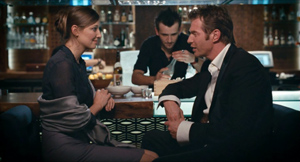

The anticipatory cuts lead us to expect that Guy is calling to ask her out, and Natalia will accept. This sort of cross-stitching can be found in The Godfather and other films of the late 1960s and early 1970s, and it has shown up sporadically since, but it’s rare enough to still look modern.
In cinema, network narratives can occasionally be found before the 1990s, but they’ve become far more common. I count nearly 150 films of the last twenty years employing the structure. In literature, of course, such plots go back quite far, and they formed the basis of nineteenth-century novels by the likes of Balzac, Dickens, Zola, and George Eliot. Television soap operas and ensemble series like Hill Street Blues showed that modern media’s long-form formats fit well with network storytelling. So cinema has caught up, adjusting the template to feature-length plots. City of Life shows that artists from emerging filmmaking nations can use this structure to enter a festival circuit dominated by Western norms of construction. At the same time, those artists can tailor this structure to their own ends—in this case, it seems to me, presenting Dubai as a city of emigrants ruled by a feckless leisure class.
The theatre of memory
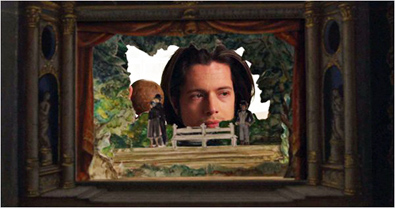
What happens, though, when conventions of sprawling nineteenth-century novels aren’t squeezed so drastically into the usual feature length? I had a chance to find out from Vancouver’s screening of Raul Ruiz’s four-and-a-half-hour Mysteries of Lisbon. Based on an 1854 novel by Camilo Castelo Branco, a fictioneer as prolific as Ruiz himself, the film doesn’t trim off the exfoliating plot lines that we enjoy in three-deckers from the period. This being a Ruiz film, there is as well a tangible pleasure in the artifice of storytelling. The film acknowledges that all the handy coincidences, buried pasts, multiple identities, and revelations of kinship are there for our delectation.
Orphans again: João is being raised in a church school, but he has no idea of his parentage. Early on, kindly Father Dimis tells him that his mother is Angela, the countess of Santa Barbara, but her brutal husband is not his father. We are soon embarked on the extended flashback that traces the doomed love affair that results in the birth of the young hero, now named Pedro. In the course of that tale, we meet two more suspicious characters, the gypsy Salino Cabra and the hired assassin Heliodoros.
This recounted history is only the first of a cascade of flashbacks, issuing from several characters, and these gradually show deep connections among persons tied to Pedro’s past. Secondary characters in one story become protagonists of another. The young hero is gradually displaced as the center of the action by war, secret romances, rivalries, duels, and infidelities. Like Pasolini in his Trilogy of Life, Ruiz is happiest when opening up a plot detour that will eventually become a new main road.
By the end, our young hero has become something of a nullity, an empty center around which aristocratic ecstasies and follies have swirled. He’s something like the Dubai of City of Hope: a point of intersection of many fates. He’s also a passive observer of scale-model dramas played out on his toy theatre stage. His voice-over narration has enwrapped the whole film, and our last glimpse of him is as merely a narrator. Pedro seems finally to realize that his entire existence has served simply to gather other people in a tangle of doomed passions.
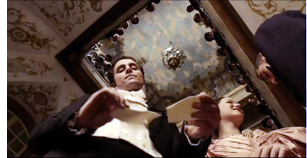 Mysteries of Lisbon has a rich, high-thread-count look, but it’s not your usual prestige costume drama. The long takes cling to characters as they flirt their way across a ballroom, and the camera slips through walls in the manner of old-fashioned cinema. There are the usual Ruiz flourishes of hallucinatory deep focus (achieved through split-focus diopters), characters floating rather than walking, and the occasional peculiar angle. But the film remains calm and lustrous, culminating in a slow tread into pure light.
Ruiz’s appetite for narrative is almost gluttonous; he supposedly wrote over a hundred plays in six years, and he’s made about as many films. He once told me that he thought that Postmodernism was simply a revival of the Baroque in modern dress. From Mysteries of Lisbon, it’s clear that he sees in many older narrative traditions affinities with our tastes today. Network narratives? They’ve been done, and maybe better, centuries ago. Follow the lacy tendrils of classic family-origins plots, and you’ll find a pattern as intricate as anything in Short Cuts or Pulp Fiction. More story ahead: there’s a six-hour television version.
Rumination on ruination
Ruiz understands that modernist narrative techniques, including unreliable narrators and fancy time-switches, depend upon a long tradition in at least two ways. First, very often the tradition got there first; scholars like Meir Sternberg and Robert Alter have demonstrated complex plays with chronology and point of view in the Bible and the Greek classics. Secondly, unusual plot structures may ring unexpected variations on more conventional ones. Case in point: reversed plot sequence.
Again, this seems to be something of a modern trend. The locus classicus appears to be Harold Pinter’s 1978 play Betrayal, in which, scene by scene, the plot proceeds in reverse chronology. This was filmed in 1983 and gave birth to a famous Seinfeld episode. As you know, Memento, Irreversible, and other recent films have taken up reverse-chronology plotting. Actually, however, there are several earlier instances, notably the 1934 Kaufman and Hart play Merrily We Roll Along (turned into a musical by Stephen Sondheim) and W. R. Burnett’s 1934 novel, Goodbye to the Past. Other examples, some going back quite far, are listed here.
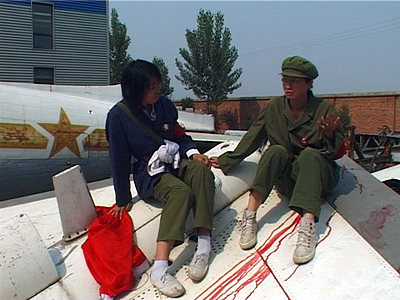
Rumination, a film by Xu Ruotao in the Dragons & Tigers young directors competition at Vancouver, turns the structure to political ends. Reduced to the bare bones, the film shows a teacher, his wife, and their son caught up in the Chinese Cultural Revolution. The father falls in with a gang of Red Guard youths rampaging through the countryside. The son trails the gang at a distance and occasionally interferes with their acts of violence. These story events are arranged in blocks, with each cluster of scenes associated with a specific year. The blocks proceed backward in time, from 1976 to 1966. After a prologue, the film shows scenes of the waning of the Revolution; before the epilogue, we get a stalwart young man announcing the Revolution’s birth.
The scenes are fairly episodic and independent, so I didn’t detect the backwards structure for quite a while. But my uncertainty had another source. Xu introduces each year’s scenes with a date that is, except for one instance, not the year of the actions shown. In fact, while the segments move in reverse order, the years’ designations move in chronological order.
The opening 1976 section is labeled 1966, the 1975 section is labeled 1967, and so on up to the end, with the 1966 action designated as 1976. So we see the father’s reunion with his wife, a moment of clumsy embrace, long before he decides to leave home. As you’d expect, there’s one year in which the action and the tag coincide, 1971, and that is the only one built out of photos and film clips from the period. The year is privileged, Xu explains, because that was the year of the mysterious plane-crash death of Lin Biao, a military hero and Cultural Revolution leader who was accused of plotting Mao’s assassination.
In my viewing, the misleading dates helped conceal the reverse chronology. Confronted with so many discrete episodes of unidentified characters sprinting through the countryside, beating passersby and stealing chickens, I took the default option and assumed that the segments were chronological. Moreover, the film’s scenes play out almost entirely in overcast landscapes and decrepit factories, a landscape in which I couldn’t detect any indications of change from year to year. Watching Ruination a second time, I saw the reversal more clearly, but I also thought that some segments tease us into thinking along chronological lines. An early scene shows the father getting up in the morning (a conventional way to start a plot), saluting Chairman Mao’s statue, and reading from the Little Red Book. Yet this scene is set in 1975, after the father has returned to his wife from his Red Guard period.
Moreover, there’s some evidence that the son actually matures across the film, even though the scenes show him objectively getting younger. By the end of the plot (the earliest moment in story time) he seems to have transformed himself into a strapping young Red Guard. Supporting this construal is the fact that in the Q & A after the showing, Xu mentioned that one influence on his film’s design was The Curious Case of Benjamin Button!
Xu explained that the tragedy of the Cultural Revolution could not be comprehended through normal storytelling techniques. I suspect that viewers familiar with the relevant events and the film’s slogans, iconography, and oblique citations (even to Godard) could follow the backwards sequencing. But I suspect that those viewers would need a sense of the historical chronology to grasp the 3-2-1 order of the plot. It seems to me that Xu, known until now as a painter, has shown how an innovative approach to plot structure relies on conventional responses even as it thwarts them.
Hahaha indeed
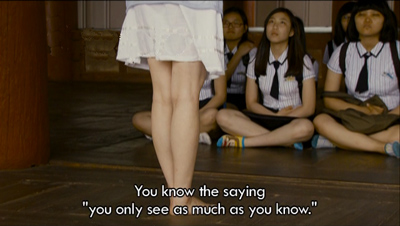
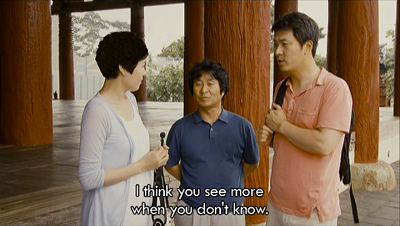
Hong Sangsoo has been one of the leading experimenters with narrative in today’s Asian cinema. My two favorites, The Power of Kangwon Province (1998) and The Virgin Stripped Bare by Her Bachelors (2000) have engaged the viewer in playful puzzlement about how story lines can collide or slip sideways, how our memory of earlier scenes’ action can be tested and found faulty. I haven’t been deeply engaged by his recent forays into more straightforward drama/comedy, such as The Woman on the Beach (2006), but his two latest features, both from this year and both on display in Vancouver, completely satisfied my hunger for intriguing plot structures.
It’s an unspoken convention of recounted-flashback tales that even though the events are told by A, B learns everything that we do—everything, that is, that we can see or hear in the flashback. But Hahaha decouples the verbal recounting from the visual presentation. Here listener B definitely does not grasp what we witness happening onscreen in the tale as told.
Hahaha is a parallel-protagonist tale. Two pals meet for some drinking before one, Munkyung, leaves South Korea for Canada. Through a series of flashbacks, they regale each other with their recent adventures, mostly amorous. The plot is structured as two alternating streams, crosscutting one man’s tale with the other’s and usually returning to the framing situation of their drinking bout. But because we can see what each one recounts, we come to realize that both stories are populated by the same people, notably the tempting female tour guide Seongok. And those people have their own relationships, which we must piece together out of the glimpses we get in each man’s tale.
Neither Munkyung nor his pal Jungshik has a clue that they are part of a fairly tight circle. The result, as usual with Hong, is a comedy of ironic misunderstanding and the puncturing of male pretension. Hahaha can also be seen as his response to the rise of network narratives. Characters in such a film don’t usually realize the larger mosaic they’re part of; the intersecting lives in City of Life transform one another unwittingly. Normally that lack of awareness isn’t the main point of the film. Here it is, and it’s wrung for classic humor at the protagonists’ expense.
In Oki’s Movie, Hong gives us another fractured plot, but now in the form of four short films. They center on three characters: Song, a film director turned professor; his student Jingu; and Oki, the woman both men are interested in. The raggedy credits of each short suggest handmade movies, but what we see in each one is the polished style familiar from Hong himself, including his current interest in abrupt zooms.
The four-part structure is far from transparent. It might be taken as a series of episodes from the trio’s lives. The first film, “Specters of the New World,” which presents Jingu as a professor himself, would have to take place in the present, and the following three would then be presenting flashbacks to the Jingu-Oki-Song triangle. In that case, the first segment would prove that Jingu did not wind up with Oki, as he’s married to another woman.
Perhaps, though, all four films are free hypothetical variations on the central situation. I’m not sure that we can easily arrange the events in the second, third, and fourth episodes chronologically. The films could be presenting successive groups of events, or events scattered across a single time span and then selectively gathered around one of the central characters. The first episode is largely organized around Jingu’s range of knowledge; the second is confined to professor Song; and the third is explicitly presented as Oki’s own thoughts. Earlier Hong films have offered us contrasting, even incompatible plots built out of a core group of characters. Oki’s Movie may be using the framing conceit of student films (none of which is plausible as a student film) to give us a suite of variants on the love triangle.
The idea of ambiguous variation is made explicit in the final mini-film, “Oki’s Movie.” It’s a sustained exercise in—yes, again—crosscutting. This episode alternates two excursions to Mount Acha, one with each man. Shot by shot, we see different courtship styles and we hear her differing reactions to her two lovers. Was she dating both men at once? When did the two excursions take place? Which one occurred first? As these questions are juggled, we get a rapid checklist of Oki’s attitudes, in voice-over, toward both these minor-key losers.
In both Hahaha and Oki’s Movie, Hong takes what’s offered by tradition—in this case, the romantic comedy and the conventions of flashbacks, crosscutting, and restricted narration—and creates a fresh structure. The play of novelty and norm is engrossing in itself, apart from the vagaries of the drama. Our appetite for narrative will always be whetted when directors find ways to whip up something new out of familiar ingredients.
For more on the three dimensions of film narrative, as well as discussion of the principles of network construction, see my Poetics of Cinema. There’s more discussion of flashbacks in film in this entry. On early narrative structure, see Meir Sternberg’s Poetics of Biblical Narrative and Robert Alter’s Art of Biblical Narrative, as well as Sternberg’s discussion of The Odyssey in Expositional Modes and Temporal Ordering in Fiction. For a sharp-eyed consideration of Oki’s Movie, see Andrew Tracy’s review at Cinema Scope.
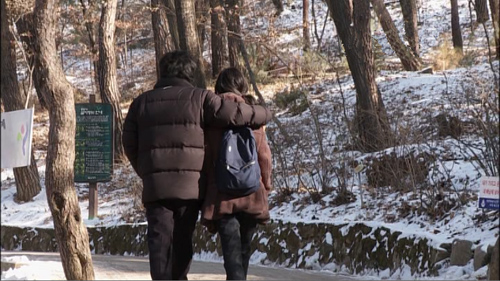
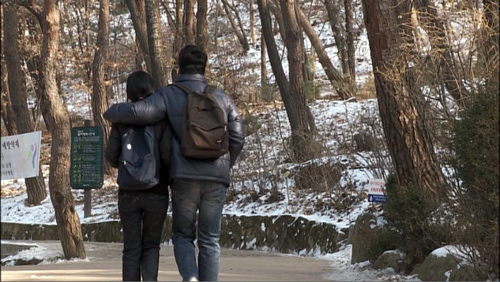
Oki’s Movie.
What makes Hollywood run?
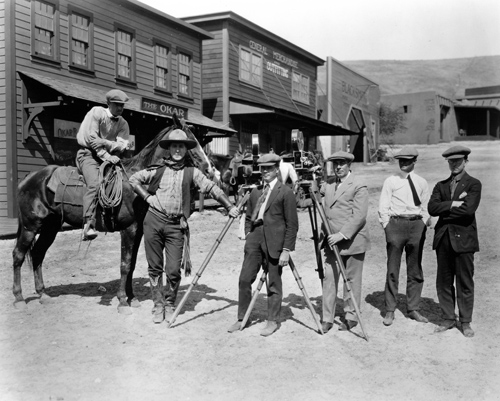
William S. Hart and crew at Inceville, 1910s.
DB here:
For decades most people had a sketchy idea of The Hollywood Studio Film. Boy meets girl, glamorous close-ups, spectacular dance numbers or battle scenes, happy endings, fade-out on the clinch. But even if such clichés were accurate, they didn’t cut very deep or capture a lot of other things about the movies. Could we go farther and, suspending judgments pro or con the Dream Factory, characterize U. S. studio filmmaking as an artistic tradition worth studying in depth? Could we explain how it came to be a distinctive tradition, and how that tradition was maintained?
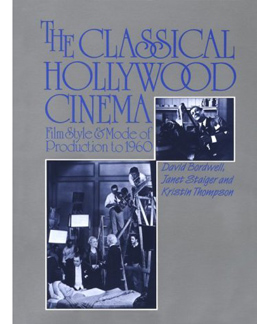
In 1985 Routledge and Kegan Paul of London published The Classical Hollywood Cinema: Film Style and Mode of Production to 1960. Kristin, Janet Staiger, and I wrote it. Since it’s rare for an academic film book to remain in print for twenty-five years, we thought we’d take the occasion of its anniversary to think about it again. Those thoughts can be found in the adjacent web essay, where we three discuss what we tried to do in the book, spiced with comments about areas of disagreement and more recent thoughts. This blog entry is just a teaser.
A touch of classical
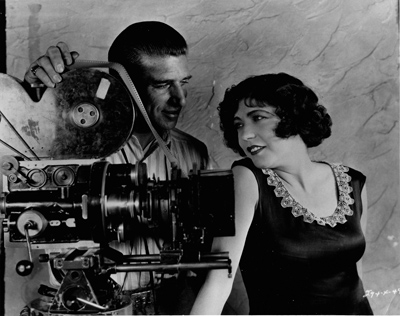
John Arnold, a Bell & Howell camera, and Renée Adorée in 1927.
The prospect of analyzing Hollywood as offering a distinctive approach to cinematic storytelling emerged slowly. The earliest generations of film historians tended to talk about the emergence of film techniques in a rather general way. For example, historians were likely to trace the development of editing as a general expressive resource, appearing in all sorts of movies. While they recognized that, say, the Soviet filmmakers made unusual uses of this technique, writers still tended to think of editing as either a fundamental film technique or a very specific one—e.g., Eisenstein’s personal approach to editing.
An alternative approach was to understand the history of film as an art as a stream of cinematic traditions, or modes of representation, within which filmmakers worked. From this angle, there was a Hollywood or “standard” or “mainstream” conception of editing, and this didn’t exhaust all the creative possibilities of the technique. But it went beyond the inclinations of any particular director. People had long recognized that there were group styles, like German Expressionism and Italian Neorealism, but it took longer to start to think of mainstream moviemaking as, in a sense, a very broad and fairly diverse group style.
In the late 1940s André Bazin and his contemporaries started to point out that different sorts of films had standardized their forms and styles quite considerably. Bazin attributed the success of Hollywood cinema to what he called “the genius of the system.” In my view, his phrase referred not to the studio system as a business enterprise but rather to an artistic tradition based on solid genres and a standardized approach to cinematic narration. This artistic system, he suggested, had influenced other cinemas, creating a sort of international film language.
The idea that there was a dominant filmmaking style, tied to American studio moviemaking, was developed in more depth during the 1960s and 1970s. Christian Metz’s Grande Syntagmatique of narrative film pointed toward alternative technical choices available in the “ordinary film.” Raymond Bellour’s analysis of The Birds, The Big Sleep, and other films pointed to a fundamental dynamic of repetition and difference governing American studio cinema. Somewhat in the manner of Roland Barthes’ S/z, Thierry Kuntzel’s essays explored M and The Most Dangerous Game looking for underlying representational processes that were characteristic of studio films. From a somewhat different angle, in the book Praxis du cinema and later essays Noël Burch traced out a dominant set of techniques that formed what he would eventually call the “Institutional Mode of Representation.” The Cahiers du cinéma critics famously posited different categories of filmic construction, each one tied to the representation of ideology. In English, Raymond Durgnat was an early advocate of studying what he called the “ancienne vague,” the conventional filmmaking that young directors were rebelling against.
The trend was given a new thrust by the British journal Screen, which disseminated the idea of a “classical narrative cinema,” a mode of representation characterized by distinctive dynamics of story, style, and ideology. Perhaps the most emblematic article of this sort was Stephen Heath’s in-depth analysis of Touch of Evil. Over the same years a new generation of film historians was studying early cinema with unprecedented care, and they too were finding a variety of modes of representation at work in filmmaking of the pre-1920 era.
The effect was to relativize our understanding of Hollywood. Mainstream U. S. commercial filmmaking wasn’t the cinema, merely one branch of film history, one way of making movies. Breaking a scene into a coherent set of shots, to take the earlier example, wasn’t Editing as such. It was one creative choice, although it had become the dominant one. And what made Hollywood’s brand of coherence the only option? Eisenstein, Resnais, Godard, and other filmmakers explored unorthodox alternatives.
Nearly all of the influential research programs of the period emphasized the film as a “text.” This wasn’t surprising, since several of the writers were working with concepts derived from literary semiotics and structuralism. At the same period, other scholars were developing ideas about Hollywood as a business enterprise. Douglas Gomery, Tino Balio, and a few others were showing that the studio system was just that—a system of industrial practices with its own strategies of organization and conduct. But most of those business studies did not touch on the way the movies looked and sounded, or the way they told their stories.
Could the two strains of research be integrated? Could one go more deeply into the films and extract some pervasive principles of construction? And could one go beyond the films and show how those principles of style and story connected to the film industry?
The prospect of integrating these various aspects—and, naturally, of finding out new things—intrigued us.
Secrets of the system
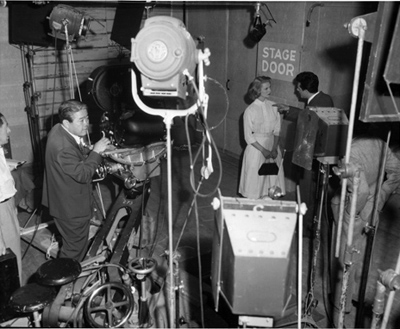
Main Street to Broadway (1953, MGM release). Cinematographer James Wong Howe on left.
The overall layout of CHC tried to answer these questions while weaving together a historical overview. Part One, written by me, provided a model or ideal type of a classical film, in its narrative and stylistic construction. Part Two, by Janet, outlined the development of the Hollywood mode of production until 1930. In Park Three, Kristin traced the origins and crystallization of the style, from 1909 to 1928. Part Four included chapters by all three authors on the role of technology in standardizing and altering classical procedures during the silent and early sound era. In Part Five Janet resumed her account of the mode of production, tracing changes from 1930 to 1960. The technology thread was brought up to date in Part Six, where I discussed deep-focus cinematography, Technicolor, and the emergence of widescreen cinema. Part seven, which Janet and I wrote together, pointed out implications of the study and suggested how Hollywood compared with alternative modes of film practice.
Clearly, CHC was several books in one. Janet could easily have written a free-standing account of the mode of production. Kristin could have done a book on silent film technique and technology. I could have focused on style and form, using sound-era technologies as test cases. The point of interspersing all these studies (and creating a slightly cumbersome string of authorial tags within sections) was to trace interdependences. For instance, Kristin examined the emerging stylistic standardization in the 1910s. Janet showed how that standardization was facilitated by a systematic division of labor and hierarchy of control, centered around the continuity script. At the same time, the organization of work was designed to permit novelties in the finished product, a process of differentiation that is important in any entertainment business.
 Moreover, once the stylistic menu was standardized, it reinforced and sometimes reshaped the mode of production. At every turn we found these mutual pressures, a mostly stable cycle among tools, artistic techniques, and business practices. Once the studios became established, they needed to outsource the development of new lighting equipment, camera supports, microphones, make-up, and other tools. A supply sector grew up, carrying names like Eastman, Bell & Howell, Mole-Richardson, Western Electric, and Max Factor. But the suppliers had to learn that they couldn’t innovate ad libitum. The filmmakers laid down conditions for what would work onscreen and what would fit into efficient craft routines. In turn, the routines could be adjusted if a new tool yielded artistic advantages. And the whole process was complicated by an element of trial and error. The film community often couldn’t say in advance what would work; it could only react to what the supply firms could provide.
In the late 1920s, for instance, sound recording made the camera heavier than the tripods of the silent era could bear. Supply firms engineered “camera carriages” that could wheel the beast from setup to setup. But this development occurred soon after filmmakers had noticed the expressive advantages of the “unleashed camera” in German films and some American ones. So the camera carriage became a dolly, redesigned to permit moving the camera while filming. It’s not that there weren’t moving-camera shots before, of course, but with the camera permanently on a mobile base, tracking and reframing shots could play a bigger role in a scene’s visual texture. Similarly, studio demands for ways of representing actors’ faces in close-ups forced Technicolor engineers back to their drawing boards again and again. Once the problem of rendering faces pleasant in color was solved, filmmakers could then redesign their sets and adjust their make-up to suit the vibrant three-strip process. And the interaction of work, tools, and style triggered larger cycles of activity. The need to pool information about stylistic demands and technological possibilities helped foster the growth of professional associations and the Academy of Motion Picture Arts and Sciences.
This give-and-take among the studios, the supply sector, and the stylistic norms had never been discussed before, and we couldn’t have done justice to it in separately published books. Nor could isolated studies have easily traced how industrial discourses—the articles in trade journals, the communication among the major players—helped weld the mode of production to artistic choices about filmic storytelling.
The Classical Hollywood Cinema was generously reviewed, in terms that made us feel our hard work had been worth it. Books we’ve written since haven’t been so widely acclaimed. (Nothing like peaking young.) We’re grateful to the reviewers who praised the book, and to the teachers and students who have strengthened their biceps by picking it up to read. Of course there are others who don’t consider the project worthwhile; the TLS reviewer called it “sludge.” Probably nothing we say in the accompanying essay will persuade those readers to take a second look. Without responding to all the criticisms the book received (that would take a book in itself), our accompanying essay tries to position this 1985 project within our current lines of thinking.
We studied how Hollywood routinized its work, but that doesn’t mean that we think division of labor is always alienating. It may produce a much better outcome than do the efforts of a solitary individual. For us, that’s what happened during this rewarding exercise in collaboration.
Our thinking was shaped by many sources; here are some of them.
For André Bazin on “the genius of the system,” see “La Politique des auteurs,” in The New Wave, ed. Peter Graham (New York: Doubleday, 1968), pp. 143, 154, and “The Evolution of the Language of Cinema,” in What Is Cinema? ed. and trans. Hugh Gray (Berkeley: University of California Press, 1967), pp. 23-40. Christian Metz explains the Grande Syntagmatique of the image track in “Problems of Denotation in the Fiction Film,” Film Language, trans. Michael Taylor (New York: Oxford University Press, 1974), 108-146. Raymond Bellour’s essays of the period are available in The Analysis of Film. Thierry Kuntzel’s essay on The Most Dangerous Game was translated into English as “The Film-Work 2,” Camera Obscura no. 5 (1980), 7-68. An important gathering of essays in this line of inquiry is Dominique Noguez, ed., Cinéma: Théorie, lectures (Paris: Klincksieck, 1973).
Noël Burch’s early ideas are set out in Theory of Film Practice, trans. Helen R. Lane (New York: Prager, 1973). Even more important to our project was Noël Burch and Jorge Dana, “Propositions,” Afterimage no. 5 (Spring 1974), 40-66, and Burch’s To the Distant Observer: Form and Meaning in Japanese Film (London: Scolar Press, 1979), available online here.
Raymond Durgnat’s series, “Images of the Mind,” deserves to be republished, preferably online. The most relevant installments for this entry are “Throwaway Movies,” Films and Filming 14, 10 (July 1968), 5-10; “Part Two,” Films and Filming 14, 11 (August 1968), 13-17; and “The Impossible Takes a Little Longer,” Films and Filming 14, 12 September 1968), 13-16. Stephen Heath’s analysis of Touch of Evil may be found in “Film and System: Terms of Analysis,” Screen 16, 1 (Spring 1975), 91-113 and 16, 2 (Summer 1975), 91-113.
Barry Salt’s Film Style and Technology: History and Analysis (London: Starword, 1983) works in comparable areas to CHC, though without our interest in industry-based sources of stability and change. The newest edition is here.
Tino Balio’s courses and his collection The American Film Industry (Madison: University of Wisconsin Press, 1976) had a substantial influence on us. He has been a wonderful friend and guide for us all since the 1970s. Our friendship with Douglas Gomery dates from our early days in Madison. Many conversations, along with his teaching in our program, shaped our thinking. A good summing up his of decades of work on the business and economics of Hollywood is The Hollywood Studio System: A History (London: British Film Institute, 2008).
Some of the stylistic traditions discussed in this entry are discussed in my On the History of Film Style. Several blog entries on this site fill in more details; click on the category “Hollywood: Artistic traditions.”
PS 26 September 2010: Douglas Gomery reminds me that the idea of sampling Hollywood films in an unbiased fashion–one feature of our method in CHC–was suggested to us by Marilyn Moon, economist extraordinaire. I’m happy to thank Marilyn, along with Joanne Cantor and Douglas himself, who helped us devise a sampling procedure.
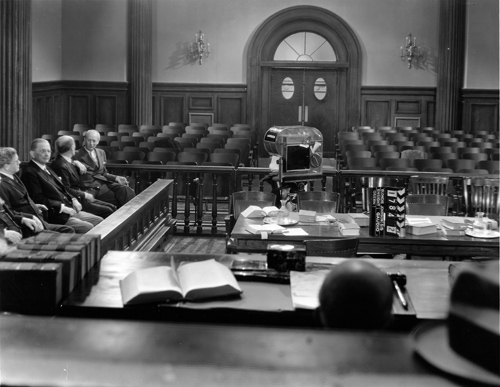
Actors and set for Blondie Johnson (Warners, 1933).
No coincidence, no story
Serendipity.
DB here:
I’ve been thinking about coincidences lately. Watching Hong Kong movies can do that to you.
Hong Kong vs. Hollywood?
Initial D; I Corrupt All Cops.
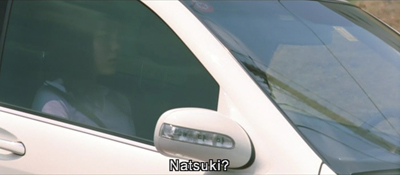
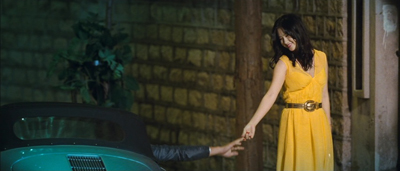
In Initial D (2005, Andrew Lau Wai-keung and Alan Mak Siu-fai, script by Felix Chong Man-keung), the protagonist Takumi is dazedly in love with the seductive schoolgirl Natsuki. Takumi’s pal Itsuki is out with another girl when he spots Natsuki riding out of a “love hotel” with an older man. Itsuki tells his pal. This leads to a major crisis, in which Takumi’s faith in Natsuki is shaken.
Then there’s I Corrupt All Cops (2009) from the indefatigable writer-director-producer-actor Wong Jing. (Many wish he were far more fatigable.) Unicorn, a corrupt, brutal police officer, has just been savagely beaten by gamblers who once were his allies. He staggers to a street stall and nearly collapses, spitting blood into his congee. Then he glimpses his girlfriend getting out of a rich man’s car. In the next scene, when he visits her apartment, he finds his boss, the even more corrupt cop Lak, in her bed. His realization that he can trust no one pushes him to join the police anti-corruption unit.
True, the coincidences play different roles in the two movies. In Initial D, there might be an innocent explanation for Natsuki’s visit to the hotel. Perhaps Takumi’s friend even mistook another girl for her. So we may be inclined to suspend our judgment and wait for more information about whether she’s actually being unfaithful. In I Corrupt All Cops, Unicorn’s suspicions about his girlfriend’s disloyalty are immediately confirmed; instead of suspense, we get surprise, in the form of the revelation of who her lover is.
But in each case, a major plot movement is triggered by sheer accident. Itsuki wasn’t spying on Natsugi’s assignation; he was trying to talk his date into the love hotel. Unicorn wasn’t suspicious of his girlfriend, he just happened to be across the street when she came home. Each coincidence is also a matter of timing: Had either man come a few minutes later to the location, he wouldn’t have learned the big secret. In retrospect, we are likely to think that the screenplays of Inital D and I Corrupt All Cops are using chance rather than causality to move their action forward.
Granted, Hong Kong films are generally weak in plot construction. Even the lauded films of Wong Kar-wai are built out of casual encounters and unpredictable turns of events. The old Chinese maxim “No coincidence, no story” might seem to give accidental revelations a high place in this cinema. But Hong Kong films aren’t outstanding offenders. When you start to look, you find that films in different traditions are no less committed to coincidence. After all, Rick in Casablanca notices the vast implausibility of what’s just happened: “Of all the gin joints in all the towns in all the world, she walks into mine.”
One precept of Hollywood screenwriting has been that coincidences are permissible when you’re setting up the narrative. Indeed, they’re often necessary: Circumstances have to come together in some way to launch an extended action. A sudden rainstom brings boy and girl together under the same awning, creating the cute meet, and things can build from there.
But, the Hollywood wisdom goes, don’t use a coincidence to develop or resolve the plot. Consider another Hong Kong film, Infernal Affairs (2006, directed by Lau and Mak, with script by Chong). Chan the undercover cop has come in from the cold. While officer Lau is out of his office, Chan is poking idly around Lau’s desk. There he finds the envelope on which Chan himself once scribbled a correction.
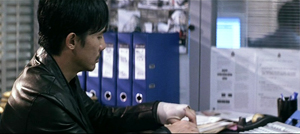
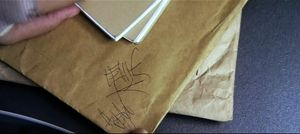
That envelope was in the hands of the gang that Chan joined. If Lau has that envelope, he must be the triad mole in the police force. This recognition triggers the film’s climax: Chan flees police headquarters and sets out to unmask Lau’s treachery.
You would think that if Hollywood filmmakers were anxious to avoid such a timely accident, the Infernal Affairs remake known as The Departed (directed by Martin Scorsese, script by William Monahan) would find another way for Billy Costigan to discover that Colin Sullivan is the mole. But no. Billy notices the telltale envelope sticking out from a pile of papers on Sullivan’s desk.
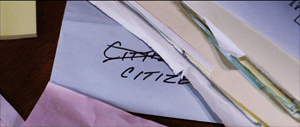
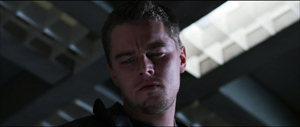
The different ways the two films drive the discovery home to the audience merit a closer look than I can spare here. My point is that the handy coincidence of the police mole leaving this damning clue for his adversary to find is used without apology in the Hollywood movie. And like its counterpart, the scene sets off the movie’s climax. You could even argue that Infernal Affairs supports its revelation a little better. Billy accidentally glimpses the crucial envelope, but Chan is actively browsing Lau’s desk, perhaps because after years spent among triads he doesn’t trust anyone .
So you have to wonder. Maybe filmmakers in many traditions have accepted the Chinese maxim. Moreover, contrivance of this sort doesn’t seem to damage a film’s reputation. (Many critics considered The Departed one of the very best US films of 2006.) More generally, we seldom feel such coincidences to be arbitrary or forced. Maybe screenwriters and directors have found ways to mask the coincidental tenor of such scenes.
As with our earlier Inception entry, we’re in the realm of motivation.
The roots of coincidence
Most story actions result from characters’ choices, purposes, reactions, plans, and the like. These factors create patterns of cause and effect. Chan/Billy didn’t just mosey into Lau/ Colin’s office: He came in because he thought it was safe to break his cover. We accordingly worry for him because we know, as he doesn’t, that he’s far from safe.
Everyone seems agreed that a plot can’t replace all causal connections with a string of coincidences. If everything happens by convenient accident, then we can’t form any expectations about what will happen next. And without expectations, our cognitive and emotional engagement with the story is likely to be slight. Moreover, designing a story packed with coincidences isn’t that hard. Children do it all the time. But most artistic traditions thrive on their constraints. If anything at all can happen to advance or conclude your plot, you’re playing tennis without a net. The interesting challenge for a storyteller in traditional forms is to create a pattern of incidents that arouses our curiosity, builds up suspense, and presents surprises that turn out to be, in retrospect, cunningly prepared for—all the while playing on our emotions.
Yet, and again: No coincidence, no story. Sometimes, the plot’s forward momentum needs encounters and discoveries not planned by the characters. So how can these convenient accidents be made to serve narrative craft?
Well, what is a coincidence anyway? At the least, it’s a matter of converging incidents, as the name implies; but surely it involves more.
I wake up one morning and ask, “I wonder what my sisters are up to? I haven’t heard from them in a while.” Nothing important is happening in the family, no health crises or upcoming reunions. I just wonder how the girls are. So I reach for the phone, but before I can dial I get a call from Diane (the Texas sister). I say, “What a coincidence! I was just going to call you.”
This sort of thing happens. But not all the time. Not even most of the time. The thousands of things that flit through our day almost never match up so nicely. And we don’t notice it when they don’t match up, because we don’t expect them to. The non-coincidences of everyday life go unregistered because they’re so pervasive.
On those rare occasions when things do sync up, we notice. In The Evolution of God, Robert Wright puts it well:
It makes sense that human brains would naturally seize on strange, surprising things, since the predictable things have already been absorbed into the expectations that guide them through the world; news of the strange and surprising may signal that some amendment of our expectations is warranted.
We usually attribute such coincidences to chance. But humans aren’t very good at thinking about chance. If the coincidence seems meaningful, as many do, we’re always tempted to consider it the result of some secret force. Did I send out invisible thought-waves that Diane somehow picked up? Did fate, or God, make her call me? In general, when we notice patterns, we look for causes. The phone-call convergence is a pretty minimal pattern, but even there we might be tempted to find a cause.
I hang up on Diane and the phone rings immediately. It’s Darlene (the peripatetic sister). “I was just trying to call you, David, but the line was busy.” This is getting weird. The pattern heightens and may prompt a stronger impulse to search for causes. Do we three siblings mind-meld in some mysterious fashion? (If so, though, why do we need phones?) It’s just a coincidence, highly improbable but, out of all the times we three think about one another and make phone calls, not impossible.
I believe that narrative artists in all media are practical psychologists. They trigger and exploit and heighten our ordinary ways of making sense of the world. Philosophers and statisticians have sophisticated ways of thinking about chance, but they needed special training to get beyond our folk psychology. Artists take us as we are.
Stories can use coincidences because we accept them. They are the sorts of things that sometimes happen, and so, as Aristotle argued, they are fit subjects for plot-making.
The poet’s task is to speak not of events which have occurred, but of the kind of events which could occur, and are possible by the standards of probability or necessity (Poetics, Chapter 9).
Here Aristotle points to two sorts of possible events. There are events that we expect to happen as a necessary result of earlier events; this corresponds to some notion of causality. Then there are events that are merely probable—things that are likely to happen.
But how likely is my call from Diane and the followup from Darlene? Aren’t these examples of what Aristotle dismisses as “the arbitrary and fortuitous”? Not necessarily, because for Aristotle too the storyteller is a practical psychologist. Things that seem unlikely, he says, can be motivated by reference to people’s beliefs or to the fact that improbable things are likely to happen occasionally.
Irrationalities should be referred to “what people say,” or shown not to be irrational (since it is likely that some things should occur contrary to likelihood) (Poetics, Chapter 25).
In sum, how do you motivate a coincidence? Aristotle recommends two tactics, which I could use if I were writing a story featuring the felicitous phone calls. People say that members of a family have a special affinity that can cross time and space. And anyhow, stranger things have happened.
Narrative norms
SPL.
Aristotle suggests a third motivational tactic as well. He says that unlikely things may be resolved “by reference to the requirements of poetry.” Poetry here refers to any verbal artform, just as poet refers to the maker of literary works in general. So what are the “requirements” of storytelling?
Most minimally, a plot needs an inciting incident. If I were a fictional character, my lucky phone calls might kick off a plot in which my sisters and I, feeling a new and mysterious bond, set out on road trips to meet somewhere. The telephone contrivance would correspond to the Hollywood dictum that coincidences are permissible at the outset of the plot.
Many commentators on Aristotle take his mention of poetic “requirements” to involve more specific conventions, especially those of different genres. We’ve long known that certain kinds of art works permit things that would be forbidden in other kinds. A children’s movie is unlikely to show chainsaw dismemberings, unless Eli Roth has been given a producing deal at Pixar. This idea of genre fitness or decorum has implications for coincidences too.
Clearly, coincidences flourish in comedy. The innocent young man trapped in a lady’s boudoir will have to hide under the bed because her husband bursts in at an awkward moment. In the long chase sequence through old Hong Kong in Project A (1983), Jackie Chan keeps bumping into his superior officer. Sometimes Jackie is set back by the encounter, but once the officer inadvertently rescues him. David Lodge writes: “Audiences of comedy will accept an improbable coincidence for the sake of the fun it generates.” His novel Small World culminates in a pile-up of coincidences in which an airline check-in clerk happens to give the heroine a copy of The Faerie Queene at the precise moment she needs to check a literary reference.
This is all highly implausible, but it seemed to me that by this stage of the novel it was almost a case of the more coincidences the merrier, provided they did not defy common sense, and the idea of someone wanting information about a classic Renaissance poem getting it from an airline Information desk was so piquant that the audience would be ready to suspend their disbelief.
Melodrama is another genre that relies on coincidences, particularly those that bring bad luck. (Think of Rock Hudson’s cliff-edge fall in All that Heaven Allows.) Likewise, I think that the revelations of the incriminating envelopes in Infernal Affairs and The Departed are partly motivated by genre conventions. In undercover tales, the detectives have to be alert for any physical items that might betray them or offer clues. So the envelopes are something that the hypersensitive narc could plausibly fasten onto. (Why the envelopes are left lying around in the first place is another part of the story, which I’ll come to.) Similarly, Initial D is partly a teenage romance, and we know that such films require an obstacle to happiness; that’s what Itsuki’s accidental discovery provides.
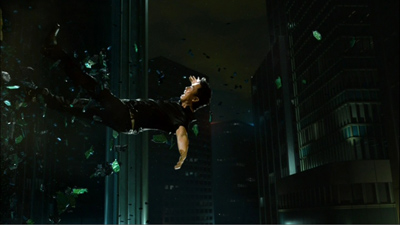
There’s another “requirement” of poetic art that can motivate coincidence, and it cuts across different genres. In Wilson Yip Wai-sun’s SPL (2005), a brutal martial-arts fight in a nightclub ends with the gangland chief Wong Po hurling Inspector Ma through a window far above the street.
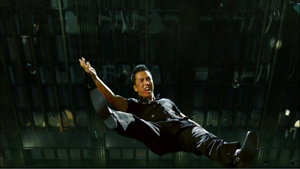
Down below in a waiting car are Wong Po’s wife and baby son, the only things in life he loves.
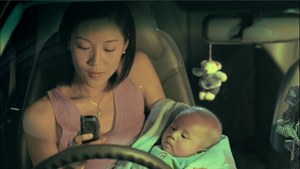
Care to have a guess where Ma lands?
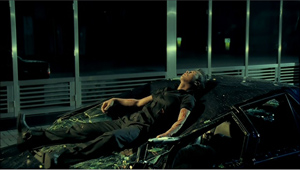
This is a coincidence motivated by poetic justice: The brutal Wong Po has inadvertently killed his wife and child. Serves him right!
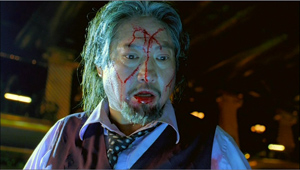
As we might expect, Aristotle anticipated poetic justice too. He remarked that there was a special sense of fitness when the statue of a murdered man toppled over on his killer.
Three dimensions of narrative
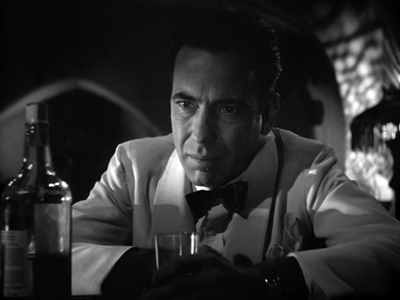
Casablanca.
In an essay in Poetics of Cinema I argued that we can think of any narrative as having three dimensions: the story world, the macrostructure of the plot, and the narration–the flow of information as it’s presented, moment by moment, in the film. Each of these dimensions can motivate coincidence, and each answers to what Aristotle calls “requirements” specific to narrative art.
Say you want two characters to meet without making a rendezvous. One way is to establish that each has a routine. Jack stops for coffee at Starbuck’s every morning on the way to work; so does Jill. Sooner or later, it’s plausible that they will run into each other. The appeal to routine is probably behind the unlucky coincidence in I Corrupt All Cops. After being beaten, Unicorn staggers to the food stall across from his girlfriend’s apartment house–evidently on his way to call on her.
Another sort of story-world motivation involves characterization. In Initial D, it’s not implausible that the randy Itsuki would be hanging around outside a love hotel. Given his personality, he’s more likely to see Takumi there than other, more upright characters would be. In Infernal Affairs, Lau is a cautious mole, but he has no reason to hide the telltale dossier because he thinks it would be meaningless to anyone else. (Lau can’t know that Chan is the one who scribbled the corrected spelling on the envelope.) Lau’s studied nonchalance lets him stack papers on his desk without concern that this one is particularly revelatory.
Coincidence can also be motivated by the overall plot structure. If you start your film by alternating scenes showing two characters living their lives separately, you make it easier for your audience to accept what might otherwise seem a chance meeting between them later. After all, if they aren’t going to have some interaction, why are they both in this story? Sleepless in Seattle provides a clear-cut instance, although here the conventions of the romantic comedy genre also insist that the couple will get together. (Vera Chytilová’s Something Different of 1963 shrewdly defeats the expectation aroused by this sort of alternating construction.)
Likewise, a flashback structure can motivate coincidences. If we’ve seen the outcome of an action, even implausible events leading up to it can seem more natural. At the start of The Big Clock (1945) we see a hunted man hiding in a vast clock mechanism that surmounts a skyscraper.
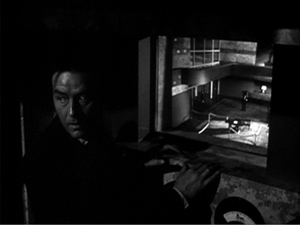
In a long flashback, we see what led up to Stroud’s plight. Fired from his magazine job, he meets up with a blonde woman who takes him bar-hopping. They wind up in her apartment, but she hurries him out just as his boss Janoth comes in. Stroud watches Janoth go into the woman’s apartment.
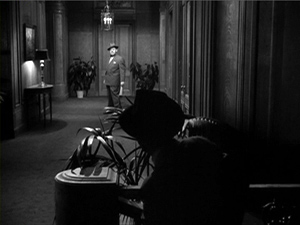
The encounter isn’t wholly accidental. We know, as Stroud does not, that the woman is Janoth’s mistress, and she knows Janoth is coming to visit her. Nonetheless, what happens next leads to Stroud’s being fingered for murder. Stroud has pretty bad luck, but the opening frame story of his flight retroactively motivates his presence at the crime scene; we wouldn’t have the clock scene unless it proceeded, as Aristotle might say, by necessity from something pretty serious. The order of presentation coaxes us to accept whatever led up to the opening situation.
The story world and the plot macrostructure can do only so much. Sometimes coincidences need more fine-grained motivation. Here’s where narration, the patterned flow of information, comes in. If a cowardly cowboy is just about to leave the saloon when the bullying gunfighter enters, it can seem less stage-managed if we show, beforehand, the gunfighter riding into town with his minions. It doesn’t make the encounter more plausible in the story world, but it prepares us to find it more plausible: the two paths seem to converge. Here crosscutting accomplishes on the small scale what alternating scenes can do for macrostructure.
An even simpler tactic is to have someone announce that what’s happening is extremely unlikely. Lodge points out the audacity of Henry James in The Ambassadors when he presents a major moment through a character who reflects, “It was too prodigious, a chance in a million. . . ” This is the equivalent of Rick’s comment about Ilsa dropping into his gin joint. A frank admission of a coincidence can pull you through.
It was meant to be
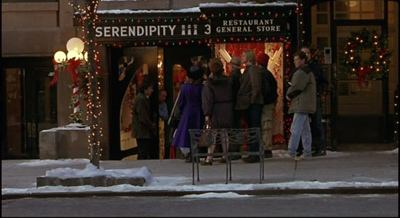
Many of these motivating factors can work together with a more sweeping one. Recall that we’re sometimes tempted to consider everyday coincidence the result, or sign, of forces larger than we can comprehend–God, karma, fate, the Sibling Affinity Frequency. A narrative can motivate its coincidences by suggesting that they are working out an elusive but powerful pattern. Somehow, coincidence is just the hand of destiny. The French film known in English as Happenstance (2000) provides an example, but so does Serendipity (2001).
Jonathan and Sara meet cute in Manhattan, but mishaps separate them. They never learn each other’s identity. Years later, Sara is in San Francisco living with a musician, while Jonathan is about to get married. Vaguely dissatisfied and fretful, Sara returns to Manhattan to find Jonathan. Meanwhile, just before his marriage, he sets out to find her. Each one thinks that recapturing the love that flared up in one magical night would be worth one last effort.
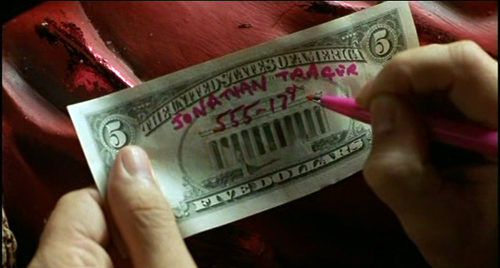
How do they find one another? Clues, plus coincidences. Jonathan starts to track Sara through a sales receipt for gloves she bought when they first bumped into each other. Sara returns to the Waldorf and visits “their” café in hope of finding some connection to Jonathan. But a lot of luck is involved too. Jonathan confirms Sara’s location thanks to her inscription in a used copy of Love in the Time of Cholera–a copy that his fiancée gives him, no less. By chance she bought Sara’s copy. Correspondingly, Sara finds the $5 bill Jonathan signed years before in her friend’s purse. Her friend got it as change at the café. The characters take purposive action, but they achieve their goals through coincidences.
These coincidences are simply outrageous. How can we motivate them? At the beginning of their magical night Sara announces that she believes that happy accidents are in fact controlled by fate. If she and Jonathan are meant to be together, things will arrange themselves the right way. She tells him this as they have coffee in her favorite café, Serendipity.
So Sara mounts some tests of their cosmic compatibility. She insists they leave the café separately: if they’re destined to remeet they will. Jonathan leaves his scarf behind, and she finds it, so they’re back together. She writes her contact information on a scrap of paper, but it blows away. “Fate’s telling us to back off,” Sara warns. Jonathan writes his phone number on the fiver, but she then pays for something with it, saying that if it returns to her, she’ll call him. In exchange, she’ll write her information in the Márquez novel and give it to a used bookshop; if he finds it, he can call her. Finally, at the Waldorf Astoria, each one is to get in a separate elevator car, pick a floor, and see if they’re in synch. It’s this test that leads him, through problems of timing, to lose her.
What motivates the cascade of coincidences, then, is the film’s starkly announced theme. In love, favorable coincidence is just serendipity; the film puts its operating procedure in Sarah’s mouth. To make your coincidences seem plausible, then, make your movie explicitly about how coincidences can be read as destiny.
But the theme doesn’t work on its own. Several of our other principles of motivation help out. For one thing we have Aristotle’s notion of common opinion: “What people say” about true love is that a couple is somehow meant for each other. In addition, of course, this is a romantic comedy, a kind of film that depends on separating and uniting lovers. We’d be very surprised, not to say disappointed, if these two didn’t wind up together. Genre helps motivate the way coincidences help out the couple.
Perhaps most interestingly, the “requirements of art” in Hollywood dramaturgy include a symmetrical play with motifs and character traits. Each lover is given a token—$5 bill, Márquez novel—and certain locales gain significance through repetition (Bloomingdale’s, the Waldorf, Serendipity, the skating rink). At the start of the film, Sara is the romantic, while Jonathan is more pragmatic. After a few years as a psychotherapist, however, she no longer trusts in fate. But by searching for her, Jonathan becomes a passionate believer in signs, reading everything around him as a possible trace of her presence. His pursuit of a love that defies likelihood moves his friend, the journalist Dean, to write a hypothetical obituary:
Even in certain defeat the courageous Trager secretly clung to the belief that life is not merely a series of meaningless accidents or coincidences. Uh-uh. But rather it’s a tapestry of events that culminate in an exquisite, sublime plan.
That plan is worked out through a traditional plot symmetry. Sara had found Jonathan’s scarf in the café at the start. At the climax, he discovers her jacket on a bench overlooking the ice rink where they shared their first date. (She had gone back there in a nostalgic mood earlier in the day.) Now, coming back for her jacket, she reunites with Jonathan. Hollywood’s use of tokens and props to develop the drama fits nicely with the theme of fate’s good offices. You could say that the vicissitudes of destiny are recruited to motivate some principles of classical plot construction.
Time out
You may dislike all the films I’m mentioning (Serendipity?! That’s a movie for wimps!). But my purpose here isn’t evaluative. I want to explore some principles that are used to make stories hang together, more or less. The same principles are present in what we sometimes call art films, from Bicycle Thieves to The Headless Woman. Coincidences abound in these movies, often motivated as the randomness of life, or n-degrees-of-separation, or mysterious larger forces that create correspondences (Paris nous appartient, the Three Colors trilogy of Kieslowski). Appeal to realism, to folk psychology, to genre, to thematic significance, and to formal unity can be found in virtually all narrative cinema. Here as elsewhere, I’m just trying to make such principles explicit and study how they work.
In thinking about those principles, I’m struck by one more way in which narratives need coincidences. What makes a story intriguing, or even worth paying attention to?
Here’s a story. I got up this morning, had breakfast with Kristin, went to school to take some frame enlargements from Hong Kong films, and dropped off the slides at a lab before coming home. Technically, it’s a story, but you yawned halfway through. To be engaging, stories need a remarkable situation or twist—a lover betrayed, a man pursued for a crime he didn’t commit, a cop discovering that his savior is his worst enemy, people who meet and fall in love and then lose one another.
We need, in short, something out of the ordinary. Coincidences, popping out from the bland backdrop of everyday life, can provide an uncommon event. At the start of a plot, they launch the action. At intervals, and with the proper motivation, they can be invoked if they liven things up. The effect may go back to the strangeness that Robert Wright suggests that we’re always on the lookout for.
Granted, the effect of motivation is to make coincidences seem less strange than they might otherwise seem. Most of these factors work to give the coincidences a sort of causal boost. Itsuki sees Natsuki because he’s at the love hotel, Chan/ Billy notices the envelope because he’s an alert cop, Jonathan and Sara get together again because they follow up clues and try really hard and anyhow an unseen hand (causally) shapes their fate, and so on. The coincidences are often covered by a causal alibi. That suggests that what’s most coincidental in these situations is timing.
Most movie coincidences run on tight schedules. A few moments later, Itsuki wouldn’t have seen Natsuki leave the love hotel; Unicorn wouldn’t have caught his wife with his boss; Chan/ Billy wouldn’t have found the telltale envelope; and so on. As the film unrolls, we want our extraordinary events tied to close shaves, barely missed messages, and revelations taking place under a ticking clock.
Every moment in filmic storytelling seems to bristle with possibilities of convergence and revelation. The sort of actions that make stories interesting are even more gripping if they take place under time pressure. Very often, if a key event had happened slightly earlier or later, there would have been no coincidence. And movies, unrolling at a pace to which we all submit, are well-suited to arouse our interest with turns of events that might, just barely, have been very different. Perhaps we accept the power of good or bad timing because, to recall Aristotle, “people often think” things like this: If I had missed that train, I would never have met my soul mate. . . .
Clearly, though, timing is a tale for another occasion.
My thanks to Ben Brewster for discussing these ideas with me and reminding me of the Chinese adage. That precept is briefly discussed in Kam-ming Wong, “‘No Coincidence, No Story’: The Esthetics of Serendipity in Chinese Fiction,” International Readings in Theory, History and Philosophy of Culture (St. Petersburg, Russia: EIDOS, 2003), Vol.16, 180-97.
My references to the Poetics come from Stephen Halliwell’s edition, The Poetics of Aristotle: Translation and Commentary (Chapel Hill: University of North Carolina Press, 1987), pp. 40, 42, and 63. My extracts from David Lodge’s The Art of Fiction (New York: Viking, 1993) are from his section on coincidence, pp. 149-153.
Hilary P. Dannenberg’s book, Coincidence and Counterfactuality: Plotting Time and Space in Narrative Fiction (Lincoln: University of Nebraska Press, 2008) includes many intriguing ideas about coincidence. Her focus is the “coincidence plot” in which people realize they’re related to one another. Some of her arguments are presented in more compact form in her article, “A Poetics of Coincidence in Narrative Fiction,” Poetics Today 25: 3 (Fall 2004), pp. 399-436.
P.S. 31 September: In a study of The Pledge, film scholar Gary Bettinson has a valuable discussion of how coincidence can be motivated to resolve a plot. It’s available here.
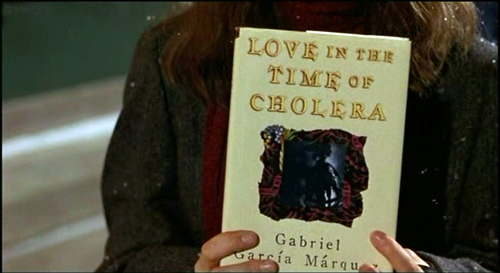
Serendipity.
Revisiting INCEPTION
Inception.
Heading cross-country from Chicago in Dad’s old Honda Prelude, we’re no further than Wisconsin on the first day when Jonah turns from the passenger seat and tells me he’s working on something.
Christopher Nolan, on the origins of Memento
We were driving my dad’s old car from Chicago to Los Angeles. It must have been the second day of driving–we were past Minnesota.
Jonathan Nolan, on the origins of Memento
It’s rare when a filmmaker confirms hypotheses put forward by critics. But that seems to have happened to us.
An enormous amount had been written about Inception, both on the internet and in print, before we wrote our blog entry last week. For the most part, we avoided reading about the film, fearing spoilers and statements about the film that might influence our own initial take on it. Since then, we’ve read Jeff Goldsmith’s in-depth interview with Christopher Nolan published in Creative Screenwriting (not yet available online). There Nolan broaches several ideas about his approach to the film, and some of those square with our analysis. Today we highlight a few of those remarks and tease out their implications. We end with comments from some readers.
Exposition rules
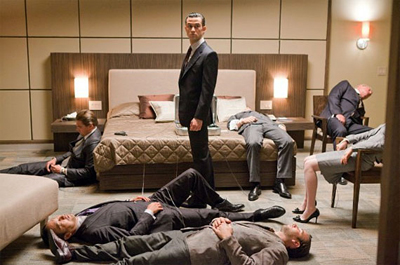
Kristin here:
My contribution to last week’s entry concerned the film’s dependence on nearly continuous exposition, which I thought of as a major formal device across the film. In the Creative Screenwriter interview, Nolan says that exposition was a particular concern of his in making the film.
Ten years ago he envisioned the film as a heist caper:
“One of the fascinating things about the heist movie, and one of the reasons I took this as the model, is that the type of exposition that in most films is problematic, boring, tricky, hard to get through—in a heist movie becomes the meat of it,” Nolan says. “It’s part of the entertainment simply because the process of a heist movie and that sort of procedure, the way they put things together, becomes the reason you’re watching the story.”
Usually in a heist film we get a big dose of exposition as the team’s leader explains the plans for the crime to his colleagues. Then we watch the plan unfold, with exposition added well into the film as needed. In Inception, however, the heist explanation becomes nearly continuous. Goldsmith comments, “Nolan smartly flipped this conceit on its head and instead of keeping the audience at a distance, he decided to take them along for the entire ride. The subtle re-configuration allows for the audience and the characters to sweat together whenever any hiccups arise in the well-thought-out plan.” In fact, the “well-thought-plan” unfolds only as we watch the film.
Nolan also comments on this idea of the audience being active, saying that he wanted to involve viewers alongside the characters:
“Exposition is such a massive demand,” he admits.” It’s something you have to just try and imbue in the relationships of the characters. You never want to find yourself in a scene where characters are passively receiving information in some way, because you don’t want the audience passively receiving information. You want them engaged with that dramatization.”
The implication here is that the audience becomes involved in the plot not through learning about the characters’ backgrounds and traits, as most spectators seem to expect in standard Hollywood films—even blockbusters. Instead, our relationships with the characters (apart from Cobb) come through learning new information along with them and being attached so closely to them while they work through the mechanics of the plot.
The result, at least for many viewers, seems to be a feeling of dissatisfaction at not being able to get close to the characters in a more conventional, detailed way. The advantage, if one wishes to consider it as such, is that we are forced into a struggle to understand the workings of the plot.
Yet we are not entirely with the characters in their achievement of the mission, because we move back and forth among the levels of the dream, as none of them does. Thus we may be attached to the characters in the parceling-out of exposition, but we know much more than they do at any given moment once the second dream (the hotel) begins. The result comes through further experimentation on Nolan’s part, this time with intercutting.
Prestigious patterning
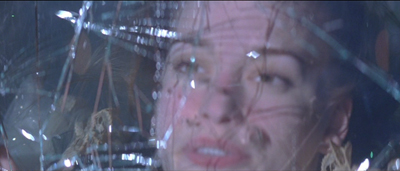
The Prestige.
DB here:
In our earlier entry I argued that Inception uses the dream subject matter to set up a heist plot and to motivate a pattern of embedded narratives. Normally, embedded stories are presented as sealed off from one another, like concentric circles. One interest of the film, I thought, lies in the freedom with which Nolan crosscut among these nested tales.
After further reading and re-viewing, I’m forced to ask: Which is the real center of his interest–embedded stories or crosscutting? And this question leads me to think about his development as a filmic storyteller.
In college Nolan studied literature (a good model for aspiring filmmakers, who too often focus only on movies). To this training he attributes his interest in form. “I wrote Memento very much as a puzzle box. I was fascinated by the idea of structure.”
For Nolan, I think, form has centrally to do with the sorts of juxtapositions you can create by crosscutting. You could say he treats crosscutting the way Ophuls treats tracking shots or Dreyer treats stark decor: an initial commitment to a creative choice, which in turn shapes the handling of story, staging, performance and other factors.
Moreover, his fondness for crosscutting favors actions taking place in different time frames. Traditionally, a crosscut sequence switches between lines of action taking place at the same time. While Smith walks his dog, we see Jones stalking Smith’s wife. The Dark Knight has many sequences that crosscut simultaneous lines of action. When crosscutting isn’t presenting simultaneous actions, it’s often alternating between present and past. An influential example is Hiroshima mon amour, in which the female protagonist’s memories of occupied France are juxtaposed with her visit to Hiroshima in the present. Here, as often happens, the switch to an earlier time is motivated as a character-based flashback, an expression of the persistence of her memories.
Nolan’s interest in crosscutting various time frames doesn’t quite square with tradition. He was much influenced by Graham Swift’s 1983 novel Waterland, as he has pointed out over the years. Here is what he says in the CS interview.
“It opened my eyes to something I found absolutely shocking at the time,” Nolan says. “It’s structured with a set of parallel timelines and effortlessly tells a story using history—a contemporary story and various timelines that were close together in time (recent past and less recent past), and it actually cross cuts these timelines with such ease that, by the end, he’s literally sort of leaving sentences unfinished and you’re filling in the gaps.”
What initially intrigued Nolan, it seems to me, is the idea of taking a story that could be told in straightforward chronology and breaking it into two or three discrete phases. He then cuts among scenes within the phases, without motivating the shifts as character-centered flashbacks.
The story of his first feature, Following, could have been told in 1-2-3 order. Instead, within a framing situation of an interrogation, the plot breaks the protagonist’s tale into three phases, all quite close in time, and then cuts among them. Within each phase, the action is chronological (so far as I can see), but the three “eras” are intercut. Nolan is careful to keep us oriented as to which time zone we’re in through things like the protagonist’s appearance (sloppy, well-groomed, bruised) and a burst of black frames that signals a shift to a different zone. Eventually all three phases get linked up, so, for example, the last thing we see of phase one leads smoothly to what we saw as the first imagery of phase two.
The same concern to break up a linear story is at work in Memento. Again, different phases of the same tale are intercut. But now a forward-moving module is accompanied by one moving backward. Again, these are kept distinct through time markers (color footage vs. black-and-white), and the reverse-chronology one is filled with tokens and echoes that remind us that what we’ve already seen actually took place after what we’re seeing now.
The Prestige expands crosscutting in another direction. Christopher Priest’s original novel is based on the discovered-manuscript convention. Adam Worthy, a publisher, begins reading a book by Alfred Borden, Secret Methods of Magic. What follows are several other memoirs, treating events at different points in history, with some going back as far as 1866. These texts are not intercut or even nested. They stand as solid blocks, presenting overlapping time schemes and varying points of view on the central rivalry between the two conjurers Borden and Robert Angier.
For the film of The Prestige Nolan and his screenwriter-brother Jonathan again create a basically linear chronology. Once more it is fractured into discrete phases. There is a present (Cutter showing a bird trick to the little girl Jess), the recent past (Alfred arrested for killing Robert and awaiting trial), a more distant past (Robert visiting Nicolai Tesla in Colorado), and thanks to Alfred’s journal, the most remote days when the two became competitors and Alfred created the Transported Man illusion.
But The Prestige treats its time zones somewhat as if they were embedded stories. I think that this is partly because we have two protagonists and a split point-of-view pattern. The biggest cue, however, is the way that the Nolans absorb the discovered-manuscript convention into the film. In a classic embedded structure, a character recalls or recounts a string of events with its own integrity, and sometimes the frame story involves a character reading a letter or memoir. In the film, this situation is provided by journals kept by the rival magicians. Now Nolan can cut freely among nested stories. At one point we have Alfred, jailed for murder, reading Robert’s journal, in which Robert tells about reading Alfred’s journal in Colorado. Alfred’s version of events is embedded in Robert’s version, which is in turn embedded in the moment of Alfred’s reading in prison.
Moreover, instead of Following‘s rather mechanical demarcation of phases (black frames signal a shift between phases), the narration of The Prestige is quite fluid, joining distant periods through smooth hooks of imagery and sound. Sometimes the sound comes from one period but the shots are in a distant one. We’re introduced to this strategy in the very opening: Cutter’s voice-over is in the present, but the image is two layers into the past.
So it seems to me that in The Prestige Nolan’s interest in crosscutting different timelines became more audacious, working with not only linear events but embedded stories. The interest in nested stories emerges much more explicitly in Inception, as I suggested in the earlier post. But what I didn’t see then was that using dreams to motivate embedded plotlines changes the time game.
A dream within a dream can’t be said to be taking place earlier than the surrounding dream, the way a flashback or discovered manuscript necessarily presents past events. The dream realms can’t be ironed out into a chronological structure as the phased plotlines of Following, Memento, and The Prestige can. In fact we find our old friend simultaneity at work among all the phases (dreaming while dreaming while, etc.). And Nolan’s film invokes the convention of the climactic deadline (actually, four of them). So in a perverse way, Inception‘s formal gambit is more traditional than the time-scrambling of the earlier films. But because we seldom see embedded stories intercut, the result is also pretty daring–something akin to that abstract filmic time that Griffith creates by intercutting four historical epochs in Intolerance.
From this perspective, Inception marks a step forward in Nolan’s exploration of telling a story by crosscutting different time frames. You can even measure the changes quantitatively. Following contains four timelines and intercuts (for the most part) three. Memento intercuts two timelines, but one moves backward. Like Following, The Prestige contains four timelines and intercuts three, but it opens the way toward intercutting embedded stories. The climax of Inception intercuts four embedded timelines, all of them framed by a fifth, the plane trip in the present. For reasons I mentioned in the previous post, it’s possible that Nolan has hit a recursive limit. Any more timelines and most viewers will get lost. What can he do next?
Letters, we get letters (and links)
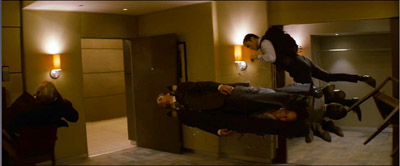
DB again:
We’re grateful to several people who linked to our posting, especially Jim Emerson at Scanners, who continues to compile ideas about a movie he doesn’t like much. Other people wrote us directly to share some ideas. From Jason Mittell of Middlebury College:
I really appreciate and agree with the idea that the motivation for the film is to tell nested or embedded stories, with the shared dreaming device essentially as a framing convenience rather than thematic imperative. One parallel I was surprised D&K didn’t raise was with the embedded narration of The Prestige. I teach the latter in my narrative theory course as a case study specifically to explore how the film plays with storytelling levels, with the dual journals/letters, voice-over, flashbacks, etc. Inception makes this layering more literal in terms of parallel worlds, but I do see some important precedents forged in Nolan’s earlier work.
I agree with Jason’s suggestion about The Prestige and decided to develop the point he suggested. I didn’t dwell on the film in the earlier entry beyond noting that it’s discussed at some length it in the ninth edition of Film Art: An Introduction. It’s good to know that Jason (who maintains an excellent blog here) finds the film a lively way to introduce narrative concepts in his teaching.
Jim Healy pointed out another example of a film with several nested story lines.
As for complicated embeddings since The Matrix, I was a big fan (maybe the only one) of Carpenter’s Ghosts of Mars, which has, I think, a flashback within a flashback, within a flashback, within a flashback.
James Kreul wrote with another example of nested-goal crosscutting schemes:
You might consider looking at Matthew Barney’s Cremaster 3, or at least the segment available on DVD called “The Order.” “The Order” has simultaneous action on 5 different levels of the Guggenheim Museum. If you watch it linearly, it seems very much like a video game, as the protagonist has to achieve certain goals on each level. The DVD also gives you the option, however, of toggling between the different levels across the duration of the segment, so that even if the protagonist isn’t on level 1, you can watch level 1 (there was a variation on this for the multiple-screen video installation version of the piece).
“The Order” itself is nested within the larger narrative of the protagonist (Barney, the “Entered Apprentice”) working his way up the Chrysler Building to confront “the Architect,” and there is a parallel between the climax of the Order and the climax of the action with the architect. The website synopsis describes “The Order” as a “choric interlude,” and even though the Barney character is called the Entered Apprentice in the both the larger and nested narrative, the nested version is a “fantastical incarnation” of the character. But there’s nothing to mark it explicitly as a dream or the subjective experience of the character (as far as I can remember). The two versions of the character are instead connected by the fact that Barney plays both of them and by certain motifs (he loses teeth in the larger narrative, he has a bloody mouth in “The Order”).
In any case, it might be a useful example if you return to the idea of narrative strategies within a nested structure. “The Order” also has various thematic connections with the other films in the series (each level in the Guggenheim references the 5 films in the series) so that this “middle film” both looks back and looks forward to the other films in the series. It was released last.
Jim’s reference to Barney’s Cremaster series reinforces our sense that Nolan is exploring some avant-garde techniques but anchoring them in familiar genres, plot patterns, and the like. Motivation, in other words.
Speaking of motivation, I wrote in an aside in the original post: “Likewise, the backward progression of Memento’s plot is partly justified by the clinical condition of short-term memory deficits. I grant you, why this ailment supports a reverse-chronology tale is a bit puzzling.” In reply David Wigram wrote to point out that most movies want to align the viewer with the protagonist’s thoughts and feelings. Accordingly,
In Memento Nolan needs to keep the audience as clueless about the recent past as Leonard is, otherwise this identification is lost. The only way to do this is with the looping reverse form that was used. All the other aspects of the conceit flow from this necessity. I seem to remember interviews in which Nolan talked about trying to find the technique required to tell this story, and how everything fell into place when he did. But even if it was reverse-engineered, even if the filmmmaker simply wanted to make a fractured-time narrative and needed a story – any story – to tell, I think story and storytelling in Memento (of anterograde amnesia in the protagonist and a looping reversed chronology) are perfectly and elegantly matched.
I find David’s point persuasive. It illustrates how an overarching formal commitment confronts you with a cascade of obligatory choices, and how those choices can be motivated.
If you want to restrict the plot to Leonard’s range of knowledge, you have a problem because he forgets what happened to him a few minutes before. Then our knowledge will always be greater than his, creating a very externalized, objective narration. In other words, if the events are told chronologically, then we see what Leonard will soon forget. But a reverse-order plot suppresses our knowledge of the recent past, thus approximating the character’s range of knowledge in any particular scene.
This creates a new problem to solve, however, because we now still have knowledge outside Leonard’s ken—knowledge of the future story events. For instance, we know that he will be betrayed by Natalie and will shoot Teddy. Yet in a way our future knowledge doesn’t hurt the plot’s unfolding, because this is a film noir. In a noir we often sense that harm is destined to befall the protagonist. This sense of fatality is sometimes specified by a frame story anticipating the protagonist’s end, as in Double Indemnity and Sunset Boulevard. Here, instead of using a flashback, Nolan conjures up the doom scenario by reverse-order presentation. Motivation again, this time by that quasi-genre we call film noir. Would the structure work so well with a Western?
Like Inception, Memento finds a structure that meets Hollywood’s demand that the presentation be motivated by appeal to genre and character psychology. A good counterexample is provided by Gaspar Noë’s Irreversible, in which the 3-2-1 ordering of scenes isn’t justified by such factors. As often happens outside Hollywood, a play with form doesn’t need such motivations–or alibis, if you like.
The Nolan brothers’ memories of Memento are taken from Christopher Nolan, Memento and Following (London: Faber, 2001), p. 233. In the same volume (pp. 97-99), Nolan offers some comments on structure echoing those we quote here. The remarks on Inception come from Jeff Goldsmith, “The Architect of Dreams,” Creative Screenwriting (July/ August 2010), 18-26. CS is well worth subscribing to, and its free podcasts are very informative. On Memento, Andy Klein’s careful reconstruction from 2001 remains admirable. On Christopher Priest’s reaction to the film version of his novel, see The Magic: The Story of a Film; see also our entry here. For a discussion of the sort of audiovisual hooks Nolan employs in The Prestige, see this web essay. Another entry on this site considers Nolan’s visual storytelling in The Prestige. We also have a post discussing Barney’s Cremaster project.
P. S. 31 August: Who can keep up with all the Webchurn on Inception? We won’t try, but simply point you to two reactions that pictorialize the embedded-dream device: here and here.
Scientific American weighs in on lucid dreaming. And again here.
P. S. 2 Sept: Sean Wietner makes this point about how Nolan motivates slow motion:
In an interview with Elvis Mitchell on his KCRW program The Treatment, Nolan mentions that he’s had a hard time being comfortable with the aesthetics of slow motion — he’s never known what it’s best used for. So he was quite chuffed about the falling van in Inception — finally, a good reason to use slow-motion. He makes similar comments about cross-cutting that echo your blog post; he’s so pleased to be “forced by” (my paraphrase) the narrative to cut parallel action like this.
This is one of the things about Nolan that sticks with me, and I think it’s related to the perception some have of him as chilly. I think it speaks to a larger issue that touches on ideas like Hitchcock’s plausibles, and their Body Snatcher infiltration of audience mores. There are times when Nolan comes across as the King of the Plausibles, the overplanner who can’t deal with being painted into a corner, so rather than deal with that messiness he erects massive scaffolding. He requires a time-dilation mechanic so he can have the freedom to play with the classic cinematic device of slow motion!
Thanks to Sean for his comment!