






Archive for the 'Film technique' Category
Classical cinema lives! New evidence for old norms
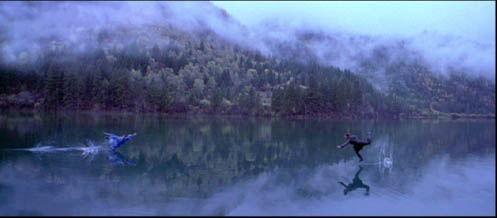
Hero.
Kristin here—
Note: This entry was written for Jim Emerson’s Contrarian Blog-a-Thon (III).
When David and I got into film studies in the late 1960s and early 1970s, an era of Hollywood’s history was drawing to a close. Many of the great directors who had defined the classical studio era from the period of World War I to the early age of television were at or approaching retirement. Andrew Sarris’s pivotal book, The American Cinema: Directors and Directions 1929-1968 (1968) came out just in time to elevate their reputations by dubbing them with the fashionable French term auteur.
John Ford and Howard Hawks made their last films in this period (7 Women, 1966, and Rio Lobo, 1970). Alfred Hitchcock, Otto Preminger, and Vincente Minnelli kept driecting into the 1970s, though few would say their late films stacked up to their earlier ones. (Preminger did manage to struggle back after a string of turkeys to make a very creditable final film, The Human Factor, in 1980.) Sam Fuller kept working through the 1980s, but he had to go to France to do it. Billy Wilder’s last film came out in 1981, though most of us wish he had stopped with The Private Life of Sherlock Holmes in 1970.
The decline of these greats coincided with the rise of the New Hollywood generation, whose directors, originally dubbed “the movie brats,” have become the grand old men of the current cinema. It also coincided with the early rumblings of the blockbuster (Jaws, 1975) and franchise (Star Wars, 1977) age that we know today. Definitely a shift took place in the 1970s, but to what?
Many film historians have claimed that the films that have come out of Hollywood since roughly the end of the 1980s are radically different from those of the classical “Golden Age.” Factors like television, videogames, spectacular special effects, moviegoers with short attention spans, the internet, the acquisition of the old studios by multi-national corporations, and the resulting rise of franchises have all putatively given rise to a “post-classical” cinema. This phenomenon is sometimes also referred to as the “post-Hollywood” or “post-modern” era.
I’m suspicious of the “post” terms, vague as they are. Usually stylistic labels describe what something is, not what it follows. Do we speak of “post-silent” or “post black-and-white” cinema?
Post-classical films supposedly jettison the old norms of style and storytelling. Frenetic editing, constant camera movement, product placement, juggled time-schemes—these and other tropes of recent cinema have replaced the continuity system, the carefully structured screenplay, and the character-based storytelling of the classical era. Computer-generated imagery has enabled filmmakers to create action scenes, spectacular settings, and fantastical creatures that hold our attention so thoroughly that the plot ceases to matter.
Or not. David and I have spent much of our professional careers studying the norms of classical filmmaking. We’ve swum against the stream by claiming that, despite many changes in style and technique, the fundamental norms of classical storytelling have remained intact. The classical cinema is with us still, precisely because it enables filmmakers to present us with absorbing plots and characters. It also is a flexible filmmaking approach that can absorb new technologies and new influences from other media and bend them to its own uses.
It’s less seductive to proclaim a long-term stability in Hollywood than to trumpet revolutionary, transformational, epochal changes. Still, some things just work so well that people want to keep them going as is. American films have dominated world screens since 1915. Why tinker with an approach that works so well?
It’s amazing to think of it now, but back in the late 1970s, virtually no one had studied the traditional norms of Hollywood filmmaking. We all knew what the distinctive traits of the great auteurs were, but distinctive as opposed to what? Academics kept saying that someone should figure out just what the cinema of the classical studio era consisted of. What principles guided filmmakers? What assumptions did they share? Not realizing how much material was available on Hollywood cinema, we and our colleague Janet Staiger set out to document the norms of style, technology, and mode of production that composed the “classical Hollywood cinema.”
The result was a much larger tome than we had expected, The Classical Hollywood Cinema: Film Style and Mode of Production to 1960 (1985). After finishing it, David and I dusted off our hands, figuring that we had dealt with that topic. We went back to studying non-classical directors like Ozu, Eisenstein, Tati, Godard, Bresson, and Hou, confident that we had the knowledge to show exactly how and why their work differed from standard filmmaking.
Then claims about post-classical filmmaking started to appear. In our book, we had limited our survey to pre-1960 cinema because the breakdown of the studio structure and the competition from television led to a different situation in Hollywood. We did not, however, say that classical filmmaking died then. Quite the contrary; we said that it had endured through those changes in the industry.
Those favoring the post-classical explanation obviously disagreed with that. Bypassing our claims for the endurance of classical filmmaking, they borrowed our cut-off date of 1960, as if we had intended that year to signal the end of all aspects of the classical cinema—style, storytelling, mode of production, technology, the whole thing.
During the 1990s it became apparent that claims about post-classical cinema were becoming one very common way of dealing with modern Hollywood films. We decided to move well beyond 1960 and show that classical norms still prevail in American mainstream cinema. I wrote Storytelling in the New Hollywood (1999), which analyzes ten successful films of the 1980s and 1990s to show that they use narrative principles that are virtually the same as those that were standard in the 1930s and 1940s. Goal-oriented characters, dangling causes, appointments, double plot-lines, carefully timed turning points, redundancy—all these classical devices are still very much with us. The claim was not that every single film coming out of Hollywood adhered to classical norms, only that the vast majority did.
David went on to make a similar argument in The Way Hollywood Tells It (2006), though he deals with visual style as well as narrative. There he examines some of the new norms of storytelling, showing how they are variants of the older classical system. He discusses, for example, “intensified continuity,” where tighter framings on actors, faster cutting, and prowling camera movements have modified but not replaced the standard continuity approach to presenting a conversation scene.
One of the most persistent claims by proponents of a post-classical era is the spectacle made possible by CGI. With the thrilling fight sequences of The Matrix, the vast battles of The Lord of the Rings, the extensive recreation of historical places of Gladiator, and the fantastical creatures and places of The Chronicles of Narnia: The Lion, the Witch and the Wardrobe, the individual scene supposedly becomes more spellbinding than the story in which it is embedded.
David and I have tried to refute this claim to some extent. I talk about Terminator 2 in the first chapter of Storytelling, showing that it has a tightly constructed, character-based narrative. David has a chapter section called “A Certain Amount of Plot: Tentpoles, Locomotives, Blockbusters, Megapictures, and the Action Movie,” where he examines films like Judge Dredd and The Rock. He demonstrates that they, too, have plots that adhere to traditional Hollywood norms. He puts forth a more detailed analysis in this online essay.
 We’ve never really dealt much, however, with the issue of how CGI may or may not have elevated spectacle over narrative interest. Luckily now a new book does that and does it very well. Shilo T. McClean, in her Digital Storytelling: The Narrative Power of Visual Effects in Film (MIT Press, 2007), agrees with much of what we have claimed about the survival of classical filmmaking (though The Way Hollywood Tells It came out too late for her to have seen it). She builds upon our case by examining systematically and imaginatively the question of whether digital special effects support narrative interest. McClean convincingly demonstrates that DVFx (digital visual effects), as she terms them, are used in an enormous variety of ways, and most of these help to tell classically constructed stories.
McClean’s basic points are two. First, DVFx are not used just in the more obvious ways, for big action scenes or elaborate fantasy and science fiction settings. They are applied for a wide range of purposes, from dustbusting (removing dust and other minor flaws from frames) to spectacular scenes. Far from being inevitably spectacular, DVFx are often invisible. (1)
Second, McClean claims that whether modest or spectacular, DVFx usually serve the narrative in some way—and she points out that practitioners in the industry invariably make that same claim.
Digital Storytelling started out as McClean’s dissertation at the University of Technology Sydney. It betrays its origins in a survey of the literature that takes up the first two chapters. There the author is somewhat too conciliatory, for my taste anyway, to a number of theorists’ claims about the breakdown of narrative in the digital-effects age. She tries to find something useful in each writer’s position, even though some of those positions are irreconcilable with the general standpoint she adopts.
Chapter 3 sketches the history of computer graphics and how they came to be used in films. McClean points out that DVFx are perfectly suited to the three criteria for the adoption of new technology that David and Janet formulated in their sections of The Classical Hollywood Cinema: greater efficiency, product differentiation, and support for achieving standards of quality. Like sound and color, DVFx have marked a major technological shift for the film industry, but like them, DVFx have been readily integrated into the existing division of labor. A modern digital studio, as she says, functions in much the same way as a physical one does. Indeed, in watching the credits of a modern film, we see lighting, matte paintings, and so on listed as the specialties for the digital craftspeople.
In these early chapters, McClean points out that in many ways DVFx simply replaces the traditional special effects of the pre-digital age. Most of Citizen Kane’s many effects are not supposed to be noticeable, and indeed for years historians were unaware of just how many it contained. In cases where DVFx create a flashy effect, as in the virtual camera movements through walls in Panic Room, the function is to inform the viewer of the locations of various characters and create suspense. Probably the most vital lesson one could take away from this book is that techniques can serve multiple purposes in a film. Spectacularity, as McClean calls it, and storytelling can co-exist in the same digital images.
The author also explains that, unlike what many writers say about DVFx, they are not simply a post-production technique used to ramp up the visual appeal of a film. Computer imagery is used from the pre-production stages onward, and the mise-en-scene and camera movements must be planned around them.
After this setup, the author systematically explores the factors that might influence the storytelling—or merely spectacular—use of DVFx. As we did in The Classical Hollywood Cinema, McClean samples a large number of films, 500 including shorts. Any film using DVFx, however unobtrusively, qualified.
On this basis, the author has distinguished eight types of DVFx usage. Documentary is one, as in films where computer reconstructions of ancient buildings are shown. Such usage comes into films when information is presented as part of the mise-en-scene, as with the educational film that is screened in Jurassic Park. The second type of DVFx usage, Invisible, is fairly self-explanatory. We are not supposed to notice when buildings are extended, clouds are added to skies, or smudges on actors’ faces disappear.
Seamless DVFx are those we know must be faked, even though the results look photorealistic. The recreation of ancient cities, as with Rome in Gladiator or giant storms, as in Master and Commander, are of this type. Exaggerated effects involves actions or things posited to be real but created in a stylized fashion. McClean cites the comic effects in Steven Chow comedies, and puts wire-erasure for stunts into this category. I assume The Hudsucker Proxy would be another instance.
Fantastical DVXs obviously involve impossible beings like dragons, cave trolls, and a wide variety of X-Men. McClean also finds them in non-fantasy, non-sci fic films like Forrest Gump, Big Fish, and Hero. Surrealist uses of effects can include mental representations, as in Eternal Sunshine of the Spotless Mind and American Beauty, or a bizarre but objective world, as in Amélie.
Finally, there are New Traditionalist uses of DVFx, exemplified by Pixar’s films, and HypeRealist ones, like Final Fantasy.
Armed with this typology, McClean studies various approaches to film studies, testing what each one reveals about the use of DVFx. Since classical Hollywood cinema is based on character traits and goals, she begins by showing convincingly how DVFx can “establish, realize, and enhance” character. For example, films often use effects to put the protagonist in greater danger than would be safe to do in reality. The staged fights in Gladiator, the author argues, create a greater emotional engagement with the main character and make plausible the heroism that allows him to defeat his enemy in the end.
Next McClean tests how DVFx can change the impact of a film by analyzing a pre-digital film and its remake in the computer age. (As a method, this is similar to what David does in The Way Hollywood Tells It when he examines framing, editing, and other techniques in the two versions of The Thomas Crown Affair.) The case study chosen is the 1963 Robert Wise version of The Haunting and the Jan De Bont remake (1999). McClean presents considerable evidence that the inferiority of the later film has nothing to do with its expensive DVFx supernatural effects. Instead, she locates the problem partly in the removal of all the creepy ambiguity of the earlier version. De Bont also changes the heroine from a guilt-ridden, virtually suicidal woman (too wimpy in this politically-correct age?) to a strong, determined savior. The result is a conventional super-woman versus evil monster film where the digital effects stand out simply because the original story was stripped of its most intriguing elements.
McClean moves on to genre, an important subject given the apparent concentration of DVFx (the ones we notice, that is) in fantasy and sci-fi films. She rightly points out, “For all the many assertions that special effects are an emerging narrative form, no one has proposed the narrative structure that this new form demonstrates.” The author makes up for that lack herself, concocting an outline of a film based around a string of effects-laden action scenes. Her outline fits the descriptions of films as given by proponents of post-classicism. The result, however, doesn’t resemble any film I’ve ever seen.
In the genre chapter McClean uses an obvious research resource, but one that the post-classicists largely ignore. She has gone through the entire run of the special-effects journal Cinefex, on the assumption that the films it covers are those assumed to be most significant in terms of their DVFx. McClean lists the 291 films by genre, showing that sci-fi films and horror do not have a monopoly on DVFx. For example, thirty-three period and dramatic movies feature in her list.
To gauge the impact of the rise of franchises in modern Hollywood, McClean surveys the four Alien films, which begin in the pre-digital and move into the digital era. As with remakes, the author demonstrates through analysis that the decline in the series after its two first films had to do with a thematic shift and a change in the character of Ripley.
McClean does not overlook the auteur theory, tracing the work of Steven Spielberg during that same transition from pre-digital to digital cinema. Unlike the other effects-oriented giants of Hollywood, George Lucas and James Cameron, Spielberg has worked in many genres. As soon as DVFx became available, he used them in nearly all the ways listed in McClean’s typology, from the Invisible creation of the swooping airplanes in Empire of the Sun to the Exaggerated in the Flesh Fair setting in A.I. to the Fantastical Martians in War of the Worlds. Always in the service of the narrative.
Along the way McClean offers a number of astute observations. One of these is a novel argument against the “DVFx equals non-narrative spectacle” position. She points out that “In many instances technically weak DVFx will be forgiven if they are narratively congruent; it is the strength of the narrative that will carry them, rather than the other way round.” This claim is plausible when we consider how in the pre-digital age we tried to overlook the obvious back-projections and matte-work in Hitchcock films like The Birds and Marnie.
She also suggests some plausible reasons why bad films might be heavy with DVFx. In some cases the effects create a publicity hook that makes up for the lack of other production values. In others, an inexperienced director, carried away with the “cool” possibilities of DVFx, uses them to excess.
And finally someone has come out strongly against the use of the term “cinema of attractions” to describe modern films. Historian Tom Gunning originally coined this phrase in describing very early cinema, where magic acts with stop-motion disappearances and elaborately hand-colored dances were as common as narrative films. For that period, the label worked and was useful. Applying it to later eras just because films have spectacular sequences has rendered the term much less meaningful.
One thing that I particularly like about McClean’s book is that she shows respect for the films she discusses. She actually seems to enjoy both watching and writing about them. McClean asks questions of aesthetic import, and she treats films as artworks—some good, some bad, but all to be taken seriously as evidence for her case.
Her final chapter provides an excellent conclusion: “While DVFx have completely reequipped the storyteller’s toolbox, they have not rewritten the storyteller’s rulebook entirely.” Yes, classical cinema lives, and Digital Storytelling provides vital new evidence to bolster that claim.
(1) In Film Art, we have touched on this range in the section “From Monsters to the Mundane: Computer-Generated Imagery in The Lord of the Rings” (pp.249-251 in the 7th edition, pp. 179-181 in the 8th). McLean treats the topic in far more depth.
Walk the talk
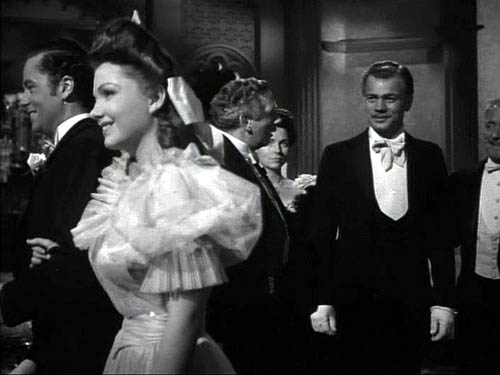
The Magnificent Ambersons.
“It’s only history,” Jack Valenti is reported to have said when allowing scholars access to MPAA files. (1) After studying Hollywood for over thirty years, I should be used to the ways in which trade journalists (and some critics) forget or ignore historical precedents in moviemaking. But I still get bug-eyed when I encounter something like the Variety piece on TV director Tommy Schlamme (Studio 60 on the Sunset Strip).
The subhead tells us that this DGA nominee is known for his “hallway shots.” That gets my interest.
I lose interest fast. The writer tells us that Schlamme
developed the “walk and talk” on Sports Night and then mastered it on The West Wing.
The shot—which features two or more actors moving from one location to another on the set, often from one office to another via a hallway—has become a Schlamme signature.
The first sentence could be read as saying that Schlamme invented the walk-and-talk. Since I spent a little time studying this technique in The Way Hollywood Tells It, my inner film historian cries out, Aarrgh. Long before Sports Night (aired 1998-2000) and The West Wing (1999-2006), movies were developing such bravura shots.
The oblique view
In the prototypical walk-and-talk, two or more characters advance, and the camera tracks along, keeping them centered as they move through the environment. Such shots are quite uncommon in the silent cinema, but they emerge in 1930s films from many countries.
They were truly “signature shots” for Max Ophuls and the lesser-known Erik Charell. In Charell’s captivating The Congress Dances (1931) Lillian Harvey sings while a carriage takes her through an entire town and into the country, all in flowing tracking shots. Call it a ride-and-sing.
If that’s not as pure an instance as you’d like, we can find nice ones during a street scene of The Thin Man (1934). A more somber example occurs in Mizoguchi Kenji’s Story of the Last Chrysanthemums (1939), with the camera in a river bed angled upward at the couple it follows.
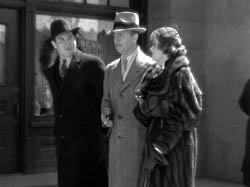
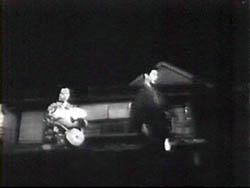
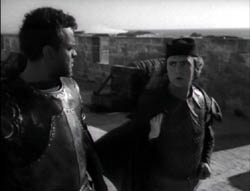
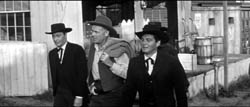
Usually such traveling shots from the 1930s and 1940s are shot obliquely to the actors. That is, the performers are seen in a ¾ view, and they walk along a diagonal path with respect to the frame edges; the camera moves on a similar trajectory. Sound cameras were mounted on dollies that usually ran on tracks. Framing the actors head-on raised problems with this gear. Performers couldn’t walk smoothly if they were stepping within rails, and there was a risk that the rails in the distance might appear in the frame. It was simpler to set the camera at an oblique angle so that actors could walk unimpeded and the tracks wouldn’t be seen. Directors continued to use this framing into the 1950s, as in Welles’ Othello (1952) and Fuller’s Forty Guns (1957). Both are unusually long takes; in the second, poor Gene Barry seems to be panting to keep up with the other men.
Back off
Today’s walk-and-talk is more likely to be a head-on framing, with the camera retreating from the actors. (More rarely, it dogs them from behind.) With a retreating Steadicam, you don’t have to worry about glimpsing the ground or floor behind the actors, in the distance, since there are no track rails to be exposed. Again, though, we have some precedents, most famously the splendid camera movements, evidently executed with a crane, in the ball sequences of The Magnificent Ambersons (1942), when George and Lucy stroll through the party.
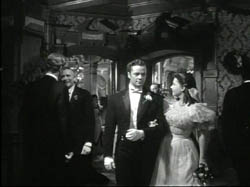
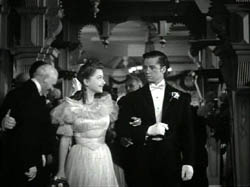
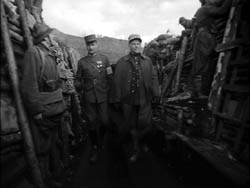
When location shooting became more common in the 1940s and 1950s, cameras could be supported on more versatile dollies that didn’t require track rails, and these reverse-tracking shots become a bit more common. Kubrick, highly influenced by Welles and Ophuls, captured his officers striding through the trenches of Paths of Glory (1957). Vincent LoBrutto’s information-packed book (2) tells us that Kubrick’s dolly rolled backward on the planks that the actors walked on (authentic details, as boards were indeed used in the muddy trenches). Godard’s long traveling through the office lobby in Breathless (1960) was shot from a wheelchair.
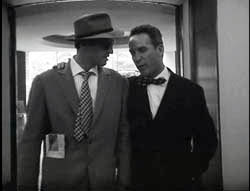
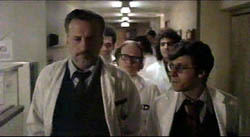
Such head-on (and tails-on) shots can be found in several films well into the 1970s, as in Arthur Hiller’s The Hospital (1970). In fact, hospitals, police stations, and other sprawling institutional spaces seem to invite this approach.
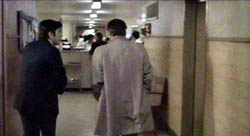
By the 1980s, these shots proliferate in American films largely because the Steadicam makes them easy. One famous example is De Palma’s Bonfire of the Vanities (1990), which follows the drunken Peter Fallow through a hotel as he picks up and drops off many other characters.
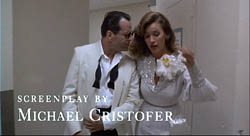
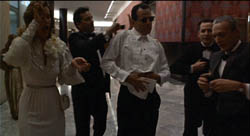
Today such shots are very common in both high- and low-budget films. Schlamme’s “signature” device seems to be in pretty wide circulation. At best it’s a convention, at worst a cliché.
They’re called actors; let them perform action
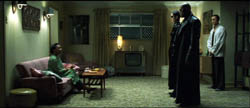
I argue in The Way Hollywood Tells It that walk-and-talk is one of two principal staging techniques of contemporary Hollywood. The other, usually called stand-and-deliver, plants the characters facing one another and simply cuts from one to the other. The scene is built primarily out of singles (shots of only one actor) or over-the-shoulder framings. Here’s a typically static dialogue scene from The Matrix Revolutions (2003).
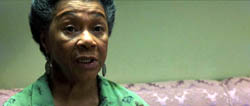
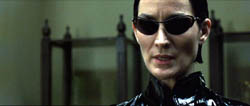
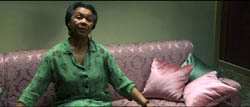
Both stand-and-deliver and walk-and-talk began in the studio era, decades ago, but then there were other options as well. Directors cultivated smooth, unobtrusive blocking tactics that moved characters in ways that reflected the developing scene. The actors had to perform with their whole bodies, and bits of business motivated them to circulate through the setting and turn toward or away from the camera. One example given earlier on this blog is from Mildred Pierce; here’s another, from the program picture Homicide (1949).
Detective Michael Landers has a hunch that the purported suicide of a former sailor is really murder. He has to persuade Captain Mooney to let him pursue some leads out of his jurisdiction. Today this might be played out in a stand-and-deliver session, with both men seated and shot/ reverse-shot cutting carrying the scene. But the director Felix Jacoves decides to let his actors earn their money through ensemble staging, not merely line readings. Here are just three shots from the middle of the scene that illustrate my point.
Landers stands at Mooney’s desk and gets a refusal. As he turns away to the left, Mooney walks to the rear files to put the papers away.
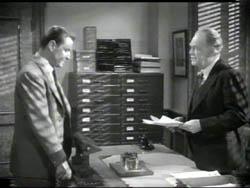
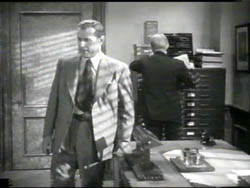
As they’re retreating to the opposite ends of the screen, Landers’ partner Boylan, who’s been offscreen for this phase of the scene, strides into the center and pauses at the door. The result of this choreography is both a balanced three-point composition and a chance to let us observe Boylan’s skeptical reaction to Landers’ next plea.
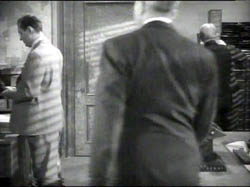
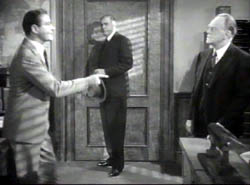
The camera tracks in as Landers approaches Mooney. Boylan shifts closer as well. What seems somewhat stagy as we analyze it doesn’t look obtrusive on the screen, because we’re following Landers’ arguments and watching the older men’s reactions. The closer framing and the position of the men, now face to face rather than separated by a desk, raises the dramatic pressure. As Landers pauses, Mooney folds his arms—a simple piece of body language that lets us know he’s still resisting.
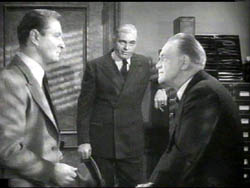
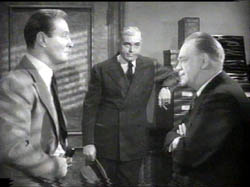
Now a cut to Mooney, in an OTS framing, stresses his continued resistance as he tells Landers off, and a reverse shot gives Landers’ angry reaction.
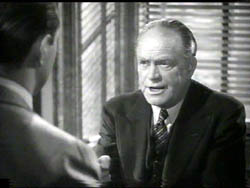
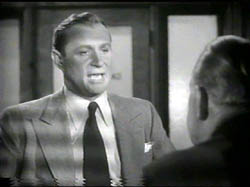
Interrupting the sustained take, the shot/ reverse shot cuts have gained more emphasis than if they were part of a string of OTS shots. Jacoves has saved his cuts and closer views for a moment that raises the stakes visually as well as dramatically.
I’m not claiming that this is a brilliant stretch of cinema. (But you have to like a plot in which the hero defeats the killer by denying him access to insulin.) It’s just that the sequence activates, in a way that directors once took for granted, aspects of film art that we don’t find too often nowadays. Once you didn’t have to choose between Steadicam logistics and static dialogue; there is a very wide middle ground if you’re willing to move actors around the set and give them some body language and prop work. No need for a walk-and-talk here.
Schema and revision
The Variety article explains that Schlamme utilizes his long walk-and-talks to save time and money. But directors in the studio era shot their fully elaborated scenes like that in Homicide to be economical as well. If actors know their lines and hit their marks, playing out pages of dialogue in a few sustained setups can be very efficient; the Homicide full shot consumes 45 seconds. I’d argue that most contemporary directors have never learned to stage scenes this way. It’s a lost skill set. I make the case in more detail in Figures Traced in Light and The Way Hollywood Tells It.
To some extent, however, another skill set has emerged. Some walk-and-talks in The West Wing and other programs have an extra feature that the Variety writer and I haven’t mentioned. Often character A and B are walking toward us down the corridor, then B drifts off and C catches up with A. A and C walk for a while, then A peels off and C picks up somebody else, and so on. This approach is suited to multiple-protagonist dramas. You can show the plotlines crossing and separating.
I’m no TV historian, but I think that this technique showed up on St. Elsewhere (1982-1988), and it’s definitely on display in ER (1994-). Hospitals again. I think we also find this mingling/ separating choreography in contemporary film, but I can’t recall many examples in earlier eras. You could argue that one of the shots in the Ambersons’ ballroom does this, though I don’t think it’s a pure instance. (The principle of overlapping character actions is at work in many Renoir films, most famously in the final party melee in Rules of the Game, but Renoir doesn’t employ what we’re calling a walk-and-talk.) Did movies pick up this intertwined walk-and-talk from TV or vice-versa? I don’t know. If you do, drop me a line!
In On the History of Film Style and Figures Traced in Light, I argue that stylistic change in filmmaking often follows a logic of what art historian E. H. Gombrich calls schema and revision. (3) A pattern or practice becomes standardized, but then creators extend it to new situations or find new possibilities in it, and they modify it.
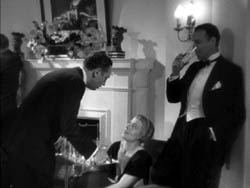
Camera movements have long been used to link characters. For instance, when Nick Charles circulates drinks in The Thin Man, Van Dyke tracks leftward to follow him from guest to guest.
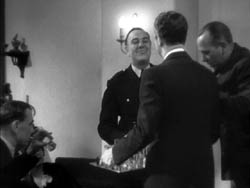
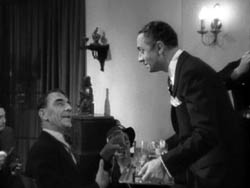
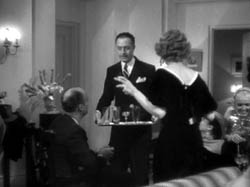
So maybe in the 1980s and 1990s, when ensemble stories had to balance attention among several major characters, directors blended the multiple-interaction aspect of lateral camera movements with the schema of the advancing walk-and-talk. The result makes characters move in and out of each others’ orbits along a single trajectory. Whoever came up with this device, I’d speculate that it arose from the realization that the backing-up walk-and-talk could be repurposed for dramas following the fates of several protagonists.
It’s only history, but it matters if we want to understand stylistic continuity and change.
(1) Thanks to Richard Maltby for passing this along.
(2) Vincent LoBrutto, Stanley Kubrick: A Biography (New York: Fine, 1997), 141-142.
(3) E. H. Gombrich, Art and Illusion: A Study in the Psychology of Pictorial Representation (Princeton, N. J. Princeton University Press, 1960), especially Chapter III.
My name is David and I’m a frame-counter
DB here:
Elsewhere on this site and in Figures Traced in Light (Chapter 1) and The Way Hollywood Tells It (second essay), I sometimes say rude things about the rapid editing in today’s films. But I’m actually a fan of fast cutting–when it’s precise, functional, and thoughtful. Most directors today don’t think about their cuts. Godard: “The only great problem of cinema seems to be more and more, with each film, when and why to start a shot and when and why to end it.”
My interest in fast cutting goes back to the 1960s, when I was first reading Eisenstein and seeing fims by Godard, Truffaut, Hitchcock, and, yes, Richard Lester. At first I would wind sequences backward and forward on a 16mm projector, stopping to pull the film off the reels to hold up to the light. For my dissertation on French cinema of the 1920s, I had a chance to examine films by Abel Gance, Jean Epstein, Germaine Dulac, et cie on editing tables or rewinds. In quickly-cut passages, the patterns of shot-length showed how a director could control the visual pace.
Over the years, when I studied 35mm film prints regularly, I periodically returned to my love of rhythmically cut passages. I studied Dreyer’s Passion de Jeanne d’Arc, the work of the Soviet Montage directors, and Asian action movies, from 1920s Japanese swordplay items to 1990s Hong Kong martial-arts sagas. Somewhat surprisingly, I found that Ozu, as in everything else, was there too; a lot of his intermediate spaces (landscapes, objects in rooms) are cut arithmetically.
By examining 16mm and 35mm prints, I could measure shot lengths in frames. In a sound film, a 24-frame shot would last a second on the screen. Things were trickier in gauging the cutting of silent films, since they were shown at rates between 16 and 24 frames per second. But at least the number of frames per shot gave me a sense of rhythmic relationships. A sequence in Jean Epstein’s Chute de la Maison Usher (1928) displays an arithmetical unfolding that would yield a distinct tempo at any projection speed of the era.
Directors have been counting frames for a long time. Experimental filmmakers like Brakhage did. Ozu had a special stopwatch built to register feet and frames during filming. Hitchcock cared about frame counting too. In Film Art‘s chapter on editing (pp. 224-225 of the new edition), we show how the gas station fire in The Birds gains impact from its steadily shorter shot lengths. The first shot lasts 20 frames, the second 18, the third 16, and so on down to 8 frames.
In sum, frame counting is one valuable way to find how a director can govern the pace of our pickup. When shots come this fast, our involvement can quicken as well.
When 35mm plays us false
For silent films, counting frames can be a problem if you have a “stretch-printed” copy. Since silent films often ran at something less than 24 frames per second (sound speed), some later film versions have been printed to repeat frames at certain intervals, to stretch out the print to 24 fps. That makes it easier to add a synchronized score to the print.
In the 1970s the Soviets were big fans of this procedure, rereleasing many classics by Eisenstein, Pudovkin, and others in stretch-printed 35mm and 16mm copies. The Soviet Montage filmmakers definitely counted frames, calculating the shots to play off each other rhythmically, so adding extra frames spoiled things. Worse, the stretch-printed versions often played sluggishly at sound speed, making the action spasmodic and blurring the figures. The result completely wrecked the rhythmic effects the directors were after. Even today, stretch-printed copies of Eisenstein’s Strike are in circulation.
Videotape and the 3:2 pulldown
Videotape arrived. The first Betavision players measured something–a little tally counter clicked away–but you couldn’t be sure what was being counted. Then came digital displays that measured hours, minutes, and seconds. But what about frames? When I tried to count frames on videotape, I found that the figures didn’t match those I got from film frames.
To see why, we have to remember that television developed its own frame rates. The technical details can get pretty daunting; see here for one account. I also recommend Jim Taylor’s DVD Demystified and Kallenberger and Cvjetnicanin’s Film into Video. Still, we non-engineers can get a general sense of what’s at stake.
There are two primary television standards, NTSC and PAL. NTSC (for National Television System Committee) is used primarily in North America and Japan. PAL (Phase Alternating Line) is common throughout Europe and Asia. Because NTSC video operates at a 60-Hertz refresh rate, the rate for individual frames is close to 30 per second. (Actually, it’s 29.97 fps.) The problem is this: Do you run 24-frame movies at 30 frames per second on television? This would make them look speeded up. Or do you pad out a second of film to fit a second of TV? American engineers took the second solution and created the so-called 3:2 pulldown.
In interlaced video, each “frame” is really two venetian-blind image fields presented as one image on your screen.(1) In the 3:2 pulldown, some film frames are selectively repeated to fill out the video playback format. The film is converted to video by making two fields from one film frame and then three from the next frame. Here is a useful diagram from a site on video transfer.
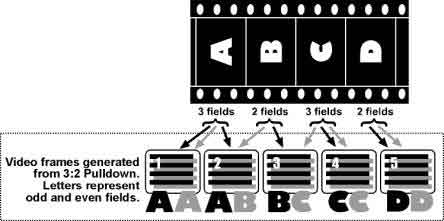
The 3:2 pulldown preserves three of the original four film frames (video frames AA, CC, and DD above).
But you don’t see this exactly this result when you jog/shuttle through a videotape frame by frame because the VCR has been engineered to display the 3:2 pulldown slightly differently. Stepping through a videotape, we find that some frames will show phases of movement and some repeat a phase. Depending on your playback machine and the tape itself, you may get varying patterns. Usually I see four video freeze-frames decomposing a movement, then they’re followed by an extra frame in which nothing changes.(2) That process turns 4 film frames into 5 display frames. Adding 6 repeated frames to the original 24 frames yields 30 video frames a second. I find that you can get a rough sense of the number of frames in the original shot by ignoring the repeated frames in the video display, but the video frames showing decomposed movement may or may not correspond to the actual film frames.
Laserdiscs and the frame count
Those heavy, rainbow-flashing 12″ discs: Cinephiles loved ’em. They gave us a sharper picture, properly letterboxed, along with terrific sound. Aficionados today still prefer the rich digital sound of laserdiscs to the compression of many DVDs.
Most laserdiscs used the CLV (Constant Linear Velocity) format, which preserved and even exaggerated the effects of the 3:2 pulldown. Counting frames meant stepping through the stills and ignoring the repeated ones, as with videotape, but often the coupled frames (AB and BC above) shivered wildly. But in the high-end CAV (Constant Angular Velocity) format, laserdiscs were able to make each stored frame pristine. This is why people thought that laserdiscs would be used archivally, for storing paintings, photographs, manuscript pages.
A bonus of the CAV format was that in transferring motion pictures to disc, one film frame could be matched to a single video frame. In fact, each film frame was assigned its own number, so the counter display spit out digits with blinding speed. During normal playback, the 3:2 repeated frames were added in, but in STEP mode, CAV laserdiscs gave you the original film frames one by one–steady, crisp, and bright. Frame-counting gained a new piece of hardware.
DVD and frame counting
Laserdiscs used optical analog technology for the image track. But consumers wanted something easier to handle, on the model of the music CD, so in came digital image technology via MPEG-2 and the DVD.
Despite all the differences between digital video and film (color, resolution, artifacts, etc.), DVDs in the NTSC format gained one advantage over tape. Like CAV laserdiscs, they could preserve the 24-frames-per-second rate of film. Essentially MPEG-2 technology encodes the film frame by frame. Flags on the DVD instruct the player to regenerate extra frames during playback. For a more detailed explanation, go to Dan Ramer’s article here.
The result is that during freeze-frame viewing, a DVD can yield the original film frames. Watch the Universal DVD of The Birds, and the frame-counts correspond to the 20-18-etc. layout we discovered on a 16mm print. Your remote’s STEP button moves through the original frames, hiding the repeated ones that were shown during normal playback.
But not always. DVDs can sometimes play us false.
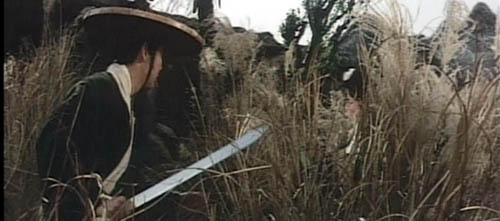
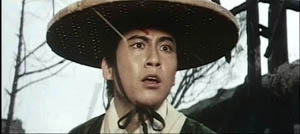
Before the DVD was a gleam in Warren Lieberfarb‘s eye, I studied King Hu’s wonderful A Touch of Zen on an editing table. There is a lot of frame arithmetic in the editing. During one swordfight, the mysterious stranger leaps away from the blows of Miss Yang and lands in a medium shot. He steps back, tipping up his face to reveal that she’s bloodied his head. He stares in astonishment. The shot lasts only 20 frames.
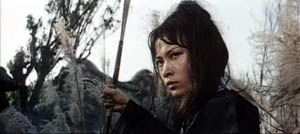
Yang stands still, holding her sword at the ready. The shot lasts a mere 9 frames, which dynamizes her stillness.
The stranger turns and runs out of frame in another twenty-frame shot. The static shot of Miss Yang now becomes an abrupt punctuation, and the stranger’s panic registers on us more sharply by being caught up in a repetitive rhythmic pattern.
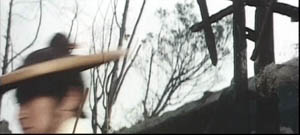
Yang plunges after him, in a twelve-frame shot.
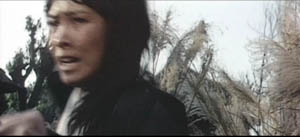
All four shots add up to less than three seconds of screen time, but they’re completely legible. It seems to me that the shots accentuate a pause in the fight by inserting a striking micro-rhythm, and then they dissolve that by letting the fighters continue the combat. Would that today’s filmmakers thought out their cuts so precisely! (If you want to learn more about King Hu’s editing style, see my Planet Hong Kong and the essay on him in the forthcoming Poetics of Cinema.)
But if you examine these shots on the US DVD of A Touch of Zen, you’ll find that the number of frames is way off from the film. The first and third shots run 25 frames each, not 20 frames; the second shot runs 11 frames (instead of 9), and the fourth 15 (instead of 12). Why? Inspection reveals our old friend, the 3:2 pulldown, at work. Improper authoring has left in the frames that should be jettisoned in step playback.
An even more severe instance: The sequence from Epstein’s Fall of the House of Usher that I admired in my dissertation days. It has become hash on the US DVD. When I try to count frames, I find that apparently the silent original has been stretch-printed and subjected to the 3:2 pulldown. When I click through the frames on a DVD player, I find that many frames are repeated, and some shots have doubled in length.
The lesson: Not all DVDs are created equal, or equally accurate in their correspondence with the original film.
What about PAL?
NTSC interlaced video has a 60-Hertz refresh rate. But PAL has a 50-Hertz one. That means not 30 video frames per second but 25. What do you do in transferring a film? The obvious answer: You speed it up.
Films shot at 24 frames per second tend to run at 25 in PAL videos, both tapes and DVDs. As a result, many films on European video run shorter than they did in the theatre, or on American DVDs. For example, Preminger’s Where the Sidewalk Ends runs 94:41 on the Fox DVD, but the same film, known as Mark Dixon Detective, runs 90:49 on the French DVD release. That’s a difference of nearly four minutes. PAL video playback of a 24 fps movie runs about 4% shorter than the original. For this reason, some European films are shot at 25 frames per second, to facilitate transfer to PAL.
So counting frames on a PAL videotape or DVD won’t necessarily mislead you on the number of frames, since none is repeated. That’s the case with our Touch of Zen example. Both the UK and the French DVDs of King Hu’s film yield the correct frame-counts for the shots in question. We just need to remember that each frame is onscreen for a tiny bit less time. In other words, each shot will contain the right number of frames, but that shot will be briefer in screen duration .
Note to Sátántangó fans: Yes, that means a much shorter movie. The PAL DVD available from England’s Artificial Eye claims to run 419 minutes; if you disregard opening and closing credits, the film runs a shade under 400 minutes. But the 35mm version I clocked here runs 434 minutes sans credits. So if you want to add 34 minutes to your life, watch the import DVD.
Note to Asian cinema fans: For reasons I don’t understand, many Hong Kong DVDs yield very blurred and vibrating still-frame images, not corresponding to the frames of the original film. These discs may be using a downmarket authoring process, or there may be problems converting to and fro between PAL and NTSC.
Progressive scan
This all applies to interlaced video, the original television broadcast format. Now we have progressive-scan video, for plasma and LCD displays and computer monitors. A progressive display, still adhering to the 60-Herz standard, is rigged to preserve the right number of film frames without repeating any.
But it does so by in effect combining two film frames together, and the step function may skip over several frames, or create a blurred composite that isn’t there on any frame. This is especially apparent on media-player computer software.
When I run my Touch of Zen shots on my computer, I get wildly abbreviated frame-counts in Step mode. In WinDVD, for instance, the first shot of the UK DVD registers as 8 frames, not 20; the second as 3 frames, not 9; the third as 9 frames, not 20; and the fourth as 6, not 12. Same thing for Epstein’s Fall of the House of Usher. On a tabletop DVD player there are more frames than in the original film; on my player’s software, there are fewer.
For this reason, I’d avoid trying to count frames on a computer’s media player.
So…..
Frame-counting is a nifty tool for discovering some secrets of filmmaking, but when we work from a video copy, we need to keep in mind the constraints of the various formats. And whenever possible, check the film!
(1) To complicate things, the scanning of alternate raster lines never yields a single complete frame. Before the image is fully completed at the bottom, it’s being refreshed at the top! To this extent, the video frame doesn’t have the stable, singular identity of a film frame. It can be encoded to correspond to a film frame, but as an image display, even a frozen frame is always in the process of being filled in. It’s just that our eyes, not designed to track such small-scale processes, are fooled.
(2) A quick sampling of my old VHS tapes shows that occasionally a tape doesn’t exhibit effects of the 3:2 pulldown. My Facets VHS copy of Where Is the Friend’s Home? plays back on two machines without any repeated frames. Perhaps this comes from making the transfer from a PAL master tape?
From Hollywood to Atlanta to us
DB here:
Some day Ph. D. students will be writing dissertations on the contribution of Turner Classic Movies to US culture. I’d argue that Ted’s baby is as important to our collective sense of cinema history as the establishment of the Museum of Modern Art Film Department was.
As a movie fan, I’m overwhelmed by the chance to see so many of my favorites for the cost of monthly cable. As a film researcher, I find myself feeling as if a film archive dumped a dozen movies on my front lawn every morning. In 1990, my colleagues and I would’ve killed for the opportunity to see this stuff, and now it’s whizzed to us at home. “Seven Brides for Seven Brothers again?” some of us sigh. We are so spoiled.
 To refresh his core MGM-RKO-WB titles, Turner showcases items from Columbia, Paramount, Goldwyn, and other studios. The channel has become an eternal college course in cinema, with no exams or papers and all viewers happy to earn a perpetual Incomplete.
Why mention TCM now? Because I’m especially wrought up by what’s on offer over the waning days of January. Every day boasts many classics, so I’ll mostly skip mentioning all the fine standbys that they’re running. Here are more offbeat things I’m up for, most of which I haven’t seen.
Overturning centuries of Western tradition, TCM defines a new day as starting at 6:00 AM. Sounds reasonable to me. But check for local playing times.
Jan 21: Stolen Moments (1920): I don’t get Rudolph Valentino’s appeal, but any film from this era demands a look.
Munchhausen (1943) A textbook classic from the Nazi cinema.
Jan. 22: The Legend of Lylah Clare (1968): Trashy premise + Kim Novak + Robert Aldrich = must-see.
Jan. 23: A cornucopia. I’ll just keep the recorder going all day for:
The Black Book (1949): As oddball a film as Anthony Mann ever made, with John Alton’s pitch-black scenes turning the French Revolution into a noir nightmare. Forget the commercial DVD, evidently ripped from a 16mm print; the TCM version should look better.
Gangster Story (1959): Walter Matthau starred and directed this NYC low-budgeter.
The Guilty Generation (1931): From Rowland V. Lee, endless supplier of B’s.
The Criminal Code (1931): Excellent Hawks with Karloff. Bogdanovich paid tribute to this in Targets.
A string of Boston Blackie films, from 1941-1942: I remember this popular B series from TV syndication in my childhood. Fast-paced and punchy, with direction by Robert Florey, Edward Dmytryk, Michael Gordon, and the prolific Lew Landers.
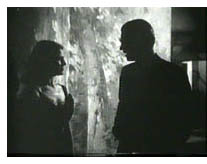 Angels over Broadway (1940; on right): Mostly shot in one nightclub set (in the Astoria studio?), a murky drama signed by Ben Hecht and Lee Garmes. Douglas Fairbanks Jr., Thomas Mitchell, and a young Rita Hayworth fill out sober long takes.
The King Steps Out (1936): Hard-to-see von Sternberg.
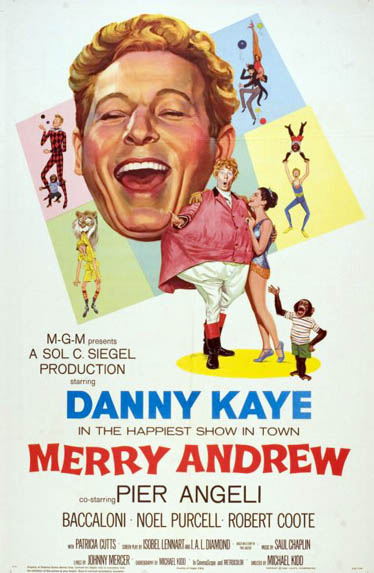
Jan. 24: Of course you’ll watch La Strada, Detective Story, The Big Carnival, etc. if you haven’t seen them. Me, I’m poised to record Merry Andrew (1958), a CinemaScope vehicle featuring Danny Kaye as an Oxbridge archaeologist. The film contains another unexorcizable ghost from my childhood, the song “Everything is Tickety-Boo.” What’s tickety-boo? Canadians know.
Jan. 25: Lots of prime stuff, including Experiment in Terror, Anatomy of a Murder, Dead Heat on a Merry-Go-Round, The Caddy, and several classic MGM musicals.
Jan. 26: A day devoted mostly Paul Newman and Paris, but there’s also:
The Killer Is Loose (1956): Boetticher. Say no more.
To Paris with Love (1955): Robert Hamer, director of the Ealing classic Kind Hearts and Coronets, gave us this, starring Alec Guinness, one of cinema’s finest and most modest actors.
A drive-in horror double bill courtesy William Beaudine: Billy the Kid vs. Dracula (1966) and Jesse James Meets Frankenstein’s Daughter (1966).
Jan. 27: Of course you’ll see, if you haven’t, Gunga Din, The Yearling, The Naked Spur, The Manchurian Candidate (kinda overrated, methinks), The Spy Who Came in from the Cold (kinda underrated), The Quiet American, etc. But there’s also:
The Last of the Mohicans (1935): This, rather close to Michael Mann’s later version, I remember as being pretty solid.
A Bullet for Joey (1955): Edward G and George Raft in their sunset years; can it be bad? Okay, it can, but I’m still going to check it out.
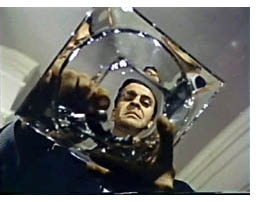 Jan. 28: Among much good stuff, including the still poignant Umbrellas of Cherbourg, I’ll be targeting Dragnet (1954), a nifty, seldom seen feature by that unique genius Jack Webb. How often do we get an ashtray’s-eye-view of a scene? Does this cablecast portend a DVD release?
Jan. 29: It’s teen dance music till prime time: Bop Girl, Rock around the Clock, Don’t Knock the Rock, Don’t Knock the Twist, Don’t Rock the Twist, Don’t Twist My Rock, etc. Might just as well keep the recorder rolling… and rocking!
Today’s outstanding piece of esoterica is The Show (1927). Every year or so I’ve been writing TCM to ask them to play this strange item from the agreeably warped Tod Browning. Let’s just say that John Gilbert plays Cock Robin and Renee Adoree plays Salome, with Lionel Barrymore chewing the scenery as the villain. Other attractions include cuckoldry, decapitation, and murderous iguanas. With a new score from TCM’s highly laudable Young Composers competition.
Jan. 30: Of course you’ve seen Ford’s stunning Arrowsmith, Pressburger’s Life and Death of Colonel Blimp, This Happy Breed, Shane, His Girl Friday, etc. But don’t forget:
The Clairvoyant (1935): the relentlessly prolific Maurice Elvey, doyen of Brit good taste, directs Claude Rains (ditto) and Fay Wray.
Strike Me Pink (1936): Eddie Cantor isn’t for all tastes, but I want to give this one a chance.
Raffles (1939): I’m a sucker for gentleman-thief stories, and with Gregg Toland as cinematographer, Sam Wood may indulge his Gothic streak, so memorable in Our Town and Kings Row.
Jan. 31: Not as strong a day as yesterday, but I’ll be checking on This Could Be the Night (1957), helmed, as they say, by Robert Wise and starring the radiant Jean Simmons (another adolescent fascination of mine), and Mitchell Liesen’s The Mating Season (1950), written by Charles Brackett and starring the fascinatingly blank Gene Tierney.
February, devoted to Oscar pictures, doesn’t contain so many marginal items, but still it’s a cornucopia of outstanding movies.
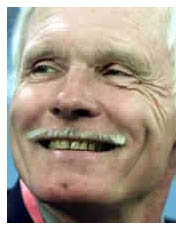
Controversial as he is, Ted Turner has proven a generous mogul, both politically and cinematically. Forget colorization! That was a bogus issue, and anyhow, for every colorized title a spanking fine-grain positive was made for archival preservation. Turner has done more than any single person to sustain and publicize the American film heritage, and he’s made it available to everyone within reach of cable. You can read more about Ted in Ken Auletta’s brisk and chatty biography.
Dorothy’s rainbow comes to earth at TCM. Watch regularly. Check the website for extra stuff, and browse the 150,000 film database. Buy the monthly program guide; it’s only twelve bucks. While you soak up the pleasure, pause to pity the cinephiles overseas. Their version of TCM, hedged by rights holder restrictions, offers mere crumbs from our bursting banquet table.
PS: Since I first posted this, film historian Doug Gomery has pointed out that Turner hasn’t controlled TCM in 12 years, but both Time-Warner bosses Gerry Levin and Dick Parsons have kept it going. We owe them thanks for refusing to ‘AMC’ it with commercial breaks and dopey gimmicks. Fortunately it makes money for TW. Long may TCM prosper.
PPS as of 23 Jan.: Lee Tsiantis of the Turner Entertainment Group adds that credit also belongs to Jeff Bewkes, who among other duties oversees the channel. So a big thanks to him as well.