




Archive for the 'Film technique' Category
Updates and outtakes (in which we try, perhaps in vain, to catch up with ourselves)
Exiled
Kristin writes:
“The Hobbit Film: New Developments” (January 13, 2007)
In this entry I discussed Bob Shaye’s recent claim that Peter Jackson would never get a chance to direct The Hobbit for New Line. I mentioned that one of the factors involved in the negotiations about who would direct is that the production rights will eventually revert to producer Saul Zaentz. I didn’t know the length of the option on those rights, which New Line currently holds. The January issue of the fantasy/sci fic magazine Locus says that the rights will revert to Zaentz in 2009.
Zaentz had owned the rights since the mid-1970s and sold them to Miramax in early 1997. Miramax had the two-film version of The Lord of the Rings in pre-production for about 18 months and then sold the rights to New Line in August of 1998. I don’t know what the source of Locus’ information is, but a twelve-month option would seem pretty plausible.
If that information is correct, New Line only has about two years to get the actual making of the film underway. It takes years for any big film to lumber into production in Hollywood these days, so the studio doesn’t have a lot of room to wiggle.
“By Annie Standards” (December 14, 2006)
Here I talked about methods for publicizing animated features. One way, I suggested, would be to foster audience interest in the various animation awards other than the Oscars. I remarked, “Under Academy rules, only three animated features can be nominated in any year unless sixteen or more such features are released that year. Then the number of nominations jumps to five, but so far that hasn’t happened. It may finally happen this year, if all sixteen features currently under consideration qualify under Academy rules.”
Close, but not close enough. On January 11, Variety announced that one film, Luc Besson’s Arthur and the Invisibles, had been disqualified as an animated feature. To qualify, a film must have at least 75% animated footage, and Arthur has too much live action.
With the number of qualifying features down to fifteen, only three can be nominated. Probably Cars will win, as I predicted in the original entry. It just won the Golden Globe in the newly established Animated Film category.
“Snakes, No, Borat, Yes: Not All Internet Publicity Is the Same” (January 7, 2007)
Here I suggested some reasons why Snakes on a Plane failed at the box office and Borat: Cultural Learnings of America for Make Benefit Glorious Nation of Kazakhstan succeeded, despite the fact that both garnered considerable fan-generated publicity on the internet. I mentioned that Sacha Baren Cohen had appeared on talk shows in character as Borat rather than in persona proper: “Each appearance by “Borat,” supposedly there to talk about the film, ended up being a hilarious performance by Cohen, ad-libbing on everything around him—the chairs, the coffee mugs, the cameras, the audience. Spectators ended up with one impression about the film: it was about this incredibly funny guy doing incredibly funny things.”
Trying to correct the widespread assumption that Borat was an improvised film, the January 8-14 issue of Variety ran a story about how Cohen worked with three scriptwriters, Peter Baynham, Dan Mazer, and Anthony “Ant” Hines: “The scribes even concoct Cohen’s dialogue for his promo appearances on ‘The Tonight Show’ and ‘Live With Regis and Kelly.’” Although Cohen presumably ad-libs to meet specific circumstances of each talk show, the publicity appearances are even more controlled by Cohen than I had assumed.
I also remarked that it is difficult to judge the degree to which the film manipulated the scenes of Borat’s encounters with real people. Especially in terms of editing and sound techniques, there was clearly much opportunity for this manipulation. The same Variety story goes on to say, “Much of the script had to be altered depending on how situations unravel. This means the writers ultimately end up producing the equivalent of multiple scripts, much of which ends up on the cutting room floor.” I’m not sure how chunks of scripts can end up on the cutting-room floor, but the point is that the filmmakers were carefully stitching the “documentary” scenes together on the script level and presumably would do so through stylistic means as well.
David writes:
Back to the Hotel
The Uchoten Hotel (aka Suite Dreams, blogged here) has acquired yet another English-language title: Hotel Avanti. It made it to #93 on Variety‘s list of the world’s 100 top-grossing films, with $51 million box office in Japan and none yet recorded overseas.
Speaking of Variety‘s list, the highest-grossing non-English language item turns out to be Bong Joon-ho’s Korean hit The Host (#59 at $84 million), due out in the US any month now. Only ten non-English-speaking films made the top 100, and of those, three were European (including Volver) but all the rest were Asian: Chinese (Fearless), Korean (The Host and King and Clown), and Japanese (Tales from Earthsea, Umizaru 2 Limit of Love, Hotel Avanti, and Japan Sinks–no rude remarks, please).
The entire list is in the 15-21 January hard copy of Variety, p. 15, but evidently it isn’t yet available on the paper’s site.
More on Johnnie To
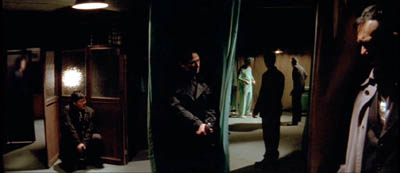
In an earlier blog I praised Johnnie To as a director who shot and cut PTU smoothly and crisply. I waited through the fall, hoping somehow to see To’s latest, Exiled, on the big screen at one festival or another. No such luck. So last night I broke down and watched the DVD. Making full use of the widescreen format, To shows that classic technique can be at once rigorous and imaginative.
Exiled was more visually engaging than any US film I can recall last year, including Miami Vice. It immediately became my Best Film of 2006 That I Saw in 2007. (Runner-up: Children of Men.) I visited Milkyway while the film was being shot, and I hope to blog about the result in a future entry.
At Large on the Internets
On this very site, I’ve posted a new essay on action movies.
Annie Frisbie interviewed me for the Zoom-In podcast here. Annie is also blogging/reviewing Sundance films here.
Fox Independent visited Madison and posted videos on its site. The setup and the interview with filmmaker and teacher Erik Gunneson are here. An interview with me is here.
Shot-consciousness
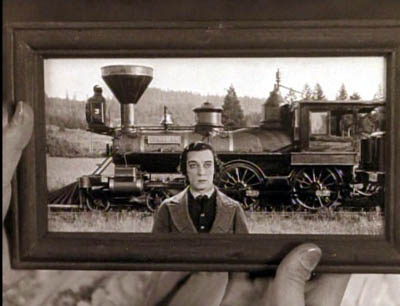
Most professional critics seem uninterested in the film shot as a shot. They might notice when the images call flagrant attention to themselves, as in Zhang Yimou’s recent films, or in those protracted walk-and-talk Steadicam takes. On the whole, though, reviewers prefer to talk about plot and acting.
Granted, it’s hard to be aware of shots, especially if you get engrossed in the story. But if we want to be fully alert to how movies work on us, we should keep our eyes open. Back in 1968, I read The Moving Image by Robert Gessner, one of the first teachers of cinema studies in the US. There Gessner offered a sturdy piece of advice: Be shot-conscious.
About twenty years later, trying to be shot-conscious and all, I started to notice a certain type of image becoming more common, especially in European and Asian films. Then it started to appear in US films as well, especially indie items. Now it’s very common everywhere, though it’s still not the predominant sort of shot.
Here’s a fairly early example, from R. W. Fassbinder’s Katzelmacher (1969).
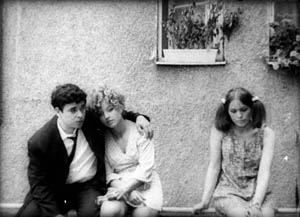
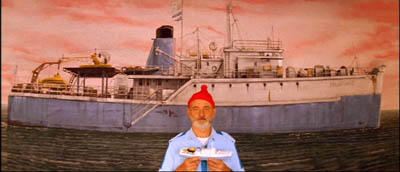
How to characterize it? The camera stands perpendicular to a rear surface, usually a wall. The characters are strung across the frame like clothes on a line. Sometimes they’re facing us, so the image looks like people in a police lineup. Sometimes the figures are in profile, usually for the sake of conversation, but just as often they talk while facing front.
Sometimes the shots are taken from fairly close, at other times the characters are dwarfed by the surroundings. In either case, this sort of framing avoids lining them up along receding diagonals. When there is a vanishing point, it tends to be in the center. If the characters are set up in depth, they tend to occupy parallel rows.
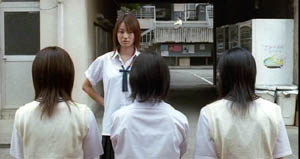
Linda Linda Linda (2005)
No one to my knowledge had noticed this sort of shot, let alone named it. I started to call it mug-shot framing, but I found that art historian Heinrich Wölfflin had called it planar or planimetric composition. I went with “planimetric” because that term suggests the rectangular geometry so often seen in these shots.
What’s striking is that such imagery is quite rare before, say, 1960. We can find some examples, principally in silent comedy and especially the films of Buster Keaton (himself a pretty geometrical director). But in the 1960s, we find Antonioni and Godard using planimetric shots fairly often.
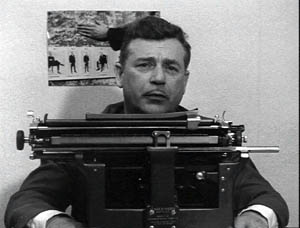
Vivre sa vie (1962)
This image design became more popular from the 1970s onward. Why? In On the History of Film Style and Figures Traced in Light, I tried to trace out some sources and functions of it. Briefly, I think that the planimetric shot emerged from filmmakers’ growing reliance on long lenses, which tend to create a flatter-looking, more cardboardy space than wide-angle lenses do. A telephoto shot makes an image seem less voluminous. It seems to be made of slices of space lined up one behind another.
Filmmakers began using long lenses for many purposes, often because of the demands of filming on location. And some directors realized that long-lens optics offered fresh resources for staging and composition.
For instance, the planimetric scheme is well-suited to a “painterly” or strongly pictorial approach to cinema. In Figures, I discuss two directors who made planimetric shots central to their style. Hou Hsiao-hsien saw very deeply into the possibilities of these shots; I think he learned it from his early skill at shooting on the street with long lenses. You can find more about that here. By contrast, Angelopoulos used the planimetric image in conjunction with architecture and landscape to create a sort of de-dramatized spectacle, a spare grandeur reminiscent of icon painting.
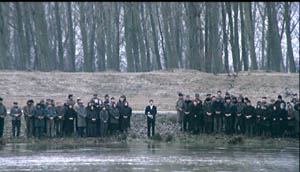
The Suspended Step of the Stork (1991)
The functions of the planimetric image can vary a lot. Often it’s used to suggest stasis and passivity, as in the Katzelmacher instance. Kitano Takeshi picks up on this sense of torpor in certain shots of Sonatine, which suggests that being a gangster means having a lot of time to kill just hanging out.
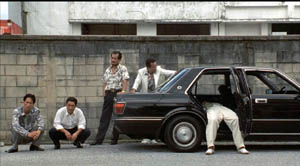
Kitano’s use of the image also suggests a kind of childish simplicity or naïve cinema. Unlike Hou and Angelopoulos, Kitano uses the planimetric schema as if it were just the most basic way to film anything. Line up your characters and shoot ’em, as if they were figures in South Park or Cathy.
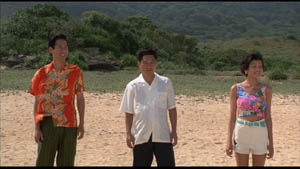
Kitano has compared himself to the kamishibai man, the street performer who narrates stories for children by flipping through illustrated cards, and Kitano’s paintings are more sophisticated, often planimetric versions of those drawings.
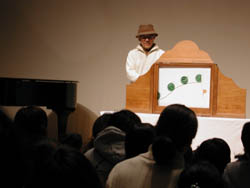
The planimetric schema can suggest something more oppressive too. That’s one purpose, I think, of certain shots in Terence Davies’ remarkable Distant Voices, Still Lives. The film’s stylistic system is quite rigorous in its use of straight-on compositions, and it’s worth more attention than I can give it here. For now I’ll just mention that the first part presents tableaux of unhappiness that suggest bleak family portraits.
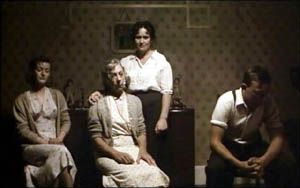
Here and more generally, the planimetric image often carries the connotations of a posed photograph. Possibly the dry, rectilinear imagery of Walker Evans and the wide-eyed attitudes of Diane Arbus’s portraits have contributed to the sense of stiff ceremony such shots sometimes have.

Walker Evans, Roadside Stand Near Birmingham (1936)
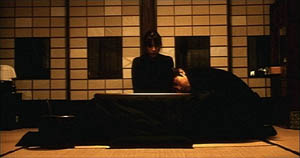
Asian filmmakers combined the planimetric image with very long takes. In Kore-eda Hirokazu’s Maborosi, Yumiko’s husband comes home drunk, a slip from his usual reliable habits. She has just been remembering her previous husband, dead in a bike accident. The rocklike stability of the shot, aided by the grid backing the characters, throws every gesture into relief, particularly when Yumiko’s face lifts slightly into and out of shadow in the course of the action.
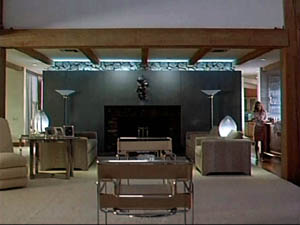
In the 1990s US indie filmmakers adapted this staging strategy. In Safe, Todd Haynes uses it to suggest the hard-edged sterility of the wife’s suburban life, which surrounds her with cubical furniture.
Wes Anderson used the image schema occasionally in Bottle Rocket but came to rely on it more and more. (He tended to use wide-angle rather than longer lenses, though; note the bulging effect in the Life Aquatic shot below.)
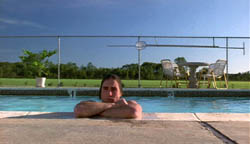
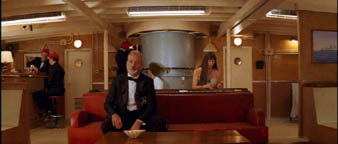
For Anderson, as for Keaton and Kitano, the static, geometrical frame can evoke a deadpan comic quality. This comes out as well in Jared Hess’s Napoleon Dynamite.
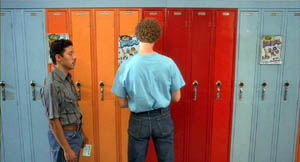
Initially, this scheme also helped filmmakers distinguish their work from Hollywood. Mainstream American films tend to film players in 3/4 views, except for certain situations, such as a theatrical performance or a scene showing a mammoth image display.
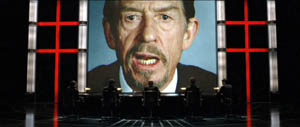
V for Vendetta (2005)
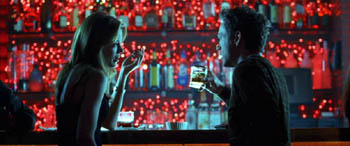
Some American directors seem to have used the planimetric shot decoratively, as a nifty one-off touch, as here in Kiss Kiss Bang Bang.
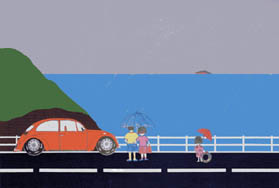
Many overseas directors who rely on this schema adjust their cutting accordingly. In Figures I called it compass-point editing. The usual tactic is to follow one planimetric shot with a reverse shot that’s also planimetric. In the first four shots of Kitano’s A Scene at the Sea, the camera angle switches either 180 degrees or zero degrees.
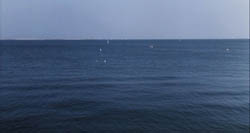
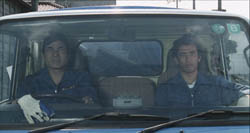
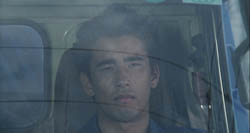
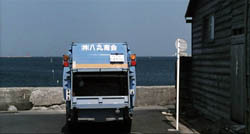
When I asked Kitano why he cut this way, he gestured toward me, then at himself. “When we are speaking, this is the way we look toward each other. It’s the most natural way to show a conversation.” Apparently this is why over-the-shoulder shots are pretty rare in Kitano’s films.
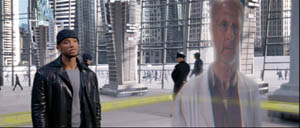
Planimetric shot/ reverse shot is seldom used in Hollywood films, and it seems to be reserved for certain confrontational situations, or institutional scenes (e.g., doctor/ patient conversations). It can sometimes suggest an unnerving or unnatural encounter, as in I, Robot. The detective Spooner is calling on his old friend Dr. Lanning, and their dialogue is shot in to-camera medium-shots.
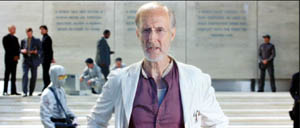
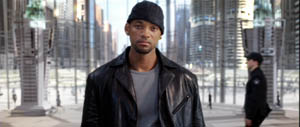
At the climax of the conversation, the camera takes up a 3/4 position and arcs around Lanning, revealing him to be only a hologram, presenting his dying message to Spooner. The planimetric image is motivated as suitable for a flat, virtual presence.
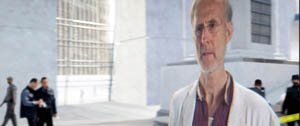
Proyas has cleverly prepared us for this subterfuge by ending the previous scene with an unremarkable planimetric framing on Spooner as elevator doors close on him.
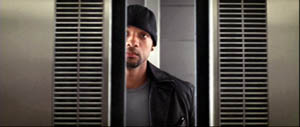
This shot leads directly to the initial shot of Dr. Lanning above, apparently addressing us, in a sort of shot/ reverse shot cut across two scenes.
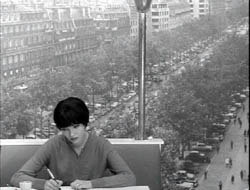
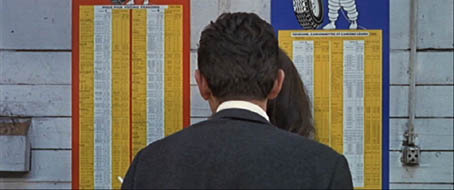
As we might expect, Godard, who helped disseminate the schema, is all up for upsetting it, in Vivre sa vie and Made in USA. The first shot below teases us to read the flat background as a high-angle vista; the second carries the idea of a conversation in a planimetric frame to a beautiful absurdity.
My quick survey doesn’t exhaust the various forms and uses of this strategy. I just wanted to show how shot-consciousness can lead us to notice when filmmakers take up new pictorial tools and modify them for particular purposes.
Can they make ’em like they used to? continued

DB here:
In the wake of discussions of The Good German, on this site and elsewhere, the idea of a retro-looking movie has surfaced again. American Cinematographer‘s coverage of Casino Royale is very intriguing.
Phil Méheux, the cinematographer, decided that the opening sequence, a black-and-white passage showing Bond earning his 00 status, would pay homage to 1960s Techniscope. Techniscope was an optical process that produced 2.35:1 images without anamorphic lenses. It allowed great depth of field because it could take advantage of the wide-angle lenses available for non-anamorphic cinematography. The most familiar Techniscope images are probably those in Sergio Leone’s westerns.
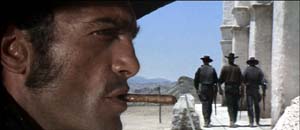 For a Few Dollars More.
Mehaux explains what he wanted for Casino Royale:
With Techniscope, the increased depth of field meant they were able to put things like lampshades and telephone boxes in the foreground, and they didn’t appear amoebic–you could actually see depth in them. In The Ipcress File, there’s a shot where a table lamp is huge in the frame and a man’s face is in the top right-hand corner. I really like that look. Part of the dialogue in our opening sequence was done with very carefully controlled shots that have huge things in the foreground and faces pushed to the corners of the frame. Little things like that echo the Cold War period of spy films.
But, but….
1. In the print of Casino Royale I saw in my local, the opening office scene didn’t really exploit sharp-focus foregrounds. There weren’t that many objects in the foreground, and they weren’t in discernible focus. Of course the cutting was so rapid that it was hard to concentrate on foreground/ background relations.
2. It’s fall of 1965, in Albany, New York. A film geek literally fresh off the farm is in his freshman year of college and goes to every movie in town. He sees The Ipcress File not once but three times. He’s fascinated by its flamboyant technique. He’s just seen Citizen Kane, so he’s impressed by deep staging and big foregrounds in this unheralded spy pic.
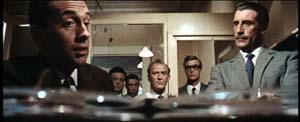
There’s even wilder stuff: a murder victim seen through a hanging lamp, for example.
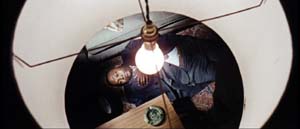
The Geek reads up on long lenses, wide-angle lenses, and so on. Knowing nothing about Techniscope, he wonders how these extravagant shots got made. Just as important, why are they here (apart from looking cool)?
(Spoilers coming up. Skip to 3 if want to retain your innocence.)
After a couple viewings, the Geek begins to get a hunch about what those lampshades are doing there. Throughout the movie, actors are shot in juxtaposition to looming shapes–doors, lecterns, tabletops–which mask large stretches of the set.
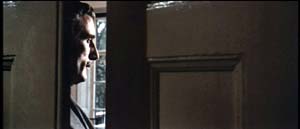
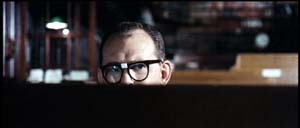
And sometimes those blocking objects are lampshades.
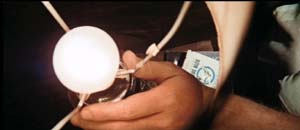
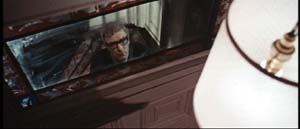
At a climactic moment, our hero escapes from torture and calls his superior officer, who’s framed in the usual off-center way, with a lampshade dominating the shot. It works as a sheer (and pretty) block of solid color.
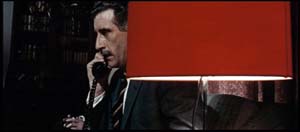
Turns out, however, that this time the shade actually conceals something important. The officer withdraws behind the shade and out pops a guest sitting alongside him.
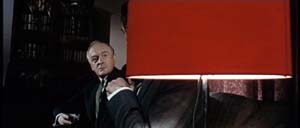
The guest is the arch-villain. Now we know the officer is a traitor.
The Geek dimly realizes three things.
*A movie sets up visual “rules” it will follow or violate. (Later the Geek will call these intrinsic norms.)
*Visual motifs build up across a film, sometimes asking the viewer to notice them.
*A motif can seem gratuitous but that very gratuitousness can be exploited for storytelling purposes. When we see the red lampshade, we assume that it’s another decorative flourish, not a way of hiding information. Earlier sequences suggest that the device is a mannered tic but at the climax it helps spring a surprise. Motifs, the Geek would realize eventually, can fulfill narrational functions–that is, motifs can shape the ongoing flow of story information.
3. Sidney J. Furie was considered a showoffish filmmaker. Michael Caine said he belonged to the look-Ma-I’m-directing school. Certainly the outrageous compositions involving Marlon Brando’s sombrero in The Appaloosa back up that charge.
But like Richard Lester, Ken Russell, and other fancy-pants pictorialists, Furie can at least get us to notice technique. Not bad to cut your cinephile teeth on. Or at least so the Geek thinks, forty years afterward.
4. The AC article also talks about the problem of making poker games interesting. Hong Kong filmmakers figured this out long ago. Martin Campbell, director of the new 007 adventure, should study the crisp card sequences in Wong Jing’s God of Gamblers series. Filmed on a minuscule budget, they put the strained and blandly shot poker scenes of Casino Royale to shame. Incidentally, Wong’s use of diopters yields the sort of nifty depth that Meheux liked in Ipcress.
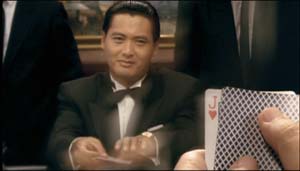 God of Gamblers.
PS: Casino Royale didn’t learn the lessons of the 1960s well enough, in my view. After the sparkling opening credits, it was all downhill. The usual problems: overcut scenes, overcloseupped acting, incoherent chases and fights, uninspired dialogue you recite just before the actor says the line. One landing-strip truck fracas amalgamates Road Warrior, Raiders of the Lost Ark, and Die Hard 2. The makers have indeed updated the Bond franchise. After a series of lame 1970s-looking movies, the franchise has given us a lame contemporary-looking movie.
Granted, I never cared much for the Bond pictures. The Geek liked From Russia and Goldfinger, and Diamonds Are Forever is enjoyable in its wacko way. But for Machiavellian intrigue, Fritz Lang’s Spies remains the gold standard. No one can make ’em like he used to.
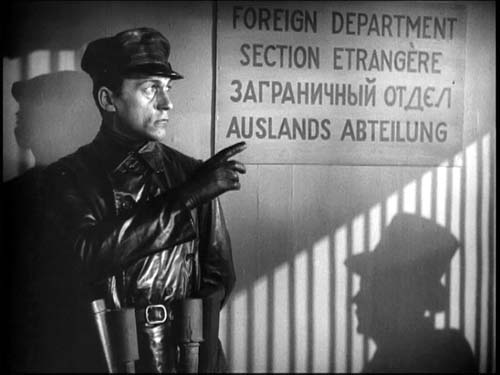 Spies
Spies
Another pebble in your shoe
DB here:
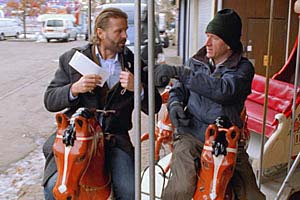
“Life is a Dogme film. It’s hard to hear, but the words are still important.” This is one of the many in-jokes peppering Lars von Trier’s The Boss of It All, his newest feature. I watched it while preparing an essay for the Danish Film Institute, which superbly promotes Danish cinema to the world. But I wasn’t ready for what I saw.
It’s a comedy, of course, with a classic bait-and-switch premise. For shadowy motives, a corporate lawyer entices an idle actor to pretend to be the superboss whom the IT staff has never met. Unfortunately, through emails to the staff, the lawyer has constructed a persona for the boss–in fact, several personae, a different one for every worker. Our actor must play many parts before finally, in a series of reversals, he gets to “find” the real character.
In tone, the film is as mixed as most von Trier works, hovering between sympathy for idealistic underdogs and a sour realization that they will always be victims. It reminded me somewhat of Kaurismaki and the Fassbinder of Fox and His Friends. But the film is a breezy piece of work; nothing really serious faces his innocent here. There’s a lively satire of the corporate world, mocking management catchphrases du jour (not outsourcing, we’re told, but offshoring) and touchy-feely hugging. The hostile incomprehension between Denmark and Iceland provides some good gags too. Von Trier also pokes fun at actors, perhaps invoking his well-publicized feuding with divas like Kidman and Björk. Our hero/loser Kristoffer is a sort of Method man, but he learns that he gets the best results through shameless sentiment.
Here the words are important–it’s a very talky movie–but so are the pictures. Shot in 16mm in available light, The Boss breaks with von Trier’s normal commitment to handheld camerawork. Except for some interpolated crane shots outside the office building, the camera never moves, not even panning. But the image is constantly being refreshed through incessant cutting (there are over 1500 shots). The film boasts more jump cuts than Breathless or Matchstick Men, and each one creates a bump. There’s very little sound overlap between shots–the ambient noise usually drops out for a fraction of a second–and there are often visual mismatches, so (as in The Idiots), nearly every cut feels like an ellipsis. A film, von Trier has said, should be as irritating as a pebble in your shoe, and his abrasive tempo gives his comedy an anxious edge.
Then there are the very peculiar framings. Here’s a string of three brief shots from the first scene, with continuous dialogue (in gappy duration). The lawyer is trying to persuade the actor to perform as the boss.
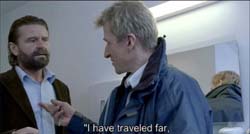
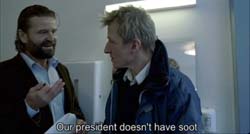
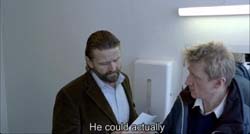
(Yes, these are three separate shots, not three stages of one wobbly shot.)
These cuts break the so-called 30-degree rule, which mandates that if you’re cutting to different angles on the same subject, your second angle should vary by at least 30 degrees from the first. In addition, the later off-center compositions seem gratuitous; why not just sustain the first shot, since the next two hardly vary from it? Sometimes you get results like this.
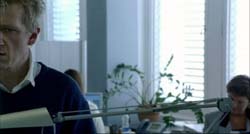
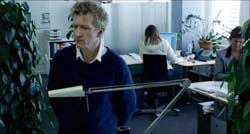
It turns out that there is method to the madness, although the method, granted, is a bit mad. You can read about Automavision here, if you want to know in advance why the movie looks this way. But if you want to be as startled as I was, refrain. Let’s just say that von Trier’s famous 100-camera technique of Dancer in the Dark has been repurposed in a pretty unexpected way. And don’t believe what he says about surrendering to chance; the cuts are often very careful.
Whether you do your homework in advance or not, you’ll probably enjoy The Boss of It All. After my criticisms of editing in The Departed (which made me seem to be raining on the Scorsese parade) and my comments about classical principles of coverage, I’m happy to report on a film which offers something new and strange. The vivacious Danish film culture makes a space for von Trier to set up creative obstructions, for both himself and his viewers.
Postscript: Since I wrote this, von Trier announced that he’s added more tricks to his bag. Turns out that The Boss of It All employs Lookey, a game that challenges the viewers to spot objects that don’t belong in a scene. “For the casual observer it’s just a glitch or mistake,” he says, “but for the initiated it’s a riddle to be solved.” The purpose is to keep viewers alert and active. Film’s great flaw, he claims, is that “it’s a one-way medium with a passive audience.” Lookey, however whimsical, fits well with the agitating effects of the cut and sound dropouts.
The first viewer in Denmark to identify all the Lookeys correctly wins a cash prize and a chance to be an extra in von Trier’s next film.
PPS: Thanks to Vicki Synott of the Danish Film Institute.
PPPS 28 December: I just discovered a frisky website devoted to Nordic filmmaking, where Mirja Julia Minjares has gathered some interesting quotes from von Trier and his sound recordist Ad Stoop. Von Trier says that the computer program also selects for sound gain and filter. Adds Stoop: “When a computer program chooses the settings for the sound and cinematography between each shot, every edit gets underlined in the finished film.”
PPPS 31 December: Check perceptual psychologist Tim Smith’s blog for more insights into von Trier’s games with continuity editing.
–dB