





Archive for the 'Film history' Category
Daisies in the crevices
DB here:
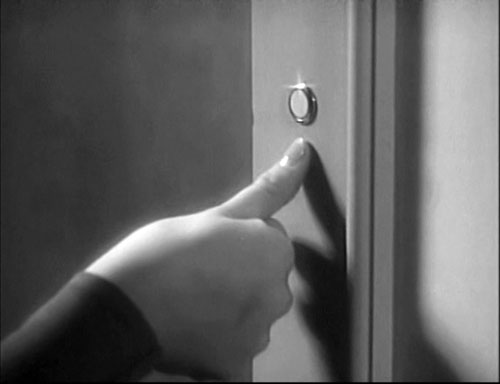
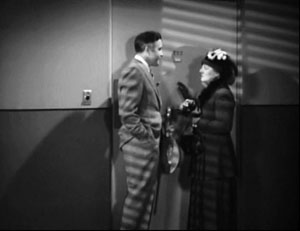
If you wanted a prototype of some unique visual pleasures of 1930s cinema, you could do worse than pick this innocuous image. It’s perfunctory in narrative terms, merely telling us that Sylvia Day is calling on Bill Smith. Beyond its plot function, though, it’s fun to see. We can enjoy the unfussy modern edge of the doorjamb, the curve of the manicured thumb, and soft highlights bringing out the hand and knuckles.
Above all, there is that starry gleam at the top of the doorbell. Who needs it? It’s just a doorbell. Why take so much trouble lighting a throwaway shot?
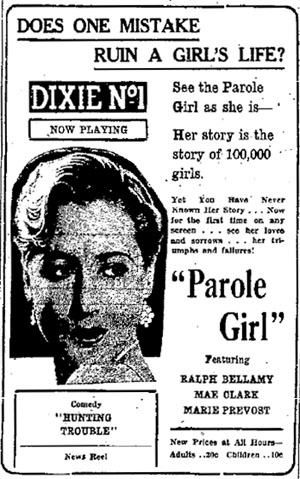
Add to this that Parole Girl (1933) is a program picture, and from Columbia, no less—the Poverty Row studio that had yet to break through with It Happened One Night (1934). We learn from Bernard F. Dick’s deeply-researched book on Harry Cohn that the budget for Parole Girl would have been about $250,000, when MGM B’s were running about $400,000. Why spend money on a shot like this?
Because that was the standard of good-looking moviemaking at the time. Most problems of converting to talkies had been solved, so films were regaining not only the fluent narration but the sparkling imagery of 1920s cinema. Under Cohn’s leadership, Columbia was trying to compete with the bigger studios’ movies, and looking classy was one way to do it. Recently I spent a day or so watching four titles, and I was reminded how pictorially sophisticated and refreshing low-end Hollywood can be. These movies also offer us an unusual window into what was already characteristic storytelling strategies of classical Hollywood. But there will be spoilers ahead too.
Welcome to 1933
As so often, I have TCM to thank. Since their Jean Arthur tribute of 2007, they have been running a generous number of Columbia titles (all restored by the master hand of Grover Crisp). By including less-known 1930s items along with classics like The Awful Truth and the Capra titles, they continue their mission of serving American film culture every hour.
Lea Jacobs has convinced me that it’s useful to think of studio releases in those days as filling a season running from Labor Day to Memorial Day rather than a calendar year. Studio heads planned budgets and production schedules according to that time frame, like network TV broadcasters now. Unlike today, summer was not a big release period, maybe because of the competition of other leisure activities, maybe because with air-conditioned movie houses people would come watch anything thrown on the screen. In any case, the big pictures were saved for fall, winter, and spring.
So my frame of reference is the 1932-33 season. Columbia ushered in the new year with its best-remembered film of the season, Capra’s Bitter Tea of General Yen (6 January). The studio probably considered Washington Merry-Go-Round (15 October), Virtue (25 October), and No More Orchids (15 November) to be A projects, but the large output of Westerns, the absence of historical pictures, and the relative dearth of stars in this output confirm the studio’s status as a Poverty Row company.
My movies come from the winter and spring of 1933. Each was shot in two to three weeks and each runs about seventy minutes.
Air Hostess (15 January, directed by Albert Rogell) tells of the daughter of a WWI ace who marries a reckless young pilot. Trying to build a new type of plane, he shops his business plans to a rich woman investor, who tries to seduce him.
In Child of Manhattan (4 February, directed by Edward Buzzell), a wealthy widower falls for a taxi dancer and takes her as his mistress. When she becomes pregnant, he marries her. But the baby dies soon after birth and the wife flees to Mexico for a divorce while the husband tries to track her down.
In Parole Girl (4 March, directed by Edward Cline), a department store executive sends a woman con artist to prison. She vows revenge. When she gets out, she seduces the executive, although he’s unaware of who she is.
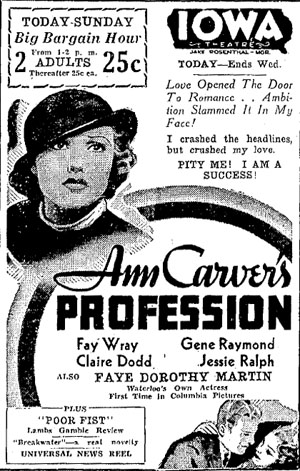
Ann Carver’s Profession (26 May 1933, directed by Buzzell) centers on a couple torn by career rivalry. After being a gridiron hero in college, the husband is failing as an architect. Meanwhile, his wife is becoming a celebrated trial lawyer. Eventually the husband leaves the household and takes up with a floozie, who winds up strangled. His wife must defend him against the murder charge.
For connoisseurs of naughty pre-Code movies, there are the usual attractions of double beds, extramarital sex, peekaboo negligees, and risqué dialogue. Child of Manhattan goes the farthest, perhaps because it’s an adaptation of a Preston Sturges play. “You’re a fascinating little witch,” says the millionaire. “Did you say witch?” the dancer asks. This is the same girl, played by perky Nancy Carroll, who thinks the man is trying to feel her up when he slips a thousand-dollar bill into her garter. Later she recalls her mother’s advice: “Never, ever walk upstairs in front of a gentleman.” And when she confesses to her Texan admirer in her mangled pronunciation, “I’m a courtesian,” he pauses and replies, “Well, religion doesn’t make any difference with me.”
Despite such pleasant moments, and two screenplays credited to Robert Riskin and Norman Krasna, these movies won’t win prizes for imaginative scripting. The tone is often uncertain, with comic banter clashing with scenes of melodramatic sacrifice. The long arm of coincidence becomes elastic. In Parole Girl, the heroine happens to meet the offending executive’s first wife in prison. During the taxi dancer’s stay in Mexico, she runs into the cowpoke who had wooed her aggressively in Manhattan. In Ann Carver’s Profession, the husband’s girlfriend accidentally strangles herself. Yes, you read that correctly.
Still, you have to give points for speed. Only Parole Girl has unusually quick cutting, at an average of 6.6 seconds per shot, but the overall pace of most of the plots is pretty rapid. (The exception is Child of Manhattan, whose lumbering dramatic rhythm is echoed in an average shot length of sixteen seconds.) Playing far-fetched action fast makes it less noticeable and more forgivable. Today any movie that can tell a moderately interesting story in a little more than an hour feels like a triumph. You can watch two of my pictures in the time it takes to groan your way through Funny People. And in these movies, the opening credits flash by in less than fifty seconds. Those were the days when crafts people under contract didn’t have to be acknowledged, and there were no executive producers.
Apart from Capra, whom do we remember as a Columbia director? Probably not my three guys. Albert Rogell, director of Air Hostess, began directing in the early 20s and worked for Columbia, Tiffany, Monogram, RKO, Universal, and Paramount. A prototypical B filmmaker, he signed over a hundred films in twenty-five years. Edward Buzzell was somewhat more prominent. After Ann Carver’s Profession, he left Columbia for Universal and eventually moved to MGM, where he directed (as if that were possible) the Marx Brothers in At the Circus (1939) and Go West (1940), as well as helming Song of the Thin Man (1947). Like Rogell, Edward Cline (Parole Girl) skipped among studios; like Buzzell, he landed on his feet with comedian comedy, steering W. C. Fields through You Can’t Cheat an Honest Man (1939), My Little Chickadee (1940), and other vehicles. In all, studio artisans, yes; auteurs, no.
Two Joes and a Ted
Parole Girl
If you’re interested in how Hollywood tells its tales, there’s a fair amount to chew on in these modest releases. The scripts tend to obey Kristin’s four-part model, adapted to very short running times, with the key turning point taking place midway through the film. Despite the coincidences, the characters’ goals and changes of heart tend to be planted early. In Ann Carver’s Profession, Ann’s intense ambition and Bill’s swaggering overconfidence prepare us for the crisis in their marriage, when each is unwilling to compromise.
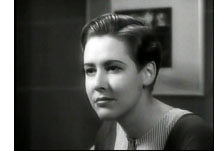 As for performances, perhaps the very speed of production forced actors to play naturally. True, Fay Wray is a bit arch as Ann Carver, but Gene Raymond as her husband moves convincingly from boisterousness to self-doubt. In Child of Manhattan, John Boles, trying to mingle with the little people, can be stiff, but Nancy Carroll has pep, and Buck Jones as her cowboy swain adds a welcome dose of naive gallantry. All three show how important distinct voices had already become: Boles mellifluous, Carroll up and down the scale, Jones slow and sincere. Reliable Columbia regular Ralph Bellamy shows up in Parole Girl, but more memorable is the performance, or rather presence, of Mae Clark. When she comes back from prison bent on vengeance, she’s a glowering figure in her stylishly chopped hairdo.
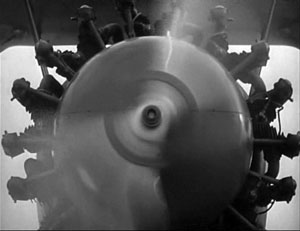
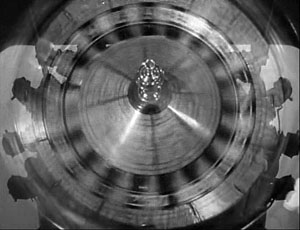
The films make fluent use of storytelling devices that predate the 1930s but are forever associated with that decade. Sequences are linked through headline montages and wipes, recently made possible by the optical printer. There are more elaborate techniques too, particular the visual or auditory hook connecting scenes. We’re not surprised to see commonplace instances, as when a note pad listing an apartment number dissolves to that number on the door. In Air Hostess, however, a spinning propeller gives way to a roulette wheel, and this association does a little more work, linking Ted Hunter’s reckless flying to his gambling and his general tendency to take risks.
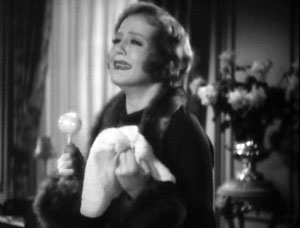
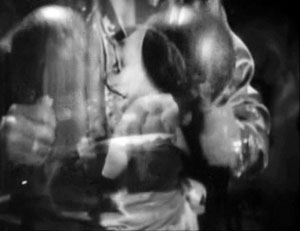
In Child of Manhattan, as Madeleine resolves to leave her husband after the death of her child, she tearfully shakes a baby rattle, and this dissolves to marimbas in a nightclub, swiftly turning her pathos into her effort to start a new life with a Mexican divorce.
But what is perhaps most striking about these films is their photography. Ten minutes into Air Hostess, the first one I watched, we get a lovely sustained track into a sunny airfield, our view guided by the walkway wheeled up to a plane door as passengers step out.
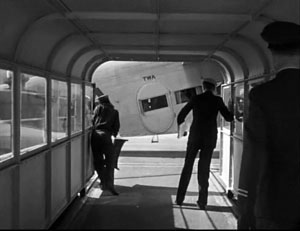
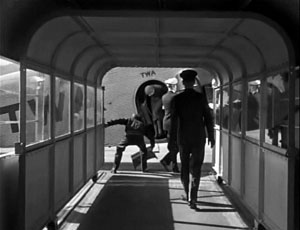
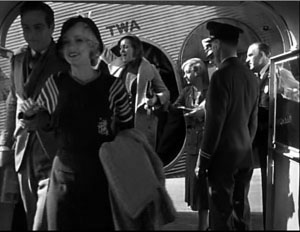
The relaxed play of light and shadow in this geometrical shot yields one of those fugitive visual delights that classic cinema so often supplies.
What’s it doing in a Columbia programmer? This Poverty Row studio realized that they could give their pinched budgets an upscale look with polished cinematography. Accordingly, you can argue that the biggest talents on the Columbia lot were the directors of photography. Our four films were shot by ace DP’s.
Joe August (Parole Girl) was the grand old man. He filmed some of the best-looking hits of the 1910s, including Ince’s Civilization (1916) and a great many William S. Hart movies (including Hell’s Hinges, 1916). In the 1920s and up to 1932 he worked at Fox on films by Ford, Hawks, and Milestone. At Columbia August would shoot Borzage projects like Man’s Castle (1933) before moving to RKO for Sylvia Scarlett (1936), Dance, Girl, Dance (1940), and the flamboyant All That Money Can Buy (aka The Devil and Daniel Webster, 1940).
Another Joe, somewhat younger, was no less gifted. Joseph Walker, the DP of Air Hostess came to Columbia early and soon teamed with Capra; he would shoot twenty movies with the director, including the splendid American Madness (1932), a particular favorite of mine. Walker stayed loyal to Columbia, shooting Only Angels Have Wings (1939), His Girl Friday (1940), Penny Serenade (1941), and on and on—returning to Capra for the independent production It’s a Wonderful Life (1947). Walker also patented an original zoom-lens design.
Ted, sometimes known as Teddy, Tetzlaff was another Columbia loyalist, and he certainly cranked them out. Hawks’ The Criminal Code was one of eleven movies Tetzlaff was credited with in calendar 1931. But by the spring of 1933 he seems already to have become a free lance, eventually working at Paramount on a string of classics (Easy Living, Remember the Night, Road to Zanzibar), then RKO (The Enchanted Cottage, Notorious), and occasional jobs back at Columbia. Tetzlaff became a director as well, remembered chiefly for the cult classic The Window (1949).
No wonder my four films dazzle, even on TV. According to Bob Thomas’s biography King Cohn, Columbia took special care to create a phosphorescent look through careful processing that enhanced the DPs’ efforts. Hence not only the sparkle on a door buzzer but glowing applications of then-standard edge lighting. Hence as well the use of striped shadows to suggest venetian blinds, a convention we associate with the forties but here in precise array (Child of Manhattan, Parole Girl).
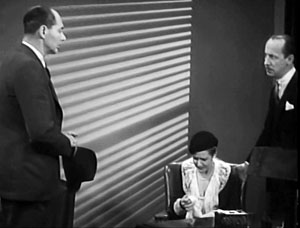
Trust Joe Walker to provide a little of that striped texture with a fuselage.
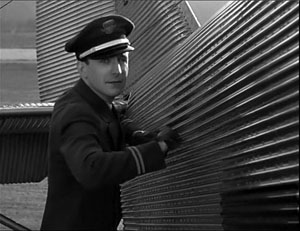
Hence too some striking depth. Here is the next-to-last shot of Walker’s work in Air Hostess, the sort of fancy aperture composition that crops up surprisingly often in the 1930s.
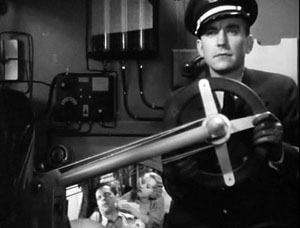
Tetzlaff, first in Child of Manhattan and then Ann Carver’s Profession, seems to be fooling around with faces and elbows.
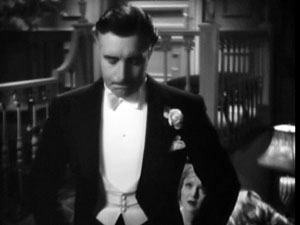
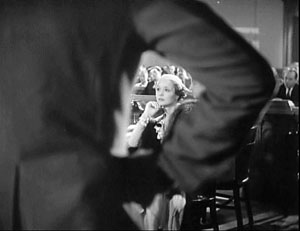
Probably the most visually and narratively complex of my films from spring 1933 is Ann Carver’s Profession. It’s possible that it was Columbia’s equivalent of an A production: Gene Raymond was a mid-range star known for a few Paramount and MGM pictures, and Fay Wray’s King Kong had premiered a week before filming started. Whatever the cause, Ann Carver has more complex plotting and more consistently inventive visuals than the three other titles.
From the very start, when gridiron hero Bill promises to provide for Ann the waitress, we get the sort of offhand flash that I like in 1930s movies. As Bill follows Ann into the kitchen, she’s framed in a swinging door and the camera moves closer to pick up their clinch.
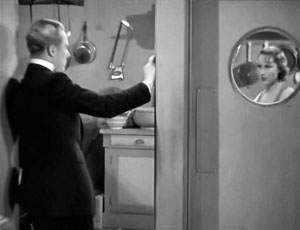
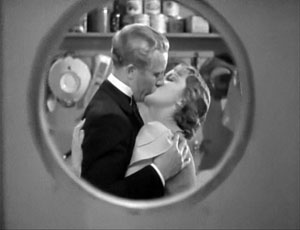
Once they’re married, the circle has become a rectangle, and trouble is on the way.
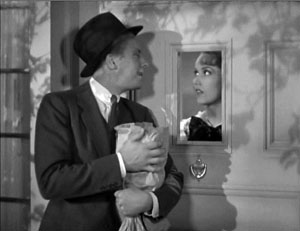
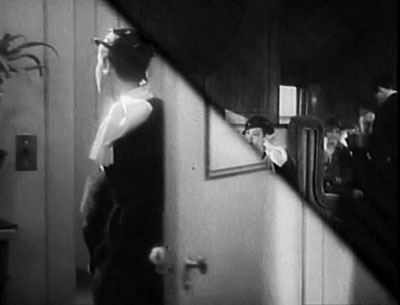
There are fancy mirror shots, pov constructions that lead characters to the wrong inferences, and examples of the big-foreground compositions that would come to prominence in the 1940s.
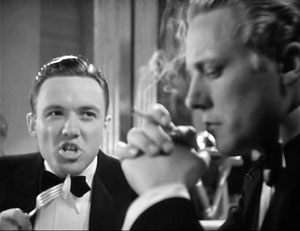
The trial recesses; crane up to the clock; spin the hands to cover a couple of hours; crane back to the trial resuming. Or start with Bill’s girlfriend, passed out and garroted by the necklace that has snagged on a leering chair carving. Dissolve to Bill’s night on the town, before ending that fuzzy montage with a dissolve back to the chair carving.
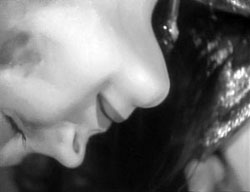
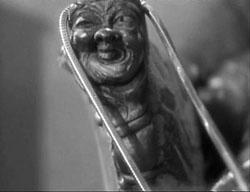
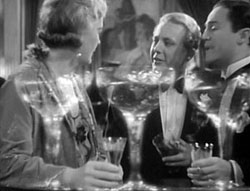
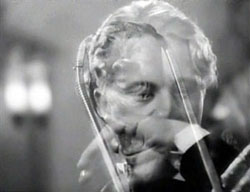
Bill didn’t kill her, but the pictorial logic makes him almost magically responsible, with the carving mocking him for what’s to come.
Above all there is one of the most laconic (and cheaply filmed) courtroom montages I’ve ever seen. A string of witnesses testifies, and after a newspaper pops out the first one, we get a fusillade of extreme close-ups, cut very quickly.
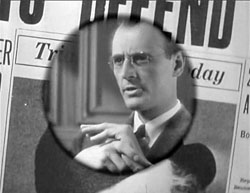
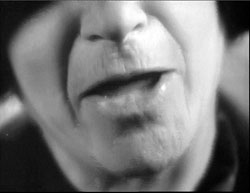
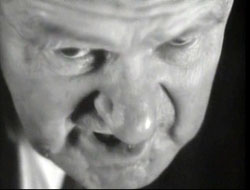
Just as striking is the coordinated sound montage, which reduces the testimony to clipped sentences, then phrases (“”Four-thirty!” “Quarter to five!” “Both of ‘em!”), then single words (“Drunk!” “Drunk!” “Strangulation!”), all damning Bill. Why take us through all the rigamarole—people sworn in and questioned at length—when you can give the essence of it in twenty-eight shots and twenty-five seconds?
My 1933 quartet contains no great film; perhaps none is worth more than one viewing. But what I learned from watching ordinary movies for our Classical Hollywood Cinema book is borne out by my soundings here. We can enjoy seeing a well-honed system steering us through a story, especially when gifted people like Teddy and the two Joes are shifting the gears. We can appreciate the opportunities for grace notes in what some call formula filmmaking. And we can see that this lowly studio, making films ignored in traditional histories, has something to teach filmmakers today: proud modesty. A film can radiate pride in being concise, in exercising a craft, and in telling a story that hurtles forward while shedding moments of casual beauty.
Most critical writing on early 1930s Columbia pictures focuses on Frank Capra, but there is good general background in Bernard F. Dick, The Merchant Prince of Poverty Row: Harry Cohn of Columbia Pictures (Lexington: University Press of Kentucky, 2009). My mention of budget levels comes from his discussion on pp. 119-120. An older, citation-free but still helpful biography is Bob Thomas, King Cohn (Beverly Hills: New Millennium, 2000). In-depth information on Joseph Walker as a Columbia cinematographer is available in Joseph McBride’s excellent biography Frank Capra: The Catastrophe of Success (New York: Simon and Schuster, 1992), 189-215. Walker’s engaging autobiography supplies nothing specific to these films, but he sprinkles technical information among its anecdotes. See Joseph Walker and Juanita Walker, The Light on Her Face (Los Angeles: ASC Press, 1984).
On 1934 as the end of naughtiness, see Tom Doherty’s Pre-Code Hollywood. For a skeptical account of the idea of Hollywood “before the Code,” see Richard Maltby, “More Sinned Against than Sinning [2003],” in Senses of Cinema here, and essays in “Rethinking the Production Code,” a special issue of The Quarterly Review of Film and Video 15, 4 (1995), ed. Lea Jacobs and Richard Maltby.
If you’re interested in more complicated narrative strategies in films of this period, try our entry “Grandmaster Flashback.” For another take on low-budget 1930s films, there’s our entry on Mr. Moto and Charlie Chan.
Between you, me, and the bedpost
Imitation of Life.
DB here:
I do not like finding phallic symbols in movies.
I grant you that there are some films that deliberately evoke the love wand: Tex Avery cartoons, Frank Tashlin and Jerry Lewis movies. Surely the Wolf in Avery’s Red Hot Riding Hood (1943) has more than a Platonic interest in Red’s stage show.
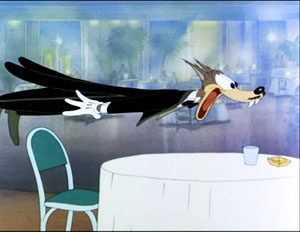
But some critics/ academics look way too hard. For them, as a literature professor of mine put it back in the mid-1960s, phallic symbols are everywhere in art. And I learned fast that he meant everywhere, from the Odyssey to Emily Dickinson. I changed sections.
Films, of course, are full of images that encourage the hunt for avatars of the skin flute. So for forty years, I’ve argued against interpretations of a scene that depend on reading you-know-what into anything that resembles a pole, post, or pylon—any vaguely tubular shape, slender or squat, organic or mechanical. It is a duffer’s mistake to think that film shots including swords, logs, telephone poles, pine trees, skyscrapers, Greek columns, fountain pens, picket fences, shovels, rocket ships, and Pontiac fins always pay homage to the trouser snake.
Except, I must admit, bedposts.
I don’t think I’ve ever slept in a bed with bedposts, not even in those cozy B & Bs that smother you with affection and sugar-sprinkled muffins. But the American cinema likes bedposts. Red-blooded American women in classic movies often have beds braced or decorated with bedposts.
Sometimes those bedposts do some alarming things.
Exhibit A: Start, as we often do (but probably shouldn’t), with D. W. Griffith. In The Birth of a Nation, Elsie Stoneman has just spent a romantic afternoon with Ben Cameron, aka The Little Colonel.
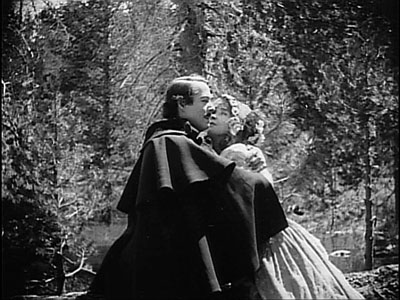
She races into her bedroom, obviously smitten.
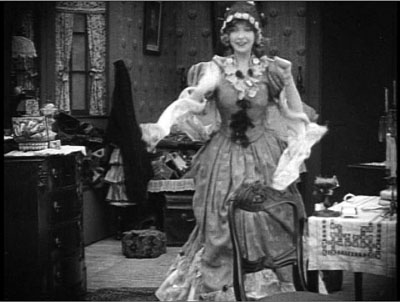
What does she do? She hops to the bed and leans dreamily against the fancy tapering bedpost. Now Griffith gives us the closest image of her that we’ve seen so far in the movie.
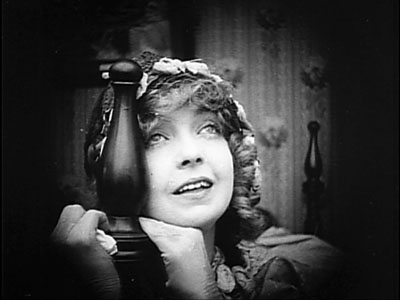
And since Griffith never passes up a chance to crosscut between anything and anything else, we get another shot of Ben, perhaps looking off toward Elsie’s house. (We have to say perhaps because Griffith is not terribly concerned with consistent eyelines.) It operates as a typical Griffith signal that one character is thinking about another.
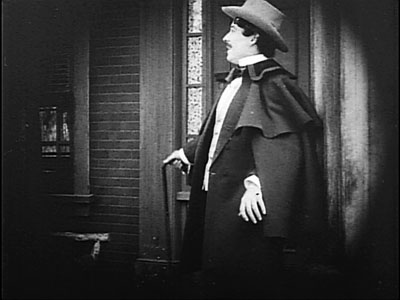
And as if aware that Ben is thinking of her, Elsie rewards her bedpost accordingly.
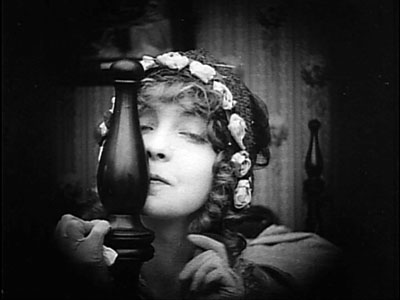
Should you doubt that these bedpost calisthenics are connected with the thought of a guy, I submit Exhibit B. In Bringing Up Baby, Susan Vance (Katharine Hepburn) is taken with David Huxley (Cary Grant). While he showers, she wraps herself around the only thing in the room taller than she is.
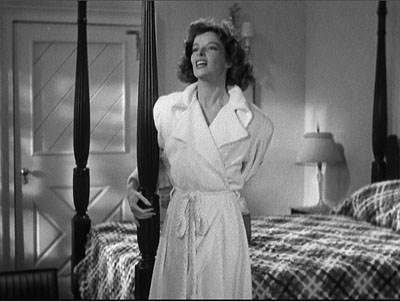
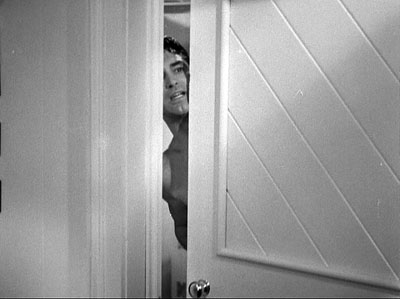
One can easily see why a glimpse of Cary Grant stepping out of the shower could make somebody clutch a support , but wouldn’t a chair have done as well?
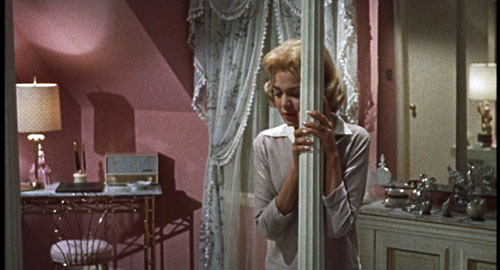
Exhibit C: Douglas Sirk has done interesting bedpost work in Imitiation of Life (surmounting this entry), but surely his triumph is Magnificent Obsession (1954). A blind Helen Phillips (Jane Wyman) has just learned that no operation is likely to recover her sight. Helen rises from her chair, and we hear a wordless choir along with a piano theme evocative of Rob (Rock Hudson), the mysterious man in her life. As if drawn by magnetism, she makes her way through the darkness to a totemic mass, sort of Elsie Stoneman’s bedpost on Viagra. She moves with the solemnity of a priestess paying homage to an angry god.
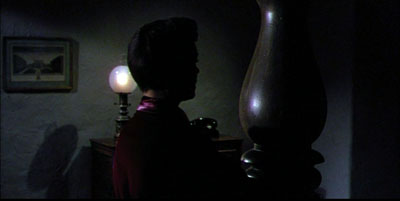
Actually, this thing isn’t exactly a bedpost; it’s a strange thrusting protrusion from a love seat that functions as a room divider. But it’s clearly in the bedpost tradition—as we see when, like Elsie, Helen embraces it and leans her head against it.
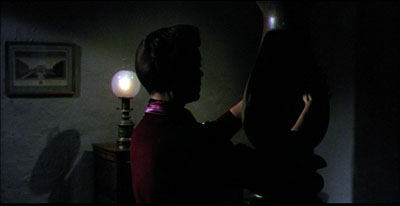
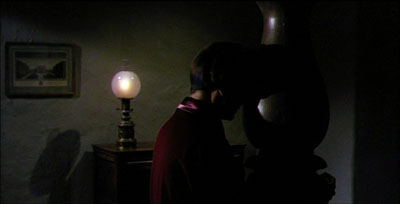
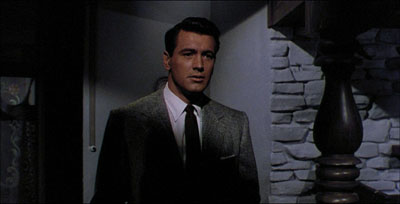
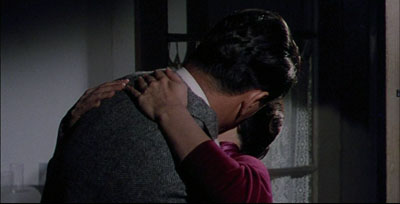
Soon Rob enters, framed by the post, and in no time the couple are in a clinch.
If forced to interpret these items, I’d probably say that Griffith may have included The Bedpost in a moment of frank eroticism, Hawks knew the cliché and exploited it for an actor’s bit of business, and Sirk, sophisticated Euro émigré, used it ironically. But of course these interpretations are open to dispute. I expect someone to start a dissertation on the matter immediately.
I don’t know of comparable scenes in which men, thinking of women, hug bedposts or crawl into big cavities. Bedpost worship can obviously be interpreted as another sign of Hollywood’s bias toward patriarchal values. But its blatancy and more or less witting silliness also respond to that quality that delighted Parker Tyler about Hollywood movies—the way that flagrant symbolism is flung onto the screen but toyed with, to tease us. For Tyler, the “only indubitable reading of a given movie” was
its value as a charade, a fluid guessing game where the only “winning answer” was not the right one but any amusingly relevant and suggestive one: an answer which led to interesting speculations about society, about mankind’s perennial, profuse, and typically serio-comic ability to deceive itself.
Sometimes, then, a bedpost is just a bedpost. But probably not in the movies.
The quotation comes from Parker Tyler’s Three Faces of the Film, rev. ed. (South Brunswick, NJ: Barnes, 1967), 11.
My frame enlargements from a 16mm print of Magnificent Obsession aren’t good enough in the scene I mentioned, so I’ve been obliged to draw my images from the Criterion DVD. That version crops the frame to 2.0:1, which has seemed too radical for many observers, me included. Should it instead be 1.66 or 1.85? The aspect-ratio debate has played out in extensive detail here and here.
Thanks to Lea Jacobs and Jeff Smith for some DVD loans. Jeff also encouraged me to keep this discussion in good taste.
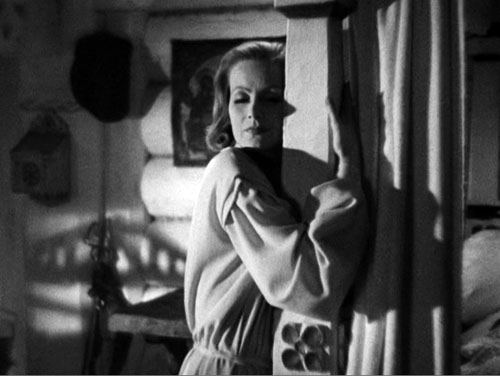
Queen Christina.
Wantons and wontons
Oxhide II.
DB here, with more from the Vancouver film fest:
Two of the more innovative films I saw evoked film history—one explicitly, the other obliquely. Raya Martin’s Independencia is part of a planned series devoted to the history of the Philippines, told from the bottom up. In this first installment, villagers flee into the jungle to hide from the American “liberation” of their islands. The film centers on a mother and son who, joined by a woman the son finds, create a new family. After years, the son and the woman have a child, but their new life is threatened by the encroachment of the invaders.
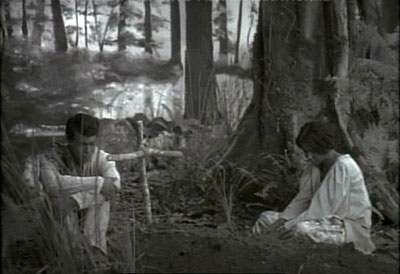
What sets Independencia apart is Martin’s effort to create the look and feel of a 1930s fiction feature. He shot the movie wholly in a studio, and the evidently faked backdrops are counterbalanced by gorgeously controlled lighting effects, and even dashes of color. Since virtually no Filipino films survive from this period, Martin gives us less a pastiche than a possibility, a sort of hypothetical archival film. The fact that the film makes aggressive use of Dolby sound, especially during a tremendous storm sequence, only adds to the sense of history being reimagined for today.
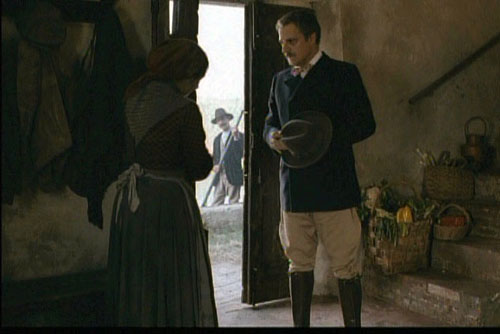
More traditional, at first glance, is Puccini and the Girl, a historical drama by Paolo Benenuti and Paolo Baroni. Facts of the case: In 1909, a maid in Puccini’s Tuscan villa, accused of being his concubine, committed suicide. But an autopsy revealed that she was a virgin.
The film’s reconstruction of what happened behind the scenes, tracing the veins of jealousy and deceit running through the household, relies on recent research into the tragedy.
At the same time, we have an homage to silent cinema. In most scenes we hear no dialogue: actors whisper at a distance from us, or simply conduct themselves without speaking. What words we do hear are recited pro forma (the Mass) or sung (in a waterside tavern, or in nondiegetic accompaniment). There is only one line of conversation, and that is given greater saliency by being a cry from the heart.
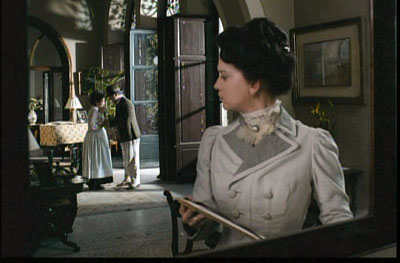
So we’re largely confronted with a silent film, accompanied by music and sound effects. To add to the estranging effect, characters communicate chiefly through letters and telegrams—exactly as in the films of the period. We hear the letters’ text read aloud, but the sense of stately compositions propelled by written commentary, distinctive features of 1910s cinema, remains. An unwitting homage, perhaps, but one that pleased this fan of classic tableau cinema.
Independencia was part of the Dragons and Tigers thread, one of the hallmarks of the Vancouver event. Year after year it gives an unequaled view of current Asian cinema. This year’s program, assembled by Tony Rayns and Shelly Kraicer, was at least as fine as ever. Eight films compete for the $10,000 prize given to first or second features. The winning film, Eighteen by Jang Kun-jae, centered on the familiar situation of teenage lovers separated by parents and school pressures. I didn’t see all the competitors, but my own favorite was Chris Chong’s Karaoke, a Malaysian story of a young man coming to terms with his mother’s decision to sell her karaoke bar. The first ten minutes are quite creative, disorienting the audience through complicated sound mixing, while the boy’s community, devoted to the production of palm oil, is presented with a documentary directness.
Outside the competition, I saw several Asian films of consequence. I’ve already discussed Yang Heng’s Sun Spots and Bong Joon-ho’s Mother. Ho Yuhang’s At the End of Daybreak marks a shift from his lyrical first feature, Rain Dogs, which I reviewed at Vancouver in 2006. A plot situation close to that of Eighteen is treated in much darker tones. A young man falls in love with a high-school girl, but he’s driven to murder by her growing indifference to him. The familiar elements of furtive sex, drinking parties, and demands from the girl’s family for reparations are given a noirish treatent. Ho’s admiration for American crime novels shows in his increasingly bleak handling of the affair. Here the femme fatale is a high-school girl, and the entrapped male’s revenge is complicated by an unexpected erection.
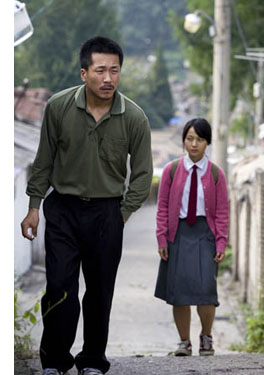 Also under the influence of classic crime films was Yang Ik-June’s Breathless from Korea (right). It shows a brutal debt collector coming to terms with his childhood. Under a harsh surface realism, the film has the contours of the familiar redemption of a hard case, including the decision to reform that comes a tad too late. (Whenever a crook vows that this will be the last time he pulls a job, wait for the ironic retribution.) I thought that the character parallels (two scenes of murdered mothers) were somewhat too neat, but the director plays the anti-hero with conviction and deadpan humor, and Kim Kkobbi supplies an exhilarating turn as the tough high-school girl who becomes his companion.
Bong Joon-ho has been something of a leitmotif on this site lately, with my comments on Influenza and Mother. Under the rubric “Bong Joon-Ho & Co.,” Dragons and Tigers screened a collection of shorts paying tribute to the Korean Academy of Film Arts. Most were from the 2000s, but Kim Eui-suk’s Chang-soo Gets the Job, dated from 1984. Focusing on a gang of teenage purse snatchers, Kim’s film was a little rough technically, but it built its story deftly. The quality of the rest was quite strong, with the grisly and wacky Anatomy Class (2000, Zung So-yun) being a high point. Meanwhile, Bong’s Incoherence (1994) shows that his urge to deflate official hypocrisy, seen in Memories of Murder and The Host, was already present in his student days.
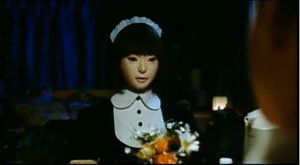
My admiration for Hirokazu Kore-eda runs high, as I indicated in my discussion of Still Walking at last year’s VIFF. But Air Doll, while full of vagrant pleasures, left me unsatisfied. The Kafkaesque premise, derived from a manga, is that an inflatable saucy-French-maid dolly comes to life, endowed with speech and movement but retaining her seams and air valve (both of which will figure in the plot). Her sad-sack owner doesn’t notice the transformation, but while he’s at work, she takes a job at a video store and wanders the city.
The aim, I think, is to defamiliarize ordinary city life by seeing it through Nazomi’s eyes. The fact that a sex effigy is the most innocent character in the movie is part of the point. Makeup, money, and fashion start to seem extensions of sad, solitary eroticism, and the line between mainstream movies and porn gets blurred. But all the thematic elements didn’t blend very well, and at moments, as during the music montages showing people’s desperate loneliness, I worried that for once Kore-eda had slipped into conventional sentimentality. The tone also shifts, with a climax that revises the big scene of In the Realm of the Senses. Kore-eda deserves credit for his unflagging effort to try something fresh with every project, but here, it seemed to me, that the film was defeated by an overcute conceit and underdeveloped execution.
The most exciting Asian film I saw at VIFF was Liu Jiayin’s Oxhide II. Her first feature, Oxhide, was screened at Vancouver in 2005. (Full disclosure: I was on the jury that awarded that film the D & T prize.) This one seemed to me even better.
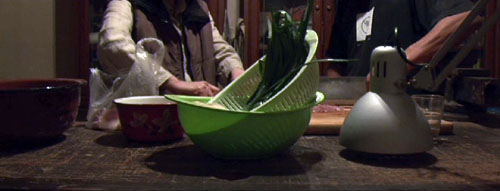
To say that this 132-minute film is about a family making dumplings is accurate but misleading. To add that the action consumes only nine shots makes it sound like an arid exercise. In fact, it’s a consistently warm, engaging—I don’t hesitate to say entertaining—film that is also a demonstration of how a simple form, patiently pursued, can yield unpredictable rewards.
In the first Oxhide, we saw the comedy and tensions of Liu’s life with her parents, who run a leatherwork shop. By the time she shot part two, they had already lost their business, but the sequel presupposes that the shop is still going, albeit coming to a critical point. So there’s a quasi-documentary aspect, as the family’s financial strains, discussed cryptically at various points, hover over the mundane process of wonton cookery. Yet although everything looks spontaneous, it was all completely staged—written out in detail, rehearsed over months, reworked in test footage, and eventually played out in “real time.”
And in real space. The first shot, which consumes twenty minutes, shows Liu’s father pummeling a hide in his vise and eventually clearing the table for serious food preparation.
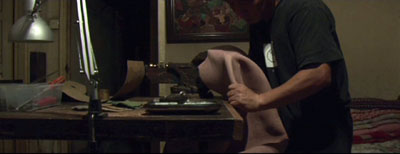
Actually, the film’s subject is that table. On its surface, a meal is prepared; around it, the family gathers; we even see what happens underneath. We watch father and mother chop scallions, mince pork, twist and yank dough, pinch the dumpling wrappers around the filling. We watch the daughter try to match her parents’ dexterity. This is a movie about housework as handiwork, and family routines and frictions.
For minutes on end, we see only hands and arms; Liu’s 2.35 frame often chops off faces. Liu employed a construction-paper mask to create the CinemaScope format within HD video. Why the wide frame? Most filmmakers use it for expansive spectacle, she remarks; but “I wanted to see less.” And the horizontal stretch further emphasizes the table.
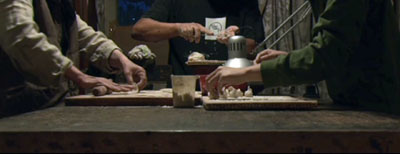
As if this weren’t rigorous enough, Liu has filmed the table from a strictly patterned arc of camera positions, dividing the space into 45-degree segments. These unfold in a clockwise sequence around the table. What could seem an arbitrary structural gimmick is justified by the fact that each setup proves ideally suited to each stage of the process. When father and mother team up to start the meal, the angle gives us two centers of interest. And Liu feels free to “spoil” her mathematical structure by varying the height and angle of her camera. Plates, bowls, and an articulated lamp become massive outcroppings in this micro-landscape.
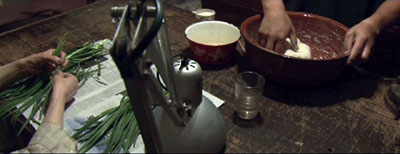
Oxhide II is unpretentiously inventive, quietly virtuosic. Evidently it took a Chinese filmmaker (whose day job is writing TV dramas) to blend domestic life with the rigor of Structural Film. Liu displays the fine-grained resources yielded by several cinema techniques, from framing and staging to lighting and sound. The finished dumplings get constantly rearranged on the cutting board. Each family member has a different technique for pulling off bits of dough, and each gesture yields its own distinctive snap.
I had to think, almost with pity, of all those US indie filmmakers who believe they have to cultivate CGI and slacker acting, to seduce investors and strain for outrageous sex and edgy violence. Liu made this no-budget, low-key masterpiece over years in a single room, and with her parents. That’s a new definition of cool.
Liu promises us another installment. In the meantime, every festival that’s serious about the art of cinema should pledge to show Oxhide II.
Puccini and the Girl.
PS 12 October: Thanks to Matthew Flanagan for correcting an embarrassing typo.
PS 15 October: Thanks to Ben Slater for correcting yet another one!
(50) Days of summer (movies), Part 2
DB here:
How I spent part of my summer vacation: notes on three more films.
Gangbusters
Two major directors–one an emblem of goofy bravado, the other emerging as a contemporary master–gave us movies this summer, and both let me down. I have cautiously championed Tony Scott’s recent work because at least he’s willing to go all the way, however misguided the direction. From Spy Games on, he has stuck to the credo that too much is never enough. His technique is swaggering and undisciplined, mannered to the nth degree. Yet I find his fevered visuals more genuinely arresting than the safe noodlings of most of today’s mainstream cinema. Man on Fire and Déja Vu reheat their genre leftovers into something spicy, if not nourishing, while Domino, the cinematic equivalent of hophead graffiti, wraps its sleazy characters in a visual design apparently inspired by the glowing interior of a peepshow booth.
So it’s with a chagrin that I report that The Taking of Pelham 123 is utterly square. The violence isn’t reveled in, the color scheme isn’t garish, the story has a florid villain played by scenery-masticating Travolta, and Denzel Washington has never seemed more passive and drab. In Scott’s DVD commentaries, he insists that art-school training led him to approach cinema with a painterly eye. But this project has the feel of a commissioned magazine illustration, not the delirious wall-size outrage that he could make if given his head.
I’ve respected Michael Mann since I saw Thief on its initial run. Heat seems to me on the whole his best work, though I admire many qualities of Manhunter, The Last of the Mohicans, The Insider, and Collateral. Ali and Miami Vice seem to me lesser achievements, and with Public Enemies he has gone somewhere I can’t follow.
I found it a surprisingly flat exercise, skimming over familiar territory–the charming bandit vs. the square-jawed cop, the struggle of the freebooter vs. the mob, the cynical politics of law enforcement vs. the authentic impulses of the outlaw. The plot is unusually straightforward for Mann, and the last shot, which ought to be a corker, is wasted. Too many scenes are nakedly expository, relying on fussy period detail to carry them. At the same time, more basic exposition seemed to me botched at the outset. In the opening scene, shouldn’t we get a clearer sense of what Dillinger’s sidekicks look and act like? A classically constructed film would dwell on them, characterize them, give them bits of behavior that develop in the course of the film. Mann treats them as part of the scenery setting off his handsome hero. Later, when one of Dillinger’s hired pistoleros goes kill-crazy, shouldn’t we have been set up to see him as a possible risk?
Typically Mann romanticizes, even sentimentalizes, his hard cases in that tough-guy way we know from fiction. But I couldn’t discern any vivid attitude toward his parallel protagonists Dillinger and Purvis. After Heat, where crook and cop both show a willingness to abandon women who want them, it’s probably significant that Dillinger is characterized by his fidelity to Billie. Yet while she’s in jail he’s back to an insouciant night on the town with his familiar floozies. In all, I can’t figure out why Mann made this movie about these people, or why we should care.
Collateral was already veering toward a certain obviousness of construction, when Vincent talks initially about how in impersonal L. A. a dead guy can ride the subway without anyone noticing. In Public Enemies the final line returns to the film’s most underscored motif in a distressingly on-the-nose way. Similarly, one thing I admire about Heat is that it acts as if no other gangster movie has ever been made. Its scenes offer plenty of opportunities for cute citations of old crime movies, especially when Vincent (a different Vincent) catches his wife’s lover watching TV. Instead, Mann treats the material as cut off from cinema, and this saves him from the coyness of so much genre work today.
Is he then a realist? His interviews and DVD commentaries indicate that he thinks of himself this way. Yet he strikes me instead as a genre purist. Each film is sui generis because it aims to recover the authentic dramatic core of the policier, the social comment film, or the wilderness adventure. But in Public Enemies, Dillinger’s visit to the movie house to watch Manhattan Melodrama (1934), even though the event is historically accurate, hits the parallel chords hard. Dillinger, who’s about to be cut down in a few moments, smiles in fascination when Gable says: “Die the way you lived–all of a sudden.” In such scenes, Mann seems to me to have retreated into being a more ordinary filmmaker. The worst thing I can say about Public Enemies is that it risks becoming academic.
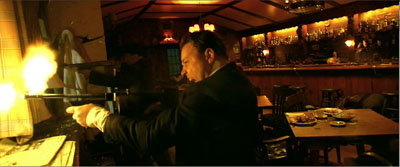
Mann’s claims to realism are partly his efforts to deny being a self-conscious stylist. For many of his admirers, me included, his pictorial sense is a large part of what makes his work distinctive. There’s plenty of controversy about the look of Public Enemies, and I have to come down on the side of the nay-sayers. I saw it twice, once in 2K digital projection in a superb multiplex in Europe. My second viewing was on 35mm, in a reliable Madison, Wisconsin venue. The digital version too often teemed with artifacts, blown-out bright areas, and disconcerting shifts in tonal values within scenes. The next two images are successive shots in the HD trailer, and I haven’t adjusted them. The disparities between them reflect the sort of mismatches that struck me in the digital screening.
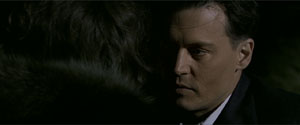
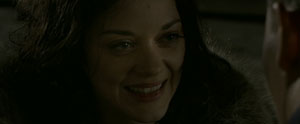
On film, the faces lost the edge enhancement and the mushy textures I saw in the digital version, and the tommygun fire was less tinged with yellow, pink, and orange. On the whole, I thought that the images benefited from the mercies of emulsion.
The chance to take high-definition video all the way, especially in low-light situations, seems to have invigorated Mann creatively, but it may have distracted him from basic craft. Investing wholly in a new look, he belabors even the simplest action through staccato cutting; getting people in and out of cars should not take such effort. Action scenes occasionally succumb to the jittery camera. I consider the climactic bank robbery in Heat somewhat awkwardly staged (though the dazzling sound work there compensates somewhat), and similar short-cuts can be found in the Wisconsin shootout here.
If you find my tone tentative, you’re right. I didn’t care for The Insider on first viewing; it took me a second visit to grasp what I now take as its virtues. That’s why I saw Public Enemies twice. I expect as well that Mann’s eloquent defenders, such as Matt Zoller Seitz, who has done a passionate series of shorts on Mann, will find fault with my evaluation. For the film’s admirers, what I find sketchily indicated they could see as daringly elliptical; what I see as inconsistent they might consider calculatedly ambiguous. The incompatibilities of color and light could be part of Mann’s experimentation too. I see his oeuvre as largely updating cinematic classicism, while others tend to see it as a daring leap beyond it. Maybe I’ll come around eventually. For now, I have to consider Public Enemies the biggest disappointment of my fifty days.
A welcome basterdization
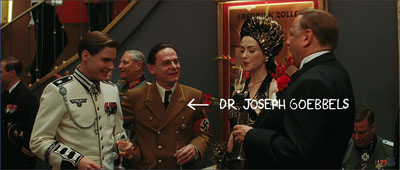
It’s a measure of the changes wrought by the Internets that Inglourious Basterds has in about a month amassed a daunting volume of serious commentary. Without benefit of DVD (let’s be charitable and assume no BitTorrenting), dozens of online writers have dug deep into this movie. As if to demonstrate the virtues of crowdsourcing, this flurry of critical discussion has shown that most professional movie reviewers have tired ideas, know little about film history, and are constrained by the physical format and looming deadlines of print publication. At this point, I’m very glad I’m not writing a book on Tarantino; the sort of secondary sources that normally take years to accrete have piled up in a few weeks, and the pile can only grow bigger, faster.
So what is there left for me to say? A little, though I can’t be sure every point isn’t made somewhere else. In any case, surely you’ve seen it, so I don’t have to warn you about spoilers, do I?
Since I thought Death Proof offered merely proof of the director’s creative death, I went to Inglourious Basterds with low expectations. I came out thinking that it was the most audacious and ambitious American movie I saw in my fifty days of summer viewing.
To deal with the current controversy immediately: I didn’t think its counter-history was intrinsically offensive or immoral, since I remembered those what-if-Germany-had-won counterfactuals in Deighton’s novel SS-GB and Brownlow’s film It Happened Here (1966). Did those express defeatism or an inability to counter the Nazi threat? So why not have a band of vindictive Jews seeking to match the Nazis in ruthlessness (except that their targets, so far as we see, are only soldiers and collaborationists)? We call it fiction.
You can quarrel about whether a revenge plot should carry some signals of the cost to the avenger, but I’m sufficiently convinced that tit-for-tat is embedded in human nature and will always be perceived, however recklessly, as virtuous. In any case, the movie’s emblem of revenge, the powerful image of Shosanna laughing mockingly as she goes up in flames along with the audience, carries the strategic ambiguity of a lot of cunning popular art. It’s at once a glorying in payback, a Jeanne d’Arc martyrdom, and a reminder of the fate of Jews elsewhere at that moment. It doesn’t permit a single easy reading.
Granted, there are some low-jinks, like the misspelled title and heroine’s name; are these jokes on Tarantino’s notorious spelling malfunctions? Yet the movie seemed to me Tarantino’s most mature (to use a term of praise that he hates) since Jackie Brown. I say that not because his other work is juvenile, which it’s not (except for Death Proof). I call Inglourious Basterds mature because it exploits his strengths in fresh but recognizable ways.
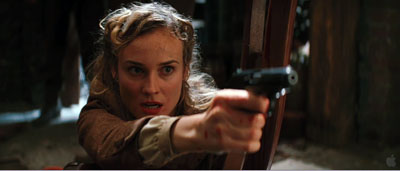
First, strengths of structure. Tarantino’s conception of storytelling owes at least as much to popular literature, particularly policiers, as it does to current conventions of screenwriting.
Take his penchant for repeating scenes from different viewpoints. In Elmore Leonard’s novel Get Shorty, Chapter 2 ends with Harry, seeing Chili at his desk, exclaiming, “Jesus Christ!” Chapter 3 consists of the first stretch of their conversation. Chapter 4 starts with Karen approaching Harry’s office and hearing him say, “Jesus Christ!” This overlapping-scene strategy, sketched in Reservoir Dogs, gets elaborated in Pulp Fiction and Jackie Brown.
Likewise, thrillers and crime novels commonly play on showing how distant lines of action unexpectedly intersect. In Peter Abrahams’ Hard Rain the agent who becomes the hero tells the story of two coal miners, Bazak and Vaclav, who meet after tunneling from two ends of the field. Needless to say, Hard Rain’s own plot enacts the same pattern. Charles Willeford’s chance-driven, parallel-action novel Sideswipe could be a model for the structure of Pulp Fiction. So it should be no surprise that Inglourious Basterds, labeling its long sequences “chapters,” should rely on the stepwise convergence of Shosanna’s plotline and the Basterds’ guerrilla operations, with the UK Operation Kino serving as the first sign of a merger.
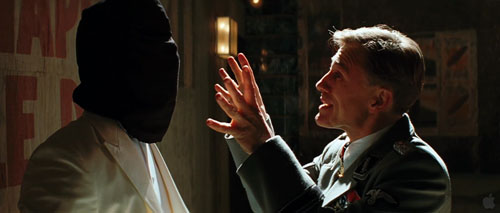
So the film is built on large-scale alternation of the principal forces: Shosanna (Chapter 1), the Basterds (2), Shosanna again (3), the Basterds again (4), and finally the two strands knotting at the screening of National Pride (5). Landa also knits the two strands together, of course, starting when he investigates the tavern shootout at the end of (4). In Chapter 5 the alternation gets carried by classic crosscutting. We shift to and fro among Shosanna’s plot, the capture of Raine and Utivich, the conflagration in the auditorium, and the deal struck between Landa and the US command. Yet right to the end both Shosanna and the Basterds have no awareness of each other’s plan: only we grasp the double dose of Jewish vengeance. More than in most films, but typical for Tarantino, we’re aware of the plot’s abstract architecture.
Then there are strengths of texture—the moment-by-moment unfolding of the action. Again pulp fiction offers some models.
In Get Shorty, Leonard develops the scene I mentioned above in an extraordinary way. Chili, Harry, and Karen talk through the night about Chili’s purpose and about the ways of the movie industry. Their conversation runs for a remarkable seven chapters and sixty pages, interrupted only by a brief flashback. When I met Leonard at a book-signing event, I asked him why he took up a fifth of the novel with a single scene. He said that he hadn’t realized it consumed so much space, because it was “fun to write.”
Tarantino can lay bare his chapter-block architecture because his scenes are devoted to this sort of prolongation. You may remember the bursts of violence, but what he fashions most lovingly is buildup. Here the spirit of Leone hovers over our director. In each entry of the Dollars trilogy, you can see the rituals of the Western getting more and more stretched out, filled with microscopic gestures and eye-flicks. Eastwood’s lips stick slightly together and must peel apart when he speaks: This becomes a major event. I’m a primary-document witness to the fact that 1969 cinephiles were stunned by the long opening scene of Once Upon a Time in the West, which after painstakingly establishing the tics of several characters ends by eliminating them. Later, John Woo gained fame by dwelling on Homeric preparations for combat and endlessly extended bouts of gunplay. From these masters Tarantino evidently learned the power of the slow crescendo and the sustained aria.
Leone and Woo’s amped-up passages rely chiefly on imagery and music. Tarantino is no slouch in either department, but he relies, like his beloved pulp writers, on talk. As everyone has noticed, the conversations in Basterds go on a very long time. In an era when scenes are supposed to run two to three minutes on average, Tarantino has only a couple this brief. The introduction at LaPadite’s farm runs over eighteen minutes, by my count, and the more complicated Chapter 2, with intercut flashbacks and flash-forwards, runs about the same length. Thereafter scenes last anywhere between four and twenty-four minutes, and Chapter 5’s crosscut climax consumes a stunning thirty-seven minutes. All but the last depend completely on dialogue. Leonard would probably consider them to have been fun to write.
Talk in Tarantino comes in two main varieties: banter and intimidation. At the coffee shop the Reservoir Dogs squabble and soliloquize; later exchanges will be conducted at gunpoint. En route to the preppies’ apartment, Jules and Vincent chat casually; when they arrive, the talk turns threatening. If Death Proof lets banter dominate, Inglourious Basterds goes to the other extreme. Here talk is a struggle between the powerful and the powerless.
As Jim Emerson points out, nearly every scene is an interrogation. This entails that someone in authority (Landa, Aldo, Hitler, the Germans who question Archie’s accent in the tavern, Zoller) is trying to pry information out of someone else. Intimidation through interrogation gives every scene an urgent shape. Now Tarantino’s digressions (three daughters, rats and squirrels, a card game, the correct pronunciation of Italian) don’t read as self-indulgence, but rather as feints in a confidence game. Here Tarantino’s tendency to write endless scenes, something he confesses in his recent Creative Screenwriting interview on the film, is fully harnessed to more classic, albeit unusually extended, scene structure.
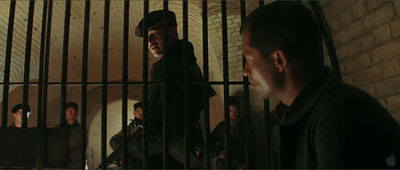
To keep us focused on the lines and the actors delivering them, Tarantino has adopted a classical approach to style. He shoots with a single camera, so every composition is calculated. “I’m not Mr. Coverage,” he remarked in 1994, “. . . . I shoot one thing specifically and that’s all I get.” He foreswears handheld grab-and-go. In Basterds he locks his camera down, or puts it on a dolly or crane. Cinematographer Robert Richardson says that there is only one Steadicam shot in the film.
We don’t usually call Tarantino tactful, but his technique can be surprisingly discreet. He has the confidence to let key dialogue play offscreen: in the café when Landa arrives at Goebbels’ lunch, we stay fastened on Shosanna, a good old Hitchcockian ploy that ratchets up the tenson. Although Tarantino cuts rapidly throughout each chapter (on average every 5.6 seconds), he repeats setups quite a bit. This permits a simple change of angle or scale to mark a beat or shift the drama to a new level.
He can bury details on the fringes of the shot, as when the cut to the tight close-up of LaPadite shows him tossing his match into an ashtray sitting beside Landa’s cap, which bears the insignia of a skull and crossbones. It’s out of focus and on the edge of the screen, but the glimpse of it increases our fear that LaPadite is indeed harboring a Jewish family. As in Jackie Brown, another film that extends its scenes through detailing of performance, lighting, and setting, there seems no doubt that Tarantino, for all his PoMo reputation, appreciates some traditional Hollywood virtues.
He can inflect them, however. Richardson finds that Tarantino has an unusual approach to the anamorphic format.
I naturally move [the framing of characters] to one side or the other, especially when shooting anamorphic, whereas Quentin enjoys dead-center framing. For singles in particular, we’re just cutting dead-center framing from one side to the other, with the actors looking just past the barrel of the lens.
I noticed this tendency most in the reverse angles. Tarantino’s two-shots tend to be simple and symmetrical, shooting the characters in profile, as in the image surmounting this entry. But in over-the-shoulder shots, about half the frame is unoccupied—as if Tarantino were compensating, like his 1970s mentors, for an eventual TV pan-and-scan version of the scene.
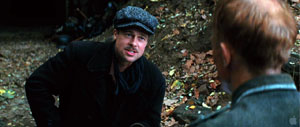
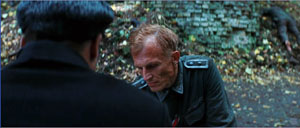
Or take the cliché of arcing the camera around a group of chatting people, picking up one after the other. Tarantino didn’t invent this, but the opening scene of Reservoir Dogs probably helped popularize it. In Chapter 5 he uses the technique in the lobby of the Le Gamaar cinema, only to break its momentum by having the camera trail Landa when he breaks out of the circle and retreats, in a paroxysm of giggles, after Bridget says she broke her leg while mountain climbing.
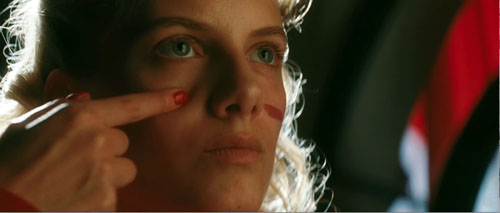
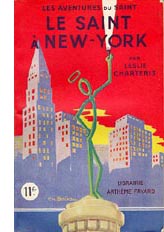 There are many other intriguing touches, like the mixed typography of the opening credits, all of which seem to use fonts derived from 1970s paperback novels. Or the reference to The Saint in New York, perhaps less important for its plot parallels than for the fact that author Leslie Charteris’ later Saint novel, Prelude to War (1938), was banned in Germany and Italy for its attacks on fascism (even warning about the camps). So is reading a Saint novel a covert act of defiance on Shosanna’s part? Later, she applies make-up in fierce strokes, like an American Indian, reminding us that Raine’s Basterds model their tactics on the Apache.
Perhaps most striking is the dairy motif, from the glass of milk in Chapter 1 to Landa’s ordering a glass for Shosanna in Chapter 3. Is this a hint that he suspects her of being the girl who fled the massacre? Or is it a test he offers to any French national he meets? In the restaurant scene, the extreme close-ups of the crème fraiche may underscore the possibility that Landa is looking for signs that she won’t eat dairy products not prepared according to Orthodox dietary rules. Few filmmakers today would trust audiences to imagine this possibility on their own; instead we’d get an explanation to an underling. (“So here’s a quick way to find out if we have a Jew ….”)
Another nest of details involves the film-within-the-film, Nation’s Pride. Many online critics have noticed that it provides the sort of film that Basterds refuses to be: We never see our squad in the sort of Merrill’s Marauders skirmishes we probably expected going in. What I find intriguing about the movie, purportedly directed by Eli Roth, is that despite some anachronisms it exemplifies the sort of confrontational cinema we find in the silent Soviet pictures. Surprisingly, this was a tradition that Goebbels admired. Eisenstein’s Battleship Potemkin, he claimed, “was so well made that it could make a Bolshevist out of anyone without a firm philosophical footing.” So in Nation’s Pride Roth and Tarantino have provided a Nazified homage to Eisenstein: a baby carriage rolls away from a mother, a soldier suffers an assault to the eye reminiscent of the wounding of the schoolteacher on the Odessa Steps, and even Soviet-style axial cut-ins are used for kinetic impact.
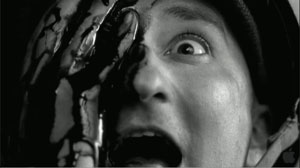
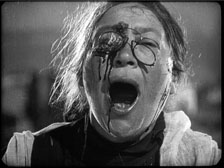
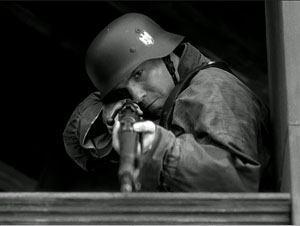
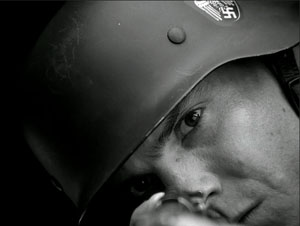
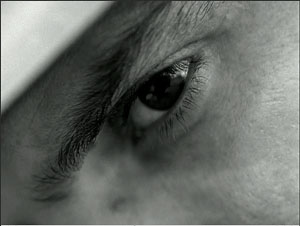
This pastiche of agitprop culminates in the sort of to-camera address we find in Dovzhenko. Zoller shouts, “Who wants to send a message to Germany?” But this is followed by Shosanna’s spliced-in close-up addressing the audience in her theatre.
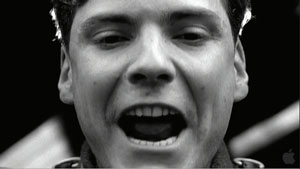
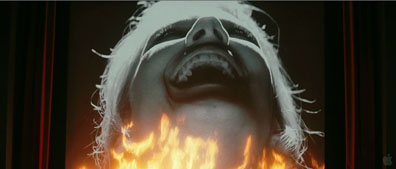
She makes her own confrontational cinema.
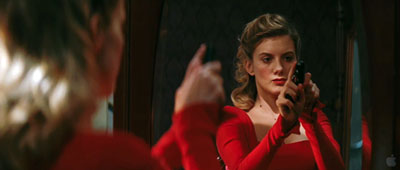
Several years ago the film theorist Noël Carroll speculated that the Movie Brats of the 1970s sought to create a shared culture of media savvy that would replace the traditional culture based on religion, classical mythology, and official history. For the baby boomers, knowledge of the Christian Bible and iconography of American history would be replaced by deep familiarity with movies, pop music, and TV. This secular sacred would bind the audience in a new set of traditions. On this path, Scorsese, Spielberg, and Lucas didn’t go as far as Tarantino has. In his films every situation or character name or line of dialogue feels like a citation, a link in a web of pop-culture associations. (Aldo Raine = Aldo Ray = Bruce Willis, whom Tarantino once compared to Aldo Ray.) The only other filmmaker I know who has achieved this supersaturated cross-referencing is Godard, another exponent of the vivid-moments model (though he uses it to create a more fragmentary whole). Tarantino is the most visible evidence of what Carroll called “The future of allusion.”
But it’s too limiting to see Tarantino’s films as merely anthologies of references. I think he wants more.
Many viewers seem to assume that Tarantino’s film is somewhat cold. The Basterds are grotesques, parodies of men on a mission; Shosanna, though in a sympathetic position, must maintain a frosty demeanor. Even revenge, so central to films that Tarantino admires, is served frigid here, a purely formal postulate, like the urge for vengeance animating classic kung-fu films.
There is cinema that asks you to empathize with its characters. Then there is cinema that aims to thrill you with a cascade of vivid moments. There is How Green Was My Valley (1941) and Citizen Kane (1941). I think that Tarantino’s films mostly tilt to the vivid-moment pole, seeking to win us through their immediate verve, the way film noir and the musical and the action movie often do. The young man arrested by great bits from blaxploitation and biker movies sees cinema not as merely piling up cinephiliac references—though that’s surely part of it—but as a flow of tingle-inducing gestures, turns of phrase, shot changes, musical entrances. There can be pure pleasure in having time to see how actors move, or savor their lines, or simply fill up physical space by being centered in the anamorphic frame. Our fascination with Landa comes, I suspect, from the spectacle of a man who is utterly enjoying himself every second.
We might be tempted to claim that this effort to create what Jim Emerson calls “movie-movie moments” actually breaks the film’s overall unity. But Tarantino keeps nearly everything in check by the architectural clarity of his plot. The carving of the swastika on Landa’s brow sets you squirming, but it reveals itself as the culmination of a process we have seen piecemeal up to now. It’s the last in a string of firecracker bursts that have kept the film humming along.
So I’m not convinced that Inglourious Basterds lacks emotion. The emotions Tarantino aims for will arise not from character “identification” but from the overall structure and texture of the work. We are to be stirred, enraptured, astonished by a procession of splendors big and small. It’s the tradition (again) of Eisenstein, particularly in the Ivan films, but also of Leone and, in another register, Greenaway. Formal virtuosity isn’t necessarily soulless; it can yield aesthetic rapture.
The most sophisticated analyses and interpretations I’ve found online are led off by the indefatigable Jim Emerson (start here to track his many entries on the subject), along with his knowedgeable readers, who furnished a book’s worth of commentary and critique. Jim provides links to many other writers’ work (here, for example), not all of which I’ve been able to absorb. For exhaustive, not to say exhausting, coverage of things Tarantino, visit The Archives.
On Tarantino’s time-shuffling and its relation to crime fiction, see my Way Hollywood Tells It, 90-91. In Chapter 7 of Film Art Kristin and I provide an analysis of the replayed scene in Jackie Brown. Tarantino’s comments on writing the Basterds script are in Jeff Goldsmith’s article, “Glorious,” in Creative Screenwriting 16, 4 (July/ August 2009), 20-29. His comments on coverage come from Gavin Smith, “When You Know You’re in Good Hands,” in Quentin Tarantino Interviews, ed. Gerry Peary (Jackson: University Press of Mississippi, 1998), 102. In the same interview he has illuminating comments on the role of the axis of action. Robert Richardson discusses filming Basterds in Benjamin Bergery, “A Nazi’s Worst Nightmare,” American Cinematographer 90, 9 (September 2009); the quotation here is from p. 47. This feature is available online here.
Goebbels’ remark on Battleship Potemkin is quoted in Klaus Kreimeier, The UFA Story: A History of Germany’s Greatest Film Company, trans. Robert and Rita Kimber (New York: Hill and Wang, 1996), 207. For background on Goebbels’ agenda for German cinema, summed up by Lt. Archie Hicox, see Eric Rentschler, The Ministry of Illusion: Nazi Cinema and Its Afterlife (Cambridge: Harvard University Press, 1996). I talk about axial cutting in Eisenstein and other Soviet directors at various points in The Cinema of Eisenstein.
Noël Carroll’s comments about popular entertainment as a secular alternative to shared religious culture are in his essay, “The Future of Allusion: Hollywood in the Seventies (and Beyond),” in Interpreting the Moving Image (Cambridge: Cambridge University Press, 1998), 244, 261-63. On the idea of an emotionally arousing cinema that doesn’t rely on attachment to character psychology, see my Cinema of Eisenstein.
PS 20 Sept 2009: Curt Purcell, at The Groovy Age of Horror, finds a similar plot architecture emerging in the comic-book series Blackest Night.