




Archive for the 'Film comments' Category
Everybody’s Irish
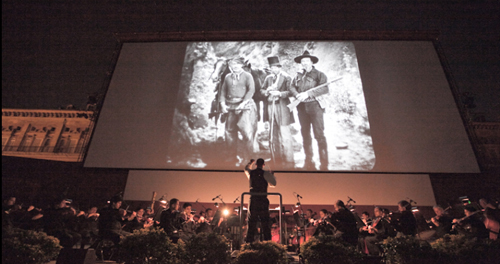
Three Bad Men (1926) at the Piazza Maggiore; Orchestra del Teatro Communale di Bologna conducted by Timothy Brock. Photo by Lorenzo Burlando.
DB, still in Bologna:
The early Ford retrospective at Cinema Ritrovato rolls on. The surviving reel of The Last Outlaw (1919) proved very tantalizing. An end-of-the-West Western, it shows its grizzled hero revisiting the town of his youthful exploits. But now, in an anticipation of Ride the High Country (1962), civilization has taken over. Cars chase Bud off the streets and the theatre features movies (Universal Bluebirds at that, a bit of product placement). Ford heightens the contrast by letting us into the hero’s memory, introduced by the title: “Memories of the past flashing back to him”—the earliest reference to the term “flashback” I recall seeing in the movies.
The plot of Cameo Kirby (1923) involves a cardsharp who tries to help a southern family but whose chivalrous intentions are misunderstood. The film’s virtues were, I’m afraid, undercut by a choppy, contrasty print. Another 1923 vehicle, North of Hudson Bay (1923) was in much better shape. A fairly routine adventure about schemers trying to take over the gold claim of two brothers, it was enlivened by a mysterious murder scene, in which a man is shot before our eyes but we can’t say exactly how. Ford later replays the scene to clarify what happened, and then sets up suspense as the trap is put in play again, this time to kill our hero.
Kentucky Pride (1923) is a turf tale narrated by a racehorse. This might have become a tedious gimmick, but the film handles it with aplomb and modest emotion. Our narrator Virginia’s Future stumbles during the race, and the scene during which she is about to be shot generates a great deal of suspense and concern. At the end, her reunion with her son, Confederacy, is smoothly integrated into the humans’ reconciliations and just deserts. In between, Virginia’s Future passes from owner to owner, in something of a rough draft for the adventures of Bresson’s donkey in Au hazard Balthasar.
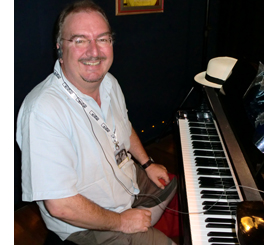 Kentucky Pride is a programmer, but between the peaks of racetrack excitement we get several arresting interludes. In one scene the now-destitute horse farmer reunites with his daughter. He’s at the dinner table. She comes up behind him and covers his eyes. So far, so conventional. But he raises his calloused, dirtied hands very slowly to touch her wrists. Prolonging the gesture shows not only Ford’s delicate way with such moments but the quiet skill of Henry B. Walthall; it’s impossible not to think of similar handwork in Griffith’s The Avenging Conscience (1914) and The Birth of a Nation (1915). The scene’s subdued pathos was enhanced by the accompaniment of Neil Brand, a Bologna regular.
In another horsy tale, The Shamrock Handicap (1926), the financially challenged aristocrat is an Anglo-Irish lord , and to pay his taxes he sells some of his stable to an American racing entrepreneur. His top rider, Neil, goes along, leaving sweetheart Sheila behind. Once in the US, Neil takes a serious spill and acquires a game leg. Soon the aristocrat and his 120 % Irish household are coming to America to stake everything on racing their pride filly in the Handicap. The whole thing is a pleasant tissue of contrivance and coincidence, allowing Ford some chances for sentiment, camera tricks induced by ether, and gags on Irishness. The horse handler discovers that all his old friends and kinfolk in the New World have become cops.
There were opportunities to develop Sheila as more than a pretty face (that belongs to the enchanting Janet Gaynor), but the plot puts the menfolk to the front. The scenes of Neil’s acceptance in the hard-bitten jockey world show America as a place in which ethnic minorities hang together; his best friend is a Jewish rider who keeps a black valet. The characteristic Ford sadness surfaces in a lovers’ reunion. When Neil greets Sheila at dockside, Ford gives us a painful glimpse of wounded masculine pride. Neil stands waiting with his pals. Has he recovered?
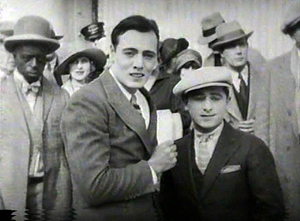
As Sheila approaches, Neil swings his crutch abruptly away from her, as if to hide it. But the same gesture sharply reveals to us that he’s now lame.
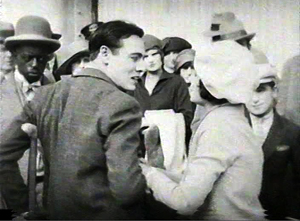
In their embrace, the crutch falls away. Neil clutches Sheila as if she were not his sweetheart but his mother; he needs consolation, not passion.
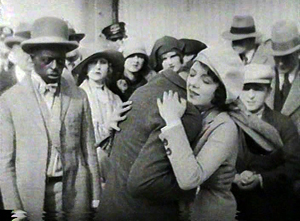
The film may be about male pride, but as ever in Ford a man’s sense of self-worth is sustained by a touching reliance on women. So it’s fitting that the walking staff Neil leaves behind in Ireland–a slip in continuity, you might think–becomes his new crutch when he comes home again for good.
Lightnin’ (1925) moves not like lightning but at the pace of its elderly protagonist, Bill (Lightnin’) Jones. The opening is a drawling play with rustic humor, centering on Bill’s laborious stratagems to hide his whisky bottles from his wife. Bill isn’t Irish, but he might as well be, like the purported Welshmen of How Green Was My Valley (1941).
Initially the film seems to depend on one of those promising screenwriting switcheroos. The couple manage a hotel perched on the border between California and Nevada, so aspiring divorcées can collect their California mail and still maintain residency in Nevada. A dividing line runs through the center of the house, and it provides some adroit byplay when a young lawyer, pursued by corrupt businessmen, teases the Nevada sheriff by hopping from state to state. The romance between the lawyer and the old couple’s adopted daughter is handled briskly, with the usual repeated-and-varied dialogue motifs (courtesy Frances Marion’s script). One might expect a climax wringing comic confusion out of the divided household. But soon the border gimmick is forgotten and Ford moves to the emotional core of the movie, the testing of the old couple’s marriage.
When Mrs. Jones tries on a guest’s fashionable dress to find out what it’s like to wear nice clothes, Bill reacts obtusely. It’s his indifference as much as her decision to sell the hotel to land-grabbers that pushes her to sue for divorce. The climax is a prolonged trial scene in which Bill becomes his own advocate. As in later folkish tales like Judge Priest (1934) and The Sun Shines Bright (1953), plot dynamics take a back seat to horseplay and quietly detailed scenes of character reaction and reflection. Some laughs are milked from the family dog wavering between husband and wife, the judge flirting with a flapper, and the dimwitted drinking buddy with his two pudgy children. But soon Bill is fingering his Civil War medal as he slowly confesses his faults as a husband, and we recognize what we’d learn to call a pure Fordian moment.
Those were the days when you could make a film about old people.
For more on Ford, visit Tag Gallagher’s generous and wide-ranging website. It includes a revised version of his critical biography on the Skipper, as well as articles on many other filmmakers. For more Cinema Ritrovato photos, go here. For Gabe Klinger‘s rapid-fire Bologna updates, try Mubi. And for remarks on non-Fordian entries in this abundant festival, check in with us again soon.
Off to Yurrp; but first….

Photo by Marc Vernet.
DB here:
Over the last few weeks we’ve added a fair amount of material to this site. As Kristin and I pack for our annual trip to Cinema Ritrovato (Ford! Godard! Donen! Capellani! 1910!), in what we Americans know as Yurrp, I thought I’d mention them. All can be found in the left column, but I’ll link to them too.
First, more on the Danish cinema of Dreyer’s earliest days. As background to my recent essay on Dreyer’s first film, I’ve revised and updated an essay on style in Nordisk films of the 1910s. Even if you don’t want to read it, I think you’ll find it pretty to look at, and most of the (many) illustrations come from rare 35mm prints. Thanks to Dan Nissen and Lisbeth Richter Larsen, who edited the first version and gave me permission to publish this new one here. Thanks as well to archivists extraordinaire Thomas Christensen and Mikael Brae for their help during my visits to Copenhagen.
Second, I’ve added pdf extracts from two of my books. There’s the introduction to The Way Hollywood Tells It, already kindly flagged by Catherine Grant of Film Studies for Free. I’ve also added two bits from Poetics of Cinema. There’s the somewhat polemical introduction, and there’s the piece I wrote on eye behavior in film performance. Yes, I’m already known as Professor Blinky. But read before you condemn. Maybe you’ll even be enticed to read the rest of the books. I can dream, can’t I?
Most quietly, we’ve added a facile Print command so you can make hard copies of any of our entries, including our most ancient ones.
One of our many summer tasks is to go back through our early entries and clean them up, fixing photos, restoring what broken links we can, etc. Mark Minett has been diligently combing our blogs and we’ll try to shape them up….after we get done watching movies at Bologna, and then Brussels. From there I hope to file a report on my visit to the Musée Hergé, which is holding a Joost Swarte exhibition. (Swarte is one of my favorite cartoon artists.) Of course Brussels also boasts the remarkable annual festival Cinédécouvertes, which is showing many new titles, including Godard’s Film Socialisme. I am so there.
Thanks as usual to our web tsarina Meg Hamel for her efforts in putting up all this stuff, not to mention putting up with me. Next week, some observations from Bologna.
Now you see it, now you can’t
DB here:
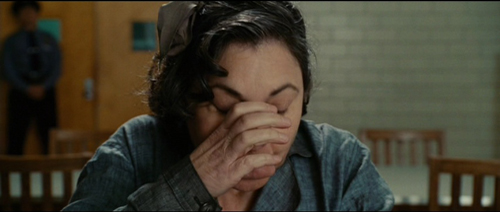
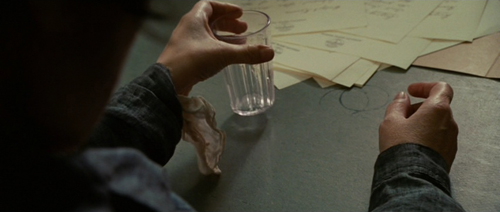
We usually respond to films spontaneously, but afterward we can think about our responses and figure out why we reacted as we did. When we’re fooled by a mystery, for instance, we can re-watch the film and trace exactly how we were misled. Now that Shutter Island is out on DVD, fans will be dissecting its visual gimmicks. Even when a film isn’t a mystery, a lot of critical analysis involves what we might call a rational reconstruction of how the whole shebang works. Novice screenwriters crack open a movie like The Apartment or The Godfather to peer into the fine mesh of plot construction, to tease out all the setups and plants and twists that seem inevitable only after the fact.
This is film research, we might say, at the personal level. Not in the sense of your or my unique identity, but rather at the scale we see the world. We don’t see atoms or gravity. We evolved to sense and think about middle-sized social and physical phenomena, like places and objects and, especially, other humans. We’re aware of the world because we sense ourselves as individual agents, guided by intentions and desires and beliefs. We’re used to talking about films at this level. When we track action and character, note surroundings and time passing, or ask about the purposes of a plot device or theme, we are working at the level of personhood.
But life assigns us to other levels too. There is the subpersonal level. All kinds of things are happening to you now that you can’t be aware of. You can’t watch the cells in your retina detect this sentence, or the neurons in your brain firing to make sense of it, or the flow of signals to your hand urging the mouse to scroll onward. A huge amount of our mental activity takes place behind the scenes that flit through our consciousness. We can’t pay attention to the man behind the curtain—partly because there is nobody there.
There’s also the suprapersonal level, the level of collective behavior patterns. Now we’re talking about people as parts of large-scale forces, like groups and cultures and societies. Historians have traditionally worked at this level. For example, some researchers have traced how film audiences, en masse, have responded to movies.
More strikingly, many scientists now study “self-organization”—the emergence of patterns of order that don’t seem to be willed or intended by individuals or groups. We find impressive instances in nature: fish swim and birds flock in intricate patterns that no one fish or bird could imagine or dictate. Such self-organization is even more striking in human activities like traffic flow or online networks. Is there a sort of “physics of society”? No doubt people have intentions and quirks, but often we can bracket those out and see shapes in the data that no one could have designed. The classic instance is a power law. A remarkable example is Vilfredo Pareto’s discovery that income distribution in any society tends to settle out as 20 percent of the people controlling 80 percent of the wealth. Mark Buchanan sums up the suprapersonal viewpoint this way: “Think patterns, not people.”
We know we can study films at the personal level. How can we study films subpersonally and suprapersonally too?
Reverse-engineering a movie
Mon Oncle.
My answer comes after four days earlier this month at the annual convention of the Society for Cognitive Studies of the Moving Image. We met in Roanoke, Virigina, in a massive nineteenth-century hotel made over into a convention center. You know the place has things under control when every PowerPoint presentation works flawlessly.
What ideas unite the film scholars, psychologists, and philosophers who gathered here? Roughly, the members explore moving-image media through empirical methods. Empirical inquiry can include classic scientific method (hypothesis/ experiment) or methods of aesthetic, historical or quantitative analysis. Typically the goal is not interpretation of a particular film or TV show or videogame but rather understanding of some general aspects of these media. Not explication, we might say, but rather explanation. Further, most members of the Society are interested in ways that film can be illuminated by areas of modern psychological research, such as neuroscience, cognitive science, and evolutionary psychology.
Some of our philosophers would say that they pursue conceptual analysis rather than empirical inquiry. Still, they join our meetings because the sorts of concepts they want to analyze are the ones that the film folk and the psychologists deploy—concepts like artistic intention or the nature of genre. Many of our liveliest sessions have come from disputes between Filmies, Psychos, and Philosophes.
For more on what we do, I’ve offered some background in earlier entries on this site. I previewed the 2008 convention here and here. I previewed the 2009 convention here and here.
Previews, but not followups. The big problem covering these events is that they’re so busy I have no time to blog during them, and by the time they’re over I’m usually en route to Il Cinema Ritrovato in Bologna. So I tended to make those entries introductions to the cognitive perspective, rather than surveys of who said what. This year, because our gathering was earlier than usual, I’m trying to sum up the event reasonably soon after it ended. We had simultaneous sessions, sometimes three at once, so I attended fewer than half of the talks. I’ll try to mention presentations that seem relevant, even if I didn’t hear them. Similarly, I heard some presentations (e.g., Lisa Broad on possible worlds) that were stimulating but don’t quite fit into my thesis here.
There were plenty of talks that developed arguments at the level I called personal. That is, they analyzed how films were designed to achieve certain effects. This calls for “reverse engineering”: starting from plausible viewer responses and then looking for creative choices made by the filmmakers that seemed to fulfill particular functions.
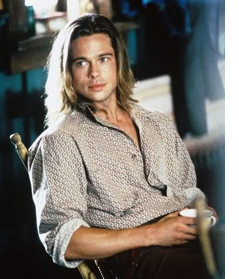 Take as an example Carl Plantinga’s paper on how we strike up moral attitudes toward characters. He was interested in how we achieve what Murray Smith calls “allegiance”—a “pro-attitude” toward certain characters. Is it just a matter of wishing good things for them, or admiring their positive traits? Is it a matter of sympathy for their situation?
Carl argued that all these factors play a role, but they aren’t enough to assure our siding with a character. He argues that allegiance also involves moral judgments, or rather moral intuitions. Films exploit two facts about these moral intuitions: they must be summoned up quickly, without much thought, and they are often driven by emotion rather than ideas.
Oddly enough, our moral intuitions are not necessarily driven by moral standards! Carl drew on Anthony Appiah’s analysis of moral judgments as influenced by how a situation is framed, ordered, and primed—basic cognitive cues that influence responses. For example, Legends of the Fall sets up two brothers, one conventionally moral and the other not. Yet it’s the wild, violent Tristan who earns our sympathies, because he displays vitality, youth, beauty, sensitivity, and closeness to nature. The upshot is that we rationalize a moral judgment on non-moral grounds. Carl got several questions about his conception of morality and the possibility that our moral intuitions are tied to things we value, like beauty.
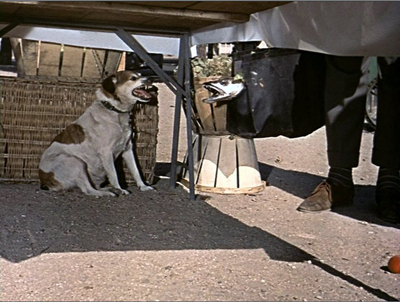
Malcolm Turvey offered a paper on gags in Jacques Tati. Pointing to prior work on how Tati’s gags are integrated into a shot’s composition (scattered so that we may miss them) and linked to one another (through overlap, Kristin has suggested), Malcolm went on to argue that the gags themselves don’t obey the conventions of classic comedy. They exhibit strategies of misinterpretation, blockage, ellipsis, fragmentation, and concealment that are highly original and unusually challenging. Malcolm is working on a book on “ludic modernism,” and he sees Tati as fitting into this tradition.
Malcolm’s precise and persuasive account was framed by a strong attack on the tendency of cognitive film theory to concentrate on ordinary, even undistinguished films and ignore problematic and avant-garde instances. He pointed to passages in Stephen Pinker’s writings that mock experimental art, and he urged cognitive film researchers to “call Pinker out” for his borderline Philistinism. He remarked that psychological researchers could learn as much from Tati’s work as from ordinary films…and maybe discover new things.
 A similar sort of rational reconstruction at the level of personal response was found in many other papers I heard. Jason Gendler dissected the misleading narration in The Blue Gardenia. Rory Kelly wondered why viewers tend to forget the water-utility plotline at the start of Chinatown. James Fiumara considered why modern startle effects are comparatively rare in classic horror films. Torben Grodal isolated a group of “disgust-driven phobic films” (Taxi Driver, Blade Runner, Se7en) that sink so deeply into disgust that melancholy drives out empathy. Lennard Hojberg studied circular camera movements that express the dizziness of love as based on embodied vision.
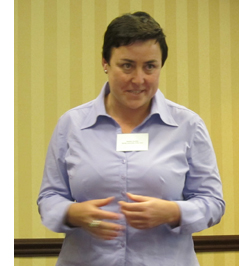
Some researchers used quantitative procedures to capture a film’s regularities. Monika Suckfuell (right) exposed some very complex patterns in a short film, Father and Daughter. These create a distinct emotional tone through what she calls “distance editing.” The patterns are combinations of thematic units like problem-solving or humor, and the recurring combinations arouse both comprehension and pleasure. In another quantitative study, Tseng Chiaoi and John Bateman sought to tie concrete uses of filmic elements with more abstract aspects of meaning. (Chiaoi and John had done a presentation on film-based discourse semantics at last year’s event.) Concentrating on characters’ action patterns, Chiaoi used computer software to trace their structures in television commercials and the war genre.
Squeezing the stimulus
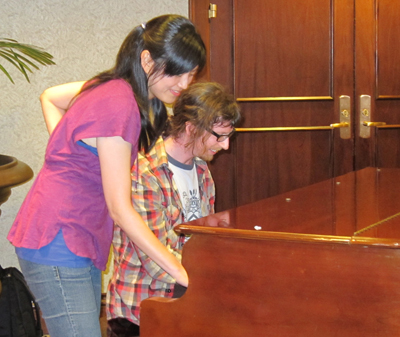
Bopping after a session: Tseng Chiaoi and Paul Taberham.
The talks I’ve mentioned, along with several others, analyze processes that we can access by re-viewing films, studying their form and materials, and examining the genres and stylistic traditions to which they belong. But other talks concentrated on the subpersonal areas, the parts of our responses that we can’t access so easily.
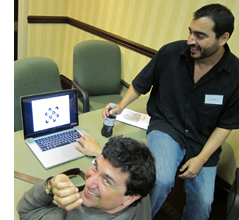 For instance, how do we mentally stitch together various shots to create a unified space for a scene’s action? Film scholar Todd Berliner and psychologist Dale Cohen presented an account of how we achieve an illusion of spatial continuity. Initially the brain grasps shots as if they were pieces of space selected by the viewer, and then it builds up a model of the whole space—say a porch in front of a house’s front door. When a character moves his arm a certain way toward an offscreen area, our model of porches and doors makes it most probable that he is pressing the doorbell.
In such ways we run “beyond the information given.” Filmmakers count on our doing that, so they give us feedback (say, the sound of a doorbell, or a shot of a door opening) that confirms our model of the space. Most mainstream films build in such redundancy. But the unity of these spaces is undermined by some contemporary exhibition technology. Todd and Dale suggested that the mental models we build of space exclude the movie theatre, so that surround sound and 3D become problematic.
They also got several good questions. How concretely specified are these model spaces? How do they develop in the course of a scene? Might our perception of continuity come down to a lack of perception of discontinuity—that is, maybe we operate on very simple default assumptions and don’t build up many models of the space.
Todd and Dale’s presentation was in the Helmholtz tradition; they even invoked “unconscious inference” as part of the story. Another tradition, represented by SCSMI founders Joseph and Barbara Anderson, invokes James J. Gibson’s ecological approach to perception, which argues that such modeling and inference-making isn’t really happening. Things are much more direct: Perception is data-driven, and needs top-down correction only in rare cases (like nighttime or fog).
Other perceptual researchers try for a more parsimonious research strategy: How much information about the visual world can we squeeze out of the stimulus? This question was raised by Jordan DeLong, who has been exploring how we can identify emotional arousal through very “low-level” information. Using a corpus of 150 films (more on this later), he looked at shot lengths, the distribution of shot-lengths across a film, and a purely physical measure of visual activity (essentially the change from frame to frame) to see if they correlate with genres we associate with high levels of arousal, like action and adventure films. Jordan’s study is preliminary, but there is the possibility that certain purely physical features are reliable indices to levels of arousal—even if people don’t notice those features and are much more fastened on characters and their actions.
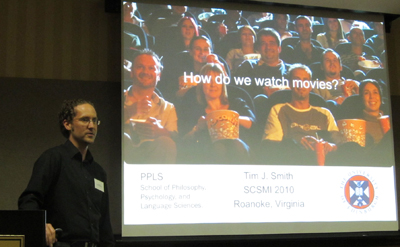
The current projects of Tim Smith’s research team exemplify the parsimonious strategy. Tim is a long-time participant in SCSMI, and his talks show how a research program can expand and enrich itself.
We know people look at certain areas of a shot. We also know that our attention is directed, driven by features of the stimulus. What features? We filmies would pick out shot composition, color, movement, lighting, shot scale, etc. We can access those middle-level variables through expert introspection and analysis. But can those features be further decomposed?
Tim thinks so. We can consider any of these technical qualities as made up of luminance, color channels, and other low-level physical aspects of vision. Through signal-detection methods, Tim seeks to pinpoint what the crucial variables are. The results of his work are soon to be published, and I don’t want to give the game away. I’ll just say that he has shown through eye-tracking that certain low-level features are more important than others in engaging viewers’ attention.
One implication of Tim’s findings is that what I’ve called “intensified continuity” seems to have an optimal grip on spectators. This technique, he remarked, “almost paralyzes the eyes,” yielding “an illusion of active vision with passive eyes.” More generally, his work seems to back up James Cutting’s remark that “There is no such thing as voluntary attention sustained for more than a few seconds at a time.” Most of our attention is at the mercy of the outside world, which means that filmmakers need to engage us at every moment—either with narrative, or with something else we’ll find arresting.
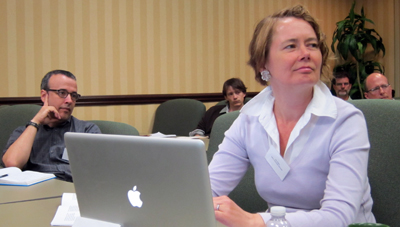
Dan Levin, Pia Tikka; in the background William Brown, Carl Plantinga, and Dirk Eitzen.
Dan Levin gave the keynote address at SCSMI two years ago, and he showed how we vastly overrate our ability to spot outrageous changes in the world or on the movie screen. (He’ll have a field day with the tricks in Shutter Island, such as the one surmounting this blog.) This time around Dan talked about Theory of Mind in the movies, the ways that films exploit our (species-specific?) inclination to attribute beliefs, desires, and goals to the creatures we see in the world, and in films. His paper scanned mandatory, bottom-up cues, middle-level activity (the sort of organization of visual space Todd and Dale discussed), and then “controlled cognition,” such as our narrative expectations. So for Dan it’s not all in the stimulus. Once we’ve picked out certain aspects of it, our Theory of Mind system locks on them.
What aspects? Chiefly, signals of intention and marked eye direction. When we think we’re watching an intentional agent, like a movie character, we tend to see the agent’s eye direction as giving us a clue to his or her aims. Using films he has made, Dan tests people for how eyeline-matched cuts are read, and he varies the cues to see how people construe them differently.
Interestingly, when he showed the same shots in a different order, about two-thirds of the subjects didn’t notice that the order was different. That is, whether the object of the glance or the person glancing came first, gaze deflection remained the primary cue to understanding the situation. This suggests to me that storytelling cinema doesn’t absolutely need the classic pattern of person looking/ person looked at/ person looking, but the extra shot makes sure we all understand (redundancy again).
A similar sort of top-down/ bottom-up theory was proposed by Dan Barratt, who gave it a more computational spin. Like Tim, he works on eye movements; like Todd and Dale he’s interested in how we construct space; like Dan, he seeks out intentional factors. It’s not all in the stimulus, but we won’t know how much until we keep squeezing.
Ripples in the flow of films
The Society broke new ground in what I called the “suprapersonal” realm, that of large-scale patterns of activity that aren’t explicitly coordinated by individuals or groups. Several researchers are probing this in relation to films. Films are, in effect, deposits of human behavior; they are artifacts resulting from choice. What if we find patterns of choice that we can’t plausibly trace to coordinated decision-making?
Chris Atherton raised the issue by considering how to study style statistically. Citing Barry Salt as a pioneer in the area, he focused on the work of the Cinemetrics group and offered suggestions on how to better collect data and track patterns at various levels of generality. More sharply, he posed the question of function. How can you measure that? One implication was that in a big body of films we can disclose order that can’t wholly be explained as the sum of individual choices. Those choices matter, but so do forces we have yet to determine, including historical processes. Chris’s reflections chimed nicely with those of our keynote speaker.
James E. Cutting is a distinguished perceptual psychologist at Cornell. He’s written a fine book on motion perception and has done a quantitative historical study of the creation of the canon of French Impressionist painting. He’s a former dancer and a sensitive appreciator of art and music (and film). He’s the ideal person to analyze ticklish aesthetic issues.
You may have run across him recently because his research on Hollywood films was picked up and trumpeted in the press. “Solved: The Mathematics of the Hollywood Blockbuster,” read one headline. Needless to say, James was doing something more subtle. You can read summaries here and here.
In his lively address, “Attention, Intensity, and the Evolution of Hollywood Film,” James explained two of his areas of interest: the ebb and flow of change across a film, and how that change is tied to human pickup. James studies these topics with a big database: 150 movies from 1935 to 2005. He emphasizes widely seen films belonging to five genres and chosen from the highest-rated titles on IMDB. But there’s a micro- side too. He and his research team went through every film frame by frame coding each one along many dimensions.
Naturally, he takes on the vexed issue of Average Shot Length. You can read the ongoing discussions of this concept on Yuri Tsivian’s Cinemetrics site. What interests James is less ASL in itself than the ways in which comparable patterns of shot lengths cluster in certain parts of the film. A film’s ASL may be 8 seconds, but in some passages several shots might have similar lengths, say 12 seconds each. Moreover, those patterns may “ripple through the film,” recurring at certain intervals and different scales (shot clusters, scenes, or other chunks).
 Not every film shows such patterns; film noirs seem random in their patterns of shot lengths. But many movies, especially those of the last fifty years do display these patterns—typically clusters of short shots for physical action, clusters of longer ones for conversations. This clustering tendency is on the increase, even outside the action genre.
The finding leads James to ask about the pacing of visual change, which raises the prospect of the sort of tension/ release dynamics we find in music. The patterns he finds don’t look arbitrary because they match the so-called 1/f or pink-noise pattern. This pattern has been detected in the natural world, in heartbeats, and in brain activity. It’s also been discovered in reaction times to tasks. In effect, the 1/f pattern captures not continual attentiveness but rather an alternation of intense concentration, moments of slower pickup, and moments of sheer mind-wandering. A nontechnical explanation of the 1/f pattern is here; a technical one is here.
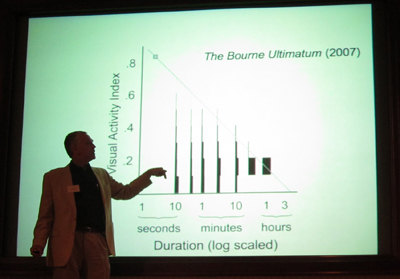
As for intensity, James is seeking to measure visual activity in the shots. How much change, in effect, can there be from frame to frame? This can be captured by correlating each frame with its mates. James and his team find that from 1930 to 1950, there’s been a steady increase of frame-to-frame visual activity across all genres. The images became busier, with more movement. Today, he suggests, Hollywood is exploring ways to raise the frame-to-frame visual activity—not only through lots of movement of characters (the action film comes to mind) but also through “queasicam” handheld movements.
In combination with decreasing ASLs, Hollywood seems to be asking: How briefly can I show you this and still get the point across? So far, James suggests, films like Mission: Impossible III and The Bourne Ultimatum seem to be the busiest at the visual level. But animated films score about the same.
James has a caveat: The size of the screen matters. Even a big home-theatre screen doesn’t duplicate the breadth of a theatre screen, which activates not only our central vision but our peripheral vision too. That’s why bumpy shots that you can tolerate on a computer monitor may make you queasy at the multiplex. Interestingly, the Bourne films and Cloverfield, James suggests, were more popular on IMDB after the DVD versions came out. Perhaps people were better able to assimilate them on a smaller display.
At one level, James is interested in the subpersonal factors. He grants that you don’t notice cuts but can attend to them if you shift your focus from the story. But the widespread patterns he discloses aren’t easy to ascribe to deliberate planning. Nobody but an avant-gardist would decide to have shots of similar lengths at points 14 minutes or 25 minutes apart throughout the film. But James finds such correlations at levels beyond chance.
I can’t pretend to understand everything mathematical in James’ argument, but I think that his discoveries open up a new way to think about pacing in film. My first impulse is to think about historical causes, as Chris suggests: filmmakers learning from each other, converging on optimum choices. But I also like to entertain the possibility that this optimum carries a resonance even beyond the flux of history. Perhaps like fish and fowl, filmmakers are obeying and viewers are fulfilling, completely unawares, deep rhythms built into nature and numbers.
A tangled databank
Traditional humanists would decry a lot of what goes on at SCSMI meetings. The appeal to general explanations, the recourse to biology and evolution, the use of quantitative and experimental methods would all smack of “scientism.” But more and more, humanists are starting to turn away from the endless reinterpretation of canonical or non-canonical artworks. Many are also quietly defecting from the Big Theory that dominated the 80s and 90s. In film publishing, I’m told, editors have come to an informal moratorium on books on Deleuze. Possibly more people write them than read them.
Committed to a theory of permanent revolution in Theory, humanists are seeking new pastures. Some have discovered neuroscience, others evolutionary psychology. Franco Moretti has launched quantitative studies of the literary marketplace. For many converts, the reconciliation with science is just a bandwagon to hop onto, and they will jump off when a newer one trundles past. But other scholars have been committed from early on. The prospect of “consilience,” the compatibility between the sciences and the arts, is something the literary Darwinists like Brian Boyd, Jonathan Gottschall, Joseph Carroll, and like-minded souls were defending long before it became fashionable.
Film theory, as Joe Anderson is fond of pointing out, has a long and intense fascination with experimental psychology. Hugo Münsterberg, Rudolf Arnheim, and Sergei Eisenstein saw no conflict in studying film art with tools and findings derived from the sciences. That interest was lost in the 1960s, for a variety of reasons. But some of us have persisted. An explicitly “cognitive” perspective has been developing in film studies for the last twenty-five years, and SCSMI has nurtured this tradition since 1997. Our commitment is deep. We’re making headway. We’re not going to go away.
There is grandeur in this view of life, and cinema.
Our Society owes a great debt to Stephen Prince of the Virginia Tech School of Performing Arts and Cinema, who hosted this year’s convention. He also gave a splendid paper on the research traditions behind precinematic optical toys, as a way of thinking about modern CGI.
I found these books on suprapersonal patterns helpful: Mark Buchanan, The Social Atom: Why the Rich Get Richer, Cheats Get Caught and Your Neighbor Usually Looks Like You (London: Cyan, 2007); Steven Strogatz, Synch: The Emerging Science of Spontaneous Order (New York: Theia, 2003); Philip Ball, Critical Mass: How One Thing Leads to Another (New York: Farrar Straus Giroux, 2004).
Todd Berliner and Dale Cohen’s paper, “The Illusion of Continuity: Active Perception and the Classical Editing System,” is scheduled for publication in the Journal of Film and Video in 2011. Tim Smith’s paper is in press at Cognitive Computation as P. J. Mital, T. J. Smith, R. Hill, and J. M. Henderson, “Clustering of gaze during dynamic scene viewing is predicted by motion.” You can check Tim’s DIEM project for video demonstrations, and his blog, Continuity Boy.
The original article by James Cutting, Jordan DeLong, and Christine Nothelfer, “Attention and the Evolution of Hollywood Film,” appeared in the March issue of Psychological Science. Access is through subscription.
As for Shutter Island, thanks to Justin Daering for pointing out the double sleight-of-hand. More thoughts on the film and Scorsese’s expressionist/ impressionist tendencies are in our backfile.
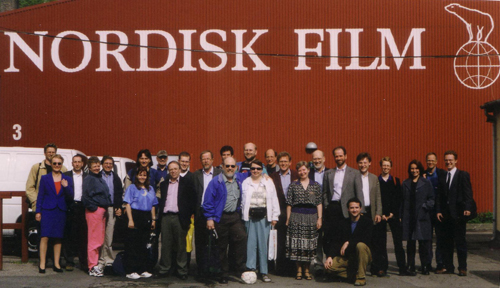
1999 Conference of the Center [later Society] for Cognitive Studies of the Moving Image; Valby, Denmark. Photo by Johannes Riis.
Glancing backward, mostly at critics
DB bere:
As Freud’s mom says in Huston’s film, “Memory plays queer tricks, Siggy.” Herewith, some journeys into the past, launched on a lazy June afternoon.
Ten-best lists are nothing new. The New York Times ran them in the 1930s. Here’s one for 1940 (NYT 29 Dec 1940, p. X5).
The Grapes of Wrath, The Baker’s Wife, Rebecca, Our Town, The Mortal Storm, Pride and Prejudice, The Great McGinty, The Long Voyage Home, The Great Dictator, and Fantasia.
The author’s runner-up titles include Of Mice and Men and The Philadelphia Story. Pretty tasteful by today’s standards, no? Who came up with a list including Hitchcock, Borzage, Sturges, Pagnol, Chaplin, Disney, Milestone, Cukor, and Ford twice?
None other than Bosley Crowther, long-serving Times reviewer who became the emblem of middlebrow taste in endless polemics (including some I’ve mounted). Who knew he was a closet auteurist?
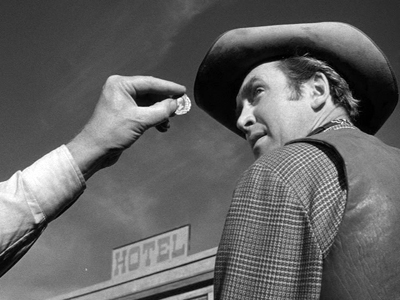
Winchester ’73 (1950).
Now try this one.
The movies live on children from the ages of ten to nineteen, who go steadily and frequently and almost automatically to the pictures; from the age of twenty to twenty-five people still go, but less often; after thirty, the audience begins to vanish from the movie houses. Checks made by different researchers at different times and places turn up minor variations in percentages; but it works out that between the ages of thirty and fifty, more than half of the men and women in the Unites States, steady patrons of the movies in their earlier years, do not bother to see more than one picture a month; after fifty, more than half see virtually no pictures at all.
This is the ultimate, essential, overriding fact about the movies. . . .
Yes, another oldie, this time from Gilbert Seldes’ book The Great Audience (1950). What we’ve been told for years was characteristic of our Now—the infantilization of the audience—has been in force for at least sixty years.
By the way, here are some US features released in 1950: Father of the Bride, Gun Crazy, House by the River, In a Lonely Place, Julius Caesar, Mystery Street, Night and the City, Panic in the Streets, Rio Grande, Shakedown, Stage Fright, Stars in My Crown, Summer Stock, Sunset Blvd., The Asphalt Jungle, The Baron of Arizona, The File on Thelma Jordan, The Furies, The Gunfighter, The Third Man, Twelve O’Clock High, Union Station, Wagon Master, Where the Sidewalk Ends, Whirlpool, Winchester ’73, and probably some other good movies I haven’t seen.
Perhaps not a luminous year, but I’d settle. Especially compared with 2010. Did kids just have better taste then?
Beyond reviewing
Most people conceive a film critic as a film reviewer. The review is a well-established genre, and we all have its conventions in our bones. At a minimum, you synopsize the plot, comment on the acting, mention the pacing or the cinematography, throw in some wisecracks, and recommend or condemn the film. Good reviewers do these things well, but the genre remains a limited one.
Crowther was a reviewer; Seldes was something more. But how to define that extra something? Two long-lived heavyweights can help us.
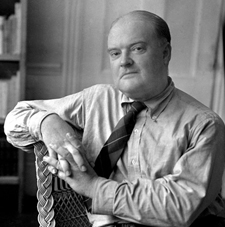
In the 1935 essay “The Literary Worker’s Polonius: A Brief Guide for Authors and Editors,” Edmund Wilson spells out what he takes to be the duties and genres of literary labor. At the time, the “New Criticism” in the universities had barely gotten started, so most literary criticism Wilson encountered was journalistic and belletristic—that is, reviewing.
Accordingly, Wilson distinguishes different types of reviewers. There the people who simply need work. There are literary columnists who pump out observations on the latest books. There are people who want to write about something else; that’s when you use the book under review as a pretext to ride your hobby horse. There are the reviewer experts, as when a philosopher is called in to review a book of philosophy. Then there’s the rarest, the “reviewer critics.” Here is why such creatures are rare.
Such a reviewer should be more or less familiar, or ready to familiarize himself, with the past work of every important writer he deals with and be able to write about an author’s new book in the light of his general development and intention. He should also be able to see the author in relation to the national literature as a whole and the national literature in relation to other literatures. But this means a great deal of work, and it presupposes a certain amount of training.
In sum, the best critic has to be very, very knowledgeable. But is knowledge enough?
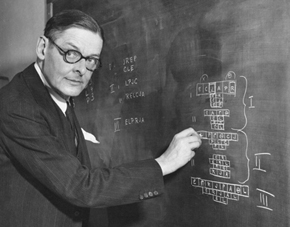
T. S. Eliot, it’s often said, believed that the only qualification of a critic is to be very intelligent. (One example of this claim is here.) What Eliot actually wrote is more interesting. His 1920 essay “The Perfect Critic” is considering Aristotle as a theorist of literature. Of The Poetics he notes:
In his short and broken treatise he provides an eternal example—not of laws, or even of method, for there is no method except to be very intelligent, but of intelligence itself swiftly operating the analysis of sensation to the point of principle and definition.
The final clause is a good description of what I take “poetics” to be as applied to film. We analyze effect (“sensation”) so to discover not laws but principles (governing a genre, a trend, a style, whatever) that we in turn articulate (“definition”). In this analysis, we don’t use a method—that is, I take it, a prior commitment to a system of thought that blocks our seeing the object in its own terms.
Contrary to the common modern view that our personal feelings and ideas color everything we think about, Eliot seems to advocate a more objective way of thinking. Aristotle the theorist is praised because “in every sphere he looked solely and steadfastly at the object.” His search for the principles underlying tragedy, comedy, and epic is contrasted with the dogmas of Horace, the “lazy critic” who offers us precepts, tips from the top about laws to be obeyed. (Sound familiar from screenplay manuals?)
Aristotle, Eliot thinks, was endowed with “universal intelligence”: “He could apply his intelligence to anything.” Such a gift overrides the sort of specialized inquiry that yields “methods.” I read “The Perfect Critic” as recommending that critics try to combine their sensitivity to nuance with Aristotelian intelligence:
Aristotle had what is called the scientific mind—a mind which, as it is rarely found among scientists except in fragments, might better be called the intelligent mind. For there is no other intelligence than this, and in so far as artists and men of letters are intelligent (we may doubt whether the level of intelligence among men of letters is as high as among men of science) their intelligence is of this kind.
This is what it is to be “intelligent” in Eliot’s sense: to be wide-ranging, rigorous, and committed to understanding the artwork both as unique object and embodiment of principle. He finally spells it out in his praise for the Symbolist Remy de Gourmont:
Of all modern critics, perhaps Remy de Gourmont had most of the general intelligence of Aristotle. An amateur, though an excessively able amateur, in physiology, he combines to a remarkable degree sensitiveness, erudition, sense of fact and sense of history, and generalizing power.
So Wilsonian erudition and historical knowledge aren’t enough. You need sensitivity, “a sense of fact,” and “generalizing power”—the ability to see larger implications and principles at work in what you’re writing about. In short, the best critics don’t shy away from probing ideas.
The general go
Where do the ruminations of Wilson and Eliot leave us with writers who go beyond reviewing? Let’s go back to Seldes.
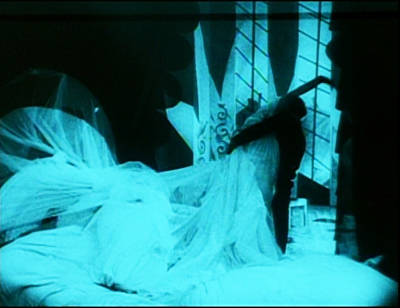
He became one of our best American critics, in fact one of our first media critics, thanks to his “generalizing power.” The 7 Lively Arts (1924) was a trailblazing defense of Tin Pan Alley, comic strips, vaudeville, jazz, and films. Reacting against “genteel” taste, Seldes believed that the bursts of exaltation to be found in the “minor” arts were as profound as anything to be found elsewhere. “Our experience of perfection is so limited that even when it occurs in a secondary field we hail its coming.” Such perfection is to be found, he says, in an instant in The Cabinet of Dr. Caligari, when Cesare seizes Jane and the bed curtains snag her gown. He starts with what Eliot called “sensation,” the piercing arousal.
A moment comes when everything is exactly right, and you have an occurrence—it may be something exquisite or something unnamably gross; there is in it an ecstasy which sets it apart from everything else.
But Seldes goes beyond noting moments that give him a buzz. He tries to explain how and why the vulgar arts can arouse us. It’s hard for us now to realize that what we take for granted as vital popular culture was scorned by the much of the intelligentsia. In 1924 Seldes set out on a crusade to convince his readers that the Keystone Kops, Flo Ziegfeld, Irving Berlin, ragtime, and Fanny Brice offered more of genuine artistry than the Bogus Arts (we’d say middlebrow) that were then ruling high culture. In 1924, this was a thunderbolt:
The daily comic strip of George Herriman (Krazy Kat) is easily the most amusing and fantastic and satisfactory work of art produced in America today.
If the best critics offer not only opinions but information and ideas to back them up, The 7 Lively Arts had both in abundance. Seldes begins the book with the suggestion that the consolidation of the film industry, and particularly the establishment of Triangle, Kay-Bee, and Keystone, was the turning-point in the history of American film. But instead of the usual litany of praise for Griffith’s and Ince’s discovery of “cinematic” storytelling, Seldes condemns them as too quickly seduced by extravagant spectacle. The journeyman Mack Sennett stuck to making “the most despised, and by all odds the most interesting, films produced in America. . . . He is the Keystone the builders rejected.” Far more than the work of Griffith and Ince, Sennett’s comedies exploit what cinema is best suited for: chases, crashes, explosions, “locomotives running wild, yet never destroying the cars they so miraculously send spinning before them. . . . And all of this is done with the camera, through action presented to the eye.”
Seldes wrote about radio, dancing, and other pastimes, but films were his special love. An Hour with the Movies and the Talkies (1929) and The Movies Come from America (1937) combine historical knowledge with subtle appreciation of the forces operating on studio picturemaking. These books thrum with ideas. For instance, Seldes defends the director as the key creative artist in cinema. One reason is that only the director can control pacing.
The director is responsible for the general go of a picture, for making it run off neatly, for controlling the speed of its various parts, for seeing that a romantic episode does not race along while a melodramatic conversation lags. He is, or ought to be, responsible for the interruptions of the main action of the picture so that a comic interlude is not placed too near to the climax of a tragic one, but only near enough to give more intensity to the emotion.
What about the camera? Hollywood movies, he says, have developed a rapid-turnover tradition that favors conciseness and novelty in the flow of images.
When Van Dyke in 1934 [in The Thin Man] wished to show a familiar event in the life of any man who walks a dog—an event which, although familiar, might not be passed by the censors—he merely showed the leash tightening and the hand of the man being jerked back; then the man stood still and a little later the same operation was repeated. . . . The part not only takes the place of the whole, but is more effective because the imagination of the spectator supplies what is missing.
Seldes might have added that once we’ve supplied that missing piece, we laugh at Asta’s ability to puncture Nick Charles’ serious disquisition on murder.
Seldes became a tamer thinker later in life. By the 1950s he was part of the media establishment, producing television shows on culture. He grew disappointed with the film industry, leading to his critiques in The Great Audience. Still, his critical skills persisted. His next major book, The Public Arts (1956), pins his hopes on television but also offers a balanced account of Hollywood’s widescreen revolution. Confronted with CinemaScope and its kindred systems, he worried, again, about pacing.
Wherever the movie touches time, it as mysterious and primordial as the beating of the heart. Absorbed in new techniques, directors may neglect essentials as they did a generation ago when they immobilized the camera to favor the microphone; but, as they recovered mobility then, so I am confident that they will recover the art of using and manipulating time in the substructure of their pictures.
Although he’s seldom discussed in film circles now, Seldes stands out as a worthy critic not because of one-off reviews but in virtue of his pointed, sometimes daring ideas, his knowledge, and the zest they arouse in the reader. These are the payoffs, I think, when a critic leaves reviewing, even the 10-best lists and other fun parts, behind.
My quotations from Seldes come from The Great Audience (New York: Viking Press, 1950), 12; The 7 Lively Arts (Mineoloa, NY: Dover, 2001), 204, 309, and 5; Movies for the Millions (London: Batsford, 1937), 75; The Public Arts (New York: Simon and Schuster, 1956), 55-56. For more on Seldes and his milieu, see Michael Kammen’s excellent intellectual biography, The Lively Arts: Gilbert Seldes and the Transformation of Cultural Criticism in the United States (New York: Oxford University Press, 1996).
My quotation from “The Literary Worker’s Polonius,” comes from Edmund Wilson, Literary Essays and Reviews of the 1920s and 1930s (New York: Library of America, 2007), 490.
Although the terminology is different, Eliot seems to be advancing something similar to Kristin’s arguments about film analysis in the first chapter of Breaking the Glass Armor: Neoformalist Film Analysis (Princeton: Princeton University Press, 1988).
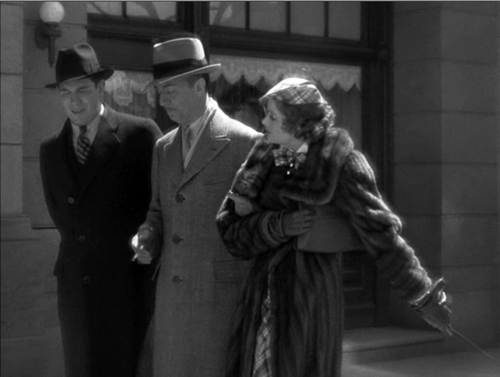
The Thin Man (1934). Seldes forgot that it was Nora, not Nick, who senses Asta’s response to the call of nature.