









Archive for the 'Film comments' Category
INCEPTION; or, Dream a Little Dream within a Dream with Me
Kristin here:
Inception reminds me of the common claim that Hollywood films are no longer character-centered. Special effects and slam-bang action supposedly have replaced character traits as the basis for storytelling. Now, here is a contemporary film released as a summer tentpole film and definitely successful in box-office terms. It crossed the $200 million domestic gross figure on Tuesday, August 3. Yet the nearly universal complaint, for those who don’t like the film, or some aspects of the film, is that we don’t get to know the characters.
If modern tentpoles have generally neglected characterization, that must be a convention by now. Why would people expect to find rounded characters? Is this complicated/complex (take your choice) intellectual film aimed at adults ironically going to prove that the critics of modern Hollywood blockbusters have been right all along?
I agree that the characters in Inception, apart from Cobb, the protagonist, are barely assigned traits. Ariadne, for example, does not return to join Cobb’s team as its architect because she has some personal goal or trait that inclines her to want to do so. It’s just that everyone who experiences the possibilities of shared dreams gets hooked.
But if there’s little characterization, is Nolan substituting something interesting in its place—apart from the usual computer-effects and spectacle? The first time I saw the film, I suspected he is, but for a long time I couldn’t figure out what. As a result, I did not really enjoy it until the point where the van breaks through the railing on the bridge and starts to fall. That’s pretty far into the film, 104 minutes in a roughly 140-minute film, not counting the credits. The van’s beginning to fall also marks the end of what we’ve called the Development portion of the film and the beginning of the Climax. (See here and here and here.)
At that turning point, it dawned on me that Nolan has elevated exposition of new premises to the main form of communication among characters. Discussion of their personal relationships, hopes, and doubts largely drops out. As the Russian Formalists would say, exposition, usually given early on and at wide intervals later in a plot, becomes the dominant here. That’s an unusual enough tactic to warrant a closer look.
We grasp most of the characters by the types of premises they provide. Yusuf is the man who understands how to manipulate the sedatives that will allows the team to progress deep enough into Fischer’s subconscious to plant the idea. Oh, yes, and he has a cat. Robert Fischer is the man who thinks his father despised him, so he is susceptible to the team’s machinations to plant the idea in his subconscious. (Saito says that Fischer has a “complicated” relationship with his father, but it’s actually just the opposite: a single trait, which is all that’s needed to establish his part in the action.) He also seems to be very concerned with security, since his subconscious conveniently peoples the dream levels with bodyguards who provide obstacles, fatally wound Saito, and force the van off the bridge, among other functions.
The characters’ goals, apart from Cobb’s, arise from the premises of the dream-sharing technology. Of course, they want to get paid, but that’s assumed. Their actions all arise from the need to keep doing what they must to sustain the dreams and later from the need to improvise solutions to unforeseen problems that seem to violate the rules they have previously known. Why they need the money, whom they go home to when off-duty, how they got into this business, and all the other conventions of Hollywood characterization, are simply ignored. Even Saito’s claim that Maurice Fischer’s corporation is dangerous to the world because it controls so much of its energy sources is simply assumed to be true. Our possible suspicions that Saito himself might really be the more dangerous tycoon, out to eliminate a powerful rival, might add a little complexity. The film, however, never hints at such a possibility.
Ariadne is somewhat different in her function. As in so many Hollywood films, there are two lines of action. First, there is the attempt to perform inception in Fischer’s subconscious. Second, there are Cobb’s related goals of getting back to his children but also of holding onto his dead wife through his visits to his projection of her in dreams. No one besides Ariadne fully understands Cobb’s obsession with Mal and hence she alone sees the danger it poses to the team. Ariadne lives up to her ancient namesake, guiding us through the maze of the Cobb’s obsession by acting as an expository figure in that storyline.
That is presumably why she doesn’t simply tell Arthur, who is much more experienced than she is in sharing dreams, about Cobb’s dangerous obsession. Instead, she decides to go into the dream levels as part of the team to keep on eye on Cobb—thus allowing her to continue as a privileged witness and transmitter of vital information about that storyline.
Each new premise creates a link in the chain of actions, and for the most part the actions are governed by the rules, or apparent rules of the dream-sharing machine, the sedatives, the levels, the characters’ respective skills, and all the other factors.
The narration constructs its causal chain by being nominally omniscient. For short stretches of the film we may be “with” Ariadne and Cobb or Mal and Cobb and witness them having personal conversations, most dramatically when Cobb fails to talk Mal out of leaping to her death. These moments provide the main alternative to the exposition-ridden dialogue, and they are a very small portion of the overall speech in the film. Yet the narration arches over all, stitching together the series of causes by moving us among the levels, catching at exactly the right moment the critical action (Arthur is putting a stack of dreaming people into an elevator) or dialogue (Cobb is asking Ariadne where she designed a route bypassing the labyrinth in the hospital).
Once I realized that this film’s plot concerns fiendishly complicated action that requires almost constant exposition from the characters, I enjoyed the rest of it. I saw it a second time and enjoyed it even more. I certainly don’t understand the entire plot, and I suspect that’s partly because, despite the nearly constant revelation of premises, there were a few left out. For one thing, just how does Eames, the “forger,” manage to change into other people? (No mention of polyjuice potion or anything else.) I can understand how he might do it in his own dreams, but the one dream where he doesn’t change is his own. Even the guides to Inception that have already been posted on the internet don’t answer every question. (Here and here are two examples of many.) Perhaps when the DVD comes out, the answers will be forthcoming—more of them, but probably not all.
In the meantime, I don’t see why we should get annoyed because Inception doesn’t contain rich, fully rounded characters. It’s clearly a puzzle film that takes the usual complicated premises of a heist movie and pushes them to extremes. Accepting the flow of nearly continuous exposition may remove some of the frustrations viewers face. After all, there’s no rule against it.

DB here:
When an actor comes to me and wants to discuss his character, I say, “It’s in the script.” If he says, “But what’s my motivation?”, I say, “Your salary”.
Alfred Hitchcock
Forget dream stuff for a while. Yes, Nolan says he was interested in dreams, especially lucid dreaming. Yes, he claims that the precision of detail in the film was an effort to suggest how “real” dreams feel when you’re having one. And yes, critics have defended the films’ dream worlds as realistic, or attacked them as phony substitutes. All interesting points and worth exploring, but not my focus at the moment.
And forget videogames. I leave that stuff to the experts, such as several members of our Wisconsin Filmies listserv. They have kindly pointed out many analogies and disanalogies. (See the coda for specifics.) And of course there’s no shortage of commentary about the film’s ties to gaming, or dreaming, on the Net.
My focus instead is motivation. Not the sort that Hitchcock and Bergman talked about, but rather the idea that any artwork needs to justify certain elements or strategies it presents.
Motivation beyond Bergman

You want your movie to have musical numbers. How to justify them in your story? Many early musicals simply make the characters show-business types, so we see them rehearsing and performing numbers for the audience. Other musicals cast that “realistic” motivation aside and let the characters sing and dance wholly for one another. But then those films were appealing to a sort of motivation familiar from opera, where characters simply burst into song or dance without realistic motivation. We accept this type of artifice too because that’s just what this genre of film permits—the way that horror films include monsters that are unlikely to exist in the real world.
The notion of motivation turns a lot of our usual thinking about cinema inside out. Usually we think that something is present in order to support what the film “says.” But actually a lot of what we find in films is motivated, either by genre or by appeal to realism, in order to give us a particular narrative experience.
For a couple of decades, some American cinema (both Hollywood and indie) has been launching some ambitious narrative experimentation. We’ve seen “puzzle films” (Primer), forking-path or alternative-future films (Sliding Doors), network narratives (Babel, Crash), and other sorts. This trend isn’t utterly new—there are earlier cases, especially in the 1940s—but it seems to have been accelerating in recent years, particularly after Pulp Fiction (1994). Christopher Nolan has participated in the trend as well, with Following and Memento.
The film industry encourages some degree of innovation. Novelty can attract attention, and perhaps audiences too. Yet, as I argued in The Way Hollywood Tells It, such innovations are counterbalanced by traditional storytelling maneuvers. These make sure that audiences aren’t entirely lost. For example, Memento’s backward structure requires very explicit signposting of the transitions, highlighting objects or gestures we’ve seen in the previous time-slice to link them to the next one we see. At the same time, these experiments can pay off financially: a complex narrative that balances enigma and understanding can lure audiences to revisit the multiplex or buy the DVD for further scrutiny. Remember, we are all nerds now.
Memento illustrates a couple of ways in which Hollywood efforts at innovation are controlled by tradition. First, you can motivate a film’s formal play through genre conventions. A science-fiction film, for instance, can invoke time travel or alternate universes. Doc’s time machine in the Back to the Future series motivates a fairly unusual play with cause and effect, particularly in the second installment. Likewise, mystery and detective stories pioneered the “lying flashback,” when people give false testimony about a crime (as in Crossfire). The possibility that a film noir will encourage complicated narration (an optically subjective first-person narrator in The Lady in the Lake, a dying narrator in Double Indemnity, a dead one in Sunset Blvd.) helps us recognize that Memento is an experiment in that tradition.
Second, you can motivate formal experiment through the movie’s appeal to some widely-believed law of life, a common-sense realism. Uncanny coincidences in movies like Serendipity and Sliding Doors are justified by the notion that fate or spiritual harmony can bring soulmates together. Six Degrees of Separation’s plot exploits the idea of social networks. Likewise, the backward progression of Memento’s plot is partly justified by the clinical condition of short-term memory deficits. I grant you, why this ailment supports a reverse-chronology tale is a bit puzzling—but that may only suggest that we’re ready to overlook flimsy justification if the novelty is piquant enough. A little motivation can go a long way.
So we ought to recognize that Inception is relying heavily on motivation from these two sources, genre and commonsense realism. Science fiction grants the possibility of entering people’s dreams through a futuristic technology. Likewise, we have all experienced dreams, so the film can appeal to folk wisdom about them. I suggest, though, that the purpose of the film not to explore the dream life but rather to use the idea of exploring the dream life to justify creating a complex narrative experience for the viewer. That is the purpose of the film; the dreams operate as alibis.
Interestingly, traditions outside Hollywood don’t require these sorts of motivation for narrative experiments. Last Year at Marienbad is perhaps the supreme example of a purely artificial construct, which can’t be justified by genre or subject/theme. I’d argue that Kieslowski’s Blind Chance, Buñuel’s Obscure Object of Desire, van Dormael’s Toto le héros, and other films of a highly artificial cast either ignore or cancel both realistic and generic motivation. They present themselves as experiments in storytelling, pure and simple. Another art-cinema motivational ploy invokes psychological realism, as in Fellini’s 8 ½. This is less daring than the blunt-artifice option, and so has been more easily adapted to mainstream storytelling.
One more point about the New (or now Not-So-New) Narrative Artifice. Strategies that seemed striking in the pioneering films are quickly mastered by others. Innovations are copied, and the learning curve is steep. By now anybody can create a fairly coherent network narrative or forking-path tale. Artistically ambitious filmmakers want to press further. So how can you create fresh experiments in storytelling today?
Architecture beyond Ariadne
If you decide to organize a film in sharply distinct plotlines, you have two problems. First, how do you combine them? What will be the overall architecture? Second, how do you fill in the chain of actions?
Consider combination first. You can create parallel plotlines, as in Intolerance’s assembly of four different historical periods or in Vera Chytilová’s Something Different, in which two women living at the same moment lead very different lives. You can create branching or forking-path plotlines, as in Run Lola Run. You can link stories through a simple overlap, as in Wong Kar-wai’s Chungking Express, or by letting them pass through the same place; the inn in Wong’s Ashes of Time functions as a sort of node that gathers together the destinies of different characters.
One sort of plot construction that hasn’t been explored deeply in recent years is actually one of the oldest. The embedded story, or the tale-within-the-tale, dates back at least to The Odyssey. In the standard case, we have one level of story reality, and in that a character tells a story that takes place earlier and elsewhere. Typically the embedded story is pretty extensive, with its own structure of exposition, development, crisis, and climax. You can of course multiply the stories, as in The Arabian Nights, The Decameron, and The Canterbury Tales.
Sometimes the framing story is merely a backdrop, though usually that has its own dramatic impetus: Scheherazade tells a story each night to postpone her death. Often, though, the framing situation carries the main interest. In Don Quixote, readers are tempted to skip the tales told by people whom the knight and Sancho encounter, in order to get back to the real story, the relationship of the central pair.
The “discovered manuscript” convention of nineteenth-century fiction was an equivalent of this pattern, a sort of novel-within-a-novel. Some experimental fiction has exploited the embedded story; I think of Calvino’s If on a Winter’s Night a Traveler. The principle of embedding has been found in cinema too, of course. Citizen Kane is the classic example, since it embeds recounted stories (most of the flashbacks), a written text (Thatcher’s memoirs), and even a film-within-a-film (News on the March). Many of the embedded stories we find in films are presented as flashbacks, and those are usually motivated by a character recalling or telling another character about past events. (See our blog entry “Grandmaster Flashback” for some more discussion.)
The task of the author is to motivate the story’s presence through relevance to the framing situation. Why insert the tale in the first place? Most commonly, it involves some of the same characters we find in the surrounding story world, as in a flashback. In that case, the embedded tale supplies new information about plot or character. It may also provide a parable or counterpoint to what’s happening in the surrounding situation. In The Sin of Madelon Claudet (1931), a woman is about to leave her husband, but she changes her mind when a family friend tells her, for the bulk of the movie, about the sacrifices made by the husband’s mother.
Some researchers might argue that the purest instance of this format is one in which the characters of the overarching frame story don’t participate in the embedded tale. Classic instances like the Mahabhrata are often studied as compilations. A partial instance in cinema is the country-house frame story of Dead of Night, in which some characters recount stories that didn’t involve them. Here the frame story arouses considerable interest in its own right.
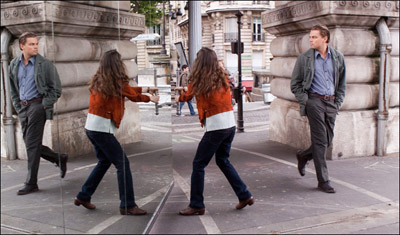
Once you allow the possibility of an embedded story, some storyteller will ask: Why not embed a story into the embedded story? And so on. Calvino’s novel does this, suggesting the possibility of that infinitely extended series we see when somebody stands between two mirrors and the image is multiplied forever. (Inception gives us such an image when Ariadne summons up mirrors on a Parisian street.) Hollywood filmmakers experimented with multiple embedding in some flashback films of the 1940s. In The Locket and Passage to Marseille, there are flashbacks within flashbacks. More daring, and closer to Calvino, is Pasolini’s Arabian Nights, in which one character recounts a tale in which he encounters another character, who recounts his tale, and so on.
Here, I think, is the accomplishment of Nolan’s film. The general absence of complicated embeddings today (at least since The Matrix) presents an opportunity for an ambitious moviemaker. Inception constitutes an extended experiment in what you can do with a nested plot structure, motivated by the dream-invasion premise.
The Dream team
Nolan adds a new wrinkle. Instead of recounting or recalling stories, the characters enter worlds “hosted” by one of their number and furnished by another. The movie introduces this strategy to us obliquely. After the prologue in which Cobb confronts a very aged Saito in Limbo (which I think you can take as either a flashforward or a symptom of their collaborative dreaming at the moment), we are plunged into layers of embedding. In the real world, Cobb, Arthur, and the architect are dreaming with Saito on a train; we later learn that this is an audition to test Cobb’s extraction skills. They dream that they are in an apartment where Saito meets his mistress. But in that apartment they are sleeping, and dreaming that they are in a luxurious mansion where Cobb is trying to discover Saito’s secrets. That effort is disrupted by Mal, Cobb’s ex-wife, and the dream world collapses.
What’s tricky is that Nolan doesn’t establish these layers of embedding in customary order. The flashback tradition leads us to expect to move from outside to inside, like peeling an onion: from the train to the apartment to the mansion. Instead, we are first shown the mansion, and we get glimpses of the apartment. That tactic hints that the apartment is the primary level of reality in the fiction. But in the apartment Saito notices discrepancies in the carpet, making him realize he’s dreaming. Only then does Nolan shift to the external frame, the four men on the train, minded by a young Japanese passenger.
This has been our first training exercise, and it turns out to be based on surprise: We weren’t aware of how many embedded plotlines were in play. In the film’s terms, the dream session on the train went down two levels. Cobb says he can go down three, and that forms one goal for the team.
Later exercises are simpler, involving only shared dreams rather than embedded ones. That’s because these dreams operate as tutorials, as when Cobb shows Ariadne how dreamworlds are constructed and populated (though the framing situation is deleted at the outset–another, if milder, surprise). The dreams also function as psychological probes, as when Ariadne learns that Cobb’s unresolved problems with his wife are expressed in her eruptions into whatever dreamworld is conjured up. These études have to be relatively transparent if we’re to understand all the premises of this game. Similarly, our introduction to Limbo is given not through dream-penetration but through a good old flashback, when in the first-level dream world Cobb confesses to Ariadne that he and Mal built their own dreamscape there. Limbo changes the rules of the game to such an extent that we shouldn’t have to worry about who’s dreaming what for whom; a straightforward piece of visual exposition does the trick.
The most intricate embedding takes place in the final seventy-five minutes, most of the second half of the film. Instead of a train, a plane. Instead of four dreamers, six: the target young Fischer, plus all the members of the team, including Ariadne, who will monitor Cobb’s subconscious. Each team member hosts one story world, the other members enter it, and Fischer gets to populate it. Yusuf the chemist hosts the rainy car chase that leads to the van’s descent to the river. Arthur the point man hosts the hotel scene in which Cobb accosts Fischer. Eames the Forger (or rather the imposter) hosts the snow fortress siege, in which Fischer is induced to confront his dying father (thinking he is entering the dream of the family confidant Browning). Finally, to pursue Mal, Cobb and Ariadne plunge into the beachfront/ metropolis zone of Limbo constructed by the couple during their dream days. It’s then revealed that Cobb brought about his wife’s idée fixe by planting the idea that dreams could become reality; this showed him, with tragic consequences, that inception could work.
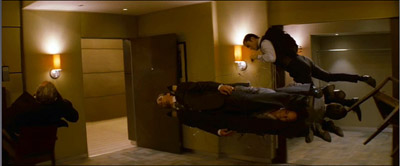
So we have five levels: the plane trip embeds the rainswept chase, which embeds the hotel, which embeds the snow fortress, which embeds the Limbo confrontation. The nested structure is recapitulated in the burst of shots showing Ariadne snapping awake in each level up to the submerged van (dream level 1).
Indeed, I think that one prime purpose of Nolan’s fancy structure is to foster such little coups. The Ariadne passage is cinematically simple—just a string of quick, graphically matched close-ups—but in context arresting. Of course that context displays a clockwork intricacy. What Nolan has done is created four distinct subplots, each with its own goal, obstacles, and deadline. Moreover, all the deadlines have to synchronize; this is the device of the kick, which ejects a team member from a dream layer. With so many levels, we need a cascade of kicks.
The last forty-five minutes of the film become an extended exercise in crosscutting. As each plotline is added to the mix, Nolan can flash among them, building eventually to four alternating strands—with additional crosscutting within each strand (in the hotel, Cobb at the bar/ Saito and Eames in the elevator/Arthur and Ariadne in the lobby). Each level has its own clock, with duration stretched the farther down you go. One thing that has long struck me about classical crosscutting is that in one line of action time is accelerated, while in another it slows down. The villains are inches away from breaking into the cabin/ the hero is miles away/ the villains are almost inside/ the hero is just arriving. I wonder if Nolan noticed this aspect of the crosscutting convention and built it into his plot, supplying motivation (that word again) by stipulating that different dream levels have different rates of change.
Another clever touch is what Nolan doesn’t include in the orgy of crosscutting: the framing situation in the first-class jet cabin. Once we leave that, we don’t see it again for about seventy minutes. I think we tend to forget about it, so that Cobb’s startled expression upon finally awakening mimics our own realization that all the intense physical action has been enframed by this quiet, stable situation.
I think that structurally, if not stylistically, the climax is a virtuoso piece of cinema. It recalls Griffith’s Intolerance, which also intercuts the climaxes of four plotlines, and supplies crosscut lines of action within each line as well. Here, one might say, is one way to innovate in the New Narrative Artifice: Create something like the Intolerance of the twenty-first century.
Possible, and not that unstable
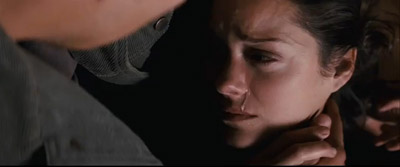
The film is shameless in its regard for cinema, and its plundering of cinematic history. What’s fun is that a lot of people I talk to come up with very different movies that they see in the film, and most of them are spot-on. There are all kinds of references in there.
Also like Griffith, Nolan has hit upon some ways to make his innovation user-friendly. For one thing, as most viewers have noticed, he situates his levels in very different locales: rainy, traffic-filled city versus eerily vacant metropolis; cushy hotel versus more Spartan one; beach versus mountains. This allows us to keep oriented during even the most rapidly cut portions. More subtly, Nolan has, deliberately or not, respected the limits of recursive thinking, or metacognition.
As shrewd members of a very social species, we are all good at mindreading, figuring out what other people are thinking. I know that Chelsea admires Hillary. We’re good at moving to the next level too: I know that Chelsea believes that Hillary wants to monitor Bill. And I know that Chelsea believes that Hillary suspects that Bill is smitten with Monica. If you drew this situation as a cartoon, you’d have one thought bubble inside another inside another, and so on—like the Russian-doll structure of the climax of Inception.
It turns out that our minds can’t build these nested structures indefinitely. We hit a limit.
Peter believes that Jane thinks that Sally wants Peter to suppose that Jane intends Sally to believe that her ball is under the cushion.
Robin Dunbar, whose example this is, suggests that most adults can’t handle so much recursion. His experiments indicate that the normal limit is at most five levels—just what we have in Inception (four dream layers plus the reality frame). Add more, and most of us would get muddled.
The filmmaker’s second big problem with modular plotting, I mentioned near the start, is how to fill in the plotlines. Let me suggest a general principle, at least for storytelling aimed at a broad audience: The more complex your macrostructure is, the simpler your microstructure should be. In Memento, the high degree of redundancy between memory episodes and the unusually heightened transitions help us track the backward layout of scenes. Similarly, all four episodes of Intolerance culminate in a race to the rescue—a device that was by 1916 immediately legible for audiences.
Genre plays a role in simplifying the modules too. Our efforts to make sense of Memento are helped by film noir conventions like the trail of clues, the deceptive allies, and the maneuvers of a femme fatale. Likewise, Griffith used the conventions of current genres to fill in the plotlines of Intolerance. The Christ story can be seen as a recasting of the many pious Passion plays of the first years of cinema. The Babylonian story and the Huguenots’ story rely on the established conventions of the costume pictures, including the French and Italian features that were popular at the time. (Capellani, discussed in an earlier entry, was one master of this genre.) And of course Intolerance’s modern story is pure melodrama, showing a young family pulled apart by the forces of urban poverty and bluenose reform. Griffith wove together not only four epochs but several genres.
So does Nolan in Inception. He recruits the conventions of science fiction, heist movies, Bond intrigues, and team-mission plots like The Guns of Navarone to make the scene-by-scene progression of the plot comprehensible. The iterated chases and fights keeps us grounded too, though you might wonder why Fischer’s subconscious projections all seem to have leaped out of a Bruckheimer picture. And of course you’ve seen many of the other images before, from the Paris café to the luxury hotel bar. Shamelessly clichéd, the image of kids playing in the sunlight immediately evokes fatherhood and family in any film.
I’ve already argued that the comparatively transparent training and exploration sessions in the middle of the film help us keep our bearings. Another handhold is the convention of the new male melodrama, the husband or boyfriend trying to come to terms with the death of his woman. The simple action movie, from Death Wish to Bad Boys, uses vengeance to ease the man’s torment. The more “serious” plot makes the man responsible in some degree for the woman’s fate. The emotional temperature rises as the male protagonist tries to fight his feelings of guilt, turning it outward to a perpetrator (as in The Prestige) or inward (as in Memento, and Shutter Island). The under-plot of Inception, driven by Ariadne’s curiosity, gradually reveals to us that Cobb gave Mal the fatal idea of dwelling in dreams.
Moreover, the rise of fantasy, science-fiction, and comic-book movies has brought a new interest in creating “worlds” with their own laws. Once you have Superman, you need a secret identity and Kryptonite and well-placed phone booths, not to mention a host of constraints on what can and can’t happen. Comic books supply not only a world furnished with characters and settings but also rules about conduct, morality, even physics. George Lucas, in his youth more of a comic-book reader than a cinephile, took over this principle of construction for Star Wars. Of course this idea of richly furnished, rule-governed worlds has been elaborated more fully in videogames. My point is that contemporary viewers are ready to ride with this as another convention of contemporary virtual-world storytelling, and this habit simplifies our pickup of the rules governing Inception’s embedded stories.
In sum, as ambitious artists compete to engineer clockwork narratives and puzzle films, Nolan raises the stakes by reviving a very old tradition, that of the embedded story. He motivates it through dreams and modernizes it with a blend of science fiction, fantasy, action pictures, and male masochism. Above all, the dream motivation allows him to crosscut four embedded stories, all built on classic Hollywood plot arcs. In the process he creates a virtuoso stretch of cinematic storytelling.
I could find faults. As in The Dark Knight, Nolan’s action scenes are clunky and distressingly casual in their composition and cutting. He is much better at mind games than spatially precise physical activity. Some dialogue could be pruned too. (What are you doing here? He loved you–in his own way. Something is happening…as we speak.) And I haven’t even posed the interpretive issues. Find a sympathetic young woman to exorcise the demonic wife you can’t quite abandon. Find a new father figure (Japanese mogul) to replace the old one (Brit architect). Use the spinning top to exemplify both change and stability, childhood and maturity, and/or the unending flux of narrative. As Kristin hints, the whole thing might actually be complicated rather than complex; instead of a dense but coherent cluster of principles we might have a shiny contraption, bolting on new premises as it hurtles along.
Nonetheless, if current excitement about this movie is any measure, Nolan has pulled off the big balancing act. The film is redundant and familiar enough to let most of us follow the main trajectories on the first pass. Yet it’s enigmatic, elliptical, and equivocal enough to keep many of us talking about it. . . and watching it again. Recidivism, thy name is Inception.
Based on Uncle Scrooge? That’s rich!
Kristin back again:
There has been much suggestion on the internet, sometimes in jest, sometimes in earnest, sometimes half in jest and half in earnest, that Nolan got the idea for Inception from an Uncle Scrooge comic story with a shared-dream premise, “The Dream of a Lifetime!” Nearly all postings on this subject date this comic, created by Don Rosa, to 2002. Yes, “Dream” first appeared in 2002—in Danish. It came out in the U.S. in the May, 2004 issue of Uncle Scrooge (Gemstone #329). In 2006, it was reprinted in Rosa’s book, The Life and Times of Scrooge McDuck Companion.
A download of “The Dream of a Lifetime” is available online, but it is missing a page, so I’m not linking it here. The Companion volume is out of print but can still be purchased here. It contains Rosa’s “The Making of ‘The Dream of a Lifetime!’” “The Dream of a Lifetime” is included in the tenth and final volume of a series reprinting all of Rosa’s duck stories chronologically by their original appearance. The “Behind the Scenes” section at the back leads off with a revised version of “The Making of ‘The Dream of a Lifetime!'” Here Rosa mentions the theory that Inception was based on his comic tale. He saw the film only after reading about this on the internet and being skeptical of fans’ claims. His comment upon seeing the film is “And … whoa … I was no longer so dismissive of those internet theorists. There are so many elements in Inception that match aspects of my story very closely! Ah well–no matter.” (p. 175)
If Nolan got the idea from the Rosa tale, which seems unlikely, he certainly developed upon and changed it considerably. In fact, there are more significant differences than similarities.
First, the similarities:
1. In “The Dream of a Lifetime!” several people enter the dream by being hooked up to a machine. Here it’s a radio-controlled device invented by Gyro Gearloose, who intended for it “to help psychiatrists examine the dreams of their patients.” (Gearloose was created in 1952 by Carl Barks to provide whatever wacky invention his plots required.) The receivers are metal colanders wired as antennae and worn on the heads of the people sharing the dream.
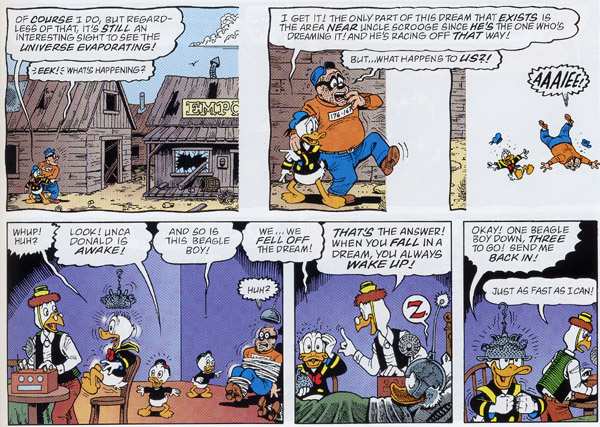
2. Waking up from visiting the dream is triggered by falling (see below).
3. Characters in reality can attempt to insert objects or situations into the dream by making sounds or presenting objects for Scrooge to smell, though this usually goes comically wrong. This somewhat resembles the premise that the jolts of the van in the first dream level of Inception cause earthquake-like rumbles in the second level and so on.
4. The characters frequently explain to each other how the shared-dream technology works. Rosa makes this humorous in part by starting the story with Scrooge dreaming and the Beagle Boys arriving in his money bin with the Gearloose equipment, which they have already stolen. He then makes the exposition deliberately clunky and obvious. One of the stupider Beagles asks, “Sure … uh … tell me again how it works?” There are then several panels of explanation as the group arranges the equipment to enter the dream. As they are about ready, one remarks, “But I’ll explain later” how they will get Scrooge to tell them the combination to his vault.
5. All of the characters who enter Scrooge’s mind are aware that they are in a dream, as is Scrooge, who has had each of these dreams many times.
Now, the differences:
1. There is a single dreamer throughout, and Scrooge remains in his own bed.
2. There is only one level of dreaming, and Donald, who enters the dream to foil the Beagle Boys, returns at intervals to the bedroom to report progress and plan strategies.
3. Spatially, the dream extends only a short distance around Scrooge. If the characters move too far from him, it fades out, which Rosa represents by having portions of the panels go white. The Beagle Boys exit the dream, one by one, by falling into the white void (see below).
4. Scrooge’s dreams are essentially flashbacks, though they are altered by the other characters who enter the dreams. The plot passes through a series of seven recurring dreams, all based on real adventures Scrooge has had in the distant past. Each of the seven dreams derives from situations in Rosa’s The Life and Times of Scrooge McDuck series. (The one-volume edition of this series is out of print, but it still is available in a two-volume version, here and here.) These dreams take place out of chronological order, and Scrooge’s age changes with each new dream. (The stories are “The Vigilante of Pizen Bluff,” #6, Scrooge age 23; “The Dreamtime Duck of the Never Never,” #7, age 29; “The Master of the Mississippi,” #2, age 15; “The Empire Builder from Calisota,” #11, age 45; “The Buckaroo of the Badlands,” #3, age 15; “The Last of the Clan McDuck,” #1, age 10; and “Hearts of the Yukon,” #8C, age 31.)
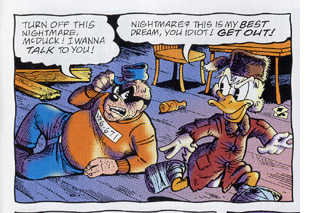 5. The rules are relatively simple. Crucially, Scrooge may be any age within the current dream, but he, being the main dreamer, recognizes Donald and the Beagle Boys.
6. “Dream” is designed to be funny, as when the Beagle Boys keep complaining that they’re in a nightmare, while Scrooge thinks of them as pleasant dreams. This is normal life to such an adventurous character.
It should be clear that the complexity of Rosa’s story originates not from the shared-dream structure, which is fairly straightforward. Rosa is more interested in finding a way to rework some of the scenes from his earlier biographical Scrooge comics. The whole Life and Times project originated from Rosa’s working method of teasing out minutiae about Scrooge from the original Carl Barks stories and then concocting sequels or prequels to them. Life and Times is an attempt to use all the mentions of past events, relatives, locales, and dates to devise a biography of Scrooge. “Dream of a Lifetime!” carries that modus operandi one step further.
The other big difference between “Dream” and Inception is that a reader who was not familiar with the seven earlier stories would miss much of what goes on in “Dream.” It was written for McDuck aficionados as a sort of game of recognition. For those who do recognize the seven situations referenced, “Dream” is quite easy to follow. For those who don’t, it must seem complicated and mysterious, most crucially since they won’t recognize Glittering Goldie, Scrooge’s lost love, in the opening “private” part of the dream.
In contrast, Inception is self-contained and tries for a very different sort of game of comprehension with the viewer, one which would not be aided by knowledge from other Nolan films.
“Dream” is also recognizable to fans as another of the “trick” stories that Rosa has written occasionally. These are not linked to Barks’s stories but develop some simple premise that allows Rosa to play with time and space in virtuoso fashion. These include “Cash Flow,” where the Beagle Boys buy an anti-friction ray-gun (Uncle Scrooge, Gladstone #224); “The Beagle Boys vs. the Money Bin,” (Uncle Scrooge, Gemstone #325), where the Beagle Boys find a map of the money bin; and my favorite, “A Matter of Some Gravity” (Walt Disney’s Comics, Gladstone, #610), where Magica de Spell buys a wand that turns gravity sideways for Scrooge and Donald.
In short, if Nolan ever saw “Dream of a Lifetime!” it could only have given him a few ideas out of the many that went into Inception.
DB coda:
For more discussion of the art of Christopher Nolan, see his category on the right-hand side of the page. We have an analysis of sound in The Prestige in the ninth edition of Film Art: An Introduction, and there we discuss the film’s narrative strategies as well.
Despite not caring for the movie, Jim Emerson has been assembling a wide-ranging and long-running dossier on Inception, with many comments. Scroll down the several entries here. Likewise visit David Cairns, who makes the necessary Anthony Mann comparison. The Wikipedia entry on the film is information-packed, and it includes several helpful links.
Our UW informants suggest that videogames having affinities with Inception include Assassin’s Creed II, Meigakure, and Shadow of Destiny. Thanks to Jason Mittell, Tim Palmer, Evan Davis, Leo Rubinkowski, Ethan de Seife, Edward Branigan, and Andrea Comisky for suggestions. See also Kirk Hamilton’s “Inception’s Usability Problem.”
On fourth-and fifth-level mindreading, see Robin Dunbar, The Human Story: A New History of Mankind’s Evolution (London: Faber, 2004), pp. 45-52. Dunbar’s study found evidence suggesting that women are better at tracking recursive mental states than men are.
Jan Simons offers an analytical survey of writing about New Artifice in an article here. For interpretations of particular films within the trend, see Allan Cameron, Modular Narratives in Contemporary Cinema (Palgrave Macmillan, 2008) and Warren Buckland, ed., Puzzle Films: Complex Storytelling in Contemporary Cinema (Wiley-Blackwell, 2009). I try to lay out some narrative principles governing such films, including Memento, in The Way Hollywood Tells It and in the essays “Film Futures” and “Mutual Friends and Chronologies of Chance” in Poetics of Cinema.
PS (17 December 2010): We have a rethink of Inception in this later entry.
[November 29, 2018: I have updated the section on Don Rosa’s “The Dream of a Lifetime!” by removing or updating dead links, correcting one error, and adding a few remarks on Rosa’s updated making-of essay on the comic. (KT)]
The long right wall explained
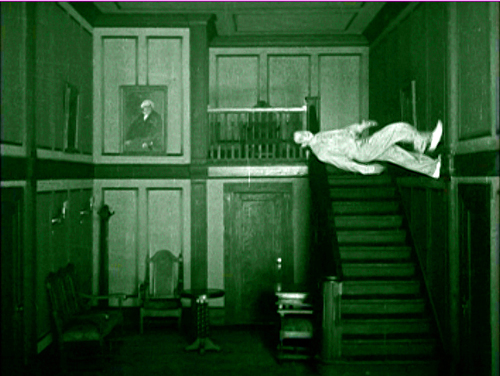
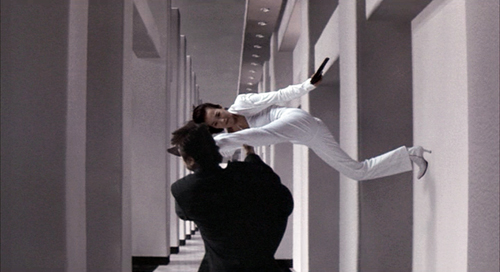
When the Clouds Roll By (Victor Fleming, 1919); So Close (Yuen Kwai, 2002).
DB here:
Kristin will be posting a new entry in the next couple of days, but in the meantime, here’s news of another enhancement of this site. It’s the very lengthy list of categories you see on the right.
The blog will be four years old this fall, and we’ve written nearly 360 entries. Some of those are brief and ephemeral, like this one, but many are big. Several entries range over many topics or various periods of film history. Likewise, our festival reports often sweep across a range of directors, genres, and national cinemas. So we thought it was time to expand the categories pertaining to our posts.
We also thought that a finer-grained set of categories would let you see the scope of topics we’ve considered over the years. Maybe you didn’t know that Harold Lloyd or American indies or New Zealand cinema were some of our recurring concerns. In addition, the long right wall makes it easier to dig up older posts when a new film is released. For example, readers interested in Inception (about which I hope to write soon) can have a look at two substantial entries on other films by Christopher Nolan.
The result is the extensive, we hope not daunting, list of categories. These categories apply only to sustained discussions. If we merely mention Ford or screenwriting in passing, that doesn’t qualify for inclusion. Even if a director’s film earned a couple of paragraphs in one entry, we didn’t create a category for that person. That would have made the list enormous and cumbersome. What we have are the names and topics that frequently crisscross the blog entries. But of course the Search function enables you to locate every mention of any person, idea, or film you’re interested in.
We hope that this new wrinkle makes our blog more intriguing and helpful for our readers, whom we thank for their continuing support.
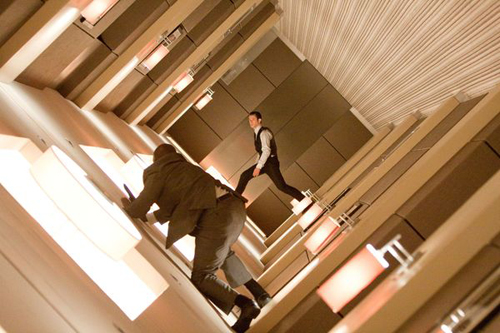
Inception (Christopher Nolan, 2010).
Ledoux’s legacy
DB here:
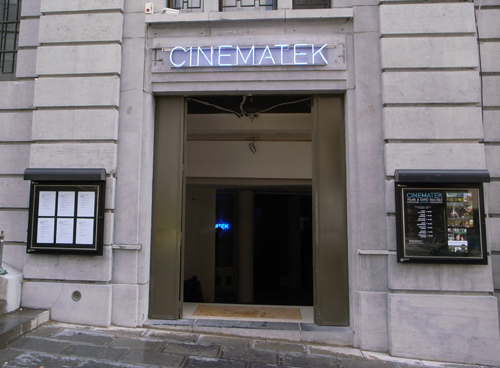
Every summer Brussels hosts one of the world’s most unusual film festivals. By global standards it’s a small event: it showcases only twenty or so titles, each screened twice. The films are on the whole unknown. The prizes are minuscule by the million-plus benchmarks set by Dubai and Abu Dhabi. The venue stands behind an inconspicuous doorway. Yet for me it’s an unmissable event, a crucial influence on my thinking about film and my search for cinematic satisfaction.
Jacques the gentle
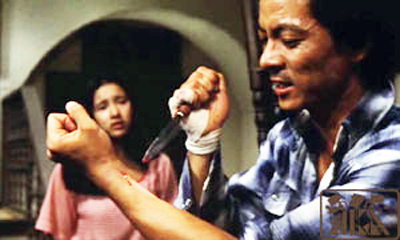
Young Murderer (Seishun no satsujin sha, 1976).
Between 1948 and his death in 1988, Jacques Ledoux was the curator of the Royal Film Archive of Belgium. He made it into one of the cinema’s legendary places, at once Mecca and Aladdin’s cave. On remarkably small budgets, he assembled broad and deep collections. He bought many titles for distribution to local cinemas and schools. He created a public screening program that for decades has shown five different films (two of them silents), every day of the year. The year Ledoux died he received an Erasmus Prize for his services to European culture.
His early life could have come out of an East European movie. Born in Poland in 1921, he fled to Belgium to escape the German onslaught. He hid in several places, including a monastery. There the abbot gave him work publishing Benedictine books. In the abbey’s screening room Ledoux discovered a copy of Nanook of the North. He offered it to the just-started Belgian Cinémathèque, and its supervisor, the filmmaker Henri Storck, offered Ledoux a job. Finding film archivery more appealing than studying science and medicine, he stayed with the Cinémathèque. Interestingly, “Jacques Ledoux” was a pseudonym; one translation is Jacques the Gentle.
Not always gentle Jacques in his scraps with other archivists and local politicians, Ledoux pledged himself to filmmakers, audiences, and—a rarity at the time—overseas film scholars. New Wave directors and Parisian critics made railway pilgrimages to Brussels to see films unavailable in France. When Kristin and I started doing research in the archive in the 1979, Ledoux welcomed us and guided us to treasures we hadn’t known existed.
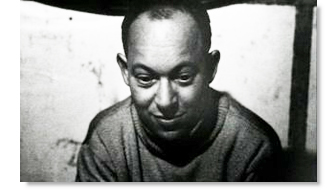 Unlike the very public Henri Langlois, Ledoux worked best behind the scenes. Probably most cinephiles today know him only from his brief appearance as one of the sinister experimentalists in La Jetée (1961). He resisted being photographed, and he refused to wear a necktie. Unsurprisingly, he admired directors who strayed from the beaten path. He created the first festival of experimental cinema at Knokke-le-Zoute, in 1949.
His desire to widen everyone’s knowledge of cinema found another outlet when he created the Prix l’Age d’or/ Prijs l’Age d’or in 1958. It was aimed to reward, as Ledoux put it, “a film that, by questioning taken-for-granted values, recalls the revolutionary and poetic film of Luis Buñuel, L’Age d’or.” Ledoux wanted to encourage a cinema that was subversive in both content and form.
The first prizes were given within the framework of the Knokke event: in 1958, to Kenneth Anger; in 1963, to Claes Oldenberg; in 1967 to Martin Scorsese (for The Big Shave). In 1973, the prize assumed something close to its current form. Several films were screened for the public, and the award, now in the form of cash, was decided by a jury system. The first winners were W. R.: Mysteries of the Organism (in 1973); Borowczyk’s Immoral Tales (1974); Raul Ruiz’s Expropriation (1975); Angelopoulos’ Traveling Players (1976); Hasegawa Kazuhiko’s Young Murderer (1977); and Antoni Padros’ Shirley Temple Story (1978).
The winners emerged from a vast and powerful field of competition. In 1973, the first formal year of L’Age d’or, there were sixty-nine films screened, including Aguirre, the Wrath of God, Oshima’s Ceremonies, Paul Morrissey’s Heat, Tout va bien, and works by Rosa von Praunheim, Wim Wenders, and Miklós Jancsó. There was even The Discreet Charm of the Bourgeoisie, but Buñuel didn’t win a prize named after his own film! The number of titles dropped a little as the years passed, but it’s good to know that in 1978 Assault on Precinct 13, Eraserhead, Perceval le Gallois, and films by Ruiz, Littín, and Schroeter were in the competition.
Ciné-Discoveries
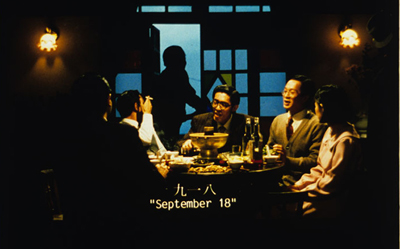
City of Sadness (Hou Hsiao-hsien, 1989); screened at Cinedécouvertes 1990.
Things changed a bit after 1979. The L’Age d’or criteria were modified to identify “films that by their originality, the singularity of their viewpoint, and their style [ecriture] deliberately break from cinematic conformity.” For whatever reasons, hard-edged subversive cinema was harder to come by. In the meantime, the Prix was absorbed into a broader festival Ledoux launched in 1979, Cinédécouvertes.
Cinédécouvertes became a “festival of festivals.” It culled its selection from films that had been screened at Rotterdam, Berlin, Cannes, Venice, and other events. What set Cinédécouvertes apart was its determination to expand film culture. All the films on the program had no Belgian distribution. Each cash award (today, two of 10,000 euros each) would go not to the filmmaker but to a distributor willing to pick up the film. This is a very tangible way to help films of quality find a local audience.
Over the last ten years, Cinédécouvertes has awarded prizes to Audition, Chunhyang, Werckmeister Harmonies, Oasis, Tropical Malady, Day Night Day Night, Mogari no Mori, Afterschool, and Police, Adjective. The L’Age d’or prize has been given to Aoyama’s Eureka, Reygadas’ Japón, Encina’s Hamaca Paraguay, Balabanov’s Cargo 200, and several others. Not every film has been picked up for local distribution, but the impulse to elevate films that go beyond the obvious festival favorites has continued. Ledoux’s successor as curator, Gabrielle Claes, has maintained the legacy of L’Age d’or and Cinédécouvertes. The July festival flourishes in the Cinematek’s newly rebuilt complex and in its other venue, the lovely postwar-moderne building in the Flagey neighborhood.
The annual Brussels event helped me find my way through modern cinema. There I saw my first Kiarostami (Where is My Friend’s Home?), my first Tarr (Perdition), my first Hou (Summer at Grandpa’s), my first Oliveira (No; or, the Vainglory of the Commander), my first Sokurov (The Second Circle), my first Kore-eda (Maborosi), my first Panahi (The Mirror), my first Jia (Xiao Wu). The Cinematek’s talent-spotters were quick to find many of the most important filmmakers of the 1980s and 1990s, and I’ll be forever grateful for their acumen. After I saw these films and many others here, my ideas about cinema got more cogent and complicated. My life got better, too.
Now most of these filmmakers find commercial distribution in Belgium, so Gabrielle’s scouts must scan new horizons. This year as usual Cinédécouvertes boasted some familiar names like Iosseliani, Wiseman, Guzman, and the eternal troublemaker Godard. But there are also filmmakers from Costa Rica, Sri Lanka, Ireland, Peru, Colombia, and Ukraine. The landscape of film is vast, as Ledoux always reminded us, and a small festival can nonetheless open windows wide.
Mind games, or just games

Elbowroom.
Psychology is at the center of festival cinema. Deprived of car chases and exploding buildings, arthouse filmmakers try to track elusive feelings and confused states of mind. That this can be dramatically engaging in quite a traditional way, as was shown by one of the Cinédécouvertes winners, How I Ended This Summer.
Director Aleksei Popogrebsky puts two men on a desolately beautiful island in the Arctic. They’re initially characterized by the way they execute the routines of measuring weather conditions. Sergei, the stolid older one, is soaked in the ambience of the place, enjoying fishing and boating while insisting on exactness in the log. Pasha is a summer intern, a little careless because he’s exhilarated by the atmosphere: he’s introduced first taking a Geiger-counter reading but then hopping and racing along a cliff edge to the beat of his iPod.
Soon, though, Pasha must give Sergei a piece of bad news that comes in over the radio. Out of awkwardness, fear, refusal of responsibility, and other impulses, he avoids telling his mentor. The consequences are unhappy for each. The film takes on the suspense of a thriller, with conflicts surfacing in a cat-and-mouse game at the climax. Yet before that, more subtly, we have watched several tense long takes of Pasha’s face as he tries to cover up his failures. Not surprisingly, How I Ended This Summer won one of the two Cinédécouvertes prizes. It is an engrossing case for character-driven, locale-sensitive cinema.
Elbowroom tackles psychology from a more opaque and disturbing angle. With no exposition or backstory, we’re plunged into an institution for the handicapped. During the first ten minutes, without dialogue, a handheld camera lurks over the shoulder of a young woman who tries with twisted fingers to apply lipstick. Soon she is preparing to have sex with another inmate, and after their liaison she is whacking her feeble roommates, who sob under her blows. Eventually we’ll recognize this introduction as a summary of her days: fighting with others, being coaxed or berated by staff, meeting her lover, and taking up cleaning tasks. Only far into the film will we learn about how she got here and what her fate will be.
Soohee, stricken with cerebral palsy, is played by a young woman with a milder disease. Very often the camera doesn’t let us see her face, fastening instead on a ¾ view from behind. This seems to me partly a matter of tact, but its ultimate effect is to force us to infer Soohee’s state of mind from her behavior. The visual narration remains resolutely outside the character. Psychology gets reduced to gestures— spasmodic smearing of lipstick, the clasping of a necklace, the seizure of a baby doll (with which she’s bribed). Only at the end does a long held close-up of Soohee’s twitching, smiling face give us fairly direct access to her feelings. Despite the smile—which can be read as a sort of perverse victory for her—Soohee isn’t the noble victim; we’ve seen her petty and selfish side already.
This trip into a world most of us haven’t seen before is presented without conventional pieties, and it’s unsettling. Elbowroom, Ham Kyoung-Rock’s first feature, offers the sort of challenge to aesthetic and moral conventions that the L’Age d’or Prize was designed to encourage. The film won it.
 Characters’ psychological developments can also be brought out by parallel construction. A willful little girl and a scientist cross paths in Paz Fábrega’s Cold Water of the Sea. Karina is on a beach holiday with her family and insists on wandering off at intervals. Marianne is a medical researcher, here for a vacation with her boyfriend. When Marianne finds Karina asleep along the road one night, the girl claims that her parents are dead and that her uncle abuses her. But next morning she’s gone, and fears for her safety are only the first of several anxieties that haunt Marianne’s holiday. While Karina incessantly bedevils her mother and makes mischief with other kids, Marianne descends into ennui as she watches her boyfriend devote his time to selling a piece of family property.
Once more Rossellini’s Voyage to Italy proves to be a template for festival cinema. What is wrong with Marianne goes beyond her diabetes: she feels bored and useless. But while Rossellini adhered primarily to the viewpoints of his dissolving couple, Fabrega opens out the portrayal of upper-class anomie by intercutting episodes from the lives of working-class families. The film has two fully-developed protagonists, with Karina’s verve balancing Marianne’s increasing torper. Splitting his story allows Fabrega to make some social points (the family camps on the beach, the couple stays in a motel with a scummed-over swimming pool) and to suggest secret affinities between the little girl and the professional woman. Cold Water of the Sea seemed to me an honorable effort to let some air into the premises of the standard portrayal of a cosmopolitan couple’s ennui.
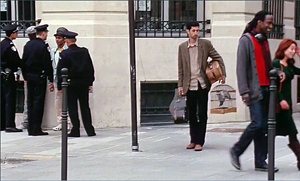
Parallels likewise form the core of Otar Iosseliani’s Chantrapas, another of his celebrations of shirkers, layabouts, con artists, and free spirits. The title is Russian slang for a disreputable outsider (derived from the French ne chantera pas, “won’t sing”). Here the outsider is Kolya, a young Georgian director who turns in a movie that can’t pass the censors. He emigrates to Paris, where he finds an aging producer (played by Pierre Etaix) eager to tap his talent. But the new project’s backers try to take over the project in scenes deliberately echoing the ones of Party interference.
Chantrapas lacks the shaggy intricacy of Iosseliani’s “network narratives” like Chasing Butterflies (1992) and Favorites of the Moon (1984), the latter of which I enjoyed analyzing in Poetics of Cinema. When we’re given a single protagonist, as in Monday Morning (2002), Iosseliani’s characteristic refusal of motivation, exposition, and introspection creates a more plodding pace. No mind games here. In earlier films, his favorite shot—panning to follow people walking—creates convergences and near-misses and comic comparisons in the vein of Tati. Here the pans serve as merely functional devices, almost time-fillers, and comedy is largely lacking. Still, Iosseliani avoids the easy traps. A Soviet censor bans Kolya’s film, then congratulates him on making such a good movie. When the Parisian preview audience flees the theatre, we can’t call them philistines. Kolya’s movie, despite its stylistic debt to Iosseliani’s own films, looks awful. In the end, even cinema seems less important than smoking, drinking, eating, and, above all, loafing.
It was a documentary, Nostalgia de la Luz by Patricio Guzmán, that won the second Cinédécouvertes prize. It starts as a memoir of Guzmán’s fascination with astronomy, explaining that the unusually clear skies of Chile have attracted researchers who want to probe the cosmos. Because the light from heavenly bodies takes a long time to reach us, Guzmán casts his observers as archeologists and historians: “The past is the astronomer’s main tool.” This is the pivot to the film’s main subject, the search for the disappeared under the US-installed dictator Pinochet.
The analogies rush over us. The enormity of the universe is paralleled by the immensity of Pinochet’s oppression of his country. Captives in desert concentration camps learned astronomy, but eventually they were forced inside at night; the skies’ hint of freedom threatened the regime. Some of the astronomers are friends or relations of the disappeared and see research as therapeutic, putting their personal sufferings in a much more vast cycle of change. Above all there are the old women who patiently scour the desert for traces of their loved ones. A woman tells of finding her brother’s foot, still encased in sock and shoe. “I spent all morning with my brother’s foot. We were reunited.” Scientists try to know the history of the cosmos, and ordinary people tirelessly challenge their government’s efforts to conceal crimes. Both groups, Guzmán suggests, acquire nobility through their respect for the past.
Taking some chances

More formally daring was Totó. This was the first Peter Schreiner film I’ve seen, and on the basis of this I’d say his high reputation as a documentarist is well-deserved. Without benefit of voice-over explanations, we follow Totó from his day job at the Vienna Concert Hall (is he a guard or usher?) to his hometown in Calabria. The film is an impressionistic flow registering his musings, his train travel, and his conversations with old friends, many of the items juggled out of chronological order.
Schreiner avoids the usual cinéma-vérité approach to shooting. Instead the camera is locked down, the framing is often cropped unexpectedly, and the digital video supplies close-ups that recall Yousuf Karsh in their clinical detail. We see pores, nose hair, follicles at the hairline; the seams of sagging eyelids tremble like paramecia. In addition—though I won’t swear that Schreiner controlled this—the subtitles hop about the frame, sometimes centered, sometimes tucked into a corner of the shot, usually with the purpose of never covering the gigantic mouths of the people speaking. All in all, a documentary that balances its human story with an almost surgical curiosity about the faces of its subjects. The Jean Epstein of Finis Terrae would, I think, admire Totó.
I had to miss some of the offerings, notably Oliveira’s Strange Case of Angelica. (Fingers crossed that it shows up in Vancouver.) Eugène Green’s Portuguese Nun was screened, but I’ve already mentioned it on this site. Other things I saw didn’t arouse my passion or my thinking, so they go unmentioned here. Of the remainders, two stood out above the rest for me.
My Joy (Schastye moe), by Sergei Loznitsa, is a daring piece of work. After a harsh prologue, it spends the first hour or so on Georgy, a trucker whose effort to make a simple delivery takes him into the predatory world of the new Eastern Europe. He meets corrupt cops, a teenage hooker, and most dangerously a trio of ragged men bent on stealing his load. After an anticlimactic confrontation, the film introduces a fresh cast of characters, including a mysterious Dostoevskian seer. The film becomes steadily more despairing, culminating in a shocking burst of violence at a roadside checkpoint.
At moments, My Joy flirts with the idea of network narrative. When Georgy turns away from a traffic snarl, the camera dwells on roadside hookers long enough to make you think that they will now become protagonists. One character does bind the stories together: an old man who fought in World War II and who now helps the seer at a moment of crisis. The sidelong digressions, slightly larger-than-life situations, and the floating time periods suggest a sort of Eastern European magic realism. But the whole is intensely realized, at once fascinating and dreadful. After one viewing, I wanted to see it again.

My favorite, as you might expect, was Godard’s Film Socialisme. There are the usual moments of self-conscious cuteness (the zoom to the cover of Balzac’s Lost Illusions, for instance), but on the whole it’s pretty splendid.
Contrary to what a lot of people claim, I don’t think Godard is an “essayist” in most of his films. (Perhaps in Histoire(s) du cinema, but rarely elsewhere.) He tells stories. Granted, they are elliptical, fragmentary, occulted stories, free of expository background and flagrantly unrealistic in their unfolding. Into these stories he inserts citations, interruptions, digressions: associational form gnaws away at narrative. But stories they remain.
The first part of Film Socialisme takes place on a cruise ship. As it visits various ports on the Mediterannean, some passengers learn that a likely war criminal is on board. Then, like Loznitsa, Godard shifts to a new plot. In the French countryside, a garage-owner’s family is invaded by a TV crew. (As far as I can tell from the untranslated dialogue, the son and daughter are purportedly running for elective office.) Finally, in the last eighteen minutes or so, we get pure associational cinema—not an essay, I think, but something like a collage-poem: a busy montage of clips seeking (or so it seems to me) to ask what sort of European politics is possible after the death of socialism.
Andréa Picard has already written a superb commentary on the film, and it would be useless for me, after only two viewings, to try to go much beyond her account. I’d just say that the first two stories show the same sort of ripe visual imagination we have come to expect from late Godard. The images are oblique and opaque, framed precisely but denying us much in the way of story information. Who are these people? Who’s related to whom? (Who are the women apparently linked with the mysterious Goldberg?) More concretely, who’s talking to whom?

Godard cuts among images of varying degrees of definition in a manner reminiscent of Eloge de l’amour, but here color is paramount. We get saturated blocks of blue sky and blue/ turquoise/ charcoal sea. See the image further above, or this one, which is virtually a perceptual experiment on the ways that color changes with light and texture.
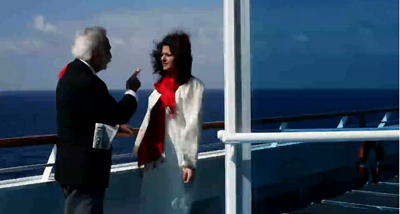
Anybody with eyes in their head should recognize that such shots show what light, shape, and color can accomplish without aid of CGI. They aren’t simply pretty; they’re gorgeous in a unique way. No other filmmaker I know can achieve images like them. We also get entrancing scatters of light in low-rez shots in the ship’s central areas and discotheque.
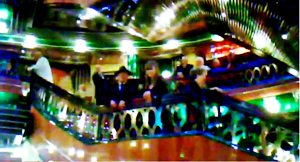
Just as noteworthy from my front-row seat was Godard’s almost Protestant severity in sound mixing. For the first twenty minutes or so, the sound is segregated on the extreme right and extreme left tracks, leaving nothing for the center channel. We hear music on the left channel and sound effects on the right, or ambient sound on one side and dialogue on the other. The result is a strange displacement: characters centered in the screen have their dialogue issuing from a side channel. Sometimes a sound will drift from one channel to another and back again, but not in a way motivated by character movement (“sound panning”). Having accustomed us to this schizophrenic non-mix, Godard then starts dropping a few bits into the center channel. But for the bulk of the shipboard story, that region is largely unused.

We leave the ship with a title, “Quo Vadis Europa,” and now we’re in Martin’s garage, listening to him being interviewed by an offscreen woman. His voice squarely occupies the central channel, with offscreen traffic sliding around the side channels. The same central zone is assigned to the wife and the kids. Would it be too much to say that the working people have taken control of the soundtrack? In any case, although the side channels are very active, the sound remains centered during a permutational cluster of family scenes (parents and children alone, father with daughter, mother with son, boy with father, daughter with mother).

This section ends with a final confrontation with the nosy reporters. The overall episode can be seen as a revisiting of Numero deux (1975), another uneasy family romance and one of Godard’s first forays into video.
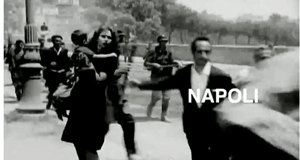
The rapid-fire finale would require the sort of parsing that Histoire(s) du cinema has invited. Through footage swiped from many other filmmakers, Godard revisits the cruise ship’s ports of call, investing each with a symbolic role in the history of the West. Egypt and Greece get considerable emphasis, but so do Palestine and Israel. This history is, naturally, filtered through cinema: not just footage of the Spanish Civil War but clips from fiction films like The Four Days of Naples (1962). After glimpses of Eisenstein’s Odessa Steps massacre, we get shots of today’s kids standing on the steps declaring they have never heard of Battleship Potemkin.
Exasperating and exhilarating, Film Socialisme shows no flagging of its maker’s vision. “He’s a poet who thinks he’s a philosopher,” a friend remarked. Or perhaps he’s a filmmaker who thinks he’s a painter and composer. In any case, Film Socialisme will be remembered long after most films of 2010 have been forgotten. More intransigent than most of his other late features, and unlikely to be distributed theatrically outside France, if there, it shows why we need “little” festivals like Cinédécouvertes now more than ever.
The home page of the Cinematek is here. A complete list of L’Age d’or and Cinédécouvertes winners is here. Last year, between research and preparing for Summer Movie Camp, I had no time to blog about the festival. But you can go to my earlier coverage for 2007 and 2008.
As one who cares about Godard’s aspect ratios, it pains me to use illustrations from online sources, which are notably wider than the version I saw projected in Brussels. When I can get my hands on a proper DVD version, I will replace these images with ones of the right proportions.
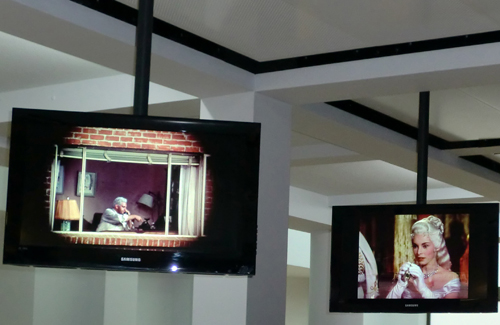
Seeing movie seeing: Display monitors in the reception area of the Cinematek.
A serial for the unserious
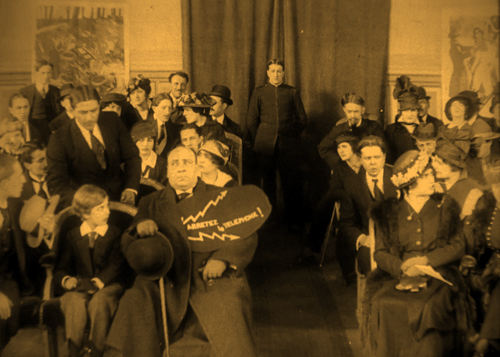
Please silence your mobile phone during the film! Le Pied qui étreint 1: Le Micro bafouilleur sans fil (1916).
DB here, still in Yurrp:
Today the Cinémathèque Française will celebrate Bastille Day by showing one of the strangest movies the programmers could have picked–sort of the Monty Python’s Flying Circus of the 1910s.
Le Pied qui étreint (1916), directed by Jacques Feyder, is a four-part parody of the crime serial. The title translates as “The Clutching Foot,” and as if that weren’t a clear enough signal, Gaumont’s announcement in the trade press set the tone:
A sensational film in 1979 episodes–assembled in four installments without any dull spots.
The running conflict pits the plus-size inventor Clarin, his boy assistant, and his rich girlfriend Eliane against a ruthless, incompetent secret society modeled on Feuillade’s Vampires. The boss of the gang is a mysterious masked figure always wheeled around in a baby carriage with his feet sticking out in front. Gang members recognize each other by flashing an emblem of a bare foot painted on the soles of their shoes.
In the first episode, Clarin invents a wireless telephone, which causes him some embarrassment in movie theatres. Electricity is also on the mind of the Clutching Foot gang, who rewire Eliane’s house so that when she answers the phone she falls into spasms of shocks. Soon all the servants who try to grab her are splayed out on the floor, convulsing in synchronization. Fortunately Clarin and his assistant rescue all by judicious use of rubber gloves.
In “The Black Ray,” the gang devises a gadget that emits a beam that will turn a white person black. The device proves startlingly effective on Eliane, but again Clarin has a scientific solution, sending a current through her to revive her pale beauty. Part three involves the Chinese branch of the The Clutching Foot. They kidnap Eliane and lull her into languor by means of a sinister incense. But Clarin, disguised as a Chinese, rescues her, and his boy displays unexpected pistol skills by dispatching a dozen Chinese while eating a bun.
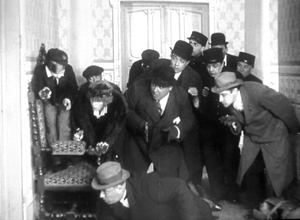
Feyder and his scriptwriters make merciless fun of the still-emerging serial conventions. Masked thugs break into a house, but passing citizens and policemen are completely indifferent. A mysterious message is sent to the heroine via paper airplane, which gets stuck in her hair. When some of the gang converge on Eliane’s parlor, they hide in different crannies and flash their foot-insignia all at once. The apparently unlimited resources of Zigomar and Fantomas are taken to their logical conclusion when the Clutching Foot team boasts of its resources in the city directory.
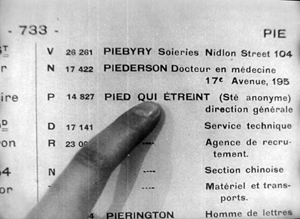
The iconic image of cops converging on crooks is pushed to a nutty limit.
The last installment is the most peculiar. The master of the Clutching Foot is revealed to be none other than Charlie Chaplin. This shameless effort to cash in on the star’s popularity makes him central to the episode. After a chase through a hotel, Chaplin escapes the cops, worms his way into Eliane’s affections, and winds up marrying her. The wedding feast features a lookalike for the star Max Linder as well as guests from other Gaumont films, including the child star Bout-de-Zan and Marcel Levèsque, a comic fixture in early Feuillade and memorable as the censorious concierge in Le Crime de Mr. Lange. The Charlot imitator is Georges Biscot, discovered by Feyder and soon to play many roles for Feuillade. The woman who slinks around in her leotard and makes with those Irma Vep eyes is Musidora herself. The jokey star walk-on is clearly not unique to our time.
The movie ventures into new territory at the end, when Charlot and Eliane retire to the bridal suite. For once the randy tramp gets some real action.
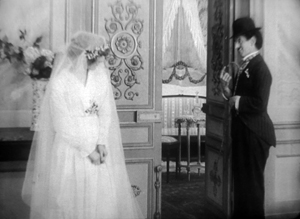
In a nice closing touch, the hotel staffer who collects shoes for cleaning writes the room number in chalk on Charlie’s boots–a recollection of the high-sign of his gang.
I haven’t mentioned other appeals, such as Chinese gangsters flung off a spinning weather vane, or the moment in the last installment when Clarin’s lad sets up a projector in the lab and, as if willing the whole movie to start over, screens the opening of the serial’s first part. Take that, Postmodernism!
It’s all a bit juvenile, but no harm in that. Sometimes, as Tsui Hark remarks, it’s fun to be stupid. And Le Pied qui étreint should remind us of something important. Too often we assume that parody is a sign that a form or genre is exhausted, that there’s nothing left to do but mock it. But that’s not always so. Parody needn’t announce decline or decadence. Parody is lurking everywhere, ready to spring out as soon as conventions are crystallizing. Irreverence, vulgarity, reflexivity, derangement, and dirty fun are wired into popular cinema from the very start.
For contemporary reactions to the film, which were a little stiff-lipped, see Henri Bousquet, “‘Le pied qui étreint,'” Cahiers de la Cinémathèque no. 40 (1984), 23-24. My quotation from the Gaumont ad is taken from this article. For a brief online comment and a nice production still, go here.
Thanks to Nicola, Francis, and Bruno, who reminded me that Feyder was a Belgian.
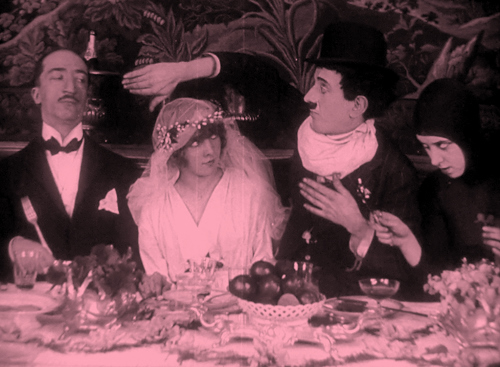
Marcel Levèsque, Kitty Hott, Biscot, and Musidora at the wedding feast.