







Archive for the 'Film comments' Category
Dreyer goes digital

The President (1919).
DB here:
Back in 2008 I noted that the Danish Film Institute was at work on a vast website devoted to Carl Dreyer. Now for the good news: It’s up! The English version is here.
Has any other director received such a comprehensive, authoritative treatment on the Web? Carl Theodor Dreyer: The Man and His Work is a pathway to all things Dreyerian: biographical background, documents from his career (over 4000 letters alone!), gorgeous stills, film clips, and news of current Dreyer-related events. There’s a library of video and audio interviews (with English translation). There are also essays on his life and working methods, his themes and techniques. The site will grow as well. (I’ll be adding an essay, mostly on The President, later this month.)
We’re deeply grateful to the Danish Film Institute for all their years of effort in making this lode of material available to scholars and admirers.
PS 4 June: I told you the site was growing fast! A new entry supplies anecdotes–some charming, some disconcerting–about Dreyer’s days running a movie theatre.
PPS 8 June: Jon Asp writes that Ingmar Bergman has earned a vast site that rivals (and precedes) the Dreyer one. It’s here. Embarrassing for us Yanks! Where’s our comparably rich site on Griffith, Ford, et al.? Thanks to Jon for the link.
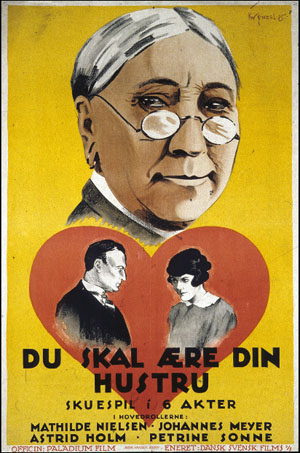
The Master of the House (1925).
It takes all kinds
Kristin here—
How many directors are there whose bad reviews just make you more eager to see their new films? I’m not at Cannes and haven’t seen Jean-Luc Godard’s Film socialisme. But I’ve read some negative reviews, mainly those by Roger Ebert and Todd McCarthy. Now I’m really hoping that Film socialisme shows up at the Vancouver International Film Festival this year. (Please, Mr. Franey? I promise to blog about it.)
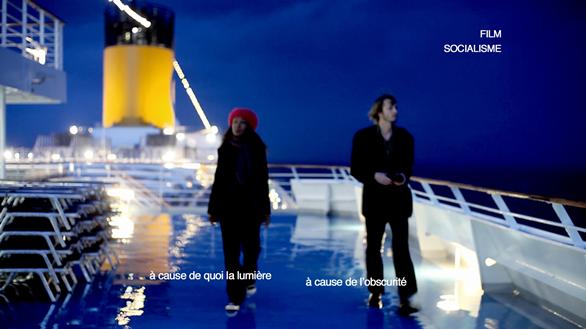
As you can tell from my writings, I’m no pointy-headed intellectual who won’t watch anything without subtitles. I love much of Godard’s work and have analyzed two films from early in what a lot of people see as his late, obscurantist period (Tout va bien and Sauve qui peut (la vie) in Breaking the Glass Armor). But I also love popular cinema. If I made a top-ten-films list for 1982, both Mad Max II (aka The Road Warrior) and Passion (left and below) would be on it.
Of course, those are old films by most people’s standards. Godard’s films have gotten much more opaque since I wrote those essays. I wouldn’t dare to write about King Lear or Hélas pour moi. That’s partly because I don’t speak French, though a French friend of ours has assured us that that doesn’t help much. Here Godard thwarts the non-French-speaker further by not translating the dialogue. Variety‘s Jordan Mintzer describes the subtitles that appear in the film: “To add fuel to the fire, the English subtitles of “Film Socialism” do not perform their normal duties: Rather than translating the dialogue, they’re works of art in themselves, truncating or abstracting what’s spoken onscreen into the helmer’s infamous word assemblies (for example, “Do you want my opinion?” becomes “Aids Tools,” while a discussion about history and race is transformed into “German Jew Black”).” Mintzer’s review provides a long description of the film; he mentions how baffling it is but doesn’t offer any real value judgments on it. Like other reviews, though, it piques my interest in the film.
Since Godard has increasingly moved into video essays, I’ve not kept as close track of him. But I always look forward to seeing his occasional new features on the big screen. The man has a mysterious knack for making beautiful images out of the mundane. How could a shot of a distant airplane leaving a jet-trail across a blue sky be dramatic? Godard manages it in the first shot of Passion. (I won’t show a frame from that shot, since it depends on the passage of time for its effect.) His soundtracks are dense and playful. Every few years the man cobbles together an incomprehensible plot based on rather tired political ideas and turns out something so visually striking that it might as well be an experimental film. I’m willing to watch and listen hard without assuming that I’m obliged to strain to find a message. McCarthy comments, “More personally, I have become increasingly convinced that this is not a man whose views on anything do I want to take seriously. […]” Did we take his views all that seriously back when he was a Maoist? I didn’t, but La Chinoise is a terrific film.
That’s not my point, though. As Ebert’s and McCarthy’s reviews both mention there are devotees of Godard who will most likely enjoy and defend Film socialisme. Ebert: “I have not the slightest doubt it will all be explained by some of his defenders, or should I say disciples.” McCarthy says that Godard is one of an “ivory tower group whose work regularly turns up at festivals, is received with enthusiasm by the usual suspects and then is promptly ignored by everyone other than an easily identifiable inner circle of European and American acolytes.” (McCarthy’s review is entitled “Band of Insiders.”)
I’m not sure what’s wrong with being devoted to Godard, even to the point of defending films that may be obscure or even maddening. I personally haven’t enjoyed his more recent theatrical releases like Forever Mozart and Éloge pour l’amour as much as his earlier work, but they’re still better than most Hollywood, independent, and foreign art-house films. The man is pushing 80 and not likely to change, so live and let us acolytes live.
Not coming to a theater remotely near you
I’m not here to defend Godard—not yet, anyway. But on May 19, Roger posted an essay calling for more “Real Movies” to be made, essentially narratives based on psychologically intriguing characters in situations with which we can empathize. He doesn’t say so, but I suspect this idea was inspired in part by his reaction to Film socialisme. His examples of real movies are some of the films he’s enjoyed this year at Cannes. I haven’t seen those, either, but I’ve read enough of Roger’s writings and been to Ebertfest often enough to know he loves U. S. indie films like Frozen River and Goodbye Solo. Excellent films with fascinating characters, but they and most of the foreign-language films that get released in the U.S. play mostly at festivals and in art-houses, both of which tend to be confined to cities and college towns. I’m sure that such character-driven films would be more likely than Film socialisme to get booked into art-houses, but they wouldn’t wean Hollywood from its tentpole ways.
Even the films that play festivals and arouse great emotion and admiration in the audiences will seldom break through into the mainstream. There simply aren’t enough of those art-houses.
As with many of Roger’s posts, “A Campaign for Real Movies” has aroused comments from people complaining about the lack of an art-house within driving distance of where they live. Jeremy Chapman remarked:
But Roger, if they did that (“Real Movies”), then I’d return to the cinema. And those in charge of the movie industry have proven again and again that they don’t wish to see me there. They’d rather show regurgitated nonsense to people so desperate for some distraction from their lives that they’ll go even though they know that they’re watching rubbish.
If any of these films you mention play nearby, then I shall see them. But they won’t. Instead I’ll have the option of Avatar II or some remake of a movie that was quite good enough (or not) the first time it was made. I love the movies, but I’m so over the movie industry (at least in the US).
Talking to regulars at Ebertfest, one hears time and again that some of them journey across several states to have a quick, intense immersion in films that haven’t played near their homes. Similarly, many who post comments on Roger’s essays refer to having been limited to seeing indie and foreign films on DVDs or downloads from Netflix.
 I completely sympathize with that problem. Even with Sundance’s six-screen multiplex and the University of Wisconsin’s Cinematheque series and Wisconsin Film Festival, most of the movies David and I see at events like Vancouver or Hong Kong don’t play here. Sundance has to book pop films on some of its screens to allow them to bring art films to the others. Right now Iron Man 2 and Sex in the City 2 are playing there, alongside The Secret in Their Eyes and Letters to Juliet. If that’s what it takes to keep the place going, then so be it.
However much people decry the crassness of Hollywood—and there’s plenty of it to go around—or denounce audiences who only go to the latest CGI spectacle, the simple fact is that the market rules. Indeed, if there were a truly free market, we probably would see far fewer indie and foreign-language films. Film festivals are supported largely by sponsors, and the films they show are often wholly or partially subsidized by national governments. The festival circuit has long since become the primary market for a range of films that otherwise never reach audiences.
That may sound terrible to some, but consider the other arts. Some presses only publish books they hope will be best-sellers, while poetry and other specialist literature is relegated to small presses whose output doesn’t show up in Barnes & Noble. That’s very unlikely to change. Amazon and other online sales have been a shot in the arm for small presses, just as Netflix has made it far easier for people to see films they probably would not otherwise have access to. (Our plumber told me the other day that he had been watching a bunch of recent German films downloaded from Netflix. Well, that’s Madison, as we say; high educational level per capita. But most people have the same option, if they wish.)
Art-houses are scarce in small cities and towns, but such places are not likely to have opera houses either, or galleries with shows of major modern artists, or bookstores which offer 125,000 titles. (As I recall, that’s what Borders claimed to have when it first opened in Madison. Now they seem to be working on that many varieties of coffee.) Opera or ballet lovers are used to traveling to cities where they can see productions, and serious Wagner buffs aim to make the pilgrimage to Bayreuth at least once in their lives.
David and I are lucky. It’s vital to our work to keep up on world cinema, so now and then we travel to festivals and wallow in movies for a week or two. Quite a few civilians plan their vacations around such events, too. We’ve run into people in Vancouver who say they save up days off and take them during the festival. Naturally not everyone can do that, but not everybody can see the current Matisse exhibition in Chicago (closes June 20) or the recent lauded production of Shostakovich’s eccentric opera The Nose at the Metropolitan. I really wish I had seen The Nose, but I don’t really expect the production to play the Overture Center here.
To some people, film festivals might sound like rare events that inevitably take place far away, like the south of France. Those are the festivals that lure in the stars and get widespread coverage. But there are thousands of lesser-known festivals around the world, dedicated to every genre and length and nationality of cinema. For those who like to see old movies on the big screen, Italy offers two such festivals, Le Giornate del Cinema Muto (silent cinema) and Il Cinema Ritrovato (restored prints and retrospectives from nearly the entire span of cinema history; this year’s schedule should be posted soon). Last month in Los Angeles, Turner Classic Movies successfully launched its own festival of, yes, the classics. Ebertfest itself began with the laudable goal of bringing undeservedly overlooked films to small-city audiences, specifically Urbana-Champaign, Illinois. It was and is a great idea, and it would be wonderful if more towns in “fly-over country” had such festivals.
The films we don’t see
Usually when someone calls for more support of independent or foreign films, there seems to be an implicit assumption that all those films are deserving of support, invariably more so than Hollywood crowd-pleasers. If a filmmaker wants to make a film, he or she should be able to, right? But proportionately, there must be as many bad indie films as bad Hollywood films. Maybe more, because there are always lots of first-time filmmakers willing to max out their credit cards or put pressure on friends and relatives to “invest” in their project. There’s also far less of a barrier to entry, especially in the age of DYI technology.
True, the indie films we see seem better. By the time most of us see an indie film in an art cinema, it has been through a pitiless winnowing process. Sundance and other festivals reject all but a relatively small number of submitted films. A small number of those get picked up by a significant distributor. A small number of those are successful enough in the New York and LA markets to get booked into the art-house circuit and reach places like Madison. Yes, some worthy films get far less exposure than they deserve. But many more films that would give indies a bad name mercifully get relegated to direct-to-DVD, late-night cable, or worse. On the other hand, most mainstream films, no matter how dire their quality, get released to theaters. Their budgets are just too big to allow their producers to quietly slip them into the vault and forget about them.
The winnowing process for art-house fare happens on an international level as well. A prestige festival like Cannes dictates that a film they show cannot have had a festival screening or theatrical release outside its country of origin. Programmers for other festivals come to Cannes and cherry-pick the films they like for their own festivals. Toronto has come to serve a similar purpose, especially for North American festivals. Some films fall by the wayside, but the good ones attract a lot of programmers. These films show up at just about every festival. By the way, that kind of saturation booking of the year’s art-cinema favorites at many festivals means that the distributors are more and more often supplying digital copies of films to the second-tier events. Going to festivals is no longer a guarantee that you’ll be seeing a 35mm print projected in optimal conditions. At the 2009 Vancouver festival, I watched Elia Suleiman’s The Time that Remains twice, because it was a good 35mm print and I suspected that I’d never have another chance to see it that way.
To each film its proper venue
There’s no way that every deserving film will reach everyone who might admire it. Condemning the crowds who frequent the blockbusters won’t help open new screens to offbeat fare. If someone loves Avatar, as long as they keep their cell phones off, refrain from talking, and don’t rustle their candy-wrappers too loudly, as far I’m concerned they can go on believing that this is the best the cinema has to offer. Simply showing these audiences a film like A Serious Man, say, or Precious isn’t going to change their minds about what sort of cinema they prefer. To break through decades of viewing habits, such people would need to learn new ones, which takes time and effort. People’s tastes can be educated, but the odds are usually against it actually happening.
Finally, in defending art cinema against mainstream multiplex fare, commentators often cite Avatar or Transformers or the latest example of Hollywood’s venality and audience’s herd-like movie-going patterns. Yet every year major studio films come out that get four stars or thumbs up or green tomatoes. Last year, we had Cloudy with a Chance of Meatballs, Up, Inglourious Basterds, Coraline, and a few others that were well worth the price of a ticket. All of them did fairly well at the box-office while playing in multiplexes. Some readers might substitute other titles for the ones I’ve mentioned, but to deny that Hollywood is bringing us anything worth watching seems blinkered. As I said in 1999 at the end of Storytelling in the New Hollywood, where I criticized some aspects of recent filmmaking practices, “In recent years, more than ever, we need good cinema wherever we find it, and Hollywood continues to be one of its main sources.”
Ultimately my point is that in this stage in cinema history, international filmmaking has settled into a defined group of levels or modes. Hollywood gives us multiplex blockbusters and more modest genre items like horror films and comedies. They bring us the animated features that are among the gems of any year’s releases. Then there are the independent films and the foreign-language ones which together form festival/art-house fare. There are also the experimental films, which play in festivals and museums. The institutions that show all these sorts of films have similarly gelled into specialized kinds of venues suited to each type. A broad range of films is still being made. There are some few really good films in each category made each year. The question is not how many worthy films are getting made but how much trouble it takes to see them.
None of the current types of institutions is likely to change on its own. What will make a difference is the growing possibilities of distribution via the internet. Filmmakers who get turned down by film festivals can produce, promote, and sell their movies via DVD or downloads. True, recouping expenses that way is so far a dubious proposition; it’s probably easier to get into Sundance than to do that. As I mentioned, digital projection may make some festivals less attractive to die-hard film-on-film cinephiles. On the other hand, in some towns opera-lovers who can’t get to the big city now can see a digital broadcast of a major production each week at their local multiplex. Not as exciting as a trip to the city to see it live, but a lot cheaper and hence within the reach of a lot more people’s means. All sorts of other digital developments will change movie viewing in ways we can’t yet imagine.
_______________
Jim Emerson has been covering the Film socialisme battle of the reviews on Scanners, with quotes and links to the ones I mentioned and more. He also demonstrates that people have been baffled by Godard since Breathless, with reviews that “are, incredibly, the same ones he’s been getting his entire career — based in part on assumptions that Godard means to communicate something but is either too damned perverse or inept to do so. Instead, the guy keeps making making these crazy, confounded, chopped-up, mixed-up, indecipherable movies! Possibly just to torture us.” He offers as evidence quotes from New York Times reviews over the decades.
Eric Kohn gauges the controversy and offers a tentative defense of the film on indieWIRE.
For our reports on various festivals, see the categories on the right. We discuss Godard’s compositions, late and early, here and his cutting here.
A hundred years, plus a few thousand more, in a day
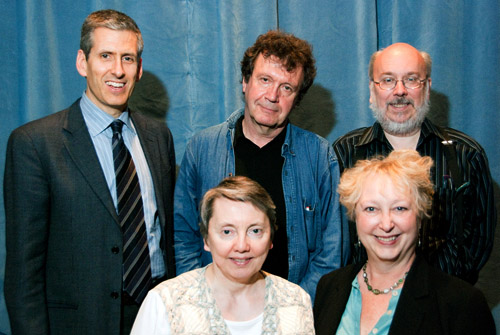
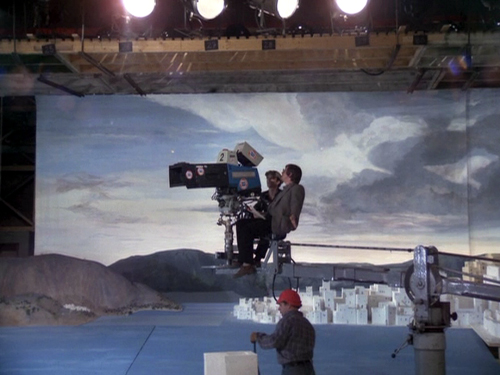
Charlie Keil, Yuri Tsivian, Henry Jenkins, Kristin Thompson, and Janet Staiger. Photo by Joel Ninmann.
Last Saturday we held the symposium “Movies, Media, and Methods” in honor of Kristin’s arrival at age sixty. Four distinguished scholars, all professors from major universities, presented top-flight talks. As a bonus, Kristin gave The Film People a glimpse into her Egyptological work. I report on this very full day in the hope of giving a sense of how stimulating we found it.
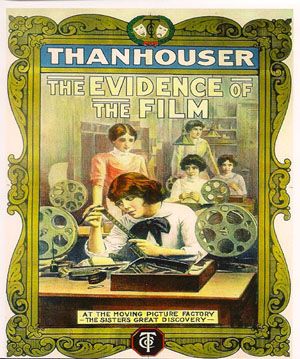
Thanhouser was an American film company that flourished between 1909 and 1917. It has been overshadowed by Biograph because that firm put out more films and, not incidentally, employed D. W. Griffith. But Ned Thanhouser has been diligently gathering his family company’s output from archives around the world and releasing it in informative DVD editions. The most famous Thanhouser production is probably Cry of the Children (1912), a powerful attack on child labor. You could also try the thriller The Woman in White (1917), adapted from Wilkie Collins’ masterful novel. A study in sadism, and more subtle than The Girl with the Dragon Tattoo.
Charlie Keil, an expert in 1910s US film from the University of Toronto, examined Thanhouser’s films with two questions in mind. Did the studio have a “distinctive personality” in its products? And does its output reflect the development of film style across the crucial transitional years of the early 1910s? Borrowing a method that Kristin had applied to Vitagraph films in an essay, Charlie took one film from 1911, one from 1912, and one from 1913. Charlie wasn’t ready to conclude that these specimens displayed a unique studio style, but it was clear that across just three years, big changes in storytelling were taking place.
The plot of Get Rich Quick (1911) involves a man who joins a business that is scamming innocent investors. The film uses only five locales and plays scenes in long takes. The Little Girl Next Door (1912) has a more complex plot, with two distinct lines of action that converge on a child’s drowning. It uses many more locales and an ellipsis of a year to trace the changes in a family’s fortunes. It also incorporates cut-in close views and point-of-view editing. The Elusive Diamond (1913) is less psychology-driven than The Little Girl Next Door, but its intrigue relies almost completely on dialogue titles and it includes many close-ups and variation of camera setups.
Three films and three years: A vivid cross-section of the rapid development of what soon became classical visual storytelling. Moving from 18 shots to 53 shots to 74 shots, the films became less dependent on staging and more dependent on editing. At the same time, Charlie didn’t fail to notice how the long takes in Get Rich Quick allow some felicities of performance, particularly the way that the wife’s handling of her apron charts her psychological states. She brushes it aside to show how poor they are, then she uses it as a giant hankie.
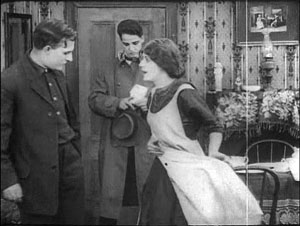
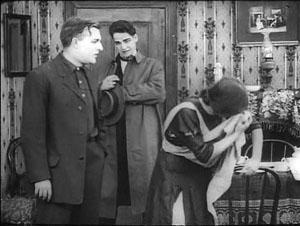
Like all good papers, Charlie’s left a lot to be discussed. People asked about how much pre-planning was done at Thanhouser, about the directors and screenwriters on staff, about the division of labor. We were left with a sense that here was another mostly unknown region that would reward further study.

Fernand Léger, Cubist Charlot (1923).
Yuri Tsivian of the University of Chicago carried us into the twenties with an in-depth examination of early Russian reactions to Charlie Chaplin. The paper held many surprises. Chaplin was popular in many countries from 1915 onward, and very soon after he was celebrated by European intellectuals. But Russia lagged behind; there’s no concrete evidence that any Chaplin films were shown there until 1922. Yet the Soviet avant-garde embraced him. How and why?
Instead of looking for a dual relationship—Chaplin directly influencing Russian artists—Yuri postulated a “triangular” relationship, in which Chaplin’s image was mediated through other European sources. For instance, Léger’s numerous images of a fragmented Chaplin led Futurists and Constructivists to declare Charlie “one of us.” They loved the idea of man as a machine executing precisely articulated movement, and what they heard of Chaplin’s pantomime and gags led them to praise him. Chaplin, said Lev Kuleshov, is “our first teacher” because he knows bio-mechanical premises better than anyone. According to the photographer and graphic designer Rodchenko Chaplin instructs viewers in how to walk or put on a hat in the most perfect manner.
So strong was this “virtual” image that artists could read Chaplin into the slapstick comedians they did see. Yuri showed that Varvara Stepanova’s striking rendition of Chaplin as an airplane propeller derived from a film he wasn’t in!
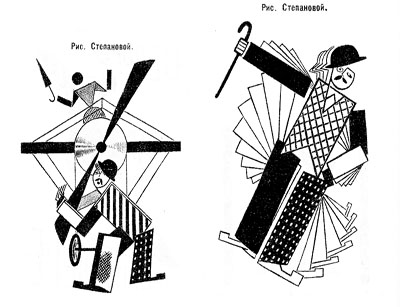
Perhaps she didn’t care: Nikolai Foregger suggested that Chaplin himself was unimportant, that the crucial fact was that he created a whole school of comedians within what Yuri called “a collaborative research community”—that is, Hollywood!
Yuri’s paper, in homage to the Russian Formalists, invoked the “law of fortuity” in art. This refers to the possibility that artistic borrowings, blendings, and crossovers are not determined by any broader social processes, as the Marxists were arguing, but are merely contingent. “Life interferes with art from below.” Accidents and unforeseen intersections, such as the Chaplin craze meeting the Constructivist movement, allow artists to seize on whatever is around them for new material. Yuri’s reference was to Kristin’s revival of Formalist methods in her “neoformalist” studies of Eisenstein, Tati, and other filmmakers.

Janet Staiger of the University of Texas at Austin collaborated with us on The Classical Hollywood Cinema, and she has for several years been the leading scholar of reception studies in film and television. In looking at the Indiana Jones series, her paper nodded to Kristin’s work on the Lord of the Rings franchise and her study of fans’ responses to the films.
“Nuking the fridge,” Janet explained, has become fan jargon for an outrageous plot twist. The phrase comes from a notorious moment in Indiana Jones and the Kingdom of the Crystal Skull (2008), in which Professor Jones escapes an atomic blast by diving into a lead-lined refrigerator. The moment becomes a crux for clashing fan judgments: This is totally unrealistic vs. Realism doesn’t matter. Janet went on to show how these and other fan responses, entwined in IMDB commentary threads, utilized several different interpretive frames.
One was authorship. Like academics and journalists, fan are auteurists. They assign the director responsibility for major aspects of the film. But this doesn’t mean that they agree in how to use this frame. In the case of Crystal Skull, a certain Kid Mogul asked if Spielberg’s willingness to reinvigorate the franchise was purely mercenary: “Is it just about the money?” Others took a more career-survey approach, noting that after prestige pictures like Schindler’s List Spielberg recalibrated his popcorn movies, particularly by handling violence more gingerly.
Another frame was story-based “lit talk.” Fans disparaging the film found it clumsily plotted and lacking in character development. Several were quite sensitive to narrative coherence, one-off gags (such as nuking the fridge), and pacing. Those defending the film appealed to the emotional burst of the final chase scenes.
Janet’s third frame of reference was what she called “formula dissonance.” She sought to capture what seeing the film would be like for those who knew Indy’s story only through the TV series or video versions of the earlier installments in the franchise. She suggested that the formula was by 2008 quite abstracted and idealized for many fans. Their sense of the franchise was thus tested by the extraterrestrial twist that resolved the Crystal Skull plot. Does it reframe the whole series in a cosmic context, or is it a violation of the premises of the Indy universe?
Janet’s survey of these types of responses made me notice that the assumptions of academic film studies and of journalistic criticism overlap with fan conversation. Fans who liked the film tried to make everything fit by appeal to organic unity, technical proficiency, emotional intensity, and other familiar criteria. It made me suspect yet another reason why “amateur” and “professional” film criticism seem to be merging: Perhaps their conceptual frames of reference aren’t so far apart. But their tastes and their degrees of commitment surely are.
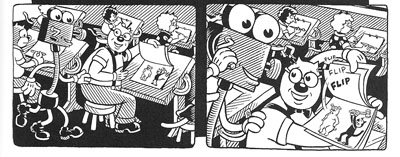
You might have expected Henry Jenkins of the Annenberg School at the University of Southern California to talk about fans too. After all, he practically invented the modern study of media fandom with his book Textual Poachers, and his work influenced Kristin’s study of fan promotion of The Lord of the Rings. Instead he turned to a survey of an artist’s oeuvre. He showed how Kim Deitch’s vast output of stories appropriate imagery from nineteenth and twentieth century mass media and present highly personal versions of the history of popular culture.
In a way, though, Henry’s talk involved fandom because Deitch is himself a prototypical fanman. He’s an obsessive collector, likely to turn his search for a rare toy or drawing into a Byzantine odyssey on the page. Fascinated by Hollywood scandal, he has constructed a phantasmagoric history of mass media through fictional characters (e.g., fake movie stars) who confront real people (e.g., Fatty Arbuckle). He’s particularly concerned about what he takes to be the warping of animated film by the influences of the mass market, epitomized by the Disney empire. The emblematic moment in Boulevard of Broken Dreams comes when Deitch’s Winsor McKay stand-in addresses torpid animators at a tribute dinner and denounces them for selling out.
Deitch’s most famous character is Waldo the cat, and Henry traced the powerful connotations of this emblematic figure. Waldo recalls Felix, the most heavily merchandised comics figure before Mickey, as well as the black cat as a figure of deception, witchcraft, and even African-American minstrelsy. Through Waldo, Deitch could hop across the history of film and comics, from McKay to Mighty Mouse and 1940s abstract films. In Alias the Cat!, Deitch finds in the 1910s everything that we associate with media today: serial narrative, stories shifting across different media platforms, an uncertain line between publicity and self-expression, and a mixing of news and sensational fiction.
Henry situated Deitch in a broader trend of comic artists trying to find a new history of their medium, one that dislodges superheroes from a central role. Deitch’s themes of old-fashioned craftsmanship, lovably antiquated technology, adult dread and degeneracy lurking behind children’s stories, and the commodity demands of comic art link him to contemporaries like Chris Ware and Art Spigelman.
Henry’s talk spurred a lot of discussion, including the question of whether we can treat an artist as offering a history that is comparable to academic research. Can Deitch’s hallucinatory vision of American media be a plausible basis for understanding what really happened? On the whole we don’t expect an artist to offer rigorous arguments. An artwork appropriates history for its own end. (Not all the Greek philosophers actually gathered together in the way Raphael depicts them in the School of Athens painting.) How cogent you find Deitch’s critique probably also depends on whether you share his disdain for Disney. His floppy-limbed denizens fuse headcomix grotesquerie with the 1930s animation that most prestige studios abandoned. As in Sally Cruikshank’s sprightly cartoon Quasi at the Quackadero, Deitch’s rubbery frames revive a style in which everything seems to throb and shimmy.
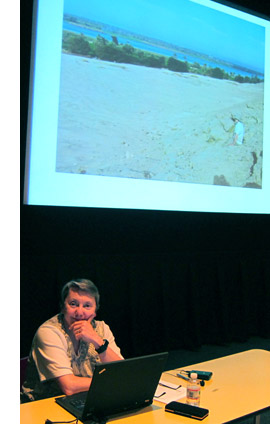
Kristin’s talk, “How I Spend My Winter Vacations: The Amarna Statuary Project and Techniques of Visual Analysis,” had two parts. In the second part, she reviewed her recent work in assembling statues out of tiny bits that had been dumped by archaeologists decades ago. You can read some of this story here. The side of her work most intriguing to students of film, I think, involves her attraction to Egyptian art in the first place.
Egyptian art is often thought of as unrealistic, but during his reign in the fourteenth century BCE the pharaoh Akhenaten introduced a peculiar sort of stylization into it. When he instituted a monotheistic religion centered on the sun god Ra (embodied in the Aten), he also demanded a new pictorial style. Thus the Aten is depicted as a disc shedding rays, a symbol of life and dominion. In addition, the royal family displays biggish hips and thighs, which fit the fecundity theme. More strikingly to our eye, Akhenaten’s family were represented as somewhat distorted, with long and narrow faces, hands, and feet. The ruler’s crown is elongated as well. Several aspects of the new style are present in Kristin’s favorite scene, a beautiful relief carving known as the Berlin family stela.

You can see the Aten’s rays ending in little hands holding ankh signs to the royal couple’s noses. But just as important is the human dimension of the scene, and two sorts of action displayed there: swiveled shoulders and pointing hands.
Unlike the flat, frontal portrayal we associate with Egyptian art, the family members are caught in twisting postures that bring one shoulder forward. Kristin explained:
Akhenaten is lifting his daughter, his foreground arm moving backward to hold her legs, the other moving forward to support her body as he kisses her. She reaches with her rear arm to chuck him affectionately under the chin, while her other arm moves backward in a pointing gesture. On the opposite site, Nefertiti’s foreground arm is held bent and backward to steady the youngest daughter of the three present, who is standing on her thigh and reaching up rather precariously to grab a golden decoration hanging from her mother’s crown. Nefertiti’s rear hand goes forward to steady the second daughter, who is also pointing, this time with her rear arm as she twists to look at her mother. These kinds of gestures can be found again and again in such scenes.
The twisting movement wasn’t unknown among images of workers and private individuals; Amarna artists, presumably encouraged by Akhenaten, applied the device to portraying the royal family.
Just as significant are the pointing gestures we find in the stela. Some scholars have interpreted them as protective gestures, which are found in other images. But Kristin points out:
 In those cases, the protecting figures hold their arms straight, they stare in the direction of the thing to be protected (as one presumably would in reciting a spell), and there is something dangerous present. None of this applies in the scene in the stela.
After pondering this scene quite a lot, it occurred to me that it looked like a really early film, a short scene, perhaps 30 seconds long, that we were to interpret as a tiny narrative. The pointing gestures seemed comparable to pantomime, where one has to interpret movements in the absence of intertitles.
Given that so much Amarna art is about displaying the royal couple as having created life by giving birth to their daughters and as sustaining that life, it seems to me that this stela is full of indications of nurturing. The columns and roof indicate that the parents have their kids in a little shelter to keep them out of the hot sun. The rows of pots behind Akhenaten’s stool are no doubt filled with cool drinks for them. Nefertiti carefully holds onto the two children on her lap while Akhenaten kisses the eldest. My interpretation is that the eldest is saying something like, why don’t you kiss sister, too?” and the one opposite is pointing out the kiss to her mother and saying something like, “Look, daddy’s kissing sister; I want a kiss too.”
This may not sound like the sort of thing kids would say, but the circulation of affectionate gestures among the family members in these casual scenes is nearly universal. The chucking under the chin gesture used by Meretaten here shows up again and again, as do embraces and kisses.
Despite all the stylization, then, Kristin concludes that the stela depicts a scene of intimate affection, complete with a child toying with a mother’s ornament. This homely realism chimes with other realistic tendencies in Amarna art, such as the differentiation of right and left feet and the presentation of plants and animals in non-stereotyped ways. In sum, Kristin’s ability to look closely at film style helped her make discoveries about visual narrative in a completely different domain.
So our Saturday talks included cinema-related material from 1911 to about 2010, and with Kristin’s lecture we flashed back about 3300 years. Every talk was crisp and lucid. We were spared the juggling of empty abstractions, the free-associative rambling, and the self-congratulatory cleverness that plague the humanities. We got knowledge and opinion presented with enthusiasm, modesty, and good humor.
Kristin and I are grateful to our presenters, as well to all the friends old and new who showed up: Leslie Midkiff Debauche from Stevens Point, Carl Plantinga from Michigan, Peter Rist from Montreal, Brenda Benthien from Cleveland, Virginia Wright Wexman from Chicago, Vicente José Benet from Spain (via Chicago) and many others. In all, a day to remember.
For more information on Kristin’s research see my earlier entry. For other cinematic implications of the Berlin stela of Akhenaten’s family , see Kristin’s blog entry here. Her article, “Frontal Shoulders in Amarna Royal Reliefs: Solutions to an Aesthetic Problem,” is available in The Journal of the Society for the Study of Egyptian Antiquities 27 (1997, published 2000).
All of our speakers are represented on the Web: Henry here, Charlie here, Janet here, and Yuri here (and of course on Cinemetrics). For more on Janet’s study of online critics and the frames they inherit, see her essay, “The Revenge of the Film Education Movement.”
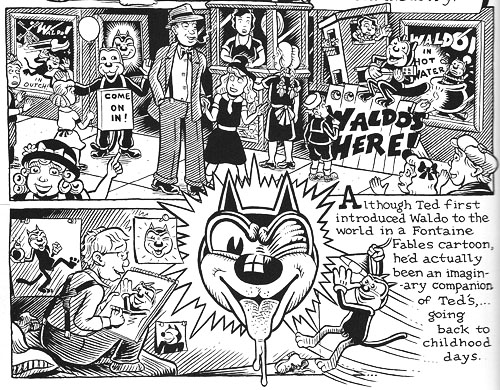
Kim Deitch, Boulevard of Broken Dreams.
Festival as repertory
DB here:
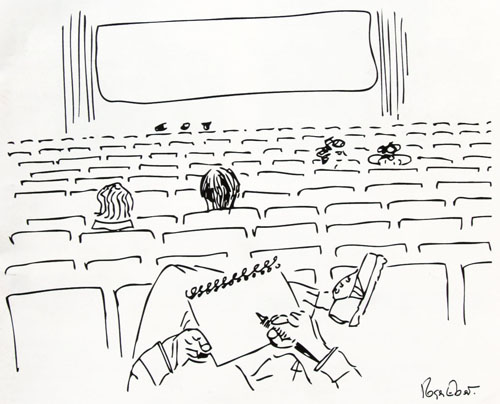
This picture points backward and forward. It looks back to the days when movies were shown on a big screen to hundreds of people in real time. No pausing or fast forwarding; you take what you get. Some viewers are settled in pretty close to the screen, and a few dare to sit in the front row. (Save me the center seat, fortunately still vacant.) The critic sits slumped far back, implying coolly distant appraisal. The pen is poised to note down moments of power, beauty, or stupidity.
But the big auditorium is nearly empty, and this makes the drawing foreshadow the approaching end of moviegoing. The warning signs are emerging: Visit any movie, even an Imax spectacular, in the off-hours (Monday through Wednesday, especially matinees) and you’re likely to find the house as empty as it is here. As for the critic, ready to jot down notes for a review: An anachronism these days, as many will tell you.
But wait. Isn’t the theatrical business booming? We’re told that 2009 was a banner year, and 2010 will be even better. True, worldwide admissions for 2009 totaled $29.9 billion, a new high. But the increase, according to the MPAA, is mostly due to 3D. In the US, the format accounted for 11 % of the country’s $10.6 billion box-office income, a sum about equal to the gain over last year’s take. Moreover, the number of domestic tickets sold increased only a little from recent years, to 1.4 billion. Overall, the years 2005-2009 have fallen off from the high points of 2002-2004, when attendance was 1.5 billion or more.
Nor is the international film industry expanding its audience. For the last five years or so, worldwide attendance has been remarkably flat, with only the Asia-Pacific region seeing signs of growth. Overall, it seems, 3D serves to let Hollywood hang on to its audience, and charge more.
The spurt in theatrical income helps offset the decline of packaged media. The DVD sell-through boom lasted from 1998 to about 2008, when subscription rental companies (Netflix, Lovefilm) and kiosks (Redbox et al) pushed down retail sales. The slump was accelerated by a glut of DVD releases, big-box stores offering discs at rock-bottom prices, the rise of downloading and video on demand, and, not least, a massive recession that made consumers cost-conscious. Today, many industry observers think that young people are more inclined to graze in the luxuriance of YouTube than visit the multiplex. At best, the Millennials might watch a current hit streaming on their cellphones or laptops or TV monitor. An admittedly small-scale inquiry in the recent Screen Digest (April, p. 100; here, but proprietary) suggests that most young entertainment fans don’t feel a need to rent a disc, let alone buy one. Moreover, all those sampled saw far more movies on monitors, often through shady downloads, than on theatre screens.
It’s not hard to imagine a near future when a movie opens simultaneously on the global market to satisfy its most devoted public before moving in a very few weeks to DVD, VOD, iTunes, and other digital platforms. It then snuggles into hundreds of thousands of hard drives around the world, ready to be awakened when somebody feels the urge to watch. These seem to be the two poles we’re moving toward: the brief big-screen shotgun blast, and the limbo of everlasting virtual access. You can argue that the very success of home video, cable, and the internet have cheapened our sense of a movie’s identity.
Which is one reason why film festivals are very, very important.
Apocalypse then and now
I’ve spent most of the last several weeks at festivals. The Hong Kong International Film Festival is a 2 1/2 week showcase of global cinema, attached to a major regional market assembly and spiced with local attractions and international retrospectives. The Wisconsin Film Festival is a 4 1/2 day local event highlighting US independent cinema but with a leavening of recent arthouse titles and restored classics. Ebertfest, formerly Roger Ebert’s Festival of Overlooked Films, is a topical festival held in a single venue, featuring a wide array of guests, and reflecting its founder’s eclectic tastes.
Each offers unique pleasures, and each reaffirms the value of the theatrical motion-picture experience. I’ve already written a bit about Hong Kong here and here and here, and I hope to write more about the Wisconsin event soon. For now I’ll concentrate on a few high points of Ebertfest, which took Roger’s cartoon above as its emblem. Kristin and I have been guests for many years (our posts are in the Festivals: Ebertfest category on the right), but this time she was in Egypt scouring the sands for pieces of statues. So I’ve had to blog solo.
Fortunately, we now have a vast archive of what happened in Urbana. With the generosity typical of Roger’s event, all the Q & A sessions and panel discussions were recorded and streamed. They’re available here. And for an appreciative account of what it all means, see Jim Emerson’s piece on Roger’s site.
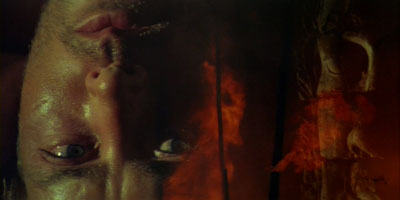
Start with the obvious. Apocalypse Now Redux was shown in a Technicolor restoration in the Virginia Theatre, a picture palace built in 1926. The image loomed, the sound engulfed you. Several people, most of them young, told me that they felt privileged to have seen the film, for once in their lives, as it must be seen. As soon as you get a home theatre that matches this presentation in sheer primal impact, call me. I’m coming over.
Editor and sound designer Walter Murch, one of my heroes, was prevented from coming by the European volcano ash. So I tried in my introduction to pay homage to what is surely one of the most complex soundtracks of any film of the period—a mixture of synthesizer, rock and roll, and layer upon layer of subtly enhanced noises. During the screening I was able to appreciate some of the daring soundfields Murch created. When Willard gets up to look out the blinds of his Saigon hotel, the sound in the left and right and surround channels narrows abruptly to the central speaker, bringing him back to mundane R & R reality. Later, most ordinary dialogue comes from the central speaker, but when Willard voices his commentary, we hear him from all three front speakers; the soft tone creates an intimacy, while the auditory spread gives it weight and authority.
A panel of commentators including Ali Arikan, Michael Phillips, and Janet Pierson did a fine job of probing various aspects of the film. Ali considers it Coppola’s crowning achievement and one of the great American films. Michael, by contrast, thought that what he aptly called the “terror and grandeur” of its opening half gives way to off-kilter and pretentious scenes in Kurtz’s compound. Janet, who had seen the film on the big screen more often than any of us, found it an enduringly impressive accomplishment in both sound and image. With the audience we had a lively exchange about the role of women in the film and the inclusion of the notorious French plantation sequence. Matt Zoller Seitz made a shrewd point about how the film shows Americans bringing along homegrown entertainments (Playmate performances, rock music, surfing) to redefine the war in familiar terms.
Despite all the shock and awe, I like the film only moderately. It’s a stunning logistical accomplishment, and it has some brilliant moments; but I think it has problems almost as soon as Willard moves upriver. I might be the only person who finds the Kilgore scenes overdrawn, almost Dr. Strangeloveish. When Kurtz bends down to give water to the wounded Vietnamese, he’s interrupted by news of surfing, and he yanks his canteen away as the VC scrabbles for it.
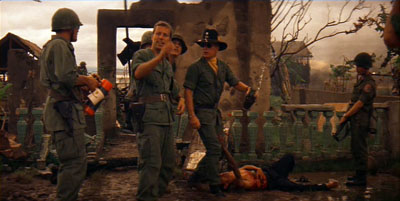
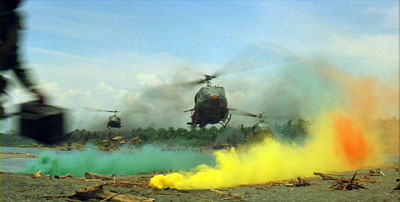
Heavy, heavy—as is the repeated motif of Americans strafing civilians and then tending to their wounds. Willard spells it out: “We cut them in half and then give them a Band-Aid.” Yet I still admire the utterly disorienting opening, which mixes thrumming choppers with ceiling fans and justifies what Michael Herr called it: the rock-and-roll war. Later we’ll see battles wreathed in psychedelic haze, and a hallucinatory assault on the bridge, with Willard stumbling through the dark and watching battle-fried infantrymen hurl ordnance into a void. It’s like a light show at the climax of a rock concert.
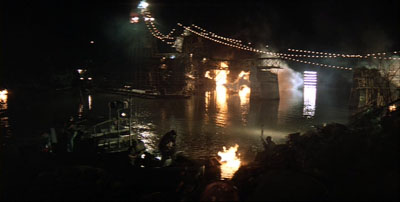
One of my favorite comments about the movie came during Dick Cavett’s television show circa 1980. Dick asked Jean-Luc Godard what he thought of Apocalypse Now. This was a period in which most of the press coverage obsessed about the film’s soaring budget. Godard remarked that Coppola had not spent enough. Cavett asked for an explanation. Godard: “Well, he spent only fifty million dollars and the war cost fifty billion. You cannot film this war on such a small budget.” That’s the way I remember it, anyhow.
From Rwanda to LA
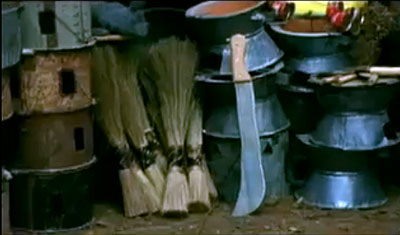
Quick notes on two other E’fest titles. (I’ve already discussed Departures here.)
“I wanted to make a film for a Rwandan audience.” Not what you might expect to hear from an American director of Korean descent. Accordingly, Lee Isaac Chung gave Munyurangabo a leisurely pace and structure. The plot centers on two young men, Sangwa and Munyurangabo (aka Ngabo), taking what seems to be an enigmatic journey. One is Hutu, the other Tutsi. Longish takes and fairly distant framings follow them hitchhiking and stopping over at Sangwa’s home. Gradually, hints such as Ngabo’s carefully wrapped machete suggest that they are heading toward a confrontation. When the revelation comes, our attachment shifts from Sangwa and his family conflicts to Ngabo’s mission of vengeance. Chung explained that the soundtrack develops accordingly, moving from objectivity to subjectivity as we start to hear what his two protagonists hear.
The production background, explained by Chung and his colleagues Sam Anderson (co-writer and producer) and Jenny Lund (co-producer and sound recordist), was fascinating. The script consisted largely of a scene outline, and the dialogue was developed with the actors. The Americans worked with translators in guiding the performances. In some cases they drew on their own experiences. Perhaps partly because of its respect for everyday life, the film has been shown on local television and in the Parliament. It has become a Rwandan film.
My colleague J. J. Murphy has written an acute analysis of Munyurangabo. He rightly praises the sudden entrance of a bardic young man who recites a six-minute poem celebrating liberation and reconciliation. The performance wasn’t planned, Chung said, but it has become a high point of the film. J. J. also links to other enlightening interviews given by Chung, Anderson, and Lund.
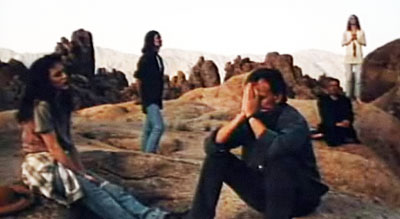
If Munyurangabo’s loose structure evokes the Dardennes brothers, Michael Tolkin’s The New Age has the coiled-serpent dramaturgy of a classic psychodrama-comedy. It’s 1994, and a prosperous LA couple is suddenly without income. Facing bankruptcy, Katherine and Peter auction off their paintings, try to borrow from Peter’s father, and eventually open a boutique catering to the tastes of their friends. At the same time they slide into casual affairs and ceremonies of New Age spirituality. Ebert’s review captures the movie’s range of reference:
Tolkin gives us one richly detailed set piece after another, involving luncheons, openings, massages, telephone tag, psychic consultations, sex, heartfelt conversation, and pagan rituals led by a bald-headed woman who sees what others cannot see. Meanwhile, the material universe remains the one thing Peter and Katherine can really count on.
Few American films examine money and class, but this one is actually about needing a paycheck. By the end, when each of our protagonists becomes a seller rather than a buyer, we have seen a remarkably sharp dissection of a lifestyle.
In the Q & A afterward, Tolkin said that the genesis of the film came from watching a Melrose shop sink into failure. When I saw the film on its initial release, lines like “It’s not an insult, it’s an intervention” and “We need space” (psychological, but also retail) leaned me toward taking the film as satire. I still do. But Tolkin insists that it’s not. The plot dares to have two truly repellant protagonists, but Tolkin doesn’t find them nasty. “I like them.” He majored in religion in college and he takes his characters’ beliefs, no matter how shallow, seriously—not a big surprise from the creator of The Rapture.
He elaborated on some differences between novels and films. When he rereads one of his novels, he thinks, “How was I ever that smart?” but when he rewatches a film it’s the imperfections that jump out. A movie has to be more compressed and rhythmically varied than a novel—something The New Age demonstrates in its brisk montages alternating with slowly unfolding scenes. In the discussion Jim Emerson praised the film’s density of detail, Tolkin elaborated by invoking William Carlos Williams’ belief in compact expression.
The next two paragraphs include plot details you may prefer to pass over.
Tolkin’s script is indeed firmly contoured. The couple’s crucial quarrel takes place at the thirty-minute mark and launches the two major plot lines. They decide to try a separation (while sharing the house), and they launch their boutique. The development section begins about halfway through, as they conduct their love affairs and watch the shop founder. The last act presents their options: bankruptcy, suicide, low-end work.
Arguably the climax is Peter’s desperate effort to make his first telemarketing sale. Here, I think, Tolkin’s ambivalent sympathies come out. Early in the film Peter had asked a cold-caller whether he ever thought he’d be doing this as a career; it’s less a moral condemnation than glib snobbery. But when Peter has to close the sale, his self-loathing is mixed with a certain pride. The cashiered ad exec finds that he can do this. He’s on the road back.
The gorgeously designed movie, with hard blacks and saturated primaries, has a developing palette (“swatches for each act,” Tolkin says). Unhappily, I can’t study the design arc here because The New Age seems never to have had a DVD release. So much for the Celestial Multiplex. Good old 35mm pulled us through, in a radiant print.
Scholars seem now to agree that film festivals serve as an alternative international distribution system. Like Hollywood’s more formal and routinized machine, festivals bring movies to audiences. Usually the movies are current ones, and a festival is offering local viewers their only chance to see such pictures before video release.
Ebertfest shows that there’s an essential place for what we might call the repertory festival. That’s one that revives and reappraises films from earlier periods—and “earlier” may mean only a few years ago. Jumping from 1929 (Man with a Movie Camera, accompanied by the Alloy Orchestra) to the 1980s (Apocalypse Now, Barfly) and the 1990s (The New Age) and then right up to 2008 (Vincent, Trucker, Departures, Synecdoche, New York, Song Sung Blue), this year’s edition reminds us that every film, old or new, is a part of history.
To come fully into history, I’m convinced, a film needs scale. Even intimate dramas attain their true gravity when spread out like a gigantic picnic on a pale blanket. It’s not the only way to enjoy cinema, certainly; but it’s one that we must never abandon. Like the note-taker in the back row and the geeks up front, everyone needs a full view.
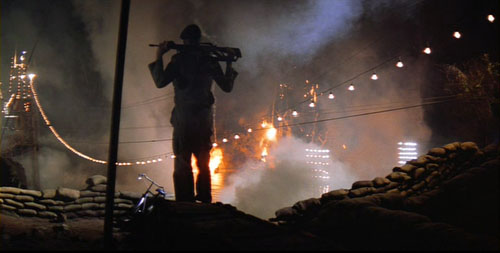
Apocalypse Now Redux.
PS 28 April: I just discovered this piece by Steven Zeitchik, who argues that reviving classics in a big-screen event format could also be good business.



