

Archive for the 'Film comments' Category
Little stabs at happiness 2: Short and sweet, in a city on fire
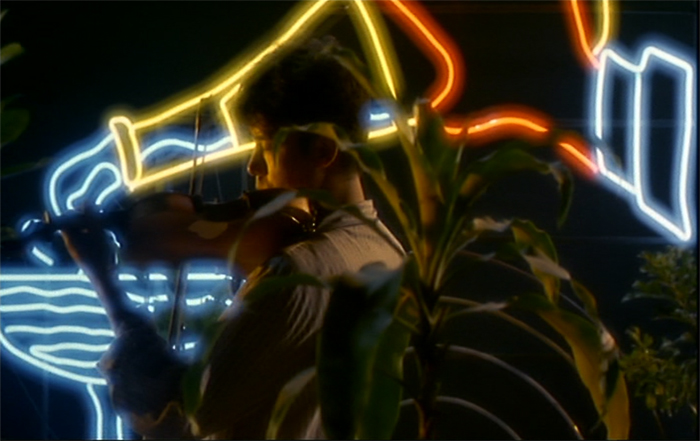
Shanghai Blues (1984).
While US streets pulse with protests against racism and police violence and a fascistic presidential regime, it’s worth remembering that we aren’t alone. Hong Kong has been through this many times, and there the people’s struggle is growing ever more acute. The idea of “burning together” (laam chau) is starting to seem the only option when civil remedies are met by oppression. Hong Kong identity, a palpable force of history, is at stake. As one of my HK correspondents writes: “When it comes it comes. I am sure we won’t just stand here . . . . We will keep fighting for our rights.”
It’s hard to find consolation in these times, but again, with apologies to Ken Jacobs for swiping his title, I offer you a pause to let film art take over. It’s especially poignant in that film, one of Hong Kong’s great contributions to world culture, can seize and hold moments of rapture. All the more ironic that this film, Shanghai Blues, is about ordinary people fleeing the mainland for the British colony to the south.
It’s as goofy a comedy as Tsui Hark ever made, but as usual with Tsui in his prime, it brims with energy. At the end of World War II, Doremi (Kenny Bee), an aspiring composer, is searching for the woman (Shu-shu, Sylvia Chang Ai-chia) he met and lost in a 1937 bombardment. But he’s living unwittingly in the same building she’s in. Meanwhile, a naive young woman (Sally Yeh Chia-wen) arrives from the country trying to make her way in the city. Over all hover two contests: a Calendar Queen prize, and a song competition.
Here’s the sequence that always makes me grin. Doremi comes out at night to play his composition. I really admire how Tsui synchronizes the rhythm of the visuals (especially Sally’s pop-up frame entrance) with the music.
Unfortunately, the film isn’t easily available. There’s a goodish French DVD, but no streaming source I know of. (My clips come from the laserdisc.) If you want more, and at the risk of a supreme spoiler, I offer you the climax, a reprise of the balcony moment that yields a happy ending and a bittersweet time loop.
This virtuoso scene is another example of Tsui’s skillful use of music, cutting, and composition. The movie may be set in Shanghai, but its shameless vivacity is pure Hong Kong.
Here are some resources if you want to help the people of Hong Kong. Thanks to Yvonne Teh for this link. Yvonne blogs, captivatingly, at Webs of Significance.
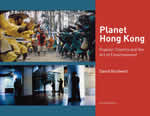
I write about Tsui, and Shanghai Blues, in Planet Hong Kong: Popular Cinema and the Art of Entertainment.
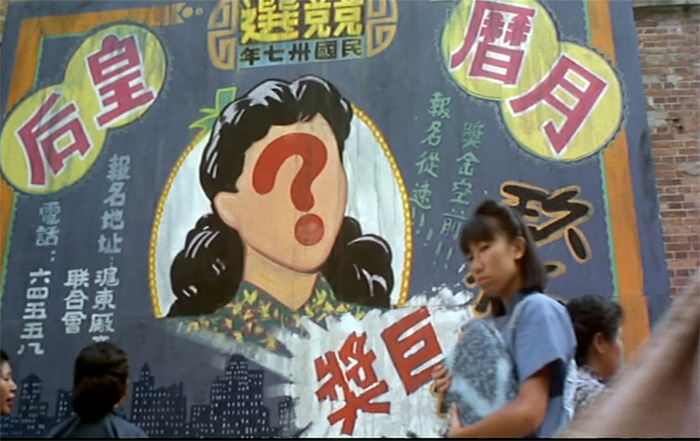
Shanghai Blues (1984).
Sometimes a swordfight . . .
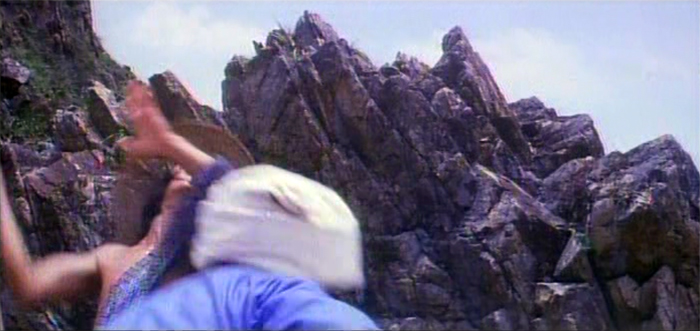
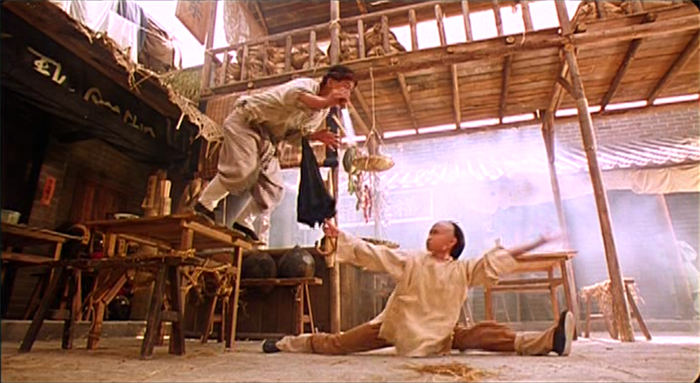
The Valiant Ones (Zhonglie tu, 1975).
DB here:
. . . makes you sit up. And notice a simple but ingenious cinematic technique.
One of the refrains of this blog is: We want to know filmmakers’ secrets, even the secrets they don’t know they know.
Over my years of studying Hong Kong film, I kept coming back to the work of King Hu (Hu Jingquan), one of the great directors of Chinese cinema. Most famous for A Touch of Zen (1971), Hu made several other striking martial arts films: Come Drink with Me (1966), Dragon Inn (aka Dragon Gate Inn, 1967), The Fate of Lee Khan (1973), and Raining in the Mountain (1979).
Kristin and I have a special fondness for The Valiant Ones (1975), which consists largely of virtuoso combat sequences. Here we find some of Hu’s most spectacular experiments in staging, framing, and cutting action scenes. The story isn’t complicated, but the result lives up to his motto: “If the plots are simple, the stylistic delivery will be even richer.” Unhappily, for reasons of rights, The Valiant Ones is harder to see than his other masterworks.
When I was studying Hu’s work at a European archive, I told the archivist that watching The Valiant Ones I had started to understand his secrets. She smiled and said, “All right, but don’t tell anyone.” Ha! Fat chance. I broke the news in an article and then in Planet Hong Kong. I use our current lockdown to share it more widely.
Suppose you have a character called the Whirlwind Swordsman. He circles his adversary so quickly, ducking and bobbing, shifting front and back, that the target is bewildered. How would you render this quicker-than-the eye tactic on film? Today’s directors think automatically of digital effects. But that wasn’t on the menu in 1975.
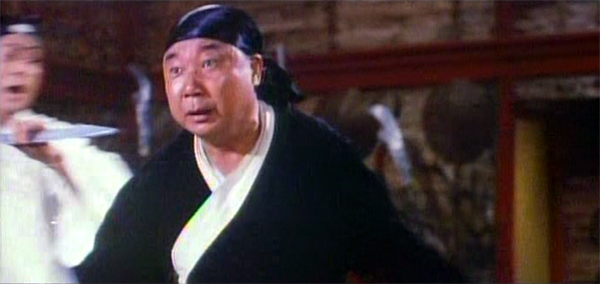
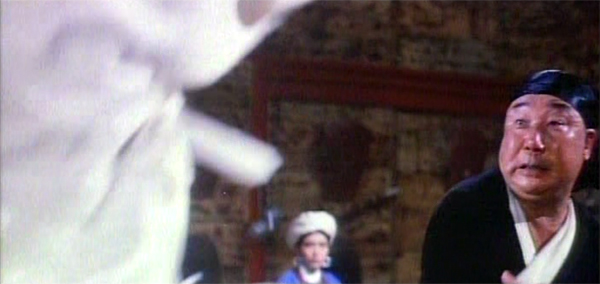
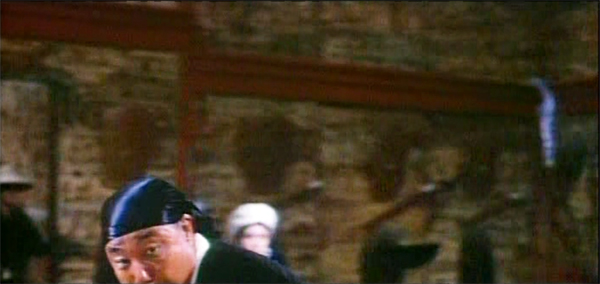
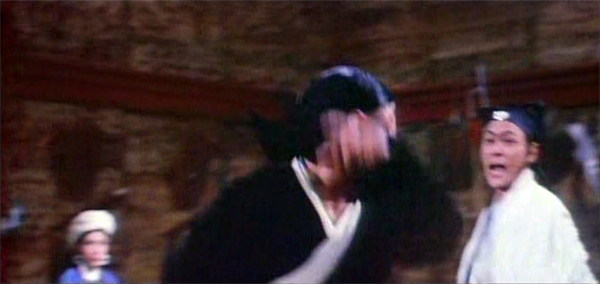
Wu Jiayun and his wife are pretending to be interested in joining a pirate gang. In a series of audition bouts, the chief pirate sends his minions to spar with them. Here we see first Wu’s wife take up a monk’s archery challenge. (I include that as bonus material.) It’s a fair sample of the rhythm Hu gets through a combination of editing and figure movement. The audition continues with Wu showing a stout pirate his Whirlwind technique.
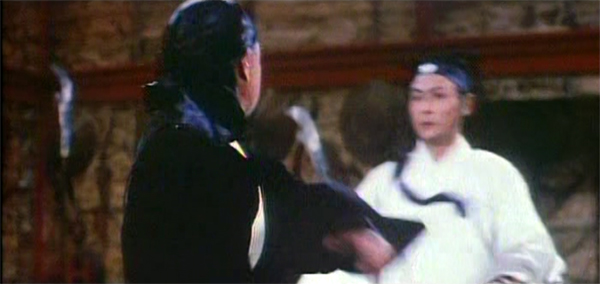
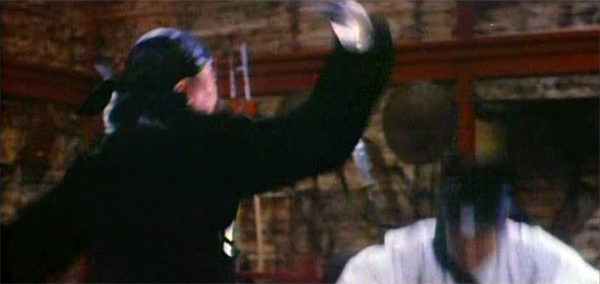
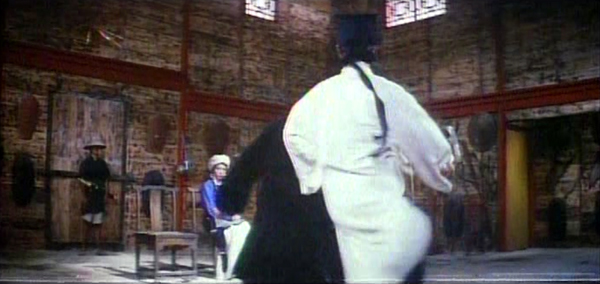
Did you see what King Hu did? He used a double for Wu, dressed him in white, and had him rocket into and out of the foreground while the primary Wu dodged in and out of frame in the background. Sometimes Wu leaves one spot and reappears elsewhere only one frame later!
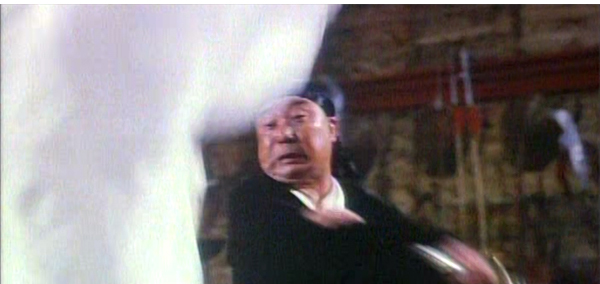
Significantly, Hu set up this cleverly confined framing by means of a simple axial match-on-action. The larger view oriented us to the area clearly.
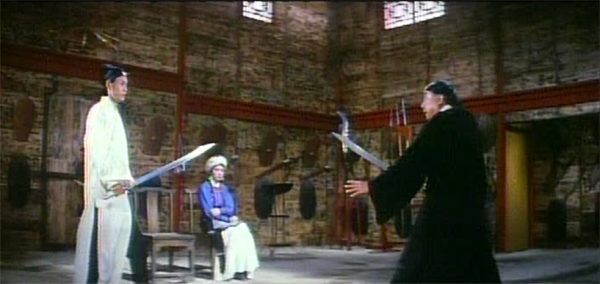
Giving up his fondness for discontinuous cuts, Hu used this cut to prime us to expect continuity of space as the shot unfolds. The double is in effect inserted in the splice.
Is it merely a trick? All’s fair in cinema. The gliding, percussive force of the frame entrances and exits shows us a preternaturally gifted fighter whose moves are too fast for the naked eye. We have no time to reflect on how it was done.
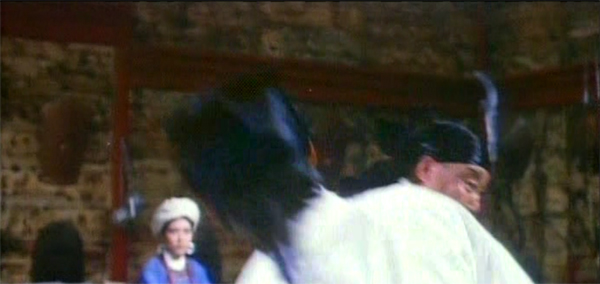
Interestingly, Wu seems to have taught Mrs. Wu his technique. At the climax she gets a chance to practice surrounding a hapless fighter. See my stills up top and at the bottom.
Secrets? You bet. We appreciate them all the more when we work to discover them.
For more on King Hu, see Stephen Teo, Chinese Martial Arts Cinema: The Wuxia Tradition (Edinburgh University Press, 2009). I discuss Hu’s style in more detail in “Richness through Imperfection: King Hu and the Glimpse” in Poetics of Cinema, and in “Three Martial Masters” in Planet Hong Kong, 2d. ed.
A Touch of Zen and Dragon Inn are available in fine restorations in the Criterion Collection and on the Criterion Channel. Also on the Channel is Hubert Niogret’s superb biographical film about King Hu.
Some recent entries (here and here) review the ideas of axial cutting and matches on action.
This is the second time I’ve used King Hu in this series; he’s a rich source of startling cinema. For other “Sometimes…” entries, go here.
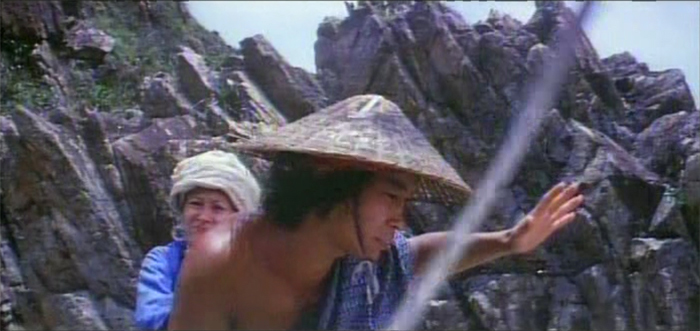
The Valiant Ones (1975).

Hollywood starts here, or hereabouts
The Woman in White (1917). Toning by DB.
DB here:
Do you know Wilkie Collins’ The Woman in White? I hope so.
The traps set by this novel of mystery and suspense–a prototype of what was called “sensation fiction”–are still ensnaring audiences. Serialized in 1859-1860, it became one of the best-selling books of the nineteenth century. Merchandisers pounced on it, offering Woman in White cloaks, bonnets, perfumes, and songs. Stage and film adaptations followed. The Brits, always eager to mine classics, have created no fewer than three TV versions (1982, 1997, and 2018). There’s a pretty good Warners “nervous A” picture from 1948, with Sydney Greenstreet as the deadly, jovial Count Fosco.
The 1917 version from the Thanhouser studio is, lucky us, currently streaming on Vimeo for free. It’s also available on DVD, as part of the excellent series of Thanhouser films. The print is a 1920 re-release, but nothing significant seems missing or altered.
Apart from its entertainment value, the Thanhouser Woman in White can teach us a lot about film history. Why? Because it sums up very forcefully what American narrative cinema could do in that crucial year 1917. Forget your Griffith, leave aside (regretfully, just a moment) your Webers and Harts and Fords and Fairbankses. The mostly unheralded team of screenwriter Lloyd Lonergan and director Ernest C. Warde have given us a concise demonstration of the power harbored by classical Hollywood from the start. The storytelling tools assembled in that era remain with us still.
Women in peril
The novel’s plot is a tale of–well, plots. Counterplots too.
Collins’ book is hugely complicated, swirling together secrets, hidden identities, abduction, impersonations, illegitimate birth, bigamy, insanity, forged records, fake tombstones, assorted hugger-mugger, and timetables that even the author had trouble keeping straight. The intricacy is magnified by Collins’ decision to adopt a “casebook” structure, in which participants and onlookers write up their accounts of what they witnessed. Each piece of testimony is restricted wholly to one character’s viewpoint, and the writers are forbidden to fill in material they learned later. “As the Judge might once have heard it, so the Reader shall hear it now.” This stricture isn’t fully observed, though, because at least one witness sneaks looks at what counterparts have written.
The book’s key image is, of course, the apparition that greets Walter Hartright on the road one sultry night.
There, in the middle of the broad, bright high-road–there, as if it had that moment sprung out of the earth or dropped from the heaven–stood the figure of a solitary Woman, dressed from head to foot in white garments; her face bent in grave inquiry on mine, her hand pointing to the dark cloud over London as I faced her.
Recovering his senses (“It was like a dream”), Hartright listens to her gap-filled story and helps her find a cab. But soon he sees two bravos halt their carriage and hail a policeman. They ask: Has he seen a woman in white? No. Why does it matter? What has she done?
“Done! She has escaped from my Asylum. Don’t forget: a woman in white. Drive on.”
The first installment ends here, and the adolescent window opens a little wider.
The main plot centers on Laura Fairlie and her half-sister Marian. Hartright is engaged as Laura’s drawing teacher and they fall in love. But Laura’s father has promised her to Sir Perceval Glyde, an apparently upright aristo. (Collins was opposed to marriage as an institution. His class hatred comes out as well, though perhaps not as scathingly as it does in his other masterpiece, The Moonstone.) Once the marriage takes place, Glyde introduces into the household Count Fosco, a suave “doctor” with the habit of letting his pet mice scamper around his waistcoat. It doesn’t take long for Marian to realize that Glyde has a Secret, and she must turn detective to protect Laura from him.
Without pressing into spoilers, you can already tell that this lays down a template for the sort of story Hollywood would later love to tell. The Woman in White is a prototype for the woman-in-peril plot that we’ll find in Suspicion (1941), Shadow of a Doubt (1943), The Spiral Staircase (1946), The Two Mrs. Carrolls (1947), Sleep My Love (1948), and many 1940s classics. These in turn rely on literary works in Collins’ wake by Mary Roberts Rinehart, Mignon Eberhart, and other women authors who updated Gothic and sensation-fiction conventions for the twentieth century.
Lloyd Lonergan was said to have suggested reducing the eight-reel cut of The Woman in White to only six. It’s indeed a tightly coiled presentation of Collins’ sprawling plot. Swathes of backstory are dropped. Instead of Collins’ multiple narrators we get an omniscient narration that shifts freely across various intrigues. Fairly quickly we learn that Glyde and Dr. Cumeo (the Fosco of the novel) are scheming to switch Laura with her lookalike Anne, the woman in white. We also realize that Marian, as an obstacle to the plan, is in mortal danger. Thanks to crosscutting, we’re aware of several lines of action unfolding at once, and in a film full of spying and eavesdropping, compositions tell us who’s snooping on whom.
Still, some revelations are saved for the end, notably one that looks forward to the flashback-heavy 1940s. When Laura and Marian discover Glyde’s secret, their informant gives them the crucial information in a flashback, which precipitates a fiery climax. The flashback device was previewed when Marian, recovering from her collapse, recalled the plans she heard on the patio between Glyde and Cumeo; a nearly Surrealist dissolve superimposes that earlier scene.
In preferring to give us a lot of information, favoring suspense over surprise, this Woman in White is typical of Hollywood scriptwriting of the classical years. In particular, the film employs strategies later elaborated by Hitchcock (discussed here and here and here). One scene in particular displays the Hitchcock touch, years before Sir Alfred took up filmmaking. Even more specifically, let’s note that the basic situation looks forward to Notorious: a woman imprisoned by her husband and a confederate is slowly softened up for disposal.
Choreography, cutting, and showing us the door
Anyone who has viewed films with critical attention must be aware that in a film we are constantly, and without knowing it, being directed what to look at. In a stage play you may be looking at one moment at the actor who is speaking; at another moment watching the face of the person addressed, or observing the behaviour of other characters on the stage. If you go repeatedly to the same play, you may choose to look at different actors in a different order, for you certainly cannot observe everybody and everything simultaneously. But in a film, the lens of the camera is constantly telling you wha to look at–it may be a close-up of the actor’s hand, by the movement of which he betrays the emotion not visible in his face.
T. S. Eliot, 1951
The 1910s were an exciting era in cinema because, as I try to show in this video lecture, the foundations of “our cinema” were laid then. The film business, movie culture, and mass audiences settled into patterns that would hold for over a hundred years.
Just as important, the forms and styles of film craft were put in place. Among those changes was a transition from a style that relied on performance and staging to an approach more reliant on editing, on breaking scenes into many shots. The dominance of editing as a principle of guiding attention is evident from the Eliot quotation; he can’t conceive that staging, lighting, and other “theatrical” techniques could steer us to the important parts of the action.
The earlier, “tableau” approach to scenes was perfectly capable of funneling attention too, but editing had many advantages, both economic and aesthetic. By 1917, as Kristin and Janet Staiger and I argued in The Classical Hollywood Cinema, the editing-based approach had coalesced into the dominant style. The Woman in White is a nifty illustration of what an ordinary film from that year could accomplish with cutting–while still retaining vestiges of the tableau style.
A simple example of the tableau technique comes when Sir Perceval Glyde calls on Laura and Marian. He has just kissed Laura’s unwilling hand, and Marian comes up from the rear of the shot to him. As she moves forward, Laura shifts aside slightly to clear our view of the others. This choreography doesn’t seem stilted because it expresses Laura’s withdrawal from her fiancé.
This is an example of the Cross, the staging technique that coordinates actors’ switching positions in the frame. Marian moves from frame left to frame right as Laura shifts to the left.
The tableau approach often plays between a lateral arrangement of characters in the foreground and a more diagonal array of figures packed into depth. As the shot unfolds, Marian is given a beat to take notice of Laura’s reaction as Glyde retreats to the background. She conveniently blocks his departure as she looks warily back at him.
But Glyde steps back into visibility in the distance as he says goodbye, with the women turning away from us so that we’re sure to concentrate on him. Then as the women turn back to react, he can be glimpsed leaving on the far right.
Doorways in the distance, characters advancing to and retreating from the camera, figures spreading themselves out horizontally but also blocking our view of things behind them, only to reveal them at the right moment–these tactics of the tableau became supple and subtle during the late 1900s and throughout the 1910s.
Eliot need not have worried that our attention would stray. Centering, frontality, movement vs. stasis, lighting, gesture, and other creative choices push us to notice the important elements of the scene. And these factors aren’t equivalent to what we see on the theatre stage; the optical properties of the camera lens create a very different playing space. (See here and here.)
Tableau staging hung on in editing-driven cinema, but it tended to be relegated to the role of an establishing shot. The first part of this scene consists of another tableau setup broken by a cut when the slimy Glyde kisses Laura’s hand.
Here the closer view underscores his gesture while isolating Laura’s concern.
The coordination of staging and cutting is nicely shown when Walter Hartright, having resigned from his post as Laura’s teacher, accidentallly encounters Glyde at the train station. Glyde is coming to arrange his marriage to Laura, so the plot needs to establish the friction between the two men early on. As they confront each other, Glyde’s assistant loads his luggage into the cab in the background.
The first phase of the scene choreographs the men’s encounter through the Cross.
Then close views underscore the significance of the encounter.
Cut back to a two-shot that reorients us.
The fact that it’s not the same framing as we saw at the start indicates the reliance of the style on editing; even the full view is re-calibrated in light of changing shot scales. And during the shot of Walter, Glyde’s position has changed from his orientation in his medium shot. That’s the sort of flexibility editing gives you. The new arrangement heightens the clash of the two men. (Typical of the 1910s emphasis on depth, Glyde’s assistant and the driver continue to load the cab in the background.)
Glyde’s enlarged hand kiss and the inserts of the two men in the station scene exemplify the axial cut. This is a cut made along the lens axis of the camera–a straightforward enlargement of a chunk of space. It’s very common in 1910s cinema, and it’s still around, though it’s not as common as it was. Editors came to prefer analytical cuts that were more angular, yielding less the sense of a sudden enlargement. Sometimes you’ll see claims that cut-ins or cut-backs should shift the angle by 30 degrees. Yet Kurosawa and Eisenstein made powerful use of the axial cut, and it’s sometimes used as a self-conscious device. During the 1910s, some directors began using the over-the-shoulder (OTS) framing as a way to assure distinct angle changes.
The cut to Glyde’s creepy kiss is also a match on action, smoothly linking Glyde’s gesture across the shot change. This too emerged in the 1910s and became a mainstay of classic editing technique, to this day. (See my earlier post on Watchmen for contemporary examples.)
The Woman in White has several adroit matches on action, which shows that the learning curve among directors was more or less complete by 1917. When Walter first encounters the mysterious woman on the road, his striking a match is carried across a cut, with the second shot introducing her coming toward in him n the distance.
One of the most common editing devices of classical continuity is the eyeline match, and filmmakers were mastering this from quite early on. By 1917, it was part of every director’s tool kit. We can see how it works together with the other techniques in a fine, smooth scene that leads up to a crucial turning point in the action. Glyde and Dr. Cuneo are in the library, where Marian is uneasily reading a novel. Cuneo moseys over behind her, softly threatening, and an axial cut matching his movement lets us know she notices.
Another match on action brings her off the sofa. Love those delicately splayed fingers.
As she starts to leave, we get the Cross, as Glyde rises from his armchair and goes frame right. We now get the start of a major piece of business: Cuneo’s byplay with the sliding doors.
Securing their privacy, Cuneo prepares to consult with Glyde about their skulduggery. But a match on action, carried by a powerful axial cut–a huge enlargement from the extreme long shot setup–alerts us. He’s listening.
Another match on action as he busies himself with the door. A new diagonal composition prepares us for a shot of Glyde to come shortly. And yet again Cuneo is matched as he opens the door.
The payoff: Cuneo has detected Marian outside listening. She bluffs, saying she left her novel behind.
Now comes the shot that was prepared for by the over-the-shoulder long shot above. It’s not an axial cut, but a genuine reverse angle on Glyde, who’s suspicious about Marian’s return.
This is a killer shot because the camera can assume a drastically new position. It has put us in between the characters in a way we weren’t in the station scene. In effect, there’s an axis of action running from Glyde to the doctor and Marian at the door. The reverse angle is a one-off technique at this moment, but the possibility of penetrating the dramatic space in this way will be central to continuity cutting.
Now tableau principles can kick in. Marian comes forward and gets the book while Cuneo watches warily in the background.
In the course of the shot, Marian leaves, and this time, thanks to deep staging, we and the plotters can see she’s not eavesdropping. As she goes upstairs, Cuneo closes the door and the men can settle down to scheming.
Five matches on action, a striking eyeline match, restrained but pointed performances, and a cogent staging of the action have yielded a vigorous, engaging scene. By 1917, classical screen storytelling is well established in even a run-of-the-mill production. But there’s nothing run-of-the-mill about the suspense that follows this trim tension-builder.
1910s noir rides again
The Woman in White illustrates a lot of other 1910s innovations in pictorial storytelling. There are, for instance, some concise special effects, as when on Laura’s wedding day she sees herself and Walter in her vanity mirror.
There are also dramatic lighting effects, motivated by firelight, single lamps, and eventually lightning flashes.
But more audacious is a sustained experiment in “1910s noir.” At that period filmmakers began associating crime and mystery with shadows and stark lighting. (See this entry.) When Glyde and Dr. Cuneo adjourn to the terrace to discuss their scheme, we get a remarkable instance. I won’t indulge my impulse to shower you with images, but I’ll try to suggest why you should try to see the sequence for yourself.
While the men smoke and talk outside, Marian has seen to the sleeping Laura before going to her own bedroom. (A sign of the film’s tidiness is the way it establishes the main characters’ rooms in the upstairs hallway. This geography becomes important when Glyde and Cuneo exchange Anne for Laura.) Opening her window, Marian hears the men outside and ventures onto the balcony above them. This yields a remarkable extreme long shot: She eavesdrops from above.
It’s a difficult shot by later standards. The main action is wildly decentered, set off on the right. But at least this framing has the virtue of preparing us for the later development of the scene, which will involve Marian sneaking along the balcony back to her room, where the light comes from.
The vertical layout of the action is immediately clarified by two closer shots, a lovely chiaroscuro image of the men and the other of Marian listening.
She hears just enough to suggest the men’s scheme before complications ensue. Glyde goes inside and upstairs, where he might discover her. Meanwhile, a rainstorm starts, and Marian dislodges a potted plant. Cuneo turns, in a new setup that emphasizes the railing in the right foreground, so that we can see the fallen plant. The shattered pot is given a close-up more or less from Cuneo’s viewpoint. His reaction supplies a moment of suspicion.
Marian, now drenched by rain, seems trapped between her two adversaries. Will one or both discover her?
Glyde who has gone to Laura’s window and is looking around outside. We’re reoriented through a new master shot of the house, a framing that varies from the original setup. The shot shows both Laura’s and Marian’s windows lit. There follows a dark passage in which Marian creeps up to Laura’s window. That action takes place in the shot I’ve put up above.
An extra twist: Glyde looks out, but then pulls the shade. Little things mean a lot. A soaked Marian manages to crawl back through her window.
Apart from its virtuosity in handling cutting and lighting, the sequence is crucial for the plot. Marian collapses from her exposure to the storm, and her illness provides a pretext for Cuneo to isolate her while he and Glyde proceed with their plan.
I invoke Hitchcock because this long passage of suspense depends on our knowing all the relevant factors in the situation, and the possibility of a giveaway–the smashed plant–drives up the tension. What I’m really saying, I guess, is that Hitchcock expanded and deepened story mechanics that were already in place in the silent era. Apart from refining them, he managed to brand them as his own.
No film from 1917 or thereabouts is faultless in executing the new editing-based style. The Woman in White has its share of mismatches. Then again, so do movies from the 1920s to the present. (Don’t get me started on the mismatched cuts in The Irishman, 2019.) The crucial point is that the system of Hollywood storytelling and style is in place, and not in a crude form. Talk all you want about post-classical cinema, chaos cinema, post-cinema–whatever. The variations we detect today arise against a background of stable norms that remain a lingua franca of world filmmaking, and they’re headed well into their next century.
Thanks to Ned Thanhouser for years of faithful service to the studio’s legacy. Now is an ideal time to visit his site for background on this remarkable company and the efforts to preserve its output. A staggering 132 Thanouser films are available for streaming on Ned’s Vimeo channel.
To find out more about what preceded this crystallization of techniques, see Charlie Keil’s Early American Cinema in Transition: Story, Style, and Filmmaking 1907-1913 (University of Wisconsin Press, 2002).
An excellent survey of Collins’ place in the history of dossier novels is A. B. Emrys, Wilkie Collins, Vera Caspary and the Evolution of the Casebook Novel (McFarland, 2011). Her treatment of Caspary and Laura, both favorites of this blog, is just as valuable. My quotation from T. S. Eliot comes from “Poetry and Film: Mr. T. S. Eliot’s Views,” in The Complete Prose of T. S. Eliot: The Critical Edition, vol. 4: A European Society, 1947-1953, ed. Iman Javadi and Ronald Schuchard (Johns Hopkins University Press, 2018), 581.
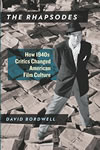
For lots more on 1910s storytelling, see the categories 1910s Cinema and Tableau Staging. Flashbacks, the woman-in-peril plot, and other conventions that coalesce in the 1940s are discussed in my Reinventing Hollywood: How 1940s Filmmakers Changed Movie Storytelling.
The Woman in White (1917). Toning by DB.
Quality bingeing
Mon Oncle (1958)
Kristin here:
Or binging, if you prefer. Either is an acceptable spelling.
Streaming entertainment is one of the things that are saving our sanity as we sit in our homes. With the theaters closed and new movies either delayed or sent straight to streaming, movie critics, other journalists, and movie buffs are now making best-films-to-stream-during-the-pandemic lists a new and common genre across the internet.
Maybe you’ve been streaming a lot of TV series, even ones you’ve already seen, and are feeling a bit guilty about that. Maybe you’re longing for something more worthwhile to watch but wishing that that something would take up more time than your average feature film.
For those people, I offer a list of films to binge. These are either long in themselves or are split up into many parts that can be binged just like TV series. Others are stand-alones but can be grouped in meaningful ways.
My experience is that online disc orders are taking longer than usual. With Amazon prioritizing health and work-at-home supplies, Blu-rays are taking around two weeks rather than two days. (David and I, of course, count Blu-rays and streaming as part of our work-at-home requirements.) While you’re waiting, I’ll bet many of you have some of these discs on your shelves already and have always meant to make time for them. That time, lots of it, has arrived.
Serials
Many fine serials were made in the silent era, but Louis Feuillade remains the director that most of us think of first in relation to this format. His three great serials of the 1910s (not including, alas, the fine Tih Minh [1918]) are available on home video.
Fantômas (1912). 5 episodes, 337 minutes. Fantômas is available in Blu-ray and DVD from Kino Lorber. David wrote a viewer’s guide to it here.
Les Vampires (1915). 10 episodes, 417 minutes. Les Vampires is available on Blu-ray and DVD from Kino Lorber. As far as I can tell, it is streaming only on Kanopy (apart from unwatchable public domain pre-restoration prints).
Judex (1917). 12 episodes, 315 minutes. Judex is ordinarily available from Flicker Alley, though it is currently listed as out of stock. Amazon has 5 left. For maximum bingeing opportunities, watch all three serials in a row and then stretch them out with Georges Franju’s charming remake, Judex (1963) for an extra 98 minutes (it’s $2.99 to stream it on Amazon Prime).
Miss Mend (Boris Barnet, 1926). Three episodes, 235 minutes. The only American-style serial from the Soviet Union that I know of, or at least the only one easily available. I wrote about it briefly when it first came out from Flicker Alley. You can still get it from Flicker Alley or Amazon. We wrote briefly about it here.
Le Maison de mystère (Alexandre Volkoff, 1923). 10 episodes, 383 minutes. I’ve already written in some detail about this long-lost serial. It’s probably not as good as Feuillade’s best, but it’s good fun and beautifully photographed (see top of section) and acted–and long enough to require a meal break. Fans of the great Ivan Mosjoukine (as he spelled his name after emigrating from Russia to France) will especially want to see this one. Available from Flicker Alley
Berlin Alexanderplatz (Rainer Werner Fassbender, 1980) 13 episodes and an epilogue. 15 hours, 31 minutes. Back when it first came out, this was treated more as a film than a TV series. It showed in 16mm at arthouses and archives. David and I drove to Chicago to see the whole thing in batches over a single weekend at The Film Center (now the Gene Siskel Film Center). It’s available on either DVD or Blu-ray as a Criterion Collection set (#411 for you Criterion number-lovers). It’s also streaming on the Channel. Both have a batch of supplements, even the 1931 German film of the novel, so you can stretch the experience out even longer.
Silent serials may work for some families, if the kids have been introduced to silents already through the more obvious route of films with Buster Keaton, Charlie Chaplin, and the other great comics of the era. If not, families can fill their time with more recent films in episodes with continuing stories.
The serial format has had a comeback in recent decades, partly due to the influence of the first Star Wars trilogy and partly to the need for ever expanding amounts of moving-image content in the era of home-video, cable, and internet services. For those who want to binge Star Wars, you don’t need my guidance. Anyway, I gave up after the first of the recent series, the one where Adam Driver took over as the villain. (Not that I have anything against Adam Driver. It was the film.) Even daily life in a pandemic is too short for more.
The Harry Potter series. (2001-2011) Eight episodes, 990 minutes, or 16.5 hours. This series is not high art, but it’s pretty good, highly entertaining (to some, at least), and even has one episode, number three, directed by Alfonso Cuarón, HP and the Prisoner of Askaban (above). The others are HP and the Sorcerer’s Stone (or Philosopher’s Stone in the UK and elsewhere; Chris Columbus), HP and the Chamber of Secrets (Chris Columbus), HP and the Goblet of Fire (Mike Newell), HP and the Order of the Phoenix, HP and the Half-Blood Prince, HP and the Deathly Hallows: Part I, and HP and the Deathly Hallows: Part II (the last four, David Yates). These films are, of course, available in multiple versions, on disc and streaming. As far as I can tell, none of the complete boxed sets have the two last parts in 3D; those have to be purchased separately. Having seen the last film in a theater in 3D, I can say that it doesn’t seem to be one of those films that is much improved if one sees it that way (unlike Mad Max: Fury Road, in the section below).
The Hobbit and The Lord of the Rings extended editions: An Unexpected Journey (2012), The Desolation of Smaug (2013), The Battle of the Five Armies (2014), The Fellowship of the Ring (2001), The Two Towers (2002), and The Return of the King (2003, above). 6 episodes, 1218 minutes, or 20 hours, 18 min. Yes, for sheer length this serial tops them all. Plus there are lots of supplements. Each part of the Hobbit films has one commentary track and a bunch of making-ofs, adding up to 40 hours, 5 1/2 minutes. This pales, however, in comparison with the LOTR extended editions, which have four commentary tracks, totaling 45 hours, 44 minutes. The making-ofs are hard to get exact figures for, but I estimate about 22 hours for all three films. That’s about 68 hours of audio and visual supplements.
To top that off, the Blu-ray set contains the three feature-length documentaries by Costa Botes: The Fellowship of the Rings: Behind the Scenes, The Two Towers: Behind the Scenes, and The Return of the King: Behind the Scenes, all adding another 5 hours, 2 1/2 minutes. (Botes’s films were also included in a “Limited Edition” reissue of the theatrical versions of the LOTR films in 2006.) In toto, if one watches every single item and listens to all the commentaries, one could escape 133 hours and 10 minutes of isolation boredom–and possibly go mad in the process. But treating the bingeing as an eight-hour-a-day job, it would come to 16 1/2 days.
All this does not include the supplements accompanying the theatrical-version discs. These are charming but more oriented toward introducing complete neophytes to the universe of Middle-earth than toward giving filmmaking information.
Series
Series, as opposed to serials, usually involve continuing characters but self-contained stories. Most of the series below could be watched out of order without suffering much. It would help to watch Mad Max first, since it’s an origin story. The Apu Trilogy should be watched in order because it’s about the central character’s stages of life. Each of the M. Hulot films bears the traces of the contemporary culture in which it is set, but one can understand each fine out of order. I saw Traffic first, in first run, and then saw the others.
Mad Max (1979), Mad Max 2, aka The Road Warrior (1981), Mad Max Beyond Thunderdome (1985), and Mad Max: Fury Road (2015) add up to 411 minutes, or 6 hours and 51 minutes. You know them, you love them–but have you ever watched them straight through? We’ve written about Fury Road (here and here). That’s a film where the 3D really does play an active role.
Jacques Tati’s Monsieur Hulot films: Mr. Hulot’s Holiday (1953), Mon Oncle (1958, see top), Play Time (1967), and Traffic (1971). They add up to 7 hours and 4 minutes. Or add his non-Hulot films, Jour de fête (1949) and Parade (1974) for just under an additional 3 hours of hilarity. You can buy all of Tati’s films at The Criterion Collection or stream them at The Criterion Channel. Throw in my “Observations on Film Art” segment on Parade for an extra 12 minutes. And check out Malcolm Turvey’s new book, Play Time: Jacques Tati and Comedic Modernism, soon to be discussed in a portmanteau books blog here.
Dr. Mabuse films plus Spione: Dr. Mabuse, der Spieler (1922), Spione (1928, frame above), The Testament of Dr. Mabuse (1933) and The Thousand Eyes of Dr. Mabuse (1960), adding up to 610 minutes, or 6 hours and 10 minutes. Few if any directors have extended a series over such a stretch of time, and the Mabuse films are quite different from each other (including having different actors play the master criminal). I throw Spione into the mix because the premise and tone are so similar to the first Mabuse film. Haghi is basically Mabuse as a master spy instead of a gambler and general creator of chaos; given that he’s played by Rudolf Klein-Rogge, who was the first Mabuse, the comparison is almost inevitable. One can almost imagine Haghi as just another of Mabuse’s disguises and it fits right into the series. I’ve linked the streaming sources to the titles above.
Kino Lorber has the restored version of Der Spieler on DVD and Blu-ray, Eureka has the restored version of Spione on DVD and Blu-ray (note: Region 2 coding) The Criterion Collection offers a DVD of Testament, and Sinister Cinema has a DVD of The 1,000 Eyes. (For those who want to dig deeper, there a Blu-ray set of all of Lang’s silents, from Kino Classics and based on the F. W. Murnau Stiftung restorations. That totals 1894 minutes, or about 31 and a half hours. I don’t know if that counts the supplements, but there are lots of them.)
Apu Trilogy: Pather Panchali (“Song of the Little Road,” but nobody calls it that, 1955), Aparajito (1956), and The World of Apu (1959). 341 minutes. Satyajit Ray’s trilogy may seem like a serial, in that it follows the life of the main character, Apu. Yet Ray had not planned a sequel until Pather Panchali achieved international success, and the films have big time gaps in between, with no dangling causes. These are three of the most beautiful, touching films ever made, and the stunning restoration from a damaged negative and other materials is little short of a miracle. If you have never seen these or saw them before the restoration, do yourself a favor and binge them. Have some tissues handy, and I don’t mean for stifling coughs and sneezes. Available on disc from The Criterion Collection and streaming on The Criterion Collection here, here, and here.
Now I briefly cede the keyboard to David for his recommendations of Hong Kong series.
Triads vs. cops, Triads vs. Triads
Infernal Affairs (2003).
There are many delightful Hong Kong series. I enjoy the silly Aces Go Places franchise (1982-1989) and the pulse-pounding Once Upon a Time in China saga (1991-1997). Alas, almost none of these installments entries are represented on streaming. I could find only the weakest OUATIC title, Once Upon a Time in China and America (1997) on Amazon Prime, Vudu, and iTunes.
If you want to go for samples, there are two diversions from the ever-lively Fong Sai-yuk series. The Legend (US title of the first entry, a bit pricy from Prime). The more reasonably priced Legend II, the US version of the second entry, has a fantastically funny martial-arts climax featuring Josephine Siao Fong-fong as Jet Li’s mom. This is available from several streamers. Older kids won’t find either one too rough, I think.
There are two outstanding series more suitable for adult bingeing. Infernal Affairs (2003-2004) was made famous by Scorsese’s remake The Departed (2006), but the original is better, and the follow-ups are loopier. The first entry offers solid, suspenseful plotting and meticulous performances by top HK stars Tony Leung Chui-wai and Andy Lau Tak-wah, supported by a rogues’ gallery of unforgettable character actors. Parts two and three spin off variations on the first one, tracing out before-and-after incidents and throwing in some quite strange narrative contortions. The whole thing provides an engrossing five and a half hours of entertainment. Available from several services.
In my book Planet Hong Kong I analyze the trilogy as an example of how directors Andrew Lau and Alan Mak Siu-fai created a more subdued thriller than is usual in their tradition. Bonus material: In the spirit of providing free stuff during the crisis, here in downloadable pdf form is my little chapter on the trilogy: Infernal Affairs interlude.
Also subdued, even subtle, is Johnnie To Kei-fung’s Election (2005) and Election 2 (aka Triad Election, 2006). These films dared to show secret gang rituals that other filmmakers shied away from. The first part plays out ruthless competition among rival Triad leaders, including strikingly unusual methods of punishing one’s adversary. The second entry, even more audacious, suggests that Hong Kong Triad power is intimately tied up with mainland Chinese gangs, backed up by political authority.
Johnnie To’s pictorialism, so feverish in The Longest Nite (1998), A Hero Never Dies (1998), The Mission (1999), and other films, gets a nice workout here as well. Infernal Affairs is agreeably moody, but the Election films are black, black noir.
The pair add up to three hours and a quarter. The first film is apparently available only on disc but the second is streaming from several sources.
Of course, to get into the real Hong Kong at-home experience, some viewers will find all these films easily and cost-free on the Darknet.
Thematic combos
Flicker Alley’s Albatros films. 5 films, 664 minutes, or 11 hours and 4 minutes. I wrote about the DVD set, “French Masterworks: Russian Émigrés in Paris 1923-1929” when it first came out. It’s still available here. The Albatros company made some of the key films of the 1920s, most of which are still too little known, including Ivan Mosjoukine’s Le brasier ardent (1923, above). If this is still a gap in your viewing of French films, here’s a chance to fill it.
Yasujiro Ozu: The Criterion Collection has released a helpful thematic grouping of some of Ozu’s early films. One is “The Silent Ozu: Three Family Comedies” (DVD and streaming), including I Was Born, but …, Tokyo Chorus, and Passing Fancy, adding up to 281 minutes. The British Film Institute has gone further along the same lines, releasing “The Gangster Films,” also three silents: Walk Cheerfully (1930), That Night’s Wife (1930), and the wonderful Dragnet Girl (1933); they add up to 259 minutes. The BFI has also put out “The Student Films,” (listed as out of stock at the moment) yet more silents: Ozu’s earliest complete surviving film, Days of Youth (1929), I Flunked, But … (1930), The Lady and the Beard (1931) , and Where Now Are the Dreams of Youth? (1932), adding up to 251 minutes.
David has recorded an entry on Ozu’s Passing Fancy for our sister series, “Observations on Film Art,” on the Criterion Channel; it should go online there sometime this year.
Or watch all the “season” films in a row: Late Spring (1949), Early Summer (1951), Early Spring ((1956), Equinox Flower (1958), Late Autumn (1960), End of Summer (1961), and An Autumn Afternoon (1962), for a grand total of 840, or 14 hours. Including An Autumn Afternoon is cheating a bit, since the original title means “The Taste of Mackerel.” Still, it’s so much like the earlier films in equating a season with a stage of life that the English title seems perfect. The early films equate the seasons with the young people, about to marry or recently married, while in the later films, and especially the last three, the seasons refer to the older generation, lending an elegiac tone to the end of Ozu’s career. David has done commentary for the DVD of An Autumn Afternoon.
All of these (except for Days of Youth) and many other Ozu films can be streamed on The Criterion Channel, which also has a bunch of supplements on this master director.
Or just watch The Criterion Channel’s Kurosawa films in chronological order, or Bresson’s or Godard’s or Bergman’s or …
Or watch all of Hideo Miyazaki’s films in chronological order, with or without the company of kids.
Just really long films
War and Peace (Sergei Bondarchuk, 1965-1967, above) 4 parts: 7 hours, 3 minutes, 44 seconds. I suppose this is technically a serial, since the parts were released over three years. Still, the idea presumably was that it ultimately should be seen as one film, and the running time would permit it being seen in one day fairly easily. I have not seen this restored version, only the considerably cut-down American release back when it first came out. I remember it as being quite conventional, but on a huge scale in terms of design, cinematography, and crowds of extras. Seeing it in its original version would no doubt be impressive (see above). Available on disc at The Criterion Collection and streaming on The Criterion Channel. The supplements total 175 minutes and four seconds, pushing the total up to nearly 10 hours.
Satan’s Tango (Béla Tarr, 1994) 450 minutes, or 7 hours 30 minutes. Film at Lincoln Center has just made Tarr’s epic available for streaming; you can rent it for 72 hours and support a fine institution. As to owning it, the DVDs seem to be out of print. There is, however, a Blu-ray coming from Curzon Artificial Eye on April 27 in the UK. Pre-order it here. Obviously many of us will still be stuck inside by the time it arrives. Or if you have it on the shelf and never quite got around to watching it, here’s your chance. Derek Elley’s Variety review sums up its pleasures. Our local Cinematheque has shown it twice, once in 35mm and more recently on DCP (see here, with the news buried at the bottom of the story). David reported on that first showing, and later he wrote a general entry about Tarr’s work on the occasion of having met the man himself.
Shoah (Claude Lanzmann, 1985) 550 minutes, or 9 hours and 10 minutes. The Holocaust examined through modern interviews with a broad range of people involved. Available in a restored version on disc from The Criterion Collection. It does not seem to be available currently for streaming.
Unclassifiable
Then there’s Dau (2020-), a biopic of a Soviet scientist that is perhaps the most ambitious filmmaking venture ever.
Shot on 35mm over three years in a real working town with 400 characters played by actors who remained in character and costume round the clock the whole time. Few have seen these, though two showed at the Berlin festival this year. We haven’t seen them but plan to give it a go, since they have just shown up online. Here’s a helpful summary of the project. At the Dau Cinema website, you can stream the first two films for $3 each: Dau. Natasha (2:17:53) and Dau. Degeneration, (6:09:06) adding up to 8 hours and 27 minutes. Twelve more films are announced for future release, with no timings given. Clearly not suitable for family viewing.
I have not attempted to add up all these timings, but if you can track most of them down, they might get you through much of the isolation period. Stay safe!
Election (2005).